Archive for September, 2010

Bending the cost curve … health insurance premiums going up … oops.

September 9, 2010

Did anybody really think that eliminating life-time payout caps, covering “adult-children”, and covering all pre-conditions would be free … or reduce total healthcare expenditures?

PS There’s no Easter Bunny, either …

* * * * *

Health Insurers Plan Hikes Related to Health-Care Overhaul, Sept. 7, 2010

Health insurers say they plan to raise premiums for some Americans as a direct result of the health overhaul.

Aetna, some BlueCross BlueShield plans and other smaller carriers have asked for premium increases of between 1% and 9% to pay for extra benefits required under the law, according to filings with state regulators.

These and other insurers say Congress’s landmark refashioning of U.S. health coverage is causing them to pass on more costs to consumers than Democrats predicted.

Many carriers also are seeking additional rate increases that they say they need to cover rising medical costs. As a result, some consumers could face total premium increases of more than 20%.

Democrats front-loaded the legislation with early provisions they hoped would boost public support. Those include letting children stay on their parents’ insurance policies until age 26, eliminating co-payments for preventive care and barring insurers from denying policies to children with pre-existing conditions, plus the elimination of the coverage caps.

Insurance companies are telling state regulators it is those very provisions that are forcing them to increase their rates.

The industry contends its increases are justified.

Anytime you add a benefit, there are increased costs,”

Full article:
http://online.wsj.com/article/SB10001424052748703720004575478200948908976.html?mod=WSJ_hpp_MIDDLETopStories

A Coke by any other name would taste as sweet

September 9, 2010

TakeAway: When one brand becomes dominant enough in the marketplace, its name can become a synonym for the entire category.  In many places of the U.S. Coke simply means any cola soft drink. 

However, in India, Pepsi is the default name for a cola soft drink

This is problematic for Coke as it seeks growth opportunities outside of the mature U.S. market.  To gain some mindshare, Coke is trying to associate its name with cold as it seeks to promote a broad category of beverages in India, not just cola.

* * * * *

Excerpted from Bloomberg Businessweek, “Coca-Cola can’t speak its name in India as Pepsi enters Hindi,” by Mehul Srivastava, September 8, 2010

Coca-Cola Co. offered to buy Rajesh Yadav a refrigerator for his New Delhi store if he would sell only the company’s drinks.

He kept his part of the bargain and lines of Coke and Diet Coke cans glisten behind the glass screens of the fridge. … Yet Yadav doesn’t mention his partner when he describes his shop.

I sell Pepsi and cigarettes,” said Yadav …

Yadav isn’t reneging on his deal with Atlanta-based Coca- Cola. Pepsi became a common synonym for cola in India’s most widely spoken language after having the market to itself for three years until 1993. PepsiCo Inc.’s linguistic advantage translates into higher sales. Its cola brand’s market share is 73 percent greater than Coke’s, according to Euromonitor …


In much of the Hindi-speaking belt of northern India, home to three of the five most populous states, children begging at street corners will point to bottled juices inside cars and plead for “Pepsi.”


In addition to competition from Pepsi, Coca-Cola … has to contend with consumer preferences for other drinks. About 90 percent of India’s beverage market is composed of tea, milk and coffee-based drinks, with bottled soft drinks holding less than 5 percent … The company relies on drinks other than Coke to be the country’s top beverage seller.


While Coca-Cola uses the cola brand to drive market share in other countries, the company’s top three products in India by sales volume are Kinley bottled water, Thums Up cola, and Sprite, according to Euromonitor. …“Pepsi is bigger than Coke as a brand, but Coke as a company has very smartly introduced other brands that have done very well,” said Bijoor, [a] consultant. …

That’s Coca-Cola’s strategy, said Atul Singh, the company’s president for India and South West Asia.

“We want every part of our portfolio to grow, so that any consumer, on any occasion, anywhere in India, makes a choice to drink a Coca-Cola product” …

Coca-Cola has run an advertising campaign called “Thanda Matlab Coke,” which translates to “Cold Means Coke.” North Indians speaking in Hindi regularly use “thanda,” the word for cold, as a noun when offering someone a drink.

“It was definitely a good idea,” said Bhushi, [an] anthropologist. “If Pepsi means cola, then emphasizing that a ‘thanda’ means Coke is perhaps the best way to gain control of the vocabulary.” …

Edit by DMG

* * * * *

Full Article
http://www.businessweek.com/news/2010-09-08/coca-cola-can-t-speak-its-name-in-india-as-pepsi-enters-hindi.html

* * * * *

More re: the German Recovery …

September 9, 2010

Below is a link to still another article on whether the apparently successful German austerity program trumps the U.S’s spending spree program …

* * * * *

Germany has cut government spending and its economy is growing smartly.

Germany’s real output expanded at a robust 9% annual rate in the second quarter, while the U.S. economy grew at an anemic 1.6% rate.

So is Germany now a role model for how to recover?

By comparison with U.S. policy makers, “we (Germans) take the longer view and are, therefore, more preoccupied with the implications of excessive deficits and the dangers of high inflation.”

Full article: WSJ, The German Miracle: Another Look, Sept. 8, 2010  

 >> Latest Posts

Mission Accomplished at GM? … We’ll bet ‘under’ (with a caveat).

September 8, 2010

GM is rushing to IPO before the mid-term election to “prove” the wisdom of the bailout.

Pundits are saying that the company’s politically motivated IPO could jeopardize taxpayer ”investment.”

Here’s why:

  • Taxpayers have somewhere between $40 billion to $60 billion “invested” in Gov’t Motors
  • For taxpayers to come out whole, the Treasury’s 304 million of the company’s 500 million common shares would need to average $131 to $197 per share
  • That would put GM’s implied valuation at somewhere between $65 billion to $98 billion.
  • Ford has a market value of only $40 billion.
  • Ford’s near-yerm earnings are expected to be six times those of GM.
  • If investors valued both companies the same …  taxpayers would incur a 50% loss.
  • And, oh yeah, the market isn’t looking all that good these days.

Ken’s Bet: Watch the Administration to rush the IPO and then strong-arm Goldman et. al. to buy up GM shares at inflated prices and either push the share on clients (think CDOs) or eat them in their proprietary accounts.

* * * * *

Post inspired by: Obama’s ‘Mission Accomplished’ Moment At GM, 08.30.10
http://www.forbes.com/2010/08/30/general-motors-ipo-elections-opinions-columnists-shikha-dalmia.html?boxes=opinionschannellatest

You Can’t Just “Shrink It and Pink It”

September 8, 2010

TakeAway: Eight years ago, sportswear maker Under Armour learned that making smaller, pinker versions of its male apparel wouldn’t simply translate to women. 

Women buy because a piece fits well and promises to help keep them cooler or drier. 

Under Armour’s founder believes women’s apparel will one day surpass its men’s apparel, so learning what women wanted was key…the consumer always comes first! 

* * * * *

Excerpted from New York Times, “Under Armour Wants to Dress Athletic Young Women” By Elizabeth Olson, August 31, 2010

Under Armour is aiming at the “team girl,” which Adrienne Lofton, head of Under Armour’s women’s apparel, defines as a female who is competitive and confident and who plays on high school or college sports teams, or who, after college, continues to work out regularly.  “The team girl is tough, intense and passionate, and she creates her own style.”

In 2003, Under Armour began marketing a line of women’s wear designed by women. Even so, women’s apparel represents only about 25 percent of the company’s nearly $800 million in annual revenue, and it wants more.  It is the only sports apparel sector where sales are forecast to grow, according to Marshal Cohen, an analyst for NPD Group, a market research group.  Part of that is due to the marketing of active wear as street wear.

Under Armour’s newly designed line, with compression shorts, a sports bra, shorts, footwear and other training gear, is being introduced Wednesday with a campaign called “Protect This House I Will,” which builds on the company’s successful we’ll-tough-it-out-together theme that it started for its men’s gear.  

Perhaps surprisingly, the 60-second television and digital spot anchoring the campaign features both male and female athletes — a choice, Mr. Battista said, shaped by focus-group research among high school and college women playing on sports teams.  Women wanted to see themselves on par with men – as athletes, not “female athletes.” 

For the campaign’s digital marketing, Under Armour is placing two- and three-minute segments it filmed of the three female athletes on a new Facebook site for women (which is not yet active) and on each athlete’s Web site.  The digital portion of the campaign will appear on MTV.com, Facebook and other teenage-oriented outlets, video sites like Hulu and CW and the high school sports site MaxPreps.  “We have been shifting more to digital,” the company’s Vice President for Brands said. “It is now 80 or 90 percent digital. Our customers are telling us they like to receive information online and prefer to shop online.”

Edit by AMW

* * * * *

Full Article:
http://www.nytimes.com/2010/09/01/business/media/01adco.html?ref=media

* * * * *

Orzag says “extend the Bush tax cuts” …

September 8, 2010

Yesterday we posted that the looming decision on the Bush tax cuts put the Dems in a political pickle: let some or all or them expire and jeopardize the prospects of an economic recovery … extend them and implicitly concede that Bush’s tax plan was right.  Oh, what a dilemma.

Peter Orzag – Obama’s budget director who jumped ship last month – fueled the debate with an op-ed in the NY Times (link below).

Orzag opined:

What to do about the Bush-era tax cuts scheduled to expire at the end of the year?

,,, the best approach is a compromise: extend the (Bush) tax cuts for two years and then end them altogether.

Ideally only the middle-class tax cuts would be continued for now. Getting a deal in Congress, though, may require keeping the high-income tax cuts, too. And that would still be worth it.

Higher taxes now would crimp consumer spending, further depressing the already inadequate demand for what firms are capable of producing at full tilt.

And since financial markets don’t seem at the moment to view the budget deficit as a problem — take a look at the remarkably low 10-year Treasury bond yield — there is little reason not to extend the tax cuts temporarily.

Hmmmm …. wonder why the guy decided to leave the Obama economic team ?

* * * * *

The op-ed made me smile until Orzag pushed one of my hot-buttons:

Many conservatives (would) make the tax cuts permanent for the likes of Warren Buffett, even though he’d prefer they didn’t.

First, Billionaire Buffet doesn’t speak for everybody making more than $200,000.

Second, if Warren wants to pay more taxes, then why doesn’t he just write a fat check to the Feds and shut the (expletive deleted) up already ?

* * * * *

Full Op-ed: New York Times, One Nation, Two Deficits, PETER ORSZAG, September 6, 2010
http://www.nytimes.com/2010/09/07/opinion/07orszag.html?_r=1&ref=opinion

Expiration of Bush tax cuts puts Dems in a pickle…

September 7, 2010

Everybody knows that the so-called Bush Tax Cuts are due to expire at the end on 2010.

Here’s the rub …

While Dems like to refer to them with the modifier “for the wealthy”, they touched all income brackets and, the bulk of the tax savings (in dollars) go to the middle and lower income earners.

So, letting the whole tax plan expire is a non-starter … violates Obama’s campaign pledges and delivers a staggering blow to the slow economy.

Conventional wisdom is that the so-called middle class cuts would be extended, but that the upper bracket cuts would be allowed to expire.

The problem: Would be more an act of politics than economics … would only dent the deficit (since most dollars are going to the lower and middle brackets) … and the dent assumes that upper bracket folks don’t change their behavior (i.e. by shifting income and assets).

For sure, the impact on the economy would be negative – since high earners consume disproportionately, and since some small businesses are lumped in the tax bracket. May not be a losing hand, but it sure isn’t a winner.

The other option is is renew the Bush Tax Cuts in their entirety for a year or two.

Hmmm.

That would say that Bush was right all along … not good politics.

As Woody Allen would say:

More than any other time in history, mankind faces a crossroads.

One path leads to despair and utter hopelessness.

The other, to total extinction.

Let us pray we have the wisdom to choose correctly.

Woody Allen, Speech to Graduates, circa 1979
http://www.quotedb.com/quotes/1761

* * * * *

Post inspired by: WSJ,  ‘The Bush Tax Increase’, August 31, 2010
http://online.wsj.com/article/SB10001424052748703467004575463772860827634.html?mod=WSJ_Opinion_MIDDLETopOpinion

Take a quick test: Are you “reflective” or “impulsive”?

September 7, 2010

The following is a three question Cognitive Reflection Test (CRT), a sort of mini IQ test. Give it a try.

  1. A bat and a ball together cost 110 cents. The bat costs 100 cents more than the ball. How much does the ball cost?
  2. If it takes five machines five minutes to make five widgets, how long would it take 100 machines to make 100 widgets?
  3. In a lake, there’s a patch of lily pads. Every day, the patch doubles in size. If it takes 48 days for the patch to cover the entire lake, how long would it take for the patch to cover half the lake

Actually, the CRT doesn’t purport to measure intelligence in any meaningful sense.

Rather, it’s a test of willingness to think things through and check your answers.

All three items are gotcha questions to which the first incident occurs to just about everyone is wrong.

Scroll down for answers …

If you got two or three of the questions right you are “reflective”– that’s good.

If you got none or one right, you’re “impulsive”. You can draw your own conclusion on that one.  In fact since you’re impulsive, you probably have already have.

Source: Priceless, William Poundstone, Hill and Wang Books, 2010

* * * *  *

Answers: 5 cents, 5 minutes, 47 days

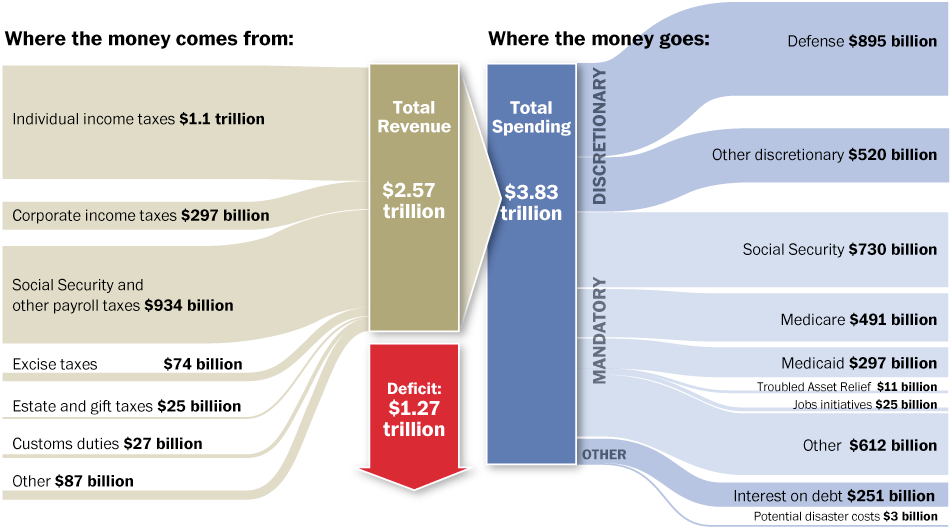
The Federal budget … what comes in, what goes out … and what doesn’t come in but still goes out.

September 3, 2010

I thought that this snapshot from BigPicture.com was pretty interesting …  a nice summary (and a great chart, to boot). 

click image to enlarge

image

http://www.ritholtz.com/blog/wp-content/uploads/2010/07/budget2010.gif

If you want kids to eat carrots, make 'em think it's junk food … huh?

September 3, 2010

TakeAway: Sometimes to beat the competition, you have to be more like the competition. 

To better compete with the $18 billion dollar salty snack food industry, a cooperative of baby carrot growers is launching a $25 million dollar advertising campaign, coupled with new packaging to mimic Doritos and other salty snacks. 

While effective promotions can create an illusion that a product delivers desired benefits, if the product cannot deliver those benefits consumers are likely to reject the product eventually. 

Kids choose salty snacks from vending machines because they like the taste. 

However, recent studies have shown that kids believe foods packaged with cartoon characters taste better than the same foods with boring packaging

It should be interesting to see if kids start to believe that these newly packaged carrots taste better than regular carrots.  Regardless though, given the choice most kids would probably still choose salty snacks over baby carrots.

* * * * *

Excerpted from brandchannel, “Baby Carrots: The Original Orange Doodle,” by Sheila Shayon, August 31, 2010


As America’s nutritionally-challenged youth head back to school, an initiative … is taking on the junk food industry with a killer snack food alternative – carrots. Baby carrots actually. In this corner – the $18 billion dollar salty snack food industry; and in this corner – the $1 billion dollar baby carrot world …

Spending some $25 million dollars … baby carrots will be packaged like Doritos, with three design choices (check them … at the campaign’s website, babycarrots.com); sold in school vending machines (already being tested in Syracuse and Cincinnati); kid-skewing slogans (“Eat ’em like junk food,” “The original orange doodles”); a mobile app featuring a crunch-powered game, now available for free download on iTunes; seasonal tie-ins such as Halloween ‘scarrots;’ a Facebook page; and TV spots that aim to portray baby carrots as hip and sexy …

… “It’s not an anti-junk-food campaign. It takes a page out of junk food’s playbook and applies it to baby carrots,” comments Jeff Dunn, Bolthouse Farms CEO and former president of Coca-Cola North America …

Can branding baby carrots as junk food really woo kids away from salty, unhealthy, high caloric snacks?

As Fast Company blogger Ariel Schwartz writes, good luck tricking kids into thinking carrots are Cheetos or Doritos, while The Atlantic‘s Derek Thompson points out that kids’ marketers have ingrained some tough-to-beat traits: “according to a recent study, most children say food packaged with cartoon characters tastes better than the same food in a boring wrapper. Seventy percent of what we taste is smell. For kids, half of what they taste is sight. Image matters, and it’s smart and overdue for veggie and fruit producers to advertise creatively.”

All the more reason why carrot growers are paying good money in the hopes that that kids can be won over

Edit by DMG

* * * * *

Full Article
http://www.brandchannel.com/home/post/2010/08/31/Baby-Carrots-The-Original-Orange-Doodle.aspx#continue

* * * * *

Is fiscal responsibility (by individuals, not the gov’t, of course) killing the economy?

September 2, 2010

Punch line: As long as consumers (and companies) continue to deleverage, the economy will continue to sputter.

And, the deleveraging is likely to continue …

* * * * *

Excerpted from RCP :Why the Recovery Lags, by Robert Samuelson, August 30, 2010

The logic of  Recovery Summer allegedly recognized that over-borrowed Americans would repay loans and replenish depleted savings, creating a temporary drop in consumer spending and economic activity.

But once savings increased and debt declined, consumer buying would strengthen. It would replace the Obama stimulus program. Hiring would improve; the recovery would become self-sustaining.

So, why is the recovery faltering?

There are many explanations: depressed housing; weaker-than-expected exports; cautious (rebellious?) corporations.

But consumers, representing 70 percent of the economy’s $14.5 trillion of spending, are the crux of the matter.

“Consumers are deleveraging (reducing debt) … and rebuilding saving faster than expected.”

In 2007, the personal savings rate (the share of after-tax income devoted to saving) was 2 percent. Now it’s about 6 percent. In the early 1980s, the savings rate averaged 10 percent.

The Federal Reserve reports that debt service — the share of income going to interest and principal payment — has decreased from almost 14 percent in early 2008 to about 12.5 percent, the lowest since 2000.

In the past decade, consumers counted rising stock and home wealth as “saving,” which rationalized high borrowing and spending.

Now, the process may work in reverse.

Since late 2007, lower home and stock values have shaved about $10 trillion from household wealth.

If Americans tried to replace most of this through more annual saving, consumer spending would remain weak for years.

Consumers are adopting a “defensive outlook,” they’re prone to “pare their debt” or increase “reserve” savings.

They aren’t “itching to resume old spending habits.”

Full article:
http://www.realclearpolitics.com/articles/2010/08/30/why_the_recovery_lags_106923.html

Never Say Never to Wal-Mart

September 2, 2010

TakeAway:

Seventh Generation specialty products will now be available at Wal-Mart (and its broad, mainstream audience), as Wal-Mart boosts its “green” efforts by winning over a company that said it would never sell there. 

“We now believe that we can have a bigger impact by partnering with Wal-Mart than by shunning it.” 

Seventh Generation lowered prices across the portfolio so that they cost as much as or only slightly more than the leading national brand. 

To justify its decision, Seventh Generation explains that Wal-Mart’s social and environmental targets were specific and its reports seemingly transparent.

* * * * *

Excerpted from WSJ, “Adversary’s Clean Start with Wal-Mart” by Ellen Byron, July 26, 2010

For years, Seventh Generation Inc. co-founder Jeffrey Hollender liked to say “hell would freeze over” before his company’s environmentally friendly household products would be sold by Wal-Mart Stores . He feels differently now.

Starting next month, Seventh Generation staples, including laundry detergent, dish soap, all-purpose sprays and disinfectant wipes, will be sold in about 1,500 Wal-Mart stores.

Five years ago, the world’s largest retailer began setting goals to reduce its energy consumption, cut waste and introduce more sustainable products.

To be sure, selling green products is also increasingly lucrative.

While many shoppers switched to cheaper labels during the recession, sales of household products billed as environmentally friendly have held up relatively well despite their premium prices. 

  • Sales of green household and laundry cleaning products rose to $557 million last year, having more than tripled since 2005.
  • Green products are still a niche category, however, representing only about 3% of the overall $19.9 billion household cleaners and laundry market.

Seventh Generation’s change of heart toward Wal-Mart came gradually.

Seventh Generation and Wal-Mart are both members of the Sustainability Consortium, a group of manufacturers, retailers, nongovernmental organizations and government officials that is developing tools and strategies to evaluate the environmental and social impacts of products’ lifecycles.

“Wal-Mart can move quicker than probably any government on the planet.”

Edit by AMW

* * * * *

Full article: http://online.wsj.com/article/SB10001424052748704421304575383271764631764.html?mod=dist_smartbrief

Is Germany Ruining the Recovery?

September 2, 2010

Yesterday’s post – which suggested that Germany’s fiscal austerity is outperforming Obama’s ‘spend ‘til you drop’ program – seems to have piqued some interest.

As a follow-on, here are some highlights a New Republic article on the topic:

For months, top U.S. officials have begged the Germans to stay the course on their modest stimulus measures, fearing that a too-quick withdrawal would hamstring the European recovery and pose risks to the global economy.

But the Germans have stood firm, rejecting the administration’s Keynesian logic with rhetoric that can sound gratingly reminiscent of Republican talking points.

The Germans even dragged their feet over a stress test of European banks, complicating efforts to restore confidence in the continent’s balky financial system.

* * * * *

Welcome to economic stewardship in the age of German parochialism.

For years, the Germans could be relied upon to play a stabilizing role in Europe, subsuming their national self-interest to lofty visions of continental solidarity.

But, over the last decade, as German leadership has passed to a younger generation less compelled by the war’s memory and unbothered by the Soviet menace, the Germans have ceased to view Europe’s safekeeping as their historical responsibility.

* * * * *

The Americans and Germans spent a stretch of the spring debating the right time to close the stimulus spigot and start narrowing their deficits.

The Americans, haunted by the Great Depression, worried that countries would cut back too quickly and relapse into recession.

The Germans, haunted by their own interwar experience, worried that deficits would lead to a debilitating inflation.

* * * * *

Goodbye to Berlin: How Germany became a thorn in America’s side, August 30. 2010
http://www.tnr.com/article/politics/magazine76973/america-germany-global-finance-conflict?passthru=N2FjMThhMmJmYjU3YzQ2YTQ2YWU3YTZkMTljYTFhNjU

Germany’s fiscal austerity creating jobs … hmmm

September 1, 2010

I haven’t seen these 2 pieces of information tied together any where else …

In June, German Chancellor Merkel announced a massive austerity program.

President Obama tried to jawbone her out of it and have her follow his lead and spend, spend, spend.

The German government unveiled the largest package of austerity measures in the country’s history, with deep cuts in social welfare programs and the public sector.

German Chancellor Angela Merkel announced an unprecedented austerity package involving initial spending cuts of 11.2 billion euros . The government hopes to save 80 billion euros by 2014.

Deutsch Welle, German government unveils unprecedented austerity plan, 07.06.2010
http://www.dw-world.de/dw/article/0,,5658604,00.html

Germany’s unemployment rate has been dropping … and is now a full 2 points lower than the U.S.’s

The German unemployment rate was stable in August at 7.6 percent of the workforce,  as the number of people seeking work edged slightly lower to 3.188 million people. Europe’s biggest economy continues to power out of its worst post-war recession.

It was the 14th monthly decline in a row and left the unemployment rate at close to a two-year low point.

“The clear rebound of the German economy continues to translate positively onto the jobs market.”

AFP: German official unemployment rate stable at 7.6%, Aug. 31, 2010

So, what are you going to believe – our government models that say that the Stimulus is working – or Germany’s real life experience with an austerity plan.

>> Latest Posts

All MBAs are simply clones … so predictable!

September 1, 2010

Just finished reading two books that started with a similar observation – that products and brands are becoming commoditized — then prescribed radically different remedies.

In Outsmart the MBA Clones, Dan Herman argues MBA degree holders are all clones who studied the same materials, learned the same analytical techniques, and oversimplify everything.  He suggests using nuanced research to differentiate your products “at the margin” – adding distinctive features to separate from competition.

That sounded OK to me until I read Different by HBS Prof Youngme Moon.  She argues that  companies are so focused on their competitors and competitive benchmarking that all competitors quickly converge on similarity, becoming “heterogeneously homogenized” – adding superfluous product benefits that are apparent only to category expects.

Her answer: don’t get mired in all of the tradition (and predictable) research methods.  Step back and let your intuition (counter-intuition) drive big idea brands and products.

One of her notions: “reduced brands”. Stripping products of all but their potent and necessary features & benefits … and then adding back in some features or benefits that are unexpected.

Her poster child: IKEA … stripped out in-store service,and delivery, outsourced assembly to customers, and made no claims of quality or durability … but added back in the “personal journey” of finding the right product and the “personal fulfillment” of screwing the stuff together when you get it home.

So, should we be adding bells & whistles at the margin or stripping out the ones that are already there ?

I report, you decide.

Which Senators said: “Surge is wrong …”?

September 1, 2010

There were several … most notably Joe “Trifurcate the Country” Biden and Barack Obama.

Since BHO neglected to mention in last nite’s speech, here’s a clip. 

Gotta love Youtube …