Archive for March 21st, 2011

Jobs affected by federal minimum wage hikes account for 41.8% of the total reduction in jobs seen since 2006.

March 21, 2011

Economists warned that raising the minimum wage would result in lost jobs. It always does.

Why?

As labor gets more expensive, companies pare back the employment rolls.

Sure, the folks who hang onto their jobs make more … but folks who lose their jobs make less – zero to be precise.

Here’s a great analysis from the site Political Calculations

* * * * *

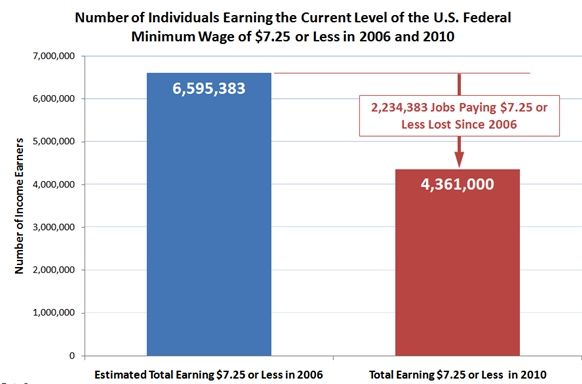
In 2006, the last full year in which the U.S. federal minimum wage was a constant value throughout the whole year, at least before 2010, approximately 6,595,383 individuals in the United States earned $7.25 per hour1 or less.

For 2010, the first full year in which the U.S. federal minimum wage was a constant value through the year since 2006, the U.S. Bureau of Labor Statistics estimates that an average of just 4,361,000 individuals in the United States earned the same equivalent of the current prevailing federal minimum wage of $7.25 or less throughout the year.
 image

In terms of jobs lost, that means that 2,234,383 of the jobs lost in the U.S. economy since 2006 have been jobs that were directly impacted by the series of minimum wage increases that were mandated by the federal government in 2007, 2008 and 2009.

Interestingly, the average number of employed members of the civilian labor force in 2006 was 144,427,000. In 2010, the average number of employed members of the civilian labor force in the U.S. was 5,363,000 less, standing at 139,064,000.

So, in percentage terms of the change in total employment level from 2006 to 2010, jobs affected by the federal minimum wage hikes of 2007, 2008 and 2009 account for 41.8% of the total reduction in jobs seen since 2006.

Thanks to Tags for feeding the lead

Panera builds loyalty .. and, oh yeah, keeps prices high.

March 21, 2011

TakeAway: Panera Bread investors are hoping the company’s new loyalty program and additional menu items will lead the way for continued sales and traffic growth.  The loyalty program, MyPanera cards, is a way for the company to build deeper relationships with people who are already engaged with the brand.

* * * * *

Excerpted from WSJ, “Panera Bread Sees Loyalty, Innovation Bringing in the Dough” By Annie Gasparro, February 11, 2011

On the heels of launching its customer-loyalty program, Panera is bringing in steak as new protein for its sandwiches, which, bolstered by extra marketing, are expected to help continue the trend of increasing sales, especially in the dinner and catering businesses.

The move to add steak to the menu comes at a time when beef prices are at all-time highs and rising, putting additional commodity pressure on Panera. But the company remains confident.

Panera’s loyalty program, MyPanera cards, is expected to be a key driver in future traffic growth, as it allows the company to track what its customers are buying, when they buy it and how much they spend. The free program was launched in the fourth quarter and presents members with “soft rewards,” like complimentary items, that match their buying habits.

This kind of insight can be used to make marketing substantially more effective, analysts point out. By giving a free bakery item to a customer who normally buys just coffee, Panera could create a higher-check customer long-term. In the same way, it could bring breakfast frequenters, for instance, in more regularly for lunch or dinner as well.

Panera isn’t afraid of raising prices coming out of the recession. The bakery chain says its overall commodity costs, about 80% of which are locked in for the year, will be up about 3% this year, causing the company to raise prices 2%.  Panera’s bottom line improved through much of the recession, having increased every quarter in nearly three years largely due to customer loyalty. While competitors discounted to lure customers during a slump in dining demand, Panera’s aversion to price cuts succeeded among its base of mostly upper-middle-class customers and revenue growth never reversed.

Edit by AMW

* * * * *

What do the Big East and Richmond, VA have in common?

March 21, 2011

Both have 2 team in the NCAA’s Sweet Sixteen.

Ouch.

All of a sudden, the Big East looks more like the Big Easy.

Charles Barkley on TBS: “When you get to the tourney you’ve got to be physical & talented … not just physical.  Everybody’s physical. Except for Connecticut’s Kemba Walker, who does the Big East have?”

Double ouch.

Think back to brackets’ day.  The pundits (Bilas, Vitale)  praised the Big East and said Virginia Commonwealth didn’t belong in the tournament. That there needs to be more “basketball guys” on the selection committee — who know what they’re talking about. 

Hmmm.  So, who knows what they’re talking about?

Time for baseball.  Go Cubbies.