Archive for April 26th, 2011

About all those billionaire loopholes …

April 26, 2011

Since tax hikes are back in the news, I’ve been poking away at the data – just to try to understand – and to separate fact from fiction.

First stop: a look at deductions.

Below is a recap of AGI, and taxable income – right from the IRS site. The difference between the two is made up of deductions and exemptions – the so-called “loopholes”.

Note that millionaires – defined as tax filers with AGIs > $1 million – only shelter about 10% of their AGI.  Sure, that accounts for a pile of dollars, but I expected the number to be a lot higher.

Also note that for low income folks, taxable income is a very small portion of their AGI.  Said differently, practically all of their AGI is sheltered by exemptions and the standard deduction. That’s not surprising.

In the middle brackets, tax filers are sheltering about 1/3 of their AGI in exemptions, and deductions such as mortgage interest, local taxes and charitable contributions.

My bet: those are the folks who will get caught in the crossfire when deductions get eliminated.

image

About those millionaire & billionaire tax rates … now, this is interesting.

April 26, 2011

I’ve been doing some data searching to understand all of the gibberish being spouted about tax rates (from both the left and the right).

Here’s the scoop.

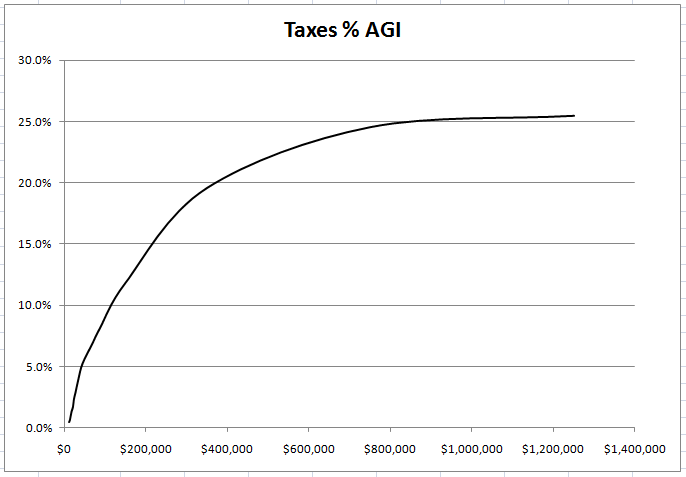
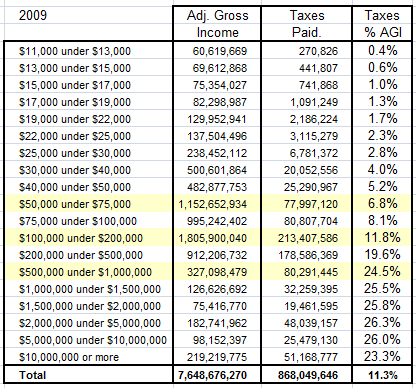
Below is a graph showing the actual taxes paid (per the IRS site) divided by AGI (adjusted gross income) across income ranges (the way the IRS reports them).  Below the graph is the tabular data.

Note that:

Rates are ‘average’ at 11.8% between $100,000 and $200,000.

The rates move up quickly to about 20% of AGI in the range between $200,000 and $500,000

Then – and this is where things get interesting — starting at about $750,000 in income, the % of AGI paid in taxes hits about 25% and hangs there. 

  • Note: On the table you can see that there’s a very small dip in the percentage for folks reporting more than $10 million – probably because of a high proportion of cap gains and dividends.

Again, these numbers are right off the IRS site … they’re not confused by tax tables or annoying reports that Warren Buffet pays less than his secretary.  They’re not zero as ‘progressives’ would lead us to believe …  and they’re not 100% as ‘conservatives’ would lead to believe.  The fact-based answer: 25%.

So what?

Reasonable people can differ (a little) on what rate constitutes a person’s “fair share”.

My view: 25% sounds about right.

What do you think?

image

image

Most Published Research Findings Are False

April 26, 2011

I didn’t say it, the New Yorker magazine did, setting off a buzz in the halls of academia.

The theme of the New Yorker article –- titled “Truth Wears Off” –was that most (academic) research was flawed and not able to be replicated.  This is, the results were at best true under some special circumstances at a specific point in time, but can’t be replicated. At worst, they’re just plain bull.

Hmmm.

Challenging the integrity of publication-driven academics?

Turns out that the New Yorker wasn’t the first mag on the beat.

There was an article in 2005 titled “Why Most Published Research Findings Are False” published in a medical journal that said point blank: “ It can be proven that most claimed research findings are false.”

According to the study, there are several reasons why.

My favorites:

  • Claimed research findings may often be simply accurate measures of the prevailing bias … that is, telling audiences what they want to hear
  • The hotter a scientific field, the less likely the research findings are to be true … that is, rushing to ride the wave
  • The greater the financial and other interests and prejudices in a scientific field, the less likely the research findings are to be true … no kidding?

Geez, if you can’t trust stuff printed in academic journals, what can you trust?

Grab your wallet … Ticketmaster going to “dynamic pricing”.

April 26, 2011

Punch line: Ticketmaster  plans to develop “dynamic pricing” systems that would adjust the cost of sports and concert tickets in response to demand, a strategy airlines and hotels have long used to maximize profits …  TM expects sports teams  to adopt the new system before concert promoters or Broadway producers.

* * * * *

Excerpted from WSJ, Ticketmaster to Tie Prices to Demand 

Dynamic pricing a key element in Ticketmaster’s strategy to revive sales of concert tickets, which have been stagnant or declining for years.

Last year was brutal for the concert industry, with ticket sales plunging 12% despite a modest decline in average prices. Recent price drops follow more than a decade of steady increases, a trend that helped mask fundamental problems.

“2010 taught us we have real challenges as an industry,” Mr. Hubbard said. “One of them is pricing.”

A frustration throughout the concert industry: the best seats appear to be consistently priced below what fans are willing to pay, leading to a multibillion-dollar “secondary market” in which scalpers can reap profits by reselling tickets above face value.

At the same time, he said, 40% of concert tickets sit unsold industry-wide, meaning that the ostensibly cheap seats for many shows are simply not cheap enough.

Thanks to JD for feeding the lead

Groupon rejects Google’s $6 billion offer … so, here come daily-deals from Google. Let the games begin.

April 26, 2011

TakeAway: After having its acquisition bid rebuffed by Groupon, Google is  launching its own daily-deal service offering, Google Offers, in NYC, the Bay area, and Portland.  Google aims to snatch market share from Groupon (No. 1) and LivingSocial (No. 2) … 

Ken’s Bet: Google will be a force in this market and hug Groupon for rejecting its almost $6 billion offer …

* * * * *

Excerpted from WSJ, “Google’s Groupon Rival Launches in NYC, Bay Area,” , April 21, 2011

Google’s rival to daily-deal services such as Groupon and LivingSocial, called Google Offers, officially launched today in New York City, the Bay Area and Portland.

Like its competitors … Google Offers will alert consumers to local-business deals on things like restaurant meals, promising “50% off or more” than the regular price “at places you’ll love.” …

Google Offers, which became public in January, comes several months after Google failed to acquire Groupon for more than $5 billion.  Meanwhile, Groupon is planning a public offering of its shares later this year …  between $15 billion and $20 billion.

… a Google spokeswoman said, “Today we launched a marketing campaign inviting Portlanders to sign up for a test of Google Offers — to get great deals delivered right to their inboxes. Offers is part of an ongoing effort at Google to make new services that give consumers great deals while helping connect businesses with customers in new ways.”

Edit by KJM