Archive for October 20th, 2011

Making science cool (again) … dy-no-mite!

October 20, 2011

My daughter-in-law has a group of PhD scientist-friends.

Last summer I was chatting with them about why the U.S. is reportedly falling behind in math and science.

They offered  that the PhD grind is, in fact, a grind … and that comp levels in science are paltry.

My hypothesis: there aren’t enough aspirational heroes for kids these days.

In my day, Salk was a hero vaccinating polio and every kid wanted to be an astronaut.

My prescription: we need more heroes and we need to make school (and science) cool again.

Well, maybe science is getting cool again.

Check out this video from the McGill Cancer Research Center … a fun view of lab science.

See, science doesn’t have to be boring!

                                    click to view

image

image

Thanks to Barbara Gordon & Jess Homa @ American Society for Biochemistry and Molecular Biology for feeding the lead

>> Latest Posts

Squeezing Buffett’s numbers … Part 4

October 20, 2011

In Part 1, we looked hard at Buffett’s effective income tax rate (17.4%), and showed how he could get to that low rate by offsetting practically all of his ordinary income with $23 million in deductions.

This conclusion debunks the popular pundit point that he gets to the rate by having practically all of his income in capital gains and dividends.

In Part 2, we showed that about $20 million of the deductions are probably charitable contributions – a device that rich folks use to (1) do good things and (2) to manage down their tax liabilities.

Better to give to a cause that you believe in, right? Why give it to the government and have it waste the money?

In Part 3, we agreed that Buffett’s tax rate as a percentage of his taxable income is probably less than his secretary’s – partially due to his capital gains being taxed at a comparatively low rate, but mostly because he shelters his ordinary income with charitable deductions.

And, we showed how ordinary earners can get to a rate lower than Warren’s … just by donating a huge chunk of their income to charity.  Not realistic, but mathematically possible.

Whew.

Now let’s start pulling things together.

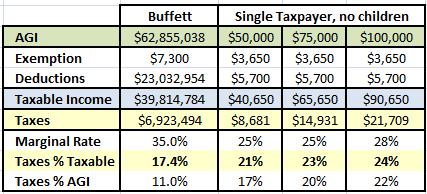
The chart below makes the obvious clear … at least to me to me.

image

Note that Buffett’s tax rate as a percentage of AGI is only 11% …. about half of the estimated rate for our secretary surrogates.

Now that’s a gap!

But, I haven’t seen anybody in the mainstream media even notice.  They, and Chuckie Shumer, just focus on the rate to taxable income.

What’s going on?

Same story as before: Buffett shelters over a third of his AGI – and practically all of his ordinary income with charitable deductions.

Simply stated, because he gives money away to charities (e.g. the Bill Gates Foundation) he only has to give a pittance to the Feds.

Is that a good thing or a bad thing?

We’ll save that for a subsequent post.

>> Latest Posts

Today’s Deal: Groupon at 1/3 off … buy now?

October 20, 2011

Punch line: Groupon’s IPO was originally expected to value the three-year-old company at between $15 billion and $20 billion … now, the company is talking $12 billion … still a huge deal, but heading south

According to the WSJ …

In a stark comedown for what was expected to be one of the hottest stock offerings of the year, Groupon is scaling back plans for its public debut.

The Chicago company and its bankers will begin meeting with investors in the next few days to sell them on a deal that values the daily deals pioneer at less than $12 billion.

Groupon’s IPO was originally expected to value the three-year-old company at between $15 billion and $20 billion, according to people familiar with the matter.

The change comes in the wake of recent market volatility as well as several missteps by the company, the people said. Regulators have been scrutinizing Groupon’s accounting and the company was forced last month to change the way it books revenue.

Groupon plans to conduct its road show for investors next week.
.
The size of the stock sale, expected to be completed in the next two weeks, could be $500 million to $700 million.

The small offering, which would represent well under 10% of the company’s outstanding shares, is meant to cut the amount of stock being sold, in hopes that more shares can be sold later at higher prices

As we’ve said before, these guys will rue the day they turned down Google’s $5.5 billion offer …

>> Latest Posts

IBM study indicates CMOs are old school … but trying to catch-up

October 20, 2011

Punch line: This IBM study outlines top concerns from global CMOs and highlights how CMOs fail to analyze and capitalize on digital channels …

* * * * *
Excerpted from “IBM Study Shows CMOs Fail To Monitor Digital Channels

“From Stretched to Strengthened,” IBM’s latest Global Chief Marketing Officer Study, interviewed 1,734 CMOs from 19 industries and 64 countries. Topline findings converge on three points:

  • The empowered customer is now in control of the business relationship
  • Delivering customer value is paramount — and an organization’s behavior is as important as the products and services it provides
  • The pressure to be accountable to the business is not just a symptom of hard times, but a permanent shift that requires new approaches, tools and skills.

While 82% of marketing chiefs rely on traditional market research — which delivers information about consumers in the aggregate — comparatively few “are exploiting the full power of the digital grapevine,” with only 26% regularly tracking blogs, 42% tracking third-party reviews and only 48% tracking consumer reviews.

Four major priorities concern CMOs:

  1. Data explosion
  2. Social media
  3. Proliferation of channels and devices
  4. Shifting consumer demographics.

… IBM warns that a majority of CMOs are missing the personal touch, by paying more attention to markets than individuals and “peddling, not partnering,” and favoring data over relationships.

The researchers offer three key areas for improvement:

  1. understand and deliver value to empowered customers;
  2. create lasting relationships with those customers;
  3. measure marketing’s contribution to the business in relevant, quantifiable terms.

While more than half of the interviewees are confident their organization’s corporate character is understood in the marketplace, just 20% believe their employees are fully on board, and 75% believe marketing should oversee brand reputation inside and outside the enterprise.

Conclusions on how to “Get fit for the future” include:

  1. Create value for customers as individuals
  2. Reprioritize investments to analyze digital channels to access customers’ views and use advanced analytics to recognize preferences and trends across every touch point
  3. Work with IT to assess potential data and infrastructure exposures, employ tools to secure customer data and update privacy policies to address customers’ concerns
  4. Capitalize on new digital channels to stimulate customer conversations and new relationships; use tangible incentives to attract followers.

“Marketing people will need unique skills in the near future. They’ll need to be capable of integrating marketing and IT – like footballers who can kick with both feet,” concludes Jeroen de Punder, CMO of Ricoh Netherlands.

Edit by KJM.

>> Latest Posts