Archive for April 17th, 2012

Apple stock tumbling … You may be surprised how much YOU own !

April 17, 2012

Apple’s stock has lost about 9% of its value since hitting its most recent all-time high of $644, and is on a week-long skid.

Even if you don’t own any AAPL sahres outright, if you’re holding any mutual funds or ETFs, you probably own a boatload.

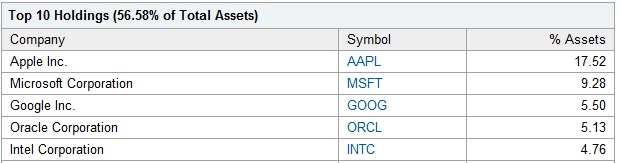
For example, if you’re holding the PowerShares QQQ (QQQ), you’re holding a big slice of Apple … 17.5% is in AAPL/
image

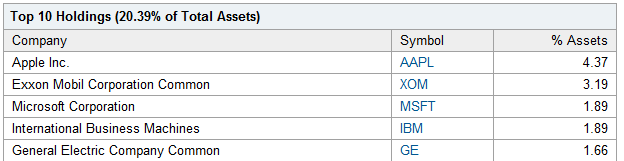
What’s the top holding in the SPDR S&P 500 (SPY)?

You guessed it, APPL …4.37% of the SPY
image

Ditto for many of the most popular mutual funds.

For example, APPL is almost 10% of Fidelity’s Contrafund.

image

A couple of other biggies:

  • Fidelity Magellan (FMAGX) … top stock … 6.24%%
  • American Funds Growth Fund of Amer A (AGTHX) … top stock … 4.85%

You get the picture, right?

Two major takeaways:

First, If you’re holding any popular ETfs or mutual funds — individually or in, say, 401-Ks — then you probably own a bunch od Apple.

Even more important, so many big dogs — ETFs and mutual funds — are so heavily invested in Apple that, as Apple goes, so will the market.

I’m surprised that more hasn’t be written about about Apple’s influence on the total stock market.

You might want to start worrying

>> Latest Posts

What’s the difference between the “Buffett Rule” and the AMT?

April 17, 2012

Finished up my taxes this weekend …. OUCH.

Along with more than 30 million other taxpayers, I got caught by the Alternative Minimum Tax (AMT).

There are about 130 million Fed tax filings each year … about half of them pay no Fed income taxes (or get a refundable credit) … that means that about half of all tax payers get hit with the AMT.  it only takes about $75,000 in income to make somebody a candidate for the AMT.

This year — in part because of the hoopla re: the Buffett Rule — I dug dig into the AMT calculations rather than just take Turbo Tax’s answer and run.

The bottom line — based on my dissection — is that the AMT requires that high earners pay about 28% on their ordinary taxable income — wages, interest, pensions, etc.

So, on ordinary taxable income the Obama-Buffett Rule (OBR) boosts the rate from 28% to 30%.

Big deal, right?

The real impact is what happens to capital gains and “qualified” dividends — which are currently capped at a 15% rate — even under the AMT.

Under the Obama-Buffett Rule, capital gains and qualified dividends would be taxed at 30% — a doubling of the current AMT rate.

Now, that is a big deal.

When you cut to to the chase, the Obama-Buffett Rule is simply a doubling of the capital gains tax rate — selectively applied to those people who earn most of the capital gains.

The OBR simply takes capital out of play from the private sector and transfers it to the government sector.

If you think that the government does a better job allocating capital than the free market, then you gotta love the Obama-Buffett Rule.

If you think the government uses capital less efficiently than the private sector, you gotta hate it.

Put me in the latter camp …

>> Latest Posts