According Pew Research, an increasing plurality (43%) of people think the Federal government negatively impacts their lives.
15 years ago, 50% thought he impact was positive … now, only 38% think so …..
How do you feel?
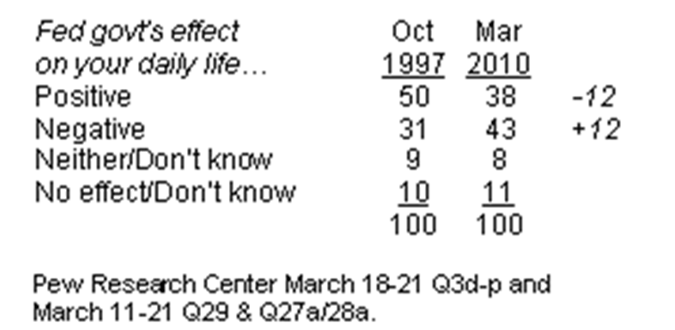
According Pew Research, an increasing plurality (43%) of people think the Federal government negatively impacts their lives.
15 years ago, 50% thought he impact was positive … now, only 38% think so …..
How do you feel?
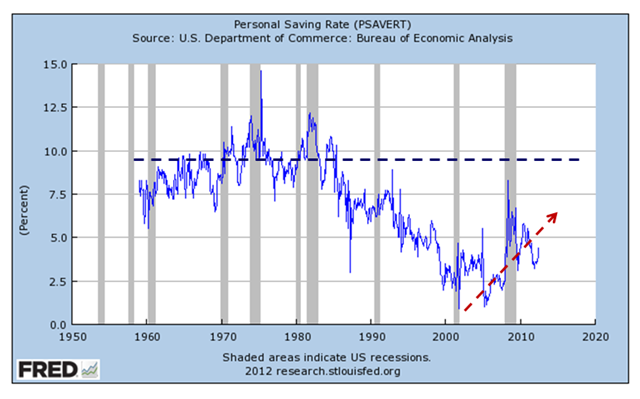
One of the drags on the economy is that folks have tried to deleverage – i.e. pay down debts – and are saving more.
Recently, I’ve seen several articles talking about the “alarming” spike in the savings rate.
Strikes me as odd since, in the past, saving was considered a good thing (you know, savings is what funds investment which drives the economy) … and there was hand wring that folks were spending like drunken sailors and weren’t saving enough.
Hmmm.
Here’s a glance at the numbers …
Yes, the savings rate has been increasing since troughing around 2005.But – and it’s a big BUT – the saving rate is still about 5 points lower than it was in the 1970s and 1980s … when there was concern that we weren’t saving enough.
So, if you think the current rate is alarming, expect to be more alarmed as we bounce back to the old normal.
Answer: Starting salaries tend to drop & to 8 percentage points for each percentage point increase in the unemployment rate … and it can take up to 15 years to get back to “normal” levels.
Lisa Kahn, a Yale School of Management economist analyzed government data during and after the deep 1980s recession.
She found that for each percentage-point increase in the unemployment rate, those with the misfortune to graduate during the recession earned 7% to 8% less in their first year out than comparable workers who graduated in better times.
The effect persisted over many years, with recession-era grads earning 4% to 5% less by their 12th year out of college, and 2% less by their 18th year out.
For example, a man who graduated in December 1982 when unemployment was at 10.8% made, on average, 23% less his first year out of college and 6.6% less 18 years out than one who graduated in May 1981 when the unemployment rate was 7.5%.
For a typical worker, that would mean earning $100,000 less over the 18-year period.
Takeaway: High unemployment rates isn’t just somebody else’s problem …


 The Homa Files