Archive for September 14th, 2012

Encore: Why the market goes up when the Fed “quantitatively eases” …

September 14, 2012

Yesterday Bernanke announced another (and apparently infinite) round of quantitative easing … that is, substantially increasing the amount of money in circulation

The stated logic: keep interest rates low so that businesses and prospective homeowners borrow.

The cynical interpretation: 56 days until election … Obama stands by Bernanke … Mitt says he’s fire him

The immediate impact: stock jumped over 200 points.

Why?

There’s a strong link between the supply of money and stock prices.

More money => lower interest rates +> higher comparative returns from stocks => higher stock prices.

That is, until inflation kicks in and borrows face higher rates …

* * * * *

Here’s an archived post that gives more detail:

Back about 40 years ago, an economist-wannabe co-authored a study in the Journal of Finance titled “The Supply of Money and Common Stock Prices”.

image

The article summarized an econometric study that demonstrated a tight link between the amount of money floating around and, on a slightly time-delayed basis, the price of stocks.

OK, fast forward to today.

Now, when the Feds expand the money supply, it’s called “Quantitative Easing” … or QE, for short.

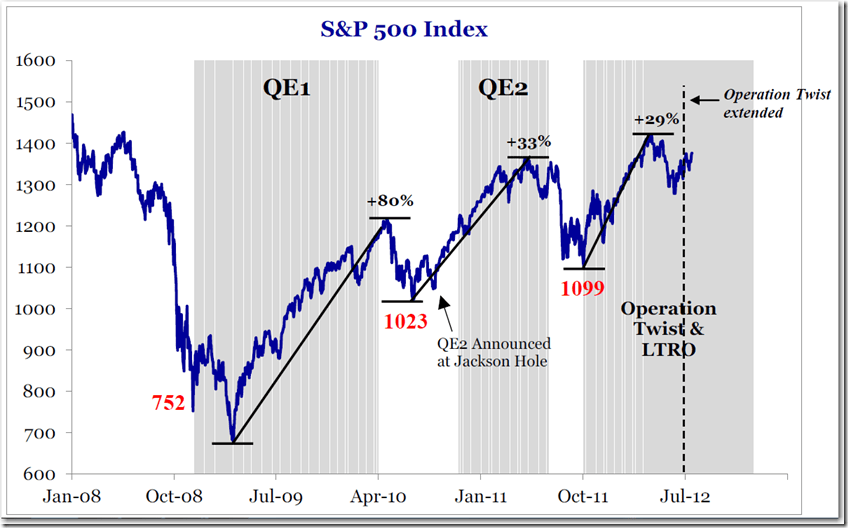
Recently, Jason Trennert of Strategas Research Partners published a revealing chart that visually relates stock prices (the S&P 500) to the recent periods of quantitative easing.

Hmmm.

Looks like the supply of money and common stock prices are still related.

Partially explains why the Dow is over 13,000 despite a sluggish and uncertain economy.
image

>> Latest Posts

How many Tea Partiers voted for Obama?

September 14, 2012

According to pollsters Rasmussen & Schoen in their book “Mad as Hell … …

A significant number of self-identified Tea Party supporters —20 to 30 percent, depending on the poll — voted for Obama,

To put hat number in context:

  • A February 20, 2010, Economist/YouGov poll found that one in five Americans identify themselves as being part of the Tea Party movement.
  • Approximately 35 percent of the electorate self-identifies as Tea Party “supporters.

* * * * *

Source: Rasmussen, Scott; Schoen, Doug,
Mad As Hell (pp. 44, 219, 220).
Harper Collins, Kindle Edition.

image

>> Latest Posts

MBA applicants declining … more $$$ for top students and minorities.

September 14, 2012

Punch line: Top US business schools are reporting single and double digit applicant decline, making admission easier for candidates.  After years of applicant increases, admissions offices explain the trend by tough competition – with cheaper and more convenient programs, and ramped up efforts from 2nd tier schools. 

image

* * * * *

Excerpted from businessweek.com’s, “At Top Business Schools, an MBA Application Drought.”

In the last few weeks, a handful of top business schools have reported single-digit, and in some cases double-digit, declines in applications for their full-time MBA classes, including most recently Columbia Business School and New York University’s Stern School of Business.

Full-time MBA applications have sunk at at least a dozen of the top 30 B-schools.

Among the schools that have reported declines are the University of Chicago’s Booth School of Business, the Yale School of Management and Duke University’s Fuqua School of Business (down 3.5 percent, 9.5 percent, and 7 percent, respectively).

A handful of schools reported even steeper drops, including Michigan State University’s Broad College of Business, where applications fell 18 percent, and Indiana University’s Kelley School of Business, with a significant dip of nearly 21 percent.

The decline in applications is attributed to increased competition from rival business schools and a plethora of available choices, including part-time and online programs.

Second-tier schools are working more aggressively to recruit top MBA candidates and entice them with hefty financial aid packages.  “…employer sponsorship for full-time MBA programs is almost nonexistent, and doing an MBA part-time or online can be an attractive offer for some students, especially when there is funding available.

With a smaller pool of MBA applicants, getting an offer to a top business school has become slightly easier … To meet their target enrollment for this year’s incoming MBA class, schools had to work harder to ensure admitted students accepted their offers. For many of those schools, that extra push paid off. Yield was up at nine of the 13 schools on which information was available.

This year, competition was especially stiff for women, underrepresented minorities, and students from nontraditional work backgrounds, says Liz Riley Hargrove at Fuqua. “It was just a really competitive environment, and I think it impacted everybody’s yield this year,” she says.

Edit by BJP

>> Latest Posts

Sorry, but the BLS streak continues …

September 14, 2012

I promise that I’ll stop writing about BLS reporting bias when the streak ends.

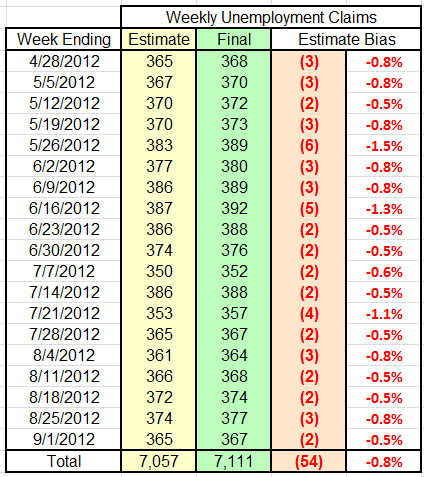
Now we’re up to 78 out of 79 weeks — and, at least 19 election season weeks in a row — that the BLS’s “headline number” has under-reported the number of initial unemployment claims … and cast the jobs situation as brighter than it really is.

Based on Thursday’s BLS report, the number for the week ending Sept. 1 was revised upward from 365,000 to 367,000.

In itself, the 2,000 isn’t a big deal.

But, in context it is

Again, I ask: statistical bias or political bias?

If the former: fix it already, BLS.

Hint to BLS: just add 2k or 3k … or .8% to your prelim forecast !

image

* * * * *

And, oh yeah, the initial jobless claims increased by 15,000 … above the consensus estimates … and consistent with an unemployment rate higher than 8.1%.

image

>> Latest Posts