Archive for October 18th, 2012

Hoisted by their own pitards … BLS unemployment claims are in.

October 18, 2012

Last week, Team Obama was crowing about the huge drop in initial unemployment claims … proof poitive that the recovery was gaining steam.

They failed to mention the fact that the state of California sat on a pile of claims … making the numbers look better than they really were.

Well, as Rev. Wright would say, the chickens have come home to roost.

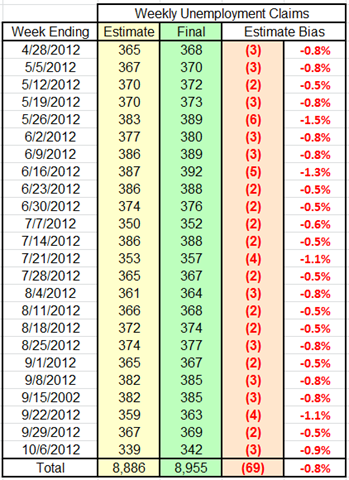
According to the BLS: “In the week ending October 13, the advance figure for seasonally adjusted initial claims was 388,000, an increase of 46,000 from the previous week’s revised figure of 342,000.”

Oops.

Headline: “Jobless claims increase 46,000”

Not exactly proof positive of an economy gaining steam.

My bet, Team Obama emphasizes that claims are overstated because of California.

Too bad.

* * * * *
And, yes … the BLS streak — understating initial claims – continued.

Now we’re up to at least 23 election season weeks in a row that the BLS’s “headline number” has under-reported the number of initial unemployment claims … and cast the jobs situation as brighter than it really is.

Based on today’s BLS report, the number for the week ending October 6  was revised upward from 339,000 to 342,000.

C’mon guys … get it right already.
image

>> Latest Posts

The “Biden Effect” …

October 18, 2012

Hot off the presses …

Gallup’s tracking has Romney up by 7 … 52% to 45%

Expect for Gallup to get calls from Axlerod and Holder …

image

The election in a nutshell … maybe jobs don’t matter as much any more!

October 18, 2012

There’s a sobering,  must read editorial in the WSJ today … Can Government Benefits Turn an Election?

Here are key points …

The federal government’s 120 means-tested programs today provide $1 trillion of benefits.

  • Unemployment insurance has stretched to 99 weeks
  • Record numbers of unemployed have qualified for disability benefits
  • Food stamps recipients have increase 40% to almost 50 million

The spending for these programs has grown 2½ times faster during the Obama presidency than in any other comparable period in American history.

To what extent might these benefits not just foster dependency but also make the economy’s performance seem less of a deciding factor in voters’ choices?

If you are concerned about your well-being and worried about a failed recovery — but getting new help from the government— do you vote for the candidate who promises more jobs or do you support the candidate who promises more government benefits?

Voters have historically set high standards and voted out incumbents not because they personally disliked them.

Rather, they’ve elected a new president because they understood the importance of a strong economy to their jobs, their income and the future prospects of their children.

Based on the economy, Mr. Obama should lose on Nov. 6. Yet it seems implausible that tens of millions of Americans who have received additional government benefits during his presidency can be completely unaffected by that largess. The election will test the relative power of private-sector aspirations and public-sector dependence.

Based on the economy, Mr. Obama should lose on Nov. 6.

Yet it seems implausible that tens of millions of Americans who have received additional government benefits during his presidency can be completely unaffected by that largess.

The election will test the relative power of private-sector aspirations and public-sector dependence.

Keep in mind that most jobs being created are relatively low paying service sector jobs … an increasing number of which are part-time … in part of duck Fed regulations and taxes (think, ObamaCare).

To get a visceral sense of the electoral “tension”, read Threats to Assassinate Romney Explode After Debate.

And, consider that an increasing number of folks feel that they are paying their fair  share (or more) with the government wasting much or most of the taxes it takes in …   what if those folks decide it’s not worth 60 hour weeks any more any more and shift into neutral?

This year’s election won’t be the end of the process … regardless of the outcome.

>> Latest Posts

Sucka Alert: It’s after 5 p.m., so the price is higher…

October 18, 2012

Excerpted from the book Pricing Segmentation and Analytics by Bodea and Ferguson

One example of using price segmentation in the price analytics process has been applied at a grocery store chain.

Previous studies have shown that consumers who shop at a grocery store after 5 p.m. on weekdays are generally less price sensitive than consumers who shop on weekdays before 5 p.m.

This finding is intuitive as the consumers who are shopping after 5 p.m. are generally working professionals who are on their way home from work and do not bother to comparison shop, while consumers who shop before 5 p.m. consist of homemakers and retired individuals who, conceivably, are more price conscious and have more time to comparison shop.

To take advantage of this knowledge, there is a grocery store chain in Texas that raises the prices of almost all items after 5 p.m. on weekdays and lowers them again before opening the next morning.

I’m a strong advocate of “dynamic pricing” but this one gives me the creeps … I’d like to be a fly on the wall when customers catch on to the pricing scheme.

>> Latest Posts

Hey, Facebook … China still doesn’t like you.

October 18, 2012

Punch line: As Facebook reaches a billion global users, the company is turning to new tactics to drive international growth.  Despite China’s firm ban on Facebook, Facebook still has opportunity in other Facebook-inclined countries.

* * * * *
Excerpted from adage.com’s, “How Facebook Will Find its Next Billion Users”

Facebook crossed the billion-user threshold last week but where it finds its next billion is a tough question, especially since the world’s largest internet market, China, is still closed to the social network.

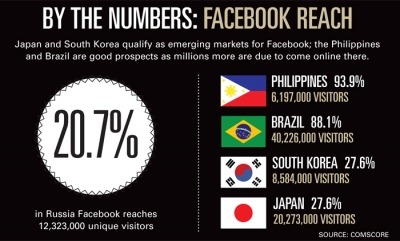
Facebook’s mature markets are saturated. In the U.S., 61% of the 65-and-older population visited Facebook in August, while 87.3% of the 18-to-24 set did.  It’s hard to imagine those numbers getting much higher as growth has slowed to 2% a month.

by-the-numbers-facebook-reach

For Facebook, Japan qualifies as an emerging market, as does South Korea.  In Russia … the company is being upfront about its aspirations. CEO Mark Zuckerberg spent last week in Moscow, where he hosted a competition for developers to build Facebook apps tailored for the Russian market.

While it might appear that Facebook has already conquered markets such as Brazil (where it surpassed once-dominant Orkut last year) and the Philippines, millions more are likely to come online there in the next several years and will be apt to share their fellow citizens’ appetite for Facebook.

Advertising may play a part in recruiting the next billion users. Working with an agency, Facebook unveiled its first brand ad last week. The ad … was made for existing users, but also contains a message for nonusers, even without a distinct call to action.  Facebook noted the purpose of the ad isn’t to promote growth.

Facebook plans to distribute the spot using its own ad products, and the 13 markets selected shed some light on where the company thinks its next billion users could be, even if it’s not being overt in its messaging. The ad will be promoted in the U.S., U.K., France, Germany, Italy, Spain, Mexico and India, as well as in what Facebook hopes are markets fueling future growth: Indonesia, the Philippines, Brazil, Japan and Russia.

Edit by BJP

>> Latest Posts