Archive for November 1st, 2012

More re: early voting …

November 1, 2012

According to a just released Pew poll

Roughly 1 in 5 have voted early.

Among early voters, Romney has the edge 50% to 45%.

Romney is outperforming McCain’s rate in 2008 by 16 percentage points.

Obama is underperforming his 2008 performance by 10 percentage points.

Hmmm.

image

>> Latest Posts

Old song … BLS still under-reporting initial unemployment claims.

November 1, 2012

Yeah, yeah, yeah … I’m getting as tired writing about it as you’re getting reading about it.

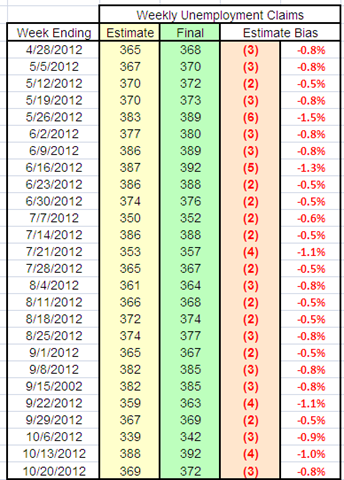
But, the BLS streak — understating initial claims – continued this week.

Now we’re up to at least 26 election season weeks in a row that the BLS’s “headline number” has under-reported the number of initial unemployment claims … and cast the jobs situation as brighter than it really is.

Based on today’s BLS report, the number for the week ending October 20 was revised upward from 369,000 to 372,000 … making this week’s headline look 3,000 better.

These guys can’t be this sloppy or this stupid … can they?

image

= = = = =

To put today’s number in context. let’s flashback to the chart in yesterday’s post

The reported 4-week moving average is 374,000.

So, if the relationship of inital unemployment claims and the unemployment rate holds, tomorrow’s BLS report should be an unemployment rate of about 8.1%

That’s what all of my analyses say that the number is … but I’m still betting the under.

I think the BLS will fudge the numbers to keep the unemployment rate under 8%.

We’ll see tomorrow.

image

>> Latest Posts

Ahead of Friday’s number …

November 1, 2012

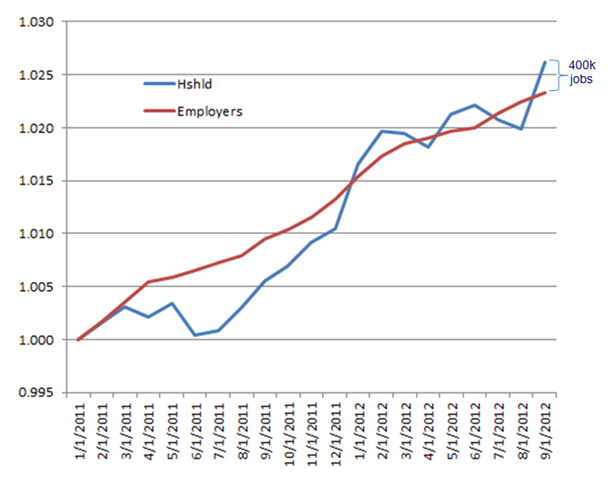
Last month, there was a “discontinuity” between jobs added as reported by the BLS’ establishment survey of employers (114k jobs added) and the household survey (873k).

The spurt in the latter drove the unemployment rate calculation (7.8%) which raised many eyebrows.

So, what to expect this Friday?

Looking back to the beginning of 2011, job growth via the employer survey has averaged 150,000 per month; the household survey has averaged  179,000.

Said differently, the employer survey has reported about 3 million jobs added; the household survey has reported about 3.6 million jobs added.

Below is a chart that indexes the two series back to January 2011.

image

Note that for the past couple of months, the less stable household survey has bounced over and under the employer survey.

That’s what you’d expect for two comparable data series drawn from different samples.

So, statistically speaking, I’d expect one of two outcomes this Friday … either:

1) The household series “averages out” and bounces under the employer number … showing a decline of about 350k jobs and a a higher unemployment rate, or

2) The household series “serially correlates” (i.e. continues a high run) … and burps out another sizable increase in employment (say, 250k) … and another reduction in the unemployment rate.

If #1 happens, Team Obama will argue that you shouldn’t place too much weight on one monthly number … an argument that they shelved last month.

If #2 happens, Team Romney (and Jack Welch) will claim book-cooking again.

Either way, I think voters will yawn since they believe so little of what gets spewed out these days

>> Latest Posts

How “intensity” turns a tie into a 6 point lead … here’s the math.

November 1, 2012

The election polls results are all over the place.

My take: the election is a dead heat nationally (slight Romney edge in the popular vote) and in key swing states (slight Obama lead in pivotal swing states, lead in electoral votes).

But … the fat lady hasn’t sung yet.

To get a better understanding of the dynamics in play, I dug into this week’s NPR poll.

Why NPR?

Because, if anything, it leans left, so no cookin’ the books for Mitt.

Also, it reported some interesting metrics that provide a basis for some interesting analysis.

  • Note: my primary intent is provide a calibrated analytical structure, not a prediction.

= = = = =
Topline Results

First, NPR reports Romney leading Obama by 1 point … 48% to 47% for all respondents … dead heat.

And, 48% + 47% = 95%, so 5% are still undecided, voting for another candidate, or hopelessly confused … or all three.

So, 5 points are arguably up for grabs.

Conventional wisdom says they break mostly for the challenger … advantage Romney.

image

Looking deeper – into the footnotes, NPR says:

  • ALL results are based on 1000 weighted cases, MoE = ±3.10

In other words, Romney’s score could be as high as 51% or as low 45%.

Obama’s score could be as high as 50% and as low as 44%.

Bottom line: Either candidate might be leading … Romney could be leading by as  many as 7 points … 51% to 44%.

Or, Obama could be leading by as many as 5 points … 50% to 45%.

That doesn’t tell us much, right?

= = = = =
Independent Voters

Let’s look at the Independent voters (above chart).

Romney leads with independent voters by 12 points … 51% to 39%,

Is that lead statistically significant?

Well, NPR says:

  • IND results are based on 309 respondents, MoE = ±5.58 percent.

So, Romney could be as high as 56.5% or as low as 45.5%.

Obama could be as high as 44.5% or as low as 33.5%.

Bottom line: Romney has an unequivocal, statistically significant lead among Independents.

= = = = =
Voter Intensity

Here’s where things get interesting …

NPR asked:

  • On a scale of one to ten, with one being “not at all enthusiastic” and ten being “extremely enthusiastic,”
    how enthusiastic are you about voting in the Presidential election this November?

image

In marketing research, there’s a principle called the “top box effect”.

In essence, it says to focus on folks who check the highest level allowed … and pretty much ignore the rest as insignificant.

So, what do the numbers tell us?

Republican “intensity”, i.e. “extremely enthusiastic”, is 76% – 10 percentage points higher than the Dems 66% … and 22% higher than Independents 54%.

That’s a big intensity advantage for the Republicans.

How might it translate to votes?

We need another piece of data and some basic arithmetic.

= = = = =
Turnout Assumption

You’ve probably been hearing the grumbling—mostly from Republicans – that recent surveys have been skewed Democratic … that they implicitly assume that Dems will turnout more than Republicans.

  • Of course, the turnout is a function of both party registration (“mix”) and voting propensity.  Most surveys of party affiliation peg the Dems & Republicans at about even.

The NPR “mix” is 35% Republicans, 33% Independents, and 31% Republicans.
image

We’ll test the sensitivity of those numbers later … for now, let’’s use NPR’s assumption.

= = = = =
”Hard Support”

OK, now let’s play with the numbers.

Here’s the summary chart … below, I’ll explain it.

image

What we’re trying to get to is “Hard Support” … folks who are “intense” (“extremely enthusiastic”) and favor Romney or Obama.

To get at that, we have to look at Republicans, Independents and Democrats separately.

For example, 76% of Republicans are “extremely enthusiastic” … and 96% of Republicans say they’ll vote for Romney.

Multiply those 2 numbers together, and they imply that 73% of Republicans are both “extremely enthusiastic” and inclined to vote for Romney (76% X 96% = 73%).

Since the sample “mix” is 31% Republican, Romney’s hard support from Republicans is equivalent to 22.6% of all voters (since 73% X 31% = 22.6%).

Applying the same calculations to the other classifications (Independent & Democrat) … and the data indicates that of Romney’s total of 48%,  32.9% is “hard support” and 15.2% is “soft support” that is less likely to show up at the polls.

Repeating the process for Obama, the data indicates that of Obama’s total of 47%. 29.1%% is “hard support” and 17.9% is “soft support”.

So what?

Romney has a 3.7 percentage advantage in hard support – the folks who are most likely to show up at the polls.

That’s a statistically significant number, given the polls 3 point margin of error.

Bottom line: If we factor in intensity, Romney has statistically significant advantage.

= = = = =
Another mix scenario

Let’s add one more twist.

What if the mix of Dems and Republicans is roughly equal at 33% … instead of 35% to 31%?

image

Big change!

Romney’s lead increases to 5.6% percentage points … Romney 50.6% to Obama 45%.

And, Romney’s hard support lead increases to 6.4 percentage points … well outside the margin of error.

= = = = =

Punch line

Yes, the headline number may signal a dead heat … within the margin of error.

But, if you factor in intensity and party mix … the numbers change pretty dramatically.

The Republican’s intensity advantage and lead among Independents seem pretty consistent across polls.

So, the key for Republicans is delivering on the intensity advantage … making sure that the “extremely enthusiastic” Republican & Independent voters turnout to vote.

For Dems, the turnout effort is even more critical since they have to close the intensity gap.

Dems claim that their turnout machine gives it substantial competitive advantage that will close the gap … or more.

I guess we’ll see next Tuesday.

>> Latest Posts

Fair Econometric Model predicts election outcome …

November 1, 2012

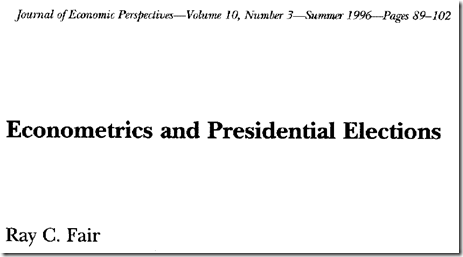
It’s called the Fair Model – not because it’s unusually unbiased (though I assume it is unbiased – but because its creator id Prof Ray Fair … currently at Yale, previously at Princeton.

click for Prof. Fair’s original article
image

We’re reporting the results for 2 reasons.

First, because I was one of Prof. Fairs research assistants at Princeton … he was the person who introduced me to econometrics … and, for that I’ll be forever grateful.

Second, because Prof. Fair’s modeling has essentially reduced presidential election outcomes down to 3 economic variables:

  • The per capita growth rate of gross domestic product in the three quarters before the elections. For the first three quarters of this year, GDP per capita grew at a 1.01% annual rate.
  • Inflation over the course of the entire presidential term, as measured by the GDP price index. The annual rate of inflation by this measure was 1.58%.
  • The number of quarters during the presidential term that GDP per capita growth exceeded 3.2%. There has been only one such “good news” quarter — the fourth quarter of last year, when GDP per capita grew 3.3%.

According to the WSJ, plug those figures into Prof. Fair’s econometric model and Romney edges Obama 51 to 49.

Said differently, “if Romney doesn’t win, it will have been despite an economy that Mr. Fair’s model suggests should have been in his favor.”

>> Latest Posts

Study says gender pay gap really is an issue …

November 1, 2012

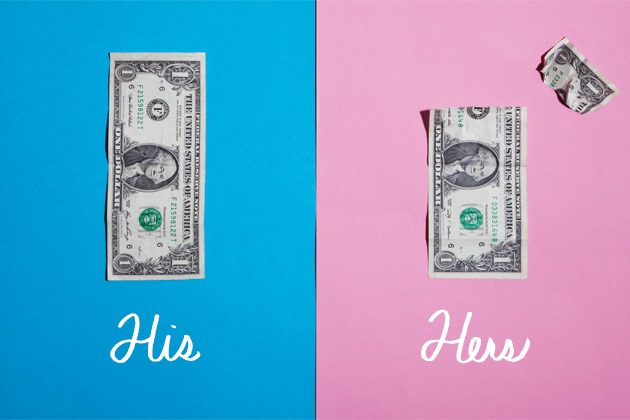
Punch line:Women are attending college at higher rates than men, graduating in greater numbers and earning higher grades. Yet one year after graduation, women were making only 82 percent of what their male colleagues were paid.

* * * * *

Excerpted from The Washington Post’s, “One year out of college, women already paid less than men, report finds”

Equal Pay - Photo Illustration by 731

Nearly every occupation has long paid men more than women, despite laws aimed at narrowing and dissolving the differences.

Even when men and women had the same majors, there were often gaps in pay.

But much of the overall gap — the 18-percentage-point disparity — could be explained by career choices; men are more likely to enter high-paying fields such as engineering and computer science.

The researchers controlled for that, along with other variables, but an “unexplained” 6.6-percentage-point gap remained.

The researchers put forward suggestions for reducing the pay gap, including encouraging women to pursue careers in higher-paying fields and to negotiate higher pay.

“A problem as long-standing and widespread as the pay gap, however, cannot be solved by the actions of individual women alone,” the researchers wrote.

“Employers and the government have important roles to play. The pay gap has been part of the workplace so long that it has become simply normal.”

Edit by JDC

>> Latest Posts