Archive for November 13th, 2012

Gallup: Largest gender gap in recorded history … oh, really?

November 13, 2012

Here we go again …

Gallup’s headline “2012 election had the largest gender gap in recorded history

  • The gender gap in the 2012 presidential election was the largest since Gallup began tracking the metric in 1952.
  • Obama won women by 12 percentage points, while Mitt Romney won men by 8. That’s a 20-point gender gap.
  • 2012 was the fifth straight election to feature a double-digit gender gap.

OK, CNN’s topline numbers do, in fact say that Obama won women by 10 points and that Romney won men by 9 points … a gender gap of 19 points.

image

= = = = =
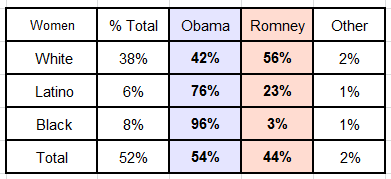
But, digging deeper, Romney may have lost “women” by 10 points, but he won white women by 14 points.

Romney got shellacked with Black and Latino women … but, at a rate that’s comparable to the shellacking that he took with Black and Latino men.

Said differently, it looks to me like the racial divide is driving the numbers, not gender.
image

image

= = = = =
Note also that married women – in aggregate – favored Romney … by 14 points.

Proportionately more white women are married … suggesting again that race may be driving the apparent gender differences.

At least, that’s what the numbers say …

image

Taxes: Simpson-Bowles … be careful what you wish for, because you might get it.

November 13, 2012

I often read “Why don’t they just implement Simpson-Bowles?”.

It’s usually stated in a way that it’s a painless gimme.

The convenient compromise.

My hunch: About as many people read the Simpson-Bowles Report as read the  ObamaCare law.

image

I expect that S-B will become a template for any “grand bargain” … so I started refreshing my memory

= = = = =
Taxes

Below is the summary chart from the report.

Most of the buzz centers on the reduction of rates, elimination of the AMT, and capping of some deductions.

Let’s get specific.

Among other things, Simpson-Bowles proposes:

  1. Three brackets with a top tax rate of 28% with no AMT
  2. Capital gains & dividends get taxed at ordinary income tax rates … not 15%, not 20% … 28% at top rates
  3. Muni Bonds: Income on newly issued  municipal bonds gets taxed … i.e. existing bonds are grandfathered as Fed  tax-free.
  4. Employer paid health insurance premiums: Exclusion phased out by 2038 (2038?) via a complicated formula catering to unions … translation: employer paid health insurance premiums would eventually be taxed as ordinary income
  5. Deductions: Eliminate ALL itemized deductions … everybody takes the standard deduction … offset by some capped credits
  6. Mortgage deduction replaced by a 12% non-refundable tax credit … Mortgage capped at $500,000; No credit for interest from second residence and home equity loans
  7. Charitable giving: 12% non-refundable tax credit available above 2% of Adjusted Gross Income (AGI) floor … e.g. if you make $100,000, then no credit for the first $2,000 of charitable giving.
  8. No deduction or exclusion for State & Local Taxes … i.e. state income taxes, state sales taxes, local real estate taxes

Obviously, these changes hit different people in different ways.

Start planning …

= = = = =

Simpson-Bowles Report

image

Even in the era of Moneyball politics, pundits still have a place

November 13, 2012

Punch Line: While political “Sabermetrics” has its value, people still want to indulge their biases and opinions. This ensures that pundits are in no danger of losing their jobs anytime soon.

* * * * *

Excerpted from Forbes’, “Political Junk Food: Why Pundits Will Survive the Moneyball Election”

Moneyball politics

This year’s election already seems to have a name, and that’s the Moneyball election.

While this is true … I don’t agree with the growing notion that this election could mark the beginning of the end for professional political pundit.

Think about it: it’s well-known that people of all political leanings tend to seek out information that reinforces their pre-existing beliefs.

Fox News, MSNBC, Drudge and The Daily Show all know this to their very core, and while some of us try to sustain ourselves on a respectable media diet full of journalistic fiber … only the most disciplined of us doesn’t periodically want to throw in a helping of a political Twinkie.

Just as ten years after the Moneyball revolution all baseball organizations still employ scouts, ten years from now news networks will still have plenty of talking heads.

Edit by JDC

Want to build loyalty? Think economics not just emotions.

November 13, 2012

Punch line: Marketers have long attempted to build relationships by engendering emotional loyalty. However, true loyalty requires better understandings of economics and behaviors.

* * * * *
Excerpted from Fast Company’s, “What Marketers Are Getting Wrong About Loyalty”

264307354_d7a7574fde_o

The biggest mistake brands make with loyalty programs is to model them on human loyalty.

It’s time not to make loyalty more “human,” in the traditional way, but to treat it as a question of economics and behavior.

This requires models that take into account:

  • DECISION-MAKING: One thing to know about human decision-making is that we want to be happy. And we prefer many small repeated gains over anything else. Knowing what mental accounts its customers are using and how they manage them helps a company maximize the impact of its offers.
  • BUSINESS DESIGN: The first thing to know is how a loyalty program will make money. Loyalty programs succeed when they simultaneously contribute to the bottom line and have a high negative churn rate.
  • EXPERIENCE DESIGN: At its simplest, experience design is about the quality of users’ experience with a product or service: ease of use, beauty, convenience, utility, simplicity. Improvements can revolve around adding a “software layer” over a company’s core business (as Target does), combining digital and analog offerings (Tesco Price Check) … or coming up with complimentary offerings (Amex Open Forum).

Instead of one-size-fits all, these new models are designed for diversity and customization … and they turn the entire company experience into customer benefit.

Edit by JDC

>> Latest Posts