Archive for November 16th, 2012

Now that the dust has settled, reflect: Your “I Voted” sticker worth its weight in gold … probably more

November 16, 2012

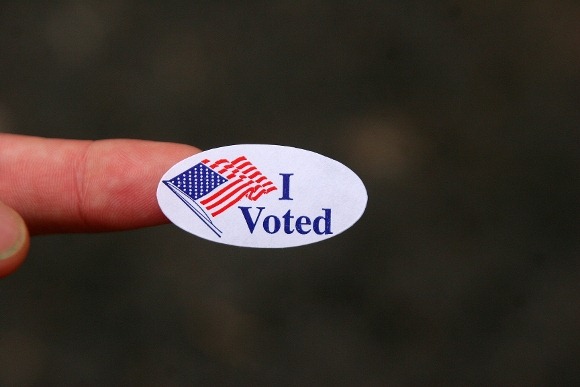
Punch line: They’re everywhere on election day: “I Voted” stickers.

If almost everybody’s got one, it feels pointless to put one on your own sleeve.

But actually, the fact that everybody’s got one is the point.

* * * * *
Excerpted from The Atlantic’s, “Why the ‘I Voted’ Sticker Matters”

I Voted Sticker

At a pure cost-benefit level, it’s hard to justify taking hours out of your day to cast a single vote.

And yet, we vote. We vote because we think it’s important.

We vote because we care about our country and our rights. We vote because it makes us feel good.

People like being seen having voted.

And that’s where the “I Voted” sticker comes in.

The “I Voted” sticker is a signal and an advertisement.

It binds people together … and reminds others to join the group.

Tens of millions of people will vote in every presidential election whether there are free stickers or free cookies.

But beyond these intrinsically interested voters are countless more citizens who need motivation to show up at the ballot box.

The “I Voted” sticker’s value — and its motivation — is purely social.

And to the extent that it might actually get some marginal Americans to the polls, it’s also priceless.

Edit by JDC

Follow The Homa Files on Twitter @KenHoma

November 16, 2012

  click to follow @KenHoma
image

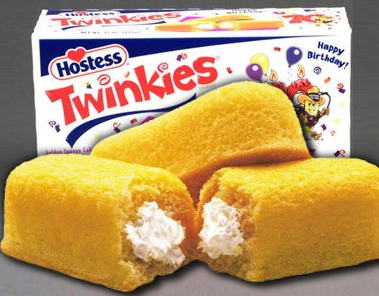
Twinkies are dead … long live Twinkies.

November 16, 2012

Hot off the WSJ wires …

image

Hostess Brands, the maker of iconic treats such as Twinkies and traditional pantry staple Wonder Bread, is shuttering its plants and liquidating its 82-year-old business.

A victim of changing consumer tastes, high commodity costs and, most importantly, strained labor relations, Hostess ultimately was brought to its knees by a national strike orchestrated by its second-largest union …  the Bakery, Confectionery, Tobacco Workers and Grain Millers Union.

The company will “promptly” lay off most of its 18,500 employees and focus on “selling its assets to the highest bidders.”

Hostess’s remaining inventory — loaves of bread and plastic packages of cream-filled desserts — probably will be sold in bulk to a discounter or big-box store.

The company will attempt to sell its plants and its brands – think Twinkies, Ding-Dongs.

The names have decades of “deliciously retro” brand equity, and there is “pretty significant demand” for the products.

A fresh owner of the intellectual property, which includes everything from names to recipes to graphics, could revitalize the Hostess brands  with new flavors, limited-edition Twinkies, co-branded products, and  international reach.

* * * * *

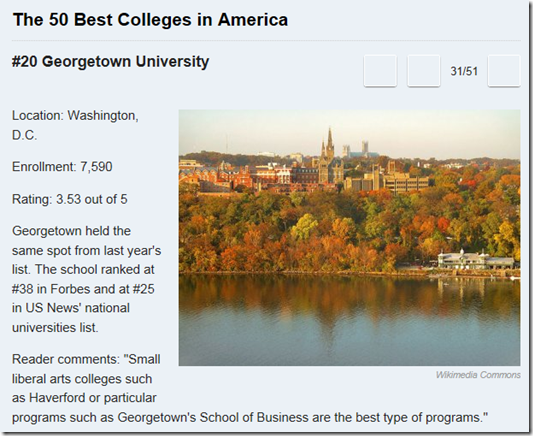
Business Insider: “Programs such as Georgetown’s School of Business are the best type of programs."

November 16, 2012

MSB gets a well deserved shout out from Business Insider

Punch line:

” …  programs such as Georgetown’s School of Business are the best type of programs.”


image

* * * * *

Per Simpson-Bowles … go ahead and limit the mortgage interest deduction.

November 16, 2012

Since I think Simpson-Bowles will be the template for the fiscal cliff resolution, I’ve been thinking about its provisions … starting with taxes (of course).

image

= = = = =

Mortgage Interest Deduction

Currently, income tax payers who itemize are allowed to deduct mortgage interest subject to some liberal restrictions:

  • Mortgages for both primary and second homes are allowed up to a combined mortgage balance of $1 million
  • Home equity loans— up to $100,000 are allowed with some restrictions on use of the funds

Simpson-Bowles proposed that:

  • The mortgage deduction be eliminated and replaced by a non-refundable tax credit.
  • The non-refundable credit would be equal to the interest on a primary home mortgage up to $500,000
  • No credit would be provided for interest on second home mortgages and home equity loans

Let’s do an example.

Say somebody is holding $1 million in mortgages carrying a 5% interest rate … annual interest paid = $50,000.

  • Under current tax regs, the $50,000 is tax deductible … so, if the taxpayer is in the 35% bracket, the deduction is worth $17,500 in tax savings.
  • Under Simpson-Bowles, only $500,000 of the mortgage qualifies … the imputed  interest on the $500,000 is $25,000 … so, the tax payer – regardless of his tax bracket would get a $3,000 credit against his taxes (12% times $25,000 = $3,000)

On balance, I side with with Simpson-Bowles on this one.

In fact, I’d probably be even more aggressive and phase the mortgage interest tax advantage out entirely over, say, 10 years.

My basic logic: Why should home owners get a tax break that’s not available to the 35% of people who rent the place where they live?

Said differently, why should renters who pay income taxes subsidize my mortgage?

And, it’s hard to say, with a straight face, that vacation homes deserve a tax break.

So, I say: start the process of eliminating the mortgage interest deduction.

What do you say?

* * * * *

Problem Solving Skills: Identifying Core Issues … the PAR framework

November 16, 2012

One key problem solving skill is identifying core issues quickly.

In a prior post, we explored why “Managers faced with a complex problem typically end up solving the wrong problem” …. and suggested some remedies.

Continuing that discussion …

Recognize that the number of core business problems is not infinite … though variants abound.

More specifically, in my opinion, the defining conceptual structure of most business problems is the same … and is captured in the PAR Framework.

PAR stands for Potential – Action – Results … companies take action against identified market potential to secure results … which, in most cases, are measured as profits.

image

A business problem – or case interview question — usually centers on one of the PAR components … with the other 2 providing a basis for resolution.

For example, if profits (the “R”) are down, the question is whether it’s due to market conditions (the “P”) or the company’s actions (the (“A”).

Or, the question may be how to respond (the “A”) to a change in market or competitive conditions (the “P”) … and what results to expect for alternative responses.

Or, the question may be what markets to enter (the “P”) in what way (the “A”) … to achieve what results.

The takeaway point: the PAR Framework provides a ready structure for getting your arms around common business problems.

> Latest Posts

Papa asks: “Want a Taylor Swift CD with your pizza?”

November 16, 2012

Punch line: With internet piracy and digital song-sharing sites like Spotify, selling records is increasingly difficult.

Taylor Swift uses retail partners, traditional media and broad audience targeting to top the charts once again.

* * * * *
Excerpted from WSJ’s, “Taylor Swift Album Fast Out Of Gate”

Taylor Swift’s “Red,”  is on track to sell more than one million copies in its first week in U.S. stores.

The album is expected to set new one-week sales records on Apple’s iTunes Store.

Target — one of Ms. Swift’s corporate sponsors—sold more than 400,000 copies, also a one-week record for the chain.

Breaking the one-million-unit mark today takes more ingenuity than it did in 2000, the year the CD-sales boom peaked.

The pace of million-sellers has slackened along with broader music sales, which have fallen by nearly 42% in the past 12 years.

Sales have been hurt by Internet piracy and a variety of other factors.

As online access replaces ownership, million-selling debuts could become a thing of the past.

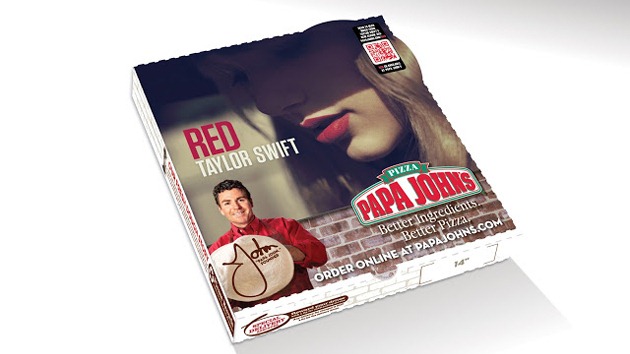
Ms. Swift’s latest ascent into the stratosphere has been aided by several corporate partners, including Papa John’s Pizza which has been delivering to customers Ms. Swift’s “Red” CD along with a single-topping large pizza for a total of $22.

Her photo also appears on Papa John’s pizza boxes.

M_TaylorSwiftPapaJohnsPizza630_101212

Many of Walgreen’s 8,000 locations have displayed the disc prominently, along with free-standing, life-size cardboard images of the 22-year-old pop star that fans have used for photo opportunities.

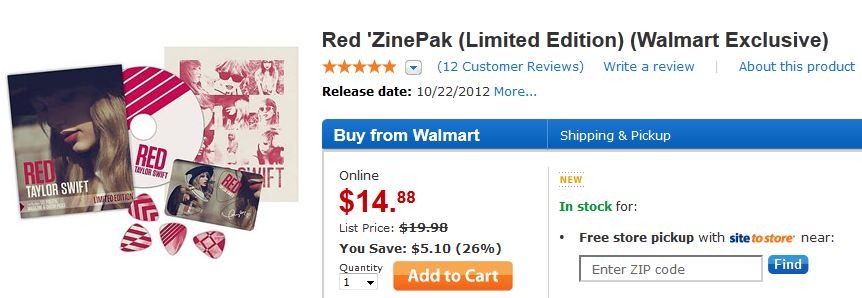
Wal-Mart offers a limited edition Red ‘Zine Pack.

Capture

The album has also been powered largely by more traditional means.

Since announcing the album in August, Big Machine has released four singles and played 30-second previews of each song the day before the singles went on sale on iTunes.

Potentially boosting Ms. Swift’s sales, Big Machine isn’t making her album available through online streaming services such as Spotify for at least several months.

Many artists and labels have complained that they make little from such services, which let users listen to unlimited amounts of music for a flat monthly price, or even free.

Though Ms. Swift is nominally a country artist, her music has taken on an increasingly pop sound, a key to attracting more buyers.

You don’t get a number like she did without attracting a number of tribes.

It’s the niche-ing of America.

Edit by BJP