HITS: HomaFiles Ideas To Share
Punch line: Relatively small increases in price can generate large increases in profitability … that’s called price-profit leverage. And, relatively small increases in prices are low hanging fruit for practically all products and companies since consumers have “zones of price indifference” or, in other words, a “latitude of price acceptance”.
* * * * *
Price-profit Leverage
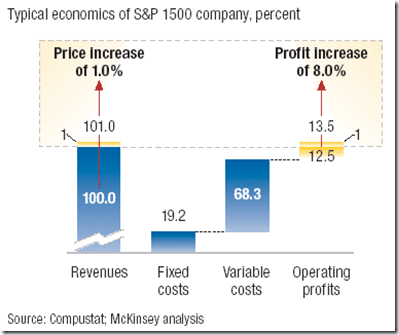
According to McKinsey Increases in price typically have 2 to 4 times the effect on profitability as proportionate increases in volume.
More specifically, given the cost structure typical of large corporations, a 1% boost in price realization yields a 5% to 15% net income gain.
* * * * *
Latitude of Price Acceptance
Customers have a latitude of price acceptance — a range of possible prices within which price changes have little or no impact on their purchase decisions.
Customers frame their LPAs from the price range that they observe, say, in-store vs. online, or regular vs. sale prices.
LPAs vary for different categories of products that customers buy.
A McKinsey & Co. study shows that LPAs can range widely: from 17% for branded consumer health and beauty products to 10% for engineered industrial components and apparel to only 2% for some financial products.
The 2% for financial products may seem paltry, but the McKinsey study indicates that a financial services company moving from the middle to the top of a 2% LPA band for personal loan products would generate an 11% increase in operating profits for those products.
Source
* * * * *
Buyer behavior & LPAs
Scanner panel data analyses for sweetened and unsweetened drink categories support the presence of a region of price insensitivity around a reference price.
- Consumers with higher average reference price have a wider latitude of price acceptance.
- Consumers with a higher frequency of purchase (i.e., shorter average interpurchase time interval) have a narrower latitude of price acceptance, because they are more aware of the range of price distributions.
- Consumers with a higher average brand loyalty have a wider latitude of price acceptance, demonstrating greater tolerance of price fluctuations.
* * * * *
Takeaway: Know the LPA … then go for it … don’t leave easy $$$ on the table.
Source
>> Latest Posts
SHARE THIS POST WITH FRIENDS & FAMILY




 The Homa Files