Archive for the ‘Autos – Travel’ Category

Why the auto companies let the UAW drive the bus …

November 9, 2010

Insightful article by Megan McArdle,  business and economics editor for The Atlantic … 

Punch line: Both the auto companies and the UAW took the most obvious course at any given time, while not realizing that their cumulative decisions were entirely toxic.  They created a non-competitive cost structure that lured foreign competition that wasn’t burdened by high labor costs/

* * * * *
The Atlantic, New GM, Same Old Union?, Oct 5 2010

In the mid-1950s the Big Three had settled into a relatively stable relationship with the UAW. 

When contract time came around, the UAW picked off the company it perceived as the least able to survive a strike; used the threat of a strike to get a good contract; and then demanded the same from the other two. 

Management bought union peace with concessions that seemed cheap at the time:  tax-favored pension and health care benefits. 

Those companies were now in a bad position, because if they risked a strike, their competitor, who already had a contract, would take all their customers.

This relationship essentially meant that the Big Three simply didn’t compete on labor cost, work processes, or any of the other labor-side innovations that have enhanced productivity over the last forty years.  

This was good for the UAW and good for the auto manufacturers, because arguably it actually helped cement their cosy oligopoly by removing one of the major competitive pressures. 

In hindsight, this was stupid for many reasons. 

  • Automation made it possible to produce more cars with fewer workers. 
  • Foreign competition cut into market share — the Big Three had about 90% of the US market at the end of World War II, versus about 45% today. 
  • Workers started living a lot longer than they were expected to.  Now, GM has a little over 50,000 hourly employees–and about a half a million retirees. 
  • Soaring health care costs made the health care benefits even more of a problem than the pensions.

Had there been no foreign competition, this wouldn’t have mattered so much.  

Unfortunately for the Big Three, there was competition, from foreign automakers who didn’t have the same legacy cost structure. 

Critics of the union say that the union should have been willing to give back more on labor.  That’s easy to say, but hard to do; unlike many unions, which put their retirees on inactive status, UAW’s bylaws gave retirees considerable power.  Naturally, by the time 90% of your membership is retirees, those bylaws are not going to be altered.

Critics of the company say that the company could have dealt with these problems by making better cars.   How, exactly, were they supposed to make better cars when they were burdened by these huge legacy costs? 

The company was burdened with these costs simply because it had made extraordinarily generous promises in an era when health care was cheaper — and when the firms and the union had a cozy arrangement that allowed them to pass any increase in their labor costs onto consumers

Full article:
http://www.theatlantic.com/business/archive/2010/10/new-gm-same-old-union/64088/
Mission Accomplished at GM? … We’ll bet ‘under’ (with a caveat).

September 8, 2010

GM is rushing to IPO before the mid-term election to “prove” the wisdom of the bailout.

Pundits are saying that the company’s politically motivated IPO could jeopardize taxpayer ”investment.”

Here’s why:

  • Taxpayers have somewhere between $40 billion to $60 billion “invested” in Gov’t Motors
  • For taxpayers to come out whole, the Treasury’s 304 million of the company’s 500 million common shares would need to average $131 to $197 per share
  • That would put GM’s implied valuation at somewhere between $65 billion to $98 billion.
  • Ford has a market value of only $40 billion.
  • Ford’s near-yerm earnings are expected to be six times those of GM.
  • If investors valued both companies the same …  taxpayers would incur a 50% loss.
  • And, oh yeah, the market isn’t looking all that good these days.

Ken’s Bet: Watch the Administration to rush the IPO and then strong-arm Goldman et. al. to buy up GM shares at inflated prices and either push the share on clients (think CDOs) or eat them in their proprietary accounts.

* * * * *

Post inspired by: Obama’s ‘Mission Accomplished’ Moment At GM, 08.30.10
http://www.forbes.com/2010/08/30/general-motors-ipo-elections-opinions-columnists-shikha-dalmia.html?boxes=opinionschannellatest

Auto sales are booming … or are they ?

August 11, 2010

The initial headlines were that US auto sales were up big in July.

Not so fast.

Yeah, they were up versus July 2009, but …

  • Industrywide deliveries dropped to an 11.1 million pace
  •  GM’s sales rose 1.5% … they were expected to rise 10%.
    Ford’s sales fell 0.7 %, trailing analysts’ estimates for a 10% gain.
    Chrysler sales gained 1.1%, versus a 2.2% expectation
    Toyota and Nissan sales dropped, but topped expectations.

The results show GM’s turnaround efforts may be slowing after last year’s bankruptcy.

Bloomberg, GM, Ford and Chrysler Sales All Lag Estimates,  Aug 3, 2010 Aug. 3
http://www.bloomberg.com/news/2010-08-03/gm-s-july-u-s-auto-sales-rise-5-4-falling-short-of-analysts-estimates.html

Why didn’t they just name it Edsel ?

August 3, 2010

Punch line: The Chevy (oops, I meant to say Chevrolet) Volt will have a  $41,000 sticker price while offering the performance and interior space of a $15,000 economy car.

Maybe nobody will notice …

* * * * *

Excerpted from NYT: G.M.’s Electric Lemon, July 29, 2010

GM introduced America to the Chevrolet Volt at the 2007 Detroit Auto Show as a low-slung concept car that would someday be the future of motorized transportation. It would go 40 miles on battery power alone, after which it would create its own electricity with a gas engine.

Oops.

For starters, G.M.’s vision turned into a car that costs $41,000 before relevant tax breaks (projected to be about $7,500 per car). Tthe Volt’s main competition, the Nissan Leaf ends up costing $8,000 less as a result.

And instead of a sleek coupe , the Volt looks suspiciously similar to a Toyota Prius.

It also requires premium gasoline, seats only four people (the battery runs down the center of the car, preventing a rear bench) and has less head and leg room than the $17,000 Chevrolet Cruze, which is more or less the non-electric version of the Volt.

In short, the Volt appears to be exactly the kind of green-at-all-costs car that some opponents of the bailout feared the government might order G.M. to build.

Though President Obama’s task force reported in 2009 that the Volt “will likely be too expensive to be commercially successful in the short term,” it didn’t cancel the project.

So the future of General Motors (and the $50 billion taxpayer investment in it) now depends on a vehicle that costs $41,000 but offers the performance and interior space of a $15,000 economy car.

If G.M. were honest, it would market the car as a personal donation for, and vote of confidence in, the auto bailout. Unfortunately, that’s not the kind of cross-branding that will make the Volt a runaway success.

Full article:
http://www.nytimes.com/2010/07/30/opinion/30neidermeyer.html?_r=1&ref=opinion

Told you so: Closing auto dealers cost jobs without saving GM any money …

July 20, 2010

Punch line: A government watchdog slammed the Obama administration’s handling of auto dealer closings that were pushed through last year to speed the bankruptcy proceedings of Chrysler and General Motors.

This is neither new news, nor surprising.

HomaFiles reported on these dealer closings when they were going down.

A local dealer told us at the time:

  1. There would be no savings to the car companies since the bulk of their dealer support costs are variable costs, e.g. cooperative marketing programs
  2. In fact, the companies would lose “floor plan” inventory – the cars that dealers have to buy, finance, and keep on their lots.  Fewer dealers translates to fewer cars on lots.
  3. The major criteria for closing were political … dealers who opposed Obama’s plan were warned … and if they continued to make waves, they were put on the “to be closed” list.
  4. Surviving car dealers might become more profitable since fewer dealers means less price competition
  5. The biggest impact of dealer closings would be the dealerships’ employees.  As the guy told me:
    ”I’ll still have my foreign nameplate stores … may have to sell one of my beach houses … but that’s no big deal.  I worry about th 50 to 100 employees per store … some have been with me for 30 years …  I can’t absorb them into my other stores … and I don’t think any surviving dealers will pick many of them up.

* * * * *

Excerpted from Dow Jones: Watchdog Criticizes Treasury’s Role In Auto Dealer Closures, July 18, 2010

The decision by Treasury’s auto task force to reject the companies’ plans for gradual dealer closures in favor of an accelerated process may have exacerbated job losses in the midst of a recession.

The office of special inspector general Neil Barofsky, set up to monitor the $700 billion financial bailout known as TARP, took the administration to task for failing to sufficiently oversee the closures and weigh the broader economic impact of its decisions.

“Treasury made a series of decisions that may have substantially contributed to the accelerated shuttering of thousands of small businesses and thereby potentially adding tens of thousands of workers to the already lengthy unemployment rolls — all based on a theory and without sufficient consideration of the decisions’ broader economic impact.” 

The audit said “only time will tell” whether the accelerated closures will help the companies’ profitability. But Treasury should have “taken every reasonable step” to ensure the closures were necessary and that the benefits to the companies outweighed the economic costs of “potentially tens of thousands of accelerated job losses” 

But many dealers and their congressional representatives said the process by which GM and Chrysler chose which dealerships to cut was arbitrary.

Full article:
http://online.wsj.com/article/BT-CO-20100718-703295.html

Making quirky profitable … the Subaru way.

June 24, 2010

Punch line: By maintaining the quirky persona of its brand and keeping prices low, Subaru has quietly, but aggressively, increased growth … even through the recession.

* * * * *
Excerpted from: Bloomberg Business Week, At Subaru, Sharing the Love Is a Market Strategy, May 20, 2010

While much of the U.S. auto business is just beginning to emerge from retrenchment mode, sales at Subaru are climbing.

“Our customers were not affected by the recession … They have a better financial situation.”

By courting financially solid buyers with a taste for the quirky, has grown steadily and, for the first time, its unit sales exceed those of such better-known brands as BMW, Lexus, Mazda, and Volkswagen.

Subaru has long been popular with a core of professorial drivers in tweed in the Northeast and flannel-clad outdoor enthusiasts in the Northwest. Lately, however, the carmaker has been aggressively moving beyond the snowy, soggy, and mountainous regions that are its stronghold.

Subaru’s secret is that it understands the customers who drive its cars and has gotten smarter and more aggressive about reaching out to new ones who would feel at home as part of that clan.

  • The average household income of a Subaru owner is $88,000, the same as Honda Motor and $10,000 more than Toyota.
  • Subaru buyers are three years younger than the industry average and a quarter more likely to have a college degree.
  • They are a thrifty lot, traditionally buying less car than they can afford. Some 36 percent pay cash.

Much of the automaker’s marketing focuses on cementing its connection to customers.

  • Subaru’s research shows them to be an eco-friendly bunch who value the freedom to go where they want, when they want.
  • Subaru supports causes such as the American Canoe Assn. and the Leave No Trace Center for Outdoor Ethics. Unlike luxury car buyers, Subaruers are “customers who are not buying things, but experiences.”
  • “In their marketing they’ve been focusing on what creates love between the owner and the automobile.”
  • “They are basically adding people who are Subaru buyers in their hearts, but don’t know it.”

The bottom line: By maintaining the quirky persona of its brand and keeping prices low, Subaru has quietly, but aggressively, increased growth.

Full article:
http://www.businessweek.com/magazine/content/10_22/b4180018655478.htm

Your green neighbor wants an electric car … get out your wallet!

May 14, 2010

This week I was again struck by the irony: the US Feds – who have no money and are deeply in debt — are going to borrow still more money from China to bail out the Greeks – who are deeply in debt.  That’s nuts.

And, the few remaining US taxpayers are going to asked (make that ‘told’) that they (and the Chinese lenders) subsidize their neighbors new green rides. 

And incumbents wonder why voters are dispatching them one after another …

* * * * *

Excerpted from WSJ: Welfare Wagons The new electric cars are powered by taxpayer credits, May 12, 2010

Congratulations. You’re about to buy a fancy new Nissan Leaf or Chevy Volt . . . for someone else.

The all electric  Nissan Leaf is a car for a wealthy hobbyist — good for a trip of 100 miles after which it becomes an inert lump at the end of your driveway (or behind a tow truck) for the many hours it will take to recharge. 

The Leaf will roll out in December with a surprisingly modest price of $25,280. That’s after a $7,500 federal tax credit is counted.

Buyers will also have to spring for a $2,200 charging station, but another tax credit ($1,100) cuts the cost in half.

Some states – e.g. bankrupt California, Georgia and Tennessee — will chip in additional consumer tax credits as high as $5,000.

  • Note: total tax credits = $13,600

By pricing low and going for volume, Nissan is making a calculated grab for the lion’s share of the available tax dollars — and also pressuring Washington to extend the program when the money runs out.

iPad lust applies to cars too, and early adopters can be expected to line up around the block.

But it is insane to subsidize these vehicles with taxpayer dollars.

Tax handouts for electric vehicles are emblematic of an alarmingly childish refusal to take account that the U.S. government is deeply in debt. Running up more debt to subsidize electric runabouts for suburbanites is not such a sign.

* * * * *

Even if you believe saving gasoline is a holy cause, subsidizing electric cars simply is not a substitute for politicians finding the courage to jack up gas prices.

Think about it this way:

  • You can double the fuel efficiency of any car by putting a second person in it.
  • You can increase its fuel efficiency to infinity by refraining from frivolous trips.

These are the incentives that flow from a higher gas price.

Exactly the opposite incentives flow from mandatory investment in higher-mileage vehicles. If you paid a lot for a car that costs very little to operate, why not operate it? Why bother to car pool? Why not drive across town for a jar of mayonnaise?

* * * * *

Full article:
http://online.wsj.com/article/SB10001424052748703880304575236692175987752.html?mod=djemEditorialPage_h

Mercedes, BMW … and Lincoln?

May 14, 2010

TakeAway: Just because Ford calls Lincoln its luxury brand doesn’t make it so.  Luxury is in the eye of the beholder and Ford faces the challenging task of changing customer perceptions of its stodgy, “upscale” brand.  So far, the results have been disappointing.

The less-than-luxury perception of Lincoln is not just the result of a communications gap.  Ford has been slow to update the Lincoln product line with original designs not based on middle-market Ford-branded models.

Training Lincoln dealers to offer “high-touch” service is important for the luxury segment, but shouldn’t Ford first figure out how to get customers to the dealerships?  The new models launching this summer will tell us if they got it right.

* * * * *

Excerpted from Bloomberg Businessweek, “With Lincoln, Ford Isn’t in the Lap of Luxury,” by Keith Naughton, May 6, 2010

Business is booming in Jack Kain’s Ford dealership in London, Ky. Not so much, though, at his Lincoln showroom, where new models … go begging for buyers …

Ford is on a roll, as mainstream car buyers embrace the American brand that didn’t go bankrupt. Now that CEO Alan Mulally is unloading Volvo, however, Ford’s upscale ambitions are riding on Lincoln. Sales at the unit are down 64% from its 1990 peak and buyers average an industry-high age of 62 … “To younger generations, that’s grandpa’s car,” says auto analyst Jesse Toprak … “That doesn’t help when you’re going up against Mercedes and BMW.”

Ford is trying to give Lincoln a hip implant. It’s outfitted four new models with more-dramatic design and installed high-tech features including a voice-activated phone and entertainment system …

The new look isn’t helping much. Lincoln’s U.S. market share is stuck at a paltry 0.8% this year, while the Ford nameplate grew at its fastest rate since 1977 … Lincoln is still defined by the black Town Car that has ferried generations of business travelers to the airport,

Ford long ignored Lincoln, in part because … it bought a stable of European luxury brands that seemed to hold more potential: Jaguar, Land Rover, Aston Martin, and Volvo. But … Mulally began dismantling what he called Ford’s “house of brands,” selling off the European lines at fire sale prices. The idea was to first fix its largest franchise, the middle-market Ford brand … Lincoln, whose models are based on Ford’s mechanical platforms and built in Ford plants, would be kept and fixed later.

Ford is retiring the Town Car next year and launching new models aimed at younger buyers like the MKX sport wagon this summer. It’s infusing Lincoln advertising with Gen X-friendly music from the 1980s. And Lincoln dealers are being trained to offer the high-touch service given by some European manufacturers …

The bottom line: Ford dumped its luxe brands to focus on its core vehicles. Now it’s left with aging Lincoln just as luxury demand is set to take off.

Edit by DMG

* * * * *

Full Article
http://www.businessweek.com/magazine/content/10_20/b4178023174411.htm

* * * * *

PowerPoint Management: Ford’s secret to recent success

March 16, 2010

Punch line: Ford’s CEO Ford’s CEO has an obsession with Power Point … and it works !

* * * * *

Excerpted from WSJ: Ford’s Renaissance Man, Feb 26., 2010

Alan Mulally, Ford’s president and chief executive officer, is exuding ebullience over, of all things, PowerPoint slides.

“How cool is that?” asks Mr. Mulally, pointing to slides showing rows and rows of numbers … relishing a slide of color-coded charts depicting the status of key projects that looks like a scrambled Monopoly board … and one that shows overlapping ovals that depict the configuration of corporate alliances in the global car business.

Mr. Mulally and his team of 16 top executives review 300 such slides in each weekly BPR, or Business Planning Review, which lasts just over two hours.

“If you aren’t comfortable with that you might be more comfortable leaving the company.”

To a visitor, these slide shows sound mind-numbing. But the CEO is excited about them for good reason.

Ford’s recent success is already amazing considering the prior half-dozen years of near-fatal decline. If it continues, Mr. Mulally will be credited with one of the great turnarounds in corporate history. His method has been to simplify, relentlessly and systematically, a business that had grown way too complicated and costly to be managed effectively.

“Improve Focus, Simplify Operations,” reads one of Mr. Mulally’s many charts, which he repeats like a sacred mantra.

* * * * * 

Soon after his arrival Ford began shedding brands—Jaguar, Land Rover and Aston Martin among them—that the company couldn’t afford to support. Volvo will be next to go.

In the process, Ford cut its number of global platforms, or chassis, to eight from more than 20, and the number of nameplates to 25 from 97.

Ford is methodically implementing the “One Ford” strategy of developing cars in a single region (say Europe, or North America) and selling them globally, instead of developing slightly different cars in each region at enormous extra cost.

“It’s back to Henry Ford’s original vision, isn’t that cool?” gushes Mr. Mulally, reaching for—you guessed it—yet another chart. “It’s all about producing products people want,” he adds. “Our goal is PGA – Profitable Growth for All.”

Full article:
http://online.wsj.com/article/SB10001424052748704479404575087372469421104.html?mod=djemEditorialPage_h

The new GM figures out that trucks are profitable and green cars aren’t … no kidding.

January 13, 2010

Excerpted from WSJ: Back to the Future: GM Bets on Trucks, Jan. 13, 2010

GM now is trying to boost revenue and return to profitability in a bid to repay the $6.7 billion in cash it owes the U.S. government. The Treasury Department also invested roughly $50 billion more in GM that was converted into a 60% stake in the auto maker.

The government has pushed GM, Chrysler — which also restructured in a federally financed bankruptcy — and other auto makers to produce smaller, more fuel-efficient vehicles, including battery-powered cars.

But, GM announced that it is using freed up cash to fund a major update of its full-size pickups, a bet that consumers and businesses will resume buying trucks after a long lull in sales.

GM, which had relied on full-size pickups such as the Chevrolet Silverado for a major portion of its U.S. revenue and operating profit, had put off redesigning the trucks as its finances collapsed and it underwent a government-backed bankruptcy reorganization last year.

Trucks sales sagged in the past two years after gasoline spiked to $4 a gallon in 2008 and home sales — a big driver of truck purchases by contractors and builders — collapsed amid the recession.

Until the past few years, full-size pickups had been a big business for Detroit car companies. They often sell for $30,000 and more and generate thousands of dollars in operating profit each.

“When the housing industry starts to pick up, you will see truck sales increase immediately and companies will need to have fresh products out there,”

Full article:
http://online.wsj.com/article/SB126334663717427135.html?mod=WSJ_hps_LEFTWhatsNews

Nouveau rides may leave drivers up the creek without a paddle

January 7, 2010

Takeaway: Green enthusiasts applaud electric cars as a breakthrough innovation to control emissions.

However, these cars’ limited range along with an absence of charging stations may leave consumers stranded.

The product’s success is unlikely unless automakers find an effective way to fill these voids by identifying and serving a niche market better than do legacy products.

Only highly satisfied customers will tout the product’s benefits to others and thereby help the manufacturers cross the chasm to broad-based product adoption.

* * * * *

Excerpt from Washington Post, “Where can I juice up my ride?”, by Pete Whoriskey, November 17, 2009.

Electric cars entering U.S. showrooms as early as next year will be engineering marvels: stylish, battery-operated, zero-emission wonders.   While most electric cars are expected to be recharged at home, the predicament of a driver who runs out of battery power on the road has yet to be settled. 

A Nissan chief executive said in an interview that he believes that range anxiety will afflict only a portion of the potential market. For plenty of people, trips of 100 miles or less will be fine.

General Motors, meanwhile, has studied range anxiety and seems to have arrived at a different conclusion.  Accordingly, its forthcoming electric car runs on a battery for the first 40 miles, but when the charge runs low, a gasoline engine kicks in. With or without public charging stations, a Volt driver can motor on as long as there is a gas station nearby.

“For a long time, cars have represented a way to move around — freedom,” a GM executive said. “Some people are unwilling to accept restrictions to that.”

Nissan said that by forgoing the gas engine at the expense of a more limited range, Nissan will be better able to make its electric cars cheaply.

Nissan and other companies exploring the market for electric cars say it would be very difficult to win over consumers without the benefit of the $7,500 tax credit for people who purchase electric cars.

Edit by BHC

* * * * *

Full Article
http://www.washingtonpost.com/wp-dyn/content/article/2009/11/16/AR2009111603706.html?wpisrc=newsletter&wpisrc=newsletter&wpisrc=newsletter

* * * * *

Cash for a Clunker? … GM’s gov’t-selected CEO gets the heave-ho.

December 2, 2009

In March, Pres. Obama and his “car czar” axed GM’s CEO Rick Waggoner and appointed  Fritz’ Henderson to replace him, change the organizational culture, and save the company.

Oops.

On Tuesday, the GM board forced Henderson to resign, and initiated a search for his successor.

Good luck.   

Bringing in new blood is likely to be pretty hard since the company’s major shareholder (Uncle Sam) is capping pay offers, and restricting bonuses. 

The paradox: GM needs somebody with great judgement … and anybody who would take the job is disqualified based on that criteria alone.

http://online.wsj.com/article/SB10001424052748703735004574570370686365390.html?mod=article-outset-box

Cash 4 Clunkers … or, make that Cash for a new Hummer … geez.

November 10, 2009

TakeAway: Under Cash for Clunkers, some owners of large pickups cashed in old trucks for between $3,500 and $4,500 toward new Hummer H3 SUVs that got only 16 mpg.        

Source: Associated Press: Clunker pickups traded for new pickups, Nov 4, 2009

The most common deals under the government’s $3 billion Cash for Clunkers program, aimed at putting more fuel-efficient cars on the road, replaced old Ford or Chevrolet pickups with new ones that got only marginally better gas mileage.

The single most common swap — which occurred more than 8,200 times — involved Ford F150 pickup owners who took advantage of a government rebate to trade their old trucks for new Ford F150s. The fuel economy for the new trucks ranged from 15 mpg to 17 mpg based on engine size and other factors, an improvement of just 1 mpg to 3 mpg over the clunkers.

Owners of thousands more large old Chevrolet and Dodge pickups bought new Silverado and Ram trucks, also with only barely improved mileage in the middle teens,.

Those deals helped the Ford F150 and Chevy Silverado — along with Ford’s Escape midsize SUV — climb into the Top 10 most-popular vehicles purchased with the government rebates. The most common truck-for-truck and truck-for-SUV deals totaled at least $911 million.

* * * * * 

In scores of deals, the government reported spending a total of $562,500 in rebates for new cars and trucks that got worse or the same mileage as the trade-ins — in apparent violation of the program’s requirements.

More than 95,000 of the new vehicles purchased under the program — or about one in seven — got less than 20 mpg, according to the data.

Plenty of consumers bought relatively low-mileage trucks and SUVs with the help of government checks.

Full story:
http://news.yahoo.com/s/ap/20091104/ap_on_bi_ge/us_cash_for_clunkers

* * * * *

On the plus side:

Popular high-mileage commuter cars including the Toyota Corolla, Honda Civic, Toyota Camry and Ford Focus also were among the Top 10 most popular new vehicles bought under the four-week program, with 105,280 of those models sold for a total of about $2 billion.

Ignoring its product problems, GM attempts to boost sales via distribution increases

October 22, 2009

TakeAways: (1) When you give buyers a chance to bid low on your product, they will.  (2) If your  product sucks, they’ll bid low … real low.

Welcome to the era of Government Motors.

* * * * *

Excerpted from WSJ, “GM, eBay End Online Sales Effort” By Geoffrey Fowler, Scott Morrison, and Sharon Terlep, September 30, 2009

General Motors is ending a seven-week experiment to sell new cars in California with eBay as many dealers report the online marketplace didn’t help sell more vehicles and led shoppers to offer low-ball prices … but the program did generate customer interest … and customer leads …

The program launched … as part of an effort to make car shopping more convenient …

The experience illustrates why car retailing, which involves peculiarities such as franchised dealers with exclusive territories and the tradition of haggling in person, makes an odd fit for the Web, where consumers expect to comparison shop for the lowest price …

The promotion didn’t allow customers to bid against each other, like they do in typical eBay auctions. Rather, they could click “Buy It Now” to purchase a car at a preset price, or send an offer to a dealer … the ridiculously low offers forced staff to sift through bids that were highly unlikely to result in sales …

Maybe GM and eBay should have done more to set appropriate expectations among shoppers, many of whom had no idea where to start their price negotiations.

Edit by TJS

* * * * *

Full Article
http://online.wsj.com/article/SB125423429407549391.html#mod=todays_us_marketplace

* * * * *

First Cash for Clunkers … now, Carts for Clubbers.

October 20, 2009

Ken’s Take: This stuff keeps getting nuttier and nuttier. 

Half-baked ideas with shoddy implementation doesn’t strike me as a (cart) path to success.

* * * * *

Excerpted from WSJ:Cash for Clubbers – Congress’s fabulous golf cart stimulus, Oct. 17, 2009

Thanks to the federal tax credit to buy high-mileage cars that was part of President Obama’s stimulus plan, Uncle Sam is now paying Americans to buy that great necessity of modern life, the golf cart.

The federal credit provides from $4,200 to $5,500 for the purchase of an electric vehicle, and when it is combined with similar incentive plans in many states the tax credits can pay for nearly the entire cost of a golf cart. 

The golf-cart boom has followed an IRS ruling that golf carts qualify for the electric-car credit as long as they are also road worthy. These qualifying golf carts are essentially the same as normal golf carts save for adding some safety features, such as side and rearview mirrors and three-point seat belts. They typically can go 15 to 25 miles per hour.

The IRS has also ruled that there’s no limit to how many electric cars an individual can buy, so some enterprising profiteers are stocking up on multiple carts while the federal credit lasts, in order to resell them at a profit later. 

Roger Gaddis of Ada Electric Cars in Oklahoma said earlier this year. “Is that about the coolest thing you’ve ever heard?”

If this keeps up, it’ll soon make more sense to retire and play golf than work for living.

Full article:
http://online.wsj.com/article/SB10001424052748704107204574473724099542430.html

* * * * *

Cash for Clunkers: Preliminary post-mortem …

October 5, 2009

Ken’s Take: The core question re: the effectiveness of C4C is whether the program created incremental demand for cars or simply paid people to shift likely demand earlier. Initial results are coming in … synopsis: ouch !

* * * * *

Excerpted from WSJ: One of Washington’s all-time dumb ideas, Oct. 4, 2009

Remember “cash for clunkers,” the program that subsidized Americans to the tune of nearly $3 billion to buy a new car and destroy an old one?

Last week U.S. automakers reported that new car sales for September, the first month since the clunker program expired, sank by 25% from a year earlier. Sales at GM and Chrysler fell by 45% and 42%, respectively. Ford was down about 5%.

Some 700,000 cars were sold in the summer under the program as buyers received up to $4,500 to buy a new car they would probably have purchased anyway, so all the program seems to have done is steal those sales from the future. Exactly as critics predicted.

Burton Abrams and George Parsons of the University of Delaware added up the total benefits from reduced gas consumption, environmental improvements and the benefit to car buyers and companies, minus the overall cost of cash for clunkers, and found a net cost of roughly $2,000 per vehicle. Rather than stimulating the economy, the program made the nation as a whole $1.4 billion poorer.

In the category of all-time dumb ideas, cash for clunkers rivals the New Deal brainstorm to slaughter pigs to raise pork prices. The people who really belong in the junk yard are the wizards in Washington who peddled this economic malarkey.

* * * * *

http://online.wsj.com/article/SB10001424052748703628304574453280766443704.html?mod=djemEditorialPage#printMode

* * * * *

RIP: Saturn – a new (make that dead) car company …

October 2, 2009

Ken’s Take: I seem to be the solitary mind thinking that GM should keep the Saturn brand and distribution network and use them for sale and distribution of electric and hybrid cars.  Seems like a perfect fit to me.

* * * * *

Excerpted from WSJ: Collapse of Penske Deal Spells End For Saturn, Oct. 1, 2009

A deal to save GM’s Saturn brand fell through after former race-car driver Roger Penske unexpectedly abandoned a bid to buy its network of dealers, prompting GM to say it would shut the operation down.

It also likely will add Saturn’s 350 dealers to the thousands of U.S. auto retailers that are closing in the car industry’s worst downturn since World War II.

The novel bid to create a car company that didn’t build cars fell apart when Penske Automotive Group failed to secure a related agreement to have France’s Renault SA supply autos for dealers to sell when GM stopped building Saturns in about two years.

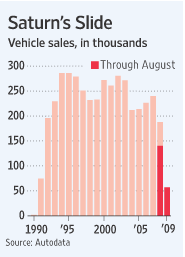
For Saturn, it likely means the end of the road for a quirky brand that analysts believe never made money in its 19-year history. GM created Saturn in an attempt to better compete against Japanese auto makers such as Toyota Motor Corp.

Saturn won loyal fans who liked its customer-friendly image and no-haggle sales policy.

But GM produced few new Saturn models in the 1990s and, despite a flurry of critically acclaimed cars added this decade, it never met its sales targets.

The chance of another buyer stepping in to purchase Saturn is remote.

Saturn will wind down by October 2010 under agreements GM already made with the brand’s dealers. Many of the dealerships are expected to close before that deadline. GM remains in talks to sell Saab and Hummer, and is shutting down Pontiac.

GM said earlier this year that Saturn, Hummer and Saab generated an average annual pretax loss of $1.1 billion a year. The moves leave GM with four brands: Chevrolet, Cadillac, Buick and GMC.

image

Full article:
http://online.wsj.com/article/SB125434260817353567.html?mod=WSJ_hps_LEFTWhatsNews#printMode

* * * * *

Build your own electric car … my friend did !

October 1, 2009

Ken’s Take: A friend of mine recently finished cobbling together — from scratch — an electric car.  Gotta love it when somebody walks the talk … instead of just talking.  Way to go Brian.

* * * * *

From the St. Cloud Minnesota Times:

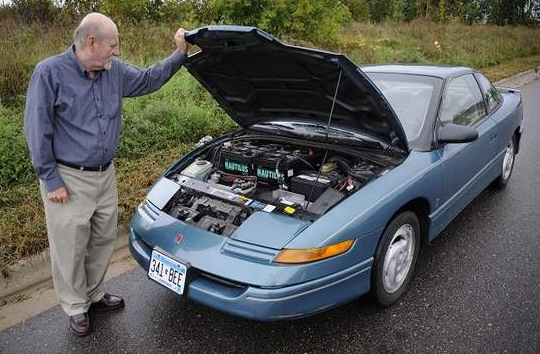
For Brian Darovic, filling up his car is as simple as plugging in a toaster — and almost as inexpensive.

Darovic of Sartell recently converted his car from a standard, gas-powered vehicle to an electric, battery-powered vehicle.
“Sure, you could buy a GM Volt next year for $40,000,” Darovic said. “But are you going to be spending $40,000 on a car next year? I’m not.”

Though electric car conversion kits are available for between $10,000 and $15,000, Darovic was determined to build it from scratch.

He found a 1994 Saturn and spent more than a year on the project. He sketched designs and then removed the vehicle’s engine, fuel tank, exhaust system and radiator. They were replaced with an electric motor, 12 batteries and a device that controls the motor speed.

The project cost between $9,000 and $10,000, not including labor.

The car covers about 25 miles per charge with a top speed of 60 mph. But Darovic expects to reach 40 miles per charge after he finishes fine-tuning the vehicle.

Darovic estimates his Voltessa will cost about $1 per charge or a little more than 2 cents per mile.

Electric cars are also low maintenance. Tires, brakes, shock absorbers, lights, horn, radio, seats, glass and body work remain the same as those of a gasoline-fueled engine.

But there is no more need for oil changes, antifreeze, belts, exhaust systems or tune-ups. Electric motors are essentially zero maintenance and last the life of the vehicle.

While Darovic had experience working with cars, he said the conversion process is simple enough for those with less experience. “Just about anybody could do it. It’s not rocket science.” 

As demand increases and costs decrease, electric cars are likely to become more affordable. For those that don’t want to wait, converting an existing vehicle to electric power offers a cost-effective solution for today.

http://www.sctimes.com/article/20090926/NEWS01/109260013&referrer=FRONTPAGECAROUSEL

image

* * * * *

A123’s Systems’ IPO is a big deal … here’s why.

September 28, 2009

Ken’s Take: A123’s Systems’ IPO is a big deal for 2 reasons:

(1) A successful IPO has to be a good sign for the market

(2) Virtually all batteries for hybrid and electric cars are made outside the U.S. — mostly in Japan and Korea.  So, a shift to hybrids would still make the U.S. dependent on foreign sources for the cars’ power supply.  Domestic sources of batteries is critical for energy independence.

But note: lithium — the primary component of most rechargeable batteries — is almost entirely mined outside the U.S.   For more details, see the February 26, 2009 HomaFiles post “Batteries are the key weapon in the battle for energy independence … too bad we’re losing the weapons race.” 
https://kenhoma.wordpress.com/2009/02/26/batteries-are-the-key-weapon-in-the-battle-for-energy-independence-too-bad-were-losing-the-weapons-race/

* * * * *

MarketWatch, A123 Systems jolts IPO market,  Sept. 24, 2009

Lithium ion battery maker draws strong interest

A123 Systems’ newly minted shares jumped 50% in their stock market debut as Wall Street placed its bets behind the government-subsidized maker of lithium-ion batteries for the growing electric car market. On Aug. 6, A123 won $249 million in federal stimulus funds, which the company plans to use to build factories for making batteries.

A123 drew interest from IPO investors as a way to tap into new technology. The company raised $378 million in its debut on the Nasdaq.

* * * * *

A123 Systems, an eight-year-old battery builder launched by engineers from the Massachusetts Institute of Technology, has yet to turn a profit. The company reported a loss of $40.7 million on revenue of $42.9 million in the six months ended June 30.

The company carries marquee investors in its list of principal shareholders, including General Electric , Qualcomm Inc. , Motorola Inc. and North Bridge Venture Partners.

Not only a provider for electric cars, A123 Systems develops and manufactures advanced lithium-ion batteries and battery systems for the electric grid services and consumer markets as well.

* * * * *

A123 said in its IPO filing that the number of hybrid electric, plug-in hybrid and electric cars is expected to grow from 19 models in 2009 at an annual production rate of at least 20,000 vehicles to more than 150 models in 2014 and more than 200 models in 2019.

A.T. Kearney projects the market will grow to about $21.8 billion by 2015 and $74.1 billion by 2020, stoked by governmental regulation, emerging powertrain technology and rising consumer demand.

* * * * *

Full article:
http://www.marketwatch.com/story/story/print?guid=FEC91852-2BEC-4821-A6C2-F3BD67C61B7A

* * * * *

Toyota powers up … more ads, more hybrids.

September 21, 2009

Reuters – CNBC.com, Toyota Plans $1 Billion Marketing, More Hybrids, 17 Sep 2009

Toyota landed three models among the top 10 sold in the recent “Cash for Clunkers” incentive program by the U.S. government.

Now, Toyota is preparing a $1 billion marketing campaign — 30 percent to 40 percent more than the company typically spends in the quarter — to boost U.S. sales in the fourth quarter, while also expanding its line of hybrid models under the Prius name.

The $1 billion will include a media campaign, as well as buyer and dealer incentives, including sweeteners for leasing.

Word of the media blitz comes less than a week after General Motors announced its own media campaign, in large part aimed at recapturing consumers who believe Toyota and other foreign automakers make better products.

Toyota executives said the company planned to sell 500,000 to 600,000 hybrid vehicles globally by the end of 2009.

Full article:
http://www.cnbc.com/id/32903880

* * * * *

Shocker: Car dealers “fully price” during C4C landrush …

September 4, 2009

From the WSJ:

The federal “cash for clunkers” program pushed auto sales to their highest levels in over a year. But.analysts say the boost is likely temporary and some anticipate falloff.

Auto sales for August were between 13 and million on a  seasonally adjusted annual rate .

For comparison, auto sales regularly hit 16 million a month before the recession, they have since dipped, hitting a low in February of 9.1 million.

Even within August, the numbers point to a pullback. On a weekly basis, dealers sold cars at an annualized rate of over 19 million in the first week of the clunkers program, followed by weeks of car sales at rates of 12 million.

In the final week of August, after the program ended, sales slumped to eight million.

And, according to Edmunds.com, the clunkers program caused “unintended consequences”, including higher car prices and lower levels of supply.

Dealers raised their prices on Toyota Corollas, for example, by approximately $445 while the clunkers program was in effect. Many dealers were charging sticker prices (or more) for hybrids.

WSJ, Next for Auto Sector, Post-Clunker Hangover, Sept 1, 2009 
http://online.wsj.com/article/SB125175596718373969.html

* * * * *

TakeAway: There’s a big difference between unintentional and un-anticipatable – neither the pull-up of sales nor the jacked up prices should surprise anybody.

* * * * *

Cash-for-Clunkers: The “Re-Leveraging Effect”

September 3, 2009

Bottom line: the C4C program jacked $3 billion from about 100 million tax payers, redistributed it to 750,000 clinker owners (some tax payers, some not), and leveraged the rebates dollar-for-dollar into $3 billion in new consumer debt.

* * * * *

Talk with friends over the weekend turned to the C4C program … specifically, how many rebate-takers were driving clunkers because they couldn’t afford a fancy new ride.  Consider the implications if that’s true.

Running some back-of-the-envelope numbers, it’s likely that C4C buyers took on debt (auto loans) equal or greater than the tax payer provided rebates.

Here’s the logic, using rough, top-of-mind assumptions:

Assume that a clunker qualifies for a $4,000 rebate, that the clinker owner applies the rebate to a new $24,000 car, and that $20,000 balance is rolled into a shiny new auto loan. (Note: no money down – just like the home deals that got us into this mess).

Assume the $20,000 is financed at 6% over a 4 year term.  The monthly payment is just a bit under $500.

So, the clunker-trader walked into the showroom with a clunker and no auto loan payments. 

He rides out with a cool new ride and a new $500 monthly payment.  Hmmm.

Assume that 1 in 4 clunker-traders are rich folks who pay cash, and that the other 3 take out auto loans.

Project the numbers to the whole program (calcs below) … and PRESTO – the C4C program jacked $3 billion from about 100 million tax payers, redistributed it to 750,000 clinker owners (some tax payers, some not), and leveraged the rebates dollar-for-dollar into $3 billion in new consumer debt.

Frankly, I’m not sure if that’s good or bad.  Maybe the stimulative effects are worth it.

But, it begs the question: isn’t this how we got into this mess in the first place?

* * * * *

image

copyright K.E. Homa 2009, All Rights Reserved

* * * * *

C4C … here’s the “incremental analysis”

August 18, 2009

Most reports tout the Cash for Clunkers programs as a runaway success.

In fact, about 250,000 C4C deals were transacted in a week or two – fully utilizing the budgeted $1 billion – at an average rebate of about $4,000.

But …

Marketing promotions should always be evaluated on an incremental basis.  That is, how many sales were induced over and above what would have happened any way.

Car authority J.D. Power and Associates thinks that most of the cars purchased through the C4C program were simply sales that would have happened this year but were pulled ahead a few months. The company thinks that as few as 20% of the cars bought in the program are really new sales to the market. That means that as many as 80% of the cars would have been sold this year anyway. Edmunds.com, which tracks vehicles pricing and buying data, agrees. They say: “when the public thought that the program would cease after the first billion dollars was spent, they rushed to dealerships.By Aug. 20, we could be back to pre-clunker sales levels.”

So what ?

Well, from a marketing analysis perspective, the full cost of a program should be assigned to the incremental sales.  So, the $1 trillion should be allocated across 50,000 incremental car sales (20% times 250,000).  That’s about $20,000 per incremental sale. 

Recast, phase 1 of C4C took 250,000 clunkers off the road by, in effect, giving away 50,000 new, more fuel efficient cars.

Worth it? 

You decide.

* * * * *

See Business Week, Cash for Clunker Interest Slows, August 14, 2009
http://www.businessweek.com/autos/autobeat/archives/2009/08/cash_for_clunke_10.html

* * * * *

Uh-oh … Cash for Clunkers sputtering ?

August 12, 2009

Ken’s Take: Maybe I was mistaken when I said I was mistaken …

* * * **
Excerted from CNNMoney.com, Interest in Cash for Clunkers sputters, August 11, 2009

After sparking an initial rush to showrooms, the Cash for Clunkers program seems to be running out of fuel.

Interest in Cash for Clunkers has fallen 15% since its peak, and the number of people planning to buy cars could fall to pre-Clunkers levels by next week, an auto research group said.

Under the Clunkers program, vehicles purchased after July 1 are eligible for refund vouchers worth $3,500 to $4,500 on traded-in cars with a fuel economy rating of 18 miles per gallon or less.

The program ran through its initial $1 billion in its first week,leading lawmakers to approve an additional $2 billion in funding.

But interest in the program peaked on July 29, and demand has waned, according to the report from Edmunds.com.

The report, which cited Internet shopping data, said if current trends continue, auto purchase intent will fall back to pre-Cash for Clunker levels by August 20.

The original money set aside for “created a Gold Rush mentality where consumers hurried to take advantage before funding ran out.”

The additional $2 billion in funding removed the urgency to participate.

Full article:
http://money.cnn.com/2009/08/11/autos/cash_for_clunkers_interest_declines/?postversion=2009081114

* * * * *

Trading in American clunkers … for new Toyota rides

August 11, 2009

According to the Department of Transportation …

Top Trade-Ins Under Cash for Clunkers

1.  Ford Explorer
2.  Ford F150 Pickup 2WD
3.  Jeep Grand Cherokee 4 WD
4.  Jeep Cherokee 4 WD
5.  Dodge Caravan/Grand Caravan

Top New Car Purchases: Cash for Clunkers

1.  Toyota Corolla
2.  Ford Focus FWD
3.  Honda Civic
4.  Toyota Prius
5.  Toyota Camry 

Draw your own conclusion …

* * * * *

How do you know a successful new car when you see it ?

August 6, 2009

 Ken’s Take: This article is specific to the auto industry but the general principles are applicable to most businesses.

* * * * *

Excerpted from: WSJ, The Auto Industry’s Comeback, July 29, 2009

The future of any car company is built on the relative success of its new cars.

Between now and 2014 there will be approximately 250 launches of either all-new or significantly redesigned new cars in the U.S.

* * * * *

What constitutes a successful launch?

First,  focus on the true indicators of how well a launch is going. Sales reports are not enough. What are the cars actually selling for at retail? Do the vehicles require incentives? Are dealers earning a profit? How are the residual values holding?

Second, the company must deliver a high-quality product if sales are to be sustained. Getting things right from the start has become the price of admission. Even the most subtle mistakes—like user-unfriendly technology—can kill off an otherwise promising product.

Third, the vehicle must have appeal. Owner delight with the design, content, layout and performance can be objectively measured. Attributes such as drivability, instrument panel layout can make the buyer an advocate and give the launch momentum.

Fourth, the products must have durability and reliability. It takes about three years to get a good reading on how the consumer feels about these two qualities. But we do know there is a direct relationship between a brand’s reputation for reliability and durability and its performance. So part of the assessment should include a look at the reputation of the brand. Where the reputation is strong, the launch gets a boost.

Fifth, while manufacturers launch cars, dealers sell them. The dealer’s willingness to put his best sales people on the new product, advertise vigorously, finance, carry and merchandise (a fancy word for trick out) the requisite inventory is all a reflection of the dealer’s confidence in the franchise. Brands that enjoy a high level of dealer confidence and exclusive dealership facilities have a more effective channel for launching a new vehicle.

 Full article:
http://online.wsj.com/article/SB10001424052970204886304574308202570479912.html

* * * * *

The Auto Biz: Some reasons for optimism …

August 5, 2009

Ken’s Take: I’m still betting under on this one …

* * * * *

According to the WEJ …

Ssome analysts are predicting that new car sales could hit 15 million in 2012 because …

  • American motorists are scrapping 10 million to 12 million vehicles each year.
  • There are nearly 6million buyers who have been kept out of the market because they owe more on their vehicles than they’re worth.
  • There are millions of consumers who bought the “near new” cars that the daily rental fleets quickly turned over at auction. Now, daily rental companies are holding their inventory much longer (30,000 miles plus), so the “near new” customer will be back in the new car market.

Conceivably, streamlined car manufacturers are positioned to make serious money when the market turns up.

* * * * *

Excerpted from: WSJ, The Auto Industry’s Comeback, July 29, 2009
http://online.wsj.com/article/SB10001424052970204886304574308202570479912.html

* * * * *

Cash for Clunkers Surprises its Critics … me included

August 3, 2009

I still don’t get it, but obviously I was wrong when I bet under on Cash for Clunkers (C4C). I disn’t think it would generate much showroom traffic, let alone sales.

Bit by all reports, C4C is the hottest promotion since Hoover UK almost bankrupted itself by offering free plane tickets with the purchase of a vacuum cleaner.

Where did I go wrong ?

First, I assumed that the $4,500 government rebate was just a replacement for a trade in allowance.  So, only real clunkers – worth less than $4,500 as a trade – would be advantaged.

Second, I assumed that clunkers were being driven by downscale folks who didn’t have the scratch for brand new rides – who bought used cars and drove them until they died.  These folks, I thought, wouldn’t be able to step-up to buy new cars.

Apparently, many rich folks make their teenage or college kids drive hand-me-down cars – maybe to humble them.  Dealers are saying that these are the clunkers being traded in.  So, the kids get fancy new bumpers for their Obama ‘08 stickers.

Third, and most important, I underestimated naturally pent-up demand. According to an analysis by Edmunds.com “in any given month 60,000 to 70,000 “clunker-like” deals happen with no government program in place .. over 100,000 buyers put their purchases on hold waiting for the program to launch.”

OK, I missed on the program’s initial take-up, but I still see problems:

1) Reports say that the bulk of deals are for non-Detroit brands. Oops.

2) Easy prediction: fraud will be prevalent, e.g. clunkers showing up on used car lots instead of scrap heaps.

3) It’ll be hard to go off the needle.  Over the past few years, auto companies have tried – with only modest success – to wean the market off deep price rebates.

Let’s see what happens when taxpayer-funded discounts end.  Hmmm.

Maybe they won’t. Ouch.

Even so, gotta admit that it makes me smile to see the President touting Cash for Clunkers as his administration’s hallmark stimulus initiative.  That alone is worth a couple of billion dollars.

* * * * *
Source for Edmunds data
http://online.wsj.com/article/SB10001424052970204619004574324350084909302.html?mod=djemEditorialPage

* * * * *

Cash for Clunkers … bet “under” on this one, too

July 15, 2009


Ok, another $1 billion government program .  This one is intended to to jump-start  — or as VP Biden would say “dropkick” –the car industry. 

Let’s start with the basics: if the program were to work, fewer than 300, 000 cars would be sold –- about 1 weeks worth of sales.  And, not all  of those would be be incremental to the ones that might have bought any way.  So call it 250,000.

But, not to worry, not much of this money will make its way out of Treasury’s vault.

Why?

Though there are no income limits on voucher recipients, nor restrictions on where the new cars are made — the program has lots of “small print” qualifiers. 

According to Business Week:

• Vouchers of either $3,500 or $4,500 will only be given to people who trade in an older vehicle to buy a new one.

• The trade-in, or clunker, must be no older than 25 years, have average gas mileage of less than 18 miles per gallon.

• The clunker must have been owned by the seller for at least a year.

• The new car must cost less than $45,000 and get more than 22 mpg. To get the higher voucher, the new vehicle must also average 10 more miles per gallon than the old one.

• To get the higher voucher, the new vehicle must also average 10 more miles per gallon than the old one.

• For trucks—SUVs, pickups, and minivans, a improvement of at least 2 mpg between the old and new vehicles qualifies for $3,500; 5 mpg or more entitles buyers to $4,500.

Ken’s translation of the rules: good luck.

If a clunker qualifies, there are some obvious questions about whether the folks driving those clunkers are willing and able to step up to brand-new wheels.

Think about it. 

The economic impact is less than the face value of the rebates.  Why?  Because the clunkers probably have some market value that is greater than zero  – i.e. the owner can sell it as a step-up model to somebody driving a clunkier (or dead) clunker.  An economist would say that only the difference between the rebate and the clunker’s fair market value counts as an incentive.

More important, people usually drive clunkers because they can’t afford any thing else.  People driving clunkers often buy used cars – not new ones, and even with a $4,500 discount, they probably won’t want to take on new-car payments during a time of economic hardship.

Maybe an arbitrage market will emerge, with upscale people buying a clunker on the open market for less than its clunker program rebate, and trading it in for fancy new wheels (that they were going to buy anyway) – deducting the the clunker rebate’s full “coupon” value. 

What about the rule that somebody has to have owned the car for at least 1 year?  Easy: the current clunker owner uses the rebate to buy a new cay, and then immediately turns around and flips the new car to a pre-arranged “partner”.  Pretty easy.

Congressional reps really should read these bills before they  enact them …

Source article:
Business Week, Cash for Clunkers: What Can $1 Billion Buy?, June 24, 2009 
http://www.businessweek.com/magazine/content/09_28/b4139000349712.htm

* * * * *

Gov’t Motors agrees to assume legal responsibility for defect-related injuries drivers suffer … well, kinda.

June 29, 2009

Ken’s Take: First, the gov’t tossed contract and bankruptcy laws out the window and screwed the secured creditor (i.e. bondholders) by subordinating their claims beneath unsecured UAW claims.

What I missed was that the gov’t was also tossing product liability claims out, too.  For example, if you’re driving a Chrysler car and the engine blows up because of a defect, your family gets zilch from the New Chrysler.

GM was trying to pull the same trick.  But, since GM is bigger and folks had time to think about the details of the gov’t orchestrated settlement, a ruckus broke out.

Now, the New GM will altruistically accept responsibility for claims that might arise from Old GM cars that are still on the road.  Big of them.

Question: why in the world would anybody buy a bond issued by New Chrysler and New GM, knowing that their security is, well, unsecured.

And, why would anybody take a chance buying a car from those companies.  You’ve gotta have a high risk tolerance, for sure.

* * * * *

Excerpted from WSJ, “GM to Take On Future Product-Liability Claims”, June 28, 2009

GM under pressure from state attorneys general, has agreed to assume legal responsibility for injuries drivers suffer from vehicle defects after the auto maker emerges from bankruptcy protection.

The concession means consumers who are injured in car accidents after GM emerges from Chapter 11 protection will be able to bring product-liability claims against the new government-owned auto maker.

Under GM’s original bankruptcy plan, the auto maker planned to leave such liabilities behind after selling its “good” assets to a “New GM” owned by the government. That meant future GM car-accident victims who believed faulty manufacturing caused their injuries would be unable to sue the New GM. Instead, they would have been treated as unsecured creditors, fighting over the remains of GM’s old bankruptcy estate.

In court papers, GM maintained it was not legally-required to take on the claims, saying “federal-preemption” meant the bankruptcy code overrode state laws governing the rights of car-accident victims to sue the new GM. It also noted that Chrysler, which recently emerged from bankruptcy in a deal with Fiat, would not be responsible for such claims.

But the auto maker said it agreed to take on future product-liability claims “to alleviate certain concerns that have been raised on behalf of consumers.”

Full article:
http://online.wsj.com/article/SB124614495545265019.html#mod=testMod

* * * * *

Brand equity moves to the fast lane … Penske buys Saturn

June 10, 2009

Ken’s Take:  I’ve posted a couple of times that I think GM made a huge mistake by failing to capitalize on the early brand success of Saturn … and that Government Motors blundered by ditching the brand  instead of using it as the umbrella brand for eco-cars. 

It will be interesting to see how well Penske is able to leverage the Saturn brand. 

My bet: Saturn will flourish, GM’s stable of passe brands will continue to fade.

* * * * *

Excerpted from Business Week, “Penske to Buy Saturn from GM”, June 5, 2009

Roger Penske , a legendary figure in auto racing, is about to take on a decidedly less racy piece of Detroit.  Penske will buy GM’s Saturn brand of passenger cars and SUVs .… The racing legend and car-dealership magnate – who owns 310 retail automotive franchises and 25 collision repair centers — will have other automakers build the vehicles while he handles sales, service, and marketing … the brand that 25 years ago was supposed to transform GM.

GM Chairman Roger Smith first unveiled the Saturn idea in November 1983, describing it as a revolutionary new way to build and sell small cars in America. But the project was slow to develop and the brand did not officially launch until 1990. It featured the well-known tagline: “A different kind of car company.”

GM hoped Saturn would lure younger buyers away from imports with smaller, hipper cars. The new factory in Spring Hill had more flexible work rules than traditional GM plants. But despite the cult-like following that grew up around Saturn, the brand never made money for GM. The factory stopped making Saturns in 2007 .

“This is still a good business and we are going to make it better,” Penske says.

Penske’s auto businesses run the gamut from exclusive distribution of the tiny Smart cars in the U.S. for Daimler-Benz to worldwide car and truck dealerships representing 40 different brands.

Despite boasting one of the most honored sedans on the road today, the Aura, and the highly acclaimed Outlook SUV, Saturn’s overall sales have been falling.

The unit has been a thorn in GM’s side for years. It started out with a bang, created from scratch in the 1980s to compete with Japanese small cars and inject entrepreneurial spirit into a lethargic company. Its cars were sold in upgraded dealerships that fostered a sense of community; thousands of customers would flock each year for a reunion at the Saturn factory in Spring Hill, Tenn.

But GM starved the brand of competitive new products throughout the 1990s. By the time management tried to reinvigorate Saturn with new car designs after 2000, the brand’s image had taken a huge hit.

“When Saturn launched in the 1980s, it was the new, new thing, with the best dealer service and no-haggle pricing that put customers at ease,  But in recent years, it has just been another GM division, operating the same as Chevy or Pontiac, with nothing to differentiate it and a marketing message that keeps changing, so that people haven’t been able to get a handle on what the brand is supposed to be.”

Saturn sales are down almost 60% this year, worse than most other brands. Consumer demand has waned, especially since GM made it clear earlier this year that it would sell the brand. At the current pace, fewer than 100,000 Saturns will sell this year. The brand, said Penske, should be able to rebound toward the 200,000 level it enjoyed, on average, during the last five years. 

Penske thinks he can change that. “We will be able to bring totally fresh and unique product to Saturn, and we can leverage what is still an excellent dealer network and the fact that we have no legacy costs to worry about”.

As romantic as owning a car company sounds, Penske rattled off more rational reasons for buying the business from GM. He pointed to the fact that some 3.5 million Saturn customers have vehicles on the road today, meaning that he can count on steady demand for parts. Also, Saturn’s more than 300 dealers have modern, up-to-date facilities and sell only Saturn vehicles. “It is incredibly valuable to have an established business like this without all the legacy costs GM had to worry about covering.” 

First off, he won’t own any manufacturing plants. All production will be outsourced.  Saturn will continue to buy today’s vehicles from GM for at least two years. Penske will talk to other auto manufacturers in Europe and Asia about supplying new products after that.   Auto companies have far more manufacturing capacity than they need, so all would be eager to add Saturn’s current sales volume to their factories. “Our success has been with handling the business that is closest to the customer, so I don’t want us to get into our own manufacturing business.”

As Penske looks to replace models … he will solicit designs from that company—or perhaps from a contracted design studio—for a plan that differentiates the vehicle from any the manufacturer is selling under its own name. 

Full article:
http://www.businessweek.com/bwdaily/dnflash/content/jun2009/db2009065_956038.htm?chan=top+news_top+news+index+-+temp_news+%2B+analysis

There is a precedent for Government Motors … AMTRAK

June 9, 2009

Summary: According to Rasmussen. only 26% of Americans applaud the GM bailout.  (For reference,  17% favor boycotting GM cars as a form of protest.}

Why the low level of support?  Perhaps because folks older than Obama remember a similar experience with Amtrak.  Amtrak was supposed to turn a tidy profit,  but taxpayers are still sinking billions of dollars into Amtrak—almost 40 years after buying it.

Economist James Langenfeld says the bailout of GM will be an even bigger disaster.

* * * * *

Excerpted from The daily Beast,  “Is GM the New Amtrak?”. James Langenfeld,  June 5, 2009

Both Congress and the Obama administration apparently believe a bailout is best for GM, and that “what’s good for General Motors” is still good for America. So we taxpayers appear to be on the brink of owning most of GM. Do we know what we are buying, how long we will own it, and what it will really cost? Perhaps we can learn some lessons from another government owned company, the National Rail Passenger Corporation—aka Amtrak. The Amtrak experience raises many issues about the future of GM.

In the 1960s, private railroads wanted to dump their unprofitable intercity passenger service and concentrate on their more-profitable freight service. So in 1971 the U.S. government obliged them by creating Amtrak.

The talk then was all about becoming profitable, but the reality has been anything but. Amtrak is now 38 years old, and shows no sign of moving out of the taxpayer’s house.

The government gives Amtrak about $1.5 billion per year, not including an additional $1.3 billion from the recently passed American Recovery and Reinvestment Act. These figures may seem small compared to the $50 billion recently plowed into GM, but Amtrak subsidies amount to $85,000 a year for each Amtrak employee, or about $35 every time Amtrak sells a ticket.

Bottom line: It costs taxpayers about $1.40 for every $1 of revenue Amtrak takes in.

President Obama and his administration seem to understand that creating another Amtrak is not promising. They speak in one voice about not wanting to run a car company, not planning on micromanaging the company, and selling the government’s stake as soon as possible. All good thoughts, but these same officials cannot provide any timetable for getting out the car business.

Moreover, there are early signs that GM may have many of the same problems that Amtrak has faced and we may very well end up with GMtrak. 

http://www.thedailybeast.com/blogs-and-stories/2009-06-05/is-gm-the-new-amtrak/?cid=bs:archive4
Dr. James Langenfeld is a director at the economics consulting firm LECG and teaches at Loyola University Chicago. Previously he was a senior economist at General Motors and an analyst at Amtrak.

Higher MPGs, More Miles Driven … hmmm

June 5, 2009

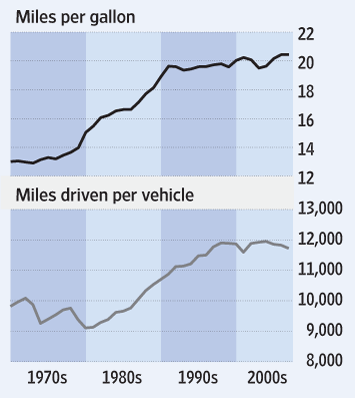
Ken’s Take: A couple analyses I did last summer suggested that people drive more when they get higher MPG from their vehicles … largely (or completely) offsetting the efficiency gain.

image

http://online.wsj.com/article/SB124338431100556717.html?mod=djemalert

Here are a couple of articles citing studies going back to the 19th century that draw the same conclusion.

* * * * *

Excerpted from Heritage Foundation, “Why the Government’s CAFE Standards for Fuel Efficiency Should Be Repealed, not Increased”, July 11, 2001

Clearly, the CAFE program has failed to accomplish its purposes. Consumption has not decreased.

As fuel efficiency improves, consumers have generally increased their driving, offsetting nearly all the gains in fuel efficiency.

Advocates of higher CAFE standards argue that increasing miles per gallon will reduce gas consumption. What they fail to mention is the well-known “rebound effect”–greater energy efficiency leads to greater energy consumption.

As more fuel-efficient vehicle costs less to drive per mile, so vehicle mileage increases.

Since 1970, the United States has made cars almost 50% more efficient; in that period of time, the average number of miles a person drives has doubled.
http://www.heritage.org/Research/EnergyandEnvironment/BG1458.cfm

* * * * *

Interesting Historical Perspective

Excerpted from WSJ: “The rebound effect: Conservation Wastes Energy,”  May 17, 2001

Way back in the 19th century, English economist Stanley Jevons embarked on a study of coal and its consumption. He was intrigued by the introduction of James Watt’s new, efficient steam engine, which began replacing older, more energy-hungry engines.

Jevons found that in Scotland (Watt’s native land), coal consumption was initially reduced by one-third. But in the ensuing years of 1830 to 1863, there was a tenfold increase in consumption. Why? The engines were so much cheaper to run that people used them far more than they ever would have before. Greater efficiency had produced more energy use, not less.

The same arguments apply to government-mandated energy efficiencies today.

Since 1970, the U.S. has made cars almost 50% more efficient; in that period of time, the average number of miles a person drives has doubled. Studies show that when consumers buy more energy-efficient air conditioners, they run them longer because it still costs the same amount.

Consumers, in short, spend to the size of their billfolds.

And that is the failing of government-led demand reduction.

There is only one thing that convinces Americans that they should conserve — market prices. Only when gas prices start to pinch will Americans drive less or hunt for smaller cars.
http://www.opinionjournal.com/columnists/kstrassel/?id=95000484

* * * * *
Want more from the Homa Files?
     Click link =>
  The Homa Files Blog

Ken’s take: The fall of GM … 3 critical mistakes.

June 3, 2009

Lots has been reported, and everybody has their point-of-view re: why GM slid from arguably the best run company in the world to bankruptcy.

Ken’s Take: the situation boils down to 3 critical mistakes: (1) making fatal concessions to the UAW in the 1970s (2) cost-cutting brands via shared models  (3) failure to leverage the Saturn brand. 

Each in turn …

* * * * *

(1) Making fatal concessions to the UAW in the 1970s

The issue: GM signed generous labor deals during the 1970s, including the right to retire after 30 years with full pension and benefits, partly because it believed the contracts would cripple its smaller competitors, Ford and Chrysler. Then along came Honda, Nissan and Toyota, which didn’t have to deal with labor contracts at all. That was the beginning of the agonizing decline.
http://online.wsj.com/article/SB124389995447074461.html

Ken’s Take: It’s popular to castigate the GM management as insular and weak-kneed.  But, in the early 1970s, GM had a commanding market share and the Japanese brands were starting to gain traction with serious cars (i.e. stepped up from the early, cheap compact models).  The UAW picked GM as its target company in negotiations, got militant and threatened to strike.  A strike at that time would’ve given the Japanese brands a clear shot at accelerating their market development efforts.  And, at the time, healthcare was relatively inexpensive and pensions were seemingly a long way off.  So, management caved – making a largely unretractable and unsustainable deal with the union.

* * * * *

(2) Cost-cutting brands via shared models 

The Issue:

While Henry Ford invented mass manufacturing, GM’s long-time president and chairman of the board, Alfred P. Sloan Jr., developed mass marketing: a “car for every purse and purpose,” as he put it in the company’s 1924 annual report. This meant a hierarchy of brands ranging from practical Chevrolets to prestigious Cadillacs.  GM’s strategy of offering a multiplicity of brands started to fray in the 1980s. To cut costs, GM began stocking its makes with nearly identical cars. That blurred the differences between brands and made it hard for consumers to tell a Chevy from a Pontiac or a Buick.
http://online.wsj.com/article/SB124390025302374483.html

Ken’s Take: Using multiple brands to niche a market is a common strategy – and one that was very successful for GM over decades.  The problem: each brand needs critical mass – enough “scale” to justify the separate overhead structures (think brand-specific plants, separate R&D centers) and to support cost-effective production.  As GM lost share to the foreign brands, their scale economies deteriorated – lower sales in aggregate and by brand.  Rather than dropping brands, GM tried to cost reduce itself out of the problem – taking product quality risks and marketing tweaked models (with shared components) under different brand names.  The result: a blurring of brand images that undermined the niche strategies.

* * * * *

(3) Failure to leverage the Saturn brand

The issue: To confront the rising threat from foreign auto makers, GM in 1985 created an entirely new brand, Saturn, at a cost of several billion dollars. It was set up as a separate car company whose mission was to win back customers who had defected to foreign makes.
http://online.wsj.com/article/SB124390025302374483.html

Ken’s Take: I differ with most pundits on this one.  They generally say that introducing Saturn was a blunder and good riddance to the brand.  I think Saturn was a brilliant concept that was simply underleveraged.  Again, think back in history.  GM was trying to develop a radically new brand –- produced in Japanese-like factories (i.e. quality oriented with fewer union constraints), sold through a separate “no haggle” dealer network that promoted product not price,  and supported with cult-like marketing (think Harley Davidson).  Initially, Saturn was a huge success – remember the much ballyhooed customer picnics at the Tennessee manufacturing plant.  But, there wasn’t a second wave of product to sustain momentum. Rather GM started dumping tweaked models into the Saturn line too. 

I think Saturn was  the platform for GM’s future, but they blew it – homogenizing it back into the GM operations and mindset. 

In fact, I’m surprised that the Saturn brand isn’t being retained to market eco-friendly Obamamobiles.  I bet the brand name still has some cachet, and a standalone dealer network – experienced in selling product not price — could be route for selling electric cars.

* * * * *

That’s my take …

KEH

Obamamobiles: Second order effects and unintended consequences

May 22, 2009

Ken’s Take: One of my criticisms of Team Obama is their unwillingness (or inability) to think beyond proclamations and “first steps”.  Think: close Gitmo, so where to put them.?  

Same applies to the arbitrary raising of CAFE standards, which is guaranteed to cost lives, and arguably, will increase pollution — at least in the short-run.

If you want to cut gas consumption, slap on a gas tax — that’ll get people driving fewer miles — fewer miles = less gas, fewer deaths.

* * * * *
Excerpted from WSJ, “Light Cars Are Dangerous Cars “,  May 22, 2009

Obama’s new CAFE rules could impose substantial costs in terms of urban air pollution and human life.

The great irony of Mr. Obama’s fuel efficiency proposals is that they may worsen emissions of these harmful gases.

In today’s automobile fleet, the majority of the pollution comes from the oldest, dirtiest cars. In fact, the dirtiest 10% of the cars account for more than 50% of smog and carbon monoxide. The dirtiest one-third of the fleet accounts for more than 80% of the pollution.

By the White House’s own calculation, the new rules will  increase the average price of a new car by $1,300. Herein lies the problem.

If you raise the price of new cars, people will buy fewer of them or, at a minimum, put off the purchase for a year or so while they drive the old clunker for a few thousand more miles. And fewer new cars means more pollution, which can cause significant health problems.

The Obama fuel efficiency plan may also contribute to a significant increase in highway deaths as vehicles are required to quickly meet the new CAFE standard and will likely become lighter in weight as a result.

An NRC study estimated that  between 1,300 and 2,600 motor vehicle crash deaths per year would not have occur if cars were as heavy as they were in 1976.

It is likely that down-weighting of cars will be an important means of meeting the new standard. And one result again could be highway deaths that might otherwise not have occurred.

One might argue, this “death effect” would not be the case if everyone drove smaller cars … but, nearly half of all car crashes  are one-vehicle crashes. Put another way: If your car hits a tree or a post or a bridge abutment, you are most certainly better off in a larger car.

Full article:
http://online.wsj.com/article/SB124294901851445311.html#mod=djemEditorialPage
* * * * *
Want more from the Homa Files?
     Click link =>
  The Homa Files Blog

Tougher CAFE Standards … and Behavioral Economics

May 20, 2009

OK, put one in the win column: Pres. Obama fiated that passenger cars must get almost 40 MPG by 2016 … cutting dependence on foreign oil and lowering greenhouse gases.

Not so fast.

Key questions: will Americans flock to buy premium priced mini-cars that have, shall we say, safety issues?

The price premium will be taxed away — take it to the bank that there will be a taxpayer subsidy for the purchase of Obamamobiles to neutralize the economic disadvantages (and make Obama Motors Inc. look like it’s turning a profit).

My opinion, the safety issue looms large.  There’ll be plenty of SUVs on the road for the next couple of years.  In a collision, Smart cars aren’t going to look that smart.  (Note: most policy makers think only of major metro areas, not  the open roads — where hybrids have insignificant fuel advantages).

Unmentioned in the press today, is the question: will higher MPGs actually cut gas consumption.  That’s not obvious to me   Gas consumption is a function of MPG and miles driven.  Past history says that when MPG goes up, people drive more.  Why not?  They can stretch their fuel budget further.

So, how to reduce gas consumption and emissions?  The proven answer is a gas tax.  Works in Europe.  When gas prices got to $4 in the U.S., folks slowed down and drove less. 

Sure, a gas tax would be a political challenge.  But, isn’t Obama supposed to be the agent of bold strokes and meaningful change.

If yes, why is he simply recycling and an old idea that probably won’t make a whit of difference?

* * * * *
Want more from the Homa Files?
     Click link =>
  The Homa Files Blog

Shocker: Folks against hiking gas taxes to push fuel efficient cars

May 19, 2009

Ken’s Take: Virtually all economists agree that the way to shift people to hybrids and other fuel efficient vehicles is to impose a large gas tax — say, $2 per gallon.  That’s what the UK does now. 

I’d agree with the economists, except that I know the Feds would just waste the money. 

Predictabilty, most people — make that ‘almost all’ — think that hiking gas taxes is a very bad idea.  In other words, it’s political suicide.

* * * * * 

According to Rasmussen:

Only 22% of Americans are willing to spend more to buy an energy-efficient hybrid car to help the environment. Even last October, after record high prices at the pump, just 37% said they were more likely to buy a hybrid car than they were a year earlier.

* * * * *

Given last year’s record-high gasoline prices and the still-fluctuating price at the pump, most Americans aren’t interested in the government tacking on any more, even in the name of fuel efficiency.

Just 10% of adults think the federal government should increase the tax on gasoline by a large amount as a way of encouraging people to buy more fuel-efficient cars … 81% oppose a large tax hike for that purpose, and 8% don’t know.

Americans also took a dim view of another car-focused tax when it was proposed earlier this year. Seventy-three percent (73%) rejected the idea of taxing drivers based on how many miles they drive to help fund the building and repair of roads and bridges. Only 18% supported a mileage tax.

In April of last year, 60% of Americans favored suspending the federal gas tax completely for the summer to offset soaring gas prices.

Full article:
http://www.rasmussenreports.com/public_content/business/gas_oil/81_oppose_gas_tax_hike_to_encourage_sales_of_more_efficient_cars

* * * * *

Want more from the Homa Files?
Click link =>
  The Homa Files Blog

If so many people want hybrid cars … how come ?

May 12, 2009

Ken’s Take: Both GM and Chrysler will be pushed by Team Obama to make the itsy-bitsy hybrids that “everybody wants.”

According to the WSJ: hybrids still  aren’t getting any traction in the market and, now, Toyota is beefing up the Prius with more size and more power.

Hmmmm.

* * * * *

 Excerpted from WSJ: “Hybrids Battle for Green”, May 11, 2009

With sales of hybrid vehicles sinking, … Toyota,is rolling out a major U.S. ad push for its 2010 Prius, the third generation of the world’s top-selling hybrid vehicle.

Toyota’s new ad for its third-generation Prius shows a planet in harmony, with humanized clouds, fields and flowers bursting into song.

Some experts believe that price should be a big factor in the campaigns; hybrids typically cost thousands of dollars more than comparable gas-burning models. “They need to emphasize not only the social benefits of hybrids but also the economics … one of the big hang-ups with these cars is that they cost more.”

The allure of hybrids has waned with the decline in oil prices. Prius sales have fallen about 50% from Jan. 1 to April 30. F or all their earth-friendly cachet, hybrid cars represent only 2% of the light-vehicle market.

“It’s stunning … despite all the successes of the Prius and the emphasis on global warming, we can’t get significant hybrid penetration.”

“The big barrier for mass consumers is they worried that the Prius was underpowered and small …  the newly remodeled Prius is slightly bigger, with more horsepower.

The initial Prius advertising largely targeted the early adopter and the tree-hugging crowd, while the second generation of the vehicle was seen as the family’s second or commuter car. This campaign is about the “mainstreaming of the product.”

Full article:
http://online.wsj.com/article/SB124199018707904593.html

* * * * *
Want more from the Homa Files?
     Click link =>
  The Homa Files Blog

G.M. Seeking Stake in Fiat … huh ?

May 7, 2009

Ken’s Take: Let me be sure that I got this right: Chrysler is bankrupt and in bankruptcy proceedings.  GM is bankrupt but is trying to duck bankruptcy proceedings. Fiat gets a part of Chrysler without paying a dime for it.  GM snags a part of Fiat.  So, one bankrupt company is bailing another, using an Italian auto juggernaut as the conduit.

I must be missing something

* * * * *

From the NY Times:

Four years after paying $2 billion to extricate itself from a partnership with Fiat, General Motors is seeking a stake in the Italian automaker …

G.M., despite its precarious financial position, now feels it has a bargaining chip with its Latin American unit, and is negotiating with Fiat over what it might get in return. G.M. executives are holding out for at least 30 percent of the Fiat Auto Group.

Fiat and G.M. frequently clashed during their five-year partnership, which began in 2000. Fiat engineers said G.M. was too cautious and unwilling to embrace new technology that would have created cleaner, more fuel-efficient engines. In Germany, meanwhile, Opel engineers became convinced that Fiat didn’t share its focus on detail or quality standards.

Full article:
http://www.nytimes.com/2009/05/07/business/global/07auto.html?scp=1&sq=gm%20fiat&st=cse

* * * * *

Want more from the Homa Files?
Click link =>
  The Homa Files Blog

Does anybody really think that Chrysler will survive?

May 6, 2009

Ken’s Take: Let’s see …. a union controlled company, run by Italian automakers, cranking out inherently unprofitable clown cars.  Does that sound like a formula for success to you?  Call me cynical, but I’m betting under on this one.

Great editorial in WSJ today titled “Return of Le Car”.   Worth reading.  Hear are a few of the highlights.

* * * * *

Last week Pres. Obama said that he hoped you would buy an “American car” — though apparently not one built in a red state in a plant owned by Japanese or German investors. He meant a car built by a company headquartered in Detroit, even if the car itself is assembled in Mexico or Canada. How confusing.

* * * * *

Chrysler would be in deep yogurt in any case amid the market collapse, but its other problem is a decent franchise in Jeeps, muscle cars, minivans and pickups — and nothing to meet Congress’s stiff new “corporate average” fuel economy rules, and nobody to supply the billions to develop such vehicles and (inevitably) bribe customers to drive them off the lots.

Daimler, its previous parent, certainly had no desire to fund such profitless extravagance. The Germans took a lot of guff but they’re the ones laughing now. They sold their majority stake in Chrysler just months after Democrats took over Congress, and just weeks after President Bush began blathering about “oil addiction” and echoing Democratic demands for stringent new fuel-mileage rules (after opposing them for years).

* * * * *

Not since Renault teamed up with AMC to bring you Le Car has an odder pairing been seen — or a less promising one.

Credulous media accounts insist the only challenge now is whether Chrysler can hang on for two years until Fiat begins churning out U.S. versions of its popular European models in U.S. factories. Goodness.  Unless gasoline prices go to $5 a gallon,no one can be so foolish as  to believe making and selling teensy eurocars in the U.S. is anybody’s route to salvation. Even in Europe…  a move to bigger, more powerful cars is underway. Motorists are getting fatter and older — and unwilling to contort themselves to get in and out of a car … which ought to caution against any hope that the pixie car will sell particularly well in the U.S.

* * * * *

Trying to beat Toyota at its own game is a nonstarter. Toyota sets a standard of quality and technology that all must meet — that’s the price of admission. But “what we have that Toyota does not have ?”

Some [Obama auto] task force members acknowledge that the drive for profitability is likely to collide with Mr. Obama’s fuel-efficiency and low-emission goals.”

When will Team Obama explain exactly how Chrysler is supposed to make money building the “green cars” Mr. Obama wants it to build.   You already know the answer: You, the taxpayer, have not finished chipping in to keep Fiat-Chrysler alive.

Full article:
http://online.wsj.com/article/SB124157578117190427.html

* * * * *

Want more from the Homa Files?
Click link =>
  The Homa Files Blog

"If Japanese automakers can make a profitable hybid, why can't American automakers?"

May 1, 2009

That’s the question that President Obama posed in his 100 day press conference.

The answer: According to the Washington Post, they (the Japanese) can’t make a profitable hybrid — even the Prius loses money!  So, add on a few UAW work rules and legacy costs and you get a mega loss generator … probably supported by extensive government subsidies.

P.S. to President Obama — we didn’t invent the auto — the Germans did (ever hear of Mercedes Benz ?)

P.P.S. to Pres. Obama — hire a fact-checker

* * * * *

Excerpted from Washington Post, “The Car of the Future — but at What Cost?”, Steven Mufson, November 25, 2008

Hybrid Vehicles Are Popular, but Making Them Profitable Is a Challenge

Sen. Charles E. Schumer said last week. “We need a business model based on cars of the future, and we already know what that future is: the plug-in hybrid electric car. ”But the car company Schumer and other lawmakers envision for the future could turn out to be a money-losing operation, not part of a “sustainable U.S. auto industry.”

That’s because car manufacturers still haven’t figured out how to produce hybrid and plug-in vehicles cheaply enough to make money on them.

After a decade of relative success with its hybrid Prius, Toyota has sold about a million of the cars and is still widely believed by analysts to be losing money on each one sold.

U.S. lawmakers want the companies to produce automobiles of the future, using advanced technologies and featuring hybrid or plug-in vehicles. But there’s no guarantee that the new business model would be any more viable than the current one.

Automobile experts estimate that the battery in a plug-in vehicle could add at least $8,000 to the cost of a car, maybe considerably more. Most Americans will be unwilling to pay the extra price, especially if gasoline prices languish around $2 a gallon.

GM will have to stake its future on Malibus, the Chevy Cruze, and much more conventional technologies.

“Do you bet on lighter, smaller, more fuel efficient but ultimately less profitable cars or do you hold back a little on technology development and look at new versions of existing cars.

”Many experts say that gas guzzlers will not fade away as long as Congress fails to impose higher taxes on gasoline to steer people toward fuel-efficient cars.

GM and other car companies, while preparing plug-in vehicles, are more likely to live or die based on the sales of conventional cars that get better fuel efficiency through improved transmissions, reduced weight or hybrid technology.

”There’s fluff and there’s reality … The fluff is the Chevy Volt . . . That’s not going to save GM in the next five years. What will save GM is more small sedans and more crossovers. That’s what people are going to be buying.”

Full article:
http://www.washingtonpost.com/wp-dyn/content/article/2008/11/24/AR2008112403211.html?wpisrc=newsletter

* * * * *

Want more from the Homa Files?
Click link =>
  The Homa Files Blog

Would you rather buy a car from a bankrupt automaker, or from ….

April 30, 2009

An automaker majority owned by the UAW, or …

The United Auto Workers union would eventually own 55% of the stock in a restructured Chrysler LLC under the deal reached by the union and the automaker.

Fiat SpA “eventually” will own 35%, and the U.S. government and Chrysler’s secured lenders together will end up owning 10% of the company once it is reorganized.
http://online.wsj.com/article/SB124087751929461535.html

An automaker majority owned by the Federal government, with the  UAW owning most of the rest, or …

General Motors outlined a new turnaround plan that would leave the U.S. government controlling the auto maker.

Under the plan, GM is asking for an additional $11.6 billion in government loans, on top of the $15.4 billion it has already received. It envisions giving the government at least half ownership of the company as payment for half of the loans.

At the same time, GM said it would use stock instead of cash to pay off half the $20.4 billion it owes a United Auto Workers fund to cover retiree health care. That stock would leave the union owning about 39% of GM.
http://online.wsj.com/article/SB124083476254259049.htmlhttp://online.wsj.com/article/SB124083476254259049.html

Buy a Lexus, BMW, Mercedes, or …

Hmmmm … let me think about that one for a moment

* * * * *

Want more from the Homa Files?
Click link =>
  The Homa Files Blog

High-speed trains: Faster than a car … and just about as profitable.

April 27, 2009

Business Week says:

“By committing $13 billion to high-speed train travel, the Obama Administration is giving long-dormant projects a boost

A priority is a line that would whiz passengers 520 miles from Anaheim to San Francisco in less than three hours and upgrades of Amtrak service in New England and the Midwest to reach speeds of up to 150 mph.”

* * * * * 

The article also notes:

(1) U.S. government analysts concede that it’s impossible to run these hugely expensive networks profitably.

(2) Among the interested investors: Japan Railway, Bombardier, Kawasaki, and Siemens. (Notice anything “interesting” about the list?)

The article glosses over our national success running Amtrak.

That sucking sound you hear is more of money leaving your wallet (assuming that you’re in the half of Americans who pay income taxes)

* * * * *

Full article: Business Week, “U.S. High-Speed Train Projects Get a Push”, April 23, 2009
http://www.businessweek.com/print/magazine/content/09_18/b4129029604145.htm

* * * * *

Want more from the Homa Files?
Click link =>
  The Homa Files Blog

Looks like a car, drives like a car … according to Nissan, it’s a "Mobile Device"

April 27, 2009

Excerpted from New York Times, “With the Car Industry in Trouble, Nissan Rolls Out the Mobile Device”, by Stuart Elliott, April 5, 2009

* * * * *

Nissan Motors is betting an estimated $20 million that a spirited campaign can get drivers to purchase the Nissan Cube–a cute, smallish car scheduled to go on sale on May 5.

And scratch the word “car,” for the campaign to introduce the Cube in the United States refers to the vehicle as a “mobile device.”

* * * * *

The phrase, borrowed from the digital domain, signals that the intended market for the Cube is younger drivers. It also signals the focus of the campaign: presenting the Cube as a part of a fun, busy life that can be customized and personalized as easily as a cellphone ring tone or a Facebook page.

To underscore all that, the campaign borrows terms from technology like “search engine,” “browse,” “storage capacity,” “add friends” and “set preferences” to describe features of the Cube. And the media mix skews decidedly toward nontraditional elements like iPhone games, wallpapers, text messaging, the Internet and MP3 downloads.

* * * * *

The Cube is entering a crowded category of the depressed auto market composed of niche models meant as emotional purchases rather than rational. Such cars are intended to attract attention for unusual design rather than horsepower, bling or fuel economy.

Nissan comments, “This is a tough time to bring anything out, whether a car or a new TV. So we decided we wouldn’t think about it as a car,” he added, but rather “position it as designed to bring young people together — like every mobile device they have.”

Edit by DAF

* * * * *

Full article:
http://www.nytimes.com/2009/04/06/business/media/06adco.html?ref=media&pagewanted=print

* * * * *

Want more from the Homa Files?
Click link => 
The Homa Files Blog

* * * * *

Feds Hire BCG to Advise Detroit … so, what’s new ?

April 25, 2009

Ken’s Take: For years,  Detroit has been a huge cash cow for consultants.  Some things don’t change, I guess.

* * * * *

The government will pay the Boston Consulting Group as much as $7 million to advise General Motors and Chrysler as they work to pare costs and overhaul operations, according to a federal award notice. G.M., which received $13.4 billion in federal money, is trying to avoid a potential June 1 bankruptcy. Chrysler, which received $4 billion, has an April 30 deadline to pare debt and complete an alliance with Fiat.

“A very significant portion” of Boston Consulting’s work will be to analyze G.M.’s restructuring plan and Chrysler’s proposed alliance with Fiat, according to the notice posted on a government procurement site.

Edit by DAF

* * * * *

Excerpted from New York Times, “U.S. Hires Boston Consulting to Advise Carmakers”, from Bloomberg News, April 11, 2009
http://www.nytimes.com/2009/04/11/business/11bizbriefs-USHIRESBOSTO_BRF.html?ref=business&pagewanted=print

* * * * *

Want more from the Homa Files?
Click link => 
The Homa Files Blog

* * * * *

A car company that knows how to create value …. hint: not based in Detroit

April 22, 2009

Ken’s Take: In marketing, there’s a concept know as “product augmentation” —  adding features and services to a “core product” in order to deliver more differentiating benefits to target customers.  Hyundai seems to have hit the target with its assurance program.

* * * * *

Excerpted from Brandchannel, “Marketing Strategies that Build Value” by Barry Silverstein, April 6, 2009

Value building is not a new concept. In good times and bad, smart brand marketers have always recognized the need to build value and differentiate—to make their brands a little better than competitors by adding a new feature, creating a special promotion or forging a unique alliance with another brand.

What’s different today is the targeted relevance of value building. Faced with a protracted global economic recession, established brands are searching for ways to add maximum value without cheapening their image or undermining profits. Some brands are out-smarting and out-performing their competitors because of value-building strategies.

One breakthrough example of value building is occurring in, of all places, the automotive industry. While most car manufacturers and dealers are slashing prices and offering deep discounts, one car maker is leveraging the impact of the economy on consumers by offering something simple yet powerful and timely: peace of mind.

In early 2009, the Korean auto company Hyundai introduced a program called Hyundai Assurance in the US market. It made a bold promise: “Finance or lease any new Hyundai, and if in the next year you lose your income, we’ll let you return it.” Hyundai recently enhanced the offer, renamed Hyundai Assurance Plus: “If you lose your income, we’ll make your payments for 3 months while you get back on your feet, and if that’s not enough time to work things out, you can return the car with no impact on your credit.”

Hyundai built additional value into Hyundai Assurance by broadly defining the ways in which loss of income might occur. Hyundai included the following “life-changing events” in its promise: involuntary unemployment, physical disability, loss of driver’s license due to medical impairment, international employment transfer, self-employed personal bankruptcy and accidental death. Obviously the company thought carefully about the current economic environment and consumers’ potential misfortunes.

Ironically, when Hyundai cars first entered the marketplace, they were not well regarded; in fact, Hyundai was perceived as a lower-quality brand in its early days. But following in the footsteps of the Japanese automakers, Hyundai kept making its cars better and better. Ten years ago, Hyundai stunned the industry by introducing the best automobile warranty in the US—a “safety net” that gave customers the confidence they needed to purchase a vehicle from Hyundai. Hyundai Assurance is essentially a thoughtful extension of that original value-building strategy.

In January 2009, after the introduction of Hyundai Assurance, Hyundai’s sales were up more than 14 percent over January 2008. “Hyundai had the largest sales increase of any automaker, and it was one of only three with any increase at all,” reported CNNMoney.com. 

In March 2009, Hyundai started offering low-rate loans on three car brands, in addition to cash-back incentives. Dave Zuchowski, vice president of sales for Hyundai Motor America, told Automotive News, “We’re looking for [Hyundai] Assurance to drive traffic and then the new rebates to help close the deals” (“Hyundai Piles On Incentives,” March 9, 2009).

Another way brands can practice value building is to promote exclusivity and offer consumers something of unique value for a limited time. The recent introduction of the 70th Anniversary Platinum Edition of the Disney movie Pinocchio typifies the category.

The Pinocchio release is just the latest in a series of Disney Platinum Editions—part of a larger value-building strategy by Disney to release original movies from the “Disney vault” for limited time periods, thus increasing their perceived value. 

Disney is already one of the world’s most recognized brands, so why do they need to issue Platinum Editions? Because Platinum Editions reinforce the image of the brand. Once the limited-release time period is over, the Platinum Edition movies are no longer available through traditional retail channels—they become “out of print” collector’s editions—and the Disney brand maintains its aura of exclusivity.

A third path to value building is more conventional but just as effective: using add-ons that enhance the value of a brand and reinforce the brand purchase decision. Apple’s iPhone stands out in this area. While it was a legitimate breakthrough brand in its own right, the iPhone was high priced and, by some standards, a risky and unproven technology. Apple rapidly overcame those early objections by opening up the iPhone to developers. The result was an iPhone “App Store” with thousands of applications for the iPhone, some of them free. In March 2008, more than 100,000 developers had downloaded the iPhone Software Development Kit in a period of just four days. By the end of 2008, Apple had recorded over 100 million application downloads.

Still, Apple succeeded in demonstrating that it was once again a pioneering technology brand, and that the iPhone was an added-value platform—one that could provide a mind-numbing quantity of applications unlike any other communications device on the market. 

These brand marketers know that value building is an important means of keeping their brands fit—and creating strong bonds with customers who are seeking the best value…especially in these economic times.

Edit by NRV
Full article:
http://www.brandchannel.com/start1.asp?fa_id=472

* * * * *

Want more from the Homa Files?
Click link => The Homa Files Blog

Retrofitting Gas Guzzlers with Batteries … hmmm, interesting idea, Mr. Grove

April 21, 2009

Ken’s Take: The conventional plan has been to make small hybrids — that few outside metroplexes are interested in, and which stand no chance of generating profits for auto companies.  I like that this plan tries to transforn SUVs and pick-ups into socially responsible rides..

* * * * *
Excerpted from the McKinsey Quarterly, “An Electric Plan for Energy Resilience”, by Andy Grove and Robert Burgelman, December 2008

Every president since Richard Nixon has vowed to reduce the United States’ dependence on foreign oil. None has succeeded. Imports—and thus America’s vulnerability to disruptions—have increased to where now they supply two-thirds of consumption.

Our aim should not be total independence from foreign sources of petroleum. That is neither practical nor necessary in a world of interdependent economies. Instead, the objective should be developing a sufficient degree of resilience against disruptions in imports. Think of resilience as the ability to absorb a significant disruption, bigger than what could be managed by drawing down the strategic oil reserve.

The best alternative to oil? Electricity. The means? Convert petroleum-driven miles to electric ones.

* * * * *

What would it take to build enough plug-in electric vehicles (PEVs) to make a significant dent in oil consumption?

Revamping the fleet of automobiles already on the road through production of new automobiles would take far too long for comfort. If ten automobile manufacturers each introduced a new PEV now and increased its production as fast as Toyota did with its highly successful Prius, the vehicles would still account for less than 5 percent of the 250 million vehicles on US roads a decade from now.

We believe the United States should consider accelerating this movement by creating an industry of after-market retrofitters.

* * * * *

We estimate the price tag of such a pilot project to be around $10 billion, owing to the present high cost of batteries, which are around $10,000 each.

Assuming an average gas price of $3 per gallon, the payback period to the owner of a retrofitted vehicle is at least ten years, not a strong economic incentive.

But the benefits of this program—testing and validating a key approach to energy resilience—accrue to the well-being of the United States at large. As the general population is the predominant beneficiary, economic assistance flowing from everyone to vehicle owners, in the form of tax incentives, is justified.

* * * * *

There are different approaches to retrofitting vehicles. We favor GM’s Volt design, in which the car is directly driven by an electric motor. To simplify the retrofitting task, we would limit the scope of the program to six to ten U.S. models, selected on the basis of two criteria: low fuel efficiency and large numbers of vehicles on the road. Most of these vehicles would be SUVs, pick-ups, and vans.

Further, we propose targeting fleets of automobiles owned by corporations or government entities. That way, many retrofits could be performed at just a few locations.

Given the current difficult economic conditions, auto dealers and garage operators may well be attracted by this potential new source of revenue and be eager to participate, helping the program in its early stages.

* * * * *

The biggest problem, however, is the availability of batteries. The most suitable battery technology, which offers both a sufficient range and enough power to provide the acceleration required by today’s drivers, is the lithium-ion battery system. Making the batteries required for one million vehicles would mean doubling current manufacturing output.

There is another issue we need to consider. While there are many sources of the batteries’ raw materials—such as lithium and cobalt—battery manufacturing is almost exclusively based in China, Japan, and Korea. To avoid battery manufacturing becoming the next source of dependency, we have to build domestic technical and manufacturing capability.

Another important goal is to improve the cost and quality of battery technology.

* * * * *

We are approaching the inevitable decline of oil availability which gives the United States the opportunity to move into a more desirable strategic position. Today, we compete with countries whose richer natural resources give them a strategic advantage. If we shift transportation towards electric miles, we gain an opportunity to employ our own resources: newly energized governmental leadership, a tradition of high-volume manufacturing, and a culture of technological innovation.

These capabilities and skills have served the United States well in the past, and the drive toward electric miles may help revitalize them. That result is every bit as important as the electric miles themselves.

Edit by DAF

* * * * *

Full article:
http://www.mckinseyquarterly.com/Energy_Resources_Materials/Environment/An_electric_plan_for_energy_resilience_2276

* * * * *

Want more from the Homa Files?
Click link => 
The Homa Files Blog

* * * * *

Treasury Directs GM to Prepare for Bankruptcy Filing … surprise, surprise, surprise

April 15, 2009

Source: CNBC.com 

The NY Times reports that The Treasury Department is directing General Motors to lay the groundwork for a bankruptcy filing by a June 1 deadline, despite public contention that it could still reorganize outside court, people with knowledge of the plans said during the weekend.

The goal is to prepare for a fast “surgical” bankruptcy … creating a new company that would buy the “good” assets of GM almost immediately after the carmaker files for bankruptcy … Less desirable assets, including unwanted brands, factories and health care obligations, would be left in the old company, which could be liquidated over several years.

* * * * *

But what about the UAW?  Not to worry … 

President Obama, who was elected with strong backing from labor, remained concerned about potential risk to GM’s pension plan and wants to avoid harming workers, these people said.

So, GM may require as much as $70 billion in government financing, and possibly more to resolve the health care obligations and the liquidation of the factories, according to legal experts and federal officials.

* * * * *

Preserving GM’s stellar reputation.  Huh ?  …  

a quick restructuring is necessary so its image and sales are not damaged permanently.

The government has said it will guarantee GM’s vehicle warranties.

GM has started an aggressive advertising campaign stressing that car buyers should have confidence in the company, and offering to make nine months of payments, up to $500 each, for owners who lose their jobs.

* * * *

Promise: a transparent administration.  Yeah, right … 

None of these people agreed to be identified because they were not authorized to discuss the process. GM declined to comment and the Treasury Department did not comment.

* * * *
Full article:
http://www.cnbc.com/id/30184869

* * * * *
Want more from the Homa Files?
     Click link =>
  The Homa Files Blog

Chrysler intros a new SUV … these guys have stones!

April 8, 2009

Ken’s Take:

(1) Team Obama says folks want Segway crossover hybreds (see yesterday’s post); but the folks say they want pick-ups and SUVs.  Apparently the folks are too dumb to know what they want … but, they’re allowed to vote.  Go figure.

(2) How dumb is Chrysler making cars that make money instead of ones that lose money … apparently the path to profitability is paved with unprofitable mini-cars.  Go figure that one, too.

* * * * *

According to CNBC:

Just a week after the White House scolded Chrysler for relying too much on gas guzzlers, the company is unveiling a new SUV.

Chrysler insists the Jeep Grand Cherokee is a crowd favorite: “Customers have told us they want this vehicle and that it’s the right size.”

The White House slammed Chrysler for having a product lineup so heavily weighted with trucks and SUVs. It added that the automaker does not have enough products in the pipeline to meet an expected increase in demand for small cars.

But Chrysler is standing by the Grand Cherokee. It’s profitable, recognizable and the No. 2-selling vehicle in the Jeep lineup. Grand Cherokee

One analyst said: “I think it’s going to be written up as being out of touch, but from a business standpoint, I think it’s the right thing to be doing,”

“It may be hard for Chrysler to please both the government, which is demanding greater fuel efficiency from the Big Three, and its customers, many of whom still demand big cars. It would be far more foolish for Chrysler to abandon its core competencies in the Jeep brand lineup than it is to come out with a new” Grand Cherokee” 

“To some extent, it’s refreshing to me to see them not kowtowing to the government.”

Full article:
http://www.cnbc.com/id/30103625

* * * * *

Want more from the Homa Files?
Click link =>
  The Homa Files Blog

Finally GM "gets it" … an Obamamobile !

April 7, 2009

Part of GM’s viability plan, I guess …

Hitting the news today, GM is joint venturing with  Segway to develop a clean, all electric urban vehicle.  Reportedly, it can go 35 miles on each charge.

At last, a vehicle less safe than a Smart car.

Question: how long do you think it takes for a person to get feeling back in his / her butt after traveling a few miles in this joke machine ?

Just shoot me, please.

image

http://online.wsj.com/article/SB123906731177395605.html#mod=testMod

* * * * *
Want more from the Homa Files?
Click link =>
  The Homa Files Blog