Archive for the ‘Employment – Jobs’ Category

Obama confronted with a McDonald’s Dilemma

June 6, 2011

Two of Friday’s press reports put Pres. Obama on the horns of a dilemma.

On one hand, First Lady Obama was visible stumping for “My Plate” … the iconic replacement for the “Food Pyramid” ….  part of her program to put a dent in childhood obesity and get kids eating healthier.

Obviously, there’s no room for McDonald’s on the First Lady’s plate.

On the other hand, a measly 54,000 jobs were created in May … and, it turns out that half of the jobs came from a single employer — McDonald’s. 
          
McDonald’s ran a big hiring day on April 19 — after the Labor Department’s April survey for the payrolls report was conducted.  Reportedly, McDonald’s swelled its workforce by more than 30,000 … more than half of May’s total gain.

So, while Michelle is trying to shut McDonald’s down, Barack is counting on the company for recovery summer deux.

What a dilemma …

* * * * *
P.S. You may remember that McDonald’s got an ObamaCare waiver.

Coincidence?

Flashback: Why private sector jobs won’t be coming back any time soon

June 3, 2011

The dismal jobs picture isn’t really very mysterious: CEOs are dismayed by Team Obama’s economic, regulatory and pro-union policies and won’t do any serious hiring while Obama  is in power.

For the record, the Homa Files pitched this case almost 2 years ago in a post titled: “Why private sector jobs won’t be coming back any time soon … Hint: it’s called passive aggressive resistance” … the punch lines:

Given the Administration’s anti-corporate rhetoric, actions, and proposed game-changing rules, I doubt that many CEOs will be taking on added costs and risks to boost the administration.

More likely, they will let unemployment continue to creep along, and will slow roll the process of rehiring. 

Corporate chieftains will sit back and watch the President squirm and spin his “4 million jobs – saved or created”.  As Rev. Wright would say “the chickens will have come home to roost”.  Passively aggressive  resistance at its very best.

Unfortunately, that means we’ll be seeing high unemployment for some time – at least through the 2012 Presidential elections.

The full original post is worth another read !

* * * * *

Ken’s current take:

Certainly there won’t be any meaningful hiring until the 2012. elections are in the book.

CEO heels are dug in.  I’ve heard cocktail party chatter like “Each job added is a vote for Obama … Fool me once, shame on you … fool me twice, shame on me”

CEOs started to relent a bit when the Congress tilted GOP and Obama extended the Bush tax cuts.  (Whatever happened to Immelt’s job creation task force?)

But, recent moves – e.g. stopping Boeing’s move to South Carolina, stumping again for higher taxes, especially on off-shore profits – have more than offset any momentum.

We’ll be stuck with unemployment in the 9s until 2012 … or until there’s a substantial policy roll-back – e.g. repealing ObamaCare.

And, the latter just ain’t gonna happen …

JOLTS: Each year about 1/3 of of the US workforce “churns” …

May 17, 2011

Punch line: The jobs numbers (job growth and unemployment rate) that create so much anticipation from the business press  …. do not give a clear picture of the labor market’s health.

A better understanding requires an examination of hires and separations, or what the Bureau of Labor Statistics calls Job Openings and Labor Turnover Survey (JOLTS) data.

* * * * *

Excerpted from WSJ: Why the Job Market Feels So Dismal, May 16, 2011

At any point in the business cycle, even during a recession, American firms still hire a huge number of workers.

That’s because most of the action in the labor market reflects “churn,” the continual process of replacing workers, not net expansion or contraction of employment.

The lowest number hired in any month of the current recession was 3.6 million workers. Even during the dismal year of 2009 there were more than 45 million hires.

Bear in mind that the U.S. labor force has more than 150 million workers or job seekers.

In a typical year, about one-third or more of the work force turns over, leaving their old jobs to take new ones.

When the labor market creates 200,000 jobs, it is because five million are hired and 4.8 million are separated, not because there were 200,000 hires and no job losses.

When we’re talking about numbers as large as five million, the net of 200,000 is small and may reflect minor, month-to-month variations in the number of hires or separations.

* * * * *

Total Non-Farm Hires

image

image

So far this year, the economy has added 768,000 jobs … here’s why.

May 9, 2011

The jobs report on Friday said that so far this year, the economy has added 768,000 jobs.

The administration shills (think Goolsbee) are proclaiming that recent job growth is proof-positive that  Obama’s economic policies are working.

They imply that the results are a delayed reaction to the trillion dollars of stimulus paybacks .

Gimme a break.

What the administration and the mainsteam media seem to have forgotten is that in December 2010, President Obama signed into law a 2-year extension of the George W. Bush tax plan and cutting payroll taxes by 2%.

Washington Post, Obama signs bill to extend Bush-era tax cuts for two more years, December 17, 2010

President Obama signed into law the most significant tax bill in nearly a decade … to continue for two more years tax breaks enacted under president George W. Bush.

The $858 billion package prevents taxes from rising … for virtually every American household.

And it includes … a two-percentage-point reduction in the Social Security payroll tax that would let workers keep as much as $2,136.

Well, well, well.

Once businesses (and individuals) had at least 2 years of tax plan certainty … with relatively low tax rates for all … companies started adding jobs.

Surprise, surprise, surprise.

Bush was so stupid … except for job-creating economic incentives and security-intelligence infrastructures.

Hmmm.

Fewer are working … instead, they’re asking for more from those who do. Uh-oh.

April 18, 2011

According to  USA TODAY

The share of the population that is working fell to its lowest level in three decades. 

Only 45.4% of Americans had jobs in 2010, the lowest rate since 1983 and down from a peak of 49.3% in 2000.

The bad economy, an aging population and a plateau in women working are contributing to changes that pose serious challenges for financing the nation’s social programs.

Job troubles appear to have slowed a trend of people working later in life, putting more pressure on Social Security.

“No matter how wealthy you are, you have a problem if half the population is not working and depending on those who are.”

Why work when you can just wait for the mailman?

April 15, 2011

Punch line: Men are disappearing from the workplace in ways that don’t always register on the official unemployment rate 

Excerpted from Business Week, The Hidden Job Crisis for American Men, April 7, 2011

The March jobs report released on Apr. 1 seemed like the best in years. Behind the headlines, though, statistics on jobs are far less encouraging.

Yes, job growth has picked up somewhat. Yet an equally important reason for the lower jobless rate is that many people, men in particular, have simply given up looking for work and are no longer counted among the unemployed.

Some sit at home. Rather than paying taxes on labor income, they are drawing government benefits, or relying on family and friends for support.

There is an ominous trend of disengagement for male workers that stretches back six decades. The share of American men aged 16 to 64 who are employed has fallen, from nearly 85 percent in the early 1950s to less than 65 percent now.

A Bureau of Labor Statistics study found that many older workers who lose jobs never go back to work again. Of those aged 55-64 who were displaced from 2007 through 2009, 21 percent were out of the labor force as of January 2010.

Typically the unemployment rate stays flat or even rises when the economy begins to recover. People reenter the labor force. There is no flood of reentrants this time, at least not yet.

So, it the unemployment rate up or down?

March 22, 2011

Answer: Depends who you ask.

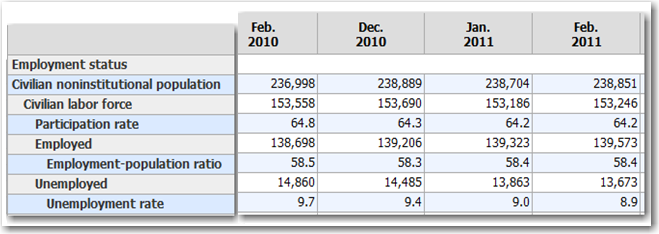
The gov’t Bureau of Labor Statistics reported that unemployment has fallen the past couple of months and is now a bit under 9%.

That would be good news … if true.

image

http://www.bls.gov/news.release/empsit.a.htm

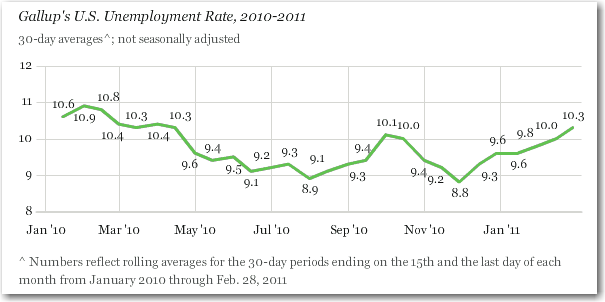
But, it seems that Gallup begs to differ.

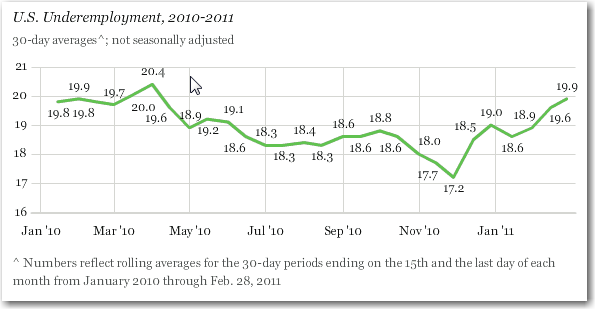
According to Gallup, the unemployment rate has been increasing the past couple of months and is now over 10%.  The underemployment rate has also been increasing and is now almost 20%

So, who to believe – the fox guarding the henhouse or a left-leaning, reasonably objective 3rd party.

Hmmm.

image

 image

Jobs affected by federal minimum wage hikes account for 41.8% of the total reduction in jobs seen since 2006.

March 21, 2011

Economists warned that raising the minimum wage would result in lost jobs. It always does.

Why?

As labor gets more expensive, companies pare back the employment rolls.

Sure, the folks who hang onto their jobs make more … but folks who lose their jobs make less – zero to be precise.

Here’s a great analysis from the site Political Calculations

* * * * *

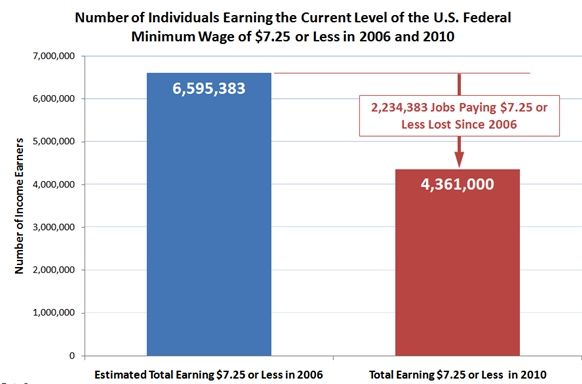
In 2006, the last full year in which the U.S. federal minimum wage was a constant value throughout the whole year, at least before 2010, approximately 6,595,383 individuals in the United States earned $7.25 per hour1 or less.

For 2010, the first full year in which the U.S. federal minimum wage was a constant value through the year since 2006, the U.S. Bureau of Labor Statistics estimates that an average of just 4,361,000 individuals in the United States earned the same equivalent of the current prevailing federal minimum wage of $7.25 or less throughout the year.

 image

In terms of jobs lost, that means that 2,234,383 of the jobs lost in the U.S. economy since 2006 have been jobs that were directly impacted by the series of minimum wage increases that were mandated by the federal government in 2007, 2008 and 2009.

Interestingly, the average number of employed members of the civilian labor force in 2006 was 144,427,000. In 2010, the average number of employed members of the civilian labor force in the U.S. was 5,363,000 less, standing at 139,064,000.

So, in percentage terms of the change in total employment level from 2006 to 2010, jobs affected by the federal minimum wage hikes of 2007, 2008 and 2009 account for 41.8% of the total reduction in jobs seen since 2006.

Thanks to Tags for feeding the lead

Jobs: Cause & effect … and spin

March 7, 2011

High fives on Friday when the monthly unemployment numbers were reported.

Jobs up,  Unemployment below 9%.

Even the WSJ is hinting at a turning point (extract below).

Thank god for Obama’s Trillion-dollar Stimulus.

Oh, really ?

First, the unemployment rate is down because the discouraged folks have stopped looking for work and don’t get counted as unemployed.

According to Reuters:

  • The U.S. labor force remains as small as it has been in a generation … 
  • More than 5 million Americans have disappeared from the job rolls …
  • If the labor force was currently at 2007 levels, the unemployment rate would be a whopping 12 percent.

Second, the Stimulus was almost 2 years ago.

Time lag?

I think not.

If, in fact, the economy is turning – and, for the record, I’m not buying that – it’s more likely a rapid-fire response to the extension of those much maligned  Bush Tax Cuts.

At least, companies have 2 years of relative certainty regarding taxes.

Perhaps a little certainty is breeding a little employment.

You think ?

* * * * *

WSJ, The economy shifts into forward, March 5, 2011

Even the WSJ declared:

“With 192,000 new jobs created in February, the U.S. economic engine clearly has shifted into forward recovery.

  • The unemployment rate for the first time in 20 months nudged below 9%, settling at 8.9%.
  • In the private economy, hiring expanded by 222,000.
  • Construction hiring hints that perhaps the worst of the housing depression is over.

Keynesians will have a hard time explaining why the jobs recovery started long after the bulk of the stimulus dollars were spent.

We still have 13.7 million officially unemployed Americans, with 2.7 million more who stopped looking for jobs. Nearly half (43.9%) of those without jobs have been out of work at least six months.

The main reason the unemployment rate has fallen the last several months is that the number of working-age Americans not in the labor force dropped by two million over the past year.

The U.S. economy needs to maintain a pace of 190,000 net new jobs for at least the next 12 months merely to get the jobless rate back to a still awful 8%.

At least the jobs recovery is finally headed in the right direction.”

When it snows … unemployment goes down … huh?

February 8, 2011

Last Friday’s jobs report indicated that virtually no jobs were added (a paltry 36,000 to be precise), yet the unemployment rate dropped from 9.4% to 9.0%

How can that be?

Well first, January is the month when major revisions are made to the factors used to project ‘sample numbers’ to the ‘population numbers’. In other words, the metrics go from apples-to-apples to apples-to-who knows what. 

Most often, when the unemployment rate dips without a surge in jobs, it’s attributed to a LOT of unemployed folks getting discouraged and suspending their efforts to find jobs.  When they throw in the towel, they’re no longer counted as unemployed.

This January’s unemployment report had an extra twist: the snow storms that hit much of the country.

According to some analysts, a million or more people reported that they stopped looking for work in January because the weather was too bad. So, they were no longer counted as unemployed.

So, if the weather warms – or at least the snowfalls stop – these folks are likely to re-start their job searches, will be counted again as unemployeds, and the unemployment rate will go back up.

That is, unless it gets too hot to look for work.

This is a great country …

Trapped !

January 14, 2011

A friend send me an article about the current economic challenges.

The author turned a phrase that caught my attention:

“Capital and technology are mobile, labor isn’t.”

He was making a globalization point, but it holds domestically, too.

Now, as somebody who made 13 job-related moves, I almost glossed over the point.

My parents told me that – in the real old days – folks moved from the coal mining area of Pennsylvania to Detroit  (autos) and Pittsburgh-Cleveland (steel) because that’s where the jobs were. I guess labor was mobile then.

So, I always wondered why folks in Detroit didn’t pack up and head for Texas when the car companies started to crater.

I guess the usual answer is friends & family and an odd geographic comfort factor.

These days, lots of folks – even if they want to move — are tied down geographically since they can’t sell their houses.

So, labor is even more  immobile, and we don’t just need jobs, we need jobs in places like Detroit.

Might happen ..

Fuzzy math: About that remarkable drop in the unemployment rate …

January 10, 2011

Let’s see, the BLS reports 100k jobs added in Dec. –– pushing the unemployment rate down from 9.8% to 9.4% – giving Obama & Goolsbee fodder to crow that their economic programs are “clearly working”.

Hmmm.

According to the BLS data set, in Nov. there were 238.715 million non-institutionalized civilians age 16 and over … 153.950 of them were participating in the labor force by either being employed or actively looking for work … that’s a 64.5% participation rate, down from 64.9% in May.

Of the 153.950 million … 138.909 (90.2%) were employed, 15.041 (9.8% – rounded up from 9.77%) were unemployed.

Then the BLS reported that about 100k jobs were added in Dec.

OK, let’s do the math.

138.909 million employed in Nov. plus 100k jobs added in Dec. equals 139.009 employed in Dec. …  which divided by 153.950 participants equals 90.3% employed … or, flipping the numbers, 9.7% unemployed … down from the rounded 9.8% in Nov.

But, the Feds say unemployment went from 9.8% to 9.4% … how can that be?

Simple.

First, the unemployment number comes from a different source: household surveys vs. employer surveys.

The household survey says that 297k jobs were added … 3 times what the employers say they added.

OK,  let’s recalculate.

138.909 million employed in Nov. plus 297k jobs added in Dec. equals 139.206 employed in Dec. …  which divided by 153.950 participants equals 90.4% employed … or, flipping the numbers, 9.6% unemployed … down from the rounded 9.8% in Nov. and the 9.7 based on the employer data.

But, the Feds say unemployment went down to 9.4% … where’s the other .2% ?

Simple.

260k unemployed people who were previously participating in the labor force by at least looking for work got sufficiently discouraged (or distracted by Xmas) that they stopped looking for jobs … so the labor pool denominator dropped to 153,690.

Let’s re-do the math one more time.

138.909 million employed in Nov. plus 297k jobs added in Dec. (according to the household survey) equals 139.206 employed in Dec. …  which divided by 153.690 participants equals 90.6% employed … or, flipping the numbers, 9.4% unemployed … down from the rounded 9.8% in Nov.

Presto.

Bottom line: if government policies can simply discourage another 7 million people enough that they stop looking for work, we’ll have the unemployemnt problem fixed.

Companies & the market are doing fine, but employment is stalled … here’s one explanation.

January 4, 2011

Punch line: Corporate profits are up. Stock prices are up. But, companies aren’t hiring.

Here’s one theory of the case… they are — but not in the U.S.

Excerpted from AP, Where are the jobs? For many companies, overseas, Dec 29, 2010

Corporate profits are up. Stock prices are up. So why isn’t anyone hiring?

Actually, many American companies are — they’re hiring overseas, where sales are surging. Sales in international markets are growing at least twice as fast as domestically. Demand has grown dramatically this year in emerging markets like India, China and Brazil.

The trend helps explain why unemployment remains high in the United States, even though companies are performing well and the stock market is booming.

But the jobs are going elsewhere. American companies have created 1.4 million jobs overseas this year, compared with less than 1 million in the U.S.

In recent years, though, those jobs have become more sophisticated — think semiconductors and software, not toys and clothes.

Companies will go where there are fast-growing markets and big profits.”

With the future looking brighter overseas, companies are building there, too.

  • Caterpillar, maker of the signature yellow bulldozers and tractors, has invested in three new plants in China in just the last two months to design and manufacture equipment.
  • DuPont — known as one of the most innovative American companies of the 20th century –now sells less than a third of its products in the U.S.
  • Coca-Cola — of Coke’s 93,000 global employees, less than 13 percent were in the U.S. in 2009, down from 19 percent five years ago.

Harvard Business School Dean Nitin Nohria worries that the trend could be dangerous. He says that if U.S. businesses keep prospering while Americans are struggling, business leaders will lose legitimacy in society. He exhorted business leaders to find a way to link growth with job creation at home.

Other economists, like Columbia University’s Sachs, say multinational corporations have no choice, especially now that the quality of the global work force has improved. Sachs points out that the U.S. is falling in most global rankings for higher education while others are rising.

Full article:
http://www.google.com/hostednews/ap/article/ALeqM5iFY0R9agrMVljqtaB6ccsILSKd3Q?docId=771fbe245e624cbd95ab5a49122dd701

Thanks to SMH for feeding the lead

Obama cites harsh rhetoric creating gulf with biz execs … their’s not his!

December 17, 2010

Here’s one from the “say what?” file …

At Wednesday’s CEO Summit, execs told Obama that

“ … an overwhelming majority of those in business believe the administration is hostile, with little or no understanding of how this saps the “animal spirits” required for taking risks on expansions and start-ups.”
http://www.ft.com/cms/s/0/1e56086c-0882-11e0-80d9-00144feabdc0.html#axzz18Gn2QqtQ

OK, that’s not new news to most of us.

The President’s rebuttal:

“ …  the president expressed his frustration about the apparent disconnect between productive talks with the executives, and the harsh rhetoric directed at the administration by the business lobbyists they employ.”http://www.ft.com/cms/s/0/ea11431a-087b-11e0-80d9-00144feabdc0.html#axzz18GoEJFOK

After 2 years of vilifying virtually every company (except Google) with the harshest rhetoric on the planet, the President says the problem is biz talking trash about him.

You gotta be kidding me.

Ironic that the fate of his presidency is now largely in the hands of those who he has trash talked.

See FT, Only business can put Obama back on top, December 15 2010
http://www.ft.com/cms/s/0/1e56086c-0882-11e0-80d9-00144feabdc0.html#axzz18Gn2QqtQ

My bet: the execs will continue to sit on cash and slow roll the hiring process.

Why?

They just don’t trust the guy …

Old timers say: “What unemployment?”

December 15, 2010

A recent Fortune article — quoting Jason Levin, an MSB MBA alum — cites employment bright spots for college grads and and gray haired folks …

Punch line: The November unemployment rate for people 55 and older is lower than for any younger age group, welcome news for a group that often worries about being shut out of jobs by age bias.

Scratch the surface of November’s disappointing unemployment statistics, and you find yet more evidence that, while joblessness plagues almost every stratum of society, not everyone is affected in quite the same way.

With unemployment hovering around 5% for people with college degrees, about half the rate for the population as a whole, education is clearly a big factor.

Age is another.

Consider: The November unemployment rate for people 55 and older, at 7.3%, is lower than for any younger age group.

That’s all welcome news for a group that often worries about being shut out of jobs by age bias, or by what some call “the O word” (for “overqualified”).

Still, Russell points out, not all the numbers are cause for celebration. The average job hunter over 55, for instance, is still out of work for about 45 weeks, or three white-knuckle months longer than the average for those under 55.

Older people may take longer to find work for a variety of reasons, says Jason Levin, a senior account executive at career site Vault.com. “Bear in mind that these tend to be more experienced and more sophisticated candidates” than their wet-behind-the-ears counterparts, he notes, so “negotiations over salary and benefits may take longer. They may also have more savings to rely on while they look for exactly the right opportunity.”

Levin, for one, isn’t surprised that overall employment is rising for this group. “Companies that cut way back all through the recession are starting to realize that they need highly qualified people to get the work done,” he observes. “Older managers understand nuance and hierarchies. They have accumulated a lot of wisdom, and they know how to run projects.” He adds: “Experience matters. It will always matter.”

One subtle advantage that more mature job seekers have, adds Levin: “They know how to craft a well-thought-out handwritten note. At this time of year, that means holiday cards with actual stamps on them. If you want to make an impression, that’s worth 100 emails. The personal touch never gets old.”

Fortune, Over 55 and unemployed? Finally a bit of good news, December 8, 2010
http://management.fortune.cnn.com/2010/12/08/over-55-and-unemployed-finally-a-bit-of-good-news/

Unemployment rate jumps … but, at least, we survived ‘recovery summer’ … and a trillion dollars of tax cuts are coming.

December 9, 2010

The chart below is worth a thousand words … so, I’ll just add a couple:

  • The optimistic bars a couple of months ago were all of the Census Dept jobs
  • The recent negative bars were, in fact, Obama’s “Recovery Summer”
  • Maybe a trillion dollars in tax cuts will reverse the trend … oh my. 

image

Who got stimulated ?

December 3, 2010

Answer: the Federal government bureaucracy.

Here are some facts that will make you cringe.

Between December 2007, when the Great Recession began, and last July …

  • The private sector lost 7,837,000 jobs (down 6.8 percent).
  • Local-government employment dropped 128,000 positions (minus 0.9 percent).
  • State governments shed 6,000 positions (less 0.1 percent).
  • Federal employment zoomed by 198,100 slots as Uncle Sam’s workforce expanded by 10 percent.

image

And don’t forget …

In 2009:

  • The average private-sector employee earned compensation of $61,051 ($50,462 in wages and $10,589 in benefits).
  • State and local-government workers hauled in $69,913 ($53,056 in wages and $16,857 in benefits).
  • Federal-civilian employees took away $123,049 ($81,258 in wages and $41,791 in benefits).

But, those Federal employees (that you’re paying — now and when they draw their fat pensions) are here to help.

image

Source:  NRO, Charts that Will Infuriate Taxpayers, October 21, 2010
http://www.nationalreview.com/articles/250485/three-charts-will-infuriate-taxpayers-deroy-murdock?page=2

Gallup say unemployment is 10% … and post-election unemployment report will be ugly

October 21, 2010

Last month, BLS reported unemployment level at 9.6% when Gallup reported an whopping increase to 10.1%.

Hmmm.

Now, Gallup reports that in mid-October, unemployment is at 10.0%  — essentially the same as the 10.1% at the end of September but up sharply from 9.4% in mid-September and 9.3% at the end of August.

Gallup says: This mid-month measurement confirms the late September surge in joblessness that should be reflected in the government’s Nov. 5 unemployment report.

image

http://www.gallup.com/poll/143714/Gallup-Finds-Unemployment-Mid-October.aspx

Overall employment in advertising, marketing, promotions and PR is expected to jump 13 percent in the next decade, but …

October 21, 2010

… according to CNBC, career prospects for client-side Advertising and Promotions Managers are weakening.

The stats:
Employed in U.S.: 44,600
Change expected in next decade: -2%
Average salary: $80,220

The situation:
Overall employment in advertising, marketing, promotions and PR is expected to jump 13 percent in the next decade, but for those who direct a firm’s ad campaigns and promotions aimed at driving sales, prospects are expected to drop by 2 percent.

The drop is largely due to the economy – and the changing landscape of the media business.

Advertising and promotions are also subject to demand in the industries they’re promoting, so if an industry is hard hit by the economic slump, it will take a toll on the advertising and promotions managers that work with it.

The advertising industry is changing rapidly as the media and Internet landscape changes, making it crucial for advertising and promotions managers to be flexible and creative in harnessing new methods of promoting products.

Job opportunities will be greatest for those with a high level of creativity, plus strong communications and computer skills, and those who quickly adapt to new media such as the Internet and social media.

Full article:
http://www.cnbc.com/id/39541097?slide=7

About the private sector job growth that Obama is touting …

October 11, 2010

The BLS reported that that private sector added 64,000 in September.

Point 1: ADP reported that the private sector cut 39,000 jobs in September … hmmm … one says up, one says down … wonder if the BLS chief got any ‘context’ from the White House ? … remember when the the CBO director got an invitation to the Oval Office when his healthcare numbers weren’t coming out right ?
http://blogs.abcnews.com/politicalpunch/2009/07/republicans-assail-president-obama-meeting-with-congressional-budget-office-director-as-inappropriat.html

Point 2: Accepting the BLS number and putting it into perspective: there are roughly 120 million folks employed in the private sector, so 64,000 represents about  1/20th of 1 percent … better than a negative number, and better than nothing … but not by much …it means that the private sector is adding jobs at the galloping rate of about 1/2% annually … nothing to brag about
(64,000 / 120,000,000 = 0.053% X 12 = .64%)

Point 3: The BLS reports a 9.6% unemployment rate Gallup reports 10.1% … double hmmm

Ken’s Prediction: On the Friday after the election, the meager apparent jobs gain will be revised downward  and the unemployment rate will be revised up.  Just watch …

Gallup pegs unemployment @ 10.1% … says "expect BLS report to understate"

October 8, 2010

There are 3 main sources of unemployment data: ADP, Gallup, and the BLS, with the latter — the gov’t number — comes out today.

This week, ADP report that 39,000 private sector jobs were lost in Sept.

Now, Gallup is reporting a .7% rise in the unemployment rate to 10.1%, and an increase in the underemployment rate to 18.8%. Charts and link below.

So, the Recovery Summer Tour — showcasing the trillion dollar faux stimulus program — started with unemployment at 9.6%, and ends with the rate at 10.1%.

Some recovery …

Gallup says that most of the job losses came in the last 2 weeks of the month and probably won’t be reflected in today’s BLS numbers … they’ll show up in a revision that comes — you guessed it — 3 days after the mid-term elections. 

Hmmm.

image

image

” The government’s final unemployment report before the midterm elections is based on job market conditions around mid-September. Gallup’s modeling of the unemployment rate is consistent with Tuesday’s ADP report of a decline of 39,000 private-sector jobs, and indicates that the government’s national unemployment rate in September will be in the 9.6% to 9.8% range. This is based on Gallup’s mid-September measurements and the continuing decline Gallup is seeing in the U.S. workforce during 2010.

However, Gallup’s monitoring of job market conditions suggests that there was a sharp increase in the unemployment rate during the last couple of weeks of September. It could be that the anticipated slowdown of the overall economy has potential employers even more cautious about hiring.”

http://www.gallup.com/poll/143426/Gallup-Finds-Unemployment-September.aspx

Germany’s fiscal austerity creating jobs … hmmm

September 1, 2010

I haven’t seen these 2 pieces of information tied together any where else …

In June, German Chancellor Merkel announced a massive austerity program.

President Obama tried to jawbone her out of it and have her follow his lead and spend, spend, spend.

The German government unveiled the largest package of austerity measures in the country’s history, with deep cuts in social welfare programs and the public sector.

German Chancellor Angela Merkel announced an unprecedented austerity package involving initial spending cuts of 11.2 billion euros . The government hopes to save 80 billion euros by 2014.

Deutsch Welle, German government unveils unprecedented austerity plan, 07.06.2010
http://www.dw-world.de/dw/article/0,,5658604,00.html

Germany’s unemployment rate has been dropping … and is now a full 2 points lower than the U.S.’s

The German unemployment rate was stable in August at 7.6 percent of the workforce,  as the number of people seeking work edged slightly lower to 3.188 million people. Europe’s biggest economy continues to power out of its worst post-war recession.

It was the 14th monthly decline in a row and left the unemployment rate at close to a two-year low point.

“The clear rebound of the German economy continues to translate positively onto the jobs market.”

AFP: German official unemployment rate stable at 7.6%, Aug. 31, 2010

So, what are you going to believe – our government models that say that the Stimulus is working – or Germany’s real life experience with an austerity plan.

>> Latest Posts

The bleak job market for 2010 grads …

August 31, 2010

Some factoids from USA Today …

  • About 2.4 million students graduated with bachelor’s and associates degrees as part of the Class of 2010
  • Fewer than half of employers plan to hire recent college grads in 2010 … 79% in 2007
  • Two-thirds of those graduating with a bachelor’s degree are saddled with an average of $23,186 in federal and private loans
  • Among 2009 U.S. college graduates, 80% moved back home with their parents after graduation up from 67% in 2006.
  • Those with computer-related degrees led their class with an average job offer of $58,746.

Source: USA Today;Toughest test comes after graduation: Getting a job, 5/21/2010
http://www.usatoday.com/money/economy/employment/2010-05-19-jobs19_CV_N.htm?csp=obnetwork

Where Are the New Jobs?

August 26, 2010

No “new news” per se … but adds some ‘color’ to the discussion …

According to John Stossel …

“Corporate profits are soaring. Companies are sitting on billions of dollars of cash. And still, they’ve yet to amp up hiring or make major investments.”

Today, businesses replace equipment and inventory, but they are reluctant to hire new workers.

Investment that does occur aims at replacing the use of labor by adopting advanced technology. In a growing economy, that’s a sign of progress. Freed-up workers are then available for new projects. But lately, those new projects aren’t being launched.

When new workers are potential threats because of Labor Department regulations, businesses have little confidence to hire. President Obama’s vaunted legislative record not only left entrepreneurs with the burden of bigger government, it also makes it impossible for them to accurately estimate the new burden.

“As much as I might want to hire new salespeople, engineers and marketing staff in an effort to grow, I would be increasing my company’s vulnerability to government.”

“(A)ll of these unsettling possibilities and others of substantial significance must give pause to anyone considering a long-term investment, because any one of them has the potential to turn what seems to be a profitable investment into a big loser.”

Excerpted from RCP: Where Are the New Jobs?, August 25, 2010
http://www.realclearpolitics.com/articles/2010/08/25/where_are_the_new_jobs_106876.html

Recovery Summer update: About those 600,000 private sector jobs created …

August 23, 2010

From the WSJ …

The unemployment numbers are even worse than reported.

Last year the Labor Department admitted it over-counted the number of jobs by 1.4 million.

Why?

Because they used a computer program that tries to extrapolate how many new companies are being created during each month and then estimates the number of jobs these firms should be creating.

They were wrong!

Since April, the Labor Department has counted 550,000 nonexistent jobs under this so-called birth/death series.

Without these phantom jobs, the economy this year created virtually no jobs — certainly not the 600,000 the administration has been touting.

WSJ, The End of American Optimism, August 16, 2010
http://online.wsj.com/article/SB10001424052748703960004575427332237529948.html

Recovery Summer update: About those 600,000 private sector jobs created …

August 23, 2010

From the WSJ …

The unemployment numbers are even worse than reported.

Last year the Labor Department admitted it over-counted the number of jobs by 1.4 million.

Why?

Because they used a computer program that tries to extrapolate how many new companies are being created during each month and then estimates the number of jobs these firms should be creating.

They were wrong!

Since April, the Labor Department has counted 550,000 nonexistent jobs under this so-called birth/death series.

Without these phantom jobs, the economy this year created virtually no jobs — certainly not the 600,000 the administration has been touting.

WSJ, The End of American Optimism, August 16, 2010
http://online.wsj.com/article/SB10001424052748703960004575427332237529948.html

Flash: Michael Moore may be onto something… well, kinda.

August 16, 2010

An article in The Daily Beast — by super-sized, unconscionably rich, uber-lib Michael Moore – caught my eye.  In it, Moore says:

To understand what’s happening (in the economy), we have to focus on the bottom line, just like CEOs do.

And what the bottom line says is that the entire business world has figured out how to make huge buckets of money without hiring people to work for them.

I’m not sure how in the long run this benefits these companies. Maybe the same robots who make most things now are also programmed to buy them?

But the upshot is this: We have to face the fact that most of America’s CEOs don’t want the economy to get “better.”

Because for them, it couldn’t get better—they’ve got profit coming out their ears, while with 9.5 percent unemployment their entire workforce is too scared to ask for a 25 cent-an-hour raise.

They’d be happy to have things stay just like they are now. Forever.

Profits Up at GM! And You’re Still Unemployed by Michael Moore, Aug 13, 2001
http://www.thedailybeast.com/blogs-and-stories/2010-08-13/gm-profits-michael-moore-on-unemployment-gm-hiring-new-ceo/?cid=hp:mainpromo1

I think Moore’s conclusion that CEOs don’t want the economy to get better is just plain nuts.

But, he’s onto something: the entire business world has figured out how to make huge buckets of money without hiring people.

Well, maybe not the entire business world, but a big chunk of it.

Fact is that businesses always use economic slowdowns to purge themselves of organizational fat that has accumulated in good years.  This slowdown is no exception.

The differences:

(1) more fat had accumulated this time so the cuts appear deeper

(2) companies are rebuilding their cash balances so that – if there is a double dip – they won’t have to grovel for gov’t aid again

(3) few companies  are expecting a quick return to growth —  so hiring freezes are in place

(4) surviving employees are stepping up and delivering productivity increases

(5) ObamaCare, etc., have substantially increased the cost per employee – so there’s less economic advantage to hiring.

How many millionaires are there in the U.S. ? … and some other interesting economic factoids

August 16, 2010

For an update see our later post How many millionaires & billionaires are there in the US ?

* * * * *
From the BusinessInsider.com :

  • In 2009, the number of millionaires in the United States rose 16 percent to 7.8 million.
  • The top 10% of Americans now earn around 50% of our national income.
  • 83 percent of all U.S. stocks are in the hands of 1 percent of the people.
  • The bottom 80 percent of American households held about 7% of the liquid financial assets.
  • The bottom 50 percent of income earners in the United States now collectively own less than 1 percent of the nation’s wealth.
  • 61 percent of Americans “always or usually” live paycheck to paycheck, which isup from 49 percent in 2008 and 43 percent in 2007.
  • More than 40 million Americans are on food stamps.
  • 21 percent of all children in the United States are living below the poverty line
  • 36 percent of Americans say that they don’t contribute anything to retirement savings.
  • 43 percent of Americans have less than $10,000 saved up for retirement.
  • 24% of American workers say that they have postponed their planned retirement age in the past year.
  • The average federal worker now earns 60% MORE than the average worker in the private sector.
  • More than 40% of Americans who are employed are now working in service jobs.
  • In China a garment worker makes approximately 86 cents an hour and in Cambodia a garment worker makes approximately 22 cents an hour.

* * * * *

Source: 22 Statistics That Prove The Middle Class Is Being Systematically Wiped Out Of Existence In America 

>> Current Posts

The economy: Light at the end of the tunnel ?

August 2, 2010

Nope.  Not according to the AP’s survey of leading economists.

That’s confusing (to me) since the President said on the view that he’s got this one under control.

Who to believe ?

* * * * *

Excerpted from: AP survey: A bleaker outlook for economy into 2011, July 29,2010

The U.S. economic recovery will remain slow deep into next year, held back by shoppers reluctant to spend and employers hesitant to hire, according to an Associated Press survey of leading economists.

Economists have turned gloomier in the past three months as “we hit an air pocket in consumer spending,”  They foresee weaker growth – less than 3% — and higher unemployment than they did before.

Growth would have to equal 5 percent for a full year to drive the unemployment rate down by 1 percentage point. Neither the economists in the AP survey nor the Obama administration expects that to happen.

More specifically, economists  forecast:

  • Economic growth the rest of this year and early next year will weaken, to less than 3 percent. From January through May, the economy grew at roughly a 3.5 percent pace.
  • The unemployment rate will be no lower at the end of the year than it is now — 9.5 percent. It will be 2015 or later before the rate falls to a historically normal 5 percent.
  • State budget shortfalls pose a “significant” or “severe” risk to the national economy. The loss of tax revenue has forced state and local governments to cut services and lay off workers. State and local governments cut their spending in the first three months of this year by 3.8%. The drop in state and local government spending shaved about half a percentage point off the U.S. gross domestic product in the first three months of this year.

Full article:
http://www.google.com/hostednews/ap/article/ALeqM5ioRXliVfpQrwlEITOiWDGlofCQfAD9H8FSJ80

Corporate profits are up … jobs, not so much.

July 29, 2010

We’ve been hammering the corporate resistance to hiring for over a year.

Reich raises a couple of good points, but his ideology blinds him to the Administration’s anti-business policies and their impact on employment. 

* * * * *

Excerpted from Robert Reich’s blog: The Great Decoupling of Corporate Profits from Jobs, July 26, 2010

Corporate profits are up. And big American companies are sitting on a gigantic pile of money.

So with all this money and profit, they’ll start hiring again, right? Wrong – for three reasons.

First, lots of their profits are coming from their overseas operations. So that’s where they’re investing and expanding production.

GM now sells more cars in China than it does in the US, but makes most of them there. The company now employs 32,000 hourly workers in China. But only 52,000 GM hourly workers remain in the United States – down from 468,000 in 1970.

Second, big U.S. businesses are investing their cash in labor-saving technologies. This boosts their productivity, but not their payrolls.

But due to labor-saving technologies, Ford now has half as many employees as it did a decade ago.

Wall Street analysts are happy with Ford’s “commitment to keeping capacity in check.”

“Keeping capacity in check” is the Street’s way of saying “no new hiring.” In fact, the Street is advising investors to sell the stocks of companies that talk openly of expanding capacity.

Third, corporations are using their pile of money to pay dividends to their shareholders and buy back their own stock – thereby pushing up share prices.

Last Friday, GE announced it would raise its dividend by 20 percent and reinstate its share-buyback plan. It’s GE’s first dividend increase since the company cut its dividend in early 2009. As a result, GE shares are up more than 5% in the past few days.

Bottom line: Higher corporate profits no longer lead to higher employment.  We’re witnessing a great decoupling of company profits from jobs. 

The reality is this: Big American companies may never rehire large numbers of workers.

Full article:
http://robertreich.org/post/863304269/the-great-decoupling-of-corporate-profits-from-jobs

Why folks are feeling down …

July 26, 2010

Punch line: This has been the most egalitarian of all the 11 recessions since World War II.

In various ways, it has touched every social class through job loss, pay cuts, depressed home values, shrunken stock portfolios, eroded retirement savings, grown children returning home — and anxiety about all of the above.

* * * * *
Excerpted from RCP: The Great Stranglehold, Robert Samuelson, July 12, 2010 

A new study from the Pew Research Center  confirms that Americans have become more frugal and changed life plans:

  • 71 percent say they’re buying less expensive brands
  • 57 percent say they’ve trimmed or eliminated vacations
  • 28 percent of Americans under 65 borrowed money from family or friends
  • 11 percent say they’ve postponed marriage or children
  • 9 percent have moved back with parents.

The economic and spiritual damage extends much further, for many reasons.

First, the huge job loss: By most measures (length of unemployment, permanent firings versus temporary layoffs), joblessness is the worst since World War II.  Younger workers change jobs more often and have higher jobless rates.)

Second, pay cuts: These have affected almost a quarter of workers, including nearly a fifth of those with family incomes exceeding $75,000. Some workers also have had to take unpaid leave or part-time work.

Third, the loss of housing and stock market wealth: This decline (more than 25 percent at its peak on an annual basis) has been concentrated among higher-income Americans, who own a disproportionate share of the wealth. A reverse wealth effect has gripped the upper middle class. Feeling poorer, people saved more and spent less. Their reluctance to make major purchase commitments (a new car or home) validates their pessimism by retarding recovery.

Full article:
http://www.realclearpolitics.com/articles/2010/07/12/the_great_stranglehold_106258.html

OK, let’s pretend the Stimulus worked … the math (continued)

July 16, 2010

Yesterday, we pointed out that taking Obama’s numbers at face value, i.e. the Stimulus “saved or created” 3.5 million jobs … almost $250k was (or will be spent) for each job saved or created.

A couple of loyal readers replied that “only half of the Stimulus money has been spent so the cost is only about $125k per job saved or created”.

First, $125k is still a lot of money per job.

More important, all of the money will eventually be spent and the total claim for jobs saved or created is 3.5 million … so we’re back to the $250k number.

Most important, let’s merge the 2 ideas: Romer says 3 million jobs saved or created are in the books … since $425 billion has been spent (1/2 of the total Stimulus) … that means that the spending per job has been just under $150k.

But, the next $425 billion will only save or create 500,000 jobs … that works out to about $850,000 per job.

It’s called “diminishing returns” … and it illustrates – using Obama’s own numbers – why throwing more stimulus money at the problem is a bad idea.

image

Almost 10% of unemployment benefits are fraudulent … and Congress wants to ramp ‘em up … OUCH !

July 16, 2010

While many Americans are feeling the pain of expired unemployment benefits, some have gotten a good chunk more than they were legally eligible for.

Preliminary estimates released by the Department of Labor find that, in 2009, states paid $76.8 billion in unemployment benefits … more than $7.1 billion (over 9%) were overpayments in unemployment insurance

Fraud accounted for $1.55 billion in estimated overpayments last year, while errors by state agencies were blamed for $2.27 billion, according to the Labor Department.

Assistant Secretary for Employment and Training Jane Oates testified before Congress in May that the top cause for overpayments was people returning to work and continuing to claim benefits.

Other overpayments are often the result of the unemployed errantly claiming that they were laid off instead of fired for cause — the latter of which typically disqualifies a person for benefits.

Excerpted from ABC NEWS: Labor Dept. Estimates $7.1 Billion in Overpayments to Unemployed, July 9, 2010 
http://abcnews.go.com/Business/underemployed-overpaid-states-shell-unemployment/story?id=11118137

OK, let’s pretend the stimulus worked … but let’s do some math

July 15, 2010

Yesterday, as part of the Recovery Summer Tour, Obama’s CEA Chief Christina Romer cheerfully pitched that the Stimulus worked ever better then they (her and Biden-economist Jared Bernstein) said it would … that 3 million jobs have already been saved or created and another 600,000 will materialize before the end of 2010.

It’s easy to quibble since actual employment has fallen by 2.5 million since the Stimulus was enacted … and it’s well-traveled that the same same Ms. Romer said the unemployment rate would rise to 9% without the Stimulus, but would get capped at 8% if the gov’t threw a cool trillion dollars  at the problem.  Oops.

 image

The Job Impact of the American Recovery and Reinvestment Plan, Romer & Bernstein, January 2009
http://www.economy.com/mark-zandi/documents/The_Job_Impact_of_the_American_Recovery_and_Reinvestment_Plan.pdf

But, HomaFiles aren’t in to cheap shots, so we’ll assume that Ms. Romer has gotten smarter and has crafted a more refined econometric model.

And, we’ll assume that she’s an honest person and isn’t just ginning up numbers for political purposes.

Let’s do some simple arithmetic.

Assuming Romer’s right, then – in the best case — each job saved or created cost almost $250,000 !

I don’t know about you, but that strikes me as a pretty big number.

And, keep in mind that the Stimulus just funds jobs temporarily …. when the Stimulus is expended, somebody else has to pick up the tab or the saved and create jobs vanish again.


image

From passive aggressive to active aggressive behavior … Business groups tell Obama: “Let’s rumble …”

July 15, 2010

In a couple of posts dating back to last year, we’ve pointed to the passive aggressive behavior of corporations and their CEOs.  Knowing that the vindictive Administration would be all over them if they openly opposed the Obama agenda, they kept quiet and simply kept their employment offices closed.

Well, now the passive aggressive stage is becoming active aggressive.  The Chamber of Commerce led the way (and got dis-invited from the White House).  The Business Roundtable went public a couple of weeks ago with a 60 page list of grievances.

Now, the U.S. Chamber of Commerce, the Business Roundtable and the National Federation of Independent Businesses — are forming a united front  in their confrontation with the Obama administration over economic policy, calling on the White House to cut taxes, expand royalty-earning oil drilling and timber harvesting, sign stalled trade agreements  and curb its regulatory over-reach.

Business groups’  list of concerns is summarized in an open letter to the President that reads in part:

The congressional leadership and your administration have taken their eyes off the ball.

They neglected America’s number one priority — creating the more than 20 million jobs we need over the next 10 years for those who lost their jobs, have left the job market, or were cut to part-time status—as well as new entrants into our workforce.

Instead of continuing their partnership with the business community and embracing proven ideas for job creation, they vilified industries while embarking on an ill-advised course of government expansion, major tax increases, massive deficits, and job-destroying regulations.

This approach has failed to return our economy to a path of robust growth, which is a critical prerequisite to significant private sector job growth.

In some cases, wrong policy choices are actually eliminating good job opportunities for American workers.

By straying from the proven principles of American free enterprise, policymakers are needlessly prolonging the economic agony of the recession for millions of Americans and their families

Today, more than 16% of American workers are unemployed, underemployed, or have simply given up looking for a job.

Consumer confidence remains low, housing prices are still depressed, the stock market has trended downward, the global recovery is sputtering, and there are growing concerns about the prospects of a double-dip recession.

Through their legislative and regulatory proposals — some passed, some pending, and others simply talked about— the congressional majority and the administration have injected tremendous uncertainty into economic decision making and business planning. This is why

  • Banks are reluctant to lend
  • American corporations are sitting on well over a trillion dollars in cash
  • America’s small businesses and entrepreneurs, the engines of innovation and job creation, are starving for capital and are either struggling
    to survive or unable to expand.

The business community shares the view of most Americans that the current approaches are not working.

We are offering an achievable road map to greater economic growth and more jobs, and we don’t care who gets the credit.

Full letter to the President (worth reading):
https://createpdf.adobe.com/cgi-pickup.pl/FINAL%20-%20READY%20FOR%20LAYOUT%20-%20Open_Letter-%207%2012%2010.pdf?BP=IE&LOC=en_US&CUS=64b295f11e9e6c402b22f65989ef84df&CDS=4C3D49A7-0917-28BB03

From passive aggressive to active aggressive behavior … Business groups tell Obama: “Let’s rumble …”

July 15, 2010

In a couple of posts dating back to last year, we’ve pointed to the passive aggressive behavior of corporations and their CEOs.  Knowing that the vindictive Administration would be all over them if they openly opposed the Obama agenda, they kept quiet and simply kept their employment offices closed.

Well, now the passive aggressive stage is becoming active aggressive.  The Chamber of Commerce led the way (and got dis-invited from the White House).  The Business Roundtable went public a couple of weeks ago with a 60 page list of grievances.

Now, the U.S. Chamber of Commerce, the Business Roundtable and the National Federation of Independent Businesses — are forming a united front  in their confrontation with the Obama administration over economic policy, calling on the White House to cut taxes, expand royalty-earning oil drilling and timber harvesting, sign stalled trade agreements  and curb its regulatory over-reach.

Business groups’  list of concerns is summarized in an open letter to the President that reads in part:

The congressional leadership and your administration have taken their eyes off the ball.

They neglected America’s number one priority — creating the more than 20 million jobs we need over the next 10 years for those who lost their jobs, have left the job market, or were cut to part-time status—as well as new entrants into our workforce.

Instead of continuing their partnership with the business community and embracing proven ideas for job creation, they vilified industries while embarking on an ill-advised course of government expansion, major tax increases, massive deficits, and job-destroying regulations.

This approach has failed to return our economy to a path of robust growth, which is a critical prerequisite to significant private sector job growth.

In some cases, wrong policy choices are actually eliminating good job opportunities for American workers.

By straying from the proven principles of American free enterprise, policymakers are needlessly prolonging the economic agony of the recession for millions of Americans and their families

Today, more than 16% of American workers are unemployed, underemployed, or have simply given up looking for a job.

Consumer confidence remains low, housing prices are still depressed, the stock market has trended downward, the global recovery is sputtering, and there are growing concerns about the prospects of a double-dip recession.

Through their legislative and regulatory proposals — some passed, some pending, and others simply talked about— the congressional majority and the administration have injected tremendous uncertainty into economic decision making and business planning. This is why

  • Banks are reluctant to lend
  • American corporations are sitting on well over a trillion dollars in cash
  • America’s small businesses and entrepreneurs, the engines of innovation and job creation, are starving for capital and are either struggling
    to survive or unable to expand.

The business community shares the view of most Americans that the current approaches are not working.

We are offering an achievable road map to greater economic growth and more jobs, and we don’t care who gets the credit.

Full letter to the President (worth reading):
https://createpdf.adobe.com/cgi-pickup.pl/FINAL%20-%20READY%20FOR%20LAYOUT%20-%20Open_Letter-%207%2012%2010.pdf?BP=IE&LOC=en_US&CUS=64b295f11e9e6c402b22f65989ef84df&CDS=4C3D49A7-0917-28BB03

Balancing local budgets on the back of teachers, firemen, and police … huh?

July 13, 2010

Every time a local school tax levy comes to a vote, the shrill is the same: we’ll have to eliminate football, band, and AP classes – those things that parents hold dear.

Borrowing the argument, budget-deficited locales are now claiming that the only way to balance their budgets is to cut policemen, firemen, and teachers.

Q1: Why not cut overpaid paper-shuffling bureaucrats instead ?  We’d never know they’re gone.

Q2: Why not cut back on the oversized pensions and healthcare that gov’t retirees get ? In the old days, I’d say “because a contract is a contract”.  But, once Team Obama disregarded contract law in the GM deal by elevating the claims of unsecured unions over secured bond holders, I say “what contacts ?”

Q3: If teachers have to be cut, why not the underperformers – the ones who aren’t contributing anyway ?  Think the NY public schools “rubber rooms” where officially tagged worthless teachers report each day to read papers, chat on their cells and draw a paycheck.

The WSJ article highlighted below raises an irritating  twist to the story.

In Milwaukee, the teachers union is resisting contract givebacks that teachers are willing to take to save jobs … instead, the union would rather threaten layoffs and count on Obama to rush in with bailout dough to “save teachers’ jobs.” 

Win-win for Milwaukee – lose-lose for fiscally responsible states. 

* * * * *

Excerpted from WSJ: A Case Study in Teacher Bailouts, July 7, 2010

The Obama administration is pressuring Congress to spend $23 billion to rehire the more than 100,000 teachers who have been laid off across the country.

Wisconsin is a microcosm of the union intransigence that’s fueling the school funding crisis in so many cities and states and leading to so many pink slips. It also shows why a federal bailout is a mistake. Milwaukee shows that unions will keep resisting concessions if Washington rides to the rescue.

Because of declining tax collections and falling enrollment, Milwaukee’s school board announced in June that 428 teachers were losing their jobs — including Megan Sampson, who was just awarded a teacher-of-the-year prize.

Yet the teachers union, the Milwaukee Teachers Education Association, had it within its power to avert almost all of the layoffs.

The teachers’ current health plan costs taxpayers $26,844 per family, compared to the typical $14,500 cost for a private employer family plan. The plan does not require teachers to pay any premiums toward the cost of the health plan.

In the spring, the school board offered a new health plan that would reduce costs to $17,172 per family. The plan would have saved money by requiring co-pays.

Shifting teachers to the plan offered by the school board could have saved $47.2 million.

This would have prevented, according to the report, the lay offs of “approximately 480 teachers” — more than the number that ultimately lost their jobs.

But when union officials were presented the option, they chose to allow their members to be dismissed.

Many Milwaukee teachers have been quoted in the local press complaining that union officials never offered them a choice to make health-care concessions, and many say they would have been willing to go with reduced benefits to avoid the firings.

So why were these teachers considered expendable by the people who are supposed to protect their jobs?

The Milwaukee Teachers Education Association was immovable on benefits in part because it placed a bet on its Democratic friends in Washington rushing to the rescue.

Milwaukee’s experience suggests that the $23 billion bailout fund is meant to provide a federal life raft to keep afloat the unsustainable, gold-plated compensation packages that unions negotiated when states and cities were flush with cash.

It is hardly sensible to force taxpayers in Mississippi, Colorado, New Hampshire and elsewhere to step in and save the union’s bacon.

A federal bailout only further entrenches bad policies — especially unaffordable benefit packages — that led to the school funding crisis in the first place and leave every child behind.

Full article:
http://online.wsj.com/article/SB10001424052748704535004575348980568232888.html?KEYWORDS=moore+milwaukee+school

Recovery Summer Update: “I’m pro-business, sucka”

July 12, 2010

OK, those weren’t Obama’s exact words.

The President’s “Recovery Summer” Tour continues.

Now, he has replaced the silly “well, at least unemployment isn’t 12% or 14%” with “make no mistake about it, we’re headed in the right direction.”

Couple of points:

  1. Even I have figured out that the loose translation of “make no mistake about it” is “brace yourself, here comes a whopper”
  2. Almost 2/3s of Americans beg to differ … they think we’re headed in the wrong direction.image
  3. The recent economic data isn’t even equivocal … any recovery that night have been taking place is stalled … with an increasing number of pundits looking for a double-dipper … why ?

Consider the WSJ comments of PIMCO CEO El-Erian:

High unemployment has historically induced companies and countries to become more inwardly oriented.

Many firms have already moved to a “self-insurance” mode, including holding large cash balances rather than investing in equipment and hiring people.

Internally, the economy is adapting to an environment of lower credit, general deleveraging, higher regulation and future tax increases.

Externally, it is adjusting to the impact of emerging economies like China, and the fact that certain European countries are facing increasingly unsustainable debts and deficits.

To remain successful, firms have no choice but to adapt.

Many have begun to adapt by resizing their cost structure, increasing cash balances, and altering how they use new earnings.

For companies, this is a prudent response to the uncertainty associated with national and global policy changes.

But to governments, firms come across as unresponsive to stimulus policies.

WSJ:  The Real Tragedy of Persistent Unemployment,  July 9, 2010
http://online.wsj.com/article/SB10001424052748704111704575354792743173672.html?mod=djemEditorialPage_h

Now, Team Obama says “What uncertainty ? President Obama is just misunderstood by business leaders”

And, the RST (Recovery Summer Tour) rolls on  ….. promoting our pro-business president :

The big political news out of Washington yesterday is that the White House wants you to know that President Obama is not antibusiness.

White House aides say that they have launched “a coordinated campaign to push back against the perception” that its agenda is hostile to business.

“And it is more than just politics: Obama’s aides believe confidence in the general direction of White House policy has an effect on the willingness of corporations to hire, invest and push the economy toward a more solid recovery.”

You think?

We suppose it’s progress if Democrats are figuring out that business confidence is crucial to nurturing a fragile economic recovery into a durable expansion.

U.S. companies have an estimated $2 trillion in cash that they could deploy to create new jobs or buy equipment, but they aren’t about to do so until they know what their costs will be. There’s a  “capital strike.”

The problem for Mr. Obama at this stage is that business will need more than words to conclude there’s been a real political change.

WSJ: Our pro-businesss president, July 9, 2010
http://online.wsj.com/article/SB10001424052748704111704575355413601768820.html?mod=WSJ_newsreel_opinion

Start-ups are cool … but these days, they don’t create jobs.

July 9, 2010

Interesting perspective from Intel’s Andy Grove: these days, ideas are still being developed in the U.S. but when they’re “scaled up” to production levels, the associated jobs go off-shore.

* * * * *

Excerpted from Bloomberg BusinessWeek: How to Make an American Job Before It’s Too Late, Andy Grove, Jul 1, 2010

Since the early days of Silicon Valley, the money invested in companies has increased dramatically, only to produce fewer jobs.

Simply put, the U.S. has become wildly inefficient at creating American jobs.

The great Silicon Valley innovation machine hasn’t been creating many jobs of late — unless you are counting Asia, where American technology companies have been adding jobs like mad for years.

Startups are a wonderful thing, but they cannot by themselves increase employment.

Equally important is what comes after that mythical moment of creation in the garage, as technology goes from prototype to mass production. This is the phase where companies scale up. They work out design details, figure out how to make things affordably, build factories, and hire people by the thousands. Scaling is hard work but necessary to make innovation matter.

Scaling isn’t easy. The investments required are much higher than in the invention phase. And funds need to be committed early, when not much is known about the potential market.

The scaling process is no longer happening in the U.S.  And as long as that’s the case, plowing capital into young companies that build their factories elsewhere will continue to yield a bad return in terms of American jobs.

* * * * *

Today, manufacturing employment in the U.S. computer industry is about 166,000 — lower than it was before the first personal computer was assembled in 1975. Meanwhile, a very effective computer-manufacturing industry has emerged in Asia, employing about 1.5 million workers — factory employees, engineers and managers.

For every Apple worker in the U.S. there are 10 people in China working on iMacs, iPods and iPhones.

The same roughly 10-to-1 relationship holds for Dell, disk-drive maker Seagate Technology, and other U.S. tech companies.

The job-machine breakdown isn’t just in computers.  U.S. employment in the making of photovoltaic films and panels is perhaps 10,000 — just a few percent of estimated worldwide employment.

Full article:
http://www.bloomberg.com/news/2010-07-01/how-to-make-an-american-job-before-it-s-too-late-andy-grove.html

Flashback: Why private sector jobs won’t be coming back any time soon

July 8, 2010

In the past week or so, major media has caught onto the point that CEOs are dismayed by Team Obama’s economic, regulatory and pro-union policies and won’t do any serious hiring while Obama  is in power. 

For the record, the Homa Files pitched this case almost a year ago in a post titled: “Why private sector jobs won’t be coming back any time soon … hint: it’s called passive aggressive resistance” … the punch line:

Given the Administration’s anti-corporate rhetoric, actions, and proposed game-changing rules, I doubt that many CEOs will be taking on added costs and risks to boost the administration.

More likely, they will let unemployment continue to creep up, and will slow roll the process of rehiring. 

Corporate chieftains will sit back and watch the President squirm and spin his “4 million jobs – saved or created”.  As Rev. Wright would say “the chickens will have come home to roost”.  Passively aggressive  resistance at its very best.

Unfortunately, that means we’ll be seeing double digit unemployment for some time – at least through the 2010 Congressional elections.

The full post is worth another read !
https://kenhoma.wordpress.com/2009/07/21/why-private-sector-jobs-wont-be-coming-back-any-time-soon/

* * * * *

Ken’s current take:

Certainly there won’t be any meaningful hiring until the Nov. elections are in the book. 

CEO heels are dug in.  I’ve heard cocktail party chatter like “Each job added is a vote for Obama … Fool me once, shame on you … fool me twice, shame on me”

CEOs may relent a bit if Obama put in check by a GOP Congress … but frankly, I don’t think it’ll be statistically significant.

We’ll be stuck with unemployment in the 9s until 2012 … or until there’s a substantial policy roll-back – e.g. repealing ObamaCare.

And, the latter just ain’t gonna happen …

Here’s what NOT to tell your boss, when you miss your performance objective (by a lot)

July 6, 2010

Let’s fresh our memories. 

Obama’s crack team of economists said: “Let O spend $750 billion to stimulate the economy and unemployment won’t go over 8%”.

Then, Team Obama overspent the $750 billion by about $100 billion.

If you’re keeping track, that’s an overspend of more than 13%.

(Don’t try that at your company … )

Then, unemployment shot past 8%, all the way to 10% … and has settled between 9.5 and 10%.

The first excuse: “the mess we inherited was even worse than we could have imagined.”

Hmmm.

You self-proc;aim to be the the smartest people on God’s earth and you’re the ones who set the performance metric.

Try again.

OK, try this: “critics say the unemployment rate is 9.7% .. but at least it’s not 12% or 13% or 15%…”

Huh ?

First, in Racine – where the stupid line was delivered – unemployment is 14.2%

Second, the argument is idiotic.  Carried to the logical extreme, as long as unemployment stays below 100%, the stimulus worked because unemployment could have been even higher – forget that 8% number.

Try that logic in your next operating review: “well we might have lost even more market share”.

My bet: you’ll be shown the door.

Here’s the video if you haven’t seen it … I love when the teleprompter is turned off.

http://www.youtube.com/watch?v=I3TlNsPFkyE

http://www.youtube.com/watch?v=I3TlNsPFkyE

What “Mission Accomplished” was to Bush, “Recovery Summer” will be to Obama … just watch.

July 1, 2010

First unforced error: Obama touts study by his econ gurus Romer & Bernstein that – if a trillion dollars of faux-stimulus is thrown at the economy – unemployment will stay under 8%.  Oops.

Second unforced error, declaring the next couple of months “Recovery Summer” … kicked off by the President’s visit to a new hospital wing in swing-state Ohio that added 36 temporary construction jobs.

Since then:

  • CEO’s in the Business Roundtable sent a letter outlining how the administration’s policies are crippling job growth
    https://kenhoma.wordpress.com/2010/06/24/business-roundtable-ceos-come-out-of-the-closet/
  • The G-8 has jumped out of the stimulus canoe, opting for austerity – lower spending, lower deficits
  • The Conference Board’s Consumer Confidence Index fell to 52.9 from 62.7
  • The stock market has plunged
  • ADP reported that private-sector jobs in the U.S. increased by 13,000 in June …  Economists had expected ADP to report a jobs gain of 60,000 for June.
  • Weekly new jobless claims claims increased by almost 3%

And, oh yeah – there’s an unemployment report coming tomorrow.

Stay tuned …

Obama shells out a mega-buck of taxpayer money to extol his “Big … Deal”

June 23, 2010

On Friday, President Obama’s economic victory lap stopped for an hour in Columbus, Ohio where he declared:

This is a “big….deal,” pausing for effect between the two words between which Biden had inserted an expletive in an overheard whisper three months ago.

CBS estimates that the trip cost taxpayers – you know, about half of the country —  between $500,000 and $1 million since:

  • Air Force One alone bills out at $100,000 per hour
  • There’s a fleet of accompanying military aircraft to carry limos and secret service vehicles
  • The Marine One helicopter is  on standby
  • The security entourage includes Secret Service, local police and other first responders.

And, oh yeah, construction sites in the immediate area were shut down for the day (on Secret Service orders) – so, about 100 workers got unpaid (and unwanted) days off. 

Source article: CBS News, Obama Jokes About Biden’s “Big F-ing Deal” Comment, June 18, 2010
http://www.cbsnews.com/8301-503544_162-20008201-503544.html

Why are employers on strike ?

June 7, 2010

Last week, the Feds reported that 441,000 jobs were added to the economy.  That’s good news.

If fact, it’s “the best news” President Obama has heard in awhile.

How do we know ?  Because he said so.

But, 411,000 of the 441,000 were temporary census workers – hired to chase down folks who didn’t return their paper survey forms. That’s bad news.

It means that private employers added less than 1,000 jobs per state.

The WSJ coined the situation “Employers on Strike” (see article hi-lites below)

As usual, the Homa Files were a couple of months ahead of the biz press.

In early February we called it passive aggressive behavior:

Real business guys tell me that they are, in fact, holding off hiring until “things settle down” in the economy.

Further, they fear draconian reprisals from Team O if they show any resistance to the anti-business initiatives or rhetoric.

They might be the next industry to be tax-jacked, punitively regulated, or publicly scorned as eco-dangerous, socially-negligent, wealth hoarding profiteers.

So how can businesses fight back against Team O?

Easy.  Just ‘recast’ each potential new hire as a vote for Obama’s policies … and refuse to pull the lever.

It’s called passive aggressive behavior.

Why unemployment will stay high … at least until after the 2010 elections.
https://kenhoma.wordpress.com/2010/02/01/why-unemployment-will-stay-high-at-least-until-after-the-2010-elections/

Now, we can make two sure-shot predictions:

(1) Businesses — large and small – will contain hiring until after the Nov. elections when the legislative “spill” is contained.

(2) The Census will run into unexpected procedural issues (i.e. “systemic failures”) that will require even more Census workers kept on the gov’t payroll even longer.

* * * * *
Excerpted from WSJ: Employers on Strike, June 5, 2010

Congress keeps giving business reasons not to hire. Almost everything Congress has done in recent months has made private businesses less inclined to hire new workers.

  • ObamaCare imposes new taxes and mandates on private employers.
  • Congress raised the minimum wage to $7.25, pricing more workers out of jobs.
    Note: The teen unemployment rate rose to 26.4% in May, and for those between the ages of 25 and 34 it rose to 10.5%. These should be some of the first to be hired in an expansion because they are relatively cheap and have the potential for large productivity gains as they add skills.
  • The “jobs” bill that the House passed last week expands jobless insurance to 99 weeks.
    Note: Empirical evidence suggests that lengthening unemployment insurance prolongs unemployment
  • The “jobs” bill raised taxes by $80 billion on small employers and U.S-based corporations.
  • On January 1, Congress is set to let taxes rise on capital gains, dividends and small businesses.

None of the above are incentives to hire more Americans.

If the administration wants this to be more than a jobless recovery, it should drop its government-creates-wealth illusions and start asking why so many private employers remain on strike.

Full article:
http://online.wsj.com/article/SB10001424052748704764404575286831965692578.html?mod=djemEditorialPage_h

Pres. Obama says "policies are working" … as unemployment rate jumps to 9.9% … huh ?

May 10, 2010

Last Friday’s jobs report was interesting. 

Reportedly, the  economy added almost 300,000 jobs — which is certainly better than losing jobs — but not enough to to keep pace with the number of people entering (or re-entering) the labor force. 

So, the unemployment rate went from 9.7% to 9.9%, the number of unemployed people increased to 15.3 million, and the underemployment rate — which includes people whose hours have been cut as well as those working part time because they cannot find full-time jobs — rose .2 to 17.1

President Obama’s take on April’s job report: “particularly heartening … showing that the “difficult and at times unpopular steps we’ve taken over the past year are making a difference.”  
http://www.cbsnews.com/8301-503544_162-20004423-503544.html

The media’s spin is that folks who were frustrated and stopped looking for work have turned optimistic, jumped off their couches, and took to the streets to look for jobs. 

Or, it could simply be that their 99 weeks of unemployment compensation ran out and they had no choice but to start looking again.

I’m betting the latter, but we won’t be seeing much of that in the mass media … 

* * * * *

Math Note

Some of the bump in the unemployment rate was simply rounding. 

The reported rate was 9.9% — up .2 from 9.7.

Unrounded, the unemployment rate rose to 9.863% from 9.749% in March.

That calcs to ‘only’ 0.114 percentage point.

* * * * *

In this economy, “earned success.” is harder to come by …

April 21, 2010

Punchline: This economy makes job satisfaction a thing of the past … and in the future, will people be happy forking over their earnings to the government or will they find real satisfaction when holding their hands out to the government?

* * * * *
Excerpted from RCP: Under Obama, Reducing Choices for the Future, April 5, 2010

As Americans, we get such satisfaction when we believe the work we are doing — in workplaces and in community activities and voluntary associations — is serving interests broader than our own.

We’re making use of our talents, whatever they may be, to make a contribution to society.

It’s hard to get that kind of satisfaction in this kind of economy.

People say, “At least I’ve got a job.”

Not a satisfying job, not one that it makes full use of their talents and interests, not one that provides a sense of earned success.

Just a job, a source of income.

The kind of job in which you keep looking at the clock, counting the time before you can leave, counting the hours until the weekend comes.

The economy we enjoyed between 1983, when the Ronald Reagan tax cuts kicked in, and 2007, when the housing market collapsed, provided many more jobs in which people could gain such satisfaction.

You could make a living as a master carpenter, as an actor or sewing quilts because steady economic growth and low inflation meant expanded markets for custom goods.

You could do work you really wanted to do. You didn’t have to settle for a data-entry or bolt-attaching job.

The economy we have now doesn’t do that.

Full article:
http://www.realclearpolitics.com/articles/2010/04/05/under_obama_reducing_choices_for_the_future.html

The Jobs Picture Still Looks Bleak

April 12, 2010

Punchline: Many outsourced jobs will never return, and median income will likely continue to fall. But, the jobs of well-educated Americans, although hardly immune to foreign outsourcing and technological displacement, have been less vulnerable to these trends than the jobs of Americans with fewer years of education.

* * * * *

Excerpted from WSJ: The Jobs Picture Still Looks Bleak, April 12, 2010

The U.S. economy added 162,000 jobs in March. That sounds impressive until you look more closely.

  • At least a third of them were temporary government hires to take the census—better than no job but hardly worth writing home about.
  • The 112,000 real new jobs were fewer than the 150,000 needed to keep up with the growth of the U.S. population.

It’s far better than it was—we’re not hemorrhaging jobs as we did in 2008 and 2009—but the bleeding hasn’t stopped.

  • The economy has shed 8.4 million jobs and failed to create another 2.7 million required by an ever-larger pool of potential workers. That leaves us more than 11 million jobs behind.
  • The number is worse if you include everyone working part-time who’d rather it be full-time, those working full-time at fewer hours, and people who are overqualified for the jobs they’re in.

This means even if we enjoy a vigorous recovery that produces, say, 300,000 net new jobs a month, we could be looking at five to eight years before catching up to where we were before the recession began.

* * * * * 

Outlays from the federal stimulus have already passed their peak, and the Federal Reserve won’t keep interest rates near zero for very long.

And even households whose incomes have returned are likely to be residing in houses whose values haven’t—which means they can’t turn their homes into cash machines as they did before the recession.

Consumers have been shedding their debts like mad—often simply by defaulting on loans — but, their remaining burdens are still heavy. Debt averages $43,874 per American, or about 122% of annual disposable income.

Most Americans’ biggest asset is their homes. The “wealth effect” of the rising stock market is felt mainly by the richest 10%, whose net worth is largely stocks and bonds.

* * * * *

What’s likely to slow the jobs recovery most, however, is the indubitable reality that many of the jobs that have been lost will never return.

The Recession has accelerated a structural shift in the economy that had been slowly building for years.

Companies have used the downturn to aggressively trim payrolls, making cuts they’ve been reluctant to make before.

  • Outsourcing abroad has increased dramatically.
  • Companies have also cut costs by substituting more computerized equipment for labor.

These cost-cutting moves have allowed many companies to show profits notwithstanding relatively poor sales.

Those who have lost their jobs to foreign outsourcing or labor-replacing technologies are unlikely ever to get them back. And they have little hope of finding new jobs that pay as well.

This shift also helps explain why …

  • The unemployment rate for Americans with college degrees is now only 5%
  • It is 10.5% for those with only a high-school degree, and …
  • 15.6% for Americans with less than a high-school diploma.

The jobs of well-educated Americans, although hardly immune to foreign outsourcing and technological displacement, have been less vulnerable to these trends than the jobs of Americans with fewer years of education.

Full article:
http://online.wsj.com/article/SB10001424052702304222504575173780671015468.html

Bernanke puzzled by slow job growth … here’s why, Ben

April 2, 2010

It’s a mystery that has puzzled even U.S. Federal Reserve Chairman Ben Bernanke: if the U.S. economy is growing rapidly, why isn’t it creating jobs?

The Fed and private economists are trying to answer the bigger question of why the labor market shed 8.4 million jobs during this recession. Although the downturn was the deepest since the Great Depression, the job losses were even more severe than most forecasters had predicted based on models that compare economic growth and employment.

The U.S. unemployment rate is at 9.7 percent, and the consensus view is that it will hold there. Why?

Bernanke offers two possible explanations: Either the recession was deeper than originally thought … or “productivity gains were greater than we thought they would be when firms were able to cut their work forces and still maintain output.”

Reuters, The Jobs Puzzle Bernanke Can’t Solve,
28 Mar 2010
 
http://www.cnbc.com/id/36031173

Well, I’ve got the answer for you Ben.

In fact, HomaFiles laid it out for you in July, 2009 (link to original post is below)

Here’s the encore presentation …

* * * * *

Why private sector jobs won’t be coming back any time soon
(Hint: it’s called passive aggressive resistance)

Team Obama thinks that it has corporate America right where it wants it –- under its thumb.

CEOs and Boards serve at the pleasure of the President, executive compensation is overseen by a Federal czar, product lines are green-dictated by Federal czars and Task Forces, contract law is suspended at will,  bankruptcy laws are changed on the fly — relegating secured creditors behind politically-favored unsecured ones, ineffective government agencies dictate to stumbling companies, unions are given jolts of legislated adrenalin.

The Administration has empowered itself to sort out good guys from bad guys, to pick marketplace winners and  losers, and to destine survivors and failures, Companies (and individuals) that question government policy are ridiculed, harassed, and punished; those that oppose the policies are squashed faster than decades-old GM or Chrysler dealers.

Corporate CEOs are quaking in there boots … or are they ?

Team Obama –- which consistently demonstrates uncanny business naiveté — may be underestimating a staple of organizational behavior: the power of passive aggressive resistance.  Rather than being openly insubordinate when confronted with undesirable tasks — and getting nailed by vindictive superiors –  employees and organizational units will often just procrastinate and work work inefficiently, in effect, pocket vetoing the unpopular orders from above.   In corporate jargon, it’scalled “slow rolling”.

Sure, corporate chieftains will tell President Obama what he wants to hear, and may even stand next to him on a stage in a faux show of support.  Why risk the rath of a Presidential punishment, especially when there are other ways to skin a cat?

Specifically, with respect to continuing job cuts and rising unemployment, here’s a theory of the case.

First, you can’t  let a good crisis go to waste, right?  Businesses always use tough economic times to clean house.   Fat builds in all organizations over time.  In “normal” times, it’s difficult to get rid of dead wood.  Employment laws –  perhaps well-intended originally –- serve to protect slackers by making it cumbersome and difficult to fire anybody.  When the economic tide rolls out, companies have the air cover they need to resize and purge under-performers en masse. The tendency is to cut deep.  If some muscle gets pared too, so be it.  It can be rehabilitated later.

In typical business cycles, employment is a so-called lagging indicator of an economic rebound.  That is, when the economy starts to recover, jobs are usually added back very slowly.  Why?  Because businesses have a renewed zeal for productivity, they recommit to keeping the fat from building up again, and they want to be sure that the signs of better economic times aren’t false positives.

Eventually, open positions are filled and capacity — human and physical –  is added to meet increasing demand.  It may take awhile, but the system eventually gets back in balance.

If the economy is bottoming out now -– as many experts assert –  employment would be expected to start rebounding in 2010.  But, it won’t. Why?

Because the rules of engagement have changed.  It has become far more costly and risky for companies to restore or enlarge their payrolls.

For openers, the minimum wage is scheduled to increase by over 10%, making entry level staffing more costly.  Then, there is the risk that “employer mandate” will force companies to expand health insurance coverage or pay fines – again, making labor most costly.  Then, there is the threat of “card check” legislation turbo-boosting  the mass inionization of U.S. businesses .  And now, there’s the evident risk that government will change rules and regulations on political whims, creating an unprecedented level of uncertainty.

The bottom line: businesses will resist government policies passive aggressively.  Fewer jobs will get added back than history would suggest, and those that get added back will materialize later than past patterns.  Businesses will add jobs as a last resort rather than trying to build capacity ahead of the economic growth curve.  Why should companies  increase their costs and  risks any more than is absolutely necessary ? Companies will continue to off-shore jobs, but will be more clever and clandestine about it, e.g. by vertically disintegrating and simply buying goods and services from 3rd parties.

Given the Administration’s anti-corporate rhetoric, actions, and proposed game-changing rules, I doubt that many CEOs will be taking on added costs and risks to boost the administration. More likely, they will let unemployment continue to creep up, and will slow roll the process of rehiring.  Corporate chieftains will sit back and watch the President squirm and spin his “4 million jobs – saved or created”.  As Rev. Wright would say “the chickens will have come home to roost”.  Passively aggressive  resistance at its very best.

Unfortunately, that means we’ll be seeing double digit unemployment for some time – at least through the 2010 Congressional elections.

https://kenhoma.wordpress.com/2009/07/21/why-private-sector-jobs-wont-be-coming-back-any-time-soon/

* * * * *

Paul Krugman: "Don’t believe what’s in my textbook" … huh ?

March 9, 2010

OK Krugman didn’t actually say those words, but he did deliver the message.

Great ‘catch’ by WSJ writer James Taranto who hoists economist Paul Krugman  by his own pitards …

* * * * *

Excerpted from WSJ: Mirror, Mirror, By JAMES TARANTO, March 5, 2010

Former Enron adviser Paul Krugman takes note in his New York Times column of what the calls “the incredible gap that has opened up between the parties”:

Today, Democrats and Republicans live in different universes, both intellectually and morally.
“What Democrats believe,” he says “is what textbook economics says”

But that’s not how Republicans see it.

GOPers say unemployment relief “doesn’t create new jobs. In fact, if anything, continuing to pay people unemployment compensation is a disincentive for them to seek new work.”

Krugman scoffs: “To me, that’s a bizarre point of view — but then, I don’t live in their universe.”

What does textbook economics have to say about this question? Here is a passage from a textbook called “Macroeconomics”:

Public policy designed to help workers who lose their jobs can lead to structural unemployment as an unintended side effect. . . . In other countries, particularly in Europe, benefits are more generous and last longer. The drawback to this generosity is that it reduces a worker’s incentive to quickly find a new job. Generous unemployment benefits in some European countries are widely believed to be one of the main causes of “Eurosclerosis,” the persistent high unemployment that affects a number of European countries.

So it turns out that what Krugman calls Republicans “bizarre point of view” is, in fact, textbook economics.

By the way, the authors of that textbook are Paul Krugman and Robin Wells. Miss Wells is also known as Mrs. Paul Krugman.

It seems Krugman himself lives in two different universes — the universe of the academic economist and the universe of the bitter partisan columnist.

NY Times: “So Much for Jobs, Jobs, Jobs”

March 8, 2010

You read that right.  Even the NY Times has noticed that the administration’s high emphasis on jobs & unemployment had the the lifespan of a tsetse fly.  One calendar week, to be exact — then back to spend, spend, spend — and, oh yeah, health care.

* * * *

Excerpted from NY Times:So Much for Jobs, Jobs, Jobs,  March 5, 2010

The job market may be hitting bottom, but it seems likely to remain mired there.

And despite the insistence that their top three priorities are jobs, jobs, jobs, Congress and the Obama administration aren’t doing enough to create them.

With the latest monthly tally, 8.4 million jobs have been lost since the recession began in December 2007. Another 2.7 million jobs needed to absorb new workers were never created, leaving the economy bereft of 11.1 million jobs. [Ken’s note:  not counting another 10 million or so who are underemployed.]

To keep up with a growing work force, filling the hole would require more than 400,000 new jobs a month for three years — wildly in excess of even the most optimistic projections.

Employers are unlikely to make new hires until they restore current workers to full time. In the private sector, just restoring hours cut during the recession will be like adding 2.8 million jobs, without a single hire.

Over the next several months, the economy will get a temporary job boost from the census, which will hire some one million temporary workers.

The danger is that with stopgap measures boosting the headline job numbers, Congress and the administration will avoid the heavy lifting that is required to clear away the wreckage of the recession.

Layoffs, while waning in the private sector, will shift to the public sector. [Ken’s translation:  bloated government bureaucracies will finally be pared back.]

And as the states tighten, the private sector would be squeezed anew because lower state spending and higher state taxes would mean less consumer spending.

Full article:
http://www.nytimes.com/2010/03/06/opinion/06sat3.html?ref=todayspaper