Archive for the ‘Government & Politics’ Category

91 to nothing … now, that’s a rout !

October 27, 2008

Everybody knows that Barack Obama has strong support in the African American community.  Just how strong?

Well, the IBD/TIPP Oct 26 tracking poll (the most accurate in 2004), reports that among Blacks, 91% intend to vote for Obama and 9% say that they’re undecided.  Doing the arithmetic, that leaves McCain with no votes from that group.  Zero.  Zilch.  Na-da. Hmmm.

From the same poll: Obama is carrying Hispanics 55% to 29% with 16% undecided.  McCain carries whites  51% to 39% with 10% undecided.

McCain is carrying 87% of Republicans.  Obama is carrying 86% of Dems.  Independents go for Obama 43% to 38% with 19% still undecided.

Draw your own conclusions

* * * * *
Source:
http://www.realclearpolitics.com/articles/docs/2008-IBD-TIPP-DAY14.htm

* * * * *

Want more from the Homa Files?
Click link =>
  The Homa Files Blog

For the record: 5 factors to watch as the campaigns close …

October 22, 2008

A couple of numbers have caught my eye in the past couple of days.  They’re not getting much play, but could be “sleepers” for the next couple of weeks.

* * * * *

Catholics

According to IBD/TIPP (the most accurate poll in the 2004 election), Catholics are currently favoring Obama over McCain 47% to 43%
http://ibdeditorials.com/Polls.aspx?id=309299583450546

Ken’s Take: Watch this shift as Catholic bishops remind church goers that the sanctity of life is a fundamental tenet of the Church.  The abortion debate has been back-burnered, watch it heat up

* * * * *

Wealth Distribution

According to Gallup, Americans overwhelmingly — by 84% to 13% — prefer that the government focus on improving overall economic conditions and the jobs situation in the United States as opposed to taking steps to distribute wealth more evenly among Americans.
http://www.rasmussenreports.com/public_content/politics/election_20082/2008_presidential_election/democrats_favor_spreading_wealth_around_gop_disagrees

Ken’s take: Obama’s gaffe to Joe the Plumber seems to have traction — and not just among high-earners.  The candidates’ economic pitches are disbelieved mumbo-jumbo to most folks, so images like Joe communicate with impact.

* * * * *

Middle Class

According to Rasmussen, among middle-income Americans, those earning $40,000 to $100,000 annually, 58% say that McCain (or his defacto surrogate Joe the Plumber) best understands their situation. Just 35% say Obama does.
http://www.rasmussenreports.com/public_content/politics/election_20082/2008_presidential_election/democrats_favor_spreading_wealth_around_gop_disagrees

* * * * *

Ken’s Take: This is a corollary of the wealth distribution factor.  While those to whom wealth is being distributed like the idea, folks at the top and in the middle don’t.  My guess: those in the middle either don’t believe they’ll get any of the loot or still aspire to be in the top bracket.

* * * * *

Iraq

According to a 2008 national survey of independents by TargetPoint Consulting 66% of independent voters believe that the U.S. has an obligation to establish security in Iraq before withdrawing.
http://online.wsj.com/article/SB122445963016248615.html

Ken’s Take: I’m betting this gets some sway in the last days of the campaign.

* * * * *

Mud Slinging

Ken’s Take:

(1) Nothing will stick re: Ayers, but ACORN will elevate as an issue and Rev. Wright will do a reprise to center stage.

(2) The attacks on Joe the Plumber and Cindy McCain (NY Times) will create some backlash.  It will bebarely noticeable until election day.

* * * * *

Want more from the Homa Files?
Click link =>
  The Homa Files Blog

Raise your hand if you like Joe the Plumber ?

October 21, 2008

Excerpted from Rasmussen Reports, Oct. 19, 2008

* * * * *

61% of voters have been following news stories of Joe the Plumber somewhat or very closely.

Among those following the story,  58% have a favorable opinion of Joe — 37% unfavorable.

71% of Republicans have a favorable opinion of Joe — 64% of Democrats have an unfavorable view.

Among middle income voters (earning $40,000 a year to $100,000) 52% have a favorable opinion of Joe — 33% unfavorable 

39% of those who earn less than $40,000 a year have a favorable opinion of Joe —  44%  unfavorable.

35% of higher income have a favorable opinion of Joe — 52% unfavorable.

57% of entrepreneurs have a favorable opinion Joe.

* * * * *

Given a choice between the two presidential candidates and Joe, 44% say Obama is the one who best understands the economic realities they face. Twenty-nine percent (29%) named McCain and 19% Joe the Plumber.

Among middle-income Americans, those earning $40,000 to $100,000 annually, 58% say that either McCain or Joe the Plumber best understands their situation. Just 35% say Obama does.

* * * * *

Full article:
http://www.rasmussenreports.com/public_content/politics/election_20082/2008_presidential_election/democrats_favor_spreading_wealth_around_gop_disagrees

* * * * *

Want more from the Homa Files?
Click link =>
  The Homa Files Blog

Guess: Who Favors Spreading Wealth Around ?

October 20, 2008

Excerpted from Rasmussen Reports, Oct.19, 2008

* * * * *

Barack Obama told Joe the Plumber, “When you spread the wealth around, it’s good for everybody.”

* * * * *

44% of voters agree with Obama’s statement — 42% disagree.

69% of Democrats think their candidate is right, but 78% of Republicans disagree.

* * * * * 

A majority of those who earn less than $40,000 a year agree with Obama about spreading the wealth around, while most of those who earn more than that disagree.

Ken’s Note: Approximately 40% of adults pay no income tax or get a refundable credit check; the top 50% of tax filers pay over 97% of all income taxes.  Could it be that those who pay taxes are less inclined towards spreading ?

* * * * *

Entrepreneurs are strongly opposed.

A slight plurality of government employees agree.

63% of voters under 30 agree with Obama’s statement — 33% disagree. A plurality of those over 30 take the opposite view.

* * * * *

A plurality of voters (48%) believes that McCain or Joe the Plumber better understand their situation better than Obama does.

* * * * *

Full article:
http://www.rasmussenreports.com/public_content/politics/election_20082/2008_presidential_election/democrats_favor_spreading_wealth_around_gop_disagrees

* * * * *

Want more from the Homa Files?
Click link =>
  The Homa Files Blog

Attn: Senator Obama … Re: Your Tax Plan’s Marginal Rates

October 20, 2008

I’m now completely convinced that neither Sen. Obama nor anybody else understands what’s in his tax plan — the mathematics — and the implications.

For example, he told Joe the Plumber that his taxes would only go up 3% in order to “spread the wealth”.

Let’s start with the marginal tax rate for folks making more than $250,000.

Obama says that it will go back to what it was under Bill Clinton. OK, in 1999, the top bracket started at $283,150 (for both individuals and marrieds filing jointly) — the rate was 39.6%.

For 2008, the top bracket starts at $357,700 (for both individuals and marrieds filing jointly) — and the marginal tax rate is 35%. Note that it’s 35% — most politicos are running around saying it’s 36% — not true.

So, the top bracket marginal rate increase under Obama’s plan is 4.6 percentage points (from 35% to 39.6%) which is a 13% increase in the marginal rate (4.6% / 35% = 13%).

In 2008, the 2nd highest bracket starts at $200,301 for marrieds — with a marginal rate of 33%. For those folks, the increase is 6.6 percentage points (from 33% to 39.6%) which is a 20% increase in the marginal tax rate.

There’s a big difference between 3% and 13%, and a bigger difference between 3% and 20%. Shouldn’t somebody mention this to both Joe and Barack ?

* * * * *

Want more from the Homa Files?
Click link =>
  The Homa Files Blog

* * * * *

Taxes – If 39.5% sounds high …

October 20, 2008

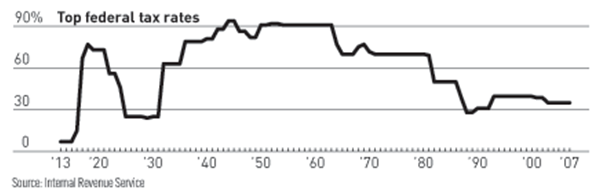
Did you know that once upon a time, the high bracket marginal federal income tax rate was a whooping 90%. 

Add in some state & local taxes, and uber-earners were shelling every piece of marginal income to the government.

My surprises:

(1) the 90% rates hung in for almost 30 years.

(2) it was JFK, not Reagan that made the first cuts

image

Chart extracted from an IBD editorial:
http://www.ibdeditorials.com/IBDArticles.aspx?id=303088374745338

* * * * *

Want more from the Homa Files?
Click link =>
  The Homa Files Blog

* * * * *

'Play Ball' ? Obama – treading on the American pastime – says 'not so fast' …

October 17, 2008

Excerpted from THR.com “Fox to Change World Series Start Time for Obama”, Paul J. Gough, Oct 15, 2008

* * * * *

To accommodate a half-hour Obama political advertisement on Fox on Oct. 29, Major League Baseball has agreed to move the start time of World Series Game 6 by about 15 minutes. That would move the start of the game from 8:20 p.m. ET or so to 8:35 p.m.

“Fox will accommodate Senator Obama’s desire … If requested, the network would be willing to make similar time available to Senator McCain’s campaign.”

The blessing from MLB clears the way for Fox to air the promo and collect upward of $1 million in ad revenue for the half hour, more than what either CBS or NBC was charging.

* * * * *

Full article:
http://www.hollywoodreporter.com/hr/content_display/television/news/e3ifa25645bfd6bcf91b52ef4f665b661f5 

Thanks to SMH for spotting the story

* * * * *
Ken’s Take:

(1) If I were McCain, I’d take Fox up on the offer and buy 30 minutes or so before game 7 … good buzz even if the series doesn’t go the full 7 games

(2) When at B&D, we’d buy “end of reel” time during the World Series.  It’s kinda like flying standby. Networks sell extra commercial spots (cheap) just in case a game has many pitching changes or goes into extra innings.  One year, we hit lotto — game 7 went extra innings and we got several exposures.  Mc Cain should do that, too.

* * * * *

Want more from the Homa Files?
Click link =>
  The Homa Files Blog

‘Play Ball’ ? Obama – treading on the American pastime – says ‘not so fast’ …

October 17, 2008

Excerpted from THR.com “Fox to Change World Series Start Time for Obama”, Paul J. Gough, Oct 15, 2008

* * * * *

To accommodate a half-hour Obama political advertisement on Fox on Oct. 29, Major League Baseball has agreed to move the start time of World Series Game 6 by about 15 minutes. That would move the start of the game from 8:20 p.m. ET or so to 8:35 p.m.

“Fox will accommodate Senator Obama’s desire … If requested, the network would be willing to make similar time available to Senator McCain’s campaign.”

The blessing from MLB clears the way for Fox to air the promo and collect upward of $1 million in ad revenue for the half hour, more than what either CBS or NBC was charging.

* * * * *

Full article:
http://www.hollywoodreporter.com/hr/content_display/television/news/e3ifa25645bfd6bcf91b52ef4f665b661f5 

Thanks to SMH for spotting the story

* * * * *
Ken’s Take:

(1) If I were McCain, I’d take Fox up on the offer and buy 30 minutes or so before game 7 … good buzz even if the series doesn’t go the full 7 games

(2) When at B&D, we’d buy “end of reel” time during the World Series.  It’s kinda like flying standby. Networks sell extra commercial spots (cheap) just in case a game has many pitching changes or goes into extra innings.  One year, we hit lotto — game 7 went extra innings and we got several exposures.  Mc Cain should do that, too.

* * * * *

Want more from the Homa Files?
Click link =>
  The Homa Files Blog

A PreMortem for The McCain Campaign

October 17, 2008

Ken’s Note: Howard Wolfson is a Hillary diehard who leans very left. This caught my eye because of (1) the notion of a “pre-mortem” analysis (2) I think his analysis is on target.  I only hope that reports of McCain’s presidential bid’s dying are premature …

* * * *

Excerpted from RCP: “A PreMortem for The McCain Campaign”, Howard Wolfson,  11.10.2008

* * * * *

The economic crisis dealt the McCain campaign a fatal body blow. None the less, the choices that Senator McCain has made during this race will impact the margin of his defeat and the fortunes of other Republicans on the ballot. Today it’s worth considering what Senator McCain could have done differently. 

1) Avoid Faustian Bargains.
John McCain enjoyed a national reputation as a moderate maverick who was willing to challenge the voices of intolerance within his own party and work across the partisan divide. After 9/11 Senator McCain changed course dramatically and yoked his fortunes with President Bush’s. This strategy clearly helped Senator McCain capture his party’s nomination — but it left him poorly positioned to compete in a general election in the current political environment.

2) A Second Act for Sarah Palin.
Sarah Palin’s introduction to the American public was a strong one. She helped to rally the Republican base and drew interest from blue collar voters and some women who might not have otherwise given John McCain a second look. Since then her performance has been poor.

3) A Different VP Choice Entirely.
The choice of a VP speaks volumes to the American public about the candidate making it. What if he had chosen Gov. Tom Ridge, a pro-choice former Governor or former Senator Joe Lieberman instead? Would the choice of Mitt Romney have helped credential Senator McCain on the economy?

4) Distance from George W. Bush.
He allowed Senator Obama and Democrats to define his prospective first term as President Bush’s third. The last thing the American public wants is four more years of the last eight. Senator McCain never made a compelling case that he would do anything differently.

5) Attempt to Define Senator Obama Earlier.
Senator McCain’s efforts to hang Bill Ayers around Senator Obama’s shoulders are totally irrelevent to the current mood of the country and only serve to reinforce how out of touch he is with the real concerns of the American people. They are also much too late to do any good.

6) A Coherent Response to the Economic Crisis.
Senator McCain’s response to the economic crisis — first lauding the economy, then suspending his campaign to pass a bill that failed on its first try, threatening to skip the first debate — was lurching, incoherent, and tone deaf. 

* * * * *

Full article:
http://blogs.tnr.com/tnr/blogs/the_flack/archive/2008/10/11/a-premortem-for-mccain.aspx 

* * * * *

Want more from the Homa Files?
Click link =>
  The Homa Files Blog

Debate: Missed opportunities, no kill shots …

October 16, 2008

Among the things that I harp on with students is that each slide in their pitches should be explicitly “conclusive” or “prescriptive”. 

That is, tell the audience the answer, don’t make them figure it out on their own.  Otherwise, they might draw the wrong conclusion or no conclusion at all.

I wish McCain had taken one of my courses.  Last night, Obama artfully dodged and weaved. He gave McCain opportunities, but McCain never went in for the kill. For example,

* * * * *

On the subject of tax cuts to 95% of Americans, here’s what I was hoping McCain would say:

“Senator, since 40% of workers don’t pay any income taxes (thanks largely to the Bush tax plan) how can you give them tax cuts?  You’re not giving tax cuts, you’re rebuilding the welfare system that Pres. Ciinton dismantled.  What don’t you just call it what it is — welfare?” , or

“Senator, the core of you tax plan is to tax businesses — large and small — and give $500 credits to 95% of workers.  That works out to be about $1.37 per day. Higher taxes on businesses will raise prices (which is bad for all) — and will cut jobs. Do you really think that workers are willing to bet their jobs for a little over a buck a day?”

* * * * *

On the subject of Obama’s sleazy associations:

“Senator, you attended Rev. Wright’s church for 20 years and didn’t hear his anti-American rants — the Rev. Wright of today isn’t the man you knew; you worked with and for Bill Ayres — a self-admitted terrorist — who isn’t the man you knew; you funneled government money to Tony Rezko — a convicted felon — but not the man you knew; your campaign gave almost $1 million to ACORN — an organization that has been tied to voter fraud in the last 2 presidential elections and is being investigated in 11 states as we speak — but that’s not the organization you knew.  Senator, if these despicable characters can fool you for so long, why should we have confidence that you won’t be fooled by people like Mahmoud Ahmadinejad?”

* * * * *

Instead, McCain let it to the audience to draw their own conclusions.  My bet: they concluded “so what?”

* * * * *

Want more from the Homa Files?
Click link =>
  The Homa Files Blog

Putting the stock market (and capital gains) in perspective …

October 15, 2008

Historical Perspective

Like most folks, I’ve gotten hammered by the recent market declines.  But yesterday —when Obama said “McCain’s capital gains tax cut won’t have any effect … not even the best investors have to worry about capital gains these days” — it got me thinking “how bad are things, and is Obama right?”  Answer: “not that bad”, and “no”.

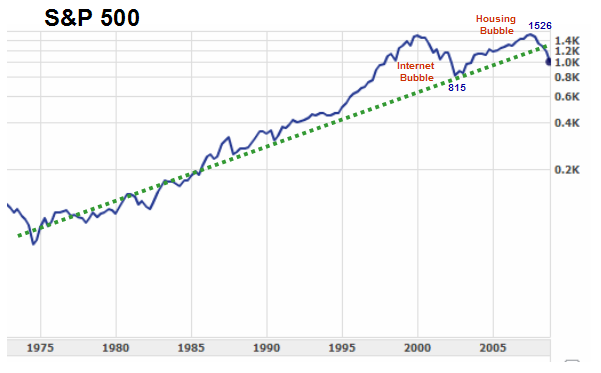
Below is historical data for the S&P 500 Index — right off Yahoo Finance.  Since the plot is logarithmic, the straight line represents a constant rate of increase — across 33 years.  Pretty remarkable, right ?  Even considering the past couple of weeks’ battering.  The chart really puts things in perspective. If you compare where we are to 2 artificially high periods — the internet -bubble and the housing bubble — things look pretty bleak.  If you compare where we are to the long run historical trend — we’re only slightly below the trend line.  In other words, right on track.

image

* * * * * *

Capital Gains

What about Obama’s assertion that not even the savviest investors will benefit from a halving of the capital gains rate?

Well, that might or might not be true. It depends on when stocks were bought.  Using the S&P 500 as a proxy for an average stock, if a stock  was bought near the peak of the internet or housing bubbles, it’s probably “under water” with no unrealized capital gains (i.e. capital losses).  McCain’s proposal to allow deductibility of up to $15,000 of losses (up from $3,000) would offset some of the pain.  The average tax benefit of the step-up would be about $2,400 [$12,000 step-up times 20% average effective tax rate equals $2,400].

But, note that a stock that’s been held for about 10 years — e.g. the portfolios of diehard “buy & hold” folks — are “in the money” and have capital gains.  Or, folks who bought into the market after the internet bubble burst may have capital gains.  For example, if somebody bought the S&P Index in Sept. 2002 at 815, they’d be sitting down from the housing bubble peak of 1,500 but — at 1,000 — they’d still have 185 of capital gains.  After McCains 7.5% capital gains tax, that nets to 171; after Obama’s 20%, that nets to 148 — a 16% difference. Hmmm.  I guess the cut in the capital gains tax rate could matter.

More important, McCain’s capital gains tax rate cut is intended to attract capital into the market now — with the prospects of favorable tax treatment when prospective gains are realized.  The increased flow of capital should boost the stock market — which is good for all investors, big and small — and should provide growth capital to businesses — which should help employment.  Win-win.

image

* * * * *

Want more from the Homa Files?
Click link =>
  The Homa Files Blog

Kumbaya ? I don’t think so …

October 15, 2008

Excerpted from WSJ: “Hopes Quickly Fade For a Postpartisan Era”, Seib, Oct. 14, 2008

* * * * *
Idealists once looked at this presidential campaign, between two candidates who fancy themselves as free of conventional party ties, and thought it might produce the election that finally pulls Washington out of the deep rut of partisan divisiveness it fell into in the 1990s … Instead, partisan animosity is growing rather than waning.

Pollster Peter Hart has found some startling new evidence of high tensions. In surveying voters over the weekend, Mr. Hart found that more than a third of each candidate’s supporters say they have grown to “detest (the other candidate) so deeply that they would have a hard time accepting the one they don’t support as president.

* * * * *

It’s starting to appear that the only way for Washington to overcome partisan divides may be if one party — the Democrats, in this case — wins by such commanding margins that it can overpower the other party.
That might be good for efficiency, but it would be bad for building the kind of national consensus that’s desirable to overcome the enormous economic challenges the nation will face after Nov. 4.

(America will) again elect a president whom a sizable chunk of voters somehow consider illegitimate. That may make for good autumn sport, but it’s discouraging for anyone who thought Washington was about to pull out of its divisive partisan ditch.

Full article:
http://online.wsj.com/article/SB122393387064230201.html 

* * * * *

Want more from the Homa Files?
Click link =>
  The Homa Files Blog

For the record: Ideas for McCain …

October 14, 2008

Last week I emailed some ideas to Doug Holtz-Eakin — McCain’s chief economic advisor. Why?  Just frustrated.  Waste of time ? Probably. I imagine that it went right to a spam file … and I certainly didn’t get a reply.

Still, since McCain is supposed to unveil some new economic tactics today, I wanted to get my notions on the record.  Interesting to see if any are included.

* * * * *  

    Ken’s Ideas

1) Make the first $100,000 of capital gains tax free for everybody
   (Note: Warren Buffet & other uber-fat cats
              wouldn’t benefit much)
 

2) Make IRA and 401K withdrawals taxable at capital gains rates — not ordinary income rates
    (Note: even though IRAs are down, many are still above water)

3  Make all capital gains from the sale of primary residences tax free … always
    (Note: allows empty-nesters to downsize — currently,
               only 1 primary home sales is cap gains free)
  

4) Allow home mortgage interest to be income tax deductible for the 65% of filers who use the standard deduction.
    (Note: roughly comparable to Obama’s 10% tax credit
              for mortgage interest )
  

5) Give a 1-time stimulus payment to Social Security retirees equal to 1 month their annual SS benefits
    (Note: gets some relief to fixed income Seniors)

6) Shift the payroll tax schedule by by increasing the earnings cap by $25,000 (to $127,000)
    … but give a non-refundable tax credit for payroll taxes on the first $25,000 of earnings.
   (Note: this Out-Obamas Obama)

7) Retroactively impose a draconian 1-time income tax surcharge for 2008 earnings OVER $5 million.
    For example: a 100% surcharge on income over $
     5 million would mean a 70% rate.

   (Note: I realize this isn’t conservative and
     muddies the “no tax” message  … but it
     goes right after the “greedy fat cats”
    Note:  tax changes can be retroactive
… puts responsibility on Dem Congress, this year)
 

* * * * *

Want more from the Homa Files?
Click link =>
  The Homa Files Blog

The health care debate … that isn’t being held

October 14, 2008

Ken’s Take: Coburn & Burr raise good points — especially re: the likely consequences of gov’t controlled health care.  But, even they ignore the biggest issue: we’re spending over $7,000 per capita annually on health care.  Until the costs get contained, we’re just shifting around the burdens of who pays what.

* * * * *

Excerpted from RCP: “Americans Deserve a Real Health Care Debate”, Tom Coburn and Richard Burr, October 10, 2008

* * * * *

The American people have had enough and want the campaigns to confront the real problem: Health care is becoming less affordable and less accessible for millions of middle-class families. While health care premiums have gone up 78 percent from 2001-2007, workers’ earnings have only risen by 19 percent.

* * * * * 

Three core principles. First, a person’s ability to afford health care should not depend on whether they work for an employer who offers health insurance. Second, wealthy Americans with expensive health plans do not deserve a bigger tax benefit than working class Americans. And finally, workers should be able to pick the health care plan that best meets their needs, and they should be able to take it with them when they change jobs.

* * * * *

Our current tax code is fundamentally unfair and regressive. Lower income workers receive the least benefit, while wealthy Americans receive the most. Because tax rules are tied to employment (health care benefits paid for by employers are exempt from income and payroll taxes), if you leave your job, you leave your health care behind. Meanwhile, Americans who purchase their own health insurance generally do not receive a tax benefit.

* * * * *

Government-controlled health care is a seductive message that, in practice, is most cruel to those who can least afford a way out. Much of Europe is moving away from government-control health care.  Countries like the United Kingdom have learned the painful lesson that the only way government can control costs when it is in charge is by rationing care. In the UK, it is not uncommon for women diagnosed with breast caner to wait months for treatment.  Canadians look for health care asylum in the United States, not vice versa. As the Canadian Supreme Court said in a ruling that exposed the inequities of government-controlled health care, “Access to a waiting list is not access to health care.”In short, government-sponsored health care will do for the health care economy what government-sponsored mortgages did to the housing market.

Tom Coburn, M.D. is a U.S. Senator from Oklahoma and Richard Burr is a U.S. Senator from North Carolina.

* * * * *
Full article:
http://www.realclearpolitics.com/articles/2008/10/americans_deserve_a_real_healt.html

* * * * *

Want more from the Homa Files?
Click link =>
  The Homa Files Blog

Financial crisis: history repeating itself ?

October 14, 2008

Source: IBD: “America’s Second Wake-Up Call!”, Oct. 10, 2008
http://www.ibdeditorials.com/IBDArticles.aspx?id=308530236252361

* * * * *

Want more from the Homa Files?
Click link =>
  The Homa Files Blog

Obama’s Magic Show

October 13, 2008

Ken’s Take: Obama fans might want to skip this one. McCain fans will wonder why J-Mac can’t rattle this stuff off in debates. Open-minded folks should keep reading.

* * * * *

Excerpted from WSJ: “Obama’s Magic”, Strassel, Oct.10, 2008

* * * * *

And now, America, we introduce the Great Obama! The world’s most gifted political magician! A thing of wonder. Just watch him defy politics, economics, even gravity!

* * * * *
To kick off our show tonight, Mr. Obama will give 95% of American working families a tax cut, even though 40% of Americans today don’t pay income taxes! How can our star enact such mathemagic? How can he “cut” zero? Abracadabra! It’s called a “refundable tax credit.” It involves the federal government taking money from those who do pay taxes, and writing checks to those who don’t. Yes, yes, in the real world this is known as “welfare,” but please try not to ruin the show.

* * * * *
For his next trick, the Great Obama will jumpstart the economy by raising taxes on businesses that are today adrift in a financial tsunami! That will include … small-business owners, and the nation’s biggest employers who currently pay some of the highest corporate tax rates in the developed world. Mr. Obama will, with a flick of his fingers, show them how to create more jobs with less money. It’s simple, really. He has a wand.

* * * * *
Next up, Mr. Obama will re-regulate the economy, with no ill effects whatsoever! Did someone in the audience just shout “Sarbanes Oxley?”  Usher, can you remove that man?

* * * * *

Just watch the Great Obama perform a feat never yet managed in all history. He will create that enormous new government health program, spend billions to transform our energy economy, provide financial assistance to former Soviet satellites, invest in infrastructure, increase education spending, provide job training assistance, and give 95% of Americans a tax (ahem) cut — all without raising the deficit a single penny! And he’ll do it in the middle of a financial crisis. And with falling tax revenues! Voila!

* * * * *
Moving along to a little ventriloquism. Study his mouth carefully, folks: It looks like he’s saying “I’ll stop the special interests,” when in fact the words coming out are “Welcome to Washington, friends!” Wind and solar companies, ethanol makers, tort lawyers, unions, community organizers — all are welcome to feed at the public trough and to request special favors. From now on “special interests” will only refer to universally despised, if utterly crucial, economic players. Say, oil companies. Hocus Pocus!

* * * * *
And for tonight’s finale, the Great Obama will uphold America’s “moral” obligation to “stop genocide” by abandoning Iraq! While teleported to the region, he will simultaneously convince Iranian leaders to peacefully abandon their nuclear pursuits (even as he does not sit down with them), fix Afghanistan with a strategy that does not resemble the Iraqi surge, and (drumroll!) pull Osama bin Laden out of his hat!

* * * * *

We’d also like to thank Mr. McCain for keeping all the focus on himself these past weeks. It has helped the Great Obama to just get on with the show.

* * * * *

Full article:
http://online.wsj.com/article/SB122360618747721991.html

* * * * *

Want more from the Homa Files?
Click link =>
  The Homa Files Blog

Taxes: The 95% illusion … what’s a tax cut?

October 13, 2008

Excerpted from WSJ: ” Obama’s 95% Illusion”, Oct. 13, 2008

* * * * *   
One of Obama’s most potent campaign claims is that he’ll cut taxes for no less than 95% of “working families” … (and cut aggregate income taxes).

How does he conjure this miracle, especially since more than a third of all Americans already pay no income taxes at all? First, by proposing one of the largest tax increases ever on the other 5%.

There are several sleights of hand, but the most creative is to redefine the meaning of “tax cut.”

* * * * *
For Obama , a tax cut is no longer letting you keep more of what you earn. In their lexicon, a tax cut includes tens of billions of dollars in government handouts that are disguised by the phrase “tax credit.”  Obama is proposing to create or expand no fewer than seven such credits for individuals:

  • A $500 tax credit ($1,000 a couple) to “make work pay” that phases out at income of $75,000 for individuals and $150,000 per couple.
  • A $4,000 tax credit for college tuition.
  • A 10% mortgage interest tax credit (on top of the existing mortgage interest deduction and other housing subsidies).
  • A “savings” tax credit of 50% up to $1,000.
  • An expansion of the earned-income tax credit that would allow single workers to receive as much as $1,110 if they are paying child support.
  • A child care credit of 50% up to $6,000 of expenses a year.
  • A “clean car” tax credit of up to $7,000 on the purchase of certain vehicles.

Here’s the political catch. The credits  would be “refundable,” which is Washington-speak for the fact that you can receive these checks even if you have no income-tax liability. In other words, they are an income transfer — a federal check — from taxpayers to nontaxpayers. Once upon a time we called this “welfare.”  Mr. Obama’s genius is to call it a tax cut.

* * * * *
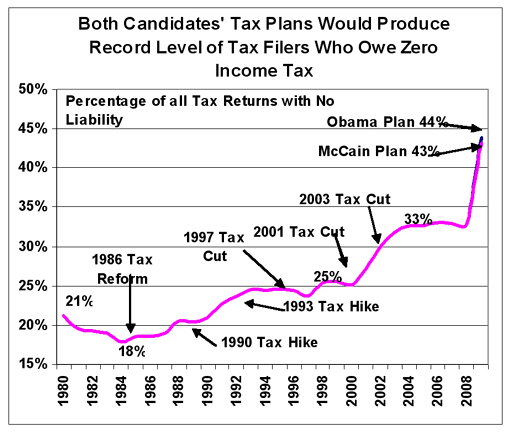
The Tax Foundation estimates that under the Obama plan 63 million Americans, or 44% of all tax filers, would have no income tax liability and most of those would get a check from the IRS each year.

The total annual expenditures on refundable “tax credits” would rise over the next 10 years by $647 billion to $1.054 trillion, according to the Tax Policy Center.  By redefining such income payments as “tax credits,” the Obama campaign also redefines them away as a tax share of GDP. Presto, the federal tax burden looks much smaller than it really is.

There’s another catch: Because Mr. Obama’s tax credits are phased out as incomes rise, they impose a huge “marginal” tax rate increase on low-income workers. The marginal tax rate refers to the rate on the next dollar of income earned. The marginal rate for millions of low- and middle-income workers would spike as they earn more income.

[Review & Outlook]

* * * * *

Full article:
http://online.wsj.com/article/SB122385651698727257.html

* * * * *

Want more from the Homa Files?
Click link =>
  The Homa Files Blog

Short course: The real cause of the subprime loan mess …

October 13, 2008

Ken’s Take:

Cuts through all of the rhetoric to the root cause: (1) the government “encouraged” bad loans   (2) the government allowed bundling of loans into MBSs (mortgage backed securities)  (3) the government provided an implied guarantee to the MBS bundles via Fannie and Freddie —GSEs ( government sponsored entities)  (4) the MBS bundles were resold up the financial food chain — separating their risk from their origination (5) the MBSs established a platform for very highly leveraged financial derivatives (e.g. CDOs, default swaps)  (6) when home prices peaked, the derivatives lost value and couldn’t support the associated borrowings, creating — in effect — the mother of all margin calls.

Dems are at the root of the problem, but the GOP isn’t blame free.  The Community Reinvestment Plan was a Dem brainchild, Clinton authorized the bundling of subprime loans, and Frank-Dodd-Reid have stopped regulation of Fannie and Freddie.  But, Bush also pushed for “a culture of (home) ownership” and had a GOP Congress until 2006 that should have been able to force greater regulation on Fannie and Freddie.

* * * * *

From IBD: “America’s Second Wake-Up Call!”, Oct. 10, 2008

* * * * *

Do you know the real cause of the out-of-control subprime loan mess that’s creating so much fear and hurting every American?

In 1995, President Clinton mandated new regulations that coerced banks to make significantly more subprime loans to inner-city residents previously viewed as unqualified buyers in high-risk areas. Many subprimes were variable-rate loans made without down payments or documentation of borrowers’ incomes. Banks were rated on how well they complied and faced big fines if they didn’t do what government regulators wanted.

The government’s worst decision was allowing and encouraging banks, for the first time, to bundle these subprime loans in giant packages with prime loans. These packages were then sold to other investors as safe because they were government-sponsored by Fannie Mae and Freddie Mac. The first of these government-encouraged packages came to market in 1997.

For the banks, the loan bundles were profitable because they could be sold quickly and thereby absolve the banks of any risk in the loans they made.

The banks could then use the money to make even more of these lower-quality, government-required loans, and Fannie Mae and Freddie Mac bought them with virtual abandon.

It evolved into a Big Government pyramid scheme . In short, this was yet another well-intended, government-designed and run program that failed miserably and had the usual unintended consequences.

* * * * *

September 2003: Treasury Secretary John Snow, in testimony to the House Financial Services Committee, recommended that Congress enact legislation to create new agency to regulate and supervise financial activities of housing-related government entities to set prudent and appropriate minimum capital requirements.

Rep. Barney Frank, the committee’s ranking member, strongly disagreed, saying: “Fannie Mae and Freddie Mac are not facing any kind of financial crisis . . . . The more people exaggerate these problems, the more pressure there is on these companies, the less we’ll see in terms of affordable housing.”

April 2004: Rep. Barney Frank ignored warnings, accusing the administration of creating an “artificial issue.” “People pay their mortgages,” he told a group of mortgage bankers. “I don’t think we are in any remote danger here. This focus on receivership, I think, is intended to create fears that aren’t there.”

July 2005: Senate Majority Leader Harry Reid rejected legislation on reforming Fannie and Freddie. “While I favor improving oversight by our federal housing regulators to ensure safety and soundness, we cannot pass legislation that would limit Americans from owning homes and harm our economy in the process,” he said.

* * * * *

Full article:
http://www.ibdeditorials.com/IBDArticles.aspx?id=308530236252361

* * * * * *

Want more from the Homa Files?
Click link =>
  The Homa Files Blog

Bad news: Tax-payers on the hook for the bailout … Good news (?): that’s not many people

October 10, 2008

Ken’s Take:  I’ve been railing for awhile on the trend to have a minority of voters incur the full burden of taxes. I think everybody should have some skin in the game.

So, who is paying for the bailout?  Read on …

* * * * *

Excerpted from RealClearPolitics.com: “The Bailout and the Vanishing Taxpayer”, October 08, 2008

* * * * *
We have heard much in the press lately about the American taxpayer being forced to rescue the sharpies on Wall Street from their own greed and irresponsibility. Anti-bailout sentiment cuts “across class lines” on Main Street because “the taxpayers are on the hook for the bad judgment of others,” as the Washington Post put it.

Now for a reality check. Many Americans probably won’t pay a cent of the cost of this bailout.

That’s because a rapidly increasing percentage of U.S. households legally pay no income taxes, and many others pay so little in taxes that they already get back more from the federal government in services than they send to Washington. The number of taxpayers  … is small and shrinking, which is why the only way that the folks on Main Street will pay for this bailout will be if Main Street is where the mansions are in your town.

* * * * *

The declining portion of households who pay taxes is a direct result of policies pursued by both Republicans and Democrats over the last 15 years or so. While deductions and credits have always served to eliminate the tax bill for some low and lower-middle income workers, from 1950 through roughly 1990, the percentage of households with no income tax burden stood constant at slightly more than one-fifth of all filers, according to the Tax Foundation. But since 1990, Washington has added all sorts of tax credits��”subsidizing everything from “lifetime learning” to adoption expenses–that have further reduced the tax tab, and in the process raised the proportion of households with no federal tax liability to 33 percent.

A big culprit in this evolution is the current Bush administration and its tax packages. Although the 2001 and 2003 tax cuts are often criticized as having favored the rich, in fact they were also laden with tax credits benefiting low and middle income families, and as a result, under Bush, the percent of families not paying taxes increased more than under any other president during the last 50 years.

Both presidential candidates would vastly accelerate the trend (from 33% to the mid 40%s).

* * * * *

In the end, how we actually pay for the bailout is just part of the issue. The larger point is that if McCain or Obama follow through with their tax plans, we’ll continue a trend that makes us look more and more like some European social welfare state, where many people have a stake in growing government entitlements, which fewer and fewer taxpayers finance. At some point along that road, change becomes impossible because too many citizens benefit from the system in place, while those who pay the freight for this system try whatever they can, including starting businesses elsewhere, or reducing their output, to avoid the disproportionate tax bite.

* * * * *

Full article:
http://www.realclearmarkets.com/articles/2008/10/the_bailout_and_the_vanishing.html

* * * * *

Want more from the Homa Files?
Click link =>
  The Homa Files Blog

Worth reading: Playing Frisbee on a Precipice

October 10, 2008

Ken’s Take: Peggy Noonan a gifted writer who plays pretty much down the middle and always seems to cut to the core of political issues.   I think this sober analysis is worth reading and pondering.  Here are some highlights.  Full rticle is well worth the time.

* * * * *

Excerpted from WSJ:”Playing Frisbee on a Precipice”, Peggy Noonan, Oct. 10, 2008 

* * * * *

Punch Line: “America’s political class lacks the seriousness this moment demands.”

* * * * *

In parts and pockets of the middle, we have Americans who aren’t thinking about politics because they’re busy trying to imagine what a modern depression would look like and wondering, for the first time ever, if it is possible that they may wind up living in their cars.

Quoting an old comic: “I have enough to live comfortably for the rest of my life, as long as I’m hit by a bus tomorrow.”

* * * * *

In a time of crisis, do you really want one party to control the entire government? Don’t you want one party controlling one power center, and one in charge of the other, with each side tempering the other’s worst impulses?

* * * * *

Both campaigns, in the closing stretch, seem not fully worthy of the moment. We are in crisis—a once-in-a-century event, as we now say. And what we got from the candidates, in this week’s presidential debate, was a bunch of gummy meanderings—smooth, rounded sentences so full of focus-grouped inanities that six minutes in viewers entered a kind of trance in which we almost immediately gave up on trying to wrest meaning from what was being said and instead focused on mere impressions. The look of things. The men on the plane, the pseudo-tough political operatives who surround both candidates, sometimes grouse, in private, that it’s all symbols now, all mood, all about the visual.

But they have some real responsibility here. They send their candidates out to speak such thin gruel, such spat-out porridge, that we are struck dumb, and left daydreaming about the fact that Mr. Obama’s suits are always slate gray and never seem to wrinkle, and Mr. McCain tonight seems like a rabbity forest creature darting amid the hedgerows.

* * * * *

As to what they will do about the crisis, Mr. Obama will raise taxes on the rich and help us weatherize our homes, while Mr. McCain favors “energy independence” and buying up mortgages. On the causes of the crisis they spoke of insufficient regulation, or high spending.

But these were not the great causes. Neither party has clean hands. Or rather, both parties have dirty hands. Here is the truth, spoken by the increasingly impressive Sen. Tom Coburn: “The root of the problem is political greed in Congress. Members . . . from both parties wanted short-term political credit for promoting homeownership even though they were putting our entire economy at risk by encouraging people to buy homes they couldn’t afford. Then, instead of conducting thorough oversight and correcting obvious problems with unstable entities like Fannie Mae and Freddie Mac, members of Congress chose to . . . distract themselves with unprecedented amounts of pork-barrel spending.” That is the truth.

* * * * *

And yet at the debate, when one citizen-questioner invited both candidates to think aloud about the responsibility of our representatives in Washington, they both gently suggested she was cynical.

She was not cynical. She was informed.

Why would anyone trust either candidate to help dig us out of this if they can’t speak frankly about what got us into it?

* * * * *

One had the sense this week that our entire political class is playing Frisbee on the edge of a precipice, that no one is being serious enough, honest enough, that it’s all too revved, too intense, and yet too shallow. I have grown impatient with the strategists from the campaigns, the little blond monsters who go on cable TV to give us their bouncy, aggressive, tendentious talking points. They are like the men on the plane, the gargoyles with BlackBerrys who think the race is about them and their personal win/loss ratio, who think history is their plaything, who stay up with the press in the bar sipping Perrier and calling it seltzer, and who advise their candidates, in essence, to talk down to the voters, to the American people. They treat every crisis as if it is a political fact to be used for gain or loss, and not as a real crisis, something that deserves a response of gravity and seriousness.

It is asking a lot to ask a political animal to be thoughtful, because they find meaning in action. They are propelled through life by the force of their hunger. But now and then you want to see them think. You want to see them speak the truth. This is one of those times.

* * * * *
Full article:
http://online.wsj.com/article/SB122359863551021415.html#articleTabs%3Darticle

* * * * *

Want more from the Homa Files?
Click link =>
  The Homa Files Blog

The perils of buying at the peak …

October 9, 2008

Ken’s Take:

1) It never pays to buy at the peak — unless somebody is staking you — and the government is ready with a safety net.

2) Nobody that I know is good as calling the peak.

3) 2005-2007 … 3 years that will live in infamy … with their lessons forgotten by 2012

4) Remember: the mortgage mess is highly concentrated to California, Florida, Nevada, and Arizona.

5) Also remember: 1/3 of 75 million are owned free & clear of any mortgages

* * * * *

[McCain Reshuffles Rescue Deal]

http://online.wsj.com/article/SB122351316270117559.html

* * * * *

Want more from the Homa Files?
Click link =>
  The Homa Files Blog

Worth reading: Lessons from the financial crisis …

October 9, 2008

Excerpted from RealClearPolitics.com: “Wall Street 101”, Victor Davis Hanson, October 09, 2008

* * * * *

Until the past few weeks, the financial panic was still mostly far away on Wall Street. But not now.

Car loans, mortgages and college financing are suddenly harder to come by. Millions are stuck in houses not worth what is owed on them. Cash-strapped consumers are cutting back. The economy is slowing. Jobs are disappearing. Who wants to open quarterly 401(k) statements only to learn that everything they put away in retirement accounts the past two or three years is gone?

There is plenty of blame to go around. Greedy Wall Street speculators took mega-bonuses even when they knew their leveraged companies were tottering — and someone else would pick up the tab. Crooked or stupid politicians allowed Fannie Mae and Freddie Mac to squander billions, as they raked in campaign donations and crowed about their politically correct support for millions of shaky — and now mostly defaulting — buyers.

The new national gospel became charge now/pay later and speculate, rather than put something away in case of a downturn. To provide more goodies that we hadn’t earned, politicians ignored soaring annual budget deficits and staggering national debt and kept spending.

* * * * *  

But amid the gloom, there are some valuable lessons that we can take away from the Wall-Street panic.

First, cash really is king. For all the talk of a trillion here or billions there, when the crunch came many of these investment houses and their once-strutting managers found themselves with a minus net worth. They were desperate to find liquidity — any money anywhere they could find it. Pedestrian passbook savings accounts proved wiser investments than all the clever hedge funds, derivatives and subprime schemes put together.

Second, wisdom and blue-chip college educations are not quite the same thing. The fools in Washington and New York who blew up Wall Street had degrees from our finest professional schools. [For example, Barney Frank and Franklin Raines are both Harvard Law graduates.] If these guys are our best and brightest, then it is about time we rethink what constitutes wisdom, since an Ivy League law degree certainly seemed no proof of either intelligence or ethics.

Third, we as a nation need to relearn the old notion of shame — as in, “Shame on you!” Firms like Lehman Brothers and Bear Stearns were once responsible Wall Street institutions, built up over decades by sober men. But their far-lesser successors in just a few months have bankrupted these venerable brokerage houses — with seemingly no shame at what they have done to the image of Wall Street.

* * * * *

Americans used to pay their debts. Somewhere in all the blame-gaming about the crooks and liars in New York and Washington, we never hear that real people borrowed real money that they should not have. And they then defaulted on what they owed to others. Walking away from debts may have been understandable, but it was also a violation of trust — and wrong.

Finally, what one makes is no proof of his worth. Almost every head of a Wall Street firm took tens of millions of dollars in bonuses these past few years, as they posted phony profits by borrowing ever more with ever fewer assets. But if financing facilitates the American economy, we should remember that less exotic and remunerative construction — such as farming, manufacturing and mining — is what really powers America.

* * * * *

How odd that all those boring lessons from our grandparents turn out to be true in the globalized, hip 21st century: Save your money. Don’t borrow what you can’t pay back. Look first at a man’s character, not his degrees. And if a promised return on an investment seems too good to be true, it probably is.

* * * * *

Victor Davis Hanson is a classicist and historian at the Hoover Institution, Stanford University,

* * * * *
Full article:
http://www.realclearpolitics.com/articles/2008/10/wall_street_101.html

* * * * *

Want more from the Homa Files?
Click link =>
  The Homa Files Blog

Is the mortgage glass 15% empty or 85% full ?

October 9, 2008

Ken’s Take:

1) The headline in the WSJ says “1 in 6 underwater”.  I’m more impressed that almost 85% of home owners owe less than their home is worth, and that almost 1/3 own their houses free and clear — with no mortgage balance at all.

2)  Though home prices have slid 13% in the past year or so, they’re up over 70% since 2000.  That’s not bad appreciation.

3) McCain went long-ball last nite with the mortgage buy-back proposal. Note that Congress enacted a “foundation” bill in July that provides a framework for doing so.

* * * * *

Excerpted from WSJ: “Housing Pain Gauge: Nearly 1 in 6 Owners ‘Under Water’, October 8, 2008

* * * * *

The majority of homeowners still have equity, and even among those who don’t, many continue to make their mortgage payments on time.

In contrast with the 12 million home borrowers estimated to be under water, 64 million have equity in their homes. These include 24 million households who own their homes free and clear, and 40 million whose homes remain worth more than is owed on them.

About 75.5 million U.S. households own the homes they live in. After a housing slump that has pushed values down 30% in some areas, roughly 12 million households, or 16%, owe more than their homes are worth.

The comparable figures were roughly 4% under water in 2006 and 6% last year, Among people who bought within the past five years, it’s worse: 29% are under water on their mortgages.

* * * * *
The result of homeowners being “under water” is more pressure on an economy that is already in a downturn. No longer having equity in their homes makes people feel less rich and thus less inclined to shop at the mall.

And having more homeowners under water is likely to mean more eventual foreclosures, because it is hard for borrowers in financial trouble to refinance or sell their homes and pay off their mortgage if their debt exceeds the home’s value. A foreclosed home, in turn, tends to lower the value of other homes in its neighborhood.  As home values slip, growing numbers of would-be borrowers lack sufficient equity to refinance. The falling values also make mortgage lending look riskier to banks, spurring them to tighten credit standards.

Even for folks with equity in their homes, some borrowers fret that declining prices and tighter lending standards could make it hard for them to tap their equity.

* * * * *

Prices are back to 2003 levels in the San Diego and Boston metropolitan areas, and back to 2004 levels in Las Vegas, Los Angeles, San Francisco, Fort Lauderdale, Fla., and Minneapolis.

Among mortgages on one- to four-family homes, 9.16% were a month or more overdue or were in foreclosure in the second quarter.. That compared with 6.52% a year before and was the highest level since the association began such surveys 39 years ago.

Most mortgages in default were issued in 2006 and 2007, when lending standards were loosest and the housing market was peaking. Many who bought then made small down payments or none, so they had little equity in their homes from the start.

In July, Congress enacted legislation designed to help borrowers who owe more than their homes are worth by allowing them to refinance into a government-backed loan, provided their mortgage company forgives part of their principal. It’s not clear how many borrowers the program will help, because before reducing the principal, lenders would almost always try first to freeze or reduce borrowers’ interest rate to make payments more affordable.

* * * * *

How much pain homeowners feel varies greatly from place to place. The most severe drops in home values are in parts of California, Florida, Nevada, Arizona and other areas where speculation pushed prices up and builders far overestimated demand.

On a national basis, home prices peaked in mid-2006 after rising 86% since January 2000, according to the First American index. Since peaking, that index has fallen 13%.

The declines have made homes more affordable, bringing prices in many areas closer to their long-term relationship to incomes. In the second quarter, the median home price of about $203,000 was 1.9 times average pretax household income. That was close to 1.87 times income for 1985 through 2000, prior to the housing boom.


[Home Economics]

http://online.wsj.com/article/SB122341352084512611.html

* * * * *

Want more from the Homa Files?
Click link =>
  The Homa Files Blog

McCain goes long-ball with mortgage buyback … warning track or outta here ?

October 8, 2008

Ken’s Mega-Take: McCain rolled this grenade out last night, but didn’t explode it for impact. 

After researching the terms and conditions (below), I think McCain may be on to something.  A potentially good deal for the economy, but not clear to me how many votes it wins. The mortgage mess is concentrated in a few states:  McCain has Arizona locked and has no chance in California; but plan could help in  Florida, Nevada, Ohio. 

Keep in mind that only 75 million homes are “owned”, and 85% of folks are “above water” and making their payments (1/3 of homeowners own their homes free and clear of any mortgages). There could be backlash from honest, hard-working folks who don’t want slackers and cheats bailed out — whether on Wall Street or down-the-street.

* * * * *

Excerpted from Politico.com: “McCain proposes bailout for homeowners”,  10/7/08 

* * * * *

Qualifiers

The McCain “American Homeownership Resurgence Plan ” would be available to mortgage holders that:

1)  live in the home (primary residence only)

2) can prove their creditworthiness at the time of the original loan (no falsifications)

3) provided a down payment

Ken’s Take: Excludes investor-speculators, frauds, and folks who never had any equity in the home … I think the program is limited to the right group

* * * * *

Structure

The new mortgage would be an FHA-guaranteed fixed-rate mortgage at terms manageable for the homeowner.

The direct “cost” of this plan would be roughly $300 billion, the amount of homeowners’ “negative equity” in some homes.

Funds provided by Congress in recent financial market stabilization bill can be used for this purpose; indeed, by stabilizing mortgages, it will likely be possible to avoid some purposes previously assumed needed in that bill.

The plan could be implemented quickly as a result of the authorities provided in the stabilization bill, the recent housing bill, and the U.S. government’s conservatorship of Fannie Mae and Freddie Mac.

Ken’s Take:

1) What if “they” can’t qualify under the revised terms?  What if housing prices continue to decline and the homes go back under water ?

2) The initial cash out flow to buy the loans will be greater than $300 billion … but the eventual “cost” will only be the buy-out of the negative equity.

3) I like the idea of buying a mortgage versus buying a derivative based on a pool of mortgages owned by a trust and serviced by a third party.  At least I can understand where the money is going.

4) Reminder: in July 2008, Congress enacted a program to do just this — save for the government eating the lost equity

5) By my recollection, this is essentially the business that Fannie and Freddie were originally commissioned to transact.

* * * * *

Political Talk

AMERICAN HOMEOWNERSHIP RESURGENCE PLAN

McCain said he will direct his Treasury secretary to implement an American Homeownership Resurgence Plan (McCain Resurgence Plan) to keep families in their homes, avoid foreclosures, save failing neighborhoods, stabilize the housing market and attack the roots of our financial crisis. America’s families are bearing a heavy burden from falling housing prices, mortgage delinquencies, foreclosures and a weak economy.

“It is important that those families who have worked hard enough to finance homeownership not have that dream crushed under the weight of the wrong mortgage. The existing debts are too large compared to the value of housing. For those that cannot make payments, mortgages must be restructured to put losses on the books and put homeowners in manageable mortgages. Lenders in these cases must recognize the loss that they’ve already suffered.

The McCain Resurgence Plan would purchase mortgages directly from homeowners and mortgage servicers, and replace them with manageable, fixed-rate mortgages that will keep families in their homes. By purchasing the existing, failing mortgages, the McCain Resurgence Plan will eliminate uncertainty over defaults, support the value of mortgage-backed derivatives and alleviate risks that are freezing financial markets.”

* * * * *

Source article:
http://www.politico.com/news/stories/1008/14377.html

* * * * *

Want more from the Homa Files?
Click link =>
  The Homa Files Blog

Re: Congress – 59% say "throw ’em all out"

October 8, 2008

Excerpted from Rasmussen Reports, Oct. 6, 2008

* * * * *
Congress was front and center in the national news last week and the American people were far from impressed. Just 11% of voters say Congress is doing a good or an excellent job. If they could vote to keep or replace the entire Congress, 59% of voters would like to throw them all out and start over again.

Today, just 23% have even a little confidence in the ability of Congress to deal with the nation’s economic problems and only 24% believe most Members of Congress understand legislation before they vote on it.

Less than half (49%) believe that the current Congress is better than individuals selected at random from the phone book.

* * * * * 

Despite these reviews, more than 90% of Congress is likely to be elected this November due to an electoral system designed to benefit incumbents. The biggest advantage offered those in the House of Representatives is a process known as Gerrymandering where Congressional Districts are loaded with friendly voters from Representative’s own party. In effect, Members of Congress—working through their state legislature–get to choose their voters rather than letting voters choose their Congressman.

Also aiding incumbents is high name recognition from news coverage, large staffs funded by taxpayers, and other perks.

* * * * * 

When the Constitution was written, the nation’s founders expected that there would be a 50% turnover in the House of Representatives every election cycle. That was the experience they witnessed in state legislatures at the time (and most of the state legislatures offered just one-year terms). For well over 100 years after the Constitution was adopted, the turnover averaged in the 50% range as expected.

In the twentieth century, turnover began to decline. As power and prestige flowed to Washington during the New Deal era, fewer and fewer Members of Congress wanted to leave. In 1968, Congressional turnover fell to single digits for the first time ever and it has remained very low ever since.

Full article:
http://www.rasmussenreports.com/public_content/politics/election_20082/2008_presidential_election/59_would_vote_to_replace_entire_congress

* * * * *

Want more from the Homa Files?
Click link =>
  The Homa Files Blog

Oops: Meet me at Katie’s Restaurant …

October 6, 2008

Excerpted form WSJ: “Biden’s Fantasy World”, Oct. 5, 2008

* * * * *

Note: The article outlines several of Biden’s sustentative mis-statements during the debate. The others are way more inportant, but this is my favorite.

* * * * *

Closer to home, the Delaware Senator’s blarney …  invited Americans to join him at “Katie’s restaurant” in Wilmington to witness middle-class struggles.

Just one problem: Katie’s closed in the 1980s. The mistake is more than a memory lapse because it exposes how phony is Mr. Biden’s attempt to pose for this campaign as Lunchbucket Joe.

* * * * *

Full article:
http://online.wsj.com/article/SB122325448093406451.html

* * * * *

TakeAway Point: Grandma Homa used to say “it’s better to not know than to not know that you don’t know”

* * * * *

Want more from the Homa Files?
Click link =>
  The Homa Files Blog

Tax hikes won’t impact you if you’re in the 95% … or will they ?

October 3, 2008

Excerpted from WSJ: “The Tax Issue Still Resonates”, Karl Rove,
Oct. 2, 2008

* * * * *

Conventional wisdom says tax cuts have lost their political power. One reason offered for the alleged decline of tax cuts as a potent issue is that since 2000, tax cuts have taken 13 million filers off of the income tax rolls. Today, one-third of all filers have no federal income tax liability and nearly 40% of all federal income taxes are now paid by the top 1% of taxpayers (60% by the top 5%). The fewer people who are paying taxes, the fewer people who care about tax cuts, or so goes the reasoning.

* * * * *
In a July 2008 Pew Poll, 52% of Americans said it was “difficult to afford” taxes. By comparison, 46% said the same about health care, 49% about home heating/electric bills, and 38% about food.

* * * * *

Obama says that only the top 5% will pay higher taxes under his proposals.

But, nearly three out of every four filers who’ll pay higher taxes under a President Obama are small businesses, the source of most new jobs and growth.

An Urban Institute-Brookings Institution Tax Policy Center study found that 73% of the filers hit by Mr. Obama’s tax increases report business income — i.e., they are small business owners. His tax hikes will affect every worker at those enterprises.

* * * * *

Ken’s POV:

The bottom line is that Obama’s tax hikes won’t impact you unless you work for a big company, a small company, or buy stuff from either big or small companies — who will simply increase prices to offset higher taxes.

* * * * *

Want more from the Homa Files?
     Click link =>
  The Homa Files Blog

Re: Fannie and Freddie – Who said what … and when did they say it ?

October 3, 2008

Excerpted from WSJ: “What They Said About Fan and Fred”,
October  2, 2008

* * * * *

A special word is in order here for Congress. Today we’re running a collection of greatest Member hits in defense of Fannie Mae and Freddie Mac.

The guilty deserve such attention because those two government-sponsored enterprises did so much to turbocharge the credit mania. By providing subsidized rates of return to global investors, they helped fuel the bubble in housing and mortgage-backed securities that is now haunting so many financial institutions.As the quotes make clear, the Members fought furiously against any attempt to make Fan and Fred less dangerous.

The Bush Administration was on the right side of this debate for eight years, as was the late Clinton Treasury. This was a scandal in plain sight that all but a few ignored.

* * * * *

Worst of the Worst

Rep. Barnie Frank: I do think I do not want the same kind of focus on safety and soundness that we have in OCC [Office of the Comptroller of the Currency] and OTS [Office of Thrift Supervision]. I want to roll the dice a little bit more in this situation towards subsidized housing. House Financial Services Committee hearing, Sept. 25, 2003

* * * * *
Worth reading – the complete list of quotes:
http://online.wsj.com/article/SB122290574391296381.html

* * * * *

Want more from the Homa Files?
     Click link =>
  The Homa Files Blog

Paying the piper …

October 2, 2008

Excerpted from WSJ: “Bailing Out Ourselves – Bankers weren’t the only ones who enjoyed the credit mania”, October 2, 2008

* * * * *

“If banks, in spite of every precaution, are sometimes betrayed into giving a false credit to the persons described, they more frequently enable honest and industrious men of small and perhaps of no capital to undertake and prosecute business with advantage to themselves and to the community.”

So wrote Alexander Hamilton in 1790, amid an earlier populist backlash against American bankers. Hamilton didn’t hesitate to use the powers of the Treasury to calm markets amid a speculative panic for the good of the larger community. The U.S. is at another Hamiltonian moment, if Congress has the nerve to act in the national interest.

* * * * *
We are told this is a “bailout for Wall Street.” But if Americans are honest with themselves, they will admit that bankers are far from the only cause of our current predicament.

The U.S. is living through the aftermath of a classic credit mania, one that all of us enjoyed while it lasted. We don’t remember many protests when home prices were rising by 15% a year, or when interest rates stayed at 1% for a year and real interest rates were negative for far longer.

* * * * *
Our point isn’t to absolve Wall Street or Washington — far from it. The point is that credit manias are by their very nature societal, which is why the panics that follow can do so much damage to Americans outside the financial arena. They are part of a larger psychology that sweeps everyone up in euphoria for a time, only to send everyone into a defensive crouch when the credit stops.

The challenge at such a moment is to prevent a panic from becoming a crash that does far more extensive damage. This is where we are now, and this is why the House should pass the bill that passed the Senate last night, even with its flaws. The government needs the power to use public capital to defend and stabilize the financial system. In that sense, we are really bailing out ourselves.

* * * * *
Credit markets are ceasing to function by any normal standard, with banks refusing even to lend to one another, much less to credit-worthy borrowers on Main Street.

Yesterday, the Institute for Supply Management’s manufacturing index reported its largest one-month drop in 24 years. While at 43.5 the index remains above the recession level of 41, the credit vise may soon guarantee one.

* * * * *
Fannie Mae and Freddie Mac … those two government-sponsored enterprises did so much to turbocharge the credit mania. By providing subsidized rates of return to global investors, they helped fuel the bubble in housing and mortgage-backed securities that is now haunting so many financial institutions.

The Bush Administration was on the right side of this debate for eight years, as was the late Clinton Treasury. This was a scandal in plain sight that all but a few ignored.

* * * * *

The Paulson plan isn’t what we would have drawn up. It will not by itself inject capital into troubled banks, and it carries risks in how Treasury will price toxic assets when it buys them. But it is one more policy tool at a time when something needs to be done, and it is the only one currently up for a vote. Passing it won’t by itself revive the banking system, but defeating it will guarantee far more damage to far more Americans.

In this sense, too, the votes this week in Congress are about bailing out our political class from its own embarrassing performance. Americans are anxious, even frightened, about the financial system. They are looking for leaders who will act to defend it.

* * * * *
Full article:
http://online.wsj.com/article/SB122292003161497455.html

* * * * *

Ken’s POV:

The bailout simply closes a loop.  The government ‘encouraged’ lower mortgage loan qualifying criteria with the Dem’s Community Reinvestment initiatives and Bush’e Ownership push.  Now, the government will be stuck holding the bad paper that it thought it was feisting off on the banks.  It would be poetic justice if the government weren’t playing with our money.

* * * * *

Want more from the Homa Files?
     Click link =>
  The Homa Files Blog

Game-changing idea for the candidates …

October 1, 2008

Millions of baby boomers are delaying retirement because their IRAs are tanking; millions of retirees are crushed by rising energy and food costs.

Attack these two “kitchen table” issues directly:

1) Increase Social Security benefits by 10% (to help Seniors with rising living costs)

2) Make IRA withdrawal taxable at capital gains rates (they’re currently taxed at ordinary tax rates)

3) Make the first $100,000 of annual capital gains tax-free (they’re currently taxed 15% for many folks)

The last initiative would effect more than retirees, but would exclude “fat cats”.  And, the move would certainly buoy the stock market — at least a little.

* * * * *

Want more from the Homa Files?
     Click link =>
  The Homa Files Blog

Mortgage mess: Blaming the victim ?

October 1, 2008

Excerpted from WSJ: “The GOP Blames the Victim”, Thomas Frank, Oct. 1, 2008

* * * * *

“Capitalism sure is fragile if subprime borrowers can ruin it.”

* * * * *

We hear from some on the right that the disaster on Wall Street was the handiwork not of those with unbridled pecuniary motives but of Fannie Mae and Freddie Mac, which were government-sponsored enterprises and therefore partially exempt from market discipline and of theoretical necessity the sole culprits.

There is no doubt that Fannie and Freddie enabled the subprime neurosis, but for certain conservatives they are virtually the only malefactors worth noting.

The dirge goes like this: Fannie and Freddie were buying up subprime mortgages, and they were doing it for (liberal) political reasons. Mortgage originators thus had no choice but to hand out mortgages like candy. Had market forces been in charge, loans would, no doubt, have been administered with (more) rigor and sternness

Bill Black, a professor of economics and law at the University of Missouri-Kansas City and an authority on the Savings and Loan debacle of the 1980s, … points out that, for all their failings, Fannie and Freddie didn’t originate any of the bad loans — that disastrous piece of work was done by purely private, largely unregulated companies, which did it for the usual bubble-logic reason: to make a quick buck.

Most of the mistakes for which we are paying now, Mr. Black told me, were actually made “by four entities that under conservative economic theory should have exercised effective market discipline — the appraisers, the originators of the mortgages, the rating agencies, and the investment banking firms that packaged the subprime mortgage-backed securities.” Instead of “disciplining” the markets, these private actors “served as the four horsemen of the financial apocalypse, aiding the accounting fraud and inflating the housing bubble.” It is they, Mr. Black says, who “turned a crisis into a catastrophe.”

Ah, but truth is no ally to a conservative with his back to the wall. So much more helpful are the trusty narratives on which the movement was built. So when we have dispatched this first canard, we learn from other conservatives that it is the sub-prime people who are to blame; that by taking out loans they couldn’t possibly pay off, these undesirable borrowers have ruined us all.

Full article:
http://online.wsj.com/article/SB122282690823092989.html

* * * * *

Ken’s POV:

Bailing out greedy Wall Streeters irks most folks– me included.  So does bailing out people who lied on their mortgage application (even if coached to do so by an unscrupulous originator), who put little or no money down, and made few if any payments (some of which may have been interest only — at low teaser rates).  These folks are culpable, too.  “Keeping them in their homes” is nonsense.  What makes them “their” homes ?

Denying government’s role in encouraging the drop in loan criteria is also nonsense.  Fannie and Freddie played a  mega-role in creating the crisis.  Period.

* * * * *

Want more from the Homa Files?
     Click link =>
  The Homa Files Blog

They just don’t get it … but who are "they" ?

September 30, 2008

Excerpted from The Washington Post, “They Just Don’t Get It”, by Steven Pearlstein, September 30, 2008

* * * * *

The basic problem is that too many people don’t understand the seriousness of the [financial and economic] situation.

Americans fail to understand that they are facing the real prospect of a decade of little or no economic growth because of the bursting of a credit bubble that they helped create and that now threatens to bring down the global financial system.

Politicians worry less about preventing a financial meltdown than about ideology, partisan posturing and teaching people a lesson.

Financiers have yet to own up publicly to their own greed, arrogance and incompetence. And leaders of foreign governments still think that this is an American problem and that they have no need to mount similar rescue efforts in their own countries.

In the coming weeks and months, all of these people will come to understand how deep the hole really is and how we’re all in it together.

* * * * *

Restoring real stability to financial markets will require the kind of systemic approach and extraordinary government interventions that the public has refused to authorize and finance.

In better times, the public might have put aside its reluctance in response to the strong and unified recommendation of political and business leaders.

But it is a measure of how little trust remains in both Washington and Wall Street that voters are willing to risk a serious hit to their wealth and income rather than follow their lead.

Edit by DAF

* * * * *

Full article:
http://www.washingtonpost.com/wp-dyn/content/article/2008/09/29/AR2008092902762.html

* * * * *

Want more from the Homa Files?
Click link => 
The Homa Files Blog

* * * * *

Mr. Romney, please call your office …

September 30, 2008

I didn’t see the Sarah Palin pick coming.  But, I thought it was a masterful coup that added energy and ‘authenticity’ to McCain’s campaign.  I still like that she’s a real person who has a strong value system and a record of achievements.

But, the economy has become the issue.  With McCain and Obama flaunting their economic ignorance with naive talking points,  I find myself wishing McCain had gone boring with Mitt Romney.  He’s the only one of the current batch of politicos who has any idea how the economy works. 

Just my opinion.

* * * * *

Want more from the Homa Files?
     Click link =>
  The Homa Files Blog


The bailout: Obama’s windfall

September 29, 2008

Strictly my POV:

All of the pundits are saying that the cost of the bailout will hamstring either Obama or McCain — whoever gets elected.  (see http://www.politico.com/news/stories/0908/14027.html)

McCain wouldn’t be able to cut (or hold) taxes;  Obama won’t be able to afford his expensive social programs.  I disagree — especially if Obama’s “$500 for everybody who votes for me” campaign succeeds.

First, Obama will use the cost of the program to justify even more tax increases.  The increases will hit more people and will be bigger.

Second, the $700 billion will become a permanent layer of the national debt.  It will never be paid down.  Any proceeds received from closing, renegotiating or reselling the toxic loans will simply be redeployed to other spending programs.  Think Iraq – it was originally off budget.  Now, there is talk of how to put the $10 billion per month to better use. 

Mark my words.

* * * * *

Want more from the Homa Files?
Click link =>
  The Homa Files Blog

Been paying your mortgage, sucker ?

September 29, 2008

Excerpted from WSJ: “Rescue Includes Steps to Help Borrowers Keep Homes”, Sept. 29, 2008

* * * * *

Ken’s POV: Just imagine a non-citizen investor (e.g. a “flipper”) who lied on his mortgage application, didn’t put any money down  and hasn’t made any monthly payments.  He’ll get his mortgage adjusted.  You won’t

* * * * *
The bailout package includes more aggressive steps to help troubled borrowers keep their homes by requiring the government to do more to reduce loan balances and interest rates.

The bill calls on the government, as the owner of mortgages, mortgage-backed securities and other assets backed by real estate, “to implement a plan that seeks to maximize assistance to homeowners and use its authority to encourage the servicers of underlying mortgages, and considering net present value to the taxpayer, to take advantage of…available programs to minimize foreclosures.”

Such measures could reduce monthly loan payments for homeowners and, in theory, increase the likelihood that borrowers keep up mortgage payments. It could also slow down the growing number of foreclosures.

The modifications are designed so that the payments on a borrower’s mortgage don’t exceed 38% of gross income.

* * * * *
Although the latest plan may evoke anger among taxpayers who pay their mortgages on time, economists say helping those in trouble could benefit all taxpayers by blunting the impact of the financial crisis on the housing market and local communities.

Getting borrowers back on track could help reduce the cost of the bailout to taxpayers. In recent years, troubled loan portfolios have yielded about 32% of book value, compared with more than 87% for loans in which the borrower is current.

* * * * *
There are more questions than answers about how effective the government’s program will be. If the government buys entire loans.

Another crucial unanswered question is how many borrowers will be helped by stepped-up loan-modification efforts. “There’s a great deal of skepticism about the ability of modifications to improve the performance of loans.”

Deutsche Bank recently looked at subprime loans packaged into securities, most of which were modified in 2008. It found that roughly 35% of the loans were at least 60 days past due roughly six months after the modification.

“Investors think these loans will all redefault in a year or a couple of years and the losses will be higher.” Historically, modifications haven’t done that well.

One fear is that if mortgage companies or the government, is too liberal in offering help, more borrowers who might otherwise stay current on their loans will fall behind to get a better deal. “What we don’t want to do is undertake some kind of program that changes the behavior of those many, many people who undertake extraordinary effort to pay their mortgage and make sure they can stay in their home.”

As many as 40% of homeowners, or about 20 million households, will owe more than their home is worth by the time the housing market stabilizes.

[Chart]

* * * * *

Full article:
http://online.wsj.com/article/SB122265697254684627.html?mod=article-outset-box

* * * * *

Want more from the Homa Files?
Click link =>
  The Homa Files Blog

Voter opposition to bailout plan creates an opportunity for McCain … does he have the stones ?

September 29, 2008

* * * * *

According to Rasmussen Reports, only 25% of voters favor the bailout plan.  Obama supporters are most skeptical of it. (More data and the link are below)  All of which creates an bold political opportunity fo McCain — as articulated by Dick Morris.

Note: Probably by the time your read this, the die will have been cast — one way or another.

* * * * *

Excerpt from: “MCCAIN’S TRUMP CARD”, Dick Morris,  New York Post, September 28, 2008

During Friday’s debate, John McCain assiduously and inexplicably avoided using the issue that might have won him the debate and the presidency: opposition to a taxpayer-funded bailout of the financial crisis.

Congress is about to pass – and the president is about to sign – a bill that the American people detest by 2:1 margins. When Americans realize that there is, indeed, an alternative to handing over $700 billion to financial institutions as a reward for their failure, opposition to the idea will swell even further.

The bailout ideas proposed by the House Republicans and trumpeted by former Speaker Newt Gingrich make eminent sense. Indeed, they make so much sense that it is as if the roles of the parties have been reversed. It is the Republicans who are demanding that the banks and financial institutions pay for their own bailout, granting them only a mixture of loans and premium-paid insurance, while the Democrats want to pass the hat among the taxpayers to buy their dirty paper.

In an unusual act of political foresight and skill, the normally dead-headed House Republican leadership has crafted a platform that can carry the party to victory in November. All that remains is for the Party’s candidate – and perhaps even its president and Treasury Secretary – to get on board. McCain can recover at the negotiating table the economy issue he lost in Friday’s debate. He needs to have the courage of his convictions and insist on a bailout without requiring taxpayer-funded purchase of defunct mortgages from failing institutions.

The difference in the bailout plans is, of course, largely cosmetic. Dead paper is dead paper whether it is on the books of the government, purchased from banks, or on the books of the banks, insured by the government. The game is the same: Through loans or grants fund the deficient debt service on the defaulted mortgages until homes can recover their value in the cyclical real estate market.

Loans are politically viable. Purchase of bad debt with tax money is not.

The Democrats and our politically-challenged president have failed to appreciate the difference between spending and lending. Treasury Secretary Paulson can be excused for not realizing it. Politics is not his thing.

But John McCain must realize the crucial distinction and must use his leverage to stop a taxpayer-funded bailout, insisting instead on loans and insurance.

* * * * *

If McCain stands firm, the Democrats will either have to pass the bailout package on their own, without Republican votes, and rely on Bush’s signature on the bill to provide a fig leaf of bipartisanship – or they will have to cave in and pass the Republican package.

Either way, McCain comes out ahead.

If he gets his way, he gets credit for the bailout. If he doesn’t, he can spend the campaign attacking Obama and the Democrats for spending $700 billion of taxpayer money.

If the Democrats don’t adopt either course and play a game of chicken with the Republicans, their Congressional status as the majority party dooms them to taking the blame for any ensuing collapse.

Voters can count. They know that Reid and Pelosi are Democrats and that they control Congress. With this power comes responsibility.

And if the Democrats do nothing – that is they fail to use their majorities to pass a bailout or to cooperate with the Republicans in adopting the GOP version of the package – it is they who will get the blame for the catastrophe which will follow.

The Democrats don’t dare take that chance.

The cards are dealt for John McCain. All he has to do is have the guts to do what he didn’t have the courage to do in the debate: Play the hand.

* * * * *

Full article:
http://www.vote.com/mmp_printerfriendly.php?id=1115

* * * * *

From Rasmussen Reports, Sept. 27, 2008

The more voters learn about the proposed $700-billion taxpayer-backed Wall Street rescue plan, the less they like it.

Just 24% of U.S. voters now favor the plan first proposed by Treasury Secretary Henry Paulson [and modified by Congress] … 50% oppose it, and 25% are undecided.

72% say they have followed stories on [the financial crisis], including 37% who say they have been following the news Very Closely.

* ** * *

House Republicans, who regard the unprecedented government involvement in the financial markets as nothing short of socialism, are demanding significant downsizing of the plan and other changes.

The White House and Democratic leaders argue the plan to buy up bad mortgage debt from private firms is the surest way to free up credit for all Americans, but many GOP legislators fear the potential losses to taxpayers. Congressional Democrats are worried about voter opposition to the plan and don’t want to pass it without significant Republican support.

* * * * *

Both men and women oppose the bailout plan two-to-one. Likely McCain and Obama voters reject the plan by similar margins, although Obama supporters are slightly more skeptical.

* * * * *

Full Report:
http://www.rasmussenreports.com/public_content/business/general_business/support_for_bailout_plan_now_down_to_24

* * * * *

Want more from the Homa Files?
Click link =>
  The Homa Files Blog

Bailout: A checklist of Republican demands …

September 28, 2008

When the deal gets revealed — later today or tomorrow — check to see if the House Repubs had any impact on the final legislation.  If they didn’t, uh-oh.

Here’s a handy checklist of what they wanted.

* * * *

Excerpted from Rasmussen Reports: “A Paulson-Cantor Plan Is a Win-Win for Taxpayers”, Lawrence Kudlow, September 26, 2008

* * * * *

Basically, the House Republicans want a “cleaner” bill with

1. Inclusion of a federal bond insurance guarantee for straight mortgage-backed paper, financed by private-sector insurance premiums. (The “Cantor Plan”)

2. Removal of the ACORN slush fund   [Ken’s POV: Ostensibly, this provision is to provide more affordable housing to certain communities.  That’s the policy that got us into this mess to start with.  ACORN is Obama’s major mobilizer for voter registration.]

3 Removal of the so-called union proxy to run a slate of corporate directors

4. Requirement that all profits from the Treasury rescue mission must be used to reduce the national debt — 100 percent. [Ken’s POV: This is key … otherwise, the $700 billion will become a permanent layer of national debt — with any paydown simply diverted to other programs]

5. Removal of authority to  bankruptcy judges for setting mortgage terms and interest rates  [Ken’s POV: Otherwise, non-citizens who lied on their mortgage apps and never had an ability to repay loans will be getting more favorable terms than their neighbors who played by the rules]

6.  Elimination of the  so-called government equity ownership of banks … because it effectively creates a corporate tax increase on banks at a time when they are struggling.

7. Scaling back the Treasury secretary’s request for $700 billion … or at least phasing it in.

* * * * *

Full article:
http://www.rasmussenreports.com/public_content/political_comentary/commentary_by_lawrence_kudlow/a_paulson_cantor_plan_is_a_win_win_for_taxpayers

* * * * *

Want more from the Homa Files?
Click link =>
  The Homa Files Blog

Flawed logic ? The Real Cost of the Bailout …

September 28, 2008

Excerpted from WSJ: “What’s the Real Cost of the Bailout?”, Sept. 26, 2008

* * * * *

Assume Hank Paulson gets his $700 billion appropriation.  And, assume he then spends it all, immediately, buying up the financial toxic waste that is rapidly destroying the banking system.

How much would that actually “cost” taxpayers?

The Federal government pays just 4.34% interest on long-term, 30-year loans. So the government could borrow this money for 30 years at a cost of just $30 billion in interest per year.

To put that in context, that is about one-fifth of 1% of our gross domestic product. One-fifth of 1%.

* * * * *

Obviously, the story doesn’t just end with the interest cost. When you take out a loan, you’ve got to be able to repay the principal in due course as well.

Let’s take a worst case scenario. Let’s imagine Uncle Sam borrows $700 billion to buy these assets and never gets a single penny of it back. Let’s imagine this paper ends up completely worthless. So instead he has to tap taxpayers to pay off part of the principal every year for 30 years, until the loan is all redeemed.

How much would that cost per year?

Try $42 billion. That’s the interest and principal repayment.

That’s less than one-third of 1% of our annual gross domestic product. That’s the true, annual cost of this bailout. Not $700 billion.

And that’s the worst case scenario. That’s assuming Uncle Sam never gets back one penny on these assets. In reality, the Treasury will certainly get some of its money back and will probably get most.

It may even make a profit. Someone with deep pockets, the ability to borrow long-term money for just 4.34%, and the expertise to analyze today’s distressed mortgage market could make an absolute killing here.

Full article:
http://online.wsj.com/article/SB122245659564179649.html

* * * * *

Ken’s POV

The author’s “worst case” is hardly the worst case. The worst (and most likely) case is that the $700 billion becomes a permanent layer of the national debt, i.e. any potential pay-down just gets diverted incrementally to other spending programs.  If so, the full cost of the program is the value of the perpetual annuity stream of interest payment — which is $700 billion [$30 / 4.34%].

Why is the worst case the most likely?  Think Iraq spending — the $10 billion per month.  It was originally ex-budget. Now, at least one presidential candidate is talking about repatriating the $10 billion per month into domestic spending programs.  Suddenly, ex-budget becomes on-budget.

* * * * *

Want more from the Homa Files?
Click link =>
  The Homa Files Blog

Where do the poor live ?

September 26, 2008

     Interesting info from the Census Department :

image

* * * * *

Want more from the Homa Files?
Click link =>
  The Homa Files Blog

"Paulson’s Folly" or Greatest Deal since "Seward’s Folly") ?

September 25, 2008

* * * * *

Ken’s POV: I never underestimate the government’s core incompetence — its bungling inefficiency — and, philosophically, I hate to see anything get nationalized or socialized.  Nonetheless, I’m becoming a believer in the favorable economics of the Paulson Plan.  This article is the crux of the reason why.

* * * * *

Excerpted from WSJ: “The Paulson Plan Will Make Money For Taxpayers”, Andy Kessler, Sept 25, 2008 

Mr. Kessler, a former hedge-fund manager, is the author of “How We Got Here” (Collins, 2005).

* * * * *

There is a saying on Wall Street that goes, “The market can stay irrational longer than you can stay solvent.”

* * * * *

Warren Buffett is now hoping to make big money on Goldman Sachs.

My analysis suggests that Treasury Secretary Henry Paulson (a former investment banker, no less, not a trader) may pull off the mother of all trades, which could net a trillion dollars and maybe as much as $2.2 trillionfor the United States Treasury.

* * * * *

Wall Street’s bread-and-butter business of investment banking and trading stocks stopped making much money years ago. So investment banks took their enormous capital and at first packaged yield-enhanced, subprime mortgage loans into complex derivatives such as collateralized debt obligations (CDOs). Eventually and stupidly, these institutions owned them for themselves — lots of them, often at 30-to-1 leverage. The financial products were made “safe” by insurance products known as credit default swaps, a credit derivative from companies such as AIG. When housing turned down, the mortgages and derivatives were worth a lot less and no one would lend Wall Street money anymore.

Then the piling on started. Hedge funds could short financial stocks and then bid down the prices of CDOs stuck on Wall Street’s balance sheets. This was pretty easy to do in an illiquid market. Because of the Federal Accounting Standards Board’s mark-to-market 157 rule, Wall Street had to write off the lower value of these securities and raise more capital, diluting shareholders. So the stock prices would drop, which is what the shorts wanted in the first place. It was all legit.

* * * * *

In a weird twist, it’s the government that is set up to win the prize.

Here’s how: As short-term financing dried up, Fannie Mae and Freddie Mac’s deteriorating financials threatened to trigger some $1.4 trillion in credit default swap payments that no one, including giant insurer AIG, had the capital to make good on. So Treasury Secretary Henry Paulson put Fannie and Freddie into conservatorship. This removed any short-term financing hassle. He also put up $85 billion in loan guarantees to AIG in exchange for 80% of the company.

Taxpayers will get their money back on AIG. Fannie and Freddie are a gold mine. For $2 billion in cash up front and some $200 billion in loan guarantees so far, the U.S. government now controls $5.4 trillion in mortgages and mortgage guarantees.

Fannie and Freddie each own around $800 million in mortgage loans, some of them already at discounted values. They also guarantee the credit-worthiness of another $2.2 trillion and $1.6 trillion in mortgage-backed securities. Held to maturity, they may be worth a lot more than Mr. Paulson paid for them. They’re called distressed securities for a reason.

* * * * *

Now Mr. Paulson is pitching Congress for $700 billion or more to buy distressed loans and CDOs from the rest of Wall Street, injecting needed cash onto balance sheets so that normal loans for economic activity can be restored. The trick is what price he will pay.

Firms will haggle, but eventually cave — they need the cash. I am figuring Mr. Paulson could wind up buying more than $2 trillion in notional value loans and home equity and CDOs for $700 billion.

* * * * *

It’s not without risk, but the Feds, with lots of [“patient capital”] and levers, can and will pump capital into the U.S. economy to get it moving again.

  • Future heads of Treasury and the Federal Reserve will be growth advocates — in effect, “talking their book.”
  • A stronger U.S. economy, with its financial players having clean balance sheets, will become a safe haven for capital.
  • Europe is threatened by an angry Russian bear.
  • The Far East, especially China, has its own post-Olympic banking house of cards of non-performing loans to deal with.
  • Interest rates will tick up as the economy expands — a plus for the dollar.
  • A stronger economy driven by industry instead of financials means more jobs, less foreclosures and higher held-to-maturity payouts on this Fed loan portfolio.

* * * * *

My calculations, which assume 50% impairment on subprime loans, suggest it is possible, all in, for this portfolio to generate between $1 trillion and $2.2 trillion — the greatest trade ever. 

The next president gets a heck of a windfall. In the spirit of Secretary of State William Seward’s purchase of Alaska for $7 million in 1867, this week may be remembered as Paulson’s Folly.

Full article:
http://online.wsj.com/article/SB122230704116773989.html

* * * * *

Want more from the Homa Files?
Click link =>
  The Homa Files Blog

From good intentions to a meltdown …

September 25, 2008

Excerpted from IBD: ” Good Intentions Paved The Road To Subprime-Stoked Meltdown”, September 23, 2008

* * * * *

You need to go back — way back — to 1977, and the Jimmy Carter presidency.

It was then, for the best and purest of reasons, that well-meaning members of Congress brought the Community Reinvestment Act “to eliminate the practice of redlining by lending institutions.”

In the 1970s, redlining” was widely seen as the cause of housing disparities between white and black Americans.

The redlining theory: Banks set up shop in low-income areas, took deposits, then lent the funds to richer areas — leaving poor and minority communities starved of housing and capital.

President Carter saw CRA as a way to end the supposed practice of redlining …  nd bringing African-Americans into the American dream.

Unfortunately, this well-intended law eventually led to a housing boom based on shoddy loan practices, a subsequent bust, and the financial mess we are in today.

Initially, the CRA was supposed to not just lend to poor areas, but to do so “consistent with safe and sound lending practices.” That latter key proviso was ignored as CRA was implemented.

The CRA forced banks and savings institutions — then, far more heavily regulated than today — to make loans to poor, often uncreditworthy minority borrowers.

Banks were required to keep extensive records of their minority lending practices. Those that didn’t pass muster could be denied the right to expand their branches, merge with other banks, or boost lending in new markets.

If a community group decided a bank was operating in bad faith, it could affect the bank’s “CRA rating” — the scorecard for how well it was doing as a minority lender.

Banks became pliable, easy targets. No bank CEO wanted to be maumaued as an enemy of the poor.

Later, in the Clinton era, Fannie Mae and Freddie Mac got involved — buying up bad loans from banks, and securitizing them for sale on world markets. The seeds of the subprime meltdown were planted.

As of last year, the homeownership rate among all Americans was 68.1% — up from 63% in 1970. For black Americans, it’s up from just below 42% in 1970 to 47.2% last year. It’s still below 50%, and still the lowest of any minority group.

image

Full editorial:
http://www.ibdeditorials.com/IBDArticles.aspx?id=307061229501695#

* * * * *

Want more from the Homa Files?
Click link =>
  The Homa Files Blog

Of drunken and sober sailors …

September 25, 2008

According to the non-partisan Concerned Citizens Against Goverment Waste ….

Note: A high score means the Senator voted often against wasteful spending; a low means that a Senator voted often for bills that include wasteful spending provisions.

Sen. Barack Obama’s (D-Ill.) 2007 rating was 10 percent, making his lifetime score 18 percent. The 2008 Congressional Pig Book contained 53 earmarks worth $97.4 million for Sen. Obama, including $1,648,850 for the Shedd Aquarium.

Sen. Joe Biden (D-Del.) received the worst possible rating in 2007 with 0 percent, while his lifetime rating is 22 percent. According to the Pig Book, Sen. Biden had 70 earmarks for a total of $119.7 million in fiscal year 2008, including $246,100 for the Grand Opera House in Wilmington.

Sen. John McCain (R-Ariz.) received a score of 100* percent and has a lifetime rating of 88, has never requested nor received a single earmark, and has pledged to veto any spending bill that contains any earmarks.

Source: http://swineline.org/2008/08/28/pork-in-the-presidential-race/

Full report, including specific tax votes and rankings:
http://councilfor.cagw.org/site/DocServer/2007_Senate_Ratings_Final.pdf?docID=3282
 

Summary data below, sorted from high (voted against) to low (voted for)

image

Want more from the Homa Files?
Click link =>
  The Homa Files Blog

Bailing out Main Street … not so fast

September 24, 2008

Excerpted from RealClear Politics.com:”The Mortgage Mess Began on Main Street”, Steven Malanga, September 24, 2008

* * * * *

Ken’s POV: Should foreclosed speculators be bailed out?  No.  Should folks who lied on their applications get bailed out?  No.  Should folks who made no downpayment — and sometimes no payments at all — be bailed out?  No.  Should folks who couldn’t qualify for conventional loans then (or now) — about 80% of all subprimes — get them at favorable rates now? No.  Should honest, hardworking folks who got duped or are experiencing some extraordinary hardship get relief?  You bet.  Wonder how many of them there are ….

Here are some facts …

* * * * *

Article Extract:

Journalists like simple stories with clear-cut villains who are easy for readers (and journalists themselves) to recognize. And so, as the financial crisis has brought Wall Street to its knees in recent weeks, it’s become so much easier for journalists to cope. Time Magazine, for instance, tells us in its current issue that Wall Street “sold out” America.

It’s easy to forget that this mess began with a heap of bad mortgages made by American consumers who never came within a hundred miles of the card sharps on Wall Street. The inability (and in a good deal of cases, the unwillingness) of these same ordinary Americans to pay back these loans, many of which are sitting in mortgage backed-securities held by institutions around the world, helped tilt us toward this systemic threat to our financial system. And even as we focus on bad bets and lousy leverage ratios on Wall Street, these toxic mortgages continue to unwind, and as they do, we are getting a better look at how they were made—and it’s not pretty.

If it wasn’t clear before, it should be now, that speculation and fraud—much of it on the part of borrowers—were rampant.

* * * * *

The FBI says that reports of suspicious mortgage activity increased by 10-fold from 2001 through 2007.

70 percent of subprime loans that default before they reset (exactly the kind that trouble the market right now) contain some kind of misrepresentation by the borrower, lender or broker, or some combination of the three.

* * * * *

One big category of deception has been so-called ‘no-doc’ loans, where a borrower agrees to pay a slightly higher interest rate in exchange for not documenting his income. Originally designed for the growing number of self-employed workers in America who don’t have ready documentation from an employer, these mortgages became known as ‘liar loans’ because many people without sufficient income used them to qualify for financing they otherwise couldn’t get. One lender that compared what 100 applicants claimed as income on no-doc loans to what they reported to the IRS on their tax returns found that in 60 percent of cases borrowers were exaggerating their income by as much as half.

* * * * *

Fraud reports are most common on properties near the coastlines, that is, in places where there is an enormous amount of speculation and where many purchases are for investment purposes.

Speculators are a big part of the problem. As the housing market rose, more people got into the game of betting on higher prices by purchasing homes which they intended to flip quickly without ever occupying. As this became a popular form of investing, applicants starting lying about their intentions. They were trying to fool developers who grew wary of selling too many homes in new developments to people who would never occupy them, since these are the buyers most likely to walk away from a mortgage when the market turns down. This form of misrepresentation accounts for 20% of mortgage fraud.

* * * * *

Whether they were cheating or not, speculators clearly played a big part in the mortgage mess. The vast majority of delinquent mortgages and homes in foreclosure continue to be in a handful of states where the housing bubble was largest and where speculation was common, led by California and Florida, which together accounted for a whopping 58% of all subprime adjustable rate mortgages that went into foreclosure in the second quarter of this year.

And while the rate of new foreclosures for subprime ARMs in the quarter was a whopping 6.63%, for traditional fixed-rate mortgages, it was only 0.34%.

* * * * *

We seem to have had a generation of mortgage borrowers who at the least didn’t understand the types of loans they were taking out, and at the worst were committing fraud themselves.

* * * * *

References and full article:
http://www.realclearmarkets.com/articles/2008/09/the_mortgage_mess_began_on_mai.html

* * * * *

Want more from the Homa Files?
Click link =>
  The Homa Files Blog

The minority who will be paying income taxes … regardless who wins

September 24, 2008

Excerpted from Tax Foundation: “Both Candidates’ Tax Plans Will Reduce Millions of Taxpayers’ Liability to Zero (or Less) “, Scott  Hodge, September 19, 2008

* * * * *

Ken’s Notes:

1. The statistics below consider only tax filers.  Approximately 20% of adults don’t file returns — presumably since their incomes are zero or below the filing limits.

2.  The impact of the McCain proposal surprised me.  From a tax structure perspective, the plans are a push.  Of course, Obama would layer the health insurance provisions as added spending  (versus reduced revenue).

3.  Isn’t anybody concerned that a minority of citizens will be carrying the entirety of the tax burden ?

* * * * *

Article Summary

Over the past two decades, lawmakers have increasingly turned to the tax system rather than direct spending programs to funnel money to targeted groups of Americans, furthering some social or political goal. As a result, millions of Americans have been effectively removed from the income tax payment system while the tax code has been made more complicated to comply with and more difficult to administer. The tax plans of both the presidential candidates would exacerbate this situation greatly.

* * * * *

1.3 of filers currently pay no income tax

One of the biggest challenges facing both John McCain and Barack Obama in their commitment to provide tax relief to working-class Americans is the simple fact that millions of them already pay no personal income taxes.

According to the most recent IRS statistics for 2006, some 45.6 million tax filers—one-third of all filers—have no tax liability after taking their credits and deductions. For good or ill, this is a dramatic 57 percent increase since 2000 in the number of Americans who pay no personal income taxes.

* * * * *

Obama or McCain — Essentially a Push (much to my surprise)

Tax Foundation estimates show that if all of the Obama tax provisions were enacted in 2009, the number of these “nonpayers” would rise by about 16 million, to 63 million overall. If all of the McCain tax proposals were enacted in 2009, the number of nonpayers would rise by about 15 million, to a total of 62 million overall.

* * * * *

Big Issue: Refundable Tax Credits = Negative Income Taxes

The tax code has always contained provisions that reduce the income tax burden for low-income workers, such as the standard deduction, personal exemption, and dependent exemption.

Between 1950 and 1990, the percentage of tax filers whose entire tax liability was wiped out by these provisions averaged 21 percent. Since then, lawmakers have expanded credits—such as the earned income tax credit (EITC)—while creating a plethora of new credits, including the child tax credit, the HOPE credit, lifetime learning credit, and the credit for adoption expenses.

Most tax credits can only reduce a taxpayer’s amount due to zero, but the EITC and the child tax credit were also made refundable, meaning that taxpayers are eligible to receive a check even if they have paid no income tax during the year. Those tax returns have become, in effect, a claim form for a subsidy delivered through the tax system rather than a direct payment from a traditional government program like welfare or farm supports.

* * * * *

As shown in Table 1 below, the Tax Foundation estimates that there will be 47 million tax returns with zero income tax liability in 2009 under current law. That’s one-third of all tax returns, and those 47 million tax returns represent 96 million individuals.

Both the McCain and Obama plans would increase this number by expanding existing tax benefits or creating new ones.

* * * * *

Senator McCain is proposing one expanded provision—the dependent exemption—and one new credit, a $5,000 refundable health care tax credit.

Taken together, the McCain proposals would increase the number of nonpayers by about 15 million, bringing the total number of taxpayers who pay no personal income taxes to 62 million, roughly 43 percent of all tax filers. Almost all of this is due to McCain’s health care credit, which dramatically realigns health care incentives and gives people a powerful motive to buy health insurance. This tax provision has a bigger impact on cutting people’s taxes than any single proposal from either party. 

* * * * *

Obama uses a longer list of smaller tax credit ideas to reduce a similar number of taxpayers’ liability to zero. The Obama plan contains seven new provisions, including a new “Making Work Pay Credit,” a “Universal Mortgage Credit,” and a plan to eliminate income taxes for seniors earning under $50,000. About 16 million people who are currently paying at least a little income tax would see their liability zeroed out, bringing the total to 63 million, or 44 percent of all tax returns.
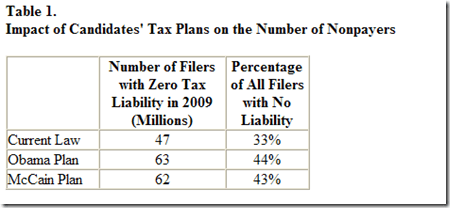
image


* * * * *

Major structural tax changes enacted during the 1980s contributed greatly to the doubling of nonpayers. Perhaps the most significant was indexing the tax brackets in 1985 to prevent inflation from pushing people into higher tax brackets. Also, the Tax Reform Act of 1986 nearly doubled the personal exemption and replaced the zero-bracket with the basic standard deduction for nonitemizers.

Since the early 1990s, however, lawmakers have increasingly used the tax code instead of government spending programs to funnel money to groups of people they want to reward. Credits have been enacted to subsidize families with children, college students, and purchasers of hybrid cars, just to name a few of the most well known. In terms of tax revenue, the most significant of these socially targeted credits was the $500 per-child tax credit enacted in 1997. The 2001 and 2003 tax bills doubled the value of the credit to $1,000 and added a refundable component.
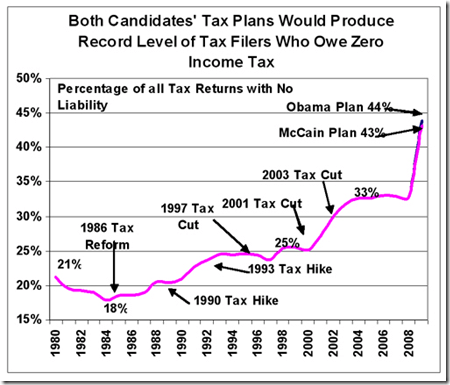
image


* * * * *

Quite aside from the fact that these refundable credits remove millions from the roster of Americans who support the government by paying the income tax, these credits have some undesirable effects.

Added complexity. The explosion of tax credits has added a tremendous amount of complexity to the tax code, especially for low-income Americans who are the supposed beneficiaries of the programs. The EITC is so complicated that more than three-quarters of those claiming it pay a tax preparer to complete their forms.

Hidden marginal tax rate increases. To withhold the benefit of these credits from “rich people,” the definition of which changes from law to law, each of these credits has a phase-out range—that is, a range of income where the taxpayer has to pay back the credit that he no longer qualifies for. As a result, taxpayers in the phase-out range face unexpectedly high effective marginal tax rates.

Narrowing the tax base.  Expanding existing credits or adding new ones pushes people who used to pay taxes into the nonpayer range, shrinking the tax base and requiring higher taxes on everyone else. Undesirable volatility in federal revenue is the likely result, as the incomes of higher-income taxpayers include more business, dividend, and capital gains income which fluctuate much more wildly than wages.

* * * * *

Full article:
http://www.taxfoundation.org/publications/show/23631.html

* * * * *

Want more from the Homa Files?
Click link =>
  The Homa Files Blog

The Fallacy of 'Green Jobs'

September 23, 2008

Excerpted fro”The Fallacy of ‘Green Jobs'”, by John Stossel,
September 10, 2008

Obama has a great twofer pitch: “green jobs.” …  In one fell swoop he can promise to end unemployment and fix and save the planet from climate change.

“I’ll invest $150 billion over the next decade in affordable, renewable sources of energy — wind power and solar power and the next generation of biofuels; an investment that will lead to new industries and five million new jobs that pay well and can’t ever be outsourced,” (http://tinyurl.com/64szf7).

Politicians always promise that their programs will create jobs. The fallacy is the same in every case: Even if the program creates jobs building bridges or windmills, it necessarily prevents other jobs from being created. This is because government spending merely diverts money from private projects to government projects.

Governments create no wealth. They only move it around while taking a cut for their trouble. Overlooking this fact is known as the broken-window fallacy (http://tinyurl.com/ydasa2). The French economist Frederic Bastiat pointed out that a broken shop window will create work for a glassmaker, but that work comes only at the expense of the cook or tailor the shopkeeper would have patronized if he didn’t have to replace the window.

Creating jobs is not difficult for government officials. Pharaohs created thousands of jobs by building pyramids. Our government could create jobs by paying people to dig holes and then fill them up. Would actual wealth be created? Of course not. It would be destroyed. It’s like arguing the hurricanes create jobs. After all, the destruction is followed by rebuilding. But does anyone seriously believe that replacing destroyed buildings creates wealth?

* * * * *

According to his web site:”Obama will strategically invest $150 billion over 10 years”

Note that word “strategically.” It is there to suggest that Obama knows how best to “invest” the $150 billion. (Of course it is not his money, and he’ll have none of his own at risk, so from his perspective, it won’t really be investment.) But how does he know that the things he names ought to get the money?

Politicians have a lousy record trying to make “strategic investments.” Jimmy Carter’s Synthetic Fuels Corporation cost taxpayers at least $19 billion but failed to give us alternative fuels (http://tinyurl.com/5ex7v5).

Investing is about predicting the future, and the future is always uncertain  … People who have their own money at risk — who face a profit-and-loss test and possible bankruptcy — are much better predictors than people who play with other people’s money. Just compare North and South Korea.

Mistakes are inevitable. Some investments will be errors. Mistakes in the competitive market tend to be on a comparatively small scale. If one company invests in plug-in hybrids and it goes bust, only a relatively few people suffer. The assets of the bankrupt firm pass into more capable hands.

When government makes a mistake, the bureaucracy can’t go bankrupt. Instead, failure twill justify increased appropriations.

If “green jobs” make so much sense, the market will create them. They will be created by private entrepreneurs and venture capitalists.  The best ideas will rise to the top, and green energy will gradually replace coal and oil.

If politicians were serious about creating jobs and cleaner technologies, they would step aside and let the free market go to work.

* * * * *

Full article:
http://www.realclearpolitics.com/articles/2008/09/green_jobs.html
Copyright 2008, Creators Syndicate Inc.

* * * * *

Referenced web site worth browsing:
Foundation for Economic Educatiob
http://www.fee.org/

* * * * *

Want more from the Homa Files?
Click link =>
  The Homa Files Blog

A Bush clone ? The 90% canard …

September 23, 2008

Excerpted from Philadelphia Inquirer: “McCain a Bush clone? These numbers dispute that”. John R. Lott , Univ. of Maryland, Sep. 19, 2008

* * * * *

Does John McCain represent a third Bush term? The Obama campaign claims … that McCain is “no maverick when he votes with Bush 90 percent of the time.”

This week Obama has begun a constant refrain that there is “not a dime worth of difference” between Bush’s and McCain’s views.

Is this the same McCain who drove Republicans nuts on campaign finance, the environment, taxes, torture, immigration and more? Where has McCain not crossed swords with his own party?

As it’s being used, the 90 percent figure, from Congressional Quarterly, is nonsensical. As Washington Post congressional reporter Jonathan Weisman explained, “The vast majority of those votes are procedural, and virtually every member of Congress votes with his or her leadership on procedural motions.

* * * * *

The same measure has Obama voting with Democrats 97 percent of the time.

* * * * *

Fortunately, a number of organizations on the left and right provide useful evaluations on how congressmen and senators vote each year. These conservative and liberal groups pick the votes they care about most and figure out how often lawmakers match up with their positions.

Well-known organizations that rank congressional voting include the American Conservative Union on the right, Americans for Democratic Action on the left, and the nonpartisan National Journal in the middle. The League of Conservation Voters also ranks politicians from an environmentalist position.

These groups’ rankings from 2001 to 2007 paint fairly similar pictures, putting McCain to the left of most Republican senators and to the right of most Democratic senators – though usually much closer to the average Republican.

The American Conservative Union finds that the average Republican senator voted conservatively 85 percent of the time, and that the average Democrat voted conservatively 13 percent of the time. McCain voted conservatively 74 percent of the time.

Although it’s at the opposite end of the political spectrum, Americans for Democratic Action essentially agreed. It found that the average Republican senator voted liberally just over 12 percent of the time, and the average Democrat voted liberally 89 percent of the time. McCain voted liberally 24 percent of the time – twice as frequently as the average Republican.

National Journal found that McCain voted conservatively 59.4 percent of the time from 2001 to 2006.

* * * * *

According to the League of Conservation Voters, John McCain is the ultimate centrist. While the average Republican supported liberal environmentalist positions 13 percent of the time, and the average Democrat supported them 76 percent of the time, McCain’s 44 percent put him in the middle.

Another way to look at these numbers is to see how many of the 99 other senators voted more conservatively than McCain. In 2006, these four groups ranked McCain as the 47th, 46th, 44th and 51st most conservative member of the Senate, respectively.

* * * * *

What issues put McCain well to the left of the average Senate Republican? The American Conservative Union lists a number of specific votes on which he differed from most other Republicans, including:

Taxes. He opposed reducing capital-gains tax rates, eliminating the inheritance tax and lowering income-tax rates.

Environment. He opposed drilling for oil in the Arctic National Wildlife Refuge, supported compliance with the Kyoto global-warming treaty, supported requiring businesses to reduce greenhouse-gas emissions, favored stricter mercury-emission rules for power plants, and supported stricter fuel-efficiency standards.

Other regulations. McCain consistently supported stricter campaign-finance regulations and voted to mandate that handguns be sold only with locks.

* * * * *

In contrast to the very liberal ratings given to Obama, the interest groups find that there are about as many senators to McCain’s right as there are to his left. So, it is a real distortion to claim he is a Bush clone.

* * * * *

Full article:
http://www.philly.com/inquirer/opinion/McCain_a_Bush_clone_These_numbers_dispute_that.html

* * * * *

Want more from the Homa Files?
Click link =>
  The Homa Files Blog

Who is walking the talk ?

September 23, 2008

* * * * *

Note: Last Friday, BHO was making a big point of the fact that women get paid less than men for comparable jobs.  An injustice, for sure.  But, guess what …

* * * * *

Excerpted from DickMorris.com 

7 of Barack Obama’s top 20 Senate staff positions are filled by women — they are paid — on average —  83 cents for each dollar his male staffers are paid

John McCain has 13 women among his top 20 staffers —  they are paid  — on average —  $1.04 for each dollar he pays to his men.

* * * * *

Note: I haven’t verified this info.

* * * * *

Want more from the Homa Files?
Click link =>
  The Homa Files Blog

The mortgage mess … in brief

September 22, 2008

Excerpted from Heritage Foundation:”Subprime Mortgage Problems: A Quick Tour Through the Rubble”, by Ronald D. Utt, April 3, 2008

* * * * *

Note: Best recap I’ve found re: the current mortgage mess.

* * * * *
The collapse of the subprime mortgage market in late 2006 set in motion a chain reaction of economic and financial adversity that has since spread to nearly all sectors of the economy, as well as to global financial markets, has created depression-like conditions in the housing market, and has led the American economy to the brink of recession.

In response, many in Congress and the executive branch have proposed a number of new federal spending and credit programs that would greatly expand the role of government in the economy.

* * * * *

How the Problem Started

These problems had their origin in the mid-1990s when mortgage lenders reduced the previously strict financial qualifications needed to acquire a mortgage to buy a house by offering credit-impaired households mortgage loans, albeit at higher interest rates to compensate for the greater risk. Despite the many different forms these mortgages would ultimately assume–no down payment, interest only, negative amortization, etc.–they were designated “subprime” because of the checkered credit histories of the households using them.  Despite the risk associated with these subprime mortgages, many mortgage lenders further relaxed their underwriting standards and in the process introduced even more risk into the system, some of it motivated by fraud and misrepresentation.

As a consequence, the availability of risky loans soared from the late 1990s through 2006. In 2001, newly originated subprime, Alt-A, and home equity lines (seconds) totaled $330 billion and amounted to 15 percent of all residential mortgages. Just three years later, in 2004, these mortgages accounted for almost $1.1 trillion in new loans, equal to 37 percent of the total. Their volume peaked in 2006 when they reached $1.4 trillion and 48 percent of the total. Over a similar period, the volume of mortgage-backed securities (MBS) collateralized by subprime mortgages increased from $18.5 billion in 1995 to $507.9 billion in 2005

In turn, the looser lending standards allowed previously unqualified borrowers to become homeowners, and the homeownership rate soared from the 64 percent range of the 35 years prior to 1995 to an all time high of 69 percent in 2004. While most celebrated this accomplishment, the consequence of lending to riskier borrowers under diminished underwriting standards led to an escalation in the number of loan defaults beginning in 2006, followed by an escalation in the number of foreclosures. Because many of these loans had been repackaged into mortgage-backed securities, the growing default problem soon spread to investors in the national and international financial markets where these instruments were sold.

The first to suffer was the housing market, where new construction and the sales of both new and existing homes plunged. This was soon followed by a decline in home values, which in turn worsened the financial problems in the mortgage market by reducing the value of the collateral securing these loans. As many subprime borrowers now found themselves owning a house worth less than the debt owed on it, the incentive to default increased, and by the end of 2007, more than 17 percent of subprime borrowers had fallen behind in their loan payments.

* * * * *

Implications for the Economy

After reaching the more than 1.7 million new units started in 2005, single-family housing starts in February 2008 fell to a seasonally adjusted annual rate of 707,000 units, less than half the level of production two years earlier. On a year-over-year basis, the decline in starts was 40.4 percent.  Sales of new homes fell precipitously over the same period. After reaching 1,283,000 units in 2005, they fell in February 2008 to a seasonally adjusted annual rate of 590,000, less than half the level of 2005 and down 29.8 percent from February 2007. For existing homes, sales peaked in 2005 at 7,076,000 units, fell to 6.4 million in 2006, and by February 2008 had fallen to a seasonally adjusted annual rate of 5 million, nearly 30 percent below the peak levels of sales during 2005.

After two years of declining activity in the housing market, many are hopeful that the bottom has been reached and that the market will soon revive, but this seems unlikely. The subprime default and foreclosure problems first emerged at a time when the economy was healthy, most borrowers were employed, and housing values were stable or rising. In 2008, home prices and sales are falling, some borrowers may soon confront unemployment, tightened credit standards will exclude many from homeownership, and the number of subprime mortgages resetting to higher payments will be greater than the number that reset in 2006 and 2007.

As a consequence, the homeownership rate is likely to fall from its record levels near 69 percent to something closer to the long-term historic norm of 64 percent. This trend in turn implies a greater number of lost homes coming onto the market at a time when sales are depressed.

* * * * *

Notwithstanding the constituent and lobbyist pressure to do something costly and do it quickly, the history of government intervention in housing markets and the economy has not been one of notable success. .

* * * * *

Full article:
http://www.heritage.org/Research/Economy/wm1881.cfm

* * * * *

Want more from the Homa Files?
Click link =>
  The Homa Files Blog

Fannie Mae and the Vast Bipartisan Conspiracy

September 22, 2008

Excerpted from Slate: “Fannie Mae and the Vast Bipartisan Conspiracy”,  Jack Shafer, Sept. 16, 2008

* * * * *

My POV:

Slate leans left, so I find its revelations particularly note worthy.  Repubs are dirtied by drinking from the lobbying trough.  Dems own the CEOs and folks who raked off the uber-dollars.  A pretty disgusting picture … Read the full article (link below) for names of “bit” players and more context.

* * * *

Article Highlights

The blowup and bailout of Fannie Mae and Freddie Mac by taxpayers was foretold so many times in the last three decades by critics of the two federally chartered and subsidized mortgage giants that not even the data-searching powers of Nexis, Factiva, and Google combined can total them.

The Wall Street Journal editorial page deserves a special commendation for hammering these two outposts of corporate socialism, not that the page’s many warnings over the years helped avert disaster.

Mae and Mac—especially Mae—were just too nurtured by the Washington establishment  — an  “influential network that extends from the highest reaches of the Clinton Administration to the ranks of conservative Republicans on Capitol Hill.”

The bipartisan network provided the essential cover Fannie Mae needed to run its scam.

* * * * *

The key to Fannie Mae’s survival was the patronage operation it ran.  “For years, high-level jobs at Fannie Mae were lucrative prizes for lawyers, bankers and political operatives waiting for their next U.S. government post.”

Now that the jig is up, let’s meet some of the bipartisan warriors who fought for Fannie Mae’s right to plunder.

At the top of the list we must place Franklin D. Raines, chairman and chief executive officer of Fannie Mae from 1998 to 2004. Raines, who served as director of the Office of Management and Budget under President Clinton.  He  was forced to leave Fannie Mae in 2004, when regulators discovered it had broken accounting rules “in an effort to conceal fluctuations in profit and hadn’t maintained adequate risk controls.” The New York Times reported two year ago that regulators “have said that of the $90 million paid to Mr. Raines from 1998 to 2003 at least $52 million—more than half—was tied to bonus targets that were reached by manipulating accounting.” Raines agreed to a $24.7 million settlement with a federal regulator in exchange for charges being dropped, but he admitted no wrongdoing.

Next up is Jamie S. Gorelick,  Deputy Attorney General during the Clinton administration. Although Gorelick had no background in finance, she joined Fannie Mae in 1997 as vice chair and departed in 2003. For her trouble, Gorelick collected a staggering $26.4 million in total compensation, including bonuses.

Republicans also proved willing to serve Fannie Mae. Robert B. Zoellick, current head of the World Bank, has served President Reagan, President Bush 1, and President Bush 2 as a trade representative, deputy secretary of state, deputy secretary of the treasury, deputy chief of staff, and so on. Zoellick’s  title at Fannie was executive vice president in charge of lobbying, public affairs, and affordable housing. According to a July 23, 1997, report in the American Banker, Zoellick “has used his close ties to Republicans in Congress, such as Speaker of the House Newt Gingrich, to defend Fannie Mae from new taxes.”

Moving back across the aisle, let’s say hello to Mr. Democrat James A. Johnson, who ran Fannie Mae from 1991 to 1998, served as vice chairman from 1990 to 1991, and earlier worked as a managing director at Lehman Bros. and for Vice President Walter F. Mondale. He made news earlier this summer when he had to resign as vice-presidential-candidate vetter for Barack Obama “as new details emerged about loans Mr. Johnson received from mortgage lender Countrywide Financial”  Mr. Johnson has made Fannie Mae both a launching pad and a landing strip for officials moving in and out of politics and Government in Washington.” Johnson earned nearly $21 million from Fannie Mae in 1998.

But Fannie Mae is nothing if not ecumenical. According to the Associated Press, Fannie Mae and Freddie Mac have spent $170 million on lobbying in the past decade. “Fannie Mae’s 51-member lobbying stable” includes “former Reps. Tom Downey, D-N.Y., and Ray McGrath, R-N.Y.; Steve Elmendorf, a Democratic political strategist and former congressional aide; and Donald Fierce, a longtime GOP operative. Freddie Mac’s list of 91 lobbyists includes former Reps. Vin Weber, R-Minn., and Susan Molinari, R-N.Y.” The AP notes the Fannie Mae ties enjoyed by McCain campaign manager Rick Davis and Arthur B. Culvahouse Jr., who helped in McCain’s veep search. According to Politico, McCain economic adviser Aquiles Suarez worked as Fannie Mae’s director of government and industry relations, and McCain finance co-chairman Frederic V. Malek spent time on the Freddie Mac board.

* * * * *

The bipartisan Fannie Mae gang appears to have broken few, if any, laws. Their crime was to have practiced—without any thought of the consequences—”access capitalism,” which Michael Lewis defined in the New Republic as “a neat solution for people who don’t have a whole lot to sell besides their access, but who don’t want to appear to be selling their access.”

“The scandal in Washington isn’t what’s illegal. It’s what’s legal.”

“The abiding lesson here is what happens when you combine private profit with government power. You create political monsters that are protected both by journalists on the left and pseudo-capitalists on Wall Street, by liberal Democrats and country-club Republicans.”

* * * * *

Full article:
http://www.slate.com/id/2200160/

* * * * * 

Want more from the Homa Files?
Click link =>
  The Homa Files Blog

Talk about special interests …

September 22, 2008

Excerpted from OpenSecrets.com

Of all the companies making headlines this week, AIG has been the most nonpartisan in its contributions, splitting evenly the $9.7 million it has contributed over time.

Sen. Chris Dodd, chair of the Senate banking committee, has racked up the most from AIG, with a total of $281,400, while Charles Schumer (D-N.Y.), a member of both the Senate Banking, Housing and Urban Affairs Committee and the Senate Finance Committee, takes second with $116,400.

Presidential candidates John McCain and Barack Obama collected $103,000 and $82,600 from AIG, respectively.

Source:
http://www.opensecrets.org/news/2008/09/aig-government-bails-out-a-hea.html

* * * * *

Source: http://www.opensecrets.org/orgs/list.php?order=A

image

image

* * * * *

Worth browsing: Federal Election Campaign Web Site:
 http://www.fec.gov/

* * * *

Want more from the Homa Files?
Click link =>
  The Homa Files Blog