Archive for the ‘Government & Politics’ Category

That Giant Sucking Sound – 2009

August 6, 2008

Excerpted from the WSJ, Hillary Clinton Op-Ed, Aug. 6, 2008

“Tucked away on the Cayman Islands sits Ugland House, an unassuming, nondescript building of modest scale and size. However, according to a recent report by the Government Accountability Office (GAO), this five-story office building is home to more than 18,000 corporate entities, nearly half of which have U.S. ties.

In the past few years, the number of corporations flocking to places like the Cayman Islands to evade U.S. taxes has exploded … these companies … have used offshore tax havens to avoid paying hundreds of millions of dollars in federal taxes. “

Full Op-Ed:
http://online.wsj.com/article/SB121798030763715107.html?mod=opinion_main_commentaries

* * * * *

One rhetorical question:

U.S. corporate tax rates are among the highest in the world.   If we raise them — even if only selectively — say on oil companies — would you expect corporate off-shoring  to speed up or slow down?  Hmmm ….

* * * * *

Want more from the Homa Files?
 
Click link =>  The Homa Files Blog

* * * * *

Uh Oh – McCain busted for plaigarism

August 6, 2008

John McCain’s campaign mocked Barack Obama’s celebrity status with a TV commercial that included comparisons to Paris Hilton.  McCain was blasted by many folks for being juvenille (true !) and by Bob Herbert of the NY Times for being racist (huh?). 

But, McCain got off clean on a very serious charge: plaigarism. 

Seems that McCain’s camp hijacked the Hilton reference from … who else, Obama himself

In 2005 Obama said: “Andy Warhol said we all get our 15 minutes of fame,” says Barack Obama. “I’ve already had an hour and a half. I mean, I’m so overexposed, I’m making Paris Hilton look like a recluse.” 

Busted, Senator McCain

See the Washington Post article “The Senator’s Humble Beginning Rising Star Barack Obama Is Resolutely Down to Earth”,  February 24, 2005
http://www.washingtonpost.com/wp-dyn/articles/A48523-2005Feb23.html

* * * * *

Other tidbits from the Post article:

“I just got elected to the U.S. Senate. I haven’t done anything yet.”

“But he comes well steeped in the basic physics of hype.”

“One of the keys to being well liked in Washington is to appear humble … All of this comes naturally to Obama.”

Even in jest, itis a rare instance where Obama lets slip with something that could be construed as immodest:

“I am genuinely somebody who doesn’t get caught up in the hype,” he says.

“You want to make everyone aware that you’re a workhorse.” As opposed to a “show horse.”

Obama is following what is known in Hill parlance as “the Hillary model,” named for the former first lady whose transition into the Senate is considered a prototype of how celebrity senators should proceed.

He invokes a favorite line: “Those who travel the high road of humility don’t face heavy traffic.”

For the full article:
http://www.washingtonpost.com/wp-dyn/articles/A48523-2005Feb23.html

* * * * *

Observation: you just can’t make this stuff up.

* * * * *

Want more from the Homa Files?
 
Click link =>  The Homa Files Blog

* * * * *

What Exactly Is a ‘Windfall’ Profit?

August 4, 2008

Excerpted from a WSJ editorial, Aug4, 2008

The “windfall profits” tax is back …  What is a “windfall” profit anyway? How does it differ from your everyday, run of the mill profit? Is it some absolute number, a matter of return on equity or sales — or does it merely depend on who earns it?

Senator Obama says government would take “a reasonable share” of oil company profits …  Senator Durbin says “The oil companies need to know that there is a limit on how much profit they can take in this economy.”

Take Exxon Mobil, which … is the main target of any “windfall” tax surcharge …   Between 2003 and 2007, Exxon paid $64.7 billion in U.S. taxes, exceeding its after-tax U.S. earnings by more than $19 billion.

Exxon’s profit margin stood at 10% for 2007, which is hardly out of line with …  the 8.9% for U.S. manufacturing (excluding the sputtering auto makers) … Chemicals had an average margin of 12.7%. Computers: 13.7%. Electronics and appliances: 14.5%. Pharmaceuticals (18.4%) and beverages and tobacco (19.1%)

If Senator Obama is as exercised about “outrageous” profits as he says he is, he might also have to turn on a few liberal darlings. Oh, say, Berkshire Hathaway. Warren Buffett’s outfit pulled in $11 billion last year, up 29% from 2006. Its profit margin — if that’s the relevant figure — was 11.47%, which beats out the American oil majors.

Or consider Google, which earned a mere $4.2 billion but at a whopping 25.3% margin. Google earns far more from each of its sales dollars than does Exxon, but why doesn’t Mr. Obama consider its advertising-search windfall worthy of special taxation?

The point is that what constitutes an abnormal profit is entirely arbitrary. It is in the eye of the political beholder …  a windfall is nothing more than a profit earned by a business that some politician dislikes. 

* * * * *

Full editorial (worth reading):
http://online.wsj.com/article/SB121780636275808495.html?mod=opinion_main_review_and_outlooks

** * * * *

For hard numbers, see prior post:
https://kenhoma.wordpress.com/2008/06/26/numbers-price-gouging-windfall-profits/

* * * * *

Want more from the Homa Files?
 
Click link =>  The Homa Files Blog

* * * * *

Obama leads McCain among low-wage workers

August 4, 2008

Excerpted from Reuters,  08-04-08

Obama holds a two-to-one lead over McCain among low-wage workers (nearly a quarter of U.S. adults, earning $27,000 or less) … Obama’s advantage is due largely to overwhelming support from African Americans and Hispanics.

The group views Obama as the more empathetic candidate and the one who most closely shares their values …  92% of African Americans chose Obama as the candidate most concerned with their problems; not a single black respondent said that about McCain, the Post said.

Most of the respondents were pessimistic about the impact of the November 4 election. A majority of those polled, both white and minority, said that no matter who won their personal financial situation would be unlikely to change, it said.

* * * * *

Want more from the Homa Files?
 
Click link =>  The Homa Files Blog

* * * * * 


That Giant Sucking Sound – 2008

August 3, 2008

In 1992, according to then presidential candidate Ross Perot, “the giant sucking sound” was the flow of U.S. jobs to Mexico under NAFTA.  Arguably, the 2008 sucking sound is the flow of capital and corporate ownership out of the U.S.  The latest: InBev’s purchase of Anheuser-Busch

Excerpted from the WSJ, “This Bud’s for Belgium”, August 3, 2008

Politicians and Wall Streeters are starting to ask why the Belgian beer company InBev purchased Anheuser-Busch and not the other way around … though shareholders were the big winners here with a $50 billion-plus takeaway.

But here’s the real question: Was the takeover basically financed by the savings … from escaping America’s increasingly uncompetitive corporate tax system? …  Bottom line: InBev (pays Belgium) around 20% of its profits in corporate taxes … (versus) Anheuser-Busch’s U.S. rate 38.4%.

The country will continue to see its competitive edge wither away without a corporate tax rate cut. Mr. McCain … wants to cut the corporate tax rate to 25%, close to the global average. Senator Obama is more interested in raising tax rates than cutting them.

Wall Street dealmakers tell us to expect more sales of U.S. companies to European rivals thanks to the combination of America’s higher corporate taxes and the weak dollar … the U.S. is pricing itself out of the market as a corporate headquarters. “America’s 35% corporate tax rate is … just bad economics”.

For full editorial:
http://online.wsj.com/article/SB121770579562707543.html?mod=opinion_main_review_and_outlooks

* * * * *

Observations

1.  Compounding the weak dollar and high corporate tax rates is the massive transfer of wealth to the oil producing nations and their sovereign wealth funds.

2.  Rhetorical question: what’s the likely impact of a windfall profits tax on U.S. based oil companies?

* * * * *

Want more from the Homa Files?
 
Click link =>  The Homa Files Blog

* * * * *

Goliath vs. Goliath – Walmart vs Obama

August 3, 2008

Excerpted from the WSJ, “Wal-Mart Warns of Democratic Win”, August 1, 2008

Through almost all of its 48-year history, Wal-Mart has fought hard to keep unions out of its stores …  (When) a small number of butchers (unionized) in early 2000 … the company phased out butchers in all of its stores and began stocking prepackaged meat. When a store in Canada voted to unionize …  the company closed the store, saying it had been unprofitable for years.

(Now) Wal-Mart is … warning that if Democrats win power in November, they’ll likely change federal law to make it easier for workers to unionize companies.

Wal-Mart executives claim that … unionization could mean fewer jobs as … payroll and health costs (rise) for companies already being hurt by rising fuel and commodities costs and the tough economic climate.

Wal-Mart’s worries center on a piece of legislation known as the Employee Free Choice Act … the U.S. Chamber of Commerce has made defeat of the legislation a top priority.

Wal-Mart makes it clear that voting for Democratic presidential hopeful Sen. Barack Obama would be tantamount to inviting unions in (since) Sen. Obama co-sponsored the legislation … known as “card check,” …  Sen. John McCain, the opposes the Employee Free Choice Act and voted against it last year.

The Employee Free Choice Act  … would simplify and speed labor’s ability to unionize companies. Currently, companies can demand a secret-ballot election to determine union representation.

The proposed legislation,  would let unions form if more than 50% of workers simply sign a card saying they want to join. It is far easier for unions to get workers to sign cards because the organizers can approach workers repeatedly, over a period of weeks or months, until the union garners enough support.

Employers argue that the card system could lead to workers being pressured to sign by pro-union colleagues and organizers.

Unions consider the Employee Free Choice Act as vital to the survival of the labor movement, which currently represents 7.5% of private-sector workers, half the percentage it did 25 years ago. (see chart below)

Business-backed lobbying groups are running ads … using  an actor from the “Sopranos” TV series about mob life to hammer home their point.

For full article (worth reading):
http://online.wsj.com/article_print/SB121755649066303381.html

* * * * *

My POV

1.  I was surprised to see how low the private sector unionization rate had fallen.

2.  The Sopranos ad — which was playing on news shows over the weekend — is quite effective. It plays off historical sterotyping to make a strong visceral point.

4.  The argument that secret ballots are a bad thing seems to have some holes  …  should we eliminate the secret ballot for presidential elections, too?

* * * * *

From the WSJ article:

 * * * * *

Want more from the Homa Files?
 
Click link =>  The Homa Files Blog

* * * * *

Obama says he'll support offshore drilling

August 2, 2008

Excerpted from McClatchy Newspapers, August 1, 2008 

Headline: “In major change, Obama says he’ll support offshore drilling”

Barack Obama Friday dropped his opposition to offshore oil drilling, saying he could go along with the idea if it was part of a broader energy package. Obama made his comments in St. Petersburg during an interview with the Palm Beach Post.

“My interest is in making sure we’ve got the kind of comprehensive energy policy that can bring down gas prices …  in order to get that passed, we have to compromise in terms of a careful, well thought-out drilling strategy that was carefully circumscribed to avoid significant environmental damage.

The change is dramatic because Obama often pointed to his opposition to drilling as a key difference between himself and presumptive Republican presidential nominee John McCain.

But the concept has proven popular, and McCain has made it a centerpiece of his stump speeches and some of his television ads. Political momentum has been moving in favor of opening up U.S. coastlines.

Obama also said, in a separate statement issued by his campaign, that he supported the bipartisan energy plan offered by 10 senators Friday.

The proposal would end most of the ban on drilling. It would allow a 50-mile buffer on the east coast, as well as Florida’s west coast. Virginia, North Carolina, Georgia and South Carolina would be permitted to start oil and natural gas exploration outside the buffer. 

Currently, the government bans exploration and drilling on the Pacific and Atlantic coasts and most of the eastern Gulf of Mexico, to protect U.S. beaches and fisheries from pollution.

For full article: http://www.mcclatchydc.com/homepage/story/46174.html

* * * * *

Other confirming articles:
http://www.iht.com/articles/ap/2008/08/02/america/NA-POL-US-Elections.php
http://news.yahoo.com/s/ap/20080802/ap_on_el_pr/obama

* * * * *

Want more from the Homa Files?
 
Click link =>  The Homa Files Blog

* * * * *

Happenings – The Berlin Rock Star

August 1, 2008

Let’s play “Who am I ?”

I was born on a tropical island.

I spent some of my childhood in the United States.

Then I moved abroad with my single mother.

I have exotic good looks and magnetic charisma.

My “stage presence” is engaging beyond compare.

Fans (especially women) often faint at my events

I’ve been compared to other young “greats” who preceded me

An event in Berlin, Germany cast me onto the world’s stage.

The media adored me.

Who am I ?

scroll down for answer

       V

       V

       V

       V

       V

       V

       V

Answer

Of course, I’m Fabrice Morvan — formerly of Milli Vanilli. 

I was born in Guadalupe, moved to Miami, then moved to Paris with my single mother. 

I was modeling and breakdancing in Berlin when producer Frank Varian picked me and Rob Pilatus to become the duo fronting Milli Vanilli.  

We sold over 30 million singles, 14 million albums and became one of the most popular acts in the world. 

We played to packed venues and achieved worldwide adulation — including a Grammy.  

We were often compared to Bob Dylan, Elvis Presley, Paul McCartney, and Mick Jagger. 

Then, during a live MTV performance at the Lake Compounce theme park in Bristol, Connecticut, a playback  machine jammed. 

Only then did people realize that we were simply lip syncing recorded tracks.  While we put on a great show, we couldn’t sing. 

Fans were disappointed, we had to give back our Grammy, and our success turned to infamy as con artists. 

 “Our career came to a sudden and ignominious end: Fakers. Frauds. A blatant marketing scam. ”

* * * * *

The nuns used to teach me that history repeats.  Hmmm … 

* * * * *

Primary source: http://music.yahoo.com/ar-257262-bio–Milli-Vanilli

Additional background provided by Wikipedia – The Free Encyclopedia: – and official reference for settling Homa family bets  http://en.wikipedia.org/wiki/Milli_Vanilli

* * * * *

Want more from the Homa Files?
 
Click link =>  The Homa Files Blog

* * * * *

Hmmm – Inconvenient Facts

July 31, 2008

Excerpted from WSJ “Where’s the Outrage? Really.” Arthur Brooks,  July 31, 2008

According to an emerging journalistic narrative … ordinary Americans are outraged. The anger is simply assumed to exist. Ironically, this assumption is questionable, and is not supported by the data.

In May 2008, the Gallup Organization asked 1,200 American adults how many days in the past week they had felt “outraged.” The average number of angry days was 1.17, and 54% of those surveyed said none. … Despite the litany of horrors presented to us daily by campaigning politicians, most of us appear to be doing really quite well managing our anger.

Indeed, we are less angry today than a decade ago… (in) the glory days of the 1990s, when — according to the media narrative — we enjoyed uninterrupted peace and prosperity. In 1996, the General Social Survey asked exactly the same “outrage” question of 1,500 adults. Then, only 38% had not been outraged at all in the past week. The average number of angry days was 1.5 per week, 29% higher than at present.

Virtually every group in the population is less angry in 2008 than in 1996 … only one major group in the population has gotten angrier: people who call themselves “very liberal.”  …  Today, very liberal people spend more than twice as much time feeling angry as do political moderates. One in seven is outraged seven days a week .

Most Americans recognize that, while gas is expensive and our grocery money doesn’t go as far as it did last year, we are still an enormously prosperous and fortunate nation.

Most …  are reasonable people, and can see the difference between correctable problems within a strong system of democratic capitalism and the kind of catastrophic failure that justifies real outrage.

* * * * *

Mr. Brooks is a professor at Syracuse University’s Maxwell School of Public Affairs.

* * * * *

For the full article (worth reading):
http://online.wsj.com/article/SB121746010408198765.html?mod=opinion_main_commentaries

* * * * *

Want more from the Homa Files?
 
Click link =>  The Homa Files Blog

* * * * *

Dogbert for President – His Tax Plan

July 30, 2008

A few years ago I stumbled on a Dogbert cartoon.  At the time it made me smile. 

Today, the cartoon makes me nervous — very nervous.

Of course, the source of my angst is the Obama tax plan.  But, my specific concerns aren’t the ones that most pundits dwell on.

* * * * *

Buying Votes

True, Obama did hijack Dogbert’s campaign strategy and plans to raise tax rates on the top 3% of income earners (individuals and  couples earning over $250,000 annually) and to redistribute the “savings” via a new tax credit of $500 per person, or $1,000 per working family.  

Cynics point out that in the good old days, Mayor Daley’s Chicago political machine could deliver a  vote for a the price of a pack of cigarettes.  Apparently the price of a vote has gone up more than the price of gasoline.  At least votes are now  “marked to market”.  The Obama plan clearly sets the price at $500 (cash) per vote, with a perpetuity value of about $10,000 @ 5%.

* * * * *

Buying Old Folk’s Votes

And, Obama promises zero Federal taxes for seniors over 65 on income up to $50,000 . 

Mark Penn, Hillary Clinton’s former chief strategist says: “The Obama camp hit a bull’s-eye with this proposal, which has little economic justification but is great politics.” http://www.politico.com/news/stories/0708/12117.html

* * * * *

Upping High Bracket Marginal Rates

In a WSJ op-ed, Stanford economics professor Michael Boskin opines that despite the rhetoric to the contrary,  Obama’s increases don’t just hit “rich” individuals.  They also impact lot of small businesses and two-earner households in high cost-of-living areas.

Specifically, Obama would raise the top marginal rates from 35% to 39.6%,  increase the tax rate on capital gains and dividends, and uncap Social Security taxes (which currently are levied on the first $102,000 of earnings).

When payroll and state income taxes are thrown in, Boskin estimates that the high bracket marginal rate goes to over 60% —  with almost $2 of every $3 earned at the margin, going to the government for services and redistribution.

click to make table bigger

click to make table bigger

http://online.wsj.com/article/SB121728762442091427.html?mod=opinion_main_commentaries

* * * * *

Redistributing $131 Billion Annually

An analysis done by the Tax Foundation — a self-proclaimed non-partisan think tank —  indicates that Obama’s plan — as proposed — would redistribute about $131 billion each year.  Taking money from the undeserving rich, and giving it directly to the financially besieged middle (and lower) class). 

Tax Foundation - Tax Policy Center Estimate
Source: Tax Foundation – Tax Policy Center Estimate

“Hard Numbers on Obama’s Tax Redistribution Plan
http://www.taxfoundation.org/publications/show/23319.html

* * * * *

My POV

1.  On a philosophical level, I agree that the grossly uneven distribution of earning power in the US is a serious problem that needs to be fixed. 

2. But, I don’t think that the problem of income inequality should be fixed via a tax system — which was originally intended to “tax & spend” efficiently on necessary common services — not to “grab and redistribute”.  Direct transfers from one citizen’s pockets to another’s (e.g. refundable tax credits) are certainly the latter.

3. Except for the impact on small businesses, I can’t get too riled over marginal rate increases that start at $350,000; but I do think a “doughnut hole” payroll tax schedule is wacky and I think raising capital gains taxes during an economic slowdown is dangerous.

4 . My real  issue:  The numbers say that in Obama World, a minority of voting age Americans will be paying income taxes.  That scares me. What’s to stop an income tax-free majority from continually voting  to  raise taxes on the tax-paying minority to fund an ever increasing potpourri of benefits or add to the redistribution pot.

* * * * *

Next Up: The numbers are conclusive … taxpayers will be a minority.

* * * * *

Want more from the Homa Files?
 
Click link =>  The Homa Files Blog

Hmmm: Obama Visits Doctor (on a Sunday Night !)

July 28, 2008

The Story

CHICAGO — Barack Obama, back in his home town after a tour of Afghanistan, the Middle East and Europe, saw a doctor at the University of Chicago Medical Center on Sunday night to deal with a sore hip, inflamed from playing basketball.

My POV  (POV = point-of-view)

1) Obama promises that when he’s elected, we’ll get exactly the same health care that Senators get.

Does that mean that my doctor will see me on a Sunday night (for “soreness” no less)  instead of telling me that the next open appointment slot is 6 weeks from Tuesday at 1:46 — come early, but plan to wait?

Must be, because Obama certainly wouldn’t think of accepting preferential care, right?

2) Why do all of the candidates confuse “medical insurance” with “health care” ?  The former is just money; the latter is fundamental service delivery.  Two different things !

Amen.

* * * * *

Want more from the Homa Files?
 
Click link =>  The Homa Files Blog

Hmmm – Some Interesting Tax Stats

July 28, 2008

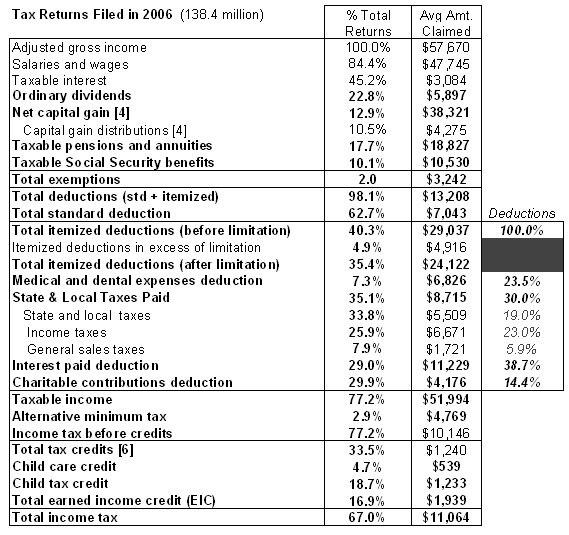
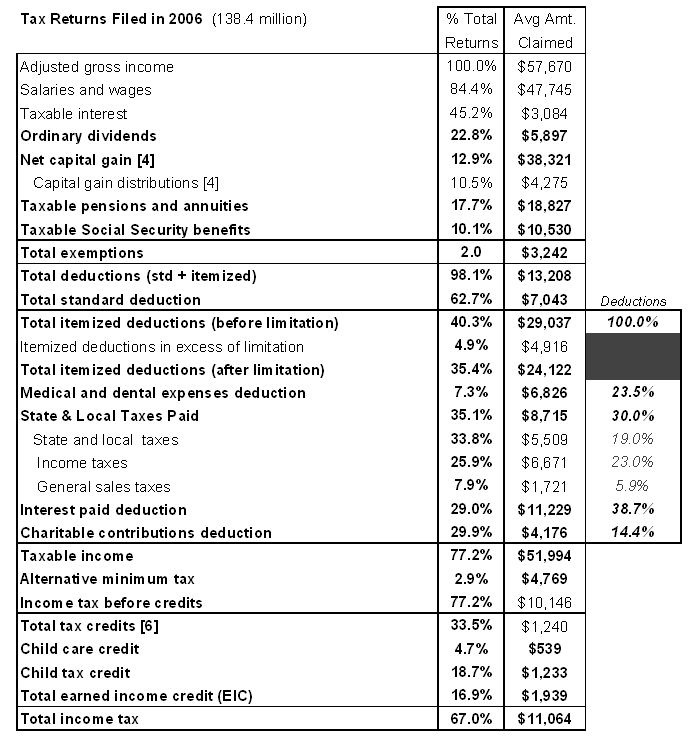
Summary: To load you with some interesting factoids for cocktail party conversations and to provide background for the next couple of analytical posts — here are some highlights from the 2006 IRS data pile (the latest year available) , and the link to the complete IRS data set (which is a treasure trove of info).

Some Highlights

138.4 million returns filed … reporting almost $8 trillion in AGI
         
 … up 8.4% from 2005 …  $57,670 average AGI

23%  reported dividend income … averaging $5,897

10.5%  reported capital gains … averaging $4,275

 63%  took the standard deduction … averaging $7,043

 37%  itemized deductions … averaging $24,122

 30%  reported charitable deductions … totaling $173 billion

2.9%  were assessed Alternative Minimum Tax
              … averaging $4,769

 19%  claimed child tax credits … averaging $1,233

 17%  claimed earned income tax credits … averaging $1,939

 67%  paid income taxes … averaging $11,064

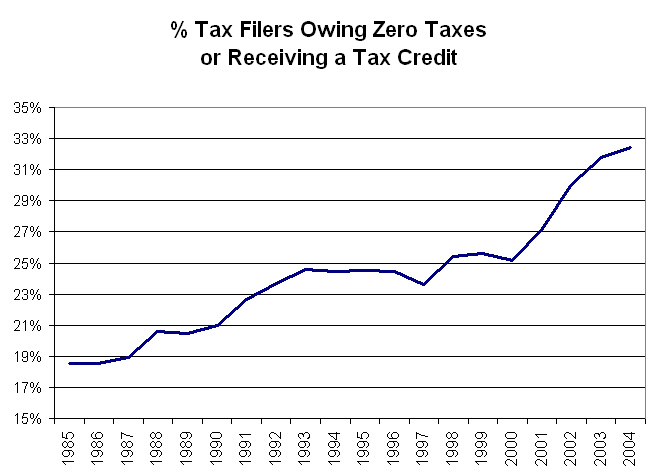
   33%  paid zero taxes (or received a refundable tax credit) 
                … up from 20% in 1990 and 25% in 2000 


 * A deeper dig on this point is coming in subsequent posts *

* * * * *

Summary Table:

click table to make it bigger

Source: IRS
http://www.irs.gov/pub/irs-soi/06in01fg.xls

* * * * *

Next up: Taxpayers –  A Dwindling Majority

* * * * *

Want more from the Homa Files?
 
Click link =>  The Homa Files Blog

Update: XM – Sirius Merger – Finally!

July 25, 2008

After more than a year of government review (largely instigated by a powerful “over the air” radio lobby led by the National Association of Broadcasters), it looks like the merger between XM Satellite Radio and Sirius Satellite Radio — is finally going to happen.

in March, the Justice Department approved the merger.  Last month (June), FCC Chairman Kevin Martin gave his ok, saying:  “I am recommending that with the voluntary commitments they’ve offered, on balance, this transaction would be in the public interest. They have voluntarily committed to setting forth price constraints, so the prices for consumers do not increase; smaller packages at lower prices; an open standard for radios; the sale of interoperable radios; and additional public interest programming for noncommercial use and for qualified entities who have not been traditionally represented.”

Two of the five FCC members commission quickly followed Martin’s lead and  announced that they would cast votes to approve the deal.

Now, their are reports that at least one of two other members of the FCC (John Adelstein, Deborah Taylor Tate), is ready give the merger the majority vote it needs provided that XM-Sirius up the ante by freezing prices for six years, by making 25% of their satellite capacity available for public-interest and minority programming, and by paying a $2o million fine for some minor technical violations of FCC transmission rules.

For more details:
http://online.wsj.com/article/SB121683130281477651.html

* * * * *

Performance Update

The companies broke even financially, and ended the 1st quarter of 2008 with a total of almost 18 million subscribers — 9.33 for XM, 8.64 for Sirius. (Reminder: The original “Bass Model” research studies projected the market would be at least 25 million).

XM’s subscriber acquisition costs (SAC), a component of cost per gross addition (CPGA), were $73.  CPGA in was $99 for XM, $91 for Sirius

XM converted  53.3 percent of OEM installations (i.e. radios already installed in new cars)to subscriptions. XM’s monthly churn rate was 1.77 percent.

* * * * *

TEST QUESTION: Given a monthly subscription price of $12.99,  what’s the customer life time value (CLTV) of an average satellite radio subscriber? Answer below

* * * * *

Observations

1. The prolonged merger approval process — which took longer than the approval of the Exxon-Mobil merger — certainly validates the political clout of the “over the air” media companies.  To a reasonably objective person (me), this one was a no-brainer.

2. Finally, I’ll be able to get the NFL and MLB on the same service.

3. I still think that converting about half of the OEM units pre-installed in new cars is cause for concern, not celebration.  Any marketer worth his / her salt wouldn’t sleep well at night until the conversion ration was at least over 75%. 

4. My Lexus RX-350 didn’t come with either XM or Sirius pre-installed.  The dealer treated the installation as a minor annoyance, and said less than half of their customers opt for satellite radio..

5. Big question: too late to matter? My sense: the buzz is gone and momentum  is gone.  Your views?

 * * * * *

Next up: Back to taxes …

Want more from the Homa Files?
 
Click link =>  The Homa Files Blog  

* * * * *

Answer to CLTV Question:
Assuming nil marginal operating costs per customer (though there would be some), and a 5% annual discount rate ( .4% monthly):
CLTV = [MS$ / (C% + DR%)] – CGAC
MS$ = monthly subscription = $12.99
C% = churn rate =  .0177
C% + DR% = .0177 + .004 = .0217
[MS$ / (C% + DR%)]  = $12.99 / .0217 = $598.61
$598.61 – CGAC = $598.61 – $95 (avg for XM & SIRI) +
$503.61

Taxes – Tax Breaks for the Wealthy?

July 24, 2008

The 2008 presidential campaign is loaded with tax rhetoric.  The GOP says that the Bush tax cuts have worked and it would be crazy to raise taxes during an economic slowdown. 

The Dems say that the Bush tax plan “gave tax breaks to the rich, who didn’t even want them” — as evidenced by Warren Buffet repeatedly saying that he pays less taxes than his secretary — and that uber-earning people — e,g, greedy CEOs and hedge fund managers — aren’t paying their fair share.

What do the numbers say?

Well, several pivotal conclusions can be drawn from a comparison of published IRS data for 2000 (the year immediately prior to the first wave of so-called “Bush Tax Cuts for the Wealthy”) to the data from 2005 (the last year of IRS data available):

1. The effective tax rate for the top 1% of tax filers — those reporting AGI greater than $365,000 — did go down 4.32 percentage points from 27.45% in 2000 to 23.13% in 2005 — a 16% reduction; the effective tax rate for the top 5% earners (which, of course, includes the top 1%) went down 3.64 percentage points from 24.42% in 2000 to 20.78% in 2005 — a 15% reduction. 

Note: “effective rate” is actual income taxes paid divided by income; “marginal rate” is the percentage of “last dollars earned” paid in taxes.  So-called “payroll taxes” for Social Security and Medicare are not included (see ana;ytical note below).


2. But — and it’s a big “but” — the effective tax rate for the bottom 50% of all tax filers (those reporting less than $28,875) also went down — from 4.62% in 2000 to 2.98% in 2005 — “only” 1.62 percentage points, but representing a whopping 36% cut from the 2000 rate.

Note: 32% of tax filers paid zero income taxes or received refundable credit checks from the government


3. And, the amount of taxes paid by the top 1% as a group was approximately the same in 2000 ($388.9 billion) and 2005 ($368.1 billion); ditto for the top 5% — $553.7 billion in 2000 and $557.8 billion in 2005. 

4. During the same time period, the tax proceeds from the bottom 50% of tax filers dropped almost 25% — from $38.3 billion in 2000 to $28.7 billion in 2005. 

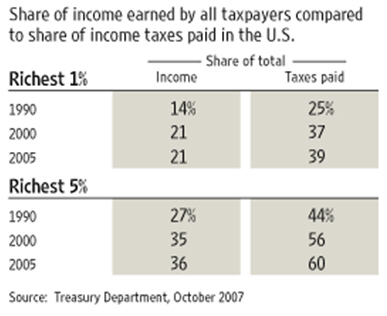
5. So, the tax burden absorbed by the top 1%  increased by 2 percentage points from 37.4% of total income taxes paid in 2000 to 39.4% of total income taxes paid in 2005; the top 5% share of the tax burden increased by 3.2 percentage points from 56.5% of toal income taxes in 2000 to 59.7% in 2005; the bottom half’s share of total income taxes paid dropped from 3.9% in 2000 to 3.1% in 2005. 

6. Taking a longer run view, the share of the income tax burden shouldered by the top 1% has roughly doubled over the past 25 years — from about 20% of total income taxes paid to about 40% of all income taxes paid; the share of the income tax burden shouldered by the top 5% has has increased roughly 25 percentage points over the past 25 years — from about 35% of total income taxes paid to about 60% of all income taxes paid. 
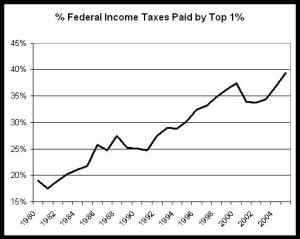


7.  The share of income taxes borne by the bottom half of tax filers has fallen from over 7% to about 3%.


* * * * *

Observations

I. The picture is certainly different when the focus shifts off marginal tax rates to the  amount of taxes paid or the share of the total income tax burden.

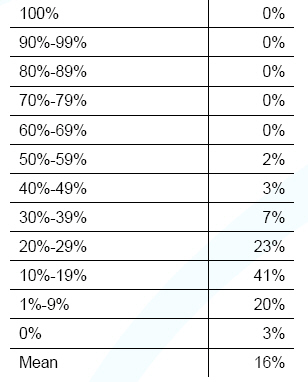
2. Broad based surveys indicate that people in general think the maximum percentage of a person’s income that SHOULD go to state, federal, and local taxes (in total) is 16%, with only 12% of respondents saying that the rate should be over 30%.

From a HarrisInterActive Poll:
Q 650: What is the maximum percentage of a person’s income that SHOULD go to taxes – that is, all taxes, state, federal, and local?

  the maximum percentage of a person's income that SHOULD go to taxes - that is, all taxes,
http://www.taxfoundation.org/files/topline-20050414.pdf

3. A tax burden of 60% of taxes paid by 5% strikes me as a pretty high number — especially since it’s 5% of tax filers not 5% of citizen-voters. Of course, “fair share” is in the eye of the beholder …

* * * * *

Data deck: 02-irs-tax-quartiles-key-metrics
Primary data source: http://www.taxfoundation.org/news/show/250.html

* * * * *

Analytical Note: This post, and a few follow-ons that I have in process, focus on individual federal income taxes.  That distinction excludes corporate taxes (an entirely different animal), state taxes (a crazy quilt of different programs), and so-called “FICA” or “payroll taxes” (for Social Security and Medicare).  The latter exclusion is admittedly dicey.  Employees’ paycheck deductions for Social Security and Medicare are a constant percentage of income (6.2% + 1.45% = 7.65%), up to $102,000 in earnings.  So, many people argue that the assessments are “regressive.”  Nonetheless, I consider these charges to be more akin to forced savings or deferred income plans since contributions are matched by employers and since the benefits received (e.g. retirement income and health insurance) are directly tied to the level of contributions.  So, I choose to outboard them from “tax and spend” analyses.  

* * * * *

Next up: More on income, deductions, credits, and taxes.

* * * * *

Want more from the Homa Files?
 
Click link =>  The Homa Files Blog

Taxes – Fair Share ?

July 22, 2008

Excerpted from the WSJ Editorial: “Their Fair Share”, July 21, 2008


“No President has ever plied more money from the rich than George W. Bush did with his 2003 tax cuts … The latest IRS data … show that the 2003 Bush tax cuts caused what may be the biggest increase in tax payments by the rich in American history.

The top 1% of taxpayers, those who earn above $388,806, earned 22% of all reported income and paid 40% of all income taxes in 2006, the highest share in at least 40 years.

The top 10% in income, those earning more than $108,904, paid 71% [of all income taxes]..

Americans with an income below the median paid a record low 2.9% of all income taxes, while the top 50% paid 97.1%.”

The WSJ editors project: If tax rates are raised on the rich — the Obama plan — their share of tax payments will fall. The last time tax rates were as high as Obama wants them — the Carter years — the rich paid only 19% of all income taxes, half of the 40% share they pay today. Why? Because they either worked less, earned less, or they found ways to shelter income from taxes so it was never reported to the IRS as income.


For full editorial:
http://online.wsj.com/article/SB121659695380368965.html

* * * * *

Observations & Questions

1. This isn’t new news, but seems to get swept under the carpet — largely because of legitimate concern for the uneven distribution of earning power in the U.S.

2. What is if “fair share”? Who should decide what it is? On what basis? Ability to pay ???

3. What is the goal of the income tax system: “collect and spend”(on necessary gov’t services) or “take and redistribute”

4. Based on cocktail party conversations, the WSJ is certainly right on at least point: folks are already starting to think about tax strategies to cope with likely tax rate increases. 

5. Warning: This editorial aroused my curiosity — so, several posts on the topic are on their way … with numbers, of course.

Want more from the Homa Files?
 
Click link =>  The Homa Files Blog

Energy – Alternative Energy Initiatives

July 21, 2008

Political candidates and pundits are talking like the energy crisis is new news, and even O’Reilly rants that the Bush administration has done absolutely nothing about it.  They conveniently overlook programs aimed at the development of hydrogen fuel, advanced energy technologies, and renewable fuels.

 Click chart to make it bigger

For details, see the DOE summary presentation:
http://www.energy.upenn.edu/docs/EWGP-Milliken-slides.pdf

The cornerstone of the program is the Advanced Energy Initiative (AEI) — which was announced in Bush’s 2006 State of the Union address .  The AEI’s stated goals  are to reduce our dependence on oil (especially foreign sourced) and to reducing emissions of greenhouse gases and other pollutants).

Specifically, the AEI was tasked with accelerating the technical and cost viability of alternative energy technologies for vehicles (e.g. plug-in hybrid vehicles,   fuel cells, and biofuels, including “cellulosic” ethanol derived from agricultural waste, forest residues and dedicated energy crops such as switchgrass), and for homes and businesses (e.g. nuclear power, clean coal, solar, and wind).

An important component of the AEI is critical basic research that should help overcome major technical barriers to the expanded use of technologies such as solar energy, cellulosic ethanol, energy storage, hydrogen fuel cells, and fusion energy.

For details of the AEI:
http://www.whitehouse.gov/stateoftheunion/2006/energy/energy_booklet.pdf

The initial enacted budget for AEI was $1.77 billion in FY2006; the proposed FY 2009 Budget is  $3.17 billion:
          

http://www.ostp.gov/galleries/Budget09/AdvancedEnergyInitiative1pager.pdf

* * * * *

Observations

1. Critics argue that the too little, too late, misdirected … with too little emphasis on convervation standards and processes.  The critics may be right, but some visibility and credit should be given for getting the ball rolling.

2. The next president will take over with the ball close to the end zone on some of the initiatives.  Watch whoever it is punch it in for the touchdown, dance in the end zone, and claim credit for the entire scoring drive.

3. The Bush team may be the worst marketers in the entire free world.

4. Gotta ask: what did Al Gore do in the 8 years he was hanging around the White House? I guess it’s easier to be bold and visionary when you don’t have responsibility … 

* * * * *

Worth browsing:  the U.S. DOE Energy Efficiency and Renewable Energy (EERE) web site: http://www.eere.energy.gov/

* * * * *

Want more from the Homa Files?
 
Click link =>  The Homa Files Blog


Idea – Revive the Hybrid Car Tax Credit

July 18, 2008

As of the end of 2007 (before the recent surge in gas prices), there were just under 1 million hybrid vehicles in use in th U.S.

http://www.eere.energy.gov/afdc/data/docs/hev_sales_model_year.xls

As I recounted in a prior post, I was surprised that  — for practical purposes —  there aren’t any tax credits available for hybrid cars to offset some of their price premium over conventional autos.

The Energy Policy Act of 2005 provided income tax credits up to $3,400 (depending on the make & model of car), for hybrids purchased by individuals after January 1, 2006. 


But, the credits weren’t applicable to taxpayers falling into the Alternative Minimum Tax category, and only the first 60,000 hybrid vehicles sold by each manufacturer qualified.  The allowable credits were phased out as manufacturers approached their 60,000 limits. 


For example, a Prius qualified for $3,150 credit on January 1, 2006.  That got cut to $1,585 on October 1, 2006; $785.50 on April 1, 2007; and to zero on October 1, 2007.


     See  http://www.fueleconomy.gov/feg/tax_hybrid.shtml for current hybrid tax incentives


The price premium for hybrids is somewhere between “statistically significant” and — with long payback periods — “economically disqualifying “.


So, wouldn’t it make sense to reinstitute some kind of tax incentive to stimulate the shift? It could be done quickly — with the stroke of a couple of pens.  


Make it big enough to matter, keep it both simple (no silly sliding scales) and broadly available (folks paying AMTare penalized enough), and watchdog the auto companies and dealers so they don’t just inflate the prices.

Want more from the Homa Files?
 
Click link =>  The Homa Files Blog


Energy – T. Boone Picken’s Plan

July 10, 2008

T. Boone Picken’s Plan to Escape the Grip of Foreign Oil
OpEd excerpted from the WSJ July 9, 2008

T. Boone Pickens has started running TV ads explaining the severity of the energy crisis and touting wind power as a quick, partial solution.  His WSJ OpEd spells out his plan:

“Each year we import more and more oil. In 1973, the year of the infamous oil embargo, the United States imported about 24% of our oil. In 1990, at the start of the first Gulf War, this had climbed to 42%. Today, we import almost 70% of our oil … [So] our economic engine is now 70% dependent on the energy resources of other countries, their good judgment, and most importantly, their good will toward us.

This year, we will spend almost $700 billion on imported oil, which is more than four times the annual cost of our current war in Iraq … if we don’t do anything about this problem, over the next 10 years we will spend around $10 trillion importing foreign oil. That is $10 trillion leaving the U.S. and going to foreign nations, making it what I certainly believe will be the single largest transfer of wealth in human history.

I have a clear goal in mind  … to reduce America’s foreign oil imports by more than one-third in the next five to 10 years.

Start with wind power  …  the U.S. has the capacity to generate 20% of its electricity supply from wind by 2030 …  [take] the energy generated by wind and use it to replace a significant percentage of the natural gas that is now being used to fuel our power plants.

Today, natural gas accounts for about 22% of our electricity generation in the U.S.  …  use new wind capacity to free up the natural gas for use as a transportation fuel. That would displace more than one-third of our foreign oil imports.

Natural gas is the only domestic energy of size that can be used to replace oil used for transportation, and it is abundant in the U.S. It is cheap and it is clean. With eight million natural-gas-powered vehicles on the road world-wide, the technology already exists to rapidly build out fleets of trucks, buses and even cars using natural gas as a fuel. Of these eight million vehicles, the U.S. has a paltry 150,000 right now.

[To get started] the government must mandate the formation of wind and solar transmission corridors, and renew the subsidies for economic and alternative energy development .

We need action. Now.”

                                      * * * * *

Observations:

1. Gotta like the guy’s passion and clarity of thought.  And, he puts his money where his mouth is – in ads and development capital.

2. Why not? Doesn’t solve the problem completely, but at least it hacks away at it.  No apparent downside. Doesn’t conflict with political agendas. 

3.  My bet? Politicos will take Picken’s ad quote “we can’t drill our way out of the problem” out of context and use it to support drilling bans. 

4. Watch: Congress will convene hearings on wind power and drag their feet.

                                   * * * * * 

Full story at:
http://online.wsj.com/article/SB121556087828237463.html?mod=opinion_main_commentaries

Thanks to Christian Walker (MSB MBA alum) for the heads-up on the article

Want more from the Homa Files?
 Click link =>  The Homa Files Blog

Energy – T. Boone Picken's Plan

July 10, 2008

T. Boone Picken’s Plan to Escape the Grip of Foreign Oil
OpEd excerpted from the WSJ July 9, 2008

T. Boone Pickens has started running TV ads explaining the severity of the energy crisis and touting wind power as a quick, partial solution.  His WSJ OpEd spells out his plan:

“Each year we import more and more oil. In 1973, the year of the infamous oil embargo, the United States imported about 24% of our oil. In 1990, at the start of the first Gulf War, this had climbed to 42%. Today, we import almost 70% of our oil … [So] our economic engine is now 70% dependent on the energy resources of other countries, their good judgment, and most importantly, their good will toward us.

This year, we will spend almost $700 billion on imported oil, which is more than four times the annual cost of our current war in Iraq … if we don’t do anything about this problem, over the next 10 years we will spend around $10 trillion importing foreign oil. That is $10 trillion leaving the U.S. and going to foreign nations, making it what I certainly believe will be the single largest transfer of wealth in human history.

I have a clear goal in mind  … to reduce America’s foreign oil imports by more than one-third in the next five to 10 years.

Start with wind power  …  the U.S. has the capacity to generate 20% of its electricity supply from wind by 2030 …  [take] the energy generated by wind and use it to replace a significant percentage of the natural gas that is now being used to fuel our power plants.

Today, natural gas accounts for about 22% of our electricity generation in the U.S.  …  use new wind capacity to free up the natural gas for use as a transportation fuel. That would displace more than one-third of our foreign oil imports.

Natural gas is the only domestic energy of size that can be used to replace oil used for transportation, and it is abundant in the U.S. It is cheap and it is clean. With eight million natural-gas-powered vehicles on the road world-wide, the technology already exists to rapidly build out fleets of trucks, buses and even cars using natural gas as a fuel. Of these eight million vehicles, the U.S. has a paltry 150,000 right now.

[To get started] the government must mandate the formation of wind and solar transmission corridors, and renew the subsidies for economic and alternative energy development .

We need action. Now.”

                                      * * * * *

Observations:

1. Gotta like the guy’s passion and clarity of thought.  And, he puts his money where his mouth is – in ads and development capital.

2. Why not? Doesn’t solve the problem completely, but at least it hacks away at it.  No apparent downside. Doesn’t conflict with political agendas. 

3.  My bet? Politicos will take Picken’s ad quote “we can’t drill our way out of the problem” out of context and use it to support drilling bans. 

4. Watch: Congress will convene hearings on wind power and drag their feet.

                                   * * * * * 

Full story at:
http://online.wsj.com/article/SB121556087828237463.html?mod=opinion_main_commentaries

Thanks to Christian Walker (MSB MBA alum) for the heads-up on the article

Want more from the Homa Files?
 Click link =>  The Homa Files Blog

Oil Econ: Losing Our Financial Independence ?

July 9, 2008

Pump Prices Hurt Americans Not Just in Pocketbook

Highlights from the WSJ July 8, 2008

Referencing a McKinsey Research Study


“Both presidential candidates are focusing on the economy this week, and for good reason: $4-a-gallon gasoline has Americans sliding into pocketbook shock.


But pain at the pump is only one reason energy now should be the central issue of this year’s campaign. Here’s the other, more insidious one: High oil prices are shredding America’s financial independence and producing a massive transfer of wealth from U.S. pocketbooks into the hands of suspect actors around the world, including Iran, Venezuela and Russia.


The U.S., in other words, now has an energy problem that is not only draining the bank accounts of its own citizens, but filling up the bank accounts of some who work against American interests around the globe … Oil-producing countries are accumulating piles of excess cash that they can use — and are using — to buy pieces of Western companies … (to buy) the  U.S. Treasury bonds that finance the federal government’s budget deficit (foreigners buy 80% of all newly issued Treasury bills) … (and) to advance anti-American political [and military] agendas.


To their credit, Sens. John McCain and Barack Obama are trying to raise awareness of the corrosive national-security effects of oil prices. In his recent centerpiece address on energy, Sen. McCain declared: “When we buy foreign oil, we are enriching some of our worst enemies.” As far back as last fall, Sen. Obama said in a speech that money spent on foreign oil “corrupts budding democracies and allows dictators from hostile regimes to threaten the international community.” 
                                              * * * * *

Observations:


1.  Right now, about 1/3 of US oil is sourced domestically, about 1/3 comes from friendly nations (Canada, Mexico), and about 1/3 from problematic nations.  Let’sdrive less and drill more to at least cover the most problematic 1/3 of our consumption.


2. Both candidates have to stop parsing words and make the issue visceral —  e.g. “roughly $1 of each gallon of $4 gas goes into the pocket of folks who don’t like us and want to hurt us”  — “what are the prospects for long-term job security if US companies are increasingly foreign-owned?”


3. Shouldn’t the Congress be doing something a little more action-oriented  than “negotiating to hold a bipartisan energy summit”?  Geez guys, do something already… 
                                               * * * * *    


Full WSJ article:
http://online.wsj.com/article_print/SB121546528614733687.html


McKinsey Global Institute special research study
“The New Power Brokers, Oil, Hedge Funds, Asia” 
http://www.mckinsey.com/mgi/publications/The_New_Power_Brokers/index.asp 


Idea: Hybridize the Govt Vehicle Fleet

July 3, 2008

Ever notice all of those Post Office mini-trucks cruising their routes?

Bet you have since the USPS is often reported to operate the largest fleet of vehicles in the country (maybe the world). 

Assume that each those vehicles is on the road 6 to 8 hours per day; probably covering 76 to 100 miles per day.  That’s 24,000 to 36,000 miles per year (2 or 3 times an average family vehicle);  At a charitable 15 MPG — that’s about 2000 gallons of gas per year. 

At a Prius-like 45 MPG, that number goes down to about 650 gallons annually — 1,350 gallons less per year.   Multiply that times the number of vehicles in the fleet (thousands),  and we’re talking MILLIONS of gallons of gas. 

Rather than coaxing consumers to buy hybrids one at a time, why not convert the entire USPS fleet in one fell swoop? 

More broadly, why not legislate that all government vehicles be hybrids, flex-fuel, or some other energy saving alternative.  Makes sense to me. 

                                     * * * * *
Side note: According to Phrases.org “fell swoop” means “suddenly; in a single action”.  They say that Shakespeare either coined the phrase, or gave it circulation, in Macbeth, 1605:

MACDUFF: [on hearing that his family and servants have all been killed]
All my pretty ones?
Did you say all? O hell-kite! All?
What, all my pretty chickens and their dam
At one fell swoop?

Free Idea: “Drill Here, Drill Now” Referendums

June 21, 2008

This one is for the McCain campaign:

Given the popular support for drilling in ANWR (over 50% approval) and off-shore in the deep seas (over 70% approval), why not get some ballot initiatives going in battleground states (e.g.  the environmentally unaffected midwest states) — public referendums on whether or not to increase domestic drilling.  Wouldn’t be legally binding on anybody, but might turn out the (right) vote.

Survey: Pick Your Favorite

June 21, 2008


Copyright protection established on June 21, 2008

Book Summary – Real Change by Newt Gingrich

June 21, 2008

 
Real Change: From a World that Fails to a World that Works
      by Newt Gingrich (former Speaker of the House)
  

Theme: activist citizenry must rise up to make government work … it won’t happen on its own due to entrenched (unionized) bureaucracies and power-hungry partisan political parties. 

Factoids & Interesting Points: 

  • It’s insane to the same thing and expect a different result (credit to Albert Einstein) 
  • Easier to be in the minority – just complain and object. 
    Majority must lead — come up with big ideas and implement them
     
  • Politicians are much better at campaigning than governing
  • Republican strategy: narrow partisan target. negative messaging, voter turnout … only works for a few campaign cycles … shrill messages eventually lose their edge and effectiveness … people can’t stay angry long enough 
  •  Democratic strategy: pander to small, specific activist segments, e.g. unions, environmentalists, who can only “win” with gov’t control and ultimately resist change to the status quo … leverage the money & visibility of the elites ( media, show biz, uber-rich) …problem: promises never materialize, mostly due to cost and ineffective government bureaucracies (waste & fraud)
  • More African-American males in prison than in college … for some, prison brings street cred … many inner-city entrepreneurs – they just operate outside the law 
  • In NYC, vice cops worked 9 am to 5 pm … drug dealers worked 9 pm to 5 am … since dealers wouldn’t change their work schedules, Rudy made the cops change their schedules
  • High school “on time” graduation rate less than 50% in Cleveland, LA, Miami, Dallas, Denver … 40% in NYC  … Baltimore lowest @ 38.5%
  • France does some things right: high speed rail, 80% nuclear powered electricity … and some things wrong: minimum work for maximum pay mindset
  • Over half of Americans own stock … over 8 million paid capital gains taxes in 2006
  • Social security tax rate = 12.4% (ouch) … split between employee and employer … currently capped at about $100k … Obama’s “tax & redistribute” plan: 12.4% from zero to $100k, and over $250k

Newt on Leadership (credit to Peter Drucker)

Values > Vision > Metrics > Strategies > Projects > Tasks

First, win agreement … then win the vote
Win agreement by saying “yes, if…” rather than “no, because …”

Reward the efforts & success of “contributors” … don’t penalize it 

Newt’s formula for change

Homeland security – the highest priority

English –  the official language … preserve American history & culture·        

Free market education: charter schools and vouchers … maybe even paying students for good grades
  
“Free choice” flat tax (17%) … eliminate taxes on capital gains, dividends, pensions & social security, and death … allow choice to continue deductions system
   
Immigration: close the borders, guest worker program aggressive assimilation 
        
Trial lawyers, civil litigation: losers pay costs, class action limits
     
Direct ownership: homes, retirement accounts
        
Balanced budget: to force hard choices, eliminate earmarks & pork-barrel spending, cut future burden
        
Energy: drill here now, nuclear, incentives for renewables  

Heath care: more personal ‘choose and pay’ (vs 3rd party – insurers and gov’t) electronic records (e-prescriptions), personal responsibility – prevention, restrictions on trial lawyers 

Ken’s Take: Quick read … not much new, insightful, provocative
                             … borrow it, don’t buy it.