Archive for the ‘Gov't Waste & Inefficiency’ Category

What’s the government’s GPA?

August 27, 2012

A Kaiser Foundation survey asked folks to grade the government on a traditional A to F grading scale.

Back in 2000, the government scored a “gentleman’s C” … GPA = 2.07.

In the past decade, the GPA has dropped to 1.63 … a C-minus / D-plus.

Hmmm.

Isn’t that probationary at most b-schools?


image


Source question

image

>> Latest Posts

Great moments in science …

July 12, 2012

No, not confirmation of the so-called “god particle” … I’m talking about the NOAA’s refutation of the existence of mermaids.

According to the LA Times

There’s no evidence mermaids exist, and most people above the age of 6 probably realize it

To put the matter to rest, the National Oceanic and Atmospheric Administration has announced  that there is no evidence that mermaids are real.

“The belief in mermaids may have arisen at the very dawn of our species,” the post explains. “Magical female figures first appear in cave paintings in the late Paleolithic (Stone Age) period some 30,000 years ago, when modern humans gained dominion over the land and, presumably, began to sail the seas. Half-human creatures, called chimeras, also abound in mythology…. But are mermaids real? No evidence of aquatic humanoids has ever been found.”

Perhaps the most surprising aspect of this revelation is why NOAA, a U.S. scientific agency, would want to weigh in on these mythical creatures any more than they’d want to expound on the potential atmospheric perturbations caused by Santa Claus’ countless Christmas Eve flights around the globe.

Our tax dollars at work.

I guess this is one item that President Obama missed when he scoured the budget line-by-line to eliminate fraud and waste …

>> Latest Posts

IRS: “Your mail is very important to us” … well, not really.

April 27, 2012

According to Business Week:

  • One in three people who call the IRS don’t get their calls answered
  • 10% of all mail sent to the IRS sits for at least 2 months before processing starts
  • Less than half of all people who write to the IRS get replies in less than 6 weeks 
  • 10% of all mail sent by the IRS never reaches the intended recipient.

Yipes !

>> Latest Posts

Presidential “piggybacking” … your tax dollars at work (but only if you pay taxes)

April 19, 2012

In an earlier post “Government Gone Wild?”, I said:

If the President takes day trips on Air Force One to campaign, why shouldn’t GSA folks take day trips to Hawaii for ribbon cuttings?

A loyal, left-leaning reader (maybe now a former left-leaning reader) challenged the Homa Files fact-checkers as “just plain wrong” since:

The campaign reimburses the federal gov’t for the usage of Air Force One and costs associated with protection of the POTUS directly related to campaigning.

My immediate reply:

There is partial reimbursement …. the campaign pays for “incremental costs not related to official business” …. it’s not prorated …. when he gives a 30 minute Buffett Rule speech and does 3 hour long fund-raisers, the campaign doesn’t pay for 75% (or 85%) of the cost of the trip.

Just to sure, we doubled back on the facts.

Landed on a point-on article by ever right-wing ABC: Presidential Piggybacking: Obama Trips Combine Official, Political Business

The act of presidential piggybacking — coupling official duties, in this case a speech on the economy, with political fundraising — was not pioneered by Obama but is prominently on display this year.

The president’s jet-setting has raised the curiosity and questions from taxpayers about who bears the sky-high costs.

Official presidential travel has traditionally been paid for by taxpayers as part of executive branch operations, while political trips and events are to be covered by a candidate’s campaign committee.

On the occasions that they mix, the costs are to be split.

“Most presidents have doubled up on trips and said they followed the law, which is a complex formula no one really understands. At the end of the day the Federal Election Commission has not been abundantly clear about how the costs of mixed purpose travel should be paid for”

As a rule of thumb, an incumbent president’s campaign is expected to reimburse the government the cost of a first class commercial airline ticket for each person riding Air Force One to or from a political event.

But the amount doesn’t come close to covering the proportional operating cost of Air Force One, or the army of Secret Service agents, White House advance teams, the fleet of Air Force cargo planes transporting the presidential motorcade or the helicopters that often ferry the president from an airport to a remote site.

Air Force One alone cost $179,750 per flight hour in fiscal year 2012.

That figure includes fuel, flight consumables, depot level repairs, aircraft overhaul and engine overhaul. Pilot and airmen salaries are not included because they are paid regardless of the plane’s use.

On a recent three-day, three-state swing that included two official events and eight fundraisers, netting more than $8 million, incurred flight costs alone of $2.1 million, based on the Air Force figure and flight times gathered from press pool reports.

The Obama campaign has reimbursed more than $1.5 million for travel so far this election cycle, according to FEC records.

Read that last paragraph carefully.

80% of the “stops” of the cited trip were campaign-related.

And, just the cost of AF One were over $2 million.

So, you’d expect that the Obama Campaign would have picked up at least $1.6 million of the costs — just for AF one, just on this one trip.

But, according to ABC, the Campaign has only picked up $1.5 million in total, for the entire campaign cycle so far.

C’mon man.

I say to the GSA guys: Go cut some ribbons” … Why not?.

>> Latest Posts

MoFoFree: Cell phones update …

February 15, 2012

Punch line: Wireless operators like Sprint Nextel are building a big business providing free cellular service to the poor. Taxpayers pick up the tab.

Ouch

* * * * *

Last year, we blogged about the Feds free cellphone service to low income folks.

You see, chatting and texting is an entitlement that tax payers are morally required to subsidize.

Say, what?

The program started with good intentions: to provide every low income household with a landline for emergency use.  No long distance.  No special service.  Just local calls and 911.

No problem.

Well, then landlines became “so yesterday” and the program morphed to cell phones

And, guess what?

Demand is exploding.

According to Business Week:

Companies like Sprint Nextel aren’t driven by altruism.

Serving cash-pinched customers  can pay off due to federal government subsidies.

And finding new customers isn’t hard.

Now the poor or unemployed form a large pool of would-be customers.

With unemployment at 9.4 percent and one in six Americans living in poverty, Sprint and  TracFone have seen an explosion in sign-ups for the government-subsidized free wireless services. 

Applicants have to be eligible for Medicaid or several other low-income assistance programs, have a family income significantly below the local poverty level (poverty guidelines vary by state), or receive food stamps.

In October, 43.2 million received such food assistance, up 14.7 percent from a year earlier.

Despite the rules, it’s reported to be  pretty easy to get one of these phones – or to get several of them.  Think “no doc” mortgages with fewer controls.

One reported scam is for qualified people to sign up, sell their phones on eBay, and then go back to the government  trough for another phone.

But, not to worry.

Also according to Business Week: “A staffer at the Federal Communications Commission, which oversees carriers, says the agency may consider tightening oversight and cost management of the fast-growing program.”

That’s a relief, for sure.

And, oh yeah … under consideration is extending the program to broadband service.

Gimme a break already.

>> Latest Posts

With junk mail & gov’t checks being the pillars of their business, what’s the USPS to do ?

October 13, 2011

Talk about being at the end of the product-life-cycle … how would you like to be the dude running the US Postal Service?

The vast majority of the stuff still handled by USPS is made up of catalogues, junk mail ads, unwanted solicitations and, oh yeah, government checks.

In a few years, all that will be left will be government checks.

Hard to make a living off them.

Unless, of course, Team O gets re-upped for a 2nd term.

Excerpted from WSJ: Junking the Junk Mail Office

Email and Fedex already take care of serious delivery business. Why subsidize catalogue carriers?.

The United States Postal Service (USPS) lost $9 billion last year.

The rapid growth of email, online bill paying and the like has reduced the volume of first class mail by 22% since 2006, cutting into the government’s monopoly.

An inexorable decline is underway. The lesson here is that even monopolies can die if they provide inefficient services to shrinking markets.

Both Fedex and UPS do a much better job shipping packages than does the USPS.

The cost of a first-class stamp to 44 cents when it should be closer to 30 cents, if held to the rate of inflation.

Meanwhile, bulk-mail discounts have resulted in a glut of unwanted catalogues and credit-card offers in our mailboxes — and have led to billions of dollars in losses.

Our political leaders should end the USPS’s dysfunctional first-class mail monopoly, opening it up to private competition.

Postal Service employees are generally very well paid and (with some notable exceptions, usually in smaller towns) have rarely been characterized by high productivity.

Visits to the post office are not normally known to be user-friendly experiences. It is a good bet that the private sector will be considerably more productive — and user-friendly — than today’s government employees, no matter how loyal they may be.

And, post offices usually occupy prime real estate in cities and towns across America, potentially of great interest to retailers, restaurateurs, municipal governments and others.

And, don’t forget, the more than 200,000 USPS vehicles are also saleable.

I’d bid on one of those USPS carrier jeeps …

>> Latest Posts

Cutting to the chase on Solyndra (again) …

October 10, 2011

Punch line: The proper role for government is to support basic research, not commercial ventures

Excerpted from the WSJ: The Solyndra Economy

“Listening to the President, Solyndra was a necessary casualty in the greater campaign to steer the U.S. economy toward Mr. Obama’s noble goals.

Private competition that winnows out losers is so yesterday.

Brad Jones of Redpoint Ventures got to the heart of the Solyndra economy in a December 2009 email to then-National Economic Council director Larry Summers:

“The allocation of spending to clean energy is haphazard; the government is just not well equipped to decide which companies should get the money and how much . . . One of our solar companies with revenues of less than $100 million (and not yet profitable) received a government loan of $580 million; while that is good for us, I can’t imagine it’s a good way for the government to use taxpayer money.”

Which is precisely the point.

The proper role for government is to support basic research, not commercial ventures that become exercises in taxpayer risk but private reward.

When government takes $535 million and invests in a loser, it not only wastes taxpayer money but it also denies that capital to some other project in the private economy that might have succeeded.

The Solyndra emails show how ill-equipped government is to predict the industries of the present, much less the future.”

Why no Occupy Wall Street placards on this one ?

>> Latest Posts

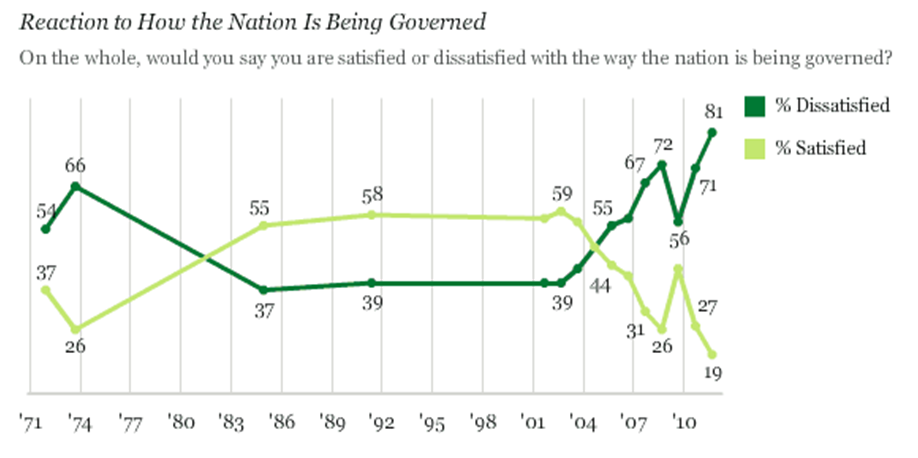
Shocker: Over 80% of Americans dissatisfied with government

September 29, 2011

Punch line: According to Gallup a record-high 81% of Americans are dissatisfied with the way the country is being governed

As Gomer Pyle would say “surprise, surprise, surprise.”

image

Ken’s Take  Carter tanked it, Reagan brought it back, Clinton held it, Bush re-tanked it,  Obama sqandered hope & change to all-time lows.

* * * * *

Drilling Down

Majorities of Democrats (65%) and Republicans (92%) are dissatisfied with the nation’s governance.

69% say they have little or no confidence in the legislative branch of government, an all-time high and up from 63% in 2010.

57% have little or no confidence in the federal government to solve domestic problems

43% have little or no confidence in the government to solve international problems.

53% have little or no confidence in the men and women who seek or hold elected office.

Americans believe, on average, that the federal government wastes 51 cents of every tax dollar

49% of Americans believe the federal government has become so large and powerful that it poses an immediate threat to the rights and freedoms of ordinary citizens.

>> Latest Posts

Americans say Feds waste 51 cents of every dollar spent … I’m betting the over.

September 22, 2011

OK, this poll cuts to the chase.

This is why many folks – me included – resist tax increases (oops, I mean ‘revenue increases’) … because there’s enough wasted money to pay for everything the gov’t needs to do … including debt reduction.

Interesting note: even liberal Dems who push hard for tax increases think that at least 45 cents of every dollar are wasted. …  yet, they keep pushing for tax increases.

Huh?

According to Gallup:

Americans estimate that the federal government wastes 51 cents of every dollar it spends, a new high in a Gallup question first asked in 1979.

image

>> Latest Posts

From the “No Choice but to Withhold Granny’s Check” file …

July 27, 2011

Courtesy of http://dirtyspendingsecrets.com/

Sure wouldn’t want to cut any of these fine programs.

  • Incredibly, Washington is spending $2.6 million training Chinese prostitutes to drink more responsibly on the job.
  • Congress recently gave Alaska Airlines $500,000  to paint a picture of a Chinook salmon on a Boeing 737
  • Federal employees cost taxpayers $146 million each year when they upgrade to business class flights. The Government Accountability Office found that more than half of these upgrades were not properly authorized.
  • The government has spent $3 billion to re-sand our nation’s beaches. Advocates claim this prevents erosion and keeps the beaches attractive to tourists. But the National Oceanic and Atmospheric Administration says the sand does nothing to prevent erosion—and this sand gets swept out to sea just as easily as existing sand!

Pick your favorite …

>> Latest Posts

About those 800,000 non-essential gov’t employees …

April 12, 2011

Perhaps the biggest win from last week’s possible government shut-down is that (apparently) all gov’t departments had to scrub their employment lists to classify employees as essential or non-essential.

Now, if gov’t were a business, somebody (think Jack Welch – or, better yet, Chainsaw Al Dunlop) would start scouring the list … to re-classify some of the non-essentials to ‘former employees’.

I’m taking the under on that bet.

The non-essentials will likely continue doing their non-essential “work” … on our dollar.

Ouch.

About those oversized government pensions …. what about Congressmen?

March 10, 2011

The flap over government employees’ pensions resurrected an old question of mine: I’ve always wondered what retired members of the Congress and Senate got to live on when they retired.  Here’s the scoop ..:

* * * * *

Members of Congress are eligible for a pension at age 62 if they have completed at least five years of service.

Members are eligible for a pension at age 50 if they have completed 20 years of service, or at any age after completing 25 years of service.

The amount of the pension depends on years of service, an accrual rate (2.5%), and the average of the highest three years of salary.

For example, after 30 years of Congressional service and a high-3 average salary of $161,800, the initial annual Civil Service Retirement System (CSRS) pension for a Member who retired in December 2006 at the end of the 109th Congress would be: 
                $161,800 x 30 x .025 = $121,350

  • Note: It’s unclear whether the qualifier is Congressional service or civilian government service … both terms are used.
  • Note: Base pay for Representatives and Senators was $165,200 in 2006.

Federal law limits the maximum CSRS pension that may be paid at the start of retirement to 80% of the Member’s final annual salary

As of October 1, 2006, 413 retired Members of Congress were receiving federal pensions based fully or in part on their congressional service. Of this number, 290  had retired under CSRS and were receiving an average annual pension of $60,972.

In 1983, Congress passed a law (P.L. 98-21) that required all federal employees first hired after 1983 to participate in Social Security.

The law also required all members of Congress to participate in Social Security as of January 1, 1984, regardless of when they first entered Congress.

Because the CSRS was not designed to coordinate with Social Security, Congress directed the development of a new retirement plan for federal employees, called the Federal Employees Retirement System (FERS), which does coordinate a federal pension with Social Security.

A total of 123 Members had retired with service under both CSRS and FERS or with service under FERS only. Their average annual pension was $35,952 in 2006.

Since, on average, SS benefits are typically around $24,000 annually,  the total is bumped to about $60,000.

Bottom line: a typical member of Congress get a pension of about $60,000

According to the National Taxpayers Union, the Congressional pension program is about two-to-three times more generous than the average corporate executive pension plan, .

* * * * *

Source:
http://www.senate.gov/reference/common/faq/retirement_for_members.shtml

Full report:
http://www.senate.gov/reference/common/faq/retirement_for_members.shtml

McKinsey says;”Public sector productivity is at least 10 years behind the private sector” … that’s a shocker, isn’t it?

March 9, 2011

Winding through TSA at BWI on Sunday, I could only laugh.  When the supply of shoe-bins reached empty, the world’s slowest  moving human started wheeling a fresh stacks of bins to the front of the line.  I swear, the women was moving at the speed of about 10 feet per minute.  What-she-worry?  She was getting paid by the hour, not based on how many bins she stacked per hour.

With that experience fresh on my mind, a friend emailed the below article to me.

Coincidence?

* * * * *

According to Time mag …

Many Americans think of Washington when they think of government workers.

But the vast majority are state and local employees. The country has 2.2 million federal civilian workers — compared with 19.4 million at the state and local levels.

Almost half of the 19 million work in education, which rivals health care for the most wasteful sector in America.

The rest are mostly police officers, firefighters, social workers, nurses and prison guards.

* * * * *
And though public workers have suffered job losses in the past year (and will suffer more this year), the government remains the most reliable employer in the country.

Compared with before the recession, there are only 1% fewer employees at the state and local levels, according to the U.S. Bureau of Labor Statistics.

The federal civilian workforce is actually 12% larger than it was in November 2007.

Meanwhile, the number of private-sector employees has declined 6.5%

* * * * *.

For now, the efficiency gap between the public and private sectors is holding us all back.

The U.S. ranked 68th (out of 139 countries) in terms of wastefulness of government spending in the 2010-11 World Economic Forum report on global competitiveness.

Experts put our public-sector productivity about 10 years behind that of the rest of our workforce.

If public workers could halve that gap, the annual savings would ring in at $100 billion to $300 billion, according to a new study by the McKinsey Global Institute.

That would mean the equivalent of a recurring stimulus package every three to eight years.

* * * * *

Full article: Time, What Public Employees Really Cost, Mar. 07, 2011 

Thanks to SGC for feeding the lead.

My favorite winter radio announcement …

January 19, 2011

Roads were icy in DC yesterday, so on the way into Georgetown I heard my favorite weather-related announcement:

“Only essential Federal employees need to report today; non-essential employees may take liberal leave”

Raises an obvious question: why do non-essential government employees ever need to report?

Sounds like a cost reduction opportunity to me … nice place to start the belt tightening … get rid of the slackers who self-identify as “non-essential”.

Why not?

Should gov’t employees get pay cuts?

January 17, 2011

That’s the question, and a recent Rasmussen Reports national telephone survey found that:

  • 40% of Adults favor a 10% pay cut for all state employees to help reduce state spending
  • 41% oppose a 10% across-the-board pay cut
  • 19% are not sure

A pretty even split, but digging deeper:

  • 60% of entrepreneurs favor a 10% pay cut for public employees
  • A plurality (45%) of private company workers favor a 10% pay cut
  • 75% of those employed by the government do not favor a pay cut.

Flipping the numbers: 1 in 4 government employees think their pay should be cut.

Hmmm.

P.S. Note that they’re called government “employees”, not “government workers”.

Double hmmm.

Exceprted from:
http://www.rasmussenreports.com/public_content/business/jobs_employment/january_2011/many_favor_cutting_pay_benefits_of_state_employees

Bumps ahead for gov’t gravy train …

December 21, 2010

Honestly, excluding the military and first-responders, what’s your view of government employees? 

How many fulfilling experiences have you had with the IRS,  the DMV, the tax assessor’s office, the planning board, etc. ?  My bet: not many.

In the old days, most folks got annoyed but gave passes because they thought the inefficient bureaucrats weren’t getting paid very much.

Recent news reports have burst those myths: revealing high pay relative to private sector employees and outrageous benefits packages.

For sure, the next couple of years will have spotlights shining on government employees and their candidate-contributing unions.

Blue states (think NY, CA, IL) will get hit particularly hard now that fiscally responsible red states are refusing to bail them out.

Since the unions won’t budge, expect higher state taxes and cuts in services …   

Compared with many sectors that have suffered grievously from the slump — housing, automobiles, finance — state and local governments have been relatively sheltered.

One reason is President Obama’s  “stimulus” packages … have provided about $158 billion to states.

As these transfers dwindle … local governments may be less lucky. They rely on property taxes for about a third of their revenues, and because property appraisals are done every few years, “the decline in house prices implies that collections will probably fall in the coming years.”

The truly bad news lies in the future with massive retiree pension and health benefits that haven’t been prefunded. How big are the shortfalls? All estimates are huge … the gaps are about $3 trillion for states and almost $600 billion for localities.

Whatever the ultimate costs, they threaten future levels of public services.

The generous benefits encourage workers to retire in their late 50s or early 60s after 25 years of service. The health benefits typically provide coverage until retirees qualify for Medicare at 65.

To pay for unfunded benefits, either government services must either be cut or taxes raised.

So support for schools, police, roads and other state and local activities is undermined by careless — or corrupt — bargains between politicians and their public-worker unions.

Promises of generous future retirement benefits were expedient contract sweeteners, with most costs conveniently deferred. Even when pension contributions were supposed to be made, they were often reduced or postponed when budgets were tight.

If these arrangements look familiar, they should. The U.S. auto industry adopted the same model; the costs helped bankrupt General Motors and Chrysler.

RCP,Cheating Our Children (Again), December 20, 2010
http://www.realclearpolitics.com/articles/2010/12/20/cheating_our_children_again_108288.html

Bailing out government pension plans …

June 23, 2010

There has been mucho chatter recently about gov’t pay levels which exceed comparable private industry rates and gov’t pension plans that make the UAW envious.

Bottom line: Many states have crafted gov’t pension plans that are going to implode in the not too distant future.

So, tax payers in fiscally responsible states will be forced to ante more into the pot to bail out the free-promising, overspending states.

Think about it next time you’re standing in line at the DMV.

* * * * *

Bloomberg: Pension Plans Go Broke as Public Payrolls Expand, June 11, 2010

Seven states will run out of money to pay public pensions by 2020.

That hasn’t stopped them from hiring new employees.

The seven are Illinois, Connecticut, Indiana, New Jersey, Hawaii, Louisiana and Oklahoma.

Combined, these states added 9,700 workers to both state and local government payrolls between December 2007 and April of this year.

Companies started firing more employees than they hired in January 2008.

Employment peaked in December 2007 at 115.6 million. During the subsequent two years, companies shed 8.5 million workers, or 7.3 percent.

By contrast,  from a peak of 19.8 million, state and local governments have reduced headcount by 231,000, or 1.2 percent.

What our politicians are telling us is that state and local governments are optimally sized — just right.

If tax revenue declines, well, then we’ll just have to find more taxes and fees to replace it.

We couldn’t possibly look at the cost-of-labor side of the equation.

If you really want to provoke outrage, you have to take into consideration public pensions.

Generous and bloated are the terms that have been used to describe them … What’s clear is that such pensions and benefits now seem unaffordable, because those responsible — state and, sometimes, local governments — didn’t put away enough, or haven’t invested wisely enough, to pay for them.

Full article:
http://www.bloomberg.com/apps/news?pid=20601039&sid=awW.rqJzAad4

1 million government census workers ???

April 8, 2010

Last Friday’s jobs report included 48,000 temporary census workers … less than anticipated given the plan to eventually hire 1 million temporary gov’t workers to service the census.

Prompted a great question from wife Kathy: “Why does it take 1 million people 6 months to count 300 million other people?

Think about it … that’s 300 counted citizens per hired temporary census worker … or each census worker counting about 2 people per day spread over the 6-months’ data collection period.

This, from the same government that’s going to eliminate waste from our healthcare system …  yeah, right.