Archive for the ‘Health Care / Medical Insurance’ Category

Snookered: Drug makers agree to lower prices … after they raise them.

November 17, 2009

Bottom line: I wondered why pharma companies got in the ObamaCare canoe and promised cutting prices by $8 billion. 

The answer should have been obvious: all for show. 

They’re hustling to inflate prices to establish a much higher base from which they can back out the “cuts”. 

In other words, the post-reform prices will be right where they had planned them before the faux show of ObamaCare support.

Imagine that … Team Obama getting snookered,

* * * * *

Excerpted from NY Times: Drug Makers Raise Prices in Face of Health Care Reform, November 15, 2009

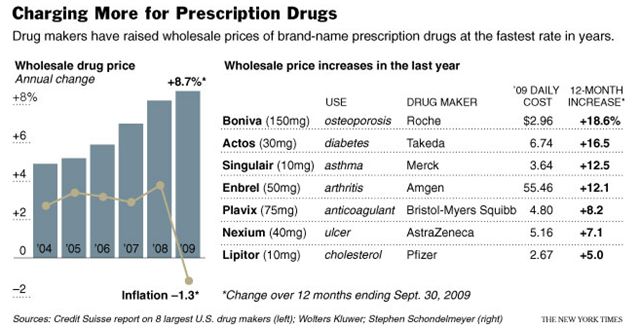
Even as drug makers promise to support Washington’s health care overhaul by shaving $8 billion a year off the nation’s drug costs after the legislation takes effect, the industry has been raising its prices at the fastest rate in years.

The industry stands to gain about 30 million customers with drug insurance from the legislation pending in Congress. But the industry also faces the prospect of tougher negotiations from both public and private buyers as the government tries to squeeze savings out of the health system.

In the last year, the industry has raised the wholesale prices of brand-name prescription drugs by about 9 percent, according to industry analysts. That will add more than $10 billion to the nation’s drug bill, which is on track to exceed $300 billion this year. By at least one analysis, it is the highest annual rate of inflation for drug prices since 1992.

Drug makers say they have valid business reasons for the price increases. Critics say the industry is trying to establish a higher price base before Congress passes legislation that tries to curb drug spending in coming years.

There was a similar pattern of unusual price increases after Congress added drug benefits to Medicare a few years ago, giving tens of millions of older Americans federally subsidized drug insurance. Just as the program was taking effect in 2006, the drug industry raised prices by the widest margin in a half-dozen years.

The drug companies say they are having to raise prices to maintain the profits necessary to invest in research and development of new drugs as the patents on many of their most popular drugs are set to expire over the next few years.

The drug industry has actively opposed some of the cost-cutting provisions in the House legislation, which passed Nov. 7 and aims to cut drug spending by about $14 billion a year over a decade.

But the drug makers have been proudly citing the agreement they reached with the White House and the Senate Finance Committee chairman to trim $8 billion a year — $80 billion over 10 years — from the nation’s drug bill by giving rebates to older Americans and the government.

But this year’s price increases would effectively cancel out the savings from at least the first year of the Senate Finance agreement. And some critics say the surge in drug prices could change the dynamics of the entire 10-year deal.
image 
http://www.nytimes.com/imagepages/2009/11/16/business/16drugprices_graphic.html

Full article:
http://www.nytimes.com/2009/11/16/business/16drugprices.html
So, will digital medical records “bend the cost curve” … in the right direction?

November 13, 2009

Ken’s Take: As a a digital kinda guy — who worked with a start-up that digitized med records —  I’m naturally in favor of electronic medical records.

But,   I am a bit concerned about privacy issues and how gov’t will use my info.

Further, I’ve watched my doc struggle while inputting data to an online system and I’ve had digital prescriptions get lost and “corrupted” in cyberspace.  So, the below article struck a chord.

Now, I’m officially ambivalent on the subject. Anybody have a strong point-of-view

* * * * *

Excerpted from RCP: Government by Holiday Inn Express, October 27, 2009

Starting during the campaign, President Obama touted digital medical records to reduce errors, improve care, and cut costs. More than $19 billion of stimulus funds were earmarked for it.

But when the Washington Post examined the matter, they discovered that digital records not only fail to produce the promised benefits, they actually reduce efficiency and cause errors.

The digital systems currently available give physicians too much information. Pages upon pages of digital information document every conceivable ailment a patient might have.

Doctors have difficulty wading through all of the unnecessary data to reach the critical information.

One emergency room physician at a hospital that had adopted a digital system complained, “It’s been a complete nightmare. I can’t see my patients because I’m at a screen entering data . … Physician productivity and satisfaction have fallen off a cliff.”

Some hospitals have adopted digital systems only to abandon them.

Full article:
http://www.realclearpolitics.com/articles/2009/10/27/government_by_holiday_inn_express_98882.html#

Electronic medical records … the next Manhattan Project ?

November 12, 2009

I thought that this reply (which was posted yesterday by Chris Hairel — an MSB MBA alum) was quite insightful. 

Bottom line: we’re talking a Manhattan Project with savings (if any) far down the road)

A nationwide electronic medical records system  represents the largest and most complex IT project in history.

There are several hundred government agencies, almost two thousand insurers, tens of thousands service and equipment providers, over 300 million patients with more than a billion records.

There are no data standards currently defined.

There are no security protocols in place.

Much of the data from paper notes and the rest must be converted from one electronic format to another.

It takes well run private companies 2 or 3 years or more to do an ERP or portal program. These are projects in controlled environments with processes and data that are much less complex than the human body and a stakeholder group several orders of magnitude less than the US health care system. 

The National Health Service in the UK has had huge cost over runs and lost a prime contractor due to poor governance over data and metrics.

The IRS is years behind on their new audit system. The FAA has been after a new ATC system since the Reagan administration.  

[Ken’s Note: Integration of our intelligence systems is still an incomplete work in progress — as evidenced by the Maj. Nassan slip-up that led to the Fort Hood massacre.]

Electronic health records won’t drive savings for quite a while – and certainly not by 2015 as currenlty promised in the government estimates.

* * * * *

The “Costs” of Medical Care …

November 11, 2009

Ken’s Take: Economists are trained to focus on “real” costs. 

One of my major complaints about the current healthcare “reforms” is that — except for electronic medical records — there are, for all practical purposes, no structural changes proposed.  No gov’t clinics, no additional medical schools, no tort reform. 

Just more money being thrown at the problem and more obfuscation of real costs.

* * * * *

Excerpted from RCP: The “Costs” of Medical Care, Thomas Sowell, November 3, 2009

We are incessantly being told that the cost of medical care is “too high”– either absolutely or as a growing percentage of our incomes.

But nothing that is being proposed by the government is likely to lower those costs, and much that is being proposed is almost certain to increase the costs.

There is a fundamental difference between reducing costs and simply shifting costs around, like a pea in a shell game at a carnival.

Costs are not reduced simply because you pay less at a doctor’s office and more in taxes– or more in insurance premiums, or more in higher prices for other goods and services that you buy, because the government has put the costs on businesses that pass those costs on to you.

Costs are not reduced simply because you don’t pay them. Letting old people die would undoubtedly be cheaper than keeping them alive– but that does not mean that the costs have gone down. It just means that we refuse to pay the costs. Instead, we pay the consequences. There is no free lunch.

Despite all the demonizing of insurance companies, pharmaceutical companies or doctors for what they charge, the fundamental costs of goods and services are the costs of producing them.

If highly paid chief executives of insurance companies or pharmaceutical companies agreed to work free of charge, it would make very little difference in the cost of insurance or medications.

If doctors’ incomes were cut in half, that would not lower the cost of producing doctors through years of expensive training in medical schools and hospitals, nor the overhead costs of running doctors’ offices.

What it would do is reduce the number of very able people who are willing to take on the high costs of a medical education when the return on that investment is greatly reduced and the aggravations of dealing with government bureaucrats are added to the burdens of the work.

In short, reducing doctors’ income is not reducing the cost of medical care, it is refusing to pay those costs. Like other ways of refusing to pay costs, it has consequences.

http://www.realclearpolitics.com/articles/2009/11/03/the_costs_of_medical_care_98986.html

The "Costs" of Medical Care …

November 11, 2009

Ken’s Take: Economists are trained to focus on “real” costs. 

One of my major complaints about the current healthcare “reforms” is that — except for electronic medical records — there are, for all practical purposes, no structural changes proposed.  No gov’t clinics, no additional medical schools, no tort reform. 

Just more money being thrown at the problem and more obfuscation of real costs.

* * * * *

Excerpted from RCP: The “Costs” of Medical Care, Thomas Sowell, November 3, 2009

We are incessantly being told that the cost of medical care is “too high”– either absolutely or as a growing percentage of our incomes.

But nothing that is being proposed by the government is likely to lower those costs, and much that is being proposed is almost certain to increase the costs.

There is a fundamental difference between reducing costs and simply shifting costs around, like a pea in a shell game at a carnival.

Costs are not reduced simply because you pay less at a doctor’s office and more in taxes– or more in insurance premiums, or more in higher prices for other goods and services that you buy, because the government has put the costs on businesses that pass those costs on to you.

Costs are not reduced simply because you don’t pay them. Letting old people die would undoubtedly be cheaper than keeping them alive– but that does not mean that the costs have gone down. It just means that we refuse to pay the costs. Instead, we pay the consequences. There is no free lunch.

Despite all the demonizing of insurance companies, pharmaceutical companies or doctors for what they charge, the fundamental costs of goods and services are the costs of producing them.

If highly paid chief executives of insurance companies or pharmaceutical companies agreed to work free of charge, it would make very little difference in the cost of insurance or medications.

If doctors’ incomes were cut in half, that would not lower the cost of producing doctors through years of expensive training in medical schools and hospitals, nor the overhead costs of running doctors’ offices.

What it would do is reduce the number of very able people who are willing to take on the high costs of a medical education when the return on that investment is greatly reduced and the aggravations of dealing with government bureaucrats are added to the burdens of the work.

In short, reducing doctors’ income is not reducing the cost of medical care, it is refusing to pay those costs. Like other ways of refusing to pay costs, it has consequences.

http://www.realclearpolitics.com/articles/2009/11/03/the_costs_of_medical_care_98986.html

It's in the bill … hard time for the voluntarily uninsured.

November 10, 2009

Failure to buy health insurance in the just-passed health care bill could get you five years in jail with a $250,000 fine.

Under sections 7201 and 7203 of  Pelosi’s bill, Americans who don’t maintain acceptable health insurance coverage and who choose not to pay a fine/tax of up to 2.5% of income are subject to fines of up to $250,000 and imprisonment of up to five years.

http://www.investors.com/NewsAndAnalysis/Article.aspx?id=511806

The good news: once incarcerated, these felons get full healthcare … for free.

Do twentysomethings who choose to self-insure understand that they’re going to be subsidizing us old folks ?  Might work …

It’s in the bill … hard time for the voluntarily uninsured.

November 10, 2009

Failure to buy health insurance in the just-passed health care bill could get you five years in jail with a $250,000 fine.

Under sections 7201 and 7203 of  Pelosi’s bill, Americans who don’t maintain acceptable health insurance coverage and who choose not to pay a fine/tax of up to 2.5% of income are subject to fines of up to $250,000 and imprisonment of up to five years.

http://www.investors.com/NewsAndAnalysis/Article.aspx?id=511806

The good news: once incarcerated, these felons get full healthcare … for free.

Do twentysomethings who choose to self-insure understand that they’re going to be subsidizing us old folks ?  Might work …

Bad things happen when you confuse "price" with "cost" … here’s an example.

November 9, 2009

I often harp to my students that it’s a cardinal sin to confuse revenue with profits, or to confuse price with cost.  Here’s an example of the latter — in the context of the current healthcare debate.

Excerpted fron IBD: Misconceptions That Mar Medical Care, 11/06/2009
From the book “Applied Economics” by Thomas Sowell.

A number of confusions plague discussions of the economics of medical care.

A confusion between prices and costs has allowed politicians to claim to be able to bring down the cost of health care, when in fact they only bring down the individual patient’s out-of-pocket costs paid to doctors, hospitals, and pharmacies.

The costs themselves are not reduced in the slightest when additional money to pay for these costs is collected in taxes or insurance premiums and routed through either government or private bureaucracies.

Most proposals to “bring down the cost” of medical care pay little or no attention to the actual cost of creating pharmaceutical drugs, training medical students, or building and equipping hospitals.

To the extent that the government imposes some form of price control by refusing to pay doctors, hospitals or pharmaceutical companies as much as they would receive through supply and demand in a free market, that does not lower the costs either.

It simply means that the government refuses to pay all those costs — and such refusals to pay costs have a centuries-old track record of leading to a reduction in the amount supplied, whether what has been subject to price controls has been housing, gasoline, food or other goods and services.

Medical treatment has been no exception. The reduction in the supply of doctors, hospitals or pharmaceutical drugs may be quantitative, qualitative or both.

In Britain, with one of the oldest government-run health systems and therefore one which has long since gone past stage one, there have been such difficulties in getting enough British doctors that there have been large and chronic importations of foreign doctors, many from Third World countries whose qualifications standards are not always up to those in more affluent countries.

As for pharmaceutical drugs, countries which have succumbed to the politically attractive policy of keeping drug prices low by fiat, or by ineffective patent protection, have had much lower rates of discovery of major new medications than does the United States, which has been left to supply a disproportionate share of the world’s major new medications.

Various organized groups in a position to bargain for lower medical charges or lower drug prices — government agencies, health insurers or large health maintenance organizations, for example — may receive preferential prices, but the total costs do not go away and have to be paid by somebody.

One consequence is a multitiered set of prices for the same medical treatment or the same medication, with the highest prices of all being paid by patients who do not have health insurance, do not belong to a health maintenance group, and are not covered by any government program.

In short, misconceptions of the economic function of prices lead not only to price controls, with all their counterproductive consequences, but also to organized attempts by various institutions, laws and policies to get most of the costs reflected in prices paid by somebody else.

For society as a whole, there is no somebody else.

Full article:
http://www.investors.com/NewsAndAnalysis/Article.aspx?id=511637

So, preventative healthcare and disease screenings save money … right ?

November 9, 2009

Ken’s Take: Since I’m in the prime group for prostate cancer — and since a couple of friends have been detected and treated (successfully) — I’ve been a fan of PSA tests.  But, I’ve had 3 docs try to talk me out of getting the tests.  Here’s their rationale … which raises a broader question re: preventative healthcare.

* * * * *

Excerpted from RCP: Government by Holiday Inn Express, October 27, 2009 

Another silver bullet the administration has peddled is preventive care.

Everyone knows that a timely PSA test will detect prostate cancer at an early and treatable phase thus saving the patient’s life and saving money, right?

Not exactly. The test is obviously worthwhile for that individual. But testing all men for prostate cancer — an overwhelming majority of whom will never get the disease — is expensive.

If more and more of us are tested for more and more diseases — even accounting for some illnesses found early — health spending will rise, not fall.

Further complicating the picture, the National Cancer Society has announced that the benefits of cancer screenings, particularly for breast and prostate cancers, have been oversold. They aren’t saving very many lives, but they are causing needless tests and surgeries.

Full article:
http://www.realclearpolitics.com/articles/2009/10/27/government_by_holiday_inn_express_98882.html#

If you’re young and you’re healthy … get out your wallet.

October 29, 2009

TakeAway: According to a detailed modeling of insurance rates, private insurance premiums could triple under ObamaCare.  Oops.

* * * * *

Excerpted from WSJ: The WellPoint Revelation, Oct. 28, 2009 

How will ObamaCare affect insurance premiums in the private health-care markets?

Despite indignant Democratic denials, the near-certainty is that their plan will cause costs to rise across the board.

WellPoint mined its own actuarial data to model ObamaCare in the 14 states where it runs Blue Cross plans.

In all of the 14 states WellPoint scrutinized, ObamaCare would drive up premiums for the small businesses and individuals who are most of WellPoint’s customers. (Other big insurers, like Aetna, focus on the market among large businesses.)

Young and healthy consumers will see the largest increases—their premiums would more than triple in some states—though average middle-class buyers will pay more too.

What distinguishes the Wellpoint study is its detailed rigor.

Take Ohio, where a young, healthy 25-year-old living in Columbus can purchase insurance from WellPoint today for about $52 per month in the individual market. WellPoint’s actuaries calculate the bill will rise to $79 because Democrats are going to require it to issue policies to anyone who applies, even if they’ve waited until they’re sick to buy insurance. Then they’ll also require the company to charge everyone nearly the same rate, bringing the premium to $134. Add in an extra $17, since Democrats will require higher benefit levels, and a share of the new health industry taxes ($6), and monthly premiums have risen to $157, a 199% boost.

Meanwhile, a 40-year-old husband and wife with two kids would see their premiums jump by 122%—to $737 from $332—while a small business with eight employees in Franklin County would see premiums climb by 86%.

It’s true that the family or the individual might qualify for subsidies if their incomes are low enough, but the business wouldn’t qualify … And even if there are subsidies, the new costs the bill creates don’t vaporize. They’re merely transferred to taxpayers nationwide—or financed with deficits, which will be financed eventually with higher taxes.

For the average small employer premiums would rise by 94%  in Indianapolis, 91% in St. Louis and 53% in Milwaukee.

A family of four with average health in those same cities would all face cost increases of 122% buying insurance on the individual market.

And it’s important to understand that these are merely the new costs created by ObamaCare — not including the natural increases in medical costs over time from new therapies and the like.

Apparently health care isn’t one huge free lunch in which everyone gets better insurance while paying less.

http://online.wsj.com/article/SB10001424052748703567204574499034177212064.html?mod=djemEditorialPage

Medicare’s cost advantage … real or illusory … and, so what ?

October 28, 2009

Ken’s Take: I would like to see more real economics in the public option debate.   A fundamental question: though counter-intuitive, does the gov’t run more efficient healthcare insurance programs than private industry?

Here are some facts … more “takes” follow.

Private insurers’ profits (included in administrative costs) explain some of Medicare’s cost advantage.

But profits represent only 3% of the insurance industry’s revenues.

* * * * *

By some estimates, Medicare’s administrative costs are only 3% of spending compared with 13% or more for private insurers. So, a government run healthcare plan is widely presumed to enjoy an advantage in overhead.

As for administrative expenses, any advantage for the public plan is exaggerated, say critics. Part of the gap between private insurers and Medicare is statistical illusion: Because Medicare recipients have higher average health expenses ($10,003 in 2007) than the under-65 population ($3,946), its administrative costs are a smaller share of total spending. A public plan, with younger members, wouldn’t enjoy this advantage.

* * * * *

The main advantage of a public plan would be the congressionally mandated requirement that hospitals and doctors be reimbursed at Medicare’s rates — as much as 30% lower than rates paid by private insurers.

With such savings, the public plan could charge much lower premiums and attract lots of customers.

Excerpted from IBD: Promise Of The Public Plan Is A Mirage,  10/23/2009
http://www.investors.com/NewsAndAnalysis/Article.aspx?id=510101

Ken’s Take:

(1) I’ve argued before that the private health insurers don’t really make that much money.  The industry ranks #35 among major industry groupings, and the 3% rate is far downscale.  Since private insurers handle about 1/2 of all healthcare spending — using the above 3% number — if you eliminate all private healthcare profits, the “savings” would be about $30 billion annually. That’s statistically significant but — in my opinion — not compelling.

(2) At first blush — again, using the above numbers — the gov’t admin advantage (3% to 13%) is significant.  First, assuming that the number of transactions handled is proportional to the dollars of healthcare expenses  — then the 3% to 13% advantage carries thru ona transaction basis. Even when you “normalize” the data per patient Medicare seems to have an advantage — Medicare administers a subscriber for $300 per year ($10,000 times 3%) versus $500 per year for private insurers ($4,000 times 13%).  That’s significant.

What’s going on?  My bet: scale economies.  While some private healthcare insurers seem big, their size pales in comparison to the government programs.  Why? Because of the limits on selling insurance across state lines.  There are something like 1,500 private insurance programs.  All have admin staffs, computer systems, etc. 

My conclusion: there are way too many private insurers, not too few.  Consolidate that industry down to a handful of companies, and Medicare’s admin cost advantage would disappear — practically overnite.

(3) I’ve also pointed out the vicious cycle that’ll occur if doctors are squeezed with reimbursement rates far below “market prices” and sometimes below cost.  Eventually, the private plans get snuffed, and more important, the base of healthcare suppliers — docs and hospitals will shrink.  That means rationing.

* * * **

Like advertising, half of all healthcare spending is wasted. Yeah, but …

October 28, 2009

Ken’s Take: Keep in mind that (1) medical tort reform isn’t even on the negotiating table, (2) much of the “billing & administration” is feeding the Medicare / Medicaid systems, and (3) they’ve been chasing the same fraud dollars for decades.

* * * * *

Excerpted from Reuters: US Health Care Wastes Up to $800 Billion a Year, Oct 26,2009

The U.S. healthcare system wastes between $505 billion and $850 billion every year, according to a report from Thomson Reuters – Healthcare Analytics.

One example — a paper-based system that discourages sharing of medical records accounts for 6 percent of annual overspending.

“It is waste when caregivers duplicate tests because results recorded in a patient’s record with one provider are not available to another or when medical staff provides inappropriate treatment because relevant history of previous treatment cannot be accessed,” the report reads.

Some other findings in the report from Thomson Reuters:

  • Unnecessary care such as the overuse of antibiotics and lab tests to protect against malpractice exposure makes up 37 percent of healthcare waste or $200 to $300 a year.
  • Fraud makes up 22 percent of healthcare waste, or up to $200 billion a year in fraudulent Medicare claims, kickbacks for referrals for unnecessary services and other scams.
  • Administrative inefficiency and redundant paperwork account for 18 percent of healthcare waste.
  • Medical mistakes account for $50 billion to $100 billion in unnecessary spending each year, or 11 percent of the total.
  • Preventable conditions such as uncontrolled diabetes cost $30 billion to $50 billion a year.
  • Wasteful use of emergency rooms due to a lack of primary care doctors.

“The average U.S. hospital spends one-quarter of its budget on billing and administration, nearly twice the average in Canada.”

“American physicians spend nearly eight hours per week on paperwork and employ 1.66 clerical workers per doctor, far more than in Canada.”

Source article:
http://www.cnbc.com/id/33477157#

Hey, Mr. Prez … Here’s a way to fund about 1/2 of your healthcare package.

October 27, 2009

Did you know …

TARP will expire on December 31, unless Geithner exercises his authority to extend it to next October.

Right now, Geithner is sitting on over $300 billion of uncommitted TARP funds, thanks in part to bank repayments. Treasury believes it has the authority to spend that returned money on new adventures in housing or other parts of the economy.

Since the TARP has largely ignored its designated mission — buying up bad mortgages and their derivatives — and has evolved into a $700 billion all-purpose political slush fund, why not simply declare success and throw the money at insuring the uninsureds?

Hmmm …. 

* * * * *

HiLites from WSJ: Rolling up the TARP, Oct.  27, 2009 

Historians will debate TARP’s role in ending the financial panic of 2008, but today there is little evidence that the government needs or can prudently manage what has evolved into a $700 billion all-purpose political bailout fund.

TARP quickly became a Treasury tool to save failing institutions without imposing discipline (Citigroup) and even to force public capital onto banks that didn’t need it. This stigmatized all banks as taxpayer supplicants and is now evolving into an excuse for the Federal Reserve to micromanage compensation.

Even with the banks, TARP has been a double-edged sword. While its capital injections saved some banks, its lack of transparency created uncertainty that arguably prolonged the panic.

By stating expressly that the ‘healthy’ institutions would be able to increase overall lending, Treasury created unrealistic expectations about the institutions’ conditions and their ability to increase lending.”

TARP was then redirected well beyond the financial system into $80 billion in “investments” for auto companies. These may never be repaid but served as a lever to abuse creditors and favor auto unions.

TARP also bought preferred stock in struggling insurers Lincoln and Hartford, though insurance companies are not subject to bank runs and pose no “systemic risk.” They erode slowly as customers stop renewing policies.

TARP also became another fund for Congress to pay off the already heavily subsidized housing industry by financing home mortgage modifications. Not one cent of the $50 billion in TARP funds earmarked to modify home mortgages will be returned to the Treasury, says the Congressional Budget Office.

TARP’s Congressional Oversight Panel warns that the entire taxpayer pot could be converted into subsidies. They are especially concerned about expanding the foreclosure prevention programs that have been failing by every measure.

The political class has twisted TARP into a fund to finance its pet programs and constituents, and the faster it fades away, the better for taxpayers and the financial system.

Full article:
http://online.wsj.com/article/SB10001424052748704224004574489740879074028.html?mod=djemEditorialPage

* * * * *

On B of A and Merrill …

The government also endangered one of the banks that they considered healthy at the time.

According to Fed documents, the government viewed BofA as well-capitalized, but officials believed that its tangible common equity would fall to dangerously low levels if it had to absorb the sinking Merrill.

In other words, by insisting that BofA buy Merrill, Messrs. Paulson and Bernanke were spreading systemic risk by stuffing a failing institution into a relatively sound one.

And they were stuffing an investment bank into one of the nation’s largest institutions whose deposits were guaranteed by taxpayers. BofA would later need billions of dollars more in TARP cash to survive that forced merger, and when that news became public it helped to extend the overall financial panic.

Full article:
http://online.wsj.com/article/SB10001424052748704224004574489740879074028.html?mod=djemEditorialPage

Gut check: what are Americans’ core values ?

October 26, 2009

Ken’s Take: If you buy the premise that  Americans’ core values are individual choice, personal accountability, and rewards for ambition then the rest of the argument falls neatly into place. 

My question: These days, how pervasive and strong are these core values ?

Call me cynical, but I’m starting to think that too many folks would rather leave their decisions to other, blame others for their irresponsibility and claim entitlement without ambition.

More ‘Take’ follows …

* * * * *

Excerpted from: WSJ, Why Government Health Care Keeps Falling in the Polls. Oct 25, 2009

Regardless of how President Barack Obama’s health-care agenda plays out in Congress, it has not been a success in public opinion. Opposition to ObamaCare has risen all year.

We continue to hear both sides of the health-care debate argue about particulars of insurance markets, the deficit impacts of reform, and the minutiae of budgetary assumptions. These arguments, while important, do not address the deeper issues involved.

Public resistance stems from the sense that the proposed reforms do violence to three core values of America’s free enterprise culture: individual choice, personal accountability, and rewards for ambition.

First, Americans recoil at policies that strip choices from citizens and pass them to bureaucrats. ObamaCare systematically does so. The current proposals in Congress would effectively limit choice across the entire spectrum of health care: What kind of health insurance citizens can buy, what kind of doctors they can see, what kind of procedures their doctors will perform, what kind of drugs they can take, and what treatment options they may have.

Second, Americans believe we should be responsible for the consequences of our actions. Many citizens bitterly view the auto and Wall Street bailouts as gifts to people who took imprudent risks, imperiled the entire economic system, and now appear to be walking away from the mess. Similarly, Americans are cold to a health-care system that effectively rewards individuals for waiting to get insurance until they get sick—subsidizing their coverage by taxing those who responsibly carry insurance in good times and bad.

Third, ObamaCare discourages personal ambition. The proposed reforms will institute a set of government mandates, price controls and other strictures that will make highly trained specialists, drug researchers and medical device makers less valued now and in the future. Americans understand that when you take away the incentive to make money while saving lots of lives, the cures, therapies and medical innovations of tomorrow may never be discovered.

Full article:
http://online.wsj.com/article/SB10001424052748704335904574495131591949574.html?mod=djemEditorialPage

* * * * *

More Ken’s Take: I think the resistance is more fundamental: everybody wants uninsured citizens to get healthcare– just so they don’t personally have to fund it. 

The 50% of people who pay income taxes don’t want their rates goosed up; Seniors don’t want Medicare cut; Juniors don’t want to buy health insurance that they don’t need; Union members don’t want to pay taxes on their gold-plated plans; Companies don’t want to pay higher taxes — unless they can pass them on to consumers.

It’s as simple as that.

The AMA gets double-crossed … surprise, surprise, surprise.

October 23, 2009

Ken’s Take:

For the record: I’m totally against “bending the cost curve” by cutting doctors pay !

The press reports — and my doctor friends confirm — that Medicare reimbursement rates are 15% to 25% below the prices paid by private insurance companies for comparable services.

In many (most?) instances, the Medicare reimbursements are below the doctors’ fully loaded costs.  Said differently — doctors often (usually ?) lose money on Medicare patients.

As a result, popular doctors (i.e. good ones who have an earned reputation and a “full panel” of patients) restrict the number of Medicare patients they treat — sometimes simply refusing to accept Medicare patients at all. Only newbies and unpopular doctors who have excess “capacity” smack their lips when they see Medicare patients coming through the door.  To these doctors, Medicare is to healthcare as Priceline is to airlines — a way to generate some revenue off a perishable asset — the doctor’s available time -to-treat.

To give the appearance of controlling runaway Medicare costs, Congress put bills in place that automatically cut Medicare reimbursement rates from year to year. Under current law, doctors face a 21.5 percent cut in Medicare fees in 2010 and then annual 5 percent cuts for several years.

Recognizing that lower rates would just decrease the number of doctors seeing Medicare patients, Congress has gotten in the habit of overriding the cuts each year — sometimes increasing them. (Note: I think that’s a good thing).

The healthcare reform legislation is supposed to fix the problem by at least freezing reimbursement rates for an extended period (maybe forever).  This “sweetener” is what got the AMA to buy in and publicly support ObamaCare.

The problem: the freeze costs about $25 billion annually — or about $250 billion over 10 years.  That’s an amount that pushes ObamaCare costs over $1 trillion (for 10 years) — that seems to be a number that everybody gags on.

So, Reid tried to outboard the freeze from the healthcare package and pass it as a run of the mill deficit spending program to be enacted immediately.

To Reid’s surprise, some Dems got uneasy with the ploy and voted against it.

So, either the freeze gets put into ObamaCare, bloating its cost — or reimbursement rates go down, understandably angering the AMA — or Congress punts the issue as a post-reform clean-up matter.

I’m betting on the latter.

P.S. I’m also betting that ObamaCare will have provisions mandating that doctors treat some minimum number of Medicare patients — even if the reimbursement rates are below cost.  Just watch … 

* * * * *

Here are a couple of links with details on Reid’s failed gambit.

The Hill, Miscalculation delivers loss on Medicare doc fix for Majority Leader Reid, Oct. 21 2009
http://thehill.com/homenews/senate/64221-miscalculation-delivers-loss-for-reid-on-doc-fix

WSJ, Temporary Beltway Sanity – The doctor fix blows up in the Senate, no thanks to the AMA. Oct. 22, 2009
http://online.wsj.com/article/SB10001424052748704597704574487622368301370.html

A ban on big screen TVs … only in California.

October 16, 2009

Ken’s Take: I really like this idea.  Why?  Frees up $$$ so folks can buy healthcare insurance … instead of me buying it for them.

* * * * *
From the San Francisco Business Times: California looks to limit big screen TVs, October 14, 2009

California may ban some types of big screen televisions because they use too much power.

The state’s energy commission has proposed limits on big screen plasma and liquid crystal TV sets. The move is supported by power utilities and opposed by electronics industry groups.

A vote by the commission could happen as early as Nov. 4. If the rules pass, they’ll take effect in two phases, the first in 2011 and the second, tougher level, in 2013, and would reduce energy consumption by 49 percent, the commission said.

These types of televisions use lots of power, as much as a refrigerator in some cases.

“The standards would improve the energy efficiency of televisions without affecting the quality of the television, ” said the commission. It also said the technology needed to improve the energy efficiency of sets already exists.

About 1,000 types of televisions already meet the stringent standards, the commission said.

http://sanfrancisco.bizjournals.com/sanfrancisco/stories/2009/10/12/daily42.html?ana=e_bjtt

Only in California, but maybe it’ll spread …

* * * * *

Should fat people pay more for health insurance?

October 15, 2009

I received several “you’re heartless” comments when I suggested that healthcare should be rationed to fat people (instead of rationing it to old people).
https://kenhoma.wordpress.com/2009/08/06/instead-of-old-people-how-about-rationing-care-to-fat-people/

Well, on a variant to the theme, a number of state insurance plans penalize smokers already.  In January of this year, Alabama became the first state to charge overweight employees more for their health insurance coverage, and North Carolina plans to place state employees who are overweight in a more expensive health insurance plan beginning in July 2011.

A new Rasmussen Reports national telephone survey finds that 50% support a plan that makes government workers who smoke pay more for their health insurance, and 30% favor making overweight government workers pay more for health coverage.

* * * * *

Factoids

70% of Americans said they opposed a national tax on all non-diet soft drinks to combat obesity.

41% of Americans describe themselves as overweight.

49% of adults say they exercise one to three times per week, and over half say their workout lasts at least 30 minutes.

18% of Americans smoke cigarettes … 34%) don’t smoke now but used to http://www.rasmussenreports.com/public_content/politics/current_events/healthcare/october_2009/30_say_overweight_workers_should_pay_more_for_health_insurance

* * * * *

Mayo Clinic’s "perfect model": turn away Medicare & Medicaid patients … oops.

October 14, 2009

TakeAway: Critics Say Move Shows That Facility Is Not a Model for Health-Care Reform

* * * * *

Excerpted from Washington Post, Mayo Clinic Faulted for Limiting Medicare Patients, October 13, 2009 

The renowned Mayo Clinic is no longer accepting some Medicare and Medicaid patients, raising new questions about whether it is too selective to serve as a model for health-care reform.

The White House has repeatedly held up for praise Mayo and other medical centers, many of which are in the Upper Midwest, that perform well in Dartmouth College rankings showing wide disparities in how much hospitals spend on Medicare patients.

Mayo announced late last week that its flagship facility in Rochester, Minn., will no longer accept Medicaid patients from Nebraska and Montana. The clinic draws patients from across the Midwest and West, but it will now accept Medicaid recipients only from Minnesota and the four states that border it. As it is, 5 percent of Mayo’s patients in Rochester are on Medicaid, well below the average for other big teaching hospitals, and below the 29 percent rate at the other hospital in town.

Separately, the Mayo branch in Arizona — the third leg of the Mayo stool, with the Rochester clinic and one in Florida — put out word a few days ago that under a two-year pilot program, it would no longer accept Medicare for patients seeking primary care at its Glendale facility. That facility, with 3,000 regular Medicare patients, will continue to see them for advanced care — Mayo’s specialty — but those seeking primary care will need to pay an annual $250 fee, plus fees of $175 to $400 per visit.

Mayo officials said Monday that the two moves were “business decisions” that had grown out of longstanding concerns about what it sees as underpayment by Medicare and Medicaid.

The officials said they were not meant to influence the national reform debate, in which Mayo has also been advocating against the creation of a government-run insurance option. But they said the moves were indicative of the need for the Medicare payment reforms it has been pushing in Washington.

http://www.washingtonpost.com/wp-dyn/content/article/2009/10/12/AR2009101202803_pf.html

* * * * *

Count employer paid health insurance premiums as income … Why not?

October 7, 2009

TakeAway: Seems obvious to me that health insurance premiums paid by employers should be counted as W-2 income, with income tax deductiblility (or credits) of, say, $5,000 per person with a max of $15,000 per family.  Helps out the folks who don’t have access to company paid premiums and stops the gold-plated programs from bloating healthcare spending.

* * * * *
From DC Examiner: Democrats Win Lobbyists but Lose Basic Reforms, October 1, 2009

The Democrats are having trouble passing convoluted and plainly imperfect health care bills. Maybe they would be better off going back to basics.

All of the current healthcare proposals build a makeshift addition to the health insurance system that grew out of a tax law decision made during World War II.

That decision was to give a preference to employer-provided health insurance: The cost of insurance would be deductible for employers and would not be counted as income for employees.

The system insulates health care consumers from costs, with the result that insurance costs have recently crowded out wage increases.

The tax preference is steeply regressive. High-earning employees with gold-plated, employer-provided health insurance get deductions that are worth many thousands of dollars.

Those without employer-provided health insurance, or low-earners who are among the 40 percent of earners who do not pay income tax, get exactly zero. If a Republican Congress had designed such a system, it would be attacked as a favor to the rich, and rightly so.

During the 2008 campaign, Barack Obama attacked John McCain’s proposal for equalizing the tax treatment of employer-provided and non-employer-provided health insurance, and so it would be embarrassing for him to advocate such a change.

More determining, labor unions, a strong Democratic constituency, want to maintain the current system because they have obtained very expensive policies for their members. But with only 8 percent of private-sector workers in unions, it seems clear that basic reforms would do more for low-earners and ordinary Americans than the Democrats’ current plans.

* * * * *

Full article:
http://www.realclearpolitics.com/articles/2009/10/01/democrats_win_lobbyists_but_lose_basic_reforms_98526.html

* * * * *

Factoids: How Medicare Works …

October 7, 2009

Ken’s Take:  It’s still not obvious to me how putting the screws to doctors will “fix” the healthcare situation …

* * * * *

Medicare’s price controls already pay only 83 cents on the private dollar.

* * * * *

Congress decides each year how much it wants to spend on doctors, period.

If one area of medicine receives a larger slice of this pie, another must accept a smaller one.

The portion sizes are determined using a formula known as Relative Value Units, or RVUs. Medicare assigns an RVU to each of 7,500 billable services—in 2008, a colonoscopy earned 5.64 of these units, a hip replacement 37.66.

Then it multiplies a doctor’s total RVUs by some dollar factor, currently about $36, and cuts a check.

* * * * *

Source: WSJ, The War on Specialists Oct. 6, 2009
http://online.wsj.com/article/SB10001424052748704471504574443472658898710.html?mod=djemEditorialPage#printMode

* * * * *

Wanna see the doctor? … Come back in a couple of months

October 2, 2009

Ken’s Take: This is my big beef with the healthcare system — the long waits to get appointments, and then the long waits to get seen on appointed days.

* * * * *

Regarding the availability of health care:

74% of those in the U.S. meet for scheduled doctors appointments within four weeks, while only 42% of British and 40% of Canadians do.

Only 10% of Americans wait longer than two months, while 33% of Brits and 42% of Canadians wait that long.

On average, doctors say neurosurgery should be performed within 5.8 weeks, but in Canada it takes about 31 weeks.

Orthopedic surgery should be within 11 weeks, but in Canada it takes 37 weeks.

Hmmm … think about it.

* * * * *

From WSJ: “ObamaCare is hazardous to your health”, Sept 24, 2009
http://online.wsj.com/article/SB10001424052970204488304574433343630176378.html?mod=djemEditorialPage

* * * * *

Majority Rule? … Forget about it !

October 1, 2009

As Congress moves forward, threatening use of the arcane “reconciliation” process to ram a bill in before T-Day … a simple question: aren’t “they” supposed to be representing “us”?

image

http://www.investors.com/NewsAndAnalysis/Article.aspx?id=507336

* * * * *

In praise of health insurance companies …

September 30, 2009

WSJ: Health Co-Ops Aren’t the Answer, Sept. 28, 2009

Private health insurers perform many complex and hard-to-replicate functions.

They issue policies and accept financial risks associated with the costs of providing care.

They perform actuarial analyses to track costs and price policies.

They design different benefit structures to meet varying needs.

They select, contract with, and monitor the quality of thousands of hospitals and doctors and other professionals who provide the services covered by their policies.

They assess evidence for which technologies and treatments provide value, and provide information to assist millions of individuals and employers with a range of health-care and health coverage issues

Most plans, especially the best ones, assist with coordination of care and management of chronic conditions, and help consumers save money and time by guiding them to better health decisions.

Typically, all of this is facilitated by highly sophisticated and expensive information systems, and many trained nurses and physicians.

“It took decades and billions of investment dollars, with some of the most sophisticated business minds, to build today’s major health insurance companies”.

* * * * *

If we want greater competition for today’s health plans to drive down costs,  revise the ground rules and create a competitive landscape across the nation for existing companies.

Start by allowing health plans to compete across state lines. Because of restricted competition, in a large number of states only one or two plans dominate the market.

Reduce the number of mandated benefits states impose on plans. They drive costs 20%-30% higher than they might be.

Encourage health plans to negotiate more aggressively than they do now with hospital monopolies that exist in many local areas.

Promote benefit designs that offer more affordable coverage, such as policies with higher deductibles and health savings accounts that foster greater consumer engagement and healthy behaviors.

A “public option” by any other name—including health-care co-op—just won’t fly. The real competitive force will come from putting more dollars into individuals’ hands and fewer into insurers’ hands, and by fostering true competition among existing insurers.

* * * * *

Full article:
http://online.wsj.com/article/SB10001424052970204488304574429481529233414.html?mod=djemEditorialPage

* * * * *

Keep the change: An excise tax on ‘caloric’ soft drinks … gimme a break.

September 30, 2009

TakeAway:  The latest headache for beverage marketers – the government has decided that adding an extra tax on sweetened beverages will help Americans lose weight and, thus, reduce health care costs .  Consumer goods companies are already taking deliberate measures to increase the health profile of product offerings.  Is government intervention necessary to help consumers make good food choices? At what point is it up to consumers to make healthy food choices?

* * * * *

Excerpted from WSJ, “New Report Argues For Tax on Soft Drinks” By Betsy McKay and Valerie Bauerlein, September 16, 2009

A report published … by the New England Journal of Medicine … called for an excise tax of a penny per ounce on caloric soft drinks and other beverages that contain added sweeteners such as sucrose, high-fructose corn syrup or fruit-juice concentrates. Such a tax could reduce calorie consumption from sweetened beverages by at least 10% and generate revenue that governments could use to fund health programs, the authors said … “Escalating health-care costs, and the rising burden of diseases related to poor diet, create an urgent need for solutions, thus justifying government’s right to recoup costs.” … The latest report joins a growing drumbeat of calls for taxes on soft drinks and other sweet beverages, which some health experts compare to calls in earlier years for cigarette taxes …

Beverage-industry executives vehemently oppose the idea, which experts say would result in significant price increases … “A penny per ounce would have a seriously negative impact on the industry, as it could potentially raise prices on key packages by 40% to 50%,” said John Sicher, editor and publisher of Beverage Digest …

Currently, 33 states have sales taxes on soft drinks, but the taxes are too low to affect consumption and the revenues are not earmarked for health programs, the new report said.

Edit By TJS

* * * * *

Full Article
http://online.wsj.com/article/SB10001424052970204518504574417380680508354.html

* * * * *

Ken’s Take: How about taxing people by the pound – say, $10 per year per pound over the national height-weight guidelines?  Why just attack old people?  Let’s go after the heavies, too.

* * * * * *


Your choice: health reform or jail !

September 29, 2009

Ken’s Take: The IRS says it will fine or jail you for not paying Obama’s mandate levy.

So, we let thugs free because of jail overcrowding and budget constraints but incarcerate folks who refuse to buy health insurance? 

You just can’t make this stuff up …

* * * * *


WSJ:  Rhetorical Tax Evasion, Sept. 29, 2009 

The Baucus bill includes the so-called individual mandate, along with what he calls a $1,900 “excise tax” if you don’t buy health insurance.

It had been as much as $3,800 but Dems reduced the amount last week to minimize the political sticker shock.

And, lo, it turns out that if you don’t pay that tax, the IRS could punish you with a $25,000 fine or up to a year in jail, or both.

Under questioning last week, Tom Barthold, the chief of staff of the Joint Committee on Taxation, admitted that the individual mandate would become a part of the Internal Revenue Code and that failing to comply would be a “criminal” act. The willful failure to file would be a simple misdemeanor, punishable by the $25,000 fine or jail time under Section 7203 — statute covering tax evasion.

* * * * *

In the 1994 health-care debate, the CBO called the individual mandate “an unprecedented form of federal action.”

The government has never before required people to buy any good or service as a condition of lawful residence in the United States.”

* * * * *

Full article:
http://online.wsj.com/article/SB10001424052748704471504574439243760133458.html?mod=djemEditorialPage

* * * * *

Transferring wealth from you to me … I kinda like that idea.

September 28, 2009

Ken’s Take: By the law of averages, most HomaFiles readers are younger than Homa.  So, if these guys are right, maybe the proposed health care “reforms” make sense.

* * * * *

Excerpted from WSJ: ‘Reform’ Is Income Redistribution, Sept.  27, 2009

Congress is contemplating changes … that would create a massively unfair form of income redistribution and create incentives for many not to buy health insurance at all.

Let’s start with basics: Insurance protects against the risk of something bad happening.

When your house is on fire you no longer need protection against risk. You need a fireman and cash to rebuild your home. But suppose the government requires insurers to sell you fire “insurance” while your house is on fire and says you can pay the same premium as people whose houses are not on fire. The result would be that few homeowners would buy insurance until their houses were on fire.

The same could happen under health insurance reform.

Here’s how: President Obama proposes to require insurers to sell policies to everyone no matter what their health status. By itself this requirement, called “guaranteed issue,” would just mean that insurers would charge predictably sick people the extremely high insurance premiums that reflect their future expected costs. But if Congress adds another requirement, called “community rating,” insurers’ ability to charge higher premiums for higher risks will be sharply limited.

Thus a healthy 25-year-old and a 55-year-old with cancer would pay nearly the same premium for a health policy.  But the 25-year-old … would pay significantly more than needed to cover his expected costs.

Like the homeowner who waits until his house is on fire to buy insurance, younger, poorer, healthier workers will rationally choose to avoid paying high premiums now to subsidize insurance for someone else. After all, they can always get a policy if they get sick.

* * * * *

To avoid this outcome, most congressional Democrats and some Republicans would combine guaranteed issue and community rating with the requirement that all workers buy health insurance—that is, an “individual mandate.”

But the combination of a guaranteed issue, community rating and an individual mandate means that younger, healthier, lower-income earners would be forced to subsidize older, sicker, higher-income earners.

And because these subsidies are buried within health-insurance premiums, the massive income redistribution is hidden from public view and not debated.

* * * * *

There are wiser and more equitable ways to ensure that every American has access to affordable health insurance, including high risk pools and taxpayer-funded vouchers subsidized for those who are both poor and sick.

Medicaid, charity care, and uncompensated care provided by hospitals cover some of these costs today. These solutions are imperfect, but so are the reforms being proposed in Congress.

* * * * *

Full article:
http://online.wsj.com/article/SB10001424052970204488304574434933462691154.html

* * * * *

Medicare Advantage saves money … so cut it to save money. Huh?

September 25, 2009

Ken’s Take: Apparently, when it comes to healthcare reform,  squeezing corporate profits is more important than saving money …

* * * * *

From WSJ, A preview of coming political health-care attractions, Sept 22, 2009

The Baucus Bill slashes $123 billion over the next decade from Dems-hated Medicare Advantage program – meaning that many (all?) seniors may lose this coverage.

Why do the Dems hate it?

Because profiteering insurers are “overpaid.”

Seniors like it is because private insurers focus on quality and preventive care and try to manage benefits, as opposed to simply paying bills.

In fact, one-fourth of beneficiaries have chosen it over traditional fee-for-service Medicare.

A new study finds that seniors on Advantage … spent 30% fewer days in hospitals over fee-for-service patients.

http://online.wsj.com/article/SB10001424052970204488304574427200839672342.html#mod=article-outset-box

* * * * *

Let’s play 20 questions … ok, how about 5 questions?

September 24, 2009

From Hugh Hewitt of the Washington Examiner …

Here are five questions every sponsor of any version of Obamacare ought to be obliged to answer — in detail:

1. Can you specify, at least to the level of tens of millions, exactly where will the $300 billion in cuts to Medicare proposed by president come from?

2. The president and his allies agree that the cost of Medicare Advantage programs will have to increase for seniors. By how much will Medicare Advantage premiums increase?

3. The president and his allies agree that some Medicare services will have to be cut. Which Medicare services will have to be cut?

4. Forty-five percent of doctors responding to a recent Investors Business Daily/TIPP poll responded that if Obamacare passed, they would consider quitting or retiring. Even if the number of disgruntled doctors is overstated — by a factor of 2 or or 5 —  wouldn’t the number of doctors who do retire early or quit out of disgust  make the delivery of health care much more difficult than it already is?

5. If the U.S. health system is so bad, how do you explain why the five-year survival rate of women with breast cancer in the United States is higher than that of women in Great Britain and the five-year survival rate for American men with any form of cancer is much higher than the same survival rate among all European men.

Hmmm.

Washington Examiner, “Obamacare is to Medicare what ACORN is to Children’s Protective Services”, September 21, 2009
http://www.washingtonexaminer.com/opinion/columns/Obamacare-is-to-Medicare-what-ACORN-is-to-Children_s-Protective-Services-8268673-59983347.html

* * * * *

Ah-ha … How Big Bro will catch the willfully uninsureds.

September 24, 2009

Ken’s Take: I’ve been asking how the folks who choose voluntarily to self-insure and buy big screens instead of health insurance will be caught in the act.  Here’s the answer .  More “take” below”.

Heritage Foundation, The Policy Is The Problem. September 21, 2009

Individual Mandates:

Starting in 2013, almost everyone who does not have coverage would be required to purchase health insurance at a minimum level to be specified in the bill.

Any individual who fails to buy health insurance will be forced to pay a tax by the Internal Revenue Service. Depending on your income and family status the new tax would be as low as $750 per person and as high as $3,800 per family.

In order to enforce these provisions, the Baucus bill would require individuals, health insurers, employers, and government health agencies to report detailed health insurance information on all Americans to the IRS, adding significant administrative costs and reducing privacy protections.

Full article:
http://blog.heritage.org/2009/09/21/morning-bell-the-policy-is-the-problem/

* * * * *

More Ken’s Take: So, companies submit confirmations that a person (i.e. social security number) is insured.  The confirmations are matched against the IRS files (social security numbers with income) and exceptions are reported out to the health reform fine collectors who go knocking on doors to collect fines and / or repo the big screens.

Might work … yeah, right.

* * * * *

What if folks who don’t have health insurance just don’t want it?

September 23, 2009

Excerpted from NY Post, ObamaCare: Losing everyone, Sept 21, 2009

The latest data from Scott Rasmussen’s poll of those who lack health insurance indicates that they’re starting to turn skeptical about the Obama plan. It’s supposed to help them, yet they back ObamaCare by only 58 percent to 35 percent — and only 30 percent support it strongly.

More to the point, only 35 percent feel it will improve the quality of their health care — and, by 41-26, they feel the cost of their care will go up, not down, under the plan.

Having the uninsured — the stated object of Obama’s compassion — turn against his reform would be the most lethal cut of all.

* * * * *

Requiring everyone to buy insurance will impose a massive tax on all who now are uninsured. The Congressional Budget Office projects that it would force the middle-income uninsured to pay on average more than 15 percent of their income.

CBO estimates that … an individual earning $32,400 a year would have to pay $4,100 in premiums before getting any subsidy.

With deductibles and co-payments, he’d have to shell out $5,600 a year, or 17.3 percent of his income.

A family of four, making $80,000 a year, would have to pay about $10,500 in premiums alone — with deductibles and co-payments, up to $15,000 or just under 20 percent of income.

And if they don’t buy insurance, they’ll face federal fines that begin to approach these same premium levels. They won’t be able to buy what they truly need — catastrophic-only coverage at a lower premium — that won’t satisfy ObamaCare’s “minimum insurance” mandate.

* * * * *

Full article:
http://www.nypost.com/p/news/opinion/opedcolumnists/obamacare_losing_everyone_GMoSJylS0ZJLsQAtWEVKyN

* * * * *

A tax on healthy risk-takers … are they kidding?

September 22, 2009

Ken’s Take: I’ve asked before (1) How will mandate evaders get caught?  and (2) What will the Feds do if the evaders have already spent their incomes and are deep in hock? How will the fines be collected? By repo’ing uber-sized big screen TVs?

These guys ask if such mandates are even constitutional.

Talk about shoddy staff work …

* * * * *

Excerpted from WSJ: Mandatory Insurance Is Unconstitutional, Sept. 18, 2009

Under Sen. Max Baucus’s most recent plan, people who do not maintain health insurance for themselves and their families would be forced to pay an “excise tax” —roughly comparable to the cost of insurance coverage under the new plan.

Beginning in 2013, individuals would be required to have health insurance. Individuals and families who do not have insurance for more than three months in a given year would be subject to an annual excise tax of $750 and $1,500, respectively, if their income is below 300% of the federal poverty line (or $66,150 for a family of four). Tax penalties for individuals and families with incomes above that would be $950 and $3,800. The excise tax would be waived for Native Americans and individuals and families whose health-insurance costs would be more than 10% of their annual income.

The majority of those impacted are young people who forgo insurance precisely because they do not expect to need much medical care. When they do, these uninsured pay full freight, often at premium rates, thereby actually subsidizing insured Americans.

Without the mandate, the entire thrust of the new regulatory scheme—requiring insurance companies to cover pre-existing conditions and to accept standardized premiums—would produce dysfunctional consequences. It would make little sense for anyone, young or old, to buy insurance before he actually got sick.

The mandate’s real justifications are even more cynical and political. Making healthy young adults pay billions of dollars in premiums into the national health-care market is the only way to fund universal coverage without raising substantial new taxes.

In effect, this mandate would be one more giant, cross-generational subsidy—imposed on generations who are already stuck with the bill for the federal government’s prior spending sprees.

But a “tax” that falls exclusively on anyone who is uninsured is a penalty beyond Congress’s authority. If the rule were otherwise, Congress could evade all constitutional limits by “taxing” anyone who doesn’t follow an order of any kind—whether to obtain health-care insurance, or to join a health club, or exercise regularly, or even eat your vegetables.

Full article:
http://online.wsj.com/article/SB10001424052970204518504574416623109362480.html?mod=djemEditorialPage

* * * * *

If it walks like a tax, and quacks like a tax, it’s a …

September 22, 2009

Ken’s Take: I don’t have a stake in this issue, but it’s fun to watch it reveal itself.  Gotta admit that Obama-logic makes me dizzy sometimes.  Maybe he’s just way smarter than I am … oe maybe he’s just making this stuff up as he goes.

* * * * *

Excerpted from WSJ, Obama’s Nontax Tax, Sept. 21, 2009

On his round of five Sunday talk shows President Obama revealed a great deal about his philosophy of government and how he defines a tax increase.

Under Max Baucus’s Senate bill that Mr. Obama supports, everyone would be required to buy health insurance or else pay a penalty as high as $3,800 a year. George Stephanopoulos posed the obvious question about this kind of coercion when “the government is forcing people to spend money, fining you if you don’t [buy insurance]. . . . How is that not a tax?”

“Well, hold on a second, George,” Mr. Obama replied. “Here’s what’s happening. You and I are both paying $900, on average—our families—in higher premiums because of uncompensated care. Now what I’ve said is that if you can’t afford health insurance, you certainly shouldn’t be punished for that. That’s just piling on. If, on the other hand, we’re giving tax credits, we’ve set up an exchange, you are now part of a big pool, we’ve driven down the costs, we’ve done everything we can and you actually can afford health insurance, but you’ve just decided, you know what, I want to take my chances.  And then you get hit by a bus and you and I have to pay for the emergency room care, that’s . . .”

“That may be,” Mr. Stephanopoulos responded, “but it’s still a tax increase.”

Mr. Obama: “No, but—but, George, you—you can’t just make up that language and decide that that’s called a tax increase.”

“I don’t think I’m making it up,” Mr. Stephanopoulos said. He then had the temerity to challenge the Philologist in Chief, with an assist from Merriam-Webster. He cited that dictionary’s definition of “tax”—”a charge, usually of money, imposed by authority on persons or property for public purposes.”

Mr. Obama: “George, the fact that you looked up Merriam’s Dictionary, the definition of tax increase, indicates to me that you’re stretching a little bit right now.”

The CBO estimates that the Senate’s individual mandate will result in new revenues of some $20 billion over 10 years because some people will choose to opt out of ObamaCare. If that $20 billion doesn’t count as tax revenue, then what is it?

Under Mr. Obama’s definition, all taxes can be justified in the name of providing some type of service, however wasteful. It turns out the President thinks a health-care tax is not a tax if he thinks the tax is for your own good. His problem is that the individual mandate really is a tax, but the President doesn’t want voters to think of it that way, because taxes are unpopular

* * * **

[Fact: uncompensated care accounts for about only 2.2% of national health spending today.]

* * * * *

Full article:
http://online.wsj.com/article/SB10001424052970204488304574425294029138738.html?mod=djemEditorialPage

* * * * *

Ouch: 45% Of Doctors Would Consider Quitting If Congress Passes Health Care Overhaul

September 18, 2009

Ken’s Take: If you think it’s hard to get in to see a doctor now, just wait …

* * * * *

IBD, 45% Of Doctors Would Consider Quitting If Congress Passes Health Care Overhaul, September 15, 2009

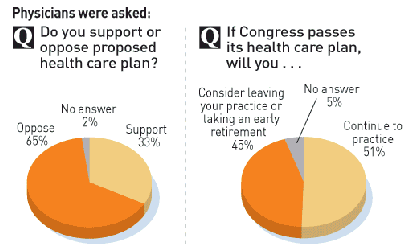
Two of every three practicing physicians oppose the medical overhaul plan under consideration in Washington, and hundreds of thousands would think about shutting down their practices or retiring early if it were adopted, a new IBD/TIPP Poll has found.

The poll contradicts the White House claims that the medical profession is behind the proposed overhaul.

* * * * *

Major findings included:

• Two-thirds, or 65%, of doctors say they oppose the proposed government expansion plan. This contradicts the administration’s claims that doctors are part of an “unprecedented coalition” supporting a medical overhaul.

• 45%, said they “would consider leaving their practice or taking an early retirement” if Congress passes the plan the Democratic majority and White House have in mind.

image

* * * **

More than 800,000 doctors were practicing in 2006, the government says. Projecting the poll’s finding onto that population, 360,000 doctors would consider quitting. The number of doctors is already lagging population growth. From 2003 to 2006, the number of active physicians in the U.S. grew by just 0.8% a year, adding a total of 25,700 doctors.

The U.S. today has just 2.4 physicians per 1,000 population — below the median of 3.1 for members of the Organization for Economic Cooperation and Development, the official club of wealthy nations.

A recent study from the Association of American Medical Colleges found steadily declining enrollment in medical schools since 1980. The study found that, just with current patient demand, the U.S. will have 159,000 fewer doctors than it needs by 2025.

Full article:
http://www.ibdeditorials.com/IBDArticles.aspx?id=337909690110379

* * * * *

Opposition to healthcare plan reaches new high …

September 17, 2009

According to Rasmussen …

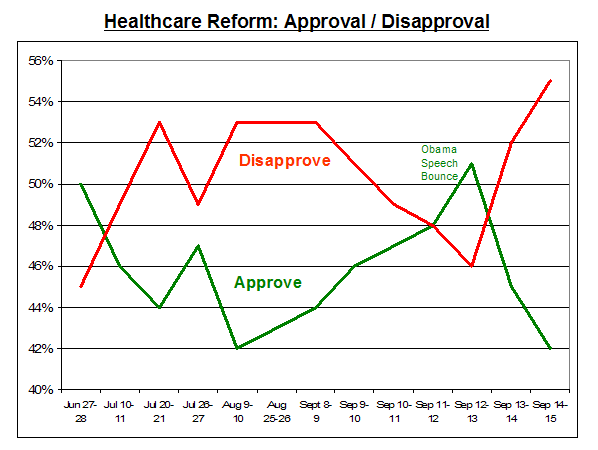
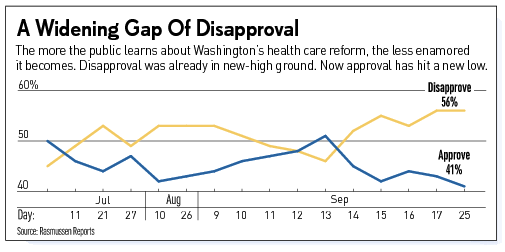
One week after President Obama’s speech to Congress, opposition to his health care reform plan has reached a new high of 55%.

The latest Rasmussen Reports daily tracking poll shows that just 42% now support the plan, matching the low first reached in August.

A week ago, 44% supported the proposal and 53% were opposed.

Following the President’s speech —  intended to relaunch the health care initiative —  support for the president’s effort bounced as high as 51% .

But the new numbers suggest that the bounce was short-lived.

image

http://www.rasmussenreports.com/public_content/politics/current_events/healthcare/september_2009/health_care_reform

"Buying insurance on your own costs 3 times as much" … no kidding?

September 16, 2009

Ken’s Take: Simple arithmetic – if you can’t lay off 2/3s of your insurance bill to an employer (or anybody else), it appears that you’re paying 3 times as much — even though the underlying cost of the insurance didn’t change. 

Are these guys grossly disingenuous or just plain dumb re: basic economics?

* * * * *

Excerpted from WSJ, Obama and the cost of individual insurance, SEPTEMBER 16, 2009

President Obama likes to take a swipe at “the marketplace” by asserting that “buying insurance on your own costs you three times as much as the coverage you get from your employer.”

This is simply false. The CBO expects premiums for employer-sponsored coverage to cost about $5,000 for singles and $13,000 for families this year on average.

According to the CBO: “Premiums for policies purchased in the individual market are much lower — about one-third lower for single coverage and half that level for family policies.”

One reason that individual policies are cheaper is that they generally require more cost-sharing by consumers.

The reason that employment-based plans seem cheaper is that on average workers only pay 17% of the premiums directly if they’re single (about $850), and 27% for family policies (about $3,500). Businesses pick up the rest by paying lower wages, thus hiding the real costs.

Meanwhile, in the individual market, consumers pay with after-tax dollars.  

This tax differential is the core of “our inefficient and inequitable system of tax-advantaged, employer-based health insurance.”

“While the federal tax code promotes overspending by making the majority unaware of the true cost of their insurance and care … the code is grossly unfair to the self-employed, small businesses, workers who stick with a bad job because they need the coverage, and workers who lose their jobs after getting sick. . . . How this developed and persisted despite its unfairness and maladaptive consequences is a powerful illustration of the law of unintended consequences and the fact that government can take six decades or more to fix its obvious mistakes.”

Full article:
http://online.wsj.com/article/SB10001424052970203917304574412813119441566.html?mod=djemEditorialPage

* * * * *

The power of infographics: The health care debate … reduced to one 8-1/2 X 11.

September 15, 2009

Excerpted from Fast Company, Infographic of the Day: Flow Chart of Obama’s Health-Care Plan, Sep 14, 2009

Charts and infographics have unequaled power to convince and explain. So why aren’t they playing a bigger role in the health-care debate?

President Obama  … uses 21st century technologies in an unprecedented ways … but he remains as musty as John Adams, in at least one respect: His insistence to use speeches alone, unaided by charts or graphs, to get his point across …  It’s not a terribly efficient way to communicate. Not, at least, compared with graphs.

There’s a business-world fetish with that one powerpoint slide that totally encapsulates a problem. Our culture is quickly growing to accept the idea of a definitive infographic, because infographics are better able to model an issue, in its sweep and complexity, than a mountain of words possibly can. No one, outside of CEO’s at investor meetings and politicians, still communicates with huge groups using speeches alone.

Why shouldn’t last week’s address to Congress have been accompanied by a couple charts? 

A summary chart (below) could have be flashed on screen endlessly afterward—more powerful than any meandering quote.

obama's health care chart

http://www.fastcompany.com/blog/cliff-kuang/design-innovation/infographic-day-flow-chart-obamas-healthcare-plan

Healthcare: Pay for quality, not quantity … now, how exactly is that going to work?

September 14, 2009

One of Team Obama’s mantras is that under government-run healthcare, payments to doctors will be made based on quality (outcomes) rather than the quantity of procedures being done.

Nice philosophically, but how to make it happen ?

Couple of observations:

  • Quality over quantity should be easier in education than healthcare since students can be tested for progress.  But, virtually all merit pay programs for teachers (i.e. outcome-based) have been rejected out of hand or fail.  But, they’ll work in healthcare … hmmm.
  • A common method for controlling output quality is to control input quality.  In healthcare, that means rejecting the toughest cases and treating only the sure winners.  For example, when I first investigated corrective eye surgery, the docs rejected me.  My eyes were too bad, and they wanted to tout the percentage of patients that they got to 20/20.
  • It’s argued that a key to controlling quality is to make primary care physicians the coordinators of all medical services. That’s silly because: (1) there is a shortage of primary care docs (evidence: how quickly can you get an appointment when you’re sick? how about an appointment outside the 9 to 5 work day window?); (2) been there, tried that – in the past, most plans required that a patient see a primary care doc to get a referral to a specialist – the referral was almost always given – net impact: a step was added to the process

I guess it’s better to bum’s rush through legislation than to give it serious thought.  Disappointing.

* * * * *

About those doctors who rush to rip out the kid’s tonsils …

September 11, 2009

Pres Obama raised some eyebrows when he implied in his press conference that doctors will sometimes opt to perform surgery on patients because the reimbursements are higher.  The example was silly since surgeons – not GPs – generally rip out tonsils. 

But, there is a broader issue: how & why might a doctor perform unnecessary or marginally required procedures.

Here are a couple of interesting factoids.

Excerpted from WSJ: Obama and the Practice of Medicine, Aug 14, 2009 

Medicare data shows that for the most part, major surgeries aren’t the source of waste in health care. These kinds of procedures are typically guided by clear clinical criteria and are closely scrutinized by doctors and patients alike. Rather it is in routine procedures and treatments that economic incentives factor heavily into doctors’ decisions.

But, doctors have been accused of excessive prescription of home medical equipment and excessive utilization of radiology scans since —  In the absence of financial incentives to restrain excess use —  relatively safe diagnostic procedures can often be justified—even if their benefits are slim.

For doctors whom Medicare pays per intervention, the problem isn’t the fee-for-service model, but the way that the government program sets the fees. Medicare’s size demands that it keep payment systems simple. Thus it relies on fixed prices for checklists of services tied to discrete billing codes. These uniform payment rules reward low and high quality care the same. Fees are set according to a fixed price schedule with no tie to the physician’s quality, experience level, or the outcome of the service.A more rational system would pay doctors for entire “episodes of care,” rather than individual procedures.

* * * * *
Full article:
http://online.wsj.com/article/SB10001424052970204409904574350370729883030.html

* * * * *

Reprise: Medicare-Medicaid waste & fraud … stop yakking and fix it already.

September 10, 2009

This was originally posted July 23. 

Six weeks later, it’s still Obama’s silver bullet for covering some added healthcare costs … but nothing has been done.  If the “nut” is so juicy, go crack it already.  Comprehensive healthcare reform isn’t required to root out waste and fraud in existing programs.  We’ve wasted another $6.5 billion since my last post on the subject.  Hmmm.

* * * * *

Currently, U.S. health care expenditures are about $2,1 trillion (just over $7,000 per person).

Of that, roughly half is already government administered via Medicare and Medicaid.

Would someone please explain to me:

(!) Why Obama’s crack team doesn’t fix the problem instead of just constantly whining about it ?  My hunch: finding random instances of abuse is easy, but ferreting  out fraud en masse is hard to do – and fixing it requires a massive overhaul of systems and procedures. If more people or resources are required, spell them out and get Congress to approve them post haste.

(2) If that half of the national healthcare budget is managed so badly by the government, why should we expect that the government will do any better with the other half if they take that over?

Ken’s Take: How about the government fix Medicare-Medicaid starting today, and when success is evident, come back and pitch to take over the other half.

* * * * *

Hard Facts

image

* * * * *

How To Really Fix Our Health-Care System

September 10, 2009

Washington Post,10 Things I Hate About Health-Care Reform, September 6, 2009

As a cardiologist and the administrator of a large practice that includes general internists and specialists, I spend much of my time trying to figure out how to provide care for a growing number of uninsured or underinsured patients. I also have to battle billion-dollar private insurance companies that don’t adequately cover patients with preexisting illnesses and often deny coverage for necessary treatments.

Here are 10 major reasons why I — and doctors like me — worry that the legislation on the table will leave us worse off.

1. Private insurance companies escape real regulation.

2. We urgently need tort reform, but it’s nowhere to be seen.

Without fixing these spiraling insurance costs and the legal environment that allows large payments in unjust suits, physicians will continue to practice expensive “defensive” medicine or simply leave states that do not enact tort reform.

3. “Prevention” won’t magically make costs go down.

in general, prevention adds to costs instead of reducing them. That’s because it often means medication for hypertension and elevated cholesterol, and screening and early treatment for cancer. No amount of “prevention” will put a dent in the cost of keeping Americans healthy.

4. Reform efforts don’t address our critical shortage of health-care workers.

Many people believe that the fix for our physician deficit is simple: expand class sizes at existing medical schools and create new ones. Sorry, it’s not that easy. There is a cap on the number of federally funded training positions for newly minted M.D.s. It hasn’t changed since 1996. If the number of graduates of U.S. medical schools increases but the number of post-graduate training positions remains the same, we won’t have fixed the problem — we’ll have created a different one.

5. We need more primary-care physicians — but we also need specialists.

Everyone is worried about the dwindling ranks of primary-care physicians. But we need more specialists, too. There are impending shortages in fields such as oncology, cardiology, general surgery and gastroenterology.  Few Americans will tolerate not having access to a specialist in an emergency or having care rationed because of a limited number of skilled physicians.

6. We have to streamline drug development and shake up the Food and Drug Administration.

Creating and producing new drug therapies in the United States is a nightmare. Regulatory hurdles, disorganization and a lack of leadership at the FDA, as well as burdensome conflict-of-interest policies, have made the drug-approval process grindingly slow. At the same time, development costs are close to $1 billion per drug.

7. We can’t fund health-care reform by cutting payments to doctors.

The Centers for Medicare and Medicaid Services has proposed increasing payments to primary-care physicians by approximately 6 percent while lowering payments for many specialists, including cardiologists and oncologists, by as much as 20 to 40 percent. The American College of Cardiology estimates that 40 percent of the cardiology practices in Florida will go bankrupt.

8. We can’t forget about research.

Every modern treatment for human disease is related in some way to research at U.S. academic medical centers. However, decreased federal funding for research over the past six years has threatened to decimate a generation of young scientists and the cures they could discover.

9. Cutting reimbursements could shut some hospitals down.

It is unlikely that the homeless, the mentally ill, the substance abusers or the illegal immigrants who now receive their care in “safety net” hospitals will carry any form of health insurance.

10. We need to improve the quality of care.

The Institute of Medicine has pointed out, poor quality of care can be divided into three types: underuse of care, misuse of care and overuse of care. While eliminating misuse and overuse will decrease the cost of care, correcting problems from underuse will actually increase costs.

* * * * *

I want my patients to have insurance that will pay for their care, and I want to be able to offer new medications and the most sophisticated treatment. I want to be able to give preventive care as well as to monitor patients effectively if they develop diseases. I want to be able care for my patients in their homes, and I want to offer palliative care if it becomes necessary. I want them to be able to afford all this.

In short, I want to see major reforms in health care — I just don’t want what is on the table.

Full article:
http://www.washingtonpost.com/wp-dyn/content/article/2009/09/04/AR2009090402274.html

* * * * *

Sauce for for the goose, sauce for the gander … A Doctor's Plan for Legal Industry Reform

September 9, 2009

Ken’s Take: A very clever juxtaposition that gives the health care debate in a different perspective … 

* * * * *

WSJ, A Doctor’s Plan for Legal Industry Reform, Sept. 3, 2009

Since committees of lawyers are deciding what doctors should and should not do, perhaps physician committees can decide whether lawyers are necessary in any given situation.  Doctors sholuld take on the important duty of controlling and regulating lawyers.

Since most of what lawyers do is repetitive boilerplate or pushing paper, physicians would have no problem dictating what is appropriate for attorneys.

After all, we physicians know much more about legal practice than lawyers do about medicine.

Following are highlights of a proposed bill authorizing the dismantling of the current framework of law practice, i.e. “reforming” it:

Contingency fees will be  … eventually outlawed. This will put legal rewards back into the pockets of the deserving—the public and the aggrieved parties. Slick lawyers taking their “cut” smacks of a bookie operation. Attorneys will be permitted to keep up to 3% in contingency cases, the remainder going into a pool for poor people.

•  Each potential legal situation will be assigned a relative value, and charges limited to this amount. Program participation and acceptance of this amount is mandatory, regardless of the number of hours spent on the matter. Government schedules of flat fees for each service, analogous to medicine’s Diagnosis Related Groups (DRGs), will be issued. For example, any divorce will have a set fee of, say, $1,000, regardless of its simplicity or complexity. This will eliminate shady hourly billing. Niggling fees such as $2 per page photocopied or faxed would disappear. Who else nickels-and-dimes you while at the same time charging hundreds of dollars per hour? I’m surprised lawyers don’t tack shipping and handling onto their bills.

Legal “death panels. Over 75? You will not be entitled to legal care for any matter. Why waste money on those who are only going to die soon? We can decrease utilization, save money and unclog the courts simultaneously. Grandma, you’re on your own.

Ration legal care. One may need to wait months to consult an attorney. Despite a perceived legal need, physician review panels or government bureaucrats may deem advice unnecessary. Possibly one may not get representation before court dates or deadlines. But that’ s tough: What do you want for “free”?

Physician controlled legal review. This is potentially the most exciting reform, with doctors leading committees for determining the necessity of all legal procedures and the fairness of attorney fees. What a wonderful way for doctors to get even with the sharks attempting to eviscerate the practice of medicine.

Discourage/eliminate specialization. Legal specialists with extra training and experience charge more money, contributing to increased costs of legal care, making it unaffordable for many. This reform will guarantee a selection of mediocre, unmotivated attorneys but should help slow rising legal costs. Big shot under indictment? Too bad. Under reform you too may have to go to the government legal shop for advice.

Electronic legal records. We should enter the digital age and computerize and centralize legal records nationwide. All files must be in a standard, preferably inconvenient, format and must be available to government agencies. A single database of judgments, court records, client files, etc. will decrease legal expenses. Anyone with Internet access will be able to search the database, eliminating unjustifiable fees charged by law firms for supposedly proprietary information, while fostering transparency. It will enable consumers to dump their clunker attorneys and transfer records easily.

Ban legal advertisements. Catchy phone numbers such as 1-800-LAWYERS would be seized by the government and repurposed for reporting unscrupulous attorneys.

New government oversight. Government overhead to manage the legal system will include a cabinet secretary, commissioners, ombudsmen, auditors, assistants, czars and departments.

Collect data about the supply of and demand for attorneys.Create a commission to study the diversity and geographic distribution of attorneys, with power to stipulate and enforce corrective actions to right imbalances. The more bureaucracy the better. One can never have too many eyes watching these sleazy sneaks.

Lawyer Reduction Act. A self-explanatory bill that not only decreases the number of law students, but also arbitrarily removes 3,200 attorneys from practice each year. Textbook addition by subtraction.

Enthusiastically embracing the above legal changes can serve as a “teachable moment” and will go a long way toward giving the lawyers who run Congress a taste of their own medicine.

Full article:
http://online.wsj.com/article/SB10001424052970204731804574387021307651050.html?mod=djemEditorialPage

* * * * *

Sauce for for the goose, sauce for the gander … A Doctor’s Plan for Legal Industry Reform

September 9, 2009

Ken’s Take: A very clever juxtaposition that gives the health care debate in a different perspective … 

* * * * *

WSJ, A Doctor’s Plan for Legal Industry Reform, Sept. 3, 2009

Since committees of lawyers are deciding what doctors should and should not do, perhaps physician committees can decide whether lawyers are necessary in any given situation.  Doctors sholuld take on the important duty of controlling and regulating lawyers.

Since most of what lawyers do is repetitive boilerplate or pushing paper, physicians would have no problem dictating what is appropriate for attorneys.

After all, we physicians know much more about legal practice than lawyers do about medicine.

Following are highlights of a proposed bill authorizing the dismantling of the current framework of law practice, i.e. “reforming” it:

Contingency fees will be  … eventually outlawed. This will put legal rewards back into the pockets of the deserving—the public and the aggrieved parties. Slick lawyers taking their “cut” smacks of a bookie operation. Attorneys will be permitted to keep up to 3% in contingency cases, the remainder going into a pool for poor people.

•  Each potential legal situation will be assigned a relative value, and charges limited to this amount. Program participation and acceptance of this amount is mandatory, regardless of the number of hours spent on the matter. Government schedules of flat fees for each service, analogous to medicine’s Diagnosis Related Groups (DRGs), will be issued. For example, any divorce will have a set fee of, say, $1,000, regardless of its simplicity or complexity. This will eliminate shady hourly billing. Niggling fees such as $2 per page photocopied or faxed would disappear. Who else nickels-and-dimes you while at the same time charging hundreds of dollars per hour? I’m surprised lawyers don’t tack shipping and handling onto their bills.

Legal “death panels. Over 75? You will not be entitled to legal care for any matter. Why waste money on those who are only going to die soon? We can decrease utilization, save money and unclog the courts simultaneously. Grandma, you’re on your own.

Ration legal care. One may need to wait months to consult an attorney. Despite a perceived legal need, physician review panels or government bureaucrats may deem advice unnecessary. Possibly one may not get representation before court dates or deadlines. But that’ s tough: What do you want for “free”?

Physician controlled legal review. This is potentially the most exciting reform, with doctors leading committees for determining the necessity of all legal procedures and the fairness of attorney fees. What a wonderful way for doctors to get even with the sharks attempting to eviscerate the practice of medicine.

Discourage/eliminate specialization. Legal specialists with extra training and experience charge more money, contributing to increased costs of legal care, making it unaffordable for many. This reform will guarantee a selection of mediocre, unmotivated attorneys but should help slow rising legal costs. Big shot under indictment? Too bad. Under reform you too may have to go to the government legal shop for advice.

Electronic legal records. We should enter the digital age and computerize and centralize legal records nationwide. All files must be in a standard, preferably inconvenient, format and must be available to government agencies. A single database of judgments, court records, client files, etc. will decrease legal expenses. Anyone with Internet access will be able to search the database, eliminating unjustifiable fees charged by law firms for supposedly proprietary information, while fostering transparency. It will enable consumers to dump their clunker attorneys and transfer records easily.

Ban legal advertisements. Catchy phone numbers such as 1-800-LAWYERS would be seized by the government and repurposed for reporting unscrupulous attorneys.

New government oversight. Government overhead to manage the legal system will include a cabinet secretary, commissioners, ombudsmen, auditors, assistants, czars and departments.

Collect data about the supply of and demand for attorneys.Create a commission to study the diversity and geographic distribution of attorneys, with power to stipulate and enforce corrective actions to right imbalances. The more bureaucracy the better. One can never have too many eyes watching these sleazy sneaks.

Lawyer Reduction Act. A self-explanatory bill that not only decreases the number of law students, but also arbitrarily removes 3,200 attorneys from practice each year. Textbook addition by subtraction.

Enthusiastically embracing the above legal changes can serve as a “teachable moment” and will go a long way toward giving the lawyers who run Congress a taste of their own medicine.

Full article:
http://online.wsj.com/article/SB10001424052970204731804574387021307651050.html?mod=djemEditorialPage

* * * * *

No one should have to move from NJ to Kentucky …

September 2, 2009

We lived in Kentucky for 2 years and enjoyed our time there, but …

* * * * *

Excerpted from WSJ:The Competition Cure, Aug 23, 2009

In places like New Jersey, the annual cost of an individual plan for a 25-year-old male in 2006 was $5,880.

A similar plan in Kentucky,  cost less than $1,000 in 2006.

The higher cost of medical services in the Garden State only explains a small part of the difference.

The main reason: New Jersey is highly regulated, with costly mandated benefits and guaranteed access to insurance.

Affordability would improve if consumers could escape states where each policy is loaded with mandates.

“If consumers do not want expensive ‘Cadillac’ health plans that pay for acupuncture, fertility treatments or hairpieces, they could buy from insurers in a state that does not mandate such benefits”

If consumers can’t escape heavily mandated states,  “risk selection” is a problem.

As more healthy people opt out of health insurance because it is too expensive relative to what they consume, the pool transforms into a group of older, sicker people. Prices go higher still and more healthy people flee.

High-mandate states are in what experts call an “adverse selection death spiral.”

http://online.wsj.com/article/SB10001424052970203550604574360923109310680.html?mod=djemEditorialPage

* * * * *

The Rx: let health insurance policies be sold across state lines … in effect, working around state mandates and letting folks buy only the coverage they want.

Note: Like tort reform, ObamaCare doesn’t include the selling of policies across state lines.

* * * * *

Health reform without malpractice tort reform … get serious.

September 1, 2009

Excerpted from IBD: Tort Reform Is Key To Health Reform, August 24, 2009

Many lawmakers and analysts still stubbornly insist that medical liability lawsuits do not contribute significantly to rising health care costs.

A 2006 Harvard School of Public Health study found that 40% of medical malpractice lawsuits filed in America each year were “without merit.”

Nonetheless, defending against such lawsuits imposes costs on doctors, hospitals and insurers that invariably are passed on to health care consumers.

Beyond the obvious costs of litigation, more subtle costs related to the practice of “defensive medicine” are contributing to runaway health care inflation.

How much? In a Massachusetts Medical Society survey published last November, 83% of physicians cited the fear of being sued in their decisions to practice defensive medicine.

On average, 18% to 28% of tests, procedures, referrals and consultations and 13% of hospitalizations were ordered to avoid lawsuits. All of this adds at least $200 billion to annual health care costs.

* * * * *

President Obama should reconsider his stated opposition to limiting non-economic damages in medical liability litigation.

The president and Congress should also consider additional liability reforms, such as medical courts, administrative compensation programs, “early offers” and “safe harbors” for physicians who practice in compliance with evidenced-based clinical guidelines.

If comprehensive health care reforms are to succeed, they must include liability reform.

Certainly real victims of negligence must be fairly compensated, but public policy must discourage litigation that abuses our civil justice system and makes health care less accessible and more expensive.

Full article:
http://www.ibdeditorials.com/IBDArticles.aspx?id=336004677519666

* * * * *

Cutting to the chase on death panels and living wills …

August 27, 2009

Good insight from Charles Krauthammer:

“My own living will, which I have always considered more a literary than legal document, basically says: “I’ve had some good innings, thank you. If I have anything so much as a hangnail, pull the plug.”

I’ve never taken it terribly seriously because unless I’m comatose or demented, they’re going to ask me at the time whether or not I want to be resuscitated if I go into cardiac arrest. The paper I signed years ago will mean nothing.

And if I’m totally out of it, my family will decide, with little or no reference to my living will.

Except for the demented orphan, the living will is quite beside the point.

The one time it really is essential is if you think your fractious family will be only too happy to hasten your demise to get your money.

That’s what the law is good at — protecting you from murder and theft.

But that is a far cry from assuring a peaceful and willed death

Excerpted from: The Truth About Death Counseling, August 21, 2009
http://www.realclearpolitics.com/articles/2009/08/21/lets_be_honest_about_death_counseling_97982.html

* * * * *

“To know where I stand, look at my advisers”

August 27, 2009

Ken’s Take: Candidate Obama frequently said that folks can partially evaluate the kind of president that he’s be by looking at the advisers surrounding him.  Usually, the statement was in the context of the economy, and the advisers were people like Warren Buffett and Paul Volcker.

What if the rule rule is applied to his health care advisers?  Gives a glimpse as to how healthcare rationing will work under ObamaCare.

Some may find the principles appropriate.  Some may find them scary.

I’m in the latter group.

* * * * *

President Obama & His Health Care Advisors:

Last February funds were slipped into the stimulus bill to implement Obamacare by creating two England-type rationing boards. Staffing for this plan is in place already. Below are the players:

Dr. Ezekiel Emanuel

  • Named to two key positions: health-policy advisor at the OMB and a member of the Federal Council on Comparative Effectiveness Research.
  • In 1996, he wrote health services should not be guaranteed to persons “who are irreversibly prevented from being or becoming participating citizens,” specifically mentioning patients with dementia.
  • On March 19, Emanuel was appointed to the Federal Coordinating Council on Comparative Effectiveness Research to begin the design of a federal system for withdrawing care from those deemed unworthy of treatment. Emanuel describes his method of “Complete Lives System” which “produces a priority curve on which individuals aged between roughly 15 and 40 years get the most substantial chance, whereas the youngest and oldest people get chances that are attenuated.”

Dr. Peter Singer

  • He espouses a “quality-of-life” ethic that is contrary to the traditional Judeo-Christian “sanctity-of-life” ethic.
  • He maintains that those who suffer handicaps have less quality-of-life, and are thus less deserving of healthcare.
  • He argues that Individuals with an “insufficiently developed consciousness” actually fall below the plane of personhood. For example, with a Down syndrome baby parents should be free to kill the child up to 2 years after birth. He rationalizes that because newborn humans lack morally significant properties, their destruction is in no way intrinsically wrong.
  • In the first edition of his Practical Ethics he stated that “not … everything the Nazis did was horrendous; we cannot condemn euthanasia just because the Nazis did it … The notion that human life is sacred just because it’s human is medieval.”

Dr. David Blumenthal

Named the national coordinator for health-information technology

He  recommends slowing medical innovation and research to control health spending.

He advocates that doctors will be compelled to take “advantage of embedded clinical decision support” (a euphemism for computers instructing doctors) for “appropriate and cost effective care.”

* * * * *

Source:
http://www.defendyourhealthcare.us/

For glimpse into “health insurance portability”, look at COBRA’s strangle hold …

August 26, 2009

OK, everybody seems to agree that an employee should be able to take his / her healthcare insurance with them if they change jobs or lose their jobs.  It’s called “portability”.  That way, no worry about discontinuous coverage or those pesky pre-existing conditions.

Not so fast.

Yeah, on the surface, portability provides coverage continuity.  But, it may be more apparent than real.

Getting the insurance companies to keep people in the group pools is one thing.  Paying the premiums is another – especially since the former employer won’t be paying the bulk of the premiums.

For a dose of reality, consider COBRA.

Companies (really, their insurance companies) are required by the Consolidated Omnibus Budget Reconciliation Act 0f 1986 (COBRA) to offer departing employees a chance to keep medical insurance if the laid-off workers pay their own premiums.

But, only 1 in 10 departing employees take the COBRA coverage.

Why?

The company stops paying towards the insurance, the individual has to pay the full amount – plus, usually a small administrative adder.

The resulting premiums are high … very high … beyond the reach of most departing employees.

Uh-oh.


image

Business Week, Why Being Laid Off Is Tougher These Days, July 30, 2009
http://www.businessweek.com/magazine/content/09_32/b4142061715525.htm

* * * * *

COBRA details:
http://www.dol.gov/ebsa/pdf/cobraemployee.pdf

* * * * *

Raise your hand if you want to pay $850 higher health insurance premiums to cover in vitro fertilization ?

August 25, 2009

Some interesting factoids from a noted Harvard professor …

* * * * *

Through the Medicare and Medicaid programs and state government regulations, it sets the prices paid to providers, determines who is covered for what in its insurance plans, and requires that certain benefits are included in insurance policies.

But, some consumers may not want expensive ‘Cadillac’ health plans that pay for acupuncture, fertility treatments or hairpieces …

The government of Massachusetts, for example, requires 52 benefits, including in vitro fertilization, a benefit that raises the price of every family’s health insurance by $850 or so.

But, some consumers may not want expensive ‘Cadillac’ health plans that pay for acupuncture, fertility treatments or hairpieces …

* * * * *

Despite the government’s regulation of the prices, coverage, and benefits in Medicare, the program has incurred a $38 trillion liability – a sum equivalent to nearly three years of the nation’s Gross Domestic Product.

The country’s 87 private insurers’ general and administrative expenses are 5 percent, a percentage lower than Medicare’s.

40 percent of doctors refuse to see Medicaid recipients due to its stringent provider payment rates.  Increasingly, physicians refuse to see Medicare enrollees too, for similar reasons.

To compensate for the government’s shortfall in payments to providers, enrollees in private health insurance have been forced to pay about $90 billion more annually.

* * * * *

Source: RCP, Government Should Get Back to the Basics on Health Care, August 22, 2009
Regina E. Herzlinger, McPherson Professor at Harvard Business School and author of “Who Killed Health Care?’(McGraw Hill, 2007)http://www.realclearpolitics.com/articles/2009/08/22/government_should_get_back_to_the_basics_on_health_care_97986.html

* * * * *

Mandating that everybody carries health insurance … so, how’s that going to work?

August 24, 2009

I’m in favor of mandating that everybody carry catastrophic health insurance. 

For example, forcing a young, healthy adult to carry insurance to cover the possibility of unexpected serious illness or accident makes perfect sense to me.

I’m indifferent re: making them carry basic coverage for run-of-the-mill maladies like the occasional sore throat.  If they want to self-insure on those incidents, so be it.

What most puzzles me is how Team Obama plans to enforce the health insurance mandate. 

How will the people without insurance be identified?  How much will the fines be?  What if they can’t afford the fines?

For example, what about illegal immigrants?  (Note: despite the rhetoric to the contrary, they are in the 47 million uninsureds). The government (national and local) refuses to enforce employment laws or to check immigration status upon arrest (for non-immigration crimes). 

Will we profile folks,  stop them and ask them to present their insurance cards?  I doubt it.

So, when and where will folks have to provide proof of insurance?

For mortgages, lenders require proof of home insurance.

For auto insurance, it happens when cars are registered (though people can lie), and when there’s a traffic violation.

But for health insurance, what’s the mechanism that will be put in place?

I can’t imagine any practical way of enforcing the law … and the pontificators certainly haven’t served any up. My bet: it’ll be in the ERs when people show up for treatment – which, of course, they will get.

If anybody knows the answer, please post a reply.

* * * * *

One idea: require proof of health insurance coverage at the voting booth …

* * * * *

Backlash against Whole Foods … just because CEO proposed healthcare alternatives

August 20, 2009

On Aug. 11, the CEO of Whole Foods wrote a WSJ op-ed advocating 8 specific proposals for really reforming healthcare.
https://kenhoma.wordpress.com/2009/08/17/improving-health-care-without-adding-to-the-deficit-8-specific-ideas/

Among his proposals: tort reform, equalized tax treatment of company-paid and private health insurance premiums, continuing health savings accounts, and access to  insurance across state lines.

Unfortunately (for Whole Foods), most of his ideas aren’t part of ObamaCare since they impact trial lawyers and / or unions.

Most unfortunate, he failed to include a government run insurance option as one of his eight proposals. 

Big mistake.

So, Whole Foods is now subject to a boycott.

Talk about angry mobs …

* * * * *

Whole Foods Boycotted by Liberals for CEO’s Anti-Obama Health Care Position
http://www.politicsdaily.com/2009/08/19/whole-foods-boycotted-by-liberals-for-ceos-anti-obama-health-ca/

The grocery store Whole Foods is facing a boycott organized by liberal activists because the CEO opposes President Obama’s health care reform proposals.

The company’s chief executive, John Mackey, wrote a Wall Street Journal op-ed on health care that has roiled the liberal blogosphere and prompted calls for a boycott.

“While we clearly need health-care reform, the last thing our country needs is a massive new health-care entitlement that will create hundreds of billions of dollars of new unfunded deficits and move us much closer to a government takeover of our health-care system,” Mackey wrote in the WSJ.

“Instead, we should be trying to achieve reforms by moving in the opposite direction — toward less government control and more individual empowerment.”

The boycott leaders are organizing via the Huffington Post.

To me, it’s pretty basic: Mackey is working to oppose things I believe in, so I should stop giving him money,” wrote Ben Wyskida, who also works for the liberal magazine, The Nation. In a column titled “Why I’m Done with Whole Foods,” he said: “Mackey has confirmed for me that my money is going to support deregulation of the insurance industry, lies about the current health care proposal, and a crusade to lecture people who can’t access or can’t afford healthy food. I’m just not going to go there.”

* * * * *