Reading the headlines, it’s happy days again.
In February, employers added 242,000 jobs.
Pretty good, right?

=====
Well, unfortunately, there’s a rub …
Reading the headlines, it’s happy days again.
In February, employers added 242,000 jobs.
Pretty good, right?
=====
Well, unfortunately, there’s a rub …
Biennially, Bloomberg (Business Week) ranks MBA schools based, in part, on surveys of employers, current students, and alumni.
This year, they used the alumni sample to assess career progression – how well MBAs are doing (and getting paid) a few years after their b-school graduation.
The general finding: “The data shows that 6 to 8 years after graduation, the typical alum makes $169,000 … triple their pre-MBA compensation.”
That’s pretty good, right?
But, there’s a big divide.
“Within a few years of graduation, women with MBAs earn lower salaries, manage fewer people, and are less pleased with their progress than men with the same degree.”

======
What the heck is going on?

Based on a very rigorous analysis by Robert Wolff of NYU …
Scored in constant 1995 dollars – i.e. eliminating the effects of inflation …
Bottom line: More millionaires … but they have fewer millions.

Source: Wolff, NYU, Asset Price Meltdown and Wealth of the Middle Class
* * * * *
Follow on Twitter @KenHoma >> Latest Posts
Answer : How much your parents earned.
There’s about a .5 “intergenerational earnings correlation” in the U.S.
That means, look at how much your folks earned and you have a good idea re: how much you’ll be earning.
Causation, or just correlation ?
Well, there’s a causal variable in there.
Children of high earning parents tend to get better educations … much better educations.

Reported by the New America Foundation
Note: Based on 2009 tax year filing data, the Internal Revenue Service says an adjusted gross income, or AGI, of $343,927 or more will put you in the top 1 percent of taxpayers.
The WSJ has a cool interactive … plug in your household income (which is a higher number than AGI) and it pegs your percentile.
For example, the WSJ says …
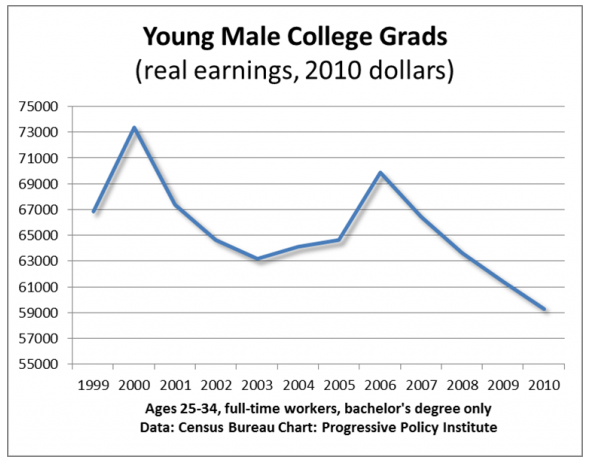
College grads’ average real earnings have declined almost 20% in the past decade.
But, there are some college grads still ringing the cash register.
According to PayScale.com:
If you’re determined to find a job that pays top dollar, you’d be wise to study math and science.
Lucrative careers exist for the history, English and foreign language majors out there, too, but they’re harder to find.
But, all’s not rosy … browse the bottom rungs, too.

The top of the list

The bottom of the list

Earlier this week, we posted that only 4.5% of college grads are unemployed … a lot lower percentage than you’d think given the coverage of the Wall Street Occupiers.
There is a flipside, though.
Mean real earnings for college grads have fallen by almost 20% over the past decade … reflecting salary caps at many companies and a re-mixing towards lower paying jobs.
Suggests that the ROI on college is going down, down, down
Great analysis presented in the WSJ.
Key is the chart below which takes official IRS data for the top 1% of pre-tax-earners, adjusts for inflation (by stating all years in constant 2008 dollars), and breaks income into it’s components
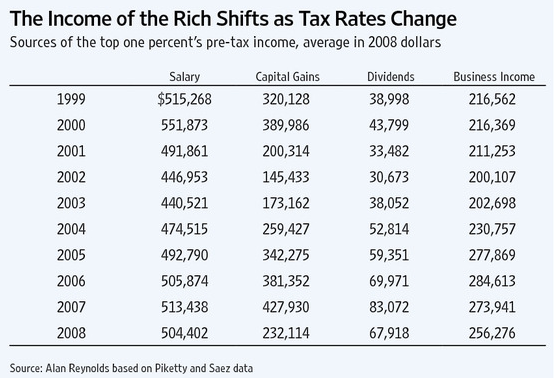
The key points:
1) Business income is roughly 25% of reported income
2) Average inflation-adjusted salary has stayed pretty flat.
3) Until the crash in 2008, capital gains grew … note: cap gains tax rates were reduced in 2003 .. coincidence?
4) Similarly, dividends increased after the dividend tax rate was cut to 15% … another coincidence?
The mega-point of the analysis is that behavioral economics is alive and well … dink with marginal rates and folks will simply shift income … causing an inverse relationship between marginal tax rates and tax receipts.
Just do the the math.
* * * * *
Full article is a worthwhile read:
WSJ,Taxes and the Top Percentile Myth, Dec. 23, 2010
http://online.wsj.com/article/SB10001424052748703581204576033861522959234.html?mod=djemEditorialPage_h




 The Homa Files