Archive for the ‘Internet – Soc Networking’ Category

Long Tail ? No way. Give me Blockbusters.

November 12, 2008

Excerpted from HBS Online, “Long-Tail Economics? Give Me Blockbusters!”, John Quelch
September 10, 2008

* * * * *

The importance of blockbusters has been challenged recently by Chris Anderson’s long tail theory that you can make money in many creative industries by selling specialized products to niche markets identified via the Internet.

For example, the new CEO of GlaxoSmithKline, the pharmaceuticals giant …  worries that a company is at risk if sales depend too much on one or two megabrands that could run into lawsuits from generic competitors or regulatory challenges.

On the other hand, the president of Warner Bros. (think Batman) aims “to take advantage of what has become a very global market by focusing on bigger films that require a bigger commitment.”

The pharmaceutical and entertainment industries are similar. R&D costs in both are high. Results are unpredictable. Drug research initiatives often result in dead ends but occasionally lead in an unexpected direction to a blockbuster result. Some big budget movies are flops, others are sleepers, still others meet expectations.

Of course, any company needs a portfolio of development projects, some with predictable sales results, others more risky. The former pay for the company’s daily bread and butter and fund R&D on future blockbusters.

More risky than pursuing blockbusters is not to pursue them, to condemn your enterprise to a lifetime of slave labor harvesting the long tail of micro-opportunities rather than imagining, pursuing, and marketing the global solution to an important, widely shared problem.

* * * * *

What then makes a blockbuster? Here are the Five S’s, the five defining characteristics of blockbusters.

Sheer size. A blockbuster has a transformational impact on a company and an industry, often opening up new markets worldwide. Blockbusters break sales records and exceed expectations. Around 100 pharmaceutical brands exceed $1 billion in annual sales. Procter & Gamble has 23 such brands.

Speed. It’s not just the sales volume; it’s the speed of the sales trajectory. Remember that the original blockbuster was a bomb that could destroy an entire city block. Blockbuster brands address pressing consumer needs so well that they often enjoy vertical sales liftoff.

Scarcity. A blockbuster brand is often in such high demand that stock-outs and shortages occur in the market. Remember the consumer lines to buy the new iPhone?

Sustainability. A blockbuster brand is not a one hit wonder. It is a gift that keeps on giving. Look at the seven Harry Potter books and five companion movies. Adding DVD and merchandise sales, theme parks, etc., Advertising Age valued the Potter economy at $15 billion.

Sizzle. A blockbuster does not just address an important need. It does so in an exciting and accessible way. Pfizer’s Lipitor was not the first cholesterol reducer but superior marketing and sales made Lipitor number one.

* * * * *

Full article:
http://hbswk.hbs.edu/cgi-bin/print?id=6014

* * * * *

Want more from the Homa Files?
Click link =>
  The Homa Files Blog
Chopping the Long Tail down to size …

November 11, 2008

Excerpted from The Register, “Chopping the Long Tail down to size”, Andrew Orlowski, Nov. 7, 2008

* * * * *

The most comprehensive empirical study of digital music sales ever conducted has some bad news for Californian technology utopians. Since 2004, WiReD magazine editor Chris Anderson has been hawking his “Long Tail” proposition around the world: blockbusters will matter less, and businesses will “sell less of more”.

Examining tens of millions of transactions from a large digital music provider, economist Will Page with Mblox founder Andrew Bud  … discovered that instead of following a Pareto or “power law” curve, as Anderson suggested, digital song sales follow a classic Log Normal distribution. 80 per cent of the digital inventory sold no copies at all – and the ‘head’ was far more concentrated than the economists expected.

In another surprise, 80 per cent of the revenue came from 52,000 songs. What’s eye-catching about the number? Well, the typical inventory of a conventional high street record store was around 4,000 CDs. Or … around 52,000 songs.

This really isn’t the upbeat fairy tale message Anderson has spent four years selling on the conference circuit.  The Long Tail helped bolster netsters’ morale – although its success owed much to sloppy thinking – and in particular, metaphorical logic.

Following the WiReD Way of Business as a matter of faith could be catastrophic for your business and investment decisions.

* * * * *
Full article:
http://www.theregister.co.uk/2008/11/07/long_tail_debunked/

* * * * *

Want more from the Homa Files?
Click link =>
  The Homa Files Blog
An Oprah Endorsement ROI – Kindle Gets a Bump

November 4, 2008

Excerpted from Ad Age “Kindle Offers Glimpse of ROI on Oprah” by Abbey Klaasen, November 3, 2008 

* * * * *

Since Amazon launched the Kindle, its electronic reader, a year ago, it has created a swarm of dedicated customer advocates. But on Oct. 24 it snagged the most important evangelist in Oprah Winfrey, who said, “I’m telling you, it’s absolutely my new favorite thing in the world.”

Oprah’s Midas touch when it comes to selling books is well-documented, so it seems reasonable that the same would be true for Kindle.

6%: The amount Amazon’s visits were up the day Oprah endorsed Kindle on her show…Amazon is a top-20 internet site — so a 6% bump can translate into hundreds of thousands of visitors.

3.1 MIL: The number of unique visitors to Oprah.com in September, according to Compete. The Kindle endorsement also drove traffic to her site.. 

80%: The percentage of blog posts about Kindle since Oct. 23 that have mentioned Oprah’s endorsement, according to BuzzLogic. About half mentioned the discount Amazon was offering until Nov. 1 — the discount code being oprahwinfrey.  

479%: The bump in search traffic for the word “kindle” the day Oprah threw her support behind the product, according to Google Insights. 

15,458%: The bump in U.S. web traffic from Oprah.com to Amazon.com, per Hitwise, between Oct. 23 and Oct. 24. 

$35.90: How much an Amazon affiliate can earn per Kindle sale, if it is part of the program that shares revenue when a consumer clicks through those links and buys on Amazon. That’s 10% of the purchase price. Oprah could be making a pretty penny on Kindles if she was part of the affiliate program — but she isn’t.  

Edit by SAC  

* * * * *
Full article:
http://adage.com/digital/article?article_id=132194

* * * * *

Want more from the Homa Files?
Click link =>
The Homa Files Blog

Online Chatter to Replace Surveys?

October 27, 2008

Excerpt from Ad Age “The End of Consumer Surveys?” September 15, 2008

* * * * *

After issuing dire warnings about the future of consumer surveys, the two biggest advertisers and buyers of market research in the world — Procter & Gamble and Unilever — are linking with the Advertising Research Foundation for an industry effort to embrace online chatter and other naturally occurring feedback like never before…

“I don’t know if we are going to have a choice but to move away from survey research,” said Donna Goldfarb, VP-consumer and market insights for Unilever Americas… “We continue to torture consumers with boring and antiquated search methods,” she said. “What’s holding us back is history and norms…”

To be sure, both companies continue to do plenty of surveys tracking brand-equity metrics for hundreds of brands daily. Ms. Dedeker noted in 2006 her company alone spent $200 million on 600 research vendors…

Yet statements signal a shift in paradigms, and most likely budgets, away from surveys and toward mining insights from blogs, social networks, consumer comments to websites and more, said Joel Rubinson, chief research officer of the ARF…

Though many…have expressed doubts in the past about how well bloggers or participants in social networks represent the broader population, Mr. Rubinson said it’s clear that digital chatter can have useful statistical properties…Clearly, however, traditional survey researchers won’t go away quickly or without a fight…

Campbell, CEO of Millward Brown…noted that “…it’s highly unlikely you’re going to be able to quantify who’s seeing your advertising in any meaningful way by simply listening in on the web.” Big issues that interest almost everyone — such as presidential elections — generate statistically useful web chatter, she said, but household-product brands usually don’t“…

* * * * *

While collecting blogger information is undoubtedly useful for marketers and advertisers, blog comments are likely to be skewed to extremes of opinions.  Either a consumer is posting because of his overwhelming excitement about a product or issue, or equally and possibly more likely because of his extreme distaste for a product or issue.

A recent Pew Internet research study also reveals that only 42% of internet users have read a blog or online journal and only 12% of respondents write their own. While these numbers will likely grow the sample remains too small at this point to have hopes of replacing consumer surveys. 

* * * * *

Full article:
http://adage.com/article?article_id=130964

* * * * *

Want more from the Homa Files?
Click link =>
The Homa Files Blog

Another Shift to Digital for P&G

October 15, 2008

Excerpt from Marketing Daily “P&G Eschews TV In Oral-B Pulsonic Intro ” September 12, 2008

* * * * * 

Procter & Gamble is introducing an ultrasonic toothbrush under its Oral-B brand, which includes manual and power toothbrushes for children and adults, oral irrigators, and products like dental floss…

The company will promote with ads and events touting it for its design and performance…Allisa Hammond, a spokesperson for P&G’s Oral Care division, says the marketing campaign for the Pulsonic is “very different than our typical marketing strategy.”

She says the campaign will include digital advertising, public relations, unique, targeted print and in-store displays. But, she says, “we will not be using TV advertising, which is something we normally use in our campaigns. Instead, we wanted to let the design of the toothbrush really stand out, and are relying on influencers such as magazine editors, bloggers, interior fashion designers and unique fashion and design sponsorships to reach this consumer”…

Edit by SAC

* * * * *

Oral-B was one of the surprising consumer product good brands to make an appearance at New York’s Fashion Week.  As the article goes on to note the product spokesperson is an interior designer from “Extreme Home Makeover” and was a feature in the the Kardashian sisters’ runway show.

* * * * *
Full article:
http://www.mediapost.com/publications/?fa=Articles.showArticle&art_aid=90443

* * * * *

Want more from the Homa Files?
Click link =>
The Homa Files Blog

What's Your Google Score?

October 9, 2008

Excerpted from BusinessWeek, “Making Social Networks Profitable”, by Heather Green, September 25, 2008

* * * * *

Imagine there was one number that could sum up how influential you are. It would take into account all manner of things, from how many people you know to how frequently you talk with them to how strongly they value your opinion. Your score could be compared with that of pretty much anyone in the world.

Maybe it’ll be called your Google number. Google has a patent pending on technology for ranking the most influential people on social networking sites like MySpace and Facebook. In a creative twist, Google is applying the same approach to social networks it has used to dominate the online search business. If this works, it may finally make ads on social networks relevant—and profitable.

The new technology could track not just how many friends you have on Facebook but how many friends your friends have. Well-connected chums make you particularly influential. The tracking system also would follow how frequently people post things on each other’s sites. It could even rate how successful somebody is in getting friends to read a news story or watch a video clip.

* * * * *

How would this improve advertising on social networks? Say there’s a group of basketball fans who spend a lot of time checking out each other’s pages. Their profiles probably indicate that they enjoy the sport. In addition, some might sign up for a Kobe Bryant fan group or leave remarks on each others’ pages about recent games they played or watched. Using today’s standard advertising methods, a company such as Nike would pay Google to place a display ad on a fan’s page or show a “sponsored link” when somebody searches for basketball-related news. With influence-tracking, Google could follow this group of fans’ shared interests more closely, see which other fan communities they interact with, and—most important—learn which members get the most attention when they update profiles or post pictures.

The added information would let Nike both sharpen and expand its targeting while allowing Google to charge a premium for its ad services. If Nike wanted to advertise a new basketball shoe, for example, it could work with Google to plop an interactive free-throw game only on the profile pages of the community influencers, knowing the game would be likely to draw the most attention in these locations. And because the new technique ranks links among groups, Google could also target the ads to broader communities.

“I would pay a premium to get a particular video in front of someone who [shares] with others, and an even bigger premium for a lot of people who would share,” says Ian Schafer, CEO of online ad firm Deep Focus, whose clients include Sean Jean and Universal Music Group.

Edit by DAF

* * * * *

Full article:
http://www.businessweek.com/magazine/content/08_40/b4102050681705.htm?chan=top+news_top+news+index+-+temp_news+%2B+analysis

* * * * *

Want more from the Homa Files?
Click link => 
The Homa Files Blog

* * * * *

Who are all those bloggers?

October 3, 2008

Excerpted from Tech Crunch “State of the Blogosphere…” by Erick Shonfeld September 22, 2008

* * * * *

Technorati, the blog search engine, put out Part I of its…State of the Blogosphere report this week. This year, it conducted a random survey of 1,079 random bloggers to paint a more detailed picture of just who exactly is out there blogging. Technorati has indexed a total of 133 million blogs since 2002. In terms of how many are active, 7.5 million blogs have added a new post during the last four months, and 1.5 million have been updated during the last week.

And the average blog that runs ads, according to Technorati, is actually making money:

Among those with advertising, the mean annual investment in their blog is $1,800, but it’s paying off. The mean annual revenue is $6,000 with $75K+ in revenue for those with 100,000 or more unique visitors per month.

…Who are these bloggers?…The vast majority of all bloggers (79 percent) write about their personal interests…more than half of all bloggers also write about business. While only 12 percent identify themselves as official “corporate bloggers,” a full 46 percent consider themselves “professional bloggers” (meaning that they write about their industries, but not in an official capacity). ..

And blogs continue to be read: blogs in the aggregate now attract 77.7 million unique U.S. visitors per month according to Comscore, nearly double the number of people who visit Facebook…

Edit by SAC

* * * * *

Full article:
http://www.techcrunch.com/2008/09/22/technorati-survey-says-the-average-blog-makes-6000-a-year/

* * * * *

Want more from the Homa Files?
Click link =>
The Homa Files Blog

Facebook’s Hidden Politics

September 30, 2008

Excerpt from the Wall Street Journal “Facebook Political Ads Test Limits” September 15, 2008 

Political parties and interest groups have long cherry-picked news stories that promote their agenda to feature in campaign ads. But some new ads popping up on Facebook take that tactic to a new level.

“AP Says: Palin Lied,” reads one ad, accompanied by an unflattering photo of the vice presidential candidate. Another ad — accompanied by the same photo — reads, “Washington Post breaks ANOTHER Palin scandal. Charging tax payers for her sleeping at home”…

Clicking on the ads takes visitors straight to a story on the Web sites of those publications…

But none of the publications cited in the ads bought them — or even was aware of them. The buyer — though never identified anywhere on the ads or on the pages that you land on after clicking on them — is the liberal group MoveOn.org. It’s the latest example of fuzziness about who’s behind what when it comes to political ads online…

Facebook says the ads comply with its policies…With Facebook’s self-service advertising system, anybody can log on to the site and create an ad. The site allows advertisers to select the text for the ad as well as a picture and the Web site to point consumers to. Most ads are bought through a cost-per-click model, so advertisers only pay if a person clicks on the ad.

Advertisers can pick specific groups of people who will see their ad, and they bid a certain amount to have their ads shown to target groups.

Edit by SAC

* * * * * 
Full article:
http://online.wsj.com/article_print/SB122143365240034005.html

* * * * *

Want more from the Homa Files?
Click link =>
The Homa Files Blog

AOL – Trying to win ’em back …

September 26, 2008

Excerpted from WSJ: “AOL Pushes to Win Back Lost Subscribers”, September 10, 2008

* * * * *

Web Portal’s Changes Are a Bid to Keep Up With How People Surf

When AOL in 2006 ditched its subscription service in favor of an advertising-based model, millions of subscribers deserted the site. Now, AOL is making its biggest push yet to win them back.

In a bid to remain relevant, AOL is unveiling a new home page as well as a slew of Web sites aimed at women, pop-culture addicts and parents of gamers.

The revamped AOL.com will for the first time let visitors access email accounts from outside providers like Google and Yahoo and will include updates from major social-networking sites and automatically personalize content for users.

The changes are an effort to recalibrate AOL’s portal model with the way people use the Internet these days.

In recent years, Web traffic has fragmented across thousands of sites and people often use multiple email accounts. But AOL was rooted in an era when most Web surfers did very little actual surfing, choosing instead to remain within the confines of a single gateway (or portal), as they read the latest news headlines, checked their horoscopes, shopped and sent email.

* * * * *

AOL still aims to be a hub of sorts, but one that serves as more of an entry point to the rest of the world than a self-contained content bubble.

Other portals, including Yahoo and Microsoft’s MSN, also provide links to third-party sites, but not access to accounts on other email or social-networking sites. AOL’s new automatic-personalization feature — where a person, for example, who looks at finance sites frequently will see finance content news featured more prominently — is also unique.

* * * * *

The big question is whether the company will be able to translate those new visits into ad dollars.

Anemic ad sales have been a big drag on the earnings. While the rest of the online ad market climbs at a healthy clip — increasing 20% in the U.S. in the second quarter — advertising growth at AOL stalled at 1.5% in the second quarter following four previous quarters of deceleration.

In particular, AOL’s ad sales growth was dragged down by a 14% slump in display ads, graphical ads that border a Web page. These ads typically are the main unit sold on a portal’s home page and can fetch some of the highest prices in the business.

For the past year, (AOL has been talking) about how traffic is not the problem, monetization is. I don’t need to be convinced that traffic can return. I just want to understand how they can convert that traffic to advertising growth.”

In an effort to address that issue, the new AOL.com will start allowing types of ads on the home page that marketers find more desirable. It will prominently feature a photo gallery and video player, which can offer ad formats that are particularly interactive and obtain higher ad rates than other more static ads.

* * * * *

AOL drew 111.4 million unique U.S. visitors in July, down slightly from the 113.9 million people that visited the site during that month last year, according to comScore Media Metrix. But the site is still fourth-largest Web site in the U.S. (by that measure).

With its relaunched home page and new content, AOL is trying to get current visitors to its home page to stay longer and also broaden its appeal.  

The revamp also marks the first major attempt by AOL to integrate Bebo, the third-largest social-networking site, which AOL acquired this year for $850 million.

* * * * * 

Full article:
http://online.wsj.com/article/SB122100183521716953.html?mod=2_1567_middlebox

* * * * *

Want more from the Homa Files?
Click link =>
  The Homa Files Blog

* * * * *

Don’t know MySpace?

September 19, 2008

Excerpted from MediaPost Publications, “Study: 58% Aren’t Familiar With Social Networking” Sep 5, 2008

* * * * *

Apparently tweeting, friending and linking have not infiltrated popular culture as much as one might think.

A new study from Synovate reveals that well over half (58%) of those surveyed do not know what social networking is. Even more surprising, more than a third of those who do engage are losing interest in it…

The Dutch were most likely to know the term social networking (89%), followed by the Japanese (71%) and Americans (70%).

Popularity of the phenomenon is fading amongst some, according to the study. When asked if they agree with the statement “I am losing interest in online social networking”, 36% of social networkers globally said yes…

The biggest finding, was that social networking is definitely not U.S.-centric. Overall, 26% of all respondents globally are members of social networking sites. This peaked with the Netherlands at 49%, United Arab Emirates (UAE) at 46%, Canada at 44% and the U.S. at 40%…

Edit by SAC

* * * * *

Facebook overcame MySpace this year to become the top social networking site.  According to InternetNews.com, Facebook had 132.1 million unique users in June, while MySpace had 117.6 million.  However, in terms of number of visits and average time spent on the site MySpace bests Facebook.  Which should a marketer prefer?

* * * * *

Full article:
http://www.mediapost.com/publications/?fa=Articles.showArticle&art_aid=89928

* * * * *

Want more from the Homa Files?
 
Click link => 
The Homa Files Blog

Tapping the wisdom of workers …

September 18, 2008

Excerpted from WSJ: “Best Buy Taps ‘Prediction Market’- Imaginary Stocks Let Workers Forecast Whether Retailer’s Plans Will Meet Goals”, Sept. 16, 2008

* * * * *

When executives at electronics retailer Best Buy  want to know if a new product or idea is likely to succeed, they can seek the opinion of rank-and-file employees by turning to the company’s “prediction market.”

The market, called TagTrade, allows Best Buy’s workers to trade imaginary stocks based on answers to managers’ questions. The market’s judgment has often proved to be more accurate than the company’s official forecasts.

Associated PressTagTrade is open to all of Best Buy’s 115,000 U.S. employees. The roughly 2,100 of them who choose to participate get $1 million in fake money to trade for a nine-month period. The top trader in the period wins a $200 gift certificate.

* * * * *

Best Buy isn’t the only company using prediction markets as a way to tap the knowledge of front-line employees. Web-search giant Google Inc. uses them to solicit forecasts on everything from how many users its Gmail service will attract to whether products will launch on time. Other companies that have experimented with them include General Electric,Intel Corp. and Microsoft.

Best Buy’s chief executive, Bradbury Anderson, …  drives decision-making down the corporate ladder and information up toward the top. Mr. Anderson says narrowing the gap between management and workers helps to make his company more nimble and responsive to customers, while boosting sales and profits.

* * * * *

Full article:
http://online.wsj.com/article/SB122152452811139909.html#printMode

* * * * *

Want more from the Homa Files?
Click link =>
  The Homa Files Blog

Many Companies All A-"Twitter"

September 16, 2008

Excerpted from Business Week, “How Companies Use Twitter To Bolster Their Brands”, by Rachel Kin, September 6, 2008

* * * * *

A growing number of companies are keeping track of what’s said about their brands on Twitter . . . using Twitter to do everything from burnish brands to provide customer service. The attention to Twitter reflects the power of new social media tools in letting consumers shape public discussion over brands.

* * * * *

Begun in 2006, Twitter is a pioneer of microblogging, a way for users to keep others informed of their current status by way of text messaging, instant messaging, e-mail, or the Web. While Twitter doesn’t release exact numbers, estimates range from 1 million to 3 million users.

It’s not just audience size that draws brands. People who use the site are likely to hold sway over others. A single Twitter message—known informally as a tweet—sent in frustration over a product or a service’s performance can be read by hundreds or thousands of people. Similarly, positive interaction with a representative of the manufacturer or service provider can help change an influencer’s perspective for the better.

* * * * *

In a July 2008 report, Gartner added microblogging to its list of technologies that will transform business over the next two to five years.

Edit by DAF

* * * * *

Full Article:
http://www.businessweek.com/print/technology/content/sep2008/tc2008095_320491.htm

* * * * *

Want more from the Homa Files?
 
Click link => 
The Homa Files Blog

McCain (and other folks) who don’t use the Internet

September 15, 2008

Excerpted from: “Wondering No More”, Jonah Goldberg, September 12, 2008

* * * * *

As part of its “get tough” makeover, the Obama campaign is mocking John McCain for not using a computer, without caring why he doesn’t use a computer.

From the AP story about the computer illiterate ad:

  • “Our economy wouldn’t survive without the Internet, and cyber-security continues to represent one our most serious national security threats,” [Obama spokesman Dan] Pfeiffer said. “It’s extraordinary that someone who wants to be our president and our commander in chief doesn’t know how to send an e-mail.”

Well, I guess it depends on what you mean by “extraordinary.” The reason he doesn’t send email is that he can’t use a keyboard because of the relentless beatings he received from the Viet Cong in service to our country.

From the Boston Globe (March 4, 2000):

  • “McCain gets emotional at the mention of military families needing food stamps or veterans lacking health care. The outrage comes from inside: McCain’s severe war injuries prevent him from combing his hair, typing on a keyboard, or tying his shoes. Friends marvel at McCain’s encyclopedic knowledge of sports. He’s an avid fan – Ted Williams is his hero – but he can’t raise his arm above his shoulder to throw a baseball. “

In a similar vein I guess it’s an outrage that the blind governor of New York David Paterson doesn’t know how to drive a car. After all, transportation issues are pretty important. How dare he serve as governor while being ignorant of what it’s like to navigate New York’s highways.

* * * * *

Ken’s POV

Besides the potential problems raised by attacking an infirmity (I’m sure it’s strictly unintentional and “innocent”  like the lipstick riff), there’s a more general marketing strategy question.

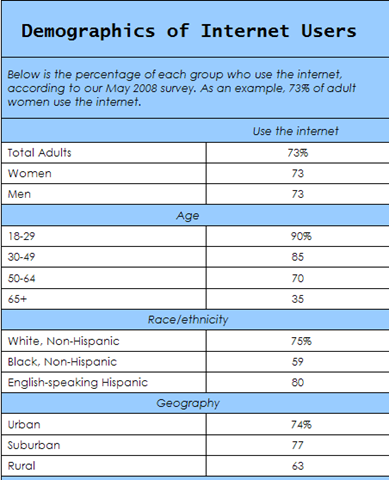
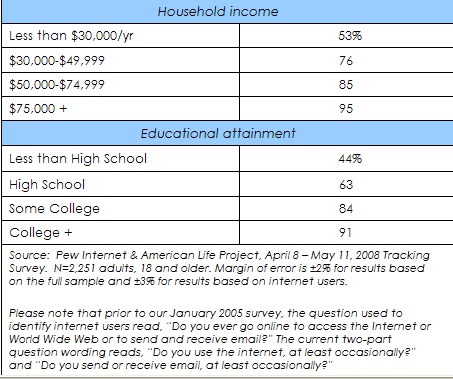
Obama is running behind with low-ed, low-income, rural old folks — who, incidentally, are the lightest users of the Internet and email. 

If that is one of Obama’s remedial target market, does it make sense to run a commercial making fun of them ?  Hmmmm

* * * * *

From Pew Research:

image

image

* * * * *

Want more from the Homa Files?
Click link =>
  The Homa Files Blog