Archive for the ‘Mktg – Brands’ Category

Give me a jolt of Reb-A … but please, no calories

January 12, 2009

Excerpted from Ad Age, “Coke, Pepsi Jump on Zero-Cal Sweetener Reb-A” By Natalie Zmuda, Dec 18, 2008

* * * * *

A new zero-calorie sweetener could boost the beverage industry — if only it can figure out how to market products containing the ingredient.

Coca-Cola and PepsiCo are rolling out products this month that will feature proprietary versions of Rebaudioside A, known as Reb-A.

Advertising messages are almost certain to take a variety of forms, and the products themselves could lead to confusion among consumers.

While consumers are accustomed to “diet” drinks containing a single calorie or none at all — and some of these new Reb-A products are likely to fill that bill — other products will have some calories …

In addition, there are two brand benefits to consider for marketing…some of the new beverages will likely be marketed as lower calorie, while others will be promoted as all natural. “The marketing and messaging is probably not going to be uniform…There’s not one single way of marketing these new beverages.”

Marketing efforts are likely to focus on education and sampling efforts to hook consumers…”In this case, because the ingredient is the differentiation of the product, it will be important to educate consumers about the value and the benefit of the sweetener…The key is to get people to get out and try these products and see for themselves that the products have a superior taste”…

It is unlikely Reb-A will find its way into flagship brands such as Diet Coke or Diet Pepsi…

A survey found that 22% of consumers are extremely interested in trying beverages using the sweetener…42% of those surveyed said they are not interested in trying beverages with Reb-A. Those consumers cited a myriad of issues ranging from safety and health concerns to taste to a preference for sugar…

Edit by SAC

* * * * *

Beverage marketers would be wise to consider the same factors for Reb-A that technology innovations must overcome to ensure product adoption. 

These factors outlined by Everret Roger in Diffusion of Innovations are:

  • Relative advantage over existing options,
  • Compatibility with existing values, simplicity in being understood,
  • Simplicity — easy to understand and to use
  • Trialability on a low risk basis, and 
  • Observability —  the degree to which the innovation is conspicuous to others. 

The biggest hurdle for beverage marketers may be in Reb-A’s simplicity.  While it’s relative advantage in being all-natural is clear, consumers must understand this benefit for it to have value. 

* * * * *
Full Article:
http://adage.com/print?article_id=133410

* * * * *

Want more from the Homa Files?
Click link =>
The Homa Files Blog

GM: 3 brands have targets on their backs …

January 6, 2009

Excerpted from BusinessWeek;, “Brand New Day”, November 28, 2008
* * * * *

General Motors is looking at killing off three brands—Pontiac, Saab and Hummer.

Everyone knows that GM is over-branded. The problem has long been that the company does not want to have to pay dealers to fold the brands it does not need as it did with Oldsmobile in 2001. State franchise laws prevent a car company from simply ending a brand. Closing down Oldsmobile cost the company around $2 billion.

Saab is not thought to have any hot buyers. According to past conversations with GM execs, Saab Cars has never turned an annual profit for GM. It has, at times, made money in Europe. But those gains have always been off-set by losses in the U.S.

Saab is one of two Swedish car companies with limited interest from both consumers and investors. Ford, too, tried to sell Volvo earlier this year, and found no takers willing to pay Ford’s asking price.

Both Saab and Volvo are premium brands that have long had followings of people who place safety above all other vehicle characteristics. Saab has also attracted some performance-oriented buyers as the company has long offered turbo chargers in some of its models.

[Note: As previously posted, green buyers typically sort performance and safety down the list of buying criteria]

Volvo is on track to sell about 82,000 vehicles this year. Sales through October were down 28%. Saab is on track to sell about 20,000 vehicles this year. Sales were down 32% through October.

Edit by DAF

* * * * *
Full article:
http://www.businessweek.com/the_thread/brandnewday/

* * * * *
Want more from the Homa Files?
Click link => 
The Homa Files Blog

* * * * *

Now, it’s the phone, not the carrier calling the shots …

January 5, 2009

Excerpted from Business Week, “How Apple’s iPhone Reshaped the Industry”, December 11, 2008

Today, apps are where the action is, and consumers are reaping the benefits

A few years ago, if someone asked what sort of cell phone you had, your response would probably be to name a network, like Sprint or Cingular. Wireless carriers so completely controlled the business, especially in the U.S., that many manufacturers weren’t even allowed to put their brand names on handsets. Now this relationship is changing in ways that will reduce the power of carriers and, with luck, increase consumers’ choices.

The relationship started to shift when people began using phones for more than voice calls and text messages. As browsers and e-mail systems became important, it mattered more whether you had a Palm Treo or a BlackBerry than whether your phone ran on the Verizon Wireless or AT&T network. Then along came Apple’s iPhone to rewrite the rules completely.

The conventional wisdom holds that AT&T scored a coup when it signed on as the exclusive U.S. iPhone carrier. The company reported that it activated 2.4 million of the new 3G iPhones in the third quarter, that 40% of those customers came to AT&T from rival operators, and that their average monthly bill was 1.6 times that of other subscribers.

But the impact on AT&T’s bottom line is another story. Mostly because of the fat subsidy it pays Apple for each iPhone, AT&T’s third-quarter earnings of $3.2 billion were $900 million less than they would otherwise have been.

More importantly, the carrier has probably lost forever its ownership of the customer, through a process economists call “disintermediation.”

Before the iPhone, relatively few owners of any phones—smart or dumb—downloaded applications. The carriers had a nice business selling ringtones and the odd game. But with iTunes and the App Store, Apple became the exclusive supplier of applications as well as music and videos. The content suppliers got about two-thirds of the revenue, Apple kept about a third, and the carriers were frozen out.

A key test of the new relationship between handset makers and smartphone software publishers, carriers, and customers will arrive when turn-by-turn driving instructions come to the iPhone. Apple seems to have created the phone with navigation in mind. Rumors are flying that Apple plans a navigation offering that leaves carriers in the cold.

This shift in power is a bad thing for wireless carriers, whose nightmares of being turned into commodity sellers of bandwidth are coming true. But it may be a win for everyone else.

Full article:
http://www.businessweek.com/print/magazine/content/08_51/b4113078121012.htm 

* * * * *

Want more from the Homa Files?
Click link =>
  The Homa Files Blog

Now, it's the phone, not the carrier calling the shots …

January 5, 2009

Excerpted from Business Week, “How Apple’s iPhone Reshaped the Industry”, December 11, 2008

Today, apps are where the action is, and consumers are reaping the benefits

A few years ago, if someone asked what sort of cell phone you had, your response would probably be to name a network, like Sprint or Cingular. Wireless carriers so completely controlled the business, especially in the U.S., that many manufacturers weren’t even allowed to put their brand names on handsets. Now this relationship is changing in ways that will reduce the power of carriers and, with luck, increase consumers’ choices.

The relationship started to shift when people began using phones for more than voice calls and text messages. As browsers and e-mail systems became important, it mattered more whether you had a Palm Treo or a BlackBerry than whether your phone ran on the Verizon Wireless or AT&T network. Then along came Apple’s iPhone to rewrite the rules completely.

The conventional wisdom holds that AT&T scored a coup when it signed on as the exclusive U.S. iPhone carrier. The company reported that it activated 2.4 million of the new 3G iPhones in the third quarter, that 40% of those customers came to AT&T from rival operators, and that their average monthly bill was 1.6 times that of other subscribers.

But the impact on AT&T’s bottom line is another story. Mostly because of the fat subsidy it pays Apple for each iPhone, AT&T’s third-quarter earnings of $3.2 billion were $900 million less than they would otherwise have been.

More importantly, the carrier has probably lost forever its ownership of the customer, through a process economists call “disintermediation.”

Before the iPhone, relatively few owners of any phones—smart or dumb—downloaded applications. The carriers had a nice business selling ringtones and the odd game. But with iTunes and the App Store, Apple became the exclusive supplier of applications as well as music and videos. The content suppliers got about two-thirds of the revenue, Apple kept about a third, and the carriers were frozen out.

A key test of the new relationship between handset makers and smartphone software publishers, carriers, and customers will arrive when turn-by-turn driving instructions come to the iPhone. Apple seems to have created the phone with navigation in mind. Rumors are flying that Apple plans a navigation offering that leaves carriers in the cold.

This shift in power is a bad thing for wireless carriers, whose nightmares of being turned into commodity sellers of bandwidth are coming true. But it may be a win for everyone else.

Full article:
http://www.businessweek.com/print/magazine/content/08_51/b4113078121012.htm 

* * * * *

Want more from the Homa Files?
Click link =>
  The Homa Files Blog

Starbucks’ (un)happy Baristas unionizing … uh-oh !

January 2, 2009

Excerpted from Business Week, “Starbucks’ Union Blues”, December 31, 2008

Starbucks’ legal wrangles with a union that wants to organize its baristas is tarnishing the coffee chain’s reputation for social responsibility

Starbucks, once the undisputed leader in premium-price caffeine fixes, has long cultivated a corporate image for social responsibility, environmental awareness, and sensitivity to workers’ rights. Now that carefully crafted reputation is under assault, thanks to a messy legal dispute with a group called the Starbucks Workers Union (SWU).

The NLRB found that Starbucks had illegally fired three New York City baristas as it tried to squelch the union organizing effort …. the company broke the law by giving negative job evaluations to other union supporters and prohibiting employees from discussing union issues at work.

The judge ordered that the three baristas be reinstated and receive back wages. The judge also called on Starbucks to end discriminatory treatment of other pro-union workers.

The timing isn’t ideal for Starbucks, which faces lower demand from the recession, an overall loss of panache for the brand, and a sliding stock price.

The company’s shares more than halved in value in 2008, while Dunkin Donuts and McDonald’s continued to grab market share among coffee drinkers.

Starbucks has been the target of numerous National Labor Relations Board complaints over unlawful violations of workers’ rights.

The SWU is especially keen on tarnishing Starbucks’ image as a “socially responsible” company. Union reps say that Starbucks has a systematic problem with low wages, irregular working hours, and a lack of reliable health care. Starbucks maintains that it pays competitive wages and is among the first large employers to offer health insurance to part-time employees, who make up 100% of its workforce.

Starbuck’s carefully cultivated reputation for social responsibility, may be vulnerable. “The image of the brand that it is wonderful being green, promoting free trade, and helping people, and not being an oppressor of labor.”

Full article:
http://www.businessweek.com/magazine/content/09_02/b4115026911242.htm?chan=top+news_top+news+index+-+temp_news+%2B+analysis

* * * * *

Want more from the Homa Files?
Click link =>
The Homa Files Blog

GM’s Marketing Missteps

December 23, 2008

Excerpted from Harvard Business Online, “How General Motors Violated Your Trust”, by John Quelch, December 11, 2008

* * * * *

The top eight reasons why GM has failed as a marketer:

1. Focus on products, not customers. For years, Detroit wrongly viewed product types as market segments. Cars were classified as subcompacts, compacts, intermediates etc. But no consumer ever left home passionate to buy an “intermediate car.” Segments are groups of customers, not products.

2. Too many products, too many brands. The Toyota and BMW product lines are very simple, easy for a salesperson to explain and easy for the consumer to understand. There is a logic to the product lineup. Desperate to retain share in the US, GM continues to add to its already confusing array of 60 models under 8 different brand names. The positioning of each brand has long been unclear, a problem magnified by look-alike models built on common production platforms with frequent model changeovers adding complexity costs to production. Buying a car is an infrequent purchase; the consumer needs a clear roadmap of what is on offer.

3. Too many dealers. GM did not reduce its dealerships as it lost share. As a result, dealers began competing on price against each other rather than external competitors. Slipping sales caused dealers to consolidate two or more GM brands on a single lot, further undermining any pretense at distinctive positioning for each marque. And the need to keep sales up at each dealership limited GM’s enthusiasm for embracing new ways of taking new car orders from consumers over the internet.

4. Losing market control. You know you are the market leader when the other players in the value chain – producers, dealers, consumers – all look to your product line as the bellwether alongside which they organize theirs. Today, GM is correctly trying to regain control of the middle with the new Chevrolet Malibu. But will it be able to displace the Toyota Camry and Honda Accord?

5. Bigger is better. Higher wage and benefit costs make it harder for GM to make money on small cars. But the real reason for the migration of the product mix to SUVs and trucks is that the “petrolheads” who run Detroit are all big, tall men. They would rather go down in Detroit history as the guys who brought you the Escalade, not the Prius. They are Jack Palance, not Billy Crystal. Over half the cars bought in the USA are purchased by women; would you know that from the lineup of senior executives at GM?

6. No global brand. Here Ford has a clear advantage over GM. Ford is a global brand. The company name is the brand name. Sure, they have Lincoln and Mercury but the vast bulk of Ford’s marketing dollars worldwide back the mother brand. GM, by contrast, is a house of brands, none of which is global. Marketing resources at GM are inevitably dissipated.

7. Not invented here. Smaller than GM, Ford has been prompted by necessity to better integrate its worldwide operations. In a well-run multinational, this involves US headquarters learning from its subsidiaries, not just telling them what to do or letting them run independently. For decades, Detroit has spurned US launches of high quality vehicles conceived and made in its own European factories.

8. Finance focus. GM has not been run by marketers. It has been run by accountants. The cost focus has crowded out needed emphasis on consumer insight and marketing. Instead of obsessing over the $1,500 per car labor and benefits cost differential separating the big three and the foreign transplant brands, GM should have exploited its market access to develop brilliant new designs that the American consumer would gladly have paid more for. Instead, the Toyota Prius has trumped Detroit and GM’s belated answer is the $40,000 electric Volt.

Edit by DAF

* * * * *

Full article:
http://discussionleader.hbsp.com/quelch/2008/12/how_general_motors_violated_yo.html

* * * * *

Want more from the Homa Files?
Click link => 
The Homa Files Blog

* * * * *

New Domain Names, New Costs to Brands

December 22, 2008
Excerpted from WSJ “New Domain Names Put Name Brands in a Bind” by Emily Steel, November 5, 2008
* * * * *
Worried about having to shell out millions of dollars to protect their brands, several major companies are protesting the launch of a slew of new top-level domains — the suffixes like “.com” that appear at the end of Web-site names.

Verizon Communications, Marriott, and New York Life Insurance are among the companies arguing that the new domains could open the flood gates to Internet fraud and drastically increase their costs of doing business online…

The organization that oversees the Internet, the Internet Corporation for Assigned Names and Numbers, plans to start selling the rights to an unlimited number of top-level domains next year. These domains are likely to take their names from popular subjects, types of businesses, geographic locations or even brand names, such as .bank, .hotel, .nyc or .verizon.

Companies fear that if they don’t register their trademarks at the new domains, their brand names could be hijacked, leading to mistrust of their brands, as well as Internet scams.

“Companies are in a difficult position. In one sense, they may feel compelled to register their crown jewels in all these locations because if they don’t, an infringer will come along, and you will have to deal with the consequences. But at the same time, it’s a huge waste of corporate resources,” says Sarah Deutsch, vice president and associate general counsel at Verizon.

ICANN, a not-for-profit organization whose members include the registrars who operate the top-level domains, says…current domains are too crowded. The crowding makes it difficult for newcomers to buy a domain that suits their business…

Companies are debating whether they should buy up the rights to operate their own brand-specific domains, such as .marriott or .nylife. They also are looking at registering their trademarks for more generic domains. For example, Marriott is considering acquiring the rights to Marriott.nyc, Marriott.travel or Marriott.vacations…

A typical company might register 20 sites within each new top-level domain, making the total cost to participate in all 200 of them $2 million, says Josh Bourne, managing partner of FairWinds Partners, an Internet-strategy consulting firm.

There currently are 21 generic top-level domains, such as .org, .info and .biz…Companies already spend a significant sum each year to buy up domain names connected to their brand…

Companies say they have been through this before, pointing to earlier launches of such domains as .asia or .eu. They bought up hundreds of thousands of domains pre-emptively but say these sites either sit dormant or fail to generate traffic.

 Edit by SAC

Full article:
http://online.wsj.com/article/SB122583938093998683.html

 Want more from the Homa Files?
Click link =>
The Homa Files Blog

Soup Isn’t Sexy, Its Effective

December 18, 2008

Excerpted from Brand Channel “Campbell’s Soup un-canny” by Adam Sauer, November 10, 2008

* * * * *  

Even before Warhol pointed out the obvious, Campbell’s was an iconic brand. From its humble beginnings as Joseph Campbell’s cannery of tomatoes, soups, condiments, vegetables, and mincemeat in 1869, it grew into a brand that identifies Americana as much as it identifies America.

While the popularity of the brand’s profile fluctuates over time—often depending on the economic health of its consumers—Campbell’s enjoys extraordinary brand recognition and an envy-inducing level of respect. For example, despite being the oldest of old-economy brands, a 2008 survey…found that Campbell’s was second on a list of the most socially responsible companies in the US, behind only Google.

Campbell’s owes a great deal of its success to technological innovation. Its turn-of-the-century breakthrough of halving water content to create a condensed soup helped to expand its wide popularity.

But just how does the brand fair online in the new economy?

Campbellsoup.com is the brand’s online gateway representing and linking to the brand’s stable of sites…

Much of Campbell’s online success can be attributed to what the brand hasn’t attempted to do. The brand, for example, understands the reasons to visit a soup website do not include Flash-based video games or social networking based on a love for chicken soup. (It should be noted that many similar consumer brands, or those brands’ agencies, are convinced otherwise.)

Also, Campbell’s realizes its brand’s place on the sex appeal spectrum; it knows it is not a high fashion label and it opts, wisely, to avoid flamboyance both online and on the shelf…

A final paradox of the brand is that while Campbell’s is known for the simplicity of its design and product (soup), the label is actually an umbrella for a conglomerate of products ranging from juice to seeds. The challenge is to differentiate the site enough to represent this family of brands without losing that simple Campbell’s iconography that captured Warhol’s attention.

Campbell’s likewise accomplishes this with links to its Pepperidge Farms, Prego and Swanson brand offerings… So, soup to nuts, Campbell’s online does all it should and none of what it shouldn’t. Simple. Effective. Just like the soup.

Edit by SAC 

* * * * *
Full article:
http://brandchannel.com/features_webwatch.asp?ww_id=406

* * * * *

Want more from the Homa Files?
Click link =>
The Homa Files Blog

The Nike Network

December 17, 2008

Excerpted from BusinessWeek, “How Nike’s Social Network Sells to Runners”, by Jay Greene, November 6, 2008

* * * * *
Nike is winning a new game that other corporations, from Coca-Cola to Verizon to General Motors, have tried unsuccessfully to play: building brand loyalty via online social networking.

In the two years since it launched Nike+, a technology that tracks data of every run and connects runners around the world at a Web site, nikeplus.com, Nike has built a legion of fans. In August, for instance, 800,000 runners logged on and signed up to run a 10K race sponsored by Nike simultaneously in 25 cities, from Chicago to São Paulo. Now the company is testing a social network to promote its basketball shoes.

Some analysts back up Nike’s claims that the site is renewing the popularity of its running shoes. SportsOneSource, a Princeton (N.J.) market research firm, says Nike accounted for 48% of all running-shoe sales in the U.S in 2006. Today, its share is 61%. “A significant amount of the growth comes from Nike+,” says Matt Powell, a SportsOneSource analyst.

* * * * *

Nike’s online strategy differs from those of other companies. Most have tried to create virtual communities through a build-it-and-they-will-come approach centered on a brand or specific product. Originally, the Beaverton (Ore.) company envisioned Nike+ simply as a clever way to combine music and running, not as a prototype for a new kind of marketing.

The key to bringing runners onto the Web was the development in 2006 of a $29 Sport Kit sensor that, when synched with an iPod touch or nano, tracks runners’ speed, mileage, and calories burned. When those runners dock their iPods, nikeplus.com launches, and the run data get uploaded. More important, the site is a virtual gathering place. Runners have collectively logged 93 million miles on nikeplus.com.

* * * * *

Nike now hopes to score with another group of jocks: basketballers. The company is beta-testing Ballers Network, a Facebook application that lets players organize real-world games and manage their teams online.

Edit by DAF

* * * * *

Full article:
http://www.businessweek.com/magazine/content/08_46/b4108074443945.htm?chan=top+news_top+news+index+-+temp_news+%2B+analysis

* * * * *

Want more from the Homa Files?
Click link => 
The Homa Files Blog

* * * * *

Hot-Wired Hotels

December 5, 2008


Excerpted from the New York Times, “Hotels Offer Guests the Latest Technology Tools”, by Susan Stellin, November 11, 2008

* * * * *

Hotels are under such pressure to keep up with their gadget-obsessed guests that they are working with technology companies to regain their edge.

Sheraton teamed with Microsoft to create its new Link@Sheraton lounges, as part of an overhaul of the brand that includes carving out spaces in lobbies where guests can use public computers to check their e-mail, print boarding passes and record video greetings to send to family and friends.

Westin struck a deal with Nintendo to outfit some of its fitness centers with Wii consoles and games like Wii Fit, a game that uses a balance board to guide players through exercises and yoga poses.

Even smaller brands are turning to technology leaders to equip their public spaces and guestrooms with the latest electronics. The Gansevoort Hotel Group is working with Sony to develop a lounge at its new Gansevoort South property in Miami Beach. The goal is to relocate the traditional business center to a more social setting near the lobby. The lounge will have Sony computers and PlayStation 3 game consoles as well as digital book readers and cameras.

“What we’re trying to do is give people the chance to experience firsthand the latest in technology,” said Elon Kenchington, Gansevoort’s chief operating officer, explaining that choosing the right technology has become as critical as other elements of a hotel’s design.

“It’s an integral part of not only the success of an operation, but also what makes one brand better than another or more interesting to travelers than other brands,” he said.

* * * * *

Technology companies, in turn, have a chance to show off their wares to a desirable demographic. “The same guests that walk through the hotel lobby are the same consumers Microsoft targets,” said Sandra Andrews, hospitality industry solutions director for Microsoft.

* * * * *

One challenge for hotels is making sure guests are comfortable using the technology and not being forced to wrestle with products that are too complex. 

“If you need your neighbor’s teenage kid to help you figure out how to use something,” said Henry H. Harteveldt, a travel analyst with Forrester Research, “it’s probably too complex for a hotel to implement.”

That is why the James hotel in Chicago has been spending the last few months testing technology made by Control4, known for its home automation systems. On trial in one guestroom, the system allows guests to operate the lights, the blinds, the thermostat and the television using one remote. It can even be used to set a more customized wake-up experience, in which, for example, the TV turns on and gradually increases in volume.

Another company working with Control4 is the Mandarin Oriental Hotel Group, which plans to use the system to create a welcome experience at its Las Vegas property, scheduled to open in late 2009. Guests arriving in their room after checking in will be greeted by the drapes opening, the lights automatically turning on and the television displaying a customized message with the guest’s name.

* * * * *

Given the economic climate, Mr. Harteveldt cautioned that hotels ought to focus on Internet access and other essential technologies that either help justify a higher room rate or attract more guests.

Hotels have to make sure they address the basics before they think about the fanciful,” he said. “This is not a time for the fanciful.”

Edit by DAF

* * * * *

Full article:
http://www.nytimes.com/2008/11/11/business/11technology.html?_r=1&oref=slogin&ref=technology&pagewanted=print

* * * * *

Want more from the Homa Files?
Click link => 
The Homa Files Blog

* * * * *

Detroit's fuzzy strategy reflected in its brands …

December 4, 2008

Excerpted from AdAge, “If GM Has a Brand, It’s General Misery” by Al Ries, December 02, 2008

* * * * *

Of the 100 most valuable brands in the world, according to Interbrand, 52 are owned by U.S. companies. And how many of the 52 are U.S. automobile brands? Just one: Ford. None of GM’s eight automobile brands made the list…however, 10 automobile brands from outside the U.S…

Part of the fundamental nature of Detroit’s Japanese competition is its ability to build brands. Toyota stands for reliability, Scion for youth, Prius for hybrid, Lexus for luxury.

But what does Saturn stand for? Or Chevrolet? Or Pontiac? Or Buick? Or Cadillac?…

The conventional wisdom is that General Motors has too many (eight).

Over the years, Gillette, has marketed seven different brands…Gillette has an astounding 71% of the world’s wet-shaving market, in part due to its multiple brands.

The difference between Gillette and GM is that each of the seven Gillette brands stands for something specific and each of the eight GM brands does not… 

To build a brand, you generally need to “contract” the brand.  Instead,  GM has introduced expensive Saturns and cheap Cadillacs.

GM’s brands themselves are practically worthless.. 

Edit by SAC

* * * * *

To make matters worse GM’s plan to Congress slash its marketing spending by $600 million by 2012.  The bright side of this significant reduction in advertising and promotions is that GM will focus its efforts on Chevy, Cadillac, Buick, and GMC, which according to its restructuring plan, account for 83% of its business.  While the tighter budget may prompt focused efforts it does not guarantee improved branding.  GM will need both to compete.

* * * * *

Full Article:
http://adage.com/columns/article?article_id=132938

* * * * *

Want more from the Homa Files?
Click link =>
The Homa Files Blog

CPG’s ask: What are they thinking?

December 2, 2008

Excerpted from Marketing Daily “Understanding, Leveraging Consumers’ Five CPG Mindsets” by Karlene Lukovitz, October 16, 2008

* * * * *

Consumers approach different categories of consumer packaged goods with different mindsets, and marketers that understand and leverage these can enhance their products’ performance.

CPG marketers “don’t want to get it wrong in the fleeting nano-second of purchase decision  … Marketers need to know what buttons to press to influence their shoppers and win on the ultimate marketing battleground–the store aisle.”

Here’s a summary of the five CPG mindsets and how marketers can best exploit these. The insights apply across all retail channels where CPG’s are sold, including grocery, drug stores, convenience stores, mass merchandisers and club stores.

Indifferent auto-pilot and blinkered auto-pilot mindsets: When it comes to products like bathroom cleaners, bar soaps, dishwashing soap and cotton swabs, consumers’ pilot buttons are set to “indifferent.” Rather than spend time on decisions, they automatically reach for the brands they usually buy, generally without comparing prices. Since there’s low brand-attachment, consumers have no problem switching if their usual brands aren’t available.

To avoid such switches, marketers of leading brands in these CPG categories need to ensure against out-of-stocks or visibility and distribution issues The overall key to influencing consumers on auto pilot lies in knowing when and how that mindset can be disrupted by external stimuli, so that they are ready to consider alternatives and new offers…

Browser mindset: Consumers are more engaged with products such as shampoo and conditioner, body washes, and toothpaste and brushes–they check out labels and packaging, sniff and test these. This means that marketers need to provide a wide product assortment and realize that packaging innovations can be persuasive in decisions.

Buzz mindset: Hand and body lotions, air fresheners and baby toiletries are among the product categories that are “buzz-activated.” Shoppers actively seek out information about these.

Constant innovation in packaging and new product attributes–introduction of attention-grabbers such as “age-defying,” “shimmering,” tanning and aromatherapy, for example–combined with exciting advertising and new product introductions, are the keys for these categories.

Bargain-activated mindset: Unless there’s hot news about some brand, shoppers tend to switch brands on toilet paper, laundry detergent, paper towels, facial tissues, liquid hand soaps and batteries based on which are on sale or appear to be bargains.

Edit by SAC

* * * * *
Full article:
http://www.mediapost.com/publications/?fa=Articles.showArticle&art_aid=92836

Want more from the Homa Files?
Click link =>
The Homa Files Blog

Boost your ROI by building your brand ..

November 25, 2008

Excerpted from Brand Channel “Trust as a Tangible Brand Attribute” by Mary Weisnewski, November 3, 2008

* * * * *

How do you transform your company’s core values into a business asset you can see and feel?

Investing in branding is a good start.  Unfortunately, too many companies slow their efforts to a grinding halt after the rollout party to unveil the new website design and hand out pens embossed with the new logo..

.“Investing in brand development is increasingly important to build credibility and differentiate…People are making purchasing decisions based on how closely aligned their values are with an organization and how much they trust what that organization is providing. This is as true whether people are making donations to nonprofits, buying consumer products, or hiring consultants.”

Revealing your organization’s core values by developing an authentic brand platform, then consistently walking the talk of those core values, is the foundation of employee and customer trust and loyalty—both of which directly affect your bottom line.

 * * * * *

Trust is the engine that powers your brand. When a brand delivers consistently on what it says it will do there are tangible results. When the visual brand is aligned consistently with the experience it communicates an honest, reliable organization and there are tangible results. It’s all about building loyalty and long-lasting relationships…

Trust results from a reliable cache of perceptions and experiences, built over time. We think of organizations just like we do people we know. If I have heard of you I am more likely to trust you. If you do what you say you are going to do, my level of trust will increase…

You have to survey, or audit, everyone involved with your organization to find out what they really think and feel about what you’re offering, and listen to their concerns and desires…

What every company really wants, regardless of its size or market niche, is brand equity: tangible results that show a return on investment. When United Way underwent a rigorous brand evaluation in 2003, they discovered that the strong brand was 67 percent of the reason why people chose to invest in the organization.

* * * * *

Making your brand tangible leads to: ongoing affirmation of purpose, organizational alignment, differentiation, stronger relationships and connections, increased recognition; stronger recruitment, and increased ROI.

The bottom line is that a tangible brand is a win-win for your company and your customers…When a brand delivers consistently on its promise there are tangible results. This is true whether your company is just starting out or has a well-known national or international presence….People will pay more for, and choose faster, the experience and peace of mind a healthy brand promises.  

Edit by SAC 

* * * * *
Full article:
http://brandchannel.com/brand_speak.asp?bs_id=205

* * * * *

Want more from the Homa Files?
Click link =>
The Homa Files Blog

Boost your ROI by building your brand ..

November 25, 2008

Excerpted from Brand Channel “Trust as a Tangible Brand Attribute” by Mary Weisnewski, November 3, 2008

* * * * *

How do you transform your company’s core values into a business asset you can see and feel?

Investing in branding is a good start.  Unfortunately, too many companies slow their efforts to a grinding halt after the rollout party to unveil the new website design and hand out pens embossed with the new logo..

.“Investing in brand development is increasingly important to build credibility and differentiate…People are making purchasing decisions based on how closely aligned their values are with an organization and how much they trust what that organization is providing. This is as true whether people are making donations to nonprofits, buying consumer products, or hiring consultants.”

Revealing your organization’s core values by developing an authentic brand platform, then consistently walking the talk of those core values, is the foundation of employee and customer trust and loyalty—both of which directly affect your bottom line.

 * * * * *

Trust is the engine that powers your brand. When a brand delivers consistently on what it says it will do there are tangible results. When the visual brand is aligned consistently with the experience it communicates an honest, reliable organization and there are tangible results. It’s all about building loyalty and long-lasting relationships…

Trust results from a reliable cache of perceptions and experiences, built over time. We think of organizations just like we do people we know. If I have heard of you I am more likely to trust you. If you do what you say you are going to do, my level of trust will increase…

You have to survey, or audit, everyone involved with your organization to find out what they really think and feel about what you’re offering, and listen to their concerns and desires…

What every company really wants, regardless of its size or market niche, is brand equity: tangible results that show a return on investment. When United Way underwent a rigorous brand evaluation in 2003, they discovered that the strong brand was 67 percent of the reason why people chose to invest in the organization.

* * * * *

Making your brand tangible leads to: ongoing affirmation of purpose, organizational alignment, differentiation, stronger relationships and connections, increased recognition; stronger recruitment, and increased ROI.

The bottom line is that a tangible brand is a win-win for your company and your customers…When a brand delivers consistently on its promise there are tangible results. This is true whether your company is just starting out or has a well-known national or international presence….People will pay more for, and choose faster, the experience and peace of mind a healthy brand promises.  

Edit by SAC 

* * * * *
Full article:
http://brandchannel.com/brand_speak.asp?bs_id=205

* * * * *

Want more from the Homa Files?
Click link =>
The Homa Files Blog

Pepsi Overhaul: Cutting Jobs & Changing Logos

November 19, 2008

Excerpted from AdAge “PepsiCo Launches Massive Overhaul” by Natalie Zmuda, October 14, 2008

* * * * *

PepsiCo said it will pour some $1.2 billion over three years into a push that will include sweeping changes to its brands, including …  a revamp of “every aspect of the brand proposition for our key [carbonated soft drink] brands. How they look, how they’re packaged, how they will be merchandised on the shelves, and how they connect with consumers.”

Included is the redesign of many of the brands’ packaging graphics, as well as a redesign of the Pepsi globe logo. The white band in the middle of the logo will now loosely form a series of smiles. A “smile” will characterize brand Pepsi, while a “grin” is used for Diet Pepsi and a “laugh” is used for Pepsi Max. Also, Mountain Dew will be rebranded as Mtn Dew…

Time for strong action
It is our belief that, especially, in this economic downturn, we should be investing in the category to get consumers to stay with and some to return to the packaged liquid refreshment beverage category and to our brands, in particular.”

PepsiCo said the $1.2 billion will come from its “Productivity for Growth” program, which involves the elimination of 3,300 positions, as well as the closing of six plants… “The majority of the savings will be invested in our businesses. A primary focus will be restoring growth to our North American beverage business. At the same time, we will increase our investment in developing markets, make selective investments to continue growing our global snacks business and accelerate our global R&D initiatives to help secure our future innovation pipeline.”

During the third quarter, PepsiCo Americas Beverages reported a 2.5% volume decline, with a 4% decline in North America, specifically. North American carbonated soft-drink volume dropped 3%, while non-carbonated beverages declined 5%. Unflavored water and Propel saw double-digit declines during the quarter…

Gatorade in for a facelift
.”We’re initiating similar upgrades for the entire Gatorade line, which will have an entirely new contemporary identity, and there will be exciting innovations for both G2 and Tiger and a renewed Propel platform.” 

Beverages are more affected than snacks in this economy, because there is a free substitute: tap water. The last 12 to 18 months mark the first time the category is seeing a decline. “We’re saying goal one is to stem that decline . … It’s a critical source of profitability,”

 “Once we have a breakthrough on a natural low-calorie sweetener that can be used in colas, we have a reason to talk about this category growing again.” 

Edit by SAC
* * * * *
Full article:
http://adage.com/article?article_id=131733

Want more from the Homa Files?
Click link =>
The Homa Files Blog

Pepsi's New Logo – The Real Cost

November 14, 2008

Excerpted from Ad Age “What Went Into the Updated Pepsi Logo ” by Natalie Zmuda, October 27, 2008

* * * * *

How long does it take to remake an icon? Try five months.
That’s the amount of time Pepsi took to revamp its famous logo…Pepsi would not discuss what it’s paying for the revamp, but experts estimate the cost for a top firm to work five months at north of $1 million. But that’s just the beginning.
The real cost, said an expert, is in removing the old logo everywhere it appears and putting new material up. For Coke or Pepsi, when you add up all the trucks, vending machines, stadium signage, point-of-sale materials and more around the world, it could easily tally several hundred million dollars, the expert said.

The new logo is a white band in the middle of Pepsi’s circle that loosely forms a series of smiles: A smile will characterize brand Pepsi, while a grin is used for Diet Pepsi and a laugh is used for Pepsi Max. The new logo is Pepsi’s 11th…Five logos have been introduced in the past 21 years, with the last update in 2002…

Consumers won’t see a new campaign for a while…the launch isn’t expected until 2009… 


So far, branding experts are in both camps. “It’s tilting the brand presentation from a classic expression of uniqueness and quality into something more humorous, almost flippant,” said Tony Spaeth, an identity consultant. “…it is less durable, less permanent and classic. It comes across as more of a campaign idea than an enduring brand expression.”

“This seems to be a really good solution. It feels like the same Pepsi we know and love, but it’s more adventurous, more youthful, with a bit more personality to it,” said Chris Campbell, executive creative director at Interbrand. “In theory, what they’re doing sounds like a really clever solution to link together a family of brands.”

 Edit by SAC 

* * * * *
Full article:
http://adage.com/article?article_id=132016

* * * * *

Want more from the Homa Files?
Click link =>
The Homa Files Blog

No Surprise, Best Marketers Wal-Mart, P&G

November 7, 2008

Excerpted from Promo Magazine “Wal-Mart, P&G Still Tops for Marketing Strength: Survey” November 3, 2008

* * * * *

Wal-Mart and Procter & Gamble still hold the top spots in the 2008 Cannondale Associates’ annual PoweRanking survey of both manufacturers and retailers. But their ratings…were lower than last year.

Respondents were asked to rate companies for their retail marketing competence on criteria, including clear company strategy, most innovative consumer marketing, and best store branding.

For the tenth year, Wal-Mart stood head and shoulders above the others… Among other Top Ten retailers only Kroger showed appreciable gains, boosting its rank by almost 5% to move into third place, behind Wal-Mart and Target… Walgreens hiked its composite ranking by 2.8% this year and filled out the Top Ten, right behind rival health and beauty vendor CVS…“This suggests that Wal-Mart’s low price strategy is resonating with consumers and manufacturers…It also suggests that Kroger’s strong showing in targeting its shoppers and shopper segments is paying dividends. Also, drug retailers CVS and Walgreens are effectively targeting consumers and delivering on programs.”

On the manufacturer side, four of the Top Ten moved up in standing this year, while…ConAgra, dropped out of the first rank altogether.Traditional  leaders P&G, Kraft and PepsiCo all saw their scores fall off this year. P&G’s popular vote dropped 4.2 points, although it still held the Number One slot. Kraft’s score drop of 0.3 points wasn’t enough to move it from the second slot…General Mills saw its score increase to grab the fourth spot. Meanwhile Nestle built its ranking up…and Clorox re-joined first-tier manufacturers after a two-year absence with a score increase of 1.7 percentage points.“General Mills has been given great credit for a re-focus on customer initiatives and wholly embracing the concept of working collaboratively with retailers to better develop business,’ …Nestle is being given credit for focusing on a health and wellness message that starts at the top.”“Retailers that excelled…have completed their own customer segmentation and begun to develop alternative store formats and merchandising platforms to address newly identified needs”…

Edit by SAC

* * * * * 

Full article:
http://promomagazine.com/retail/news/1103-walmart-pg-tops-marketing/

* * * * *

Want more from the Homa Files?
Click link =>
The Homa Files Blog

Of age and race, which mattered most ?

November 7, 2008

Excerpted from
http://www.cnn.com/2008/POLITICS/11/04/exit.polls/

* * * * *

While Obama will be the nation’s first black president, John McCain would have been the oldest person ever elected to the nation’s highest office.

Race played less of a role in the election than age

The only age group where McCain prevailed was 65 and over, and that by just a 10-percentage-point margin, 54 percent to 44 percent, the exit polls showed.

Minorities went heavily into the Obama camp. Blacks, 96 percent Obama to 3 percent McCain; Latinos, 67 percent Obama to 30 percent McCain;

Obama did well with Latinos because they appear to disapprove of President Bush’s job performance more than the rest of the country,

About 80 percent of Latinos give Bush negative marks, while 72 percent of all Americans do, exit polling showed.

* * * * *

Ken’s Take:

(1) Interesting that 93% of blacks voted for Obama because he was — on his record and positions — the better candidate.  But, 54% of old people voted for McCain just because he was old.  Huh ?

(2) McCain put his political career on the line pushing for comprehensive immigration reform (i.e. amnesty).  Which, incidentally, Bush supported.  Obama stayed out of the fray.  Yet, Hispanics rejected McCain 2 to 1.  Gotta feel a bit sorry for the guy.

* * * * *

Want more from the Homa Files?
Click link =>
  The Homa Files Blog

If nations were brands, how would they rank ?

October 31, 2008

Excerpted from Brand Channel “Rating Nation Brands: What Really Counts” by Randall Frost, October 6, 2008

* * * * *

Simon Anholt, a nation branding expert who advises governments on such issues, believes it is unacceptable for governments to spend taxpayers’ and donors’ money on nation branding campaigns if the results can’t be measured, tracked, or made accountable. For that reason, he launched his Nation Brands Index (NBI) in 2005…

The NBI index considers a country’s exports, governance, culture and heritage, people, tourism, and investment and immigration…

According to Anholt, the NBI ranking is not simply a list of the 40 or 50 ‘strongest nation brands’ in the world. Rather, he says, it’s a highly detailed analysis and comparison of 40 or 50 selected countries…

Last August, East West Communications in Washington, D.C., released a competitive ranking of nation brands. Unlike the NBI index, the East West Global Index 200 looks at all 192 UN members, as well as 8 territories, based on how they are perceived in the international media.

According to East West president Thomas Cromwell, the new index tracks 38 major media sources…plus major regional publications that are translated into English and some digitized input from broadcast channels…

Perception Metrics in Ohio conducts the media analyses for East West. According to Brad Snyder of the company,…“What we’re really trying to identify is the brand value by considering the number of mentions, and the tone; we believe both are essential. How much is the country being portrayed positively? And how often is that positive image reinforced? Or is a negative image being presented, and is it hitting home?”…

Both the NBI and East West indexes rank nations by how favourably they are perceived around the world. Because the NBI measures consumer perceptions, however, and East West media perceptions, one would not expect total agreement in the two rankings. But both indexes employ scientifically sound methodologies, so one might anticipate a little more overlap than appears to be the case..

image .

If one considers the top 100 ranked (positively nuanced) countries in the East West index, the ten most frequently media-cited countries are the US, the UK, Australia, France, Japan, Russia, Germany, Italy, Spain and Canada. These countries correspond quite closely to those that have the highest rankings in the NBI index.

One interpretation of this result is that although the media sets the agenda for awareness of countries (what countries people think about), it does not influence what people think of those countries nearly as much…

Professor David Gerstner of Pace University in New York is currently developing yet another nation branding index. Says Gerstner, “Given the increasing importance, attention, and interest in place branding, more nation rankings are likely to appear in the future. The results of these studies are likely to vary. The reason is that, even though they claim to measure the same idea—how attractive or well-regarded a nation is—due to differences in methodologies they are actually measuring different things.”

Edit by SAC

* * * * *
Full article:
http://www.brandchannel.com/start1.asp?fa_id=443

* * * * *

Want more from the Homa Files?
Click link =>
The Homa Files Blog

Better Behavior, Better for Business

October 27, 2008

Excerpted from BusinessWeek, “Outperforming by ‘Outbehaving'”, by Dov Seidman, October 7, 2008

* * * * *

Previously in business, finding advantage meant differentiating ourselves from the rest of the herd based on the products we produced, the supply chains we used to get our products to market quicker than the competition, and the service we provided to customers. If we outproduced, outsped, and outhustled rival companies, we also outsold them and “overpowered” the marketplace. This advantage was sustainable for longer periods of time in a less connected world, one in which it took competitors longer to catch up.

Today, we live in a hyperconnected world thanks to the explosion of communications technology in the late 20th century. Since hyper-connectivity breeds hyper-transparency, everyone can instantly see what we do and how we do it. As a result, everyone has grown much more interested in how we do what we do. This is especially true of our competitors, who can quickly see, study, and reverse-engineer our best-in-class supply-chain management processes, innovative product designs, and lightning-quick customer response times.

Hyperconnectivity and hypertransparency explain why so-called competitive advantage now lasts only weeks and months when it once endured for years and decades. We’re running out of areas in which we can stand out because previous forms of competitive differentiation are quickly becoming commodities.

What can’t be copied is how the company pursues these strategies.

* * * * *

How a company approaches its decisions and how it executes them is as important as the decisions and actions themselves. It is defined by the extent to which it pursues its aspirations with authenticity, openness, consistency, and with fidelity to its values and principles.

The emergence of how—or behavior as a source of competitive differentiation is evident in the humanization business is experiencing.

On the marketing front, a growing number of companies assert that they are about much more than their products or services—that “much more” translates to people. For example, Johnson & Johnson (JNJ) asserts that “Tylenol is different because of the people who make it.” The product’s site contains video testimonials of workers responsible for the product, who make promises about the care and commitment they pour into their production and quality-assurance processes. Johnson & Johnson seeks to differentiate Tylenol from competing companies not only on the quality of its product, but more so based on the quality of its employees’ behaviors.

The entire “customer experience” movement reflects a similar desire, and it has been embraced by products and services companies alike. Business leaders have realized that customer service no longer suffices as a competitive differentiator, so they focus more time, energy, and investment in the human interaction their employees develop with customers.

Customer service is about how quickly an employee can connect with a customer. Customer experience is about the quality of that connection over time. Customer service is growing increasingly automated thanks to ATMs, interactive voice response (IVR) systems, and online self-service. Customer experience, which is designed to enhance the long-term loyalty of the most valuable customers, requires companies to outbehave their competitors.

* * * * *

Adopting behavior as a governing principle of human endeavor and business can also be difficult because our previous habits of thought and action—all the outs (outmuscle, outfox, outscheme, etc.)—are deeply engrained.

These old habits of behavior allowed us to accumulate power over people through leverage. Our hyperconnectivity has greatly reduced the leverage we can exert over other people, however. In today’s flat and hyperconnected world, power increasingly is derived through people—through relationships, authenticity, transparency, and openness.

Edit by DAF

* * * * *

Full article:
http://www.businessweek.com/managing/content/oct2008/ca2008107_857241.htm?chan=top+news_top+news+index+-+temp_managing

* * * * *

Want more from the Homa Files?
Click link => 
The Homa Files Blog

* * * * *

Tampa Bay Rays Takes a Play from P&G’s Book

October 23, 2008

Excerpted from AdAge “Tampa Bay Rays get P&G Style Makeover” by Jeremy Mullman, October 6, 2008

* * * * *

Under the guidance of a former Procter & Gamble brand manager, the Tampa Bay Rays have gone through the sort of transformation typical of deodorant sticks and shaving razors. First off, the team got a new name — Devil is gone — and a fresh logo and color scheme, swapping green for blue. A list of “consumer touchpoints” was found via focus-group research and monitored to make sure the ballpark experience is fun for fans.

And a P&G staple — product improvement — was even applied as the team morphed from one of the league’s most hapless teams into perhaps its best young squad. The emergence of fresh stars such as pitcher Scott Kazmir and third baseman Evan Longoria helped the team beat out such annual powerhouses as the Boston Red Sox and New York Yankees to win a division title and playoff berth only a year after finishing dead last. There’s evidence the strategy might be starting to show a glimmer of success. The Rays won their first playoff game last Thursday, and their first two home games are sold out.

But there’s still a long way to go. Sales did climb about 30%, but that put the Rays at only 26th in attendance among the league’s 30 teams — a weak performance, considering they boasted the league’s second-best record…

Mr. Raymond — who worked on fabric softeners and panty liners at P&G — and the team’s other top executives have nevertheless engaged in a Procter-style treatment of their brand, complete with a mantra of five “brand pillars” and 30 carefully monitored consumer touch points that help the team monitor consumer satisfaction. “It’s a lot like what P&G does with brand-equity models,” he said. “We know when our cleaning scores dip or when our security wasn’t helpful enough”…

The team also has taken steps to improve its fan experience by strategizing against the armies of Northeast transplants in the area who flock to the stadium to cheer against the home team whenever the Yankees or Red Sox come to town.

It designated a group of its most hard-core fans to meet with the team’s coaches or players before games to initiate new cheers; gave away cowbells to fans, who bring them back and ring them in droves when opposing players are on the verge of striking out; and even used YouTube-style consumer-generated fan videos on the stadium’s JumboTron.

The result has been a formidable home-field advantage — when the fans actually show up, that is. “Our record is 20-2 in games where we have 30,000 or more fans,” said Mr. Raymond, raising the obvious question of how good the Rays’ record would be if they could draw crowds like that for the other 59 home games.

Edit by SAC

* * * * *
Full article:
http://adage.com/article?article_id=131499

* * * * *

Want more from the Homa Files?
Click link =>
The Homa Files Blog

The 6 drivers of brand credibility …

October 23, 2008

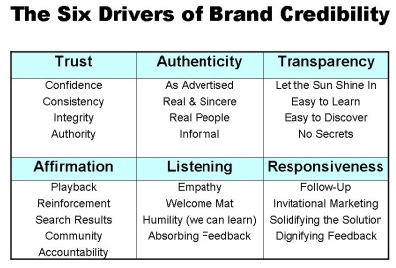
According to Pete Blackshaw of Nielsen, a brand’s credible reputation is driven by 6 factors:

image

Source: Pete Blackshaw http://www.tell3000.com/

* * * * *

Want more from the Homa Files?
Click link =>
  The Homa Files Blog

J&J Fights Big With Small Brands

October 22, 2008

Excerpted from AdAge “Small Brands Could be J&J’s Next Big Thing ” by Jack Neff, October 6, 2008

* * * * *

Selling big, heavily extended brands at large retailers has been a cornerstone of success for the personal-care marketers for most of the decade. But as that business model shows signs of fraying, $61 billion Johnson & Johnson increasingly is trying something a lot more entrepreneurial.

In the past year, J&J has quietly ramped up a major assault on direct-response skin-care powerhouse Proactiv with the SkinID brand. The Neutrogena subbrand offers customized acne-fighting and other skin-care products and is sold online…

Clearly, J&J has benefited from the big-brand, big-retailer model up to now. Information Resources Inc. data reported by Deutsche Bank shows the company gaining share in key categories such as acne products, facial moisturizers and cleansers in recent quarters. With global sales estimated by people familiar with the company at $2 billion to $2.5 billion, Neutrogena is neck and neck with other global megabrands, such as Procter & Gamble Co.’s Olay and Unilever’s Dove.

Yet both of those rival brands have slowed within the past year and begun losing share, at least in tracked U.S. channels. And even the biggest brand behemoth in mass, L’Oréal…has begun losing share in cosmetics and hair colorants in the past year…to smaller P&G brands Cover Girl and Clairol…

Should the same fate befall Neutrogena, at least J&J has skin in another game. J&J launched SkinID by “Neutrogena Dermatologics” on a limited basis in April, then ramped up spending behind infomercials featuring former “American Idol” contestant Katharine McPhee starting in May…

As with Proactiv, the products are customized assortments available only by phone or online, but Neutrogena ads bill SkinID products as “twice as effective as Proactiv.” The tack appears to be working, with traffic to skinid.com running at around half the level of traffic to proactive.com after only a few months of all-out effort by J&J…

“We’re revolutionizing skin care through questions to our consumers,” said Cal Schmidt, VP-sales and marketing for J&J unit McNeil Nutritionals, referring to the early stages of SkinID in a talk at an Advertising Research Foundation forum in April. “We are offering our customers specific products tailored to them… And then you have this ongoing dialogue.”

Not to mention ongoing sales. What likely makes the proposition most attractive to Neutrogena is automatic replenishment, which keeps consumers buying and prevents the switching common at a retail shelf…

Edit by SAC

* * * * *

The SkinID brand isn’t J&J’s first attempt at skin-care products for specific skin types.  The company has had success with another smaller brand, Ambi, since it acquired the brand in 2004.  The Ambi brand includes skin-clearing and skin-tone evening products to specifically meet the needs of African, Asian and Latin woman.  As with SkinID.com, the product website, ambi.com also provides skin care advice for consumers and helps them find the product to best meet their skin-care needs.

* * * * *
Full article:
http://adage.com/article?article_id=131485

* * * * *

Want more from the Homa Files?
Click link =>
The Homa Files Blog

Buzz Words: “Brand Accretion”

October 16, 2008

Excerpted from BusinessWeek “The Case for Brand Accretion”, by Steve McKee, September 12, 2008

* * * * *

Brand accretion. With respect to branding, accretion is the simple principle that the more you invest—and the more consistently you invest—the better your long-term returns will be.

* * * * *

In a branding context, accretion means that none of your marketing efforts exist in a vacuum. Sure, you want them to have an impact today, but they also add to, and are interpreted within, the context of your past and future efforts.

Think of branding as a process, not a static point in time; if your message is steady and consistent, you can build significant brand equity. If, however, you continually change your approach, carelessly cut your budget, or seek only short-term benefits, you’ll be compromising your own long-term interests.

* * * * *

James Gregory’s marketing firm, CoreBrand, has conducted years of research about the long-term effects of marketing investments. He says it’s rare for even a one-year surge in advertising spending to generate measurable results in image development; it’s usually at least three years before you see real change. That’s a long time if you’re starting from zero, but if your efforts are continuous, the power of accretion will continually work on your behalf.

Edit by DAF

* * * * *

Full article:
http://www.businessweek.com/print/smallbiz/content/sep2008/sb20080912_752256.htm

* * * * *

Want more from the Homa Files?
Click link => 
The Homa Files Blog

* * * * *

Big Profits from "Inferior" Products

October 15, 2008

Excerpted from Strategy & Business, “A Breakaway Opportunity for “Inferior” Products”, by Leslie Moeller, James Ryan, and Juan Carlos Webster, September 16, 2008

* * * * *
As the difficult economy causes consumers to trade down in their purchases, companies need to adjust their offerings to their customers’ new behavior.

The current economic crisis is creating a “new normal” in consumer buying habits. Before the recent downturn, when consumers tried to save money, they traded down from branded products to private-label or so-called value brands. But they tended to keep buying some form of the product; they continued to pay for the convenience of, say, antibacterial throwaway wipes or gourmet frozen foods. In the current economy, they are not just trading down within a category, but switching to “inferior” products and services — paper towels instead of wipes, washcloths instead of paper towels. In the process, they are raising the value of the type of products and services economists call “inferior goods”: those that attract consumers more when purchasing power declines.

This will require a major shift of focus for many consumer-oriented companies. During the past decade or so, marketers have grown accustomed to the trend known as “premiumization”: Each year, consumers sought out higher-priced and more distinctive products.

Premiumization will never go away completely. But suddenly it has moved to the slow lane. The reason, of course, is the continuing economic downturn.

The impact has not been gentle on premium products, even the relatively inexpensive or everyday kinds. Retail sales figures for the second quarter of 2008 showed declines of 0.7 percent for Target Corporation (versus a gain of 2.7 percent for Wal-Mart Stores Inc., which has much less of a premium focus in its category) and a significant “mid-single-digit” decline for the Starbucks Corporation.

* * * * *

If you can attract consumers to your category from another, the era of inferior products may bring you superior opportunities. Consumer-oriented companies should consider the following options when facing the current economic slowdown:

1. Don’t blindly lower prices to regain volume. Simply reducing prices could well be financially disastrous; it already has been for several casual-dining restaurant chains. Across-the-board price-cutting may lower the price of a $12 meal to $9 or $10, and thus affect the perceived value of, say, Boston Market versus Chipotle, but it will not have any effect on a consumer who is opting for a $5 meal by eating at home.

2. Find the inferior products that will attract consumers as their purchasing power decreases. Introduce a new brand or sub-brand in the categories to which consumers are moving in this downturn. Of course, companies will run the risk of potential cannibalization, but that’s still better than losing customers altogether.

3. Cement consumers to your brand. Once you have attracted consumers to your inferior product, bind them to your brand. Give them an experience that merits repurchase. Think about the products you can trade them up to when the economy starts to recover — for example, the health-conscious, convenient, or premium products that will make them stick to your brand as their incomes increase.

4. Make the new normal feel better. You can help consumers feel good about migrating to inferior goods by enabling them to justify their decisions in terms other than affordability. Toyota Motor Company’s Prius is a great example: Consumers don’t feel bad about trading in their BMW or Escalade, because they are doing their part for the environment; it’s not simply that they can’t afford anything more expensive.

* * * * *

Brand owners and companies that offer products or services to customers across a broad range of price points, and that can manage the cycle, will fare better than those with more focused products and offerings that can’t adapt up- or downstream as consumer choices change.

Edit by DAF

* * * * *
Full article:
http://www.strategy-business.com/li/leadingideas/li00093?pg=all

* * * * *

Want more from the Homa Files?
Click link => 
The Homa Files Blog

* * * * *

Credit Crunch Decaffeinates Coffee Push at McDonalds

October 15, 2008

Excerpted from AdAge “Credit Crunch Takes Bite Out of McDonalds” by Emily Bryson York , September 29, 2008 

* * * * * 

The banking crisis is threatening to take a rather surprising hostage: McDonald’s big-budget coffee rollout.

Tightening credit conditions, which are crimping plans for marketers as diverse as giant General Motors Corp. and relatively small household-products company Method, have prompted Bank of America to halt loans to McDonald’s franchisees. They need the capital to frantically build coffee bars in the chain’s 14,000 locations for what was planned to be an April coffee introduction.

And although it won’t derail the launch altogether, it is likely to delay it nearly into summer — hardly optimal timing for a hot-beverage introduction. It also could force the company to postpone a huge marketing push it’s been planning to support the java drive, as the company generally waits until 60% of its stores have been outfitted to undertake a national ad push. The fast feeder maintains that everything is on track…

Franchisees are spending about $100,000 per store to accommodate the “combined beverage business,” which includes lattes and cappuccinos. Most are seeking loans for the build-out. “As money remains tight, it’s going to be more difficult to get the loans to remodel for the combined beverage strategy,” one franchisee said…

The corporate memo additionally advised that “now is not the time to be shopping for loans based on interest rates,” or to refinance existing debt. It went on to suggest franchisees consider using cash on hand to cover new-equipment costs…

“I think it could very likely slow down the [rollout],” said Darren Tristano, exec VP of Technomic. “That plus the impact that Starbucks has seen in traffic and a decline in sales, I think it probably would be better to slow it down and continue to test it and see how the results are.”

McDonald’s spokesman Bill Whitman, however, said the beverage strategy is “on target and progressing as planned.”

“There continues to be more than sufficient liquidity available to our franchisees to fund capital improvements in their restaurants,” he said, adding that more than 50 national, regional and local lenders are providing financing to U.S. franchisees.

…it seems clear that the company is backpedaling. In July, McDonald’s was expecting the rollout to be completed by April. Earlier this month, Ralph Alvarez, chief operating officer, told analysts at a Bank of America conference that the specialty-coffee rollout should be complete by mid-2009.

Even if that date stays on track, the chain would likely miss the cold-weather window in which hot drinks are said to be the most popular…Another problem will be what to do with the ad calendar…

Edit by SAC

* * * * *
Full article:
http://adage.com/article?article_id=131320

* * * * *

Want more from the Homa Files?
Click link =>
The Homa Files Blog

Pepsi Targets Eco-Centric Consumers Online

October 14, 2008

Excerpted from Brandweek “Pepsi Ups its Online Eco Efforts” by Kenneth Hein, September 30, 2008  

* * * * * 

Pepsi, today, is launching not one, but two Web sites trumpeting its eco-friendly efforts. PepsiEcoChallenge.com and Pepsirecycling.com both spotlight Pepsi-Cola North America’s slew of sustainability programs.

The more promotional site, Pepsirecycling.com, offers consumers 100 Pepsi Stuff points for taking a quiz about recycling. Points can be redeemed for prizes, like shirts made from recycled materials, and entrance into a sweepstakes for a Smart car. Pepsirecycling.com  offers a myriad of information about recycling as well as origami instructions for used 12-pack cartons.

“We’re putting recycling front and center and giving our customers an incentive to do their part for the environment,” said Victor Melendez, vp-marketing, sustainability for PCNA, Purchase, N.Y., in a statement. “Pepsi has always stood for fun and now we’re channeling that Pepsi spirit into raising environmental awareness.”

PepsiEcoChallenge.com reads more like an interactive brochure that explains how the company is working to save energy and water as well as working to create sustainable packaging… It points out Pepsi is working to reduce its U.S. plants’ water consumption by 20%, electricity usage by 25% and fuel consumption by 25% by 2015.

Because a segment of consumers demand eco-accountability from their favorite brands, such efforts are of increasing importance, said John Sicher, editor of Beverage Digest, Bedford Hills, N.Y. “There is certainly growing interest among consumers in buying products from socially responsible companies,” he said. “It’s important that big companies like Pepsi reach out and show decision makers and decision influencers that they are taking a lead in this.”

Edit by SAC

* * * * * 

Full article:
http://www.brandweek.com/bw/content_display/news-and-features/digital/e3i5452d1396a606a4187805864881b8d0d

* * * * *

Want more from the Homa Files?
Click link =>
The Homa Files Blog

Coke Leads Brand Value Rankings

October 14, 2008

Excerpt from Ad Age “Coke Still No. 1 in Brand Value” by Jean Halliday September 19, 2008  

* * * * *

Coca-Cola is again the world’s most valuable brand, according to Interbrand’s just-released annual list of the Best 100 Global Brands.

While Coke held onto its top slot from last year, IBM, by expanding its services and transitioning out of production, moved up to No. 2, knocking Vista-burdened Microsoft to third…GE was fourth, boosted by its “Ecomagination” communications program, and Nokia fifth.

The brands with the biggest growth in the past 12 months were: Google, up 43%; Apple, up 24%; Amazon, up 19%; retailer Zara, up 15%; and Nintendo, up 13%. Only one brand in the top 20, Citi, saw its brand value fall…Joining the list for the first time are: retailer H&M, taking the No. 22 slot; Thomson Reuters, ranking No. 44; BlackBerry at 73; Ferrari at 93; Marriott at 96; FedEx at 99; and Visa at 100.
Among the five brands with the biggest year-over-year drops in brand value were three financial players: Merrill Lynch, which fell 21%; Morgan Stanley, sliding 16%; and Citi, falling 14%. Gap was down 20%, and Ford dropped 12%.
Strong and weaker brands all use research to try to stay in touch with their customers. But the winning brands can innovate quickly and bring fresh ideas to market, said Mr. Bateman, citing a statement by hockey great Wayne Gretsky as advice to fallen brands: “Skate to where the puck was going, not to where it was.”      

Edit by SAC
* * * * * 
For more information and to see the full list of brand rankings, visit: http://biz.yahoo.com/prnews/080918/ny33972.html?.v=1

* * * * *  

Full article:
http://adage.com/article?article_id=131117

* * * * *

Want more from the Homa Files?
Click link =>
The Homa Files Blog

Captive Brands Compete Big in Beauty

October 9, 2008

Excerpted from Brand Week “Retailers Rally Behind Their ‘Captive Brands'” by Elaine Wong, September 28, 2008

* * * * *

Retailers have come a long way from the no frills aisle.Rather than marketing store brands as some lesser, cheaper alternative to brand name products, Wal-Mart, Walgreens, CVS and others are increasingly creating and promoting their own “captive brands”… 

Carrying no evidence of the store’s affiliation, these brands, manufactured by a third party and sold exclusively at the chains (hence “captive”), let the retailer command a price similar to brands produced by consumer packaged goods companies like P&G. They also let the retailers gain ground in a category—beauty—for which consumers generally take a dim view of traditional private label brands….

P&G has taken notice. “We treat them just like we do any other competition,” said P&G rep Dave McCracken. “We try to out-innovate anyone, whether it’s a captive or retailer brand or other competition.”…Competition among retailers is driving the captive brand movement, said Walgreens rep Tiffani Bruce. “It’s a way of differentiating. If there’s something we have that other retailers don’t have, it’s an opportunity for us to build loyalty.”
Walgreens created an internal “brand police” to regularly evaluate its product portfolio. “They protect the standard and quality for our brands so we know that we are competing side-by-side with national brands,” Bruce said. “We have limited shelf space so we try our best to pinpoint which brands are resonating well with customers and what needs are being met.”

One reason why the shift has affected beauty care more than other industries is because the category itself is “over-SKU-ed,” said Mike Moriarty…”If you look at the haircare aisle, it has way too much product in it anyway.”  The influx makes it particularly tempting for retailers to introduce their own offerings because they can identify certain niches not yet met by their consumer packaged partners, Moriarty said.Since the retailer ultimately controls the display units, the result is a shelf space war. That’s a circumstance in which captive brands have a distinct advantage…This, however, does not mean that captive beauty brands will eventually displace their branded rivals, CVS’ Pensa said.. 

Edit by SAC

* * * * *  

Full article:
http://www.brandweek.com/bw/content_display/news-and-features/packaged-goods/e3if624dc1ee34cd1b5f24e9d19408550b8?imw=Y

* * * * * 

Want more from the Homa Files?
Click link =>
The Homa Files Blog

Cheap & Chic Brands Pay Off

October 8, 2008

Excerpted from BrandChannel “Value Store Brands: High-end Taste for Low Spenders” by Barry Silverstein, September 29, 2008

* * * * *

Arguably, the king of cheap chic is US retailer Target. Faced with intense retail competition years ago, Target chose “to reposition itself as a mass merchandiser of affordable chic goods”…While Kmart was approaching bankruptcy and Wal-Mart was dominating the retail market with low prices, Target “successfully associated its name with a younger, hipper, edgier, and more fun image than its competitors. Target is often pronounced in faux French, ‘Tar-zhay,’ to connote its trendy sensibility.”

Target achieved differentiation…This ‘cheap chic’ strategy enabled Target to become a major brand…Target’s strong sales results over the past several years prove that the strategy has paid off…the chain is doing better than many of its competitors, buffered by well-regarded store brands, clever advertising, and novel merchandising.

…One reason Target’s brands have achieved cheap chic status is Target’s emphasis on design. Fashion designers such as Mossimo, Isaac Mizrahi, Philippe Starck, and Sigerson Morrison have developed exclusive lines for Target…These collections have the cachet of name-brand designer merchandise, but at a price point far less than the typical designer-driven brands sold at more expensive retailers.

Other value stores use this strategy. Kmart, for example, sells Jaclyn Smith-branded fashion and Martha Stewart-branded housewares. Sears is currently featuring the exclusive LL Cool Jay Collection. Retailer Kohls has joined in, exclusively marketing Simply Vera Vera Wang, a premium fashion and lifestyle brand, and a Food Network-branded line of kitchen and home goods.

Price-cutting giant Wal-Mart has tried its hand at designer brands as well…Despite these efforts, however, Wal-Mart has not seen significant financial gains from its designer clothing—nor has Wal-Mart been able to match Target’s trendiness…

* * * * *

Target has exerted its cheap chic strategy in another area: upscale foods. Target markets a premium brand called Archer Farms…Archer Farms uses upscale packaging, often depicting full-color product photography on elegant boxes, bottles and jars. As with Target’s other upscale brands, however, the prices are unusually affordable.

Value-priced upscale food is a growing market in its own right. Chains such as US-based Trader Joe’s supermarkets…trade on the consumer’s desire for affordable gourmet products. Trader Joe’s unique differentiator is that…most of the items on its shelves are actually its own store brands. These products are largely specialty items priced considerably below gourmet food stores…

There is already a fair amount of evidence that store brands, chic or not, are seeing a significant uptick in sales because of the economy. In September 2008, Kroger, one of the largest US supermarket chains, reported that its own store brands accounted for a record 26 percent of its fiscal second quarter sale…

* * * * *

Whether it’s fashion, food, or any other product category, cheap chic is clearly a global trend…Global economic conditions are likely to keep the interest in cheap chic brands high. While the average consumer likes trendy merchandise at bargain prices, the wealthy shopper may find cheap chic increasingly attractive as luxury goods become too pricey…

Retailers like Target, who already know how to create and market cheap chic brands, stand to benefit the most. But adopting a cheap chic strategy could help many other retailers insulate themselves from an economic downturn. That would be a welcome development for consumers who don’t want to sacrifice quality design for price.  

Edit by SAC

* * * * *

Full article:
http://www.brandchannel.com/start1.asp?fa_id=442

* * * * *

Want more from the Homa Files?
Click link =>
The Homa Files Blog

Brand Wars: Obama vs. McCain

October 6, 2008

Excerpted from BrandChannel: “Brand Obama or Brand McCain ”, Patt Cottingham

* * * * *

Ken’s Note: The full article is interesting reading for marketers.  It’s a non-political run-through of of how the candidates’ “brands” developed — the words, the images, and of course, the logos.

* * * * *

OBAMA LOGO: The Obama Campaign chose an icon that captured the feeling of sunrise over a field of red and white stripes. There is also a subtle “O” for Obama that is in play here though the name Obama is not used in the icon. This makes it a universal logo/icon that anyone can attach their own meaning to. The Obama and Pepsi (far right) logos are both round, youthful, and use the colors red, white, and blue.

image

* * * * *

McCAIN LOGO: The McCain Campaign chose a logo that comes directly out of his family heritage of 3 generations in the US Navy, as well as his war hero status political leader. The colors of blue and gold are US Navy colors, the star icon comes directly out a military reference found on many uniforms indicating rank. The McCain and US Army logos (far right) are traditional, proud, and derived from the military.

image


* * * * *

Full article:
http://www.brandchannel.com/images/papers/443_Presidential_Brands_final_web.pdf

* * * * *

Want more from the Homa Files?
Click link =>
  The Homa Files Blog

Lessons for Brands in a Polarized Economy

October 6, 2008

Excerpted from BrandChannel “Best Global Brands: Lessons Learned” by Jim Thompson, September 17, 2008  

* * * * *

Despite this past week, the year 2008, in general, has been an excellent one for developing nations. China, Brazil, Russia, India and other historically troubled economies continue to enjoy burgeoning middle and upper classes that are spending money on purchases they could not afford in the past.

In contrast, this has not been a good year for developed nations. The United States, and now every country tied to America’s radioactive financial service industry, is suffering because deluded borrowers and irresponsible lenders were circulating money they never actually had.

So, what can Interbrand’s 2008 Best Global Brands report teach us about the world’s top 100 brands in this bipolar global economy? Plenty.

* * * * *

Lesson #1: Brand Engagement is Crucial

Here is how Merrill Lynch positions its brand online:

Merrill Lynch demonstrates its commitments to clients and shareholders through the firm’s emphasis on excellence, integrity and ethical behavior…

Though individual citizens share much of the responsibility, financial services touting a devotion to fiscal responsibility and economic viability failed to maintain brand engagement among their ranks, and the result has been a devastating collapse of trust and shivers of recession that are reverberating across the globe.

Investing in the proper training of employees so they embrace and live corporate brand attributes is a key component of branding, so it is not surprising that myopic financial service brands such as AIG, UBS, and Morgan Stanley have all dropped in Interbrand’s 2008 Best Global Brands rankings…

* * * * *

Lesson #2: Luxury Brands Adjust to the Tides of the Global Economy

…Luxury brands benefit from a consumer-driven psychological buoyancy that allows them to paddle the currents that stir the global economy…

People like nice things. Unfortunately, most of us can’t afford the highest in quality, the finest in elegance, and the sleekest in design. The vast majority of the human race cannot afford a Rolex watch. However, as many economies around the world thrived during the past year, increasing numbers of people came within financial reach of luxury brands…as these demographics become accustomed to nice things, something compelling happens.

Ricca explains, “In a mature economy, a consumer’s self-confidence derives from being discerning rather than merely rich. Subtle details, which add depth to the product experience, are not within reach of the wealthy, but the wealthy cognoscenti.” Indeed, being able to afford Iranian caviar, and being able to deconstruct Iranian caviar, represent two different levels of experience with the luxury-brand lifestyle.

* * * * *

Lesson #3: Know Thyself and Build Trust in Others

Branding communicates a set of values and promises to customers. When a brand delivers on those promises, trust is created, and a relationship based on shared experience and loyalty ensues. That bond is vital to brands, particularly when the economic climate sours and consumers shift their spending habits.

As the 2008 Best Global Brands Executive Summary states, “The uncertainty of a downturn drives consumers to want more for their money and demand a more emotionally rewarding experience for their hard-earned and limited cash.” In such times loyalty often competes with necessity. “It’s no longer a choice between Nike or adidas shoes. The question becomes, ‘Do I buy shoes or an iPod?'”…

Brands that have and continue to consistently build trust with consumers are better off in tough times than brands that seek to capitalize on the latest trend or exploit the sincerity of the moment…

Brands who aren’t true to who they say they are can be more susceptible to outside forces and peer pressure from changing markets and emerging trends. There is a difference between being thoughtful, engaged, and flexible, and simply being something you are not. Like trustworthy.

* * * * *

Lesson #4: Brands are Defining Borders in the Global Economy

…With the incredible expansion of international commerce and advances in transportation over the past 100 years, immigrants—both legal and illegal—have become the blood coursing through today’s economic circulatory system. The phrase “Made in _____” should be expanded to say “Made in _____, by _____.” For example, “Made in the U.S.A., by Mexicans.” …Or even “Made in France, by some Algerians, four Russians, a Brazilian, and nine Saudi Arabians.”

Dr. Häusler explains that when consumers around the globe think of fine “Italian” menswear, they aren’t thinking of Italy, the actual country, at all; they are, in fact, collectively thinking of Italian brands such as Armani, Brioni, and Ermenegildo Zegna…Though particular nations may benefit from the halo effect of these brands, which is certainly warranted, credit should be attributed to the brands for the quality of their products and their admirable unwillingness to compromise the brand values that consistently ensure quality.

* * * * *

Lesson #5: Technology Continues to Empower the Consumer

…Understandably, a brand’s worst nightmare is of being hijacked by disgruntled customers with plenty of attitude, heaps of time, and a high-speed Internet connection.

Brands, however, must respect social networking. Corporations spend millions of dollars on marketing research to understand what their customers, and potential customers, are thinking. With the Internet today, that information is everywhere.

Brands must deal with positive feedback by being grateful, intelligent, and gracious, reaching out to loyal customers and building mutually beneficial relationships with prospective ones. Negative feedback should be treated deftly and honestly, and never create the impression of being defensive, paranoid, or dismissive. How a brand reacts to negative feedback and criticism speaks volumes about its values, ethics, and maturity. Above all, respect the power of pedestrians on the Web…

After all, brands that don’t value input from their customers don’t have much value themselves.

At least that is what online consumers are telling us. 

Edit by SAC

* * * * * 
Full article:
http://www.brandchannel.com/start1.asp?fa_id=441

* * * * *
Want more from the Homa Files?
Click link =>
The Homa Files Blog

Using a Downturn to Build Your Brand

October 1, 2008

Excerpted from BusinessWeek, “Best Global Brands: Gutsy marketers spend into the teeth of a recession”, by Burt Heim, September 18, 2008

* * * * *

Every time a recession threatens, executives glare at the balance sheet and wonder aloud about one particular expense: brand building. Trimming the marketing budget can seem eminently sensible. After all, doing so won’t hurt product quality or, most likely, next week’s sales. As the business climate has worsened in recent months, a number of blue-chip companies have announced plans to cut marketing costs.

Then there are the other guys—companies that refuse to let tough times distract them from their long-term brand-building efforts. Sometimes they see a recession as the perfect moment to get a leg up on a weakened rival. Others strengthen their brands to ward off discount competitors. Still others feel they have a knockout new product that requires support.

“There’s always pressure to cut,” says Jez Frampton, chief executive of Interbrand, a brand consultancy, which typically advises clients to spend harder during a recession. Consumers, he argues, “are more conscious they’re spending their hard-earned money. It increases what they expect they should receive in return.”

* * * * *

Still, it requires a gutsy chief marketing officer to ask the boss to invest in something as squishy as brand-building when the economy softens. CEOs typically set marketing budgets as a percentage of expected future revenue, a number that often shrinks in a downturn. Results-hungry investors, meanwhile, want marketing money spent on activities that ring cash registers now, like promotions or coupons. Even the competition can create temptations to play it safe. Advertisers closely monitor how often their ads appear vs. the competition’s. They call this their “share of voice.” A pullback by a timid rival gives penny-pinchers an excuse to pull back while still preserving share and save money. And most companies succumb to the pressure. During the last two recessions, in 1991 and 2001, overall ad spending fell.

* * * * *

Real life isn’t so simple, of course. Many factors determine whether spending into a downturn will work, not least of which is the quality of the product and the advertising. Plus, the consumer you thought you knew, pre-recession, can be almost unrecognizable. When times get tough, people reexamine old habits and brand loyalties. Their tastes shift dramatically as they cut back. “The rate of change can be phenomenal,” says John Hayes, CMO at American Express. In the past year alone, he notes, consumers have far more negative perceptions of debt and spending on themselves.

* * * * *

Defensive Spending
Many companies that continue to invest in their brands during a downturn are not so much going on the offensive as playing defense. AmEx is no exception. CMO Hayes says he has been “doubling down” in recent months on messages that promote trust and security.

Often a downturn ups the ante in a defensive battle companies have been fighting for years. In such cases, pulling back is a false economy. In 2000 Kellogg’s decided to increase its advertising spending to brand its cereals as premium products and avoid being commoditized. The strategy so far has worked. In the first six months of this year, Kellogg’s was able to pass along higher ingredient costs, while many other food companies couldn’t. “We believe it’s critical, when the economy gets tougher, that people should be seeing the value of our brands constantly,” says Mark Baynes, Kellogg’s chief marketing officer. “Brands are much more than flakes in a box.”

Kimberly-Clark, which owns the Kleenex brand, is also playing defense in the U.S. To justify charging more than its rivals, Kimberly-Clark is following the usual playbook for packaged-goods companies: creating new iterations of the same product—extra-soft tissues, anyone? It’s also trying to forge a more personal connection with consumers by spending heavily online and on TV. “The worst thing you can do,” says CEO Tom Falk, “is pull in your brand-building spending and become more of a commodity.”

* * * * *

Offensive Spending
Then there are the companies that go on the marketing offensive. In some cases, they are perfectly suited to hard times and simply want to remind customers that they represent good value. Wal-Mart Stores, for example, has recently upped its advertising spending and returned to selling itself as a champion of the low- and middle-income consumer.

Some companies, having reached the top, are willing to spend to stay there. Louis Vuitton plans to continue to boost its marketing budget, downturn or not. “We never change the long-term strategy because of short-term problems,” says CEO Yves Carcelle. Louis Vuitton’s aim is twofold: keeping the aspirational masses hooked on classic luggage and handbags and ensuring that fashionistas continue to see the company as edgy.

Even underdogs can show some bite during a downturn. Amid slowing sales in the U.S., Volkswagen is going after a niche its Detroit rivals have pretty much left for dead: minivans. Pushing its new Routan minivan, says VW marketing manager Brian Thomas, strikes at the soft underbelly of his rivals: The Big Three have slashed ad spending on minivans, and the entire industry is running ads promoting fuel efficiency. That makes minivans a comparatively quiet niche, one in which its theoretically easier to grab consumers’ attention.

Edit by DAF

* * * * *

Full article:
http://www.businessweek.com/magazine/content/08_39/b4101052097769.htm

* * * * *

Want more from the Homa Files?
Click link => 
The Homa Files Blog

* * * * *

Clorox: Certified “Natural”

September 17, 2008

Excerpt from WSJ “Beauty Game: Being Viewed as Natural” September 10, 2008 

Proving that your brand is more authentic than the competition’s is always difficult for marketers.

For the increasingly crowded category of “natural” beauty products, that task is particularly challenging. That’s why Burt’s Bees, owned by Clorox Co., and a handful of other brands that try to minimize their use of synthetic ingredients have developed a certification process by which they can officially claim their right to call their products “natural.”

In August, Burt’s Bees products…began hitting store shelves affixed with a Natural Products Association seal. The sticker promises that at least 95% of ingredients are natural or derived from natural sources, that they have no “potential suspected human health risks” and that development processes haven’t significantly altered the effect of the natural ingredients, among other criteria.

Mike Indursky, Burt’s Bees’ marketing chief, led the brand’s involvement in the certification…Below, he discusses shoppers’ confusion with natural products..

WSJ: Why does Burt’s Bees need its naturalness certified?

Mr. Indursky: …97% of women told us they want some sort of regulation. We felt we had a responsibility to explain to people what natural is, and what natural isn’t, so they can make the most informed choice. We worked with the Natural Products Association and our competitors to develop the criteria.

WSJ: Since the standards are devised by the participating companies rather than a government agency, isn’t there a risk that this seal could be perceived as even more marketing hype?

Mr. Indursky: That would be risky if it weren’t for the National Product Association’s leadership over it, and their use of third-party certifiers. The brands have no inclusion over the certification process.

WSJ: As a marketer, how do you balance your brand’s natural stance with your parent-company’s brand, which is synonymous with bleach?

Mr. Indursky: There’s nothing to balance. Burt’s Bees is doing what it has always done, regardless of Clorox owning us. Clorox has been a fantastic supporter of ours, and our levels of sustainability and natural ingredients have only increased since we’ve been acquired.

Edit by SAC

* * * * *

Savvy consumers are likely to be skeptical of companies that create their own certification programs.  One also has to wonder if consumers recognize the stark differences between brand ideologies within a company such as Clorox.  Unilever has received criticism for the opposing ideologies of two of its brands, Axe deodorant spray and Dove.  Clorox also owns “Green Works,” a line of environmentally friendly cleaning products. Both Burt’s Bees and Green Works offer brand promises of green and natural, while the Clorox namesake represents bleach, chemicals and environmental harm. 

* * * * *
Full article:
http://online.wsj.com/article/SB122099934231816811.html?mod=todays_us_marketplace

* * * * *

Want more from the Homa Files?
Click link =>
The Homa Files Blog

Brands – The Power of Authenticity

September 17, 2008

Excerpted from Fast Company, “Who Do You Love”, Dec. 19, 2007

Juan Valdez … the fictional coffee-growing icon … has been featured in ads for decades, helping establish “100% Colombian coffee” as a global brand.

Juan’s appeal: humble but uncompromising, dedicated to the hard work of raising coffee by hand. “Juan Valdez taps into a fundamental human truth … that the things we savor the most are the hardest earned.” People emotionally connect with Juan because he seems authentic, and authenticity is a priceless commodity.

In an increasingly shiny, fabricated world of spun messages and concocted experiences … “Authenticity is the benchmark against which all brands are now judged. ”

Overloaded by sales pitches, consumers are gravitating toward brands that they sense are true and genuine. Hunger for the authentic is all around us. You can see it in the way millions are drawn to mission-driven products like organic foods.

Playing the authenticity game in a sophisticated way has become a requirement for every marketer, because the opposite of real isn’t fake–it’s cynicism. When a brand asserts authenticity in a clumsy way, it quickly breeds distrust or, at the very least, disinterest.

Each brand must build its own primary source code for the authentic. Still, there are some larger lessons (and pitfalls) that anyone charged with overseeing a brand would be wise to consider.

* * * * *

What does it take to be authentic?

It is a brand’s values — the emotional connection it makes — that truly define its realism.

A strong point of view. Authenticity emerges from “people with a deep passion for what they are doing.” So Martha Stewart is perceived to be authentic in large part because her ambitious recipes for Perfect White Cake and Chocolate-Strawberry Heart-Shaped Ice-Cream Sandwiches stand in the face of a world where food is mass-produced and preparation for the average dinner is measured by the number of minutes it takes to microwave the thing.

Serving a larger purpose. Every brand is governed by an ulterior motive: to sell something. But if a brand can convincingly argue that its profit-making is only a by-product of a larger purpose, authenticity sets in. “Just as there are purpose-driven lives … there are purpose-driven brands.” (Think Whole Foods)  “When a brand changes its story to better capture its customers’ dollars, it’s basically a poser … and people sense that right away.”

Integrity. Authenticity comes to a brand that is what it says it is. In other words, “the story that the brand tells through its actions aligns with the story it tells through its communications,” posts about Wal-Mart, the deception elicited a torrent of rebuke.

* * * * *

How do you stay authentic even as you get big?

Ubiquity might not be toxic to authenticity, but it certainly dilutes it. When a brand spreads far beyond its home turf, its branches almost invariably (though not inevitably) weaken.

No business has confronted this challenge more urgently than Starbucks. As chairman Howard Schultz lamented to upper management in a bluntly worded missive on Valentine’s Day, the company’s rapid growth has “led to the watering down of the Starbucks experience,” and the company’s stores “no longer have the soul of the past.” .”

* * * * *

Can you be authentic when you’re trying to be authentic?

Authenticity is necessary, but it cannot be compelled. Coerced by corporate fiat, their “warmth” can wear out its welcome and feel contrived. 

And therein lies an authentic paradox: A brand doesn’t feel real when it overtly tries to make itself real. To the hypertargeted consumer, baldly billboarding a brand’s message smacks of insincerity.

* * * * *

Can you be cool and still be authentic?

“Fortress brands” are deeply rooted in their heritage and values, they are inflexible, unmovable, and ultimately stuck in time. “That’s the problem with a dogmatic, static brand … the competition will outflank it, and the world will pass it by.”

Levi’s, for one, is a brand that appears to have slipped into the fortress category. The king of denim, whose founder stitched and riveted the world’s first pair of jeans in 1873, has lately missed out on the fast-changing trends of an industry that it created.

To maintain its integrity, a brand must remain true to its values. And yet, to be relevant–or cool–a brand must be as dynamic as change itself. An authentic brand reconciles those two conflicting impulses, finding ways to be original within the context of its history.

* * * * *
Full article:
http://www.fastcompany.com/magazine/115/features-who-do-you-love.html

* * * * *

Want more from the Homa Files?
Click link =>
  The Homa Files Blog

* * * * *

Brand Power: The label changes the taste ???

September 11, 2008

Excerpted from “Innovation & Branding”, by Morgan Johnson, SCI Innovation Conference, May 2005

* * * * *

In blind taste tests, beer drinkers perceive little difference among all but exceptional brands. 

image

* * * * *

But, when folks know which brand they’re drinking, taste perceptions diverge markedly.  Hmmm.

image

* * * * *
Source:
http://www.soci.org.uk/SCI/groups/bsg/2005/reports/pdf/MorganJohnson.pdf
* * * * *
Want more from the Homa Files?
Click link =>
  The Homa Files Blog
* * * * *

Brand Power- Cole vs. Pepsi

September 10, 2008

Excerpted from “Innovation & Branding”, by Morgan Johnson, SCI Innovation Conference, May 2005

* * * * *

TakeAway Point:

In blind taste tests, Pepsi usually edges out Coke. But, when folks know which brand they’re tasting, Coke wins convincingly.

Logical inference: it’s the power of the brand.

* * * * *

image 

Source:
http://www.soci.org.uk/SCI/groups/bsg/2005/reports/pdf/MorganJohnson.pdf

* * * * *

Want more from the Homa Files?
Click link =>
  The Homa Files Blog

* * * * *

Campbell’s V8 Dives into Soup

September 9, 2008

Excerpt from Marketing Daily “Campbell’s Launches Latest V8 Extension: Soups” September 8, 2008

The odds that consumers will berate themselves because they “could’ve had a V8” have just gotten slimmer.

Campbell Soup Company, which has expanded V8-branded juices to more than 20 varieties in recent years, is now extending the brand to a product category it knows pretty well: soup…

The product launch will be supported with print and TV spots, both slated to begin mid-September. The tagline is simplicity itself: “Introducing New V8 soups from Campbell’s.”

If successful, the soup line will be another example of Campbell’s mastery of using V8’s clearly defined brand mission–“To help more people get more vegetables, every day”–as the platform for a growing number of products bearing the familiar, trusted, 75-year-old V8 name…

The appeal of the much-pursued “master” or “mega” brand concept is clear: Extending an established brand’s power to more categories and consumers to realize greater sales volume, efficiencies and margins. However, many brands have failed to realize volume and share-of-market goals with extensions.

…Some brands, including V8, have the substantial advantage of being able to offer and market/advertise the same common, core benefit (the benefits of vegetable nutrition) across products…But in other cases–as with the drug category and Tylenol–while the brand personality/trust factor has real value, it’s the specific benefit being sought through a specific drug (long-lasting pain relief for arthritis versus quick pain relief for common headaches) that must be the main focus of each new product’s positioning and marketing strategy under the same brand.

Edit by SAC

* * * * *

Full article:
http://www.mediapost.com/publications/?fa=Articles.showArticle&art_aid=89983

* * * * *

Want more from the Homa Files?
Click link =>
The Homa Files Blog

Marketing: Japanese Super Brands

September 5, 2008

Excerpted from Brand Channel, “More Than a Name: Japanese Super-brands Diversify”, by Barry Silverstein, August 22, 2008

After World War II, Japan reinvented itself and developed into a global economic powerhouse.

Some believe a primary reason for this growth was the Japanese keiretsu system. Essentially, keiretsu were major families of affiliated corporations that had ties to a key bank, which both controlled and provided security to the companies. As a result, companies were “protected” financially, similar to the way Japanese companies protected their employees.

The keiretsu system spawned powerful conglomerates that for a time were insulated from economic woes. But  … “The [keiretsu] system is, in large part, to blame for Japan’s bubble economy of the 1980s that ultimately burst.”

Nonetheless, the keiretsu system was the basis for giant corporations that diversified to an extreme degree. Keiretsu could be vertical, such as Honda and Toyota, or horizontal, such as Mitsubishi and Fuyo (which spawned Canon, Hitachi, Nissan, and Yamaha, among others).

* * * * *

Mitsubishi is an excellent example. Mitsubishi started in 1870 as a shipping company. Today, this global giant has hundreds of companies under its loose umbrella, some of which do not carry the Mitsubishi brand name.

To bring some commonality to Mitsubishi companies, a corporate mark was created. It depicts three connected red diamond shapes. The word “Mitsubishi” is a combination of the Japanese words mitsu (three) and hishi (water chestnut). Hishi is traditionally used to denote a rhombus or diamond shape.

Companies with Mitsubishi in their names include Mitsubishi Chemical Corp., Mitsubishi Electric Corp., Mitsubishi Heavy Industries, Ltd., and Mitsubishi Motors Corp. Mitsubishi companies without Mitsubishi in the name include Kirin Holdings Company, Ltd., Nikon Corp., and Nippon Oil Corp.

* * * * *

Suppose two consumers have very different experiences with Mitsubishi-branded products.

For example, one consumer purchases a Mitsubishi automobile and has a good experience. Another consumer purchases a Mitsubishi television and has a bad experience. Will the first consumer look favorably upon and consider purchasing a television carrying the Mitsubishi brand name? If the second consumer decides to buy a car, will he or she be negatively predisposed toward a Mitsubishi-branded vehicle?

Emotionally, each consumer might transfer the positive or negative experience with the Mitsubishi brand from one product to another. These feelings about the brand could transcend product category.

Rationally, however, if a Mitsubishi-branded product is highly rated in a product category, it deserves consideration. If the consumer had a negative experience with the brand in one category, and wants to make an objective purchase in another product category, this creates a potential dilemma.

* * * * * 

Brand influence in the above example assumes the same consumer is the purchaser of both a car and a television. But what happens when the Japanese super-brand manufactures products with the same brand name in two entirely different and highly specialized categories?

Take Yamaha, for instance. On the one hand, this Japanese super-brand is renowned for musical instruments such as keyboards and drums. On the other hand, Yamaha is just as well known as a brand of motorcycles. Both corporate entities use the Yamaha name and mark.

Only if a musician playing a Yamaha instrument also rides a Yamaha motorcycle will the identical consumer come into contact with the same brand name in these specialized categories.

Nonetheless, the consumer’s experience with the brand in either category could influence overall brand perception. With a positive perception, the consumer thought process might be: “I bought a Yamaha keyboard and it was great… I bet their motorcycles are good, too.”

* * * * *

Bad product experiences not withstanding, brand diversification has another important benefit: Brand recognition can extend a consumer’s receptivity to other products in allied categories.

For example, a satisfied owner of a Honda automobile may seek out other Honda products. That consumer might become a buyer of a Honda motorcycle, a Honda snowblower, a Honda lawn mower, or a Honda outboard motor for a boat. The perceived quality of the Honda vehicle can lead to a satisfied consumer making other related Honda purchases.

While Japanese super-brands are not always regarded as great brand marketers, it is the quality of their products that creates the perception of great brands.

To the credit of the Japanese super-brands, they have almost uniformly built a reputation for quality, regardless of business category. This is one of the attributes that led to Japanese automakers dominating that industry.

* * * * *

Other Asian super-brands have followed the diversification strategy with success. The Korean companies Samsung and LG are good examples.

In some cases, diversifying a single brand name can have a diluting effect and may turn out to be a bad strategy. “Sony’s diversification not only drains the brand’s resources to a great extent but also diverts the brand focus from the core of the brand.”

For the most part, however, Japanese super-brands derive considerable benefit from diversification. In a world of ever-increasing options, a product with a Japanese brand name is often regarded as the best choice.

* * * *

Barry Silverstein is a 25-year advertising and marketing veteran and co-author of The Breakaway Brand (McGraw Hill, 2005).

Full article:
http://www.brandchannel.com/start1.asp?fa_id=437

* * * *

Want more from the Homa Files?
Click link =>
  The Homa Files Blog

* * * * *

Brands – Reviving those oldies but goodies …

August 22, 2008

Excerpted from NYT, “Those Shelved Brands Start to Look Tempting”, Aug. 21, 2008

During economic downturns, consumer products marketers takiw stock of brands they already own to see if any can be revived or renewed. It can cost significantly less to bring back a brand — or restore the luster to a faded one — than to develop a new product, because spending huge sums to generate awareness is not necessary.

For instance, in considering a comeback for Eagle snacks, research found that “6 out of 10 adults remember the brand” … Reserve Brands is reintroducing Eagle in stores and vending machines … plans to reintroduce Eagle include new snacks under names like Bursts and Poppers, to “modernize the brand and contemporize it.”

“It would take $300 million to $500 million to recreate that brand awareness today.”

Eagle is among scores of products that marketers abandoned because of declining sales, stronger competitors or a desire to focus on newer brands deemed more contemporary.

Marketers are also taking another look at products that are still in production but have been forgotten or neglected, known as ghost brands or orphan brands.

Makers of such products usually cut advertising budgets in the face of declining sales. That slows sales further, which leads to more budget cuts — creating a downward spiral, difficult to avoid, that can land a ghost or orphan in the netherworld of once-popular, now-deceased trademarks.  

To keep some of its venerable brands fresh — brands like Aleve, Alka-Seltzer, Bayer, Flintstones and One A Day vitamins, and Phillips’ Milk of Magnesia — Bayer HealthCare is pursuing a strategy … focused on “marketing innovation, product innovation and technology innovation.”

For instance, new advertising campaigns for Alka-Seltzer draw on its heritage while at the same time updating brand catch phrases like “I can’t believe I ate the whole thing” and “Try it; you’ll like it.”

There are also new products being brought out under the umbrella of the well-known brands, among them Alka-Seltzer Wake-Up Call, a hangover treatment, and Phillips’ Colon Health, a probiotic supplement in caplet form.

Other older brands may be ripe for revival because “as the population ages, there are certain brands that really resonate with consumers.”

* * * * *

Full article:
http://www.nytimes.com/2008/08/21/business/media/21adco.html?_r=2&adxnnl=1&oref=slogin&ref=business&adxnnlx=1219320567-FO5ND1sKBcpwsKMnC8H6nQ

* * * * *

Want more from the Homa Files?
Click link =>
  The Homa Files Blog

* * * * *

Starbucks – Grasping for (iced coffee) straws ?

August 6, 2008

Excerpted from CNN.com Aug. 5, 2008

Looking to bring more value-seeking consumers through its doors for a late afternoon caffeine fix, Starbucks … now offers its morning customers any iced grande beverage for $2 after 2 p.m.

The price is a big cut from the normal price of most grande-sized iced drinks. A grande iced latte, for example, costs about $4. To get the discount, customers must present a receipt from their morning Starbucks visit.

The company said it is …  answering consumers’ calls for more value at the chain, which has seen traffic drop as gas prices rise and consumer spending falters.

“It’s easy for baristas to implement and it’s easy for customers to understand.”

In some cities, it has offered discounted drinks on Fridays, Saturdays and Sundays. In July, the chain also gave away 12-ounce iced coffees on Wednesdays to customers in New York City, Philadelphia, Washington, Boston and Detroit who turned over an “iced brewed coffee card,” a reusable voucher distributed in stores and newspaper inserts.

“Certainly a discounting approach could lead to a better perception of value in the short run but the longer-term question remains — at the regular everyday price point, would the consumer still see Starbucks as offering the right value for them?”  “That remains uncertain.”

Full post:
http://www.cnn.com/2008/US/08/05/starbucks.deal.ap/index.html

* * * * *

Observations

1.  “Easy for customers to understand” … they’ve got to be kidding … the more hoops that folks have to jump through, the less likely a promotion will succeed.

2.  How will they handle loyal customers who don’t do coupons (or morning coffee) and see the guys in front of them get a half-priced iced-coffee.

3. Does Starbucks know that 2-bucks (no “bounce back” coupon) gets you an large iced coffee at Mickey D’s?  Mrs. H. seems to like them …

4.  Ken’s fundamental law of marketing: if you you want to do something, do it … don’t do it half-way with hooks, lines, and sinkers … otherwise, just don’t do it.

* * * * *

Thanks to Dave Fedlam MSB MBA ’09 for the heads-up … Dave says ” as a typical non-Starbucks customer, 2 cups of coffee for $6/day doesn’t really seem like much of a deal at all.”* * * * *

Want more from the Homa Files?
 
Click link =>  The Homa Files Blog

* * * * *

Brands – GM to reconsider its line-up (again)

July 7, 2008

Excerpt from the Wall Street Journal

“For decades, GM has believed a key to making money in North America was maintaining market share … and having different brands helps the company reach more potential customers and gives it more tools in fighting (competitors). 

The company currently sells vehicles under eight different brands, but most, including Buick, Saturn and Saab, struggle to attract buyers despite offering new models that cost GM billions of dollars to develop.

Critics have said keeping so many brands is a drain on resources and leaves many of its divisions competing with each other.

The company will continue to reconsider its mix of brands. All but Cadillac and Chevrolet (60% of GM sales; 12.5% market share), which GM considers core to its business, are undergoing close scrutiny,

The company has already decided to put its Hummer division up for sale.

(Another brand) under examination is Saturn, a maker of economy cars that analysts believe has never made money in its nearly 20-year history.”

                      * * * * *

Observations:

1. I always say that product is the heart of marketing strategy. Branding can only boost strong products, not perpetually cover up for weak ones.

2. In highly segmented markets (such as autos), a multiple brand strategy makes sense — as long as each brand has the potential to reach critical mass, and duplication of efforts and spending is tightly managed.

3. Remember when Saturn was GM’s star brand — a “new kind of car company” with a cult-like following?  Hmm … sound familiar? 

4. How can we expect struggling auto makers — whose highest priority is just staying alive — to lead the movement to more energy efficient cars? 

See the full article at
http://online.wsj.com/article/SB121539865693931653.html?mod=hps_us_whats_news