Archive for the ‘MARKETING’ Category

Pepsi's New Logo – The Real Cost

November 14, 2008

Excerpted from Ad Age “What Went Into the Updated Pepsi Logo ” by Natalie Zmuda, October 27, 2008

* * * * *

How long does it take to remake an icon? Try five months.
That’s the amount of time Pepsi took to revamp its famous logo…Pepsi would not discuss what it’s paying for the revamp, but experts estimate the cost for a top firm to work five months at north of $1 million. But that’s just the beginning.
The real cost, said an expert, is in removing the old logo everywhere it appears and putting new material up. For Coke or Pepsi, when you add up all the trucks, vending machines, stadium signage, point-of-sale materials and more around the world, it could easily tally several hundred million dollars, the expert said.

The new logo is a white band in the middle of Pepsi’s circle that loosely forms a series of smiles: A smile will characterize brand Pepsi, while a grin is used for Diet Pepsi and a laugh is used for Pepsi Max. The new logo is Pepsi’s 11th…Five logos have been introduced in the past 21 years, with the last update in 2002…

Consumers won’t see a new campaign for a while…the launch isn’t expected until 2009… 


So far, branding experts are in both camps. “It’s tilting the brand presentation from a classic expression of uniqueness and quality into something more humorous, almost flippant,” said Tony Spaeth, an identity consultant. “…it is less durable, less permanent and classic. It comes across as more of a campaign idea than an enduring brand expression.”

“This seems to be a really good solution. It feels like the same Pepsi we know and love, but it’s more adventurous, more youthful, with a bit more personality to it,” said Chris Campbell, executive creative director at Interbrand. “In theory, what they’re doing sounds like a really clever solution to link together a family of brands.”

 Edit by SAC 

* * * * *
Full article:
http://adage.com/article?article_id=132016

* * * * *

Want more from the Homa Files?
Click link =>
The Homa Files Blog

Long Tail ? No way. Give me Blockbusters.

November 12, 2008

Excerpted from HBS Online, “Long-Tail Economics? Give Me Blockbusters!”, John Quelch
September 10, 2008

* * * * *

The importance of blockbusters has been challenged recently by Chris Anderson’s long tail theory that you can make money in many creative industries by selling specialized products to niche markets identified via the Internet.

For example, the new CEO of GlaxoSmithKline, the pharmaceuticals giant …  worries that a company is at risk if sales depend too much on one or two megabrands that could run into lawsuits from generic competitors or regulatory challenges.

On the other hand, the president of Warner Bros. (think Batman) aims “to take advantage of what has become a very global market by focusing on bigger films that require a bigger commitment.”

The pharmaceutical and entertainment industries are similar. R&D costs in both are high. Results are unpredictable. Drug research initiatives often result in dead ends but occasionally lead in an unexpected direction to a blockbuster result. Some big budget movies are flops, others are sleepers, still others meet expectations.

Of course, any company needs a portfolio of development projects, some with predictable sales results, others more risky. The former pay for the company’s daily bread and butter and fund R&D on future blockbusters.

More risky than pursuing blockbusters is not to pursue them, to condemn your enterprise to a lifetime of slave labor harvesting the long tail of micro-opportunities rather than imagining, pursuing, and marketing the global solution to an important, widely shared problem.

* * * * *

What then makes a blockbuster? Here are the Five S’s, the five defining characteristics of blockbusters.

Sheer size. A blockbuster has a transformational impact on a company and an industry, often opening up new markets worldwide. Blockbusters break sales records and exceed expectations. Around 100 pharmaceutical brands exceed $1 billion in annual sales. Procter & Gamble has 23 such brands.

Speed. It’s not just the sales volume; it’s the speed of the sales trajectory. Remember that the original blockbuster was a bomb that could destroy an entire city block. Blockbuster brands address pressing consumer needs so well that they often enjoy vertical sales liftoff.

Scarcity. A blockbuster brand is often in such high demand that stock-outs and shortages occur in the market. Remember the consumer lines to buy the new iPhone?

Sustainability. A blockbuster brand is not a one hit wonder. It is a gift that keeps on giving. Look at the seven Harry Potter books and five companion movies. Adding DVD and merchandise sales, theme parks, etc., Advertising Age valued the Potter economy at $15 billion.

Sizzle. A blockbuster does not just address an important need. It does so in an exciting and accessible way. Pfizer’s Lipitor was not the first cholesterol reducer but superior marketing and sales made Lipitor number one.

* * * * *

Full article:
http://hbswk.hbs.edu/cgi-bin/print?id=6014

* * * * *

Want more from the Homa Files?
Click link =>
  The Homa Files Blog

No Surprise, Best Marketers Wal-Mart, P&G

November 7, 2008

Excerpted from Promo Magazine “Wal-Mart, P&G Still Tops for Marketing Strength: Survey” November 3, 2008

* * * * *

Wal-Mart and Procter & Gamble still hold the top spots in the 2008 Cannondale Associates’ annual PoweRanking survey of both manufacturers and retailers. But their ratings…were lower than last year.

Respondents were asked to rate companies for their retail marketing competence on criteria, including clear company strategy, most innovative consumer marketing, and best store branding.

For the tenth year, Wal-Mart stood head and shoulders above the others… Among other Top Ten retailers only Kroger showed appreciable gains, boosting its rank by almost 5% to move into third place, behind Wal-Mart and Target… Walgreens hiked its composite ranking by 2.8% this year and filled out the Top Ten, right behind rival health and beauty vendor CVS…“This suggests that Wal-Mart’s low price strategy is resonating with consumers and manufacturers…It also suggests that Kroger’s strong showing in targeting its shoppers and shopper segments is paying dividends. Also, drug retailers CVS and Walgreens are effectively targeting consumers and delivering on programs.”

On the manufacturer side, four of the Top Ten moved up in standing this year, while…ConAgra, dropped out of the first rank altogether.Traditional  leaders P&G, Kraft and PepsiCo all saw their scores fall off this year. P&G’s popular vote dropped 4.2 points, although it still held the Number One slot. Kraft’s score drop of 0.3 points wasn’t enough to move it from the second slot…General Mills saw its score increase to grab the fourth spot. Meanwhile Nestle built its ranking up…and Clorox re-joined first-tier manufacturers after a two-year absence with a score increase of 1.7 percentage points.“General Mills has been given great credit for a re-focus on customer initiatives and wholly embracing the concept of working collaboratively with retailers to better develop business,’ …Nestle is being given credit for focusing on a health and wellness message that starts at the top.”“Retailers that excelled…have completed their own customer segmentation and begun to develop alternative store formats and merchandising platforms to address newly identified needs”…

Edit by SAC

* * * * * 

Full article:
http://promomagazine.com/retail/news/1103-walmart-pg-tops-marketing/

* * * * *

Want more from the Homa Files?
Click link =>
The Homa Files Blog

Of age and race, which mattered most ?

November 7, 2008

Excerpted from
http://www.cnn.com/2008/POLITICS/11/04/exit.polls/

* * * * *

While Obama will be the nation’s first black president, John McCain would have been the oldest person ever elected to the nation’s highest office.

Race played less of a role in the election than age

The only age group where McCain prevailed was 65 and over, and that by just a 10-percentage-point margin, 54 percent to 44 percent, the exit polls showed.

Minorities went heavily into the Obama camp. Blacks, 96 percent Obama to 3 percent McCain; Latinos, 67 percent Obama to 30 percent McCain;

Obama did well with Latinos because they appear to disapprove of President Bush’s job performance more than the rest of the country,

About 80 percent of Latinos give Bush negative marks, while 72 percent of all Americans do, exit polling showed.

* * * * *

Ken’s Take:

(1) Interesting that 93% of blacks voted for Obama because he was — on his record and positions — the better candidate.  But, 54% of old people voted for McCain just because he was old.  Huh ?

(2) McCain put his political career on the line pushing for comprehensive immigration reform (i.e. amnesty).  Which, incidentally, Bush supported.  Obama stayed out of the fray.  Yet, Hispanics rejected McCain 2 to 1.  Gotta feel a bit sorry for the guy.

* * * * *

Want more from the Homa Files?
Click link =>
  The Homa Files Blog

Marketing – Destroying Starbuck’s Brand Value

November 3, 2008

Excerpted from: “Starbucks: How Growth Destroyed Brand Value” by Prof. John Quelch, HBS Online / BusinessWeek Online

Founder and CEO Howard Schultz had a great concept, and it worked for a while. But too many new stores and diverse products changed the experience … Schultz recognized (that) … “Stores no longer have the soul of the past and reflect a chain of stores vs. the warm feeling of a neighborhood store.”

(Now) Starbucks is a mass brand attempting to command a premium price for an experience that is no longer special. Either you have to cut price (and that implies a commensurate cut in the cost structure) or you have to cut distribution to restore the exclusivity of the brand … Sometimes, in the world of marketing, less is more … Growth targets undermined the Starbucks brand in three ways.

First, the early adopters who valued the club-like atmosphere of relaxing over a quality cup of coffee found themselves in a minority. To grow, Starbucks increasingly appealed to grab and go customers for whom service meant speed of order delivery rather than recognition by and conversation with a barista … many Starbucks veterans have now switched to Peets, Caribou and other more exclusive brands.

Second, Starbucks introduced many new products to broaden its appeal. These new products undercut the integrity of the Starbucks brand for coffee purists. They also challenged the baristas who had to wrestle with an ever-more-complicated menu of drinks. With over half of customers customizing their drinks, baristas hired for their social skills and passion for coffee, no longer had time to dialogue with customers. The brand experience declined as waiting times increased. Moreover, the price premium for a Starbucks coffee seemed less justifiable for grab and go customers as McDonald’s and Dunkin Donuts improved their coffee offerings at much lower prices.

Third, opening new stores and launching a blizzard of new products create only superficial growth … Eventually, the point of saturation is reached and cannibalization of existing store sales undermines not just brand health but also manager morale.

None of this need have happened if Starbucks had stayed private and grown at a more controlled pace. To continue to be a premium-priced brand while trading as a public company is very challenging. Tiffany faces a similar problem. That’s why many luxury brands like Prada remain family businesses or are controlled by private investors. They can stay small, exclusive and premium-priced by limiting their distribution to selected stores in the major international cities. ”

* * * * *

Ken’s Take:

1. Nice synopsis of Starbuck’s current position and challenges.

2. The issue is strategic discipline — not private vs. public ownership.

3. Eventually, you run out of folks who are willing (and able) to shell out $5 for a cup of coffee that keeps losing taste tests to both Mickey D and Dunkin’ Donuts. And, as budgets tighten, brand panache starts to look like wateful spending.

4. Things are likely to go from bad to worse as stores close and Barista “partners” confront job insecutity — so much for kumbaya.

5. Still, you have to hand it to these guys for their spectacular run.

* * * * *

Note: Prof. Quelch wrote a series of cases on Black & Decker marketing, including the classic “B&D Brand Transition”

Source: BusinessWeek Online / Harvard Business Online,
July 9, 2008         For full article:
http://businessweek.com/managing/content/jul2008/ca2008079_888377.htm?chan=top+news_top+news+index_news+%2B+analysis

Thanks to MSB-MBA alum Suhrud Atre for the heads-up on the article

Want more from the Homa Files?
 
Click link =>  The Homa Files Blog


P&G’s Innovation Culture

October 31, 2008

Excerpted from Strategy + Business, “P&G’s Innovation Culture”
by A.G. Lafley,
Autumn 2008

The heart of a company’s business model should be game-changing innovation. This is not just the invention of new products and services, but the ability to systematically convert ideas into new offerings that alter the very context of the business.

A number of game-changing innovators are operating today, including such household-name enterprises as General Electric,  Nokia, Lego , Apple, Hewlett-Packard, Honeywell, DuPont, and Procter & Gamble.

* * * * * 

Procter & Gamble CEO A.G. Lafley has worked hard to make innovation part of the daily routine and to establish an innovation culture.

Lafley and his team preserved the essential part of P&G’s research and development capability — world-class technologists who are masters of the core technologies critical to the household and personal-care businesses — while also bringing more P&G employees outside R&D into the innovation game.

* * * * *

The critical factors . .. include keeping a laser-sharp focus on the customer; establishing a disciplined, repeatable, and scalable innovation process; creating organizational and funding mechanisms that support innovation; and demonstrating the kind of leadership necessary for profitable top-line growth as well as cost reduction.

* * * * *

When I became CEO of Procter & Gamble in 2000, we were introducing new brands and products with a commercial success rate of 15 to 20 percent. In other words, for every six new product introductions, one would return our investment. This had been the prevailing ratio in our industry, consumer packaged goods, for a long time.

Today, about half of our new products succeed. That’s as high as we want the success rate to be. If we try to make it any higher, we’ll be tempted to err on the side of caution, playing it safe by focusing on innovations with little game-changing potential.

* * * * *

We sold off most of P&G’s food and beverage businesses so we could concentrate on products that were driven by the kinds of innovation we knew best.

* * * * *

We also focused on creating a practice of open innovation: taking advantage of the skills and interests of people throughout the company and looking for partnerships outside P&G. This was important to us for several reasons.

First, we needed to broaden our capabilities.

Second, building an open innovation culture was critical for realizing the essential growth opportunity presented by emerging markets … the days of achieving automatic growth by entering new markets are essentially over.

A third reason for focusing on open innovation had to do with fostering teams. The idea for a new product may spring from the mind of an individual, but only a collective effort can carry that idea through prototyping and launch.

* * * * *

“The Consumer Is Boss”

In the early 2000s, our people were not oriented to any common strategic purpose. We had a corporate mission to meaningfully improve the everyday lives of the customers we served. If 15 seconds with a deodorant or two minutes with a disposable diaper have made a small part of your life a little bit better, then we’ve made a difference.

We expanded our mission to include the idea that “the consumer is boss.” In other words, the people who buy and use P&G products are valued not just for their money, but as a rich source of in­formation and direction. If we can develop better ways of learning from them — by listening to them, observing them in their daily lives, and even living with them — then our mission is more likely to succeed.

We began by clearly and precisely defining the target consumer for each brand, and identifying subgroups of consumers for some brands.

We focused on a few big launches and on innovation that was meaningful to consumers, including distinctive packaging, provocative marketing, and delightful in-store experiences. We also took advantage of our global scale and supply chain to reduce complexity and enable a significantly lower cost structure.

We experimented with new ways to build social connections through digital media and other forms of direct interaction. We designed Web sites to reinforce consumer connections, to better understand consumers’ needs, and to experiment with prototypes.

For example, we show people digitally created alternatives in an onscreen vir­tual world. If the consumers we’re talking to have an idea, we can redesign it immediately and ask them, “Do you like that better? How would you use it?” It allows us to iterate very quickly. In effect, we are building a social system with the purchasers (and potential purchasers) of our products, enabling them to codesign and co-engineer our innovations.

* * * * *

Integrating Innovation

We keep refining our product-launch model — from idea to prototype, to development, to qualification, to commercialization.

Scalability is critical at a company the size of Procter & Gamble. If we can’t scale our processes, they don’t have much value for us. In fact, scalability is often the justification for our existence as a multinational, diversified company.

In fostering this approach and building the social system to support it, the P&G leadership has had to be very disciplined. For instance, we are now set up to see many more new ideas. Last year, the business development group reviewed more than 1,000 external ideas. This year, they’ll see 1,500. We tend to act on about 5 to 7 percent of them.

In the past. Innovation used to travel primarily from developed markets to developing markets. Today, more than 40 percent of our innovation comes from outside the United States.

* * * * *

The Talent Component

P&G used to recruit for values, brains, accomplishment, and leadership.

We still look for these qualities, but we also look for agility and flexibility. We believe the “soft” skills of emotional intelligence — fundamental social skills such as self-awareness, self-fulfillment, and empathy — are needed to complement the traditional IQ skills.

Curiosity, collaboration, and connectedness are easy to talk about but difficult to develop in practice. We have tried to carefully identify and ease out people who are controlling or insecure, who don’t want to share, open up, or learn — who are not curious. And in the process, we have discovered that most of our people are naturally collaborative.

We give our most promising people time in both functional and line positions, because we think our best leaders are great operating leaders and great innovation leaders. We also move people around geographically. We bring people into our Cincinnati headquarters from around the world, and we make a point of moving our headquarters people to our global businesses. Almost all of us have worked outside our home region. Almost all of us have worked in developing or emerging markets. And almost all of us have worked across the businesses.

We have also recently brought in people from outside to enable and stimulate creative thinking. This was unprecedented for a company that has traditionally hired only entry-level people and promoted from within.

Virtually every leading practitioner of our new design capability came from the outside as a mid-career hire. They arrived from BMW, Nike, and some of the best design shops in the world.

* * * * *

The result of P&G’s focus on innovation has been reliable, sustainable growth. Since the beginning of the decade, P&G sales have more than doubled, from $39 billion to more than $80 billion; the number of billion-dollar brands, those that generate $1 billion or more in sales each year, has grown from 10 to 24; the number of brands with sales between $500 million and $1 billion has more than quadrupled, from four to 18. 

* * * * *

Full article:
http://www.strategy-business.com/press/article/08304?pg=all

* * * * *

Want more from the Homa Files?
Click link =>
  The Homa Files Blog

If nations were brands, how would they rank ?

October 31, 2008

Excerpted from Brand Channel “Rating Nation Brands: What Really Counts” by Randall Frost, October 6, 2008

* * * * *

Simon Anholt, a nation branding expert who advises governments on such issues, believes it is unacceptable for governments to spend taxpayers’ and donors’ money on nation branding campaigns if the results can’t be measured, tracked, or made accountable. For that reason, he launched his Nation Brands Index (NBI) in 2005…

The NBI index considers a country’s exports, governance, culture and heritage, people, tourism, and investment and immigration…

According to Anholt, the NBI ranking is not simply a list of the 40 or 50 ‘strongest nation brands’ in the world. Rather, he says, it’s a highly detailed analysis and comparison of 40 or 50 selected countries…

Last August, East West Communications in Washington, D.C., released a competitive ranking of nation brands. Unlike the NBI index, the East West Global Index 200 looks at all 192 UN members, as well as 8 territories, based on how they are perceived in the international media.

According to East West president Thomas Cromwell, the new index tracks 38 major media sources…plus major regional publications that are translated into English and some digitized input from broadcast channels…

Perception Metrics in Ohio conducts the media analyses for East West. According to Brad Snyder of the company,…“What we’re really trying to identify is the brand value by considering the number of mentions, and the tone; we believe both are essential. How much is the country being portrayed positively? And how often is that positive image reinforced? Or is a negative image being presented, and is it hitting home?”…

Both the NBI and East West indexes rank nations by how favourably they are perceived around the world. Because the NBI measures consumer perceptions, however, and East West media perceptions, one would not expect total agreement in the two rankings. But both indexes employ scientifically sound methodologies, so one might anticipate a little more overlap than appears to be the case..

image .

If one considers the top 100 ranked (positively nuanced) countries in the East West index, the ten most frequently media-cited countries are the US, the UK, Australia, France, Japan, Russia, Germany, Italy, Spain and Canada. These countries correspond quite closely to those that have the highest rankings in the NBI index.

One interpretation of this result is that although the media sets the agenda for awareness of countries (what countries people think about), it does not influence what people think of those countries nearly as much…

Professor David Gerstner of Pace University in New York is currently developing yet another nation branding index. Says Gerstner, “Given the increasing importance, attention, and interest in place branding, more nation rankings are likely to appear in the future. The results of these studies are likely to vary. The reason is that, even though they claim to measure the same idea—how attractive or well-regarded a nation is—due to differences in methodologies they are actually measuring different things.”

Edit by SAC

* * * * *
Full article:
http://www.brandchannel.com/start1.asp?fa_id=443

* * * * *

Want more from the Homa Files?
Click link =>
The Homa Files Blog

Apple’s secret weapon … controlled distribution

October 30, 2008

Excerpted from  Influential Marketing Blog:.”The Real Secret To Apple’s Success”, Rohit Bhargava ; reported by MarketingProfs.com

* * * * *

At some point just about every marketer is bound to look at something that Apple is doing and wish they could have done it for their own brands.

There is a temptation … to simplify the success of Apple to two things: innovative products and great marketing.

There is a crucial missing third element that most people never talk about  …  they control distribution.

They have their own stores, their own sales people, and their own model for selling their products that cuts out any middleman or competitors completely.

The fact that they control distribution offers many benefits:

Communicates a consistent of messaging – Apple can control their sales force and the messages that they learn to talk about. As a result, everyone tells the same story about their products.

Removes the competition at point of sale – A big issue for many of their competitors is that a customer may come into a store with one product in mind, but can often get steered toward another during the time they are in store. Often they will walk out not with the product they intended to buy, but something that was cheaper, recommended more heavily by the sales staff, or (most frustratingly) another product whose packaging simply was more appealing.

Makes upselling easier – When you walk into an Apple store, everything is Apple branded in some way (even the products manufactured by other companies). As a result, you are in the ultimate upselling situation, where you might pay $45 for a connector cable that would ordinarily cost $5 elsewhere. When you are captive in the store and already spending $499 on a big product, who really cares about another $45, right?

Pricing is controlled – It is virtually impossible to find huge discounts on Apple products (particularly new ones) … if you are setting the places people buy your products, you can also centrally control the price. Not only does this allow for more consistency, it also gives you the ability to include pricing in your marketing materials and ads because you know its the same price everywhere.

* * * * *

Full article:
http://rohitbhargava.typepad.com/weblog/2008/08/the-real-secret.html

* * * * *

Want more from the Homa Files?
Click link =>
  The Homa Files Blog

Better Behavior, Better for Business

October 27, 2008

Excerpted from BusinessWeek, “Outperforming by ‘Outbehaving'”, by Dov Seidman, October 7, 2008

* * * * *

Previously in business, finding advantage meant differentiating ourselves from the rest of the herd based on the products we produced, the supply chains we used to get our products to market quicker than the competition, and the service we provided to customers. If we outproduced, outsped, and outhustled rival companies, we also outsold them and “overpowered” the marketplace. This advantage was sustainable for longer periods of time in a less connected world, one in which it took competitors longer to catch up.

Today, we live in a hyperconnected world thanks to the explosion of communications technology in the late 20th century. Since hyper-connectivity breeds hyper-transparency, everyone can instantly see what we do and how we do it. As a result, everyone has grown much more interested in how we do what we do. This is especially true of our competitors, who can quickly see, study, and reverse-engineer our best-in-class supply-chain management processes, innovative product designs, and lightning-quick customer response times.

Hyperconnectivity and hypertransparency explain why so-called competitive advantage now lasts only weeks and months when it once endured for years and decades. We’re running out of areas in which we can stand out because previous forms of competitive differentiation are quickly becoming commodities.

What can’t be copied is how the company pursues these strategies.

* * * * *

How a company approaches its decisions and how it executes them is as important as the decisions and actions themselves. It is defined by the extent to which it pursues its aspirations with authenticity, openness, consistency, and with fidelity to its values and principles.

The emergence of how—or behavior as a source of competitive differentiation is evident in the humanization business is experiencing.

On the marketing front, a growing number of companies assert that they are about much more than their products or services—that “much more” translates to people. For example, Johnson & Johnson (JNJ) asserts that “Tylenol is different because of the people who make it.” The product’s site contains video testimonials of workers responsible for the product, who make promises about the care and commitment they pour into their production and quality-assurance processes. Johnson & Johnson seeks to differentiate Tylenol from competing companies not only on the quality of its product, but more so based on the quality of its employees’ behaviors.

The entire “customer experience” movement reflects a similar desire, and it has been embraced by products and services companies alike. Business leaders have realized that customer service no longer suffices as a competitive differentiator, so they focus more time, energy, and investment in the human interaction their employees develop with customers.

Customer service is about how quickly an employee can connect with a customer. Customer experience is about the quality of that connection over time. Customer service is growing increasingly automated thanks to ATMs, interactive voice response (IVR) systems, and online self-service. Customer experience, which is designed to enhance the long-term loyalty of the most valuable customers, requires companies to outbehave their competitors.

* * * * *

Adopting behavior as a governing principle of human endeavor and business can also be difficult because our previous habits of thought and action—all the outs (outmuscle, outfox, outscheme, etc.)—are deeply engrained.

These old habits of behavior allowed us to accumulate power over people through leverage. Our hyperconnectivity has greatly reduced the leverage we can exert over other people, however. In today’s flat and hyperconnected world, power increasingly is derived through people—through relationships, authenticity, transparency, and openness.

Edit by DAF

* * * * *

Full article:
http://www.businessweek.com/managing/content/oct2008/ca2008107_857241.htm?chan=top+news_top+news+index+-+temp_managing

* * * * *

Want more from the Homa Files?
Click link => 
The Homa Files Blog

* * * * *

Tampa Bay Rays Takes a Play from P&G’s Book

October 23, 2008

Excerpted from AdAge “Tampa Bay Rays get P&G Style Makeover” by Jeremy Mullman, October 6, 2008

* * * * *

Under the guidance of a former Procter & Gamble brand manager, the Tampa Bay Rays have gone through the sort of transformation typical of deodorant sticks and shaving razors. First off, the team got a new name — Devil is gone — and a fresh logo and color scheme, swapping green for blue. A list of “consumer touchpoints” was found via focus-group research and monitored to make sure the ballpark experience is fun for fans.

And a P&G staple — product improvement — was even applied as the team morphed from one of the league’s most hapless teams into perhaps its best young squad. The emergence of fresh stars such as pitcher Scott Kazmir and third baseman Evan Longoria helped the team beat out such annual powerhouses as the Boston Red Sox and New York Yankees to win a division title and playoff berth only a year after finishing dead last. There’s evidence the strategy might be starting to show a glimmer of success. The Rays won their first playoff game last Thursday, and their first two home games are sold out.

But there’s still a long way to go. Sales did climb about 30%, but that put the Rays at only 26th in attendance among the league’s 30 teams — a weak performance, considering they boasted the league’s second-best record…

Mr. Raymond — who worked on fabric softeners and panty liners at P&G — and the team’s other top executives have nevertheless engaged in a Procter-style treatment of their brand, complete with a mantra of five “brand pillars” and 30 carefully monitored consumer touch points that help the team monitor consumer satisfaction. “It’s a lot like what P&G does with brand-equity models,” he said. “We know when our cleaning scores dip or when our security wasn’t helpful enough”…

The team also has taken steps to improve its fan experience by strategizing against the armies of Northeast transplants in the area who flock to the stadium to cheer against the home team whenever the Yankees or Red Sox come to town.

It designated a group of its most hard-core fans to meet with the team’s coaches or players before games to initiate new cheers; gave away cowbells to fans, who bring them back and ring them in droves when opposing players are on the verge of striking out; and even used YouTube-style consumer-generated fan videos on the stadium’s JumboTron.

The result has been a formidable home-field advantage — when the fans actually show up, that is. “Our record is 20-2 in games where we have 30,000 or more fans,” said Mr. Raymond, raising the obvious question of how good the Rays’ record would be if they could draw crowds like that for the other 59 home games.

Edit by SAC

* * * * *
Full article:
http://adage.com/article?article_id=131499

* * * * *

Want more from the Homa Files?
Click link =>
The Homa Files Blog

The 6 drivers of brand credibility …

October 23, 2008

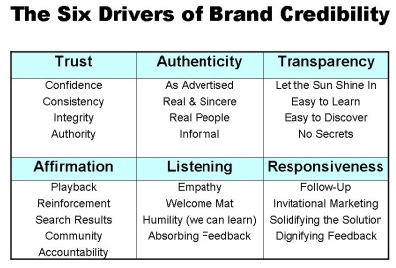
According to Pete Blackshaw of Nielsen, a brand’s credible reputation is driven by 6 factors:

image

Source: Pete Blackshaw http://www.tell3000.com/

* * * * *

Want more from the Homa Files?
Click link =>
  The Homa Files Blog

J&J Fights Big With Small Brands

October 22, 2008

Excerpted from AdAge “Small Brands Could be J&J’s Next Big Thing ” by Jack Neff, October 6, 2008

* * * * *

Selling big, heavily extended brands at large retailers has been a cornerstone of success for the personal-care marketers for most of the decade. But as that business model shows signs of fraying, $61 billion Johnson & Johnson increasingly is trying something a lot more entrepreneurial.

In the past year, J&J has quietly ramped up a major assault on direct-response skin-care powerhouse Proactiv with the SkinID brand. The Neutrogena subbrand offers customized acne-fighting and other skin-care products and is sold online…

Clearly, J&J has benefited from the big-brand, big-retailer model up to now. Information Resources Inc. data reported by Deutsche Bank shows the company gaining share in key categories such as acne products, facial moisturizers and cleansers in recent quarters. With global sales estimated by people familiar with the company at $2 billion to $2.5 billion, Neutrogena is neck and neck with other global megabrands, such as Procter & Gamble Co.’s Olay and Unilever’s Dove.

Yet both of those rival brands have slowed within the past year and begun losing share, at least in tracked U.S. channels. And even the biggest brand behemoth in mass, L’Oréal…has begun losing share in cosmetics and hair colorants in the past year…to smaller P&G brands Cover Girl and Clairol…

Should the same fate befall Neutrogena, at least J&J has skin in another game. J&J launched SkinID by “Neutrogena Dermatologics” on a limited basis in April, then ramped up spending behind infomercials featuring former “American Idol” contestant Katharine McPhee starting in May…

As with Proactiv, the products are customized assortments available only by phone or online, but Neutrogena ads bill SkinID products as “twice as effective as Proactiv.” The tack appears to be working, with traffic to skinid.com running at around half the level of traffic to proactive.com after only a few months of all-out effort by J&J…

“We’re revolutionizing skin care through questions to our consumers,” said Cal Schmidt, VP-sales and marketing for J&J unit McNeil Nutritionals, referring to the early stages of SkinID in a talk at an Advertising Research Foundation forum in April. “We are offering our customers specific products tailored to them… And then you have this ongoing dialogue.”

Not to mention ongoing sales. What likely makes the proposition most attractive to Neutrogena is automatic replenishment, which keeps consumers buying and prevents the switching common at a retail shelf…

Edit by SAC

* * * * *

The SkinID brand isn’t J&J’s first attempt at skin-care products for specific skin types.  The company has had success with another smaller brand, Ambi, since it acquired the brand in 2004.  The Ambi brand includes skin-clearing and skin-tone evening products to specifically meet the needs of African, Asian and Latin woman.  As with SkinID.com, the product website, ambi.com also provides skin care advice for consumers and helps them find the product to best meet their skin-care needs.

* * * * *
Full article:
http://adage.com/article?article_id=131485

* * * * *

Want more from the Homa Files?
Click link =>
The Homa Files Blog

The Wealthy Shifts on Luxury, Optimism, & Politics

October 21, 2008

Excerpted from AdAge “Study:Luxe Loses Luster for Wealthy” by Lucia Moses, October 2, 2008

* * * * *

Fears about personal finances are bubbling over to America’s richest, says a new survey by American Express Publishing and researcher Harrison Group, whose findings bode ill for the already-softening luxury advertising category.

The survey, conducted Sept. 19-23 among 614 consumers with an annual household income of $100,000-plus—the top 10% of America’s families—asked how the market turmoil was affecting respondents’ spending plans…The vast majority of respondents—83%—said they were waiting for items to go on sale before buying.

Luxury is losing favor with this group; the percentage of people who said a little luxury was important in tough times declined to 50% from 61% in June. “What makes the survey a source of concern is that this top 10% represents over 50% of all retail spending,” Jim Taylor, vice chairman of Harrison Group, said in a statement. “It is affluent consumers who have kept the consumer economy afloat and whose purchasing is critical to the coming holiday season.”

Attitudes among the affluent have worsened throughout the year, with 48% of the country’s richest families saying they were worried about running out of money, up from 35% in April. Sixty percent said they believed the economy was in a recession that would last more than a year, up from 55% in June.

Optimism also is on the downswing. Fifty-five percent of respondents indicated they were optimistic about their future, down from 93% in 2005…

The survey also found that the Republican Party is losing its hold on the wealthy. The percentage of the affluent calling themselves Republicans stood at 34% in September, down from 46% in 2006, the survey showed. An equal percentage said they were independent, up from 19% two years ago…findings suggest that the affluent still favor Republican candidate John McCain for president but that there are enough undecided wealthy voters to tip the scales in favor of Democratic hopeful Barack Obama.

Edit by SAC

* * * * * 
Full article:
http://www.brandweek.com/bw/content_display/news-and-features/retail-restaurants/e3id41521fe85d4537f1ae883da0ed6db34?imw=Y

* * * * *

Want more from the Homa Files?
Click link =>
The Homa Files Blog

'Play Ball' ? Obama – treading on the American pastime – says 'not so fast' …

October 17, 2008

Excerpted from THR.com “Fox to Change World Series Start Time for Obama”, Paul J. Gough, Oct 15, 2008

* * * * *

To accommodate a half-hour Obama political advertisement on Fox on Oct. 29, Major League Baseball has agreed to move the start time of World Series Game 6 by about 15 minutes. That would move the start of the game from 8:20 p.m. ET or so to 8:35 p.m.

“Fox will accommodate Senator Obama’s desire … If requested, the network would be willing to make similar time available to Senator McCain’s campaign.”

The blessing from MLB clears the way for Fox to air the promo and collect upward of $1 million in ad revenue for the half hour, more than what either CBS or NBC was charging.

* * * * *

Full article:
http://www.hollywoodreporter.com/hr/content_display/television/news/e3ifa25645bfd6bcf91b52ef4f665b661f5 

Thanks to SMH for spotting the story

* * * * *
Ken’s Take:

(1) If I were McCain, I’d take Fox up on the offer and buy 30 minutes or so before game 7 … good buzz even if the series doesn’t go the full 7 games

(2) When at B&D, we’d buy “end of reel” time during the World Series.  It’s kinda like flying standby. Networks sell extra commercial spots (cheap) just in case a game has many pitching changes or goes into extra innings.  One year, we hit lotto — game 7 went extra innings and we got several exposures.  Mc Cain should do that, too.

* * * * *

Want more from the Homa Files?
Click link =>
  The Homa Files Blog

‘Play Ball’ ? Obama – treading on the American pastime – says ‘not so fast’ …

October 17, 2008

Excerpted from THR.com “Fox to Change World Series Start Time for Obama”, Paul J. Gough, Oct 15, 2008

* * * * *

To accommodate a half-hour Obama political advertisement on Fox on Oct. 29, Major League Baseball has agreed to move the start time of World Series Game 6 by about 15 minutes. That would move the start of the game from 8:20 p.m. ET or so to 8:35 p.m.

“Fox will accommodate Senator Obama’s desire … If requested, the network would be willing to make similar time available to Senator McCain’s campaign.”

The blessing from MLB clears the way for Fox to air the promo and collect upward of $1 million in ad revenue for the half hour, more than what either CBS or NBC was charging.

* * * * *

Full article:
http://www.hollywoodreporter.com/hr/content_display/television/news/e3ifa25645bfd6bcf91b52ef4f665b661f5 

Thanks to SMH for spotting the story

* * * * *
Ken’s Take:

(1) If I were McCain, I’d take Fox up on the offer and buy 30 minutes or so before game 7 … good buzz even if the series doesn’t go the full 7 games

(2) When at B&D, we’d buy “end of reel” time during the World Series.  It’s kinda like flying standby. Networks sell extra commercial spots (cheap) just in case a game has many pitching changes or goes into extra innings.  One year, we hit lotto — game 7 went extra innings and we got several exposures.  Mc Cain should do that, too.

* * * * *

Want more from the Homa Files?
Click link =>
  The Homa Files Blog

Consumers Lose as Packaging Shrinks

October 17, 2008

Excerpt from the New York Times “Ate a Whole Pint? Check Again” September 13, 2008

* * * * * 

REMEMBER the supersize phenomenon, when fast-food restaurants offered huge portions of soda and fries?

Some packaged foods that have shrunk in size include a jar of Skippy peanut butter, from 16.3 ounces down to 15 ounces, and a bag of Doritos chips, from 13 ounces to 12.5 ounces. The reverse is now happening in America’s supermarkets and big-box retailers. In industry lingo, it’s called short-sizing.

Aiming to offset increased ingredient and transportation costs, some of the nation’s food manufacturers are reducing the size of packages…Some companies possibly cut back on the quantity of product in a package in the hope that consumers wouldn’t notice or care. Judging by rants on various blogs, though, many consumers have noticed, and they do care.

Others have acknowledged that they have downsized products, but that has not stopped consumers from venting outrage…

Ice cream once was sold in half-gallon containers, but many companies shifted several years ago to 1.75 quarts. Now, with milk and egg prices soaring, many ice cream makers are selling 1.5-quart containers — without lowering the price…

Cereal boxes are becoming smaller, too, including those for Cheerios from General Mills and Apple Jacks and Froot Loops from Kellogg’s.

Frito-Lay has cut the size of Doritos, while jars of Hellmann’s mayonnaise and Skippy peanut butter have also shrunk recently…package sizes have also been reduced for…Hershey’s Special Dark chocolate bar, Iams cat food, Tropicana orange juice, Dial soap and Nabisco Chips Ahoy cookies…

Edit by SAC

* * * * *

Full article:
http://www.nytimes.com/2008/09/14/business/14feed.html?_r=1&scp=1&sq=%22Ate%20a%20Whole%20Pint?%22&st=cse&oref=slogin

* * * * *

Want more from the Homa Files?
Click link =>
The Homa Files Blog

Tough Ads for Tough Times, Marketers Use More Comparison Ads

October 17, 2008

Excerpted from The Wall Street Journal “And in This Corner…Marketers Take Some Jabs” by Suzanne Vranica, October 2, 2008

* * * * *

As the economy gets ugly, marketers are getting nasty too.

From soup companies to pizza chains, marketers are stepping up their so-called attack ads, calling out rivals by name, comparing products and poking fun at competitors.

An example: This week, Domino’s Pizza is giving away oven-baked sandwiches to the first 1,000 customers named Jared — a reference to Jared Fogle, the well-known pitchman for Subway Restaurants…

Just how acrimonious is it getting out there? The National Advertising Division of the Council of Better Business Bureaus, which acts as the ad police, is fielding many more complaints from marketers who believe they are the victim of misleading comparison ads…in August alone, the NAD had 15 advertisers challenge competitive ads that rivals had begun using — compared with six challenges in August 2007. September also saw complaints jump about 50% from last year…

“In a downturn, people are being more and more careful on how they are spending their money, and more than usual you have to make sure you are breaking through and giving them a reason to buy you,” says Patrick Doyle, president of Domino’s USA.

Several weeks ago, Campbell Soup kicked off a big ad effort, created by BBDO, that took on rival General Mills’ Progresso. One print ad shows a can of Progresso with the caption, “Made With MSG,” while a headline above an adjacent picture of a can of Campbell’s Select Harvest reads: “Made With TLC.” The two brands have taken shots at each other in the past, but this is the most aggressive Campbell Soup has gotten…

Meanwhile, Burger King has deployed a steady string of ad attacks against its archrival McDonald’s and other competitors this year. One billboard ad featured a Whopper sandwich not fitting into a Big Mac box with a headline that reads: “SILLY WHOPPER, THAT’S A BIG MAC BOX”…

Comparison ads have been around since the 1970s, when the major television networks lifted a ban on the practice after the FTC publicly began to encourage it. Since then, they have been used to sell everything from antacids to paper towels. The technique is most closely associated with the cola wars between Coke and Pepsi…

With the current financial crisis looking like it is far from over, consumers can expect plenty more attack ads…

Attack ads, when they get too intense, can confuse consumers…The key is some subtlety in the delivery, marketers say. It is “inappropriate to get overly aggressive,” says Colin Watts, vice president and general manager of Campbell’s U.S. Soups…Despite the risks, many marketers say they have scored points with hard-edged ads.

…Campbell Soup’s taste-test commercial was the fifth-most-liked television ad that ran from Aug. 18 to Sept. 14, according to IAG, a Nielsen Co.-owned market-research firm that uses an online panel to measure ad performance.

Edit by SAC

* * * * *
Full article:
http://online.wsj.com/article/SB122289868915095901.html

* * * * *

Want more from the Homa Files?
Click link =>
The Homa Files Blog

Wendy’s Changes its Target, Leaving the Red Wig Behind

October 16, 2008

Excerpted from the Wall Street Journal “Wendy’s Comes Up With a New Strategic Recipe” by Janet Adamy, September 29, 2009

* * * * *

Wendy’s plans to target older customers, change its value menu and improve items like its french fries as its new owner takes over.

Wendy’s new chief executive, Roland Smith, says the chain plans to market to older customers…Wendy’s has struggled to increase sales and profit since Mr. Thomas died six years ago, and that led directors to put the chain up for sale last year.

In an interview, Roland Smith, president and chief executive of the new Wendy’s/Arby’s Group Inc., said executives plan to reverse the previous’ management team’s strategy of courting 18- to 24-year-olds and will instead aim its marketing at customers ages 24 to 49. A new marketing campaign that focuses on the quality of the chain’s food “is a breath of fresh air from the red-wig campaign,” a more offbeat series of commercials that Wendy’s ran last year featuring young men wearing red wigs, Mr. Smith said.

Mr. Smith said that, like rivals McDonald’s Corp and Burger King Holdings Inc., Wendy’s plans to change its value menu, which includes three items for 99 cents, as it faces higher ingredient and labor costs. He said Wendy’s is considering higher price points for some items and looking at putting different items on the menu…

Mr. Smith acknowledged that Wendy’s hasn’t done a good-enough job of creating products to bolster sales and fend off competitors. After talking to franchisees, he decided that the chain also needs to improve the quality of existing items and emphasize a message of freshness in its marketing. In particular, he wants Wendy’s to offer better french fries, sandwich buns and bacon.

For Wendy’s, one of the keys to increasing its sales and profit will be breaking into the breakfast business…Wendy’s has been serving breakfast at some locations but has yet to hit on a successful strategy. Mr. Smith said the company needs to reformulate some of its breakfast items and improve its coffee, which is made by Procter & Gamble’s Folgers. Wendy’s also is testing espresso drinks in some stores.

Another key to improving sales will be remodeling thousands of Wendy’s restaurants…The credit crunch is likely to make that more difficult for franchisees who need to borrow money to fund the renovations. “It’s going to be tougher to get money to buy stores and rebuild stores”…

Edit by SAC

* * * * * 
Full article:
http://online.wsj.com/article/SB122270629158386159.html

* * * * *

Want more from the Homa Files?
Click link =>
The Homa Files Blog

Buzz Words: “Brand Accretion”

October 16, 2008

Excerpted from BusinessWeek “The Case for Brand Accretion”, by Steve McKee, September 12, 2008

* * * * *

Brand accretion. With respect to branding, accretion is the simple principle that the more you invest—and the more consistently you invest—the better your long-term returns will be.

* * * * *

In a branding context, accretion means that none of your marketing efforts exist in a vacuum. Sure, you want them to have an impact today, but they also add to, and are interpreted within, the context of your past and future efforts.

Think of branding as a process, not a static point in time; if your message is steady and consistent, you can build significant brand equity. If, however, you continually change your approach, carelessly cut your budget, or seek only short-term benefits, you’ll be compromising your own long-term interests.

* * * * *

James Gregory’s marketing firm, CoreBrand, has conducted years of research about the long-term effects of marketing investments. He says it’s rare for even a one-year surge in advertising spending to generate measurable results in image development; it’s usually at least three years before you see real change. That’s a long time if you’re starting from zero, but if your efforts are continuous, the power of accretion will continually work on your behalf.

Edit by DAF

* * * * *

Full article:
http://www.businessweek.com/print/smallbiz/content/sep2008/sb20080912_752256.htm

* * * * *

Want more from the Homa Files?
Click link => 
The Homa Files Blog

* * * * *

Its His Turn: Marketing to Dad’s

October 16, 2008

Excerpted from Marketing Daily “Marketing to Today’s Dad Requires New Approaches” by Karlene Lukovitz, September 22, 2008

* * * * *

Many Generation X and Y fathers, in particular, are a new breed who are more involved with their children’s lives and more likely to make day-in, day-out types of product purchases–not just the home electronics or riding lawnmower buys, confirms a new study from Packaged Facts authored by Silver Stork Research.

Marketers looking to reach beyond appealing mostly or only to mothers to tap into this “Dad Factor” need to stop reflexively “thinking pink,” say the analysts. They should gear their brands’ media outreach and benefits positioning to these new fathers–who have a markedly different purchasing behavior than moms…

Who are these new generations of dads? They are less defined by gender stereotypes and see much less of a dividing line between men and women…these dads approach parenthood with a team attitude. Gen X and Y dads are positive, comfortable with their gender, optimistic about being parents …and much more active consumers than dads of previous generations.

* * * * *

Key facts about newer-generation dads and marketing effectively to them, per the report:

Dads are men–meaning that parenthood doesn’t change their overall approach to the world; it just expands it.

Like mothers, fathers’ key concerns regarding their children are education and health…

Dads don’t like to browse and shop, at least when it comes to family-oriented products… However, they do have a propensity to make impulse purchases–an opportunity for marketers.

Electronic media and the Internet are key…

New dads are attracted to products that are practical and solve a problem. They put quality before price…At the same time, marketing should seek to leverage these dads’ appreciation of a humorous element in…and seek to add an element of fun to the products themselves. Fun and play are cornerstones of interaction between these dads and their kids.

Marketing/advertising should reflect these dads’ parental motivations to give their kids what they want, make their kids happy and be perceived as heroes by their children.

Marketing should include images of dads interacting with kids, especially “real” dads/kids, to reflect the more positive, involved image to which younger dads relate… Product packaging should take male-appeal into account…

Including products or product appeals geared to dads within promotions primarily targeting moms can also be effective.

Edit by SAC

* * * * *
Full article:
http://www.mediapost.com/publications/?fa=Articles.showArticle&art_aid=91038

* * * * *

Want more from the Homa Files?
Click link =>
The Homa Files Blog

Big Profits from "Inferior" Products

October 15, 2008

Excerpted from Strategy & Business, “A Breakaway Opportunity for “Inferior” Products”, by Leslie Moeller, James Ryan, and Juan Carlos Webster, September 16, 2008

* * * * *
As the difficult economy causes consumers to trade down in their purchases, companies need to adjust their offerings to their customers’ new behavior.

The current economic crisis is creating a “new normal” in consumer buying habits. Before the recent downturn, when consumers tried to save money, they traded down from branded products to private-label or so-called value brands. But they tended to keep buying some form of the product; they continued to pay for the convenience of, say, antibacterial throwaway wipes or gourmet frozen foods. In the current economy, they are not just trading down within a category, but switching to “inferior” products and services — paper towels instead of wipes, washcloths instead of paper towels. In the process, they are raising the value of the type of products and services economists call “inferior goods”: those that attract consumers more when purchasing power declines.

This will require a major shift of focus for many consumer-oriented companies. During the past decade or so, marketers have grown accustomed to the trend known as “premiumization”: Each year, consumers sought out higher-priced and more distinctive products.

Premiumization will never go away completely. But suddenly it has moved to the slow lane. The reason, of course, is the continuing economic downturn.

The impact has not been gentle on premium products, even the relatively inexpensive or everyday kinds. Retail sales figures for the second quarter of 2008 showed declines of 0.7 percent for Target Corporation (versus a gain of 2.7 percent for Wal-Mart Stores Inc., which has much less of a premium focus in its category) and a significant “mid-single-digit” decline for the Starbucks Corporation.

* * * * *

If you can attract consumers to your category from another, the era of inferior products may bring you superior opportunities. Consumer-oriented companies should consider the following options when facing the current economic slowdown:

1. Don’t blindly lower prices to regain volume. Simply reducing prices could well be financially disastrous; it already has been for several casual-dining restaurant chains. Across-the-board price-cutting may lower the price of a $12 meal to $9 or $10, and thus affect the perceived value of, say, Boston Market versus Chipotle, but it will not have any effect on a consumer who is opting for a $5 meal by eating at home.

2. Find the inferior products that will attract consumers as their purchasing power decreases. Introduce a new brand or sub-brand in the categories to which consumers are moving in this downturn. Of course, companies will run the risk of potential cannibalization, but that’s still better than losing customers altogether.

3. Cement consumers to your brand. Once you have attracted consumers to your inferior product, bind them to your brand. Give them an experience that merits repurchase. Think about the products you can trade them up to when the economy starts to recover — for example, the health-conscious, convenient, or premium products that will make them stick to your brand as their incomes increase.

4. Make the new normal feel better. You can help consumers feel good about migrating to inferior goods by enabling them to justify their decisions in terms other than affordability. Toyota Motor Company’s Prius is a great example: Consumers don’t feel bad about trading in their BMW or Escalade, because they are doing their part for the environment; it’s not simply that they can’t afford anything more expensive.

* * * * *

Brand owners and companies that offer products or services to customers across a broad range of price points, and that can manage the cycle, will fare better than those with more focused products and offerings that can’t adapt up- or downstream as consumer choices change.

Edit by DAF

* * * * *
Full article:
http://www.strategy-business.com/li/leadingideas/li00093?pg=all

* * * * *

Want more from the Homa Files?
Click link => 
The Homa Files Blog

* * * * *

Credit Crunch Decaffeinates Coffee Push at McDonalds

October 15, 2008

Excerpted from AdAge “Credit Crunch Takes Bite Out of McDonalds” by Emily Bryson York , September 29, 2008 

* * * * * 

The banking crisis is threatening to take a rather surprising hostage: McDonald’s big-budget coffee rollout.

Tightening credit conditions, which are crimping plans for marketers as diverse as giant General Motors Corp. and relatively small household-products company Method, have prompted Bank of America to halt loans to McDonald’s franchisees. They need the capital to frantically build coffee bars in the chain’s 14,000 locations for what was planned to be an April coffee introduction.

And although it won’t derail the launch altogether, it is likely to delay it nearly into summer — hardly optimal timing for a hot-beverage introduction. It also could force the company to postpone a huge marketing push it’s been planning to support the java drive, as the company generally waits until 60% of its stores have been outfitted to undertake a national ad push. The fast feeder maintains that everything is on track…

Franchisees are spending about $100,000 per store to accommodate the “combined beverage business,” which includes lattes and cappuccinos. Most are seeking loans for the build-out. “As money remains tight, it’s going to be more difficult to get the loans to remodel for the combined beverage strategy,” one franchisee said…

The corporate memo additionally advised that “now is not the time to be shopping for loans based on interest rates,” or to refinance existing debt. It went on to suggest franchisees consider using cash on hand to cover new-equipment costs…

“I think it could very likely slow down the [rollout],” said Darren Tristano, exec VP of Technomic. “That plus the impact that Starbucks has seen in traffic and a decline in sales, I think it probably would be better to slow it down and continue to test it and see how the results are.”

McDonald’s spokesman Bill Whitman, however, said the beverage strategy is “on target and progressing as planned.”

“There continues to be more than sufficient liquidity available to our franchisees to fund capital improvements in their restaurants,” he said, adding that more than 50 national, regional and local lenders are providing financing to U.S. franchisees.

…it seems clear that the company is backpedaling. In July, McDonald’s was expecting the rollout to be completed by April. Earlier this month, Ralph Alvarez, chief operating officer, told analysts at a Bank of America conference that the specialty-coffee rollout should be complete by mid-2009.

Even if that date stays on track, the chain would likely miss the cold-weather window in which hot drinks are said to be the most popular…Another problem will be what to do with the ad calendar…

Edit by SAC

* * * * *
Full article:
http://adage.com/article?article_id=131320

* * * * *

Want more from the Homa Files?
Click link =>
The Homa Files Blog

Pepsi Targets Eco-Centric Consumers Online

October 14, 2008

Excerpted from Brandweek “Pepsi Ups its Online Eco Efforts” by Kenneth Hein, September 30, 2008  

* * * * * 

Pepsi, today, is launching not one, but two Web sites trumpeting its eco-friendly efforts. PepsiEcoChallenge.com and Pepsirecycling.com both spotlight Pepsi-Cola North America’s slew of sustainability programs.

The more promotional site, Pepsirecycling.com, offers consumers 100 Pepsi Stuff points for taking a quiz about recycling. Points can be redeemed for prizes, like shirts made from recycled materials, and entrance into a sweepstakes for a Smart car. Pepsirecycling.com  offers a myriad of information about recycling as well as origami instructions for used 12-pack cartons.

“We’re putting recycling front and center and giving our customers an incentive to do their part for the environment,” said Victor Melendez, vp-marketing, sustainability for PCNA, Purchase, N.Y., in a statement. “Pepsi has always stood for fun and now we’re channeling that Pepsi spirit into raising environmental awareness.”

PepsiEcoChallenge.com reads more like an interactive brochure that explains how the company is working to save energy and water as well as working to create sustainable packaging… It points out Pepsi is working to reduce its U.S. plants’ water consumption by 20%, electricity usage by 25% and fuel consumption by 25% by 2015.

Because a segment of consumers demand eco-accountability from their favorite brands, such efforts are of increasing importance, said John Sicher, editor of Beverage Digest, Bedford Hills, N.Y. “There is certainly growing interest among consumers in buying products from socially responsible companies,” he said. “It’s important that big companies like Pepsi reach out and show decision makers and decision influencers that they are taking a lead in this.”

Edit by SAC

* * * * * 

Full article:
http://www.brandweek.com/bw/content_display/news-and-features/digital/e3i5452d1396a606a4187805864881b8d0d

* * * * *

Want more from the Homa Files?
Click link =>
The Homa Files Blog

Coke Leads Brand Value Rankings

October 14, 2008

Excerpt from Ad Age “Coke Still No. 1 in Brand Value” by Jean Halliday September 19, 2008  

* * * * *

Coca-Cola is again the world’s most valuable brand, according to Interbrand’s just-released annual list of the Best 100 Global Brands.

While Coke held onto its top slot from last year, IBM, by expanding its services and transitioning out of production, moved up to No. 2, knocking Vista-burdened Microsoft to third…GE was fourth, boosted by its “Ecomagination” communications program, and Nokia fifth.

The brands with the biggest growth in the past 12 months were: Google, up 43%; Apple, up 24%; Amazon, up 19%; retailer Zara, up 15%; and Nintendo, up 13%. Only one brand in the top 20, Citi, saw its brand value fall…Joining the list for the first time are: retailer H&M, taking the No. 22 slot; Thomson Reuters, ranking No. 44; BlackBerry at 73; Ferrari at 93; Marriott at 96; FedEx at 99; and Visa at 100.
Among the five brands with the biggest year-over-year drops in brand value were three financial players: Merrill Lynch, which fell 21%; Morgan Stanley, sliding 16%; and Citi, falling 14%. Gap was down 20%, and Ford dropped 12%.
Strong and weaker brands all use research to try to stay in touch with their customers. But the winning brands can innovate quickly and bring fresh ideas to market, said Mr. Bateman, citing a statement by hockey great Wayne Gretsky as advice to fallen brands: “Skate to where the puck was going, not to where it was.”      

Edit by SAC
* * * * * 
For more information and to see the full list of brand rankings, visit: http://biz.yahoo.com/prnews/080918/ny33972.html?.v=1

* * * * *  

Full article:
http://adage.com/article?article_id=131117

* * * * *

Want more from the Homa Files?
Click link =>
The Homa Files Blog

Packaging’s Impact On Waistlines

October 10, 2008

Excerpted from INSEAD Knowledge “Supersizing and downsizing: the impact of changing packaging and portion sizes on food consumption

* * * * *

When it comes to packaging, size matters.

In a research paper, INSEAD Associate Professor of Marketing Pierre Chandon and co-author Nailya Ordabayeva, an INSEAD PhD student, found that changes in the shape of packaging or portions can have a big impact on our consumption patterns.

As consumers, we tend to buy bigger packages or order bigger portions because we believe we’re getting better value. However, this phenomenon leads to overeating and obesity because we fail to notice just how big these portions and packages are and hence underestimate how much we consume. The size and the shape of packaging play a key role in these misperceptions…

For marketers, this means that if a company increases the size of its packaging in one dimension, consumers perceive it to be much larger and so assume they’re getting a better deal and are more likely to buy it. If a company increases the product size by the same volume but the package is expanded in three dimensions – not just one – consumers don’t perceive as big of a change.

This has important consequences for purchase and consumption decisions…“If you want people to order a larger portion, then you should just increase the height because people will notice. If you want to reduce the quantity of your portions, for example if you had higher raw material costs, you should reduce the height, the width and the length because people won’t notice,” Chandon says.

The research is timely because the phenomenon of ‘supersizing’ has swept the US and is now moving to the rest of the world…This trend has had a big impact on how much consumers eat. The supersizing trend is one of the main drivers of the obesity epidemic and packaging is adding to the problem, the study states.

“It’s very easy to be influenced by marketers,” Chandon says. “For example, the size of the package, the size of the meals, even the size of the plates and of the spoons; we know these things have a very strong impact on how much we eat.”

When it comes to eating healthy, people sabotage themselves as well…Chandon’s research shows that, in addition to underestimating how much we eat, when we eat ‘healthier’ meals, we tend to reward ourselves with treats or bigger portions…

One of the other conclusions of the research: downsizing packaging and portions is one of the most effective ways of reducing overeating. Chandon believes there’s a growing market for low calorie, smaller portion products. But manufacturers need to be very clear in their labelling and careful about pricing, because many consumers think smaller portions are less economical. 

Edit by SAC

* * * * * 
Full article:
http://knowledge.insead.edu/SupersizingDownsizing080901.cfm

* * * * *

Want more from the Homa Files?
Click link =>
The Homa Files Blog

Captive Brands Compete Big in Beauty

October 9, 2008

Excerpted from Brand Week “Retailers Rally Behind Their ‘Captive Brands'” by Elaine Wong, September 28, 2008

* * * * *

Retailers have come a long way from the no frills aisle.Rather than marketing store brands as some lesser, cheaper alternative to brand name products, Wal-Mart, Walgreens, CVS and others are increasingly creating and promoting their own “captive brands”… 

Carrying no evidence of the store’s affiliation, these brands, manufactured by a third party and sold exclusively at the chains (hence “captive”), let the retailer command a price similar to brands produced by consumer packaged goods companies like P&G. They also let the retailers gain ground in a category—beauty—for which consumers generally take a dim view of traditional private label brands….

P&G has taken notice. “We treat them just like we do any other competition,” said P&G rep Dave McCracken. “We try to out-innovate anyone, whether it’s a captive or retailer brand or other competition.”…Competition among retailers is driving the captive brand movement, said Walgreens rep Tiffani Bruce. “It’s a way of differentiating. If there’s something we have that other retailers don’t have, it’s an opportunity for us to build loyalty.”
Walgreens created an internal “brand police” to regularly evaluate its product portfolio. “They protect the standard and quality for our brands so we know that we are competing side-by-side with national brands,” Bruce said. “We have limited shelf space so we try our best to pinpoint which brands are resonating well with customers and what needs are being met.”

One reason why the shift has affected beauty care more than other industries is because the category itself is “over-SKU-ed,” said Mike Moriarty…”If you look at the haircare aisle, it has way too much product in it anyway.”  The influx makes it particularly tempting for retailers to introduce their own offerings because they can identify certain niches not yet met by their consumer packaged partners, Moriarty said.Since the retailer ultimately controls the display units, the result is a shelf space war. That’s a circumstance in which captive brands have a distinct advantage…This, however, does not mean that captive beauty brands will eventually displace their branded rivals, CVS’ Pensa said.. 

Edit by SAC

* * * * *  

Full article:
http://www.brandweek.com/bw/content_display/news-and-features/packaged-goods/e3if624dc1ee34cd1b5f24e9d19408550b8?imw=Y

* * * * * 

Want more from the Homa Files?
Click link =>
The Homa Files Blog

Cheap & Chic Brands Pay Off

October 8, 2008

Excerpted from BrandChannel “Value Store Brands: High-end Taste for Low Spenders” by Barry Silverstein, September 29, 2008

* * * * *

Arguably, the king of cheap chic is US retailer Target. Faced with intense retail competition years ago, Target chose “to reposition itself as a mass merchandiser of affordable chic goods”…While Kmart was approaching bankruptcy and Wal-Mart was dominating the retail market with low prices, Target “successfully associated its name with a younger, hipper, edgier, and more fun image than its competitors. Target is often pronounced in faux French, ‘Tar-zhay,’ to connote its trendy sensibility.”

Target achieved differentiation…This ‘cheap chic’ strategy enabled Target to become a major brand…Target’s strong sales results over the past several years prove that the strategy has paid off…the chain is doing better than many of its competitors, buffered by well-regarded store brands, clever advertising, and novel merchandising.

…One reason Target’s brands have achieved cheap chic status is Target’s emphasis on design. Fashion designers such as Mossimo, Isaac Mizrahi, Philippe Starck, and Sigerson Morrison have developed exclusive lines for Target…These collections have the cachet of name-brand designer merchandise, but at a price point far less than the typical designer-driven brands sold at more expensive retailers.

Other value stores use this strategy. Kmart, for example, sells Jaclyn Smith-branded fashion and Martha Stewart-branded housewares. Sears is currently featuring the exclusive LL Cool Jay Collection. Retailer Kohls has joined in, exclusively marketing Simply Vera Vera Wang, a premium fashion and lifestyle brand, and a Food Network-branded line of kitchen and home goods.

Price-cutting giant Wal-Mart has tried its hand at designer brands as well…Despite these efforts, however, Wal-Mart has not seen significant financial gains from its designer clothing—nor has Wal-Mart been able to match Target’s trendiness…

* * * * *

Target has exerted its cheap chic strategy in another area: upscale foods. Target markets a premium brand called Archer Farms…Archer Farms uses upscale packaging, often depicting full-color product photography on elegant boxes, bottles and jars. As with Target’s other upscale brands, however, the prices are unusually affordable.

Value-priced upscale food is a growing market in its own right. Chains such as US-based Trader Joe’s supermarkets…trade on the consumer’s desire for affordable gourmet products. Trader Joe’s unique differentiator is that…most of the items on its shelves are actually its own store brands. These products are largely specialty items priced considerably below gourmet food stores…

There is already a fair amount of evidence that store brands, chic or not, are seeing a significant uptick in sales because of the economy. In September 2008, Kroger, one of the largest US supermarket chains, reported that its own store brands accounted for a record 26 percent of its fiscal second quarter sale…

* * * * *

Whether it’s fashion, food, or any other product category, cheap chic is clearly a global trend…Global economic conditions are likely to keep the interest in cheap chic brands high. While the average consumer likes trendy merchandise at bargain prices, the wealthy shopper may find cheap chic increasingly attractive as luxury goods become too pricey…

Retailers like Target, who already know how to create and market cheap chic brands, stand to benefit the most. But adopting a cheap chic strategy could help many other retailers insulate themselves from an economic downturn. That would be a welcome development for consumers who don’t want to sacrifice quality design for price.  

Edit by SAC

* * * * *

Full article:
http://www.brandchannel.com/start1.asp?fa_id=442

* * * * *

Want more from the Homa Files?
Click link =>
The Homa Files Blog

Brand Wars: Obama vs. McCain

October 6, 2008

Excerpted from BrandChannel: “Brand Obama or Brand McCain ”, Patt Cottingham

* * * * *

Ken’s Note: The full article is interesting reading for marketers.  It’s a non-political run-through of of how the candidates’ “brands” developed — the words, the images, and of course, the logos.

* * * * *

OBAMA LOGO: The Obama Campaign chose an icon that captured the feeling of sunrise over a field of red and white stripes. There is also a subtle “O” for Obama that is in play here though the name Obama is not used in the icon. This makes it a universal logo/icon that anyone can attach their own meaning to. The Obama and Pepsi (far right) logos are both round, youthful, and use the colors red, white, and blue.

image

* * * * *

McCAIN LOGO: The McCain Campaign chose a logo that comes directly out of his family heritage of 3 generations in the US Navy, as well as his war hero status political leader. The colors of blue and gold are US Navy colors, the star icon comes directly out a military reference found on many uniforms indicating rank. The McCain and US Army logos (far right) are traditional, proud, and derived from the military.

image


* * * * *

Full article:
http://www.brandchannel.com/images/papers/443_Presidential_Brands_final_web.pdf

* * * * *

Want more from the Homa Files?
Click link =>
  The Homa Files Blog

Lessons for Brands in a Polarized Economy

October 6, 2008

Excerpted from BrandChannel “Best Global Brands: Lessons Learned” by Jim Thompson, September 17, 2008  

* * * * *

Despite this past week, the year 2008, in general, has been an excellent one for developing nations. China, Brazil, Russia, India and other historically troubled economies continue to enjoy burgeoning middle and upper classes that are spending money on purchases they could not afford in the past.

In contrast, this has not been a good year for developed nations. The United States, and now every country tied to America’s radioactive financial service industry, is suffering because deluded borrowers and irresponsible lenders were circulating money they never actually had.

So, what can Interbrand’s 2008 Best Global Brands report teach us about the world’s top 100 brands in this bipolar global economy? Plenty.

* * * * *

Lesson #1: Brand Engagement is Crucial

Here is how Merrill Lynch positions its brand online:

Merrill Lynch demonstrates its commitments to clients and shareholders through the firm’s emphasis on excellence, integrity and ethical behavior…

Though individual citizens share much of the responsibility, financial services touting a devotion to fiscal responsibility and economic viability failed to maintain brand engagement among their ranks, and the result has been a devastating collapse of trust and shivers of recession that are reverberating across the globe.

Investing in the proper training of employees so they embrace and live corporate brand attributes is a key component of branding, so it is not surprising that myopic financial service brands such as AIG, UBS, and Morgan Stanley have all dropped in Interbrand’s 2008 Best Global Brands rankings…

* * * * *

Lesson #2: Luxury Brands Adjust to the Tides of the Global Economy

…Luxury brands benefit from a consumer-driven psychological buoyancy that allows them to paddle the currents that stir the global economy…

People like nice things. Unfortunately, most of us can’t afford the highest in quality, the finest in elegance, and the sleekest in design. The vast majority of the human race cannot afford a Rolex watch. However, as many economies around the world thrived during the past year, increasing numbers of people came within financial reach of luxury brands…as these demographics become accustomed to nice things, something compelling happens.

Ricca explains, “In a mature economy, a consumer’s self-confidence derives from being discerning rather than merely rich. Subtle details, which add depth to the product experience, are not within reach of the wealthy, but the wealthy cognoscenti.” Indeed, being able to afford Iranian caviar, and being able to deconstruct Iranian caviar, represent two different levels of experience with the luxury-brand lifestyle.

* * * * *

Lesson #3: Know Thyself and Build Trust in Others

Branding communicates a set of values and promises to customers. When a brand delivers on those promises, trust is created, and a relationship based on shared experience and loyalty ensues. That bond is vital to brands, particularly when the economic climate sours and consumers shift their spending habits.

As the 2008 Best Global Brands Executive Summary states, “The uncertainty of a downturn drives consumers to want more for their money and demand a more emotionally rewarding experience for their hard-earned and limited cash.” In such times loyalty often competes with necessity. “It’s no longer a choice between Nike or adidas shoes. The question becomes, ‘Do I buy shoes or an iPod?'”…

Brands that have and continue to consistently build trust with consumers are better off in tough times than brands that seek to capitalize on the latest trend or exploit the sincerity of the moment…

Brands who aren’t true to who they say they are can be more susceptible to outside forces and peer pressure from changing markets and emerging trends. There is a difference between being thoughtful, engaged, and flexible, and simply being something you are not. Like trustworthy.

* * * * *

Lesson #4: Brands are Defining Borders in the Global Economy

…With the incredible expansion of international commerce and advances in transportation over the past 100 years, immigrants—both legal and illegal—have become the blood coursing through today’s economic circulatory system. The phrase “Made in _____” should be expanded to say “Made in _____, by _____.” For example, “Made in the U.S.A., by Mexicans.” …Or even “Made in France, by some Algerians, four Russians, a Brazilian, and nine Saudi Arabians.”

Dr. Häusler explains that when consumers around the globe think of fine “Italian” menswear, they aren’t thinking of Italy, the actual country, at all; they are, in fact, collectively thinking of Italian brands such as Armani, Brioni, and Ermenegildo Zegna…Though particular nations may benefit from the halo effect of these brands, which is certainly warranted, credit should be attributed to the brands for the quality of their products and their admirable unwillingness to compromise the brand values that consistently ensure quality.

* * * * *

Lesson #5: Technology Continues to Empower the Consumer

…Understandably, a brand’s worst nightmare is of being hijacked by disgruntled customers with plenty of attitude, heaps of time, and a high-speed Internet connection.

Brands, however, must respect social networking. Corporations spend millions of dollars on marketing research to understand what their customers, and potential customers, are thinking. With the Internet today, that information is everywhere.

Brands must deal with positive feedback by being grateful, intelligent, and gracious, reaching out to loyal customers and building mutually beneficial relationships with prospective ones. Negative feedback should be treated deftly and honestly, and never create the impression of being defensive, paranoid, or dismissive. How a brand reacts to negative feedback and criticism speaks volumes about its values, ethics, and maturity. Above all, respect the power of pedestrians on the Web…

After all, brands that don’t value input from their customers don’t have much value themselves.

At least that is what online consumers are telling us. 

Edit by SAC

* * * * * 
Full article:
http://www.brandchannel.com/start1.asp?fa_id=441

* * * * *
Want more from the Homa Files?
Click link =>
The Homa Files Blog

Watch out Bud, Pepsi Wants to Win

October 6, 2008

Excerpted from the Wall Street Journal “PepsiCo Seeks to Raise Stakes on Super Bowl Ads” September 24, 2008

* * * * *

When it comes to pumping out Super Bowl ads that score well with viewers, Anheuser-Busch is widely acknowledged to be the master. This year, PepsiCo has a new tactic to steal some of the brewer’s limelight.

The snack-and-beverage company is offering $1 million to anyone who can create a Super Bowl commercial for its Doritos tortilla chip brand that trumps all other ads in viewer rankings during the gridiron matchup…

By dangling a $1 million prize, it hopes to dominate the months of pregame buzz, which many public-relations and ad executives say is far more valuable than winning the myriad Super Bowl ad polls.

This has become a critical way to help offset the high costs of advertising during the Super Bowl. Ad time for this season’s game is selling for about $3 million for 30 seconds, up about 10% from last season.

To top the polls, PepsiCo’s consumer-generated ad would have to outperform the King of Beers, which has won the top spot for the past 10 years in a row, thanks in part to a highly detailed pregame ritual. Its formula involves multiple ad shoots and pregame focus groups around the country to measure viewers’ minute-by-minute reactions to its spots…

Doritos’ marketers are trying to revive the excitement they created at the Super Bowl two seasons ago with a contest inviting consumers to submit their own 30-second ads for the famous triangular chip. It marked the first time marketers used consumer-generated ads at the big game…The contest generated $36 million in free publicity for Doritos before and after the game…

Now, Doritos’ marketers face the challenge of finding an ad that will stand out at a time when consumer-generated advertising is no longer a hot trend.

“The newness that made it special in 2007 is gone — now it’s just another ad,” says Dave Balter, chief executive of BzzAgent, a word-of-mouth media company based in Boston. “They are trying to manufacture buzz”…

Edit by SAC

* * * * *

Full article:
http://online.wsj.com/article/SB122221123298169049.html

* * * * *

Want more from the Homa Files?
Click link =>
The Homa Files Blog

Krispy Kreme doubles down … huh?

October 2, 2008

Excerpted from Chicago Tribune, “Krispy Kreme looking for hot sales in smaller stores, ice cream in latest turnaround plan”, by Lauren Shepard, September 21, 2008

* * * * *

Krispy Kreme’s signature glazed doughnuts may be best hot, but its sales have been anything but in recent years. Now the chain is hoping that going cold — with its new soft-serve ice cream — will be the catalyst it needs.

The company has been trying to revive its sales for nearly three years, amid a health craze that made its glazed doughnuts an indulgence that many just couldn’t stomach.

Now industry watchers say Krispy Kreme Doughnuts Inc.’s latest turnaround plan — which includes launching the new ice cream as well as opening smaller stores and expanding overseas — still may not be enough to help the chain climb out of its hole.

“They’re trying to reposition themselves as more of a treat concept” that offers consumers desserts and indulgences, said Bob Goldin, executive vice president at food industry research firm Technomic. But “it’ll be hard to argue it’s a growth business” given trends toward eating healthier, he said.

* * * * *

Krispy Kreme will begin opening smaller locations that are less expensive to build than its older “factory store” model that allowed consumers to watch the doughnuts being made.

* * * * *

Another key part of the plan is the company’s new Kool Kreme soft serve, which will be featured with a toppings bar.

Whether the new offering will boost sales remains to be seen, but analysts have yet to be impressed — especially as Krispy Kreme’s competitors are trying to attract health-conscious customers with egg-white sandwiches and whole-grain pastries.

“There’s no question that Americans are changing their attitude about health as a way to add good things to your diet,” said Harry Balzer, vice president of consumer research firm NPD Group.

* * * * *

Regardless of whether it speaks to consumers’ desires, ice cream may not be different enough from other products already on the market. McDonald’s Corp., for example, sells a soft serve treat for less than a dollar in some areas.

“I’m not saying it won’t work, but how are you going to compete against that?” Bob Goldin, executive vice president at food industry research firm Technomic, said. “I just don’t think that’s a product that’s going to carry that well.”

Still, he said, “they’ve got to do something.”

Edit by DAF

* * * * *

Full article:
http://www.chicagotribune.com/business/chi-krispy-creme-ice-cream-sep22,0,5045476.story

* * * * *

Want more from the Homa Files?
Click link => 
The Homa Files Blog

* * * * *

A public relations milestone …

October 1, 2008

* * * * *
“A man claiming to be the spokesman for pirates holding a Ukrainian ship laden with Russian tanks said they wanted $35 million to set it free.”

* * * * *
Full article:
http://www.timesonline.co.uk/tol/news/world/africa/article4836974.ece

* * * * *
Ken’s POV: Since when do pirates have a “spokesman” ?

* * * * *

Want more from the Homa Files?
     Click link =>
  The Homa Files Blog

Using a Downturn to Build Your Brand

October 1, 2008

Excerpted from BusinessWeek, “Best Global Brands: Gutsy marketers spend into the teeth of a recession”, by Burt Heim, September 18, 2008

* * * * *

Every time a recession threatens, executives glare at the balance sheet and wonder aloud about one particular expense: brand building. Trimming the marketing budget can seem eminently sensible. After all, doing so won’t hurt product quality or, most likely, next week’s sales. As the business climate has worsened in recent months, a number of blue-chip companies have announced plans to cut marketing costs.

Then there are the other guys—companies that refuse to let tough times distract them from their long-term brand-building efforts. Sometimes they see a recession as the perfect moment to get a leg up on a weakened rival. Others strengthen their brands to ward off discount competitors. Still others feel they have a knockout new product that requires support.

“There’s always pressure to cut,” says Jez Frampton, chief executive of Interbrand, a brand consultancy, which typically advises clients to spend harder during a recession. Consumers, he argues, “are more conscious they’re spending their hard-earned money. It increases what they expect they should receive in return.”

* * * * *

Still, it requires a gutsy chief marketing officer to ask the boss to invest in something as squishy as brand-building when the economy softens. CEOs typically set marketing budgets as a percentage of expected future revenue, a number that often shrinks in a downturn. Results-hungry investors, meanwhile, want marketing money spent on activities that ring cash registers now, like promotions or coupons. Even the competition can create temptations to play it safe. Advertisers closely monitor how often their ads appear vs. the competition’s. They call this their “share of voice.” A pullback by a timid rival gives penny-pinchers an excuse to pull back while still preserving share and save money. And most companies succumb to the pressure. During the last two recessions, in 1991 and 2001, overall ad spending fell.

* * * * *

Real life isn’t so simple, of course. Many factors determine whether spending into a downturn will work, not least of which is the quality of the product and the advertising. Plus, the consumer you thought you knew, pre-recession, can be almost unrecognizable. When times get tough, people reexamine old habits and brand loyalties. Their tastes shift dramatically as they cut back. “The rate of change can be phenomenal,” says John Hayes, CMO at American Express. In the past year alone, he notes, consumers have far more negative perceptions of debt and spending on themselves.

* * * * *

Defensive Spending
Many companies that continue to invest in their brands during a downturn are not so much going on the offensive as playing defense. AmEx is no exception. CMO Hayes says he has been “doubling down” in recent months on messages that promote trust and security.

Often a downturn ups the ante in a defensive battle companies have been fighting for years. In such cases, pulling back is a false economy. In 2000 Kellogg’s decided to increase its advertising spending to brand its cereals as premium products and avoid being commoditized. The strategy so far has worked. In the first six months of this year, Kellogg’s was able to pass along higher ingredient costs, while many other food companies couldn’t. “We believe it’s critical, when the economy gets tougher, that people should be seeing the value of our brands constantly,” says Mark Baynes, Kellogg’s chief marketing officer. “Brands are much more than flakes in a box.”

Kimberly-Clark, which owns the Kleenex brand, is also playing defense in the U.S. To justify charging more than its rivals, Kimberly-Clark is following the usual playbook for packaged-goods companies: creating new iterations of the same product—extra-soft tissues, anyone? It’s also trying to forge a more personal connection with consumers by spending heavily online and on TV. “The worst thing you can do,” says CEO Tom Falk, “is pull in your brand-building spending and become more of a commodity.”

* * * * *

Offensive Spending
Then there are the companies that go on the marketing offensive. In some cases, they are perfectly suited to hard times and simply want to remind customers that they represent good value. Wal-Mart Stores, for example, has recently upped its advertising spending and returned to selling itself as a champion of the low- and middle-income consumer.

Some companies, having reached the top, are willing to spend to stay there. Louis Vuitton plans to continue to boost its marketing budget, downturn or not. “We never change the long-term strategy because of short-term problems,” says CEO Yves Carcelle. Louis Vuitton’s aim is twofold: keeping the aspirational masses hooked on classic luggage and handbags and ensuring that fashionistas continue to see the company as edgy.

Even underdogs can show some bite during a downturn. Amid slowing sales in the U.S., Volkswagen is going after a niche its Detroit rivals have pretty much left for dead: minivans. Pushing its new Routan minivan, says VW marketing manager Brian Thomas, strikes at the soft underbelly of his rivals: The Big Three have slashed ad spending on minivans, and the entire industry is running ads promoting fuel efficiency. That makes minivans a comparatively quiet niche, one in which its theoretically easier to grab consumers’ attention.

Edit by DAF

* * * * *

Full article:
http://www.businessweek.com/magazine/content/08_39/b4101052097769.htm

* * * * *

Want more from the Homa Files?
Click link => 
The Homa Files Blog

* * * * *

The Brown Bag Comeback

October 1, 2008

Excerpt from Brandweek “Brown Bagging it Becomes Fashionable” by Elaine Wong September 21, 2008  

* * * * *

Noting a shift in consumer behavior, food giants like Kraft and ConAgra are targeting new launches at lunches.

Brown bagging is at an all-time high since 2001, per the NPD Group, Port Washington, New York. Adults ages 18-and-older consumed some 8.5 billion brown-bag lunches last year (38 bagged lunches per capita compared to 35 in 2006).

Nearly 12% of lunchtime opportunities were brought from home as of the year ended February 2008. In contrast, the February  2007 figure was 11.3%. Of those polled, cost-saving was the primary motivation.

“Brown bagging has been on the rise every year we look at it,” said Harry Balzer, vp at NPD Group, Chicago. “The options available to us for carried products do make life easier than people going out to eat at lunchtime.”

The return to brown bagging has prompted food companies to reexamine their portfolio of brands…

Take Kraft, for instance. The maker of Singles cheese slices introduced new packaging for its Deli Fresh Natural Cheese slices, new Oscar Mayer thick-carved and family-sized meat varieties and a mayonnaise with olive oil this summer…

Soup maker Campbell has teamed with Kraft for a joint FSI promotion dropping this November that pairs the two companies’ staple products.

The partnership marks the first time Campbell and Kraft have joined forces in the last five years. Since the introduction of Soup At Hand, Campbell’s heat-and-go line, and microwaveable bowls, the company has seen sales exceed $250 million…

Edit by SAC

* * * * *
Full article:
http://www.brandweek.com/bw/content_display/news-and-features/packaged-goods/e3ie41d3cb71a4f0067adc18265ee39ef2d

* * * * *

Want more from the Homa Files?
Click link =>
The Homa Files Blog

Marketing to hockey moms …

September 26, 2008

Excerpted from BrandChannel.com: “Do Hockey and Soccer Mom Brands Share Goals?”, Abram Sauer, September 11, 2008

* * * * *

Alaska governor Sarah Palin opened a (marketing) debate: Is hockey mom the new millennium’s soccer mom, just as soccer mom was the 1990’s version of the 1980’s super mom? Are soccer moms and hockey moms different? Is the branding that represents them accurate, or are the terms just oversimplified stereotypes?

* * * * * 

There are about 350,000 hockey players under the age of 20 in the US, and that these hockey families have a median household income of nearly US$ 100,000—which is far higher than the national average.

A soccer mom is “most likely married, aged late 20s to early 40s, probably driving an SUV; she works, Some are college graduates and some are not.”

“The demographics of hockey moms and soccer moms are very similar … Hockey moms might have a reputation for being a little tougher—perhaps due to the nature of the sport.”

Celinda Lake — often credited for coining the term “soccer mom” in the 1990s — explains that, despite an average household income of almost US$ 100,000, “Hockey moms are more blue collar than soccer moms,”

The hockey mom demographic is also called “Wal-Mart Moms.”

“Hockey moms’ respond to male communication styles—competitive, assertive, hierarchical, us vs. them. Soccer moms respond to more female communication styles—cooperative, focused on common ground, connecting and sharing values.”

There is a consensus that “hockey mom” has a more blue-collar feel: “Some have gone so far to say that hockey moms are anti-intellectual and worse.”

Paradoxically, the generalization of “soccer moms” has made many women anxious to disassociate themselves from it. 

Often, when you think of a soccer mom, you think of a mom consumed with her kids driving a mini-van. You don’t have pictures of a highly accomplished career woman, or a technologically savvy woman, or a world leader. That’s why the label is so loaded, you associate many attributes to it that may or not be true of a particular woman.

Brands looking to reach these moms need to make solid information readily available: “There’s still a perception out there that soccer moms are only online to email, do a little shopping, and perhaps visit blogs. What they do want is information. Women are going online to research everything from buying a car, to health care insurance, to planning the family vacation. They want a lot of information, not just fluffy celebrity stories.

Women often have more questions than men do, which is another reason she is going online to do research on information she can’t find in the stores or from the sales people. There’s a huge opportunity here for companies to provide answers to her questions. Because even if she shops offline, that search very often begins online.

* * * * *

Full article:
http://www.brandchannel.com/start1.asp?fa_id=440

* * * * *

Want more from the Homa Files?
Click link =>
  The Homa Files Blog

Adding Value to Value-Brands

September 25, 2008

Excerpted from The Boston Consulting Group, “Premium Margins from Value Brands”, by  Rolf Bixner, Holger Gottstein, Sharon Marcil, and Just Schurmann, September 2007

* * * * *

Most companies have found that succeeding with brands in both the value and premium segments without inviting cannibalization can be a tricky balancing act.

To increase sales of their value brands, some companies add features without increasing price–tempting consumers of the premium brand to trade down to the value brand.  The lower-priced, lower-margin brand cannibalizes the higher-priced, higher-margin product, and profits go out the window.

Other companies eliminate features from their value brands in order to attract customers with a lower price–putting these products in competition with generic or private-label products, which often have advantageous cost structures.  The result is a loss of profitability for the value brand.

* * * * *

Consumers seek a particular combination of price and features.  Value-brand customers are interested in and willing to pay for only a very limited set of product features (“primary features”).  Benefits that fall outside this category (“secondary features”) are not, to a value-seeking consumer, worth the price, no matter how desirable they may be to others. Yet those secondary features are very important to primary-brand consumers who are willing to pay for them.

* * * * *

To redesign value brands:

1. Identify the features that value-consumers care about the most and shed the others that add to both the costs and price without providing substantial benefit.

2. Add an “extra portion” of the qualities provided by the primary features

* * * * *

Example:

With personal vehicles, value-conscious consumers prefer extra safety features and good mileage to many of the bells and whistles that drive up cost.

* * * * *

More is not necessarily better, and sometimes it can be worse. It is the quality of the primary features that attracts the value seeker, not the total number of features.

* * * * *

image

Edit by DAF

* * * * *

Full Article:
http://www.bcg.com/impact_expertise/publications/files/Premium_Margins_Sept_2007.pdf

* * * * * 

Want more from the Homa Files?
Click link => 
The Homa Files Blog

* * * * *

Stand Out on the Shelf

September 23, 2008

Excerpted from Beverage World “Isn’t That Special?” September 9, 2008 

It may seem like science fiction, but in the not-too-distant future, a beverage bottle might do more than just sit there when you pass it in the grocery aisle.

Several companies around the world are working on this kind of technology right now…breakthrough technology will replace stagnant images and text on a beverage label with digital ones that can be made to flow across the product, presenting information about ingredients, special promotions, or whatever the marketer desires…some pretty impressive technologies are already widely available.

One is called Liquid Lens. It can be used with glass or plastic bottles to make it seem as if an object is floating some 18 inches around the bottle, or inside the bottle…another technology called GWrap can display 3D images and animation on a beverage package. GWrap uses a thin film that contains a series of micro lens arrays that when printed to, or placed over, an interlaced graphic image, displays the eye-catching images…

Another company…Vacumet, is putting the finishing touches on holographic technology that will make it seem as if images are projecting out from the plane of the curvature of, say, a beer bottle…

Among the beverage marketers themselves, Coors stands out as one that has not been afraid to spruce up its packaging portfolio with special effects. Among these has been the Cold Activated Bottle, introduced in 2007. The packaging changes color when the beer is cold enough to drink. Coors says it resulted in a 7 point trend change for the brand…

Edit by SAC

* * * * *

Another big trend in packaging is sustainability.  Many companies are re-working their packaging to use recycled materials and reduce overall waste.  In doing so companies are finding that not only are they able to appeal to consumer preference for “green” products, but also save money.  This year Coca-Cola introduced re-designed its bottle tops that are 24 percent lighter and reduce Coke’s plastic consumption by 4 million pounds a year.

* * * * *
Full article:
http://www.beverageworld.com/content/view/35243/

* * * * *

Want more from the Homa Files?
Click link =>
The Homa Files Blog

Slash the Price and Sink the Brand

September 19, 2008

Excerpted from Harvard Business Online, “In A Downturn, Discounts Can Be Dangerous”, by Jeff Stibel, August 21, 2008

* * * * *

Often the first thing companies do during a downturn in the economy is reduce prices on their products and services. While it may be necessary in some cases to reduce prices, discounting has its risks. The biggest risk is that it can create a negative long-term perception of a product and a down-channel effect, ultimately leading to market-share erosion.

And discounting can also be dangerous to low-cost providers not focused on brand. Value-minded consumers have long-term memories and it is hard to retain market-share when the economy recovers and you try to raise your prices or eliminate promotions.

In some cases, it may make sense to buck the trend entirely and increase prices. In fact, many companies are taking this counterintuitive approach. To be sure, many are blaming the cost of commodities and these increases will put a strain on short-term growth. But over the long-run this could build brand value. 

There’s no doubt that discounting and sales promotions are a vital sales technique when done correctly. It inspires excitement and creates a call to action. However, when offered at the wrong times–for no other reason than to boost sales–it can cut the other way and create brand deterioration.

* * * * *

Consumers give you their hard-earned money in return for something that meets or exceeds their perceived value. They want to see value and quality in return for their money.

And studies have shown that in many cases, the more people pay, the more value they ascribe to their purchase. Money plays a funny role in the purchase process: it anchors perceived value. If you discount prices during adverse times, consumers may begin to question the original value.

When you discount, you undo the “placebo effect” of higher prices. And this leads to a decaying belief in the value of the product offered. So it may be short-term thinking to devalue a consumer’s perceived value of a product simply to move more merchandise during shifts in the economy.

* * * * *

There are ways around this, of course. Consider the auto industry, typically the first to discount their way out of economic woes. Chrysler recently did something to preserve their price while offering a discount for something that does not affect their brand: gas. Chrysler cleverly took discounting to the next level by offering up a $2.99 gas guarantee for three years on all new car purchases within its fleet. The idea was to subsidize the fuel that goes into the new car, not the MSRP of the car itself.

* * * * *

Consider the long-term consequences for discounting during a recession and the potential for inadvertently re-positioning your brand. If you must, it may be better to focus on something ancillary rather than what your brand truly represents. Because once that veil is pierced, it may be incredibly difficult to go back and reestablish the value proposition to your consumers.

Edit by DAF

* * * * *

Full Article:
http://discussionleader.hbsp.com/stibel/2008/08/in-a-downturn-discounts-can-be.html

* * * * *

Want more from the Homa Files?
Click link => 
The Homa Files Blog

* * * * *

Tapping the wisdom of workers …

September 18, 2008

Excerpted from WSJ: “Best Buy Taps ‘Prediction Market’- Imaginary Stocks Let Workers Forecast Whether Retailer’s Plans Will Meet Goals”, Sept. 16, 2008

* * * * *

When executives at electronics retailer Best Buy  want to know if a new product or idea is likely to succeed, they can seek the opinion of rank-and-file employees by turning to the company’s “prediction market.”

The market, called TagTrade, allows Best Buy’s workers to trade imaginary stocks based on answers to managers’ questions. The market’s judgment has often proved to be more accurate than the company’s official forecasts.

Associated PressTagTrade is open to all of Best Buy’s 115,000 U.S. employees. The roughly 2,100 of them who choose to participate get $1 million in fake money to trade for a nine-month period. The top trader in the period wins a $200 gift certificate.

* * * * *

Best Buy isn’t the only company using prediction markets as a way to tap the knowledge of front-line employees. Web-search giant Google Inc. uses them to solicit forecasts on everything from how many users its Gmail service will attract to whether products will launch on time. Other companies that have experimented with them include General Electric,Intel Corp. and Microsoft.

Best Buy’s chief executive, Bradbury Anderson, …  drives decision-making down the corporate ladder and information up toward the top. Mr. Anderson says narrowing the gap between management and workers helps to make his company more nimble and responsive to customers, while boosting sales and profits.

* * * * *

Full article:
http://online.wsj.com/article/SB122152452811139909.html#printMode

* * * * *

Want more from the Homa Files?
Click link =>
  The Homa Files Blog

Clorox: Certified “Natural”

September 17, 2008

Excerpt from WSJ “Beauty Game: Being Viewed as Natural” September 10, 2008 

Proving that your brand is more authentic than the competition’s is always difficult for marketers.

For the increasingly crowded category of “natural” beauty products, that task is particularly challenging. That’s why Burt’s Bees, owned by Clorox Co., and a handful of other brands that try to minimize their use of synthetic ingredients have developed a certification process by which they can officially claim their right to call their products “natural.”

In August, Burt’s Bees products…began hitting store shelves affixed with a Natural Products Association seal. The sticker promises that at least 95% of ingredients are natural or derived from natural sources, that they have no “potential suspected human health risks” and that development processes haven’t significantly altered the effect of the natural ingredients, among other criteria.

Mike Indursky, Burt’s Bees’ marketing chief, led the brand’s involvement in the certification…Below, he discusses shoppers’ confusion with natural products..

WSJ: Why does Burt’s Bees need its naturalness certified?

Mr. Indursky: …97% of women told us they want some sort of regulation. We felt we had a responsibility to explain to people what natural is, and what natural isn’t, so they can make the most informed choice. We worked with the Natural Products Association and our competitors to develop the criteria.

WSJ: Since the standards are devised by the participating companies rather than a government agency, isn’t there a risk that this seal could be perceived as even more marketing hype?

Mr. Indursky: That would be risky if it weren’t for the National Product Association’s leadership over it, and their use of third-party certifiers. The brands have no inclusion over the certification process.

WSJ: As a marketer, how do you balance your brand’s natural stance with your parent-company’s brand, which is synonymous with bleach?

Mr. Indursky: There’s nothing to balance. Burt’s Bees is doing what it has always done, regardless of Clorox owning us. Clorox has been a fantastic supporter of ours, and our levels of sustainability and natural ingredients have only increased since we’ve been acquired.

Edit by SAC

* * * * *

Savvy consumers are likely to be skeptical of companies that create their own certification programs.  One also has to wonder if consumers recognize the stark differences between brand ideologies within a company such as Clorox.  Unilever has received criticism for the opposing ideologies of two of its brands, Axe deodorant spray and Dove.  Clorox also owns “Green Works,” a line of environmentally friendly cleaning products. Both Burt’s Bees and Green Works offer brand promises of green and natural, while the Clorox namesake represents bleach, chemicals and environmental harm. 

* * * * *
Full article:
http://online.wsj.com/article/SB122099934231816811.html?mod=todays_us_marketplace

* * * * *

Want more from the Homa Files?
Click link =>
The Homa Files Blog

Brands – The Power of Authenticity

September 17, 2008

Excerpted from Fast Company, “Who Do You Love”, Dec. 19, 2007

Juan Valdez … the fictional coffee-growing icon … has been featured in ads for decades, helping establish “100% Colombian coffee” as a global brand.

Juan’s appeal: humble but uncompromising, dedicated to the hard work of raising coffee by hand. “Juan Valdez taps into a fundamental human truth … that the things we savor the most are the hardest earned.” People emotionally connect with Juan because he seems authentic, and authenticity is a priceless commodity.

In an increasingly shiny, fabricated world of spun messages and concocted experiences … “Authenticity is the benchmark against which all brands are now judged. ”

Overloaded by sales pitches, consumers are gravitating toward brands that they sense are true and genuine. Hunger for the authentic is all around us. You can see it in the way millions are drawn to mission-driven products like organic foods.

Playing the authenticity game in a sophisticated way has become a requirement for every marketer, because the opposite of real isn’t fake–it’s cynicism. When a brand asserts authenticity in a clumsy way, it quickly breeds distrust or, at the very least, disinterest.

Each brand must build its own primary source code for the authentic. Still, there are some larger lessons (and pitfalls) that anyone charged with overseeing a brand would be wise to consider.

* * * * *

What does it take to be authentic?

It is a brand’s values — the emotional connection it makes — that truly define its realism.

A strong point of view. Authenticity emerges from “people with a deep passion for what they are doing.” So Martha Stewart is perceived to be authentic in large part because her ambitious recipes for Perfect White Cake and Chocolate-Strawberry Heart-Shaped Ice-Cream Sandwiches stand in the face of a world where food is mass-produced and preparation for the average dinner is measured by the number of minutes it takes to microwave the thing.

Serving a larger purpose. Every brand is governed by an ulterior motive: to sell something. But if a brand can convincingly argue that its profit-making is only a by-product of a larger purpose, authenticity sets in. “Just as there are purpose-driven lives … there are purpose-driven brands.” (Think Whole Foods)  “When a brand changes its story to better capture its customers’ dollars, it’s basically a poser … and people sense that right away.”

Integrity. Authenticity comes to a brand that is what it says it is. In other words, “the story that the brand tells through its actions aligns with the story it tells through its communications,” posts about Wal-Mart, the deception elicited a torrent of rebuke.

* * * * *

How do you stay authentic even as you get big?

Ubiquity might not be toxic to authenticity, but it certainly dilutes it. When a brand spreads far beyond its home turf, its branches almost invariably (though not inevitably) weaken.

No business has confronted this challenge more urgently than Starbucks. As chairman Howard Schultz lamented to upper management in a bluntly worded missive on Valentine’s Day, the company’s rapid growth has “led to the watering down of the Starbucks experience,” and the company’s stores “no longer have the soul of the past.” .”

* * * * *

Can you be authentic when you’re trying to be authentic?

Authenticity is necessary, but it cannot be compelled. Coerced by corporate fiat, their “warmth” can wear out its welcome and feel contrived. 

And therein lies an authentic paradox: A brand doesn’t feel real when it overtly tries to make itself real. To the hypertargeted consumer, baldly billboarding a brand’s message smacks of insincerity.

* * * * *

Can you be cool and still be authentic?

“Fortress brands” are deeply rooted in their heritage and values, they are inflexible, unmovable, and ultimately stuck in time. “That’s the problem with a dogmatic, static brand … the competition will outflank it, and the world will pass it by.”

Levi’s, for one, is a brand that appears to have slipped into the fortress category. The king of denim, whose founder stitched and riveted the world’s first pair of jeans in 1873, has lately missed out on the fast-changing trends of an industry that it created.

To maintain its integrity, a brand must remain true to its values. And yet, to be relevant–or cool–a brand must be as dynamic as change itself. An authentic brand reconciles those two conflicting impulses, finding ways to be original within the context of its history.

* * * * *
Full article:
http://www.fastcompany.com/magazine/115/features-who-do-you-love.html

* * * * *

Want more from the Homa Files?
Click link =>
  The Homa Files Blog

* * * * *

Models Caught with Cookies

September 17, 2008

Excerpt from BrandWeek “Cookie, Toothbrush Invade Fashion Week” September 8, 2008

You expect to see MAC or Tresemme at Fashion Week, but a Kraft cookie brand?

You won’t see Kraft’s Le Petit Ecolier school boy cookie doing his thing on the runway, but the food giant will offer complimentary samples of the sweet to visitors inside its LU Lounge during Fashion Week…Kraft sees the event, known for its stick-thin models, as the perfect venue to publicize its premium biscuit line.

Kraft isn’t the only brand that has a tenuous link to the industry to glom onto Fashion Week. DHL, American Express and T-Mobile all have sponsorship stakes in this year’s Mercedes-Benz Fashion Week…

Procter & Gamble…is taking both its Tide and Oral-B brands straight to the catwalk…Models wearing clothes washed several times with the new Tide Total Care line walk the runway this morning; and tomorrow, Dash/Smooch presents its latest pajama collection in conjunction with P&G’s new slim, rechargeable Oral-B Pulsonic toothbrush…

The presence of such supermarket-friendly brands makes Fashion Week look increasingly accessible. Critics say that could pose a problem…

Many brands see the event as a way to bask in the glamorous halo of New York’s premiere fashion event. In the case of Tide, P&G is trying to use the brand’s new Total Care line as a crossover from “fabric care to fashion care,” said company rep Kash Shaikh… Oral-B, on the other hand, is going after the consumer who wants a toothbrush that not only delivers whiter teeth, but is aesthetically appealing as well.

Evian was among the first brands outside the rag trade to see Fashion Week’s potential. Evian has been the event’s bottled spring water of record for 10 years straight (1993-2003). After a five-year hiatus…Evian reemerged as the venue’s official H2O sponsor this year. 

Edit by SAC
* * * * *

As if the Kraft cookies weren’t enough, the Oral-B runway placement included models carrying toothbrushes down the catwalk and then pretending to brush their teach as they danced next to backup singers that performed during the show.  An equally odd pairing between McDonalds & the Olympics helped increase McDonald chicken sandwich sales this summer. Maybe models carrying chicken nuggets is the next unlikely pairing we’ll see on the runway.

* * * * * 
Full article:
http://www.brandweek.com/bw/content_display/news-and-features/packaged-goods/e3i8f41b4ad7b54e9000311387db21d1441?imw=Y

* * * * *

Want more from the Homa Files?
Click link =>
The Homa Files Blog

Marketing: Perspective’s from PepsiCo’s CEO

September 16, 2008

Excerped from WSJ: “PepsiCo CEO Adapts to Tough Climate”,  September 11, 2008

* * * * *

Indra Nooyi, PepsiCo chairman and chief executive, is steering the snack and beverage giant through its biggest challenges in nearly a decade.

Tough economic times are pummeling beverage sales in the U.S., Pepsi’s biggest market. Grain, vegetable-oil and other commodity prices have climbed. Rival Coca-Cola  is out to grab market share from Pepsi in juices and other noncarbonated drinks. .

* * * * *
Indra Nooyi took the helm of PepsiCo in 2006.   She was a major force behind Pepsi’s decision to spin off its Pizza Hut, Taco Bell and KFC restaurants and buy Tropicana, Quaker Oats and other makers of healthy drinks and snacks. Broadening its portfolio has allowed Pepsi to take the lead in the U.S. in the beverages that are growing the fastest: juices, flavored and bottled waters, teas and other drinks.

* * * * *

In an interview, Ms. Nooyi talked about managing in a volatile economic climate while expanding around the globe.

WSJ: Why are beverages being hit harder than snacks by the economic slowdown?

Ms. Nooyi: Beverages are a much more penetrated category … a lot of wastage … people unscrewed their bottle and didn’t finish it all. Now they’re carrying the bottle longer and finishing the beverage.

We haven’t seen this kind of slowdown in convenience-store traffic in 25 years. What you get is the consumer who walks in and picks up a bag of Doritos but can do without the [drink].

* * * * *

WSJ: What can be done to keep beverage sales from slipping further in this economy, and to revive consumer interest in soda?

Ms. Nooyi: You really have to segment your portfolio very, very carefully. You want targeted innovation that grabs the consumer and gives people a reason to buy.

People still love bubbles. We have to give people a reason to come back to cola. We’ve got to romance them.

* * * * *

WSJ: Is PepsiCo international enough?

Ms. Nooyi: Forty percent of our revenue comes from international. Most of our growth is coming from international.  We know that a lot of the growth potential is overseas, and we are going after it aggressively.

* * * * *

WSJ: Do you want to unseat Coke in international beverage sales?

Ms. Nooyi: In the Middle East and parts of Asia, where we are strong, we want to remain very, very strong. Where the market growth is spectacular like China, India, Russia, we are going to keep investing so that when the music stops we have a great shot at being up there as the leader. And then in all the other markets, we want to play the noncarbonated game aggressively.

* * * * *

WSJ: You have talked about tackling obesity. Some people would say it’s insincere or hypocritical for the chairman of a company whose biggest products include Pepsi-Cola, Lay’s and Doritos to do that.

Ms. Nooyi: Why should they think I am being insincere or hypocritical? There is a place for Pepsi, because it tastes great. Potato chips are part of the American diet.

I am extremely proud of our track record. Name me one other company that took out trans fats from all its products without increasing the price of its products — four or five years before anyone else. We’re doing everything possible to shift our portfolio to “better for you” or “good for you” products.

* * * * *

WSJ: Gatorade lost some share last year, and you changed the brand’s management team. How’s it doing now?

Ms. Nooyi: Brands go through ups and downs. Gatorade is an extremely strong brand. I think every five or seven years, you’ve got to change out the approach to the brand, because you need a new boost of energy to think about the next iteration. Brands never die. You only stop reinventing them.

* * * * *

WSJ: How do you keep up with what’s going on in the market and get new ideas for products?

Ms. Nooyi: I do market tours all the time. Every weekend I hop in the car and go somewhere. I listen to kids talk about what they’re consuming, what they’re doing, what they’re not doing.

I read a range of things to keep in touch with cultural and lifestyle trends — the usual business press but also People and Vanity Fair and anything close to the cutting edge of the culture. Even the AARP magazine.

* * * * *

Full article:
http://online.wsj.com/article_print/SB122109233453421645.html

* * * * *

Want more from the Homa Files?
Click link =>
  The Homa Files Blog

Why the power of word-of-mouth …

September 15, 2008

From the Rasmussen Reports, Sept. 11, 2008

* * * * *

46% of voters say they most trust information about the presidential campaign from family and friends as opposed to 32% who trust the information from news reporters more.

* * * * *

Voters are skeptical of media bias in general.

Only 21% of voters overall say reporters try to offer unbiased coverage.

86% of Republicans, 74% of independents, and 49% of Democrats think reporters try to help the candidate they want to win.

45% of Democrats say most reporters are providing unbiased coverage in the current presidential campaign, but only 20% of unaffiliateds and 9% of Republicans agree.

* * * * *

63% of likely McCain voters believe reporters would hide information harmful to the candidate they favor, 48% of potential Obama voters agree.

* * * * *
Full article:
http://web1.rasmussenreports.com/public_content/politics/election_20082/
2008_presidential_election/69_say_reporters_try_to_help_the_candidate_they_want_to_win

* * * * *

Want more from the Homa Files?
Click link =>
  The Homa Files Blog

Kellogg : Online Marketing ROI Beats Broadcast

September 15, 2008

Excerpted from Advertising Age, “Kellogg: Digital ROI Surpasses That of TV” Sep 4, 2008

The digital divide is narrowing for Kellogg Co..its return on online investment for the Special K brand has surpassed that of broadcast TV over the past 18 months.

Kellogg crossed the $1 billion benchmark on ad spending during 2007, and its outlay is set to increase this year.

“It’s still relatively early in our learning,” Mark Baynes, CMO…said,…”But analysis of the Special K initiative of the last 18 months showed digital media exceeding that of broadcast ROI.”

The marketer described the company’s findings as “obviously very encouraging,” and predicted they would help “drive stronger adoption across the business…For the right opportunity, the [online] space offers fresh ways to commercialize new and existing brands, target specific audiences on needs more cost effectively…”

Edit by SAC

* * * * *

While measuring success of online advertising continues to evolve, Kellogg isn’t the only company looking for higher returns online.  AdAge announced earlier this year that GM plans to move half of its ad spending online and a recent report by eMarketer notes that online advertising’s share of total media will double from 2006 to 2011, reaching $42 billion by 2011.

Chart Source:
http://www.marketingcharts.com/television/online-ad-spending-to-reach-42b-by-2011-budget-shift-to-accelerate-2292/emarketer-us-online-advertising-spending-2006-2011jpg/

* * * * *

Full article:
http://online.wsj.com/article/SB122057760688302147.html?mod=2_1567_topbox

* * * * *

Want more from the Homa Files?
 
Click link =>  The Homa Files Blog

Segmentation: Unlocking Superior Profitability

September 11, 2008

Excerpted from The Boston Consulting Group, “Consumer Segmentation: A Call To Action”, by Mary Egan and Jean-Manuel Izaret, July, 2008.

* * * * *

Segmentation should be based on a combination of qualitative and quantitative data.

Qualitative research allows a company to explore its category from the consumer’s perspective and learn how consumers think about, shop for, and use its products. The identified behavioral and attitudinal factors the qualitative phase must be supported with a rich set of quantitative data .

*  * * * *

Segmentation should be designed to yield specific business actions that will result in measurable performance.

The segmentation scheme that will have the greatest financial impact can be identified by focusing on three areas: 

1. Category involvement

2. Segment profitability

3. Opportunities for action

* * * * *

Category Involvement:

Assesses the degree to which consumers consider a product category important given their needs, emotional makeup, values, and interests.

  • Most consumers can identify at least a couple of categories for which they have a special affinity. Such shoppers may make up as little as 20% of the consumers in a category but may be responsible for as much as 70-80% of its sales.
  • Sociodemographic segmentations (age, race, income) are mostly inadequate at predicting consumer spending. They may make it easy to identify and track consumers, but they don’t necessarily lead to effective actions.
  • Occasion based segmentation may prove more effective than one that looks at consumer alone.

Implications: Segmentation surveys should focus on category-specific attitudes and avoid general questions not relevant to the category.

The explanatory power of the segmentation comes from the link established between category-specific attitudes and the particular kinds of behavior they produce.

* * * * *

Segment Profitability:

Quantifies profit pools by segment and prioritizes them by looking at the proportion of consumer spending by channel, the frequency of splurging or trading up in the category, and the proportion of buying at full price versus taking advantage of discounts, sales, or promotions.

Even in an uncertain economy, there remains in almost every category a segment of highly involved and highly profitable consumers whose emotional attachment to the category largely insulates it from economizing decisions that consumers make elsewhere to cut back.

* * * * *

Opportunities For Action:

Business actions a company intends to take as a result of the segmentation effort.

Possible levers to improve value creation: pricing and promotional strategies, consumer marketing messages and channels, new products and sub-brands, customer retention strategies, new retail concepts.

Begin with a clear hypothesis about which actions will achieve the company’s objectives and make sure that those actions are addressed in the research design and analysis.

* * * * *

At the very minimum, a segmentation should answer the following questions:

  • – Which consumer segments represent the largest profit pools in our category?
  • – What is our share of wallet across segments today?
  • – How should we prioritize the various growth opportunities within and across segments?
  • – What messages and offerings will command the attention of these consumers?
  • – How can we position our brands for growth against competitors and one another?
  • – What changes should we make in order to increase share among targeted segments?

Edit by DAF

* * * * *

Full article:
http://www.bcg.com/impact_expertise/publications/files/Consumer_Segmentation_July_2008.pdf

* * * * *

Want more from the Homa Files?
 
Click link =>  The Homa Files Blog

* * * * *

Brand Power: The label changes the taste ???

September 11, 2008

Excerpted from “Innovation & Branding”, by Morgan Johnson, SCI Innovation Conference, May 2005

* * * * *

In blind taste tests, beer drinkers perceive little difference among all but exceptional brands. 

image

* * * * *

But, when folks know which brand they’re drinking, taste perceptions diverge markedly.  Hmmm.

image

* * * * *
Source:
http://www.soci.org.uk/SCI/groups/bsg/2005/reports/pdf/MorganJohnson.pdf
* * * * *
Want more from the Homa Files?
Click link =>
  The Homa Files Blog
* * * * *

Econ – Ownership & the Endowment Effect

September 11, 2008

Excerpted from Predictably Irrational,  Dan Ariely, HarperCollins Books, 2008

“Ownership changes perspective … . once we own something — we fall on with it — and we value it more than other people do.”.

[In technical terms, It’s called the “endowment effect” … owned items accrue “emotional equity”]

Examples:

Social price premium“: Fans holding hot tickets to a big game often require multiples of what buyers are willing to pay to part with the tickets. In effect, owners are pricing in the social value of ownership/ 

IKEA effect“: The more “sweat equity” someone puts into something, the more ownership they feel for it. 

Virtual ownership“: Online auctions make people begin to feel ownership before it’s consummated.  The bidding process itself creates some sense of virtual ownership … so that bidders tend to overbid to avoid “losing” the item. 

Trial periods: Companies comfortably offer 30 day money back guarantees knowing that most people will quickly develop a sense of ownership and attachment … and be reluctant to return items. 

Stubbornness: People who hold deep convictions – from  politics to sports teams — suffer from ownership blindness.  They began to overvalue their ideas, and tend to be rigid and unyielding.

* * * * *

Bottom line: Always try to do transactions — especially big ones — is if you were a non-owner.  Stay dispassionate.

* * * * *

Want more from the Homa Files?
 
Click link =>  The Homa Files Blog

Brand Power- Cole vs. Pepsi

September 10, 2008

Excerpted from “Innovation & Branding”, by Morgan Johnson, SCI Innovation Conference, May 2005

* * * * *

TakeAway Point:

In blind taste tests, Pepsi usually edges out Coke. But, when folks know which brand they’re tasting, Coke wins convincingly.

Logical inference: it’s the power of the brand.

* * * * *

image 

Source:
http://www.soci.org.uk/SCI/groups/bsg/2005/reports/pdf/MorganJohnson.pdf

* * * * *

Want more from the Homa Files?
Click link =>
  The Homa Files Blog

* * * * *

Campbell’s V8 Dives into Soup

September 9, 2008

Excerpt from Marketing Daily “Campbell’s Launches Latest V8 Extension: Soups” September 8, 2008

The odds that consumers will berate themselves because they “could’ve had a V8” have just gotten slimmer.

Campbell Soup Company, which has expanded V8-branded juices to more than 20 varieties in recent years, is now extending the brand to a product category it knows pretty well: soup…

The product launch will be supported with print and TV spots, both slated to begin mid-September. The tagline is simplicity itself: “Introducing New V8 soups from Campbell’s.”

If successful, the soup line will be another example of Campbell’s mastery of using V8’s clearly defined brand mission–“To help more people get more vegetables, every day”–as the platform for a growing number of products bearing the familiar, trusted, 75-year-old V8 name…

The appeal of the much-pursued “master” or “mega” brand concept is clear: Extending an established brand’s power to more categories and consumers to realize greater sales volume, efficiencies and margins. However, many brands have failed to realize volume and share-of-market goals with extensions.

…Some brands, including V8, have the substantial advantage of being able to offer and market/advertise the same common, core benefit (the benefits of vegetable nutrition) across products…But in other cases–as with the drug category and Tylenol–while the brand personality/trust factor has real value, it’s the specific benefit being sought through a specific drug (long-lasting pain relief for arthritis versus quick pain relief for common headaches) that must be the main focus of each new product’s positioning and marketing strategy under the same brand.

Edit by SAC

* * * * *

Full article:
http://www.mediapost.com/publications/?fa=Articles.showArticle&art_aid=89983

* * * * *

Want more from the Homa Files?
Click link =>
The Homa Files Blog