Archive for the ‘Polls & Surveys’ Category

Is there bias in presidential approval polling … you bet !

December 8, 2009

Below is an analysis by Pollster.com that lays out the “House Effect” — more pejoratively known as “polling bias” — of the many survey organizations that report Presidential Approval Ratings.

Pollsters at the top tend to be more favorable to Pres. Obama (some very favorable); those at the bottom tend to be less favorable.

[See Ken’s Take and an important UPDATE at the bottom of this post]

2009-12-01_HouseFX-approve.png
http://www.pollster.com/blogs/why_is_rasmussen_so_different.php

* * * * *

Ken’s Take:

(1) Note that the mainstream media outlets (ABC, WP, CNN, CBS, NYT, AP) hold the top slots.  Hmmm.

(2) Note that FOX is smack dab on the median.   Pollster emphasizes that the line that corresponds with the zero value is NOT a measure of “truth” or an indicator of accuracy. It’s simply a “normalizing” measure — in effect, a median value.  TakeAway: sure seems fair & balanced.

(3) Quant jocks generally attribute the differences to methodology or samples.  For example, Rasmussen is an automated phone survey — and people tend to be less hesitant with negative responses when dealing with an automaton than they are when answering to a humanoid.

Regarding samples, less favorable surveys tend to sample likely voters, not all adults.  Critics argue that minorities and young adults are under-represented when the cut is likely to vote.

(4) A bigger deal, in my opinion, is that sampling tries to get a representative number of Dems and GOPs.  My bet: surveys at the top over-sample Dems and the ones at the bottom over-sample GOPs.

(5) Regardless of the specific poll, the conclusion: country is divided down the middle … plus or minus some random noise.

* * * * *

UPDATE

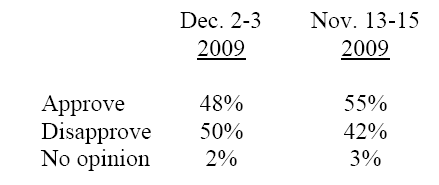
CNN — #2 in favorable leaning to the President — released new poll results on Fri. Dec. 4.

During November, President Obama’s approval dropped from 55% to 48%.

* * * * *

Question: Do you approve or disapprove of the way Barack Obama is handling his job as president?

image

For the full CNN survey results:
http://i2.cdn.turner.com/cnn/2009/images/12/04/rel18a.pdf

Pres. Obama "bends the curve" … and that’s not good news (for him)

December 7, 2009

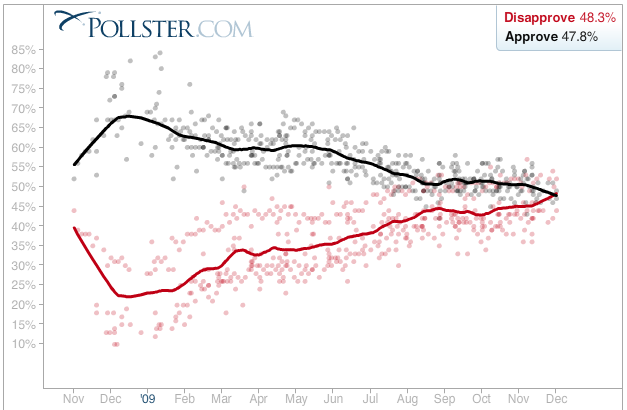
Well, on Sunday, the curves crossed for the first time during the Obama administration.

Based on the Polster.com “poll of polls” — more people disapprove of the job Obama is doing as President than approve.

The approve-disapprove curves have been on a collision course for awhile.  Now they’ve passed through what stock technicians would call a resistance level. 

Next critical number would be if disapproval passes through 50% — indicating that a majority, not just a plurality, disapprove.

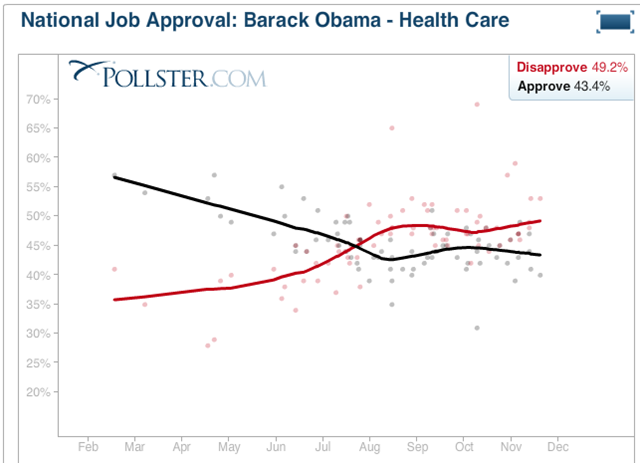
[Healthcare Reform results are below]

image

http://www.pollster.com/polls/us/jobapproval-obama.php?xml=http://www.pollster.com/flashcharts/content/xml/Obama44JobApproval.xml&choices=Disapprove,Approve&phone=&ivr=&internet=&mail=&smoothing=&from_date=&to_date=&min_pct=&max_pct=&grid=&points=1&lines=1&colors=Disapprove-BF0014,Approve-000000,Undecided-68228B

* * * * *

Self-explanatory, right ?

image
http://www.pollster.com/polls/us/jobapproval-presobama-health.php?xml=http://www.pollster.com/flashcharts/content/xml/USObamaJobPresHealth.xml&choices=Disapprove,Approve&phone=&ivr=&internet=&mail=&smoothing=&from_date=&to_date=&min_pct=&max_pct=&grid=&points=1&lines=1&colors=Disapprove-BF0014,Approve-000000,Undecided-68228B

It’s cool to be independent … again.

December 3, 2009

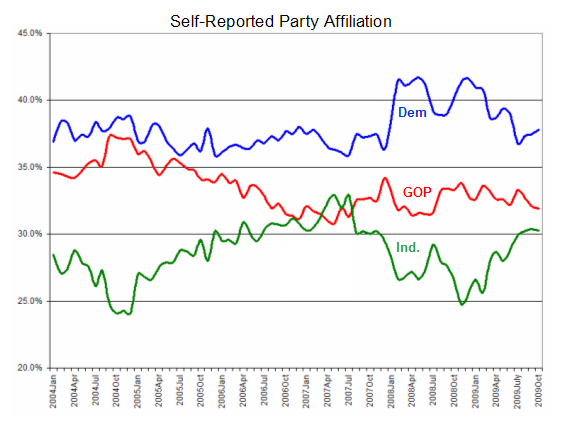
Rasmusssen (and other pollsters) ask people to self-categorize themselves by political party.

I think the trends are pretty interesting:

During the final years of the Bush admin, the mix shifted from the GOP to independents.  Note the near mirror image of the red and green lines on the left half of the chart.

When Obamamania caught traction, the mix shifted from independents to Democrats.  Again, not the near mirror image of the green and blue lines on the right half of the chart.

Now, the mix is shifting again — from Dems to independents.

While Dems still have a statistically significant plurality, the country broken roughly in thirds across Dems, GOP and independents … with independent “swing voters” carrying determining sway.

image

http://www.rasmussenreports.com/public_content/politics/mood_of_america/partisan_trends

A portrait in black & white…

December 1, 2009

Last week, Gallup reported that Pres. Obama’s approval rating has dipped below 50%.  That is, less than half of the country approves of the job he’s doing as president.  That’s less than the percentage of folks who voted for him, and 17 points lower than his inaugural approval rating.

image

Among the telling — but largely unreported trends — is Obama’s sharp drop-off among whites.  While his approval rating by blacks has stayed sky high — above 90% — his approval rating among whites has gone down from 61% to 39% — a 22 point drop. Ouch.

To diffuse any racial undertones, Gallup points out that  Bill Clinton averaged 55% job approval during his presidency, including 52% among whites … and 82% among blacks” … leading them to conclude: “One reason Obama may have maintained support among blacks is their overwhelming affiliation with the Democratic Party.”

Is that an elephant I see in the middle of the room ?

image

http://www.gallup.com/poll/124484/Obama-Approval-Slide-Finds-Whites-Down-39.aspx?CSTS=alert

image

BINGO! I was just a week ahead of the curve …

November 20, 2009

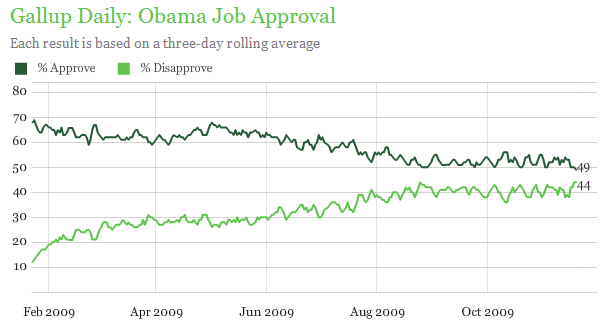
I had predicted that — last Friday — Obama’s job approval would drop below 50% on the slightly left-leaning Gallup survey.

Well, it didn’t happen last Friday, but it did today … I was just off by a week.

As a technical stock trader would say, a resistance level may have been broken …

image
http://www.gallup.com/poll/113980/Gallup-Daily-Obama-Job-Approval.aspx

Turning off the Independents …

November 20, 2009

OK, some will dismiss these numbers because they come from the FoxNews – Opinion Dynamics survey.  But, the results are consistent with many other polls.

The bottom line: a minority of registered voters 46%)  now approve of the job that President Obama is doing  … Dem support remains sky high at 85%, and GOP support is at a rock bottom 15%.  That’s not news.

The news is that only 1 in 3 Independents approve  … that’s down from 2 in 3 back in June.

image
http://www.foxnews.com/projects/pdf/111909_ObamaPoll.pdf

* * * * *

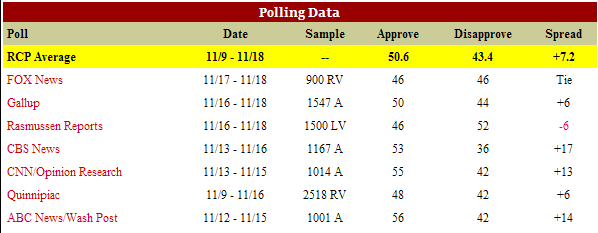
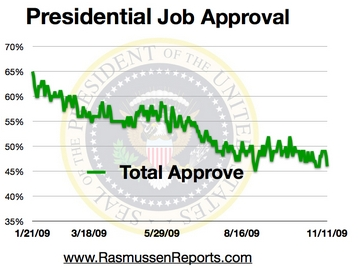
Gallup has Obama at 50% approval; Rasmussen has him at 46%.

image

* * * * *

Interestingly, 3 left-leaning TV networks (ABC, CBS, CNN) average Obama’s approval at 55%.

image 
http://www.realclearpolitics.com/epolls/other/president_obama_job_approval-1044.html

* * * * *

I missed last week when I predicted that Obama would fall below 50% in the Gallup Survey.  Keep your eye on today’s Gallup numbers …

Doing OK … except on the economy, Afghanistan, the deficit and, oh yeah, healthcare.

November 16, 2009

Bottom line: Rasmussen & Schoen say that unless Obama changes his approach and starts governing in a more fiscally conservative, bipartisan manner, the independents that provided his margin of victory in 2008 and gave the Democrats control of Congress will likely swing back to the Republicans, putting Democratic control of Congress in real jeopardy.

* * * * *

Excerpted from WSJ: Obama Is Losing Independent Voters, Rasmussen & Schoen, Nov. 14, 2009

Obama’s approval among likely voters has dropped to the low-50s in most polls, and the most recent Rasmussen Reports poll of likely voters shows him slightly below the 50% mark. This is a relatively low rating for new presidents.

A CNN poll released Nov. 6 found that 47% of Americans believe the top issue facing the country is the economy, while only 17% say its health care. However, the bulk of the president’s efforts over the past six months have been not on the economy but on health care, an issue in which he continues to draw negative ratings.

In a Rasmussen Reports poll taken after the House of Representatives passed health-care reform by the narrowest of margins last Saturday night, 54% of likely voters say they are opposed to the Pelosi plan with only 45% in favor …   58% of unaffiliated voters,oppose the bill.

The CNN poll also shows that in addition to health care, a majority of Americans disapprove of how Mr. Obama is handling the economy, Afghanistan, Iraq, unemployment, illegal immigration and the federal budget deficit. Put simply, there isn’t a critical problem facing the country on which the president has positive ratings.

An NBC/Wall Street Journal poll conducted from Oct. 22-25 found that the president’s personal ratings have suffered a similar decline. His rating for being honest and straightforward has fallen eight points from January to 33% and his rating for being firm and decisive has fallen 10 points to 27%.

Even more fundamentally, a Washington Post/ABC News poll conducted from Oct. 15-18 shows that the president has now reached a point where less than a majority of Americans believe he will make the right decisions for the country.

A Rasmussen Reports poll released Oct. 26 shows that only one-third of likely voters believe the stimulus package has helped the economy.

This week’s Rasmussen Reports poll shows  49% of respondents blame Mr. Bush for the economy and 45% blame Mr. Obama. By the beginning of next year, the problems of America will be Mr. Obama’s problems, and references to his predecessor will increasingly fall on deaf ears.

* * * * *

Deficit reduction and reining in spending are critically important priorities for the vast majority of the electorate. Indeed, according to a Rasmussen Reports Poll conducted at the end of last month, voters say deficit reduction is most important and health care is a distant second.

Obama has found himself in a false and arguably artificial conundrum on health care, with the two alternatives being his bill with a public option and a trillion-dollar price tag, or no bill at all. While the failure to pass a health-care bill could be devastating for his administration, polling suggests that ramming through an expensive bill with a public option (potentially using procedural techniques in the Senate) could divide America and not improve his standing with the public.

Voters would like to see compromises on key elements of health care to reduce costs, while the Democrats’ plan has appeared to focus largely on expanding coverage.

There is a clear, bipartisan majority who favor a less costly bill that incrementally increases coverage, provides insurance reform involving pre-existing conditions, and experiments with tort reform and competition across state lines.

* * * * *

Full article:
http://online.wsj.com/article/SB10001424052748704402404574525543109875438.html?mod=djemEditorialPage

Prediction re: Prez O’s Job Approval … Today will be a milestone.

November 12, 2009

Let’s go out on a limb …

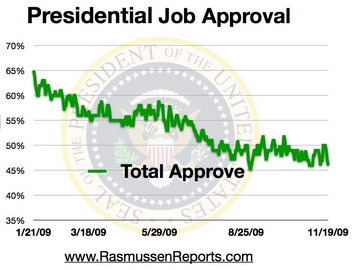
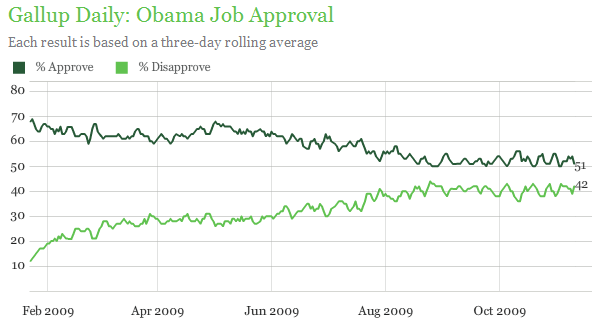
I”m posting this @ 7:59 a.m. and predicting that today’s the day that President Obama’s job approval — as measured by Gallup, a respected, slightly left leaning polling org — will drop below 50% for the first time.  If so, that’ll be a very big deal.

Why?

Major reason: yesterday’s number was 51% (chart below); today will be the first rating that fully reflects Saturday night’s healthcare vote (since Gallup is a 3-day moving average).

Secondary reason: backlash to the way the administration is handling the Afghanistan decision and the Fort Hood massacre.

Reason for confidence: Rassmussen — a slightly right leaning polling org — tends to lead Gallup by a day or two.  Rasmussen has Obama’s job approval down to 46% (chart below).

Note: Rasmussen posts around 9:30 am; Gallup in mid-afternoon.

We’ll see …

* * * * *

Gallup

image
http://www.gallup.com/poll/113980/Gallup-Daily-Obama-Job-Approval.aspx

* * * * *

Rasmussen

image
http://www.rasmussenreports.com/public_content/politics/obama_administration/obama_approval_index_history

The intensity factor …

November 3, 2009

Ken’s Take: Marketers talk about the “top box” effect when evaluating customer loyalty. A repeated finding: only customers who are “very satisfied” are likely to stay loyal — not those who are simply “satisfied”.  In all customer surveys (and political polls) keep your eye on the folks who are “very” …

* * * * *

Excerpted from WSJ: In Vote, Watch the Intensity Factor, Nov. 3, 2009

Polls can measure many things, but one thing they have a hard time getting at is intensity: Yes, people will tell a pollster whom they prefer in a campaign, but do they feel so strongly about their choice that they’ll actually go out to vote?

Only elections can answer the intensity question.

Last year, Barack Obama and his Democrats owned the intensity factor. Lately it has seemed to lie with the Republicans.

Anger is a great motivator, and there’s plenty of anger on the GOP side over Democratic plans for health care and government spending.

* * * * *

Heading into Tuesday, the intensity factor takes on a quite different form in each of the big races:

New Jersey: A Quinnipiac University poll released Monday shows Mr. Christie ahead of Gov. Corzine, 42% to 40%, with 12% for Mr. Daggett. Perhaps more important, it shows the extent of the two major candidates’ unpopularity. Some 40% of those surveyed said they had an unfavorable view of Mr. Christie, and a whopping 53% had an unfavorable view of Gov. Corzine.

Virginia: The polls suggest a dispirited Democratic base and a fired-up Republican one. A poll shows 94% of Republicans planning to vote for their candidate, compared with 85% of Democrats planning to vote for their’s.

http://online.wsj.com/article/SB125718836927523405.html?mod=WSJ_hps_MIDDLEFifthNews

* * * * *

Another Example: Healthcare Reform

Discord is all but certain if ObamaCare in anything like its present form is enacted.

A majority, or at least a large plurality, of Americans oppose it.

Their opposition is raw and intense, as we’ve learned from the spate of contentious town-hall meetings held by Democratic members of Congress last summer.

A Washington Post/ABC News poll of Oct. 19 confirmed the obvious: Far more Americans “strongly” oppose ObamaCare (36%) than “strongly” support it (26%).

Excerpted from WSJ :Major Congressional Reforms Demand Bipartisan Support, Nov. 2, 2009
http://online.wsj.com/article/SB10001424052748703932904574511263515975366.html

How Beef-Loving Voters Can Get Tofu for President

November 2, 2009

Ken’s Take: This is from my archives – one of my favs.  The original article was inspired by Clinton’s win over elder Bush (the Perot factor), younger Bush’d win over Gore (the Nader factor), and Jesse Ventura’s gov win in Minnesota.

There’s current news in the article since the independent in NJ may allow Corzine to sneak thru, and the Conservative may prevail in NY 23 as the party cadidates split the liberal vote. It’ll be interesting to watch … and (I think), the article is a fun read.

* * * * *
Excerpted from WSJ:  How Beef-Hungry Voters Can Get Tofu for President, March 14, 2003

Those odd ducks who scrutinize returns, calculate how each additional candidate affects the others’ chances and analyze strategic voting are hard at work. I refer, of course, to mathematicians.

Yes, there is a mathematics of elections.

Research has identified various voting systems world-wide in which, paradoxically, becoming more popular can make a candidate lose, abstaining gives your preferred candidate a better chance, and picking a winner means accepting someone a majority of voters don’t want.

This last paradox characterizes the U.S. system of plurality voting (vote for one; the top vote-getter wins). It works fine when there are two candidates, but with three or more, plurality voting can come up short.

For a democracy, the mathematicians’ most robust result is chilling. “It’s surprisingly difficult to identify a voting system that accurately captures the will of the people”.

* * * * *

The Election

So as not to inflame passions with current political examples I’ll illustrate his point with food.

You and two colleagues are planning an office party, and the caterer offers chicken, steak or tofu. You poll 17 invitees:

5 people prefer chicken to steak to tofu.

2 people prefer chicken to tofu to steak.

4 people prefer steak to tofu to chicken.

4 people prefer tofu to steak to chicken.

2 people prefer tofu to chicken to steak.

One organizer tallies the ballots by the plurality method, counting only first-place votes. Chicken wins (7 votes), while steak is last (4 votes).

A second organizer uses “approval voting,” in which voters mark all acceptable choices (everyone’s top two choices are acceptable). Now steak wins with 13, tofu gets 12 and chicken is last with 9.

The third organizer uses a point system that gives their first choices 2 points, second choices 1 and last picks 0. Now tofu wins with 18, steak gets 17, chicken 16.

The ‘winner’ changes with the choice of election procedureAn ‘election winner’ could reflect the choice of an election procedure” rather than the will of the people.

* * * * *

It gets better. Thanks to a mathematical property called nonmonotonicity, in some voting systems, ranking a choice higher can defeat it.

In a plurality-with-runoff system, the two candidates with the most first-place votes face one another in round two.

This time, we invite other departments to our office party, and get this first-round result:

27 prefer chicken to steak to tofu.

42 prefer tofu to chicken to steak.

24 prefer steak to tofu to chicken.

Chicken (27 votes) and tofu (42) reach the runoff. Assuming steak fans maintain their preference and give their second-round votes to tofu, tofu wins the runoff.

That seems fair.

But what if four people in the group of 27 chicken lovers are last-minute converts to vegetarianism and, in round one, prefer tofu to chicken to steak, like the group of 42?

Now steak (24 first-place votes) and tofu (46) make the runoff, in which steak beats tofu 47 to 46. Tofu’s late surge turned its win into a loss.

* * * * *

Such paradoxes tend to occur under specific but far from unusual circumstances.

With plurality voting, the most common is when two centrists face an extremist. The majority splits its vote between the centrists, allowing the fringe candidate to squeak in. In Minnesota’s 1998 governor’s race, Hubert Humphrey got 28% of the vote, Norm Coleman 34% and Jesse Ventura won with 37%, even though most voters ranked him last.

* * * * *

Thanks to such outcomes, scientists say what’s most needed is “a way for voters to register their second and third choices … especially in primaries, where there tends to be a large field.” Both a ranking system (give candidates 4, 3, 2 or 1 point) and approval voting accomplish that.

The U.N. chooses a secretary-general by approval voting. “It is particularly appealing in elections with many candidates … If your favorite candidate is a long shot, you can vote for both him and a candidate with a better chance without wasting your vote on the long shot. Approval voting would do a lot to address the problem of presidential-primary victors not being the choice of most voters.” Approval voting could well make more people (especially supporters of long shots) feel their ballot matters.

Still, no system is perfect. As Nobel-winning economist Kenneth Arrow proved mathematically in 1951, no voting system is guaranteed to be free of paradoxes in a race with three or more candidates, except one — a dictatorship.

If there are twice as many conservatives as liberals … why do I feel so lonely?

October 27, 2009

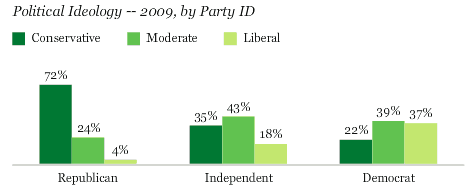
TakeAway: Conservatives continue to outnumber  liberals 2 to 1 in the American populace in 2009.

* * * * *
Excerpted from Gallup: Conservatives Maintain Edge as Top Ideological Group, October 26, 2009

Forty percent of Americans describe their political views as conservative, 36% as moderate, and 20% as liberal. This marks a shift from 2005 through 2008, when moderates were tied with conservatives as the most prevalent group.

image

* * * * *

Changes among political independents appear to be the main reason the percentage of conservatives has increased nationally over the past year: the 35% of independents describing their views as conservative in 2009 is up from 29% in 2008. By contrast, among Republicans and Democrats, the percentage who are “conservative” has increased by one point each.

image


* * * * *

In addition to the increase in conservatism on this general ideology measure, Gallup finds higher percentages of Americans expressing conservative views on several specific issues in 2009 than in 2008.

  • Perceptions that there is too much government regulation of business and industry jumped from 38% in September 2008 to 45% in September 2009.
  • The percentage of Americans saying they would like to see labor unions have less influence in the country rose from 32% in August 2008 to a record-high 42% in August 2009.
  • Public support for keeping the laws governing the sale of firearms the same or making them less strict rose from 49% in October 2008 to 55% in October 2009, also a record high. (The percentage saying the laws should become more strict — the traditionally liberal position — fell from 49% to 44%.)
  • The percentage of Americans favoring a decrease in immigration rose from 39% in June/July 2008 to 50% in July 2009.
  • The propensity to want the government to “promote traditional values” — as opposed to “not favor any particular set of values” — rose from 48% in 2008 to 53% in 2009. Current support for promoting traditional values is the highest seen in five years.
  • The percentage of Americans who consider themselves “pro-life” on abortion rose from 44% in May 2008 to 51% in May 2009, and remained at a slightly elevated 47% in July 2009.
  • Americans’ belief that the global warming problem is “exaggerated” in the news rose from 35% in March 2008 to 41% in March 2009.

Gallup has not recorded heightened conservatism on all major social and political views held by Americans. For instance, attitudes on the death penalty, gay marriage, the Iraq war, and Afghanistan have stayed about the same since 2008.

However, there are no major examples of U.S. public opinion becoming more liberal in the past year.

Full article:
http://www.gallup.com/poll/123854/Conservatives-Maintain-Edge-Top-Ideological-Group.aspx

CNN says "President Obama’s high job approval ratings continue" … ABC, CBS agree. Gallup respectfully disagrees — big time.

October 22, 2009

Ken’s Take:

I’m an avid follower of political polls.  So, the other nite when a CNN reporter said that President Obama’s high job approval ratings were still holding, it aroused my curiosity.  After all, that’s not what I recollected seeing in the polls.

My first stop: www.RealClearPolitics.com — a site that tracks polls and combines them into a “poll of polls”.

Here’s the headline on RCP:
Gallup: Obama Suffers Worst Quarter Drop in Approval Since 1953

Barack Obama has suffered the worst quarterly decline in his public approval rating of any elected president in the post-World War II era.

Obama’s average quarterly approval rating has slipped from 62 percent in the second quarter to 52.9 percent in the third quarter, according to Gallup polling.

That 9 percentage point decline is twice the amount of any other post-war elected president.

No other elected president has declined more than 5 points since 1953. 

Obama suffered the bulk of his decline in late summer, though the media was slow to notice or note.

Since summer, Obama has stabilized and generally bobbed a sliver above the 50 percent mark.

Among all presidents since WWII, Obama’s third quarter approval rating is above only Bill Clinton and Gerald Ford. Clinton averaged 48 percent in the third quarter of 1993. Ford averaged 39 percent during his 1975 third quarter.

Gallup reports that Obama’s latest quarterly average ranks 144th, or in the 44th percentile, for all post-war presidents during any quarter.

http://realclearpolitics.blogs.time.com/2009/10/21/poll-obama-worst-decline-in-approval-since-wwii/

It gets even more interesting.

RCP says that the current average rating across major polls is 52.4%.  CNN reports  55%.  Hmmm.

Interestingly, CBS reports a higher number — 56% and ABC reports a still higher 57%.  Three mainstream media shops reporting the 3 highest numbers in the sample.  Double hmmm.

The 2 surveys generally considered the most objective are Gallup — which leans a little bit left — and Rasmussen — which leans right.

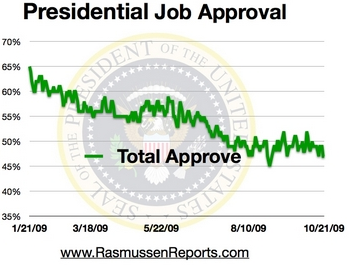
Gallup reports 50%; Rasmussen calls it 47%.

So, three mainstream networks average about 7 points more than the 3rd party sources.  I’d call that statistically significant.  And, I don’t call it a coincidence …

BTW: note that Fox reports 49% — between Rasmussen & Gallup.  I didn’t throw Fox in with either group since some folks question their objectivity and they’ve been stripped by the WH of their “news network” status.

* * * * *

The Data

image
http://www.realclearpolitics.com/epolls/other/president_obama_job_approval-1044.html

* * * * * *

Note that both Gallup and Rasmussen show a decline in job approval from the high 60%s to 50% plus or minus a little. 

Gallup bounces around a little above 50%,’ Rasmussen a little below 50%.

image
http://www.gallup.com/poll/113980/gallup-daily-obama-job-approval.aspx

image 
http://www.rasmussenreports.com/public_content/politics/obama_administration/daily_presidential_tracking_poll

* * * * *

The number I like to watch is Rasmussen’s PAI — Presidential Approval Index — the difference between the % of people who strongly approve and the 5 who strongly disapprove.

Early on, Obama’s PAI was as high as plus 30%.  Now, it’s down to minus 13% — with 27% strongly approving and 40% strongly disapproving.  That means that almost 80% of the folks who disapprove, strongly disapprove.  That’s a high intensity factor.

image
http://www.rasmussenreports.com/public_content/politics/obama_administration/daily_presidential_tracking_poll

* * * **

Why are Obama’s ratings lower in Rasmussen polls?

July 27, 2009

Ken’s Take: Since Rasmussen was first to report Obama’s approval below 50%, his methodology is being questioned by mainstream media.  Below is a pretty clear explanation. 

Bottom line: Rasmussen samples likely voters instead of all adults and distinguishes between ‘strong’ and ‘somewhat’ approval (and disapproval).

* * * * *
From RCP,Obama Upside Down, July 24th, 2009

Rasmussen officially becomes the first poll to show the President with an upside-down approval rating.  The pollster has him at 49% approve, 51% disapprove today. Rasmussen’s polls are typically spot-on in the end, but he’s been a consistent outlier on the approval rating issue.

Part of this is that Rasmussen samples likely voters, while most pollsters are sampling adults or registered voters right now.  Likely voters typically skew Republican by a few points.  On the one hand, it is difficult to screen for likely voters this early on, but on the other hand, this could be something of a preview of whether things will go when other pollsters begin imposing likely voter screens.

The other thing is that Rasmussen gives for options:  Strongly approve, strongly disapprove, somewhat approve, and somewhat disapprove.  It may well be the case that, given a simple “approve/disapprove” rubric, many people who somewhat disapprove of the job Obama is doing are unwilling to give a complete “disapprove” answer.  By adding the “somewhat” nuance, Rasmussen may be nudging voters into the “disapprove” camp.

One final thought: Rasmussen typically has fewer undecideds than other pollsters.  It may be that people who somewhat approve or somewhat disapprove of the President are more likely to describe themselves as “undecided.”  Pushed away from the “undecided” option, these voters may then choose the “somewhat disapprove” or “somewhat approve” option; it may be that, for now, the undecideds are leaning away from Obama.  This would make sense, given the general sense of approval that has surrounded Obama’s first six months, there may be a large chunk of the populace that simply isn’t willing to voice disapproval of him right now.

At any rate, an unwelcome milestone for the President.

Source article:
http://realclearpolitics.blogs.time.com/2009/07/24/obama-upside-down/

* * * * *

Gallup: Poll: Majority of Americans ‘pro-life’

May 18, 2009

Ken’s Take: Skirting the philosophical issues, I find this interesting from a political perspective.  I thought it was odd that a majority of Catholics voted for Obama given the clarity of his position on abortion rights and his track record of votes on the issue.

A few weeks after the inauguration, there was some chatter from the pulpit of our church about abortion — stimulated, I think, by Obama’s early exec directives to fund overseas abortions, etc.  Iy was as is pro-life Catholics were surprised that Obama really was pro-abortion rights.

At the time. I wondered whether there would be any backlash in the polls.  None seemed to materialize until this poll.  Why?  Apparently, the media attention surrounding the Notre Dame speech caused some folks — notably Catholics — to do a gut check.

* * * * *

Reported in the Washington Times:

According to a Gallup poll released May 15 —  a majority of  Americans now say they are “pro-life” than “pro-choice”.  Specifically, A majority of respondents 51 percent are against the practice of abortion, while 42 percent classified themselves as being pro-choice.

image

“This is the first time a majority of U.S. adults have identified themselves as pro-life since Gallup began asking this question in 1995”

The findings represent “a significant shift from a year ago,” when 50 percent of the respondents were pro-choice and 44 percent pro-life.

61 percent of Democrats say they are pro-choice and 33 percent are pro-life

70 percent of Republicans say they are pro-life and 26 percent are pro-choice

In 2008, half of women were pro-choice; now the number stands at 44 percent.

Among men, the findings are more pronounced: 49 percent identified themselves as pro-choice a year ago; the number fell to 39 percent this year. A clear majority of men 54 percent are now pro-life, compared with 46 percent a year ago.

It seems a change in the White House has prompted the change of heart. The president’s position has been the most radical pro-abortion of any American president.

“With the first pro-choice president in eight years already making changes to the nation’s policies on funding abortion overseas, expressing his support for the Freedom of Choice Act, and moving toward rescinding federal job protections for medical workers who refuse to participate in abortion procedures,”

Excerpted from Wash Times
http://www.washingtontimes.com/news/2009/may/16/poll-more-americans-pro-life/print/

* * * * *
Want more from the Homa Files?
     Click link =>
  The Homa Files Blog

Gallup: Poll: Majority of Americans 'pro-life'

May 18, 2009

Ken’s Take: Skirting the philosophical issues, I find this interesting from a political perspective.  I thought it was odd that a majority of Catholics voted for Obama given the clarity of his position on abortion rights and his track record of votes on the issue.

A few weeks after the inauguration, there was some chatter from the pulpit of our church about abortion — stimulated, I think, by Obama’s early exec directives to fund overseas abortions, etc.  Iy was as is pro-life Catholics were surprised that Obama really was pro-abortion rights.

At the time. I wondered whether there would be any backlash in the polls.  None seemed to materialize until this poll.  Why?  Apparently, the media attention surrounding the Notre Dame speech caused some folks — notably Catholics — to do a gut check.

* * * * *

Reported in the Washington Times:

According to a Gallup poll released May 15 —  a majority of  Americans now say they are “pro-life” than “pro-choice”.  Specifically, A majority of respondents 51 percent are against the practice of abortion, while 42 percent classified themselves as being pro-choice.

image

“This is the first time a majority of U.S. adults have identified themselves as pro-life since Gallup began asking this question in 1995”

The findings represent “a significant shift from a year ago,” when 50 percent of the respondents were pro-choice and 44 percent pro-life.

61 percent of Democrats say they are pro-choice and 33 percent are pro-life

70 percent of Republicans say they are pro-life and 26 percent are pro-choice

In 2008, half of women were pro-choice; now the number stands at 44 percent.

Among men, the findings are more pronounced: 49 percent identified themselves as pro-choice a year ago; the number fell to 39 percent this year. A clear majority of men 54 percent are now pro-life, compared with 46 percent a year ago.

It seems a change in the White House has prompted the change of heart. The president’s position has been the most radical pro-abortion of any American president.

“With the first pro-choice president in eight years already making changes to the nation’s policies on funding abortion overseas, expressing his support for the Freedom of Choice Act, and moving toward rescinding federal job protections for medical workers who refuse to participate in abortion procedures,”

Excerpted from Wash Times
http://www.washingtontimes.com/news/2009/may/16/poll-more-americans-pro-life/print/

* * * * *
Want more from the Homa Files?
     Click link =>
  The Homa Files Blog