According to some political-psyche pundits and news reports: they’re all narcissists.
Some have gone a step further and presumptuously diagnose them as having Narcissistic Personality Disorder (NPD), which is also called pathological narcissism. (Details below)
* * * * *
When I heard the term the second or third time, I got curious.
Initially, I thought that NPD was a made-up talk show slur. But, I did some digging and discovered that Narcissistic Personality Disorder really does exist as a documented pathology.
Below are its diagnostic criteria and the “so whats” of the pathology.
Worth reading …
* * * * *
Pathological Narcissism: How do you know ?
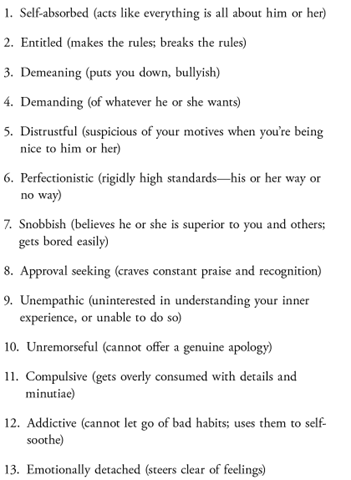
People may be clinically diagnosed as having Narcissistic Personality Disorder if they exhibit at least 5 of the following attitudes and behaviors:
1. Have an exaggerated sense of self-importance; obsess over appearance and image
2. Are preoccupied with fantasies of unlimited success, power, brilliance, beauty, or ideal love
3. Believe they are “special” and can only be understood by other special or high-status people
4. Require excessive admiration; crave the spotlight; expect to be recognized as superior to others.
5. Have a sense of entitlement; expect special treatment and automatic compliance with their wishes
6. Selfishly take advantage of others to achieve their own ends; lie, deceive, and manipulate; believe rules of morality don’t apply to them
7. Lack empathy; fail to recognize or sympathize with other people’s feelings and needs.
8. Are often envious of others and believe that others are envious of them; covet others’ relationships and possessions.
9. “Act out”: present arrogant, patronizing, contemptuous, risky, self-destructive behaviors or attitudes; when caught and confronted, blame bad behavior on other people and burdensome circumstances, show little conscience or true remorse.
Excerpted from:
http://www.halcyon.com/jmashmun/npd/dsm-iv.html
* * * * *
Pathological Narcissism: So what ?
Most people are somewhat narcissistic.
A healthy level of narcissism is a mature, balanced love of oneself coupled with a stable sense of self-worth and self-esteem. A healthy narcissist has a proportionate and realistic appraisal of his achievements and traits, and respects interpersonal boundaries.
Pathological narcissism is marked by an immature or impaired sense of one’s “true self” and situational reality that is exaggerated into a fraudulent, compensatory self-image
Down deep, a pathological narcissist is usually deficient in self-esteem or self-worth. He draws esteem and worth from the attention and admiration of others Hence, the pathological narcissist is in constant pursuit of recognition and adoration, relishes the spotlight, and habitually preys his environment for more dependable admirers
Pathological narcissism is often a reaction to abnormal environments and situations (e.g., abuse, trauma, smothering, etc.), the repression of overwhelming memories and experiences, and the suppression of inordinately strong negative feelings (e.g., hurt, envy, anger, or humiliation).
Pathological narcissism is addictive and dysfunctional. Pathological narcissists are obsessed by delusions of grandeur, superiority, and perfection – in life and love. As a result, they present themselves as image-obsessed (flawlessness) and very competitive (win at all cost). They want to be at center stage, and when others might be merely motivated, they are strongly compelled. They are driven, relentless, tireless, and ruthless. They strive and fight and learn and climb and create and think and devise and design and conspire. They need to be in control of their relationships and environments.
Pathological narcissists are prone to self-defeating and self-destructive behaviors. They often abandon their commitments, careers, and relationships in mid-stream – losing interest, giving up, moving on.
Sub-consciously, a pathological narcissist may masochistically frustrate his deepest desires and drives; obstruct his own efforts; alienate his friends and sponsors; provoke figures in authority; actively (but unconsciously) seek, submit and relish mistreatment; incite anger or rejection; engage in risky and improper behavior — all without conscience or true remorse.
Pathological Narcissism: What’s the prognosis?
While Narcissistic Personality Disorder can sometimes be moderated with psycho-therapy. the “prognosis is generally not good”. That is, the likelihood of recidivism (i.e. repeat behavior) is very high and progressive (i.e. it gets worse}.
Excerpted from:
http://www.mayoclinic.com/health/narcissistic-personality-disorder/DS00652/DSECTION=symptoms
* * * * *
Best online medical summary of NPD – from the Mayo Clinic:
http://www.mayoclinic.com/health/narcissistic-personality-disorder/DS00652
* * * * *
Final shots; Obama, Sanford and Palin may be narcissists, but pundits shouldn’t be throwing around the term “Narcissistic Personality Disorder “ lightly. It’s a real pathology. Not to be taken lightly.
* * * * *
SHARE THIS POST WITH FRIENDS & FAMILY


 The Homa Files