The WSJ and FT disagree on the impact. I disagree with both.
===========
Let’s start with some background …
Currently, when a company earns money abroad, it’s taxed in the local jurisdiction where it’s earned … and then the Feds collect U.S. income taxes when the company brings the cash associated with the earnings back to their U.S. accounts.
Most folks agree that represents punitive double taxation.
So, companies tend to keep the cash associated with offshore earnings parked offshore … deferring U.S. income taxes as long as possible.
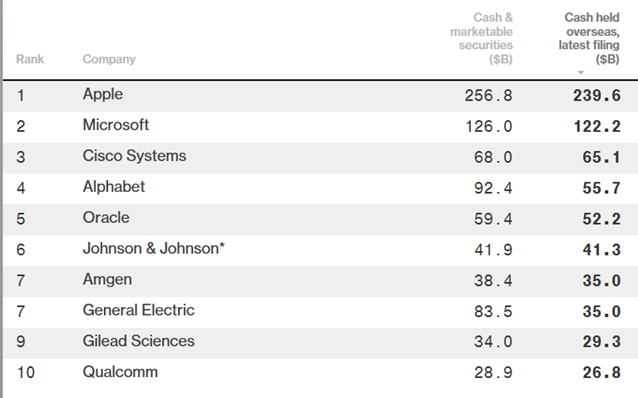
Currently, the 50 top overseas cash holders have almost $1 trillion parked outside the U.S.
============
The GOP tax plan moves towards “territorial taxation” … meaning that U.S. companies will only be taxed in the jurisdiction where money is earned.
That makes complete sense to me.
The GOP tax plan also includes a one-time “deemed repatriation rate” on earnings now held abroad … that rate is proposed to be 14% to 14.49% … lower than the current corporate rate of 35% or the proposed rate of 20%.
Why not a deemed repatriation rate of zero?
I guess the logic is that the current stockpiles of offshore cash were earned under the old double taxation rules … so the companies “owe” the Feds around 35% … offering a deemed rate of 14% roughly splits the difference between 35% and zero.
Here’s were things get interesting …


 The Homa Files