Archive for the ‘Taxes’ Category

One man’s stimulus is another man’s redistribution … think about it.

November 17, 2008

Excerpted from WSJ, “Why Spending Stimulus Plans Fail”, Riedl, Nov. 14, 2008

* * * * *

Government stimulus bills are based on the idea that feeding new money into the economy will increase demand, and thus production.  They always fail.  There’s a simple reason why. What Congress gives to some it takes away from others.

Where does government get this money? Congress doesn’t have its own stash. Every dollar it injects into the economy must first be taxed or borrowed out of the economy. No new spending power is created. It’s merely redistributed from one group of people to another.

Advocates of stimulus respond that redistributing money from “savers” to “spenders” will lead to additional spending.

That assumes that savers store spare cash in their mattresses, thereby removing it from the economy. In reality, nearly all Americans either invest their savings (where it finances business investment) or deposit it in banks (which lend it to others to spend). The money gets spent whether it is initially consumed or saved.

Governments don’t create new purchasing power out of thin air. If Congress funds new spending with taxes, it is redistributing existing income. If the money is borrowed from American investors, those investors will have that much less to invest or to spend in the private economy.

Yet Congress will repeatedly borrow money from one group of people and then give it to another group of people and tell us we’re all wealthier for it.

It’s time for lawmakers to stop futilely trying to wave the magic wand of short-term “stimulus” spending, which threatens to push the deficit above $1 trillion. Focusing on productivity will build a stronger economy over the long run and leave America better prepared to handle future economic downturns.

* * * * *

Full op-ed:
http://online.wsj.com/article/SB122663413095027641.html

* * * * *

Ken’s Take: It often frustrates me that people don’t understand that corporations and the government are simply stewards of other people’s money.  When you tax a corporation, you’re simply taxing investors or customers (via higher prices); when the government spends, it’s spending tax payers money — there is no “government money”.

Want more from the Homa Files?
Click link =>
  The Homa Files Blog

The "Barack Effect" on the stock market … and a remedy

November 14, 2008

Reminder: I made my election predictions on November 3, 2008. OK, McCain didn’t eek out a win. But, I also predicted:

“If Obama wins, and the Dems fail to reach a 60 in the Senate, the Dow will close Wednesday below 9,000 — will hit 7,500 before the end of the year — will fight back to around 10,000 — and will hover around 10,000 for a long, long time.”

I didn’t foresee the election day rally, so the steep day-after drop didn’t quite push the market below 9,000.  But, in the week since, it has gone down 14%.

Note: My prediction stands that if the Dems win Georgia, Alaska, and Minnesota to get to 60 Senate seats, the market will drop 1,000 points faster than you can click your fingers.

Keep reading …

* * * * *

Excerpted from WSJ, “A Barack Market”, November 13, 2008 

The voters may be full of hope about the looming Obama Presidency, but so far investors aren’t. No President-elect in the postwar era has been greeted with a more audible hiss from Wall Street. The Dow has lost 1,342 points, or about 14%, since the election

Much of this is due to hedge fund deleveraging, as well as dreadful corporate earnings reports and pessimism that the recession will be deeper than many had hoped. But there’s little doubt that uncertainty, and some fear, over Barack Obama’s economic agenda is also contributing to the downdraft.

The substance of what Mr. Obama has promised for the economy is bearish for stocks. The threat of higher tax rates, especially on capital gains and dividends, now may be getting priced into the market. Add that to investor doubts about Democratic policies on unions, health care and trade — and no wonder stocks are falling. Lower stock prices in turn reduce household net worth, thus slamming consumer confidence and contributing to what appears to be a consumer spending strike.

If Mr. Obama wants to reassure markets, he could announce that he won’t be raising taxes for the foreseeable future. This no-tax-hike declaration is a “stimulus” that would cost the U.S. Treasury nothing.

In the current market, there won’t be many capital gains and few companies will have surplus earnings to pay out in dividends. A higher tax rate on zero gains yields zero revenue, so what’s the point of raising rates?

What markets want to see from Mr. Obama is a sense that the seriousness of this downturn is causing him to rethink the worst of his antigrowth policies.

Full editorial:
http://online.wsj.com/article/SB122653625916922633.html

* * * * *

Ken’s Take:

The editorial  advises the President-elect to reassure markets by announcing that he won’t be raising taxes for the foreseeable future.

I suggest a bolder stroke with more upside potential: reduce the capital gains rate to ZERO  for stocks bought between, say,  November 15, 2008 and December 31, 2010 that are held at least 12 months or until January 1, 2010 — whichever is longer.

This move would radically tilt the risk-return balance by eliminating the looming capital gains rate risk, and by increasing the after-tax rates of return for investors who step-up now when we need them. It would do more than reassure the markets.  It would pull cash in from the sidelines. Perhaps, a lot of cash.

And maybe, if the impact is grand enough, the program would be extended beyond 2010.  Imagine that.

* * * * *

Want more from the Homa Files?
Click link =>
  The Homa Files Blog

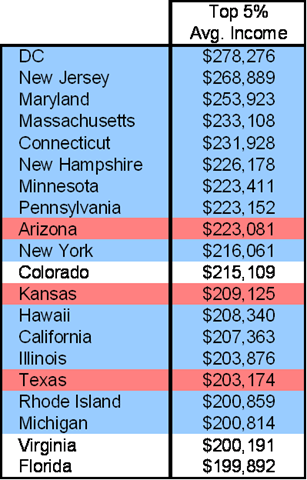
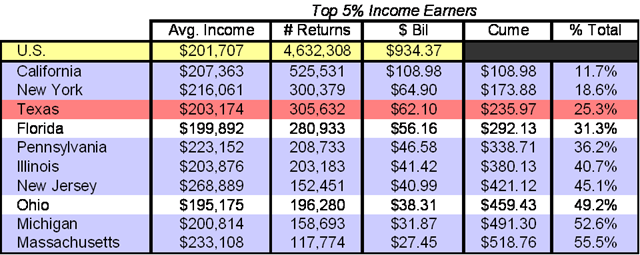
Quick: Close your eyes and picture somebody in the top 5%

November 12, 2008

From the Tax Foundation:

“Throughout this year, rhetoric regarding cutting taxes for the “middle class” and raising taxes on “the wealthy” reached an unprecedented level as the economy took a turn for the worse, and the candidates focused more intently on the economic debate.

But, what remains unanswered is who are “the wealthy” and who comprises “the middle class”?

Currently, the top 5% of taxpayers already pay 60% of the income taxes in this country.  And the top 10% pays 70% of taxes. 

But, who makes up the top 5% and top 10%?

• They are largely dual-income married couples;

• They live in high-cost metropolitan areas and have average living standards;

• They are older workers, at or nearing their peak earning years;

• They are college educated; and

• They have business income.

They are the picture of most any suburban family.”

* * * * *
Full report:
http://www.taxfoundation.org/files/dba37618d9c2d2df02f24766ac4cc39d.pdf

* * * * *

Ken’s Take: I bet most folks picture Dick Fuld, Warren Buffett, or some sleazy-looking hedge funder …

* * * * *

Want more from the Homa Files?
Click link =>
  The Homa Files Blog

Keeping score: a promise made is a promise kept … right?

November 11, 2008

Excerpted from IBD, “A Checklist Of Obama’s Many Promises”. November 10, 2008

* * * * *

Few presidential candidates have made more specific promises to American voters than Barack Obama. They came fast and furious.    So as a public service, IBD put together a handy checklist of some of the biggest Obama promises — culled from his “Blueprint for Change,” his campaign speeches and advertisements. 

Ken’s favorites are bolded. 

* * * * *

Taxes

• Give a tax break to 95% of Americans.

• Restore Clinton-era tax rates on top income earners.

• “If you make under $250,000, you will not see your taxes increase by a single dime. Not your income taxes, not your payroll taxes, not your capital gains taxes. Nothing.”

• Dramatically simplify tax filings so that millions of Americans will be able to do their taxes in less than five minutes.

• Give American businesses a $3,000 tax credit for every job they create in the U.S.

• Eliminate capital gains taxes for small business and startup companies.

• Eliminate income taxes for seniors making under $50,000.

• Expand the child and dependent care tax credit.

• Expand the earned income tax credit.

• Create a universal mortgage credit.

• Create a small business health tax credit.

Provide a $500 “make work pay” tax credit.

• Provide a $1,000 emergency energy rebate to families.

Energy

• Spend $15 billion a year on renewable sources of energy.

• Eliminate oil imports from the Middle East in 10 years.

• Increase fuel economy standards by 4% a year.

• Weatherize 1 million homes annually.

• Ensure that 10% of our electricity comes from renewable sources by 2012.

Environment

• Create 5 million green jobs.

• Implement a cap-and-trade program to reduce greenhouse gas emissions.

• Get 1 million plug-in hybrids on the road by 2015.

Labor

• Sign a fair pay restoration act, which would overturn the Supreme Court’s pay discrimination ruling.

• Sign into law an employee free choice act — aka card check — [that eliminate secret ballots in union elections] 

• Make employers offer seven paid sick days per year.

• Increase the minimum wage to $9.50 an hour by 2009.

National security

• Remove troops from Iraq by the summer of 2010.

• Cut spending on unproven missile defense systems.

• No more homeless veterans.

• Stop spending $10 billion a month in Iraq.

• Finish the fight against  the al-Qaida terrorists; [and capture Osama bin Laden ]

Social Security

• Work in a “bipartisan way to preserve Social Security for future generations.”

• Impose a Social Security payroll tax on incomes above $250,000.

• Match 50% of retirement savings up to $1,000 for families earning less than $75,000.

Education

• Demand higher standards and more accountability from our teachers.

Spending

• Go through the budget, line by line, ending programs we don’t need and making the ones we do need work better and cost less.

• Slash earmarks.

Health care

• Lower health care costs for the typical family by $2,500 a year.

• Let the uninsured get the same kind of health insurance that members of Congress get.

• Stop insurance companies from discriminating against those who are sick and need care the most.

• Spend $10 billion over five years on health care information technology.

* * * * * 

Full article:
http://www.ibdeditorials.com/IBDArticles.aspx?id=311212244872396 

* * * * *

Want more from the Homa Files?
Click link =>
  The Homa Files Blog

Some tax changes … for sure !

November 10, 2008

Excerpted from WSJ, “Taxes for 2009 Already Set to Rise and Fall “, Nov. 9, 2008

* * * * * *  
While nobody knows what will happen to taxes next year, most taxpayers can count on getting at least a small dose of relief because of inflation adjustments. Because of annual inflation adjustments, many tax provisions, such as the basic standard deduction and personal-exemption amounts, increase each year.

For example, the basic standard deduction will rise to $11,400 for married couples filing jointly, up $500 from 2008. For most singles and married people filing separately, it will be $5,700, up $250.

Tax-bracket income thresholds will rise for each filing status. For joint filers, for example, the taxable-income threshold separating the 15% bracket from the 25% bracket will be $67,900, up from $65,100 in 2008.

The annual gift-tax exclusion will increase in 2009 to $13,000 from $12,000 this year. That means you will be able to give away as much as $13,000 next year to anyone you wish — and to each of as many people as you want — without having to worry about taxes. Moreover, you can pay for someone’s tuition or medical bills, and the payments won’t count toward the annual exclusion. Just be sure to make those payments directly to the educational or medical institution.

* * * * *

But millions of high-income workers will get hit by higher Social Security taxes.

The maximum amount of earnings subject to the Social Security tax in 2009 will rise to $106,800 from $102,000 in 2008. Of the estimated 164 million workers who will pay Social Security taxes next year, about 11 million will pay higher taxes because of this increase.

* * * * *

Ken’s Take: The federal income tax code can be– and has been — modified RETROACTIVELY to the date that legislation is introduced (but not, as I understand it to a “closed” tax year).  Expect Obama’s tax changes to be introduced in the House (which has responsibility for initiating tax bills) soon after Obama’s inauguration — if for no other reason than to to set the retroactivity date.

* * * * *

Full article:
http://online.wsj.com/article/SB122619877179711425.html

* * * * *

Want more from the Homa Files?
Click link =>
  The Homa Files Blog

Where McCain & Obama stand on economic issues

November 3, 2008

Source: CNNMoney.com , Oct. 31, 2008
http://finance.yahoo.com/banking-budgeting/article/106069/Your-Money:-McCain-vs.-Obama#1

* * * * *

The best recap I’ve found — gives Obama some ‘benefits of doubt’, but is generally a factual and balanced presentation of the candidates’ positions.  It’s long, but it’s required reading for responsible voters

* * * * *

Budget Deficit

Now that the government has committed over $1 trillion to stabilize the financial system and economic growth is expected to slow, the country’s growing deficits aren’t something the next president can ignore. Yet neither candidate has adequately addressed what changes he would make to accommodate the new fiscal reality. Both men speak of the need to restore fiscal responsibility while in the same breath promising more tax cuts and proposing spending cuts that are hard to achieve.

Obama

Enforce budget rules that would require that new spending be paid for by cuts to other programs or new revenue.
Reduce spending on earmarks to no greater than 2001 levels and require more transparency on such spending.
Help pay for new proposals by drawing down troops in Iraq war, raising taxes on high-income filers and cutting certain corporate loopholes.
“Once we get through this economic crisis … we’re not going to be able to go back to our profligate ways. We’re going to have to embrace a culture and an ethic of responsibility, all of us, corporations, the federal government, and individuals out there who may be living beyond their means.”

McCain

Originally pledged to balance budget by 2013. But McCain adviser now says it will take longer.
Slow growth in Social Security, Medicare and Medicaid spending.
Eliminate funds for pet projects, known as earmarks.
Help pay for tax cuts by creating new jobs in the clean energy sector and developing new automotive technologies, which in turn will boost economic growth.
“Government spending has gone completely out of control; $10 trillion dollar debt we’re giving to our kids, a half-a-trillion dollars we owe China. I know how to save billions of dollars in defense spending. I know how to eliminate programs.”

* * * * *

Economic Crisis Response

Both candidates have proposed measures to help Americans cope with the economic downturn and stock market collapse. McCain’s proposals focus on helping seniors and investors. Obama wants to let savers tap into the retirement plans without early-withdrawal penalties.

Obama

Temporarily allow penalty-free early withdrawals from IRAs and 401(k)s of up to 15% of the balance but not more than $10,000.
Temporarily suspend rule that seniors age 70 1/2 take required annual distribution from retirement account.
Give temporary tax credit of $3,000 in 2009 and 2010 to companies for each new full-time employee it hires in the United States.
Temporarily eliminate taxes on unemployment benefits.
Require financial institutions participating in bailout to put a 90-day moratorium on foreclosures for homeowners “acting in good faith.”
Let federal government lend to state and municipal governments to help counter the budget crunch faced by states due to the mortgage crisis.
“We must move forward, quickly and aggressively, with a middle-class rescue plan that will create jobs, provide relief to families, help homeowners and restore our financial system.”

McCain

Temporarily suspend rule that seniors age 70 1/2 take required annual distribution from retirement account.
Tax withdrawals of up to $50,000 from IRAs and 401(k)s at 10% in 2008 and 2009.
Reduce capital gains tax to 7.5% from 15% for two years.
Increase amount of capital losses that may be used to offset ordinary income to $15,000 from $3,000 for 2008 and 2009.
Temporarily eliminate taxes on unemployment benefits.
Buy bad mortgages and renegotiate loan terms based on current value of home.
Convert failing mortgages into low-interest, FHA-insured loans.
“…I will help to create jobs for Americans in the most effective way a president can do this — with tax cuts that are directed specifically to create jobs, and protect your life savings.”

* * * * *

Wall Street

In the wake of the credit crisis, both candidates have stressed the need for greater transparency and imposing capital requirements on financial institutions.

Obama

Impose liquidity and capital requirements on investment banks.
Streamline regulatory framework of the financial services sector.
Create an oversight commission that would advise the president, Congress and regulators on the health of and risks facing financial markets.
Give Federal Reserve supervisory power over any bank that borrows from it.
“Let me be clear: the American economy does not stand still, and neither should the rules that govern it. The evolution of industries often warrants regulatory reform…”

McCain

Increase capital requirements on financial institutions.
Remove some of the regulatory, accounting and tax impediments to raising capital.
Examine how banks and other firms value assets that exacerbated the credit crunch.
Increase transparency of complex financial instruments.
“Capital markets work best when there is both accountability and transparency. In the case of our current [credit] crisis, both were lacking.”

* * * * *

Mortgage Giant Rescue

Both candidates supported the federal government takeover of the mortgage insurance giants since they’re central to the housing market.

Obama

Wants to void any inappropriate windfall payments to outgoing CEOs and senior management.
Says shareholders should not benefit in takeover.
Had said companies should either operate as goverment agencies or as private businesses.
“I recognize that intervention is necessary to maintain liquidity for the housing market so that homeowners can continue to get affordable mortgages and homes can be bought and sold in neighborhoods across the country.”

McCain

Called for reform of corruption at Fannie Mae and Freddie Mac two years ago.
Wants to clarify and unify regulatory authority of financial institutions, including the mortgage insurers.
“These quasi-public corporations lead our housing system down a path where quick profit was placed before sound finance…And now, as ever, the American taxpayers are left to pay the price for Washington’s failure.

* * * * *

Mortgage Fraud

Both candidates say they want to go after predatory lenders. Obama introduced the STOP FRAUD Act in the Senate and now it’s a part of his platform. McCain called for creating a task force to investigate criminal wrongdoing in the mortgage lending and securitization industry.

Obama

Boost funding for law enforcement programs aimed at housing fraud by $40 million.
Establish new federal criminal penalties for mortgage professionals found guilty of fraud.
Require lending professionals to report suspicious or fraudulent activity.
Establish a database of censured or debarred mortgage professionals, so borrowers can easily check the credentials of lenders.
Establish a standardized estimate of the total annualized cost of a mortgage loan to make it easier for borrowers to compare different loans.
“We must establish stiff penalties to deter fraud and protect consumers against abusive lending practices.”

McCain

Create a Justice Department task force that punishes individuals or firms that defrauded innocent homeowners or forged loan application documents.
Task force would also assist state attorneys general investigating abusive lending practices.
Improve transparency in the lending process so that borrowers know exactly what they are agreeing to.
“Lenders who initiate loans should be held accountable for the quality and performance of those loans and strict standards should be required in the lending process.”

* * * * *

Jobs and Wages

McCain’s plan for turning around the economy focuses on corporate tax policy, while Obama would take a more activist role that includes increasing wages and spending on public works.

Obama

Fund federal workforce training programs and direct these programs to incorporate “green” technologies training.
Raise minimum wage to $9.50 an hour by 2011 and tie future rises to inflation.
Double federal funding for basic research and make R&D tax credit permanent.
Set up $60 billion infrastructure investment bank to help fund public works. Also, create a $25 billion emergency Jobs and Growth Fund to fund other infrastructure projects.
Establish tax credit for companies that maintain or increase the number of full-time workers in America relative to those outside the U.S.
Give a temporary tax credit of $3,000 in 2009 and 2010 to companies for each new full-time employee it hires in the United States.
Temporarily eliminate taxes on unemployment benefits.
Advocate for stronger unionization.
“We will provide incentives to businesses and consumers to save energy and make buildings more efficient. That’s how we’re going to create jobs that pay well and can’t be outsourced.”

McCain

Spur economy and job growth by cutting corporate tax rate and temporarily lowering current rates on dividends and capital gains.
Leave minimum wage at $7.25 an hour, which is where current law will take it to by 2009. Opposed to tying future hikes to inflation rate.
Create tax credit equal to 10% of wages spent on R&D.
Consolidate federal unemployment programs and reform training programs for job seekers.
Temporarily eliminate taxes on unemployment benefits.
“We will build a new system, using the unemployment-insurance taxes to build for each worker a buffer account against a sudden loss of income — so that in times of need they’re not just told to fill out forms and take a number.”

* * * * *

Savings

Obama wants the government to augment low- and middle-income workers’ savings. McCain would help retirees keep their savings.

Obama

Require employers that don’t offer retirement plans to set up IRA-type accounts.
Require companies to automatically enroll their employees in 401(k)s or IRAs.
Provide a federally funded match on retirement savings for families earning below $75,000.
Temporarily suspend mandatory withdrawals from retirements accounts for senior citizens age 70 1/2 and older.
“Personal saving is at an all-time low. A part of the American dream is at risk.”

McCain

Require companies to automatically enroll their employees in retirement plans they offer.
Encourage saving by keeping investment taxes low.
Temporarily suspend mandatory withdrawals from retirements accounts for senior citizens age 70 1/2 and older.
“As president, I intend to act quickly and decisively to promote growth and opportunity. I intend to keep the current low income and investment tax rates.”

* * * * *

Driving

Both candidates want to make every gallon count. Government prizes are pivotal to McCain’s plan, while Obama wants to place more stringent requirements on automakers.

Obama

Double fuel economy standards within 18 years while maintaining current flexibility.
Offer $7,000 tax credit to buyers of plug-in hybrids.
Mandate all new cars be flex-fuel capable.
Provide $4 billion in retooling credits and loans to help domestic manufacturers switch to more fuel-efficient cars.
Aim to get 1 million 150 mile-per-gallon plug-in hybrids on the roads within six years.
Support creation of more transit-friendly communities and level employer commuting assistance for driving and public transit.
“I have a plan to raise the fuel standards in our cars and trucks with technology we have on the shelf today — technology that will make sure we get more miles to the gallon.”

McCain

Raise penalties car companies pay for violating Corporate Average Fuel Economy (CAFE) standards.
Offer $5,000 tax credit for every customer who buys a zero-emission car.
Speed introduction of “flex-fuel vehicles” that can run on ethanol blends and gasoline.
Remove or reduce tariffs on imported ethanol.
Award $300 million prize to the company that can produce a plug-in hybrid battery technology at 30% of current costs, allowing commercial development of plug-in hybrid cars.
“…Our government has thrown around enough money subsidizing special interests and excusing failure. From now on, we will encourage heroic efforts in engineering, and we will reward the greatest success.”

* * * * *

Gas Prices

The candidates agree that consumers need help with sky-high fuel bills, but they have different plans for offering relief.

Obama

Keep gas tax in place.
Keep ethanol tariff to protect domestic industry.
Tax oil profits and use the money to help fund $1,000 rebate checks for consumers hit by high energy costs.
Eliminate oil and gas loopholes.
“I realize that gimmicks like the gas tax holiday and offshore drilling might poll well these days. But I’m not running for president to do what polls well…”

McCain

Repeal the 54-cents-a-gallon tariff on imported ethanol.
Eliminate a current tax break for oil companies, but lower corporate taxes across the board.
“The effect [of a gas tax holiday] will be an immediate economic stimulus — taking a few dollars off the price of a tank of gas every time a family, a farmer, or trucker stops to fill up.”

* * * * *

Fighting Foreclosure

Obama wants the government to step in to help homeowners facing foreclosure. McCain unveiled rescue plan in October debate.

Obama

Allow troubled homeowners to refinance to a loan insured by the Federal Housing Administration.
Require any financial institution participating in Treasury’s Troubled Asset Relief Program to put a 90-day moratorium on foreclosures for homeowners “acting in good faith.”
Create a 10% tax credit for homeowners who do not itemize their taxes.
Create a $10 billion fund to help victims of predatory loans.
Create a separate $10 billion fund to help state and local governments maintain critical infrastructure.
Authorize bankruptcy judges to reduce mortgage principal.
“…If the government can bail out investment banks on Wall Street, then we can extend a hand to folks who are struggling on Main Street.”

McCain

Buy bad mortgages and renegotiate loan terms based on current value of home. Convert failing mortgages into low-interest, FHA-insured loans.
Offer of financial assistance to borrowers contingent upon lending reform.
Provide more funding for community development groups so they can expand their home rescue efforts.
“The United States government will support the refinancing of distressed mortgages for homeowners and replace them with manageable mortgages.”

* * * * *

Personal Taxes

Both candidates favor keeping some or all of the Bush tax cuts in place. Wealthy taxpayers win out under McCain’s plan, while lower-income earners benefit more under Obama’s proposals.

Obama

Leave all tax cuts in place for everyone except couples making more than $250,000 and single filers making more than $200,000. Those high-income groups would see their top two income tax rates revert to 36% and 39.6% from 33% and 35% respectively.
Provide $1,000 tax cut for working couples making less than $250,000.
Introduce other tax breaks for lower and middle-income households.
“We shouldn’t be distorting our tax code to benefit a few powerful interests — we should be insisting that everyone pays their fair share, and when I’m president, they will.”

McCain

Make 2001 and 2003 tax cuts permanent for everyone.
Permanently repeal the Alternative Minimum Tax, the so-called “wealth tax” that threatens the middle class.
“I will…propose…a middle-class tax cut — a phase-out of the Alternative Minimum Tax to save more than 25 million middle-class families as much as $2,000 in a single year.”

* * * * *

Taxing Wealth

McCain would apply a lighter hand to taxes paid by the wealthy than would Obama, who wants to make the tax code more progressive.

Obama

Tax carried interest as ordinary income rather than as an investment gain, thereby subjecting it to much higher tax rates than 15%.
Freeze the exemption amount of estates free from the estate tax at $3.5 million — where it will be in 2009.
Freeze top estate tax rate at 45%.
Raise capital gains and dividend tax rates to 20% from 15% for couples making more than $250,000 and singles making more than $200,000.
“We’ve lost the balance between work and wealth. I will close the carried interest loophole, and adjust the top dividends and capital gains rate…”

McCain

Preserve the 15% tax rate on carried interest – the cut that private equity and hedge fund managers take when the funds they manage make a profit.
Increase the amount of money exempt from the estate tax to $5 million.
Reduce the top estate tax rate to 15% from 55% – where it otherwise will be in 2011 under current law.
Reduce long-term capital gains rate to 7.5% for 2009 and 2010. Keep short-term capital gains and dividend tax rates where they are.
Increase the amount of capital losses which can be used in tax years 2008 and 2009 to offset ordinary income from $3,000 to $15,000.
“Sharply raising taxes on investment is a step in the wrong direction for the competitiveness of U.S. capital markets.”

* * * * *

Taxing Business

McCain is generally considered to be more friendly to Corporate America than is Obama, who wants to increase some companies’ tax bite in a few ways.

Obama

Consider reducing the corporate tax rate in conjunction with closing corporate tax loopholes.
Make R&D credit permanent.
Impose windfall profits tax on oil and gas companies.
Exempt investors from the capital gains tax on their investments in small businesses and startups if they made their investment when a small company was valued below a certain threshold. That threshold has yet to be defined.
Make renewable production credit permanent.
Require companies to verify transactions that have benefits other than their tax benefits.
“…We can’t just focus on preserving existing industries. We have to be in the business of encouraging new ones — and that means science, research and technology.”

McCain

Reduce corporate tax rate to 25% from 35%.
Make R&D credit permanent, but change formula.
Repeal several oil company tax breaks.
Accelerate business expense deductions.
Broaden corporate base.
“Serious reform is needed to help American companies compete in international markets. I have proposed a reduction in the corporate tax rate from the second highest in the world to one on par with our trading partners.”

* * * * *

Small Business

While both candidates promise to help entrepreneurs with friendly tax policies, they differ sharply on how much of the tab for employees’ health insurance and other benefits they expect fledgling businesses to pick up.

Obama

Expand the SBA’s direct-lending Disaster Loan Program to extend loans to companies affected by the economic downturn and credit crunch.
Temporarily eliminate fees and increase the amount guaranteed by the government through the SBA’s 7(a) and 504 programs, which insure lenders against defaults on small business loans.
Extend the stimulus act’s Section 179 tax deduction, which increased the amount businesses can write off on their taxes for capital investments in new equipment, through 2009.
Exempt investors from the capital gains tax on their investments in small businesses and startups if they made their investment when a small company was valued below a certain threshold. That threshold has yet to be defined.
Offer a 50% refundable credit for employee health insurance premiums paid by the employer.
Freeze estate tax rate at 45% and increase exemption to $3.5 million.
“We’ll work, at every juncture, to remove bureaucratic barriers for small and startup businesses.”

McCain

Allow small businesses first-year expensing of new equipment and technology purchases.
Establish a permanent tax credit equal to 10% of what a business spends on wages for research and development.
Issue tax credits to allow individuals to purchase personal, portable health insurance that can move with them from job to job.
Reduce the corporate income tax rate to 25% from 35%.
Cut estate tax rate to 15% and increase exemption to $5 million.
“…I will pursue tax reform that supports the wage-earners and job creators who make this economy run, and help them to succeed in a global economy.”

* * * * *

Free Trade

Both McCain and Obama say they are in favor of free trade. McCain has been a stronger defender of free trade agreements, while Obama has been a more vocal critic.

Obama

Work to renegotiate NAFTA, the free trade agreement with Canada and Mexico.
Opposes the free trade agreements with South Korea and Colombia.
Use trade agreements to spread good labor and environmental standards around the world.
Supports steep tariffs on imports from China if the Chinese keep their currency from rising.
Increase and expand assistance offered to workers who lose jobs due to trade and create flexible education accounts to help workers retrain.
“Allowing subsidized and unfairly traded products to flood our markets is not free trade and it’s not fair. We cannot let foreign regulatory policies exclude American products. We cannot let enforcement of existing trade agreements take a backseat to the negotiation of new ones.”

McCain

Back additional trade agreements and engage in multilateral, regional and bilateral efforts to reduce barriers to trade.
Supports the free trade agreements negotiated with South Korea and Colombia which are now awaiting Senate approval.
Would not threaten to impose tariffs on Chinese imports here if China does not allow the value of its currency, the yuan, to rise against the dollar.
Improve efforts to provide retraining for those who lose their jobs due to imports.
“If I am elected president, this country will honor its international agreements, including NAFTA, and we will expect the same of others. And in a time of uncertainty for American workers, we will not undo the gains of years in trade agreements now awaiting final approval.”

* * * **

Energy Security

The candidates agree on the need to reduce dependence on foreign oil and cut greenhouse gases. Both support a carbon “cap-and-trade” system where companies either pay to pollute or invest in cleaner technology.

Obama

Work to reduce carbon emissions 80% below 1990 levels by 2050.
Invest $150 billion in renewable energy over the next 10 years.
Allow limited amount of offshore drilling.
Require that 10% of nation’s energy comes from renewable sources by 2013.
Aim to reduce nation’s demand for electricity 15% by 2020.
“To bring about real change, we’re going to have to make long-term investments in clean energy and energy efficiency.”

McCain

Work to reduce carbon emissions 60% below 1990 levels by 2050.
Use mix of free market, government incentives and a lower corporate tax rate to foster renewable energy.
Lift ban on offshore drilling.
Commit $2 billion annually to advance clean coal technologies.
Construct 45 new reactors by 2030 as part of a push to expand nuclear power production.
“…When it comes to energy, what we really need is to produce more, use less, and find new sources of power.”

* * * * *

Health Care

McCain would rely most heavily on individuals and the free market to lower costs, while Obama would rely more on government and mandates to make coverage affordable.

Obama

Coverage would be mandatory for children.
Offer an income-based federal subsidy for people who don’t get insurance from an employer or qualify for government plans like Medicaid.
Create a national network of public and private plans for those without other access to insurance.
Require employers to either offer a plan, help pay for employee costs or pay into a national health care network.
“…We need to pass a plan that lowers every family’s premiums, and gives every uninsured American the same kind of coverage that members of Congress give themselves.”

McCain

Coverage would not be mandatory for anyone.
Change how health care subsidies are taxed.
Offer refundable tax credit for anyone who buys health insurance.
Create a federally subsidized state-administered program to offer coverage for low-income people.
“I’ve made it very clear that what I want is for families to make decisions about their health care, not government…”

* * * * *

Medicare

Rising health care costs are pushing Medicare toward an unsustainable long-term deficit nearly 5 times that of Social Security. Both candidates say their efforts to reduce health care costs will help stabilize Medicare. What few Medicare proposals they’ve made aren’t sufficient to address the shortfall, health care experts say.

Obama

Would let government negotiate for Part D drug prices.
Would increase use of generic drugs in Medicare.
Wants to close the coverage gap known as the “doughnut” hole in Part D for reimbursement of prescription drugs.
Favors eliminating subsidies paid to private Medicare Advantage plans.
Wants to legalize importation of some prescription drugs.
“As president, I will reduce costs in the Medicare program by enacting reforms to lower the price of prescription drugs, ending the subsidies for private insurers in the Medicare Advantage program and focusing resources on prevention and effective chronic disease management.”

McCain

Wants wealthy people who are enrolled in the Part D drug coverage program to pay more.
Wants to reform the payment system so health care providers don’t get paid when medical errors or mismanagement occurs.
Favors importing low-cost prescription drugs from Canada.
“People like Bill Gates and Warren Buffett don’t need their prescriptions underwritten by taxpayers. Those who can afford to buy their own prescription drugs should be expected to do so.”

* * * * *

Social Security

To help shore up the system, McCain favors individual accounts and reducing benefit growth. Obama prefers to raise taxes.

Obama

Opposes individual investment accounts.
Against raising retirement age.
Favors increasing the amount that workers making $250,000 or more pay into the system. Considering plan to tax income over $250,000 at between 2% and 4% – half of which would be paid for by the employee and half by the employer.
“We will not privatize Social Security, we will not raise the retirement age, and we will save Social Security for future generations by asking the wealthiest Americans to pay their fair share.”

McCain

Supplement Social Security benefits with individual investment accounts.
Prefers slowing the growth in benefits to raising taxes.
“…You have to go to the American people and say…we won’t raise your taxes. We need personal savings accounts, but we [have] got to fix this system.”

* * * * *

Bankruptcy

Obama wants to reform the bankruptcy process and has proposed changes to help those in financial distress. As a Senator, McCain voted in favor of legislation aimed at curbing the growing number of bankruptcy filings.

Obama

Fast-track bankruptcy process for military families.
Help seniors facing bankruptcy keep their home.
Put pension promises higher on list of debts a bankrupt employer must pay.
Amend bankruptcy laws to protect people trapped in predatory home loans.
“I fought against a bankruptcy reform bill in the Senate that did more to protect credit card companies and banks than to help working people. I’ll continue the fight for good bankruptcy laws as President.”

McCain

Backed 2005 legislation that imposed new costs on those seeking bankruptcy protection.
The law, which Obama opposed, passed the Senate with Democratic support in 2005.

* * * * *

Want more from the Homa Files?
Click link =>
  The Homa Files Blog

The runaway train and other musings …

October 31, 2008

Some things to think about ….

* * * * *

“Whoever is elected Tuesday, his freedom in office will be limited. Mr. Obama is out of money and Mr. McCain is out of army, so what might be assumed to be the worst impulses of each — big spender, big scrapper — will be circumscribed by reality.”

“For Mr. Obama, whose mind tends, as intellectuals’ minds do, toward the abstract, it all seems so . . . abstract. And cold. And rather suggestive of radical departures.”

From WSJ,  Obama and the Runaway Train, Oct. 31, 2008
http://online.wsj.com/article/SB122539802263585317.html

* * * * *

“Bush’s failure should not be counted as a failure of markets or capitalism. And even if it were, history shows us that the failures of capitalism are a lot more fun than the absence of capitalism.”

“You know, once upon a time, the stated purpose of taxation was to fund public needs — such as schools and roads — assist those who could not help themselves, defend our security and freedom, and yes, occasionally offer bailouts to sleazy fat cats.

Obama is the first major presidential candidate in memory to assert that taxation’s principal purpose should be redistribution.

The proposition that government should take one group’s lawfully earned profits and hand them to another group — not a collection of destitute or impaired Americans, mind you, but a still-vibrant middle class — is the foundational premise of Obama’s fiscal policy.”

From “If It Redistributes Like a Duck…”, David Harsanyi,
October 31, 2008
http://www.realclearpolitics.com/articles/2008/10/if_it_redistributes_like_a_duc.html

* * * * *

“McCain wants to free up health insurance by beginning to sever its debilitating connection to employment — a ruinous accident of history (arising from World War II wage and price controls) that increases the terror of job loss, inhibits labor mobility and saddles American industry with costs that are driving it (see: Detroit) into insolvency.”

From McCain for President, Part II, Charles Krauthammer, October 31, 2008
http://www.realclearpolitics.com/articles/2008/10/neither_candidate_an_economic.html

* * * * *

Want more from the Homa Files?
Click link =>
  The Homa Files Blog

* * * * *

Is that a bullseye on the back of investors ?

October 31, 2008

Excerpted from US News & World Report, Why Democrats Will Target the Investor Class in 2009, James Pethokoukis, October 30, 2008

* * * * *
There are at least two pretty effective ways to turn someone into a Republican: (1) get them married with kids and (2) get them to invest in the stock market.

That’s why (there) may well bring a concerted and all-out effort by the Obama administration and a Democratically dominated Congress to turn the generally pro-Republican Investor Class into an endangered class by, among other tactics, raising investment taxes and ending the tax preferences for 401(k)’s, IRAs, and other retirement accounts.

Here is the emerging battle plan for Operation Investor Class Rollback:

1) Hike Investment Taxes. Obama wants to raise capital gains taxes even though he has kinda, sorta admitted that it might be bad for the economy and might actually decrease tax revenue to the government. For now, he’s talking about raising the highest cap gains rate by one third to 20 percent, though earlier in the campaign, he floated pushing it as high as 28 percent, a near doubling. With the next administration facing a trillion dollar budget deficit—maybe more—there will certainly be pressure to raise taxes to higher levels than now being suggested.

2) Eliminate 401(k)’s, IRAs, and other retirement plans. Democrats in the House are now talking openly about the longtime liberal dream of repealing the tax advantages of putting money into a 401(k) plan or other tax-advantaged retirement account.  In place of 401(k) plans, they would have workers transfer their dough into government-created “guaranteed retirement accounts” with a 3 percent real return.

Not only would removing the preferential tax treatment of these vehicles raise investment taxes by $100 billion a year and affect Americans making less than $100,000, it would surely prompt many Americans, already shell-shocked by the market’s recent losses, to flee stocks. All this ignores the fact that there are trillions of dollars in American retirement accounts, and abandoning the higher-returning stock market at a probable bottom is classic financial foolishness.

3) Replace private capital with public capital. But wouldn’t a weak stock market hurt the economy by making it tougher to raise investment capital and lessen the return on risk? Surely, it would. But Obama is planning hundreds of billions of dollars of government “investment” in cutting-edge technology, particularly in the energy and healthcare sectors.  Now, the private VC industry is already pouring billions into alternative energy, but Obama thinks that’s not enough and wants Uncle Sam to get in on the action at taxpayer expense.

* * * * *

Bottom line: All this makes smart political sense for Democrats. See, since the mid-1960s, stock ownership in the United States has risen from 10 percent of households to around 50 percent. And that growing Investor Class, a term coined and popularized by CNBC commentator and host Lawrence Kudlow, has helped nudge America evermore to the right.

But now if the Democrats control both the White House and Capitol Hill, look for them to move hard in the other direction, from an Ownership Society to a Government Owns It Society that would perhaps nudge America back to the left.

* * * * *
Full article:
http://www.usnews.com/blogs/capital-commerce/2008/10/30/why-democrats-will-target-the-investor-class-in-2009.html?s_cid=rss:capital-commerce:why-democrats-will-target-the-investor-class-in-2009

* * * * *

Want more from the Homa Files?
Click link =>
  The Homa Files Blog

What happens when you tax the Dolphins ?

October 30, 2008

Excerpted from WSJ: Taxing the Dolphins, Oct.30, 2008

* * * * *  
Don’t think tax rates matter to business decisions?

In July, the Rooney family’s mused about selling part of the Pittsburgh Steelers to avoid the 45% death tax rate.

H. Wayne Huizenga, the owner of the Miami Dolphins, declared earlier this week that he intends to sell up to half his ownership in the NFL franchise before next year. Why? Because as he told a Florida newspaper, Barack Obama “wants to (almost) double the capital gains tax … I’d rather give (the money) to charity.”Obama is in fact proposing to raise the capital gains tax to 20% from 15% — which would be an increase of 33%, but Mr. Huizenga is close enough for IRS work.

* * * * *
We saw a similar tax effect in 1992 when Bill Clinton raised tax rates. The Wall Street crowd accelerated income, bonuses and stock sales to pay the 31% rate, not the expected higher rate. One of those who cashed out in 1992 was Robert Rubin, who would soon join the Clinton Administration.

* * * * *
One economist who observed this tax avoidance was Austan Goolsbee, of the University of Chicago, who is now a top Barack Obama adviser.

In a 1999 paper, “What Happens When You Tax the Rich?,” Mr. Goolsbee wrote that “the higher marginal rates of 1993 led to a significant decline in taxable income.” Many of the superrich were able to change the timing of compensation to avoid paying the higher rates. Mr. Goolsbee concluded this “short term shift” … cost the Treasury revenue it had been anticipating.

* * * * *
Full article:
http://online.wsj.com/article/SB122533091992582863.html

* * * * *

Ken’s Take: It may be “noise” in the system or a reflection of the crowd I’m exposed to, but I hear more and more folks talking about taking capital gains this year, deferring tax deductions until next year, and moving money to tax-free accounts — onshore and offshore.  This behavior — in aggregate —  is going to  be a big deal.  Watch it.

* * * * *

Want more from the Homa Files?
Click link =>
  The Homa Files Blog

Encore – So, is the U.S. tax system regressive or progressive?

October 30, 2008

Last night, I heard a group of pundits claiming that the US tax system is regressive when payroll taxes (for Medicare and Social Security) are considered.  Huh?

This encore was originally posted on Aug.3, 2008.

* * * * *

OK, I’m officially confused. Is the current U.S. tax system “regressive” – the more you make, the lower your effective rate – or is it  “progressive” – the more you make, the higher your effective rate. 

The politicos and pundits – even the smart ones – seem split on the question.  So, which is it?

* * * * *

Summary

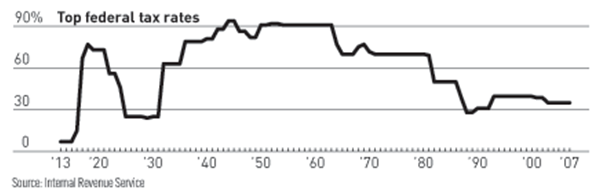
Practically everyone agrees that the U.S. federal income tax structure is progressive (i.e. high earners pay a higher tax rate).  But, the Reagan and Bush tax code changes did make it less progressive than it was in the 1960s; there are some isolated anomalies ( e.g. Warren Buffett and his secretary); and it may be less progressive than some folks want.

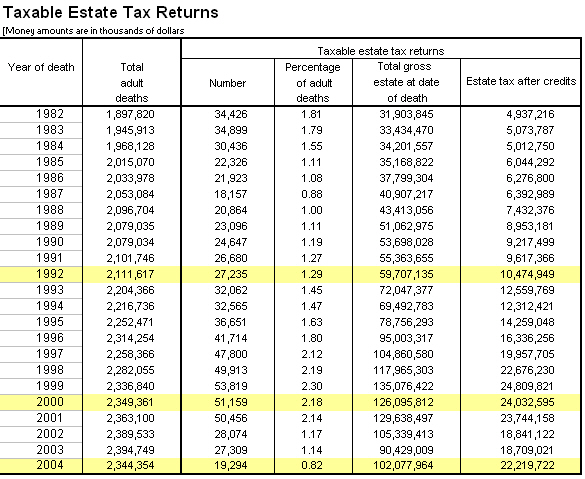
The estate tax (a.k.a, “death tax”) is – by definition —  progressive since only the wealthiest 1% of folks who die pay it.

  • Note: there’s a difference between “income” and “wealth” – while high income usually correlates with high wealth, income is a “flow” variable and wealth is a “stock”.

So, any dispute must arise from so-called  “payroll taxes” – the paycheck deductions that fund Social Security and Medicare. 

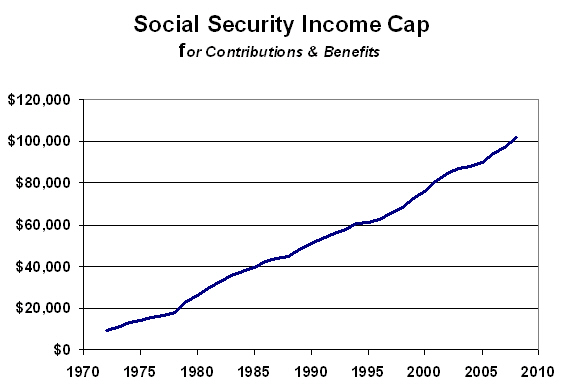
There is a single rate for Medicare (1.45%) that is applied to all wages; and.there is a single rate for Social Security(6.2%) that is applied to at most $102,000 in wages.  Employers match their employees’ contributions dollar-for-dollar.

  • Note: most economists argue that, in the final analysis, employees bear the full burden of their employer’s matching amounts since employers most likelycover the tax by reducing wages.

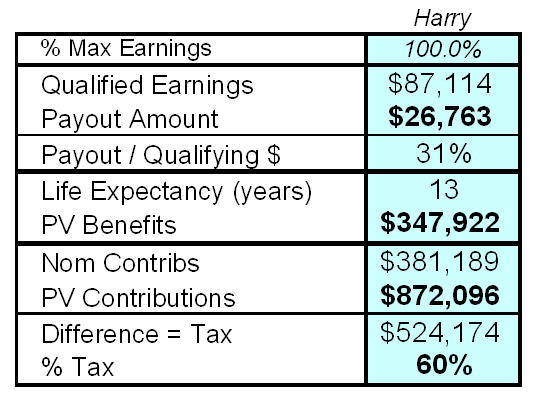
Since the same rates are applied to all taxpayers , and since Social Security’s“base earnings” are capped at  $102,000, then payroll taxes are regressive with respect to current earnings.  But – as I’ll demonstrate is future analytical posts – Medicare benefits are the same, regardless of how much a taxpayer contributes (and high earners contribute more than low earners); and Social Security benefits are “coupled” to earnings via a very progressive formula – i.e. high-earners get disproportionately less in benefits.  So, taking into account the benefits received as well as the contributions made, both programs are very progressive.

The bottom line: all of the components are progressive:  federal income taxes, estate taxes, payroll taxes.  So, it logically follows that the combined program is progressive.

In this post, I’ll set-up the issue and provide some references.  In subsequent posts, I’ll provide some numbers and analysis that support the above conclusions..

* * * * *

The Details

The question: Is the current U.S. tax system “regressive” – the more you make, the lower your effective tax rate – or is it  “progressive” – the more you make, the higher your effective tax rate.

Let’s look at the pieces that make up the U.S. tax system..

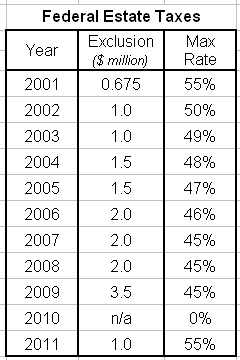
There’s the estate tax (a.k.a. “death tax”).  It’s clearly progressive since only the richest 1% of folks who die pay it.  As the exclusion levels increase under the Bush plan, fewer dead people have to pay it – making it even more progressive.  When it gets eliminated entirely in 2010, it stops being progressive, but it doesn’t start being regressive.  It just stops.

The estate tax in small potatoes in the overall  tax mix.  The big behemoth is the federalincome tax.  The aggregate statistics  (i.e. looking at the broad population , and not just Warren Buffett and his secretary) are – in my opinion – incontrovertible.  Higher income folks – say the top 50% — pay a higher effective income tax rate and shoulder over 97%l of the federal income tax burden. The federal income tax is progressive.  Period..

Why then, do many really smart, well-intended people say the tax system is regressive and that high earners aren’t paying their fair share?

  • Note: though some people use the terms interchangeably, “regressive” and “fair share” are not synonymous.

First, what some of them are really saying is that the income tax code isn’t as progressive as it used to be (true, but so what?),  or that it isn’t as progressive as the tax code in other countries, say France (true, but — for sure — so what?),  or that it’s not progressive enough based on higher order socio-ethical criteria (very important, but also, quite debatable).

A more structural argument posed by many people is that so-called “payroll taxes” that fund Social Security and Medicare are regressive and tilt the balance of the tax system..

* * * * *

For example, Robert Reich, Bill Clinton’s former Secretary of Labor says:

The fact that “84.6% of all federal taxes are paid by the top 25% of income earners, and over a third are paid by the top 1%, advances a specious argument.

Most Americans pay more in payroll taxes than in income taxes … payroll taxes take a much bigger portion of the paychecks of lower-income Americans than of higher-income.

Viewed as a whole, the current tax system is quite regressive.”

http://economistsview.typepad.com/economistsview/2007/10/robert-reichs-p.html

* * * * *

OK, so parsing Reich’s argument, if the overall system is regressive, and if major parts of the system —  income and estate taxes are progressive – then it logically follow that payroll taxes are both substantial (especially to low-earners) and very regressive.  The culprit is payroll taxes.

* * * * *

The Tax Policy Center  a joint venture of the Urban Institute and Brookings Institution and self-proclaimed non-partisan organization   – explains:

Taken as a whole, the federal tax system is progressive: on average, households with higher incomes pay a larger share of their income in federal tax than do those with lower incomes. In other words, the overall average effective tax rate-total tax paid as a percentage of income-rises as income rises.

But not all taxes within the federal system are equally progressive. The estate tax is the most progressive federal tax. The individual (and corporate) income taxes are also progressive. In contrast, payroll taxes for Social Security and Medicare are regressive, claiming a larger share of income from lower-income than from higher-income households.

For 2008 average effective payroll tax rates are estimated at 8.4 percent for the bottom fifth of income earners, and 10.4 percent for the next fifth, but only 5.7 percent for the top fifth. Households in the top 1 percent will pay an estimated average of only 1.5 percent of their income in payroll taxes.

This regressivity of payroll taxes stems from two factors. First, the Social Security portion of payroll taxes is subject to a cap: in 2008, individuals pay Social Security tax on only their first $102,000 in earnings. Second, higher-income households tend to receive more of their income from sources other than wages, such as capital gains and dividends, which are not subject to the payroll tax.”

http://www.taxpolicycenter.org/briefing-book/background/distribution/progressive-taxes.cfm

* * * * *

The underlying logic of the regressive claim is simple. Take Social Security: A worker gets docked 6.2% on wages up to $102,000.  The rate drops to zero for any wages over $102,000.  So, somebody earning $50,000 has $3,100 deducted from their paycheck [6.2% times $50,000];  somebody earning $102,000 has $6,324 deducted —  a greater amount, but the same 6.2%;  somebody earning $200,000 has $6,324 deducted — the same as the worker earning $102,000, but representing a lower effective rate (3.2%).  The more that somebody earns over the $102,000 maximum, the lower the effective rate. By definition, that’s a regressive tax since the rate declines as income gets higher.  Case closed. Right?

Not so fast.

* * * * *

The Urban Institute gets to the real core of the question:

The payroll tax is very regressive with respect to current income: The average tax rate falls as income rises …  (But) the regressivity of the payroll tax is mitigated to a substantial extent when Social Security and Medicare benefits are considered as well..

http://www.urban.org/publications/1001065.html

* * * * *

In other words, the single payroll tax rate and the cap on taxable earnings combine to make payroll taxes appear regressive when analyzed solely based on current payroll deductions but, the benefits the taxes buy (retirement income and health insurance) are so progressive – i.e. highearners get muchlowerbenefitsperdollarthanlowearners — .that the net effect on tax payers is progressive – very progressive.

* * * * *

A Congressional Joint Economic Committee states the case more directly:

The rapid growth in payroll taxes over the past 40 years has imposed a large burden on working Americans. This burden has fallen disproportionately on low-income workers. However, in the context of a comprehensive tax policy, it is misleading to focus on the short-term burden imposed by payroll taxes without accounting for the future benefits (since) the progressivity of the benefit formulae outweigh the disproportionate burden imposed by the taxes.

As a result, low-wage workers can expect to receive benefits that exceed the sum of their and their employers’ payroll tax contributions. Middle- and high-wage workers, on the other hand, can expect to pay substantially more into the system than they will receive in benefits.

Overall, middle- and high-wage workers subsidize the income and payroll tax liabilities of low-wage workers, leaving most low-wage workers with net negative tax liabilities throughout their lifetimes.

http://www.house.gov/jec/fiscal/tx-grwth/payroll/payroll.htm

* * * * *

>>> Read more

Encore – Those %#@! Bush Tax Cuts

October 29, 2008

Note: This brief was originally posted July 23, 2008.  Yesterday, Sen. Biden said “Bush’s tax cuts didn’t help the middle class at all.”  Huh?  Sorry, Joe — there were plenty of goodies in there for everybody.  Read on …

* * * * *

Summary: We’ve all heard the  rants about the cuts in the top bracket rate, capital gains rate, dividend taxes, and estate taxes.

But, when was the last time that your heard a candidate (on either side) or a pundit (O’Reilly included) mention the new 10% bracket, larger and refundable child and earned income credits, negative income taxes, elimination of the marriage tax penalty, or expanded college benefits?

* * * * *

The income tax cuts of 2001 and 2003 are shorthanded by the press and political candidates as “Bush’s tax breaks for the wealthy — who didn’t even want them”, and are blamed for an accelerating polarization of wealth distribution (i.e. rich get richer, poor stay poor).

Warren Buffet says his secretary pays more taxes than he does (really?). McCain says he’ll stay the course. Obama says that he’ll roll back the tax cuts if he’s elected and redistribute them to the “folks who need them the most”.

All of the rhetoric got me thinking.  Somewhat embarrassed, I realized Ihat I didn’t know exactly what was in the Bush tax plan.  (Quick Test: take out a sheet of paper and jot down the tax breaks enacted as part of the Bush plan)

Prompted by curiosity (and a modicum of selfish interest) I did some digging.  Here’s what I found, along with my “take”:

The top marginal income tax rate  was cut from 39.5% to 35% (applied to Adjusted Gross Income >$350,000)
– the 36% marginal rate was cut to 33%  (TI > $161,000)
– the 31% marginal rate was cut to 28%  (TI> $77,000)
– the 28% marginal rate was cut to 25%  (TI > $32,000) 
…  a clear benefit to the top half of income earners; with the biggest benefit to the highest earners

Capital gains and dividend tax rates were reduced to 15% for high-earners, zero for low earners … more of a benefit to high-earners, but 1/3 of households own stock and more than 1/4 of returns (including many retirees) report dividend income … turned out to be a windfall for hedge funds and private equity via the “carried interest” loophole (more on that in a subsequent post)

A low-income 10% tax rate bracket was introduced … benefit to many low-earners previously in the 15% bracket

Child Care Credit and Earned Income Tax Credit were increased and made refundable … resulting in zero or negative tax due balances for millions of people (note: “refundable” means that any negative tax due is paid to the citizen — a very important policy shift)

Income limits were eliminated on personal exemptions and itemized deductions … the former helps low earners most — since it’s a higher proportion of income; the latter benefits higher earners most — since they are the ones who itemize deductions. (Note: roughly 2/3’s of tax filers take the standard deduction)

Marriage penalty was neutralized … benefits middle-earning couples most

College education benefits were liberalized, e.g. 529 plans, student loan interest deduction, tax-free employer paid tuition … benefits mid- and high-earners most (since their family members disproportionately attend college)

Estate taxes were reduced and to be phased out… only impacts wealthy folks with estates that are big enough to be subject to “death taxes”


* * * * *

Details re: “Bush Tax Plan” – 2001 and 2003

Officially, the first round of Bush tax cuts were codified in the “Economic Growth and Tax Relief Reconciliation Act of 2001” which was approved by the Congressional conference committee on May 25, 2001; signed into law shortly thereafter; but phased in over a several year period.  The key provisions of the law (as reported in the conference committee’s report):
 
Introduce a 10-percent rate bracket… reducing the rate from 15% to 10% for the first $6,000 of taxable income for single individuals ($7,000 for 2008 and thereafter), $10,000 of taxable income for heads of households, and $12,000 for married couples filing joint returns ($14,000 for 2008 and thereafter).

Reduce individual income tax rates  … from 28 percent, 31percent, 36 percent, and 39.6 percent are phased-down over six years to 25 percent, 28 percent, 33 percent, and 35 percent, effective after June 30, 2001.

click table to make it bigger

Phase-out of Itemized Deductions and Restrictions on Personal Exemptions … by eliminating all limitation on itemized deductions and any restrictions on personal exemptions for all taxpayers by one-third in taxable years beginning in 2006 and 2007, and by two-thirds in taxable years beginning in 2008 and 2009, and by 100% for taxable years beginning after December 31, 2009.

Increase and Expand the Child Tax Credit… Increasing the child tax credit to $1,000, phased-in over ten years. and by making the child credit — subject to certain income limitations — non-taxable and refundable (i.e. payable to the person if the net tax liability is zero),

Provide relief from the “marriage penalty” … by increasing the basic standard deduction for a married couple filing a joint return; by increasing the size of the 15-percent regular income tax rate bracket for a married couple filing a joint return to twice the size of the corresponding rate bracket for an unmarried individual filing a single return.; and by increasing limits on the Earned Income Tax Credit.

Provide Education Benefits… by increasing the annual limit on contributions to education IRAs to $2,000; by expanding the reach of 529 tuition programs; by extending the non-taxibility of employer paid tuition; and by raising income phase out levels for deductability of student loan interest.

Phase-out and Repeal of Estate and Generation-Skipping Transfer Taxes:

click table to make it bigger

* * * * *

In 2003, a second round of tax changes was enacted in the “JOBS AND GROWTH TAX RELIEF RECONCILIATION ACT OF 2003” which:

Accelerated the phase in of the 10% bracket, the reduction in other bracket rates, the child care tax credit, and marriage penalty relief.

Provide reductions in taxes on capital gains and dividends … reducing the 10- and 20-percent rates on capital gains on assets held more than one year to five ( zero, in 2008 ) and 15 percent, respectively. and providing that dividends received by an individual shareholder from domestic and qualified foreign corporations generally are taxed at the same rates that apply to capital gains.

* * * * *

Source Reports
http://www.jct.gov/x-50-01.pdf
http://www.house.gov/jct//x-54-03.pdf


* * * * *

Want more from the Homa Files?
 
Click link =>  The Homa Files Blog

Again: Dogbert for President !

October 29, 2008

Dogbert’s tax plan … sound familiar ?

>> Current Posts

Reprise: Under Obama, Tax Payers Will be a Minority !

October 28, 2008


Note: This analysis was originally posted on July 31, 2008.  It’s the post that has gotten the most hits, and the topic is ‘hot’ this week on the talk shows.  So, here’s a flashback .
..

* * * * *

Despite the drumbeat of warnings from various sources, the prospects that a minority of voting age Americans will be paying Federal income taxes under the Obama tax plan doesn’t seem to arouse much visible public anxiety.


Why?


First, for those in the emerging majority that won’t pay any income taxes – or may even be getting government checks for tax credits due – the deal is almost too good to be true.  To them, Obama’s  plan must make perfect sense.  So, why rock the boat? 


Second, some people argue that low-earning people who don’t pay income taxes shoulder a regressive payroll tax burden to cover Medicare and Social Security.  Yeah, but these programs – which are most akin to insurance or forced savings plans — offer specific individual benefits that are directly linked to each wage earner’s contributions.and the benefits phase down quickly as qualifying income increases.  That is, they’re not as regressive as many people argue. 


Third, most of the energetic criticism of Obama’s plan has centered on its redistribution intent — taking over $130 billion of “excess” income from undeserving rich people, and giving it directly to those who earn less and need it more. 

Fourth, most folks just don’t believe that the numbers will really shift enough to create a voting majority of citizens who don’t pay income taxes. They’re wrong.  Very wrong.


Here are the numbers … and why they should bother you.


* * * * *

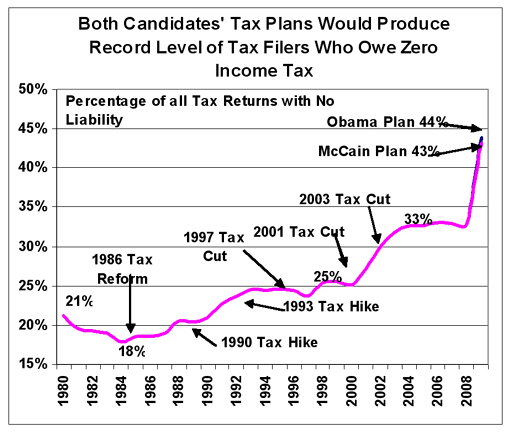
Today, 41% of voting age adults don’t pay Federal income taxes

Based on the most recent IRS data, slightly more than 200 million out of 225 million voting age Americans filed tax returns.  That means that 25 million adults – presumably low income ones – didn’t file returns and, of course, didn’t pay any income taxes. See notes [1] to [4] below

Of the 200 million voting age filers, approximately 68 million (33% of total filers) owed zero income taxes or qualified for refundable tax credits (i.e. paid negative income taxes). [5]

Add those 68 million to the 25 million non-filers, and non-payers already total 93 million –  41% of voting age adults.

* * * * *

Obama’s Estimates – Make that 49%
Not Paying Federal Income Taxes

Obama says (on his web site) that he will give tax credits up of $1,000 per family ($500 per individual) that will  “completely eliminate income taxes for 10 million Americans”.  And, he says that he will “eliminate income taxes for 7 million seniors making less than $50,000 per year.”  [6]

Taking Obama’s estimates at face value,  the incremental 17 million that he intends to take off the income tax rolls will push  the percentage of non-payers close to 49% of voting age Americans  — within rounding distance to a majority. [7]

* * * * *

And, Obama’s estimates are probably low,
so make the number 55% (or higher)
 

Since Obama’s basic proposal is for tax credits  ($500 per person or $1,000 per family) – not  simply deductions from Adjusted Gross Income (AGI) — they will have a multiplier impact on the amount of AGI that tax filers can report and still owe no taxes.

For example, a childless married couple that files a joint return can currently report about $17,500 in  Adjusted Gross Income (AGI) and owe no income taxes. [8]

Under the Obama Plan,  that couple’s zero-tax AGI is bumped up to $27,500 since their new $1,000 tax credit covers the 10% tax liability on an additional $10,000 of AGI.  And, married couples filing jointly can keep adding about $10,000 to their zero-tax AGI for each qualifying dependent child that they claim. [9]

click table to make it bigger

click table to make it bigger

Based on the 2006 IRS data, approximately 25 million tax returns were filed that reported AGI less than  $27,500 (the post-Obama zero-tax AGI) and required that some income taxes be paid.  [10]

Assuming that 45% of those were for couples filing jointly, they represent  over 22 million adults.  For sure, these 22 million will  come off the tax rolls —  and they alone will be enough to create a non-taxpayer majority (51% of voting age adults),

click to make table bigger

And, there are more folks being pushed off the tax rolls.  About 4.7 million childless individuals earn less than $13,750  (the post-Obama zero-tax AGI for childless individuals), and currently pay some Federal income taxes.   This group will shift  to non-payer status.

So would several million joint filers who can take advantage of the Child Tax Credit to report more than $27,500 and not pay Federal income taxes.

And, some portion of the 7 million Seniors that Obama says will have their taxes eliminated — that is the Seniors couples earning more than $27,500 (but less than $50,000) — and Senior individuals earning more than $13,750 (but less than $50,000).

So, post-Obama, the percentage of non-taxpayers will  easily exceed 55% of voting age adults — a solid majority.  It won’t even be close.

* * * * *

The Bottom Line – Why You Should Worry

An income tax paying minority of voting age adults isn’t just a possibility. Under Obama’s plan, it’s a virtual certainty.  Based on the hard numbers, Obama’s plan will create a new majority — a powerful voting block: non-tax payers. UH-OH.

Again, for those in the emerging majority that won’t pay any income taxes – or may even be getting government checks for tax credits due – the deal is almost too good to be true.  To them, Obama’s  plan must make perfect sense.  Count on their perpetual support for the plan.

But for those in the new minority, watch out if the new majority decides that more government services are needed, or that  $131 billion in income redistribution isn’t enough to balance the scales.

The Tax Foundation — a nonpartisan tax research group – has repeatedly warned that  “While some may applaud the fact that millions of low- and middle-income families pay no income taxes, there is a threat to the fabric of our democracy when so many Americans are not only disconnected from the costs of government but are net consumers of government benefits. The conditions are ripe for social conflict if these voters begin to demand more government benefits because they know others will bear the costs.”  http://www.taxfoundation.org/research/show/1111.html

* * * *  *

Sources & Notes

[1] The Census Bureau reported 217.8 million people age 18 and over; as of July 1, 2003.
http://www.census.gov/Press-Release/www/releases/archives/population/001703.html 
http://www.census.gov/popest/national/files/NST-EST2007-alldata.csv

[2] The IRS reported 138.4 million personal tax returns filed in 2006.
http://www.irs.gov/pub/irs-soi/06in11si.xls

[3] The IRS reported that in 2006, approximately 45% of filed returns were by married couples filing jointly (i.e. 2 adults per return); 55% for individual filers (including ‘married filing separately’ and ‘head of household’).  http://www.irs.gov/pub/irs-soi/06in36tr.xls

[4] Calculation: 138.4 million returns times 1.45 (adults per return) equals 200.7 million adults represented on filed returns

[5]  http://www.irs.gov/pub/irs-soi/06in01fg.xls      http://ftp.irs.gov/pub/irs-soi/06inplim.pdf

[6]  http://www.barackobama.com/issues/economy/#tax-relief

[7]  Analytical note: 93 million plus 17 million equals 110 million divided by 225 million equals 49%.

[8]  Analytical note:  $17,500 less a $10,700 standard deduction, less 2 exemptions at $3,400 each, equals taxable income of zero – so no federal income taxes are due.

[9] Analytical note:  $27,500 less a $10,700 standard deduction, less 2 exemptions at $3,400 each, equals taxable income of $10,000, which at a 10% rate is a $1,000 tax liability that gets offset by the $1,000 Obama credit, reducing the tax liability to zero.

* * * * *

Want more from the Homa Files?
 
Click link =>  The Homa Files Blog

Raise your hand if you like Joe the Plumber ?

October 21, 2008

Excerpted from Rasmussen Reports, Oct. 19, 2008

* * * * *

61% of voters have been following news stories of Joe the Plumber somewhat or very closely.

Among those following the story,  58% have a favorable opinion of Joe — 37% unfavorable.

71% of Republicans have a favorable opinion of Joe — 64% of Democrats have an unfavorable view.

Among middle income voters (earning $40,000 a year to $100,000) 52% have a favorable opinion of Joe — 33% unfavorable 

39% of those who earn less than $40,000 a year have a favorable opinion of Joe —  44%  unfavorable.

35% of higher income have a favorable opinion of Joe — 52% unfavorable.

57% of entrepreneurs have a favorable opinion Joe.

* * * * *

Given a choice between the two presidential candidates and Joe, 44% say Obama is the one who best understands the economic realities they face. Twenty-nine percent (29%) named McCain and 19% Joe the Plumber.

Among middle-income Americans, those earning $40,000 to $100,000 annually, 58% say that either McCain or Joe the Plumber best understands their situation. Just 35% say Obama does.

* * * * *

Full article:
http://www.rasmussenreports.com/public_content/politics/election_20082/2008_presidential_election/democrats_favor_spreading_wealth_around_gop_disagrees

* * * * *

Want more from the Homa Files?
Click link =>
  The Homa Files Blog

Bailout: One of the largest tax bills in recent years

October 21, 2008

Excerpted from WSJ: “The Bailout Includes Lots of Treats”,  Tom Herman, Oct. 12, 2008

 
The historic bailout package (includes) relief for millions of taxpayers. The new law “makes almost 300 changes” to the Internal Revenue Code.

Part of the new law prevents many people from being ensnared this year by the alternative minimum tax. Other provisions extend popular tax breaks that expired at the end of last year or were scheduled to disappear after the end of this year.

* * * * *

AMT Quick Fix

If Congress had done nothing, about 26 million people would have been affected this year by the alternative minimum tax, or AMT, up from four million last year, The new law, which includes raising the AMT income-exemption levels for 2008, essentially slaps a patch on the AMT problem.

The AMT is a parallel system to the regular tax system but operates under significantly different rules and can be mind-numbingly complex. For example, under the AMT, you can’t deduct state and local taxes. That’s why among the most common victims of the AMT are people who live in high-tax areas, such as California and New York City, and who make between about $100,000 and $500,000.

Under the new law, the AMT income-exemption level for 2008 rises to $69,950 for married couples who file jointly and $46,200 for most singles.

image
http://tax.cchgroup.com/Legislation/2008-Emergency-Economic-Stabilization-Act.pdf

* * * * *

Some Restored Deductions

The new law also restores deductions for state and local taxes, higher-education tuition and teachers’ school supplies.

Sales-tax deduction: If you itemize your deductions, you can choose to deduct state and local sales taxes, instead of state and local income taxes. You can’t deduct both, however. The sales-tax deduction is especially popular in Florida, Texas, Washington and other states that have no state income tax.

Charitable deductions from IRAs: Congress also revived a popular provision allowing people age 70½ or older to transfer as much as $100,000 a year directly from an IRA to charity without owing income taxes on the money. This transfer is counted toward the taxpayer’s required minimum distribution for the year. Many donors care deeply about this provision.

Non-Itemizers Property Taxes: Lawmakers also extended a provision that helps many people who don’t itemize. It allows them to claim an additional standard deduction for real-estate taxes of as much as $1,000 for joint filers, or $500 for most singles.

* * * * *

Full article:
http://online.wsj.com/article/SB122377122797726287.html?mod=sunday_journal_primary_hs

Comprehensive analysis:
http://tax.cchgroup.com/Legislation/2008-Emergency-Economic-Stabilization-Act.pdf

* * * * *

Want more from the Homa Files?
Click link =>
  The Homa Files Blog

Guess: Who Favors Spreading Wealth Around ?

October 20, 2008

Excerpted from Rasmussen Reports, Oct.19, 2008

* * * * *

Barack Obama told Joe the Plumber, “When you spread the wealth around, it’s good for everybody.”

* * * * *

44% of voters agree with Obama’s statement — 42% disagree.

69% of Democrats think their candidate is right, but 78% of Republicans disagree.

* * * * * 

A majority of those who earn less than $40,000 a year agree with Obama about spreading the wealth around, while most of those who earn more than that disagree.

Ken’s Note: Approximately 40% of adults pay no income tax or get a refundable credit check; the top 50% of tax filers pay over 97% of all income taxes.  Could it be that those who pay taxes are less inclined towards spreading ?

* * * * *

Entrepreneurs are strongly opposed.

A slight plurality of government employees agree.

63% of voters under 30 agree with Obama’s statement — 33% disagree. A plurality of those over 30 take the opposite view.

* * * * *

A plurality of voters (48%) believes that McCain or Joe the Plumber better understand their situation better than Obama does.

* * * * *

Full article:
http://www.rasmussenreports.com/public_content/politics/election_20082/2008_presidential_election/democrats_favor_spreading_wealth_around_gop_disagrees

* * * * *

Want more from the Homa Files?
Click link =>
  The Homa Files Blog

Attn: Senator Obama … Re: Your Tax Plan’s Marginal Rates

October 20, 2008

I’m now completely convinced that neither Sen. Obama nor anybody else understands what’s in his tax plan — the mathematics — and the implications.

For example, he told Joe the Plumber that his taxes would only go up 3% in order to “spread the wealth”.

Let’s start with the marginal tax rate for folks making more than $250,000.

Obama says that it will go back to what it was under Bill Clinton. OK, in 1999, the top bracket started at $283,150 (for both individuals and marrieds filing jointly) — the rate was 39.6%.

For 2008, the top bracket starts at $357,700 (for both individuals and marrieds filing jointly) — and the marginal tax rate is 35%. Note that it’s 35% — most politicos are running around saying it’s 36% — not true.

So, the top bracket marginal rate increase under Obama’s plan is 4.6 percentage points (from 35% to 39.6%) which is a 13% increase in the marginal rate (4.6% / 35% = 13%).

In 2008, the 2nd highest bracket starts at $200,301 for marrieds — with a marginal rate of 33%. For those folks, the increase is 6.6 percentage points (from 33% to 39.6%) which is a 20% increase in the marginal tax rate.

There’s a big difference between 3% and 13%, and a bigger difference between 3% and 20%. Shouldn’t somebody mention this to both Joe and Barack ?

* * * * *

Want more from the Homa Files?
Click link =>
  The Homa Files Blog

* * * * *

Taxes – If 39.5% sounds high …

October 20, 2008

Did you know that once upon a time, the high bracket marginal federal income tax rate was a whooping 90%. 

Add in some state & local taxes, and uber-earners were shelling every piece of marginal income to the government.

My surprises:

(1) the 90% rates hung in for almost 30 years.

(2) it was JFK, not Reagan that made the first cuts

image

Chart extracted from an IBD editorial:
http://www.ibdeditorials.com/IBDArticles.aspx?id=303088374745338

* * * * *

Want more from the Homa Files?
Click link =>
  The Homa Files Blog

* * * * *

Putting the stock market (and capital gains) in perspective …

October 15, 2008

Historical Perspective

Like most folks, I’ve gotten hammered by the recent market declines.  But yesterday —when Obama said “McCain’s capital gains tax cut won’t have any effect … not even the best investors have to worry about capital gains these days” — it got me thinking “how bad are things, and is Obama right?”  Answer: “not that bad”, and “no”.

Below is historical data for the S&P 500 Index — right off Yahoo Finance.  Since the plot is logarithmic, the straight line represents a constant rate of increase — across 33 years.  Pretty remarkable, right ?  Even considering the past couple of weeks’ battering.  The chart really puts things in perspective. If you compare where we are to 2 artificially high periods — the internet -bubble and the housing bubble — things look pretty bleak.  If you compare where we are to the long run historical trend — we’re only slightly below the trend line.  In other words, right on track.

image

* * * * * *

Capital Gains

What about Obama’s assertion that not even the savviest investors will benefit from a halving of the capital gains rate?

Well, that might or might not be true. It depends on when stocks were bought.  Using the S&P 500 as a proxy for an average stock, if a stock  was bought near the peak of the internet or housing bubbles, it’s probably “under water” with no unrealized capital gains (i.e. capital losses).  McCain’s proposal to allow deductibility of up to $15,000 of losses (up from $3,000) would offset some of the pain.  The average tax benefit of the step-up would be about $2,400 [$12,000 step-up times 20% average effective tax rate equals $2,400].

But, note that a stock that’s been held for about 10 years — e.g. the portfolios of diehard “buy & hold” folks — are “in the money” and have capital gains.  Or, folks who bought into the market after the internet bubble burst may have capital gains.  For example, if somebody bought the S&P Index in Sept. 2002 at 815, they’d be sitting down from the housing bubble peak of 1,500 but — at 1,000 — they’d still have 185 of capital gains.  After McCains 7.5% capital gains tax, that nets to 171; after Obama’s 20%, that nets to 148 — a 16% difference. Hmmm.  I guess the cut in the capital gains tax rate could matter.

More important, McCain’s capital gains tax rate cut is intended to attract capital into the market now — with the prospects of favorable tax treatment when prospective gains are realized.  The increased flow of capital should boost the stock market — which is good for all investors, big and small — and should provide growth capital to businesses — which should help employment.  Win-win.

image

* * * * *

Want more from the Homa Files?
Click link =>
  The Homa Files Blog

For the record: Ideas for McCain …

October 14, 2008

Last week I emailed some ideas to Doug Holtz-Eakin — McCain’s chief economic advisor. Why?  Just frustrated.  Waste of time ? Probably. I imagine that it went right to a spam file … and I certainly didn’t get a reply.

Still, since McCain is supposed to unveil some new economic tactics today, I wanted to get my notions on the record.  Interesting to see if any are included.

* * * * *  

    Ken’s Ideas

1) Make the first $100,000 of capital gains tax free for everybody
   (Note: Warren Buffet & other uber-fat cats
              wouldn’t benefit much)
 

2) Make IRA and 401K withdrawals taxable at capital gains rates — not ordinary income rates
    (Note: even though IRAs are down, many are still above water)

3  Make all capital gains from the sale of primary residences tax free … always
    (Note: allows empty-nesters to downsize — currently,
               only 1 primary home sales is cap gains free)
  

4) Allow home mortgage interest to be income tax deductible for the 65% of filers who use the standard deduction.
    (Note: roughly comparable to Obama’s 10% tax credit
              for mortgage interest )
  

5) Give a 1-time stimulus payment to Social Security retirees equal to 1 month their annual SS benefits
    (Note: gets some relief to fixed income Seniors)

6) Shift the payroll tax schedule by by increasing the earnings cap by $25,000 (to $127,000)
    … but give a non-refundable tax credit for payroll taxes on the first $25,000 of earnings.
   (Note: this Out-Obamas Obama)

7) Retroactively impose a draconian 1-time income tax surcharge for 2008 earnings OVER $5 million.
    For example: a 100% surcharge on income over $
     5 million would mean a 70% rate.

   (Note: I realize this isn’t conservative and
     muddies the “no tax” message  … but it
     goes right after the “greedy fat cats”
    Note:  tax changes can be retroactive
… puts responsibility on Dem Congress, this year)
 

* * * * *

Want more from the Homa Files?
Click link =>
  The Homa Files Blog

Taxes: The 95% illusion … what’s a tax cut?

October 13, 2008

Excerpted from WSJ: ” Obama’s 95% Illusion”, Oct. 13, 2008

* * * * *   
One of Obama’s most potent campaign claims is that he’ll cut taxes for no less than 95% of “working families” … (and cut aggregate income taxes).

How does he conjure this miracle, especially since more than a third of all Americans already pay no income taxes at all? First, by proposing one of the largest tax increases ever on the other 5%.

There are several sleights of hand, but the most creative is to redefine the meaning of “tax cut.”

* * * * *
For Obama , a tax cut is no longer letting you keep more of what you earn. In their lexicon, a tax cut includes tens of billions of dollars in government handouts that are disguised by the phrase “tax credit.”  Obama is proposing to create or expand no fewer than seven such credits for individuals:

  • A $500 tax credit ($1,000 a couple) to “make work pay” that phases out at income of $75,000 for individuals and $150,000 per couple.
  • A $4,000 tax credit for college tuition.
  • A 10% mortgage interest tax credit (on top of the existing mortgage interest deduction and other housing subsidies).
  • A “savings” tax credit of 50% up to $1,000.
  • An expansion of the earned-income tax credit that would allow single workers to receive as much as $1,110 if they are paying child support.
  • A child care credit of 50% up to $6,000 of expenses a year.
  • A “clean car” tax credit of up to $7,000 on the purchase of certain vehicles.

Here’s the political catch. The credits  would be “refundable,” which is Washington-speak for the fact that you can receive these checks even if you have no income-tax liability. In other words, they are an income transfer — a federal check — from taxpayers to nontaxpayers. Once upon a time we called this “welfare.”  Mr. Obama’s genius is to call it a tax cut.

* * * * *
The Tax Foundation estimates that under the Obama plan 63 million Americans, or 44% of all tax filers, would have no income tax liability and most of those would get a check from the IRS each year.

The total annual expenditures on refundable “tax credits” would rise over the next 10 years by $647 billion to $1.054 trillion, according to the Tax Policy Center.  By redefining such income payments as “tax credits,” the Obama campaign also redefines them away as a tax share of GDP. Presto, the federal tax burden looks much smaller than it really is.

There’s another catch: Because Mr. Obama’s tax credits are phased out as incomes rise, they impose a huge “marginal” tax rate increase on low-income workers. The marginal tax rate refers to the rate on the next dollar of income earned. The marginal rate for millions of low- and middle-income workers would spike as they earn more income.

[Review & Outlook]

* * * * *

Full article:
http://online.wsj.com/article/SB122385651698727257.html

* * * * *

Want more from the Homa Files?
Click link =>
  The Homa Files Blog

Bad news: Tax-payers on the hook for the bailout … Good news (?): that’s not many people

October 10, 2008

Ken’s Take:  I’ve been railing for awhile on the trend to have a minority of voters incur the full burden of taxes. I think everybody should have some skin in the game.

So, who is paying for the bailout?  Read on …

* * * * *

Excerpted from RealClearPolitics.com: “The Bailout and the Vanishing Taxpayer”, October 08, 2008

* * * * *
We have heard much in the press lately about the American taxpayer being forced to rescue the sharpies on Wall Street from their own greed and irresponsibility. Anti-bailout sentiment cuts “across class lines” on Main Street because “the taxpayers are on the hook for the bad judgment of others,” as the Washington Post put it.

Now for a reality check. Many Americans probably won’t pay a cent of the cost of this bailout.

That’s because a rapidly increasing percentage of U.S. households legally pay no income taxes, and many others pay so little in taxes that they already get back more from the federal government in services than they send to Washington. The number of taxpayers  … is small and shrinking, which is why the only way that the folks on Main Street will pay for this bailout will be if Main Street is where the mansions are in your town.

* * * * *

The declining portion of households who pay taxes is a direct result of policies pursued by both Republicans and Democrats over the last 15 years or so. While deductions and credits have always served to eliminate the tax bill for some low and lower-middle income workers, from 1950 through roughly 1990, the percentage of households with no income tax burden stood constant at slightly more than one-fifth of all filers, according to the Tax Foundation. But since 1990, Washington has added all sorts of tax credits��”subsidizing everything from “lifetime learning” to adoption expenses–that have further reduced the tax tab, and in the process raised the proportion of households with no federal tax liability to 33 percent.

A big culprit in this evolution is the current Bush administration and its tax packages. Although the 2001 and 2003 tax cuts are often criticized as having favored the rich, in fact they were also laden with tax credits benefiting low and middle income families, and as a result, under Bush, the percent of families not paying taxes increased more than under any other president during the last 50 years.

Both presidential candidates would vastly accelerate the trend (from 33% to the mid 40%s).

* * * * *

In the end, how we actually pay for the bailout is just part of the issue. The larger point is that if McCain or Obama follow through with their tax plans, we’ll continue a trend that makes us look more and more like some European social welfare state, where many people have a stake in growing government entitlements, which fewer and fewer taxpayers finance. At some point along that road, change becomes impossible because too many citizens benefit from the system in place, while those who pay the freight for this system try whatever they can, including starting businesses elsewhere, or reducing their output, to avoid the disproportionate tax bite.

* * * * *

Full article:
http://www.realclearmarkets.com/articles/2008/10/the_bailout_and_the_vanishing.html

* * * * *

Want more from the Homa Files?
Click link =>
  The Homa Files Blog

Tax hikes won’t impact you if you’re in the 95% … or will they ?

October 3, 2008

Excerpted from WSJ: “The Tax Issue Still Resonates”, Karl Rove,
Oct. 2, 2008

* * * * *

Conventional wisdom says tax cuts have lost their political power. One reason offered for the alleged decline of tax cuts as a potent issue is that since 2000, tax cuts have taken 13 million filers off of the income tax rolls. Today, one-third of all filers have no federal income tax liability and nearly 40% of all federal income taxes are now paid by the top 1% of taxpayers (60% by the top 5%). The fewer people who are paying taxes, the fewer people who care about tax cuts, or so goes the reasoning.

* * * * *
In a July 2008 Pew Poll, 52% of Americans said it was “difficult to afford” taxes. By comparison, 46% said the same about health care, 49% about home heating/electric bills, and 38% about food.

* * * * *

Obama says that only the top 5% will pay higher taxes under his proposals.

But, nearly three out of every four filers who’ll pay higher taxes under a President Obama are small businesses, the source of most new jobs and growth.

An Urban Institute-Brookings Institution Tax Policy Center study found that 73% of the filers hit by Mr. Obama’s tax increases report business income — i.e., they are small business owners. His tax hikes will affect every worker at those enterprises.

* * * * *

Ken’s POV:

The bottom line is that Obama’s tax hikes won’t impact you unless you work for a big company, a small company, or buy stuff from either big or small companies — who will simply increase prices to offset higher taxes.

* * * * *

Want more from the Homa Files?
     Click link =>
  The Homa Files Blog

Game-changing idea for the candidates …

October 1, 2008

Millions of baby boomers are delaying retirement because their IRAs are tanking; millions of retirees are crushed by rising energy and food costs.

Attack these two “kitchen table” issues directly:

1) Increase Social Security benefits by 10% (to help Seniors with rising living costs)

2) Make IRA withdrawal taxable at capital gains rates (they’re currently taxed at ordinary tax rates)

3) Make the first $100,000 of annual capital gains tax-free (they’re currently taxed 15% for many folks)

The last initiative would effect more than retirees, but would exclude “fat cats”.  And, the move would certainly buoy the stock market — at least a little.

* * * * *

Want more from the Homa Files?
     Click link =>
  The Homa Files Blog

The minority who will be paying income taxes … regardless who wins

September 24, 2008

Excerpted from Tax Foundation: “Both Candidates’ Tax Plans Will Reduce Millions of Taxpayers’ Liability to Zero (or Less) “, Scott  Hodge, September 19, 2008

* * * * *

Ken’s Notes:

1. The statistics below consider only tax filers.  Approximately 20% of adults don’t file returns — presumably since their incomes are zero or below the filing limits.

2.  The impact of the McCain proposal surprised me.  From a tax structure perspective, the plans are a push.  Of course, Obama would layer the health insurance provisions as added spending  (versus reduced revenue).

3.  Isn’t anybody concerned that a minority of citizens will be carrying the entirety of the tax burden ?

* * * * *

Article Summary

Over the past two decades, lawmakers have increasingly turned to the tax system rather than direct spending programs to funnel money to targeted groups of Americans, furthering some social or political goal. As a result, millions of Americans have been effectively removed from the income tax payment system while the tax code has been made more complicated to comply with and more difficult to administer. The tax plans of both the presidential candidates would exacerbate this situation greatly.

* * * * *

1.3 of filers currently pay no income tax

One of the biggest challenges facing both John McCain and Barack Obama in their commitment to provide tax relief to working-class Americans is the simple fact that millions of them already pay no personal income taxes.

According to the most recent IRS statistics for 2006, some 45.6 million tax filers—one-third of all filers—have no tax liability after taking their credits and deductions. For good or ill, this is a dramatic 57 percent increase since 2000 in the number of Americans who pay no personal income taxes.

* * * * *

Obama or McCain — Essentially a Push (much to my surprise)

Tax Foundation estimates show that if all of the Obama tax provisions were enacted in 2009, the number of these “nonpayers” would rise by about 16 million, to 63 million overall. If all of the McCain tax proposals were enacted in 2009, the number of nonpayers would rise by about 15 million, to a total of 62 million overall.

* * * * *

Big Issue: Refundable Tax Credits = Negative Income Taxes

The tax code has always contained provisions that reduce the income tax burden for low-income workers, such as the standard deduction, personal exemption, and dependent exemption.

Between 1950 and 1990, the percentage of tax filers whose entire tax liability was wiped out by these provisions averaged 21 percent. Since then, lawmakers have expanded credits—such as the earned income tax credit (EITC)—while creating a plethora of new credits, including the child tax credit, the HOPE credit, lifetime learning credit, and the credit for adoption expenses.

Most tax credits can only reduce a taxpayer’s amount due to zero, but the EITC and the child tax credit were also made refundable, meaning that taxpayers are eligible to receive a check even if they have paid no income tax during the year. Those tax returns have become, in effect, a claim form for a subsidy delivered through the tax system rather than a direct payment from a traditional government program like welfare or farm supports.

* * * * *

As shown in Table 1 below, the Tax Foundation estimates that there will be 47 million tax returns with zero income tax liability in 2009 under current law. That’s one-third of all tax returns, and those 47 million tax returns represent 96 million individuals.

Both the McCain and Obama plans would increase this number by expanding existing tax benefits or creating new ones.

* * * * *

Senator McCain is proposing one expanded provision—the dependent exemption—and one new credit, a $5,000 refundable health care tax credit.

Taken together, the McCain proposals would increase the number of nonpayers by about 15 million, bringing the total number of taxpayers who pay no personal income taxes to 62 million, roughly 43 percent of all tax filers. Almost all of this is due to McCain’s health care credit, which dramatically realigns health care incentives and gives people a powerful motive to buy health insurance. This tax provision has a bigger impact on cutting people’s taxes than any single proposal from either party. 

* * * * *

Obama uses a longer list of smaller tax credit ideas to reduce a similar number of taxpayers’ liability to zero. The Obama plan contains seven new provisions, including a new “Making Work Pay Credit,” a “Universal Mortgage Credit,” and a plan to eliminate income taxes for seniors earning under $50,000. About 16 million people who are currently paying at least a little income tax would see their liability zeroed out, bringing the total to 63 million, or 44 percent of all tax returns.

image


* * * * *

Major structural tax changes enacted during the 1980s contributed greatly to the doubling of nonpayers. Perhaps the most significant was indexing the tax brackets in 1985 to prevent inflation from pushing people into higher tax brackets. Also, the Tax Reform Act of 1986 nearly doubled the personal exemption and replaced the zero-bracket with the basic standard deduction for nonitemizers.

Since the early 1990s, however, lawmakers have increasingly used the tax code instead of government spending programs to funnel money to groups of people they want to reward. Credits have been enacted to subsidize families with children, college students, and purchasers of hybrid cars, just to name a few of the most well known. In terms of tax revenue, the most significant of these socially targeted credits was the $500 per-child tax credit enacted in 1997. The 2001 and 2003 tax bills doubled the value of the credit to $1,000 and added a refundable component.

image


* * * * *

Quite aside from the fact that these refundable credits remove millions from the roster of Americans who support the government by paying the income tax, these credits have some undesirable effects.

Added complexity. The explosion of tax credits has added a tremendous amount of complexity to the tax code, especially for low-income Americans who are the supposed beneficiaries of the programs. The EITC is so complicated that more than three-quarters of those claiming it pay a tax preparer to complete their forms.

Hidden marginal tax rate increases. To withhold the benefit of these credits from “rich people,” the definition of which changes from law to law, each of these credits has a phase-out range—that is, a range of income where the taxpayer has to pay back the credit that he no longer qualifies for. As a result, taxpayers in the phase-out range face unexpectedly high effective marginal tax rates.

Narrowing the tax base.  Expanding existing credits or adding new ones pushes people who used to pay taxes into the nonpayer range, shrinking the tax base and requiring higher taxes on everyone else. Undesirable volatility in federal revenue is the likely result, as the incomes of higher-income taxpayers include more business, dividend, and capital gains income which fluctuate much more wildly than wages.

* * * * *

Full article:
http://www.taxfoundation.org/publications/show/23631.html

* * * * *

Want more from the Homa Files?
Click link =>
  The Homa Files Blog

Biden: Be a patriot, pay more taxes

September 18, 2008

Excerpted from AP: ” Biden calls paying higher taxes a patriotic act”, September 18, 2008

* * * * *

Democratic vice presidential candidate Joe Biden said Thursday that paying more in taxes is the patriotic thing to do for wealthier Americans. The Republican campaign for president calls the tax increases their Democratic opponents propose “painful” instead of patriotic.

Under the economic plan proposed by Democratic presidential candidate Barack Obama, people earning more than $250,000 a year would pay more in taxes while those earning less — the vast majority of American taxpayers — would receive a tax cut.

Noting that wealthier Americans would indeed pay more, Biden said: “It’s time to be patriotic … time to jump in, time to be part of the deal, time to help get America out of the rut.”

* * * * *
Full article:
ttp://www.realclearpolitics.com/news/ap/politics/2008/Sep/18/biden_calls_paying_higher_taxes_a_patriotic_act.html

* * * * *

Reminder: Boiled down to its essence, Senator Obama’s complicated tax plan reduces to the  redistribution of over $100 billion in income each year by taking an average of about $20,000 in additional annual income taxes from about 5 million people, and redistributing the loot to 200 million others — about $500  per person in annual refundable tax credits.  That’s slightly more than a buck-a-day.

* * * * *

Want more from the Homa Files?
Click link =>
  The Homa Files Blog

Taxes: Playing small ball (very small ball)

September 17, 2008

Boiled down to its essence, Senator Obama’s complicated tax plan reduces to the  redistribution of over $100 billion in income each year by taking an average of about $20,000 in additional annual income taxes from about 5 million people, and redistributing the loot to 200 million others — about $500  per person in annual refundable tax credits.

Momentarily tabling the philosophical aspects of the redistribution plan,  I have a practical question: is the pain worth the gain?

* * * * *

A noticeable difference ?

The $500 may give some psychological reassurance that Uncle Sam cares, but will it materially change anybody’s life or lifestyle?

The simple arithmetic: $500 works out to be less than $10 per week, a little over $1 per day, and about 25 cents per hour worked for a  full-time worker.  Hardly a life- or game-changer.

* * * * *

95% get tax relief.  Really ?

Obama says that 95% of voters will get tax relief under his program.

Huh? Right now, 40% of adults have zero tax liability or qualify for a refundable credit (i.e. a negative income tax).  Since these folks aren’t paying income taxes now, they certainly aren’t getting income tax relief.

So, they must be getting payroll tax relief — an offset to their Social Security and Medicare contributions — in effect, making the first $6,500 of wages payroll tax free.  (Note: employers would still have to pay their 7.65% on those wages)

But, about about half of the 40% who don’t pay income taxes have no reportable income.  For these folks, there’s either no tax relief at all and Obama’s claim is overstated.  Or, their refundable tax credit will be even less than the $1 per day.

* * * * *

Or is it 25 cents per day ?

Reports indicate that the majority or recent Economic Stimulus payments were used to pay off consumers’ debts.  That’s legit, but what’s the impact? 

Well, assuming that the money  paid down a high interest credit card balance, paying off $500 would save about $100 per year in interest charges —  adding about 25 cents per day to the spending pot.  Not exactly a game-changer.

* * * * *

Bottom line: Obama’s income redistribution scheme may be well intended.  But, it sure doesn’t seem (to me) like the pain is worth the gain.

* * * * *

Want more from the Homa Files?
Click link =>
  The Homa Files Blog

* * * * *

Median income for intact families at all time high …

September 16, 2008

Excerpted from WSJ: “New Evidence on Taxes and Income”, ARTHUR  LAFFER and STEPHEN MOORE, September 15, 2008

* * * * *

The new Census Bureau data on income and poverty reveal that many of the economic trends in this country are a lot more favorable than America’s detractors seems to think.

In 2007, overall real median family income increased to $50,233, up $600 from 2006. The real median income for intact families — mother and father in the home — rose to $78,000, an all-time high.

* * * * * 

Although incomes fell sharply in the U.S. after the dot-com bubble burst in 2000 (and still haven’t fully recovered), these latest statistics reflect a 25-year trend of upward economic mobility.

To be sure, there has been a massive amount of wealth created in America over the last 25 years. But tax rates were cut dramatically across the income spectrum, for rich and poor alike. The results?

When all sources of income are included — wages, salaries, realized capital gains, dividends, business income and government benefits — and taxes paid are deducted, households in the lowest income quintile saw a roughly 25% increase in their living standards from 1983 to 2005.  This fact alone refutes the notion that the poor are getting poorer. They are not.

* * * * *

Income gains over the last 30 years have been systematically understated due to several factors. These include:

– Fall in people per household. The gains in household income undercount the actual gains per person, because the average number of people living in low-income households has been shrinking. On a per capita basis, the real income gain for low-income households was 44% from 1983 to 2005, about 22% from 1983 to 1992 and about 18% from 1992 to 2002. These are excellent numbers by any measure.

– Earned income tax credit effect. The Earned Income Tax Credit (EITC) is a government payment to low income people who work. Over time the EITC has multiplied the number of poor households that fill out tax forms each year and are thus counted in government income statistics. That’s because to be eligible to receive the refundable EITC, a tax return must be filed.

– We are now statistically counting more poorer families today than we used to. This is a major reason that median and poor household income gains appear to be a lot smaller than they have been in reality. Official tax return data show that in 1983, 19% of returns had zero tax liability; that percentage has climbed steadily, reaching 33% in 2005. (The Tax Policy Center estimates that in 2008 nearly 40% of filers will have no income tax liability.)

– Income mobility. In the U.S., people who had low incomes in 1983 didn’t necessarily have incomes as low a decade later. People in this country have long moved up over time, and this income mobility continues to be true. While some people do remain in the lowest income group, they are the exception.

* * * * *

What is also striking about the data is that the poor today are, in general, not the same people who were poor even a few years ago.

For example, the new Census data find that only 3% of Americans are “chronically” poor, which the Census Bureau defines as being in poverty for three years or more. Many of the people in the bottom quintile of income earners in any one year are new entrants to the labor force or those who are leaving the labor force.

* * * * *

America is still an opportunity society where talent and hard work can (almost always) overcome one’s position at birth or at any point in time. Perhaps the best piece of news in this regard is the reduction in gaps between earnings of men and women, and between blacks and whites over the last 25 years.

Census Bureau data of real income gains from 1980 to 2005 show the rise in incomes based on gender and race. White males have had the smallest gains in income (up 9%), while black females have had by far the largest increase in income (up 79%). White females were up 74% and black males were up 34%. Income gaps within groups are rising, but the gaps among groups are declining.

* * * * *

The evidence is plain that all groups across the income distribution have made solid gains during the last generation.

* * * * *

Full article:
http://online.wsj.com/article_print/SB122143692536934297.html

* * * * *

Want more from the Homa Files?
Click link =>
  The Homa Files Blog

Oil Economics: Windfall profits (for the gov’t)

September 12, 2008

Excerpted from WSJ: “Drilling for Dollars”, September 12, 2008

Congress … stands to collect a windfall if they drop their ban on offshore oil-and-gas development.

In fact, liberating publicly owned resources could net the Treasury as much as $2.6 trillion in lease payments, royalties and corporate taxes, according to one estimate currently knocking around Capitol Hill. That’s almost a full year of spending even for this spendthrift Congress.

* * * * *

Already, with the ban in place, offshore development is one of the federal government’s greatest sources of nontax revenue, amounting to $7 billion and change in 2007. Energy companies bid competitively to acquire leases upfront, then pay rents. The feds are also entitled to a royalty on the market value of oil and gas when sold. Corporate income taxes on producer profits add to the bank.

The total government take from leases in the Gulf of Mexico ranges from 37% to 51%, depending on the location of the lease. The take is somewhat higher is Alaska.

* * * * *

Opening up a small portion of the coastal plain of the Arctic National Wildlife Refuge would generate over $500  billion in government and state revenue.  (see article)

The $2.6 trillion estimate, is a back-of-the-envelope calculation from exploiting the 86 billion barrels of oil and 420 trillion cubic feet of natural gas that the Department of the Interior determines are undiscovered but “recoverable” on the Outer Continental Shelf.

We don’t know what’s actually out there because analysis with modern equipment has been forbidden by Congress in many areas for 26 years. 

* * * * *

Since fossil fuels are expected to provide nearly the same share of total energy supply in 2030 as they do today — even with major growth in alternative energy — Washington might as well make a few bucks.

* * * * *

Full article:
http://online.wsj.com/article/SB122117603688025815.html?mod=opinion_main_review_and_outlooks

* * * * *

Want more from the Homa Files?
Click link =>
  The Homa Files Blog

* * * * *

Numbers: Raise your hand if you want to redistribute income …

September 12, 2008

Excerpted from Ramussen Reports:  “Most Voters Say Encouraging Economic Growth is Key, but Big Government is Not the Solution”, September 09, 2008

* * * * *

Summary: Sixty-two percent (62%) of voters say encouraging economic growth in America is more important than closing the gap between the rich and poor, and the best way to do that is for the government to move out of the way.

* * * * *

86% of Republicans say encouraging growth is more important while just 41% of Democrats who agree.

60% of unaffiliated voters also believe promoting growth is the top priority.

54% of Democrats say bridging the gap between the upper and lower classes should be the more important goal

* * * * *

74% of adults who make over $100,000 a year  say encouraging growth is more important.

51% of voters who make less than $20,000 a year say bridging the gap between rich and poor is more important.

Note: The 74% doesn’t surprise me.  The even split of low-earners does.  I would have expected that number to be much higher.

* * * * *

51% believe the federal government has too much control over the economy.

54% think the best thing the government can do is step out of the way by reducing regulation and taxes

* * * * *.

Fewer than one-fourth of all voters believe the price of gas will go down no matter who wins the White House … 24% for McCain, 22% for Obama

* * * * *
Full report:
http://www.rasmussenreports.com/public_content/politics/issues2/most_voters_say_encouraging_economic_growth_is_key_but_big_government_is_not_the_solution

* * * * *

Want more from the Homa Files?
Click link =>
  The Homa Files Blog

How Taxes Work . . .

September 12, 2008

A classic that can’t be told too often.

* * * * *
 
This story of ten men going having dinner represents how our tax system in the U.S. works…

Suppose that every day, ten men go out for dinner. The bill for all ten comes to $100. If they paid their bill the way we pay our taxes, it would go something like this:

The first four men — the poorest — would pay nothing; the fifth would pay $1, the sixth would pay $3, the seventh $7, the eighth $12, the ninth $18, and the tenth man — the richest — would pay $59.

The ten men ate dinner in the restaurant every day and seemed quite happy with the arrangement — until one day, the owner threw them a curve (in tax language a tax cut).

“Since you are all such good customers,” he said, “I’m going to reduce the cost of your daily meal by $20.” So now dinner for the ten only cost $80.00.

The group still wanted to pay their bill the way we pay our taxes. So the first four men were unaffected. They would still eat for free. But what about the other six — the paying customers? How could they divvy up the $20 windfall so that everyone would get his “fair share?”

The six men realized that $20 divided by six is $3.33. But if they subtracted that from everybody’s share, Then the fifth man and the sixth man would end up being PAID to eat their meal.

So the restaurant owner suggested that it would be fair to reduce each man’s bill by roughly the same percentage, and he proceeded to suggest the amounts that each should pay.

Under the owner’s plan, the fifth man paid nothing, the sixth pitched in $2, the seventh paid $6, the eighth paid $10, the ninth paid $14, leaving the tenth man with a bill of $48 instead of his earlier $59. Each of the six was better off than before. And the first four continued to eat for free.

But once outside the restaurant, the men began to compare their savings. “I only got a dollar out of the $20,” declared the sixth man who pointed to the tenth. “But he got $11”

“Yeah, that’s right,” exclaimed the fifth man, “I only saved a dollar, too . . . It’s unfair that he got eleven times more than me!”.

“That’s true!” shouted the seventh man, “why should he get $11 back when I got only $2? The rich get all the breaks!”

“Wait a minute,” yelled the first four men in unison, “We didn’t get anything at all. The system exploits the poor!”

The nine men surrounded the tenth and berated him for being greedy. The next night he didn’t show up for dinner, so the nine sat down and ate without him.

But when it came time to pay the bill, they discovered, a little late what was very important. They were $48 short of paying the bill!

Imagine that!

* * * * *

Thanks to Colin Cushing, MSB MBA alum for reprising this story. 

* * * * *

Want more from the Homa Files?
Click link =>
  The Homa Files Blog

* * * * *

Maybe, just maybe, the answer is $5 million

September 11, 2008

Background: At the Obama-McCain Saddleback debate, the candidates were asked: “What’s rich?” Both gave flip answers.  Obama got a pass, McCain didn’t.  Thinking about it, McCain may have been right.

* * * * * 

Since Saddleback, Senator McCain has been getting repeatedly hammered for his $5 million dollar answer to Rick Warren’s “what’s rich?” question. 

Interestingly, but not surprisingly, Senator Obama got a free pass for his parallel laugh line — even though the annual royalties on 25 million books probably exceed $5 million.  Perhaps. the conversion from books to dollars is sufficiently nuanced that folks didn’t notice.

Even liberal columnist Paul Krugman, acknowledges that McCain was just joking when he flipped the $5 million dollar figure at Pastor Rick. 

In a recent  New York Times op-ed titled “Now, that’s rich”,  Krugman concedes the point and puts it into context.  Specifically, he references the book Richistan by Robert Frank of The Wall Street Journal. According to Krugman, Frank “declares … that country is divided into levels, and only the inhabitants of upper Richistan live like aristocrats; the inhabitants of middle Richistan lead ample but not gilded lives; and lower Richistanis live in McMansions, drive around in S.U.V.’s, and are likely to think of themselves as “affluent” rather than rich.”

Perhaps, the stage-pensive Obama should take pause and reflect on Prof. Krugman’s observations.  Senator McCain gave Senator Obama a huge gift.  No, not the new applause line that Obama keeps repeating in his stump speech. It’s bigger than that.  It’s a clue to attracting — or, at least, to avoid alienating — about 5 million voters who, in a close election, may be what the pollsters call “statistically significant”.

* * * * *

Let me explain.

Boiled down to its essence, Senator Obama’s complicated tax plan reduces to taking an average of about $20,000 in additional annual income taxes from about 5 million people, and redistributing the loot to 200 million others — $500 (or more) per person in annual tax credits. 

Some of the 5 million targeted “givers” earn as low as $200,000; some are in  Warren Buffett’s category, earning $40 million or $50 million or more.  Obama’s plan doesn’t differentiate among them. The freshly minted MBA working 80 high stress hours in a high cost, high tax locale (think, New York or San Francisco) – paying off a hundred grand or more in student loans — just gets lumped in with Bill Gates.

Now, what if Senator Obama were to adopt Senator McCain’s perspective and define “rich” as starting at $5 million ?  What would it take to raise a redistributable $100 billion from them ?

Well, according to recently released IRS data, there were about 41,000 tax returns filed in 2006 with adjustable gross income greater than $5 million.  Those returns averaged over $15 million in AGI and $13.5 million in taxable income.  As a group, the over $5 million crowd accounted for almost $600 billion in annual taxable income.

So, if he wanted to, Obama could leave the folks earning $200,000 to $5 million alone, and raise the $100 billion by introducing an uber-high income tax bracket for everybody reporting more than $5 million — upping their effective tax rates to about to about 37% (from their current 20% effective income tax rate).  To get there would require a 50% top bracket marginal income tax rate (up from 35%).  And, since about 75% of the uber-high-earners income comes from capital gains and dividends, which are insulated from the Alternative Minimum Tax calculations  — the capital gains and dividends rate would have to upped to about 30%, and rolled into the AMT.

* * * * *

Before dismissing the notion out-of-hand, consider that a $5 million top bracket fits in a historical context, and has some well-aged precedents.  

Since 1913, the top bracket income threshold has averaged about $650,000 (unadjusted for inflation), ranging from $29,750 in 1988 (Reagan’s last year)  to, yes,  $5 million (from 1932 to 1941).  In order to fund WWII, the top bracket income threshold was cut in 1941 to $200,000 — which, coincidentally, inflates to about $5 million in 2008 dollars. 

Besides generating a $100 billion redistribution pool, a top bracket with a high rate and high income threshold addresses a few of Senator Obama’s other oft-repeated concerns.  On the campaign trail, Obama often showcases Warren Buffett’s lament that his secretary’s 30% tax rate is higher than his 18%.  That gap only narrows a bit under Senator Obama’s current plan (her’s drops to 29%; his goes to 22%).

Under an uber-income rate bracket structure, the Buffett injustice would remedied, and along with it, private equity and hedge fund loopholes would be closed, and the fattest cats would start paying their fair share despite the holes in the AMT.  Sure, these uber-earners will be tempted to search harder for tax shelters — in the U.S. and offshore — but that’s a risk that Obama says he’s willing to take.

* * * * *

If Senator Obama wanted to moderate the risk somewhat, he could scheme between the extremes by creating multiple new brackets.  Maybe a bracket starting at $500,000 with a 40% marginal rate, a 42.5% bracket starting at $1 million, a 45% bracket starting at $2.5 million, a 47.5% bracket starting at $5 million, and a 50% bracket starting at $10 million.  By my math, this multiple bracket structure would give Senator Obama his $100 billion, too. The point: there are many ways to skin the (fat) cats.

Comedians say that, at their core, many jokes have a ring of truth.  Senator McCain’s $5 million jest may have provided Senator Obama with an out-of-the box idea for rebalancing incomes: deep-drilling the super-rich. The introduction of an uber-income bracket would make Obama’s tax plan more palatable to about 3% of the voting population. And, Mr. Buffett would get his wish come true. In military parlance, I think that’s called friendly-fire.  

* * * * * 

Want more from the Homa Files?
Click link =>
  The Homa Files Blog

* * * * *

From Clinton to Bush, after-tax household income is up !

August 28, 2008

One thing is definitely bipartisan: all politicians take liberties with economic data and use it selectively to make their cases.

Most recently, Senator Obama has been stumping that median real household income grew under President Clinton, and fell by over $1,000 because of President Bush’s policies. 

Taken literally, that’s true.  Reported median real household income declined from $49,163 in 2000 (Clinton’s last year in office) to $48,201 in 2006 (the most recently available data).

image
http://www.heritage.org/research/features/BudgetChartBook/index.html

Now, some folks (i.e. Republicans) might argue that the Clinton years’ gains were more attributable to the harvesting of the Reagan tax cuts and a coincidental internet-technology boom.  And, some folks (again, Republicans) might point out that Clinton handed Bush an economy that was, by generally accepted measures, in a the early stages of a recession that was subsequently deepened by the 9/11 crisis and its aftermath.  So, some of Clinton’s apparent gains may have been windfalls, and Bush may have been dealt a bad opening hand.  So be it.  That’s life in the oval office.

image 
http://www.heritage.org/research/features/BudgetChartBook/index.html

* * * * *

Putting aside the debatable qualitative aspects of the change in median real household income, what does the underlying hard data say ?

Starting from the very top, aggregate real income — the total income across all households, adjusted for inflation — grew 6.7%  from 2000 to 2006 — going from $7.2 trillion to $7.7 trillion. During that same period, the U.S. population grew 6.4%  — from  281.4 million  in 2000 to 299.4 million in 2006.  So, doing some simple arithmetic, real income per capita was flat from 2000 to 2006 — $25,722 to $25,795.  In other words, real income kept pace with population growth.

During that same period, the number of households grew 7.2%  — faster than population — going from 108.2 million in 2000 to 116.0 million in 2006.  Households got slightly smaller  — 2.58  people per household in 2006, versus 2.60 in 2000.  Why?  Some couples had fewer children, and some households split-up with multiple wage earners forming separate household units.

So, despite an increase in aggregate real income, the average —  mean real household income — declined slightly , going from $66,895 to $66,570. 

image

* * * * *

Importantly, for several reasons, mean real household income isn’t a particularly good criteria.  It is an incomplete and misleading measure of families’ economic well-being.

First, most analysts would agree that when statistical distributions are highly skewed (such as income data with many folks at the bottom and relatively few at the very top), the median  — the 50th percentile mark that splits the population into a top  and a bottom halves —  is a more representative measure than the mean, which is a simple average of all folks. 

So, from a strictly statistical perspective, it makes sense that Obama is touting a median.  The criteria he selects is median real household income — which  dropped from $49,163 in 2000 to $48,201 in 2006.

But, that narrow metric has some glaring flaws: It doesn’t include some items that contribute to household income and, most important, it is pre-tax.  It doesn’t account for  the taxes that the government takes out.

More specifically, median real household income isn’t all inclusive.  The commonly reported measure of household income — the one Obama cites —  is what’s called  “money income” — i.e., wages and transfer payments.  Money income doesn’t include common income items such as capital gains.  By just including capital gains, the median real household income gap between 2000 and 2006 narrows by a third.


image 
Note: Capital gains data is from Tax Foundation estimates:
http://www.taxfoundation.org/blog/show/23411.html

* * * * *

And, even more important, the median real household income metric is pre-tax

Since families can only spend after-tax income,  it is somewhere between disingenuous and intellectually dishonest to ignore tax benefits inyear-to-year comparisons.  This is particularly true in this case since the core of the Bush economic program is lower taxes. 

While the Bush tax plan is often demonized as being just for the rich, it also includes substantial benefits for folks in the lowest tax brackets.  For example,  the low bracket marginal income tax rate was cut from 15% to 10% , the personal exemption allowance has been increased from $2,900 in 2000  to $3,300 in 2006, and  the standard deduction has been increased from $10,200 in 2000 to $13,000 in 2006 (for joint filing married couples).

Median after-tax real household income isn’t commonly reported.  But, it can be estimated by simply running the reported median real household income through each year’s tax tables. 

In 2000, nominal median household money income — unadjusted for inflation — was $41,990.  Estimated nominal household capital gains were $680, so nominal median household income (including capital gains) was $42,670.

Since there were an average of 2.6 people per household in 2000, the estimated allowance for personal exemptions would be $7,540 — 2.6 times the $2,900 allowance per personal exemption in 2000.

The standard deduction for married couples filing jointly in 2000 was $10,200. Subtracting the personal exemptions allowance ($7,540) and the standard deduction ($10,200) from the median nominal household income ($42,670),  nets to a taxable income of $24,930. 

Since $24,930 was within the 15% marginal tax bracket in 2000, income taxes — ignoring, for simplicity, any child or earned income tax credits –would be $3,740  and median nominal after tax income would be $38,931.

Adjusting for inflation — that is, expressing the answer in 2006 dollars —  estimated median real household after-tax median income would be $45,581.

image

* * * * *

How does 2006’s median real household after-tax median income rack-up against 2000’s ?

Well, taking into account Bush’s higher personal exemption allowance, the higher standard deduction, and the lower marginal tax rate — 10% versus 15% — the answer reverses !   Median real after-tax household income went up 2%  — about 2% or $1,000 per household — from the end of the Clinton administration in 2000 to the latest reported data (2006). 

For sure, that puts a different paint job on the picture.

image

Note: An excellent  analysis by Gerald Prante of the  Tax Foundation — “Has Real Median Household Income Fallen Since 2000?”  —  traces through the inclusion or exclusion of other income adjustments.  For example, including the imputed value of employer paid health insurance increases the 2006 real advantage by over $700 per household; payroll taxes on the higher income reduces the 2006 advantage by about $200.
 http://www.taxfoundation.org/blog/show/23411.html

* * * * *

Now, some folks  (Democrats) might say that 2006 isn’t relevant since the economy has been in a slump since then. True, but the effect probably isn’t enough to re-reverse the answer.  We’ll see when the data comes out. 

Until then the most reasonable fact-based conclusion is that median real after-tax household income went up between 2000 and 2006, and Senator Obama’s claims are, in their best light, misleading.

* * * * *

Want more from the Homa Files?
Click link =>
  The Homa Files Blog

* * * * *

The Heart of the Economic Mess

August 27, 2008

A liberal view xcerpted from Former Labor Secretayrt bert Reich’s blog 07-25-08:

Most Americans can no longer maintain their standard of living. The only lasting remedy is to improve their standard of living by widening the circle of prosperity.

The basic reality is this: For most Americans, earnings have not kept up with the cost of living …  they are barely higher than they were in the mid-1970s, adjusted for inflation. The income of a man in his 30s is now 12 percent below that of a man his age three decades ago.

This underlying earnings problem has been masked for years as middle- and lower-income Americans found coping mechanisms to live beyond their paychecks:

 The the first coping mechanism was to send more women into paid work … to prop up family incomes. The percentage of American working mothers with school-age children has almost doubled since 1970 — to more than 70 percent.

A second way:  They worked more hours. The typical American now works more than … three decades ago … putting in 350 more hours a year than the average European, more even than the notoriously industrious Japanese.

A third coping mechanism:  They began to borrow …  they turned their homes into piggy banks by refinancing home mortgages and taking out home-equity loans … Now, with the bursting of the housing bubble, the piggy banks are closing.

As a result, typical Americans have run out of coping mechanisms to keep up their standard of living. That means there’s not enough purhasing power in the economy to buy all the goods and services it’s producing. We’re finally reaping the whirlwind of widening inequality and ever more concentrated wealth.

The only way to keep the economy going over the long run is to increase the real earnings of middle and lower-middle class Americans. The answer is not to protect jobs through trade protection … Nor is the answer to give tax breaks to the very wealthy and to giant corporations in the hope they will trickle down to everyone else. We’ve tried that and it hasn’t worked. Nothing has trickled down.

We must … adopt (more) progressive taxes at the federal, state, and local levels. In other words, we must rebuild the American economy from the bottom up. It cannot be rebuilt from the top down.

* * * * *

Want more from the Homa Files?
 
Click link =>  The Homa Files Blog

* * * * *

A nuanced definition of what’s "rich" …

August 25, 2008

I think that both candidates gave pretty good answers to Rick Warren’s question at Saddleback.

McCain is getting hammered for his $5 million joke (which Paul Krugman of the NY Times acknowledges was a joke).

Going beyond the sound bites and reading the transcript (below), it turns out that it was McCain, not Obama, who gave the more nuanced answer.  Hmmm.

* * * * *

Obama’s  Answer:

REV. WARREN: Okay. Taxes — this is a real simple question. Define “rich.” (Laughter.) I mean, give me a number. Is it 50,000 (dollars)? One hundred thousand (dollars)? Two hundred thousand (dollars)? Everybody keeps talking about who we’re going to tax. How do you define that?

SEN. OBAMA: You know, if you’ve got book sales of 25 million, then you qualify. (Applause.)

REV. WARREN: (Laughs.) I’m not asking about me. (Laughter.)

SEN. OBAMA: Look, here’s how I think about it. Here’s how I think about it, and this is reflected in my tax plan. If you are making $150,000 a year or less as a family, then you’re middle class, or you may be poor. But 150 (thousand dollars) down, you’re basically middle class. Obviously, it depends on region and where you’re living.

REV. WARREN: In this region, you’re poor. (Laughter and applause.)

SEN. OBAMA: I don’t know what housing prices are doing lately. (Applause.) I would argue that if you’re making more than 250,000 (dollars) then you’re in the top 3, 4 percent of this country. You’re doing well. Now, these things are all relative, and I’m not suggesting that everybody who is making over 250,000 (dollars) is living on Easy Street.

* * * * *

McCain’s  Answer:

REV. WARREN: Okay, on taxes, define “rich.” Everybody talks about, you know, taxing the rich but not the poor, the middle class. At what point — give me a number. Give me a specific number. Where do you move from middle class to rich? Is it $100,000? Is it $50,000? Is it $200,000? How does anybody know if we don’t know what the standards are?

SEN. MCCAIN: Some of the richest people I’ve ever known in my life are the most unhappy. I think that rich should be defined by a home, a good job, an education, and the ability to hand to our children a more prosperous and safer world than the one that we inherited.

I don’t want to take any money from the rich. I want everybody to get rich. (Laughter.) I don’t believe in class warfare or redistribution of wealth. But I can tell you, for example, there are small businessmen and women who are working 16 hours a day, seven days a week, that some people would classify as, quote, “rich,” my friends, and want to raise their taxes and want to raise their payroll taxes.

Let’s have — keep taxes low. Let’s give every family in America a $7,000 tax credit for every child they have. Let’s give them a $5,000 refundable tax credit to go out and get the health insurance of their choice. Let’s not have the government take over the health care system in America. (Applause.)

So I think if you’re just talking about income, how about $5 million? (Laughter.) So, no, but seriously, I don’t think you can — I don’t think, seriously, that — the point is that I’m trying to make here, seriously — and I’m sure that comment will be distorted — (laughter) — but the point is, the point is, the point is that we want to keep people’s taxes low and increase revenues.

* * * * *

Technical note: Obama’s 25 million books line (also a joke) is getting a free pass — even though, at $5 per copy, they represent $125 million in income — which is equivalent to $5 million amortized over 25 years.  Hmmm.  Did the candidates jokingly say the same thing ?

* * * * *

Full debate transcript:
http://www.clipsandcomment.com/2008/08/17/full-transcript-saddleback-presidential-forum-sen-barack-obama-john-mccain-moderated-by-rick-warren/

Video:
http://trevinwax.com/2008/08/17/obama-mccain-with-rick-warren-at-saddleback-forum-video/

* * * * *

Want more from the Homa Files?
Click link =>
  The Homa Files Blog

* * * * *

Taxes – The "Denizens of Richistan"

August 25, 2008

I never agree with ultra-liberal NY Times ranter Paul Krugman. Well, I guess I should never say never.

While I disagree with his conclusions, I think he provides some interesting perspective in this op-ed.

* * * * *

Excerpted from NY Time’s Op-Ed,  “Now That’s Rich”, Paul Krugman, August 22, 2008

Last weekend, Pastor Rick Warren asked both presidential candidates to define the income at which “you move from middle class to rich.”

Mr. Obama answered the question seriously, defining middle class as meaning an income below $150,000.

Mr. McCain, at first, made it into a joke, saying “how about $5 million?” .

The real problem, however, was with the question itself.

When we think about the middle class, we tend to think of Americans whose lives are decent but not luxurious: they have houses, cars and health insurance, but they still worry about making ends meet, especially when the time comes to send the kids to college.

Meanwhile, when we think about the rich, we tend to think about the handful of people who are really, really rich — people with servants, people with so much money that, like Mr. McCain, they don’t know how many houses they own.

The trouble with Mr. Warren’s question was that it seemed to imply that everyone except the poor belongs to one of these two categories: either you’re clearly rich, or you’re an ordinary member of the middle class. And that’s just wrong.

In his entertaining book “Richistan,” Robert Frank of The Wall Street Journal declares … that country is divided into levels, and only the inhabitants of upper Richistan live like aristocrats; the inhabitants of middle Richistan lead ample but not gilded lives; and lower Richistanis live in McMansions, drive around in S.U.V.’s, and are likely to think of themselves as “affluent” rather than rich.

Even these arguably not-rich, however, live in a different financial universe from that inhabited by ordinary members of the middle class: they have lots of disposable income after paying for the essentials, and they don’t lose sleep over expenses, like insurance co-pays and tuition bills, that can seem daunting to many working American families.

Which brings us to the dispute about tax policy.

According to estimates prepared by the nonpartisan Tax Policy Center, those Obama tax increases would fall overwhelmingly on people with incomes of more than $200,000 a year. Are such people rich? Well, maybe not: some of those Mr. Obama proposes taxing are only denizens of lower Richistan, although the really big tax increases would fall on upper Richistan.

* * * *

Full op-ed:
http://www.nytimes.com/2008/08/22/opinion/22krugman.html?_r=1&oref=slogin&pagewanted=print

* * * * *

Want more from the Homa Files?
Click link =>
  The Homa Files Blog

* * * * *

We can’t tax our way out of the problem …

August 21, 2008

Excerpted from WSJ, “We Can’t Tax Our Way Out of the Entitlement Crisis”, by R. Glenn Hubbard, August 21, 2008

The spending shortfalls in Social Security and Medicare are large.

According to the Congressional Budget Office, Social Security and Medicare spending left unchecked would, after a generation, consume about 10 percentage points more of GDP than it does today.

Simple arithmetic suggests that with this much more of GDP eaten up by the two programs, all federal taxes on average would have to be raised by more than 50% to make up the shortfall … such a tax increase would reduce long-term GDP growth by about a full percentage point … reversing all of the gains in our long-term growth rate from the productivity boom of the past 15 years.

Large entitlement budgets … cannot be financed with growth-chilling taxes alone. Spending on other areas, including defense but also education, research, etc., must also be adversely affected.

Mr. Obama’s fiscal …  vision is plain enough: a larger welfare state paid for by higher taxes …  leaving open the question of what tax increases are next.

If Mr. Obama is going to increase spending, will he raise the money by higher business taxes instead? He has already distanced himself from John McCain’s call to reduce America’s corporate tax rate, and he is committed to raising tax rates on successful small business owners who pay individual as opposed to corporate income taxes. Does this mean he will raise tax burdens on individuals with annual incomes less than $250,000?

In a June 26 interview  … Mr. Obama said he wanted to roll back the Bush tax cuts for those in the top 5% of incomes — that is, about $145,000 per year. He also voted for the Democrats’ fiscal year 2009 Budget Resolution, which would raise taxes on individuals earning $42,000 or more.

Balancing the federal budget without a tax increase is possible, but will require strong fiscal restraint.

Three actions are essential: (1) reduce entitlement spending growth through some form of means testing; (2) eliminate all nonessential spending in the rest of the budget; and (3) adopt policies that promote economic growth.

This 180-degree difference from Mr. Obama’s fiscal plan forms the basis of Sen. McCain’s priorities for spending, taxes and health care.

* * * * *

Mr. Hubbard, dean of Columbia University Business School, was chairman of the Council of Economic Advisers under President George W. Bush.

Full op-ed:
http://online.wsj.com/article/SB121927694295558513.html?mod=opinion_main_commentaries

* * * * *

Want more from the Homa Files?
Click link =>
  The Homa Files Blog

* * * * *

OTP – Singing the blue state blues …

August 20, 2008

 OTP = Obama Tax Plan

An irony of Senator Obama’s tax plan is that folks in Democratic-leaning Blue electoral states will take the brunt of  proposed tax hikes. 

High-earners are concentrated   in big Democratic strongholds: DC, New Jersey, Maryland, Massachusetts, Connecticut, New York, California, and Illinois. 

Here are a couple of indicators of the level of concentration:

First, the average income of tax filers falling into the top 5% in each state.  As a rough measure, if the average is higher than Obama’s $200,000 – $250,000 income thresholds, then most (or all) of the state’s top 5% will be hit by the Senator’s increased tax rates.

image

* * * * *

A second view is the proportion of top 5% income represented by each state’s top 5%.  The top 10 states — 7 of which are Blue states –account for over 55% of the total.

image

* * * * *

Bottom line:  More Blue state filers than Red state filers will get hit by Obama’s tax increases.  And, there’s nothing they can do about it since their states are unwaveringly Democratic states.

Maybe there is justice in the world.

* * * * *

Source : http://www.electoral-vote.com/

image 

* * * * *

Want more from the Homa Files?
Click link =>
  The Homa Files Blog

* * * * *

Most companies in the U.S. pay no taxes … Huh ?

August 19, 2008

Excerpted from Bloomberg, “Misleading on Taxes”,  Kevin Hassett, Aug. 18, 2008

Last week, the Government Accountability Office released a report … that led to an Associated Press story with the startling headline, “Most Companies in U.S. Avoid Federal Income Taxes’

House Speaker Nancy Pelosi piled on, arguing that the data revealed a fundamental unfairness in the U.S. system, and called for reform. “When two-thirds of corporations pay no taxes… American workers are forced to pay too much in taxes even as they cope with rising prices and falling wages.”

The problem is, the study showed no such thing.

First, while it is true that 60 percent to 70 percent of companies in the study paid no tax in a given year, there was a big qualification. The study focused on an Internal Revenue Service tax database that included millions and millions of companies. The vast majority of firms in the study were tiny mom- and-pop enterprises.

Why did the tiny mom-and-pop enterprises pay no taxes? Because they didn’t make any money! The study reported that was the reason about 80 percent of the firms in the sample avoided taxes in a given year. How terrible of them.

How can it be that so many small businesses made no money? Companies tended to have no profits because they had large deductions including wages. Hot dog vendors can pay themselves a wage, in which case they have no profits but pay wage taxes, or they can take their money in profits, in which case they pay profits tax. The data suggest they tend to do the former.

Most of them do this for a simple reason: we still have double taxation of dividends. If you are a hot dog vendor in the top tax bracket and you pay yourself $100, then you pay $35 in taxes. If you keep it as profit and then pay it to yourself as a dividend, you pay a $35 corporate tax, and then a 15 percent dividend tax on top of it. Why would anyone choose the latter? To do so would be to pay more taxes voluntarily.

For big corporations, the story is different. The study found that … almost no companies went through the sample period without paying taxes. 

* * * * *

For full column:
http://bloomberg.com/apps/news?pid=20601039&sid=aJHKNW1lro9Y&refer=columnist_hassett

* * * * *

Want more from the Homa Files?
Click link =>
  The Homa Files Blog

* * * * *

Economics – Five Ways to Wreck a Recovery

August 18, 2008

Excerpted from Washington Post, “Five Ways to Wreck a Recovery”, by Amity Shlaes, August 18, 2008

Perverse monetary policy was the greatest cause of the Great Depression. But five non-monetary missteps were important in making the Depression great, and the same missteps damaged the global economy as well. While many are thinking about the Depression, few seem concerned about replicating these Foolish Five today:

  1. Giving in to protectionism.
  2. Blaming the messenger (i.e. the stock market)
  3. Increasing taxes in a downturn.
  4. Assuming bigger government will bring back growth.
  5. Ignoring the cost of change.

The proximate danger today is a repeat of the 1970s, not the 1930s. But if lawmakers don’t remember the old missteps, they might find that their new recovery legislation imperils our recovery.

Amity Shlaes is the author of “The Forgotten Man: A New History of the Great Depression” and a senior fellow at the Council on Foreign Relations.

* * * * *

For full op-ed (worth reading):
http://www.washingtonpost.com/wp-dyn/content/article/2008/08/17/AR2008081702079_pf.html

Thanks to Dave Fedlam, MBS-MBA ’09 for the heads-up

* * * * *

Want more from the Homa Files?
Click link =>
  The Homa Files Blog

* * * * *

Under Obama’s tax plan, Buffett will pay a lower rate than his secretary …

August 18, 2008

Obama frequently rants that Warren Buffett’s tax rate is a bit under 18% — while Buffett’s $60,000 per year secretary has to pay 30%.

Among the ironies of the Obama plan –  as “clarified” by Forman and Goolsbee –  is that Buffett will still be paying a lower rate than his secretary. 

By my math, Buffett’s effective  rate will go up to about 22% (mostly due to the 5% bump in the capital gains rate) and his secretary’s rate will come down to 29% (courtesy of the $500 tax credit). 

The gap closes, but the much ballyhooed injustice is still there.

Apparently the plan’s architects fired but missed one of their most conspicuous, self-declared targets.

* * * * *

Want more from the Homa Files?
Click link =>
  The Homa Files Blog

* * * * *

Taxes – Beyond Mark Twain’s observation on death and taxes …

August 15, 2008

Summary: Tell your rich relatives to check out in 2010. 

* * * * * 

Under the Bush Tax Plan, estate taxes were cleverly rebranded “death taxes” and have been phasing towards full repeal (zero federal estate taxes) in 2010. 

But after 2010, estate taxes get automatically reset to 2000-2001 levels ($675,000 exclusion, 55% rate) unless Congress extends the provisions.

click table to make it bigger

* * * * *

Some Numbers

Based on 2004 IRS data (the latest available, full table below):

2.34 million adults died (a remarkably constant number over the past decade)

19,294 taxable estate returns were filed (less than 1% of adult deaths)

$5.3 million average taxable estate

22% average tax rate on taxable estates

$22.2 billion aggregate estate taxes collected (down from $24 billion in 2000)

click table to make it bigger

Source: http://www.irs.gov/pub/irs-soi/08es01hi.xls

                                        * * * * * 

Candidates’ Plans

Obama proposes a $3.5 million exclusion ($7 million for a married couple) with a top rate at 45%.

McCain proposes raising the exclusion to $5 million per person (which is thought by many to be the appropriate size to help small-business owners avoid cash-flow difficulties upon the death of a family member). and cutting the top federal estate-tax rate to 15% (linking the death tax with the current capital-gains tax rate … so that ” Americans will not be forced to pay more in death than they would if they had sold property prior to their death)”

Both Obama & McCain support retaining the current system for valuing stocks, mutual-fund shares and other inherited property whose value has increased over the years. at the time of the death (versus the original cost basis). This “stepped-up basis”  is important to many heirs because it can affect how much they eventually owe in capital-gains tax, if anything at all, when they sell inherited property.

Source: http://online.wsj.com/article_print/SB121495543483521281.html

                                     * * * * *

Observations

1. Under either plan, very few estates — less than 1 in a hundred — would pay Federal Estate taxes. 

2. I’m surprised that the stepped-up cost basis doesn’t get more attention.  Strikes me that eliminating it makes more sense than raising capital gains rates across the board.

3. These are only FEDERAL estate taxes.  States impose their own estate taxes  — and they vary widely (e.g. NY and NJ are high; FL and NV are low). For state rates check out  http://www.finance.cch.com/text/c50s15d170.asp

4. Charities will benefit (versus complete repeal).  The super-rich can direct mega-gifts to charities and foundations to at least keep the money out of the government’s hands.

5.  Heirs may benefit by getting an early distribution of estates via gifts … which are limited to $12,000 per giftor / giftee combo … meaning that a married couple can give $24,000 to an individual, tax free, each year

6. Bottom line, for all but the uber-rich, this doesn’t seem like a big issue — as long as the candidates follow through on their promises (ok, call me cynical).

7. I say, since Warren Buffet is parading his tax guilt so publicly these days, set up a separate provision to tax all of his estate 100%.  (Note: Buffet announced plans to give much of his estate  to the Gates Foundation.  That’s a worthy cause, but diverts money from the government coffers — where he wants everybody else’s money to go. Gotta ask: huh?)  


* * * * * 

Want more from the Homa Files?
 
Click link =>  The Homa Files Blog

Taxes – Payroll taxes, especially Social Security, are regressive … NOT !!!

August 14, 2008

Summary: In prior posts, I set-up the following issue …

Some policy analysts (typically left-leaning) such as  Robert Reich, Bill Clinton’s former Secretary of Labor argue that “Most Americans pay more in payroll taxes than in income taxes … payroll taxes take a much bigger portion of the paychecks of lower-income Americans than of higher-income … Viewed as a whole, the current tax system is quite regressive.”
http://economistsview.typepad.com/economistsview/2007/10/robert-reichs-p.html

Other analysts such as the Urban Institute clarify  “The payroll tax is very regressive with respect to current income: The average tax rate falls as income rises …  (But) the regressivity of the payroll tax is mitigated to a substantial extent when Social Security and Medicare benefits are considered as well.
http://www.urban.org/publications/1001065.html

But analysts generally “punt” the question “what is the effect when both payroll taxes and their benefits are considered ? ”  Why ? In part, I suspect, because they know the  answer doesn’t fit their politics … and, in part, because the analysis is challenging — with many nuances and moving parts.

In this post, I take a shot at the “combined effect” question by applying some fundamental financial analysis tools. 

Specifically, I treat Social Security benefits as an annuity stream to individual retiring workers and I treat annual  payroll taxes over a worker’s career as periodic “premiums” that get applied to the “purchase” of the annuity.”contract”.  After adjusting for inflation, the difference between the present value of the expected benefits stream and the present value of the “premiums” paid over the years is, in essence, the real tax that a plan participant pays.

The answer: low wage earners pay practically nothing for their benefits — their contributions are simply a forced saving for their retirement benefits.  High earners get relatively little of their contributions back —  in effect, paying a tax rate over 60%

* * * * *

Analytical Details

Regarding Social Security, a Congressional Joint Economic Committee reports:

“The rapid growth in payroll taxes over the past 40 years has imposed a large burden on working Americans. This burden has fallen disproportionately on low-income workers.

However, in the context of a comprehensive tax policy, it is misleading to focus on the short-term burden imposed by payroll taxes without accounting for the future benefits they provide through the Social Security program.

Social Security benefits are paid according to a progressive formula that gives low-wage workers a better rate of return on their contributions than it gives high-wage workers. The progressivity of the benefit formula outweighs the disproportionate burden imposed by the tax.

As a result, low-wage workers can expect to receive benefits that exceed the sum of their and their employers’ payroll tax contributions. Middle- and high-wage workers, on the other hand, can expect to pay substantially more into the system than they will receive in benefits.

Overall, middle- and high-wage workers subsidize the income and payroll tax liabilities of low-wage workers, leaving most low-wage workers with net negative tax liabilities throughout their lifetimes.”
http://www.house.gov/jec/fiscal/tx-grwth/payroll/payroll.htm

* * * * *

Here’s what the Joint Economic Committee is talking about:

The amount employees have deducted from their paychecks is determined by the Social Security tax rate and annual income “caps” – the maximum amount of wages subject to the tax.  The Social Security tax rate has been flat for almost 20 years; and the income cap has consistently increased over the years.


Currently. an employee’s Social Security tax rate is 6.2% on annual wages up to $102,000.  For high earners, the rate drops to zero for any wages over $102,000 in a given year.


For example, somebody earning $50,000 has $3,100 deducted from their paychecks [6.2% times $50,000].  Somebody earning $102,000 has $6,324 deducted [the same 6.2% times $102,000].  Somebody earning $200,000 has $6,324 deducted [6.2% times the $102,000 income “cap”; 0% on wages over $102,000] — so their effective rate drops to 3.2%.  The more somebody earns over the $102,000 income cap, the lower their effective rate.. By definition, that’s a regressive tax, right?


* * * * *


Not so fast.  There’s more to the story.


First, the 6.2% tax rate is literally only half of the story.  Employer’s are legally obligated to pay a matching amount to the Social Security fund (similar to a company matching 401-K contributions — but certainly not voluntary).  So, the applicable rate is really 12.4% (2 times 6.2%) — up to $102,000 in earnings. 

  • Note: Most economists argue that, in the final analysis, employees bears the full burden of the employer’s matching amounts since employers probably cover the tax by reducing wages – or viewed conversely, employers would raise wages if they weren’t stuck paying the Social Security taxes.  That conclusion is debatable, but we’ll accept it and treat the full.12.4% as a charge incurred by the employee).  
  • Note: Employers can deduct their share of the contribution for income tax purposes, but workers’ shares are not tax deductible.  For simplicity, we’ll ignore that taxing distinction. 

Obviously, doubling the rate ups the ante, but it doesn’t make this payroll tax any more (or less) regressive or progressive.


Second, while Social Security payroll deductions fit the technical definition of a tax    i.e.  a “levy” imposed on an individual or a legal entity by a government — they don’t act like most taxes. 


Most taxes are collected to fund a common interest (say, defending the country or building a bridge).  The amount that a taxpayer gets charged, is de-coupled from the benefits they (the tax payers) may receive. That is, the taxpayer may or may not actually receive a direct (or indirect) benefit, and any benefits that they do receive are almost always non-monetary (e.g. riding on a freshly paved highway, calling for an EMT crew)..


Social Security is different – it is both monetary and coupled. With Social Security, the benefits are strictly monetary – monthly retirement income checks – and are based on a  formula that is explicitly coupled to the beneficiary’s career income and corresponding contributions to the Social Security fund.


* * * * *


Let’s illustrate Social Security math using a hypothetical retiree.  We’ll call him Harry the High-earner — for shorthand referencing, just plain old Harry. 


Assume that Harry – an unmarried guy — turns 66 on January 1, 2008 and decides to retire — claiming his full Social Security benefits.

  • Note: if Harry had retired at an earlier age, say 62, he would have started receiving scaled down benefits a few years earlier. 

Also assume that Harry has been working since age 25, that he earned precisely the maximum taxable base earnings each year (i.e. the year-by-year equivalent of 2008’s $102,000 wage cap), and that he and his employer both paid the applicable Social Security rates each year on those earnings. 


Applying historical Social Security rates and income caps, during the 41 year period (since age 25), Harry would have had $190,595 deducted from his paychecks.  His employer would have matched that amount  dollar-for-dollar.   


Again, economists usually argue that employee’s bear the burden of their employer’s contributions since they are  simply a diversion of higher  wages that might have been paid to the employee.  So, Harry’s total contributions – including his employers’ portions — are $381,189. 


The $381,189 is a “nominal” amount since it doesn’t reflect the impact of inflation over the years.  Using government-provided inflation indexing factors, the $381,189 has a “real” worth — in 2008 dollars – equal to $872,096.  That’s how much Harry and his employer paid into the Social Security fund, adjusted for inflation.

http://www.ssa.gov/pubs/10070.html#a


Conceptually, when he retires and starts drawing benefits, Harry is taking the $872,096 in accumulated contributions (stated in 2008 dollars) and investing the whole amount in an annuity —  a steam of checks that he’ll be receiving from the government.


How much is the annuity worth to Harry?  That is, what’s Harry getting for his $872,096 ?


The annuity valuation has two main components: the amount of the periodic payments and the duration of the payment stream.


Social Security benefits are based  on a relatively complex formula that factors historical earnings against a sharply dropping scale of payouts. 


Specifically, the Social Security  formula “looks back” over an employee’s career, picking the 35 years in which the employee earned the highest taxable wages (up to each year’s income cap).   The employee’s top 35 years of taxed earnings are then indexed to reflect inflation – i.e. “inflated” to current day dollars — and then averaged. .


Then, the qualified earnings (i.e. the 35 year average) are plugged into the sliding scale formula to determine the initial annual amount to be received in Social Security benefits.  90% of the first $8,532 counts; 32% of the next $42,924 (up to $51,456) counts; and only 15% of any excess over $51,456 counts.


Since we’re assuming that Harry earned the maximum taxable income in each year, his top 35 years are the last 35 years (since the income cap has been consistently going up).  His inflation adjusted average income over that period is $87,114.


Plugging the $87,114 into the Social Security benefits formula, Harry’s initial annual Social Security benefit will be $26,763 — 31% of his inflation adjusted average annual wages for his highest 35 years’ earnings.


How long will Harry  be getting the payments?


That’s conceptually easy to answer: Until he dies.  

  • Note: If Harry had been married, payments would come until both Harry and his wife die  — since she would have survivor rights to his benefits).  

Currently, the average life expectancy in the U.S. is 78 years.  For simplicity assume that Harry is actuarially average, so he will get the $26,763 in annual benefits for 13 years — until age 78.  


Harry’s total  “annuity benefits” are $347,922 — 13 years times $26,763.  Assuming that the $26,763 gets inflation adjusted in future years (i.e. the Social Security Administration boosts the benefit each year to relect inflation), then the  $347,922 is — by definition — expressed in real 2008 dollars.

Pulling the parts together: stated in 2008 dollars,  Harry (and his employer) paid $872,096 to get annuity benefits worth $347,922. 

The $524,174 difference is the real Social Security tax that Harry paid — a whopping 60%


For comparison, let’s apply the same analytical logic and run the numbers for two other retirees who have  exactly the same profiles as Harry (the high-earner), except that they earned less during their best 35 years.


Low-earning Louie earned an inflation adjusted average of $30,000 and mid-earning Milt earned an inflation adjusted average of $50,000.   So, their respective calculated initial annual benefits are $14,549 (which works out to be 48% of $30,000) and $20,949 (42% of $50,000). High-earning Harry only got 31% of his inflation adjusted average wages in annual benefits.


For analytical simplicity, let’s assume that Louie and Milt earned a constant percentage of the Social Security income cap each year.  Applying that assumption, their $30,000 and $50,000 wage bases translate to 34% and 57% of each year’s income cap.  (Trust me and Excel Solver on the percentages).


Let’s assume that  Louie and Milt – like Harry — have been working and contributing to Social Security since age 25.  Then, we can multiply Louie and Milt’s income  cap percentages (34%, and 57%) times each year’s income cap (keeping in mind that it has increased in most years) — multiply that number (annual taxable wages) times the Social Security tax rate in each year (the total of the employees’ and employers’ contributions) – and then sum across the years (from age 25 to age 65).


The answer: Louie and Milt kicked in a total of $131,272 and $218,276, respectively.  Again, those are “nominal” totals, unadjusted for inflations. 


Applying the Social Security Administration’s inflation  factors –  the same ones used for the benefits calculation —   the nominal totals “inflate”  to $300,328 and $500,547 in 2008 dollars.


The rest of the analysis  is simply arithmetic: Louie kicked in $300,328 to secure an annuity with a present value (at retirement) of  $189,131.  The difference ($111,197) is, in essence, the implicit  net Social Security tax that Louie paid —  37% of his inflation adjusted contributions. 


Milt put in $500,547 to get $272,331 in benefits – an implicit tax of $228,215 – 46% of Milt’s inflation adjusted contributions. And trust me, below Louie’s qualifying income level, the rate drops further —  very quickly.


* * * * *


The Bottom Line:


Social Security “payroll taxes” are fundamentally different from other types of taxes because they represent a future payment back to the contributor. 


Thus. payroll taxes cannot be viewed in isolation, but must instead be viewed in the lifetime context of tax payments and retirement benefits. http://www.house.gov/jec/fiscal/tx-grwth/payroll/payroll.htm


When both the taxes on current wages and the eventual benefits realized are both considered, real tax rates increase with income and Social Security is then – by definition – a  very progressive plan. 


Case closed !


* * * * *

Want more from the Homa Files?
Click link =>
  The Homa Files Blog

* * * * *


Taxes – For sure, Medicare is a progressive plan !

August 13, 2008

Some politicos and pundits say that payroll taxes — the paycheck deductions that fund Medicare and Social Security are regressive taxes — with high earners paying lower rates than low earners. 

For Medicare, they point out that that the same tax rate is applied to both high and low wages — the definition of a regressive tax. 

First, no it isn’t.  It’s a neutral of proportional tax.  A regressive tax rate goes down as income increases.  This one stays the same.

More important, though, the benefits eventually received are identical — whether a taxpayer contributed a little or a lot. 

When the Medicare program is considered in its totality — contributions and benefits — it’s clearly progressive — with high earners paying way more for the same benefits that low earners get.

* * * * *

The Details

The Medicare Program was introduced in 1966.  It is  primarily “our country’s health insurance program for people age 65 or older” — “helping” to pay (i.e. not paying all) for hospital services & stays, doctors, medical supplies, and prescription drugs.  The latter is courtesy of the Bush administration.

Generally, people who qualify for Social Security benefits qualify for Medicare.  Importantly, everyone who’s on Medicare gets exactly the same benefits package — regardless of how much they paid into the program over the years through payroll deductions.

Medicare isn’t a free program. 

First, plan participants (i.e. retirees)  have to pay monthly premiums.  Most folks pay about $100 per month ($1,200 annually), but higher income participants pay more, scaled to their retirement incomes.  Folks with super-sized retirement benefits pay $2,860 per year — 2.4 times the low-earners premium.  That’s progressive, not regressive — but since about 95% of plan participants pay the minimum monthly benefit, it’s not a big deal.


click table to make it bigger

click table to make it bigger


What are a big deal are the contibutions that people pay during their working years.

The bulk of Medicare funding (roughly 75%) comes from paycheck deductions over a wage earners career.  While these are deductions are popularly referred to as “payroll taxes”, they are called “contributions” on the Social Security web site — indicating that they are more akin to prepaid insurance premiums that general taxes.

The contribution rates have increased over the years (see chart below).  These days, employees have 1.45% of their wages deducted from their paychecks — with  no income limits.  So, a person earning $25,000 pays $362.50 to the government dor safe-keeping; a person earning $150,000 pays $2,175.  Though the amounts are way different, the rate is the same — 1.45%.  Some people consider the constant rate to be regressive.  In fact, : it’s neither regressive nor progressive — it’s proportional and, thus, income neutral. 


Employers are obligated to match employees’ Medicare contributions dollar-for-dollar.  So, the combined Medicare contribution is 2.9% — half paid by employees and half paid by employers.  Since self-employed folks are both employers and employees, that get docked for the full 2.9%

  • Note: Most economists say that the employer contribution is an employee burden.  They argue that if employers didn’t have to make the matching contribution, then employee wages would be higher by that amount. 

The big deal is that the cumulative “insurance premiums” paid by a high earner are SUBSTANTIALLY higher than low-earners’ contributions.

For example, take 5 individuals who have been earning wages since 1966 (the uear Medicare was introduced).  A relatively low-earner — with average earnings of about $20,000 over the period 1966 to 2007 — would have paid about $10,700  in Medicare premiums during that period.  Inflation indexing each year’s “current year” dollars (i.e. the “nominal amounts”), the premium are worth over $23,000 in 2007 dollars (i.e. “real amounts”).  A relatively high-earner — raking in average wages of about $80,000  — would have contibuted about $43,000 in current year dollars — inflated up to about $92,000 in 2007 dollars.  Middle-earners pay between those low and high amounts; uber-earners pay, and pay, and pay.


click table to make it bigger

click table to make it bigger

  • Note: The employer contributions don’t impact the degree to which the Medicare program is regressive or progressive — but, when conbined with the employee contributions and inflated up to 2007 dollars, might raise some questions about the program’s fundamental economics.

Again, keep in mind that Medicare benefits are identical for all — regardless of how much was paid into the program over the course of a wage earner’s career. 

So, high-earners pay substantially more than low-earners for exactly the same benefits.  And, high-earners who get high pension benefits or IRA payouts — a very likely correlation —  get even less in program benefits since their premiums are higher (than low-earning retirees).

* * * * *

The bottom line:

Curent year Medicare paycheck deductions are income neutral since the same rate applies to all wage earners, with no cap on the income level.

The premiums paid by high-earners are literally multiplles of the premiums paid by low-earners.

Benefits are identical, regardless of whether a person is a high- or low- wage earner.  Arguably, the benefits are slightly progressive since high retirement earners have to pay higher Medicare premiums.

There’s no way that anybody can say with a straight face that the Medicare portion of “payroll taxes” is regressive?  It’s progressive — in fact, very progressive.  PERIOD ! 

 * * * * * 

Next up: So, what about Social Security — regressive or progressive ?

* * * * *

More re: Medicare from the goverbment web site:
http://www.ssa.gov/pubs/10043.html#part2

Medicare is our country’s health insurance program for people age 65 or older. Certain people younger than age 65 can qualify for Medicare, too, including those who have disabilities and those who have permanent kidney failure or amyotrophic lateral sclerosis (Lou Gehrig’s disease). The program helps with the cost of health care, but it does not cover all medical expenses or the cost of most long-term care.

Medicare has four parts

  • Hospital insurance (Part A) that helps pay for inpatient care in a hospital or skilled nursing facility (following a hospital stay), some home health care and hospice care.
  • Medical insurance (Part B) that helps pay for doctors’ services and many other medical services and supplies that are not covered by hospital insurance.
  • Medicare Advantage (Part C) plans are available in many areas. People with Medicare Parts A and B can choose to receive all of their health care services through one of these provider organizations under Part C.
  • Prescription drug coverage (Part D) that helps pay for medications doctors prescribe for treatment.

For most beneficiaries, the government pays a substantial portion—75 percent—of the Part B standard premium and the beneficiary pays the remaining 25 percent.

Beginning in 2007, the government portion was reduced for higher income beneficiaries who began paying a larger percentage of the premium based on income …  In 2008, higher income beneficiaries will be responsible for 67 percent of their income-related adjustment. By 2009, the end of the transition period, these higher income beneficiaries will pay a monthly premium equal to 35, 50, 65, or 80 percent of the total Part B cost, depending on their income level.   However, the law is expected to affect only about 4 to 5 percent of Medicare beneficiaries, so most people will continue to pay the standard premium, without an income-related adjustment.

* * * * *

Want more from the Homa Files?
 
Click link =>  The Homa Files Blog

* * * * *

Forget Buffett’s Low Tax Rate — How about those Hedge Funds?

August 8, 2008

In a prior post, I hypothesized that Warren Buffett’s guilt-ridden 17.7% effective Federal tax rate is most likely a consequence (unintended ?)  of the capital gains tax rate cut and  the functional failure of the AMT to do its job.

Another group of low capital gains tax rate benificiaries shows no Buffett-like remorse: private equity partnerships, and their close cousins, the hedge funds.

* * * * *

In brief, hedge funds are partnerships and are legally positioned to benefit from favorable capital gains tax treatment.  But, hedge funds cavalierly push the law to the limits with some contested schemes.

Specifically, hedge funds have made an art form of “carried interest” — a claim that current operating income should be classified as returns on their invested capital and then taxed at capital gains rates (which are, of course, much lower than regular income rates.

Many (most? all?) disinterested observers smell a rat — a Enron-like loophole that you can drive a truck through.

Why doesn’t the loophole get closed?  Simple politics.  Sen. Shumer (NY) keeps blocking action because he fears hedgers will head off-shore, and — some cynics reckon — stop their super-sized contributions to the Democratoric Senatorial Re-election Committee — which, coincidentally, Shumer runs.

The likely fix: raising everybody’s capital gains rates — to avoid the appearance of singling out a prized political support group. 

* * * * *

For details re: carried interest, below are summaries and links to a couple of good sources.

* * * * *

Carried Interest – The Issue

From : Senate Testimony: “The Taxation of Carried Interest”
by Peter R. Orszag, CBO Director
July 11, 2007

“A growing amount of financial intermediation is occurring through private equity and hedge funds, which are typically organized as partnerships or limited liability companies and … are growing rapidly for many reasons, including their tax advantages over traditional financial services corporations.

A general partner of a private equity or hedge fund typically receives two types of compensation: a management fee tied to some percentage of assets under management and “carried interest” tied to some percentage of the profits generated by those assets.

The management fee is taxed as ordinary income to the general partner. Taxation on the carried interest is deferred until profits are realized on the fund’s underlying assets, and any resulting profits to the general partner are taxed at the capital gains tax rate …

Most economists, however, would view at least part and perhaps all of the carried interest as performance-based compensation for management services provided by the general partner rather than a return on financial capital invested by that partner … and suggest taxing at least some component of the carried interest as ordinary income, as most other performance-based compensation is currently treated …

Much of the complexity associated with the taxation of carried interest arises because of the differential between the capital gains tax rate and the ordinary income tax rate, which creates an incentive to shift income into a form classified as capital gains. Further widening of the differential between the taxation of ordinary income and of capital gains would create even stronger incentives to shift income into the tax-preferred capital form.

Full testimony (worth reading):
http://www.cbo.gov/ftpdocs/83xx/doc8306/07-11-CarriedInterest_Testimony.pdf

* * * * *

Carried Interest – The Politics

According to Bloomberg:

Democratic Senator Charles Schumer of New York is fighting a plan to raise taxes on hedge funds and buyout firms with his own legislative poison pill …  saying that he would agree to the proposals only if taxes were also raised on oil-and-gas, venture-capital and real-estate partnerships.

Schumer may be trying to shield both his Wall Street constituents [i.e. keeping jobs in NYC] and his party’s electoral war chest … based on federal filings, contributions from employees of private-equity firms and hedge funds to the Democratic Senatorial Campaign Committee, which Schumer heads ,,, far exceed the industry’s contributions to the Republican Senate committee.

http://www.bloomberg.com/apps/news?pid=20601103&sid=a9DpYagBpVIo&refer=us

* * * * *

Want more from the Homa Files?
 
Click link =>  The Homa Files Blog

Back on Warren Buffett’s Case – Where’s the AMT when you need it?

August 7, 2008

In a prior post, I looked at the claim that Warren Buffett pays less taxes than his secretary:

(1) Based on numbers that WB throws around, his secretary pays about $18,000 in income taxes (to the Feds and state of Nebraska) … not much, but mostly due to the skimpy wages WB pays, not her reported 30% tax rate (Note: to get to 30%, you have to count Social Security taxes, Medicare taxes, Nebraska state taxes … and still do a hard round up)

(2) WB reportedly pays $8 million in taxes (on $46 million income) … obviously, $8 million is greater than $18,000 … but is only 17.7%

I hypothesized that his low rate was attributable to the favorable capital gains rate, but still wondered why WB wasn’t ripped by the Alternative Minimum Tax (the notorious AMT). 

So, I dug a little deeper …

* * * * *

AMT Basics

The AMT was introduced in the late 1960s to snare ultra-high income folks who were using tax shelters and super-sized deductions to minimize their income tax liabilities  — sometimes eliminating the liabilities entirely.  All legal, but not what any objective person would deem fair.

Under the regular IRS rules, you start with your gross income and subtract deductions like mortgage interest, state & local taxes, charitable gifts, and exemptions for dependents. Eventually, you get to your taxable income, apply a tax rate ranging from 10% to 35% depending on your tax bracket, subtract any tax credits (e.g. Child Tax Credit) — and bingo — you have your tax liability.

Under AMT rules, you still start with your gross income, but immediately subtract an AMT “exemption amount” that usually starts in the ballpark of $50,000 and gets scaled back as income rises. 

That sounds good to start, but since many of the usual deductions and exemptions (called “preference items”) are disallowed,   your Alternative Minimum Taxable income may be a lot higher than your regular taxable income.

Some deductions are preserved, including those for mortgage-interest and charitable donations. But, some key breaks (i.e. the preference items) are disallowed. These include state and local income taxes and property taxes, personal exemptions, and the standard deduction (which over 60% of filers take).  

  • State and local taxes are are the lion’s share of the disallowed preference items — almost 2/3’s — which is why high tax rate states (NJ, NY, CT, CA, DC, MS, MA — see table below) have the highest percentage of filers getting hit with the AMT.
     
  • Fewer than 5% of tax filers — all high-earners, by definition — get hit by the AMT  Yet it gets a lot of press attention.  Why ?  Ironically, the original law was crafted by Dems, but it’s folks in blue states (with high state taxes funding high state spending) that get hit most often with AMT. 

The AMT tax rate runs from 20% to 28% — lower than the regular high-bracket 35% — but is applied to the higher Alternative Minimum Taxable Income.  So, under AMT rules, you might end up paying more since you’re paying a lower rate on a greater amount of taxable income.

So, why isn’t Buffett paying a rate close to 28% on his $46 million income ?

Answer: we’re back to the preferential tax rate on capital gains.

* * * * *

AMT & Capital Gains

In a nutshell, Congress didn’t intend for the alternative minimum tax to apply to long-term capital gains. Why? I don’t know and can’t figure out …

And specifically, when Congress reduced the capital gain rates in 1997 and again in 2003, it provided that the lower rates would apply under the AMT, too.

In other words, long-term capital gains don’t get hit with the 28% AMT rate — they get the same preferential rate under the AMT as they do under the regular income tax — 15% for folks in the high brackets. 

So, assuming that most of Buffetts’s income is long-term capital gains, it’s “sheltered” from the AMT and all he has to pay is 15% (on that portion of his income). 

If all of Buffetts income was subject to the “regular” AMT rate, he’d be paying 28%  — a higher federal rate than his secretary’s 15% federal income tax rate (see prior post for details).  And, his tax bill would be almost $13 million, instead of a skimpy $8 million.

Case closed.

* * * * *

So What ?

1. Bumping the high-bracket marginal rate back up over 39% doesn’t fix the “Buffett Paradox”.

2. Increasing the capital gains rate just to “get” Buffett seems like committing the family to the asylum to avoid insulting your crazy uncle.

3. Seems like a quick patch to the AMT would fix the problem …

4. A broader — and more significant version of the Buffett Paradox, called “carried interest” —  involves hedge funds and other private equity partnerships.  That’ll be the subject of a subsequent post.

* * * * * 

Good primers on the AMT:
http://money.cnn.com/2005/11/09/pf/taxes/amt_101/index.htm
http://www.fairmark.com/amt/amt101.htm

* * * * *

* * * * *

Want more from the Homa Files?
 
Click link =>  The Homa Files Blog

* * * * *

That Giant Sucking Sound – 2009

August 6, 2008

Excerpted from the WSJ, Hillary Clinton Op-Ed, Aug. 6, 2008

“Tucked away on the Cayman Islands sits Ugland House, an unassuming, nondescript building of modest scale and size. However, according to a recent report by the Government Accountability Office (GAO), this five-story office building is home to more than 18,000 corporate entities, nearly half of which have U.S. ties.

In the past few years, the number of corporations flocking to places like the Cayman Islands to evade U.S. taxes has exploded … these companies … have used offshore tax havens to avoid paying hundreds of millions of dollars in federal taxes. “

Full Op-Ed:
http://online.wsj.com/article/SB121798030763715107.html?mod=opinion_main_commentaries

* * * * *

One rhetorical question:

U.S. corporate tax rates are among the highest in the world.   If we raise them — even if only selectively — say on oil companies — would you expect corporate off-shoring  to speed up or slow down?  Hmmm ….

* * * * *

Want more from the Homa Files?
 
Click link =>  The Homa Files Blog

* * * * *

Taxes – Warren Buffett & His Secretary

August 5, 2008


HEADLINE: “Warren Buffett’s Secretary Pays More Taxes than He Does” 


The story has been making the rounds for the past couple of months and seems to be the determining data point for Barack Obama’s tax plan (e.g. “Bush’s tax cuts for the wealthy who didn’t even wamt them”).


Surprisingly (to me), everybody seems to just nod and to take the story at face value without interrogation.  Not me.


According to Buffett, he pays taxes at a lower tax rate than does his $60,000-a-year secretary, 17.7 percent and 30 percent, respectively. 


Let’s start with the secretary: $60,000 @ at a 30% tax rate. We’ll take her $60,000 salary at face value (but wonder why a generous guy like Buffett would only pay her that piddling amount).


What about the 30% rate? To be conservative and simple, let’s assume that the secretary has no dependents and takes the standard deduction.  That would give her taxable income of $50,250 ($60,000 less 1 exemption @ $3,400 and a standard deduction of $5,360) and a federal income tax liability of $8,986.25 —  $4,386.25 + 25% of the excess over $31,850.  So, the secretary’s effective Federal income tax rate is only 15% ($8,986.25 / $60,000). Hmmmm.


Well, maybe Buffet is throwing in payroll taxes for Social Security and Medicare.  OK, add on 7.65% — 6.2%  for Social Security and .1.45% for Medicare.  That gets the secretary up to 22.65%.


Still short, so add on $2,750 for Nebraska state income taxes and the secretary is up to 27%.  OK, throw in everything including the kitchen sink, give the number a hard round, and we’re up to 30%.  Not the way most people think about tax rates, but let’s not quibble.


Let’s see, $60,000 times 30% — the secretary pays $18,000 to the Federal and Nebraska coffers. 


Buffett says he earned $46 million in 2006.  Even at a measly 17.7%, that’s over $8 million. Hmmm. I’d say that the usual headline “Warren Buffett Pays Less Taxes than His Secretary” is, perhaps. just a bit deceiving. What do you think? 


More interesting (to me) is Buffett’s 17.7% tax rate. How does he get it that low.  After all, the the 35% marginal tax bracket starts around $100,000, so you’d expect that most of his $46 billion would fall into that category, right?


Well, he’s probably got clever accountants and claims some pretty staggering (but legal) deductions.  How many would he need to claim to get down to 17.7%? Easy math: his deductions would have to be about $23 million to get his taxable income down to (coincidentally)  $23 million and give him a tax bill of $8 million at a 35% rate. That’s a lot of business dinners and cab rides — especially for self-proclaimed cheapskate.


Well, maybe Buffett doesn’t pay the 35% rate.  Hmmmm. Isn’t there an Alternative Minimum Tax (AMT)?


How could he do it? That is, pay a rate way below his bracket’s 35%? 


My bet: He is a huge beneficiary of the cut in dividend and capital gains rates.  It’s my recollection that Buffett takes a modest cash comp package from Berkshire Hathaway — around .$100,000.  Since BH doesn’t pay material dividends, most of his income probably comes via capital gains — distributions and stock sales.  Tax those at a 15% rate and maybe — just maybe — he really does pay 17.7%..  But, it’s not courtesy of Bush cutting the top marginal rate to 35%.  It’s because the capital gains rate was cut to 15%.

* * * * *

Observations


1. $8 million in taxes paid strikes me as a statistically significant number — and certainly greater than $18,000.


2,  Resetting the high bracket marginal tax rate to 39% doesn’t fix the “Buffet Problem”


3.  What’s up with the AMT if it doesn’t “catch” a uber-earner like Buffett?


4.  As many others have suggested, if Mr. Buffett feels so guilty why doesn’t he just write a voluntary check to the US Treasury, and keep the Feds out of our pockets.

* * * * * 

Want more from the Homa Files?
 
Click link =>  The Homa Files Blog

* * * * *

What Exactly Is a ‘Windfall’ Profit?

August 4, 2008

Excerpted from a WSJ editorial, Aug4, 2008

The “windfall profits” tax is back …  What is a “windfall” profit anyway? How does it differ from your everyday, run of the mill profit? Is it some absolute number, a matter of return on equity or sales — or does it merely depend on who earns it?

Senator Obama says government would take “a reasonable share” of oil company profits …  Senator Durbin says “The oil companies need to know that there is a limit on how much profit they can take in this economy.”

Take Exxon Mobil, which … is the main target of any “windfall” tax surcharge …   Between 2003 and 2007, Exxon paid $64.7 billion in U.S. taxes, exceeding its after-tax U.S. earnings by more than $19 billion.

Exxon’s profit margin stood at 10% for 2007, which is hardly out of line with …  the 8.9% for U.S. manufacturing (excluding the sputtering auto makers) … Chemicals had an average margin of 12.7%. Computers: 13.7%. Electronics and appliances: 14.5%. Pharmaceuticals (18.4%) and beverages and tobacco (19.1%)

If Senator Obama is as exercised about “outrageous” profits as he says he is, he might also have to turn on a few liberal darlings. Oh, say, Berkshire Hathaway. Warren Buffett’s outfit pulled in $11 billion last year, up 29% from 2006. Its profit margin — if that’s the relevant figure — was 11.47%, which beats out the American oil majors.

Or consider Google, which earned a mere $4.2 billion but at a whopping 25.3% margin. Google earns far more from each of its sales dollars than does Exxon, but why doesn’t Mr. Obama consider its advertising-search windfall worthy of special taxation?

The point is that what constitutes an abnormal profit is entirely arbitrary. It is in the eye of the political beholder …  a windfall is nothing more than a profit earned by a business that some politician dislikes. 

* * * * *

Full editorial (worth reading):
http://online.wsj.com/article/SB121780636275808495.html?mod=opinion_main_review_and_outlooks

** * * * *

For hard numbers, see prior post:
https://kenhoma.wordpress.com/2008/06/26/numbers-price-gouging-windfall-profits/

* * * * *

Want more from the Homa Files?
 
Click link =>  The Homa Files Blog

* * * * *

That Giant Sucking Sound – 2008

August 3, 2008

In 1992, according to then presidential candidate Ross Perot, “the giant sucking sound” was the flow of U.S. jobs to Mexico under NAFTA.  Arguably, the 2008 sucking sound is the flow of capital and corporate ownership out of the U.S.  The latest: InBev’s purchase of Anheuser-Busch

Excerpted from the WSJ, “This Bud’s for Belgium”, August 3, 2008

Politicians and Wall Streeters are starting to ask why the Belgian beer company InBev purchased Anheuser-Busch and not the other way around … though shareholders were the big winners here with a $50 billion-plus takeaway.

But here’s the real question: Was the takeover basically financed by the savings … from escaping America’s increasingly uncompetitive corporate tax system? …  Bottom line: InBev (pays Belgium) around 20% of its profits in corporate taxes … (versus) Anheuser-Busch’s U.S. rate 38.4%.

The country will continue to see its competitive edge wither away without a corporate tax rate cut. Mr. McCain … wants to cut the corporate tax rate to 25%, close to the global average. Senator Obama is more interested in raising tax rates than cutting them.

Wall Street dealmakers tell us to expect more sales of U.S. companies to European rivals thanks to the combination of America’s higher corporate taxes and the weak dollar … the U.S. is pricing itself out of the market as a corporate headquarters. “America’s 35% corporate tax rate is … just bad economics”.

For full editorial:
http://online.wsj.com/article/SB121770579562707543.html?mod=opinion_main_review_and_outlooks

* * * * *

Observations

1.  Compounding the weak dollar and high corporate tax rates is the massive transfer of wealth to the oil producing nations and their sovereign wealth funds.

2.  Rhetorical question: what’s the likely impact of a windfall profits tax on U.S. based oil companies?

* * * * *

Want more from the Homa Files?
 
Click link =>  The Homa Files Blog

* * * * *