Slacker insurance: Extending parents coverage to 26 year olds

March 26, 2010

OK, everybody knows that under ObamaCare insurance companies will have to allow parents to cover their “adult children” until age 26:

SEC. 2714. EXTENSION OF DEPENDENT COVERAGE FOR YOUNG PEOPLE UP TO 26TH BIRTHDAY THROUGH PARENTS’ INSURANCE .
(a) In general – A group health plan and a health insurance issuer offering group or individual health insurance coverage that provides dependent coverage of children shall continue to make such coverage available for an adult child (who is not married) until the child turns 26 years of age. [Effective 6 months after enactment.]

The way the media is covering this aspect of the plan, there seems to be a presumption that this is a free-rider program — just add them to the policy and pay the same premium. 

I don’t think so …

If the adult-child (whatever the heck that is) were to buy their own policy, the price would probably be about $5,000. 

It’s hard to imagine that insurance companies will just give $5,000 of extended family coverage for free.

And, I can’t imagine that employers will pick up any part of the tab as an employee benefit — why should they ?

So, parents will have the opportunity to shell out $5,000 to provide each of their adult-children with health insurance.

I predict major outrage when people figure out that that this isn’t a free lunch …

* * * * *

Sidenote:

Married adult-children aren’t covered … but the statute is silent on the children of unmarried adult-children. 

Just watch this one develop …

Recipes for success … driving consumer sales.

March 26, 2010

TakeAway:  Driving product usage is not as simple as it once was for food companies. 

Consumers now look for pizzazz in food products’ “back of the box” suggestions, yet consumers do not want to have to go to the grocery store to buy new/uncommon ingredients. 

Consumers do not want to be treated as cooking novices, yet more than 11 ingredients is way too complex. 

It’s a tricky position for food companies. 

As a result, the process to pick just the right recipe for the precious 2 inches of real estate on the product label is exhaustive and all inclusive. 

And, this process has a lot riding on it because if the recipe does not spur use, these products will sit, forgotten in the back of the pantry.

* * * * *

Excerpted from WSJ, “For Old Labels, a Little Zest,” By Miriam Gottfried, March 18, 2010

Recipe developers at Campbell Soup spent months testing and tasting before reaching a decision: “Chicken With Sun-Dried Tomatoes” was safe enough to print on the back of a can of cream-of-mushroom soup.

Some of the most beloved American dishes started as back-of-the-package recipes, designed in corporate test kitchens to sell more cans of soup, bags of noodles and boxes of cake mix …

Now America’s increasingly sophisticated palate, influenced by TV cooking shows, celebrity chefs and gourmet ingredients, presents a problem. Many food companies have had trouble increasing revenue …

Food companies need to figure out how to update their recipes to entice today’s more ambitious cooks to use products that might otherwise sit on the shelf for months. The recipes must make cooks feel like they’re doing more than just adding eggs to a mix, but not use so many ingredients to require a special trip to the store. If they get too trendy, they risk alienating their core consumers …

Campbell’s began the quest for new label recipes last February …

The group was unsure about “Chicken With Sun-Dried Tomatoes”—boneless, skinless chicken breasts with a sauce of cream-of-mushroom-soup, basil, shallots, red-wine vinegar and sun-dried tomatoes and served atop egg noodles. Chicken is the most popular search term on CampbellsKitchen.com, but the group was divided on sun-dried tomatoes.

“Label recipes are weeknight meals,” says Campbell’s Kitchen group manager. “Most involve rice or pasta. The real estate is small, so there are few ingredients and few steps.”

In May, recipes were sent to consumers to try at home, asking if they liked the taste, found the ingredients affordable, and whether they would make the dishes again.

Testers liked a fajita recipe but didn’t think cheddar cheese soup was a necessary ingredient. Another recipe for beef short ribs … called for braising liquid made with French-onion soup and beer … “It looked like beer was the new wine, and it might be the right time for this recipe.”  But testers said they had to make a special trip to buy beer. Short ribs were unfamiliar and some consumers thought they were too expensive …

In the end, “Chicken With Sun-Dried Tomatoes” stood out because the gourmet twist was in the title and there were more ingredients—11 instead of the four to seven used in a typical recipe …

The recipe will appear on cream-of-mushroom soup cans starting in August. Sales of cream-of-mushroom soup … usually take off in September as cold weather approaches, and the company hopes to see growth in the business from the recipe promotion …

Edit by TJS

* * * * *

Full Article
http://online.wsj.com/article/SB20001424052748704059004575127752736708066.html#mod=todays_us_personal_journal

* * * * *

Attax hits a home run in the bottom of the ninth

March 25, 2010

TakeAway:  Subject to the product life cycle, popular high growth products will eventually decline into obsolescence unless they are regenerated. 

Baseball cards were following this pattern until Attax breathed fresh life into the age-old favorite. 

Attax seized a new favorite pastime – fantasy baseball – adapted it for baseball cards, and recaptured the hearts of America’s youth. 

* * * * *

Excerpted from WSJ, “Topps Takes Trading-Card Game, Runs With It,” By Gregory Zuckerman, March 23, 2010

Attax, a sports-card game created by Topps, combines a once-popular kids’ pastime—collecting baseball and other sports cards—with a present-day “fantasy” games twist. Kids can build teams and compete against each other.

Since their 2007 launch, Attax cards, have sold over 100 million packs and now account for about 25% of revenue and profits for Topps …

Prior to the launch of Attax, Topps performance had been slipping … as some kids shifted to videogames and other diversions. Many adult collectors also moved on. When the economic downturn hit … there was worry that sales could fall as weekly allowances shriveled.

But … a 26-year-old Topps employee was tinkering with a revamped sports card, one that aimed to capitalize on the success of fantasy sports games enjoyed by many adults … The Attax game began with soccer in the U.K.; a baseball set is timed for opening day … they were an instant hit …

Last year, Topps tested its baseball cards in the New York market. By the end of the summer, the cards … had sold out of most stores, sending some parents and children on desperate searches.

To introduce the game, Topps set up demonstrations at minor-league stadiums and Little League parks in the New York area, a tactic it plans to expand this summer …

Like traditional baseball cards, the Attax line features glossy player pictures. But rather than list dozens of statistics on the back, the new baseball cards have just three ratings for each player’s ability at pitching and batting.

In games, one player puts out a pitcher, face up, and another a batter, face down. The first player then decides which of several pitches to throw. If the rating for that pitch bests the batter’s rating for those types of pitches a strikeout results; if not, it’s a home run for the player with the batter card …

Fads come and go, of course, especially among fickle youth. And some children call the baseball Attax cards too simple, because each at-bat can result in just two outcomes, a home run or an out. That would make the excitement harder to sustain …

For now, though, interest seems to be building …

“It’s been a monster,” says store manager of a store called Attack of the Baseball Cards … “It’s given kids a reason to collect cards again.”

In recent years, the store manager resorted to running seminars to teach kids the basics about baseball cards, such as how to flip and collect them, trying to revive interest. Now he expects to sell as many as 200 packs of the new cards a week, up from 100 last summer …

Edit by TJS

* * * * *

Full Article
http://online.wsj.com/article/SB10001424052748704534904575132144292424072.html

* * * * *


Grand turnabout: Spit in the Supreme Court’s eye and then …

March 25, 2010

Here’s one to watch …

In his State of the Union address, Obama broke protocol and directly admonished the attending members of the Supreme Court for a recent decision that disappointed him.

Now, several states — 38 at last count, led by Virginia and Idaho — are prepping constitutional appeals to ObamaCare.  One track: claiming that the so-called individual mandates — that impose tax-fines on healthy citizens who opt to go uninsured — is unconstitutional.

I know that judges are supposed to rule strictly on the basis of law and proven evidence.  But, in the final analysis, they’re people — with feelings, emotions, and biases.

We’ll see how they rule when ObamaCare is raised to their level.

The President may rue the night he chose to publicly embarrass them …

CBS Poll: Most Want GOP to Keep Fighting ObamaCare

March 25, 2010

Excerpted from CBS.com: Most Want GOP to Keep Fighting on Health Bill, March 24, 2010

image

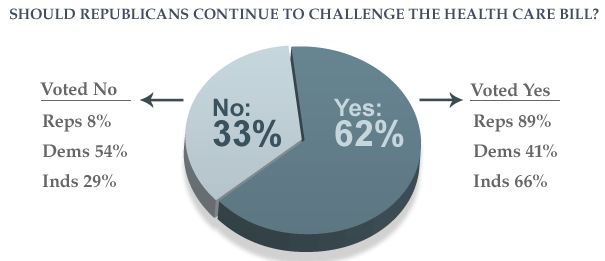
A CBS News poll finds that nearly two in three Americans want Republicans in Congress to continue to challenge parts of the health care reform bill.

The poll finds that 62 percent want Congressional Republicans to keep challenging the bill, while 33 percent say they should not do so. Nearly nine in ten Republicans and two in three independents want the GOP to keep challenging. Even 41 percent of Democrats support continued challenges.

The poll’s findings suggest an improvement in perceptions of the legislation: While 37% approved of it before the vote, 42% approved afterward.

[Ken’s Take: only a 5 pt bump, and 42% is way less than a majority !]

Full article:
http://www.cbsnews.com/8301-503544_162-20001117-503544.html

Bold stroke: Tanning salon tax starts today … no kidding !

March 24, 2010

The tax on union’s Cadillac heath insurance benefits doesn’t kick in until 2018.

The fat cats’ payroll tax on dividends and capital gains doesn’t start until 2013 (whew !).

But, no such reprieve for those evil tanning salons.

According to Bloomberg, indoor tanning salons must start charging customers a 10 percent tax beginning today … the first major reform of the U.S. health-care overhaul signed into law by President Barack Obama.

These guys  sure know how to go for the jugular …

* * * * *

Bloomberg, Health-Care Overhaul Changes to Start Taking Effect This Year
http://www.bloomberg.com/apps/news?pid=20601087&sid=aa32kl.M09T4

Next up: A doctors’ mandate … just wait & see.

March 24, 2010

Every doctor I’ve talked to says he loses mucho money on MediCare and Medicaid patients — that shouldn’t be new news to anyone.

Some tell me that Medicaid patients are especially troublesome because they account for a disproportionate “no shows” — patients who schedule an appointment but don’t post for it.  Why ?  No skin in the game.

ObamaCare is largely funded by containing physician reimbursements on MediCare and Medicaid  … concurrent with swelling the Medicaid rolls by about 15 million people.

In the past, docs have offset their MediCare and Medicaid  losses by, in effect, charging privately insureds more.

So what’s going to happen ?  It’s pretty easy to predict:

  1. The ‘natural’ proportion of gov’t insured patients (MediCare and Medicaid) will increase.
  2. Docs will try to cross subsidize them by increasing privately insured rates.
  3. But, ObamaCare police will cap the private insurance premiums.
  4. So, docs will start restricting the number of gov’t insured patients they treat … some will stop treating gov’t insured patients all together.
  5. Then, ObamaCare police will will call “foul” and mandate that all doctors must treat a minimum number of gov’t insured patients.

Just wait and see … you can smell this one a mile away (from the White House)

Cruise lines find that a rising tide lifts all boats

March 24, 2010

Takeaway: Recent passenger counts demonstrate that consumers are setting sail during the economic recovery. Though the cruise industry is rebounding nicely, it has been able to attract passengers through discount programs enabled by lower labor and fuel costs.

In the coming months, many cruise lines plan to test higher prices. Given the competitiveness of the travel and entertainment category, many marketers may be anxious to learn whether this pricing strategy sinks or swims.
 
* * * * *

Excerpt from Wall Street Journal, “Can Cruise Industry Catch Pricing Wave” by Kelly Evans, March 23, 2010.

If any industry should have been a relic of the boom, cruise lines, with their tricked-out “floating malls” catering to the whims and indulgences of consumers, were a likely contender.

Yet after a difficult 18 months, the industry is seeing a fairly impressive rebound in demand, a telling sign of the mind-set of U.S. consumers. That is bolstering the top line for operators like Carnival, which analysts expect Tuesday to report that revenue for the three-month period ending in February rose to $3.1 billion, up 8% from a year earlier.

Now comes the hard part, regaining some pricing power. Carnival announced across-the-board price rises of about 5% that took effect Monday. Norwegian said it will raise fares as much as 7% beginning April 2.

Whether these increases stick will speak volumes about how willing consumers are to spend in the absence of deep discounts. It also will show if the cruise industry has found clear sailing, after battling its way through the ravages of the recession.

Carnival, the world’s largest operator with some 82 ships and 10 different brands, is one of several lines that reported record bookings during the winter, historically the busiest time of year for the industry.

While cruise lines have discounted to lure passengers, sharply lower fuel and labor costs have dulled some of the pain. As those costs begin to rebound, and a strengthening U.S. dollar hurts competitiveness, operators like Carnival will become more dependent on higher prices to prop up margins.

And even if consumers are looking more resilient, many still are value-driven and so may be turned off by higher fares.

If that turns out to be the case, Carnival’s stock, which has doubled over the past 16 months, could face rough sailing.

Edit by BHC
 
* * * * *
Full Article:
http://online.wsj.com/article/SB10001424052748704841304575138161384844590.html?mod=WSJ_hps_MIDDLESecondNews

From soup to nuts: Campbell’s turns to psychology for consumer insights

March 23, 2010

Takeaway: Consumer anxiety commonly runs high when companies discontinue iconic images — last year scores of consumers protested the redesigned Tropicana carton.

In this high-stakes branding game, Campbell’s has sided with science and will soon abandon its widely-recognized red and white labels for a design the company believes will evoke a deeper emotional response from shoppers.

To arrive at this decision, the company employed neuromarketing – an emerging discipline that augments traditional market research with analysis of consumers’ biometric responses to new stimuli.

If successful, Campbell’s approach may provide marketers with powerful new tools for understanding their customers.
 
* * * * *

Excerpt from FastCompany, “Campbell’s Soup Neuromarketing Redux: There’s Chunks of Real Science in That Recipe” by Jennifer Williams, February 22, 2010.

About a week ago, the Campbell’s publicized a bold redesign of its iconic label with the assistance of neuromarketing. Pundits promptly predicted brand suicide, decrying the company for using pseudo-science.

With help from its parter Interscope Research, Campbell’s spent two years studying microscopic changes in skin moisture, heart rate, and other biometrics to see how consumers react to everything from pictures of bowls of soup to logo design.

By the end of a two-year study, more than 1,500 subjects were interviewed and tested using multiple methodologies–which ranged from traditional consumer feedback to cutting edge neuromarketing techniques.

The team used a combination of proprietary micro facial expression analysis obtained by in-store cameras, in-aisle eye tracking and pupilometry, and intercept interviews.

One brand team member explained that the type of cutting edge technology they employed enhanced traditional methods of market research.

An Innerscope researcher explains, “Companies that rely exclusively on traditional measures, focused only at the conscious level, are missing a critical component of what drives purchase behavior. The vast majority of brain processing (75 to 95%) is done below conscious awareness. Because emotional responses are unconscious, it is virtually impossible for people to fully identify what caused them through conscious measures such as surveys and focus groups.”

Many argue that the new label design could just as easily been arrived at by a savvy designer with good instincts. Perhaps. After all, understanding that a steamy bowl of soup is likely to elicit a positive emotional response isn’t much of a leap.

The end result offered many things that savvy design or consumer feedback alone could not have predicted. This fall, consumers can expect their soup shopping to be easier and more emotionally enjoyable than it is with Campbell’s current label. Flavor and style will be easily distinguished, and the familiar red logo will still be there. However, the logo will be smaller and out of the way in the scan and selection process, and the updated images will tap into emotions that consumers already associate with and want to feel about soup.

Was this a case of a mere marketing fad masquerading as science meant to mesmerize corporate clients more than consumers? Campbell’s synchronizing of careful research done by three agencies–research which triangulated two years of data gathering and statistical analysis–looks a lot like genuine science.

Edit by BHC
 
* * * * *

Full Article:
http://www.fastcompany.com/article/rebuttal-pseudo-science-in-campbells-soup-not-so-fast

* * * * *

Individual healthcare mandates and the 5th amendment …

March 23, 2010

Here’s an interesting twist I haven’t heard from the TV pundits …

Under ObamaCare, everybody has to buy health insurance — even healthy folks who want to opt out.

If you don’t have health insurance, you get fined … most recently, I heard that the fine has been pared down to $250 annually.

How will it be enforced ?

Well, the bill adds over 15,000 IRS agents to police it.

[Analytical note: that means that the new agents have to nail about 6 million scofflaws each year just to cover their comp & benefits … each agent will have to find and nail about one each day]  

This morning, I heard a Congressional shill say that each year — as part of the 1040 process — people will be asked if they are in compliance with law and have health insurance.

If they answer yes, they are asked to provide substantiation.

If they answer no, they have to pay the fine.

Isn’t that self-incrimination?  Isn’t that protected by the 5th amendment ?

If this process works ok for ObamaCare, why not extend it to other areas of the law ?

For example, ask people if they have complied with all speed limits when driving. If they self-incriminate, fine ’em.

Maybe ObamaCare has uncovered a whole new way to raise revenues and offset the deficit …

Stupak’s Price: $726,409 … so much for principle.

March 23, 2010

Right from Stupak’s office … note the date (March 19, 2010) … At least he waited 2 days until he switched his vote from no to yes …  for chump change compared to what Dodd, Landrieu, and the SEIU got … gezz Bart, if you’re going to sell your soul, at least go for some serious money.

image

Increasingly customers ask: what’s in a name?

March 23, 2010

Takeaway: In light of recent economic conditions, consumers are arguably more focused on value than ever before. This, combined with the increasing power of national retailers, now limits consumer products and services companies’ ability to deliver differentiated benefits to customers.

Faced with these new competitive pressures, brand managers must form new strategies for connecting with their customers to reinforce the value of their brand.
 
* * * * *

Excerpt from FastCompany, “Logos Get Lost in the Supermarket, Here’s Why” by Jamey Botter, March 11, 2010.
 
Logorama, the movie comprised entirely of animated logos, recently won the Oscar for best animated short film and is an excellent representation of the technicolor tapestry of branding that our world has become.

What would the world be like if there were no more brands to differentiate products, inspire us, or give us a good feeling about a company or product we’ve never tried before? I’m one who thinks it would be bad for brands to meld together into a homogenized mess, and I see that starting to happen in places. At the rate things are going, someday soon all brands will look like Walmart’s Great Value label.

Why is this happening? It’s partly because value is in great demand now, with unemployment still in double digits throughout parts of the country. It’s also because retailers are putting pressure on manufacturers to differentiate their brands inside their stores, so that a brand doesn’t look and act the same in one store chain as it does in another. If brands fold to this pressure, they become diluted and change what they really stand for. This erodes brand equity with consumers and eventually, retailers decide they don’t need certain brands anymore and can easily outsource the product cheaper themselves to increase their margins. So now those manufacturers are out, and jobs are lost. And so is the brand.

Private label brands grew at twice the rate of national brands over the last decade. Retailers like Walmart, Target and Costco are narrowing consumer selections everyday. Walmart recently took out Glad and Hefty storage bags to give more space to its Great Value brand. Walmart brought Hefty back, only after the company agreed to manufacture its Great Value bags.

That sort of manipulation will continue to happen unless brand managers, strategists, designers and manufacturers stand up to big-box retailers and reinforce the naturally differentiating attributes of their brands. They must build their brands so the retailer depends on them and the manufacturer, like the good old days.

Over the last 100 years, brands have played an important role in our society. The danger of private labels taking over the national branding landscape is the loss of meaning and value in the brands we love, prefer and recognize. Not only do our favorite brands help us distinguish product attributes, they inspire and motivate us, and give us a sense of individualism and choice.

If price is the only thing we as consumers are driven by, then sure, just make all the brands the same, Big Brother. But understand that what starts at retail can mushroom to other industries. Soon, we could all end up buying gas from one brand of gas station. Bank at one brand of bank. Wear clothes from one clothing company because they’re all alike anyway.

Edit by BHC
 
* * * * *
Full Article:
http://www.fastcompany.com/1579214/when-private-labels-take-over-the-world
* * * * *

What do student loans have to do with healthcare ? … and why you should care if you have a student loan.

March 23, 2010

Answer: Nothing … It’s a stretch to lump student loans and healthcare except that the apparent (i.e. unproven, unsubstantiated) savings accruing from nationalizing of student loan programs are needed to make ObamaCare look like it reduces the deficit.

I think there are huge implications — not only to banks, but also to student borrowers.

Here’s a twist: under ObamaCare, the tax-fines are going to be policed by 15,000 additional IRS agents. 

Do you think they’ll add another 15,000 to work collections on student loans ?

I’m betting the over on that one …

* * * * *

Excerpted from USA Today:  Revamped student loan bill tucked into massive health bill, Mar 19, 2010

To satisfy budget requirements and win over skeptical deficit hawks in their own party, Democratic leaders wound up directing a total of $19 billion (of the $61 billion in revenues that the student loan shift would produce over 10 years) to reduce the deficit and help pay for the health care portion of the legislation.

The basic thrust of the legislation, which would derive its $61 billion in savings by shifting all lending from the lender-based (but government-subsidized) Federal Family Education Loan Program to the government’s Direct Loan Program. The lenders have been trying to months to turn lawmakers against the idea of ending their ability to make loans (and the accompanying subsidies), arguing that doing so would kill thousands of jobs.

But on Thursday, they took another approach, directing their ire at the billions of dollars that would go to purposes other than helping students afford college, namely health care.

“Should students be paying for their neighbor’s medical costs? Separate consideration of student loan reform is imperative to ensure that legislation that minimizes job losses and reinvests savings in higher education can be considered.”

The most blatantly political move in the legislation: an exemption that would allow a state-run bank in North Dakota (alone among the states) to continue to offer loans directly to students.

Democratic Congressional aides defended the decision because they said the North Dakota bank is, as a taxpayer-owned agency, essentially a government lender like the federal government, so sustaining its ability to lend is consistent, they argued, with the legislation’s overall goal.

But critics compared the deal to the much-criticized exemption that health care supporters granted to Sen. Ben Nelson of Nebraska to win his key vote for that legislation,

“This ‘Bismarck Bank Job’ provision looks like exactly the sort of backroom deal that makes the American people hate Washington and the whole process that has led to this massive, awful government takeover of our health care.”

Full article:
http://www.usatoday.com/news/education/2010-03-19-IHE-student-loan-measures-in-health-bill19_ST_N.htm

Move over Charlie Brown, Congressman Stupak wants to kick the football …

March 23, 2010

Fool me once, shame on you.

Fool me twice, shame on me.

What about the 3rd, 4th, 5th times ?

Doesn’t Bart Stupak learn ?

To refresh your memory:

  • Back in November, pro-life Rep. Bart Stupak scored what he thought was a victory and the House passed an amendment to its ObamaCare bill limiting the use of tax-payer funds for abortions.
  • But, immediately after the vote, pro-choice Dems expressed confidence that “controversial language on abortion would be stripped from a final healthcare bill” via legislative maneuvering.
  • Then , House Dem leadership told Stupak and his pro-life buddies to take a hike …  because  liberal Dems want the government to fund abortions.
    https://kenhoma.wordpress.com/2010/03/15/why-is-stupak-surprised-that-his-amendment-was-trashed/

Sunday, to get Stupak to vote yes on ObamaCare, the President promised to issue an Executive Order that, in effect, restores the Stupak Amendment to the final bill — after the fact.

Well, a couple of potential bumps in Bart’s road:

  1. The President has to do what he promised … hmmm.
  2. Some legal pundits are saying that the Executive Order has little or no force — the passed law will prevail in high courts
  3. A President can rescind an Executive Order at any time

This time when Lucy pulls the football away, Stupak will have no one but himself to blame.

He’ll deserve to feel more ‘stupid’ than ‘Stupak’.

The biggest loser ? … Yep, the tanning salons get nailed ! … and, here's who else.

March 22, 2010

The trillion dollar ObamaCare program gets funded roughly half through MediCare cuts — mostly elimination of Medicare Advantage — and half from tax hikes, including …

  • A .9% increase in Medicare payroll taxes on couples with income of more than $250,000 a year.
  • Extension of Medicare payroll taxes (3.8%) to unearned income: dividends, interest, and capital gains.
  • A 10% excise tax on customers of indoor tanning salons.
  • Additional fees on insurance companies, pharmaceutical companies and medical device manufacturers, including $33 billion over ten years on fees on drug makers
  • A tax on individuals without qualifying coverage, maximum penalty set at 2.5% of income
  • An excise tax on high-premium insurance plans, equal to 40% of premiums paid on plans costing more than $27,500 annually for a family, starting in 2018
    http://online.wsj.com/public/resources/documents/st_healthcareproposals_20090912.html

* * * * *

Ken’s Qs:

1) Since I’ve been TurboTaxing my 2009 taxes, I’m curious: Is the magic $200,000 / $250,000 Gross Income, Adjusted Gross Income, or Taxable Income ?  That makes a big difference, and I haven’t seen a single reference clarifying it.  Anybody know ?

2) If some body hits the $200,000 / $250,000 kill point, is is all income taxed at the higher rate, or just marginal income above that rate ? Anybody know ?

3) How can a serious piece of legislation single out tanning salons for extinction — and let the Beverly Hills facelift doctors run free ? (Rhetorical question)

4) I’m still eager to see the 15,000 new IRS agents running around repo’ing big screens from folks who don’t have health insurance ?

5) If the reconciliation bill doesn’t get thru the Senate — does Obama’s deal with the unions — giving them a pass on the Cadillac plans — vaporize ?

This is going to get very interesting as folks understand the implications …

Dog catches bus! Be careful what you wish for … and other wisdom from Grandma Homa

March 22, 2010

Rarely can I pair two of Grandma Homa’s bromides together …

The dog has, indeed, caught the bus.

I think that Team Obama will soon realize that they accomplished the easy part of their healthcare takeover: getting the lemmings to pull the voting levers.

Now, they have to implemented the largest government program in recent history.  This, from an administration that has shown no implementation capability at all.  Think stimulus; mortgage / foreclosure programs; cash for clunkers, caulkers, etc.; GITMO closing; underwear bombers ratted out by parents.

The only aspects of the program that I can imagine getting implemented are the tax hikes and the elimination of MediCare Advantage since they only require swipes of a pen.

To ObamaCare supporters: I don’t want to hear any whining from you, you got what you wished for …

The biggest loser ? … Yep, the tanning salons get nailed ! … and, here’s who else.

March 22, 2010

The trillion dollar ObamaCare program gets funded roughly half through MediCare cuts — mostly elimination of Medicare Advantage — and half from tax hikes, including …

  • A .9% increase in Medicare payroll taxes on couples with income of more than $250,000 a year.
  • Extension of Medicare payroll taxes (3.8%) to unearned income: dividends, interest, and capital gains.
  • A 10% excise tax on customers of indoor tanning salons.
  • Additional fees on insurance companies, pharmaceutical companies and medical device manufacturers, including $33 billion over ten years on fees on drug makers
  • A tax on individuals without qualifying coverage, maximum penalty set at 2.5% of income
  • An excise tax on high-premium insurance plans, equal to 40% of premiums paid on plans costing more than $27,500 annually for a family, starting in 2018
    http://online.wsj.com/public/resources/documents/st_healthcareproposals_20090912.html

* * * * *

Ken’s Qs:

1) Since I’ve been TurboTaxing my 2009 taxes, I’m curious: Is the magic $200,000 / $250,000 Gross Income, Adjusted Gross Income, or Taxable Income ?  That makes a big difference, and I haven’t seen a single reference clarifying it.  Anybody know ?

2) If some body hits the $200,000 / $250,000 kill point, is is all income taxed at the higher rate, or just marginal income above that rate ? Anybody know ?

3) How can a serious piece of legislation single out tanning salons for extinction — and let the Beverly Hills facelift doctors run free ? (Rhetorical question)

4) I’m still eager to see the 15,000 new IRS agents running around repo’ing big screens from folks who don’t have health insurance ?

5) If the reconciliation bill doesn’t get thru the Senate — does Obama’s deal with the unions — giving them a pass on the Cadillac plans — vaporize ?

This is going to get very interesting as folks understand the implications …

Reporting live from Saturday’s Tea Party … stuff not on the nightly news

March 22, 2010

Since Georgetown’s hoops season had come to an abrupt end … and since the weather was beautiful … and since I take this healthcare stuff seriously… I went to the Capitol mall to be part of the citizens’  rally.

I’m glad I did.  First, I felt really democratic (small “d”), and second, the experience was very revealing.

Here’s what I saw and heard:

  1. It was a big crowd … filled the entire grass area in front of the Capitol … spilled over some across the street to the Mall.  I’m not a crowd estimator, but I know there were more than the 2,000 people that CNN reported.  There were at least as many people as were at the Verizon Center for the Duke game (my crowd estimating yardstick) … so, the crowd was at least 20,000.
  2. The crowd was very orderly. I only saw one Capitol policeman walking the crowd.  Not a single shouting match or fight or anything like that. I overheard several “where are you from ?” conversations.
  3. The crowd was all sizes and shapes and ages.  The latter surprised me some — I expected an old folks skew — while folks in their 50s were prevalent, there were plenty in there 40s, 30s, and even 20s.
  4. There weren’t any “for pay” organized groups — no conservative equivalents to ACORN or SEIU.  There were plenty of couples, many family groups, and some church groups from around the country.  No organized bus caravans.
  5. I saw several people identifying themselves as nurses and doctors. 
  6. My wife Kathy spotted one logo shirt from a local country club.  Beyond that, there weren’t many readily identifiable “fat cats” in the crowd.  I expected more since they’ll be footing much of the ObamaCare bill. I guess they protest in a different way  [more on that to come]
  7. Big deal: the crowd was all white.  I don’t recollect seeing a single non-white person, except for a doctor who spoke — and claimed to be Obama’s cousin.
  8. The intensity level was VERY high.  Obviously, people who trekked to the rally are more engaged than the average citizen, but I was still struck by the passion in the crowd — individually and collectively. 
  9. The words “civil disobedience” were evident — not prevalent, but evident.  On the Metro heading in, the guy sitting in front of us said “If this thing passes the country will be torn apart by civil disobedience”.  I hadn’t noticed that expression in years.  At the rally, there were signs calling for civil disobedience.  They didn’t spell out what kind of disobedience, they were just planting seeds.
  10. The applause line that got the biggest reaction: Do what Rush advises ‘just deem your taxes paid’. The crowd went nuts.

* * * * *

Here’s what I took away:

  1. The stark reality is that the tax payers who will be funding ObamaCare are  passionately opposed.  Why ? Well, it is their money, and — while they are OK supporting the genuinely down-trodden — they don’t want to carry slackers, drug addicts, and illegals.
  2. The ObamaCare opposition is almost entirely tax payers who consider themselves increasingly victimized by “taxation without (adequate) representation“. They’re frustrated and looking for a meaningful way to channel their emotions — and their money.
  3. My bet: April 15th is going to be an unusually interesting day this year.For sure, there will be protests galore.

    More important, there are plenty of folks scratching deeper this year to “remember” tax deductions and pursue any legal gimmick that can lower their tax payments.  In the past, for some, it wasn’t worth the effort.  But now, it has gotten personal. 

    And, it wouldn’t shock me if a statistically significant number of citizens heed Rush’s call to “deem their taxes paid”. 

    This has the prospects of getting very ugly, very fast.

We’ve Crossed the Rubicon …

March 22, 2010

This guy hits the nail on the head …

Do Democrats realize that we really have crossed the Rubicon?

In the future when the Republicans gain majorities (and they will), the liberal modus operandi will be the model — bare 51% majorities, reconciliation, the nuclear option, talk of deem and pass, not a single Democrat vote — all ends justifying the means in order to radically restructure vast swaths of American economic and social life.

Is someone unhinged at the DNC?

They just blew up any shred of bipartisan consensus when their President polls below 50%, the Democratically-controlled Congress below 20%, and health care reform less than 50%.

Usually unpopular leaders and their unpopular ideas seek the shelter of minority rights and prerogatives.

What will they do when they are in the minority—since they’ve entered the arena, boasted “let the games begin” and shouted “by any means necessary”?

We’ve Crossed the Rubicon
http://pajamasmedia.com/victordavishanson/weve-crossed-the-rubicom/2/

Why we make mistakes: Winging it, too few constraints, greener grass

March 22, 2010

In this and a couple of preceding and subsequent posts, i’ll be excerpting  the 13 reasons from:

Why We Make Mistakes, Joseph T. Hallinanm, Broadway Books 2009

Today, we finish the list.

* * * * * *

The errors we make can be explained through 13 lessons:

1. We look but don’t always see.

2. We all search for meaning.

3. We connect the dots.

4. We wear rose-colored glasses.

5. We can walk and chew gum — but not much else.

6. We’re in the wrong frame of mind.

7. We skim.

8. We like things tidy.

9. Men shoot first.

10. We all think we’re above average.

* * * * *

11. We’d rather wing it.

Over time, winging it just doesn’t work. Knowledge and deliberate practice do.

When performed correctly, prolonged, deliberate practice produces a large body of specialized knowledge in the mind of the person doing the practice.

Having this large body of knowledge allows an expert to quickly recognize patterns that other people don’t.

12. We don’t constrain ourselves.

One way to reduce errors is by introducing constraints. Essentially, these constraints are simple mental aids that keep us on the right track by limiting our alternatives

13. The grass does look greener.

Researchers have found that when it comes to well-being, neither social states, education, income, marital status, nor religious commitment accounts for more than about 3 percent of the variance in people’s reported levels of well-being.

Nonetheless, it’s human nature to overvalue the unknown and, in the process, chase elusive dreams that turn out to be less fulfilling than what we have.

All done …

Special Sunday post: Remember when the Congress voted against TARP … before they voted for it.

March 21, 2010

All the pundit chatter is that the healthcare vote is a lock this afternoon.  The logic, Pelosi wouldn’t be calling the vote is she wasn’t certain to muster 216 votes.

Well, last fall, they took TARP to the floor for a vote — believing that they had the votes.  The outcome: it lost.  [See the article below to jog your memory]

Of course, TARP was modified slightly and a second vote was taken.  It passed.

The difference with ObamaCare: if it loses today, any structural modifications will have to go through normal legislative channels — not the hood-winking reconciliation process.  No way it wins straight up.

I put the odds of passage at 80-20 … but want to be on the record, just in case the long odds hit

* * * * *

September 30th, 2008

TARP unexpectedly voted down by US House yesterday

Yesterday the US House of Representatives unexpectedly turned down by a fairly small margin the Troubled Asset Rescue Plan (TARP) put forth by the Treasury.

This quite remarkable twist of events, with all the world watching, has left investors highly uncertain about what comes next.

It is still possible that an amended version of the bill could be brought back to the floor.

At this stage, it is not clear whether major concessions will be necessary, or whether minor changes to the bill would be enough to secure the incremental (mostly Republican) votes necessary for passage.

http://www.mrforex.org/2008/09/30/tarp-unexpectedly-voted-down-by-us-house-yesterday/

“Just because you have insurance doesn’t mean there’s a physician who can (or will) see you.”

March 19, 2010

Punchline: Mitt Romney — the former Massachusetts governor — enacted something very similar to the Obama health plan. It isn’t working well.  Costs are up, folks are gaming the system, and people with insurance can’t get in to see doctors. Uh-oh.

* * * * *

Excerpted from WSJ: The Failure of RomneyCare, March 16, 2010

The Bay State is suffering from what the Massachusetts Medical Society calls a “critical shortage” of primary-care physicians.

As one would expect, expanded insurance has caused an increase in demand for medical services. But there hasn’t been a corresponding increase in the number of doctors.

As a result, many patients are insured in name only: They have health coverage but can’t find a doctor.

Fifty-six percent of Massachusetts internal medicine physicians no longer are accepting new patients.

For new patients who do get an appointment with a primary-care doctor, the average waiting time to see a doctor is 44 days.

As Dr. Sandra Schneider, the vice president of the American College of Emergency Physicians, told the Boston Globe last April, “Just because you have insurance doesn’t mean there’s a [primary care] physician who can see you.”

The difficulties in getting primary care have led to an increasing number of patients who rely on emergency rooms for basic medical services. Emergency room visits jumped 7% between 2005 and 2007.

Officials have determined that half of those added ER visits didn’t actually require immediate treatment and could have been dealt with at a doctor’s office — if patients could have found one.

* * * **

The promise that getting everyone covered would force costs down also is far from being realized.

One third of state residents say that their health costs had gone up as a result of the 2006 reforms.

A typical family of four today faces total annual health costs of nearly $13,788, the highest in the country. Per capita spending is 27% higher than the national average.

Insurance companies are required to sell “just-in-time” policies even if people wait until they are sick to buy coverage. That’s just like the Obama plan.

There is growing evidence that many people are gaming the system by purchasing health insurance when they need surgery or other expensive medical care, then dropping it a few months later.

Some Massachusetts safety-net hospitals that treat a disproportionate number of lower-income and uninsured patients are threatening bankruptcy. They still are treating a large number of people without health insurance, but the payments they receive for uncompensated care have been cut under the reform deal.

Full article:
http://online.wsj.com/article/SB10001424052748703625304575115691871093652.html?mod=djemEditorialPage_h

Consensus of majors polls: Obama is officially "under water" …

March 19, 2010

For the first time in his Presidency, more people disapprove of the job that Obama is doing as president than approve. 

His rating has been “upside down” in right-leaning Rasmussen for awhile. 

Now, the left-leaning and consensus polls agree …

Here are the facts, draw your own conclusion.

(Hint:The bad economy has been a constant, so don’t blame it for recent declines)

* * * *

Pollster.com “poll of polls”: Approve 46.4%, Disapprove 48.8%, Deficit(2.4%)

image
http://www.pollster.com/polls/us/jobapproval-obama.php?xml=http://www.pollster.com/flashcharts/content/xml/Obama44JobApproval.xml&choices=Disapprove,Approve&phone=&ivr=&internet=&mail=&smoothing=&from_date=&to_date=&min_pct=&max_pct=&grid=&points=1&lines=1&colors=Disapprove-BF0014,Approve-000000,Undecided-68228B

* * * * *

RealClearPolitics “poll of polls”: Approve 47.3%, Disapprove 47.8%, Deficit(.5%)

image
image

http://www.realclearpolitics.com/epolls/other/president_obama_job_approval-1044.html

* * * * *

Gallup: Approve 46%, Disapprove 48%, Deficit(2%)

image
http://www.gallup.com/poll/113980/Gallup-Daily-Obama-Job-Approval.aspx

* * * * *

Rasmussen Reports: Strongly Approve 23%, Strongly Disapprove 43%%, Deficit (20%)

image
http://www.rasmussenreports.com/public_content/politics/obama_administration/daily_presidential_tracking_poll

Why we make mistakes: We’re all above average (or at least think we are)

March 19, 2010

In this and a couple of preceding and subsequent posts, i’ll be excerpting  the 13 reasons from:

Why We Make Mistakes, Joseph T. Hallinanm, Broadway Books 2009

Today, we add reason #10 to the list.

* * * * * *

The errors we make can be explained through 13 lessons:

1. We look but don’t always see.

2. We all search for meaning.

3. We connect the dots.

4. We wear rose-colored glasses.

5. We can walk and chew gum — but not much else.

6. We’re in the wrong frame of mind.

7. We skim.

8. We like things tidy.

9. Men shoot first.

* * * * *

10. We all think we’re above average.

Most of us hate to think of ourselves as average. So we walk around with the private conceit that we are above average, and in that conceit lies the seeds of many mistakes.

“Calibration” measures the differences between actual and perceived abilities. If you’re as good as you think you are, then you are said to be well calibrated. If you are not as good as you think you are, then you are said to be poorly calibrated.

Most of us tend to be poorly calibrated when it comes to important skills, like those we need to perform our jobs.

Corrective feedback is a powerful way to shape human behavior. In situations where overconfidence is high.

But, feedback is often low in quantity, in quality, or in both.

* * * * *
Next up: We finish the list …

What if doctors and pharmacies stopped taking Medicaid patients ? (Psst, they have already …)

March 18, 2010

Punchline: First, the Mayo Clinic in Arizona stopped accepting Medicare patients.  Now, Walgreens drugstores across the state of Washington won’t take any new Medicaid patients, saying that filling their prescriptions is a money-losing proposition — the latest development in an ongoing dispute over Medicaid reimbursement.

Isolated instances or the start of a trend ? I’ll bet trend …

* * * * *

Excerpted from Seattle Times: Walgreens – no new Medicaid patients, March 17, 2010

Effective April 16, Walgreens drugstores across the state won’t take any new Medicaid patients, saying that filling their prescriptions is a money-losing proposition — the latest development in an ongoing dispute over Medicaid reimbursement.

In a news release, Walgreens said its decision to not take new Medicaid patients stemmed from a “continued reduction in reimbursement” under the state’s Medicaid program, which reimburses it at less than the break-even point for 95 percent of brand-name medications dispensed to Medicaid patents.

Walgreens follows Bartell Drugs, which stopped taking new Medicaid patients last month and Ritzville Drug Company in Adams County announced in November that it would stop participating in Medicaid.

Doug Porter, the state’s director of Medicaid, said Medicaid recipients should be able to readily find another pharmacy because “we have many more pharmacy providers in our network than we need” for the state’s 1 million Medicaid clients.

Fred Meyer and Safeway said their pharmacies would continue to serve existing Medicaid patients and to take new ones, though both expressed concern that the reimbursement rate is too low for pharmacies to make a profit.

Washington was reimbursing pharmacies 86 percent of a drug’s average wholesale price until July, when it began paying them just 84 percent.

“Washington state Medicaid is now reimbursing pharmacies less than their cost of participation,” said Jeff Rochon, CEO of the Washington State Pharmacy Association.

Pharmacies that continue to fill Medicaid prescriptions at the current state reimbursement rate are “at risk of putting themselves out of business altogether,” he said.

Full article:
http://seattletimes.nwsource.com/html/localnews/2011367936_walgreens18m.html

Please stop saying “deficit neutral” !

March 18, 2010

Next to “systemic risk” — which loosely translates to “don’t hold anybody accountable” … my top hair-pulling buzz-phrase is “deficit neutral” … which loosely translates to “there’s a tax increase even bigger than the spending increase” …  clever word-smithing that has people’s eyes largely off the flood of new and increased taxes.

15 reasons why … need more ?

March 18, 2010

From IBD, 15 reasons why a government takeover of the finest medical system in the world makes no sense at all:

1. The people don’t want it!

This should have some bearing on decision-making.  In the latest Rasmussen poll, 53% opposed Obama’s reform while 42% were in favor. More than four in 10 “strongly” opposed; just two in 10 “strongly” favored. This jibes with other surveys.

2. Doctors don’t want it!

A survey of 1,376 practicing physicians found that 45% of all doctors would consider leaving their practices or taking early retirements if the proposed reforms became law … nearly 30% said they’d quit the profession under the plans being considered.

3. Half the Congress doesn’t want it!

Not a single Republican backed the health care bill that cleared the Senate on Christmas Eve 60-39.  The lone Republican “aye” in the House has since switched to “no.”  Adjusting for reps who are no longer in Congress, the House vote today at 216-215 in favor.

Note: Members of Congress have already exempted themselves from whatever they inflict on us.

4. People are happy with the health care they’ve got!

Polls show that 84% of Americans have health insurance and satisfaction rates average 87%.

5. It doesn’t even cover all the people they set out to cover!

Supporters of government-run health care say there are as many as 47 million Americans — 9 million to 10 million of them illegal aliens — without medical insurance. The plans, however, will put only 31 million of the uninsured under coverage.

6. Costs will go up, not down!

Democrats say their plans will cost less than $1 trillion over the first decade, but independent analysts put the cost at $2.5 trillion over the first 10 years.

7. Real cost controls are nowhere to be found!

The Democrats are offering no meaningful tort reform that will help push down the high malpractice insurance premiums that are a burden to doctors and their patients. Nor are they considering any other cost-saving provisions, such as allowing the sale of individual health plans across state lines or easing health insurance mandates.

8. Insurance premiums will rise, not fall!

One goal of nationalizing health care is to lower costs, to bend the spending curve downward. Yet, as Democratic Sen. Dick Durbin acknowledged Wednesday, that won’t be the case.

“Anyone who would stand before you and say, ‘Well, if you pass health care reform, next year’s health care premiums are going down,’ I don’t think is telling the truth,I think it is likely they would go up.”

9. Medicare is already bankrupting us!

The Medicare trust fund, which has unfunded obligations of $37.8 trillion, will be insolvent in 2017.

10. There aren’t enough doctors now!

Last month, 26% of physicians said they had been forced to close, or were considering closing, their solo practices. Providing coverage for an additional 31 million Americans when the number of doctors is shrinking won’t improve our health care.

11. The doctor-patient relationship will be wrecked!

The latest IBD/TIPP Poll, taken just last week, found that Americans, by a wide 48% to 26% margin, believe the doctor-patient relationship will decline if the Democrats’ plan is passed.

12. Medical care will also deteriorate!

IBD/TIPP has also found that 51% of Americans believe care would get worse under government control. … 72% disagreed with administration claims that the government could cover 47 million more people with better-quality care at lower cost.

13. Rationing of care is inevitable!

Health care is not an unlimited resource and must be rationed, either by the individual, providers or government. In Britain and Canada, where the government does the rationing, medical treatment waiting lists are sometimes deadly and quite often excessively long.

14. Private health insurers will be destroyed!

Added mandates and price controls will force many insurers to simply get out of the health plan business because it will no longer be profitable.

15. It’s probably unconstitutional!

One way to help bring down the number of uninsured is to demand that those without coverage buy health plans.  Constitutional scholars say any such mandate would likely draw a legal challenge.

Sourced from IBD: Why Health Bill Makes No Sense, 03/12/2010
http://www.investors.com/NewsAndAnalysis/Article.aspx?id=527217

AP Fact Check: Premiums would rise under Obama plan

March 18, 2010

Punchline: Buyers, beware: President Barack Obama says his health care overhaul will lower premiums by double digits, but check the fine print.

Note: from the left-leaning AP, not FNN.

* * * * * 

Excerpted from Associated Press: Fact Check Premiums would rise under Obama plan, Mar 16, 2010

Visiting a Cleveland suburb this week, the president described how individuals and small businesses will be able to buy coverage in a new kind of health insurance marketplace, gaining the same strength in numbers that federal employees have.

“You’ll be able to buy in, or a small business will be able to buy into this pool,” Obama said.

“And that will lower rates, it’s estimated, by up to 14 to 20 percent over what you’re currently getting. That’s money out of pocket.”

And that’s not all.

Obama asked his audience for a show of hands from people with employer-provided coverage, what most Americans have.

“Your employer, it’s estimated, would see premiums fall by as much as 3,000 percent,” said the president, “which means they could give you a raise.”

A White House press spokesman later said the president misspoke.

* * *

Premiums are likely to keep going up even if the health care bill passes, experts say.

If cost controls work as advertised, annual increases would level off with time. But don’t look for a rollback.

Instead, the main reason premiums would be more affordable is that new government tax credits would help cover the cost for millions of people.

Listening to Obama pitch his plan, you might not realize that’s how it works.

There’s no question premiums are still going to keep going up. There are pieces of reform that will hopefully keep them from going up as fast. But it would be miraculous if premiums actually went down relative to where they are today.”

The statistics Obama based his claims on come from two sources. In both cases, the caveats got left out.

An analysis by the Congressional Budget Office found that large employers would see premium savings of at most 3 percent compared with what their costs would have been without the legislation. That would be more like a few hundred dollars instead of several thousand.

The claim that people buying coverage individually would save 14 percent to 20 percent comes from the same budget office report. But the presidential sound bite fails to convey the full picture.

The budget office concluded that premiums for people buying their own coverage would go up by an average of 10 percent to 13 percent, compared with the levels they’d reach without the legislation. That’s mainly because policies in the individual insurance market would provide more comprehensive benefits than they do today.

The premium reduction of 14 percent to 20 percent that Obama cites would apply only to a portion of the people buying coverage on their own — those who decide they want to keep the skimpier kinds of policies available today. The president usually alludes to that distinction in his health care stump speech, saying the savings would accrue to those people who continue to buy “comparable” coverage to what they have today.

And, those costs would only go down if, in fact, swarms of currently healthy uninsured young people join the risk pool — reducing average payouts and spreading insurance company overhead costs.

Full article:
http://news.yahoo.com/s/ap/20100317/ap_on_bi_ge/us_health_overhaul_fact_check

Why we make mistakes: Men shoot first, then …

March 18, 2010

In this and a couple of preceding and subsequent posts, i’ll be excerpting  the 13 reasons from:

Why We Make Mistakes, Joseph T. Hallinanm, Broadway Books 2009

Today, we add reason #9 to the list.

* * * * * *

The errors we make can be explained through 13 lessons:

1. We look but don’t always see.

2. We all search for meaning.

3. We connect the dots.

4. We wear rose-colored glasses.

5. We can walk and chew gum — but not much else.

6. We’re in the wrong frame of mind.

7. We skim.

8. We like things tidy.

* * * * *

9. Men shoot first.

Aspects of our personalities predispose many of us toward certain kinds of errors. Overconfidence is a leading source of human error and, across a wide field of endeavors.

Both men and women have been shown to be overconfident. However, men, as a rule, tend to be more overconfident than women are, and this difference explains much about the kinds of mistakes men and women make.

When men and women are asked to estimate their IQs, men, on average, will give higher estimates than women will. However, men aren’t as smart as they think they are; their IQs turn out to be lower than they had guessed. Women, on the other hand, turn out to be smarter than they think they are; their IQs are, on average, higher than their estimates. In other words, men overestimate their IQs and women underestimate theirs.

Throughout their lives, for example, men report having more confidence about their sense of direction than women do — even though there is little evidence that they actually have a better sense of direction.

When it comes to making mistakes, women appear to be harder on themselves than men are.

* * * * *
Next up: We’re all above average … yeah, right.

Uninsureds will be healthier under ObamaCare … not so fast

March 18, 2010

Punchline: the uninsured already receive about 50 percent to 70 percent of the care of the insured from hospitals, clinics and doctors

* * * * *
Excerpted from Newsweek: The Illusion of ‘Reform, March 15, 2010

You probably heard that insuring the uninsured will dramatically improve the nation’s health.

The uninsured don’t get care or don’t get it soon enough. With insurance, they won’t be shortchanged; they’ll be healthier. Simple.

Think again.

Expanding health insurance would result, at best, in modest health gains.

Why ? 

  • many uninsured are fairly healthy — about two-fifths are between 18 and 34;
  • some are too sick to be helped;
  • some have problems rooted in personal behaviors — smoking, diet, drinking or drug abuse; and
  • the uninsured already receive about 50 percent to 70 percent of the care of the insured from hospitals, clinics and doctors.

* * * * *

Whatever their sins, insurers are mainly intermediaries; they pass along the costs of the delivery system.

In 2009, the largest 14 insurers had profits of roughly $9 billion; that approached 0.4 percent of total health spending of $2.472 trillion.

This hardly explains high health costs.

Full article:
http://www.realclearpolitics.com/articles/2010/03/15/obamas_health_proposal_is_the_illusion_of_reform.html

McKinsey: A marketer’s guide to applying behavioral economics

March 18, 2010

TakeAway: Marketers have been applying behavioral economics—often unknowingly—for years. A more systematic approach can unlock significant value.

* * * * *

Excerpted from McKinsey Online: A marketer’s guide to behavioral economics, Feb. 2010

Long before behavioral economics had a name, marketers were using it.

“Three for the price of two” offers and extended-payment layaway plans became widespread because they worked — not because marketers had run scientific studies showing that people prefer a supposedly free incentive to an equivalent price discount or that people often behave irrationally when thinking about future consequences.

Here are four practical techniques that should be part of every marketer’s tool kit.

1. Make a product’s cost less painful 
In marketing practice, many factors influence the way consumers value a dollar and how much pain they feel upon spending it.

Retailers know that allowing consumers to delay payment can dramatically increase their willingness to buy.

One reason delayed payments work is perfectly logical: the time value of money makes future payments less costly than immediate ones. But there is a second, less rational basis for this phenomenon. Payments, like all losses, are viscerally unpleasant. Even small delays in payment can soften the immediate sting of parting with your money and remove an important barrier to purchase.

Consumers use different mental accounts for money they obtain from different sources.

Commonly observed mental accounts include windfall gains, pocket money, income, and savings. Windfall gains and pocket money are usually the easiest for consumers to spend. Income is less easy to relinquish, and savings the most difficult of all.

2. Harness the power of a default option
The evidence is overwhelming that presenting one option as a default increases the chance it will be chosen.

Defaults — what you get if you don’t actively make a choice — work partly by instilling a perception of ownership before any purchase takes place, because the pleasure we derive from gains is less intense than the pain from equivalent losses. When we’re “given” something by default, it becomes more valued than it would have been otherwise — and we are more loath to part with it.

An Italian telecom company, for example, increased the acceptance rate of an offer made to customers when they called to cancel their service. Originally, a script informed them that they would receive 100 free calls if they kept their plan. The script was reworded to say, “We have already credited your account with 100 calls—how could you use those?” Many customers did not want to give up free talk time they felt they already owned.

Defaults work best when decision makers are too indifferent, confused, or conflicted to consider their options.

That principle is particularly relevant in a world that’s increasingly awash with choices — a default eliminates the need to make a decision.

3. Don’t overwhelm consumers with choice
When a default option isn’t possible, marketers must be wary of generating “choice overload,” which makes consumers less likely to purchase.

Large in-store assortments work against marketers in at least two ways.

First, these choices make consumers work harder to find their preferred option, a potential barrier to purchase.

Second, large assortments increase the likelihood that each choice will become imbued with a “negative halo” — a heightened awareness that every option requires you to forgo desirable features available in some other product.

Reducing the number of options makes people likelier not only to reach a decision but also to feel more satisfied with their choice.

4. Position your preferred option carefully
Economists assume that everything has a price: your willingness to pay may be higher than mine, but each of us has a maximum price we’d be willing to pay.

How marketers position a product, though, can change the equation.

Marketers sometimes benefit from offering a few clearly inferior options. Even if they don’t sell, they may increase sales of slightly better products the store really wants to move.

Similarly, many restaurants find that the second-most-expensive bottle of wine is very popular — and so is the second-cheapest.

Customers who buy the former feel they are getting something special but not going over the top.

Those who buy the latter feel they are getting a bargain but not being cheap.

Sony found the same thing with headphones: consumers buy them at a given price if there is a more expensive option — but not if they are the most expensive option on offer.

Marketers have long been aware that irrationality helps shape consumer behavior. Behavioral economics can make that irrationality more predictable.

Understanding exactly how small changes to the details of an offer can influence the way people react to it is crucial to unlocking significant value—often at very low cost.

Full article:
https://www.mckinseyquarterly.com/Marketing/Strategy/A_marketers_guide_to_behavioral_economics_2536

New England Journal of Medicine: "Nearly 1/2 of primary care doctors say they'll leave medicine if healthcare reform bill passes" … talk about something that's being under-reported !

March 17, 2010

Story line:

(1) Dems tout that the AMA supports ObamaCare.  But, the AMA represents less than 25% of doctors, and has a vested interest — they get paid millions by the government to manage “treatment codes” used for reimbursements.

(2) The NEJM surveyed the broader base of doctors and concluded: “A very dramatic decrease in the physician workforce could become a reality as an unexpected side effect of health reform.”

(3) Specifically, almost half of primary-care physicians said that they would either want to leave medicine or that they would be “forced out” by the changes to the system.

(4) The “changes” they cite: more regulations, gov’t coming between them and patients, lower reimbursements, continuing threat of junk law suits.

* * * * *

Details:

According to a survey published in the latest issue of the New England Journal of Medicine:

  • Nearly one-third of all practicing physicians may leave the medical profession if President Obama signs current versions of health-care reform legislation into law …  If a public option were included in the legislation, the number jumps to 45.7%.
  • 46% of primary-care physicians said that they would either want to leave medicine or that they would be “forced out” by the changes to the system.
  • A majority of physicians said health-care reform would cause the quality of American medical care to “deteriorate” and it could be the “final straw” that sends a sizeable number of doctors out of medicine.

“Many physicians feel that they cannot continue to practice if patient loads increase while pay decreases.”

The survey shows that many doctors already find their situations difficult:

  • 36% said that they would not recommend medicine as a profession to others, regardless of whether health-care reform passes;
  • 27% would still recommend medicine as a career, but not if the current reform proposal passes.
  • In total, 63 percent of doctors would not recommend the profession after health-care reform passes.

96 percent of the physicians surveyed  favor of health reform, in some form or fashion … but relatively few are in favor of the current legislation.

* * * * *

But the AMA says doctors are in favor

Congressional Democratic leaders ,have said that doctors favor the bill and are part of an “unprecedented coalition” of doctors rooting for its passage. The claim is based on the American Medical Association’s endorsement of the legislation in Congress.

According to the Bureau of Labor Statistics, in 2008 there were 661,400 physicians and surgeons within the United States. Of that number, 250,000 are members of the American Medical Association (AMA) — and nearly 100,000 of those are medical students.

Full article:
http://cnsnews.com/news/article/62812

* * * * *

Key Findings from thePhysician Survey: Health Reforms Potential Impact on Physician Supply and Quality of Medical Care
New England Journal of Medicine, Mar. – Apr. 2010 

Physician Support of Health Reform in General

  • 62.7% of physicians feel that health reform is needed but should be implemented in a more targeted, gradual way, as opposed to the sweeping overhaul that is in legislation.
  • 28.7% of physicians are in favor of a public option.
  • 3.6% of physicians prefer the “status quo” and feel that the U.S. health care system is best “as is.

Health Reform and Primary Care Physicians

  • 46.3% of primary care physicians (family medicine and internal medicine) feel that the passing of health reform will either force them out of medicine or make them want to leave medicine.

Health Reform, Public Option, and Practice Revenue/Physician Income

  • 41% of physicians feel that income and practice revenue will “decline or worsen dramatically” with a public option.
  • 30% feel income will “decline or worsen somewhat” with a public option.
  • 9% feel income will “improve somewhat” with a public option, and 0.8% feel income will “improve dramatically” with a public option.

Health Reform, Public Option, and Physician Supply

  • 72% of physicians feel that a public option would have a negative impact on physician supply, with 45% feeling it will “decline or worsen dramatically” and 27% predicting it will “decline or worsen somewhat.
  • 24% of physicians think they will try to retire early if a public option is implemented.
  • 21% of physicians would try to leave medicine if a public option is implemented, even if not near retirement age at the time.

Health Reform and Recommending Medicine to Others as a Career

  • 36% of physicians would not recommend medicine as a career, regardless of health reform.
  • 27% would recommend medicine as a career but not if health reform passes.
  • 25% of physicians would recommend medicine as a career regardless of health reform.
  • 12% would not recommend medicine as a career now but feel that they would recommend it as a career if health reform passes

Source:“Physician Survey: Health Reform’s Impact on Physician Supply and Quality of Medical Care,”
The Medicus Firm, http://www.TheMedicusFirm.com

New England Journal of Medicine: "Nearly 1/2 of primary care doctors say they’ll leave medicine if healthcare reform bill passes" … talk about something that’s being under-reported !

March 17, 2010

Story line:

(1) Dems tout that the AMA supports ObamaCare.  But, the AMA represents less than 25% of doctors, and has a vested interest — they get paid millions by the government to manage “treatment codes” used for reimbursements.

(2) The NEJM surveyed the broader base of doctors and concluded: “A very dramatic decrease in the physician workforce could become a reality as an unexpected side effect of health reform.”

(3) Specifically, almost half of primary-care physicians said that they would either want to leave medicine or that they would be “forced out” by the changes to the system.

(4) The “changes” they cite: more regulations, gov’t coming between them and patients, lower reimbursements, continuing threat of junk law suits.

* * * * *

Details:

According to a survey published in the latest issue of the New England Journal of Medicine:

  • Nearly one-third of all practicing physicians may leave the medical profession if President Obama signs current versions of health-care reform legislation into law …  If a public option were included in the legislation, the number jumps to 45.7%.
  • 46% of primary-care physicians said that they would either want to leave medicine or that they would be “forced out” by the changes to the system.
  • A majority of physicians said health-care reform would cause the quality of American medical care to “deteriorate” and it could be the “final straw” that sends a sizeable number of doctors out of medicine.

“Many physicians feel that they cannot continue to practice if patient loads increase while pay decreases.”

The survey shows that many doctors already find their situations difficult:

  • 36% said that they would not recommend medicine as a profession to others, regardless of whether health-care reform passes;
  • 27% would still recommend medicine as a career, but not if the current reform proposal passes.
  • In total, 63 percent of doctors would not recommend the profession after health-care reform passes.

96 percent of the physicians surveyed  favor of health reform, in some form or fashion … but relatively few are in favor of the current legislation.

* * * * *

But the AMA says doctors are in favor

Congressional Democratic leaders ,have said that doctors favor the bill and are part of an “unprecedented coalition” of doctors rooting for its passage. The claim is based on the American Medical Association’s endorsement of the legislation in Congress.

According to the Bureau of Labor Statistics, in 2008 there were 661,400 physicians and surgeons within the United States. Of that number, 250,000 are members of the American Medical Association (AMA) — and nearly 100,000 of those are medical students.

Full article:
http://cnsnews.com/news/article/62812

* * * * *

Key Findings from thePhysician Survey: Health Reforms Potential Impact on Physician Supply and Quality of Medical Care
New England Journal of Medicine, Mar. – Apr. 2010 

Physician Support of Health Reform in General

  • 62.7% of physicians feel that health reform is needed but should be implemented in a more targeted, gradual way, as opposed to the sweeping overhaul that is in legislation.
  • 28.7% of physicians are in favor of a public option.
  • 3.6% of physicians prefer the “status quo” and feel that the U.S. health care system is best “as is.

Health Reform and Primary Care Physicians

  • 46.3% of primary care physicians (family medicine and internal medicine) feel that the passing of health reform will either force them out of medicine or make them want to leave medicine.

Health Reform, Public Option, and Practice Revenue/Physician Income

  • 41% of physicians feel that income and practice revenue will “decline or worsen dramatically” with a public option.
  • 30% feel income will “decline or worsen somewhat” with a public option.
  • 9% feel income will “improve somewhat” with a public option, and 0.8% feel income will “improve dramatically” with a public option.

Health Reform, Public Option, and Physician Supply

  • 72% of physicians feel that a public option would have a negative impact on physician supply, with 45% feeling it will “decline or worsen dramatically” and 27% predicting it will “decline or worsen somewhat.
  • 24% of physicians think they will try to retire early if a public option is implemented.
  • 21% of physicians would try to leave medicine if a public option is implemented, even if not near retirement age at the time.

Health Reform and Recommending Medicine to Others as a Career

  • 36% of physicians would not recommend medicine as a career, regardless of health reform.
  • 27% would recommend medicine as a career but not if health reform passes.
  • 25% of physicians would recommend medicine as a career regardless of health reform.
  • 12% would not recommend medicine as a career now but feel that they would recommend it as a career if health reform passes

Source:“Physician Survey: Health Reform’s Impact on Physician Supply and Quality of Medical Care,”
The Medicus Firm, http://www.TheMedicusFirm.com

Obama’s poster child’s plight revealed to be a crock … would that constitute misinformation ?

March 17, 2010

Ken’s Take: Didn’t anybody smell a rat when Natoma Canfield — the uninsured leukemia letter-writer — couldn’t appear with Obama because she was getting treatment  … at the Cleveland Clinic no less.

Turns out that:

(1) she is getting healthcare (which is different from health insurance)

(2) she is being treated by the prestigious Cleveland Clinic

(3) The Cleveland Clinic says not to worry about the bills …

(4) … because, Natoma already qualifies for Medicaid. 

(5) She hasn’t bothered to sign up … probably too busy writing letters

* * * * *

Excerpted from WTOP / AP: Woman championed by Obama eligible for aid, March 16, 2010

A woman championed as the Obama administration’s emblem for health care reform does not have to choose between her home and her health, according to officials at the Ohio hospital where she is being treated.

With a self-reported annual income of about $6,000, Natoma Canfield is a prime candidate for financial aid in the form of Medicaid – the federal health care program for low-income and disabled people – and charitable assistance.

And the Cleveland Clinic said it has no intention of putting out a lien on Canfield’s house — or letting the billing process interfere with her treatment.

“It appears that I think she’ll be fine,” said Lyman Sornberger, the hospital’s executive director of patient financial services. “By nature of the fact that she was not early on rejected by either program, that’s a key indicator that she will most likely be eligible.”

Despite the grim reality of Canfield’s fight against cancer, hospital officials say it’s not the case that she can have either a home or her health.

Like any patient who walks through the Clinic’s doors without medical coverage, Canfield was immediately assigned an adviser to help assess whether she was eligible for financial aid, hospital officials said.

Canfield said Tuesday that she had just met with her adviser in her hospital room before undergoing a round of chemotherapy in the afternoon.

“I will have to apply for Social Security disability and then something called Medicaid,” she said.

Asked whether she had understood what Medicaid was, she said: “I heard of it but I didn’t really realize what it was.”

Full article:
http://wtop.com/?nid=106&pid=0&sid=1913750&page=1

Why we make mistakes: frame of mind, skimming, tidiness

March 17, 2010

In this and a couple of preceding and subsequent posts, I’m  excerpting  the 13 reasons from:

Why We Make Mistakes, Joseph T. Hallinanm, Broadway Books 2009

Today, we add reasons 6, 7 and 8 to the list.

* * * * * *

The errors we make can be explained through 13 lessons:

1. We look but don’t always see.

2. We all search for meaning.

3. We connect the dots.

4. We wear rose-colored glasses.

5. We can walk and chew gum — but not much else.

* * * * *

6. We’re in the wrong frame of mind.

How we frame an issue can greatly affect our response to it.

In situations where we expect a loss, we are prone to take risks. However, when we are considering gains, we become more conservative; we simply want to hold on to a sure thing. This pattern seems to stem, in part, from the human approach to risk perception.

Many factors can affect the way we frame our decisions. One of the least obvious factors is time. When the consequences of our decisions are far off, we are prone to take bigger gambles. However, when consequences are more immediate, we become more conservative.

7. We skim.

We rely on context to guide our perception of everyday events. The better we are at something, the more likely we are to skim.

However, this ability comes with a trade-off: Accuracy is sacrificed, and details are overlooked. As something becomes familiar, we tend to notice less.

We see things not as they are, but as we assume they ought to be. This ingrained behavior can cause us to overlook not only small things, but some things that are startlingly large.

8. We like things tidy.

The process of retelling a story in our own narrative style places certain constraints on what we recall, and these constraints guide our reconstruction of events.

If we tell a story in a funny way, for example, we’re likely to leave out certain details or maybe even add a few of our own making. In this process, a story doesn’t simply become a vision of the original event, it becomes the event; it is the way we remember it.

* * * * *
Next up: Men shoot first …

Social networking can be infectious ….

March 17, 2010

Excerpted from: USA TODAY : How cybercriminals invade social networks, companies , Mar 4,2010

Cybercriminals are moving aggressively to take advantage of an unanticipated chink in corporate defenses: the use of social networks in workplace settings.

They are taking tricks honed in the spamming world and adapting them to what’s driving the growth of social networks: speed and openness of individuals communicating on the Internet.

“Social networks provide a rich repository of information cybercriminals can use to refine their phishing attacks.”

This shift is gathering steam.

One sign: The volume of spam and phishing scams more than doubled in the fourth quarter of 2009 compared with the same period in 2008.

“Phishing” lures — designed to trick you into clicking on an infectious Web link — are flooding e-mail inboxes, as well as social-network messages and postings, at unprecedented levels.

An infected PC, referred to as a “bot,” gets slotted into a network of thousands of other bots.

These “botnets” then are directed to execute all forms of cybercrime, from petty scams to cyberespionage.

Authorities in Spain announced the breakup of a massive botnet, called Mariposa, comprising more  than 12 million infected PCs in 190 countries.

The criminals had been spreading infected links for about a year, mainly via Microsoft’s free MSN instant messenger service.

Full story:
http://www.usatoday.com/cleanprint/?1267714767796

ERs are overcrowded with the uninsureds … oh, really ?

March 16, 2010

Punchline: If universal coverage makes appointments harder to get (and it will !), emergency room use may increase. That’s called an unintended consequence.

* * * * *
Excerpted from Newsweek: The Illusion of ‘Reform, March 15, 2010

How often have you heard the emergency-room argument?

The uninsured, it’s said, use emergency rooms for primary care. That’s expensive and ineffective. Once they’re insured, they’ll have regular doctors. Care will improve; costs will decline. Everyone wins.

Great argument.

Unfortunately, it’s untrue.

A study by the Robert Wood Johnson Foundation found that the insured account for 83 percent of emergency room visits, reflecting their share of the population.

After Massachusetts adopted universal insurance, emergency room use remained higher than the national average, reports an Urban Institute study.

More than two-fifths of visits represented non-emergencies.

People said it was “more convenient” to go to the emergency room or they couldn’t “get (a doctor’s) appointment as soon as needed.”

If universal coverage makes appointments harder to get, emergency room use may increase.

Full article:
http://www.realclearpolitics.com/articles/2010/03/15/obamas_health_proposal_is_the_illusion_of_reform.html

Why We Make Mistakes: The myth of multi-tasking

March 16, 2010

In this and a couple of preceding and subsequent posts, I’m excerpting the 13 reasons from:

Why We Make Mistakes, Joseph T. Hallinanm, Broadway Books 2009

Today, we add reason #5 to the list.

* * * * * *

The errors we make can be explained through 13 lessons:

1. We look but don’t always see.

2. We all search for meaning.

3. We connect the dots.

4. We wear rose-colored glasses.

* * * * *

5. We can walk and chew gum — but not much else.

Whether we’re on foot or behind the wheel, our attention is continually being divided by the tasks we try to juggle, such as listening to iPods, talking on cell phones, and tapping away on BlackBerrys.

Most of us believe our brains can work in the same way that computers multitask. Although multi-tasking has become a hallmark of the modern workplace, it is also one of the great myths of the modern age. We may think we are focusing on several activities at once, but our attention is actually jumping back and forth between tasks.

Not even a computer, by the way, can multitask; it actually switches back and forth between several tasks several times per second, thus presenting the illusion that all of the tasks are being performed at once.

Our minds provide us with the same illusion.

the gains we think we make by multitasking are often illusory. This is because the brain slows down when it has to juggle tasks.

Switching from task to task also creates other problems. One such problem is that we forget what we are doing — or planned to do. In some cases, the forgetting rate can be as high as 40 percent.

Another cost to multitasking is downtime. When we’re working on one thing and are interrupted, it takes us a while to refocus on what we were originally working on.

Workplace studies have found that it takes up to 15 minutes for us to regain a deep state of concentration after a distraction, such as a phone call.

Divided attention can also produce a dangerous condition known as inattentional blindness. In this condition, it is possible for an individual to look directly at something and still not see it.

One example, driver distraction, is now considered a much more frequent cause of auto accidents than safety officials once believed. When switching from task to task, drivers need downtime to recover.

* * * * *
Next up: Wrong frame of mind …

PowerPoint Management: Ford’s secret to recent success

March 16, 2010

Punch line: Ford’s CEO Ford’s CEO has an obsession with Power Point … and it works !

* * * * *

Excerpted from WSJ: Ford’s Renaissance Man, Feb 26., 2010

Alan Mulally, Ford’s president and chief executive officer, is exuding ebullience over, of all things, PowerPoint slides.

“How cool is that?” asks Mr. Mulally, pointing to slides showing rows and rows of numbers … relishing a slide of color-coded charts depicting the status of key projects that looks like a scrambled Monopoly board … and one that shows overlapping ovals that depict the configuration of corporate alliances in the global car business.

Mr. Mulally and his team of 16 top executives review 300 such slides in each weekly BPR, or Business Planning Review, which lasts just over two hours.

“If you aren’t comfortable with that you might be more comfortable leaving the company.”

To a visitor, these slide shows sound mind-numbing. But the CEO is excited about them for good reason.

Ford’s recent success is already amazing considering the prior half-dozen years of near-fatal decline. If it continues, Mr. Mulally will be credited with one of the great turnarounds in corporate history. His method has been to simplify, relentlessly and systematically, a business that had grown way too complicated and costly to be managed effectively.

“Improve Focus, Simplify Operations,” reads one of Mr. Mulally’s many charts, which he repeats like a sacred mantra.

* * * * * 

Soon after his arrival Ford began shedding brands—Jaguar, Land Rover and Aston Martin among them—that the company couldn’t afford to support. Volvo will be next to go.

In the process, Ford cut its number of global platforms, or chassis, to eight from more than 20, and the number of nameplates to 25 from 97.

Ford is methodically implementing the “One Ford” strategy of developing cars in a single region (say Europe, or North America) and selling them globally, instead of developing slightly different cars in each region at enormous extra cost.

“It’s back to Henry Ford’s original vision, isn’t that cool?” gushes Mr. Mulally, reaching for—you guessed it—yet another chart. “It’s all about producing products people want,” he adds. “Our goal is PGA – Profitable Growth for All.”

Full article:
http://online.wsj.com/article/SB10001424052748704479404575087372469421104.html?mod=djemEditorialPage_h

Novel idea: Listen to your constituents …

March 16, 2010

Punchline: Reps in swing districts can either vote with their constituents or jump off a cliff. Why is that a difficult decision?

* * * * *

Excerpted from WSJ: Swing Districts Oppose Health Reform, Mar 15, 2010 

Democratic leaders cite national polls that show support for individual provisions of the bill as a reason to pass this reform. Yet vulnerable politicians should be warned: Responses to questions about individual benefits, particularly when removed from a cost context, are different from those on the whole bill.

Voters in key congressional districts are clear in their opposition to the proposed health-care reform.

That’s one of the findings of a survey that will be released today by the Polling Company on behalf of Independent Women’s Voice. The survey consisted of 1,200 registered voters in 35 districts represented by members who could determine the outcome of the health-care debate.

The survey shows astonishing intensity and sharp opposition to reform, far more than national polls reflect.

  • For 82% , the heath-care bill is either the top or one of the top three issues for deciding whom to support for Congress next November.
  • 60% want Congress to start from scratch on a bipartisan health-care reform proposal or stop working on it this year.
  • Majorities say the legislation will make them and their loved ones, the economy and the U.S. health-care system worse off.
  • 70% would vote against a House member who votes for the Senate health-care bill with its special interest provisions.
  • 75% disagree that the federal government should mandate that everyone buy a government-approved insurance plan
  • 81% say any reform should focus first on reducing costs.
  • 75% agree that Americans have the right to choose not to participate in any health-care system or plan without a penalty or fine.
  • 60% of the voters surveyed will vote for a candidate who opposes the current legislation and wants to start over.
  • Over 1/3 of respondents say they will actively work against a candidate who votes the wrong way or for the candidate who votes the right way.

That translates into specific concerns with the Senate legislation—and none of these objections would be addressed by the proposed fixes.

Over 70%—indeed in several districts over 80%—of respondents, across party lines, said that the following information made them less supportive:

  • mandates that individuals purchase insurance or face penalties;
  • cuts Medicare Advantage;
  • will force potentially millions to lose existing coverage;
  • will cost an estimated $2.3 trillion over its first 10 years; and it will grant unprecedented new powers to the Health and Human Services secretary.

These are the constituents of the members whose votes will matter most this week. Perhaps, if this republic is still the people’s, those members should heed those they claim to represent.

Full article:
http://online.wsj.com/article/SB10001424052748704416904575121541779736742.html?mod=djemEditorialPage_h

Why is Stupak surprised that his amendment was trashed ?

March 15, 2010

Back in November, pro-life Rep. Bart Stupak scored what he thought was a victory and the House passed an amendment to its ObamaCare bill limiting the use of tax-payer funds for abortions.

Stupak’s language not only prohibits abortion coverage in the public insurance option included in the House bill. It would also prevent private plans from offering coverage for abortion services if they accept people who are receiving government subsidies.

Abortion-rights supporters called it a “de facto” abortion ban and mounted an intense but unsuccessful lobbying campaign against it.

http://thehill.com/blogs/blog-briefing-room/news/66969-senior-dem-confident-stupak-amendment-will-be-stripped

* * * * *

But, immediately after the vote, pro-choice Dems expressed confidence that “controversial language on abortion would be stripped from a final healthcare bill” via legislative maneuvering.

Excerpted from The Hill: Senior Democrat is ‘confident’ that Stupak amendment will be stripped, 11/09/09

A House Democratic leader said Monday she’s “confident” controversial language on abortion will be stripped from a final healthcare bill.

Rep. Debbie Wasserman Schultz (D-Fla.), the Democrats’ chief deputy whip in the House, said that she and other pro-abortion rights lawmakers would work to strip the amendment included in the House health bill that bars federal funding from subsidizing abortions.

“It was extremely painful for me to feel compelled to vote for a bill that contained that kind of restriction on a woman’s ability to make her own reproductive choices,” Wasserman Schultz said.

“We’re all going to be working very hard, particularly the pro-choice members, to make sure that’s the case.”

.

* * * * *
Now, House Dem leadership has told Stupak and his pro-life buddies to take a hike …
Pelosi Calls Stupak’s Bluff on Abortion:

Anti-choice zealot Rep. Bart Stupak (D-Mich) overplayed his hand. House Majority Leader Steny Hoyer announced today that the House Democrats will move forward without a deal on abortion coverage.

Why are they finally telling Stupak to pound sand after endless rounds of negotiations? First off, Pelosi had the strategic advantage of having very little to offer Stupak and his shadowy band of anti-choice Democrats. Second, Stupak’s alleged coalition is looking more like a paper tiger every day.
http://bigthink.com/ideas/19045

* * * * *

And, in the coup de grace, Stupak alledges that Rep. Henry Waxman bluntly told him that liberal Dems want the government to fund abortions.  So there, Bart !
Bart Stupak — the pro-life Democrat leading the charge in the House against passage of the Senate health insurance reform bill — said Friday that Henry Waxman — a key House committee chairman —  told him that Democrats want abortions to be paid by a federally-funded nationalized health insurance system.
http://www.youtube.com/watch?v=-yDtPRSBKyM
.
* * * * *
My questions:
(1) Why is Stupak acting surprised and dismayed by the outcome ?
.
(2) Will Stupak himself cave and vote ‘yes’ ?

My bet: yes …

* * * * *

BTW: Catholic Bishops are OK with the House language, but oppose the Senate language.

“U.S. Conference of Catholic Bishops has said the Senate-passed health care bill fails our moral criteria and must be changed.

The abortion funding problems in the Senate Bill extend well beyond the premium division scheme.

click for details:
http://catholickey.blogspot.com/2010/03/usccb-clarifies-politico-comments-still.html

Will “swing” Congressmen vote their constituents’ will … or the party bosses’ ?

March 15, 2010

The Tarrance Group conducted polling for the districts of eleven Democrats thought to be potential flippers on the final vote on health care reform.

Below are the results for the main question, “do you favor or oppose the health care reform legislation being proposed by President Obama and the Democrats in Congress” , along with the members’ votes on the health care bill the first time around.

In summary, majorities oppose the bill in every district except one (NY-13), most of the opposers strongly oppose the bill.

  • AZ-8 (Giffords, yea): 35% favor, 52% oppose, 46% strongly oppose;
  • CO-4 (Markey, nay): 33% favor, 58% oppose, 51% strongly oppose;
  • IN-9 (Hill, yea): 31% favor, 52% oppose, 44% strongly oppose;
  • NJ-3 (Adler, nay): 34% favor, 57% oppose, 46% strongly oppose;
  • OH-1 (Driehaus, yea): 39% favor, 54% oppose, 48% strongly oppose;
  • OH-16 (Boccieri, nay): 38% favor, 51% oppose, 46% strongly oppose;
  • NV-3 (Titus, yea): 40% favor, 52% oppose, 44% strongly oppose;
  • NY-13 (McMahon, nay): 40% favor, 46% oppose, 37% strongly oppose;
  • NY-24 (Arcuri, yea): 32% favor, 53% oppose, 47% strongly oppose;
  • PA-4 (Altmire, nay): 30% favor, 58% oppose, 47% strongly oppose;
  • PA-10 (Carney, yea): 28% favor, 58% oppose, 47% strongly oppose.

image 

http://www.naw.org/files/TargetCDHealthCareStudyToplines.pdf

Sourced from RCP: How Much Damage Could HC Inflict on Dems?, Mar 10, 2010
http://realclearpolitics.blogs.time.com/2010/03/10/how-much-damage-could-hc-inflict-on-dems/

Why we make mistakes …

March 15, 2010

In this and a couple of subsequent posts, i’ll be excerpting  the 13 reasons from:

Why We Make Mistakes, Joseph T. Hallinanm, Broadway Books 2009

Today, the first 4 reasons on the list

* * * * * *

When it comes to making mistakes, the cause is overwhelmingly attributed to human error.

Whether it’s airplane crashes (70 percent), car crashes (90 percent), or workplace accidents (90 percent), humans are usually to blame.

However, in many cases, our mistakes are not entirely our fault. All of us are afflicted with certain systemic biases in the way we see, remember, and perceive the world around us, and these biases make us prone to commit certain types of errors.

The errors we make can be explained through 13 lessons:

1. We look but don’t always see.

When it comes to human error, this kind of mistake is so common that researchers have given it its own nickname: “a looked but didn’t see” error. When we look at something — or at someone — we think we see all there is to see. But we don’t. Often times, we miss important details, some small and some larger.

2. We all search for meaning.

A recent poll of 3,000 people found that one-fourth of them couldn’t remember their own phone numbers, and two-thirds couldn’t recall the birthdays of more than three friends or family members.

When it comes to hiding places, people also mistakenly believe that the more unusual a hiding place is, the more memorable it will be. However, the opposite is actually true: Unusualness actually makes a hiding place more forgettable. The key to a good hiding place is making a quick connection between the thing being hidden and the place in which it is hidden.

The same holds for passwords.  While associated meanings may make them easier to hack, they’re certainly more memorable if they have personal meaning.

3. We connect the dots (prematurely).

The moment we experience a flicker of recognition, the brain does something similar to connecting the dots that we didn’t know it was connecting. These types of subtle connections are very powerful — and very common. 

Once we “see” a pattern developing we hurry it to its logical conclusion — sometimes erroneously — regardless of contrary indicators that may surface.

4. We wear rose-colored glasses.

Hindsight isn’t 20/20.

In remembering our own actions, we all tend to wear rose-colored glasses. Without intentionally trying to distort the record, we are prone to recalling our own words and deeds ina light that is more favorable than an objective record would show.

In fact, the tendency to see and remember in self-serving ways is so ingrained in us — and so subtle — that we often have no idea that we’re doing it.

* * * * *

Next up: The myth of multi-tasking …

"The special deals will be taken out !" … just kidding.

March 15, 2010

Nobody should be surprised by this move …

President Barack Obama appears ready to reverse his position and allow unpopular deal-sweetening measures in the hopes of finding Democratic support for legislation.

To clinch support, Obama is backing away from his insistence that senators purge the legislation of a number of lawmakers’ special deals.

Taking a new position, the White House will only object to state-specific arrangements, such as an increase in Medicaid funding for Nebraska, ridiculed as the “Cornhusker Kickback.”  That’s being extended to all states.

The new rule: provisions that could — under prescripted circumstances affect more than one state are OK.

That means deals sought by senators from Montana and Connecticut would be fine — even though last week they were singled out as items Obama wanted removed.

There was resistance, however, from two committee chairman, Democratic Sens. Max Baucus of Montana and Chris Dodd of Connecticut, and the White House has apparently backed down.

Excerpted from AP: Obama heads to Ohio looking for health care votes, Mar 15, 2010 
http://news.yahoo.com/s/ap/20100315/ap_on_bi_ge/us_health_care_overhaul

There are not enough taxpayers in the country or creditors in China to …

March 12, 2010

Punchline: At a time the the country is bursting at the economic seams with high debt and unfunded liabilities, the push is on to up spending by another trillion dollars … and up taxes to cover it.  Bad idea.  This excerpt cuts to the chase.

* * * * *

Excerpted from Forbes: Uncommon Sense – Wrong Bill At The Wrong Time, 03.10.10

Even before President Obama rammed through his trillion-dollar-plus stimulus/bailout packages last year, there was a growing sentiment that the country’s top priority ought to be tackling the entitlement programs whose liabilities are like a swelling aneurysm in the brain of the body politic waiting to rupture.

  • The combined unfunded liabilities of Medicare and Social Security–the federal health care and the pension programs for the elderly — are $107 trillion, seven times the current GDP.
  • Medicaid, the joint federal-state health insurance program, is consuming on average 21% of state budgets, their single biggest ticket item even before ObamaCare dumps another 16 million people into the program, expanding the Medicaid population by 25%.
  • State and local government owe their employees a trillion dollars in pension and other benefits than they have funds to deliver.

There are not enough taxpayers in the country or creditors in China capable of financing all these promises.

* * * * *

Expanding this massive, multifarious entitlement state even more strikes most normal people as sheer lunacy — especially now that it is visibly coming apart at the seams.

  • General Motors and Chrysler–the corporate version of the public welfare state in which unions had negotiated the best wage and pension deals in the free world — have already been forced into a taxpayer-financed bankruptcy.
  • California, America’s most European state, is technically bankrupt, thanks to the ubiquitous influence on the state budget of its public unions and its entitlement spending.
  • The deficits and debt of the so-called European PIGS (Portugal, Italy, Greece and Spain) — the social democracies whose cradle-to-grave welfare policies are the inspiration behind Obama’s programs –are on the brink of bankruptcy. Greece, the most vulnerable of the lot, has a deficit of 12.7% of the GDP–not that much higher than America’s 10.6 %.

ObamaCare could well become President Obama’s Iraq.

It will exacerbate the crisis of the entitlement state, requiring someone else to step forward and clean up the fiscal mess he is creating.

Full article:
http://www.forbes.com/2010/03/09/obamacare-health-democrats-congress-opinions-columnists-shikha-dalmia.html?boxes=opinionschannellighttop

The Invincibles: What to do about the twentysomethings ?

March 12, 2010

Interesting factoid from USA Today:

People in their 20s have the highest uninsured rate of any age group in the country

They make up nearly a third of the 46 million uninsured.

Under the health care overhaul bills, about 10 million lower-income young adults would qualify for Medicaid, or for government subsidies to buy private insurance.

About 5 million young adults will have to buy health care insurance or pay a penalty (aka. a ‘fine’, a ‘tax’) of $695, or 2.5% of their annual income, whichever is higher.

Full article:
http://www.usatoday.com/money/industries/health/2010-03-08-youthhealth08_ST_N.htm

Healtcare’s "12 cent problem" …

March 12, 2010

Ken’s Take: I’m a strong proponent of putting all employer paid benefits — health insurance included — on employees taxable W2s and providing a liberal deduction ( say, the lesser of $5,000 per dependent or the taxpayer’s cash outlay.)  Unfortunately, the UAW and SEIU don’t like the idea …

* * * * *
Excerpted from Washington Post: Obama in the Wilsonian Tradition, March 11, 2010

The bold move that the nation needs is a transition from the irrationality of employer-provided health insurance.

Employer-paid insurance is central to what David Gratzer of the Manhattan Institute calls “the 12 cent problem.”

That is how much of every health care dollar is spent by the person receiving the care.

Hence Americans’ buffet mentality — we paid at the door to the health care feast, so let’s consume all we can.

John McCain had the correct prescription for health care during the 2008 campaign.

He proposed serious change — taxing employer-provided health care as what it indisputably is, compensation, and giving tax credits, including refundable ones, for individuals to purchase insurance.

Instead, ObamaCare will subsidize insurance purchases for families of four earning almost $100,000 a year … a redundant reminder of unseriousness about the nation’s fiscal mismanagement.

Full article:
http://www.realclearpolitics.com/articles/2010/03/11/in_the_wilsonian_tradition_104733.html

The curse of Chuck E. Cheese: An epidemic of brawls…

March 12, 2010

Punchline: Law-enforcement officials say “alcohol, loud noise, thick crowds and the high emotions of children’s birthday parties make Chuck E. Cheese restaurants more prone to disputes than other family entertainment venues.”

* * * * *

Excerpted from BrandChannel: Someone Please Save Chuck E. Cheese’s, March 10, 2010

Generally, a strong, popular brand can weather a bad mention in the press. Even a second bit of bad press should be no big deal. However, three, four, or five are cause for alarm. And family dining and entertainment establishment Chuck E. Cheese’s should be alarmed.

The Chuck E. Cheese’s brand name has been turning up in the news with rather disturbing frequency, and each report evokes more of images “jail time” rather than “fun time.” Here is a list of some of the reports from the last few months:

  • “One day, three police incidents at Susquehanna Chuck E. Cheese’s restaurant”
  • “Brawl At Memphis Chuck E. Cheese”
  • “Two Crooks Target Mom At Chuck E. Cheese’s”
  • “Fight breaks out at St. Louis Chuck E. Cheese’s”
  • “Chuck E. Cheese Riot In Tennessee Leaves Several People Facing Charges”
  • “Customers brawl at Toledo Chuck E Cheese”
  • “Brawl breaks out at Chuck E Cheese in Flint Township”
  • “Three Arrested After Greenville Chuck E. Cheese Fight”
  • “Testimony Begins in Chuck E. Cheese Slaying”

“Fights among guests are an issue for all restaurants, but security experts say they pose a particular problem for Chuck E. Cheese’s… Law-enforcement officials say alcohol, loud noise, thick crowds and the high emotions of children’s birthday parties make the restaurants more prone to disputes than other family entertainment venues.” 

Chuck E. seems to be dragging his feet to address the situation.

So far, the only action the brand has taken is to post “rules” in his 530-plus locations:

  • No gang-style apparel.
  • No gang-type conduct or behavior.
  • No weapons, knives, chains, screwdrivers, glass cutters.

* * * * *

Ken’s Take: Gee, woulda thought those rules would have been enough to remedy the situation.  What kind of gang member disrespects a “No” sign ? 

Full article:
http://www.brandchannel.com/home/post/2010/03/10/Someone-Please-Save-Chuck-E-Cheeses.aspx

The perils of reconciliation … or the upside if you don’t like ObamaCare

March 11, 2010

Candidate Obama pledged not to use reconciliation for healthcare legislation when he was stumping.  So much for campaign promises.

There’s a greater risk to the Dems if they use the process to pass ObamaCare: if the GOP retakes a majority of the Senate, it can use the same process to repeal the legislation.  After all, an unequivocal precedent will have been set.  Oops.

* * * * *

Excerpted from WSJ: The Trouble With ‘Reconciliation’, March 11, 2010

Fear not, sayeth Speaker Pelosi, all will be fixed with the magic dust known as “reconciliation” —a  process that allows budget and spending bills to move through the Senate with 51 votes instead of 60.

But, if Democrats use reconciliation to enact health-care reform, this fight isn’t likely to end this year.

Democrats are resorting to reconciliation because that would allow them to avoid a Republican filibuster.

That leaves Republicans free to use the same process to repeal ObamaCare that Democrats are using to enact it.

It means that for the next several election cycles every GOP Senate candidate can campaign on the promise to be that 51st vote for repeal.

House Democrats would be foolish to trust a process that has deeply alienated the American public. There are lots of reasons for Democrats to worry that voters will punish them for passing this reform.

Full article:
http://online.wsj.com/article/SB10001424052748703701004575113831577327418.html

Blame the recession on low and declining business investment — and don’t expect it to get better.

March 11, 2010

Punchline: Headlines typically say that low consumer spending is at the root of the recession.  But, gov’t data indicates another cause: low and declining business investment in plant, equipment, software, and inventories. An aggregate demand problem that is certain to be exacerbated — not mitigated — by higher taxes on business and capital.

* * * * *

Excerpted from: IBD: No Recovery Until America Invests Again, 03/09/2010

The deeper story of the continuing recession can be found buried in the statistical appendix to the 2010 report of the president’s Council of Economic Advisers.

That story: a devastating decline in investment spending.

The government’s data reveal that, contrary to popular belief, consumer spending held up fairly well during the recession, falling less than 2% from the fourth quarter of 2007 to the second quarter of ’09.

A drop in private investment spending — primarily business purchases of structures, equipment, software and additions to inventories — was far more significant to the recession.

Gross private domestic investment peaked in 2006. Between the first quarter of that year and the second quarter of 2009, it fell precipitously, by nearly 34%.

This huge decline in investment spending portends an extended period of slow economic growth, lasting several years and perhaps longer. Worn-out equipment, obsolete software, ill-maintained structures and depleted inventories are not the stuff of which rapid, sustained economic growth is made.

Business firms have also fled from inventory investment, trimming their holdings by an unprecedented $125 billion in 2009 after lopping off $35 billion in 2008.

Federal government spending, meanwhile, has raced ahead. From 2007 to 2009, government purchases of newly produced final goods and services — the federal government’s “contribution” to GDP — increased by over 13% in constant dollars.

Making matters worse, the explosion of the federal government’s size, scope and power since mid-2008 has created enormous uncertainties among investors.

New taxes and higher rates of old taxes; potentially large burdens of compliance with new environmental and energy regulations and mandatory health care expenses; new, intrinsically arbitrary government oversight of systemic risks associated with virtually any type of business — all of these unsettling possibilities must give pause to anyone considering a long-term investment.

Unless Washington acts soon to resolve these uncertainties, from the cap-and-trade folly to the health care monstrosity, most investors will likely remain largely on the sidelines, consuming some of what would have been invested and protecting the remainder of their wealth in cash hoards and low-risk, low-return, short-term investments.

Full article:
http://www.investors.com/NewsAndAnalysis/ArticlePrint.aspx?id=525864