It’s official: Ken is “fair minded” … yes !!!

January 8, 2009

Justin Fox is TIME’s business and economics columnist cited one of your’s truly’s tax analyses … praising my “fair mindedness” and taking former labor secretary Robert Reich to the hoop for BS’ing.

I don’t think I’ve ever been accused of being “fair minded” before.

Below is the article …  Here’s the link   ..,   Click for PDF

image

* * * * *

Want more from the Homa Files?
Click link =>
  The Homa Files Blog

Price Wars on the Web

January 8, 2009

Excerpted from the New York Times, “Web Sites Wage Holiday Price Wars,” by Claire Cain Miller and Brad Stone, November 20, 2008

* * * * *

Internet retailers, trying to navigate the first truly dreary holiday shopping season ever on the Web, are engaged in price-cutting and discounting so aggressive that it threatens their profit margins and, in some cases, their very survival.

Traditional retailers faced the same problem, of course, but the price-cutting is fiercest on the Web, where customers can easily shop for the best price with a quick search on Google or on specialized shopping engines like Shopping.com. Online, the competition is only a click away. For many Web sites, the discounts and price cuts are the only way to hold on to customers as online buying unexpectedly plummets.

The research firm comScore reported that sales growth on e-commerce sites slowed to a meager 1 percent in October compared with the previous year — the lowest rate ever for online retail and well down from the industry’s typical 20 percent gains.

* * * * *

To preserve the sanctity of their brands and some level of pricing control, some Web companies are promoting discount sites separately from their main brands. Zappos.com, a shoe retailer never runs promotions on its site. Instead, it quietly moves shoes that do not sell in six months to 6pm.com, a clearance site it acquired last year, but runs separately. 

* * * * *

Free shipping is also becoming a painful imperative for all e-commerce sites. Three-quarters of online shoppers say that they would shop elsewhere if a site did not offer free shipping. E-commerce giants like Amazon.com can easily absorb shipping costs, but small online vendors struggle. 

To exacerbate matters, a major expense for online retailers seems to be rising: the cost to advertise products on the search engine Google, the source of considerable traffic and visibility for most e-commerce sites.

Over the last year and a half, prices for text ads related to women’s fashion have quadrupled, say apparel retailers. In the popular gifts category, the price to advertise alongside results for common search queries like “gift baskets” jumped 50 percent from the 2006 holidays to 2007 and is expected to climb again this year.

Edit by DAF

* * * * *

Full article:
http://www.nytimes.com/2008/11/20/technology/internet/20slashing.html?ref=technology

* * * * *

Want more from the Homa Files?
Click link => 
The Homa Files Blog

* * * * *

Disruptive innovation: dentists in food stores … hmmm.

January 8, 2009

Excerpted from  Business Week, ” Root Canal? Try Aisle Five”, Oct. 13, 2008

Britain  suffers from a shortage of dentists.

So, in mid-September, British supermarket giant Sainsbury’s opened a dental clinic in one of its Manchester outlets. The in-store office will operate during store hours, including evenings and weekends. Most fees ($29 for a checkup, for instance) won’t exceed those charged by Britain’s national health service.

Earlier this year, at another Manchester store, the chain installed a medical clinic that it plans to replicate at other outlets.

If the dental office’s three-month trial is successful, the company says, it will set up 50 others

Full article:
http://images.businessweek.com/ss/08/10/1002_btw/5.htm

* * * * *

Want more from the Homa Files?
Click link =>
  The Homa Files Blog

Markets bounce … Is that a light at the end of the tunnel ?

January 7, 2009

Though light trading volumes may be exaggerating movements and most pundits say a bear market that remains under way, there are some bright signs in the markets …  at least a short-term bounce, if not a turnaround.

* * * * *

Excerpted from WSJ, “Suddenly, a Markets Turnaround”, Jan.  7, 2009

From junk bonds to currencies, mortgages, stocks and commodities, the markets that were most battered in the second half of 2008 are staging rebounds, sometimes of 10% and more from their low points.

The breather comes as the U.S. government continues to push investors toward taking more risk because the returns on risk-free assets like Treasury bonds are extremely low.

The Dow has gained 19.37% from its November low point, and the S&P 500 is up 24.22%.

Still, the fear has ebbed somewhat in the shell-shocked credit markets. Junk bonds have rebounded by over 11% from their low in December … and higher-quality corporate bonds have gained more than 4% amid an increasingly robust calendar of new offerings. Led by GE, at least $6.6 billion in new corporate bonds were offered Tuesday yielding investors well over 6%, compared with Treasury bonds, which yield between 0.1% and 3%.

The Fed has cut interest rates nearly to zero, and by June, the Fed plans to buy $500 billion, or nearly one-tenth of the entire $5 trillion market for good-quality bonds backed by mortgages that conform to standards set by Fannie Mae and Freddie Mac.  The hope is that by midyear the plan will have brought down mortgage rates and sparked enough refinancing that the housing market may bottom, which would give banks more leeway to lend money into the economy. Consumers have already been applying in droves to refinance their mortgages as the average 30-year fixed rate conforming mortgage hovers just over 5%.

The Fed’s buying, which would average out to about $4 billion a day, has already sent spreads in the mortgage market almost back to what traders call “normal.” Before the credit crisis took hold, the yield of an average agency-backed mortgage bond was 1.5 to 1.6 percentage points over comparable Treasury bonds.

After hitting 2.8 percentage points in late November, that spread finished Tuesday at 1.7 percentage points.

Still, many investors and market participants  are concerned about what happens when the Fed help  dries up.

“The government can make mortgages cost 3%, but they can’t improve anyone’s credit score”

Though major indexes’ gains from their November lows so far fit the traditional definition of a bull market, up 20%, few participants are interpreting them that way. Many say the market’s recent.

image

Full article:
http://online.wsj.com/article/SB123128801585159197.html?mod=testMod 

* * * * *

Want more from the Homa Files?
Click link =>
  The Homa Files Blog

As downloading slows, Apple raises iTunes prices … but only on popular tracks … Huh?

January 7, 2009

Excerpted from WSJ, “Apple’s iTunes to Change Pricing Strategy”, Jan. 6, 2009

* * * * *

Apple unveiled significant pricing and copyright changes to iTunes.

The changes include a new three-tiered pricing plan: songs will cost 69 cents, 99 cents or $1.29 …  the “vast majority” of the songs will cost 69 cents, though the most sought-after songs — which generate most of the sales on the service — will likely cost $1.29 as both Apple and the major record labels try to boost revenue growth. The wholesale prices charged by the record labels are likely to change to reflect the new price points. The new wholesale prices couldn’t be immediately learned., instead of the 99-cents fixed price Apple has used almost exclusively.

Apple’s moves appear to be a response in part to shifts in the digital-music market. Digital-music retailers in the U.S. sold more than one billion songs in 2008. Apple surpassed Wal-Mart as the world’s largest music retailer. But, growth in paid downloads slowed significantly in 2008, rising 27%, compared with a 45% increase a year earlier.  Amazon.com sells many songs at a cheaper price than iTunes and without copy protection, giving users more freedom to do what they like with the songs they have purchased.

Apple also said it is dropping digital rights management, or copy protection, from eight million songs in its catalog effective immediately. Digital cognoscenti long have railed against DRM, saying it hobbles buyers’ ability to use music the way they want.  Apple’s DRM has made it complicated for consumers to use … and made it difficult or impossible to play songs purchased from the iTunes Store on devices other than the iPod or iPhone.

Users can pay 30 cents a song to upgrade previously-purchased songs in their iTunes library to a DRM-free version.

Full article:
http://online.wsj.com/article/SB123126062001057765.html?mod=testMod 

* * * * *

KEH Take:

(1) For MSB MBAs who took AMS: an example of the “Long Tail” and  customized pricing in action — low prices on low volume products — edging up to what the market will bear on popular ones.

(2) I can’t prove it, but it’s my sense the free downloading (i.e. “piracy”) is on the rise again. If true, Apple’s move to $1.29 on popular songs may backfire. Downloaders may be comparing to “free” again — not to Wal-Mart’s or Amazon’s prices

Want more from the Homa Files?
Click link =>
  The Homa Files Blog

Hey, Mr. Retailer: Don't even think about discounting that hot product !

January 7, 2009

Manufacturers Set Price Minimums That Retailers Must Follow or Risk Getting Cut Off

Excerpted from  WSJ, “Why Some Toys Don’t Get Discounted”, Dec. 24, 2008 

At a time when retailers are slashing prices to attract last-minute Christmas shoppers, many stores aren’t marking down certain popular gift items at all.

That’s because of little-known manufacturer agreements that require retailers to refrain from discounting, especially in any advertising. If retailers don’t comply, manufacturers sometimes stop subsidizing ads or cut off supplies altogether.

The companies say that they enforce MAPs (minimum advertised prices)To maintain the company’s “integrity and high standards of manufacturing, we must maintain the price integrity of our products,” the letter said.

This season’s products affected by pricing agreements include The latest James Bond game and Guitar Hero World Tour Band Kit from Activision.

Minimum-price agreements between manufacturers and retailers were once deemed automatically anticompetitive and thus illegal under a 1911 Supreme Court ruling. Pricing agreements related to advertising — which critics say are used to discourage any discounting at all — also have run into legal trouble in the past when federal officials found they resulted in higher prices for consumers.

But in a controversial decision last year, the Supreme Court opened the door for manufacturers to set minimum prices as a means to enhance a brand’s image and for retailers to make enough profit on their merchandise to provide better customer service. The 5-4 ruling reversed a 96-year-old precedent and said cases should now be considered on a case-by-case basis, weighing the impact of pricing policies against free-market principles. In the wake of the decision, many manufacturers have instituted pricing minimums for advertising or sales.

Opponents of the ruling, including eBay Inc. and Costco Wholesale Corp., are hoping the decision will be reversed … arguing  that minimum-pricing agreements violate the Sherman Act, the law that prohibits price fixing and bid rigging.

“However you want to dress up these policies with fancy legal language, these policies are obviously in the interest of business and not the consumer.”

Many traditional retailers favor minimum-pricing agreements because they help put a stop to what the stores view as unfair competition from online sellers, which can charge less because they have lower overhead costs.

* * * * *

Markups are the difference in percentage between the wholesale price a retailer pays to a manufacturer and the retail price charged to consumers.

Retail markups generally have been around 50% “for the last 10 to 15 years, but recently they’ve fallen to about 42%.”  Catalog companies “like their markups at about 50%” because of their added expense of printing, postage and shipping.

Markup percentages among toy mass merchants are generally in the high 30s to low 40s.”Minimum-pricing policies level the playing field” by keeping every retailer’s markups the same.

* * * * *
Sony Computer sets minimum-advertised prices for nearly two dozen products, including $499 for the PlayStation 3 with 80 gigabytes of memory and $49 for a wireless keypad, a PS3 accessory.

A survey stores — online and offline —  that sell Sony videogame products found that nearly all of them were advertising and charging the minimum prices.

Full article:
http://online.wsj.com/article/SB123007559680631543.html

Want more from the Homa Files?
     Click link =>
  The Homa Files Blog

Disruptive innovation: "netbooks" take on PCs … and win.

January 7, 2009

Excerpted from Business Week, “Netbook Sales May Be Cutting Demand For Laptop PCs”, November 26, 2008

Manufacturers and their suppliers are worried that soaring interest in netbooks is cannibalizing PC and laptop sales

Some consumers are opting for a pint-size $300 device known as a netbook instead of a traditional laptop, which normally costs at least twice as much.

This year millions are expected to buy netbooks, a relatively new family of cheap, light PCs that can handle Web surfing, e-mail, and other basic tasks.  Netbooks are one of the few bright spots in the tech industry. But their success may come at a cost: In some cases, pinched buyers are choosing netbooks instead of more expensive laptops—a potential problem for manufacturers because netbooks are typically less profitable than their bigger cousins.

PC makers originally thought a netbook would serve as a person’s third computer, complementing PCs in the home and office. But  10% to 20% of netbook buyers would have bought more expensive laptops or desktops if netbooks weren’t available.

Sales of netbooks exploded this year to an estimated 11 million, up from 182,000 last year. Analysts expect their popularity to rise as more computer makers introduce products and drop prices. 

“[Netbooks are] the classic disruption: A cheaper, less capable competitor comes into the market and takes over.”

Netbooks typically cost $300 to $500, but prices may slide … to as little as $100.

Netbooks are already putting pressure on PC prices. IDC estimates the average selling price for a portable computer will drop 8% this year, to $1,018, and an additional 12% next year, partly because of netbooks.

Full article:
http://www.businessweek.com/magazine/content/08_49/b4111064905299.htm?chan=magazine+channel_what%27s+next

* * * * *

Want more from the Homa Files?
Click link =>
  The Homa Files Blog

Darwin at work: “I don't have health insurance, but my dogs do.”

January 7, 2009

 Excerpted from Progressive Grocer, “NONFOODS: Financing Fido” by Joseph Tarnowski, December 23, 2008

* * * * *

While today’s economy may be going to the dogs, consumers’ canine friends certainly aren’t feeling it, as shoppers are making sacrifices in their own product choices so their pets can live in the manner to which they’ve become accustomed, according to a recent study by the American Kennel Club.

“In general, people are more dedicated to their dogs than ever before … No doubt dogs bring comfort and stress relief to many people during this difficult time.”

According to the study:

  • 48 percent are purchasing fewer toys, treats, and other nonessential dog supplies
  • 34 percent have begun buying food in bulk.

But …

  • 65 percent of those surveyed said they would switch to eating ramen noodles before switching to a lower-quality dog food.
  • 59 percent said they would color their hair at home so that their pet wouldn’t have to miss an appointment with the groomer.
Some dog owners have even opted to purchase health plans for their dogs over themselves. One survey respondent admitted, “My Cavaliers have health insurance; however, I do not.”

Dedicated pet owners also appear to be consistent in their desire to provide their pets with adequate health care. PetPartners says that sales rates are holding up and owners are renewing their policies in consistently high numbers—an indication that pet owners view pet insurance as a way to manage their pets’ health care costs.

Edit by NRV

Full article:
http://www.progressivegrocer.com/progressivegrocer/content_display/in-print/current-issue/e3if75f39c71ceea0820d23d3d7186a7dbe?pn=2 

* * * * *

Want more from the Homa Files?
Click link =>
The Homa Files Blog


Darwin at work: “I don’t have health insurance, but my dogs do.”

January 7, 2009

 Excerpted from Progressive Grocer, “NONFOODS: Financing Fido” by Joseph Tarnowski, December 23, 2008

* * * * *

While today’s economy may be going to the dogs, consumers’ canine friends certainly aren’t feeling it, as shoppers are making sacrifices in their own product choices so their pets can live in the manner to which they’ve become accustomed, according to a recent study by the American Kennel Club.

“In general, people are more dedicated to their dogs than ever before … No doubt dogs bring comfort and stress relief to many people during this difficult time.”

According to the study:

  • 48 percent are purchasing fewer toys, treats, and other nonessential dog supplies
  • 34 percent have begun buying food in bulk.

But …

  • 65 percent of those surveyed said they would switch to eating ramen noodles before switching to a lower-quality dog food.
  • 59 percent said they would color their hair at home so that their pet wouldn’t have to miss an appointment with the groomer.
Some dog owners have even opted to purchase health plans for their dogs over themselves. One survey respondent admitted, “My Cavaliers have health insurance; however, I do not.”

Dedicated pet owners also appear to be consistent in their desire to provide their pets with adequate health care. PetPartners says that sales rates are holding up and owners are renewing their policies in consistently high numbers—an indication that pet owners view pet insurance as a way to manage their pets’ health care costs.

Edit by NRV

Full article:
http://www.progressivegrocer.com/progressivegrocer/content_display/in-print/current-issue/e3if75f39c71ceea0820d23d3d7186a7dbe?pn=2 

* * * * *

Want more from the Homa Files?
Click link =>
The Homa Files Blog


It was only a matter of time: Raising taxes because people are driving too little …

January 6, 2009

Excerpted from AP, “Motorists’ habits spur call for tax increases”,  January 2, 2009

Motorists are driving less and buying less gasoline, which means fuel taxes aren’t raising enough money to keep pace with the cost of road, bridge and transit programs.

The dilemma for Congress is that highway and transit programs are dependent for revenue on fuel taxes that are not sustainable. Many Americans are driving less and switching to more fuel-efficient cars and trucks, and a shift to new fuels and technologies like plug-in hybrid electric cars will further erode gasoline sales.

A federal commission created by Congress to find a way to make up the growing revenue shortfall in the program that funds highway repairs and construction is talking about increasing federal gas and diesel taxes.

To close the gap of over $100 billion per year, the commission recommends a roughly 50 percent increase in gasoline and diesel fuel taxes (currently 18.4 cents per gallon and 24.4 cents per gallon, respectively) is being urged by the commission until the government devises another way for motorists to pay for using public roads.

The commission will urge Congress to raise the gas tax by 10 cents a gallon (from 18.4 cents to 28.4 cents) and the diesel tax by about 12 cents to 15 cents a gallon (from 24.4 cents  to 39.4 cents). 

The commission will also recommend that states raise their fuel taxes and make greater use of toll roads and fees for rush-hour driving.

The commission also recommends moving to a new system that taxes motorists according to how much they use roads. While details have not been worked out, such a system would mean equipping every car and truck with a device that uses global positioning satellites and transponders to record how many miles the vehicle has been driven, and perhaps the type of roads and time of day.

[Ken’s Note: Are these the same folks who thought the Patriot Act infringed on privacy ?]

Projected shortfalls in revenue led the National Surface Transportation Policy and Revenue Study Commission, in a report issued in January 2008, to call for an increase of as much as 40 cents a gallon in the gas tax, phased in over five years.

Full article:
http://biz.yahoo.com/ap/090102/gas_tax.html?printer=1

* * * * *

Want more from the Homa Files?
Click link =>
  The Homa Files Blog

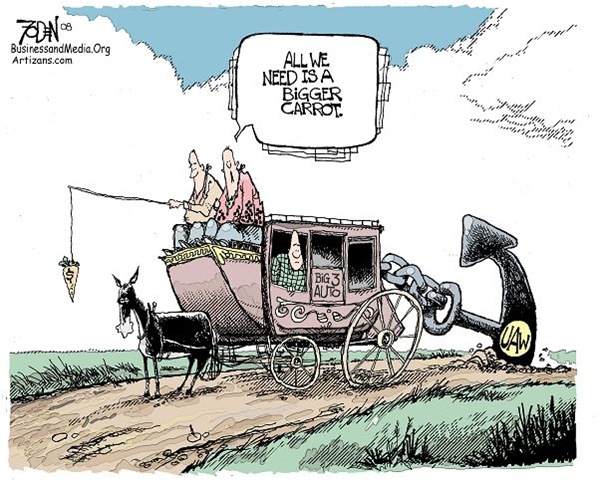
The UAW … you gotta love these guys

January 6, 2009

Excerpted from IBD, “The UAW’s Money-Squandering Corruptocracy”, Malkin, December 31, 2008

While carmakers soak up $17 billion in taxpayer bailout funds and demand more for their ailing industry, United Auto Workers bosses have wasted tens of millions of their workers’ dues on gold-plated resorts and rotten investments.  While membership in the union has plummeted, the UAW retains assets worth $1.2 billion.

The UAW owns and operates Black Lake Golf Course — a “championship caliber” course opened in 2000 that’s part of a larger “family education center” and retreat nestled in 1,000 acres of property in Onaway, Mich. The resort includes “a beautiful gym with two full-sized basketball courts, an Olympic-size indoor pool, exercise and weight room, table-tennis and pool tables, a sauna, beaches, walking and bike trails, softball and soccer fields and a boat launch ramp.” The Detroit Free Press reported earlier this year that the golf course (valued at $6 million) and education center (valued at $27 million) have together lost $23 million over the past five years. 

The UAW  bid $9.75 million to purchase the gated La Mancha Resort Village in Palm Springs. The 100-room walled resort with spas, poolside massages and a “croquet lawn lit for night use” was on the verge of bankruptcy with $5.2 million in debt. Fortunately (for members), that deal didn’t go through.

The union poured $14.7 million into Pro Air, a start-up airline that, well, didn’t get off the ground. Plagued by safety problems, the feds shuttered the company less than a year later.

In 1996, union heavies invested $5 million in United Broadcasting Network, a liberal radio network precursor to Air America.  They shelled out for a $2 million, state-of-the-art studio in Detroit and incurred years of losses of a reported $75,000 a month before closing the network down in 2003.

And while the UAW and carmakers cry poor, they’ve operated massive joint funds for years that have paid for lavish items such as multi-million-dollar NASCAR racer sponsorships and Las Vegas junkets. 

At least the groveling Big Three CEOs gave up their corporate jets. Where’s the public flogging for the greed-infested UAW fat cats reaching into our pockets to keep them afloat?

* * * * *
Full article:
http://www.ibdeditorials.com/IBDArticles.aspx?id=284004627416260

UAW’s annual report:
http://www.unionreports.gov 

* * * * *

Want more from the Homa Files?
Click link =>
  The Homa Files Blog

GM: 3 brands have targets on their backs …

January 6, 2009

Excerpted from BusinessWeek;, “Brand New Day”, November 28, 2008
* * * * *

General Motors is looking at killing off three brands—Pontiac, Saab and Hummer.

Everyone knows that GM is over-branded. The problem has long been that the company does not want to have to pay dealers to fold the brands it does not need as it did with Oldsmobile in 2001. State franchise laws prevent a car company from simply ending a brand. Closing down Oldsmobile cost the company around $2 billion.

Saab is not thought to have any hot buyers. According to past conversations with GM execs, Saab Cars has never turned an annual profit for GM. It has, at times, made money in Europe. But those gains have always been off-set by losses in the U.S.

Saab is one of two Swedish car companies with limited interest from both consumers and investors. Ford, too, tried to sell Volvo earlier this year, and found no takers willing to pay Ford’s asking price.

Both Saab and Volvo are premium brands that have long had followings of people who place safety above all other vehicle characteristics. Saab has also attracted some performance-oriented buyers as the company has long offered turbo chargers in some of its models.

[Note: As previously posted, green buyers typically sort performance and safety down the list of buying criteria]

Volvo is on track to sell about 82,000 vehicles this year. Sales through October were down 28%. Saab is on track to sell about 20,000 vehicles this year. Sales were down 32% through October.

Edit by DAF

* * * * *
Full article:
http://www.businessweek.com/the_thread/brandnewday/

* * * * *
Want more from the Homa Files?
Click link => 
The Homa Files Blog

* * * * *

4 million existing homes on the market … so what?

January 5, 2009

There’s a lot of hand-wringing going on over the fact that there are about double the number of existing homes on the market now versus historical averages.  And, there 4 million number is probably low since some people would like to sell but aren’t listing their homes because of the bad market.

But, put the number in perspective.  The 4 million homes represent only about 3% of total households and about 5% of owner-occupied households. That means that for 95% of home owners, the number is largely irrelevant.  They’re paying their mortgages and taxes, and they aren’t planning on selling to move.  Sure, house prices are down, but — unless they have  home equity loans  — the only short-term impact is simply “on paper”.  These folks will be fine until the housing market rebounds … and it eventually will !

My suggested remedy to the problem: (1) set a zero capital gains tax rate on houses bought in 2009 and 2010 as long as they’re held at least 2 years, and (2) allow landlord-investor’s who buy residential homes in 2009 and 2010 to accelerate depreciation and offset ordinary income with all rental losses.  The 2 million “overhang” in houses would be cleared in weeks, and folks who can’t afford to buy houses would have more rental choices,

[Buyers' strike]

Source: WSJ, 01-02-09
http://online.wsj.com/article/SB123084433166547199.html

* * * * *

Want more from the Homa Files?
Click link =>
  The Homa Files Blog

Nine driving forces to watch in 2009

January 5, 2009

The best list I’ve seen so far.  I especially like #4 … and I agree with the logic.

* * * * *

Excerpted from IBD, “Nine Possibilities Heading Into 2009”,  December 31, 2008

1. A Less Safe Homeland ?

Will Obama take the heat from the left of his own party and boldly use his constitutional authority as president to go the extra mile in protecting the country, as  Bush did, or will he dilute the indispensable tools that have helped keep us safe since the 9/11 attacks ? 

We’ll see. Promising to get Osama bin Laden sounds great in a campaign; governing requires more than catchphrases.

2. Stimulus Pushes Deficit To $1 Tril

Late in 2008, talk centered around a deal involving up to $800 billion in new spending, focused mainly on infrastructure and so-called Green Jobs. Tax cuts of $150 billion or more will focus on the middle class. Under Obama, those who no longer pay any taxes will surge from 44 million currently to more than 50 million, as those in the top 5% of incomes shoulder a greater share of the tax burden.

Obama’ s stimulus, along with the nearly $2 trillion in outlays for 2008’s financial and auto bailout, will push the deficit to more than $1 trillion — 7% of GDP, the biggest deficit since 1946.

Republican efforts to cut capital gains taxes — a proven way to strong economic and job growth — will fail.

Businesses may start feeling left out, and the GOP will try to make it a wedge issue in congressional elections of 2010.  

3. China Falls Into Recession

After decades of stunning 10% GDP growth, China’s economy stumbled late in 2008. It will continue to slow in 2009 — and possibly beyond. The main trigger for their slump: Soaring energy prices during early 2008, and a steep decline in U.S. demand for China’s goods.

If China grows by 5% or less over the next year or so, it won’t create enough jobs and will face serious social pressures that could break into open violence.

Despite its rapid growth, China still only ranks No. 81 on the U.N.’s human development index, a gauge that combines health, education and income. Things are far worse for the more than half of China’s 1.3 billion people who live in rural areas.

4. Recovery In The U.S.?

The U.S. economy will pull out of its recession as a massive home inventory overhang is worked off, oil prices stay low, trillions of dollars in stimulus and bailout funds are put to work and Fed interest-rate cuts kick in.

Banks and finance companies will start lending again, and rising demand will push companies to hire.

World demand for oil will fall, as it did in 2008.  And since each 10-cent drop in gas prices is equal to a $12 billion tax cut, the U.S. will get a “silent” tax cut of about $295 billion.

The bear market in stocks — which are one of the economy’s best leading indicators — should be drawing to a close. This bear is now in its 15th month, and most don’t last more than 15 or 16. Nine to 10 is more like it.

5. Energy Fever, Climate Change Cool Off

The cooling trend that began in 1998 will continue as solar activity remains dormant. Last year was the coolest year in a decade.

As the evidence grows, more scientists will join the list of climate “deniers,” as protests arise in Europe and the U.S. over expensive alternate-energy schemes that slow global economic recovery.

But as long as crude remains below $70 a barrel — the make-or-break level for many energy projects and alternative energy — Congress will continue to drag its feet on drilling for more oil and gas in the U.S.

6. Big Labor Fights For Relevance

Organized labor made a big deal about its $400 million in campaign spending to win the election for Democrats in 2008.

But as 2009 rolls in, all that cash is starting to look less like power projection and more like a last-gasp bid to go for broke.

The big problem is that in a weak economy, the union agenda is incompatible with economic growth. Businesses can’t grow and create jobs in an atmosphere where workers are forced into unions and free trade is restricted. Given the choice of a recovering economy or a satisfied union base, Obama is likely to tilt toward saving the economy, if only for the sake of his own political viability.

Unions want to show they still matter after watching their share of the U.S. work force shrink from 31.4% in 1960 to less than 12% today.

Two fronts will emerge: “card-check” — a change to the National Labor Relations Act that would eliminate secret ballots to make organizing new unions easier — and free-trade pacts.  

7. Obama Seeks Health Care Reform

Even health care experts sympathetic to Obama’s goals argue the president-elect understates his plan’s costs. Obama’s plan of near universal coverage means “a $100 billion infusion of new health care spending.”

ObamaCare’s massive new spending will be a tough political sell, especially with taxpayers already footing the bill for bailouts of banks and the auto sector, and millions of Americans losing their jobs.

Obama will insist that a big government health care reform is imperative for economic recovery, imposing the kind of socialized medicine found in France, Britain and Canada, where waiting lists and substandard quality are the norm.

8. India Gets Assertive

India’s citizens have gained a lot from their opening to the world in 1991 and they aren’t about to give it up. But threats remain from the global economic downturn and terror attacks out of Pakistan.

Fiscal stimulus is on the plate, and possibly more defense spending. The government may tighten its alliance with the U.S. to modernize its military.

As a large market, India will forge closer trade ties with markets like the U.S., Japan, and EU.

9. Israel Gets Rid Of Iran’s Nuclear Threat

Will Israel use its altercation with the Iranian-backed Hamas as a stepping stone toward a strike on Iran’s nuclear facilities?

The signs are that an Obama Administration, committed to “tough diplomacy,” will be less likely to let Israel take matters into its own hands and strike Tehran.

Lack of U.S. support would make such airstrikes more difficult, and leave Israel even more vulnerable politically on the world stage.

Still, Israel might be tempted to go for broke, taking out Iran’s burgeoning nuclear threat rather than letting Tel Aviv go up in a mushroom cloud.

* * * * * *
Full article:
http://www.ibdeditorials.com/IBDArticles.aspx?id=283999323921715 

* * * * *

Want more from the Homa Files?
Click link =>
  The Homa Files Blog

Now, it's the phone, not the carrier calling the shots …

January 5, 2009

Excerpted from Business Week, “How Apple’s iPhone Reshaped the Industry”, December 11, 2008

Today, apps are where the action is, and consumers are reaping the benefits

A few years ago, if someone asked what sort of cell phone you had, your response would probably be to name a network, like Sprint or Cingular. Wireless carriers so completely controlled the business, especially in the U.S., that many manufacturers weren’t even allowed to put their brand names on handsets. Now this relationship is changing in ways that will reduce the power of carriers and, with luck, increase consumers’ choices.

The relationship started to shift when people began using phones for more than voice calls and text messages. As browsers and e-mail systems became important, it mattered more whether you had a Palm Treo or a BlackBerry than whether your phone ran on the Verizon Wireless or AT&T network. Then along came Apple’s iPhone to rewrite the rules completely.

The conventional wisdom holds that AT&T scored a coup when it signed on as the exclusive U.S. iPhone carrier. The company reported that it activated 2.4 million of the new 3G iPhones in the third quarter, that 40% of those customers came to AT&T from rival operators, and that their average monthly bill was 1.6 times that of other subscribers.

But the impact on AT&T’s bottom line is another story. Mostly because of the fat subsidy it pays Apple for each iPhone, AT&T’s third-quarter earnings of $3.2 billion were $900 million less than they would otherwise have been.

More importantly, the carrier has probably lost forever its ownership of the customer, through a process economists call “disintermediation.”

Before the iPhone, relatively few owners of any phones—smart or dumb—downloaded applications. The carriers had a nice business selling ringtones and the odd game. But with iTunes and the App Store, Apple became the exclusive supplier of applications as well as music and videos. The content suppliers got about two-thirds of the revenue, Apple kept about a third, and the carriers were frozen out.

A key test of the new relationship between handset makers and smartphone software publishers, carriers, and customers will arrive when turn-by-turn driving instructions come to the iPhone. Apple seems to have created the phone with navigation in mind. Rumors are flying that Apple plans a navigation offering that leaves carriers in the cold.

This shift in power is a bad thing for wireless carriers, whose nightmares of being turned into commodity sellers of bandwidth are coming true. But it may be a win for everyone else.

Full article:
http://www.businessweek.com/print/magazine/content/08_51/b4113078121012.htm 

* * * * *

Want more from the Homa Files?
Click link =>
  The Homa Files Blog

Now, it’s the phone, not the carrier calling the shots …

January 5, 2009

Excerpted from Business Week, “How Apple’s iPhone Reshaped the Industry”, December 11, 2008

Today, apps are where the action is, and consumers are reaping the benefits

A few years ago, if someone asked what sort of cell phone you had, your response would probably be to name a network, like Sprint or Cingular. Wireless carriers so completely controlled the business, especially in the U.S., that many manufacturers weren’t even allowed to put their brand names on handsets. Now this relationship is changing in ways that will reduce the power of carriers and, with luck, increase consumers’ choices.

The relationship started to shift when people began using phones for more than voice calls and text messages. As browsers and e-mail systems became important, it mattered more whether you had a Palm Treo or a BlackBerry than whether your phone ran on the Verizon Wireless or AT&T network. Then along came Apple’s iPhone to rewrite the rules completely.

The conventional wisdom holds that AT&T scored a coup when it signed on as the exclusive U.S. iPhone carrier. The company reported that it activated 2.4 million of the new 3G iPhones in the third quarter, that 40% of those customers came to AT&T from rival operators, and that their average monthly bill was 1.6 times that of other subscribers.

But the impact on AT&T’s bottom line is another story. Mostly because of the fat subsidy it pays Apple for each iPhone, AT&T’s third-quarter earnings of $3.2 billion were $900 million less than they would otherwise have been.

More importantly, the carrier has probably lost forever its ownership of the customer, through a process economists call “disintermediation.”

Before the iPhone, relatively few owners of any phones—smart or dumb—downloaded applications. The carriers had a nice business selling ringtones and the odd game. But with iTunes and the App Store, Apple became the exclusive supplier of applications as well as music and videos. The content suppliers got about two-thirds of the revenue, Apple kept about a third, and the carriers were frozen out.

A key test of the new relationship between handset makers and smartphone software publishers, carriers, and customers will arrive when turn-by-turn driving instructions come to the iPhone. Apple seems to have created the phone with navigation in mind. Rumors are flying that Apple plans a navigation offering that leaves carriers in the cold.

This shift in power is a bad thing for wireless carriers, whose nightmares of being turned into commodity sellers of bandwidth are coming true. But it may be a win for everyone else.

Full article:
http://www.businessweek.com/print/magazine/content/08_51/b4113078121012.htm 

* * * * *

Want more from the Homa Files?
Click link =>
  The Homa Files Blog

More subscribers, continuing losses … sat radio still alive (but not well)

January 5, 2009

Excerpted from Marketing Daily, “Flying High: Sirius-XM Revs up 14%” by Eric Sass

* * * * *

In an ironic twist, Sirius-XM saw revenues and subscribers jump compared to last year…But there is some doubt that the good times will continue, as one of the satcaster’s major sources of new subscriptions–factory installations in vehicles–appears to be headed for a ditch in 2009…

First, the good news: Sirius-XM will finish 2008 with over 19 million subscribers, which is up 10% …and revenues of around $2.4 billion–up 14%.

Satellite radio is a niche medium, and may be somewhat immune to the sharp downward trend in the economy at large…the average satellite radio customer is relatively well-heeled, with an average household income of almost $80,000 versus a national average of about $45,000, so satellite subscribers may have more of a cushion for discretionary expenditures…

In 2008, the company added 500,000 new subscriptions through vehicle sales, despite the “dramatic” slowdown in the automobile industry, accounting for about 30% of all new subscriptions. At Sirius, the proportion was even higher during its last pre-merger quarter, with 87% of new subs coming from new vehicle sales…

The company is counting on continuing vehicle sales to bring in an equivalent proportion in 2009, in part by installing radios in a higher proportion of vehicles than before…Beneath the positive outlook, the satcaster has moved aggressively to limit costs since its merger…the merged company cut 22% of its total workforce…

Edit by SAC

* * * * *

Despite an increase in revenues Sirius is still expected to post a loss of around $200 million this year.  While it will see temporary gains from merger efficiencies Sirius’ future success depends more on its ability to retain new subscribers and find channels outside of automobile sales to attract new subscriptions.

* * * * *

Want more from the Homa Files?
Click link =>
The Homa Files Blog

Driving in the rain? Here’s a safety tip …

January 2, 2009

This email has been making the rounds:  

A woman had an accident and totaled her car.   It was raining, though not excessively, when her car suddenly began to hydro-plane and literally flew through the air.  She was not seriously injured but very stunned at the sudden occurrence!

The highway patrolman on the scene told her something that every driver should know: NEVER USE YOUR CRUISE CONTROL IN THE RAIN OR SNOW — OR ON WET OR SLIPPERY PAVEMENT. 

The lady thought she was being cautious by setting the cruise control and maintaining a safe consistent speed in the rain. Not so.

According to the highway patrolman: if the cruise control is on when your car begins to hydro-plane and your tires lose contact with the pavement,
your car will accelerate to a higher rate of speed making you lose control.
 
NOTE: Some vehicles (like the Toyota Sienna Limited XLE) will not allow you to set the cruise control when the windshield wipers are on.

* * * * *

Ken’s Take: This may be an urban myth, but I doubt it — makes too much sense.

* * * * *

Want more from the Homa Files?
Click link =>
  The Homa Files Blog

Starbucks’ (un)happy Baristas unionizing … uh-oh !

January 2, 2009

Excerpted from Business Week, “Starbucks’ Union Blues”, December 31, 2008

Starbucks’ legal wrangles with a union that wants to organize its baristas is tarnishing the coffee chain’s reputation for social responsibility

Starbucks, once the undisputed leader in premium-price caffeine fixes, has long cultivated a corporate image for social responsibility, environmental awareness, and sensitivity to workers’ rights. Now that carefully crafted reputation is under assault, thanks to a messy legal dispute with a group called the Starbucks Workers Union (SWU).

The NLRB found that Starbucks had illegally fired three New York City baristas as it tried to squelch the union organizing effort …. the company broke the law by giving negative job evaluations to other union supporters and prohibiting employees from discussing union issues at work.

The judge ordered that the three baristas be reinstated and receive back wages. The judge also called on Starbucks to end discriminatory treatment of other pro-union workers.

The timing isn’t ideal for Starbucks, which faces lower demand from the recession, an overall loss of panache for the brand, and a sliding stock price.

The company’s shares more than halved in value in 2008, while Dunkin Donuts and McDonald’s continued to grab market share among coffee drinkers.

Starbucks has been the target of numerous National Labor Relations Board complaints over unlawful violations of workers’ rights.

The SWU is especially keen on tarnishing Starbucks’ image as a “socially responsible” company. Union reps say that Starbucks has a systematic problem with low wages, irregular working hours, and a lack of reliable health care. Starbucks maintains that it pays competitive wages and is among the first large employers to offer health insurance to part-time employees, who make up 100% of its workforce.

Starbuck’s carefully cultivated reputation for social responsibility, may be vulnerable. “The image of the brand that it is wonderful being green, promoting free trade, and helping people, and not being an oppressor of labor.”

Full article:
http://www.businessweek.com/magazine/content/09_02/b4115026911242.htm?chan=top+news_top+news+index+-+temp_news+%2B+analysis

* * * * *

Want more from the Homa Files?
Click link =>
The Homa Files Blog

Wines: Highly rated … and under $10

December 31, 2008

Excerpted from WSJ, Tastings, “Easy on the Wallet, Lovely on the Palate”, Dec. 26, 2008 

WSJ’s Tastings columnists John Brecher and Dottie GaiterWe taste around 2,000 wines a year at all price ranges, and conclude that price is absolutely no guarantee of quality.  Here’s their 2008 list of 10 “wonderful” wines for $10 or less.

  • Terre del Nero d’Avola (Rossetti) 2005 ($9.95). Italy.
  • Château Au Grand Paris Bordeaux Supérieur 2005 ($10). France.
  • Valle Reale “Vigne Nuove” Montepulciano d’Abruzzo 2005 ($9.95), Italy
  • Castellana (Cantina Miglianico) Montepulciano d’Abruzzo 2006 ($5.99). Italy
  • Fairvalley (Coastal Region) Sauvignon Blanc 2007 ($8.99)
  • Juno Wine Co. (Robertson) Sauvignon Blanc 2006 ($7.99)
  • Ken Forrester Vineyards “Petit Chenin” (Stellenbosch) 2007 ($9.95). South Africa.
  • The Hogue Cellars (Columbia Valley) Pinot Grigio 2007 ($6.99).
  • Alamos (Catena) Torrontés (Salta) 2007 ($10)
  • Pannotia Vineyards Torrontés (Salta) 2006 ($7.99). Argentina.

Full article (with tasting notes):
http://online.wsj.com/article/SB123033096164636121.html?mod=djemtastings

Want more from the Homa Files?
     Click link =>
  The Homa Files Blog

On December 15th …

December 31, 2008

Shoppers bought more than 6.3 million items – or 72.9 items per second – from Amazon.com on December 15, its best day of the holiday season.

* * * * * 

Internet Usage

83% of those earning more than $100,000 annually say they are online every day or nearly every day.

57% of whites use the Internet every day or nearly every day
35% of African-Americans use the Internet every day or nearly every day
24% of blacks rarely or never go online.

* * * * *

Source: Rasmussen Reports
http://www.rasmussenreports.com/public_content/lifestyle/general_lifestyle/60_are_comfortable_using_credit_cards_online

* * * * *

Want more from the Homa Files?
Click link =>
  The Homa Files Blog

Daily workouts: health-conscious discipline or just plain creepy?

December 30, 2008

Excerpted from IBD, “A Tale Of Two Presidential Workout Fanatics”, Malkin, December 26, 2008

* * * * *

Former Washington Post writer Jonathan Chait famously attacked Bush three years ago in an opinion piece for the Los Angeles Times headlined “The (over)exercise of power.”

Recounting how President Bush ran 3.5 miles a day and preached more cross-training to a federal judge, Chait fumed: “Am I the only person who finds this disturbing? . . . What I mean is the fact that Bush has an obsession with exercise that borders on the creepy.”

Chait argued that Bush’s passionate devotion to exercise was a dereliction of duty. “Does the leader of the free world need to attain that level of physical achievement?” he jeered. “It’s nice for Bush that he can take an hour or two out of every day to run, bike or pump iron. Unfortunately, most of us have more demanding jobs than he does.”

“Bush says exercise helps sharpen his thinking. But some of his critics view his exercise obsession as an indulgence that takes time away from other priorities.”

* * * * *

[Fast forward to] Christmas Day 2008, the Washington Post delivered a front-page paean to Barack Obama’s workout habits: “Gym Workouts Help Obama Carry the Weight of His Position.”

For adoring journalists, you see, Obama’s workout fanaticism demonstrates the discipline and balance in his life.  “it’s his time for himself, a chance for him to reflect. It’s his break. He feels better and more revved up after he gets in his workout.”

And when Obama feels better, the skies will part, the sun will shine (in moderate, environmentally correct, non-global-warming-inducing amounts, of course), and peace will reign worldwide!

Too bad the doughy, coffee-guzzling members of the White House press corps couldn’t see the merits of White House exercise over the past eight years.

* * * * *

Fit Republican president = Selfish, indulgent, creepy fascist.

Fit Democratic president = Disciplined, health-conscious Adonis role model.

Full article:
http://www.ibdeditorials.com/IBDArticles.aspx?id=315188478171644

* * * * *

Want more from the Homa Files?
     Click link =>
  The Homa Files Blog

Sam’s new carton has some folks crying over spilt milk …

December 30, 2008

Excerpted from Fortune, “How Sam’s Club sees the future”, October 16, 2008

Of all the things you might think you could innovate on, the milk jug might not be at the top of your list. But, it is at the top of the Sam’s Club list.

Traditional milk jugs don’t stack, and they were coming in (to Sam’s) on metal carts that were being shipped back to the dairy, cleaned, and then sent back to the stores and clubs, and recycled, which created a lot of energy drain.

sams_club_milk.03.jpgSam’s developed a new milk jug that is stackable, so Sam’s can get 400 additional jugs in a trailer,  eliminating 11,000 delivery trips to the stores.  And,  there are no carts to send back to the dairy.

Trucks are  loaded in a way that reduces bacteria, which gives additional 6 days shelf life.

So, the new package provides a better-quality product, and costs a dime to 20 cents less.

The one big challenge has been that it’s different to pour. If you tip it and put it into the glass, it works fine, but if you pick it up and pour it like the old jug, you’ll miss. Which has some people crying over spilled milk.

Full article:
http://money.cnn.com/2008/10/15/news/companies/Wal-Marts_rising_star_colvin.fortune/index.htm

* * * * *

Want more from the Homa Files?
Click link =>
  The Homa Files Blog

Among the Clinton Library donors … here are some head-scratchers

December 29, 2008

On the recently released list of donors to the Clinton Library, four caught my eye:

McDonald’s … makes sense since he loved Big Macs almost as much as interns

“I Won’t Cheat” Foundation …. no joke — of the many charities doling out money to this political cause, this was among the more ironic

United Way … I’ve always been suspicious of the UW — from high exec comp & perks to the long list of questionable charities … this unadulterated political gift insures  that they won’t ever get another buck from me

Georgetown University … so tuition and donor dollars get diverted to political causes?  That’s disappointing news to me (and probably a lot of others)

* * * * *

Source WSJ, “Clinton’s Donor List Raises Lots of Questions”, Dec. 23, 2008

Want more from the Homa Files?
     Click link =>
  The Homa Files Blog

Big enough to drive a truck through: Detroit’s labor cost disadvantage …

December 26, 2008

So, how much is Detroit’s labor cost disadvantage, really?  According to Reuter’s:

image

Reuter’s notes that trust for retiree healthcare called a Voluntary Employee Beneficiary Association, or VEBA, is to be established in 2010 — to shift retired workers liabilities to a union-aligned trust. Reuters reports that the so-called legacy disadvantgage will go away then — leaving a mere $9 per hour difference (16%).  Reuter’s doesn’t say how the trust will be funded.  Hmmm.

Source:
http://www.reuters.com/article/privateEquity/idUSN1246948520081212?pageNumber=2&virtualBrandChannel=10360

* * * * *

Want more from the Homa Files?
Click link =>
  The Homa Files Blog

Happy Holidays

December 24, 2008

May your holiday season be peaceful and happy …

Ken 

* * * * *

Want more from the Homa Files?
Click link =>
  The Homa Files Blog

Goldman: "Must pay to retain talent to insure continued success" … say, what?

December 24, 2008

Excerpted from IBD, “Bailing Out Bonuses”, December 22, 2008

Amid coast-to-coast cutbacks and layoffs by the thousands, bankers at the center of the financial crisis pay themselves $1.6 billion in taxpayer-funded bonuses .  In addition to the bonuses, they got club dues, financial planners, corporate jet travel, daily limousines and home security systems, courtesy of the taxpayers.

It’s obvious these banker bonuses had no correlation to productivity or performance. In the real world, enterprises provide such benefits only when executives produce results — that is, profits.

Goldman Sachs said it needed to retain and motivate its talent to ensure its “continued success,” not mentioning where this talent is threatening to migrate in a global and industry downturn.

Full article:
http://www.ibdeditorials.com/IBDArticles.aspx?id=314842162013024 

* * * * *

Want more from the Homa Files?
Click link =>
  The Homa Files Blog

Is lithium the oil of the future? … If so, one foreign dependency gets replaced by another.

December 23, 2008

Electric hybrid cars are the secret sauce that will save the planet and free the U.S. from its dependency on foreign oil, right?

Well, the environmental benefits are apparent, but we’ve got a problem.  Batteries are the major cost component of hybrid electric cars (running from $3,000 to $5,000 each).  Right now, industrial strength rechargeable batteries are made mostly in Japan and China — not in the U.S.  A consortium of U.S. companies is soliciting government money to develop and build batteries here.  That’s good.  But, there’s another problem: Lithium — the major element that goes into the current battery of choice — is only minimally available in the U.S.  Uh oh.

* * * * *

Excerpted from “The Trouble with Lithium”, Meridian International Research, Dec. 2006

The world is embracing the Lithium Ion battery as its answer to mobile electrical energy storage needs (translation:  for use in cars).

All other technologies are being more or less swept aside by the attraction of the potentially high energy density of Lithium based batteries.

The most well known alternative to LiIon is the NiMH battery. It is rugged, proven, has high cycle life and has many years development behind it. However, it is heavier than LiIon, very Nickel intensive. (and poses an environmental disposal challenge).

Analysis of Lithium’s geological resource base shows that there is insufficient Lithium available in the Earth’s crust to sustain Electric Vehicle manufacture in the volumes required, based solely on LiIon batteries.

Depletion rates would exceed current oil depletion rates and switch dependency from one diminishing resource to another.

Analysis shows that a world dependent on Lithium for its vehicles could soon face even tighter resource constraints than we face today with oil.

Concentration of supply would create new geopolitical tensions, not reduce them.

Exclusive dependency on Lithium Ion batteries, where the Lithium will overwhelmingly come from South America, would be like being dependent on South America for 100% of our oil supply.

image

Full technical article:
http://www.evworld.com/library/lithium_shortage.pdf

* * * * *

Want more from the Homa Files?
Click link =>
  The Homa Files Blog

GM’s Marketing Missteps

December 23, 2008

Excerpted from Harvard Business Online, “How General Motors Violated Your Trust”, by John Quelch, December 11, 2008

* * * * *

The top eight reasons why GM has failed as a marketer:

1. Focus on products, not customers. For years, Detroit wrongly viewed product types as market segments. Cars were classified as subcompacts, compacts, intermediates etc. But no consumer ever left home passionate to buy an “intermediate car.” Segments are groups of customers, not products.

2. Too many products, too many brands. The Toyota and BMW product lines are very simple, easy for a salesperson to explain and easy for the consumer to understand. There is a logic to the product lineup. Desperate to retain share in the US, GM continues to add to its already confusing array of 60 models under 8 different brand names. The positioning of each brand has long been unclear, a problem magnified by look-alike models built on common production platforms with frequent model changeovers adding complexity costs to production. Buying a car is an infrequent purchase; the consumer needs a clear roadmap of what is on offer.

3. Too many dealers. GM did not reduce its dealerships as it lost share. As a result, dealers began competing on price against each other rather than external competitors. Slipping sales caused dealers to consolidate two or more GM brands on a single lot, further undermining any pretense at distinctive positioning for each marque. And the need to keep sales up at each dealership limited GM’s enthusiasm for embracing new ways of taking new car orders from consumers over the internet.

4. Losing market control. You know you are the market leader when the other players in the value chain – producers, dealers, consumers – all look to your product line as the bellwether alongside which they organize theirs. Today, GM is correctly trying to regain control of the middle with the new Chevrolet Malibu. But will it be able to displace the Toyota Camry and Honda Accord?

5. Bigger is better. Higher wage and benefit costs make it harder for GM to make money on small cars. But the real reason for the migration of the product mix to SUVs and trucks is that the “petrolheads” who run Detroit are all big, tall men. They would rather go down in Detroit history as the guys who brought you the Escalade, not the Prius. They are Jack Palance, not Billy Crystal. Over half the cars bought in the USA are purchased by women; would you know that from the lineup of senior executives at GM?

6. No global brand. Here Ford has a clear advantage over GM. Ford is a global brand. The company name is the brand name. Sure, they have Lincoln and Mercury but the vast bulk of Ford’s marketing dollars worldwide back the mother brand. GM, by contrast, is a house of brands, none of which is global. Marketing resources at GM are inevitably dissipated.

7. Not invented here. Smaller than GM, Ford has been prompted by necessity to better integrate its worldwide operations. In a well-run multinational, this involves US headquarters learning from its subsidiaries, not just telling them what to do or letting them run independently. For decades, Detroit has spurned US launches of high quality vehicles conceived and made in its own European factories.

8. Finance focus. GM has not been run by marketers. It has been run by accountants. The cost focus has crowded out needed emphasis on consumer insight and marketing. Instead of obsessing over the $1,500 per car labor and benefits cost differential separating the big three and the foreign transplant brands, GM should have exploited its market access to develop brilliant new designs that the American consumer would gladly have paid more for. Instead, the Toyota Prius has trumped Detroit and GM’s belated answer is the $40,000 electric Volt.

Edit by DAF

* * * * *

Full article:
http://discussionleader.hbsp.com/quelch/2008/12/how_general_motors_violated_yo.html

* * * * *

Want more from the Homa Files?
Click link => 
The Homa Files Blog

* * * * *

Facebook: Thank your friends for that pop-up …

December 23, 2008

Excerpted from WSJ “Facebook Tries to Woo Marketers” by Jessica Vascellaro, November 11, 2008

* * * * *

Despite its surging Internet audience, Facebook has yet to prove it can wring steady revenue out of advertisers. Now it’s trying a new tactic to woo Madison Avenue.

The company is rolling out a new ad format called “engagement ads” that further blurs the line between marketing and social networking.

The new ads appear on the main screen when a person first logs in to Facebook. They prompt a user to do something within the ad, such as comment on a movie trailer or RSVP for the season finale of a TV show.

If the user completes the action, such as adding Bravo TV’s “Project Runway” show to a personal list of events, Facebook tries to get Bravo’s ad in front of more eyeballs by sharing a notice about what the user has done with their friends.

Facebook has a lot to prove with the new ad format, which it began quietly testing in August and started making available to all advertisers this month. The company says 70 of the U.S.’s 100 largest advertisers have advertised on its site since 2007. But its share of total number of U.S. online display ad views was just 1.1%…MySpace.com, is the market leader with 15.9% of display-ad spending…

Facebook’s new push also comes as economic turbulence hits the online ad market…growth is expected to decelerate from 17% in 2008 to 14.5% next year…

Advertising on social-networking sites appears particularly vulnerable, analysts say, because advertisers are still searching for the right ways to measure the effectiveness of ads on those sites…

The new ads won’t appeal to all Facebook users. Heather Watson, 32, recently saw the engagement ad for “Project Runway.” Ms. Watson says such ads “detract from the [Facebook] experience,” and she clicked the “not attending” option to wipe the Bravo ad from her view…

Facebook has tried many ad efforts in the past, starting with basic “fliers,” the low-budget graphical ads users could buy to promote things like events….But many marketers stayed away, concerned advertising alongside user-generated content might tarnish their brands and that the site appealed only to college students.

As Facebook has widened its audience, it has run into another problem: users weren’t clicking on ads when they browsed each other’s profiles…the rate at which users click on Facebook’s display ads is less than 1% 

Edit by SAC 

Full article:
http://online.wsj.com/article/SB122637098500816351.html

Want more from the Homa Files?
Click link =>
The Homa Files Blog

Detroit’s fight for survival … then and now.

December 22, 2008

Ken’s Take: It has taken awhile for folks to begin to realize that Detroit execs weren’t complete dolts — save for the unfortunate union negotiations in the 1970s that doomed the companies.  Consumers did want mini-vans and SUVs, and fortunately for the Detroiters, minivans and SUVs were profitable enough to cover their labor cost disadvantages.  Now, only to find a way out of the mess …

* * * * *

Excerpted from WSJ, “Auto Bailout Caps Flawed Relationship”, Dec. 22, 2008

The Detroit Three’s post World War II business strategies — which relied on large, powerful cars built by richly paid union workers — were doomed from the day in 1982 when the first Honda Accord rolled off a nonunion assembly line in Ohio.

How Detroit’s auto makers will be able to stabilize financially in the short run is unclear, since it takes years to redo their product lines.

The fastest way to profitability for the Detroit Three, beyond giving haircuts to bondholders and slashing workers wages, would be to take advantage of falling gas prices to sell more of the gas-hungry sport-utility vehicles and large pickup trucks that  Obama and congressional Democrats don’t like.

Washington’s policies, and the way the government exerted regulatory control over the auto makers, often worked against the profound changes the companies needed to make to compete with foreign makers.

Up until this year, Detroit had few reasons not to lean on trucks and SUVs for profits — and government policy all but invited them to do so.

Since the 1980s, Washington’s de facto energy policy has been to keep gasoline prices, and gasoline taxes, low. By contrast, European nations for years have boosted fuel prices to around $6 a gallon through taxes, which pushed consumers toward small cars.

The result: U.S. consumers gravitated toward ever larger and more powerful vehicles because the costs to fuel them were relatively low. In 1987, the average American vehicle got 22 miles to the gallon, weighed 3,221 pounds and accelerated from 0 to 60 miles per hour in 13.1 seconds. By 2007, the average car weighed 4,144 pounds, accelerated to 60 miles per hour in under 10 seconds — and averaged 20 miles per gallon.

Federal tariffs imposed on imported trucks and other quirks in Washington’s fuel-economy regulatory scheme also encouraged U.S. auto executives to push trucks and SUVs.Federal fuel-economy rules allow car makers to average the fuel usage of most of their products. They could sell fuel-efficient small cars and trucks at little or no profit to make up for the high-profit, gas-hungry luxury cars and big SUVs they promoted.

In recent years, GM, Ford and Chrysler made money on trucks — with profits of as much as $8,000 a vehicle — and lost money on cars. Detroit made enough money to cover spiraling health-care and pension costs.

Federal rules caused Detroit “to cede the car market and make all their money in trucks.”

Full article:
http://online.wsj.com/article/SB122990466217625249.html?mod=article-outset-box 

* * * * *

Want more from the Homa Files?
Click link =>
  The Homa Files Blog

Quick: The batteries that power hybrid electric cars — where are they made?

December 22, 2008

Answer: Mostly Japan.  By Panasonic and Sanyo — soon to be just Panasonic since it announced that it’s buying Sanyo. Some from China.

So, our national strategy to become energy independent requires sourcing the major auto component — a $5,000 battery — from a foreign supplier.

Anybody see a problem with that?

This ironic twist is widely known, seems to stay off most radar screens.  Fortunately, there’s a consortium of U.S. companies — called the National Alliance for Advanced Transportation Battery Cell Manufacture — trying to develop a U.S. based battery manufacturing capability.   The consortium is knocking on the government’s door for some development money.

This is one use of tax dollars that I’m in favor of …

* * * * *
Excerpted from WSJ, “U.S. Firms Join Forces to Build Car Batteries”,  December 12, 2008

Many experts believe battery technology and manufacturing capacity could become as strategically important as oil is today.

Fourteen U.S. technology companies are joining forces and seeking $1 billion in federal aid to build a plant to make advanced batteries for electric cars, in a bid to catch up to Asian rivals that are far ahead of the U.S.

Two decades ago, a similar helped the U.S. computer-chip industry restore its competitiveness.

Auto makers, including General Motors Corp. and Ford Motor Co., say they plan to roll out plug-in electric cars by 2010. But the U.S. has limited capacity to make the lithium-ion batteries those cars will need. Most of the batteries used in today’s hybrid vehicles, including Toyota Motor Corp.’s Prius and some of GM’s hybrid models, come from Asian makers.

Though much of the advanced battery technology was developed in the U.S., American companies “opted out” of battery production because of the low returns the business offered and the U.S. has lost the lead in battery manufacturing. Asian manufacturers picked up the business because of their proximity to makers of electronic devices, which need a steady supply of batteries.

The consortium intends to solicit as much as $1 billion in federal funds from the Obama administration by tapping loan guarantees contained in an energy-security act passed last year. The act pledges as much as $7 billion in loan guarantees for advanced-battery plants in the U.S. The first large-scale lithium-ion battery plant in the U.S. could cost $1 billion to $2 billion.

Full article:
 http://online.wsj.com/article/SB122957206516817419.html?mod=testMod

* * * * *

Ken’s Take:

U.S. battery manufacturing must be a strategic national priority if we’re serious about becoming energy independent and carbon fuel light.

But, battery manufacturing is only part of the equation. 

The primary input to the next generation auto grade rechargeable battery is lithium.  Any idea where that element comes from? 

Hint: not the U.S.  I’ll give the answer in a subsequent post.

* * * * *

Want more from the Homa Files?
Click link =>
  The Homa Files Blog

For small car buyers, fuel economy & sticker price are important … not safety. Huh ?

December 22, 2008

Excerpted from WSJ, “Small Cars Improve in Crashes” by Jonathan Welsh, December 17, 2008

* * * * *
The demand for smaller, more fuel-efficient cars has increased. Sales of compact cars like the Honda Fit, Toyota Yaris and Nissan Versa rose 24% though November, while sales of large utilities fell 36%.

Among small-car buyers, safety tends to take a back seat to fuel economy and a low sticker price. While 86% of basic compact-car buyers rated fuel economy as the feature about which they cared most, 29% rated safety as a top concern…

The good news: Small cars fare better in crashes than they used to … But, they still lag behind larger vehicles in protecting passengers. Their disadvantages are especially clear in side-impact crashes. Of the nine small cars recently tested…all received the group’s top rating of “good” in frontal crashes — but only two got good ratings when hit from the side. The test results highlight the difficulty for designers and engineers in developing cars that are small and light yet still strong enough to withstand collisions with large vehicles

Only the SX4 and Matrix, and its twin the Vibe, received good ratings for protection in side crashes. The Ford and Chevrolet were judged acceptable in side-impact protection, while the Hyundai and Saturn were marginal and the Chrysler was poor. Only the Ford Focus was top-rated in rear-impact crashes…The Chrysler PT Cruiser was the worst performer…Car makers have rapidly improved small-car design in the past few years by strengthening vehicles’ protective framework and adding side airbags…

The … side-impact tests are especially difficult for small cars because the barrier used to strike the test vehicle simulates the front end of a large SUV or pickup truck. The high bumper typically hits the test car at the same level as the heads of test dummies representing the driver and rear driver-side passenger. This makes head-protection side airbags critical.

Edit by SAC 

* * * * *

Ken’s Take:  I wonder if small car drivers pick airlines based on the same criteria?

* * * * *

Want more from the Homa Files?
Click link =>
The Homa Files Blog

Plunging U.S. auto sales …

December 22, 2008

Combined Detroit 3 U.S. auto sales today (under 7 million vehicles) are about equal to GM’s sales in 1985 …

[u.s. auto sales]

Note: about 1/3 of Chrysler’s 600,000 sales are to fleets, e.g. rental cars, company pools.

Source:
http://online.wsj.com/article/SB122969367595121563.html?mod=testMod 

* * * * *

Want more from the Homa Files?
Click link =>
  The Homa Files Blog

New Domain Names, New Costs to Brands

December 22, 2008
Excerpted from WSJ “New Domain Names Put Name Brands in a Bind” by Emily Steel, November 5, 2008
* * * * *
Worried about having to shell out millions of dollars to protect their brands, several major companies are protesting the launch of a slew of new top-level domains — the suffixes like “.com” that appear at the end of Web-site names.

Verizon Communications, Marriott, and New York Life Insurance are among the companies arguing that the new domains could open the flood gates to Internet fraud and drastically increase their costs of doing business online…

The organization that oversees the Internet, the Internet Corporation for Assigned Names and Numbers, plans to start selling the rights to an unlimited number of top-level domains next year. These domains are likely to take their names from popular subjects, types of businesses, geographic locations or even brand names, such as .bank, .hotel, .nyc or .verizon.

Companies fear that if they don’t register their trademarks at the new domains, their brand names could be hijacked, leading to mistrust of their brands, as well as Internet scams.

“Companies are in a difficult position. In one sense, they may feel compelled to register their crown jewels in all these locations because if they don’t, an infringer will come along, and you will have to deal with the consequences. But at the same time, it’s a huge waste of corporate resources,” says Sarah Deutsch, vice president and associate general counsel at Verizon.

ICANN, a not-for-profit organization whose members include the registrars who operate the top-level domains, says…current domains are too crowded. The crowding makes it difficult for newcomers to buy a domain that suits their business…

Companies are debating whether they should buy up the rights to operate their own brand-specific domains, such as .marriott or .nylife. They also are looking at registering their trademarks for more generic domains. For example, Marriott is considering acquiring the rights to Marriott.nyc, Marriott.travel or Marriott.vacations…

A typical company might register 20 sites within each new top-level domain, making the total cost to participate in all 200 of them $2 million, says Josh Bourne, managing partner of FairWinds Partners, an Internet-strategy consulting firm.

There currently are 21 generic top-level domains, such as .org, .info and .biz…Companies already spend a significant sum each year to buy up domain names connected to their brand…

Companies say they have been through this before, pointing to earlier launches of such domains as .asia or .eu. They bought up hundreds of thousands of domains pre-emptively but say these sites either sit dormant or fail to generate traffic.

 Edit by SAC

Full article:
http://online.wsj.com/article/SB122583938093998683.html

 Want more from the Homa Files?
Click link =>
The Homa Files Blog

Bush wimps … punts automakers to Obama … UAW celebrates

December 19, 2008

An “orderly, pre-packaged reorganiztion” didn’t make the cut after all.

Instead, Bush just cut a check, loaning GM and Chrysler $17.4 billion to bridge them through the end of January. 

The “teeth”: companies have to promise to try harder.  Just kidding, that’s not even a requirement as near as I can tell.  No restructuring of overhead; UAW workers will still get $150,000 to work the line.

Bottom line: Bush got freaked that the sky would fall and didn’t have the stones to push the UAW to reopen the gold plated contract. Geez.

PS: the politics of this move are interesting …

Full article:
http://online.wsj.com/article/SB122969367595121563.html?mod=testMod 

* * * * *

Want more from the Homa Files?
Click link =>
  The Homa Files Blog

Bush considering "orderly" auto bankruptcy … (for the already bankrupt automakers)

December 19, 2008

Excerpted from AP, Bush considering “orderly” auto bankruptcy, December 18, 2008

* * * * *

The Bush administration is seriously considering “orderly” bankruptcy as a way of dealing with the desperately ailing U.S. auto industry.

The White House was close to a decision …  on an auto rescue plan …  and is continuing discussions with the various sides that would have to sign on to a managed bankruptcy — entities such as labor unions and equity holders in addition to the companies themselves.

Full article:
http://finance.yahoo.com/news/Bush-considering-orderly-auto-apf-13868234.html

* * * * *

Ken’s Take:

  1. The automakers already are bankrupt.  The new news is trying to do something orderly.
  2. Didn’t the Detroit CEO’s say that the sky would fall before Christmas?
  3. Hard to believe that UAW folks will still be drawing over $70 per hour when the auto plants are closed.  Can’t the automakers at least redeploy the workers to infrastructure projects for the month?  Guess not — union work rules.
  4. Wouldn’t surprise me if Bush played rope-a-dope until he hands the keys to Obama …

* * * * *

Want more from the Homa Files?
Click link =>
  The Homa Files Blog

As Detroit burns (figuratively), UAW gets a paid vacation …

December 19, 2008

When Chrysler plants are idled because they are not making vehicles, Chrysler is still required to pay its UAW workers 95 percent of their wages.
http://voices.washingtonpost.com/economy-watch/2008/11/corker_uaw_should_not_be_paid.html?hpid=topnews

image002

* * * * *

Want more from the Homa Files?
Click link =>
  The Homa Files Blog

From Band-Aid to K-Y: The Power of Green Packaging

December 19, 2008

Excerpted from Ad Age “J&J’s Green-Packaging Rebirth Proves Power of Smart Design” by Teressa Iezzi, November 3, 2008 

* * * * *

AIGA, “the professional association for design,” held a conference bringing together an interesting range of voices from design, branding and culture…One of the featured speakers was Chris Hacker…design officer at Johnson & Johnson…

Hacker’s…presentation took a look at the reinvention of the design process at the package-goods giant and how design has resulted in a major win for J&J’s bottom line as well as for the environment.

J&J had acknowledged over the years that while the company did a lot of things very well, product design was not one of them. That bit of reality was thrown into alarming relief one day when during a meeting with Target, Goggins was told that if J&J didn’t “get its design act together,” it would lose position in stores…

The company didn’t have in-house designers in the consumer-products group. All design decisions were made by “the left hand”…typically by the most junior marketing people…who tended to move around every 18 months or so. They worked with outside design consultants, and all projects were handled separately, without a unifying vision.

When Hacker joined, he set up a design office…The new design discipline (which includes working with outside designers) has resulted in a number of successful product rebirths and a new focus on sustainability for the company.

Among the product stories: a sales-inducing facelift for the iconic Baby Shampoo packaging, new Band-Aid packaging and a streamlined first-aid kit, and an all-out redesign of K-Y, with more intimately oriented packaging and the addition of the K-Y Yours & Mine…

Hacker described sustainability at a company J&J’s size as “a journey.” It starts with packaging-weight reduction and the use of recyclable and certified materials; biodegradability and reusability are the next step. He says, for example, when he joined the company, Band-Aid packaging was made mostly in Brazil from “unknown source” material. He moved to Forest Stewardship Council-certified paper; post-consumer recycled paper will follow. The Aveeno brand has also moved in part to post-consumer materials and will continue to do so.

Will the design and sustainability journey be slowed by the current economic conditions? “Recession is exactly the reason we need to be doing what we’re doing,” he said. “It’s cutting through the chaos of everything that’s going on.”

Edit by SAC  

Full article:
http://adage.com/columns/article?article_id=132145

* * * * *

Want more from the Homa Files?
Click link =>
The Homa Files Blog

Low-interest mortgages are the answer … Not !

December 18, 2008

Here’s the newest twist on how to stabilize the housing market: price fix the retail mortgage rate at 4.5%, with the government (i.e. you and me) subsidizing the rates for folks who wouldn’t otherwise be able to afford the mortgage payments.  My suggestion for stabilizing housing prices is below.

* * * * *
Excerpted from WSJ, “Low-Interest Mortgages Are the Answer”, Hubbard & Mayer, December 17, 2008

The Treasury Department is considering a plan to offer a 4.5% mortgage for home buyers for a period of time. Let’s hope it does. It would help arrest the decline in house prices that is at the base of the ongoing financial crisis and recession.

In most markets house values are today lower than what is consistent with the average level of affordability in the past 20 years. Current futures markets suggest that house prices will decline by 12%-18% in the next 18 months.

Nonetheless, without policy action house prices are likely to continue falling. Conversely, we see little risk that increasing the demand for housing will touch off another housing bubble. While the economy is contracting, low interest rates would spur housing activity.

A 4.5% mortgage rate is not too low. The 10-year U.S. Treasury yield closed at 2.3% on Dec. 12, 2008. Hence a 4.5% mortgage rate is 2.2% above the Treasury yield, above the 1.6% spread that would prevail in a normally functioning mortgage market.

Recall that a mortgage can be thought of as a risk-free bond plus two possibilities that increase risk to lenders: default and/or prepayment. Historically, the risk of default adds about 0.25% to the interest rate. The remaining spread of the mortgage rate over the Treasury yield represents the risk of prepayment and underwriting costs. With falling house prices, the risk of default could indeed add 0.75% or more for a newly underwritten and fully documented loan.

Moreover, a 4.5% mortgage rate will raise housing demand significantly. A simple forecast can be obtained by applying the 2003-2004 homeownership rates to 2007 households. We use the 2003-2004 home ownership rates because those were the years of the lowest previous mortgage rates (the average mortgage rate was 5.8%).

An increase in the homeownership rate from 67.9 (third quarter, 2008) to 68.6 (the average rate from 2003-2004) would increase homeownership by about 800,000 new homeowners. A simple statistical analysis examining the impact of lower mortgage rates and higher unemployment rates yields an even higher, and firmer, estimate of 2.4 million additional owner occupied homes in 2009.

4.5% mortgage rate that the Treasury is considering also should be available for present homeowners who want to refinance, because of the benefits for the economy as a whole. We calculate that up to 34 million households would be able to do so, at an average monthly savings of $428 — or a total reduction in mortgage payments of $174 billion.

Research article:
http://www4.gsb.columbia.edu/realestate/research/housingcrisis/mortgagemarket

WSJ article:
http://online.wsj.com/article/SB122948162452913103.html

* * * * *

Ken’s Way:

Eliminate capital gains taxes on all residential property that is acquired during 2009 and 2010, provided that the property is held at least 24 months. (Note: that the tax exclusion would depend on both the purchase date and the holding period)

The goal: get private investors — large and small — to buy residential property (i.e. houses) and rent them to folks who neither really can’t afford to buy a house on their own.  To sweeten the deal, let landlords depreciate the property on a highly accelerated basis for income tax purposes, and allow all current tax losses to offset ordinary income when calculating taxes.

It would be a win-win.  Investors would have a place to park their money; more rental housing would be available for non-owners; tax payers wouldn’t have to subsidize anything.  

* * * * *

Want more from the Homa Files?
Click link =>
  The Homa Files Blog

Majority Oppose Government-run National Health Plan … and only 45% of Dems favor it.

December 18, 2008

Excerpted from Rasmussen Reports, December 12, 2008

* * * * *

51% of U.S. voters oppose the creation of a single-payer national health insurance plan overseen by the federal government, 30%  favor it, and 19% are undecided.

45% of Democrats favor a government-run national single-payer plan;  74% of Republicans are against it.

55% of white voters oppose a government-run plan, while a plurality of African-Americans (44%) support it.

61% of liberals favor a national health plan overseen by the government, compared to 30% of moderates and 14% of conservatives.

Married voters — by double digits –are more opposed to a government plan than unmarrieds.

Full article:
http://www.rasmussenreports.com/public_content/business/healthcare/51_oppose_government_run_national_health_plan

* * * * *

Want more from the Homa Files?
Click link =>
  The Homa Files Blog

Soup Isn’t Sexy, Its Effective

December 18, 2008

Excerpted from Brand Channel “Campbell’s Soup un-canny” by Adam Sauer, November 10, 2008

* * * * *  

Even before Warhol pointed out the obvious, Campbell’s was an iconic brand. From its humble beginnings as Joseph Campbell’s cannery of tomatoes, soups, condiments, vegetables, and mincemeat in 1869, it grew into a brand that identifies Americana as much as it identifies America.

While the popularity of the brand’s profile fluctuates over time—often depending on the economic health of its consumers—Campbell’s enjoys extraordinary brand recognition and an envy-inducing level of respect. For example, despite being the oldest of old-economy brands, a 2008 survey…found that Campbell’s was second on a list of the most socially responsible companies in the US, behind only Google.

Campbell’s owes a great deal of its success to technological innovation. Its turn-of-the-century breakthrough of halving water content to create a condensed soup helped to expand its wide popularity.

But just how does the brand fair online in the new economy?

Campbellsoup.com is the brand’s online gateway representing and linking to the brand’s stable of sites…

Much of Campbell’s online success can be attributed to what the brand hasn’t attempted to do. The brand, for example, understands the reasons to visit a soup website do not include Flash-based video games or social networking based on a love for chicken soup. (It should be noted that many similar consumer brands, or those brands’ agencies, are convinced otherwise.)

Also, Campbell’s realizes its brand’s place on the sex appeal spectrum; it knows it is not a high fashion label and it opts, wisely, to avoid flamboyance both online and on the shelf…

A final paradox of the brand is that while Campbell’s is known for the simplicity of its design and product (soup), the label is actually an umbrella for a conglomerate of products ranging from juice to seeds. The challenge is to differentiate the site enough to represent this family of brands without losing that simple Campbell’s iconography that captured Warhol’s attention.

Campbell’s likewise accomplishes this with links to its Pepperidge Farms, Prego and Swanson brand offerings… So, soup to nuts, Campbell’s online does all it should and none of what it shouldn’t. Simple. Effective. Just like the soup.

Edit by SAC 

* * * * *
Full article:
http://brandchannel.com/features_webwatch.asp?ww_id=406

* * * * *

Want more from the Homa Files?
Click link =>
The Homa Files Blog

But, the dogs have been eating the dog food …

December 17, 2008

The Detroit auto execs have been getting pillaged for not making the kind of vehicles that consumers want to buy.

That accusation doesn’t seem to to ring true when driving down an interstate highway or walking through shopping mall parking lots.  I see plenty of SUVs, min-vans, and pick-ups with American brand names.  Some look pretty new to a casual observer.  Seems like folks are buying them.

In fact, for the past several years, about half of the best selling vehicle models are U.S. brands.  The SUVs have fallen out of the top 10, but pick-ups still top the list and at least one American car (Impala) makes the list.  Detroit may not have the car of the future, but it seems to have had some cars for the recent past.

Where are hybrids are the list?  Nowhere.  

CNBC’s Maria Bartiromo  raised that point with Congressman Barney Frank:

Does Congress realize how few hybrids have been sold, as it pushes, Detroit to make them, and will Congress give consumers greater incentives to buy these cars?

Frank’s reply was odd — even by Barney Frank standards:

“That’s a very fair point. And one of the things I’ve been saying is that some of my colleagues and the commentators who have been blaming the auto companies forget to blame somebody else—the consumers. In the recorded history of America, no one was ever forced at gunpoint to buy a Hummer. But we do believe that the combination of genuine concern about global warming and energy efficiency means people are now ready to buy these cars.”
http://www.businessweek.com/magazine/content/08_51/b4113000737793.htm 

Translation:   “If the dogs don’t eat the dog food, blame the dog.”  Not exactly the “marketing concept” at work.

Ken’s take: It looks like Detroit makes vehicles that many American consumers like, but that Washington  doesn’t like .  The congressional meddlers want Detroit to make cars that are guaranteed to lose money (lots of it).  If only the dogs would eat the right food.

* * * * *

Want more from the Homa Files?
Click link =>
  The Homa Files Blog

If the consumer craves "green", why is Toyota delaying its new Prius plant?

December 17, 2008

Toyota is delaying the opening of a new Prius plant in Mississippi.

The plant, near Tupelo, was originally going to make Highlander SUVs from late 2009. Then, as part of a big shakeup of the company’s U.S. production, Toyota decided it would begin making the new Prius at the site from 2010.

Now, Toyota will wait until the market starts picking up.

Excerpted from Business Week Online, Dec. 15, 2008:
http://www.businessweek.com/autos/autobeat/archives/2008/12/toyota_delays_n.html?chan=top+news_top+news+index+-+temp_news+%2B+analysis

* * * * *

Ken’s Take: It is broadly reported that Toyota — the runaway market leader in hybrids — loses money on each Prius it sells.  So, if Toyota can’t make money on hybrids, how are they (hybrids) going to save Detroit?  As usual, I must be missing something.

* * * * *

Want more from the Homa Files?
Click link =>
  The Homa Files Blog

Sirius XM faces strategic challenges, debt load … and, oh yeah, NASDAQ delisting

December 17, 2008

Excerpted from Business Week, “Sirius XM’s Dual Concerns: Debt, Delisting”, December 12, 2008

* * * * *

Sirius XM  is racing to get its financial house in order … The company’s shares have plunged more than 85%, to 14¢,and risk being delisted from the Nasdaq stock market in the coming months.

The biggest hurdle for cash-strapped Sirius XM will be refinancing $1 billion in debt that’s coming due in 2009.

The company is also under pressure to reduce operating costs. Sirius XM may need to negotiate for a lower price on some of its programming agreements. The company pays $60 million a year to broadcast Major League Baseball through 2012, for instance.

Analysts question plans to expand the company’s constellation of costly satellites … the company is due to pay $31.2 million for the construction and launch of a new satellite in 2009. 

In the long run, the company may have to make changes to its whole method for distributing content.  “There are lots of ways to distribute programming, and satellites may not prove to be the ideal way.” Engel says. The company could expand its network of terrestrial repeaters, towers similar to those traditional radio stations use to relay signals, and rely on costly satellites less.

A more aggressive push online and onto wireless networks and devices like the Apple iPhone may help expand Sirius’ customer base, currently about 19 million. “Sirius may be artificially limiting its scope by relying on satellite technology as a delivery vehicle.” A push online or through a wireless network could help Sirius round out its packages of channels, selling for $6.99 to $16.99 a month, with more personalized content.

A greater variety of personalized options may help calm longtime XM subscribers who have grown frustrated in recent months as Sirius consolidated some of its programming and some beloved shows went away… many are considering canceling the service after losing favorite channels.

Word of disgruntled existing users may keep new subscribers from signing up. “That kind of move has a ripple effect beyond the existing subscriber base.”

By starting to distribute its content differently, for instance via the iPhone, Sirius may be able to offer what some of its rivals already offer, and allow users to pay to listen to specific interviews or a particular concert. It may even allow subscribers to purchase song tracks and audio books from its Web site or through its radio receivers.

“If they are going to remain tied to a pure subscription model, they are probably not going to succeed in the long run.”  After all, rivals like Web radio, HD radio, and music services like Apple’s  iTunes are making inroads.

Automakers like Ford  are building more support for Apple iPod music players into their cars.

According to IDC’s fall survey of nearly 2,000 people, 58% of Americans own portable media players, and while only 16.5% subscribe to satellite radio service, many of them are die-hards.

Full article:
http://www.businessweek.com/technology/content/dec2008/tc20081212_917411.htm?chan=top+news_top+news+index+-+temp_news+%2B+analysis

* * * * *

Want more from the Homa Files?
Click link =>
  The Homa Files Blog

How green is your dry cleaner? … and, oh yeah, how clean are your clothes?

December 17, 2008

Excerpted from WSJ, “Finding an Eco-Friendly Dry Cleaner,” by Gwendolyn Bounds, December 4, 2008

* * * * *

Recently we’ve spotted a growing number of dry cleaners hawking “organic” and “eco-friendly” services and wondered if they were up to par, or just engaging in green-washing of a different sort. 

Roughly 80% of the nation’s 30,000 dry cleaners still employ a cleaning method using the liquid solvent perchloroethylene — or “perc”…because it is known to remove stains and odors effectively without damaging or shrinking delicate garments.

However, perc has been listed as a hazardous air pollutant and a probable human carcinogen…long-term exposure could increase the cancer risk for consumers who wear a lot of dry-cleaned clothes…the EPA is requiring a phase-out of perc at dry cleaners located in residential buildings…

These moves, coupled with consumer appetite for eco-anything, are fueling the growth of professional cleaners who dub themselves as “greener.” They’re ditching perc for myriad alternatives, such as liquefied carbon dioxide, silicone and gentle, biodegradable detergents…

WSJ put a handful of cleaners through their sartorial-sanitizing paces to see how they stacked up…all the stores we tested generally cleaned as well as, if not better than, our regular outlets…however, there’s real debate over just how eco-friendly and safe some of these newer methods are.

We tested the four cleaning techniques frequently touted as greener alternatives to perc: “wet-cleaning”…CO2 cleaning, hydrocarbon cleaning and a silicone-based cleaner.  At least two of these methods don’t get endorsements among some eco-watchers. For instance, the hydrocarbon method uses a petroleum solvent that, while not considered hazardous like perc, contains volatile organic compounds that can contribute to smog…Likewise, there have been questions raised about the silicone method…

“It’s absolutely confusing…We are entering a new world here in terms of regulation of chemicals.” As a rule of thumb, “you are pretty darn safe with wet-cleaning” provided you go to a pro that has the proper equipment needed to reshape garments after they’re washed…For now, the Web is the best bet for consumers hunting for a non-perc cleaner in their neighborhood…

Edit by SAC

* * * * *

With the myriad of businesses are claiming to be “green” today the Eco-cleaner’s claims do appear to have some merit.  In the article’s test the “green” cleaners not only stood up against the traditional method, but offered comparable prices and in some cases additional complementary services.  This indicates that consumers aren’t yet aware of the value in eco-cleaning and thus businesses aren’t able to charge a premium or that the cleaners themselves have yet to impose a pricing premium for their green services.  While the eco-jury is still out Eco Cleaners will continue to grow as the use of “perc” is phased out.

* * * * *

Full Article:
http://online.wsj.com/article/SB122834783552077505.html?mod=wsjcrmain

* * * * *

Want more from the Homa Files?
Click link =>
The Homa Files Blog

The Nike Network

December 17, 2008

Excerpted from BusinessWeek, “How Nike’s Social Network Sells to Runners”, by Jay Greene, November 6, 2008

* * * * *
Nike is winning a new game that other corporations, from Coca-Cola to Verizon to General Motors, have tried unsuccessfully to play: building brand loyalty via online social networking.

In the two years since it launched Nike+, a technology that tracks data of every run and connects runners around the world at a Web site, nikeplus.com, Nike has built a legion of fans. In August, for instance, 800,000 runners logged on and signed up to run a 10K race sponsored by Nike simultaneously in 25 cities, from Chicago to São Paulo. Now the company is testing a social network to promote its basketball shoes.

Some analysts back up Nike’s claims that the site is renewing the popularity of its running shoes. SportsOneSource, a Princeton (N.J.) market research firm, says Nike accounted for 48% of all running-shoe sales in the U.S in 2006. Today, its share is 61%. “A significant amount of the growth comes from Nike+,” says Matt Powell, a SportsOneSource analyst.

* * * * *

Nike’s online strategy differs from those of other companies. Most have tried to create virtual communities through a build-it-and-they-will-come approach centered on a brand or specific product. Originally, the Beaverton (Ore.) company envisioned Nike+ simply as a clever way to combine music and running, not as a prototype for a new kind of marketing.

The key to bringing runners onto the Web was the development in 2006 of a $29 Sport Kit sensor that, when synched with an iPod touch or nano, tracks runners’ speed, mileage, and calories burned. When those runners dock their iPods, nikeplus.com launches, and the run data get uploaded. More important, the site is a virtual gathering place. Runners have collectively logged 93 million miles on nikeplus.com.

* * * * *

Nike now hopes to score with another group of jocks: basketballers. The company is beta-testing Ballers Network, a Facebook application that lets players organize real-world games and manage their teams online.

Edit by DAF

* * * * *

Full article:
http://www.businessweek.com/magazine/content/08_46/b4108074443945.htm?chan=top+news_top+news+index+-+temp_news+%2B+analysis

* * * * *

Want more from the Homa Files?
Click link => 
The Homa Files Blog

* * * * *

Feds in "stand off" over foreclosures … is that bad news or good news ?

December 16, 2008

Excerpted from Business Week, “A Standoff Over How to Rescue the Housing Market”, December 11, 2008

* * * * *

image 
        http://images.businessweek.com/ss/08/12/1211_numbers/2.htm

Without reducing foreclosures and ending the slide in home prices, it will be nearly impossible to stabilize banks and lessen the depth of the recession. And sharply rising unemployment has added new urgency: Last spring, Rod Dubitsky, Credit Suisse’s (CS) head of research for asset-backed securities, projected 6.5 million foreclosures. With unemployment set to top 8% in 2009, he says up to 10 million families may lose their homes.

What’s the best way to stabilize plunging home prices?

Treasury Secretary Hank Paulson and his staff are considering plans to push mortgage rates down to 4.5% in hopes of bringing buyers back into the moribund market.

Democrats—in Congress and on President-elect Barack Obama’s team—seem more set on pressing lenders to renegotiate troubled mortgages. That tack, championed by FDIC head Sheila Bair, is aimed at trimming foreclosures and ending fire sales.

Bair’s plan offers a guarantee to lenders that modify a mortgage so payments are trimmed to 31% of a homeowner’s gross income. If they cut interest rates or stretch out the life of a loan, Washington would cover part of the lender’s losses should a homeowner redefault. Bair says the plan would save 1.5 million homeowners at a cost of $24.4 billion. [Note; lenders would get subsidies only on loans that redefault.]

But conflicting investor interests make it legally tough to modify securitized loans. And new statistics suggest that more than half of loans modified early this year are already at least 30 days past due.

Treasury says it’s studying several options, including the plan to subsidize low rates. Proponents say that by bringing new buyers to the market, the move could help end the pricing slide.   Problem is, low rates would do little for those now facing foreclosure or trapped in homes worth less than their mortgages.

Full article:
http://www.businessweek.com/magazine/content/08_51/b4113030318539.htm?chan=top+news_top+news+index+-+temp_news+%2B+analysis

* * * * *

Ken’s Take:

In rough numbers …

  1. 2/3’s of roughly 125 million households are owner-occupied
  2. 1/3 of owner-occupied households are owned free and clear of any mortgage
  3. 20% of mortgages are sub-prime; most with no down payment; many “under water”
  4. Vast majority  of sub-primes were “unqualified” at fair market (vs. “teaser”) interest rates
  5. 12% of sub-primes are in foreclosure, accounting for 40% of total foreclosures
  6. 50% of foreclosed sub-primes don’t qualify at modified terms (e.g. writing loan down to house’s FMV)
  7. 50% of modified sub-prime loans re-default within 6 months

image

Bottom line: Many of the people being foreclosed on are “occupants” not “owners”.  Help legitimate owners who are going through some tough times; stop delaying the inevitable for the sub-primes — and certainly don’t reward them with deals better than the people who played by rules have.  That’s not fair !

* * * * *

Want more from the Homa Files?
Click link =>
  The Homa Files Blog

The automaker’s specious bankruptcy argument …

December 16, 2008

Excerpted from WSJ, How Destructive Would Bankruptcy Be for Big Three?, December 12, 2008

* * * * *
One of the Big Three’s main arguments for a bailout is that American consumers won’t buy General Motors and Chrysler cars if they are forced into bankruptcy. They would be tainted by a stigma and by worries that warranties and parts wouldn’t be available years down the road if the firms ran the risk of liquidation.

Consumer surveys support this view. One survey of 6000 consumers by CNW Research this summer found that 80% said they would abandon an auto maker if it were to file for bankruptcy.

Does the argument hold up? One way to test it is to look at consumers’ actual behavior. The risk of bankruptcy has obviously risen in the past few months. If bankruptcy is likely to drive consumers away, one might expect to see the market share of GM and Chrysler fall more precipitously as bankruptcy risks rise.

The U.S. market share of the Big Three has been dropping consistently for years, from 74% in the mid-1990s to less than 50% today. But there’s little evidence in the data so far that this longer term pattern has been dramatically amplified by the rising risk of bankruptcy.  

With the whiff of bankruptcy in the air …

Chrysler’s U.S. sales market share has actually risen from 8.7% in July to 11.5% in November, according to  Moody’s Economy.com.

GM’s market share has bounced around but hasn’t dropped below levels hit earlier this year. 

Ford, which isn’t facing an immediate cash crunch, has picked up market share too, rising from 14.2% in July to 16.5% in November.

Of course, sales have been propped up by  fire-sale deals and aggressive fleet sales.  But, that’s not new news.

http://blogs.wsj.com/economics/2008/12/12/how-destructive-would-bankruptcy-be-for-big-three/

* * * * *

Ken’s Take:

1. Is there anyone who doesn’t recognize that the Detroit automakers are hanging by financial threads?  The companies are bankrupt, they’re just not in legal bankruptcy proceedings. If they were, they’d at least stand some chance of restructuring themselves into healthy positions. The current government thinking stands no chance of doing that. 

2. As I’ve said before, they survey results are misleading.  Would somebody be more likely to buy a car from a financially healthy car maker?  Of course.  Would somebody prefer to by from one that is on the brink of financial collapse or one that is in bankruptcy proceedings?  I bet that would be a statistical tie.

* * * * *

Want more from the Homa Files?
Click link =>
  The Homa Files Blog

Feeling pinched these days? Here’s why …

December 16, 2008

Economists estimate households will have lost more than $5 trillion in net worth since the summer of 2007 because of falling home equity and stock prices.

In recent years, households have used their big multiyear wealth gains as a means to afford more debt and as a surrogate form of savings, instead of socking away more of their pay. But by the end of 2008,  They are now more dependent on income growth to finance their spending and saving and less so on credit and wealth.

Source: Business Week
http://www.businessweek.com/magazine/content/08_51/b4113010266237.htm

* * * * *

Ken’s Take: On average, that works out to be about $40,000 per household — or about 80% of median annual household income — i.e. the rough equivalent of an average person being laid of for about a year.  Ouch.

Want more from the Homa Files
Click link =>  The Homa Files Blog