Baby Boomers Delay Retirement

September 22, 2008

Excerpted from WSJ: “Baby Boomers Delay Retirement
Declines in Assets Force a Generation to Face New Reality”,
Sept. 22, 2008 
 

* * * * *

In May, 27% of surveyed workers age 45-plus said the economic slowdown had prompted them to postpone plans to retire.

For millions of Americans approaching retirement, events of recent weeks are delivering a clear message: Not so fast. With nest eggs shrinking, housing prices still falling and anxieties about their financial future growing, the oldest members of the baby-boom generation are putting the brakes on plans to leave work.

Most people underestimate how much money they will need for retirements that could easily last two or three decades, and are leaving the work force with nest eggs that are likely to expire long before they do.

Less than one-quarter of workers age 55 and older — just 23% — have savings and investments totaling $250,000 or more. About 60% have less than $100,000.

[Chart]

The average retirement age in the U.S. is 63 — but most investors don’t recognize the benefits from working even just two or three additional years. For example, a 62-year-old with a $100,000 salary and a $500,000 nest egg will see his annual retirement income from investments and Social Security rise by 6% for every additional year he remains in the work force.

Working longer “gives people time to build up their 401(k) balance, can result in a bigger benefit from Social Security, and reduces the amount of time people will have to depend on their savings. “The arguments in favor of working longer are overwhelming.”

“It’s particularly tough if the market gets hit in your early years of retirement. If you’re about to retire and something like this happens, maybe you should stay working.”

Retirees returning to work — is also being played out in the wake of the market turmoil. “I’m trying to go back to work and let our portfolio build back up,” he explained. “We’ve lost such a big amount of money lately, we’re going to get to the point where we can’t recover.”

* * * * *

Full article:
http://online.wsj.com/article/SB122204345024061453.html

Want more from the Homa Files?
Click link =>
  The Homa Files Blog

So What If It's "Green"?

September 22, 2008

Excerpted from Harvard Business Online, “It’s Green, But Will People Want It?”, by Steve Bishop, September 10, 2008

* * * * *

Over the summer, The New York Times reported about the rollout of a relatively new “Milk Jug for a Green Earth.” Now in 189 stores throughout the country, the novel design requires less material to manufacture, and its boxy shape allows the jugs to be stacked closely together, requiring less fuel to transport and less energy to cool. Retailers are even passing on some of the financial savings to consumers.

But not everyone is buying into what seems – at least on paper – like a successful green solution. While the design offers many advantages to retailers, consumers are confronted with a very different experience with a very familiar product. For many, this unexpected user experience is a big turnoff. According to the article, “The jugs have no real spout, and their unorthodox shape makes consumers feel like novices at the simple task of pouring a glass of milk.”

So, how truly successful is this green product? Over the last year, people have tried the jug and responded with a litany of complaints, from leakage problems to its strange look. Not surprisingly, the blogosphere has piled on with still more negative feedback. At this point, the success – and future – of this green product looks risky, even if retailers stand behind it.

The story is a reminder that there are, in fact, two sides to every business equation: a supply-side and a demand-side. A lot of companies have made strides in the more tangible supply-side, but many stop short of adequately addressing both elements. To assure successful green offerings in the marketplace, companies need to also consider the often-overlooked demand-side.

* * * * *

Supply-side Sustainability
By making more product with fewer resources, environmental goals conveniently align with business objectives and pursue bottom-line savings. That serves as a great motivation for companies to change what they put in consumers’ hands. The question it raises, however, is why will people want it?

* * * * *

Demand-side Sustainability
While the supply-side deals with things, demand-side efforts address people, their needs, and what their experiences with green offerings enable. The key is to understand people’s latent and blatant needs, and then to address them with an appropriate solution.

By creating something green that is also desirable and fits into people’s daily lives, environmental goals align with consumers’ personal goals and go after top-line growth. Results can be measured in sales and market-share, two objectives common and desirable to most companies.

* * * * *

Neither the supply- nor the demand-side takes precedence. As we have seen in the milk jug example, addressing the supply-side alone risks creating the green product that no one wants.

To have positive impact on the environment, the business, and people’s lives, both demand and supply need to be considered.  

Edit by DAF

* * * * *

Full article:
http://blogs.harvardbusiness.org/leadinggreen/2008/09/its-green-but-will-people-want.html

* * * * *

Want more from the Homa Files?
Click link => 
The Homa Files Blog

* * * * *

So What If It’s "Green"?

September 22, 2008

Excerpted from Harvard Business Online, “It’s Green, But Will People Want It?”, by Steve Bishop, September 10, 2008

* * * * *

Over the summer, The New York Times reported about the rollout of a relatively new “Milk Jug for a Green Earth.” Now in 189 stores throughout the country, the novel design requires less material to manufacture, and its boxy shape allows the jugs to be stacked closely together, requiring less fuel to transport and less energy to cool. Retailers are even passing on some of the financial savings to consumers.

But not everyone is buying into what seems – at least on paper – like a successful green solution. While the design offers many advantages to retailers, consumers are confronted with a very different experience with a very familiar product. For many, this unexpected user experience is a big turnoff. According to the article, “The jugs have no real spout, and their unorthodox shape makes consumers feel like novices at the simple task of pouring a glass of milk.”

So, how truly successful is this green product? Over the last year, people have tried the jug and responded with a litany of complaints, from leakage problems to its strange look. Not surprisingly, the blogosphere has piled on with still more negative feedback. At this point, the success – and future – of this green product looks risky, even if retailers stand behind it.

The story is a reminder that there are, in fact, two sides to every business equation: a supply-side and a demand-side. A lot of companies have made strides in the more tangible supply-side, but many stop short of adequately addressing both elements. To assure successful green offerings in the marketplace, companies need to also consider the often-overlooked demand-side.

* * * * *

Supply-side Sustainability
By making more product with fewer resources, environmental goals conveniently align with business objectives and pursue bottom-line savings. That serves as a great motivation for companies to change what they put in consumers’ hands. The question it raises, however, is why will people want it?

* * * * *

Demand-side Sustainability
While the supply-side deals with things, demand-side efforts address people, their needs, and what their experiences with green offerings enable. The key is to understand people’s latent and blatant needs, and then to address them with an appropriate solution.

By creating something green that is also desirable and fits into people’s daily lives, environmental goals align with consumers’ personal goals and go after top-line growth. Results can be measured in sales and market-share, two objectives common and desirable to most companies.

* * * * *

Neither the supply- nor the demand-side takes precedence. As we have seen in the milk jug example, addressing the supply-side alone risks creating the green product that no one wants.

To have positive impact on the environment, the business, and people’s lives, both demand and supply need to be considered.  

Edit by DAF

* * * * *

Full article:
http://blogs.harvardbusiness.org/leadinggreen/2008/09/its-green-but-will-people-want.html

* * * * *

Want more from the Homa Files?
Click link => 
The Homa Files Blog

* * * * *

The mortgage mess … in brief

September 22, 2008

Excerpted from Heritage Foundation:”Subprime Mortgage Problems: A Quick Tour Through the Rubble”, by Ronald D. Utt, April 3, 2008

* * * * *

Note: Best recap I’ve found re: the current mortgage mess.

* * * * *
The collapse of the subprime mortgage market in late 2006 set in motion a chain reaction of economic and financial adversity that has since spread to nearly all sectors of the economy, as well as to global financial markets, has created depression-like conditions in the housing market, and has led the American economy to the brink of recession.

In response, many in Congress and the executive branch have proposed a number of new federal spending and credit programs that would greatly expand the role of government in the economy.

* * * * *

How the Problem Started

These problems had their origin in the mid-1990s when mortgage lenders reduced the previously strict financial qualifications needed to acquire a mortgage to buy a house by offering credit-impaired households mortgage loans, albeit at higher interest rates to compensate for the greater risk. Despite the many different forms these mortgages would ultimately assume–no down payment, interest only, negative amortization, etc.–they were designated “subprime” because of the checkered credit histories of the households using them.  Despite the risk associated with these subprime mortgages, many mortgage lenders further relaxed their underwriting standards and in the process introduced even more risk into the system, some of it motivated by fraud and misrepresentation.

As a consequence, the availability of risky loans soared from the late 1990s through 2006. In 2001, newly originated subprime, Alt-A, and home equity lines (seconds) totaled $330 billion and amounted to 15 percent of all residential mortgages. Just three years later, in 2004, these mortgages accounted for almost $1.1 trillion in new loans, equal to 37 percent of the total. Their volume peaked in 2006 when they reached $1.4 trillion and 48 percent of the total. Over a similar period, the volume of mortgage-backed securities (MBS) collateralized by subprime mortgages increased from $18.5 billion in 1995 to $507.9 billion in 2005

In turn, the looser lending standards allowed previously unqualified borrowers to become homeowners, and the homeownership rate soared from the 64 percent range of the 35 years prior to 1995 to an all time high of 69 percent in 2004. While most celebrated this accomplishment, the consequence of lending to riskier borrowers under diminished underwriting standards led to an escalation in the number of loan defaults beginning in 2006, followed by an escalation in the number of foreclosures. Because many of these loans had been repackaged into mortgage-backed securities, the growing default problem soon spread to investors in the national and international financial markets where these instruments were sold.

The first to suffer was the housing market, where new construction and the sales of both new and existing homes plunged. This was soon followed by a decline in home values, which in turn worsened the financial problems in the mortgage market by reducing the value of the collateral securing these loans. As many subprime borrowers now found themselves owning a house worth less than the debt owed on it, the incentive to default increased, and by the end of 2007, more than 17 percent of subprime borrowers had fallen behind in their loan payments.

* * * * *

Implications for the Economy

After reaching the more than 1.7 million new units started in 2005, single-family housing starts in February 2008 fell to a seasonally adjusted annual rate of 707,000 units, less than half the level of production two years earlier. On a year-over-year basis, the decline in starts was 40.4 percent.  Sales of new homes fell precipitously over the same period. After reaching 1,283,000 units in 2005, they fell in February 2008 to a seasonally adjusted annual rate of 590,000, less than half the level of 2005 and down 29.8 percent from February 2007. For existing homes, sales peaked in 2005 at 7,076,000 units, fell to 6.4 million in 2006, and by February 2008 had fallen to a seasonally adjusted annual rate of 5 million, nearly 30 percent below the peak levels of sales during 2005.

After two years of declining activity in the housing market, many are hopeful that the bottom has been reached and that the market will soon revive, but this seems unlikely. The subprime default and foreclosure problems first emerged at a time when the economy was healthy, most borrowers were employed, and housing values were stable or rising. In 2008, home prices and sales are falling, some borrowers may soon confront unemployment, tightened credit standards will exclude many from homeownership, and the number of subprime mortgages resetting to higher payments will be greater than the number that reset in 2006 and 2007.

As a consequence, the homeownership rate is likely to fall from its record levels near 69 percent to something closer to the long-term historic norm of 64 percent. This trend in turn implies a greater number of lost homes coming onto the market at a time when sales are depressed.

* * * * *

Notwithstanding the constituent and lobbyist pressure to do something costly and do it quickly, the history of government intervention in housing markets and the economy has not been one of notable success. .

* * * * *

Full article:
http://www.heritage.org/Research/Economy/wm1881.cfm

* * * * *

Want more from the Homa Files?
Click link =>
  The Homa Files Blog

Fannie Mae and the Vast Bipartisan Conspiracy

September 22, 2008

Excerpted from Slate: “Fannie Mae and the Vast Bipartisan Conspiracy”,  Jack Shafer, Sept. 16, 2008

* * * * *

My POV:

Slate leans left, so I find its revelations particularly note worthy.  Repubs are dirtied by drinking from the lobbying trough.  Dems own the CEOs and folks who raked off the uber-dollars.  A pretty disgusting picture … Read the full article (link below) for names of “bit” players and more context.

* * * *

Article Highlights

The blowup and bailout of Fannie Mae and Freddie Mac by taxpayers was foretold so many times in the last three decades by critics of the two federally chartered and subsidized mortgage giants that not even the data-searching powers of Nexis, Factiva, and Google combined can total them.

The Wall Street Journal editorial page deserves a special commendation for hammering these two outposts of corporate socialism, not that the page’s many warnings over the years helped avert disaster.

Mae and Mac—especially Mae—were just too nurtured by the Washington establishment  — an  “influential network that extends from the highest reaches of the Clinton Administration to the ranks of conservative Republicans on Capitol Hill.”

The bipartisan network provided the essential cover Fannie Mae needed to run its scam.

* * * * *

The key to Fannie Mae’s survival was the patronage operation it ran.  “For years, high-level jobs at Fannie Mae were lucrative prizes for lawyers, bankers and political operatives waiting for their next U.S. government post.”

Now that the jig is up, let’s meet some of the bipartisan warriors who fought for Fannie Mae’s right to plunder.

At the top of the list we must place Franklin D. Raines, chairman and chief executive officer of Fannie Mae from 1998 to 2004. Raines, who served as director of the Office of Management and Budget under President Clinton.  He  was forced to leave Fannie Mae in 2004, when regulators discovered it had broken accounting rules “in an effort to conceal fluctuations in profit and hadn’t maintained adequate risk controls.” The New York Times reported two year ago that regulators “have said that of the $90 million paid to Mr. Raines from 1998 to 2003 at least $52 million—more than half—was tied to bonus targets that were reached by manipulating accounting.” Raines agreed to a $24.7 million settlement with a federal regulator in exchange for charges being dropped, but he admitted no wrongdoing.

Next up is Jamie S. Gorelick,  Deputy Attorney General during the Clinton administration. Although Gorelick had no background in finance, she joined Fannie Mae in 1997 as vice chair and departed in 2003. For her trouble, Gorelick collected a staggering $26.4 million in total compensation, including bonuses.

Republicans also proved willing to serve Fannie Mae. Robert B. Zoellick, current head of the World Bank, has served President Reagan, President Bush 1, and President Bush 2 as a trade representative, deputy secretary of state, deputy secretary of the treasury, deputy chief of staff, and so on. Zoellick’s  title at Fannie was executive vice president in charge of lobbying, public affairs, and affordable housing. According to a July 23, 1997, report in the American Banker, Zoellick “has used his close ties to Republicans in Congress, such as Speaker of the House Newt Gingrich, to defend Fannie Mae from new taxes.”

Moving back across the aisle, let’s say hello to Mr. Democrat James A. Johnson, who ran Fannie Mae from 1991 to 1998, served as vice chairman from 1990 to 1991, and earlier worked as a managing director at Lehman Bros. and for Vice President Walter F. Mondale. He made news earlier this summer when he had to resign as vice-presidential-candidate vetter for Barack Obama “as new details emerged about loans Mr. Johnson received from mortgage lender Countrywide Financial”  Mr. Johnson has made Fannie Mae both a launching pad and a landing strip for officials moving in and out of politics and Government in Washington.” Johnson earned nearly $21 million from Fannie Mae in 1998.

But Fannie Mae is nothing if not ecumenical. According to the Associated Press, Fannie Mae and Freddie Mac have spent $170 million on lobbying in the past decade. “Fannie Mae’s 51-member lobbying stable” includes “former Reps. Tom Downey, D-N.Y., and Ray McGrath, R-N.Y.; Steve Elmendorf, a Democratic political strategist and former congressional aide; and Donald Fierce, a longtime GOP operative. Freddie Mac’s list of 91 lobbyists includes former Reps. Vin Weber, R-Minn., and Susan Molinari, R-N.Y.” The AP notes the Fannie Mae ties enjoyed by McCain campaign manager Rick Davis and Arthur B. Culvahouse Jr., who helped in McCain’s veep search. According to Politico, McCain economic adviser Aquiles Suarez worked as Fannie Mae’s director of government and industry relations, and McCain finance co-chairman Frederic V. Malek spent time on the Freddie Mac board.

* * * * *

The bipartisan Fannie Mae gang appears to have broken few, if any, laws. Their crime was to have practiced—without any thought of the consequences—”access capitalism,” which Michael Lewis defined in the New Republic as “a neat solution for people who don’t have a whole lot to sell besides their access, but who don’t want to appear to be selling their access.”

“The scandal in Washington isn’t what’s illegal. It’s what’s legal.”

“The abiding lesson here is what happens when you combine private profit with government power. You create political monsters that are protected both by journalists on the left and pseudo-capitalists on Wall Street, by liberal Democrats and country-club Republicans.”

* * * * *

Full article:
http://www.slate.com/id/2200160/

* * * * * 

Want more from the Homa Files?
Click link =>
  The Homa Files Blog

Talk about special interests …

September 22, 2008

Excerpted from OpenSecrets.com

Of all the companies making headlines this week, AIG has been the most nonpartisan in its contributions, splitting evenly the $9.7 million it has contributed over time.

Sen. Chris Dodd, chair of the Senate banking committee, has racked up the most from AIG, with a total of $281,400, while Charles Schumer (D-N.Y.), a member of both the Senate Banking, Housing and Urban Affairs Committee and the Senate Finance Committee, takes second with $116,400.

Presidential candidates John McCain and Barack Obama collected $103,000 and $82,600 from AIG, respectively.

Source:
http://www.opensecrets.org/news/2008/09/aig-government-bails-out-a-hea.html

* * * * *

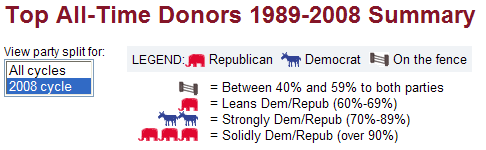
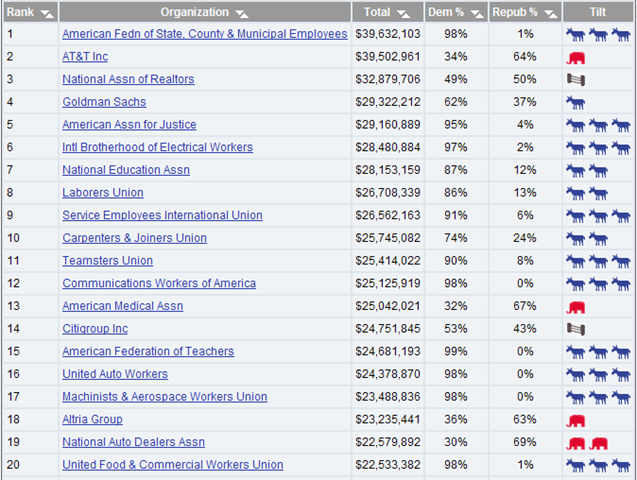
Source: http://www.opensecrets.org/orgs/list.php?order=A

image

image

* * * * *

Worth browsing: Federal Election Campaign Web Site:
 http://www.fec.gov/

* * * *

Want more from the Homa Files?
Click link =>
  The Homa Files Blog

Who would do best job handling the economy?

September 19, 2008

      From Friday’s Diageo-Hotline tracking poll. 

     Who would do best job handling the economy?

Who would do the best job handling the<br /> economy?

* * * * *

Note: This poll is run by an MSB MBA alum

* * * * *

Want more from the Homa Files?
Click link =>
  The Homa Files Blog

Must read: Supporters of both candidates doubt their man is up to the job …

September 19, 2008

Excerpted from WSJ: ” Why It’s Getting Mean”, Peggy Noonan, Sept 19, 2008

* * * * *

My Opinion

This week, a couple of my friends expressed frustration that the financial crisis revealed the obvious —  neither McCain nor Obama — have the slightest clue what’s going on, why it’s going on, and most important, how to fix it.  I’ll bet that a check of their college transcripts shows that neither has even taken Econ 101; their resumes show no business management experience; neither show any instinct for “the game”, neither seem to cope well with complexity and ambiguity.

Peggy Noonan leans right, but is usually pretty balanced (meaning that I often disagree with her).  I think her op-ed really puts a finger on the the pulse.  Highlights below — worth following the link and reading the whole essay.

* * * * *

Article Highlights

The financial crisis changes the entire shape and feel of the presidential election.  It isn’t just bad news; it’s deep bad news that reaches into the heart of widespread national anxiety.

* * * * *
Everyone is afraid—the rich that they will no longer be rich, the poor that they’ll be hit first by the downturn in the “last hired, first fired” sense, the middle class that it will be harder now to maintain their hold on middle-classness

Both the Democrats and the Republicans spent the week treating the catastrophe as a political opportunity. This was unserious. A serious approach might have addressed large questions such as: Was this crisis not, at bottom, a failure of stewardship?

* * * * *
The economic crisis brings a new question, unarticulated so far but there, and I know because when I mention it to people they go off like rockets.

It is: Do you worry that neither of them is up to it? Up to the job in general? Is either Mr. McCain or Mr. Obama actually up to getting us through this and other challenges? I haven’t heard a single person say, “Yes, my guy is the answer.”

* * * * *
The overarching political question: In a time of heightened anxiety, will people inevitably lean toward the older congressional vet, the guy who’s been around forever? Why take a chance on the new, young man at a time of crisis? Wouldn’t that be akin to injecting an unstable element into an unstable environment? There’s a lot at stake.

Or will people have the opposite reaction? I’ve had it, the system has been allowed to corrode and collapse under seven years of Republican stewardship. Throw the bums out. We need change. Obama may not be experienced, but that may help him cut through. He’s not compromised.

* * * * *
A mere hunch in a passing moment: In a time of crisis, confusion and fear, Americans just might, in their practicality, turn back to the old tradition of divided government.

They know the Congress will be Democratic. They assume it will soon be more Democratic. Therefore the president they choose may well be of the other party.

* * * * *
What if neither of them is the right man? What if neither of them is equal to the moment? What if neither party is equal to the moment?

This is not in itself important—who cares what they think, really? But there will be a small impact in terms of tone.

If you are a longtime Obama supporter and are beginning now to admit to deep doubts, you can’t just announce you’ve been wrong for the past year. You’d look like a fool. You cannot speak credibly, or in a way you yourself believe, in rosy support. But what you can do is turn, with new rage, on the guy you’ve at least long opposed. So you ignore Mr. Obama and attack Mr. McCain with new ferocity.

Or, if you have doubts about Mr. McCain, you ignore him and turn your heat on Mr. Obama.

* * * * *

Do you ever have the passing thought that the presidential election doesn’t matter as much as we think?

If you win bad in a 50/50 nation, it makes it really hard to govern. Whoever wins will govern within more of less the same limits, both domestically and internationally.

A New York liberal leaning toward Mr. McCain told me this week he has no fear that Mr. McCain may be a more militant figure than Mr. Obama. We already have two wars, “we’re out of army.” Even if Mr. McCain wanted a war, he said, he couldn’t start one.

I wonder if we follow the election so passionately because we’re afraid. We’re afraid a lot of our national problems are intractable, and the future too full of challenge.

Deep inside we think: Ah, that won’t work either.  We are all making believe this is a life-changing election because we know it’s not a life-changing election.

* * * * *

Full article:
http://online.wsj.com/article/SB122176556077753375.html

* * * * *

Want more from the Homa Files?
Click link =>
  The Homa Files Blog

Slash the Price and Sink the Brand

September 19, 2008

Excerpted from Harvard Business Online, “In A Downturn, Discounts Can Be Dangerous”, by Jeff Stibel, August 21, 2008

* * * * *

Often the first thing companies do during a downturn in the economy is reduce prices on their products and services. While it may be necessary in some cases to reduce prices, discounting has its risks. The biggest risk is that it can create a negative long-term perception of a product and a down-channel effect, ultimately leading to market-share erosion.

And discounting can also be dangerous to low-cost providers not focused on brand. Value-minded consumers have long-term memories and it is hard to retain market-share when the economy recovers and you try to raise your prices or eliminate promotions.

In some cases, it may make sense to buck the trend entirely and increase prices. In fact, many companies are taking this counterintuitive approach. To be sure, many are blaming the cost of commodities and these increases will put a strain on short-term growth. But over the long-run this could build brand value. 

There’s no doubt that discounting and sales promotions are a vital sales technique when done correctly. It inspires excitement and creates a call to action. However, when offered at the wrong times–for no other reason than to boost sales–it can cut the other way and create brand deterioration.

* * * * *

Consumers give you their hard-earned money in return for something that meets or exceeds their perceived value. They want to see value and quality in return for their money.

And studies have shown that in many cases, the more people pay, the more value they ascribe to their purchase. Money plays a funny role in the purchase process: it anchors perceived value. If you discount prices during adverse times, consumers may begin to question the original value.

When you discount, you undo the “placebo effect” of higher prices. And this leads to a decaying belief in the value of the product offered. So it may be short-term thinking to devalue a consumer’s perceived value of a product simply to move more merchandise during shifts in the economy.

* * * * *

There are ways around this, of course. Consider the auto industry, typically the first to discount their way out of economic woes. Chrysler recently did something to preserve their price while offering a discount for something that does not affect their brand: gas. Chrysler cleverly took discounting to the next level by offering up a $2.99 gas guarantee for three years on all new car purchases within its fleet. The idea was to subsidize the fuel that goes into the new car, not the MSRP of the car itself.

* * * * *

Consider the long-term consequences for discounting during a recession and the potential for inadvertently re-positioning your brand. If you must, it may be better to focus on something ancillary rather than what your brand truly represents. Because once that veil is pierced, it may be incredibly difficult to go back and reestablish the value proposition to your consumers.

Edit by DAF

* * * * *

Full Article:
http://discussionleader.hbsp.com/stibel/2008/08/in-a-downturn-discounts-can-be.html

* * * * *

Want more from the Homa Files?
Click link => 
The Homa Files Blog

* * * * *

Don’t know MySpace?

September 19, 2008

Excerpted from MediaPost Publications, “Study: 58% Aren’t Familiar With Social Networking” Sep 5, 2008

* * * * *

Apparently tweeting, friending and linking have not infiltrated popular culture as much as one might think.

A new study from Synovate reveals that well over half (58%) of those surveyed do not know what social networking is. Even more surprising, more than a third of those who do engage are losing interest in it…

The Dutch were most likely to know the term social networking (89%), followed by the Japanese (71%) and Americans (70%).

Popularity of the phenomenon is fading amongst some, according to the study. When asked if they agree with the statement “I am losing interest in online social networking”, 36% of social networkers globally said yes…

The biggest finding, was that social networking is definitely not U.S.-centric. Overall, 26% of all respondents globally are members of social networking sites. This peaked with the Netherlands at 49%, United Arab Emirates (UAE) at 46%, Canada at 44% and the U.S. at 40%…

Edit by SAC

* * * * *

Facebook overcame MySpace this year to become the top social networking site.  According to InternetNews.com, Facebook had 132.1 million unique users in June, while MySpace had 117.6 million.  However, in terms of number of visits and average time spent on the site MySpace bests Facebook.  Which should a marketer prefer?

* * * * *

Full article:
http://www.mediapost.com/publications/?fa=Articles.showArticle&art_aid=89928

* * * * *

Want more from the Homa Files?
 
Click link => 
The Homa Files Blog

Some Simple Arithmetic – Unemployment

September 19, 2008

The “soaring” unemployment rate is about 6%.

There are roughly 225 million adult citizens in the U.S.

So, about 210 million are employed; 15 million aren’t

Frequent reports: 10 to 20 million illegal aliens in the country.

Coincidence?

* * * * *

I know, I know: they’re in crummy jobs that citizens don’t want.

So, 15 million would rather be unemployed ?  Hmmm.

* * * * *

Want more from the Homa Files?
Click link =>
  The Homa Files Blog

Biden: Be a patriot, pay more taxes

September 18, 2008

Excerpted from AP: ” Biden calls paying higher taxes a patriotic act”, September 18, 2008

* * * * *

Democratic vice presidential candidate Joe Biden said Thursday that paying more in taxes is the patriotic thing to do for wealthier Americans. The Republican campaign for president calls the tax increases their Democratic opponents propose “painful” instead of patriotic.

Under the economic plan proposed by Democratic presidential candidate Barack Obama, people earning more than $250,000 a year would pay more in taxes while those earning less — the vast majority of American taxpayers — would receive a tax cut.

Noting that wealthier Americans would indeed pay more, Biden said: “It’s time to be patriotic … time to jump in, time to be part of the deal, time to help get America out of the rut.”

* * * * *
Full article:
ttp://www.realclearpolitics.com/news/ap/politics/2008/Sep/18/biden_calls_paying_higher_taxes_a_patriotic_act.html

* * * * *

Reminder: Boiled down to its essence, Senator Obama’s complicated tax plan reduces to the  redistribution of over $100 billion in income each year by taking an average of about $20,000 in additional annual income taxes from about 5 million people, and redistributing the loot to 200 million others — about $500  per person in annual refundable tax credits.  That’s slightly more than a buck-a-day.

* * * * *

Want more from the Homa Files?
Click link =>
  The Homa Files Blog

Getting Real About Health Care

September 18, 2008

Excerpted from Newsweek: “Getting Real About Health Care
It’s not about coverage. It’s about costs.”, Robert J. Samuelson
Sep 6, 2008

* * * * *

Note: There are roughly 45 million uninsudred people in the U.S.  Approximately 1/3 are not legal citizens; approximately 1/3 are in the top 1/2 of wage earners (i.e. over the $50,000 median); approximately 40% are 19 to 34, relatively healthy and, in effect, choose to self-insure.

* * * * *

Summary; Emphasis should be on fundamental restructuring of costs:     more electronic record-keeping, better case management, fewer dubious tests and procedures (i.e. unnecessary, duplicative), contained end-of-life treatment.

* * * * *

Article

46 million Americans … or almost one in seven lack health insurance.

By impressive majorities, Americans regard this as a moral stain. Sen. Ted Kennedy echoed the view of many that health care is a “right” that demands universal insurance. This is a completely understandable view and one that is, I think, utterly wrong.

* * * * *

Health care should be at the top of the agenda. But the central problem is not improving coverage. It’s controlling costs.

In 1960, health care accounted for $1 of every $20 spent in the U.S. economy; now that’s $1 of every $6, and …  it could be $1 of every $4 by 2025.  Ponder that: a quarter of the U.S. economy devoted to health care.

Countless studies have shown that many diagnostic tests, surgeries and medical devices are either ineffective or unneeded.

Greater health spending should not have the first moral claim on our wealth, because its relentless expansion is slowly crowding out other national needs.

For government, higher health costs threaten other programs—schools, roads, defense, scientific research—and put upward pressure on taxes. For workers, increasingly expensive insurance depresses take-home pay, as employers funnel more compensation dollars into coverage. There’s also a massive and undesirable income transfer from the young to the old, accomplished through taxes and the cross-subsidies of private insurance, because the old are the biggest users of medical care.

* * * * *

It is widely assumed that health care, like most aspects of American life, shamefully shortchanges the poor. This is less true than it seems.

Data show that, on average, annual health spending per person—from all private and government sources—is equal for the poorest and the richest Americans. In 2003, it was $4,477 for the poorest fifth and $4,451 for the richest.

The reason: government already insures more than a quarter of the population, including many of the poor. Medicare covers the elderly; Medicaid, many of the poor and their children; SCHIP (State Children’s Health Insurance Program), more children.

Another reason, stems from the skewing of health spending toward the very sick and dying; 10 percent of patients account for two thirds of spending. People in this unfortunate group, regardless of income, get thrust onto a conveyor belt of costly care: long hospital stays, many tests, therapies and surgeries.

* * * * *

That includes the uninsured. In 2008, their care will cost about $86 billion, … The uninsured pay about $30 billion themselves; the rest is uncompensated.

Of course, no sane person wants to be without health insurance, and the uninsured receive less care and, by some studies, suffer abnormally high death rates. But other studies suggest only minor disadvantages for the uninsured.

* * * * *

We need more realism on health care. The trouble with casting medical-care as a “right” is that this ignores how open-ended the “right” should be and how fulfilling it might compromise other “rights” and needs.

What makes people healthy or unhealthy are personal habits, good or bad (diet, exercise, alcohol and drug use); genetic makeup, lucky or unlucky, and age. Health care, no matter how lavishly provided, can only partially compensate for these individual differences.

* * * * *

There is a basic moral and political dilemma that most Americans refuse to acknowledge. What we all want for ourselves and our families—access to unlimited care paid for by someone else—may be ruinous for us as a society.

Sensible limits must somehow be imposed.

* * * * *

The crying need now is not to insure all the uninsured. This would be expensive (an additional $123 billion a year, estimates the Kaiser study) and would provide modest health gains at best since 40% of the uninsured are young (19 to 34) and relatively healthy.

The compelling need now is to limit the runaway increases in spending that make private and government insurance more expensive and may not deliver significant health improvements.

* * * * *

Both McCain and Obama have health-care proposals that …  largely ignore the massive health-care challenge already sitting in the government’s lap: Medicare.

By some studies, 30 percent of Medicare spending may go to unneeded services that do not enhance recipients’ well-being.

Medicare is so large and influential that by altering how it operates, government can reshape the entire health-care system. This would require changes in rules and reimbursements to encourage more electronic record-keeping, better case management, fewer dubious tests and procedures, and a fairer sharing of costs between the young and the old.

The work would be unglamorous and probably unpopular. But if the next president won’t—or can’t—do it, his presidency will fail in one fateful way.

* * * * *

Full article:
http://www.newsweek.com/id/157573

* * * * *

Want more from the Homa Files?
Click link =>
  The Homa Files Blog

Strategy: Lessons from Obama’s Campaign

September 18, 2008

Excerpted from MSNBC: Obama’s woes have nothing to do with ‘lipstick’, by Howard Fineman,  Sept. 10, 2008

* * * * *

Note: Fineman is a left-leaning political commentator. I thought this piece was an interesting strategic analysis.   Try to put the politics aside — whether you agree or disagree — and pull out the strategy lessons.

* * * * *

For two years, Obama played the golf course of presidential politics with the ice-cold self-assuredness of a Tiger Woods. But since securing the Democratic nomination, he’s made a series of strategic errors that could jeopardize his chances in November.

Here’s my list of his errant shots:

Declining to take federal financing for the general election
This mistake is multi-pronged. Obama stands accused of flip-flopping … appears to have ceded some higher ground to McCain, who, with his public funding, appears slightly more immune to interest groups …  will have to leave the campaign trail more often to headline fundraising events.

Declining McCain’s offer to hold ten town hall debates
When Obama was leading the race in leaps and bounds, he blew off this GOP proposal. Too bad. Had Obama locked in that deal, he would now be able to confront McCain face-to-face about some of the Republicans’ more aggressive … claims.

Failing to go all the way with the Clintons
I know, the Clintons are difficult to deal with and probably hope Obama fails.  They are not eager to do so, but it was still Obama’s task to trap them into displays of political enthusiasm. Obama also neglected to court Clinton fundraisers and supporters in places like Los Angeles. 

The 22-state strategy
For months, the Obama campaign invested advertising time and organizing money in an impressive array of red states that haven’t been on the Democrats’ radar in recent elections … for the most part, it was a waste of assets … He’d be more successful focusing on traditional battlegrounds.

Failing to state a sweeping, but concrete, policy idea
It is not enough to be for change – everybody is, or is trying to be. To make it stick, Obama needed, and needs, to put forth an easy-to-grasp grand proposal, one that would encapsulate what his central message … Instead, he’s got more of a laundry list than an actual rallying cry.

Remaining trapped in professor-observer speak
When you listen to Obama, it sometimes feels like you’re hearing a smart but distant analysis of the political scene. He sounds like a writer or teacher, but not the leader of a political crusade … Voters want an action plan, not an exegesis.

Failing to attack McCain early
Obama was wary of attacking a man who had suffered so much during the Vietnam War – an understandable emotion. But that wariness, combined with Obama’s natural inclination to be seen as the nice guy (one who lets others do the knifing) lead to an unfortunate result. It gave two free months for McCain to build up a head of steam as a war hero, as opposed to … a man beholden to corporate interests and a likely clone of George W. Bush. 

* * * * *

I would be worried that his mistakes have a common thread – pride.

Obama seems to want to do things on his own, and on his own terms. It’s understandable. Obama has his own crowd – from Chicago, from Harvard, and from a new cadre of wealthy, Ivy-educated movers and shakers.

“He’s an arrogant S.O.B.,” one of the latter told me today. “He wants to do it his way, and his way alone.” But politics doesn’t work that way.

* * * * *

Full article:
http://www.msnbc.msn.com/id/26640489/

* * * * *

Want more from the Homa Files?
Click link =>
  The Homa Files Blog

Gimme a break: An AIG winner …

September 18, 2008

American International Group said it paid a $47 million severance package to former Chief Executive Martin J. Sullivan, who “resigned”.

Sullivan, left his position in mid-June after two quarters of record losses at AIG, will receive severance of $15 million, and a bonus of $4 million for the portion of the year he worked, according to a regulatory filing.

Sullivan also will hold on to outstanding equity and long-term cash awards valued at about $28 million, the filing said.

Reference:
http://clipmarks.com/clipmark/C85E7BC6-2172-46E7-B07E-5412446AB182/

* * * * *

Want more from the Homa Files?
Click link =>
  The Homa Files Blog

Tapping the wisdom of workers …

September 18, 2008

Excerpted from WSJ: “Best Buy Taps ‘Prediction Market’- Imaginary Stocks Let Workers Forecast Whether Retailer’s Plans Will Meet Goals”, Sept. 16, 2008

* * * * *

When executives at electronics retailer Best Buy  want to know if a new product or idea is likely to succeed, they can seek the opinion of rank-and-file employees by turning to the company’s “prediction market.”

The market, called TagTrade, allows Best Buy’s workers to trade imaginary stocks based on answers to managers’ questions. The market’s judgment has often proved to be more accurate than the company’s official forecasts.

Associated PressTagTrade is open to all of Best Buy’s 115,000 U.S. employees. The roughly 2,100 of them who choose to participate get $1 million in fake money to trade for a nine-month period. The top trader in the period wins a $200 gift certificate.

* * * * *

Best Buy isn’t the only company using prediction markets as a way to tap the knowledge of front-line employees. Web-search giant Google Inc. uses them to solicit forecasts on everything from how many users its Gmail service will attract to whether products will launch on time. Other companies that have experimented with them include General Electric,Intel Corp. and Microsoft.

Best Buy’s chief executive, Bradbury Anderson, …  drives decision-making down the corporate ladder and information up toward the top. Mr. Anderson says narrowing the gap between management and workers helps to make his company more nimble and responsive to customers, while boosting sales and profits.

* * * * *

Full article:
http://online.wsj.com/article/SB122152452811139909.html#printMode

* * * * *

Want more from the Homa Files?
Click link =>
  The Homa Files Blog

Lessons from the financial crisis

September 17, 2008

Excerpted from WSJ: “We Need Better-Capitalized Institutions”, Sept. 17, 2008

* * * * *

That which does not kill us makes us stronger. Nietzsche may not have been aware of credit default swaps and subprime mortgages when he formulated that worldview, but so it will be with the current crisis. Like the 12 steps of recovery, the financial system is now purging itself of years of excess. How sad that it should have to come at such enormous human and institutional cost.

* * * * *
Important Lessons

First, these losses were foremost a consequence of poor investment decisions. These decisions, driven by a virulent new strain of irrational exuberance, caused theoretically highly sophisticated firms to put hundreds of billions of dollars of poorly conceived and inadequately collateralized securities onto their balance sheets.

In a sense, that’s no different than other bouts of investing euphoria that ended badly, like the dot-com bubble. So for investors, this episode is an important reminder to stay true to conviction rooted in dispassionate analysis and avoid being swept along with the hype, even when it seems painful to watch others making money that you’re not.

* * * * *
Second, risk management was equally poor. These financial institutions are (or were) in many ways giant hedge funds, except that they used far more leverage than almost any hedge fund (and made worse investments).

Stunningly, even with all the warning signs, the most fragile institutions shirked from sufficiently tough medicine — taking in ample new capital, selling off divisions, even merging their firms — that might have preserved value for their shareholders.

* * * * *
Third, the systemic failure extended far beyond government oversight. Apart from experienced and highly paid in-house management, these institutions were each watched over by a flotilla of outside auditors, credit and equity analysts, and rating agencies. Virtually none of them accurately gauged the dangers.

* * * * *

The market is loudly signaling that it wants larger, better-capitalized financial institutions. Even the vaunted Goldman Sachs and the venerable Morgan Stanley may prove too small to remain independent.

For those which emerge, both management and oversight will need to be far tighter. That will be reinforced by a dramatically changed business model.

Instead of highly leveraged banks providing a commodity — money — at razor thin margins, we will have less leveraged institutions providing a scarce resource — money — at more profitable pricing.

* * * * *

Full article:
http://online.wsj.com/article/SB122161101467645853.html

* * * * *

Want more from the Homa Files?
Click link =>
  The Homa Files Blog

Taxes: Playing small ball (very small ball)

September 17, 2008

Boiled down to its essence, Senator Obama’s complicated tax plan reduces to the  redistribution of over $100 billion in income each year by taking an average of about $20,000 in additional annual income taxes from about 5 million people, and redistributing the loot to 200 million others — about $500  per person in annual refundable tax credits.

Momentarily tabling the philosophical aspects of the redistribution plan,  I have a practical question: is the pain worth the gain?

* * * * *

A noticeable difference ?

The $500 may give some psychological reassurance that Uncle Sam cares, but will it materially change anybody’s life or lifestyle?

The simple arithmetic: $500 works out to be less than $10 per week, a little over $1 per day, and about 25 cents per hour worked for a  full-time worker.  Hardly a life- or game-changer.

* * * * *

95% get tax relief.  Really ?

Obama says that 95% of voters will get tax relief under his program.

Huh? Right now, 40% of adults have zero tax liability or qualify for a refundable credit (i.e. a negative income tax).  Since these folks aren’t paying income taxes now, they certainly aren’t getting income tax relief.

So, they must be getting payroll tax relief — an offset to their Social Security and Medicare contributions — in effect, making the first $6,500 of wages payroll tax free.  (Note: employers would still have to pay their 7.65% on those wages)

But, about about half of the 40% who don’t pay income taxes have no reportable income.  For these folks, there’s either no tax relief at all and Obama’s claim is overstated.  Or, their refundable tax credit will be even less than the $1 per day.

* * * * *

Or is it 25 cents per day ?

Reports indicate that the majority or recent Economic Stimulus payments were used to pay off consumers’ debts.  That’s legit, but what’s the impact? 

Well, assuming that the money  paid down a high interest credit card balance, paying off $500 would save about $100 per year in interest charges —  adding about 25 cents per day to the spending pot.  Not exactly a game-changer.

* * * * *

Bottom line: Obama’s income redistribution scheme may be well intended.  But, it sure doesn’t seem (to me) like the pain is worth the gain.

* * * * *

Want more from the Homa Files?
Click link =>
  The Homa Files Blog

* * * * *

The sky is falling … or is it ?

September 17, 2008

Excerpted from Washington Post: “Quit Doling Out That Bad-Economy Line”,  Donald Luskin, September 14, 2008

* * * * *

In the past two months, the Post alone has written no fewer than nine times, in news stories, columns and op-eds, that key elements of the economy are the worst they’ve been “since the Great Depression.”

That diagnosis has been applied twice to the housing “slump” and once to the housing “crisis,” to the “severe” decline in home prices, to the “spike” in mortgage foreclosures, to the “change” in the mortgage market and the “turmoil” in debt markets, and to the “crisis” or “meltdown” in financial markets.

* * * * *

Overall, the pessimists are up against an insurmountable reality: In the last reported quarter, the U.S. economy grew at an annual rate of 3.3 percent, adjusted for inflation. That’s virtually the same as the 3.4 percent average growth rate since — yes — the Great Depression.

* * * * * 

Why, then, does the public appear to agree with the media? A recent Zogby poll shows that 66 percent of likely voters believe that “the entire world is either now locked in a global economic recession or soon will be.” Actually, that’s a major clue to what started this thought-contagion about everything being the worst it has been “since the Great Depression”: Politics.

* * * * *

The Mortgage Bankers Association (MBA) database, which allows rigorous apples-to-apples comparisons, only goes back to 1979. It shows that today’s delinquency rate is only a little higher than the level seen in 1985.

According to the MBA, 6.4 percent of mortgages are delinquent to some extent, and 2.75 percent are in foreclosure.

Moreover, MBA data show that today’s foreclosures are concentrated in that small fraction of U.S. homes financed by subprime mortgages. Such homes make up only 12 percent of all mortgages, yet account for 52 percent of foreclosures.

* * * * * *

It is flat-out wrong … that “the personal savings rate is now the lowest it’s been since the Great Depression.” The latest rate, for the second quarter of 2008, is 2.6 percent — higher than the 1.9 percent rate that prevailed in the last quarter of Bill Clinton’s presidency.

* * * * *

According to the latest report from the National Association of Realtors, the median price of an existing home is up 8.5 percent from the low of last February.

And according to the U.S. Census Bureau, the median price of a new home is up 1.3 percent from the low of last December. Home prices may not be at all-time highs — and there are pockets of continuing decline in some urban areas — but overall they’ve clearly stopped going down and have started to recover.

* * * * *

According to the FDIC, there have been a total of 13 bank failures in 2007 and so far into 2008. There were 15 in 1999-2000, the climax of the celebrated era of Clintonian prosperity. And in recession-free 1988-89, there were 1,004 failures — almost an order of magnitude more than today. Since the Great Depression, the average number of bank failures each year has been 94.

* * * * *

From all-time highs last October, the S&P 500 has fallen 20 percent. But that’s nothing by historical standards. Stocks have often fallen more than that over comparable spans of time. Even the present 20-percent loss isn’t what it seems. The damage has been heavily concentrated in the financial sector — banks, investment firms and mortgage companies. If you exclude the financial sector, stocks are off 14.8 percent.

* * * * *

Whatever the political outcome this year, hopefully this will prove to be yet another instance of that iron law of economics and markets: The sentiment of the majority is always wrong at key turning points. And the majority is plenty pessimistic right now. That suggests that we’re on the brink not of recession, but of accelerating prosperity.

Full articel:
http://www.washingtonpost.com/wp-dyn/content/article/2008/09/12/AR2008091202415_pf.html

* * * * *

Want more from the Homa Files?
Click link =>
  The Homa Files Blog

Clorox: Certified “Natural”

September 17, 2008

Excerpt from WSJ “Beauty Game: Being Viewed as Natural” September 10, 2008 

Proving that your brand is more authentic than the competition’s is always difficult for marketers.

For the increasingly crowded category of “natural” beauty products, that task is particularly challenging. That’s why Burt’s Bees, owned by Clorox Co., and a handful of other brands that try to minimize their use of synthetic ingredients have developed a certification process by which they can officially claim their right to call their products “natural.”

In August, Burt’s Bees products…began hitting store shelves affixed with a Natural Products Association seal. The sticker promises that at least 95% of ingredients are natural or derived from natural sources, that they have no “potential suspected human health risks” and that development processes haven’t significantly altered the effect of the natural ingredients, among other criteria.

Mike Indursky, Burt’s Bees’ marketing chief, led the brand’s involvement in the certification…Below, he discusses shoppers’ confusion with natural products..

WSJ: Why does Burt’s Bees need its naturalness certified?

Mr. Indursky: …97% of women told us they want some sort of regulation. We felt we had a responsibility to explain to people what natural is, and what natural isn’t, so they can make the most informed choice. We worked with the Natural Products Association and our competitors to develop the criteria.

WSJ: Since the standards are devised by the participating companies rather than a government agency, isn’t there a risk that this seal could be perceived as even more marketing hype?

Mr. Indursky: That would be risky if it weren’t for the National Product Association’s leadership over it, and their use of third-party certifiers. The brands have no inclusion over the certification process.

WSJ: As a marketer, how do you balance your brand’s natural stance with your parent-company’s brand, which is synonymous with bleach?

Mr. Indursky: There’s nothing to balance. Burt’s Bees is doing what it has always done, regardless of Clorox owning us. Clorox has been a fantastic supporter of ours, and our levels of sustainability and natural ingredients have only increased since we’ve been acquired.

Edit by SAC

* * * * *

Savvy consumers are likely to be skeptical of companies that create their own certification programs.  One also has to wonder if consumers recognize the stark differences between brand ideologies within a company such as Clorox.  Unilever has received criticism for the opposing ideologies of two of its brands, Axe deodorant spray and Dove.  Clorox also owns “Green Works,” a line of environmentally friendly cleaning products. Both Burt’s Bees and Green Works offer brand promises of green and natural, while the Clorox namesake represents bleach, chemicals and environmental harm. 

* * * * *
Full article:
http://online.wsj.com/article/SB122099934231816811.html?mod=todays_us_marketplace

* * * * *

Want more from the Homa Files?
Click link =>
The Homa Files Blog

Brands – The Power of Authenticity

September 17, 2008

Excerpted from Fast Company, “Who Do You Love”, Dec. 19, 2007

Juan Valdez … the fictional coffee-growing icon … has been featured in ads for decades, helping establish “100% Colombian coffee” as a global brand.

Juan’s appeal: humble but uncompromising, dedicated to the hard work of raising coffee by hand. “Juan Valdez taps into a fundamental human truth … that the things we savor the most are the hardest earned.” People emotionally connect with Juan because he seems authentic, and authenticity is a priceless commodity.

In an increasingly shiny, fabricated world of spun messages and concocted experiences … “Authenticity is the benchmark against which all brands are now judged. ”

Overloaded by sales pitches, consumers are gravitating toward brands that they sense are true and genuine. Hunger for the authentic is all around us. You can see it in the way millions are drawn to mission-driven products like organic foods.

Playing the authenticity game in a sophisticated way has become a requirement for every marketer, because the opposite of real isn’t fake–it’s cynicism. When a brand asserts authenticity in a clumsy way, it quickly breeds distrust or, at the very least, disinterest.

Each brand must build its own primary source code for the authentic. Still, there are some larger lessons (and pitfalls) that anyone charged with overseeing a brand would be wise to consider.

* * * * *

What does it take to be authentic?

It is a brand’s values — the emotional connection it makes — that truly define its realism.

A strong point of view. Authenticity emerges from “people with a deep passion for what they are doing.” So Martha Stewart is perceived to be authentic in large part because her ambitious recipes for Perfect White Cake and Chocolate-Strawberry Heart-Shaped Ice-Cream Sandwiches stand in the face of a world where food is mass-produced and preparation for the average dinner is measured by the number of minutes it takes to microwave the thing.

Serving a larger purpose. Every brand is governed by an ulterior motive: to sell something. But if a brand can convincingly argue that its profit-making is only a by-product of a larger purpose, authenticity sets in. “Just as there are purpose-driven lives … there are purpose-driven brands.” (Think Whole Foods)  “When a brand changes its story to better capture its customers’ dollars, it’s basically a poser … and people sense that right away.”

Integrity. Authenticity comes to a brand that is what it says it is. In other words, “the story that the brand tells through its actions aligns with the story it tells through its communications,” posts about Wal-Mart, the deception elicited a torrent of rebuke.

* * * * *

How do you stay authentic even as you get big?

Ubiquity might not be toxic to authenticity, but it certainly dilutes it. When a brand spreads far beyond its home turf, its branches almost invariably (though not inevitably) weaken.

No business has confronted this challenge more urgently than Starbucks. As chairman Howard Schultz lamented to upper management in a bluntly worded missive on Valentine’s Day, the company’s rapid growth has “led to the watering down of the Starbucks experience,” and the company’s stores “no longer have the soul of the past.” .”

* * * * *

Can you be authentic when you’re trying to be authentic?

Authenticity is necessary, but it cannot be compelled. Coerced by corporate fiat, their “warmth” can wear out its welcome and feel contrived. 

And therein lies an authentic paradox: A brand doesn’t feel real when it overtly tries to make itself real. To the hypertargeted consumer, baldly billboarding a brand’s message smacks of insincerity.

* * * * *

Can you be cool and still be authentic?

“Fortress brands” are deeply rooted in their heritage and values, they are inflexible, unmovable, and ultimately stuck in time. “That’s the problem with a dogmatic, static brand … the competition will outflank it, and the world will pass it by.”

Levi’s, for one, is a brand that appears to have slipped into the fortress category. The king of denim, whose founder stitched and riveted the world’s first pair of jeans in 1873, has lately missed out on the fast-changing trends of an industry that it created.

To maintain its integrity, a brand must remain true to its values. And yet, to be relevant–or cool–a brand must be as dynamic as change itself. An authentic brand reconciles those two conflicting impulses, finding ways to be original within the context of its history.

* * * * *
Full article:
http://www.fastcompany.com/magazine/115/features-who-do-you-love.html

* * * * *

Want more from the Homa Files?
Click link =>
  The Homa Files Blog

* * * * *

Uh Oh – Higher text message prices …

September 17, 2008

Excerpted from AP:  “Senator examining rising text messaging rates
09.09.08

The Senate Judiciary Committee is asking the nation’s top four wireless carriers to justify the “sharply rising rates” they charge people to send and receive text messages … it is concerned that rising text messaging rates reflect decreasing competition in the wireless business.

(Reportedly) consumers are paying more than 20 cents per message, up from 10 cents in 2005.

All four of the (wireless) companies appear to have adopted identical price increases at nearly the same time. “This conduct is hardly consistent with the vigorous price competition we hope to see in a competitive marketplace”.

* * * * *

European Commission regulators are threatening to impose a cap on roaming fees for text messages sent by Europeans traveling outside of their home nations.

* * * * *
Full article:
http://www.forbes.com/feeds/ap/2008/09/09/ap5405763.html?partner=alerts

* * * * *

Want more from the Homa Files?
Click link =>
  The Homa Files Blog

Models Caught with Cookies

September 17, 2008

Excerpt from BrandWeek “Cookie, Toothbrush Invade Fashion Week” September 8, 2008

You expect to see MAC or Tresemme at Fashion Week, but a Kraft cookie brand?

You won’t see Kraft’s Le Petit Ecolier school boy cookie doing his thing on the runway, but the food giant will offer complimentary samples of the sweet to visitors inside its LU Lounge during Fashion Week…Kraft sees the event, known for its stick-thin models, as the perfect venue to publicize its premium biscuit line.

Kraft isn’t the only brand that has a tenuous link to the industry to glom onto Fashion Week. DHL, American Express and T-Mobile all have sponsorship stakes in this year’s Mercedes-Benz Fashion Week…

Procter & Gamble…is taking both its Tide and Oral-B brands straight to the catwalk…Models wearing clothes washed several times with the new Tide Total Care line walk the runway this morning; and tomorrow, Dash/Smooch presents its latest pajama collection in conjunction with P&G’s new slim, rechargeable Oral-B Pulsonic toothbrush…

The presence of such supermarket-friendly brands makes Fashion Week look increasingly accessible. Critics say that could pose a problem…

Many brands see the event as a way to bask in the glamorous halo of New York’s premiere fashion event. In the case of Tide, P&G is trying to use the brand’s new Total Care line as a crossover from “fabric care to fashion care,” said company rep Kash Shaikh… Oral-B, on the other hand, is going after the consumer who wants a toothbrush that not only delivers whiter teeth, but is aesthetically appealing as well.

Evian was among the first brands outside the rag trade to see Fashion Week’s potential. Evian has been the event’s bottled spring water of record for 10 years straight (1993-2003). After a five-year hiatus…Evian reemerged as the venue’s official H2O sponsor this year. 

Edit by SAC
* * * * *

As if the Kraft cookies weren’t enough, the Oral-B runway placement included models carrying toothbrushes down the catwalk and then pretending to brush their teach as they danced next to backup singers that performed during the show.  An equally odd pairing between McDonalds & the Olympics helped increase McDonald chicken sandwich sales this summer. Maybe models carrying chicken nuggets is the next unlikely pairing we’ll see on the runway.

* * * * * 
Full article:
http://www.brandweek.com/bw/content_display/news-and-features/packaged-goods/e3i8f41b4ad7b54e9000311387db21d1441?imw=Y

* * * * *

Want more from the Homa Files?
Click link =>
The Homa Files Blog

Economics: The high cost of CAFE …

September 17, 2008

Excerpted from the WSJ: “How to Save Detroit … And $50 Billion”, by Holman Jenkins, September 10, 2008

* * * * *

The Detroit auto makers were all over the two conventions … with  a plea for $50 billion in federal loans. Congress practically owes us this money, Ford, GM and Chrysler argue — because Congress slammed us with new fuel mileage mandates that will cost us $100 billion to meet.

But before rushing to pass the legislation, there’s an easy way to save $50 billion or whatever part of these loans wouldn’t be paid back: Just repeal the fuel economy rules.

It must infuriate the auto makers how readily their critics attribute their problems to their own incompetence. Then how to explain that GM is thriving in Europe, selling small cars that get lots of miles per gallon? Buick is among the biggest selling brands in China. GM is running away with Latin America.

The Big Three’s problem, to be blunt, is North America. They should have pulled out long ago.

* * * * *

Not only did history saddle them with a UAW labor monopoly that their foreign competitors have managed to avoid. Even that might not have been fatal had Congress not enacted its “corporate average fuel economy” rules in the 1970s.

Look at gallons consumed, miles driven, barrels imported or emissions emitted: CAFE has had no significant impact on energy consumption. Its sole practical effect has been to inflict on Detroit the need to produce, with high-cost U.S. labor, millions of small cars designed to lose money.

* * * * *

CAFE has to be the most perverse exercise in product regulation in industrial history. It confronted the Big Three with the choice only of whether to lose a lot of money, by matching Toyota and Honda on quality and features; or somewhat less money, by scrimping on quality and features and discounting, discounting, discounting.

Rationally, they scrimped — and still live under a reputational cloud in the eyes of sedan buyers. Yet notice that their profitable product lines, in which they invest to be truly competitive — such as SUVs, pickups and minivans — hold their own against the Japanese and command real loyalty among U.S. consumers.

* * * * *

It flies in the face of human and business realities to imagine that, generation after generation, Detroit hired idiots while Toyota recruited geniuses — though that’s the usual explanation of Detroit’s troubles.

Had CAFE not existed, there is no reason the Big Three today could not be competitive. As businesses do, they would have allocated capital to products capable of recovering their costs. Investments in fuel efficiency would still have taken place — to the extent consumers valued those investments. That is, if they were profitable.

* * * * *

If Washington found this unsatisfactory, it could have done as the Europeans do and raised fuel taxes to coax the public to make different choices. Politically inexpedient? Well, yes, but that doesn’t mean CAFE is an effective substitute. It isn’t and never was.

* * * * *

Having squandered the domestic auto industry’s capital on millions and millions of cars that lost money, now Congress will squander the taxpayer’s capital. It will lend the auto makers $50 billion to invest in fuel efficiency innovations that, by definition, won’t command from car shoppers a price high enough to cover the cost of making them. Which makes it very unlikely we will get the $50 billion back.

Bottom line: Fifty billion won’t turn CAFE into effective policy. It will do just fine, though, as an indicator of Washington’s willingness to throw good money after bad rather than admit the folly of its own long-running handiwork.

* * * * *
Full article:
http://online.wsj.com/article/SB122100316976917063.html?mod=todays_columnists

* * * * *

Want more from the Homa Files?
Click link =>
  The Homa Files Blog

Median income for intact families at all time high …

September 16, 2008

Excerpted from WSJ: “New Evidence on Taxes and Income”, ARTHUR  LAFFER and STEPHEN MOORE, September 15, 2008

* * * * *

The new Census Bureau data on income and poverty reveal that many of the economic trends in this country are a lot more favorable than America’s detractors seems to think.

In 2007, overall real median family income increased to $50,233, up $600 from 2006. The real median income for intact families — mother and father in the home — rose to $78,000, an all-time high.

* * * * * 

Although incomes fell sharply in the U.S. after the dot-com bubble burst in 2000 (and still haven’t fully recovered), these latest statistics reflect a 25-year trend of upward economic mobility.

To be sure, there has been a massive amount of wealth created in America over the last 25 years. But tax rates were cut dramatically across the income spectrum, for rich and poor alike. The results?

When all sources of income are included — wages, salaries, realized capital gains, dividends, business income and government benefits — and taxes paid are deducted, households in the lowest income quintile saw a roughly 25% increase in their living standards from 1983 to 2005.  This fact alone refutes the notion that the poor are getting poorer. They are not.

* * * * *

Income gains over the last 30 years have been systematically understated due to several factors. These include:

– Fall in people per household. The gains in household income undercount the actual gains per person, because the average number of people living in low-income households has been shrinking. On a per capita basis, the real income gain for low-income households was 44% from 1983 to 2005, about 22% from 1983 to 1992 and about 18% from 1992 to 2002. These are excellent numbers by any measure.

– Earned income tax credit effect. The Earned Income Tax Credit (EITC) is a government payment to low income people who work. Over time the EITC has multiplied the number of poor households that fill out tax forms each year and are thus counted in government income statistics. That’s because to be eligible to receive the refundable EITC, a tax return must be filed.

– We are now statistically counting more poorer families today than we used to. This is a major reason that median and poor household income gains appear to be a lot smaller than they have been in reality. Official tax return data show that in 1983, 19% of returns had zero tax liability; that percentage has climbed steadily, reaching 33% in 2005. (The Tax Policy Center estimates that in 2008 nearly 40% of filers will have no income tax liability.)

– Income mobility. In the U.S., people who had low incomes in 1983 didn’t necessarily have incomes as low a decade later. People in this country have long moved up over time, and this income mobility continues to be true. While some people do remain in the lowest income group, they are the exception.

* * * * *

What is also striking about the data is that the poor today are, in general, not the same people who were poor even a few years ago.

For example, the new Census data find that only 3% of Americans are “chronically” poor, which the Census Bureau defines as being in poverty for three years or more. Many of the people in the bottom quintile of income earners in any one year are new entrants to the labor force or those who are leaving the labor force.

* * * * *

America is still an opportunity society where talent and hard work can (almost always) overcome one’s position at birth or at any point in time. Perhaps the best piece of news in this regard is the reduction in gaps between earnings of men and women, and between blacks and whites over the last 25 years.

Census Bureau data of real income gains from 1980 to 2005 show the rise in incomes based on gender and race. White males have had the smallest gains in income (up 9%), while black females have had by far the largest increase in income (up 79%). White females were up 74% and black males were up 34%. Income gaps within groups are rising, but the gaps among groups are declining.

* * * * *

The evidence is plain that all groups across the income distribution have made solid gains during the last generation.

* * * * *

Full article:
http://online.wsj.com/article_print/SB122143692536934297.html

* * * * *

Want more from the Homa Files?
Click link =>
  The Homa Files Blog

This picture says at least 1,000 words.

September 16, 2008

This one should have been easy to call …

image 

Great analysis from SMH

* * * * *

Want more from the Homa Files?
Click link =>
  The Homa Files Blog

Dumb & Dumber … and campaign implications

September 16, 2008

The facts

Approximately 1/3 of people approve of the job that Bush is doing.

Only 1/5 of people think approve of the job that Congress is doing.

* * * * *

Question:
Why has McCain become competitive (or arguable gained a lead) in the presidential race ?

Hypothesis:
Bush’s 33% approval rating is usually mocked as overwhelming evidence of his failure as President

Adopting a “glass 1/3 full” perspective, these folks agree with Bush’s policies but may have considered McCain to be off-the -reservation.  Adding Palin to the ticket recast McCain as back on-the-reservation to this 1/3 voting block.  In other words, McCain recaptured the base.

But, McCain distances himself from Bush, claiming that he’ll maintain the “good” from Bush (e.g. low taxes, security) and  fix the “bad” (e.g. spending like a drunken sailor, cronyism, secrecy).  That appeals to folks who disapprove of Bush but don’t want to throw out the baby with the bath water.

* * * * *

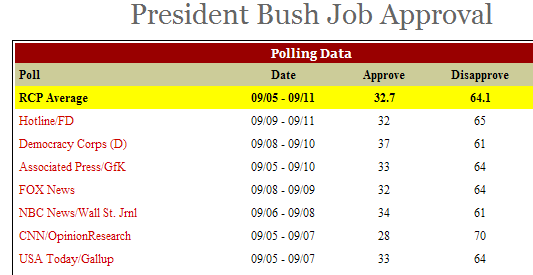
Approximately 1/3 of people approve of the job that Bush is doing. 

image 
http://www.realclearpolitics.com/epolls/other/president_bush_job_approval-904.html#polls

* * * * *

Only 1/5 of people think approve of the job that Congress is doing.

w7oqqv

The last time the yearly average for approval of Congress approached this low a level was in 2006, when the Republicans lost majority control of Congress.

The previous occasion was in 1994, when the Republicans wrested control from the Democrats.

In both of these midterm election years, the average congressional approval score was 25%.

However, with an 18% approval rating for Congress in 1992, the Democrats succeeded in holding their majority in Congress. That was a presidential year in which the Democratic candidate, Bill Clinton, won.

Gallup: “Battle for Congress Suddenly Looks Competitive”, September 12, 2008

http://www.gallup.com/poll/110263/Battle-Congress-Suddenly-Looks-Competitive.aspx

* * * * *

Want more from the Homa Files?
Click link =>
  The Homa Files Blog

Many Companies All A-"Twitter"

September 16, 2008

Excerpted from Business Week, “How Companies Use Twitter To Bolster Their Brands”, by Rachel Kin, September 6, 2008

* * * * *

A growing number of companies are keeping track of what’s said about their brands on Twitter . . . using Twitter to do everything from burnish brands to provide customer service. The attention to Twitter reflects the power of new social media tools in letting consumers shape public discussion over brands.

* * * * *

Begun in 2006, Twitter is a pioneer of microblogging, a way for users to keep others informed of their current status by way of text messaging, instant messaging, e-mail, or the Web. While Twitter doesn’t release exact numbers, estimates range from 1 million to 3 million users.

It’s not just audience size that draws brands. People who use the site are likely to hold sway over others. A single Twitter message—known informally as a tweet—sent in frustration over a product or a service’s performance can be read by hundreds or thousands of people. Similarly, positive interaction with a representative of the manufacturer or service provider can help change an influencer’s perspective for the better.

* * * * *

In a July 2008 report, Gartner added microblogging to its list of technologies that will transform business over the next two to five years.

Edit by DAF

* * * * *

Full Article:
http://www.businessweek.com/print/technology/content/sep2008/tc2008095_320491.htm

* * * * *

Want more from the Homa Files?
 
Click link => 
The Homa Files Blog

Marketing: Perspective’s from PepsiCo’s CEO

September 16, 2008

Excerped from WSJ: “PepsiCo CEO Adapts to Tough Climate”,  September 11, 2008

* * * * *

Indra Nooyi, PepsiCo chairman and chief executive, is steering the snack and beverage giant through its biggest challenges in nearly a decade.

Tough economic times are pummeling beverage sales in the U.S., Pepsi’s biggest market. Grain, vegetable-oil and other commodity prices have climbed. Rival Coca-Cola  is out to grab market share from Pepsi in juices and other noncarbonated drinks. .

* * * * *
Indra Nooyi took the helm of PepsiCo in 2006.   She was a major force behind Pepsi’s decision to spin off its Pizza Hut, Taco Bell and KFC restaurants and buy Tropicana, Quaker Oats and other makers of healthy drinks and snacks. Broadening its portfolio has allowed Pepsi to take the lead in the U.S. in the beverages that are growing the fastest: juices, flavored and bottled waters, teas and other drinks.

* * * * *

In an interview, Ms. Nooyi talked about managing in a volatile economic climate while expanding around the globe.

WSJ: Why are beverages being hit harder than snacks by the economic slowdown?

Ms. Nooyi: Beverages are a much more penetrated category … a lot of wastage … people unscrewed their bottle and didn’t finish it all. Now they’re carrying the bottle longer and finishing the beverage.

We haven’t seen this kind of slowdown in convenience-store traffic in 25 years. What you get is the consumer who walks in and picks up a bag of Doritos but can do without the [drink].

* * * * *

WSJ: What can be done to keep beverage sales from slipping further in this economy, and to revive consumer interest in soda?

Ms. Nooyi: You really have to segment your portfolio very, very carefully. You want targeted innovation that grabs the consumer and gives people a reason to buy.

People still love bubbles. We have to give people a reason to come back to cola. We’ve got to romance them.

* * * * *

WSJ: Is PepsiCo international enough?

Ms. Nooyi: Forty percent of our revenue comes from international. Most of our growth is coming from international.  We know that a lot of the growth potential is overseas, and we are going after it aggressively.

* * * * *

WSJ: Do you want to unseat Coke in international beverage sales?

Ms. Nooyi: In the Middle East and parts of Asia, where we are strong, we want to remain very, very strong. Where the market growth is spectacular like China, India, Russia, we are going to keep investing so that when the music stops we have a great shot at being up there as the leader. And then in all the other markets, we want to play the noncarbonated game aggressively.

* * * * *

WSJ: You have talked about tackling obesity. Some people would say it’s insincere or hypocritical for the chairman of a company whose biggest products include Pepsi-Cola, Lay’s and Doritos to do that.

Ms. Nooyi: Why should they think I am being insincere or hypocritical? There is a place for Pepsi, because it tastes great. Potato chips are part of the American diet.

I am extremely proud of our track record. Name me one other company that took out trans fats from all its products without increasing the price of its products — four or five years before anyone else. We’re doing everything possible to shift our portfolio to “better for you” or “good for you” products.

* * * * *

WSJ: Gatorade lost some share last year, and you changed the brand’s management team. How’s it doing now?

Ms. Nooyi: Brands go through ups and downs. Gatorade is an extremely strong brand. I think every five or seven years, you’ve got to change out the approach to the brand, because you need a new boost of energy to think about the next iteration. Brands never die. You only stop reinventing them.

* * * * *

WSJ: How do you keep up with what’s going on in the market and get new ideas for products?

Ms. Nooyi: I do market tours all the time. Every weekend I hop in the car and go somewhere. I listen to kids talk about what they’re consuming, what they’re doing, what they’re not doing.

I read a range of things to keep in touch with cultural and lifestyle trends — the usual business press but also People and Vanity Fair and anything close to the cutting edge of the culture. Even the AARP magazine.

* * * * *

Full article:
http://online.wsj.com/article_print/SB122109233453421645.html

* * * * *

Want more from the Homa Files?
Click link =>
  The Homa Files Blog

Health Care: The Obama Plan

September 16, 2008

Excerpted from WSJ: ” Why Obama’s Health Plan Is Better”, David Cutler, Sept. 16, 2008 

* * * * *
The big threat to growth in the next decade is not oil or food prices, but the rising cost of health care. The doubling of health insurance premiums since 2000 makes employers choose between cutting benefits and hiring fewer workers.

Rising health costs push total employment costs up and wages and benefits down. The result is lost profits and lost wages, in addition to pointless risk, insecurity and a flood of personal bankruptcies.

Sustained growth thus requires successful health-care reform.

* * * * *

Sen. Obama’s proposal

Learning. One-third of medical costs go for services at best ineffective and at worst harmful. Fifty billion dollars will jump-start the long-overdue information revolution in health care to identify the best providers, treatments and patient management strategies.

Rewarding. Doctors and hospitals today are paid for performing procedures, not for helping patients. Insurers make money by dumping sick patients, not by keeping people healthy. Obama proposes to base Medicare and Medicaid reimbursements to hospitals and doctors on patient outcomes (lower cholesterol readings, made and kept follow-up appointments) in a coordinated effort to focus the entire payment system around better health, not just more care.

Pooling. The Obama plan would give individuals and small firms the option of joining large insurance pools. With large patient pools, a few people incurring high medical costs will not topple the entire system, so insurers would no longer need to waste time, money and resources weeding out the healthy from the sick. 

Preventing. In today’s health-care market, less than one dollar in 25 goes for prevention, even though preventive services — regular screenings and healthy lifestyle information — are among the most cost-effective medical services around. Guaranteeing access to preventive services will improve health and in many cases save money.

Covering. Controlling long-run health-care costs requires removing the hidden expenses of the uninsured. The reforms described above will lower premiums by $2,500 for the typical family, allowing millions previously priced out of the market to afford insurance.In addition, tax credits for those still unable to afford private coverage, and the option to buy in to the federal government’s benefits system, will ensure that all individuals have access to an affordable, portable alternative at a price they can afford.

* * * * *

Given the current inefficiencies in our system, the impact of the Obama plan will be profound. Besides the $2,500 savings in medical costs for the typical family, according to our research annual business-sector costs will fall by about $140 billion.

We know these savings are attainable: other countries have them today. We spend 40% more than other countries such as Canada and Switzeraland on health care — nearly $1 trillion — but our health outcomes are no better.

The lower cost of benefits will allow employers to hire some 90,000 low-wage workers currently without jobs because they are currently priced out of the market. It also would pull one and a half million more workers out of low-wage low-benefit and into high-wage high-benefit jobs. Workers currently locked into jobs because they fear losing their health benefits would be able to move to entrepreneurial jobs, or simply work part time.

* * * * *
Mr. Cutler is professor of economics at Harvard and an adviser to Barack Obama’s presidential campaign.

* * * *
Full op-ed:
http://online.wsj.com/article/SB122152292213639569.html#printMode

* * * * *

Want more from the Homa Files?
Click link =>
  The Homa Files Blog

McCain (and other folks) who don’t use the Internet

September 15, 2008

Excerpted from: “Wondering No More”, Jonah Goldberg, September 12, 2008

* * * * *

As part of its “get tough” makeover, the Obama campaign is mocking John McCain for not using a computer, without caring why he doesn’t use a computer.

From the AP story about the computer illiterate ad:

  • “Our economy wouldn’t survive without the Internet, and cyber-security continues to represent one our most serious national security threats,” [Obama spokesman Dan] Pfeiffer said. “It’s extraordinary that someone who wants to be our president and our commander in chief doesn’t know how to send an e-mail.”

Well, I guess it depends on what you mean by “extraordinary.” The reason he doesn’t send email is that he can’t use a keyboard because of the relentless beatings he received from the Viet Cong in service to our country.

From the Boston Globe (March 4, 2000):

  • “McCain gets emotional at the mention of military families needing food stamps or veterans lacking health care. The outrage comes from inside: McCain’s severe war injuries prevent him from combing his hair, typing on a keyboard, or tying his shoes. Friends marvel at McCain’s encyclopedic knowledge of sports. He’s an avid fan – Ted Williams is his hero – but he can’t raise his arm above his shoulder to throw a baseball. “

In a similar vein I guess it’s an outrage that the blind governor of New York David Paterson doesn’t know how to drive a car. After all, transportation issues are pretty important. How dare he serve as governor while being ignorant of what it’s like to navigate New York’s highways.

* * * * *

Ken’s POV

Besides the potential problems raised by attacking an infirmity (I’m sure it’s strictly unintentional and “innocent”  like the lipstick riff), there’s a more general marketing strategy question.

Obama is running behind with low-ed, low-income, rural old folks — who, incidentally, are the lightest users of the Internet and email. 

If that is one of Obama’s remedial target market, does it make sense to run a commercial making fun of them ?  Hmmmm

* * * * *

From Pew Research:

image

image

* * * * *

Want more from the Homa Files?
Click link =>
  The Homa Files Blog

So,what exactly is the "Bush Doctrine" ?

September 15, 2008

Excerpted from RealClear Politics: “Charlie Gibson’s Gaffe”, Charles Krauthammer, September 13, 2008

* * * * *

Note: Krauthammer — a conservative commentator —  is credited (even by Wikipedia) as having coined the term  “Bush Doctrine”.  So, he should know …
 http://en.wikipedia.org/wiki/Bush_Doctrine

* * * * *

Summary

The “Bush Doctrine” is not a “doctrine at all — there are only 2 presidential doctrines in history — the Monroe & the Truman.  The prevailing  contemporary usage of the term  “Bush Doctrine” is the fundamental mission of American foreign policy is to spread democracy throughout the world  … not “anticipatory defense”.

* * * * * 

Article

“Ms. Palin most visibly stumbled when she was asked by Mr. Gibson if she agreed with the Bush doctrine. Ms. Palin did not seem to know what he was talking about. Mr. Gibson, sounding like an impatient teacher, informed her that it meant the right of `anticipatory self-defense.'” — New York Times, Sept. 12

* * * * *

Informed her? Rubbish.

The Times got it wrong. And Charlie Gibson got it wrong.

There is no single meaning of the Bush doctrine. In fact, there have been four distinct meanings, each one succeeding another over the eight years of this administration — and the one Charlie Gibson cited is not the one in common usage today.

* * * * *

He asked Palin, “Do you agree with the Bush doctrine?”

She responded, quite sensibly to a question that is ambiguous, “In what respect, Charlie?”

Sensing his “gotcha” moment, Gibson refused to tell her. After making her fish for the answer, he grudgingly explained to the moose-hunting rube that the Bush doctrine “is that we have the right of anticipatory self-defense.”

Wrong.

* * * * *

I know something about the subject because, as the Wikipedia entry on the Bush doctrine notes, I was the first to use the term. In the cover essay of the June 4, 2001, issue of The Weekly Standard titled, “The Bush Doctrine: ABM, Kyoto, and the New American Unilateralism,” I suggested that the Bush administration policies of unilaterally withdrawing from the ABM treaty and rejecting the Kyoto protocol, together with others, amounted to a radical change in foreign policy that should be called the Bush doctrine.

Then came 9/11, and that notion was immediately superseded by the advent of the war on terror. In his address to Congress nine days later, Bush declared: “Either you are with us, or you are with the terrorists. From this day forward, any nation that continues to harbor or support terrorism will be regarded by the United States as a hostile regime.” This “with us or against us” policy regarding terror — first deployed against Pakistan when Secretary of State Colin Powell gave President Musharraf that seven-point ultimatum to end support for the Taliban and support our attack on Afghanistan — became the essence of the Bush Doctrine.

Until Iraq. A year later, when the Iraq War was looming, Bush offered his major justification by enunciating a doctrine of pre-emptive war. This is the one Charlie Gibson thinks is the Bush doctrine.

It’s not. It’s the third in a series and was superseded by the fourth and current definition of the Bush doctrine, the most sweeping formulation of Bush foreign policy and the one that most distinctively defines it: the idea that the fundamental mission of American foreign policy is to spread democracy throughout the world. It was most dramatically enunciated in Bush’s second inaugural address: “The survival of liberty in our land increasingly depends on the success of liberty in other lands. The best hope for peace in our world is the expansion of freedom in all the world.”

This declaration of a sweeping, universal American freedom agenda was consciously meant to echo John Kennedy’s pledge that the United States “shall pay any price, bear any burden … to assure the survival and the success of liberty.” It draws also from the Truman doctrine of March 1947 and from Wilson’s 14 points.

* * * * * 

If I were in any public foreign policy debate today, and my adversary were to raise the Bush doctrine, both I and the audience would assume — unless my interlocutor annotated the reference otherwise — that he was speaking about Bush’s grandly proclaimed (and widely attacked) freedom agenda.

Not the Gibson doctrine of pre-emption.

Not the “with us or against us” no-neutrality-is-permitted policy of the immediate post-9/11 days.

Not the unilateralism that characterized the pre-9/11 first year of the Bush administration.

* * * * *

Presidential doctrines are inherently malleable and difficult to define. The only fixed “doctrines” in American history are the Monroe and the Truman doctrines, which came out of single presidential statements during administrations where there were few conflicting foreign policy crosscurrents.

Such is not the case with the Bush doctrine.

* * * * *

Yes, Palin didn’t know what it is. But neither does Gibson. And at least she didn’t pretend to know — while he looked down his nose and over his glasses with weary disdain, “sounding like an impatient teacher,” as the Times noted.

In doing so, he captured perfectly the establishment snobbery and intellectual condescension that has characterized the chattering classes’ reaction to the phenom who presumes to play on their stage.

* * * * *

Full article:
http://www.realclearpolitics.com/articles/2008/09/charlie_gibsons_gaffe.html

* * * * *

Want more from the Homa Files?
Click link =>
  The Homa Files Blog

Why the power of word-of-mouth …

September 15, 2008

From the Rasmussen Reports, Sept. 11, 2008

* * * * *

46% of voters say they most trust information about the presidential campaign from family and friends as opposed to 32% who trust the information from news reporters more.

* * * * *

Voters are skeptical of media bias in general.

Only 21% of voters overall say reporters try to offer unbiased coverage.

86% of Republicans, 74% of independents, and 49% of Democrats think reporters try to help the candidate they want to win.

45% of Democrats say most reporters are providing unbiased coverage in the current presidential campaign, but only 20% of unaffiliateds and 9% of Republicans agree.

* * * * *

63% of likely McCain voters believe reporters would hide information harmful to the candidate they favor, 48% of potential Obama voters agree.

* * * * *
Full article:
http://web1.rasmussenreports.com/public_content/politics/election_20082/
2008_presidential_election/69_say_reporters_try_to_help_the_candidate_they_want_to_win

* * * * *

Want more from the Homa Files?
Click link =>
  The Homa Files Blog

Kellogg : Online Marketing ROI Beats Broadcast

September 15, 2008

Excerpted from Advertising Age, “Kellogg: Digital ROI Surpasses That of TV” Sep 4, 2008

The digital divide is narrowing for Kellogg Co..its return on online investment for the Special K brand has surpassed that of broadcast TV over the past 18 months.

Kellogg crossed the $1 billion benchmark on ad spending during 2007, and its outlay is set to increase this year.

“It’s still relatively early in our learning,” Mark Baynes, CMO…said,…”But analysis of the Special K initiative of the last 18 months showed digital media exceeding that of broadcast ROI.”

The marketer described the company’s findings as “obviously very encouraging,” and predicted they would help “drive stronger adoption across the business…For the right opportunity, the [online] space offers fresh ways to commercialize new and existing brands, target specific audiences on needs more cost effectively…”

Edit by SAC

* * * * *

While measuring success of online advertising continues to evolve, Kellogg isn’t the only company looking for higher returns online.  AdAge announced earlier this year that GM plans to move half of its ad spending online and a recent report by eMarketer notes that online advertising’s share of total media will double from 2006 to 2011, reaching $42 billion by 2011.

Chart Source:
http://www.marketingcharts.com/television/online-ad-spending-to-reach-42b-by-2011-budget-shift-to-accelerate-2292/emarketer-us-online-advertising-spending-2006-2011jpg/

* * * * *

Full article:
http://online.wsj.com/article/SB122057760688302147.html?mod=2_1567_topbox

* * * * *

Want more from the Homa Files?
 
Click link =>  The Homa Files Blog

Small step forward on off-shore drilling …

September 12, 2008

Excerpted from WSJ: “Outer Continental Shuffle”, September 12, 2008

* * * * *

Background

In  recent letter to Congress on this specific  issue, one large oil company claimed that it had actively explored over 95 percent of their existing federal oil and natural gas leases.

Most the explored leases did not contain economically viable oil and natural gas resources. 

Based on known geological characteristics, the company anticipates a higher success rate and commercial viability from the off-shore acreage that is currently “off limits”. 


* * * * *

Article

The Senatorial Gang of 10 compromise … plan would allow drilling offshore of four states — Georgia, Virginia and the Carolinas — and in the eastern Gulf of Mexico.

It would also allow modern seismic surveillance (which has been banned for 26 years)

* * * * *

Today 85% of the Outer Continental Shelf is off limits for drilling. The Gang of 10 would only reduce that to 75%,

It also allows drilling only outside of 50 miles and only if the states allow it. That arbitrary 50-mile buffer zone is more than three times farther than necessary to be out of sight from shore.

It also walls off many of the most promising and least costly drilling sites, such as the Gulf of Mexico’s Destin Dome, which is some 25 miles offshore of Florida.

* * * * *

The gang proposal does nothing to open up more of Alaska, and nothing to remove the ban on exploring oil shale in states like Colorado and Utah.

* * * *

The gang would also impose about $86 billion in new taxes, in large part on oil and gas companies through higher royalty fees

Naturally, the Members propose to take that $86 billion . . . and ladle it out in subsidies for “clean coal,” electric cars, nuclear energy research, biofuels, cellulosic ethanol and solar and wind power.

The plan would provide …Detroit $7.5 billion to “retool” to make electric or alternative-fuel cars; $7.5 billion for research on battery-operated cars; and another $5 billion for a $7,500 tax credit for Americans who purchase these “green” cars.

Full article:
http://online.wsj.com/article_print/SB122117598127425809.html

* * * * *

Note: A scientist friend of mine points out that lithium — the core of rechargeable batteries — is  a capacity constrained element.  There’s not enough of it in the world to support the aggressive hybrid plans being bandied about.  And, disposal of spent lithium-based batteries presents a significant an environmental  issue.  Nothing’s easy …

* * * * *

Want more from the Homa Files?
Click link =>
  The Homa Files Blog

Oil Economics: Windfall profits (for the gov’t)

September 12, 2008

Excerpted from WSJ: “Drilling for Dollars”, September 12, 2008

Congress … stands to collect a windfall if they drop their ban on offshore oil-and-gas development.

In fact, liberating publicly owned resources could net the Treasury as much as $2.6 trillion in lease payments, royalties and corporate taxes, according to one estimate currently knocking around Capitol Hill. That’s almost a full year of spending even for this spendthrift Congress.

* * * * *

Already, with the ban in place, offshore development is one of the federal government’s greatest sources of nontax revenue, amounting to $7 billion and change in 2007. Energy companies bid competitively to acquire leases upfront, then pay rents. The feds are also entitled to a royalty on the market value of oil and gas when sold. Corporate income taxes on producer profits add to the bank.

The total government take from leases in the Gulf of Mexico ranges from 37% to 51%, depending on the location of the lease. The take is somewhat higher is Alaska.

* * * * *

Opening up a small portion of the coastal plain of the Arctic National Wildlife Refuge would generate over $500  billion in government and state revenue.  (see article)

The $2.6 trillion estimate, is a back-of-the-envelope calculation from exploiting the 86 billion barrels of oil and 420 trillion cubic feet of natural gas that the Department of the Interior determines are undiscovered but “recoverable” on the Outer Continental Shelf.

We don’t know what’s actually out there because analysis with modern equipment has been forbidden by Congress in many areas for 26 years. 

* * * * *

Since fossil fuels are expected to provide nearly the same share of total energy supply in 2030 as they do today — even with major growth in alternative energy — Washington might as well make a few bucks.

* * * * *

Full article:
http://online.wsj.com/article/SB122117603688025815.html?mod=opinion_main_review_and_outlooks

* * * * *

Want more from the Homa Files?
Click link =>
  The Homa Files Blog

* * * * *

Numbers: Raise your hand if you want to redistribute income …

September 12, 2008

Excerpted from Ramussen Reports:  “Most Voters Say Encouraging Economic Growth is Key, but Big Government is Not the Solution”, September 09, 2008

* * * * *

Summary: Sixty-two percent (62%) of voters say encouraging economic growth in America is more important than closing the gap between the rich and poor, and the best way to do that is for the government to move out of the way.

* * * * *

86% of Republicans say encouraging growth is more important while just 41% of Democrats who agree.

60% of unaffiliated voters also believe promoting growth is the top priority.

54% of Democrats say bridging the gap between the upper and lower classes should be the more important goal

* * * * *

74% of adults who make over $100,000 a year  say encouraging growth is more important.

51% of voters who make less than $20,000 a year say bridging the gap between rich and poor is more important.

Note: The 74% doesn’t surprise me.  The even split of low-earners does.  I would have expected that number to be much higher.

* * * * *

51% believe the federal government has too much control over the economy.

54% think the best thing the government can do is step out of the way by reducing regulation and taxes

* * * * *.

Fewer than one-fourth of all voters believe the price of gas will go down no matter who wins the White House … 24% for McCain, 22% for Obama

* * * * *
Full report:
http://www.rasmussenreports.com/public_content/politics/issues2/most_voters_say_encouraging_economic_growth_is_key_but_big_government_is_not_the_solution

* * * * *

Want more from the Homa Files?
Click link =>
  The Homa Files Blog

Doh!: Top eight campaign gaffes

September 12, 2008

Excerpted from Politico.com, “Doh!: Top eight gaffes of the campaign”, by Jim VandeHei and Harry Siegel, September 8, 2008

* * * * *

Here is Politico’s list of the top eight gaffes that are virtually certain to haunt John McCain and Barack Obama until Election Day:

1. “Bitter”

At an April 6 fundraiser in San Francisco, “You go into some of these small towns in Pennsylvania, and like a lot of small towns in the Midwest, the jobs have been gone now for 25 years and nothing’s replaced them…And it’s not surprising then they get bitter, they cling to guns or religion or antipathy to people who aren’t like them or anti-immigrant sentiment or anti-trade sentiment as a way to explain their frustrations.”

Not coincidentally, the small towns in places like Western Pennsylvania and West Virginia are where Obama found the least support in his primary bid.

2. Countless houses

McCain wasn’t able to tell Politico in an interview last month …  “I think—I’ll have my staff get to you, I can’t tell you about that. It’s condominiums where—I’ll have them get to you.”

The slip dovetailed perfectly with a just-launched Democratic bid to counter McCain’s ads painting Obama as a lightweight celebrity with an offensive of their own

The Obama campaign had an attack ad depicting the Republican as wealthy and out of touch with the concerns of ordinary Americans.

3. “Shout out to my pastor”

Obama praised Rev. Jeremiah Wright — of ““God damn America.” —  fame last July while addressing a conference of black clergy members:

“And then I’ve got to give a special shout out to my pastor. The guy who puts up with me, counsels me, listens to my wife complain about me. He’s a friend and a great leader not just in Chicago but all across the country, so please everybody give an extraordinary welcome to my pastor Dr. Jeremiah Wright, Jr., Trinity United Church of Christ.”

The comments seems tailor-made for an attack ad, where they can be juxtaposed with some of Wright’s more inflammatory remarks.

4. Don’t know much about economy

In 2005, McCain told the Wall Street Journal, “I’m going to be honest: I know a lot less about economics than I do about military and foreign policy issues. I still need to be educated.”

As damaging as print quotes can be, it’s video of similar comments that may prove most damaging with voters.

5. “Likable enough”

Obama’s crack at his then-rival during the Jan. 5 primary debate may come back to haunt him.

Clinton was asked a question about voters preferring Obama to her on a personal level, and as she replied, “I’ll try to go on. He’s very likable, I agree with that. I don’t think I’m that bad—“ he interrupted to crack, “You’re likable enough, Hillary.”

Hillatry supporters cringed.

6. “100 years”

McCain’s remark at a January 3 town hall that American troops might stay in Iraq for 100 years had been intended to evoke America’s continued peacetime military presence in countries like Germany and South Korea, but the sound bite endures:

Obama quickly added the line “John McCain wants us to keep troops there for 100 years” into his stump speech, and MoveOn.org aired one of the first significant third-party buys of the cycle, “

7. The “Ones”

“We are the ones we’ve been waiting for. We are the change that we seek. We are the hope of those boys who have little; who’ve been told that they cannot have what they dream; that they cannot be what they imagine.”

Republicans will spend the next two months painting Obama as an empty celebrity with a messianic complex. Expect this Super Tuesday Obama moment to resurface as part of that effort.

8. Computer Illiterate

Politico asked McCain: “Mac or PC?”

“Neither,” McCain replied. “I am a pc illiterate that has to rely on my wife for all of the assistance that I can get.”

Younger, internet-savvy voters were aghast.

* * * * *

Honorable mention: The wives

Michelle Obama — Pride
“For the first time in my adult life I am proud of my country because it feels like hope is finally making a comeback.”

Cindy McCain—The only way to travel
“In Arizona the only way to get around the state is by small private plane.”

* * * * *

Full article (with pictures & videos):
http://dyn.politico.com/printstory.cfm?uuid=3CAF8BF0-18FE-70B2-A8381956A653CBD0

* * * * *

Want more from the Homa Files?
Click link =>
  The Homa Files Blog

* * * * *

How Taxes Work . . .

September 12, 2008

A classic that can’t be told too often.

* * * * *
 
This story of ten men going having dinner represents how our tax system in the U.S. works…

Suppose that every day, ten men go out for dinner. The bill for all ten comes to $100. If they paid their bill the way we pay our taxes, it would go something like this:

The first four men — the poorest — would pay nothing; the fifth would pay $1, the sixth would pay $3, the seventh $7, the eighth $12, the ninth $18, and the tenth man — the richest — would pay $59.

The ten men ate dinner in the restaurant every day and seemed quite happy with the arrangement — until one day, the owner threw them a curve (in tax language a tax cut).

“Since you are all such good customers,” he said, “I’m going to reduce the cost of your daily meal by $20.” So now dinner for the ten only cost $80.00.

The group still wanted to pay their bill the way we pay our taxes. So the first four men were unaffected. They would still eat for free. But what about the other six — the paying customers? How could they divvy up the $20 windfall so that everyone would get his “fair share?”

The six men realized that $20 divided by six is $3.33. But if they subtracted that from everybody’s share, Then the fifth man and the sixth man would end up being PAID to eat their meal.

So the restaurant owner suggested that it would be fair to reduce each man’s bill by roughly the same percentage, and he proceeded to suggest the amounts that each should pay.

Under the owner’s plan, the fifth man paid nothing, the sixth pitched in $2, the seventh paid $6, the eighth paid $10, the ninth paid $14, leaving the tenth man with a bill of $48 instead of his earlier $59. Each of the six was better off than before. And the first four continued to eat for free.

But once outside the restaurant, the men began to compare their savings. “I only got a dollar out of the $20,” declared the sixth man who pointed to the tenth. “But he got $11”

“Yeah, that’s right,” exclaimed the fifth man, “I only saved a dollar, too . . . It’s unfair that he got eleven times more than me!”.

“That’s true!” shouted the seventh man, “why should he get $11 back when I got only $2? The rich get all the breaks!”

“Wait a minute,” yelled the first four men in unison, “We didn’t get anything at all. The system exploits the poor!”

The nine men surrounded the tenth and berated him for being greedy. The next night he didn’t show up for dinner, so the nine sat down and ate without him.

But when it came time to pay the bill, they discovered, a little late what was very important. They were $48 short of paying the bill!

Imagine that!

* * * * *

Thanks to Colin Cushing, MSB MBA alum for reprising this story. 

* * * * *

Want more from the Homa Files?
Click link =>
  The Homa Files Blog

* * * * *

Econ – Social & Market Norms

September 12, 2008

Excerpted from Predictably Irrational, Dan Ariely, HarperCollins Books, 2008

Social norms include the friendly requests that people make to one another … and reciprocity is neither immediate nor required … just because you help your neighbor move his couch doesn’t mean he has to run right over and help you move your’s.  The social actions themselves provide pleasure for both the giver and the receiver.”

Market norms are all about [valuing] benefits and making prompt payments.  When you play in the domain of market norms, you get what you pay for … there’s nothing warm and fuzzy about it.”

“Money is very often the most expensive way to motivate people.”  As soon as money is introduced to a transaction … any existing social contract is violated,  market norms take over,  and you get what you pay for, 

Example: AARP

AARP asked some lawyers if they would offer simple legal services to needy retirees at low prices — something like $30 an hour.  Most lawyers said no. 

Then, AARP asked lawyers if they would offer the same services free of charge to needy retirees.  Overwhelmingly, the lawyers said yes.  A market norm was transformed into a social norm — very successfully.

Example: Late Day Care Pickups

A day care center started fining parents who arrived late to pick up their children.  Counter-intuitively, the number of late pickups increased. 

Why?  Because a social norm — the embarrassment of showing up late to pick up your children — was replaced by a market norm — the amount of the fine.  So, with the social stigma removed, parents could simply decide whether it was worth it to them to pay the fine and show up late. 

Eventually the day care center stop collecting fines, and started publishing the names of late parents.

* * * * *

Bottom line: Don’t underestimate the power of social norms, or overestimate the power of market norms and monetary compensation.

* * * * *

Want more from the Homa Files?
 
Click link =>  The Homa Files Blog

Maybe, just maybe, the answer is $5 million

September 11, 2008

Background: At the Obama-McCain Saddleback debate, the candidates were asked: “What’s rich?” Both gave flip answers.  Obama got a pass, McCain didn’t.  Thinking about it, McCain may have been right.

* * * * * 

Since Saddleback, Senator McCain has been getting repeatedly hammered for his $5 million dollar answer to Rick Warren’s “what’s rich?” question. 

Interestingly, but not surprisingly, Senator Obama got a free pass for his parallel laugh line — even though the annual royalties on 25 million books probably exceed $5 million.  Perhaps. the conversion from books to dollars is sufficiently nuanced that folks didn’t notice.

Even liberal columnist Paul Krugman, acknowledges that McCain was just joking when he flipped the $5 million dollar figure at Pastor Rick. 

In a recent  New York Times op-ed titled “Now, that’s rich”,  Krugman concedes the point and puts it into context.  Specifically, he references the book Richistan by Robert Frank of The Wall Street Journal. According to Krugman, Frank “declares … that country is divided into levels, and only the inhabitants of upper Richistan live like aristocrats; the inhabitants of middle Richistan lead ample but not gilded lives; and lower Richistanis live in McMansions, drive around in S.U.V.’s, and are likely to think of themselves as “affluent” rather than rich.”

Perhaps, the stage-pensive Obama should take pause and reflect on Prof. Krugman’s observations.  Senator McCain gave Senator Obama a huge gift.  No, not the new applause line that Obama keeps repeating in his stump speech. It’s bigger than that.  It’s a clue to attracting — or, at least, to avoid alienating — about 5 million voters who, in a close election, may be what the pollsters call “statistically significant”.

* * * * *

Let me explain.

Boiled down to its essence, Senator Obama’s complicated tax plan reduces to taking an average of about $20,000 in additional annual income taxes from about 5 million people, and redistributing the loot to 200 million others — $500 (or more) per person in annual tax credits. 

Some of the 5 million targeted “givers” earn as low as $200,000; some are in  Warren Buffett’s category, earning $40 million or $50 million or more.  Obama’s plan doesn’t differentiate among them. The freshly minted MBA working 80 high stress hours in a high cost, high tax locale (think, New York or San Francisco) – paying off a hundred grand or more in student loans — just gets lumped in with Bill Gates.

Now, what if Senator Obama were to adopt Senator McCain’s perspective and define “rich” as starting at $5 million ?  What would it take to raise a redistributable $100 billion from them ?

Well, according to recently released IRS data, there were about 41,000 tax returns filed in 2006 with adjustable gross income greater than $5 million.  Those returns averaged over $15 million in AGI and $13.5 million in taxable income.  As a group, the over $5 million crowd accounted for almost $600 billion in annual taxable income.

So, if he wanted to, Obama could leave the folks earning $200,000 to $5 million alone, and raise the $100 billion by introducing an uber-high income tax bracket for everybody reporting more than $5 million — upping their effective tax rates to about to about 37% (from their current 20% effective income tax rate).  To get there would require a 50% top bracket marginal income tax rate (up from 35%).  And, since about 75% of the uber-high-earners income comes from capital gains and dividends, which are insulated from the Alternative Minimum Tax calculations  — the capital gains and dividends rate would have to upped to about 30%, and rolled into the AMT.

* * * * *

Before dismissing the notion out-of-hand, consider that a $5 million top bracket fits in a historical context, and has some well-aged precedents.  

Since 1913, the top bracket income threshold has averaged about $650,000 (unadjusted for inflation), ranging from $29,750 in 1988 (Reagan’s last year)  to, yes,  $5 million (from 1932 to 1941).  In order to fund WWII, the top bracket income threshold was cut in 1941 to $200,000 — which, coincidentally, inflates to about $5 million in 2008 dollars. 

Besides generating a $100 billion redistribution pool, a top bracket with a high rate and high income threshold addresses a few of Senator Obama’s other oft-repeated concerns.  On the campaign trail, Obama often showcases Warren Buffett’s lament that his secretary’s 30% tax rate is higher than his 18%.  That gap only narrows a bit under Senator Obama’s current plan (her’s drops to 29%; his goes to 22%).

Under an uber-income rate bracket structure, the Buffett injustice would remedied, and along with it, private equity and hedge fund loopholes would be closed, and the fattest cats would start paying their fair share despite the holes in the AMT.  Sure, these uber-earners will be tempted to search harder for tax shelters — in the U.S. and offshore — but that’s a risk that Obama says he’s willing to take.

* * * * *

If Senator Obama wanted to moderate the risk somewhat, he could scheme between the extremes by creating multiple new brackets.  Maybe a bracket starting at $500,000 with a 40% marginal rate, a 42.5% bracket starting at $1 million, a 45% bracket starting at $2.5 million, a 47.5% bracket starting at $5 million, and a 50% bracket starting at $10 million.  By my math, this multiple bracket structure would give Senator Obama his $100 billion, too. The point: there are many ways to skin the (fat) cats.

Comedians say that, at their core, many jokes have a ring of truth.  Senator McCain’s $5 million jest may have provided Senator Obama with an out-of-the box idea for rebalancing incomes: deep-drilling the super-rich. The introduction of an uber-income bracket would make Obama’s tax plan more palatable to about 3% of the voting population. And, Mr. Buffett would get his wish come true. In military parlance, I think that’s called friendly-fire.  

* * * * * 

Want more from the Homa Files?
Click link =>
  The Homa Files Blog

* * * * *

Health Care: Wanted – Primary Care Physicians …

September 11, 2008

Excerpted from AP: “Fewer US med students choosing primary care”, Sep 9, 2008

* * * * *

Note:

One of my hot buttons is the way that politicos confuse “health insurance” with “health care”.  It’s relatively easy to throw money at problems.  It’s harder to fix fundamental problems.  This article highlights a fundamental problem. 

* * * * *

The coordinated care provided by primary care doctors can keep costs down by preventing harmful drug interactions, unneeded medical procedures and fragmented specialty care, Goodman said.

Only 2 percent of graduating medical students say they plan to work in primary care internal medicine, raising worries about a looming shortage of the first-stop doctors.The results of a new survey being published Wednesday suggest more medical students, many of them saddled with debt, are opting for more lucrative specialties.

In a similar survey in 1990, the figure was 9 percent.

Paperwork, the demands of the chronically sick and the need to bring work home are among the factors pushing young doctors away from careers in primary care, the survey found.

* * * * *

“I didn’t want to fight the insurance companies”

“Medicare’s fee schedule pays less for office visits than for simple procedures”

Primary care doctors  … “speed to see enough patients to make a reasonable living,” 

* * * * *

It’s hard work taking care of the chronically ill, the elderly and people with complex diseases — “especially when you’re doing it with time pressures and inadequate resources.”

* * * * *

The salary gap may be another reason.

Family medicine had the lowest average salary last year, $186,000, and the lowest share of residency slots filled by U.S. students, 42 percent.

Orthopedic surgery paid $436,000, and 94 percent of residency slots were filled by U.S students.

* * * * *

Meanwhile, medical school is getting more expensive. The average graduate last year had $140,000 in student debt.

* * * * *

A separate study in JAMA suggests graduates from international medical schools are filling the primary care gap.

About 2,600 fewer U.S. doctors were training in primary care specialties — including pediatrics, family medicine and internal medicine — in 2007 compared with 2002.

In the same span, the number of foreign graduates pursuing those careers rose by nearly 3,300.

“Primary care is holding steady but only because of international medical school graduates … and holding steady in numbers is probably not sufficient when the population is growing and aging.”

* * * * *

And as American students lose interest, teaching hospitals will probably become less interested in offering primary care programs.

JAMA called on Congress to create a permanent regulatory commission to encourage training for needed specialties.

U.S. teaching hospitals now receive $10 billion a year from the government to train doctors.

* * * * *

Full article:
http://news.yahoo.com/s/ap/20080909/ap_on_he_me/med_fewer_docs&printer=1;_ylt=AnGPB0GDsuNJ96p_SpCK0D5a24cA

* * * * *

Want more from the Homa Files?
Click link =>
  The Homa Files Blog

Campaign Economics – Never leave $84 million on the table …

September 11, 2008

Excerpted from Newsweek, “Was Obama Right to Opt Out of Public Financing?” Andrew Romano, September 09, 2008

* * * * *

On Sept. 16, Obama will start his evening at a 46,000 square-foot mansion in Beverly Hills, then proceed to the posh Beverly Wilshire hotel. Needless to say, Obama won’t be prospecting for votes  … He’ll be mining for money.

When Obama opted out of public financing- – nlike McCain, who gladly accepted an $84.1 million check from the American taxpayers  — he predicted that his efficient Web-based small-donor money machine would rake in “around or above $300 million” 

The real surprise of this year’s cash chase is that it’s much more competitive than anyone expected.

Take July, for example. While Obama netted a massive $51 million–again clobbering McCain, who racked up $27 million.

The important statistic to look at is the combined amount of cash-on-hand for each candidate and his party. The totals were nearly identical: the Republicans finished the month with $96 million in the bank ($75 million for the RNC, $21 million for McCain) versus $94.3 million for the Democrats ($25.8 million for the DNC, $65.8 million for Obama). In other words, Obama & McCain-were tied.

August didn’t look any rosier for Obama.  The New York Times reported that “the campaign is struggling to meet ambitious fund-raising goals it set for the campaign and the party,” collecting “in June and July far less from Senator Hillary Rodham Clinton’s donors than originally projected” and pushing donors to give more with letters characterizing their recent efforts as “extremely anemic.”

“After a year of telling donors not to contribute to 527 groups, of encouraging strategists not to form them and of suggesting that outside messaging efforts would not be welcome in Obama’s Democratic Party, Obama’s strategists” are now “hoping that Democratic allies”–i.e., 527 groups–“will come to Obama’s aid.”

In terms of cold, hard cash … Obama started September with around $90-$100 million in the bank. The McCain campaign … finished the month with more than $100 million on-hand money that it has now turned over to the RNC. Combined with McCain’s fresh infusion of $84 million in public funds and the $100 million RNC fundraisers expect to raise in September and October, that would leave the GOP with about $300 million at its disposal.

To keep up, Obama and Democrats have to rake in about $100 million a month from now until November 4. That’s $25 million more than their best combined monthly total to date.

In truth, the problem isn’t that Obama doesn’t have enough dinero. He has–and will continue to have–tons, most of which he can invest at his own discretion (unlike McCain, who’s only allowed to direct a small portion of the RNC’s disbursements). Given that Obama is bent on expanding the map — and using its own resources to do it — that’s an important distinction.

The problem is that — compared to his publicly-financed Republican rival — Obama may not have enough money to justify the costs of opting out. While McCain spends the two-month sprint to the finish wooing voters in Ohio, Michigan and Pennsylvania without stopping to replenish his coffers, Obama will have to work harder than ever to keep the cash flow coming. That means more fundraisers … in Beverly Hills or in New Jersey with Bon Jovi … and less time on the trail.

No doubt that … Obama would rather be in Ohio than Beverly Hills, listening to a working mom talk about her economic struggles instead of listening to Barbara Streisand sing. No doubt his political strategists — keenly aware of how the rest of American will interpret Streisand + mansions + Hollywood — would agree. But it isn’t quite working out that way.

* * * * *
Full article:
http://blog.newsweek.com/blogs/stumper/archive/2008/09/09/was-obama-right-to-opt-out-of-public-financing.aspx

* * * * *

Want more from the Homa Files?
Click link =>
  The Homa Files Blog

Segmentation: Unlocking Superior Profitability

September 11, 2008

Excerpted from The Boston Consulting Group, “Consumer Segmentation: A Call To Action”, by Mary Egan and Jean-Manuel Izaret, July, 2008.

* * * * *

Segmentation should be based on a combination of qualitative and quantitative data.

Qualitative research allows a company to explore its category from the consumer’s perspective and learn how consumers think about, shop for, and use its products. The identified behavioral and attitudinal factors the qualitative phase must be supported with a rich set of quantitative data .

*  * * * *

Segmentation should be designed to yield specific business actions that will result in measurable performance.

The segmentation scheme that will have the greatest financial impact can be identified by focusing on three areas: 

1. Category involvement

2. Segment profitability

3. Opportunities for action

* * * * *

Category Involvement:

Assesses the degree to which consumers consider a product category important given their needs, emotional makeup, values, and interests.

  • Most consumers can identify at least a couple of categories for which they have a special affinity. Such shoppers may make up as little as 20% of the consumers in a category but may be responsible for as much as 70-80% of its sales.
  • Sociodemographic segmentations (age, race, income) are mostly inadequate at predicting consumer spending. They may make it easy to identify and track consumers, but they don’t necessarily lead to effective actions.
  • Occasion based segmentation may prove more effective than one that looks at consumer alone.

Implications: Segmentation surveys should focus on category-specific attitudes and avoid general questions not relevant to the category.

The explanatory power of the segmentation comes from the link established between category-specific attitudes and the particular kinds of behavior they produce.

* * * * *

Segment Profitability:

Quantifies profit pools by segment and prioritizes them by looking at the proportion of consumer spending by channel, the frequency of splurging or trading up in the category, and the proportion of buying at full price versus taking advantage of discounts, sales, or promotions.

Even in an uncertain economy, there remains in almost every category a segment of highly involved and highly profitable consumers whose emotional attachment to the category largely insulates it from economizing decisions that consumers make elsewhere to cut back.

* * * * *

Opportunities For Action:

Business actions a company intends to take as a result of the segmentation effort.

Possible levers to improve value creation: pricing and promotional strategies, consumer marketing messages and channels, new products and sub-brands, customer retention strategies, new retail concepts.

Begin with a clear hypothesis about which actions will achieve the company’s objectives and make sure that those actions are addressed in the research design and analysis.

* * * * *

At the very minimum, a segmentation should answer the following questions:

  • – Which consumer segments represent the largest profit pools in our category?
  • – What is our share of wallet across segments today?
  • – How should we prioritize the various growth opportunities within and across segments?
  • – What messages and offerings will command the attention of these consumers?
  • – How can we position our brands for growth against competitors and one another?
  • – What changes should we make in order to increase share among targeted segments?

Edit by DAF

* * * * *

Full article:
http://www.bcg.com/impact_expertise/publications/files/Consumer_Segmentation_July_2008.pdf

* * * * *

Want more from the Homa Files?
 
Click link =>  The Homa Files Blog

* * * * *

Brand Power: The label changes the taste ???

September 11, 2008

Excerpted from “Innovation & Branding”, by Morgan Johnson, SCI Innovation Conference, May 2005

* * * * *

In blind taste tests, beer drinkers perceive little difference among all but exceptional brands. 

image

* * * * *

But, when folks know which brand they’re drinking, taste perceptions diverge markedly.  Hmmm.

image

* * * * *
Source:
http://www.soci.org.uk/SCI/groups/bsg/2005/reports/pdf/MorganJohnson.pdf
* * * * *
Want more from the Homa Files?
Click link =>
  The Homa Files Blog
* * * * *

Econ – Ownership & the Endowment Effect

September 11, 2008

Excerpted from Predictably Irrational,  Dan Ariely, HarperCollins Books, 2008

“Ownership changes perspective … . once we own something — we fall on with it — and we value it more than other people do.”.

[In technical terms, It’s called the “endowment effect” … owned items accrue “emotional equity”]

Examples:

Social price premium“: Fans holding hot tickets to a big game often require multiples of what buyers are willing to pay to part with the tickets. In effect, owners are pricing in the social value of ownership/ 

IKEA effect“: The more “sweat equity” someone puts into something, the more ownership they feel for it. 

Virtual ownership“: Online auctions make people begin to feel ownership before it’s consummated.  The bidding process itself creates some sense of virtual ownership … so that bidders tend to overbid to avoid “losing” the item. 

Trial periods: Companies comfortably offer 30 day money back guarantees knowing that most people will quickly develop a sense of ownership and attachment … and be reluctant to return items. 

Stubbornness: People who hold deep convictions – from  politics to sports teams — suffer from ownership blindness.  They began to overvalue their ideas, and tend to be rigid and unyielding.

* * * * *

Bottom line: Always try to do transactions — especially big ones — is if you were a non-owner.  Stay dispassionate.

* * * * *

Want more from the Homa Files?
 
Click link =>  The Homa Files Blog

Oil: Those 68 million acres of "idle leases" …

September 10, 2008

The issue

Some in Congress have recently argued that oil companies are not doing enough to develop the 68 million acres of leases they already have. 

Oil companies respond that the the current leases represent a very small part of the total Federal land bank, that there is or has been substantial activity on virtually all of the leased acreage, and that a small percentage of the leased acres have economical commercial quantities of oil or natural gas.

* * * * *

Exploration status

In  recent letter to Congress on this specific  issue, one large oil company claimed that it had actively explored over 95 percent of their existing federal oil and natural gas leases.

Most the explored leases did not contain economically viable oil and natural gas resources. 

Based on known geological characteristics, the company anticipates a higher success rate and commercial viability from the off-shore acreage that is currently “off limits”. 

* * * * *

The economics

Oil and gas companies have a very strong financial incentive to develop their leases and ramp-up production as quickly as possible.

To obtain federal leases, oil companies bid on tracts that are made available. Winning bidders make significant payments to the federal government to acquire the leases and then pay annual rentals to “maintain” them. 

Millions of dollars in exploration costs are incurred in the hope of finding commercial quantities of oil and natural gas.

The Dept of the Interior indicates that success rates are approximately 10% for new on-shore areas, 20% in deepwater offshore areas, and 33% in shallow water offshore areas.

If the companies do discover and produce commercial quantities of oil and gas, they must pay royalties and other tax payments on production.  Currently, revenues from federal oil & natural gas leases provide the second largest revenue stream for the Federal government — second only to IRS receipts.

In addition, under current federal law, an energy company with an oil and natural gas lease must “use it or lose it.”  If energy is not produced within the lease term (generally ten years), the lease reverts back to the federal government and the company forfeits all the money it has invested in it (which, for large tracts, can be hundreds of millions of dollars).

* * * *  *

Want more from the Homa Files?
Click link =>
  The Homa Files Blog

* * * * *

Ethics: Moral Reminders & the “Cash Effect”

September 10, 2008


Excerpted from: Predictably Irrational,  Dan Ariely, HarperCollins Books, 2008


“There are two types of dishonesty.  One is the type of dishonesty that evokes the image of her crooks knocking off a gas station.


Then there’s a second type of dishonesty.  This is a kind committed by people who generally consider themselves honest — the men and women who have borrowed a pen from a conference site, take an extra set of soda from the soft drink dispenser, exaggerated the cost of their television on their property loss report, or falsely reported a meal with and Enid is a business expense.


In multiple experiments, when students were given leeway to cheat, they did — but only a little.  [Apparently there is some upper limit to what students consider to be an acceptable level of cheating.]  Even in situations where the students had virtually no chance of getting caught, they did cheat, but they didn’t become wildly dishonest.

When students are given a moral reminder before taking an exam — say, being asked to sign an honor pledge — cheating was practically eliminated altogether — even if the school didn’t really have an honor code.” 


The principal: if we are reminded of morality at the moment we are tempted, and we’re much more likely to be honest.  So, oaths and rules must be recalled at, or just before, the moment of temptation.


                                                * * * * *


“Hard cash tends to make people more honest.  Many people feel comfortable taking a pen from work, but few would reach into the petty cash drawer and grab a couple dollars.” 

The principal: The further a person is removed from cash money, the more yielding they are to temptation.  Think: expense reports, insurance claims, credit card expenditures.

* * * * *

Want more from the Homa Files?
 
Click link =>  The Homa Files Blog

More proof … the power of "free"

September 10, 2008

Excerpted from Warrillow & Co., “Nothing good in life is free? 65% of small business owners disagree”

In 2002,  small business owners were significantly more interested in discounts for new products, with rewards and free trials competing for distant second and third positions. In a growing economy, like that of 2002, the free trial wasn’t worth the effort for most small business owners. Trial campaigns in strong economic conditions generate reasonable uptake, but generally result in poor conversion to the fee product or service and a lower quality customer over the lifetime of the account.

A 2008 survey … yielded the exact opposite set of preferences from small business owners:

Free trials are now preferred by far over discounts, with rewards dropping to the last position. In the current economy, … free offers are much more broadly applicable and appealing to the average business owner.

* * * * *
Three recommendations to most effectively utilize free trial offers:

  1. Prove your superior service: Free trials get you in the door … high quality service remains the key factor in customers. Sell your company as a whole, in addition to … specific products.
  2. Provide an in-trial assessment: All too often, engagement with the customer during the trial period focuses exclusively on upgrading to a fee product. Create proactive and customized usage analysis … prior to the end of the trial that gives a reasonably unbiased assessment of the product fit for the customer … and recommendations for getting more out of the remaining trial time.
  3. Don’t abandon targeting: Creating a free version doesn’t automatically make your product or service more applicable to business owners outside your target market. Steer clear of blanket offers and focus your efforts on the customers for whom your products have the best fit.

* * * * *
Full article:
http://www.warrillow.com/weeklyNews.aspx

Thanks to Straz (FOK) for the head’s-up

* * * * *

Want more from the Homa Files?
Click link =>
  The Homa Files Blog

Brand Power- Cole vs. Pepsi

September 10, 2008

Excerpted from “Innovation & Branding”, by Morgan Johnson, SCI Innovation Conference, May 2005

* * * * *

TakeAway Point:

In blind taste tests, Pepsi usually edges out Coke. But, when folks know which brand they’re tasting, Coke wins convincingly.

Logical inference: it’s the power of the brand.

* * * * *

image 

Source:
http://www.soci.org.uk/SCI/groups/bsg/2005/reports/pdf/MorganJohnson.pdf

* * * * *

Want more from the Homa Files?
Click link =>
  The Homa Files Blog

* * * * *