Obama Tax Plan (OTP) moves in right direction …

August 18, 2008

Excerpted from IBD, “Obama Moves In Right Direction On Taxes,  Laurence Kudlow, August 15, 2008

Lo and behold, Team Obama is moving toward the supply side and pivoting toward the political center on key aspects of its tax policy.

And perhaps they are implicitly recognizing the likelihood that higher tax rates on cap-gains and dividends will generate lower revenues and a higher budget deficit.

Obama advisers  … outlined a plan that would raise tax rates on capital gains and dividends only from 15% to 20% for individuals making more than $200,000 and on family incomes above $250,000.

Before this, investors worried that Barack Obama would double the 15% tax rate on cap gains and bring the 15% rate on dividends back to 40%.

Nonetheless, the cost of capital would rise under Obama, and investment returns would decline by 11%. Uncle Sam will keep more and investors will retain less, all while the economy is languishing.

* * * * *

Another glitch in the Obama plan is the difference between the $200,000 income limit for individuals and the $250,000 threshold for two-earner families.

If two singles each earning $200,000 get married, one will have to surrender over half of what he or she earns to the government.

* * * * *

Full editorial:
http://www.ibdeditorials.com/IBDArticles.aspx?id=303692432142866

* * * * *

Want more from the Homa Files?
Click link =>
  The Homa Files Blog

* * * * *

Maybe dreams do come true …

August 15, 2008

According to New York magazine:

“In October, Obama’s former pastor, Jeremiah Wright, is expected to publish a new book and hit the road to promote it”

http://www.printthis.clickability.com/pt/cpt?action=cpt&title=The+Color-Coded+Campaign&expire=&urlID=30298633&fb=Y&url=http%3A%2F%2Fnymag.com%2Fnews%2Ffeatures%2F49138%2Findex2.html&partnerID=73272

* * * * *

Want more from the Homa Files?
Click link =>
  The Homa Files Blog

* * * * *

Uh Oh – What if employers want proof and patience ?

August 15, 2008

Excerpted from WSJ, “… College is a Waste of Time”, Aug. 13, 2008 

Re:  “evidence of competence” … and apprenticeships:

Young people entering the job market should have a known, trusted measure of their qualifications they can carry into job interviews. That measure should express what they know, not where they learned it or how long it took them. They need a certification, not a degree.

The model is the CPA exam that qualifies certified public accountants  … employers can assess where the applicant falls in the distribution of accounting competence. You may have learned accounting at an anonymous online university, but your CPA score gives you a way to show employers you’re a stronger applicant than someone from an Ivy League school.

Here’s the reality: Everyone in every occupation starts as an apprentice. Those who are good enough become journeymen. The best become master craftsmen. This is as true of business executives and history professors as of chefs and welders.

* * * * *

Full article (worth reading):
http://online.wsj.com/article/SB121858688764535107.html?mod=opinion_main_commentaries

* * * * *

Want more from the Homa Files?
Click link =>
  The Homa Files Blog

* * * * *

Taxes – Beyond Mark Twain’s observation on death and taxes …

August 15, 2008

Summary: Tell your rich relatives to check out in 2010. 

* * * * * 

Under the Bush Tax Plan, estate taxes were cleverly rebranded “death taxes” and have been phasing towards full repeal (zero federal estate taxes) in 2010. 

But after 2010, estate taxes get automatically reset to 2000-2001 levels ($675,000 exclusion, 55% rate) unless Congress extends the provisions.

click table to make it bigger

* * * * *

Some Numbers

Based on 2004 IRS data (the latest available, full table below):

2.34 million adults died (a remarkably constant number over the past decade)

19,294 taxable estate returns were filed (less than 1% of adult deaths)

$5.3 million average taxable estate

22% average tax rate on taxable estates

$22.2 billion aggregate estate taxes collected (down from $24 billion in 2000)

click table to make it bigger

Source: http://www.irs.gov/pub/irs-soi/08es01hi.xls

                                        * * * * * 

Candidates’ Plans

Obama proposes a $3.5 million exclusion ($7 million for a married couple) with a top rate at 45%.

McCain proposes raising the exclusion to $5 million per person (which is thought by many to be the appropriate size to help small-business owners avoid cash-flow difficulties upon the death of a family member). and cutting the top federal estate-tax rate to 15% (linking the death tax with the current capital-gains tax rate … so that ” Americans will not be forced to pay more in death than they would if they had sold property prior to their death)”

Both Obama & McCain support retaining the current system for valuing stocks, mutual-fund shares and other inherited property whose value has increased over the years. at the time of the death (versus the original cost basis). This “stepped-up basis”  is important to many heirs because it can affect how much they eventually owe in capital-gains tax, if anything at all, when they sell inherited property.

Source: http://online.wsj.com/article_print/SB121495543483521281.html

                                     * * * * *

Observations

1. Under either plan, very few estates — less than 1 in a hundred — would pay Federal Estate taxes. 

2. I’m surprised that the stepped-up cost basis doesn’t get more attention.  Strikes me that eliminating it makes more sense than raising capital gains rates across the board.

3. These are only FEDERAL estate taxes.  States impose their own estate taxes  — and they vary widely (e.g. NY and NJ are high; FL and NV are low). For state rates check out  http://www.finance.cch.com/text/c50s15d170.asp

4. Charities will benefit (versus complete repeal).  The super-rich can direct mega-gifts to charities and foundations to at least keep the money out of the government’s hands.

5.  Heirs may benefit by getting an early distribution of estates via gifts … which are limited to $12,000 per giftor / giftee combo … meaning that a married couple can give $24,000 to an individual, tax free, each year

6. Bottom line, for all but the uber-rich, this doesn’t seem like a big issue — as long as the candidates follow through on their promises (ok, call me cynical).

7. I say, since Warren Buffet is parading his tax guilt so publicly these days, set up a separate provision to tax all of his estate 100%.  (Note: Buffet announced plans to give much of his estate  to the Gates Foundation.  That’s a worthy cause, but diverts money from the government coffers — where he wants everybody else’s money to go. Gotta ask: huh?)  


* * * * * 

Want more from the Homa Files?
 
Click link =>  The Homa Files Blog

In the Wall Street Journal …

August 14, 2008

The  WSJ.com “Forum” accepted an abbreviated  Homa Files post.

Subject is the Obama tax plan, of course.

To see the post “live”, click the link and scroll down until you get to “homak” in the left hand column

http://forums.wsj.com/viewtopic.php?t=3687&autoredirect=true&sid=233db09d1fae8f63f5719726f4dfe89b

click image to make it bigger

* * * * *

The Obama Tax Plan 
homak’s reply

In their op-ed outline of Obama’s tax plan, Furman & Goolsbee make a valiant effort to focus attention on the capillaries instead of the jugular.

The most fundamental issue, if the Obama plan is enacted, is that a minority of voting age citizens will be paying 100% of all Federal income taxes. A majority will not be paying any Federal income taxes at all.

Currently, according to IRS data, 41% don’t pay any income taxes. Obama’s web site claims that 10 million more will be taken off the tax rolls via his $500 and $1,000 tax credits; another 7 million are seniors currently paying some income taxes who come off the rolls. Those 17 million additions push the number to 49%.

And, the Obama campaign projections are probably low — very low.

Based on the 2006 IRS data, approximately 22 million adults were represented on tax returns for married couples filing jointly that reported AGI less than $27,500 and paid some income taxes. Doing the tax credit math, they come off the tax rolls and push the percentage up to 51%.

Further, there are about 4.7 million childless individuals who earn less than $13,750 and currently pay some income taxes. They come off the rolls and push the number to 55% — a comfortable majority.

(For a complete analysis, see http://homafiles.info/2008/07/31/under-obama-tax-payers-will-be-a-minority/)

* * * * *

Based on the hard numbers, Obama’s plan will create a new majority — a powerful voting block of non-tax payers.

For those in the emerging majority that won’t pay any Federal income taxes – or may even be getting government checks for tax credits due – the deal is almost too good to be true. To them, Obama’s plan must make perfect sense. Obama can probably count on their vigorous and perpetual support.

But those in the new tax paying minority, there’s cause for concern. What if the new majority decides that more government services are needed, or that a mere $100 billion, or so, of income redistribution isn’t enough to balance the scales? There will be no way to stop the train.

The Tax Foundation — a nonpartisan tax research group – has repeatedly warned that “While some may applaud the fact that millions of low- and middle-income families pay no income taxes, there is a threat to the fabric of our democracy when so many Americans are not only disconnected from the costs of government but are net consumers of government benefits. The conditions are ripe for social conflict if these voters begin to demand more government benefits because they know others will bear the costs.”

(See http://www.taxfoundation.org/research/show/1111.html)

Want more from the Homa Files?
Click link =>
  The Homa Files Blog

* * * * *

Olympics – There’s no such thing as too much beach volleyball …

August 14, 2008

Excerpted from WSJ, “Beach Volleyball’s Moment”, August 14, 2008

The sport, with its beach-party atmosphere featuring impeccably cut and tanned athletes competing in skimpy bathing suits, is seen as having huge entertainment potential, which is why NBC is featuring it live in prime time throughout the Summer Games.

A number of promoters … hope the attention will help them turn beach volleyball into a perennial moneymaker, rather than a novelty hit that comes along every four years.

Despite the millions tuning into the myriad attractions of beach volleyball during the Games, the Association of Volleyball Professionals Inc., which operates games around the U.S. under the banner of the AVP Crocs Tour, is struggling to become profitable.

NBA Commissioner David Stern sees promise in professional volleyball. “You’ve got a good game, a young demographic, a great setting,” he says. “It’s got a lot going for it.”

AVP’s organizers saw opportunity in a game that traces its roots to a popular sun-splashed lifestyle. Moving from city to city, the AVP Crocs Tour is a roving, three-day beach party, with music, food and fun centered around a traveling 5,000-seat stadium.

AVP’s best players now earn several hundred thousand dollars each year in prize money and endorsements, such as swimsuit endorsements …  But many AVP players don’t make enough to cover their expenses …. some players occasionally sleep on the beach at tour events.

“I never planned to earn any money at this,”  said one competitor. “I thought I was going to have to get a real job.”

For full article (with pictures):
http://online.wsj.com/article_print/SB121867765133039329.html

* * * * *

Why not? A beach volleyball channel ?

Oh, I guess NBC has that locked up already …

* * * * *

Want more from the Homa Files?
Click link =>
  The Homa Files Blog

* * * * *

Taxes – Campaign’s economic advisers clarify Obama’s tax plan …

August 14, 2008

Excerpted from the WSJ, “The Obama Tax Plan”, By JASON FURMAN and AUSTAN GOOLSBE, economic policy director and senior economic adviser to Obama; August 14, 2008

Barack Obama proposes fiscally responsible tax reform to strengthen our economy and restore the balance that has been lost in recent years …

Sen. Obama’s tax plan … has even lower taxes than prevailed in the 1990s — including lower taxes on middle-class families, lower taxes for capital gains, and lower taxes for dividends.

Overall, Sen. Obama’s middle-class tax cuts are larger than his partial rollbacks for families earning over $250,000 …  reducing revenues to less than 18.2% of GDP — the level of taxes that prevailed under President Reagan.

Sen. Obama is focused on cutting taxes for middle-class families and small businesses, and investing in key areas like health, innovation and education.

Sen. Obama … would cut taxes for 95% of workers and their families with a tax cut of $500 for workers or $1,000 for working couples.

In addition, Sen. Obama is proposing tax cuts for low- and middle-income seniors, homeowners, the uninsured, and families sending a child to college or looking to save and accumulate wealth.

Sen. Obama also … is proposing additional tax cuts, including a tax credit for small businesses that provide health care, and the elimination of capital gains taxes for small businesses and start-ups.

Sen. Obama … would repeal a portion of the tax cuts passed in the last eight years for families making over $250,000.

The top two income-tax brackets would return to their 1990s levels of 36% and 39.6%

The top capital-gains rate for families making more than $250,000 would return to 20%

The tax rate on dividends would also be 20% for families making more than $250,000.

The estate tax would be effectively repealed for 99.7% of estates, and retained at a 45% rate for estates valued at over $7 million per couple.

Overall, in an Obama administration, the top 1% of households — people with an average income of $1.6 million per year — would see their average federal income and payroll tax rate increase from 21% today to 24%.

Sen. Obama … would not raise any taxes on couples making less than $250,000 a year, nor on any single person with income under $200,000 — not income taxes, capital gains taxes, dividend or payroll taxes.

As previously mentioned, the Obama plan is a net tax cut — his middle-class tax cuts are larger than the rollbacks he has proposed for families making over $250,000.

While Sen. Obama would … strengthen solvency by asking those making over $250,000 to contribute a bit more to Social Security to keep it sound.

Sen. Obama  … is considering plans that would ask those making over $250,000 to pay in the range of 2% to 4% more … starting a decade or more from now .

Do not take the critics’ word for it. Go look at the plans for yourself at www.barackobama.com/taxes

Full article:
http://online.wsj.com/article_print/SB121867201724238901.html

Also read: Washington Post, “Obama Tax Plan Would Balloon Deficit”
http://www.washingtonpost.com/wp-dyn/content/article/2008/08/09/AR2008080901860.html

* * * * *

Ken’s Observations

1. Be sure to note the comparison bases for all of the changes … Reagan’s proposals — which were coming off the Carter years, and the Bush changes — which came after Clinton jacked up rates. 

The core question to ask: was the prosperity during the Clinton years due to the realization of changes  from the Reagan tax cuts or from near instantaneous stimulus  induced by Clinton tax hikes?  Hmmm.

2.  My personal prediction: stock market goes down 15 to 25% if the tax rates on dividends and capital gains get implemented.  Biggest impact will be on baby boomers who thought they’d be retiring from work.  No way most of them will be able to afford it.

3. The Social Security proposal isn’t just a rate change, it’s a fundamental philosophical change — decoupling contributions to the trust fund (i.e. payroll taxes) from the benefits eventually received. Social Security becomes just another income redistribution program.  (See details in today’s other post). 

4. The editorial recap fails to mention that Obama’s proposals will result in a minority of voting age citizens paying any  income taxes.  For those of you in the emerging minority of tax payers, watch out.  If the new non- taxpaying majority wants more programs or more wealth distribution, there won’t be anything you can do to stop the train.

5. Dogbert lives …


* * * * * 

Want more from the Homa Files?
Click link =>
  The Homa Files Blog

* * * * *

Full Text from WSJ:

The Obama Tax Plan
By JASON FURMAN and AUSTAN GOOLSBEE
August 14, 2008;

Even as Barack Obama proposes fiscally responsible tax reform to strengthen our economy and restore the balance that has been lost in recent years, we hear the familiar protests and distortions from the guardians of the broken status quo.

Many of these very same critics made many of these same overheated predictions in previous elections. They said President Clinton’s 1993 deficit-reduction plan would wreck the economy. Eight years and 23 million new jobs later, the economy proved them wrong. Now they are making the same claims about Sen. Obama’s tax plan, which has even lower taxes than prevailed in the 1990s — including lower taxes on middle-class families, lower taxes for capital gains, and lower taxes for dividends.

Overall, Sen. Obama’s middle-class tax cuts are larger than his partial rollbacks for families earning over $250,000, making the proposal as a whole a net tax cut and reducing revenues to less than 18.2% of GDP — the level of taxes that prevailed under President Reagan.

Both candidates for president have proposed tax plans. But they are starkly different in their approaches and their economic impact. Sen. Obama is focused on cutting taxes for middle-class families and small businesses, and investing in key areas like health, innovation and education. He would do this while cutting unnecessary spending, paying for his proposals and bringing down the budget deficit.

In contrast, John McCain offers what would essentially be a third Bush term, with his economic speeches outlining $3.4 trillion of tax cuts over 10 years beyond what President Bush has already proposed and geared even more to high-income earners. The McCain plan would lead to deficits the likes of which we have never seen in this country. It would take money from the middle class and from future generations so that the wealthy can live better today.

Sen. Obama believes a focus on the middle class is appropriate in the wake of the first economic expansion on record where the typical family’s income fell by almost $1,000. The Obama plan would cut taxes for 95% of workers and their families with a tax cut of $500 for workers or $1,000 for working couples. In addition, Sen. Obama is proposing tax cuts for low- and middle-income seniors, homeowners, the uninsured, and families sending a child to college or looking to save and accumulate wealth.

The Obama plan would dramatically simplify taxes by consolidating existing tax credits, eliminating the need for millions of senior citizens to file tax forms, and enabling as many as 40 million middle-class filers to do their own taxes in less than five minutes and not have to hire an accountant.

Sen. Obama also recognizes that small businesses are the engine of job growth in the economy. That is why he is proposing additional tax cuts, including a tax credit for small businesses that provide health care, and the elimination of capital gains taxes for small businesses and start-ups. The vast majority of small businesses would face lower taxes under the Obama plan than under the McCain plan. In addition, Sen. Obama supports reforming corporate taxes in a manner that would help create jobs in America and simplify the tax code by eliminating distortions and special preferences.

Sen. Obama believes that responsible candidates must put forward specific ideas of how they would pay for their proposals. That is why he would repeal a portion of the tax cuts passed in the last eight years for families making over $250,000. But to be clear: He would leave their tax rates at or below where they were in the 1990s.

– The top two income-tax brackets would return to their 1990s levels of 36% and 39.6% (including the exemption and deduction phase-outs). All other brackets would remain as they are today.

– The top capital-gains rate for families making more than $250,000 would return to 20% — the lowest rate that existed in the 1990s and the rate President Bush proposed in his 2001 tax cut. A 20% rate is almost a third lower than the rate President Reagan set in 1986.

– The tax rate on dividends would also be 20% for families making more than $250,000, rather than returning to the ordinary income rate. This rate would be 39% lower than the rate President Bush proposed in his 2001 tax cut and would be lower than all but five of the last 92 years we have been taxing dividends.

– The estate tax would be effectively repealed for 99.7% of estates, and retained at a 45% rate for estates valued at over $7 million per couple. This would cut the number of estates covered by the tax by 84% relative to 2000.

Overall, in an Obama administration, the top 1% of households — people with an average income of $1.6 million per year — would see their average federal income and payroll tax rate increase from 21% today to 24%, less than the 25% these households would have paid under the tax laws of the late 1990s.

Sen. Obama believes that one of the principal problems facing the economy today is the lack of discretionary income for middle-class wage earners. That’s why his plan would not raise any taxes on couples making less than $250,000 a year, nor on any single person with income under $200,000 — not income taxes, capital gains taxes, dividend or payroll taxes.

In contrast, Sen. McCain’s tax plan largely leaves the middle class behind. His one and only middle-class tax cut — a slow phase-in of a bigger dependent exemption — would provide no benefit whatsoever to 101 million families who do not have children or other dependents, or who have a low income.

But Sen. McCain’s plan does include one new proposal that would result in higher taxes on the middle class. As even Sen. McCain’s advisers have acknowledged, his health-care plan would impose a $3.6 trillion tax increase over 10 years on workers. Sen. McCain’s plan will count the health care you get from your employer as if it were taxable cash income. Even after accounting for Sen. McCain’s proposed health-care tax credits, this plan would eventually leave tens of millions of middle-class families paying higher taxes. In addition, as the Congressional Budget Office has shown, this kind of plan would push people into higher tax brackets and increase the taxes people pay as their compensation rises, raising marginal tax rates by even more than if we let the entire Bush tax-cut plan expire tomorrow.

The McCain plan represents Bush economics on steroids. It has $3.4 trillion more in tax cuts than President Bush is proposing, largely directed at corporations and the most affluent. Sen. McCain would implement these cuts without proposing any meaningful steps to simplify taxes or eliminate distortions and loopholes. In addition, Sen. McCain has floated over $1 trillion in new spending increases but barely any specific spending cuts.

As previously mentioned, the Obama plan is a net tax cut — his middle-class tax cuts are larger than the rollbacks he has proposed for families making over $250,000. Sen. Obama would pay for this tax cut by cutting spending — including responsibly ending the war in Iraq, reducing excessive payments to private plans in Medicare, limiting payments for high-income farmers, reducing subsidies for banks that make student loans, reforming earmarks, ending no-bid contracts, and eliminating other wasteful and unnecessary programs.

While Sen. Obama would shrink the deficit from its current record levels, he recognizes that it is even more important to confront our long-term fiscal challenges, including the growth of health costs in the public and private sector. He also believes it is critical to work with members of Congress from both parties to strengthen Social Security while protecting middle-class families from tax increases or benefit cuts. He has done what few presidential candidates have been willing to do by making a politically risky proposal to strengthen solvency by asking those making over $250,000 to contribute a bit more to Social Security to keep it sound.

Sen. Obama does not support uncapping the full payroll tax of 12.4% rate. Instead, he is considering plans that would ask those making over $250,000 to pay in the range of 2% to 4% more in total (combined employer and employee). This change to Social Security would start a decade or more from now and is similar to the rate increases floated by Sen. McCain’s close adviser Lindsey Graham, and that Sen. McCain has previously said he “could” support.

In contrast, Sen. McCain has put forward the most fiscally reckless presidential platform in modern memory. The likely results of his Bush-plus policies are clear. As Berkeley economist Brad Delong has estimated, the McCain plan, as compared to the Obama plan, would lower annual incomes by $300 billion or more in real terms by 2017, costing the typical worker $1,800 or more due to the effect of large deficits on national savings and thus capital formation. Sen. McCain’s neglect of critical public investments would further impede economic growth for decades to come.

Do not take the critics’ word for it. Go look at the plans for yourself at www.barackobama.com/taxes1. Get the facts and you will see the real priorities at stake in this election. America cannot afford another eight years like these.

Messrs. Furman and Goolsbee are, respectively, economic policy director and senior economic adviser at Obama for America.

* * * * *

Taxes – Payroll taxes, especially Social Security, are regressive … NOT !!!

August 14, 2008

Summary: In prior posts, I set-up the following issue …

Some policy analysts (typically left-leaning) such as  Robert Reich, Bill Clinton’s former Secretary of Labor argue that “Most Americans pay more in payroll taxes than in income taxes … payroll taxes take a much bigger portion of the paychecks of lower-income Americans than of higher-income … Viewed as a whole, the current tax system is quite regressive.”
http://economistsview.typepad.com/economistsview/2007/10/robert-reichs-p.html

Other analysts such as the Urban Institute clarify  “The payroll tax is very regressive with respect to current income: The average tax rate falls as income rises …  (But) the regressivity of the payroll tax is mitigated to a substantial extent when Social Security and Medicare benefits are considered as well.
http://www.urban.org/publications/1001065.html

But analysts generally “punt” the question “what is the effect when both payroll taxes and their benefits are considered ? ”  Why ? In part, I suspect, because they know the  answer doesn’t fit their politics … and, in part, because the analysis is challenging — with many nuances and moving parts.

In this post, I take a shot at the “combined effect” question by applying some fundamental financial analysis tools. 

Specifically, I treat Social Security benefits as an annuity stream to individual retiring workers and I treat annual  payroll taxes over a worker’s career as periodic “premiums” that get applied to the “purchase” of the annuity.”contract”.  After adjusting for inflation, the difference between the present value of the expected benefits stream and the present value of the “premiums” paid over the years is, in essence, the real tax that a plan participant pays.

The answer: low wage earners pay practically nothing for their benefits — their contributions are simply a forced saving for their retirement benefits.  High earners get relatively little of their contributions back —  in effect, paying a tax rate over 60%

* * * * *

Analytical Details

Regarding Social Security, a Congressional Joint Economic Committee reports:

“The rapid growth in payroll taxes over the past 40 years has imposed a large burden on working Americans. This burden has fallen disproportionately on low-income workers.

However, in the context of a comprehensive tax policy, it is misleading to focus on the short-term burden imposed by payroll taxes without accounting for the future benefits they provide through the Social Security program.

Social Security benefits are paid according to a progressive formula that gives low-wage workers a better rate of return on their contributions than it gives high-wage workers. The progressivity of the benefit formula outweighs the disproportionate burden imposed by the tax.

As a result, low-wage workers can expect to receive benefits that exceed the sum of their and their employers’ payroll tax contributions. Middle- and high-wage workers, on the other hand, can expect to pay substantially more into the system than they will receive in benefits.

Overall, middle- and high-wage workers subsidize the income and payroll tax liabilities of low-wage workers, leaving most low-wage workers with net negative tax liabilities throughout their lifetimes.”
http://www.house.gov/jec/fiscal/tx-grwth/payroll/payroll.htm

* * * * *

Here’s what the Joint Economic Committee is talking about:

The amount employees have deducted from their paychecks is determined by the Social Security tax rate and annual income “caps” – the maximum amount of wages subject to the tax.  The Social Security tax rate has been flat for almost 20 years; and the income cap has consistently increased over the years.


Currently. an employee’s Social Security tax rate is 6.2% on annual wages up to $102,000.  For high earners, the rate drops to zero for any wages over $102,000 in a given year.


For example, somebody earning $50,000 has $3,100 deducted from their paychecks [6.2% times $50,000].  Somebody earning $102,000 has $6,324 deducted [the same 6.2% times $102,000].  Somebody earning $200,000 has $6,324 deducted [6.2% times the $102,000 income “cap”; 0% on wages over $102,000] — so their effective rate drops to 3.2%.  The more somebody earns over the $102,000 income cap, the lower their effective rate.. By definition, that’s a regressive tax, right?


* * * * *


Not so fast.  There’s more to the story.


First, the 6.2% tax rate is literally only half of the story.  Employer’s are legally obligated to pay a matching amount to the Social Security fund (similar to a company matching 401-K contributions — but certainly not voluntary).  So, the applicable rate is really 12.4% (2 times 6.2%) — up to $102,000 in earnings. 

  • Note: Most economists argue that, in the final analysis, employees bears the full burden of the employer’s matching amounts since employers probably cover the tax by reducing wages – or viewed conversely, employers would raise wages if they weren’t stuck paying the Social Security taxes.  That conclusion is debatable, but we’ll accept it and treat the full.12.4% as a charge incurred by the employee).  
  • Note: Employers can deduct their share of the contribution for income tax purposes, but workers’ shares are not tax deductible.  For simplicity, we’ll ignore that taxing distinction. 

Obviously, doubling the rate ups the ante, but it doesn’t make this payroll tax any more (or less) regressive or progressive.


Second, while Social Security payroll deductions fit the technical definition of a tax    i.e.  a “levy” imposed on an individual or a legal entity by a government — they don’t act like most taxes. 


Most taxes are collected to fund a common interest (say, defending the country or building a bridge).  The amount that a taxpayer gets charged, is de-coupled from the benefits they (the tax payers) may receive. That is, the taxpayer may or may not actually receive a direct (or indirect) benefit, and any benefits that they do receive are almost always non-monetary (e.g. riding on a freshly paved highway, calling for an EMT crew)..


Social Security is different – it is both monetary and coupled. With Social Security, the benefits are strictly monetary – monthly retirement income checks – and are based on a  formula that is explicitly coupled to the beneficiary’s career income and corresponding contributions to the Social Security fund.


* * * * *


Let’s illustrate Social Security math using a hypothetical retiree.  We’ll call him Harry the High-earner — for shorthand referencing, just plain old Harry. 


Assume that Harry – an unmarried guy — turns 66 on January 1, 2008 and decides to retire — claiming his full Social Security benefits.

  • Note: if Harry had retired at an earlier age, say 62, he would have started receiving scaled down benefits a few years earlier. 

Also assume that Harry has been working since age 25, that he earned precisely the maximum taxable base earnings each year (i.e. the year-by-year equivalent of 2008’s $102,000 wage cap), and that he and his employer both paid the applicable Social Security rates each year on those earnings. 


Applying historical Social Security rates and income caps, during the 41 year period (since age 25), Harry would have had $190,595 deducted from his paychecks.  His employer would have matched that amount  dollar-for-dollar.   


Again, economists usually argue that employee’s bear the burden of their employer’s contributions since they are  simply a diversion of higher  wages that might have been paid to the employee.  So, Harry’s total contributions – including his employers’ portions — are $381,189. 


The $381,189 is a “nominal” amount since it doesn’t reflect the impact of inflation over the years.  Using government-provided inflation indexing factors, the $381,189 has a “real” worth — in 2008 dollars – equal to $872,096.  That’s how much Harry and his employer paid into the Social Security fund, adjusted for inflation.

http://www.ssa.gov/pubs/10070.html#a


Conceptually, when he retires and starts drawing benefits, Harry is taking the $872,096 in accumulated contributions (stated in 2008 dollars) and investing the whole amount in an annuity —  a steam of checks that he’ll be receiving from the government.


How much is the annuity worth to Harry?  That is, what’s Harry getting for his $872,096 ?


The annuity valuation has two main components: the amount of the periodic payments and the duration of the payment stream.


Social Security benefits are based  on a relatively complex formula that factors historical earnings against a sharply dropping scale of payouts. 


Specifically, the Social Security  formula “looks back” over an employee’s career, picking the 35 years in which the employee earned the highest taxable wages (up to each year’s income cap).   The employee’s top 35 years of taxed earnings are then indexed to reflect inflation – i.e. “inflated” to current day dollars — and then averaged. .


Then, the qualified earnings (i.e. the 35 year average) are plugged into the sliding scale formula to determine the initial annual amount to be received in Social Security benefits.  90% of the first $8,532 counts; 32% of the next $42,924 (up to $51,456) counts; and only 15% of any excess over $51,456 counts.


Since we’re assuming that Harry earned the maximum taxable income in each year, his top 35 years are the last 35 years (since the income cap has been consistently going up).  His inflation adjusted average income over that period is $87,114.


Plugging the $87,114 into the Social Security benefits formula, Harry’s initial annual Social Security benefit will be $26,763 — 31% of his inflation adjusted average annual wages for his highest 35 years’ earnings.


How long will Harry  be getting the payments?


That’s conceptually easy to answer: Until he dies.  

  • Note: If Harry had been married, payments would come until both Harry and his wife die  — since she would have survivor rights to his benefits).  

Currently, the average life expectancy in the U.S. is 78 years.  For simplicity assume that Harry is actuarially average, so he will get the $26,763 in annual benefits for 13 years — until age 78.  


Harry’s total  “annuity benefits” are $347,922 — 13 years times $26,763.  Assuming that the $26,763 gets inflation adjusted in future years (i.e. the Social Security Administration boosts the benefit each year to relect inflation), then the  $347,922 is — by definition — expressed in real 2008 dollars.

Pulling the parts together: stated in 2008 dollars,  Harry (and his employer) paid $872,096 to get annuity benefits worth $347,922. 

The $524,174 difference is the real Social Security tax that Harry paid — a whopping 60%


For comparison, let’s apply the same analytical logic and run the numbers for two other retirees who have  exactly the same profiles as Harry (the high-earner), except that they earned less during their best 35 years.


Low-earning Louie earned an inflation adjusted average of $30,000 and mid-earning Milt earned an inflation adjusted average of $50,000.   So, their respective calculated initial annual benefits are $14,549 (which works out to be 48% of $30,000) and $20,949 (42% of $50,000). High-earning Harry only got 31% of his inflation adjusted average wages in annual benefits.


For analytical simplicity, let’s assume that Louie and Milt earned a constant percentage of the Social Security income cap each year.  Applying that assumption, their $30,000 and $50,000 wage bases translate to 34% and 57% of each year’s income cap.  (Trust me and Excel Solver on the percentages).


Let’s assume that  Louie and Milt – like Harry — have been working and contributing to Social Security since age 25.  Then, we can multiply Louie and Milt’s income  cap percentages (34%, and 57%) times each year’s income cap (keeping in mind that it has increased in most years) — multiply that number (annual taxable wages) times the Social Security tax rate in each year (the total of the employees’ and employers’ contributions) – and then sum across the years (from age 25 to age 65).


The answer: Louie and Milt kicked in a total of $131,272 and $218,276, respectively.  Again, those are “nominal” totals, unadjusted for inflations. 


Applying the Social Security Administration’s inflation  factors –  the same ones used for the benefits calculation —   the nominal totals “inflate”  to $300,328 and $500,547 in 2008 dollars.


The rest of the analysis  is simply arithmetic: Louie kicked in $300,328 to secure an annuity with a present value (at retirement) of  $189,131.  The difference ($111,197) is, in essence, the implicit  net Social Security tax that Louie paid —  37% of his inflation adjusted contributions. 


Milt put in $500,547 to get $272,331 in benefits – an implicit tax of $228,215 – 46% of Milt’s inflation adjusted contributions. And trust me, below Louie’s qualifying income level, the rate drops further —  very quickly.


* * * * *


The Bottom Line:


Social Security “payroll taxes” are fundamentally different from other types of taxes because they represent a future payment back to the contributor. 


Thus. payroll taxes cannot be viewed in isolation, but must instead be viewed in the lifetime context of tax payments and retirement benefits. http://www.house.gov/jec/fiscal/tx-grwth/payroll/payroll.htm


When both the taxes on current wages and the eventual benefits realized are both considered, real tax rates increase with income and Social Security is then – by definition – a  very progressive plan. 


Case closed !


* * * * *

Want more from the Homa Files?
Click link =>
  The Homa Files Blog

* * * * *


Bummer – Where’s a guy supposed to eat ?

August 13, 2008

Excerpted from the WSJ, “Uno Restaurant Chain …Facing Pinch”, Aug. 13, 2008

Uno Chicago Grill, a chain of 200-plus pizzeria-themed restaurants, will skip a bond payment on Friday as it tries to negotiate more financial breathing room.

Uno grew from a single Chicago landmark and is one of a growing number of regional and national restaurant companies squeezed by falling sales, rising food costs and burdensome debt.

Uno sales held up until late 2007, but have slid the last three quarters. Same-store sales were down 7.7 percent in the first quarter of 2008.

Long known for deep-dish, Chicago-style pizzas, Uno moved in recent years to a more expansive menu of grilled, fried and sautéed fare, including Angus beef steaks and Bolognese pasta, and drinks such as pomegranate margaritas.

Other chains, such as Chevys Fresh Mex are also in talks with their lenders

During the first half of 2008, same-store sales at midpriced sit-down restaurants declined an average of 1.1%.

In the last few months, sit-down chains such as Bennigan’s, Steak and Ale, Bakers Square and Village Inn chains have filed for liquidation or bankruptcy protection.

“Those other restaurants that filed, their concepts haven’t remained relevant. Ours has,” said Uno’s CFO.

Full article:
http://online.wsj.com/article/SB121859719364035879.html?mod=hpp_us_whats_news

* * * * *

Observations

1. First, the IHOP down the street closes … now this.

2.  “Our concept has remained relevant” … so why are you diffusing your image by promoting Bolognese pasta and pomegranate margaritas … stick to deep-dish, man.

* * * *  

Want more from the Homa Files?
Click link =>
  The Homa Files Blog

* * * * *

See, demand curves really do slope downward

August 13, 2008

Excerpted from Reuters, “Biggest drop in U.S. oil demand in 26 years”, Aug. 10 2008 

The Energy Information Administration said that U.S. oil demand during the first half of 2008 fell by an average 800,000 barrels per day (bpd) compared with the same period a year ago, the biggest volume decline in 26 years. (Note: that’s a drop of just under 4%)

Global oil consumption rose by 500,000 bpd in the six-month period, the EIA said. (Note: In other words, the ROW consumed 1.3 million more bpd)

The Energy Department’s analytical arm sees continued falling oil demand, and for the first time is predicting that U.S. petroleum consumption in 2009 will be lower than this year, which would mark a drop in annual demand for three years straight.

High gasoline prices have cut into U.S. demand, but the EIA expects lower pump costs through December than previously forecast, with gasoline averaging $3.81 a gallon in the fourth quarter compared with the record $4.11 reached in July.

Full article:
http://news.yahoo.com/s/nm/20080812/us_nm/usa_oil_demand_dc_2

* * * * *

So, when price goes up, demand goes down,  How about that …

* * * * *

Want more from the Homa Files?
 
Click link =>  The Homa Files Blog

* * * * *

Taxes – For sure, Medicare is a progressive plan !

August 13, 2008

Some politicos and pundits say that payroll taxes — the paycheck deductions that fund Medicare and Social Security are regressive taxes — with high earners paying lower rates than low earners. 

For Medicare, they point out that that the same tax rate is applied to both high and low wages — the definition of a regressive tax. 

First, no it isn’t.  It’s a neutral of proportional tax.  A regressive tax rate goes down as income increases.  This one stays the same.

More important, though, the benefits eventually received are identical — whether a taxpayer contributed a little or a lot. 

When the Medicare program is considered in its totality — contributions and benefits — it’s clearly progressive — with high earners paying way more for the same benefits that low earners get.

* * * * *

The Details

The Medicare Program was introduced in 1966.  It is  primarily “our country’s health insurance program for people age 65 or older” — “helping” to pay (i.e. not paying all) for hospital services & stays, doctors, medical supplies, and prescription drugs.  The latter is courtesy of the Bush administration.

Generally, people who qualify for Social Security benefits qualify for Medicare.  Importantly, everyone who’s on Medicare gets exactly the same benefits package — regardless of how much they paid into the program over the years through payroll deductions.

Medicare isn’t a free program. 

First, plan participants (i.e. retirees)  have to pay monthly premiums.  Most folks pay about $100 per month ($1,200 annually), but higher income participants pay more, scaled to their retirement incomes.  Folks with super-sized retirement benefits pay $2,860 per year — 2.4 times the low-earners premium.  That’s progressive, not regressive — but since about 95% of plan participants pay the minimum monthly benefit, it’s not a big deal.


click table to make it bigger

click table to make it bigger


What are a big deal are the contibutions that people pay during their working years.

The bulk of Medicare funding (roughly 75%) comes from paycheck deductions over a wage earners career.  While these are deductions are popularly referred to as “payroll taxes”, they are called “contributions” on the Social Security web site — indicating that they are more akin to prepaid insurance premiums that general taxes.

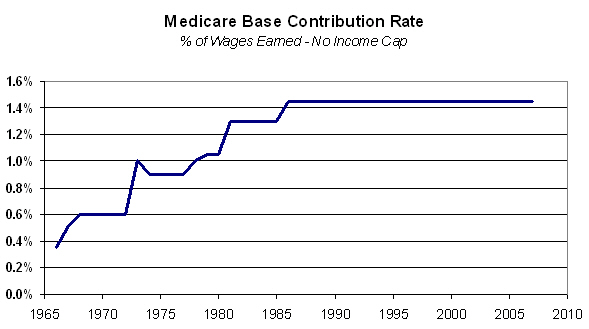
The contribution rates have increased over the years (see chart below).  These days, employees have 1.45% of their wages deducted from their paychecks — with  no income limits.  So, a person earning $25,000 pays $362.50 to the government dor safe-keeping; a person earning $150,000 pays $2,175.  Though the amounts are way different, the rate is the same — 1.45%.  Some people consider the constant rate to be regressive.  In fact, : it’s neither regressive nor progressive — it’s proportional and, thus, income neutral. 


Employers are obligated to match employees’ Medicare contributions dollar-for-dollar.  So, the combined Medicare contribution is 2.9% — half paid by employees and half paid by employers.  Since self-employed folks are both employers and employees, that get docked for the full 2.9%

  • Note: Most economists say that the employer contribution is an employee burden.  They argue that if employers didn’t have to make the matching contribution, then employee wages would be higher by that amount. 

The big deal is that the cumulative “insurance premiums” paid by a high earner are SUBSTANTIALLY higher than low-earners’ contributions.

For example, take 5 individuals who have been earning wages since 1966 (the uear Medicare was introduced).  A relatively low-earner — with average earnings of about $20,000 over the period 1966 to 2007 — would have paid about $10,700  in Medicare premiums during that period.  Inflation indexing each year’s “current year” dollars (i.e. the “nominal amounts”), the premium are worth over $23,000 in 2007 dollars (i.e. “real amounts”).  A relatively high-earner — raking in average wages of about $80,000  — would have contibuted about $43,000 in current year dollars — inflated up to about $92,000 in 2007 dollars.  Middle-earners pay between those low and high amounts; uber-earners pay, and pay, and pay.


click table to make it bigger

click table to make it bigger

  • Note: The employer contributions don’t impact the degree to which the Medicare program is regressive or progressive — but, when conbined with the employee contributions and inflated up to 2007 dollars, might raise some questions about the program’s fundamental economics.

Again, keep in mind that Medicare benefits are identical for all — regardless of how much was paid into the program over the course of a wage earner’s career. 

So, high-earners pay substantially more than low-earners for exactly the same benefits.  And, high-earners who get high pension benefits or IRA payouts — a very likely correlation —  get even less in program benefits since their premiums are higher (than low-earning retirees).

* * * * *

The bottom line:

Curent year Medicare paycheck deductions are income neutral since the same rate applies to all wage earners, with no cap on the income level.

The premiums paid by high-earners are literally multiplles of the premiums paid by low-earners.

Benefits are identical, regardless of whether a person is a high- or low- wage earner.  Arguably, the benefits are slightly progressive since high retirement earners have to pay higher Medicare premiums.

There’s no way that anybody can say with a straight face that the Medicare portion of “payroll taxes” is regressive?  It’s progressive — in fact, very progressive.  PERIOD ! 

 * * * * * 

Next up: So, what about Social Security — regressive or progressive ?

* * * * *

More re: Medicare from the goverbment web site:
http://www.ssa.gov/pubs/10043.html#part2

Medicare is our country’s health insurance program for people age 65 or older. Certain people younger than age 65 can qualify for Medicare, too, including those who have disabilities and those who have permanent kidney failure or amyotrophic lateral sclerosis (Lou Gehrig’s disease). The program helps with the cost of health care, but it does not cover all medical expenses or the cost of most long-term care.

Medicare has four parts

  • Hospital insurance (Part A) that helps pay for inpatient care in a hospital or skilled nursing facility (following a hospital stay), some home health care and hospice care.
  • Medical insurance (Part B) that helps pay for doctors’ services and many other medical services and supplies that are not covered by hospital insurance.
  • Medicare Advantage (Part C) plans are available in many areas. People with Medicare Parts A and B can choose to receive all of their health care services through one of these provider organizations under Part C.
  • Prescription drug coverage (Part D) that helps pay for medications doctors prescribe for treatment.

For most beneficiaries, the government pays a substantial portion—75 percent—of the Part B standard premium and the beneficiary pays the remaining 25 percent.

Beginning in 2007, the government portion was reduced for higher income beneficiaries who began paying a larger percentage of the premium based on income …  In 2008, higher income beneficiaries will be responsible for 67 percent of their income-related adjustment. By 2009, the end of the transition period, these higher income beneficiaries will pay a monthly premium equal to 35, 50, 65, or 80 percent of the total Part B cost, depending on their income level.   However, the law is expected to affect only about 4 to 5 percent of Medicare beneficiaries, so most people will continue to pay the standard premium, without an income-related adjustment.

* * * * *

Want more from the Homa Files?
 
Click link =>  The Homa Files Blog

* * * * *

Oil – Dying a natural death ?

August 12, 2008

According to the Institute for Energy Research, the Congressional ban on off-shore oil development dies a natural death on Sept. 30, 2008 … unless new legislation extends it. 

I’m skeptical since the eagle-eyed press hasn’t reported this, but if it’s true that the ban ends without Congressional action, every single member of Congress will have to go on record either for or against offshore drilling — right before their elections.

Things could get very interesting.

* * * *

From the IER web site:

“American oil and gas leasing has been prohibited on most of the OCS since the 1982.  Today, 97 percent of America’s offshore OCS lands are not leased for energy exploration or production.  The U.S. is now the only developed nation in the World that restricts access to its offshore energy resources.

The were two federal bans that kept the U.S. from producing its vast offshore energy resources: an executive ban and a legislative ban. Neither have the force of permanent law.

On July 14, 2008 President George W. Bush lifted the executive ban on offshore drilling, leaving only the Congressional ban.

The Congressional Moratorium comes in the form of an annual appropriations rider in Congress. It must be renewed annually by a vote in the Congress, which has enacted OCS leasing moratoria every year since 1981.

Unless Congress approves a new rider – and the President signs into law a bill that includes the rider – the Congressional ban will expire on September 30, the end of the federal FY2008 fiscal year.”

Worth exploring:
http://www.instituteforenergyresearch.org/cleaning-up-the-environment-one-more-reason-to-develop-the-outer-continental-shelf/

* * * * *

Want more from the Homa Files?
Click link =>
  The Homa Files Blog

* * * * *

Oil: Fishing where the fish are …

August 12, 2008

Excerpted highlights from IBD, “Don’t Ask, Don’t Drill”, Aug. 11, 2008

In 1970, a mere 17% of offshore wells struck oil. By 1997 that figure was up to 48%.In October 1999, the Department of Energy reported that with 3-D seismic technology overall impacts of exploration and production are reduced because fewer wells are required to develop the same amount of reserves.With even newer 4-D surveying techniques using satellites, about 70% of 4-D wells find oil. These new techniques allow us to find more oil more quickly with minimal environmental impact.

* * * * *

According to a poll released July 30 by Public Policy Institute of California, 51% of Californians are now in favor of new offshore drilling off their coast for the first time in nearly three decades.

The Minerals Management Service estimates there are 10 billion barrels waiting off the California coast.”California could actually start producing new oil within a year,” the Bernstein report said, because the oil is in shallow water, and drilling platforms have been there since before the moratoria.

* * * * *

Estimates of what lay beneath the 1.76 billion-acre continental shelf:

* * * * *

Full article:
http://www.ibdeditorials.com/IBDArticles.aspx?id=303344360938478

* * * * *

Want more from the Homa Files?
Click link =>
  The Homa Files Blog

* * * * *


Hmmm – If you’re going to cheat …

August 11, 2008

The mainstream media (MSM)  has been criticized (from the right) for hushing the Edward’s story during his run for the Dem presidential nomination.

The MSM dismisses charges of political bias and answers that the Enquirer (which broke the story) has low journalistic standards, that newsroom cutbacks have left the MSM understaffed, and — my favorite — that Mrs. Edward’s serious health situation evoked story-burying sympathy.

According to the Washington Post:

* * * * *

The Lesson from the Edward’s Affair:

If you’re a high profile politico with a healthy wife, don’t cheat on her or the press will rat you out. 

If you’re a high profile politico with an unhealthy wife, not to worry, the press won’t rat you out — out of sympathy for your ailing wife.

* * * * *

Side note: The public editor of the NY Times assured readers that liberal bias had nothing to with his paper’s refusal to run the story … and asserted that the Times front page story reporting a factless rumor of a McCain affair is not a moral equivalent. 
http://www.nytimes.com/2008/08/10/opinion/10pubed.html?_r=1&scp=1&sq=mccain%20affair&st=cse&oref=slogin

I guess because Cindy McCain is healthy …

* * * * *

Want more from the Homa Files?
Click link =>
  The Homa Files Blog

* * * * *

Taxes – Those poor folks living in New Jersey …

August 11, 2008

Well, based on data from the Tax Foundation, it’s really the rich folks living in NJ (and NY, CT, MD, and HI) that have the problem: they pay the highest state and local taxes in the country — a point or two higher than the national average 9.7%.

Add that to the federal income tax rate — with a top bracket rate of 35% that’s possibly going to 39.5%; Social Security & Medicare “contributions” that total 15.3% for the  first $102,000 in income (counting employers’ matching payments) … and you’re suddenly talking real money.

* * * * *

Reminder: State & Local taxes are disallowed “preference items” when folks calculate their Alternative Minimum Tax

* * * * *

click table to make it bigger

click table to make it bigger

click table to make it bigger

click table to make it bigger

Adapted from:Tax Foundation data:
http://www.taxfoundation.org/taxdata/show/336.html 

* * * * *

Want more from the Homa Files?
 
Click link =>  The Homa Files Blog

* * * * *

Marketing – When Teens Tighten their Wallets

August 8, 2008

Excerpted from WSJ: “Retailers Catch Teenage Blues”, August 8, 2008

Teens may dread going back to school, but the retail chains catering to them eagerly await this season for a reliable boost from kids who need new clothes. In this slow economy, however, teen retailers are showing signs of stress and beginning to worry that the late-summer boom might not arrive this year.

The teen stores have long been considered recession-resistant because young customers’ spending — often linked to allowances and summer jobs — typically holds constant in a slow economy. Back-to-school purchases were viewed as a must for taste-fickle teens who often cajole their parents in August and September into giving them extra cash.

The July results show that this year’s economic slowdown is dealing wider blows. The principal culprit: energy prices, which analysts say are fast stripping teens of their ability to buy the gas they need to get to the malls where many of these stores are located.

Strong performance in junior apparel from Wal-Mart, the world’s largest retailer, suggests it might be taking sales away from teen retailers.

For many retailers, this time of year is typically the second most profitable of the year. If performance is down this fall, it could be an unpleasant preview of what is usually the chains’ most promising time of year, the holiday season.

The industry appears divided on how to respond.

Middle-end stores like Hot Topic and American Eagle already are looking to promotions in the middle of the back-to-school selling season.

But higher-end operations like Abercrombie appear to be clinging to their price points, a bet that its brand name can weather the storm and competition with department stores. Abercrombie “prides itself being an aspirational brand, and part of that is not to mark down and have sale events. They feel like that dilutes brand equity.”

Other stores are learning to sit pretty at lower price points. Teen retailer Aeropostale Inc. is running a fleet of more than 800 stores throughout the U.S. with clothing styles not too dissimilar from those found at Abercrombie — but at prices about 30% lower.

Other chains are taking a fast turn toward markdowns

It is unclear whether these moves will be enough to lure young buyers back into the mall. Megan Tysoe, a 19-year-old Georgetown University student, says she spent $300 a month on clothes last summer using paychecks from a summer job. But this year she is working an unpaid internship as a paying job couldn’t be found. And Ms. Tysoe has words that should cause worry for retailers: “Instead of buying new things, my friends trade clothes with each other.”

Full article:
http://online.wsj.com/article/SB121810860555720233.html?mod=hps_us_whats_news

* * * * *

Want more from the Homa Files?
 
Click link =>  The Homa Files Blog

* * * * *

Energy – The Case for Doing Everything

August 8, 2008

Excerpted from “It’s Simple: Drill and Conserve”, by Charles Krauthammer.  Aug. 08, 2008

Americans’ greatest concern is the economy, and their greatest economic concern is energy (by a significant margin: 37 percent to 21 percent for inflation). By an overwhelming margin of 2-1, Americans want to lift the moratorium preventing drilling on the Outer Continental Shelf, thus unlocking vast energy resources shut down for the last 27 years.

(Some) say that we cannot drill our way out of the oil crisis. Of course not. But it is equally obvious that we cannot solar or wind or biomass our way out. Does this mean that because any one measure cannot solve a problem, it needs to be rejected?

Why must there be a choice between encouraging conservation and increasing supply? The logical answer is obvious: Do both.

Do everything. Wind and solar. A tire gauge in every mailbox. Hell, a team of oxen for every family (to pull their gasoline-drained SUVs). The consensus in the country, logically unassailable and politically unbeatable, is to do everything possible to both increase supply and reduce demand, because we have a problem that’s been killing our economy and threatening our national security. And no one measure is sufficient.

The “green fuels” … are as yet uneconomical, speculative technologies, still far more expensive than extracted oil and natural gas. We could be decades away. And our economy is teetering. Why would you not drill to provide a steady supply of proven fuels for the next few decades as we make the huge technological and economic transition to renewable energy?

Fine, let’s throw a few tens of billions at such things as electric cars and renewablesis and see what sticks. But (understand that) success will not just require huge amounts of money. It will require equally huge amounts of time and luck.

On the other hand, drilling requires no government program, no newly created bureaucracy, no pie-in-the-sky technologies that no one has yet invented. It requires only one thing, only one act. Lift the moratorium. Private industry will do the rest. And far from draining the treasury, it will replenish it with direct taxes, and with the indirect taxes from the thousands of non-subsidized new jobs created.

(In the energy debate), the argument for “do everything” is not rocket science. It is common sense. 

Full commentary:
http://www.realclearpolitics.com/articles/2008/08/drill_and_conserve.html

* * * * *

Want more from the Homa Files?
 
Click link =>  The Homa Files Blog

* * * * *

Forget Buffett’s Low Tax Rate — How about those Hedge Funds?

August 8, 2008

In a prior post, I hypothesized that Warren Buffett’s guilt-ridden 17.7% effective Federal tax rate is most likely a consequence (unintended ?)  of the capital gains tax rate cut and  the functional failure of the AMT to do its job.

Another group of low capital gains tax rate benificiaries shows no Buffett-like remorse: private equity partnerships, and their close cousins, the hedge funds.

* * * * *

In brief, hedge funds are partnerships and are legally positioned to benefit from favorable capital gains tax treatment.  But, hedge funds cavalierly push the law to the limits with some contested schemes.

Specifically, hedge funds have made an art form of “carried interest” — a claim that current operating income should be classified as returns on their invested capital and then taxed at capital gains rates (which are, of course, much lower than regular income rates.

Many (most? all?) disinterested observers smell a rat — a Enron-like loophole that you can drive a truck through.

Why doesn’t the loophole get closed?  Simple politics.  Sen. Shumer (NY) keeps blocking action because he fears hedgers will head off-shore, and — some cynics reckon — stop their super-sized contributions to the Democratoric Senatorial Re-election Committee — which, coincidentally, Shumer runs.

The likely fix: raising everybody’s capital gains rates — to avoid the appearance of singling out a prized political support group. 

* * * * *

For details re: carried interest, below are summaries and links to a couple of good sources.

* * * * *

Carried Interest – The Issue

From : Senate Testimony: “The Taxation of Carried Interest”
by Peter R. Orszag, CBO Director
July 11, 2007

“A growing amount of financial intermediation is occurring through private equity and hedge funds, which are typically organized as partnerships or limited liability companies and … are growing rapidly for many reasons, including their tax advantages over traditional financial services corporations.

A general partner of a private equity or hedge fund typically receives two types of compensation: a management fee tied to some percentage of assets under management and “carried interest” tied to some percentage of the profits generated by those assets.

The management fee is taxed as ordinary income to the general partner. Taxation on the carried interest is deferred until profits are realized on the fund’s underlying assets, and any resulting profits to the general partner are taxed at the capital gains tax rate …

Most economists, however, would view at least part and perhaps all of the carried interest as performance-based compensation for management services provided by the general partner rather than a return on financial capital invested by that partner … and suggest taxing at least some component of the carried interest as ordinary income, as most other performance-based compensation is currently treated …

Much of the complexity associated with the taxation of carried interest arises because of the differential between the capital gains tax rate and the ordinary income tax rate, which creates an incentive to shift income into a form classified as capital gains. Further widening of the differential between the taxation of ordinary income and of capital gains would create even stronger incentives to shift income into the tax-preferred capital form.

Full testimony (worth reading):
http://www.cbo.gov/ftpdocs/83xx/doc8306/07-11-CarriedInterest_Testimony.pdf

* * * * *

Carried Interest – The Politics

According to Bloomberg:

Democratic Senator Charles Schumer of New York is fighting a plan to raise taxes on hedge funds and buyout firms with his own legislative poison pill …  saying that he would agree to the proposals only if taxes were also raised on oil-and-gas, venture-capital and real-estate partnerships.

Schumer may be trying to shield both his Wall Street constituents [i.e. keeping jobs in NYC] and his party’s electoral war chest … based on federal filings, contributions from employees of private-equity firms and hedge funds to the Democratic Senatorial Campaign Committee, which Schumer heads ,,, far exceed the industry’s contributions to the Republican Senate committee.

http://www.bloomberg.com/apps/news?pid=20601103&sid=a9DpYagBpVIo&refer=us

* * * * *

Want more from the Homa Files?
 
Click link =>  The Homa Files Blog

Paris be gone ! A bigger celeb walks the energy talk.

August 8, 2008

Friday cheapshot:

I usually don’t put much stock in celebrity endorsements. 

But in marketing parlance — this one, from a star who was way ahead oh his time — might have “legs” …


click picture to make it bigger

 * * * * *

Questions:

1. Wouldn’t it be faster for Fred to leave the car at home and  just walk to work ?

2. Are rock hard wheels more enegy efficient than fully inflated tires ?

* * * * *

Want more from the Homa Files?
 
Click link =>  The Homa Files Blog

* * * * *

Back on Warren Buffett’s Case – Where’s the AMT when you need it?

August 7, 2008

In a prior post, I looked at the claim that Warren Buffett pays less taxes than his secretary:

(1) Based on numbers that WB throws around, his secretary pays about $18,000 in income taxes (to the Feds and state of Nebraska) … not much, but mostly due to the skimpy wages WB pays, not her reported 30% tax rate (Note: to get to 30%, you have to count Social Security taxes, Medicare taxes, Nebraska state taxes … and still do a hard round up)

(2) WB reportedly pays $8 million in taxes (on $46 million income) … obviously, $8 million is greater than $18,000 … but is only 17.7%

I hypothesized that his low rate was attributable to the favorable capital gains rate, but still wondered why WB wasn’t ripped by the Alternative Minimum Tax (the notorious AMT). 

So, I dug a little deeper …

* * * * *

AMT Basics

The AMT was introduced in the late 1960s to snare ultra-high income folks who were using tax shelters and super-sized deductions to minimize their income tax liabilities  — sometimes eliminating the liabilities entirely.  All legal, but not what any objective person would deem fair.

Under the regular IRS rules, you start with your gross income and subtract deductions like mortgage interest, state & local taxes, charitable gifts, and exemptions for dependents. Eventually, you get to your taxable income, apply a tax rate ranging from 10% to 35% depending on your tax bracket, subtract any tax credits (e.g. Child Tax Credit) — and bingo — you have your tax liability.

Under AMT rules, you still start with your gross income, but immediately subtract an AMT “exemption amount” that usually starts in the ballpark of $50,000 and gets scaled back as income rises. 

That sounds good to start, but since many of the usual deductions and exemptions (called “preference items”) are disallowed,   your Alternative Minimum Taxable income may be a lot higher than your regular taxable income.

Some deductions are preserved, including those for mortgage-interest and charitable donations. But, some key breaks (i.e. the preference items) are disallowed. These include state and local income taxes and property taxes, personal exemptions, and the standard deduction (which over 60% of filers take).  

  • State and local taxes are are the lion’s share of the disallowed preference items — almost 2/3’s — which is why high tax rate states (NJ, NY, CT, CA, DC, MS, MA — see table below) have the highest percentage of filers getting hit with the AMT.
     
  • Fewer than 5% of tax filers — all high-earners, by definition — get hit by the AMT  Yet it gets a lot of press attention.  Why ?  Ironically, the original law was crafted by Dems, but it’s folks in blue states (with high state taxes funding high state spending) that get hit most often with AMT. 

The AMT tax rate runs from 20% to 28% — lower than the regular high-bracket 35% — but is applied to the higher Alternative Minimum Taxable Income.  So, under AMT rules, you might end up paying more since you’re paying a lower rate on a greater amount of taxable income.

So, why isn’t Buffett paying a rate close to 28% on his $46 million income ?

Answer: we’re back to the preferential tax rate on capital gains.

* * * * *

AMT & Capital Gains

In a nutshell, Congress didn’t intend for the alternative minimum tax to apply to long-term capital gains. Why? I don’t know and can’t figure out …

And specifically, when Congress reduced the capital gain rates in 1997 and again in 2003, it provided that the lower rates would apply under the AMT, too.

In other words, long-term capital gains don’t get hit with the 28% AMT rate — they get the same preferential rate under the AMT as they do under the regular income tax — 15% for folks in the high brackets. 

So, assuming that most of Buffetts’s income is long-term capital gains, it’s “sheltered” from the AMT and all he has to pay is 15% (on that portion of his income). 

If all of Buffetts income was subject to the “regular” AMT rate, he’d be paying 28%  — a higher federal rate than his secretary’s 15% federal income tax rate (see prior post for details).  And, his tax bill would be almost $13 million, instead of a skimpy $8 million.

Case closed.

* * * * *

So What ?

1. Bumping the high-bracket marginal rate back up over 39% doesn’t fix the “Buffett Paradox”.

2. Increasing the capital gains rate just to “get” Buffett seems like committing the family to the asylum to avoid insulting your crazy uncle.

3. Seems like a quick patch to the AMT would fix the problem …

4. A broader — and more significant version of the Buffett Paradox, called “carried interest” —  involves hedge funds and other private equity partnerships.  That’ll be the subject of a subsequent post.

* * * * * 

Good primers on the AMT:
http://money.cnn.com/2005/11/09/pf/taxes/amt_101/index.htm
http://www.fairmark.com/amt/amt101.htm

* * * * *

* * * * *

Want more from the Homa Files?
 
Click link =>  The Homa Files Blog

* * * * *

Grandiose Plans … and Other Distractions

August 7, 2008

Excerpted from th WSJ Op-Ed “Boone Doggle”, Aug, 6, 2008

Note: the Op-Ed questions Boone Picken’s plan to exploit solar power for electricty and free up natural gas for vehicle use.  I didn’t think the argument was very compelling, but took away a couple of useful bullet points.

* * * * *

Over time, the price mechanism and technology will tell us how to harness the energy that is infinite around us. There’s the sun, the tides, geothermal and nuclear — energy is not in short supply; only know-how is.

* * * * ** * * * *

Asserting that something would be good to do is not “a plan.” Having reasons (to do so,ething) is not “a plan” either … Saying how to do it is “a plan.”

* * * * *

Talk is cheap. Talk favors radical solutions to get rid of problems that we are all sick and tired of hearing about. Calls for Manhattan Projects and moon shots invariably decorate the op-ed pages … in a form of social peacockery, the greater the misallocation of resources proposed, the more lavish the ovation.

* * * * *

Re: CAFE Standards and Fuel Efficiency

Take the universal recrimination over our failure to impose tougher fuel-mileage mandates . . . These complaints are lofted without the slightest attention to what we’ve actually learned in 30 years of such mandates — that car buyers simply amortize their forced investment in fuel-saving technology by driving more miles. They buy more affordable homes farther from town; they commute longer distances to work; they trek across two counties to buy groceries at Wal-Mart rather than the pricey supermarket down the street.

* * * * *

Want more from the Homa Files?
 
Click link =>  The Homa Files Blog

* * * * *

No mustard? No mayo? Just call 911 …

August 7, 2008

Storyline:

Subway “sandwich artists” don’t prep a guy’s sandwch “his way”. 
Guy calls the ultimate consumer help line: 911.

One Minute Highlights -worth watching:
http://www.youtube.com/watch?v=_zFG5-lI_44

Full 911 call (gets a bit tedious):
http://www.youtube.com/watch?v=smCmGLgg0Nw&feature=related

* * * * *

Sobering thought:

This guy gets to vote in November

* * * * *

Want more from the Homa Files?
 
Click link =>  The Homa Files Blog

* * * * *

That Giant Sucking Sound – 2009

August 6, 2008

Excerpted from the WSJ, Hillary Clinton Op-Ed, Aug. 6, 2008

“Tucked away on the Cayman Islands sits Ugland House, an unassuming, nondescript building of modest scale and size. However, according to a recent report by the Government Accountability Office (GAO), this five-story office building is home to more than 18,000 corporate entities, nearly half of which have U.S. ties.

In the past few years, the number of corporations flocking to places like the Cayman Islands to evade U.S. taxes has exploded … these companies … have used offshore tax havens to avoid paying hundreds of millions of dollars in federal taxes. “

Full Op-Ed:
http://online.wsj.com/article/SB121798030763715107.html?mod=opinion_main_commentaries

* * * * *

One rhetorical question:

U.S. corporate tax rates are among the highest in the world.   If we raise them — even if only selectively — say on oil companies — would you expect corporate off-shoring  to speed up or slow down?  Hmmm ….

* * * * *

Want more from the Homa Files?
 
Click link =>  The Homa Files Blog

* * * * *

Starbucks – Grasping for (iced coffee) straws ?

August 6, 2008

Excerpted from CNN.com Aug. 5, 2008

Looking to bring more value-seeking consumers through its doors for a late afternoon caffeine fix, Starbucks … now offers its morning customers any iced grande beverage for $2 after 2 p.m.

The price is a big cut from the normal price of most grande-sized iced drinks. A grande iced latte, for example, costs about $4. To get the discount, customers must present a receipt from their morning Starbucks visit.

The company said it is …  answering consumers’ calls for more value at the chain, which has seen traffic drop as gas prices rise and consumer spending falters.

“It’s easy for baristas to implement and it’s easy for customers to understand.”

In some cities, it has offered discounted drinks on Fridays, Saturdays and Sundays. In July, the chain also gave away 12-ounce iced coffees on Wednesdays to customers in New York City, Philadelphia, Washington, Boston and Detroit who turned over an “iced brewed coffee card,” a reusable voucher distributed in stores and newspaper inserts.

“Certainly a discounting approach could lead to a better perception of value in the short run but the longer-term question remains — at the regular everyday price point, would the consumer still see Starbucks as offering the right value for them?”  “That remains uncertain.”

Full post:
http://www.cnn.com/2008/US/08/05/starbucks.deal.ap/index.html

* * * * *

Observations

1.  “Easy for customers to understand” … they’ve got to be kidding … the more hoops that folks have to jump through, the less likely a promotion will succeed.

2.  How will they handle loyal customers who don’t do coupons (or morning coffee) and see the guys in front of them get a half-priced iced-coffee.

3. Does Starbucks know that 2-bucks (no “bounce back” coupon) gets you an large iced coffee at Mickey D’s?  Mrs. H. seems to like them …

4.  Ken’s fundamental law of marketing: if you you want to do something, do it … don’t do it half-way with hooks, lines, and sinkers … otherwise, just don’t do it.

* * * * *

Thanks to Dave Fedlam MSB MBA ’09 for the heads-up … Dave says ” as a typical non-Starbucks customer, 2 cups of coffee for $6/day doesn’t really seem like much of a deal at all.”* * * * *

Want more from the Homa Files?
 
Click link =>  The Homa Files Blog

* * * * *

Uh Oh – McCain busted for plaigarism

August 6, 2008

John McCain’s campaign mocked Barack Obama’s celebrity status with a TV commercial that included comparisons to Paris Hilton.  McCain was blasted by many folks for being juvenille (true !) and by Bob Herbert of the NY Times for being racist (huh?). 

But, McCain got off clean on a very serious charge: plaigarism. 

Seems that McCain’s camp hijacked the Hilton reference from … who else, Obama himself

In 2005 Obama said: “Andy Warhol said we all get our 15 minutes of fame,” says Barack Obama. “I’ve already had an hour and a half. I mean, I’m so overexposed, I’m making Paris Hilton look like a recluse.” 

Busted, Senator McCain

See the Washington Post article “The Senator’s Humble Beginning Rising Star Barack Obama Is Resolutely Down to Earth”,  February 24, 2005
http://www.washingtonpost.com/wp-dyn/articles/A48523-2005Feb23.html

* * * * *

Other tidbits from the Post article:

“I just got elected to the U.S. Senate. I haven’t done anything yet.”

“But he comes well steeped in the basic physics of hype.”

“One of the keys to being well liked in Washington is to appear humble … All of this comes naturally to Obama.”

Even in jest, itis a rare instance where Obama lets slip with something that could be construed as immodest:

“I am genuinely somebody who doesn’t get caught up in the hype,” he says.

“You want to make everyone aware that you’re a workhorse.” As opposed to a “show horse.”

Obama is following what is known in Hill parlance as “the Hillary model,” named for the former first lady whose transition into the Senate is considered a prototype of how celebrity senators should proceed.

He invokes a favorite line: “Those who travel the high road of humility don’t face heavy traffic.”

For the full article:
http://www.washingtonpost.com/wp-dyn/articles/A48523-2005Feb23.html

* * * * *

Observation: you just can’t make this stuff up.

* * * * *

Want more from the Homa Files?
 
Click link =>  The Homa Files Blog

* * * * *

Taxes – Warren Buffett & His Secretary

August 5, 2008


HEADLINE: “Warren Buffett’s Secretary Pays More Taxes than He Does” 


The story has been making the rounds for the past couple of months and seems to be the determining data point for Barack Obama’s tax plan (e.g. “Bush’s tax cuts for the wealthy who didn’t even wamt them”).


Surprisingly (to me), everybody seems to just nod and to take the story at face value without interrogation.  Not me.


According to Buffett, he pays taxes at a lower tax rate than does his $60,000-a-year secretary, 17.7 percent and 30 percent, respectively. 


Let’s start with the secretary: $60,000 @ at a 30% tax rate. We’ll take her $60,000 salary at face value (but wonder why a generous guy like Buffett would only pay her that piddling amount).


What about the 30% rate? To be conservative and simple, let’s assume that the secretary has no dependents and takes the standard deduction.  That would give her taxable income of $50,250 ($60,000 less 1 exemption @ $3,400 and a standard deduction of $5,360) and a federal income tax liability of $8,986.25 —  $4,386.25 + 25% of the excess over $31,850.  So, the secretary’s effective Federal income tax rate is only 15% ($8,986.25 / $60,000). Hmmmm.


Well, maybe Buffet is throwing in payroll taxes for Social Security and Medicare.  OK, add on 7.65% — 6.2%  for Social Security and .1.45% for Medicare.  That gets the secretary up to 22.65%.


Still short, so add on $2,750 for Nebraska state income taxes and the secretary is up to 27%.  OK, throw in everything including the kitchen sink, give the number a hard round, and we’re up to 30%.  Not the way most people think about tax rates, but let’s not quibble.


Let’s see, $60,000 times 30% — the secretary pays $18,000 to the Federal and Nebraska coffers. 


Buffett says he earned $46 million in 2006.  Even at a measly 17.7%, that’s over $8 million. Hmmm. I’d say that the usual headline “Warren Buffett Pays Less Taxes than His Secretary” is, perhaps. just a bit deceiving. What do you think? 


More interesting (to me) is Buffett’s 17.7% tax rate. How does he get it that low.  After all, the the 35% marginal tax bracket starts around $100,000, so you’d expect that most of his $46 billion would fall into that category, right?


Well, he’s probably got clever accountants and claims some pretty staggering (but legal) deductions.  How many would he need to claim to get down to 17.7%? Easy math: his deductions would have to be about $23 million to get his taxable income down to (coincidentally)  $23 million and give him a tax bill of $8 million at a 35% rate. That’s a lot of business dinners and cab rides — especially for self-proclaimed cheapskate.


Well, maybe Buffett doesn’t pay the 35% rate.  Hmmmm. Isn’t there an Alternative Minimum Tax (AMT)?


How could he do it? That is, pay a rate way below his bracket’s 35%? 


My bet: He is a huge beneficiary of the cut in dividend and capital gains rates.  It’s my recollection that Buffett takes a modest cash comp package from Berkshire Hathaway — around .$100,000.  Since BH doesn’t pay material dividends, most of his income probably comes via capital gains — distributions and stock sales.  Tax those at a 15% rate and maybe — just maybe — he really does pay 17.7%..  But, it’s not courtesy of Bush cutting the top marginal rate to 35%.  It’s because the capital gains rate was cut to 15%.

* * * * *

Observations


1. $8 million in taxes paid strikes me as a statistically significant number — and certainly greater than $18,000.


2,  Resetting the high bracket marginal tax rate to 39% doesn’t fix the “Buffet Problem”


3.  What’s up with the AMT if it doesn’t “catch” a uber-earner like Buffett?


4.  As many others have suggested, if Mr. Buffett feels so guilty why doesn’t he just write a voluntary check to the US Treasury, and keep the Feds out of our pockets.

* * * * * 

Want more from the Homa Files?
 
Click link =>  The Homa Files Blog

* * * * *

An HBS Mole Reports …

August 5, 2008


Excerpted from WSJ review of : Ahead of the Curve, Philip Delves Broughton (Penguin Press, 283 pages, $25.95)


Broughton had one of the most desirable jobs in newspapering …  quit and went back to school to study accounting  … at Harvard Business School.


He emerged with an ambivalence toward the HBS brand  … particularly the sense of entitlement for which its students and faculty are famous.  


Most graduate business schools, you might have noticed, award MBAs. HBS, according to the dean, specializes in “transformational experiences.” The dean says that  HBS grads reject so many routine job offers that of course recruiters are going to resent the school.


Broughton was prepared for the number-crunching nerdiness, the intense competitiveness and the unrealistically high levels of self-esteem.  “HBS,” he writes, “had two modes: deadly serious and frat boy, with little in between.”


The future titans of American industry celebrated … with  everyone … dressing as his favorite hip-hop star. … at another party, the men were to dress as women and the women as sluts. . . .


It is the other mode, the serious, non-frat-boy one, that the reader may find more disconcerting.


The jargon-choked faddishness and fatuous therapeutics of pop business books and the modern workplace have seeped into HBS too …  including New Age group bonding games and …a “personal development exercise” called “My Reflected Best Self.”


Even  Broughton …  shows signs of succumbing to a version of Stockholm Syndrome — a hostage identifying, if not with his captors. “I was happy I went.” He knows how to do a regression analysis, and he has learned how to make an Excel spreadsheet do everything but play canasta.


* * * * *

A study by a banking analyst tried to track the American equity markets in relation to the number of HBS graduates who chose to go to work in finance each year. If the figure was less than 10%, the market went up not long after. More than 30% and the market was headed for a crash. In 2006, 42% of the HBS grads went to work in finance. Right on schedule.

* * * * *

Want more from the Homa Files?
 
Click link =>  The Homa Files Blog

* * * * *

Mktg: Mickey D – How to Raise Prices (w/o Raising Prices)

August 4, 2008

Excerpted from WSJ: McDonald’s Tests Changes In $1 Burger As Costs Rise, 08-04-08

McDonald’s is testing modifications to its popular $1 double cheeseburger, and higher prices for the sandwich … selling it with one slice of cheese instead of two, and billing it as a “double hamburger with cheese ” …. or offering a double hamburger without (any) cheese …  or  selling the traditional double cheeseburger at prices ranging from $1.09 to $1.19.

Launched in 2003, the Dollar Menu has been a key driver of sales at McDonald’s 14,000 U.S. restaurants and has helped it ride out dips in consumer spending. But recently, franchisees have complained that the menu has brought too much unprofitable traffic into their restaurants.

* * * * *

As of late June, sales of the chain’s lattes, cappuccinos and other espresso drinks were off their peak … lower-priced beverages, including $1.89 iced coffee and a $1 … sweet-tea promotion, have pulled some sales away from the espresso drinks … 

McDonald’s overall beverage expansion, adding espresso drinks, smoothies, cold tea, bottled drinks and ice-blended coffee beverages at U.S. locations, is on track to exceed the company’s goal of adding $125,000 a year in sales per restaurant … and adding $1 billion a year to the company’s sales.

http://online.wsj.com/article/SB121780568775808337.html?mod=2_1567_topbox

* * * * *

Observations

1.  One way to increase price is to skinny back the product — put fewer cornflakes in the box.

2.  The $1 double cheeseburger is the heart of the menu — dropping it will be a big deal — no way I step up to $1.19 or buy a chesseburger with no cheese.

3.  Has the multi-dollar cup of coffee market peaked ?

* * * * *

Want more from the Homa Files?
 
Click link =>  The Homa Files Blog

* * * * *

What Exactly Is a ‘Windfall’ Profit?

August 4, 2008

Excerpted from a WSJ editorial, Aug4, 2008

The “windfall profits” tax is back …  What is a “windfall” profit anyway? How does it differ from your everyday, run of the mill profit? Is it some absolute number, a matter of return on equity or sales — or does it merely depend on who earns it?

Senator Obama says government would take “a reasonable share” of oil company profits …  Senator Durbin says “The oil companies need to know that there is a limit on how much profit they can take in this economy.”

Take Exxon Mobil, which … is the main target of any “windfall” tax surcharge …   Between 2003 and 2007, Exxon paid $64.7 billion in U.S. taxes, exceeding its after-tax U.S. earnings by more than $19 billion.

Exxon’s profit margin stood at 10% for 2007, which is hardly out of line with …  the 8.9% for U.S. manufacturing (excluding the sputtering auto makers) … Chemicals had an average margin of 12.7%. Computers: 13.7%. Electronics and appliances: 14.5%. Pharmaceuticals (18.4%) and beverages and tobacco (19.1%)

If Senator Obama is as exercised about “outrageous” profits as he says he is, he might also have to turn on a few liberal darlings. Oh, say, Berkshire Hathaway. Warren Buffett’s outfit pulled in $11 billion last year, up 29% from 2006. Its profit margin — if that’s the relevant figure — was 11.47%, which beats out the American oil majors.

Or consider Google, which earned a mere $4.2 billion but at a whopping 25.3% margin. Google earns far more from each of its sales dollars than does Exxon, but why doesn’t Mr. Obama consider its advertising-search windfall worthy of special taxation?

The point is that what constitutes an abnormal profit is entirely arbitrary. It is in the eye of the political beholder …  a windfall is nothing more than a profit earned by a business that some politician dislikes. 

* * * * *

Full editorial (worth reading):
http://online.wsj.com/article/SB121780636275808495.html?mod=opinion_main_review_and_outlooks

** * * * *

For hard numbers, see prior post:
http://homafiles.info/2008/06/26/numbers-price-gouging-windfall-profits/

* * * * *

Want more from the Homa Files?
 
Click link =>  The Homa Files Blog

* * * * *

Exxon — Another Windfall ?

August 4, 2008

Excerpted from IBD, August 1, 2008

Exxon Mobil reported record second-quarter income — indeed, the highest quarterly profit for any corporation ever … and, a massive (tax) windfall for the US Treasury.

In the first half, Exxon Mobil’s after-tax income rose 15% to $22.6 billion. A lot of money, to be sure, until you consider that Exxon Mobil paid (almost 3 times as much) — $61.7 billion — in taxes — also a record.

As economist Mark Perry has noted, Exxon Mobil will pay more taxes this year to the U.S. Treasury than the bottom 50% of all taxpayers — combined.

* * * * *

Note: Jimmy Carter’s windfall profits tax led to a 6% drop in domestic oil output and as much as a 15% surge in oil imports, according to the Congressional Research Service.

* * * * *

For full article:
http://www.ibdeditorials.com/IBDArticles.aspx?id=302483718997031

* * * * *

Want more from the Homa Files?
 
Click link =>  The Homa Files Blog

* * * * *

Obama leads McCain among low-wage workers

August 4, 2008

Excerpted from Reuters,  08-04-08

Obama holds a two-to-one lead over McCain among low-wage workers (nearly a quarter of U.S. adults, earning $27,000 or less) … Obama’s advantage is due largely to overwhelming support from African Americans and Hispanics.

The group views Obama as the more empathetic candidate and the one who most closely shares their values …  92% of African Americans chose Obama as the candidate most concerned with their problems; not a single black respondent said that about McCain, the Post said.

Most of the respondents were pessimistic about the impact of the November 4 election. A majority of those polled, both white and minority, said that no matter who won their personal financial situation would be unlikely to change, it said.

* * * * *

Want more from the Homa Files?
 
Click link =>  The Homa Files Blog

* * * * * 


That Giant Sucking Sound – 2008

August 3, 2008

In 1992, according to then presidential candidate Ross Perot, “the giant sucking sound” was the flow of U.S. jobs to Mexico under NAFTA.  Arguably, the 2008 sucking sound is the flow of capital and corporate ownership out of the U.S.  The latest: InBev’s purchase of Anheuser-Busch

Excerpted from the WSJ, “This Bud’s for Belgium”, August 3, 2008

Politicians and Wall Streeters are starting to ask why the Belgian beer company InBev purchased Anheuser-Busch and not the other way around … though shareholders were the big winners here with a $50 billion-plus takeaway.

But here’s the real question: Was the takeover basically financed by the savings … from escaping America’s increasingly uncompetitive corporate tax system? …  Bottom line: InBev (pays Belgium) around 20% of its profits in corporate taxes … (versus) Anheuser-Busch’s U.S. rate 38.4%.

The country will continue to see its competitive edge wither away without a corporate tax rate cut. Mr. McCain … wants to cut the corporate tax rate to 25%, close to the global average. Senator Obama is more interested in raising tax rates than cutting them.

Wall Street dealmakers tell us to expect more sales of U.S. companies to European rivals thanks to the combination of America’s higher corporate taxes and the weak dollar … the U.S. is pricing itself out of the market as a corporate headquarters. “America’s 35% corporate tax rate is … just bad economics”.

For full editorial:
http://online.wsj.com/article/SB121770579562707543.html?mod=opinion_main_review_and_outlooks

* * * * *

Observations

1.  Compounding the weak dollar and high corporate tax rates is the massive transfer of wealth to the oil producing nations and their sovereign wealth funds.

2.  Rhetorical question: what’s the likely impact of a windfall profits tax on U.S. based oil companies?

* * * * *

Want more from the Homa Files?
 
Click link =>  The Homa Files Blog

* * * * *

Goliath vs. Goliath – Walmart vs Obama

August 3, 2008

Excerpted from the WSJ, “Wal-Mart Warns of Democratic Win”, August 1, 2008

Through almost all of its 48-year history, Wal-Mart has fought hard to keep unions out of its stores …  (When) a small number of butchers (unionized) in early 2000 … the company phased out butchers in all of its stores and began stocking prepackaged meat. When a store in Canada voted to unionize …  the company closed the store, saying it had been unprofitable for years.

(Now) Wal-Mart is … warning that if Democrats win power in November, they’ll likely change federal law to make it easier for workers to unionize companies.

Wal-Mart executives claim that … unionization could mean fewer jobs as … payroll and health costs (rise) for companies already being hurt by rising fuel and commodities costs and the tough economic climate.

Wal-Mart’s worries center on a piece of legislation known as the Employee Free Choice Act … the U.S. Chamber of Commerce has made defeat of the legislation a top priority.

Wal-Mart makes it clear that voting for Democratic presidential hopeful Sen. Barack Obama would be tantamount to inviting unions in (since) Sen. Obama co-sponsored the legislation … known as “card check,” …  Sen. John McCain, the opposes the Employee Free Choice Act and voted against it last year.

The Employee Free Choice Act  … would simplify and speed labor’s ability to unionize companies. Currently, companies can demand a secret-ballot election to determine union representation.

The proposed legislation,  would let unions form if more than 50% of workers simply sign a card saying they want to join. It is far easier for unions to get workers to sign cards because the organizers can approach workers repeatedly, over a period of weeks or months, until the union garners enough support.

Employers argue that the card system could lead to workers being pressured to sign by pro-union colleagues and organizers.

Unions consider the Employee Free Choice Act as vital to the survival of the labor movement, which currently represents 7.5% of private-sector workers, half the percentage it did 25 years ago. (see chart below)

Business-backed lobbying groups are running ads … using  an actor from the “Sopranos” TV series about mob life to hammer home their point.

For full article (worth reading):
http://online.wsj.com/article_print/SB121755649066303381.html

* * * * *

My POV

1.  I was surprised to see how low the private sector unionization rate had fallen.

2.  The Sopranos ad — which was playing on news shows over the weekend — is quite effective. It plays off historical sterotyping to make a strong visceral point.

4.  The argument that secret ballots are a bad thing seems to have some holes  …  should we eliminate the secret ballot for presidential elections, too?

* * * * *

From the WSJ article:

 * * * * *

Want more from the Homa Files?
 
Click link =>  The Homa Files Blog

* * * * *

Obama says he'll support offshore drilling

August 2, 2008

Excerpted from McClatchy Newspapers, August 1, 2008 

Headline: “In major change, Obama says he’ll support offshore drilling”

Barack Obama Friday dropped his opposition to offshore oil drilling, saying he could go along with the idea if it was part of a broader energy package. Obama made his comments in St. Petersburg during an interview with the Palm Beach Post.

“My interest is in making sure we’ve got the kind of comprehensive energy policy that can bring down gas prices …  in order to get that passed, we have to compromise in terms of a careful, well thought-out drilling strategy that was carefully circumscribed to avoid significant environmental damage.

The change is dramatic because Obama often pointed to his opposition to drilling as a key difference between himself and presumptive Republican presidential nominee John McCain.

But the concept has proven popular, and McCain has made it a centerpiece of his stump speeches and some of his television ads. Political momentum has been moving in favor of opening up U.S. coastlines.

Obama also said, in a separate statement issued by his campaign, that he supported the bipartisan energy plan offered by 10 senators Friday.

The proposal would end most of the ban on drilling. It would allow a 50-mile buffer on the east coast, as well as Florida’s west coast. Virginia, North Carolina, Georgia and South Carolina would be permitted to start oil and natural gas exploration outside the buffer. 

Currently, the government bans exploration and drilling on the Pacific and Atlantic coasts and most of the eastern Gulf of Mexico, to protect U.S. beaches and fisheries from pollution.

For full article: http://www.mcclatchydc.com/homepage/story/46174.html

* * * * *

Other confirming articles:
http://www.iht.com/articles/ap/2008/08/02/america/NA-POL-US-Elections.php
http://news.yahoo.com/s/ap/20080802/ap_on_el_pr/obama

* * * * *

Want more from the Homa Files?
 
Click link =>  The Homa Files Blog

* * * * *

Happenings – The Berlin Rock Star

August 1, 2008

Let’s play “Who am I ?”

I was born on a tropical island.

I spent some of my childhood in the United States.

Then I moved abroad with my single mother.

I have exotic good looks and magnetic charisma.

My “stage presence” is engaging beyond compare.

Fans (especially women) often faint at my events

I’ve been compared to other young “greats” who preceded me

An event in Berlin, Germany cast me onto the world’s stage.

The media adored me.

Who am I ?

scroll down for answer

       V

       V

       V

       V

       V

       V

       V

Answer

Of course, I’m Fabrice Morvan — formerly of Milli Vanilli. 

I was born in Guadalupe, moved to Miami, then moved to Paris with my single mother. 

I was modeling and breakdancing in Berlin when producer Frank Varian picked me and Rob Pilatus to become the duo fronting Milli Vanilli.  

We sold over 30 million singles, 14 million albums and became one of the most popular acts in the world. 

We played to packed venues and achieved worldwide adulation — including a Grammy.  

We were often compared to Bob Dylan, Elvis Presley, Paul McCartney, and Mick Jagger. 

Then, during a live MTV performance at the Lake Compounce theme park in Bristol, Connecticut, a playback  machine jammed. 

Only then did people realize that we were simply lip syncing recorded tracks.  While we put on a great show, we couldn’t sing. 

Fans were disappointed, we had to give back our Grammy, and our success turned to infamy as con artists. 

 “Our career came to a sudden and ignominious end: Fakers. Frauds. A blatant marketing scam. ”

* * * * *

The nuns used to teach me that history repeats.  Hmmm … 

* * * * *

Primary source: http://music.yahoo.com/ar-257262-bio–Milli-Vanilli

Additional background provided by Wikipedia – The Free Encyclopedia: – and official reference for settling Homa family bets  http://en.wikipedia.org/wiki/Milli_Vanilli

* * * * *

Want more from the Homa Files?
 
Click link =>  The Homa Files Blog

* * * * *

Hmmm – Inconvenient Facts

July 31, 2008

Excerpted from WSJ “Where’s the Outrage? Really.” Arthur Brooks,  July 31, 2008

According to an emerging journalistic narrative … ordinary Americans are outraged. The anger is simply assumed to exist. Ironically, this assumption is questionable, and is not supported by the data.

In May 2008, the Gallup Organization asked 1,200 American adults how many days in the past week they had felt “outraged.” The average number of angry days was 1.17, and 54% of those surveyed said none. … Despite the litany of horrors presented to us daily by campaigning politicians, most of us appear to be doing really quite well managing our anger.

Indeed, we are less angry today than a decade ago… (in) the glory days of the 1990s, when — according to the media narrative — we enjoyed uninterrupted peace and prosperity. In 1996, the General Social Survey asked exactly the same “outrage” question of 1,500 adults. Then, only 38% had not been outraged at all in the past week. The average number of angry days was 1.5 per week, 29% higher than at present.

Virtually every group in the population is less angry in 2008 than in 1996 … only one major group in the population has gotten angrier: people who call themselves “very liberal.”  …  Today, very liberal people spend more than twice as much time feeling angry as do political moderates. One in seven is outraged seven days a week .

Most Americans recognize that, while gas is expensive and our grocery money doesn’t go as far as it did last year, we are still an enormously prosperous and fortunate nation.

Most …  are reasonable people, and can see the difference between correctable problems within a strong system of democratic capitalism and the kind of catastrophic failure that justifies real outrage.

* * * * *

Mr. Brooks is a professor at Syracuse University’s Maxwell School of Public Affairs.

* * * * *

For the full article (worth reading):
http://online.wsj.com/article/SB121746010408198765.html?mod=opinion_main_commentaries

* * * * *

Want more from the Homa Files?
 
Click link =>  The Homa Files Blog

* * * * *

Dogbert for President – His Tax Plan

July 30, 2008

A few years ago I stumbled on a Dogbert cartoon.  At the time it made me smile. 

Today, the cartoon makes me nervous — very nervous.

Of course, the source of my angst is the Obama tax plan.  But, my specific concerns aren’t the ones that most pundits dwell on.

* * * * *

Buying Votes

True, Obama did hijack Dogbert’s campaign strategy and plans to raise tax rates on the top 3% of income earners (individuals and  couples earning over $250,000 annually) and to redistribute the “savings” via a new tax credit of $500 per person, or $1,000 per working family.  

Cynics point out that in the good old days, Mayor Daley’s Chicago political machine could deliver a  vote for a the price of a pack of cigarettes.  Apparently the price of a vote has gone up more than the price of gasoline.  At least votes are now  “marked to market”.  The Obama plan clearly sets the price at $500 (cash) per vote, with a perpetuity value of about $10,000 @ 5%.

* * * * *

Buying Old Folk’s Votes

And, Obama promises zero Federal taxes for seniors over 65 on income up to $50,000 . 

Mark Penn, Hillary Clinton’s former chief strategist says: “The Obama camp hit a bull’s-eye with this proposal, which has little economic justification but is great politics.” http://www.politico.com/news/stories/0708/12117.html

* * * * *

Upping High Bracket Marginal Rates

In a WSJ op-ed, Stanford economics professor Michael Boskin opines that despite the rhetoric to the contrary,  Obama’s increases don’t just hit “rich” individuals.  They also impact lot of small businesses and two-earner households in high cost-of-living areas.

Specifically, Obama would raise the top marginal rates from 35% to 39.6%,  increase the tax rate on capital gains and dividends, and uncap Social Security taxes (which currently are levied on the first $102,000 of earnings).

When payroll and state income taxes are thrown in, Boskin estimates that the high bracket marginal rate goes to over 60% —  with almost $2 of every $3 earned at the margin, going to the government for services and redistribution.

click to make table bigger

click to make table bigger

http://online.wsj.com/article/SB121728762442091427.html?mod=opinion_main_commentaries

* * * * *

Redistributing $131 Billion Annually

An analysis done by the Tax Foundation — a self-proclaimed non-partisan think tank —  indicates that Obama’s plan — as proposed — would redistribute about $131 billion each year.  Taking money from the undeserving rich, and giving it directly to the financially besieged middle (and lower) class). 

Tax Foundation - Tax Policy Center Estimate
Source: Tax Foundation – Tax Policy Center Estimate

“Hard Numbers on Obama’s Tax Redistribution Plan
http://www.taxfoundation.org/publications/show/23319.html

* * * * *

My POV

1.  On a philosophical level, I agree that the grossly uneven distribution of earning power in the US is a serious problem that needs to be fixed. 

2. But, I don’t think that the problem of income inequality should be fixed via a tax system — which was originally intended to “tax & spend” efficiently on necessary common services — not to “grab and redistribute”.  Direct transfers from one citizen’s pockets to another’s (e.g. refundable tax credits) are certainly the latter.

3. Except for the impact on small businesses, I can’t get too riled over marginal rate increases that start at $350,000; but I do think a “doughnut hole” payroll tax schedule is wacky and I think raising capital gains taxes during an economic slowdown is dangerous.

4 . My real  issue:  The numbers say that in Obama World, a minority of voting age Americans will be paying income taxes.  That scares me. What’s to stop an income tax-free majority from continually voting  to  raise taxes on the tax-paying minority to fund an ever increasing potpourri of benefits or add to the redistribution pot.

* * * * *

Next Up: The numbers are conclusive … taxpayers will be a minority.

* * * * *

Want more from the Homa Files?
 
Click link =>  The Homa Files Blog

Tax Payers: A Dwindling Majority

July 29, 2008

A couple of years ago, one of my sons observed that people paying income taxes would soon be in the minority.  In denial, I dismissed the notion at the time. 

More recently, I read in Dick Morris’ book Fleeced:  “When Obama is done, the proportion of adult Americans who pay taxes at all will become a minority of our population” (p.41)

Finally, curiosity (and selfish interests) got the best of me and I decided to get some facts and crunch some numbers. 

My conclusion: UH-OH !!! 

Here are some things to mull over.

* * * * *

10% Bracket

The Bush tax plan introduced a 10% tax bracket that currently applies to individual tax filers with taxable incomes less than $7,825 Over $7,825 is taxed at the ‘old’ 15% marginal rate.  For marrieds filing jointly, the 10% bracket goes up to $15,659.

Technical note: Taxable income equals Adjusted Gross Income (AGI) less $3,400 per personal exemption (the filer plus dependents), less deductions.  The standard deduction is $5,350 for individuals and $10,700 for married couples filing jointly.

* * * * *

Child Tax Credit (CTC)

Additionally, the Bush tax plan doubled the size of Child Tax Credit (CTC) from $500 per qualifying dependent child — the level introduced in 1997 —  to $1,000; and made the credit “refundable(i.e. a filer gets a check for any negative tax balance); and relaxed some of the limtations.

* * * * *

10% & CTC – So what?

Well, for example, a married couple — with 2 qualifying dependent children — filing a joint return  — can report almost $43,000 in Adjusted Gross Income (AGI) and owe no taxes 

Here’s how: The couple’s AGI of $42,850 gets reduced to a taxable income of $18,550 — $42,850 AGI less $13,600 in exemptions (4 times $3,400 per exemption), less the standard deduction of $10,700, equals $18,550.  The tax on $18,550 is $2,000 — $1,565 plus 15% of the excess over $15,650 equals $2,000.  But, the couple gets a $2,000 Child Tax Credit — $1,000 for each qualifying dependent child.  So, the couple owes no taxes.

A married couple  with 2 children who  file jointly and report less than $42,850 get a refundable credit — a check from the government — in effect, a negative income tax.

* * * * *

Earned Income Tax Credit (EITC)

Similarly, the revised tax code provides for an Earned Income Tax Credit (EITC) based on a relatively complicated formula:

click table to make it bigger

So what?

Well, for example, an individual with no child dependents can report up to $10,416 in AGI and owe no taxes.  Those who report less than $10,416 in AGI, get a refundable credit. (Just trust me on the calculations — even if they’re not precise, I ‘m confident that they’re directionally right)

The table below displays the maximum AGI that individuals can report — and that maried couples can jointly report, depending on their number children — without owing income taxes i.e. their “zero-tax AGI)


click table to make it bigger

* * * * *

Bottom 40% – Negative Income Taxes

Based on Congressional Budget Office (CBO) & Tax Foundation analyses of IRS data, the bottom 40% of tax filers — as a group — have negative tax liabilities. 

That is, on average,  the effective tax rates of the bottom 40% of filers are negative. So, the filers in these quintiles get a refundable credit paid by the government.

Technical note: These are averages ! Some filers in the group may pay some income taxes — but their tax liabilities are more than offset by filers with negative tax balances.  And, as will be shown in a subsequent post, some filers in the middle quintile — which has a positive average effective rate — have negative tax liabilities.

click table to make it bigger

Sources:
http://www.cbo.gov/ftpdocs/88xx/doc8885/12-11-HistoricalTaxRates.pdf
http://www.urban.org/UploadedPDF/1001091_distribution_federal_taxes.pdf

* * * * *

32% of filed returns – Zero (or Negative) Income Tax Liability

Of those in the bottom 40%, roughly 80% (i.e. over 32% of total filers) paid zero taxes or received a refundable credit.

* * * * *

41% of U.S. Population – Zero (or Negative) Income Tax Liability

Economists at the Tax Foundation estimate that — for the 2006 tax year — roughly 43.4 million tax returns, representing over 32% of the 136 million returns filed) and 91 million individuals, faced a zero or negative tax liability.

In addition to the 91 million, about 15 million low and no income households (averaging 2 people per household) are not required to file tax returns.  

So, roughly 121 million Americans—or 41 percent of the U.S. population—  pay no income tax, or — benefiting from the earned income tax credit or child credits — get a “refundable credit” back from the goverment (i.e. a check for “negative income tax”).

Source: Tax Foundation: “Number of Americans Outside the Income Tax System”
http://www.taxfoundation.org/research/show/542.html

* * * * *

59% Think Everyone Should Pay Something 

Source: HarrisInteractive, 
http://www.taxfoundation.org/files/topline-20050414.pdf

* * * * *

Next up: Will tax payers become a minority (of voting adults) any time soon?  If so, so what?

* * * * *

 Want more from the Homa Files?
 
Click link =>  The Homa Files Blog

Hmmm: Obama Visits Doctor (on a Sunday Night !)

July 28, 2008

The Story

CHICAGO — Barack Obama, back in his home town after a tour of Afghanistan, the Middle East and Europe, saw a doctor at the University of Chicago Medical Center on Sunday night to deal with a sore hip, inflamed from playing basketball.

My POV  (POV = point-of-view)

1) Obama promises that when he’s elected, we’ll get exactly the same health care that Senators get.

Does that mean that my doctor will see me on a Sunday night (for “soreness” no less)  instead of telling me that the next open appointment slot is 6 weeks from Tuesday at 1:46 — come early, but plan to wait?

Must be, because Obama certainly wouldn’t think of accepting preferential care, right?

2) Why do all of the candidates confuse “medical insurance” with “health care” ?  The former is just money; the latter is fundamental service delivery.  Two different things !

Amen.

* * * * *

Want more from the Homa Files?
 
Click link =>  The Homa Files Blog

Hmmm – Some Interesting Tax Stats

July 28, 2008

Summary: To load you with some interesting factoids for cocktail party conversations and to provide background for the next couple of analytical posts — here are some highlights from the 2006 IRS data pile (the latest year available) , and the link to the complete IRS data set (which is a treasure trove of info).

Some Highlights

138.4 million returns filed … reporting almost $8 trillion in AGI
         
 … up 8.4% from 2005 …  $57,670 average AGI

23%  reported dividend income … averaging $5,897

10.5%  reported capital gains … averaging $4,275

 63%  took the standard deduction … averaging $7,043

 37%  itemized deductions … averaging $24,122

 30%  reported charitable deductions … totaling $173 billion

2.9%  were assessed Alternative Minimum Tax
              … averaging $4,769

 19%  claimed child tax credits … averaging $1,233

 17%  claimed earned income tax credits … averaging $1,939

 67%  paid income taxes … averaging $11,064

   33%  paid zero taxes (or received a refundable tax credit) 
                … up from 20% in 1990 and 25% in 2000 


 * A deeper dig on this point is coming in subsequent posts *

* * * * *

Summary Table:

click table to make it bigger

Source: IRS
http://www.irs.gov/pub/irs-soi/06in01fg.xls

* * * * *
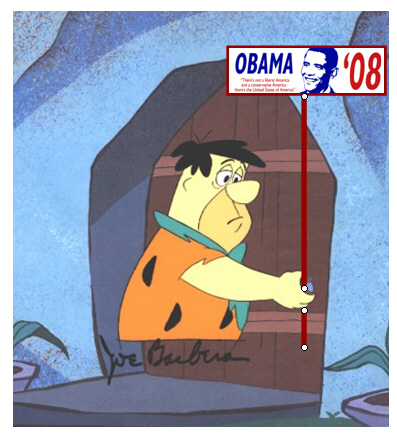
Next up: Taxpayers –  A Dwindling Majority

* * * * *
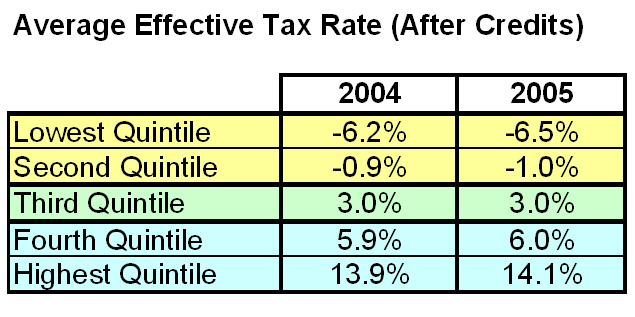
Want more from the Homa Files?
 
Click link =>  The Homa Files Blog

Randy Pausch: The Last Lecture

July 25, 2008

Randy Pausch, the Carnegie Mellon University computer science professor whose final lecture inspired millions, died early today (July 25) in Virginia of pancreatic cancer.

Last fall, Dr. Pausch delivered the lecture at CMU, which has attracted more than six million viewers. (link below)

Dr. Pausch wrote a book, “The Last Lecture,” which … elaborated on his lecture and emphasized the value he placed on hard work and learning from criticism. His words were intended as a legacy for his young children.

In May, Dr. Pausch spoke at the Carnegie Mellon commencement. He said a friend recently told him he was “beating the [Grim] Reaper” because it’s now been nine months since his doctor told him he would die in six.

“But we don’t beat the Reaper by living longer. We beat the Reaper by living well,” said Dr. Pausch, who urged the graduates to find and pursue their passion. 

Watch the Last Lecture:
http://youtube.com/watch?v=nwO7EnM0zWM

Excerpted from the Pittsburgh Gazette 

* * * * *
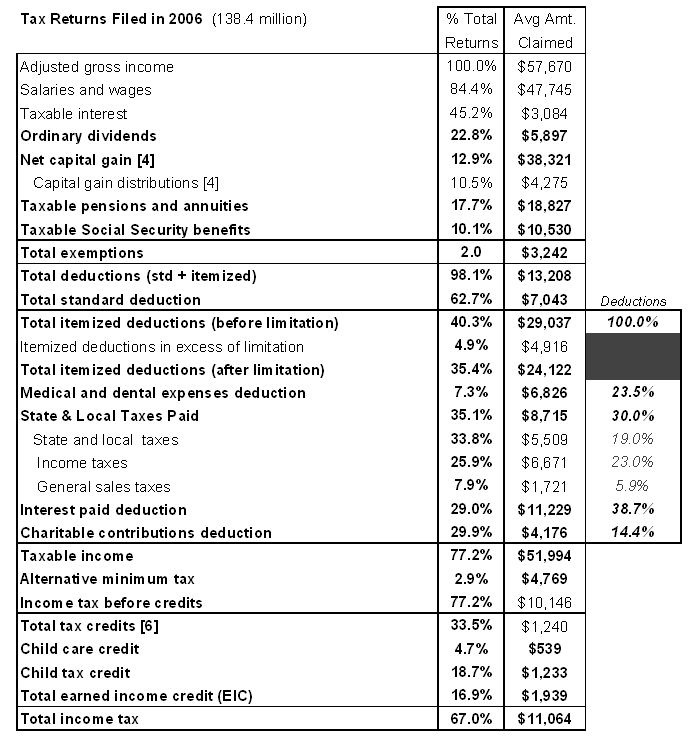
Want more from the Homa Files?
 
Click link =>  The Homa Files Blog


Update: XM – Sirius Merger – Finally!

July 25, 2008

After more than a year of government review (largely instigated by a powerful “over the air” radio lobby led by the National Association of Broadcasters), it looks like the merger between XM Satellite Radio and Sirius Satellite Radio — is finally going to happen.

in March, the Justice Department approved the merger.  Last month (June), FCC Chairman Kevin Martin gave his ok, saying:  “I am recommending that with the voluntary commitments they’ve offered, on balance, this transaction would be in the public interest. They have voluntarily committed to setting forth price constraints, so the prices for consumers do not increase; smaller packages at lower prices; an open standard for radios; the sale of interoperable radios; and additional public interest programming for noncommercial use and for qualified entities who have not been traditionally represented.”

Two of the five FCC members commission quickly followed Martin’s lead and  announced that they would cast votes to approve the deal.

Now, their are reports that at least one of two other members of the FCC (John Adelstein, Deborah Taylor Tate), is ready give the merger the majority vote it needs provided that XM-Sirius up the ante by freezing prices for six years, by making 25% of their satellite capacity available for public-interest and minority programming, and by paying a $2o million fine for some minor technical violations of FCC transmission rules.

For more details:
http://online.wsj.com/article/SB121683130281477651.html

* * * * *

Performance Update

The companies broke even financially, and ended the 1st quarter of 2008 with a total of almost 18 million subscribers — 9.33 for XM, 8.64 for Sirius. (Reminder: The original “Bass Model” research studies projected the market would be at least 25 million).

XM’s subscriber acquisition costs (SAC), a component of cost per gross addition (CPGA), were $73.  CPGA in was $99 for XM, $91 for Sirius

XM converted  53.3 percent of OEM installations (i.e. radios already installed in new cars)to subscriptions. XM’s monthly churn rate was 1.77 percent.

* * * * *

TEST QUESTION: Given a monthly subscription price of $12.99,  what’s the customer life time value (CLTV) of an average satellite radio subscriber? Answer below

* * * * *

Observations

1. The prolonged merger approval process — which took longer than the approval of the Exxon-Mobil merger — certainly validates the political clout of the “over the air” media companies.  To a reasonably objective person (me), this one was a no-brainer.

2. Finally, I’ll be able to get the NFL and MLB on the same service.

3. I still think that converting about half of the OEM units pre-installed in new cars is cause for concern, not celebration.  Any marketer worth his / her salt wouldn’t sleep well at night until the conversion ration was at least over 75%. 

4. My Lexus RX-350 didn’t come with either XM or Sirius pre-installed.  The dealer treated the installation as a minor annoyance, and said less than half of their customers opt for satellite radio..

5. Big question: too late to matter? My sense: the buzz is gone and momentum  is gone.  Your views?

 * * * * *

Next up: Back to taxes …

Want more from the Homa Files?
 
Click link =>  The Homa Files Blog  

* * * * *

Answer to CLTV Question:
Assuming nil marginal operating costs per customer (though there would be some), and a 5% annual discount rate ( .4% monthly):
CLTV = [MS$ / (C% + DR%)] – CGAC
MS$ = monthly subscription = $12.99
C% = churn rate =  .0177
C% + DR% = .0177 + .004 = .0217
[MS$ / (C% + DR%)]  = $12.99 / .0217 = $598.61
$598.61 – CGAC = $598.61 – $95 (avg for XM & SIRI) +
$503.61

Taxes – Tax Breaks for the Wealthy?

July 24, 2008

The 2008 presidential campaign is loaded with tax rhetoric.  The GOP says that the Bush tax cuts have worked and it would be crazy to raise taxes during an economic slowdown. 

The Dems say that the Bush tax plan “gave tax breaks to the rich, who didn’t even want them” — as evidenced by Warren Buffet repeatedly saying that he pays less taxes than his secretary — and that uber-earning people — e,g, greedy CEOs and hedge fund managers — aren’t paying their fair share.

What do the numbers say?

Well, several pivotal conclusions can be drawn from a comparison of published IRS data for 2000 (the year immediately prior to the first wave of so-called “Bush Tax Cuts for the Wealthy”) to the data from 2005 (the last year of IRS data available):

1. The effective tax rate for the top 1% of tax filers — those reporting AGI greater than $365,000 — did go down 4.32 percentage points from 27.45% in 2000 to 23.13% in 2005 — a 16% reduction; the effective tax rate for the top 5% earners (which, of course, includes the top 1%) went down 3.64 percentage points from 24.42% in 2000 to 20.78% in 2005 — a 15% reduction. 

Note: “effective rate” is actual income taxes paid divided by income; “marginal rate” is the percentage of “last dollars earned” paid in taxes.  So-called “payroll taxes” for Social Security and Medicare are not included (see ana;ytical note below).


2. But — and it’s a big “but” — the effective tax rate for the bottom 50% of all tax filers (those reporting less than $28,875) also went down — from 4.62% in 2000 to 2.98% in 2005 — “only” 1.62 percentage points, but representing a whopping 36% cut from the 2000 rate.

Note: 32% of tax filers paid zero income taxes or received refundable credit checks from the government


3. And, the amount of taxes paid by the top 1% as a group was approximately the same in 2000 ($388.9 billion) and 2005 ($368.1 billion); ditto for the top 5% — $553.7 billion in 2000 and $557.8 billion in 2005. 

4. During the same time period, the tax proceeds from the bottom 50% of tax filers dropped almost 25% — from $38.3 billion in 2000 to $28.7 billion in 2005. 

5. So, the tax burden absorbed by the top 1%  increased by 2 percentage points from 37.4% of total income taxes paid in 2000 to 39.4% of total income taxes paid in 2005; the top 5% share of the tax burden increased by 3.2 percentage points from 56.5% of toal income taxes in 2000 to 59.7% in 2005; the bottom half’s share of total income taxes paid dropped from 3.9% in 2000 to 3.1% in 2005. 

6. Taking a longer run view, the share of the income tax burden shouldered by the top 1% has roughly doubled over the past 25 years — from about 20% of total income taxes paid to about 40% of all income taxes paid; the share of the income tax burden shouldered by the top 5% has has increased roughly 25 percentage points over the past 25 years — from about 35% of total income taxes paid to about 60% of all income taxes paid. 


7.  The share of income taxes borne by the bottom half of tax filers has fallen from over 7% to about 3%.


* * * * *

Observations

I. The picture is certainly different when the focus shifts off marginal tax rates to the  amount of taxes paid or the share of the total income tax burden.

2. Broad based surveys indicate that people in general think the maximum percentage of a person’s income that SHOULD go to state, federal, and local taxes (in total) is 16%, with only 12% of respondents saying that the rate should be over 30%.

From a HarrisInterActive Poll:
Q 650: What is the maximum percentage of a person’s income that SHOULD go to taxes – that is, all taxes, state, federal, and local?

  the maximum percentage of a person's income that SHOULD go to taxes - that is, all taxes,
http://www.taxfoundation.org/files/topline-20050414.pdf

3. A tax burden of 60% of taxes paid by 5% strikes me as a pretty high number — especially since it’s 5% of tax filers not 5% of citizen-voters. Of course, “fair share” is in the eye of the beholder …

* * * * *

Data deck: 02-irs-tax-quartiles-key-metrics
Primary data source: http://www.taxfoundation.org/news/show/250.html

* * * * *

Analytical Note: This post, and a few follow-ons that I have in process, focus on individual federal income taxes.  That distinction excludes corporate taxes (an entirely different animal), state taxes (a crazy quilt of different programs), and so-called “FICA” or “payroll taxes” (for Social Security and Medicare).  The latter exclusion is admittedly dicey.  Employees’ paycheck deductions for Social Security and Medicare are a constant percentage of income (6.2% + 1.45% = 7.65%), up to $102,000 in earnings.  So, many people argue that the assessments are “regressive.”  Nonetheless, I consider these charges to be more akin to forced savings or deferred income plans since contributions are matched by employers and since the benefits received (e.g. retirement income and health insurance) are directly tied to the level of contributions.  So, I choose to outboard them from “tax and spend” analyses.  

* * * * *

Next up: More on income, deductions, credits, and taxes.

* * * * *

Want more from the Homa Files?
 
Click link =>  The Homa Files Blog

Taxes – Fair Share ?

July 22, 2008

Excerpted from the WSJ Editorial: “Their Fair Share”, July 21, 2008


“No President has ever plied more money from the rich than George W. Bush did with his 2003 tax cuts … The latest IRS data … show that the 2003 Bush tax cuts caused what may be the biggest increase in tax payments by the rich in American history.

The top 1% of taxpayers, those who earn above $388,806, earned 22% of all reported income and paid 40% of all income taxes in 2006, the highest share in at least 40 years.

The top 10% in income, those earning more than $108,904, paid 71% [of all income taxes]..

Americans with an income below the median paid a record low 2.9% of all income taxes, while the top 50% paid 97.1%.”

The WSJ editors project: If tax rates are raised on the rich — the Obama plan — their share of tax payments will fall. The last time tax rates were as high as Obama wants them — the Carter years — the rich paid only 19% of all income taxes, half of the 40% share they pay today. Why? Because they either worked less, earned less, or they found ways to shelter income from taxes so it was never reported to the IRS as income.


For full editorial:
http://online.wsj.com/article/SB121659695380368965.html

* * * * *

Observations & Questions

1. This isn’t new news, but seems to get swept under the carpet — largely because of legitimate concern for the uneven distribution of earning power in the U.S.

2. What is if “fair share”? Who should decide what it is? On what basis? Ability to pay ???

3. What is the goal of the income tax system: “collect and spend”(on necessary gov’t services) or “take and redistribute”

4. Based on cocktail party conversations, the WSJ is certainly right on at least point: folks are already starting to think about tax strategies to cope with likely tax rate increases. 

5. Warning: This editorial aroused my curiosity — so, several posts on the topic are on their way … with numbers, of course.

Want more from the Homa Files?
 
Click link =>  The Homa Files Blog

Energy – Alternative Energy Initiatives

July 21, 2008

Political candidates and pundits are talking like the energy crisis is new news, and even O’Reilly rants that the Bush administration has done absolutely nothing about it.  They conveniently overlook programs aimed at the development of hydrogen fuel, advanced energy technologies, and renewable fuels.

 Click chart to make it bigger

For details, see the DOE summary presentation:
http://www.energy.upenn.edu/docs/EWGP-Milliken-slides.pdf

The cornerstone of the program is the Advanced Energy Initiative (AEI) — which was announced in Bush’s 2006 State of the Union address .  The AEI’s stated goals  are to reduce our dependence on oil (especially foreign sourced) and to reducing emissions of greenhouse gases and other pollutants).

Specifically, the AEI was tasked with accelerating the technical and cost viability of alternative energy technologies for vehicles (e.g. plug-in hybrid vehicles,   fuel cells, and biofuels, including “cellulosic” ethanol derived from agricultural waste, forest residues and dedicated energy crops such as switchgrass), and for homes and businesses (e.g. nuclear power, clean coal, solar, and wind).

An important component of the AEI is critical basic research that should help overcome major technical barriers to the expanded use of technologies such as solar energy, cellulosic ethanol, energy storage, hydrogen fuel cells, and fusion energy.

For details of the AEI:
http://www.whitehouse.gov/stateoftheunion/2006/energy/energy_booklet.pdf

The initial enacted budget for AEI was $1.77 billion in FY2006; the proposed FY 2009 Budget is  $3.17 billion:
          

http://www.ostp.gov/galleries/Budget09/AdvancedEnergyInitiative1pager.pdf

* * * * *

Observations

1. Critics argue that the too little, too late, misdirected … with too little emphasis on convervation standards and processes.  The critics may be right, but some visibility and credit should be given for getting the ball rolling.

2. The next president will take over with the ball close to the end zone on some of the initiatives.  Watch whoever it is punch it in for the touchdown, dance in the end zone, and claim credit for the entire scoring drive.

3. The Bush team may be the worst marketers in the entire free world.

4. Gotta ask: what did Al Gore do in the 8 years he was hanging around the White House? I guess it’s easier to be bold and visionary when you don’t have responsibility … 

* * * * *

Worth browsing:  the U.S. DOE Energy Efficiency and Renewable Energy (EERE) web site: http://www.eere.energy.gov/

* * * * *

Want more from the Homa Files?
 
Click link =>  The Homa Files Blog


Idea – Revive the Hybrid Car Tax Credit

July 18, 2008

As of the end of 2007 (before the recent surge in gas prices), there were just under 1 million hybrid vehicles in use in th U.S.

http://www.eere.energy.gov/afdc/data/docs/hev_sales_model_year.xls

As I recounted in a prior post, I was surprised that  — for practical purposes —  there aren’t any tax credits available for hybrid cars to offset some of their price premium over conventional autos.

The Energy Policy Act of 2005 provided income tax credits up to $3,400 (depending on the make & model of car), for hybrids purchased by individuals after January 1, 2006. 


But, the credits weren’t applicable to taxpayers falling into the Alternative Minimum Tax category, and only the first 60,000 hybrid vehicles sold by each manufacturer qualified.  The allowable credits were phased out as manufacturers approached their 60,000 limits. 


For example, a Prius qualified for $3,150 credit on January 1, 2006.  That got cut to $1,585 on October 1, 2006; $785.50 on April 1, 2007; and to zero on October 1, 2007.


     See  http://www.fueleconomy.gov/feg/tax_hybrid.shtml for current hybrid tax incentives


The price premium for hybrids is somewhere between “statistically significant” and — with long payback periods — “economically disqualifying “.


So, wouldn’t it make sense to reinstitute some kind of tax incentive to stimulate the shift? It could be done quickly — with the stroke of a couple of pens.  


Make it big enough to matter, keep it both simple (no silly sliding scales) and broadly available (folks paying AMTare penalized enough), and watchdog the auto companies and dealers so they don’t just inflate the prices.

Want more from the Homa Files?
 
Click link =>  The Homa Files Blog


Autos: A Run on Used “Econocars”

July 17, 2008


Excerpted from  “Want a Used ‘Econobox’? Better Get in Line”,
WSJ: July 16,2008


The appeal of fuel efficiency is moving beyond the new-car market and creating a run on small used cars. Used economy cars … are now flying off the lots, and prices are rising.  Sustained high gasoline prices are pushing more drivers out of their gas-guzzling SUVs and into what were once called “econoboxes.”  


But because economy models haven’t been big sellers for the past few years, car makers have built relatively few of them. The resulting tight supply and strong demand have driven up prices.


“We find that the big ticket is 30 mpg,” says Norm Olson, sales operations manager for Toyota’s certified used-car business … Buyers are interested “in just about anything with four cylinders’ because those are the cars that will travel more than 30 miles per gallon.


For car shoppers, the run on econoboxes has a downside: Consumers have to pay top dollar for small used cars, even as they get lower trade-in values for their large vehicles. Some buyers may also be deterred by the higher upkeep costs of older cars   the average amount spent on a car in the fourth year of its life, according to J.D. Power & Associates, is $398..


Full article

http://online.wsj.com/article/SB121617183225056575.html

Thanks to MSB-MBA alum Jason Bates for the heads-up

Want more from the Homa Files?
 
Click link =>  The Homa Files Blog


Econ: Hybrid Cars – Tough Sell

July 16, 2008

Summary: Hybrid vehicles offer many advantages: environmental friendliness, HOV lane access, better gas mileage.  But, based strictly on economic value to the customer (EVC), it’s tough to justify buying one – especially since dealers are discounting conventional models during the current auto sales slowdown, and selling hybrids near (or above) sticker prices   I know, I shopped, I bought.  Here’s my story, replete with numbers.

                    * * * * *

OK, after 9 years and 143,500 miles — it was time to trade in my 1999 Lexus RX300 SUV.  And, with gas prices north of $4 per gallon, it made sense to consider a hybrid. 

Buying a hybrid would certainly be the “right” thing to do – more green, less gas,  But, being an economically rational guy (think “cheap”), my decision quickly centered on the economics: would the price premium being charged for hybrids, in effect, pay for itself?

Two decisions simplified my buying process.

First, I still wanted an SUV.  Sorry, but with 2 big dogs and occasional Home Depot trips,  I do enough hauling to justify it psychologically.

Second, Lexus was my brand choice since the RX300 served me well  for almost a decade, and since Lexus has a competitive  advantage in hybrids — thanks to its accumulated experience with Prius.

Specifically, I narrowed my choice set to the Lexus RX350 (updated version of my current car) and its cousin — the Lexus RX400h – a functionally comparable hybrid version.

Before leaving the house, I pulled  price and tech data  from the usual car sites: Yahoo-Autos, Edmunds, Kelly Blue Book, and CarMax … and crunched some numbers.

First, I wanted to know how much I’d save on gas if I bought the hybrid. 

The RX350 is government rated at 17 MPG in city driving and 22 MPG on the highway; the 400h is rated at 26 MPG city and 24 highway.  I was a bit surprised that the only significant difference is on city driving – slow speeds and lots of starts & stops; highway driving is essentially a push.

I drive about 12,000 miles annually (right at the national average).  I don’t keep track of my split between city & highway mileage.  In fact, I’m not exactly sure what defines the distinction, e.g. is driving down Route 7 in northern Virginia at 45 MPH city or highway?  Without belaboring the distinction,  I simply assumed that my miles are split roughly 50 / 50 between city and highway.

Given my driving pattern and  these MPG ratings, I would expect an RX400h to burn 480 gallons of gas each year (6,000 miles at 26 MPG, and 6,000 miles at 24 MPG).  An RX350 would burn 622 gallons each year (6,000 miles at 17 MPG, and 6,000 miles at 22 MPG).  

So, the hybrid would use about 142 fewer gallons of gas annually.  At the current $4 per gallon, that’s an annual savings of about $566 

Next step: compare the gas savings to the price difference in the cars.

The base price of a RX400h is $42,980; the RX350 is $39,100.  So, assuming a comparable set of equally priced options, the “hybrid premium” between the cars is $3,880. 

I checked for available tax incentives that might be available, and was surprised to find that the tax credits  provided by the Energy Policy Act of 2005 had expired for all but a few low volume makes & models.   More on that in a subsequent post.  

So, it looked like I’d be staring at a $3,880 purchase price difference (over $4,000 counting sales taxes) that would take me almost 7 years to breakeven ($3,880 divided by $566 equals 6.85 years).

Note: To be technically “pure”,  the future gas savings I should be discounted back to a present value.  Using a 5% discount rate, the breakeven is pushed out to a little more than 8 years.

Since holding a car for 7 years is the national average, and since I’ve owned my current car for 9 years, it seemed that the hybrid would be a contender.

Reality set in when I got to the local dealer. No surprise, the lot was full of RX 350s , but there were only a couple of RX400h hybrids.  The salesman volunteered that he “had room” to discount the RX350s, but that the hybrids were going “pretty close” to list price.

Sure enough.  After a couple of hours of haggling, The dealer’s “hard” offer was $48,970 for a loaded RX400h hybrid (about 2% off the sticker price), and  $41,500 for a comparably featured RX350 (about 10% off the sticker price).

Bottom line: The real hybrid price premium turned out to be $7,500 – an 18% price spread between the RX350 and the RX400h.

So, my nominal “pay back” period was pushed out to 13 years ($7,500 divided by $566 per year in gas savings equals 13.25 years); the NPV breakeven was pushed out to over 20 years.  Said differently, gas prices would have to double to $8 per gallon (starting today), to get the payback down to average ownership life of about 7 years.

My conclusion: the RX350 had a compelling economic advantage over the RX400h — its hybrid cousin.  While I admit to some guilt , I concluded that $7,500 is a lot of money and 13 years is a long time. Guess which car I drove off the lot … 

                                 * * * * *

Some observations:

1. The experience reaffirmed my view that anybody who thinks they’re pulling anything over a car dealer is fooling themselves.  Man, do they know how to bob & weave with the numbers, and there is no end to the “adders” they try to throw in.  Aggressive negotiating seems to only minimize the “damage”.  What happens to the average guy off the street?

2. I expected even more of a fuel advantage from the hybrid – and didn’t expect the difference to be almost entirely attributable to city driving.

3. I wonder how many folks will just compare list price differentials and understate the hybrid purchase price premium.  They may make the “right” decision – in part, by drawing wrong conclusions re: the economics.

4. The Prius might make sense for anybody who puts on a lot of mileage diving alone (few passengers, no gargantuan pets, no lumber),.  With a price tag in the low $20s, a sizable “installed base” (no notoriety, familiar to mechanics), and gas mileage over 45 MPG —  it makes both economic and environmental sense.  But, even with a Prius, you’re still paying about a dime a mile for gas …

5. I expect auto companies to keep inching hybrid’s sticker prices up and for dealers to “get healthy” selling them at or above sticker prices.  I wouldn’t be ahocked to start seeing “market area adjustments” added on the sticker prices.

6. I was surprised that hybrid tax credits were a thing of the past.  Most of them were phased out in 2007.   More on that topic in a later post.

Want more from the Homa Files?
 
Click link =>  The Homa Files Blog

Marketing – Reviving Old Brands

July 14, 2008

New Life from Tired Brands
Excerpted from Booz & Co., Startegy+Business

Punch line: Sometimes, it’s easier and less costly to leverage the residual awareness of an archived brand than to launch a new brand from scratch.  Key is assessing the legacy brand’s actionable equity.

The story:

The Ford Taurus was the #1 US car model in the early 1990s.  Ford diluted the brand by chasing fleet volume (companies & rental cars).  Eventually, Ford decided to shelve the brand name and introduce the Ford 500 brand — a costly failure.  Ford subsequently phased out the 500,  and revived the Taurus name.  Why? Very hgh brand awareness with manageable negatives.

Booz says that you can determine if a brand has the foundation for a new life via a 4-part “tool” called BVA — Brand Vitality Assessment:

1. Purchase Funnel Assessment (PFA) — how do prospects convert from awareness to trial to repurchase?

2. Brand Equity Review — what are customer perceptions of strengths & weaknesses?

3. Competitive Dynamics Assessment — why did the brand fell off the radar?

4. Value Proposition Check — differentiating benefits worth the price?

                                        * * * * *
Observations

1. Nothing new re: analyses (we cover them all at MSB), but they’re nicely bundled and put in a useful context. 

2. May inspire some situations which have brands on the shelf that may be revivable.

3. For MSBers, should bring back memories of Markstrat.

4. Worth reading to brush up on the 4 analyses.

For full article:
http://www.strategy-business.com/resiliencereport/resilience/rr00060

Want more from the Homa Files?
 
Click link =>  The Homa Files Blog

Energy – T. Boone Picken's Plan

July 10, 2008

T. Boone Picken’s Plan to Escape the Grip of Foreign Oil
OpEd excerpted from the WSJ July 9, 2008

T. Boone Pickens has started running TV ads explaining the severity of the energy crisis and touting wind power as a quick, partial solution.  His WSJ OpEd spells out his plan:

“Each year we import more and more oil. In 1973, the year of the infamous oil embargo, the United States imported about 24% of our oil. In 1990, at the start of the first Gulf War, this had climbed to 42%. Today, we import almost 70% of our oil … [So] our economic engine is now 70% dependent on the energy resources of other countries, their good judgment, and most importantly, their good will toward us.

This year, we will spend almost $700 billion on imported oil, which is more than four times the annual cost of our current war in Iraq … if we don’t do anything about this problem, over the next 10 years we will spend around $10 trillion importing foreign oil. That is $10 trillion leaving the U.S. and going to foreign nations, making it what I certainly believe will be the single largest transfer of wealth in human history.

I have a clear goal in mind  … to reduce America’s foreign oil imports by more than one-third in the next five to 10 years.

Start with wind power  …  the U.S. has the capacity to generate 20% of its electricity supply from wind by 2030 …  [take] the energy generated by wind and use it to replace a significant percentage of the natural gas that is now being used to fuel our power plants.

Today, natural gas accounts for about 22% of our electricity generation in the U.S.  …  use new wind capacity to free up the natural gas for use as a transportation fuel. That would displace more than one-third of our foreign oil imports.

Natural gas is the only domestic energy of size that can be used to replace oil used for transportation, and it is abundant in the U.S. It is cheap and it is clean. With eight million natural-gas-powered vehicles on the road world-wide, the technology already exists to rapidly build out fleets of trucks, buses and even cars using natural gas as a fuel. Of these eight million vehicles, the U.S. has a paltry 150,000 right now.

[To get started] the government must mandate the formation of wind and solar transmission corridors, and renew the subsidies for economic and alternative energy development .

We need action. Now.”

                                      * * * * *

Observations:

1. Gotta like the guy’s passion and clarity of thought.  And, he puts his money where his mouth is – in ads and development capital.

2. Why not? Doesn’t solve the problem completely, but at least it hacks away at it.  No apparent downside. Doesn’t conflict with political agendas. 

3.  My bet? Politicos will take Picken’s ad quote “we can’t drill our way out of the problem” out of context and use it to support drilling bans. 

4. Watch: Congress will convene hearings on wind power and drag their feet.

                                   * * * * * 

Full story at:
http://online.wsj.com/article/SB121556087828237463.html?mod=opinion_main_commentaries

Thanks to Christian Walker (MSB MBA alum) for the heads-up on the article

Want more from the Homa Files?
 Click link =>  The Homa Files Blog