Archive for June, 2008

News – Dog Overboard

June 30, 2008

Dateline:

Arnold, Maryland

June 30, 2008

9:30 a.m. EDT


A woman and two dogs were paddle boating in the Magothy River this morning.  One of the dogs – occasionally, but not dependably answering to the name “Captain” – nudged the other dog off the boat and into the crystal clear waters of the Magothy.  


The woman – identified as Kathy Homa was heard shouting, “Skipper, come”. But the overboarded dog – who is thought to be partially deaf – was dog paddling too hard to respond. 


Mrs. Homa tried to hoist the big,  black, water-logged mutt into the boat.  Her fundamentally flawed plan was predictably unsuccessful.  So, Mrs. Homa paddled like hell towards shore, hoping that Skipper would follow the boat  (rather than heading  off across the Magothy to Party Island). 


Skipper did follow the boat to shore and is back home, resting peacefully. 


Authorities  praised Mrs. Homa’s quick reactions.  No charges have been filed, but authorities said that they consider the circumstances to be “suspicious.”  They did a DPS-like canvass of the area with negative results and still consider Captain to be a “dog of interest” in their continuing  investigation.


                                                 * * * * * *

UPDATE July 2, 2008


Arnold authorites recovered a surveillance photo that clearly shows Skipper voluntarily jumping from the boat.  Captain has been cleared and is no longer considered a “dog of interest”.


Nums: Gas Consumption – Stop Blaming SUVs !

June 30, 2008

Most pundits say that we can curb gas consumption by outlawing SUVs, raising CAFE (MPG)  standards, and just plain driving less.  Here’s what the Federal Highway Administration data says:

1) An average household vehicle is driven slightly more than 12,000 miles per year … up 8% from 1992

2) There were 235 million household vehicles in the US in 2006 (latest available FHWA data) … up 28% since 1992 … about 40% of household vehicles are SUVs, vans, trucks

3) Gas consumtion (by households) was 135 billion gallons in 2006… up 27% since 1992 … almost precisely the same as the increase in the number of vehicles on the road

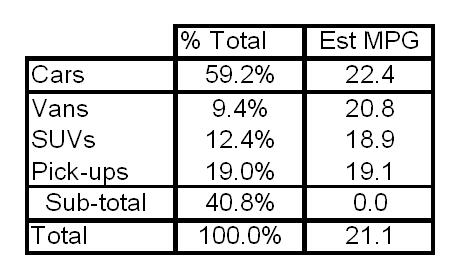
4) An average car’s actual MPG is 15% better than an average SUV, van, truck’s MPG … 22.4 MPG to 19.4 MPG

5) But, an average SUV is driven 5% fewer miles annually than an average car … 11,857 miles to 12,427 miles … so an average SUV only consumes 10% more gas per year … 612 gallons to 554 gallons

6) Current CAFE standards are 27.5 MPG for cars and 20.7 MPG for SUVs … an average car on the road is getting 22.4 MPG (82% of the CAFE) …  an average SUV on the road is getting 19.4 MPG (94% of the CAFE)

Bottom line: Based on the data, I don’t feel quite so guilty driving my SUV.

Keep reading for data and analysis

    * * * * *

Based on the latest full-year of data available from the Federal Highway Administration, U.S. households consumed over 135 billion gallons of gas 2006 — a 27%  increase since 1992, and a 4.5% increase since 2002. 

It’s conventional wisdom that the way to get consumption down is simply to raise CAFE standards (the MPG performance that new cars must achieve) and to get SUVs off the road.  The hard data suggests a bit more interesting story than that.  (See the complete data table below for details)

Cars vs SUVs

Again, fuel consumtion went up 27% from 1992 to 2006; during that same time period, the number of registered vehicles (passenger cars, vans, SUVs, light trucks) increased by 28% — from 184 million in 1992 to 235 million in 2006.  In other words, the percentage increase in registered vehicles almost perfectly matches the percentage increase in fuel consumption

There’s more to the numbers, though.  The mix of vehicles shifted away from passenger cars to vans, SUVs, trucks. 

In 1992, cars were almost 80% of the total; by 2006 — there were almost 100 million vans, SUVs, and trucks on the road — accounting for over 40% of the total.  No surprise there.

And, everybody knows that SUVs (for shorthand, I’ll just refer to the category of vans, SUVs, and trucka as “SUVs”) use more gas than cars, right? 

That’s true in aggreagte — SUVs as a group do use proportionately more gas than cars, but not by much   In 2006, SUVs were 42.3% of the vehicle mix and consumed 44.7% of the fuel. That’s not as much of a skew as most people think.  Why is that?

Keep in mind that fuel consumption is the product of both MPG (miles per gallon) and the number of miles driven.  SUVs do guzzle gas faster than cars — 19.4 MPG versus 22.4 MPG — a 15.8% difference in fuel efficiency. 

But, that spread gets partially offset by the miles driven.  On average, SUVs were driven 11,857 miles in 2006; cars weredriven 12,427 miles — a 5% conservation advantage to SUVs. 


Note: that average miles driven by SUVs fell from 1992 to 2002 .  A possible rationale is that many of them are substituting for and being used as cars, which historically have racked up lower average annual mileage.

So, an average SUV does use more gas per year than an average car, but the difference is only about 10%  — 612 gallons per SUV to 554 gallons per car.

Bottom line: SUVs are bad, but not as bad as many people make them out to be — they’re driven less and the actual MPG gap  has narrowed considerably (keep reading)

CAFE Standards (CAFE = Corporate Average Fuel Economy)

It’s hard to argue against CAFE standards.  There may be a limit as to how high they can be pushed, but we certainly haven’t reached that point.

The current CAFE standards (27.5 MPG for cars; 20.7 MPG for SUVs) have been in place for almost 15 years.  The actual fuel efficiency being achieved by the US “fleet” is 22.4 MPG for cars, and 19.4 MPG for SUVs.  In other words, the fleet average for cars is only 18% below the CAFE standard; SUVs achieve actual fuel efficiency almost 94% of their CAFE standard.  Why is that? 

Click  chart to make it bigger

Well, for openers, the CAFE standard for SUVs is lower.  But, more important, there’s an age mix of vehicles in operation — some cars may pre-date CAFE standards and drag down their average.  Since SUVs are relatively new to the scene, it’s seems reasonable to expect the fleet of SUVs to be newer and in closer compliance to the CAFE standards. 

So what?

1) Put more vehicles on the road and you’ll consume more gas — plain & simple.

2) Most fuel usage analyses focus on MPG — specifically CAFE standards — rather than actual MPG, or better yet, gallons per vehicle (per year).

3) Sure, less fuel is consumed if people drive higher MPG vehicles and hold mileage constant — but it doesn’t look like they do — as MPG goes up, so does mileage.

4) Pre-CAFE cars may be more of a problem than SUVs . (Note: I own an SUV and I don’t drive it that much).

Click  tables to make them bigger


Source: Federal Highway Administration,
            Annual Statistics, Report VM-1
            http://www.fhwa.dot.gov/policy/ohpi/hss/hsspubs.htm


Numbers – Oil – The Weak Dollar Effect

June 27, 2008

Note: I credit Martin Evans, Professor of Ecconomics, Georgetown University for remarks that inspired this analysis … of course, I take all blame for any improper analysis or wrong conclusions. 

One of the driving forces behind the recent rise in oil & gas prices has been the weakening foreign exchange value of the US dollar.

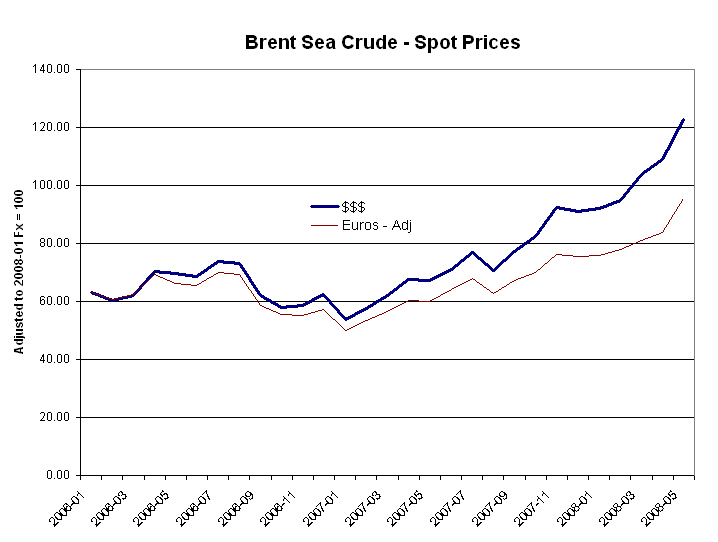
Comparing the price of oil — over time — valued in both dollars and another stronger currency helps calibrate the effect of the weakening dollar.  For example, compare the spot price of Brent Sea Crude (a represntative oil price) expressed in $ US and Euros (a relatively strong currency — compared the the US $) :


To visualize the tracking of the curves more easily, shift the Euros curve up a little so that the two curves have the same starting point. In technical terms, this process is “indexing” the two series at a common starting points.

Click chart to make it bigger 

To the extent that the curves follow each other — as they did in 2006 —  the apparent currency effect is minimal.  That is, the oil price changes are due to other factors — say, supply & demand or financial speculation. 

To the extent that the curves diverge — as they start to do in early 2007 — the apparent currency effect is increasingly meaningful.  Note that the separation between the curves increases throughout 2007, and continues in 2008.

In US dollars, the oil price went from $53.68 in January, 2007 to $122.80 in May, 2008 — up $69.12, a 128% increase. 

The oil price went from 41.30 Euros in January, 2007 to 78.93 Euros in May, 2008 — up 37.63 Euros, a 91% increase. 

By inference, if the US $ had held constant relative to the Euro, the oil price in May, 2008 would have been $102.52  ($53.68 plus 91%).  It didn’t, so the $20.28 difference ($122.80 – $102.52 = $20.28) is reasonably attributable to he currency effect of weakened dollar.

Taking some bold statistical liberties, it can be inferred that about 30% of the oil price surge is tied to the weakening dollar ($20.28 / $69.12 = 29.3%) and that about 70% of the increase in oil prices is attributable to non-currency related factors (i.e. fundamentals and speculation).

 Of course, these estimates are quite crude*  … 

* pun intended


Numbers – Price Gouging? Windfall Profits?

June 26, 2008

FYI: (a) I’m not a financial analyst or investment adviser (b) I’m not a big fan of oil companies (c) I do own some shares of Chevron Texaco  and Slumberger — not enough to sway my thinking (d) $4 per gallon for gas gives me pain at the pump, too

            * * * * *

Critics characterize oil companies’ profits as “obscene”, “unconscionable”, and “windfall”.

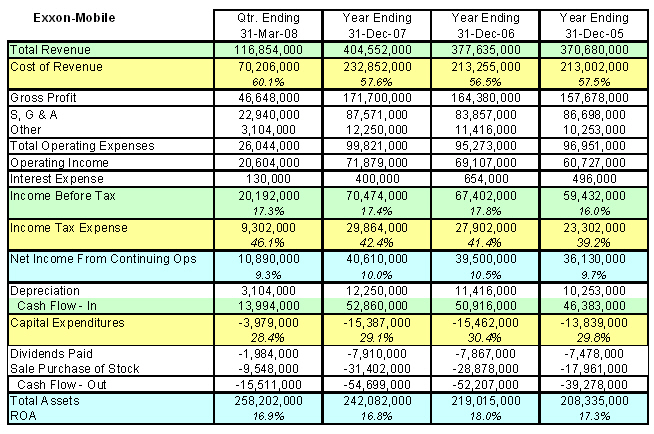
In a previous post, I compared Exxon Mobil (the poster boy for big oil) to two other mega-corps — Coke & Microsoft.  The data says that Exxon’s profit margins are lower, its effective tax rate is higher, and its ROA (return on assets) is well below Microsoft’s and roughly at par with Coke’s.  Draw your own conclusions.

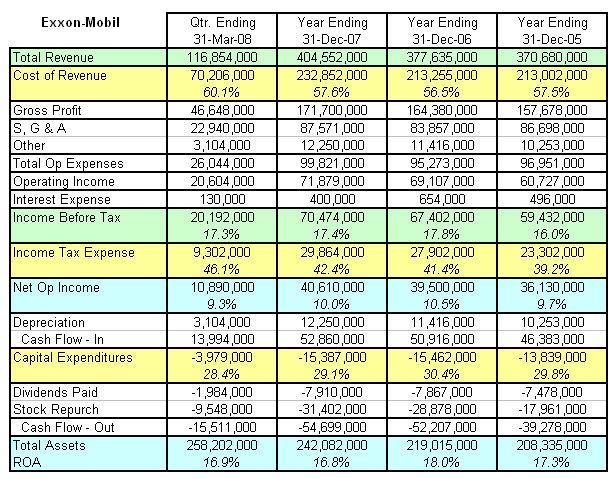
Drilling deeper on Exxon’s financial performance over the past couple of years (see chart below for details) and putting them in the perspective of standard financial ratios leads me to 5 pivotal conclusions.

1) Exxon is a very, very big company with a market cap over $450 Billion  … so all of its numbers seem supersized

2) From “50,000 feet” , there’s no evidence of price gouging … gross margins have been flat, before and after rhe run-up in crude oil prices

3) Exxon’s already paying a lot of taxes — over 40% of pretax profits, about $90 Billion since Jan. 2005

4) There’s plenty of reinvestment … capital expenditures about 30% of cash flow

5) Almost 70% of cash flow is going directly (and immediately) to shareholders in the form of dividends and stock repurchases

Some Details

1) Size & growth: Revenues have increased by about 9% from 2005 to 2007 (2% in 2006, 7% in 2007) to a whopping $404.5 billion.  Unfortunately, it’s tough to split the increases between volume (more oil sold) and price. Seems reasonable to conclude that a lot of it is price since refinery capacity is relatively fixed.

2) Margins & prices: “Cost of Revenue” has held relatively flat at about 57.5% so, by definition, gross profit margins (the flip side of cost of revenue) have been relatively flat at 42.5%.   Translation: Exxon’s “percentage mark-up” over its costs has stayed flat — if price gouging, would expect margins (i.e. mark-up) to increase.  Of course, as costs go up, the profit margin expressed in dollars (instead of percentages) goes up.  It’s reasonable to infer that Exxon’s profit — in dollars per barrel — is increasing along with crude oil prices, but that’s not evidence of gouging behavior.

3) Taxes: Exxon paid over $90 Billion in taxes from January, 2005 to March, 2008 — an effective tax rate over 40% (46.1% in Q1 of this year)

4) Reinvestment: over the 3 year period, Exxon invested about 30% of its cash flow — almost $50 Billion — in capital expenditures (presumably for drilling rigs, refineries, etc.)

5) Shareholder distributions:in recent years, about 70% of cash flow has been distributed directly to shareholders in dividends ($31.4 Billion in 2007) and stock buybacks (about $85 Billion since Jan. 2005)

So what ?

1) Retail gas prices have gone up proportionately to crude oil prices and gross margins have been flat — where is the evidence of the much touted price gouging?

2) The financial ratios are relatively constant across the years — pre and post the crude oil run up.  Where’s the windfall?

3) An effective tax rate over 40% strikes me as pretty high.  How much higher does it need to be pushed to be a  “fair share”?

4) $50 Billion in capital expenditures — 30% of cash flow — sounds like reinvestment to me.  It’s not in alternative energy sources, but as I like to say “there’s a reason they’re called oil companies”

5) In my opinion, oil company execs have been greedy (and stupid) raking off so much compensation.  But, keep in mind that most of the company’s cash flow is going directly to shareholders, either in dividends or stock buybacks (which prop up the share price for shareholders who sell) .

Note: Exxon has about 5.3 Billion shares outstanding — about 1/2 in the hands of institutions (think mutual funds) and 1/2 held by individuals.  They invested to be owners, and they’re the direct and immediate beneficiaries of Exxon’s financial success.  Said differently, any windfall profits tax would come directly out of their pockets into somebody else’s. Think about it — how fair is that?

Click chart to make it bigger  

Numbers – Obscene Profits ?

June 25, 2008

It’s a popular refrain: oil companies are making too much money and they’re failing to develop alternative energy sources.

McCain says: “I am very angry, frankly, at the oil companies not only because of the obscene profits they’ve made but at their failure to invest in alternate energy to help us eliminate our dependence on foreign oil.”

Memo to Sen. McCain: There’s a reason they’re called “oil companies” — that’s their business — that’s what they do.

Obama says:“I’ll make oil companies like Exxon pay a tax on their windfall profits, and we’ll use the money to help families pay for their skyrocketing energy costs and other bills.”

Memo to Obama: putting more money into the hands of the buyers of relatively scarce commodities will simply bid up prices faster.  It’s  fundamental economics: called the “budget effect”. Any “relief.” is briefly transitional. 

Even O’Reilly piles on, saying that the oil companies are reaping unconscionable profits by price gouging “the folks”. 

What about the obscene,  unconscionable windfall profits?  What do the numbers say?

First, on a comparative basis, it’s tough to make the case (chart below). 

Comparing Exxon Mobil to fan favorites Coke and Microsoft is revealing: 

  • Exxon’s 17.4% EBIT (earnings before interest and taxes — a measure of their profit margins — the difference between their operating costs and the prices they charge) is lower — much lower — than either Microsoft’s (39.3%) and Coke’s (28.9%)
  • Exxon already has a higher effective tax rate (42.4%) than either Microsoft (30%) or Coke (22.7%).
  • So, Exxon’s net income after taxes (10%) is about half of Coke’s (20.7%) and about 1/3 of Micosoft’s (27.5%)

Of course, applying 10% to Exxon’s gigantic revenue base ($404 billion) gives a very big number — $40 billion.  But, it takes a correspondingly enormous level of capital investment (think rigs and refineries) to generate that level of sales.  Exxon has almost $250 billion in assets — one measure of a business’ capital intensity.  Exxon earns a 16.8% return on its assets — 5 percentage points less than Microsoft, and roughly the same as Coke (depending on whether or not Coke’s “intangible assets” are counted).

Bottom line: For sure, Exxon’s profits are high.  But, they’re not “obscene”  or “unconscionable” … unless Coke and Microsoft’s are, too.  

That leaves the question of “windfall” for a follow-up post.                               


Catch: Newt “Inspired” McCain’s Prize Idea

June 24, 2008

Yesterday, candidate  McCain called for “a $300 million prize to whoever can develop a battery that will leapfrog the abilities of current hybrid and electric cars.”

On page 199 of Real Change, Newt Gingrich says “There ought to be a billion-dollar tax-free prize for the first hydrogen car that can be mass produced for a reasonable price.”

Observations:

If you’re going to jack somebody else’s ideas, give them credit — especially if the ideas are whacky.  This one meets both criteria — jacked & whacky.

At least McCain showed fiscal restraint by making the prize only $300 million — but why $300 million? In marketing jargon, that’s not a “price point” — he could have gone down to $250 million and not lost any impact, or gone up to $500 million and referred to it as “half a billion dollars” — that has some punch.

If Obama also cops the idea, it certainly won’t be tax-free.  In fact, anything over $250,000 would probably get hit with payroll taxes …

The posted reward for capturing Bin Laden is $50 million.  By inference, it must be 6 times as tough to develop a hydrogen car — and will take at least 7 years (and still counting).    

Numbers – Oil – Financial Speculation vs. Physical Hedging

June 24, 2008

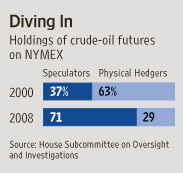
The Wall Street Journal reports that “financial speculators” currently hold more crude oil ftures than “physical hedgers” who are simply forward buying a necessary, price-escalating “factor input” to their operations.  Think: refiners and airlines.  See the prior post for data on Southwest Airline’s hedge positions.

Note : Data is from the New York Mercantile Exchange (NYMEX).  The prevailing view is that financial speculation is an even bigger piece of the action on the less regulated ICE (London based Intercontinental Commodities Exchange) and the DME (Dubai Mercantile Exchange)

Numbers – Oil Hedging – Southwest Airlines

June 24, 2008

As oil prices go up, financial speculators are garnering a lot of press and political attention, potentially obscuring the importance of commodities hedging to commercial operations (i.e. companies that actually use the oil).

When there is a scarcity projected for critical commodities — the key “factor inputs” to a company’s operations (e.g. oil for airlines) — or when prices on critical commodities are expected to increase — many companies will “forward buy” the commodities — i.e., hedge them .

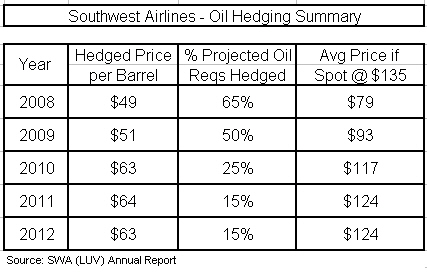
One of the ways that Southest Airlines keeps costs (and prices) comparatively low has been by hedging oil.  For example, SWA bought 65% of its projected 2008 fuel requirements (roughly 1.5 billion gallons, 35 million barrels) in advance — at an average price of $49 per barrel. 


A couple of observations:

  • Only well capitalized companies can substantially hedge key commodities — that rules out most airlines.
  • Financial speculators certainly push up the price of futures contracts — though the “players” may eventually be left hanging if spot prices fall.
  • Even SWA will feel the pressure of the ‘hot’ futures markets starting in 2010 — when their proportion of relatively cheap hedged oil falls below 50%.

Heads-up to politicians: If an operating company such as SWA hedges via exchange-traded futures contracts, then raising the margin requirements on future contracts would require an enormous inflow of capital.  For example: SWA uses about 35 million barrels of oil annually.  At $135 per barrel, that’s almost $5 billion per year.  So, if SWA hedges 50% of their oil requirement over a 4 year time horizon (as they averaged for the past couple of years), then SWA would need another $10 billion in capital to support the higher margin requirements.  As a frame of reference, SWA currently has $18 billion in “total assets” (e.g.planes. airport facilities).  That would be a challenge for them, and an impossibility for more financially fragile airlines.  (Note: I’m not sure if SWA hedges via exchanged-traded futures contracts —  they may contract directly with oil suppliers — and be outboarded from exchange margin requirements)


Hmmm: ANWR in Pictures (and Words)

June 23, 2008

According to Jonah Goldberg, writing in the National Review Online:

Both the New York Times and Washington Post editorial boards enthusiastically supported drilling in ANWR in the late 1980s. The Post noted that the area “is one of the bleakest, most remote places on this continent, and there is hardly any other where drilling would have less impact on surrounding life. . . . ”

ANWR is roughly the size of South Carolina … however, the area where, according to Department of Interior estimates, some 5.7 billion to 16 billion barrels of recoverable oil reside is much smaller and …  would amount to the size of Dulles airport.  

In the winter, it reaches 70 degrees below zero (not counting wind chill, which brings it to 120 below) and is in round-the-clock darkness.


In summer, the coastal plain is mostly mosquito-plagued tundra and bogs. (The leathernecks at Prudhoe Bay joke that “life begins at 40” — because at 40 degrees, clouds of mosquitoes and other pests take flight from the ocean of puddles).  

So, we should sacrifice national security and pay more at the pump to save this pristine land ???

Photos from  http://www.anwr.org/photo.htm
Article excerpts from http://article.nationalreview.com/?q=NTM2NzI5MmU5NTUwYzZjYTYxYWMxNjZhOWQ2NjNhODk=&w=MQ==

Numbers – U.S. Oil Refinery Operations

June 22, 2008

Summary: While the number of refineries has been substantially reduced over the past 25 years (and no new refineries have been built), aggregate refining capacity has increased and refineries have operated practically “full out”.   Source EIA (Energy Information Administration)

In 2008, there are half the number of operating refinerie in the US as there were in the early 1980s … mostly due to the retirement of outdated facilities that couldn’t be economically reengineered to meet increasingly strict environmental regulations.


Refinining capacity has increased from under 16 million barrels per day (mbpd) in the mid-1990s to over 17.5 mbpd in 2008 — an increase of more than 10%.


US oil refineries are consistently operated at utilization levels above 80% of “operable capacity” … which is generally considered to be the practical  “full out”, given normal downtime for repairs and maintenance. 

http://tonto.eia.doe.gov/dnav/pet/hist/8_na_8o0_nus_ca.htm

Free Idea: “Drill Here, Drill Now” Referendums

June 21, 2008

This one is for the McCain campaign:

Given the popular support for drilling in ANWR (over 50% approval) and off-shore in the deep seas (over 70% approval), why not get some ballot initiatives going in battleground states (e.g.  the environmentally unaffected midwest states) — public referendums on whether or not to increase domestic drilling.  Wouldn’t be legally binding on anybody, but might turn out the (right) vote.

Survey: Pick Your Favorite

June 21, 2008


Copyright protection established on June 21, 2008

Book Summary – Real Change by Newt Gingrich

June 21, 2008

 
Real Change: From a World that Fails to a World that Works
      by Newt Gingrich (former Speaker of the House)
  

Theme: activist citizenry must rise up to make government work … it won’t happen on its own due to entrenched (unionized) bureaucracies and power-hungry partisan political parties. 

Factoids & Interesting Points: 

  • It’s insane to the same thing and expect a different result (credit to Albert Einstein) 
  • Easier to be in the minority – just complain and object. 
    Majority must lead — come up with big ideas and implement them
     
  • Politicians are much better at campaigning than governing
  • Republican strategy: narrow partisan target. negative messaging, voter turnout … only works for a few campaign cycles … shrill messages eventually lose their edge and effectiveness … people can’t stay angry long enough 
  •  Democratic strategy: pander to small, specific activist segments, e.g. unions, environmentalists, who can only “win” with gov’t control and ultimately resist change to the status quo … leverage the money & visibility of the elites ( media, show biz, uber-rich) …problem: promises never materialize, mostly due to cost and ineffective government bureaucracies (waste & fraud)
  • More African-American males in prison than in college … for some, prison brings street cred … many inner-city entrepreneurs – they just operate outside the law 
  • In NYC, vice cops worked 9 am to 5 pm … drug dealers worked 9 pm to 5 am … since dealers wouldn’t change their work schedules, Rudy made the cops change their schedules
  • High school “on time” graduation rate less than 50% in Cleveland, LA, Miami, Dallas, Denver … 40% in NYC  … Baltimore lowest @ 38.5%
  • France does some things right: high speed rail, 80% nuclear powered electricity … and some things wrong: minimum work for maximum pay mindset
  • Over half of Americans own stock … over 8 million paid capital gains taxes in 2006
  • Social security tax rate = 12.4% (ouch) … split between employee and employer … currently capped at about $100k … Obama’s “tax & redistribute” plan: 12.4% from zero to $100k, and over $250k

Newt on Leadership (credit to Peter Drucker)

Values > Vision > Metrics > Strategies > Projects > Tasks

First, win agreement … then win the vote
Win agreement by saying “yes, if…” rather than “no, because …”

Reward the efforts & success of “contributors” … don’t penalize it 

Newt’s formula for change

Homeland security – the highest priority

English –  the official language … preserve American history & culture·        

Free market education: charter schools and vouchers … maybe even paying students for good grades
  
“Free choice” flat tax (17%) … eliminate taxes on capital gains, dividends, pensions & social security, and death … allow choice to continue deductions system
   
Immigration: close the borders, guest worker program aggressive assimilation 
        
Trial lawyers, civil litigation: losers pay costs, class action limits
     
Direct ownership: homes, retirement accounts
        
Balanced budget: to force hard choices, eliminate earmarks & pork-barrel spending, cut future burden
        
Energy: drill here now, nuclear, incentives for renewables  

Heath care: more personal ‘choose and pay’ (vs 3rd party – insurers and gov’t) electronic records (e-prescriptions), personal responsibility – prevention, restrictions on trial lawyers 

Ken’s Take: Quick read … not much new, insightful, provocative
                             … borrow it, don’t buy it.

Opinion: A Circuitous Way to Tax Gas at the Pump

June 19, 2008


Recently, when asked about burdening high gas prices, candidate Obama opined that he “would have preferred a more gradual progression (to high gas prices)”.  His bluntness and candor – while probably unintended – was quite revealing. In fact, he may have provided a defining clue regarding his core – but politically vulnerable — oil policy. 


First, at the extreme, progressive conservationists would like to end the use of all fossil fuels (i.e. coal and oil) since their extraction scars the earth, and their emissions threaten to warm the planet.  Beneath the hysteria, the zealots’ concerns are deep-rooted and, most likely, are directionally correct.


Most economists would probably agree that the “pure play” to ending the use of carbon-based fuels would be to “internalize their external costs” by taxing them.  That is, for example, to institute a high federal gas tax at the pump – pushing consumers’ prices to a painfully high enough level that demand for gas falls (i.e. significant conservation takes hold) and alternatives become economically more attractive (e.g. biofuels and hybrid cars).


But, political populists don’t want to impose lifestyle changes or economic hardships on hard working middle class citizens – or, at least, they don’t want to seem like they’re doing so.  A high federal gas tax at the pump would be a conspicuous lightning rod that would be politically suicidal for any candidate.


So, the reconciling question for populist conservationists is “how to get pump prices up enough to cause a shift out of gasoline without appearing to hurt the working class economically and getting punished politically?”


As Sherlock Holmes would say, “simple, Watson”.  Simply leverage classical economic market forces.  How?  (1) By constraining the supply of oil (and gasoline) to force prices to rise, (2) By putting more money into buyers’ hands to turboboost the price trajectory, and (3) By denying purposeful complicity and blaming convenient fall guys for the sorry state of affairs.


Constraining supply is the easiest part: outcast the problematic foreign oil sources (i.e. OPEC), alienate Mexico and Canada (our friendly sources) by reopening NAFTA, logjam any high potential domestic exploration (deep-sea, ANWR, mountain shale), and continue to outlaw expansion of gasoline refinery capacity.  The latter is particularly important since refineries are the “choke point” in the gasoline supply system.  As long as refinery output is kept in check, the excess market demand will eventually push gas prices up. It’s basic economics.


How can these natural economic forces – which some believers may consider too slow — be turbocharged?  Also easy.  First, let the exchange value of the U.S. dollar fall so that it takes more dollars to buy a barrel of oil (or anything else).   Then, let unsupervised financial speculators throw their stockpiled cash into the oil market, bidding up the price of oil futures contracts.  


And if that isn’t enough, move to mitigate the imposed economic burden on consumers by providing some personal “budgetary relief” via tax breaks – say, $1,000 per person to cover the increasing price of gas.  Said differently, give people more money so that they can bid up the prices even faster.  A masterful tactic since a grateful citizenry will embrace an altruistic government stepping in to ease their economic pain, never suspecting that they are important pawns in a clever plot to push prices even higher. 


And how can this “budgetary relief” be funded?  Easy.  Close the loop by taxing the apparent windfall profits of the price-gouging oil companies.  Specifically, candidate Obama promised, “I’ll make oil companies like Exxon pay a tax on their windfall profits, and we’ll use the money to help families pay for their skyrocketing energy costs and other bills.”


Another great play since political credit can be claimed for a  tax neutral program  that punishes a group of notorious corporate villains, using their ill-gotten and undeserved gains to provide middle class budget relief.  Bingo!  A certain shield of deniability (for the higher gas prices), and — with a little luck – probable coronation as a  savior.


Rather than going through these multilevel shenanigans and obfuscations, wouldn’t it just be easier to put a federal tax on gas at the pump? 


I guess that would be too obvious to folks.


KE Homa

6-19-08


Our Family …

June 19, 2008

Jess, Scott, Meg, Jay, Kathy & Ken
Jay & Meg’s Wedding – May 31, 2008

Kicking it off …

June 16, 2008

Some of my former students suggested that I start a blog with current thinking on marketing issues and views on the world.  

My first message to them: Be careful what you wish for …

KEH