Some politicos and pundits say that payroll taxes — the paycheck deductions that fund Medicare and Social Security are regressive taxes — with high earners paying lower rates than low earners.
For Medicare, they point out that that the same tax rate is applied to both high and low wages — the definition of a regressive tax.
First, no it isn’t. It’s a neutral of proportional tax. A regressive tax rate goes down as income increases. This one stays the same.
More important, though, the benefits eventually received are identical — whether a taxpayer contributed a little or a lot.
When the Medicare program is considered in its totality — contributions and benefits — it’s clearly progressive — with high earners paying way more for the same benefits that low earners get.
* * * * *
The Details
The Medicare Program was introduced in 1966. It is primarily “our country’s health insurance program for people age 65 or older” — “helping” to pay (i.e. not paying all) for hospital services & stays, doctors, medical supplies, and prescription drugs. The latter is courtesy of the Bush administration.
Generally, people who qualify for Social Security benefits qualify for Medicare. Importantly, everyone who’s on Medicare gets exactly the same benefits package — regardless of how much they paid into the program over the years through payroll deductions.
Medicare isn’t a free program.
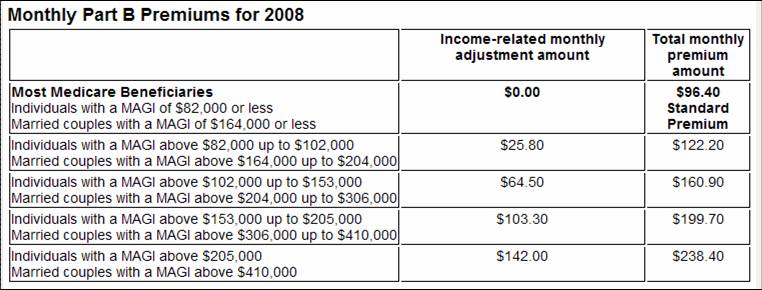
First, plan participants (i.e. retirees) have to pay monthly premiums. Most folks pay about $100 per month ($1,200 annually), but higher income participants pay more, scaled to their retirement incomes. Folks with super-sized retirement benefits pay $2,860 per year — 2.4 times the low-earners premium. That’s progressive, not regressive — but since about 95% of plan participants pay the minimum monthly benefit, it’s not a big deal.

click table to make it bigger
What are a big deal are the contibutions that people pay during their working years.
The bulk of Medicare funding (roughly 75%) comes from paycheck deductions over a wage earners career. While these are deductions are popularly referred to as “payroll taxes”, they are called “contributions” on the Social Security web site — indicating that they are more akin to prepaid insurance premiums that general taxes.
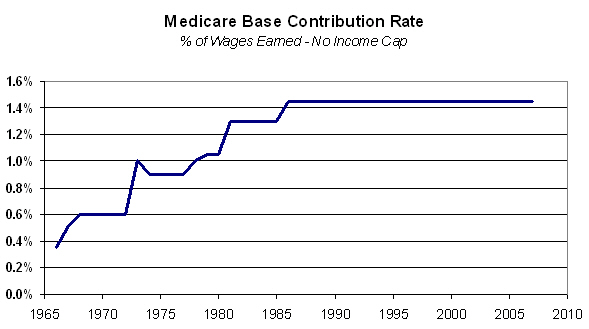
The contribution rates have increased over the years (see chart below). These days, employees have 1.45% of their wages deducted from their paychecks — with no income limits. So, a person earning $25,000 pays $362.50 to the government dor safe-keeping; a person earning $150,000 pays $2,175. Though the amounts are way different, the rate is the same — 1.45%. Some people consider the constant rate to be regressive. In fact, : it’s neither regressive nor progressive — it’s proportional and, thus, income neutral.

Employers are obligated to match employees’ Medicare contributions dollar-for-dollar. So, the combined Medicare contribution is 2.9% — half paid by employees and half paid by employers. Since self-employed folks are both employers and employees, that get docked for the full 2.9%
- Note: Most economists say that the employer contribution is an employee burden. They argue that if employers didn’t have to make the matching contribution, then employee wages would be higher by that amount.
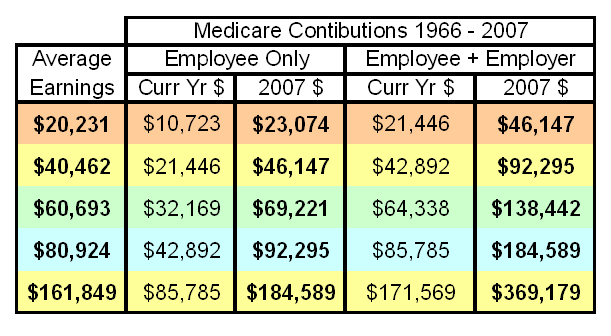
The big deal is that the cumulative “insurance premiums” paid by a high earner are SUBSTANTIALLY higher than low-earners’ contributions.
For example, take 5 individuals who have been earning wages since 1966 (the uear Medicare was introduced). A relatively low-earner — with average earnings of about $20,000 over the period 1966 to 2007 — would have paid about $10,700 in Medicare premiums during that period. Inflation indexing each year’s “current year” dollars (i.e. the “nominal amounts”), the premium are worth over $23,000 in 2007 dollars (i.e. “real amounts”). A relatively high-earner — raking in average wages of about $80,000 — would have contibuted about $43,000 in current year dollars — inflated up to about $92,000 in 2007 dollars. Middle-earners pay between those low and high amounts; uber-earners pay, and pay, and pay.
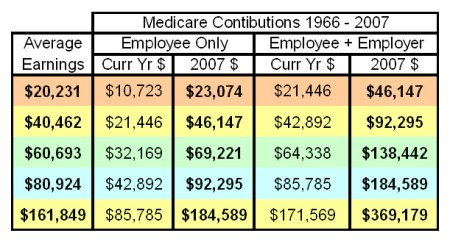
click table to make it bigger
- Note: The employer contributions don’t impact the degree to which the Medicare program is regressive or progressive — but, when conbined with the employee contributions and inflated up to 2007 dollars, might raise some questions about the program’s fundamental economics.
Again, keep in mind that Medicare benefits are identical for all — regardless of how much was paid into the program over the course of a wage earner’s career.
So, high-earners pay substantially more than low-earners for exactly the same benefits. And, high-earners who get high pension benefits or IRA payouts — a very likely correlation — get even less in program benefits since their premiums are higher (than low-earning retirees).
* * * * *
The bottom line:
Curent year Medicare paycheck deductions are income neutral since the same rate applies to all wage earners, with no cap on the income level.
The premiums paid by high-earners are literally multiplles of the premiums paid by low-earners.
Benefits are identical, regardless of whether a person is a high- or low- wage earner. Arguably, the benefits are slightly progressive since high retirement earners have to pay higher Medicare premiums.
There’s no way that anybody can say with a straight face that the Medicare portion of “payroll taxes” is regressive? It’s progressive — in fact, very progressive. PERIOD !
* * * * *
Next up: So, what about Social Security — regressive or progressive ?
* * * * *
More re: Medicare from the goverbment web site:
http://www.ssa.gov/pubs/10043.html#part2
Medicare is our country’s health insurance program for people age 65 or older. Certain people younger than age 65 can qualify for Medicare, too, including those who have disabilities and those who have permanent kidney failure or amyotrophic lateral sclerosis (Lou Gehrig’s disease). The program helps with the cost of health care, but it does not cover all medical expenses or the cost of most long-term care.
Medicare has four parts
- Hospital insurance (Part A) that helps pay for inpatient care in a hospital or skilled nursing facility (following a hospital stay), some home health care and hospice care.
- Medical insurance (Part B) that helps pay for doctors’ services and many other medical services and supplies that are not covered by hospital insurance.
- Medicare Advantage (Part C) plans are available in many areas. People with Medicare Parts A and B can choose to receive all of their health care services through one of these provider organizations under Part C.
- Prescription drug coverage (Part D) that helps pay for medications doctors prescribe for treatment.
For most beneficiaries, the government pays a substantial portion—75 percent—of the Part B standard premium and the beneficiary pays the remaining 25 percent.
Beginning in 2007, the government portion was reduced for higher income beneficiaries who began paying a larger percentage of the premium based on income … In 2008, higher income beneficiaries will be responsible for 67 percent of their income-related adjustment. By 2009, the end of the transition period, these higher income beneficiaries will pay a monthly premium equal to 35, 50, 65, or 80 percent of the total Part B cost, depending on their income level. However, the law is expected to affect only about 4 to 5 percent of Medicare beneficiaries, so most people will continue to pay the standard premium, without an income-related adjustment.
* * * * *
Want more from the Homa Files?
Click link => The Homa Files Blog
* * * * *
SHARE THIS POST WITH FRIENDS & FAMILY


 The Homa Files