Archive for August 14th, 2008

In the Wall Street Journal …

August 14, 2008

The  WSJ.com “Forum” accepted an abbreviated  Homa Files post.

Subject is the Obama tax plan, of course.

To see the post “live”, click the link and scroll down until you get to “homak” in the left hand column

http://forums.wsj.com/viewtopic.php?t=3687&autoredirect=true&sid=233db09d1fae8f63f5719726f4dfe89b

click image to make it bigger

* * * * *

The Obama Tax Plan 
homak’s reply

In their op-ed outline of Obama’s tax plan, Furman & Goolsbee make a valiant effort to focus attention on the capillaries instead of the jugular.

The most fundamental issue, if the Obama plan is enacted, is that a minority of voting age citizens will be paying 100% of all Federal income taxes. A majority will not be paying any Federal income taxes at all.

Currently, according to IRS data, 41% don’t pay any income taxes. Obama’s web site claims that 10 million more will be taken off the tax rolls via his $500 and $1,000 tax credits; another 7 million are seniors currently paying some income taxes who come off the rolls. Those 17 million additions push the number to 49%.

And, the Obama campaign projections are probably low — very low.

Based on the 2006 IRS data, approximately 22 million adults were represented on tax returns for married couples filing jointly that reported AGI less than $27,500 and paid some income taxes. Doing the tax credit math, they come off the tax rolls and push the percentage up to 51%.

Further, there are about 4.7 million childless individuals who earn less than $13,750 and currently pay some income taxes. They come off the rolls and push the number to 55% — a comfortable majority.

(For a complete analysis, see https://kenhoma.wordpress.com/2008/07/31/under-obama-tax-payers-will-be-a-minority/)

* * * * *

Based on the hard numbers, Obama’s plan will create a new majority — a powerful voting block of non-tax payers.

For those in the emerging majority that won’t pay any Federal income taxes – or may even be getting government checks for tax credits due – the deal is almost too good to be true. To them, Obama’s plan must make perfect sense. Obama can probably count on their vigorous and perpetual support.

But those in the new tax paying minority, there’s cause for concern. What if the new majority decides that more government services are needed, or that a mere $100 billion, or so, of income redistribution isn’t enough to balance the scales? There will be no way to stop the train.

The Tax Foundation — a nonpartisan tax research group – has repeatedly warned that “While some may applaud the fact that millions of low- and middle-income families pay no income taxes, there is a threat to the fabric of our democracy when so many Americans are not only disconnected from the costs of government but are net consumers of government benefits. The conditions are ripe for social conflict if these voters begin to demand more government benefits because they know others will bear the costs.”

(See http://www.taxfoundation.org/research/show/1111.html)

Want more from the Homa Files?
Click link =>
  The Homa Files Blog

* * * * *

Olympics – There’s no such thing as too much beach volleyball …

August 14, 2008

Excerpted from WSJ, “Beach Volleyball’s Moment”, August 14, 2008

The sport, with its beach-party atmosphere featuring impeccably cut and tanned athletes competing in skimpy bathing suits, is seen as having huge entertainment potential, which is why NBC is featuring it live in prime time throughout the Summer Games.

A number of promoters … hope the attention will help them turn beach volleyball into a perennial moneymaker, rather than a novelty hit that comes along every four years.

Despite the millions tuning into the myriad attractions of beach volleyball during the Games, the Association of Volleyball Professionals Inc., which operates games around the U.S. under the banner of the AVP Crocs Tour, is struggling to become profitable.

NBA Commissioner David Stern sees promise in professional volleyball. “You’ve got a good game, a young demographic, a great setting,” he says. “It’s got a lot going for it.”

AVP’s organizers saw opportunity in a game that traces its roots to a popular sun-splashed lifestyle. Moving from city to city, the AVP Crocs Tour is a roving, three-day beach party, with music, food and fun centered around a traveling 5,000-seat stadium.

AVP’s best players now earn several hundred thousand dollars each year in prize money and endorsements, such as swimsuit endorsements …  But many AVP players don’t make enough to cover their expenses …. some players occasionally sleep on the beach at tour events.

“I never planned to earn any money at this,”  said one competitor. “I thought I was going to have to get a real job.”

For full article (with pictures):
http://online.wsj.com/article_print/SB121867765133039329.html

* * * * *

Why not? A beach volleyball channel ?

Oh, I guess NBC has that locked up already …

* * * * *

Want more from the Homa Files?
Click link =>
  The Homa Files Blog

* * * * *

Taxes – Campaign’s economic advisers clarify Obama’s tax plan …

August 14, 2008

Excerpted from the WSJ, “The Obama Tax Plan”, By JASON FURMAN and AUSTAN GOOLSBE, economic policy director and senior economic adviser to Obama; August 14, 2008

Barack Obama proposes fiscally responsible tax reform to strengthen our economy and restore the balance that has been lost in recent years …

Sen. Obama’s tax plan … has even lower taxes than prevailed in the 1990s — including lower taxes on middle-class families, lower taxes for capital gains, and lower taxes for dividends.

Overall, Sen. Obama’s middle-class tax cuts are larger than his partial rollbacks for families earning over $250,000 …  reducing revenues to less than 18.2% of GDP — the level of taxes that prevailed under President Reagan.

Sen. Obama is focused on cutting taxes for middle-class families and small businesses, and investing in key areas like health, innovation and education.

Sen. Obama … would cut taxes for 95% of workers and their families with a tax cut of $500 for workers or $1,000 for working couples.

In addition, Sen. Obama is proposing tax cuts for low- and middle-income seniors, homeowners, the uninsured, and families sending a child to college or looking to save and accumulate wealth.

Sen. Obama also … is proposing additional tax cuts, including a tax credit for small businesses that provide health care, and the elimination of capital gains taxes for small businesses and start-ups.

Sen. Obama … would repeal a portion of the tax cuts passed in the last eight years for families making over $250,000.

The top two income-tax brackets would return to their 1990s levels of 36% and 39.6%

The top capital-gains rate for families making more than $250,000 would return to 20%

The tax rate on dividends would also be 20% for families making more than $250,000.

The estate tax would be effectively repealed for 99.7% of estates, and retained at a 45% rate for estates valued at over $7 million per couple.

Overall, in an Obama administration, the top 1% of households — people with an average income of $1.6 million per year — would see their average federal income and payroll tax rate increase from 21% today to 24%.

Sen. Obama … would not raise any taxes on couples making less than $250,000 a year, nor on any single person with income under $200,000 — not income taxes, capital gains taxes, dividend or payroll taxes.

As previously mentioned, the Obama plan is a net tax cut — his middle-class tax cuts are larger than the rollbacks he has proposed for families making over $250,000.

While Sen. Obama would … strengthen solvency by asking those making over $250,000 to contribute a bit more to Social Security to keep it sound.

Sen. Obama  … is considering plans that would ask those making over $250,000 to pay in the range of 2% to 4% more … starting a decade or more from now .

Do not take the critics’ word for it. Go look at the plans for yourself at www.barackobama.com/taxes

Full article:
http://online.wsj.com/article_print/SB121867201724238901.html

Also read: Washington Post, “Obama Tax Plan Would Balloon Deficit”
http://www.washingtonpost.com/wp-dyn/content/article/2008/08/09/AR2008080901860.html

* * * * *

Ken’s Observations

1. Be sure to note the comparison bases for all of the changes … Reagan’s proposals — which were coming off the Carter years, and the Bush changes — which came after Clinton jacked up rates. 

The core question to ask: was the prosperity during the Clinton years due to the realization of changes  from the Reagan tax cuts or from near instantaneous stimulus  induced by Clinton tax hikes?  Hmmm.

2.  My personal prediction: stock market goes down 15 to 25% if the tax rates on dividends and capital gains get implemented.  Biggest impact will be on baby boomers who thought they’d be retiring from work.  No way most of them will be able to afford it.

3. The Social Security proposal isn’t just a rate change, it’s a fundamental philosophical change — decoupling contributions to the trust fund (i.e. payroll taxes) from the benefits eventually received. Social Security becomes just another income redistribution program.  (See details in today’s other post). 

4. The editorial recap fails to mention that Obama’s proposals will result in a minority of voting age citizens paying any  income taxes.  For those of you in the emerging minority of tax payers, watch out.  If the new non- taxpaying majority wants more programs or more wealth distribution, there won’t be anything you can do to stop the train.

5. Dogbert lives …


* * * * * 

Want more from the Homa Files?
Click link =>
  The Homa Files Blog

* * * * *

Full Text from WSJ:

The Obama Tax Plan
By JASON FURMAN and AUSTAN GOOLSBEE
August 14, 2008;

Even as Barack Obama proposes fiscally responsible tax reform to strengthen our economy and restore the balance that has been lost in recent years, we hear the familiar protests and distortions from the guardians of the broken status quo.

Many of these very same critics made many of these same overheated predictions in previous elections. They said President Clinton’s 1993 deficit-reduction plan would wreck the economy. Eight years and 23 million new jobs later, the economy proved them wrong. Now they are making the same claims about Sen. Obama’s tax plan, which has even lower taxes than prevailed in the 1990s — including lower taxes on middle-class families, lower taxes for capital gains, and lower taxes for dividends.

Overall, Sen. Obama’s middle-class tax cuts are larger than his partial rollbacks for families earning over $250,000, making the proposal as a whole a net tax cut and reducing revenues to less than 18.2% of GDP — the level of taxes that prevailed under President Reagan.

Both candidates for president have proposed tax plans. But they are starkly different in their approaches and their economic impact. Sen. Obama is focused on cutting taxes for middle-class families and small businesses, and investing in key areas like health, innovation and education. He would do this while cutting unnecessary spending, paying for his proposals and bringing down the budget deficit.

In contrast, John McCain offers what would essentially be a third Bush term, with his economic speeches outlining $3.4 trillion of tax cuts over 10 years beyond what President Bush has already proposed and geared even more to high-income earners. The McCain plan would lead to deficits the likes of which we have never seen in this country. It would take money from the middle class and from future generations so that the wealthy can live better today.

Sen. Obama believes a focus on the middle class is appropriate in the wake of the first economic expansion on record where the typical family’s income fell by almost $1,000. The Obama plan would cut taxes for 95% of workers and their families with a tax cut of $500 for workers or $1,000 for working couples. In addition, Sen. Obama is proposing tax cuts for low- and middle-income seniors, homeowners, the uninsured, and families sending a child to college or looking to save and accumulate wealth.

The Obama plan would dramatically simplify taxes by consolidating existing tax credits, eliminating the need for millions of senior citizens to file tax forms, and enabling as many as 40 million middle-class filers to do their own taxes in less than five minutes and not have to hire an accountant.

Sen. Obama also recognizes that small businesses are the engine of job growth in the economy. That is why he is proposing additional tax cuts, including a tax credit for small businesses that provide health care, and the elimination of capital gains taxes for small businesses and start-ups. The vast majority of small businesses would face lower taxes under the Obama plan than under the McCain plan. In addition, Sen. Obama supports reforming corporate taxes in a manner that would help create jobs in America and simplify the tax code by eliminating distortions and special preferences.

Sen. Obama believes that responsible candidates must put forward specific ideas of how they would pay for their proposals. That is why he would repeal a portion of the tax cuts passed in the last eight years for families making over $250,000. But to be clear: He would leave their tax rates at or below where they were in the 1990s.

– The top two income-tax brackets would return to their 1990s levels of 36% and 39.6% (including the exemption and deduction phase-outs). All other brackets would remain as they are today.

– The top capital-gains rate for families making more than $250,000 would return to 20% — the lowest rate that existed in the 1990s and the rate President Bush proposed in his 2001 tax cut. A 20% rate is almost a third lower than the rate President Reagan set in 1986.

– The tax rate on dividends would also be 20% for families making more than $250,000, rather than returning to the ordinary income rate. This rate would be 39% lower than the rate President Bush proposed in his 2001 tax cut and would be lower than all but five of the last 92 years we have been taxing dividends.

– The estate tax would be effectively repealed for 99.7% of estates, and retained at a 45% rate for estates valued at over $7 million per couple. This would cut the number of estates covered by the tax by 84% relative to 2000.

Overall, in an Obama administration, the top 1% of households — people with an average income of $1.6 million per year — would see their average federal income and payroll tax rate increase from 21% today to 24%, less than the 25% these households would have paid under the tax laws of the late 1990s.

Sen. Obama believes that one of the principal problems facing the economy today is the lack of discretionary income for middle-class wage earners. That’s why his plan would not raise any taxes on couples making less than $250,000 a year, nor on any single person with income under $200,000 — not income taxes, capital gains taxes, dividend or payroll taxes.

In contrast, Sen. McCain’s tax plan largely leaves the middle class behind. His one and only middle-class tax cut — a slow phase-in of a bigger dependent exemption — would provide no benefit whatsoever to 101 million families who do not have children or other dependents, or who have a low income.

But Sen. McCain’s plan does include one new proposal that would result in higher taxes on the middle class. As even Sen. McCain’s advisers have acknowledged, his health-care plan would impose a $3.6 trillion tax increase over 10 years on workers. Sen. McCain’s plan will count the health care you get from your employer as if it were taxable cash income. Even after accounting for Sen. McCain’s proposed health-care tax credits, this plan would eventually leave tens of millions of middle-class families paying higher taxes. In addition, as the Congressional Budget Office has shown, this kind of plan would push people into higher tax brackets and increase the taxes people pay as their compensation rises, raising marginal tax rates by even more than if we let the entire Bush tax-cut plan expire tomorrow.

The McCain plan represents Bush economics on steroids. It has $3.4 trillion more in tax cuts than President Bush is proposing, largely directed at corporations and the most affluent. Sen. McCain would implement these cuts without proposing any meaningful steps to simplify taxes or eliminate distortions and loopholes. In addition, Sen. McCain has floated over $1 trillion in new spending increases but barely any specific spending cuts.

As previously mentioned, the Obama plan is a net tax cut — his middle-class tax cuts are larger than the rollbacks he has proposed for families making over $250,000. Sen. Obama would pay for this tax cut by cutting spending — including responsibly ending the war in Iraq, reducing excessive payments to private plans in Medicare, limiting payments for high-income farmers, reducing subsidies for banks that make student loans, reforming earmarks, ending no-bid contracts, and eliminating other wasteful and unnecessary programs.

While Sen. Obama would shrink the deficit from its current record levels, he recognizes that it is even more important to confront our long-term fiscal challenges, including the growth of health costs in the public and private sector. He also believes it is critical to work with members of Congress from both parties to strengthen Social Security while protecting middle-class families from tax increases or benefit cuts. He has done what few presidential candidates have been willing to do by making a politically risky proposal to strengthen solvency by asking those making over $250,000 to contribute a bit more to Social Security to keep it sound.

Sen. Obama does not support uncapping the full payroll tax of 12.4% rate. Instead, he is considering plans that would ask those making over $250,000 to pay in the range of 2% to 4% more in total (combined employer and employee). This change to Social Security would start a decade or more from now and is similar to the rate increases floated by Sen. McCain’s close adviser Lindsey Graham, and that Sen. McCain has previously said he “could” support.

In contrast, Sen. McCain has put forward the most fiscally reckless presidential platform in modern memory. The likely results of his Bush-plus policies are clear. As Berkeley economist Brad Delong has estimated, the McCain plan, as compared to the Obama plan, would lower annual incomes by $300 billion or more in real terms by 2017, costing the typical worker $1,800 or more due to the effect of large deficits on national savings and thus capital formation. Sen. McCain’s neglect of critical public investments would further impede economic growth for decades to come.

Do not take the critics’ word for it. Go look at the plans for yourself at www.barackobama.com/taxes1. Get the facts and you will see the real priorities at stake in this election. America cannot afford another eight years like these.

Messrs. Furman and Goolsbee are, respectively, economic policy director and senior economic adviser at Obama for America.

* * * * *

Taxes – Payroll taxes, especially Social Security, are regressive … NOT !!!

August 14, 2008

Summary: In prior posts, I set-up the following issue …

Some policy analysts (typically left-leaning) such as  Robert Reich, Bill Clinton’s former Secretary of Labor argue that “Most Americans pay more in payroll taxes than in income taxes … payroll taxes take a much bigger portion of the paychecks of lower-income Americans than of higher-income … Viewed as a whole, the current tax system is quite regressive.”
http://economistsview.typepad.com/economistsview/2007/10/robert-reichs-p.html

Other analysts such as the Urban Institute clarify  “The payroll tax is very regressive with respect to current income: The average tax rate falls as income rises …  (But) the regressivity of the payroll tax is mitigated to a substantial extent when Social Security and Medicare benefits are considered as well.
http://www.urban.org/publications/1001065.html

But analysts generally “punt” the question “what is the effect when both payroll taxes and their benefits are considered ? ”  Why ? In part, I suspect, because they know the  answer doesn’t fit their politics … and, in part, because the analysis is challenging — with many nuances and moving parts.

In this post, I take a shot at the “combined effect” question by applying some fundamental financial analysis tools. 

Specifically, I treat Social Security benefits as an annuity stream to individual retiring workers and I treat annual  payroll taxes over a worker’s career as periodic “premiums” that get applied to the “purchase” of the annuity.”contract”.  After adjusting for inflation, the difference between the present value of the expected benefits stream and the present value of the “premiums” paid over the years is, in essence, the real tax that a plan participant pays.

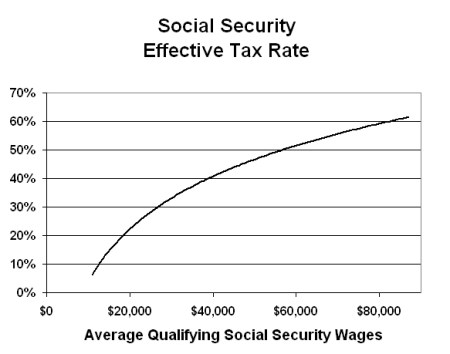
The answer: low wage earners pay practically nothing for their benefits — their contributions are simply a forced saving for their retirement benefits.  High earners get relatively little of their contributions back —  in effect, paying a tax rate over 60%
* * * * *

Analytical Details

Regarding Social Security, a Congressional Joint Economic Committee reports:

“The rapid growth in payroll taxes over the past 40 years has imposed a large burden on working Americans. This burden has fallen disproportionately on low-income workers.

However, in the context of a comprehensive tax policy, it is misleading to focus on the short-term burden imposed by payroll taxes without accounting for the future benefits they provide through the Social Security program.

Social Security benefits are paid according to a progressive formula that gives low-wage workers a better rate of return on their contributions than it gives high-wage workers. The progressivity of the benefit formula outweighs the disproportionate burden imposed by the tax.

As a result, low-wage workers can expect to receive benefits that exceed the sum of their and their employers’ payroll tax contributions. Middle- and high-wage workers, on the other hand, can expect to pay substantially more into the system than they will receive in benefits.

Overall, middle- and high-wage workers subsidize the income and payroll tax liabilities of low-wage workers, leaving most low-wage workers with net negative tax liabilities throughout their lifetimes.”
http://www.house.gov/jec/fiscal/tx-grwth/payroll/payroll.htm

* * * * *

Here’s what the Joint Economic Committee is talking about:

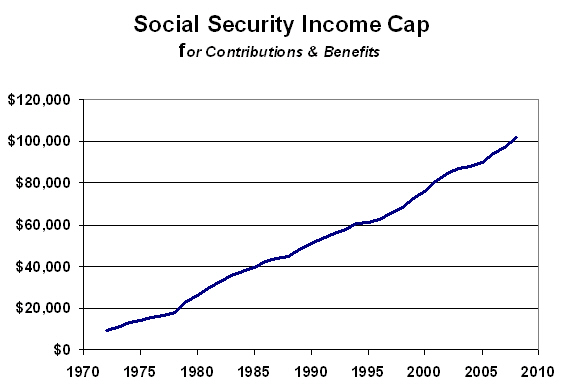
The amount employees have deducted from their paychecks is determined by the Social Security tax rate and annual income “caps” – the maximum amount of wages subject to the tax.  The Social Security tax rate has been flat for almost 20 years; and the income cap has consistently increased over the years.

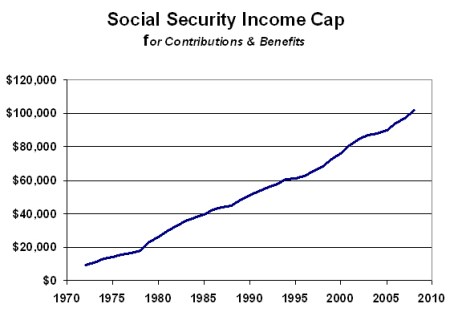


Currently. an employee’s Social Security tax rate is 6.2% on annual wages up to $102,000.  For high earners, the rate drops to zero for any wages over $102,000 in a given year.


For example, somebody earning $50,000 has $3,100 deducted from their paychecks [6.2% times $50,000].  Somebody earning $102,000 has $6,324 deducted [the same 6.2% times $102,000].  Somebody earning $200,000 has $6,324 deducted [6.2% times the $102,000 income “cap”; 0% on wages over $102,000] — so their effective rate drops to 3.2%.  The more somebody earns over the $102,000 income cap, the lower their effective rate.. By definition, that’s a regressive tax, right?


* * * * *


Not so fast.  There’s more to the story.


First, the 6.2% tax rate is literally only half of the story.  Employer’s are legally obligated to pay a matching amount to the Social Security fund (similar to a company matching 401-K contributions — but certainly not voluntary).  So, the applicable rate is really 12.4% (2 times 6.2%) — up to $102,000 in earnings. 

  • Note: Most economists argue that, in the final analysis, employees bears the full burden of the employer’s matching amounts since employers probably cover the tax by reducing wages – or viewed conversely, employers would raise wages if they weren’t stuck paying the Social Security taxes.  That conclusion is debatable, but we’ll accept it and treat the full.12.4% as a charge incurred by the employee).  
  • Note: Employers can deduct their share of the contribution for income tax purposes, but workers’ shares are not tax deductible.  For simplicity, we’ll ignore that taxing distinction. 

Obviously, doubling the rate ups the ante, but it doesn’t make this payroll tax any more (or less) regressive or progressive.


Second, while Social Security payroll deductions fit the technical definition of a tax    i.e.  a “levy” imposed on an individual or a legal entity by a government — they don’t act like most taxes. 


Most taxes are collected to fund a common interest (say, defending the country or building a bridge).  The amount that a taxpayer gets charged, is de-coupled from the benefits they (the tax payers) may receive. That is, the taxpayer may or may not actually receive a direct (or indirect) benefit, and any benefits that they do receive are almost always non-monetary (e.g. riding on a freshly paved highway, calling for an EMT crew)..


Social Security is different – it is both monetary and coupled. With Social Security, the benefits are strictly monetary – monthly retirement income checks – and are based on a  formula that is explicitly coupled to the beneficiary’s career income and corresponding contributions to the Social Security fund.


* * * * *


Let’s illustrate Social Security math using a hypothetical retiree.  We’ll call him Harry the High-earner — for shorthand referencing, just plain old Harry. 


Assume that Harry – an unmarried guy — turns 66 on January 1, 2008 and decides to retire — claiming his full Social Security benefits.

  • Note: if Harry had retired at an earlier age, say 62, he would have started receiving scaled down benefits a few years earlier. 

Also assume that Harry has been working since age 25, that he earned precisely the maximum taxable base earnings each year (i.e. the year-by-year equivalent of 2008’s $102,000 wage cap), and that he and his employer both paid the applicable Social Security rates each year on those earnings. 


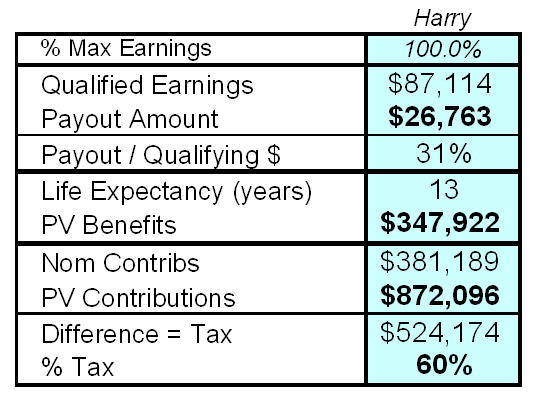
Applying historical Social Security rates and income caps, during the 41 year period (since age 25), Harry would have had $190,595 deducted from his paychecks.  His employer would have matched that amount  dollar-for-dollar.   


Again, economists usually argue that employee’s bear the burden of their employer’s contributions since they are  simply a diversion of higher  wages that might have been paid to the employee.  So, Harry’s total contributions – including his employers’ portions — are $381,189. 


The $381,189 is a “nominal” amount since it doesn’t reflect the impact of inflation over the years.  Using government-provided inflation indexing factors, the $381,189 has a “real” worth — in 2008 dollars – equal to $872,096.  That’s how much Harry and his employer paid into the Social Security fund, adjusted for inflation.

http://www.ssa.gov/pubs/10070.html#a


Conceptually, when he retires and starts drawing benefits, Harry is taking the $872,096 in accumulated contributions (stated in 2008 dollars) and investing the whole amount in an annuity —  a steam of checks that he’ll be receiving from the government.


How much is the annuity worth to Harry?  That is, what’s Harry getting for his $872,096 ?


The annuity valuation has two main components: the amount of the periodic payments and the duration of the payment stream.


Social Security benefits are based  on a relatively complex formula that factors historical earnings against a sharply dropping scale of payouts. 


Specifically, the Social Security  formula “looks back” over an employee’s career, picking the 35 years in which the employee earned the highest taxable wages (up to each year’s income cap).   The employee’s top 35 years of taxed earnings are then indexed to reflect inflation – i.e. “inflated” to current day dollars — and then averaged. .


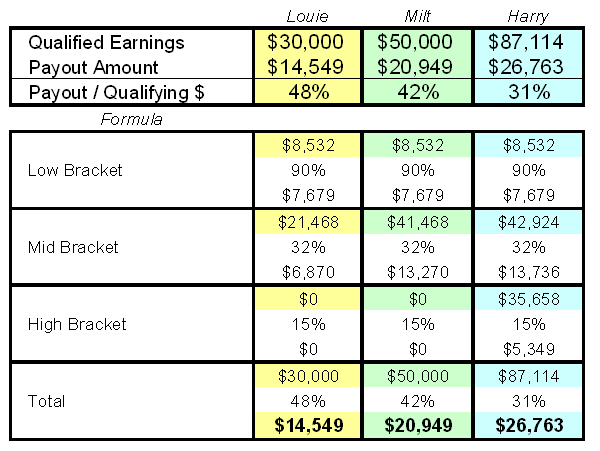
Then, the qualified earnings (i.e. the 35 year average) are plugged into the sliding scale formula to determine the initial annual amount to be received in Social Security benefits.  90% of the first $8,532 counts; 32% of the next $42,924 (up to $51,456) counts; and only 15% of any excess over $51,456 counts.


Since we’re assuming that Harry earned the maximum taxable income in each year, his top 35 years are the last 35 years (since the income cap has been consistently going up).  His inflation adjusted average income over that period is $87,114.


Plugging the $87,114 into the Social Security benefits formula, Harry’s initial annual Social Security benefit will be $26,763 — 31% of his inflation adjusted average annual wages for his highest 35 years’ earnings.


How long will Harry  be getting the payments?


That’s conceptually easy to answer: Until he dies.  

  • Note: If Harry had been married, payments would come until both Harry and his wife die  — since she would have survivor rights to his benefits).  

Currently, the average life expectancy in the U.S. is 78 years.  For simplicity assume that Harry is actuarially average, so he will get the $26,763 in annual benefits for 13 years — until age 78.  


Harry’s total  “annuity benefits” are $347,922 — 13 years times $26,763.  Assuming that the $26,763 gets inflation adjusted in future years (i.e. the Social Security Administration boosts the benefit each year to relect inflation), then the  $347,922 is — by definition — expressed in real 2008 dollars.

Pulling the parts together: stated in 2008 dollars,  Harry (and his employer) paid $872,096 to get annuity benefits worth $347,922. 

The $524,174 difference is the real Social Security tax that Harry paid — a whopping 60%


For comparison, let’s apply the same analytical logic and run the numbers for two other retirees who have  exactly the same profiles as Harry (the high-earner), except that they earned less during their best 35 years.


Low-earning Louie earned an inflation adjusted average of $30,000 and mid-earning Milt earned an inflation adjusted average of $50,000.   So, their respective calculated initial annual benefits are $14,549 (which works out to be 48% of $30,000) and $20,949 (42% of $50,000). High-earning Harry only got 31% of his inflation adjusted average wages in annual benefits.
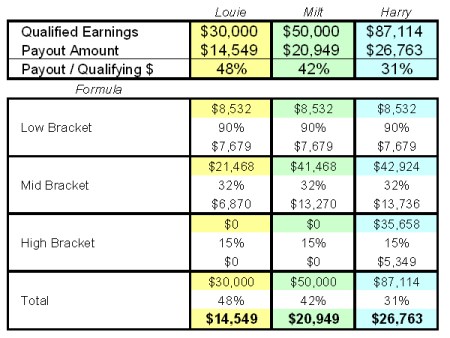


For analytical simplicity, let’s assume that Louie and Milt earned a constant percentage of the Social Security income cap each year.  Applying that assumption, their $30,000 and $50,000 wage bases translate to 34% and 57% of each year’s income cap.  (Trust me and Excel Solver on the percentages).


Let’s assume that  Louie and Milt – like Harry — have been working and contributing to Social Security since age 25.  Then, we can multiply Louie and Milt’s income  cap percentages (34%, and 57%) times each year’s income cap (keeping in mind that it has increased in most years) — multiply that number (annual taxable wages) times the Social Security tax rate in each year (the total of the employees’ and employers’ contributions) – and then sum across the years (from age 25 to age 65).


The answer: Louie and Milt kicked in a total of $131,272 and $218,276, respectively.  Again, those are “nominal” totals, unadjusted for inflations. 


Applying the Social Security Administration’s inflation  factors –  the same ones used for the benefits calculation —   the nominal totals “inflate”  to $300,328 and $500,547 in 2008 dollars.


The rest of the analysis  is simply arithmetic: Louie kicked in $300,328 to secure an annuity with a present value (at retirement) of  $189,131.  The difference ($111,197) is, in essence, the implicit  net Social Security tax that Louie paid —  37% of his inflation adjusted contributions. 


Milt put in $500,547 to get $272,331 in benefits – an implicit tax of $228,215 – 46% of Milt’s inflation adjusted contributions. And trust me, below Louie’s qualifying income level, the rate drops further —  very quickly.


* * * * *


The Bottom Line:


Social Security “payroll taxes” are fundamentally different from other types of taxes because they represent a future payment back to the contributor. 


Thus. payroll taxes cannot be viewed in isolation, but must instead be viewed in the lifetime context of tax payments and retirement benefits. http://www.house.gov/jec/fiscal/tx-grwth/payroll/payroll.htm


When both the taxes on current wages and the eventual benefits realized are both considered, real tax rates increase with income and Social Security is then – by definition – a  very progressive plan. 


Case closed !


* * * * *

Want more from the Homa Files?
Click link =>
  The Homa Files Blog

* * * * *