Archive for September 9th, 2008

Campbell’s V8 Dives into Soup

September 9, 2008

Excerpt from Marketing Daily “Campbell’s Launches Latest V8 Extension: Soups” September 8, 2008

The odds that consumers will berate themselves because they “could’ve had a V8” have just gotten slimmer.

Campbell Soup Company, which has expanded V8-branded juices to more than 20 varieties in recent years, is now extending the brand to a product category it knows pretty well: soup…

The product launch will be supported with print and TV spots, both slated to begin mid-September. The tagline is simplicity itself: “Introducing New V8 soups from Campbell’s.”

If successful, the soup line will be another example of Campbell’s mastery of using V8’s clearly defined brand mission–“To help more people get more vegetables, every day”–as the platform for a growing number of products bearing the familiar, trusted, 75-year-old V8 name…

The appeal of the much-pursued “master” or “mega” brand concept is clear: Extending an established brand’s power to more categories and consumers to realize greater sales volume, efficiencies and margins. However, many brands have failed to realize volume and share-of-market goals with extensions.

…Some brands, including V8, have the substantial advantage of being able to offer and market/advertise the same common, core benefit (the benefits of vegetable nutrition) across products…But in other cases–as with the drug category and Tylenol–while the brand personality/trust factor has real value, it’s the specific benefit being sought through a specific drug (long-lasting pain relief for arthritis versus quick pain relief for common headaches) that must be the main focus of each new product’s positioning and marketing strategy under the same brand.

Edit by SAC

* * * * *

Full article:
http://www.mediapost.com/publications/?fa=Articles.showArticle&art_aid=89983

* * * * *

Want more from the Homa Files?
Click link =>
The Homa Files Blog

Idea – Power of Free (from Predictably Irrational)

September 9, 2008

Excerpted from: Predictably Irrational by Dan Ariely, HarperCollins Books, 2008

“Free has a certain gravitational pull – everybody likes something for nothing. Free gives such an emotional charge that people perceive what is being offered as immensely more valuable than it really is.” 

Examples

Opting for a “stripped down”  free checking account  over one with a nominal charge account and a plethera of services; 

Buying 2 of something to get a third one free (even if you don’t need the 2nd or the 3rd ones) ; 

Taking a “no closing costs” mortgage with a higher interest rate; 

Hitting the buffet table for seconds, and thirds, and … 

Snatching up free pens, calendars, koozies … to throw them out when you get home

 
Why?

“Most transactions have an upside and a downside –  when something is free. people forget about the downside.  … humans are intrinsically afraid of loss.  The real lure of free is tied to this fear.  There is no visible possibility of loss when somebody chooses something that’s free.  Of course, that’s not true”  … [since “free” may require a commitment of time, headaches, or disposal fees]. 


Example: Amazon Free Shipping

In the US, Amazon has had great success offering free shipping on orders greater than $25.  Many customers started upsizing their orders (e.g ordering an additional book) just to take advantage of the free shipping offer.

In France, Amazon introduced a comparable program with a token charge for shipping (about 25 cents).  While there was a small uptick in sales, it paled in comparison to the sales increase associated with the totally free shipping program.

In other words, whereas shipping for a quarter – a savings of a couple of bucks – was largely ignored by customers, free shipping generated an enthusiastic response.

“The difference between two cents and one cent is small. 
 The difference between one cent and zero is huge.”  


                                       * * * * * 

Observations

1. The aura of “free” creates a market inefficiency – breaking  buyers’ stream of rationality 

2. Amazon’s free shipping is a compelling real life example. 

3. Lesson: If you’re going to give something away – give it away –  don’t nickel-and-dime into “no man’s land”

 
BTW: Based on my experience, Amzon’s free shipping is often just as fast as it’s regular shipping.  Sure, the items are :”flying standby”, but there is usually space on the truck.

Want more from the Homa Files?
 
Click link =>  The Homa Files Blog

Product Innovation: Establishing & maintaining dominance …

September 9, 2008

Excerpted from Strategy & Business, “The Unique Advantage”, by Alexander Kandybin and Surbhee Grover, Aug. 26, 2008

Successful consumer packaged goods (CPG) innovators, those whose new products establish and maintain dominance in the marketplace, tend to focus on seven areas. None of them represents a “silver bullet” on its own, and many of them are common sense, but together they make innovation more difficult to copy and lead to greater returns and higher growth.

1. Technology and patents. New technologies … providie companies with a way to meet new consumer needs, including those that consumers don’t yet know they have.  Patents can sustain a meaningful advantage in the marketplace. 

2. Claims. Claims add substantial value when they are tied exclusively to a product and can be held for a significant period of time.

3. Ingredient synonymy. Arm & Hammer, Planters, and POM Wonderful, respectively, have each carved out an enviable position by becoming virtual synonyms for their category. Such domination affords pricing power for products that are essentially commodities.

4. Unique brand characteristics. Strong brands can build an identity in consumers’ minds that transcends products.

5. Product experience. Successful products have an emotional component that builds a bridge to consumers, becoming part of their lives.

6. Packaging.  Packaging innovation can leverage technology, emphasize unique brand characteristics, enhance the product experience, and in fact prove very difficult to duplicate.

7. Effective vertical integration. [Keeping things “in house” can protect proprietary technologies and “secret sauces” ]

Edit by DAF

* * * * *

Full article:
http://www.strategy-business.com/press/article/08306?pg=all&tid=230

* * * * *

Want more from the Homa Files?
 
Click link =>  The Homa Files Blog

* * * * ** * * * *

Losing Altitude – Airlines down $5.2 Billion

September 9, 2008

Excerpted from Wired Blog Network “Airlines to Lose $5.2 Billion Worldwide This Year” September 8, 2008

Things keep going from bad to worse for the global airline industry, which has taken such a beating from rising fuel prices that it expects to lose a staggering $5.2 billion dollars this year — with U.S. carriers accounting for almost all of the red ink.

That bit of cheery news comes from the International Air Transit Association, which says “a toxic combination” of sky-high fuel prices and plummeting demand “continues to poison the industry’s profitability.” More than 25 airlines have gone under this year…It’s a stunning turnaround for an industry that saw a $5.6 billion profit in 2007.

The industry attributes its free-fall to the price of oil…fuel bills have jumped $50 billion this year to an estimated $186 billion. Jet fuel now accounts for 36 percent of the industry’s costs, up from 13 percent just six years ago…

The recent drop in fuel prices have brought a measure of relief to the beleaguered industry, but it might be a double-edged sword…

U.S. carriers took the biggest hit, accounting for $5 billion of the projected losses…Don’t expect next year to be any better. Fuel could account for 40 percent of the airlines’ costs next year, and the IATA predicts the industry will lose $4.1 billion in 2009. 

Edit by SAC

* * * * *

Full article:
http://blog.wired.com/cars/2008/09/airline-haters.html

* * * * *

Want more from the Homa Files?
Click link =>
The Homa Files Blog

Health Insurance – Those %#@& Health Insurance Companies !

September 9, 2008

In the book Crunch, liberal economist Jared Bernstein criticizes health insurance companies, asserts that:

  • “Other countries with advanced economies save a lot by taking the insurers out of the picture. They employ either single-payer or heavily regulated systems, in which either the government is the exclusive insurer or private insurers must provide specified, the subsidized coverage to all … costs are held down by taking advantage of the huge risk pool — the healthy majority subsidizes the sick minority … and, insurer’s profits are weeded out of the system.”
  • “Private insurers have an incentive to prevent people from getting all the care they think they need.  Insurers are in the for-profit sector, so they spend time and resources trying to avoid making payouts. “

These are oft repeated refrains from folks who advocate government administered universal heath insurance.

* * * * *

I think this argument displays a remarkably shallow understanding of what health insurance companies do, how much money they make, and how they make it.  And. it places a remarkably high level of confidence in government administered programs (think, the FDA chasing down salmonella sources). 

* * * * *

First, what is the financial upside if all health insurance companies’ profits are eliminated and put in the national bank as economic cost savings.

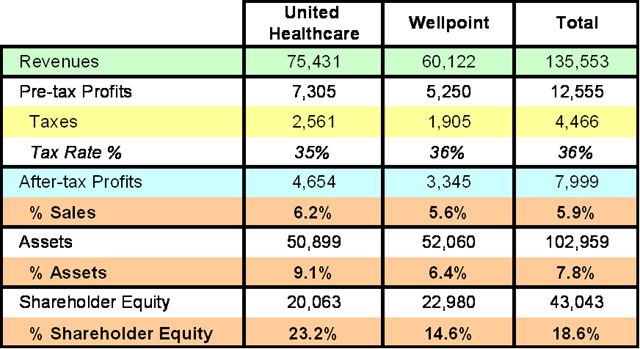
Well, for openers, the health insurance companies — don’t make all that much money.  Consider the 2007 financial results for the two biggest “pure” health insurance companies: United Health Care and Wellpoint.

image

Note that pre-tax profits are about 9% of revenues [12,555 divided by135,553].  About 1/3 of the pre-tax already goes to the government in taxes; about 2/3’s (6% of revenues) drops through to the bottom line.

Currently, U.S. health care expenditures are about $2,1 trillion (just over $7,000 per person).  Of that, roughly half is “sourced” from the government via Medicare and Medicaid.  Of the half that is private pay, about 2/3’s ($725 billion ) goes through health insurance companies — the other 1/3 is out of patient’s pockets or “other” (e.g. charitable gifts to medical centers). 

 image

So, what’s the financial upside if all health care insurers were “disintermediated” and their profits were banked as economic cost savings to the system ?

Well, assuming that the rest of the healthcare insurance companies have profitability profiles comparable to United and Wellpoint — there’s a pre-tax profit of 9% that applies to $725 billion in revenues — or roughly $65 billion dollars.

But wait, the government is already getting about 1/3 of that in taxes.

So, the net gain is at most $40 to $45 billion, or about 2% of the $2.1 trillion in total healthcare spending.  Why “at most” ? 

Simple, because it assumes that the government will be able to administer the programs as efficiently as the private companies.  Call me cynical, but I doubt it.

* * * * *

On the second point, that  health insurance companies reject claims and refuse to authorize treatment as a means of boosting their.bottom lines.

Well, that’s at most partially true, and catches the government administration folks in a circular argument.

First, about 1/3 of health  insurance companies’ transactions volume is administrative processing done in support of companies (usually big ones) that choose to self-insure.  That is, the self-insuring companies  take all of the risk, and only pay the insurance companies a fee (that includes profit, of course) for negotiating with health care suppliers and processing transactions  — in conformance with terms, conditions, and rules dictated by the companies.  There are agreed to standards that are enforced.

The other 2/3’s of their transaction volume is strictly premium based.  If more treatments are authorized, costs go up and premiums go up to cover them.   If treatments are denied,  costs go down, and the competitive market pushes premiums down,It’s that simple.

* * * * *

Want more from the Homa Files?
Click link =>
  The Homa Files Blog

* * * * *