Archive for September 22nd, 2008

Baby Boomers Delay Retirement

September 22, 2008

Excerpted from WSJ: “Baby Boomers Delay Retirement
Declines in Assets Force a Generation to Face New Reality”,
Sept. 22, 2008 
 

* * * * *

In May, 27% of surveyed workers age 45-plus said the economic slowdown had prompted them to postpone plans to retire.

For millions of Americans approaching retirement, events of recent weeks are delivering a clear message: Not so fast. With nest eggs shrinking, housing prices still falling and anxieties about their financial future growing, the oldest members of the baby-boom generation are putting the brakes on plans to leave work.

Most people underestimate how much money they will need for retirements that could easily last two or three decades, and are leaving the work force with nest eggs that are likely to expire long before they do.

Less than one-quarter of workers age 55 and older — just 23% — have savings and investments totaling $250,000 or more. About 60% have less than $100,000.

[Chart]

The average retirement age in the U.S. is 63 — but most investors don’t recognize the benefits from working even just two or three additional years. For example, a 62-year-old with a $100,000 salary and a $500,000 nest egg will see his annual retirement income from investments and Social Security rise by 6% for every additional year he remains in the work force.

Working longer “gives people time to build up their 401(k) balance, can result in a bigger benefit from Social Security, and reduces the amount of time people will have to depend on their savings. “The arguments in favor of working longer are overwhelming.”

“It’s particularly tough if the market gets hit in your early years of retirement. If you’re about to retire and something like this happens, maybe you should stay working.”

Retirees returning to work — is also being played out in the wake of the market turmoil. “I’m trying to go back to work and let our portfolio build back up,” he explained. “We’ve lost such a big amount of money lately, we’re going to get to the point where we can’t recover.”

* * * * *

Full article:
http://online.wsj.com/article/SB122204345024061453.html

Want more from the Homa Files?
Click link =>
  The Homa Files Blog

So What If It's "Green"?

September 22, 2008

Excerpted from Harvard Business Online, “It’s Green, But Will People Want It?”, by Steve Bishop, September 10, 2008

* * * * *

Over the summer, The New York Times reported about the rollout of a relatively new “Milk Jug for a Green Earth.” Now in 189 stores throughout the country, the novel design requires less material to manufacture, and its boxy shape allows the jugs to be stacked closely together, requiring less fuel to transport and less energy to cool. Retailers are even passing on some of the financial savings to consumers.

But not everyone is buying into what seems – at least on paper – like a successful green solution. While the design offers many advantages to retailers, consumers are confronted with a very different experience with a very familiar product. For many, this unexpected user experience is a big turnoff. According to the article, “The jugs have no real spout, and their unorthodox shape makes consumers feel like novices at the simple task of pouring a glass of milk.”

So, how truly successful is this green product? Over the last year, people have tried the jug and responded with a litany of complaints, from leakage problems to its strange look. Not surprisingly, the blogosphere has piled on with still more negative feedback. At this point, the success – and future – of this green product looks risky, even if retailers stand behind it.

The story is a reminder that there are, in fact, two sides to every business equation: a supply-side and a demand-side. A lot of companies have made strides in the more tangible supply-side, but many stop short of adequately addressing both elements. To assure successful green offerings in the marketplace, companies need to also consider the often-overlooked demand-side.

* * * * *

Supply-side Sustainability
By making more product with fewer resources, environmental goals conveniently align with business objectives and pursue bottom-line savings. That serves as a great motivation for companies to change what they put in consumers’ hands. The question it raises, however, is why will people want it?

* * * * *

Demand-side Sustainability
While the supply-side deals with things, demand-side efforts address people, their needs, and what their experiences with green offerings enable. The key is to understand people’s latent and blatant needs, and then to address them with an appropriate solution.

By creating something green that is also desirable and fits into people’s daily lives, environmental goals align with consumers’ personal goals and go after top-line growth. Results can be measured in sales and market-share, two objectives common and desirable to most companies.

* * * * *

Neither the supply- nor the demand-side takes precedence. As we have seen in the milk jug example, addressing the supply-side alone risks creating the green product that no one wants.

To have positive impact on the environment, the business, and people’s lives, both demand and supply need to be considered.  

Edit by DAF

* * * * *

Full article:
http://blogs.harvardbusiness.org/leadinggreen/2008/09/its-green-but-will-people-want.html

* * * * *

Want more from the Homa Files?
Click link => 
The Homa Files Blog

* * * * *

So What If It’s "Green"?

September 22, 2008

Excerpted from Harvard Business Online, “It’s Green, But Will People Want It?”, by Steve Bishop, September 10, 2008

* * * * *

Over the summer, The New York Times reported about the rollout of a relatively new “Milk Jug for a Green Earth.” Now in 189 stores throughout the country, the novel design requires less material to manufacture, and its boxy shape allows the jugs to be stacked closely together, requiring less fuel to transport and less energy to cool. Retailers are even passing on some of the financial savings to consumers.

But not everyone is buying into what seems – at least on paper – like a successful green solution. While the design offers many advantages to retailers, consumers are confronted with a very different experience with a very familiar product. For many, this unexpected user experience is a big turnoff. According to the article, “The jugs have no real spout, and their unorthodox shape makes consumers feel like novices at the simple task of pouring a glass of milk.”

So, how truly successful is this green product? Over the last year, people have tried the jug and responded with a litany of complaints, from leakage problems to its strange look. Not surprisingly, the blogosphere has piled on with still more negative feedback. At this point, the success – and future – of this green product looks risky, even if retailers stand behind it.

The story is a reminder that there are, in fact, two sides to every business equation: a supply-side and a demand-side. A lot of companies have made strides in the more tangible supply-side, but many stop short of adequately addressing both elements. To assure successful green offerings in the marketplace, companies need to also consider the often-overlooked demand-side.

* * * * *

Supply-side Sustainability
By making more product with fewer resources, environmental goals conveniently align with business objectives and pursue bottom-line savings. That serves as a great motivation for companies to change what they put in consumers’ hands. The question it raises, however, is why will people want it?

* * * * *

Demand-side Sustainability
While the supply-side deals with things, demand-side efforts address people, their needs, and what their experiences with green offerings enable. The key is to understand people’s latent and blatant needs, and then to address them with an appropriate solution.

By creating something green that is also desirable and fits into people’s daily lives, environmental goals align with consumers’ personal goals and go after top-line growth. Results can be measured in sales and market-share, two objectives common and desirable to most companies.

* * * * *

Neither the supply- nor the demand-side takes precedence. As we have seen in the milk jug example, addressing the supply-side alone risks creating the green product that no one wants.

To have positive impact on the environment, the business, and people’s lives, both demand and supply need to be considered.  

Edit by DAF

* * * * *

Full article:
http://blogs.harvardbusiness.org/leadinggreen/2008/09/its-green-but-will-people-want.html

* * * * *

Want more from the Homa Files?
Click link => 
The Homa Files Blog

* * * * *

The mortgage mess … in brief

September 22, 2008

Excerpted from Heritage Foundation:”Subprime Mortgage Problems: A Quick Tour Through the Rubble”, by Ronald D. Utt, April 3, 2008

* * * * *

Note: Best recap I’ve found re: the current mortgage mess.

* * * * *
The collapse of the subprime mortgage market in late 2006 set in motion a chain reaction of economic and financial adversity that has since spread to nearly all sectors of the economy, as well as to global financial markets, has created depression-like conditions in the housing market, and has led the American economy to the brink of recession.

In response, many in Congress and the executive branch have proposed a number of new federal spending and credit programs that would greatly expand the role of government in the economy.

* * * * *

How the Problem Started

These problems had their origin in the mid-1990s when mortgage lenders reduced the previously strict financial qualifications needed to acquire a mortgage to buy a house by offering credit-impaired households mortgage loans, albeit at higher interest rates to compensate for the greater risk. Despite the many different forms these mortgages would ultimately assume–no down payment, interest only, negative amortization, etc.–they were designated “subprime” because of the checkered credit histories of the households using them.  Despite the risk associated with these subprime mortgages, many mortgage lenders further relaxed their underwriting standards and in the process introduced even more risk into the system, some of it motivated by fraud and misrepresentation.

As a consequence, the availability of risky loans soared from the late 1990s through 2006. In 2001, newly originated subprime, Alt-A, and home equity lines (seconds) totaled $330 billion and amounted to 15 percent of all residential mortgages. Just three years later, in 2004, these mortgages accounted for almost $1.1 trillion in new loans, equal to 37 percent of the total. Their volume peaked in 2006 when they reached $1.4 trillion and 48 percent of the total. Over a similar period, the volume of mortgage-backed securities (MBS) collateralized by subprime mortgages increased from $18.5 billion in 1995 to $507.9 billion in 2005

In turn, the looser lending standards allowed previously unqualified borrowers to become homeowners, and the homeownership rate soared from the 64 percent range of the 35 years prior to 1995 to an all time high of 69 percent in 2004. While most celebrated this accomplishment, the consequence of lending to riskier borrowers under diminished underwriting standards led to an escalation in the number of loan defaults beginning in 2006, followed by an escalation in the number of foreclosures. Because many of these loans had been repackaged into mortgage-backed securities, the growing default problem soon spread to investors in the national and international financial markets where these instruments were sold.

The first to suffer was the housing market, where new construction and the sales of both new and existing homes plunged. This was soon followed by a decline in home values, which in turn worsened the financial problems in the mortgage market by reducing the value of the collateral securing these loans. As many subprime borrowers now found themselves owning a house worth less than the debt owed on it, the incentive to default increased, and by the end of 2007, more than 17 percent of subprime borrowers had fallen behind in their loan payments.

* * * * *

Implications for the Economy

After reaching the more than 1.7 million new units started in 2005, single-family housing starts in February 2008 fell to a seasonally adjusted annual rate of 707,000 units, less than half the level of production two years earlier. On a year-over-year basis, the decline in starts was 40.4 percent.  Sales of new homes fell precipitously over the same period. After reaching 1,283,000 units in 2005, they fell in February 2008 to a seasonally adjusted annual rate of 590,000, less than half the level of 2005 and down 29.8 percent from February 2007. For existing homes, sales peaked in 2005 at 7,076,000 units, fell to 6.4 million in 2006, and by February 2008 had fallen to a seasonally adjusted annual rate of 5 million, nearly 30 percent below the peak levels of sales during 2005.

After two years of declining activity in the housing market, many are hopeful that the bottom has been reached and that the market will soon revive, but this seems unlikely. The subprime default and foreclosure problems first emerged at a time when the economy was healthy, most borrowers were employed, and housing values were stable or rising. In 2008, home prices and sales are falling, some borrowers may soon confront unemployment, tightened credit standards will exclude many from homeownership, and the number of subprime mortgages resetting to higher payments will be greater than the number that reset in 2006 and 2007.

As a consequence, the homeownership rate is likely to fall from its record levels near 69 percent to something closer to the long-term historic norm of 64 percent. This trend in turn implies a greater number of lost homes coming onto the market at a time when sales are depressed.

* * * * *

Notwithstanding the constituent and lobbyist pressure to do something costly and do it quickly, the history of government intervention in housing markets and the economy has not been one of notable success. .

* * * * *

Full article:
http://www.heritage.org/Research/Economy/wm1881.cfm

* * * * *

Want more from the Homa Files?
Click link =>
  The Homa Files Blog

Fannie Mae and the Vast Bipartisan Conspiracy

September 22, 2008

Excerpted from Slate: “Fannie Mae and the Vast Bipartisan Conspiracy”,  Jack Shafer, Sept. 16, 2008

* * * * *

My POV:

Slate leans left, so I find its revelations particularly note worthy.  Repubs are dirtied by drinking from the lobbying trough.  Dems own the CEOs and folks who raked off the uber-dollars.  A pretty disgusting picture … Read the full article (link below) for names of “bit” players and more context.

* * * *

Article Highlights

The blowup and bailout of Fannie Mae and Freddie Mac by taxpayers was foretold so many times in the last three decades by critics of the two federally chartered and subsidized mortgage giants that not even the data-searching powers of Nexis, Factiva, and Google combined can total them.

The Wall Street Journal editorial page deserves a special commendation for hammering these two outposts of corporate socialism, not that the page’s many warnings over the years helped avert disaster.

Mae and Mac—especially Mae—were just too nurtured by the Washington establishment  — an  “influential network that extends from the highest reaches of the Clinton Administration to the ranks of conservative Republicans on Capitol Hill.”

The bipartisan network provided the essential cover Fannie Mae needed to run its scam.

* * * * *

The key to Fannie Mae’s survival was the patronage operation it ran.  “For years, high-level jobs at Fannie Mae were lucrative prizes for lawyers, bankers and political operatives waiting for their next U.S. government post.”

Now that the jig is up, let’s meet some of the bipartisan warriors who fought for Fannie Mae’s right to plunder.

At the top of the list we must place Franklin D. Raines, chairman and chief executive officer of Fannie Mae from 1998 to 2004. Raines, who served as director of the Office of Management and Budget under President Clinton.  He  was forced to leave Fannie Mae in 2004, when regulators discovered it had broken accounting rules “in an effort to conceal fluctuations in profit and hadn’t maintained adequate risk controls.” The New York Times reported two year ago that regulators “have said that of the $90 million paid to Mr. Raines from 1998 to 2003 at least $52 million—more than half—was tied to bonus targets that were reached by manipulating accounting.” Raines agreed to a $24.7 million settlement with a federal regulator in exchange for charges being dropped, but he admitted no wrongdoing.

Next up is Jamie S. Gorelick,  Deputy Attorney General during the Clinton administration. Although Gorelick had no background in finance, she joined Fannie Mae in 1997 as vice chair and departed in 2003. For her trouble, Gorelick collected a staggering $26.4 million in total compensation, including bonuses.

Republicans also proved willing to serve Fannie Mae. Robert B. Zoellick, current head of the World Bank, has served President Reagan, President Bush 1, and President Bush 2 as a trade representative, deputy secretary of state, deputy secretary of the treasury, deputy chief of staff, and so on. Zoellick’s  title at Fannie was executive vice president in charge of lobbying, public affairs, and affordable housing. According to a July 23, 1997, report in the American Banker, Zoellick “has used his close ties to Republicans in Congress, such as Speaker of the House Newt Gingrich, to defend Fannie Mae from new taxes.”

Moving back across the aisle, let’s say hello to Mr. Democrat James A. Johnson, who ran Fannie Mae from 1991 to 1998, served as vice chairman from 1990 to 1991, and earlier worked as a managing director at Lehman Bros. and for Vice President Walter F. Mondale. He made news earlier this summer when he had to resign as vice-presidential-candidate vetter for Barack Obama “as new details emerged about loans Mr. Johnson received from mortgage lender Countrywide Financial”  Mr. Johnson has made Fannie Mae both a launching pad and a landing strip for officials moving in and out of politics and Government in Washington.” Johnson earned nearly $21 million from Fannie Mae in 1998.

But Fannie Mae is nothing if not ecumenical. According to the Associated Press, Fannie Mae and Freddie Mac have spent $170 million on lobbying in the past decade. “Fannie Mae’s 51-member lobbying stable” includes “former Reps. Tom Downey, D-N.Y., and Ray McGrath, R-N.Y.; Steve Elmendorf, a Democratic political strategist and former congressional aide; and Donald Fierce, a longtime GOP operative. Freddie Mac’s list of 91 lobbyists includes former Reps. Vin Weber, R-Minn., and Susan Molinari, R-N.Y.” The AP notes the Fannie Mae ties enjoyed by McCain campaign manager Rick Davis and Arthur B. Culvahouse Jr., who helped in McCain’s veep search. According to Politico, McCain economic adviser Aquiles Suarez worked as Fannie Mae’s director of government and industry relations, and McCain finance co-chairman Frederic V. Malek spent time on the Freddie Mac board.

* * * * *

The bipartisan Fannie Mae gang appears to have broken few, if any, laws. Their crime was to have practiced—without any thought of the consequences—”access capitalism,” which Michael Lewis defined in the New Republic as “a neat solution for people who don’t have a whole lot to sell besides their access, but who don’t want to appear to be selling their access.”

“The scandal in Washington isn’t what’s illegal. It’s what’s legal.”

“The abiding lesson here is what happens when you combine private profit with government power. You create political monsters that are protected both by journalists on the left and pseudo-capitalists on Wall Street, by liberal Democrats and country-club Republicans.”

* * * * *

Full article:
http://www.slate.com/id/2200160/

* * * * * 

Want more from the Homa Files?
Click link =>
  The Homa Files Blog

Talk about special interests …

September 22, 2008

Excerpted from OpenSecrets.com

Of all the companies making headlines this week, AIG has been the most nonpartisan in its contributions, splitting evenly the $9.7 million it has contributed over time.

Sen. Chris Dodd, chair of the Senate banking committee, has racked up the most from AIG, with a total of $281,400, while Charles Schumer (D-N.Y.), a member of both the Senate Banking, Housing and Urban Affairs Committee and the Senate Finance Committee, takes second with $116,400.

Presidential candidates John McCain and Barack Obama collected $103,000 and $82,600 from AIG, respectively.

Source:
http://www.opensecrets.org/news/2008/09/aig-government-bails-out-a-hea.html

* * * * *

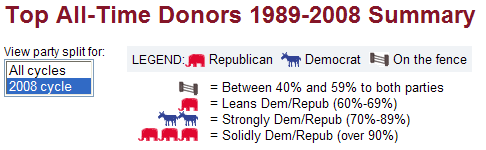
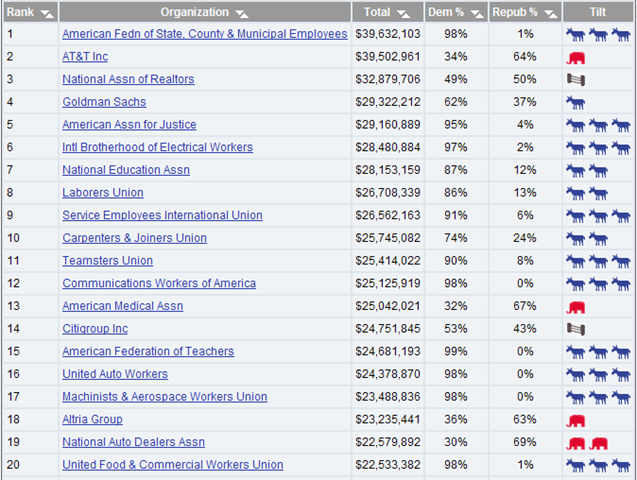
Source: http://www.opensecrets.org/orgs/list.php?order=A

image

image

* * * * *

Worth browsing: Federal Election Campaign Web Site:
 http://www.fec.gov/

* * * *

Want more from the Homa Files?
Click link =>
  The Homa Files Blog