Archive for September 24th, 2008

Bailing out Main Street … not so fast

September 24, 2008

Excerpted from RealClear Politics.com:”The Mortgage Mess Began on Main Street”, Steven Malanga, September 24, 2008

* * * * *

Ken’s POV: Should foreclosed speculators be bailed out?  No.  Should folks who lied on their applications get bailed out?  No.  Should folks who made no downpayment — and sometimes no payments at all — be bailed out?  No.  Should folks who couldn’t qualify for conventional loans then (or now) — about 80% of all subprimes — get them at favorable rates now? No.  Should honest, hardworking folks who got duped or are experiencing some extraordinary hardship get relief?  You bet.  Wonder how many of them there are ….

Here are some facts …

* * * * *

Article Extract:

Journalists like simple stories with clear-cut villains who are easy for readers (and journalists themselves) to recognize. And so, as the financial crisis has brought Wall Street to its knees in recent weeks, it’s become so much easier for journalists to cope. Time Magazine, for instance, tells us in its current issue that Wall Street “sold out” America.

It’s easy to forget that this mess began with a heap of bad mortgages made by American consumers who never came within a hundred miles of the card sharps on Wall Street. The inability (and in a good deal of cases, the unwillingness) of these same ordinary Americans to pay back these loans, many of which are sitting in mortgage backed-securities held by institutions around the world, helped tilt us toward this systemic threat to our financial system. And even as we focus on bad bets and lousy leverage ratios on Wall Street, these toxic mortgages continue to unwind, and as they do, we are getting a better look at how they were made—and it’s not pretty.

If it wasn’t clear before, it should be now, that speculation and fraud—much of it on the part of borrowers—were rampant.

* * * * *

The FBI says that reports of suspicious mortgage activity increased by 10-fold from 2001 through 2007.

70 percent of subprime loans that default before they reset (exactly the kind that trouble the market right now) contain some kind of misrepresentation by the borrower, lender or broker, or some combination of the three.

* * * * *

One big category of deception has been so-called ‘no-doc’ loans, where a borrower agrees to pay a slightly higher interest rate in exchange for not documenting his income. Originally designed for the growing number of self-employed workers in America who don’t have ready documentation from an employer, these mortgages became known as ‘liar loans’ because many people without sufficient income used them to qualify for financing they otherwise couldn’t get. One lender that compared what 100 applicants claimed as income on no-doc loans to what they reported to the IRS on their tax returns found that in 60 percent of cases borrowers were exaggerating their income by as much as half.

* * * * *

Fraud reports are most common on properties near the coastlines, that is, in places where there is an enormous amount of speculation and where many purchases are for investment purposes.

Speculators are a big part of the problem. As the housing market rose, more people got into the game of betting on higher prices by purchasing homes which they intended to flip quickly without ever occupying. As this became a popular form of investing, applicants starting lying about their intentions. They were trying to fool developers who grew wary of selling too many homes in new developments to people who would never occupy them, since these are the buyers most likely to walk away from a mortgage when the market turns down. This form of misrepresentation accounts for 20% of mortgage fraud.

* * * * *

Whether they were cheating or not, speculators clearly played a big part in the mortgage mess. The vast majority of delinquent mortgages and homes in foreclosure continue to be in a handful of states where the housing bubble was largest and where speculation was common, led by California and Florida, which together accounted for a whopping 58% of all subprime adjustable rate mortgages that went into foreclosure in the second quarter of this year.

And while the rate of new foreclosures for subprime ARMs in the quarter was a whopping 6.63%, for traditional fixed-rate mortgages, it was only 0.34%.

* * * * *

We seem to have had a generation of mortgage borrowers who at the least didn’t understand the types of loans they were taking out, and at the worst were committing fraud themselves.

* * * * *

References and full article:
http://www.realclearmarkets.com/articles/2008/09/the_mortgage_mess_began_on_mai.html

* * * * *

Want more from the Homa Files?
Click link =>
  The Homa Files Blog

Marketing "green" …

September 24, 2008

Excerpted from MarketingProfs.com: “The Power of Green Lies in Marketers’ Hands”, Jacquelyn Ottman, September 16, 2008

* * * * *
Many people think the power to restore our environment — to curb greenhouse gases, to clean up our air and water, to cut down on precious resources’ ending up in landfills—lies in the hands of technical types like scientists and engineers, even lawyers and legislators ready to clamp down on polluters.

But the real power of green lies in the hands of marketers …  who have the power to design and promote cleaner products and technologies and help consumers evolve to more sustainable lifestyles.

* * * * *

It may be hard to fathom, but over 75% of the environmental impact that a product throws off during its lifetime is determined at the design stage, when, for instance, the materials are chosen, the recyclability of a product is determined, and the amount of toxic chemicals it makes use of is decided.

* * * * *

Consider a toothbrush. Want to lessen its environmental impact? Start by making it out of recycled plastic, plastic made from corn, and educate on how to recycle or compost it. Then make the head replaceable and recyclable, too. Cut down on its packaging by only wrapping the bristly head. Think you’re finished? Not a chance! That’s because the toothbrush is part of a system—the water, the toothpaste, and the box the toothpaste comes in.

* * * * *

Marketers … are the ones who can sell them to mainstream consumers (not just the deep-green consumers who are born predisposed to all things “eco.”)

Take the Toyota Prius. A fine car with a hybrid engine. Premium price, not too likely to be offset by fuel savings. So what gets consumers over the premium-price hump as well as the risk posed by new technology? Answer: A distinctive silhouette that helps owners project their values, on-the-mark advertising that focuses on such direct benefits as super quiet ride and fuel efficiency. And a publicity machine that engenders the priceless support of Hollywood celebrities showing up at the Oscars in a Prius rather than a stretch limo.

* * * * *

We already know how to design homes and offices that use energy sparingly. We already know how to make construction materials and commercial and household furnishings that reduce the threats of indoor air pollution. We know how to design kitchens to make it easy for people to recycle and compost waste. We know how to reuse water from indoor plumbing systems to make lawns and gardens thrive. We know how to grow food using fewer or no chemical pesticides and fertilizers.

Some of these technologies are being embraced by deep-green consumers. But to really make a difference, they need to be embraced by the mainstream.

That’s where marketers can come in. Ask: What will it take to make greener products and behaviors cool? Get all consumers paying the small premiums necessary to bring such products to market?

* * * * *

Look to some recent green marketing history for help.

The Energy Star label is cool. Why? It relies on technology to create products that are highly efficient as well as high quality (read: requiring no trade-off in consumer habits.) A decade’s worth of advertising focusing on such benefits, plus the attendant savings on home and office electric bills, have made the Energy Star label the second most recognized eco-label behind the three chasing arrows denoting recycling.

* * * * *

The Tom’s of Maine line of personal care products, now owned by Colgate-Palmolive, stresses all that consumers desire in today’s personal care offerings: natural (i.e., safe), good-tasting, and trustworthy. How many toothpastes do you know that come with an ingredient statement with a full explanation of each ingredient’s role, as well as a letter from the head of the company?

* * * * *

Jacquelyn A. Ottman advises corporations on strategies for gaining competitive advantage via green marketing and eco-innovation. She is the author of Green Marketing: Opportunity for Innovation.

* * * * *

Full article:
http://www.marketingprofs.com/8/green-power-in-marketers-hands-ottman.asp?adref=znnpbsc398

* * * * *

Want more from the Homa Files?
Click link =>
  The Homa Files Blog
The minority who will be paying income taxes … regardless who wins

September 24, 2008

Excerpted from Tax Foundation: “Both Candidates’ Tax Plans Will Reduce Millions of Taxpayers’ Liability to Zero (or Less) “, Scott  Hodge, September 19, 2008

* * * * *

Ken’s Notes:

1. The statistics below consider only tax filers.  Approximately 20% of adults don’t file returns — presumably since their incomes are zero or below the filing limits.

2.  The impact of the McCain proposal surprised me.  From a tax structure perspective, the plans are a push.  Of course, Obama would layer the health insurance provisions as added spending  (versus reduced revenue).

3.  Isn’t anybody concerned that a minority of citizens will be carrying the entirety of the tax burden ?

* * * * *

Article Summary

Over the past two decades, lawmakers have increasingly turned to the tax system rather than direct spending programs to funnel money to targeted groups of Americans, furthering some social or political goal. As a result, millions of Americans have been effectively removed from the income tax payment system while the tax code has been made more complicated to comply with and more difficult to administer. The tax plans of both the presidential candidates would exacerbate this situation greatly.

* * * * *

1.3 of filers currently pay no income tax

One of the biggest challenges facing both John McCain and Barack Obama in their commitment to provide tax relief to working-class Americans is the simple fact that millions of them already pay no personal income taxes.

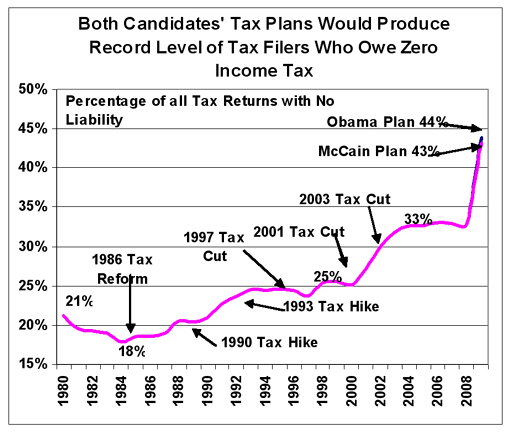
According to the most recent IRS statistics for 2006, some 45.6 million tax filers—one-third of all filers—have no tax liability after taking their credits and deductions. For good or ill, this is a dramatic 57 percent increase since 2000 in the number of Americans who pay no personal income taxes.

* * * * *

Obama or McCain — Essentially a Push (much to my surprise)

Tax Foundation estimates show that if all of the Obama tax provisions were enacted in 2009, the number of these “nonpayers” would rise by about 16 million, to 63 million overall. If all of the McCain tax proposals were enacted in 2009, the number of nonpayers would rise by about 15 million, to a total of 62 million overall.

* * * * *

Big Issue: Refundable Tax Credits = Negative Income Taxes

The tax code has always contained provisions that reduce the income tax burden for low-income workers, such as the standard deduction, personal exemption, and dependent exemption.

Between 1950 and 1990, the percentage of tax filers whose entire tax liability was wiped out by these provisions averaged 21 percent. Since then, lawmakers have expanded credits—such as the earned income tax credit (EITC)—while creating a plethora of new credits, including the child tax credit, the HOPE credit, lifetime learning credit, and the credit for adoption expenses.

Most tax credits can only reduce a taxpayer’s amount due to zero, but the EITC and the child tax credit were also made refundable, meaning that taxpayers are eligible to receive a check even if they have paid no income tax during the year. Those tax returns have become, in effect, a claim form for a subsidy delivered through the tax system rather than a direct payment from a traditional government program like welfare or farm supports.

* * * * *

As shown in Table 1 below, the Tax Foundation estimates that there will be 47 million tax returns with zero income tax liability in 2009 under current law. That’s one-third of all tax returns, and those 47 million tax returns represent 96 million individuals.

Both the McCain and Obama plans would increase this number by expanding existing tax benefits or creating new ones.

* * * * *

Senator McCain is proposing one expanded provision—the dependent exemption—and one new credit, a $5,000 refundable health care tax credit.

Taken together, the McCain proposals would increase the number of nonpayers by about 15 million, bringing the total number of taxpayers who pay no personal income taxes to 62 million, roughly 43 percent of all tax filers. Almost all of this is due to McCain’s health care credit, which dramatically realigns health care incentives and gives people a powerful motive to buy health insurance. This tax provision has a bigger impact on cutting people’s taxes than any single proposal from either party. 

* * * * *

Obama uses a longer list of smaller tax credit ideas to reduce a similar number of taxpayers’ liability to zero. The Obama plan contains seven new provisions, including a new “Making Work Pay Credit,” a “Universal Mortgage Credit,” and a plan to eliminate income taxes for seniors earning under $50,000. About 16 million people who are currently paying at least a little income tax would see their liability zeroed out, bringing the total to 63 million, or 44 percent of all tax returns.

image


* * * * *

Major structural tax changes enacted during the 1980s contributed greatly to the doubling of nonpayers. Perhaps the most significant was indexing the tax brackets in 1985 to prevent inflation from pushing people into higher tax brackets. Also, the Tax Reform Act of 1986 nearly doubled the personal exemption and replaced the zero-bracket with the basic standard deduction for nonitemizers.

Since the early 1990s, however, lawmakers have increasingly used the tax code instead of government spending programs to funnel money to groups of people they want to reward. Credits have been enacted to subsidize families with children, college students, and purchasers of hybrid cars, just to name a few of the most well known. In terms of tax revenue, the most significant of these socially targeted credits was the $500 per-child tax credit enacted in 1997. The 2001 and 2003 tax bills doubled the value of the credit to $1,000 and added a refundable component.

image


* * * * *

Quite aside from the fact that these refundable credits remove millions from the roster of Americans who support the government by paying the income tax, these credits have some undesirable effects.

Added complexity. The explosion of tax credits has added a tremendous amount of complexity to the tax code, especially for low-income Americans who are the supposed beneficiaries of the programs. The EITC is so complicated that more than three-quarters of those claiming it pay a tax preparer to complete their forms.

Hidden marginal tax rate increases. To withhold the benefit of these credits from “rich people,” the definition of which changes from law to law, each of these credits has a phase-out range—that is, a range of income where the taxpayer has to pay back the credit that he no longer qualifies for. As a result, taxpayers in the phase-out range face unexpectedly high effective marginal tax rates.

Narrowing the tax base.  Expanding existing credits or adding new ones pushes people who used to pay taxes into the nonpayer range, shrinking the tax base and requiring higher taxes on everyone else. Undesirable volatility in federal revenue is the likely result, as the incomes of higher-income taxpayers include more business, dividend, and capital gains income which fluctuate much more wildly than wages.

* * * * *

Full article:
http://www.taxfoundation.org/publications/show/23631.html

* * * * *

Want more from the Homa Files?
Click link =>
  The Homa Files Blog

XM-Sirius still reaching for the sky …

September 24, 2008

Excerpted from WSJ: “Sirius XM Sends Signals of Change”, September 15, 2008

* * * * *

Since the merger of Sirius Satellite Radio Inc. and XM Satellite Radio  in late July, the company’s stock has fallen about 40%, and now trades at less than a dollar. The downward trajectory accelerated last week after the company issued subscriber forecasts that fell below analysts’ expectations and failed to reassure investors about looming debt payments.

CEO Karmazin … says there has been “a tremendous overselling of the stock” and that his company “is heading toward making a bunch of money in the future.”

* * * * *

The merger of Sirius and XM was supposed to build confidence in satellite radio, in which subscribers pay a monthly fee for programming that is delivered through special receivers.

The months ahead will be a crucial proving ground. Sirius XM hopes to regain traction with consumers during the holiday season with its first programming packages and radio receivers that combine the Sirius and XM services.

As an enticement to consumers who tried satellite radio but didn’t stick with it, Mr. Karmazin has considered a plan to reactivate the radios of lapsed subscribers and give them a small selection of programming free of charge. 

The company will soon introduce radios that allow consumers more flexibility in the programming, including a 50-channel plan that costs $6.99 a month. Sometime next year, radios that can play the entire lineup from both Sirius and XM will hit the market.

Starting next month, even those who don’t upgrade their radios will be able to pay an extra $4 a month and get a few “best of” channels from the other company’s service. For example, a current XM subscriber will be able to get Howard Stern and Martha Stewart, now exclusively on Sirius.

* * * * *

Talk-show host Howard Stern’s five-year, $500 million pay package, announced in 2004, included 34.4 million shares payable to him and his agent, Don Buchwald. Then, the shares were worth about $110 million; by the time he joined the company in 2006, they were worth more than $220 million because of the stock’s sharp rise. Today, those shares would be worth $32.6 million.

* * * * *

Full article:
http://online.wsj.com/article/SB122143532408734143.html

* * * * *

Want more from the Homa Files?
Click link =>
  The Homa Files Blog