Archive for October 23rd, 2008

Rising healthcare costs … blame Grandma !

October 23, 2008

Excerpted from McKinsey Quarterly: “Health care costs: A market-based view”, Sept. 2008

* * * * *

In 2007, healthcare expenditures in the US wereover $2 trillion … roughly $7,000 per capita.

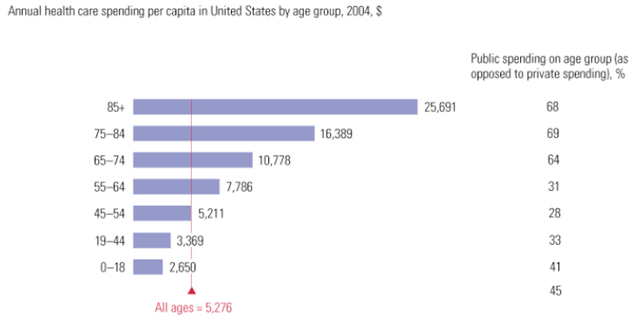
Based on 2005 data — which is likely to hold in 2007 — seniors over-consume healthcare — by a lot.

The over 75 crowd accounts for about 4 times the average healthcare spending … and about 6 times  an average  young adult (10-44)

image

Source: US Centers for Mecicare & Medicaid Services

* * * * *
Full article:
http://www.mckinseyquarterly.com/Health_care_costs_A_market-based_view_2201_abstract

* * * * *

Want more from the Homa Files?
Click link =>
  The Homa Files Blog

Maximizing (transient) shareholder value

October 23, 2008

Excerpted from Business Week: “Put Investors In Their Place”, Clayton M. Christensen and Scott D. Anthony, May  28, 2007

* * * * *

Why pander to people who now hold shares, on average, less than 10 months?

* * * *

The credo that management’s primary obligation is to maximize shareholder value is shaky to begin with, distorts managers’ sense of responsibility, and …  has been rendered obsolete by developments in the capital markets.

How did managers develop this risky fixation? The entreaty to maximize investor value … came from economists. Calculus is a primary analytical tool of microeconomics. At some point, some now-defunct economist seems to have said: “Let us assume that managers’ responsibility is to maximize shareholder value.” Through endless repetition, nearly everyone came to assume that managers are responsible for maximizing shareholder value.

Through the 1960s … the average shareholding period was more than five years. Managers seeking to maximize the long-term strength and growth of their companies could reward these patient shareholders.

But today shares are held, on average, less than 10 months. Should managers really regard such investors, whose investment horizons are so short … as stakeholders whose value they ought to maximize?

* * * * *

Perhaps it is time for companies to adjust the paradigm of management responsibility: “You are investors and speculators, not shareholders, and you temporarily find yourselves holding the securities of our company. You are responsible for maximizing the returns on your investments. Our responsibility is to maximize the long-term value of this company. We will therefore act in the interest of those whose interests coincide with our long-term prospects, namely employees, customers, the communities in which our employees live, and the minority of investors who plan to hold our securities for several years.”

* * * * *

[It’s time to] curb a shareholder value paradigm that has run amok. Well-intentioned, smart managers are systematically destroying companies by failing to take actions they know are right in the long term. Instead of slavishly serving an antiquated and increasingly irrelevant [maximization] function, managers should find ways to reward investors and stakeholders who want innovation, not plunder.

* * * * *

Full article;
http://www.businessweek.com/magazine/content/07_22/b4036100.htm?chan=search

* * * * *

Want more from the Homa Files?
Click link =>
  The Homa Files Blog

Tampa Bay Rays Takes a Play from P&G’s Book

October 23, 2008

Excerpted from AdAge “Tampa Bay Rays get P&G Style Makeover” by Jeremy Mullman, October 6, 2008

* * * * *

Under the guidance of a former Procter & Gamble brand manager, the Tampa Bay Rays have gone through the sort of transformation typical of deodorant sticks and shaving razors. First off, the team got a new name — Devil is gone — and a fresh logo and color scheme, swapping green for blue. A list of “consumer touchpoints” was found via focus-group research and monitored to make sure the ballpark experience is fun for fans.

And a P&G staple — product improvement — was even applied as the team morphed from one of the league’s most hapless teams into perhaps its best young squad. The emergence of fresh stars such as pitcher Scott Kazmir and third baseman Evan Longoria helped the team beat out such annual powerhouses as the Boston Red Sox and New York Yankees to win a division title and playoff berth only a year after finishing dead last. There’s evidence the strategy might be starting to show a glimmer of success. The Rays won their first playoff game last Thursday, and their first two home games are sold out.

But there’s still a long way to go. Sales did climb about 30%, but that put the Rays at only 26th in attendance among the league’s 30 teams — a weak performance, considering they boasted the league’s second-best record…

Mr. Raymond — who worked on fabric softeners and panty liners at P&G — and the team’s other top executives have nevertheless engaged in a Procter-style treatment of their brand, complete with a mantra of five “brand pillars” and 30 carefully monitored consumer touch points that help the team monitor consumer satisfaction. “It’s a lot like what P&G does with brand-equity models,” he said. “We know when our cleaning scores dip or when our security wasn’t helpful enough”…

The team also has taken steps to improve its fan experience by strategizing against the armies of Northeast transplants in the area who flock to the stadium to cheer against the home team whenever the Yankees or Red Sox come to town.

It designated a group of its most hard-core fans to meet with the team’s coaches or players before games to initiate new cheers; gave away cowbells to fans, who bring them back and ring them in droves when opposing players are on the verge of striking out; and even used YouTube-style consumer-generated fan videos on the stadium’s JumboTron.

The result has been a formidable home-field advantage — when the fans actually show up, that is. “Our record is 20-2 in games where we have 30,000 or more fans,” said Mr. Raymond, raising the obvious question of how good the Rays’ record would be if they could draw crowds like that for the other 59 home games.

Edit by SAC

* * * * *
Full article:
http://adage.com/article?article_id=131499

* * * * *

Want more from the Homa Files?
Click link =>
The Homa Files Blog

The 6 drivers of brand credibility …

October 23, 2008

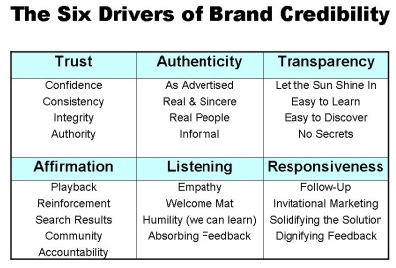
According to Pete Blackshaw of Nielsen, a brand’s credible reputation is driven by 6 factors:

image

Source: Pete Blackshaw http://www.tell3000.com/

* * * * *

Want more from the Homa Files?
Click link =>
  The Homa Files Blog

General Mills Gets A Cereal Boost from Marketing

October 23, 2008

Excerpt from the Ad Age “Cereal Business Gives Boost to General Mills” by Emily Bryson York September 17, 2008  

* * * * *

General Mills reported better-than-expected first-quarter earnings this morning. The company cited particularly strong growth in its cereal business, and said increased marketing investment helped keep its brands top-of-mind… “People are eating more meals at home, and cereal is a quick and healthy option,” Big G President Jeff Harmening said during the call…

The company continued to credit increased consumer marketing spending with much of this success. Ad spending was up 17% in its first fiscal quarter…on top of an 11% increase during the same period last year…

Competitors Kraft and Kellogg have dutifully hiked spending as well, but there has been wide speculation as to when the food industry will begin to show signs of share loss to private labels, or lower ad spending…

Instead of fighting what was expected to be a shift by consumers to lower-priced private-label brands, General Mills CEO Ken Powell said his company is benefiting from consumers seemingly eating out less often and taking more meals at home. (The move away from restaurants appears to have had a positive effect on grocery in general. Kroger reported a 3% increase in second-quarter profit yesterday, citing particular growth in its private-label business.) He said cereal is in a good spot for the current economy, because each serving only costs about 50¢, including milk. 

Edit by SAC

* * * * *

While General Mills earnings may have been better-than-expected, net income dropped 3.6% in the first quarter as it was hit hard by rising commodity prices.  According to a Wall Street Journal article, the cost sugar, oil and other commodities is expected to continue to rise through the rest of the year.  General Mills and other companies were hit particularly hard when efforts to protect against price surges ended up backfiring, particularly with the price of corn and soybeans.  For more information: http://online.wsj.com/article/SB122165181380247655.html

* * * * * 

Full article:
http://adage.com/article?article_id=131057

* * * * *

Want more from the Homa Files?
Click link =>
The Homa Files Blog