Archive for December, 2008

Wines: Highly rated … and under $10

December 31, 2008

Excerpted from WSJ, Tastings, “Easy on the Wallet, Lovely on the Palate”, Dec. 26, 2008 

WSJ’s Tastings columnists John Brecher and Dottie GaiterWe taste around 2,000 wines a year at all price ranges, and conclude that price is absolutely no guarantee of quality.  Here’s their 2008 list of 10 “wonderful” wines for $10 or less.

  • Terre del Nero d’Avola (Rossetti) 2005 ($9.95). Italy.
  • Château Au Grand Paris Bordeaux Supérieur 2005 ($10). France.
  • Valle Reale “Vigne Nuove” Montepulciano d’Abruzzo 2005 ($9.95), Italy
  • Castellana (Cantina Miglianico) Montepulciano d’Abruzzo 2006 ($5.99). Italy
  • Fairvalley (Coastal Region) Sauvignon Blanc 2007 ($8.99)
  • Juno Wine Co. (Robertson) Sauvignon Blanc 2006 ($7.99)
  • Ken Forrester Vineyards “Petit Chenin” (Stellenbosch) 2007 ($9.95). South Africa.
  • The Hogue Cellars (Columbia Valley) Pinot Grigio 2007 ($6.99).
  • Alamos (Catena) Torrontés (Salta) 2007 ($10)
  • Pannotia Vineyards Torrontés (Salta) 2006 ($7.99). Argentina.

Full article (with tasting notes):
http://online.wsj.com/article/SB123033096164636121.html?mod=djemtastings

Want more from the Homa Files?
     Click link =>
  The Homa Files Blog

On December 15th …

December 31, 2008

Shoppers bought more than 6.3 million items – or 72.9 items per second – from Amazon.com on December 15, its best day of the holiday season.

* * * * * 

Internet Usage

83% of those earning more than $100,000 annually say they are online every day or nearly every day.

57% of whites use the Internet every day or nearly every day
35% of African-Americans use the Internet every day or nearly every day
24% of blacks rarely or never go online.

* * * * *

Source: Rasmussen Reports
http://www.rasmussenreports.com/public_content/lifestyle/general_lifestyle/60_are_comfortable_using_credit_cards_online

* * * * *

Want more from the Homa Files?
Click link =>
  The Homa Files Blog

Daily workouts: health-conscious discipline or just plain creepy?

December 30, 2008

Excerpted from IBD, “A Tale Of Two Presidential Workout Fanatics”, Malkin, December 26, 2008

* * * * *

Former Washington Post writer Jonathan Chait famously attacked Bush three years ago in an opinion piece for the Los Angeles Times headlined “The (over)exercise of power.”

Recounting how President Bush ran 3.5 miles a day and preached more cross-training to a federal judge, Chait fumed: “Am I the only person who finds this disturbing? . . . What I mean is the fact that Bush has an obsession with exercise that borders on the creepy.”

Chait argued that Bush’s passionate devotion to exercise was a dereliction of duty. “Does the leader of the free world need to attain that level of physical achievement?” he jeered. “It’s nice for Bush that he can take an hour or two out of every day to run, bike or pump iron. Unfortunately, most of us have more demanding jobs than he does.”

“Bush says exercise helps sharpen his thinking. But some of his critics view his exercise obsession as an indulgence that takes time away from other priorities.”

* * * * *

[Fast forward to] Christmas Day 2008, the Washington Post delivered a front-page paean to Barack Obama’s workout habits: “Gym Workouts Help Obama Carry the Weight of His Position.”

For adoring journalists, you see, Obama’s workout fanaticism demonstrates the discipline and balance in his life.  “it’s his time for himself, a chance for him to reflect. It’s his break. He feels better and more revved up after he gets in his workout.”

And when Obama feels better, the skies will part, the sun will shine (in moderate, environmentally correct, non-global-warming-inducing amounts, of course), and peace will reign worldwide!

Too bad the doughy, coffee-guzzling members of the White House press corps couldn’t see the merits of White House exercise over the past eight years.

* * * * *

Fit Republican president = Selfish, indulgent, creepy fascist.

Fit Democratic president = Disciplined, health-conscious Adonis role model.

Full article:
http://www.ibdeditorials.com/IBDArticles.aspx?id=315188478171644

* * * * *

Want more from the Homa Files?
     Click link =>
  The Homa Files Blog

Sam’s new carton has some folks crying over spilt milk …

December 30, 2008

Excerpted from Fortune, “How Sam’s Club sees the future”, October 16, 2008

Of all the things you might think you could innovate on, the milk jug might not be at the top of your list. But, it is at the top of the Sam’s Club list.

Traditional milk jugs don’t stack, and they were coming in (to Sam’s) on metal carts that were being shipped back to the dairy, cleaned, and then sent back to the stores and clubs, and recycled, which created a lot of energy drain.

sams_club_milk.03.jpgSam’s developed a new milk jug that is stackable, so Sam’s can get 400 additional jugs in a trailer,  eliminating 11,000 delivery trips to the stores.  And,  there are no carts to send back to the dairy.

Trucks are  loaded in a way that reduces bacteria, which gives additional 6 days shelf life.

So, the new package provides a better-quality product, and costs a dime to 20 cents less.

The one big challenge has been that it’s different to pour. If you tip it and put it into the glass, it works fine, but if you pick it up and pour it like the old jug, you’ll miss. Which has some people crying over spilled milk.

Full article:
http://money.cnn.com/2008/10/15/news/companies/Wal-Marts_rising_star_colvin.fortune/index.htm

* * * * *

Want more from the Homa Files?
Click link =>
  The Homa Files Blog

Among the Clinton Library donors … here are some head-scratchers

December 29, 2008

On the recently released list of donors to the Clinton Library, four caught my eye:

McDonald’s … makes sense since he loved Big Macs almost as much as interns

“I Won’t Cheat” Foundation …. no joke — of the many charities doling out money to this political cause, this was among the more ironic

United Way … I’ve always been suspicious of the UW — from high exec comp & perks to the long list of questionable charities … this unadulterated political gift insures  that they won’t ever get another buck from me

Georgetown University … so tuition and donor dollars get diverted to political causes?  That’s disappointing news to me (and probably a lot of others)

* * * * *

Source WSJ, “Clinton’s Donor List Raises Lots of Questions”, Dec. 23, 2008

Want more from the Homa Files?
     Click link =>
  The Homa Files Blog

Big enough to drive a truck through: Detroit’s labor cost disadvantage …

December 26, 2008

So, how much is Detroit’s labor cost disadvantage, really?  According to Reuter’s:

image

Reuter’s notes that trust for retiree healthcare called a Voluntary Employee Beneficiary Association, or VEBA, is to be established in 2010 — to shift retired workers liabilities to a union-aligned trust. Reuters reports that the so-called legacy disadvantgage will go away then — leaving a mere $9 per hour difference (16%).  Reuter’s doesn’t say how the trust will be funded.  Hmmm.

Source:
http://www.reuters.com/article/privateEquity/idUSN1246948520081212?pageNumber=2&virtualBrandChannel=10360

* * * * *

Want more from the Homa Files?
Click link =>
  The Homa Files Blog

Happy Holidays

December 24, 2008

May your holiday season be peaceful and happy …

Ken 

* * * * *

Want more from the Homa Files?
Click link =>
  The Homa Files Blog

Goldman: "Must pay to retain talent to insure continued success" … say, what?

December 24, 2008

Excerpted from IBD, “Bailing Out Bonuses”, December 22, 2008

Amid coast-to-coast cutbacks and layoffs by the thousands, bankers at the center of the financial crisis pay themselves $1.6 billion in taxpayer-funded bonuses .  In addition to the bonuses, they got club dues, financial planners, corporate jet travel, daily limousines and home security systems, courtesy of the taxpayers.

It’s obvious these banker bonuses had no correlation to productivity or performance. In the real world, enterprises provide such benefits only when executives produce results — that is, profits.

Goldman Sachs said it needed to retain and motivate its talent to ensure its “continued success,” not mentioning where this talent is threatening to migrate in a global and industry downturn.

Full article:
http://www.ibdeditorials.com/IBDArticles.aspx?id=314842162013024 

* * * * *

Want more from the Homa Files?
Click link =>
  The Homa Files Blog

Is lithium the oil of the future? … If so, one foreign dependency gets replaced by another.

December 23, 2008

Electric hybrid cars are the secret sauce that will save the planet and free the U.S. from its dependency on foreign oil, right?

Well, the environmental benefits are apparent, but we’ve got a problem.  Batteries are the major cost component of hybrid electric cars (running from $3,000 to $5,000 each).  Right now, industrial strength rechargeable batteries are made mostly in Japan and China — not in the U.S.  A consortium of U.S. companies is soliciting government money to develop and build batteries here.  That’s good.  But, there’s another problem: Lithium — the major element that goes into the current battery of choice — is only minimally available in the U.S.  Uh oh.

* * * * *

Excerpted from “The Trouble with Lithium”, Meridian International Research, Dec. 2006

The world is embracing the Lithium Ion battery as its answer to mobile electrical energy storage needs (translation:  for use in cars).

All other technologies are being more or less swept aside by the attraction of the potentially high energy density of Lithium based batteries.

The most well known alternative to LiIon is the NiMH battery. It is rugged, proven, has high cycle life and has many years development behind it. However, it is heavier than LiIon, very Nickel intensive. (and poses an environmental disposal challenge).

Analysis of Lithium’s geological resource base shows that there is insufficient Lithium available in the Earth’s crust to sustain Electric Vehicle manufacture in the volumes required, based solely on LiIon batteries.

Depletion rates would exceed current oil depletion rates and switch dependency from one diminishing resource to another.

Analysis shows that a world dependent on Lithium for its vehicles could soon face even tighter resource constraints than we face today with oil.

Concentration of supply would create new geopolitical tensions, not reduce them.

Exclusive dependency on Lithium Ion batteries, where the Lithium will overwhelmingly come from South America, would be like being dependent on South America for 100% of our oil supply.

image

Full technical article:
http://www.evworld.com/library/lithium_shortage.pdf

* * * * *

Want more from the Homa Files?
Click link =>
  The Homa Files Blog

GM’s Marketing Missteps

December 23, 2008

Excerpted from Harvard Business Online, “How General Motors Violated Your Trust”, by John Quelch, December 11, 2008

* * * * *

The top eight reasons why GM has failed as a marketer:

1. Focus on products, not customers. For years, Detroit wrongly viewed product types as market segments. Cars were classified as subcompacts, compacts, intermediates etc. But no consumer ever left home passionate to buy an “intermediate car.” Segments are groups of customers, not products.

2. Too many products, too many brands. The Toyota and BMW product lines are very simple, easy for a salesperson to explain and easy for the consumer to understand. There is a logic to the product lineup. Desperate to retain share in the US, GM continues to add to its already confusing array of 60 models under 8 different brand names. The positioning of each brand has long been unclear, a problem magnified by look-alike models built on common production platforms with frequent model changeovers adding complexity costs to production. Buying a car is an infrequent purchase; the consumer needs a clear roadmap of what is on offer.

3. Too many dealers. GM did not reduce its dealerships as it lost share. As a result, dealers began competing on price against each other rather than external competitors. Slipping sales caused dealers to consolidate two or more GM brands on a single lot, further undermining any pretense at distinctive positioning for each marque. And the need to keep sales up at each dealership limited GM’s enthusiasm for embracing new ways of taking new car orders from consumers over the internet.

4. Losing market control. You know you are the market leader when the other players in the value chain – producers, dealers, consumers – all look to your product line as the bellwether alongside which they organize theirs. Today, GM is correctly trying to regain control of the middle with the new Chevrolet Malibu. But will it be able to displace the Toyota Camry and Honda Accord?

5. Bigger is better. Higher wage and benefit costs make it harder for GM to make money on small cars. But the real reason for the migration of the product mix to SUVs and trucks is that the “petrolheads” who run Detroit are all big, tall men. They would rather go down in Detroit history as the guys who brought you the Escalade, not the Prius. They are Jack Palance, not Billy Crystal. Over half the cars bought in the USA are purchased by women; would you know that from the lineup of senior executives at GM?

6. No global brand. Here Ford has a clear advantage over GM. Ford is a global brand. The company name is the brand name. Sure, they have Lincoln and Mercury but the vast bulk of Ford’s marketing dollars worldwide back the mother brand. GM, by contrast, is a house of brands, none of which is global. Marketing resources at GM are inevitably dissipated.

7. Not invented here. Smaller than GM, Ford has been prompted by necessity to better integrate its worldwide operations. In a well-run multinational, this involves US headquarters learning from its subsidiaries, not just telling them what to do or letting them run independently. For decades, Detroit has spurned US launches of high quality vehicles conceived and made in its own European factories.

8. Finance focus. GM has not been run by marketers. It has been run by accountants. The cost focus has crowded out needed emphasis on consumer insight and marketing. Instead of obsessing over the $1,500 per car labor and benefits cost differential separating the big three and the foreign transplant brands, GM should have exploited its market access to develop brilliant new designs that the American consumer would gladly have paid more for. Instead, the Toyota Prius has trumped Detroit and GM’s belated answer is the $40,000 electric Volt.

Edit by DAF

* * * * *

Full article:
http://discussionleader.hbsp.com/quelch/2008/12/how_general_motors_violated_yo.html

* * * * *

Want more from the Homa Files?
Click link => 
The Homa Files Blog

* * * * *

Facebook: Thank your friends for that pop-up …

December 23, 2008

Excerpted from WSJ “Facebook Tries to Woo Marketers” by Jessica Vascellaro, November 11, 2008

* * * * *

Despite its surging Internet audience, Facebook has yet to prove it can wring steady revenue out of advertisers. Now it’s trying a new tactic to woo Madison Avenue.

The company is rolling out a new ad format called “engagement ads” that further blurs the line between marketing and social networking.

The new ads appear on the main screen when a person first logs in to Facebook. They prompt a user to do something within the ad, such as comment on a movie trailer or RSVP for the season finale of a TV show.

If the user completes the action, such as adding Bravo TV’s “Project Runway” show to a personal list of events, Facebook tries to get Bravo’s ad in front of more eyeballs by sharing a notice about what the user has done with their friends.

Facebook has a lot to prove with the new ad format, which it began quietly testing in August and started making available to all advertisers this month. The company says 70 of the U.S.’s 100 largest advertisers have advertised on its site since 2007. But its share of total number of U.S. online display ad views was just 1.1%…MySpace.com, is the market leader with 15.9% of display-ad spending…

Facebook’s new push also comes as economic turbulence hits the online ad market…growth is expected to decelerate from 17% in 2008 to 14.5% next year…

Advertising on social-networking sites appears particularly vulnerable, analysts say, because advertisers are still searching for the right ways to measure the effectiveness of ads on those sites…

The new ads won’t appeal to all Facebook users. Heather Watson, 32, recently saw the engagement ad for “Project Runway.” Ms. Watson says such ads “detract from the [Facebook] experience,” and she clicked the “not attending” option to wipe the Bravo ad from her view…

Facebook has tried many ad efforts in the past, starting with basic “fliers,” the low-budget graphical ads users could buy to promote things like events….But many marketers stayed away, concerned advertising alongside user-generated content might tarnish their brands and that the site appealed only to college students.

As Facebook has widened its audience, it has run into another problem: users weren’t clicking on ads when they browsed each other’s profiles…the rate at which users click on Facebook’s display ads is less than 1% 

Edit by SAC 

Full article:
http://online.wsj.com/article/SB122637098500816351.html

Want more from the Homa Files?
Click link =>
The Homa Files Blog

Detroit’s fight for survival … then and now.

December 22, 2008

Ken’s Take: It has taken awhile for folks to begin to realize that Detroit execs weren’t complete dolts — save for the unfortunate union negotiations in the 1970s that doomed the companies.  Consumers did want mini-vans and SUVs, and fortunately for the Detroiters, minivans and SUVs were profitable enough to cover their labor cost disadvantages.  Now, only to find a way out of the mess …

* * * * *

Excerpted from WSJ, “Auto Bailout Caps Flawed Relationship”, Dec. 22, 2008

The Detroit Three’s post World War II business strategies — which relied on large, powerful cars built by richly paid union workers — were doomed from the day in 1982 when the first Honda Accord rolled off a nonunion assembly line in Ohio.

How Detroit’s auto makers will be able to stabilize financially in the short run is unclear, since it takes years to redo their product lines.

The fastest way to profitability for the Detroit Three, beyond giving haircuts to bondholders and slashing workers wages, would be to take advantage of falling gas prices to sell more of the gas-hungry sport-utility vehicles and large pickup trucks that  Obama and congressional Democrats don’t like.

Washington’s policies, and the way the government exerted regulatory control over the auto makers, often worked against the profound changes the companies needed to make to compete with foreign makers.

Up until this year, Detroit had few reasons not to lean on trucks and SUVs for profits — and government policy all but invited them to do so.

Since the 1980s, Washington’s de facto energy policy has been to keep gasoline prices, and gasoline taxes, low. By contrast, European nations for years have boosted fuel prices to around $6 a gallon through taxes, which pushed consumers toward small cars.

The result: U.S. consumers gravitated toward ever larger and more powerful vehicles because the costs to fuel them were relatively low. In 1987, the average American vehicle got 22 miles to the gallon, weighed 3,221 pounds and accelerated from 0 to 60 miles per hour in 13.1 seconds. By 2007, the average car weighed 4,144 pounds, accelerated to 60 miles per hour in under 10 seconds — and averaged 20 miles per gallon.

Federal tariffs imposed on imported trucks and other quirks in Washington’s fuel-economy regulatory scheme also encouraged U.S. auto executives to push trucks and SUVs.Federal fuel-economy rules allow car makers to average the fuel usage of most of their products. They could sell fuel-efficient small cars and trucks at little or no profit to make up for the high-profit, gas-hungry luxury cars and big SUVs they promoted.

In recent years, GM, Ford and Chrysler made money on trucks — with profits of as much as $8,000 a vehicle — and lost money on cars. Detroit made enough money to cover spiraling health-care and pension costs.

Federal rules caused Detroit “to cede the car market and make all their money in trucks.”

Full article:
http://online.wsj.com/article/SB122990466217625249.html?mod=article-outset-box 

* * * * *

Want more from the Homa Files?
Click link =>
  The Homa Files Blog

Quick: The batteries that power hybrid electric cars — where are they made?

December 22, 2008

Answer: Mostly Japan.  By Panasonic and Sanyo — soon to be just Panasonic since it announced that it’s buying Sanyo. Some from China.

So, our national strategy to become energy independent requires sourcing the major auto component — a $5,000 battery — from a foreign supplier.

Anybody see a problem with that?

This ironic twist is widely known, seems to stay off most radar screens.  Fortunately, there’s a consortium of U.S. companies — called the National Alliance for Advanced Transportation Battery Cell Manufacture — trying to develop a U.S. based battery manufacturing capability.   The consortium is knocking on the government’s door for some development money.

This is one use of tax dollars that I’m in favor of …

* * * * *
Excerpted from WSJ, “U.S. Firms Join Forces to Build Car Batteries”,  December 12, 2008

Many experts believe battery technology and manufacturing capacity could become as strategically important as oil is today.

Fourteen U.S. technology companies are joining forces and seeking $1 billion in federal aid to build a plant to make advanced batteries for electric cars, in a bid to catch up to Asian rivals that are far ahead of the U.S.

Two decades ago, a similar helped the U.S. computer-chip industry restore its competitiveness.

Auto makers, including General Motors Corp. and Ford Motor Co., say they plan to roll out plug-in electric cars by 2010. But the U.S. has limited capacity to make the lithium-ion batteries those cars will need. Most of the batteries used in today’s hybrid vehicles, including Toyota Motor Corp.’s Prius and some of GM’s hybrid models, come from Asian makers.

Though much of the advanced battery technology was developed in the U.S., American companies “opted out” of battery production because of the low returns the business offered and the U.S. has lost the lead in battery manufacturing. Asian manufacturers picked up the business because of their proximity to makers of electronic devices, which need a steady supply of batteries.

The consortium intends to solicit as much as $1 billion in federal funds from the Obama administration by tapping loan guarantees contained in an energy-security act passed last year. The act pledges as much as $7 billion in loan guarantees for advanced-battery plants in the U.S. The first large-scale lithium-ion battery plant in the U.S. could cost $1 billion to $2 billion.

Full article:
 http://online.wsj.com/article/SB122957206516817419.html?mod=testMod

* * * * *

Ken’s Take:

U.S. battery manufacturing must be a strategic national priority if we’re serious about becoming energy independent and carbon fuel light.

But, battery manufacturing is only part of the equation. 

The primary input to the next generation auto grade rechargeable battery is lithium.  Any idea where that element comes from? 

Hint: not the U.S.  I’ll give the answer in a subsequent post.

* * * * *

Want more from the Homa Files?
Click link =>
  The Homa Files Blog

For small car buyers, fuel economy & sticker price are important … not safety. Huh ?

December 22, 2008

Excerpted from WSJ, “Small Cars Improve in Crashes” by Jonathan Welsh, December 17, 2008

* * * * *
The demand for smaller, more fuel-efficient cars has increased. Sales of compact cars like the Honda Fit, Toyota Yaris and Nissan Versa rose 24% though November, while sales of large utilities fell 36%.

Among small-car buyers, safety tends to take a back seat to fuel economy and a low sticker price. While 86% of basic compact-car buyers rated fuel economy as the feature about which they cared most, 29% rated safety as a top concern…

The good news: Small cars fare better in crashes than they used to … But, they still lag behind larger vehicles in protecting passengers. Their disadvantages are especially clear in side-impact crashes. Of the nine small cars recently tested…all received the group’s top rating of “good” in frontal crashes — but only two got good ratings when hit from the side. The test results highlight the difficulty for designers and engineers in developing cars that are small and light yet still strong enough to withstand collisions with large vehicles

Only the SX4 and Matrix, and its twin the Vibe, received good ratings for protection in side crashes. The Ford and Chevrolet were judged acceptable in side-impact protection, while the Hyundai and Saturn were marginal and the Chrysler was poor. Only the Ford Focus was top-rated in rear-impact crashes…The Chrysler PT Cruiser was the worst performer…Car makers have rapidly improved small-car design in the past few years by strengthening vehicles’ protective framework and adding side airbags…

The … side-impact tests are especially difficult for small cars because the barrier used to strike the test vehicle simulates the front end of a large SUV or pickup truck. The high bumper typically hits the test car at the same level as the heads of test dummies representing the driver and rear driver-side passenger. This makes head-protection side airbags critical.

Edit by SAC 

* * * * *

Ken’s Take:  I wonder if small car drivers pick airlines based on the same criteria?

* * * * *

Want more from the Homa Files?
Click link =>
The Homa Files Blog

Plunging U.S. auto sales …

December 22, 2008

Combined Detroit 3 U.S. auto sales today (under 7 million vehicles) are about equal to GM’s sales in 1985 …

[u.s. auto sales]

Note: about 1/3 of Chrysler’s 600,000 sales are to fleets, e.g. rental cars, company pools.

Source:
http://online.wsj.com/article/SB122969367595121563.html?mod=testMod 

* * * * *

Want more from the Homa Files?
Click link =>
  The Homa Files Blog

New Domain Names, New Costs to Brands

December 22, 2008
Excerpted from WSJ “New Domain Names Put Name Brands in a Bind” by Emily Steel, November 5, 2008
* * * * *
Worried about having to shell out millions of dollars to protect their brands, several major companies are protesting the launch of a slew of new top-level domains — the suffixes like “.com” that appear at the end of Web-site names.

Verizon Communications, Marriott, and New York Life Insurance are among the companies arguing that the new domains could open the flood gates to Internet fraud and drastically increase their costs of doing business online…

The organization that oversees the Internet, the Internet Corporation for Assigned Names and Numbers, plans to start selling the rights to an unlimited number of top-level domains next year. These domains are likely to take their names from popular subjects, types of businesses, geographic locations or even brand names, such as .bank, .hotel, .nyc or .verizon.

Companies fear that if they don’t register their trademarks at the new domains, their brand names could be hijacked, leading to mistrust of their brands, as well as Internet scams.

“Companies are in a difficult position. In one sense, they may feel compelled to register their crown jewels in all these locations because if they don’t, an infringer will come along, and you will have to deal with the consequences. But at the same time, it’s a huge waste of corporate resources,” says Sarah Deutsch, vice president and associate general counsel at Verizon.

ICANN, a not-for-profit organization whose members include the registrars who operate the top-level domains, says…current domains are too crowded. The crowding makes it difficult for newcomers to buy a domain that suits their business…

Companies are debating whether they should buy up the rights to operate their own brand-specific domains, such as .marriott or .nylife. They also are looking at registering their trademarks for more generic domains. For example, Marriott is considering acquiring the rights to Marriott.nyc, Marriott.travel or Marriott.vacations…

A typical company might register 20 sites within each new top-level domain, making the total cost to participate in all 200 of them $2 million, says Josh Bourne, managing partner of FairWinds Partners, an Internet-strategy consulting firm.

There currently are 21 generic top-level domains, such as .org, .info and .biz…Companies already spend a significant sum each year to buy up domain names connected to their brand…

Companies say they have been through this before, pointing to earlier launches of such domains as .asia or .eu. They bought up hundreds of thousands of domains pre-emptively but say these sites either sit dormant or fail to generate traffic.

 Edit by SAC

Full article:
http://online.wsj.com/article/SB122583938093998683.html

 Want more from the Homa Files?
Click link =>
The Homa Files Blog

Bush wimps … punts automakers to Obama … UAW celebrates

December 19, 2008

An “orderly, pre-packaged reorganiztion” didn’t make the cut after all.

Instead, Bush just cut a check, loaning GM and Chrysler $17.4 billion to bridge them through the end of January. 

The “teeth”: companies have to promise to try harder.  Just kidding, that’s not even a requirement as near as I can tell.  No restructuring of overhead; UAW workers will still get $150,000 to work the line.

Bottom line: Bush got freaked that the sky would fall and didn’t have the stones to push the UAW to reopen the gold plated contract. Geez.

PS: the politics of this move are interesting …

Full article:
http://online.wsj.com/article/SB122969367595121563.html?mod=testMod 

* * * * *

Want more from the Homa Files?
Click link =>
  The Homa Files Blog

Bush considering "orderly" auto bankruptcy … (for the already bankrupt automakers)

December 19, 2008

Excerpted from AP, Bush considering “orderly” auto bankruptcy, December 18, 2008

* * * * *

The Bush administration is seriously considering “orderly” bankruptcy as a way of dealing with the desperately ailing U.S. auto industry.

The White House was close to a decision …  on an auto rescue plan …  and is continuing discussions with the various sides that would have to sign on to a managed bankruptcy — entities such as labor unions and equity holders in addition to the companies themselves.

Full article:
http://finance.yahoo.com/news/Bush-considering-orderly-auto-apf-13868234.html

* * * * *

Ken’s Take:

  1. The automakers already are bankrupt.  The new news is trying to do something orderly.
  2. Didn’t the Detroit CEO’s say that the sky would fall before Christmas?
  3. Hard to believe that UAW folks will still be drawing over $70 per hour when the auto plants are closed.  Can’t the automakers at least redeploy the workers to infrastructure projects for the month?  Guess not — union work rules.
  4. Wouldn’t surprise me if Bush played rope-a-dope until he hands the keys to Obama …

* * * * *

Want more from the Homa Files?
Click link =>
  The Homa Files Blog

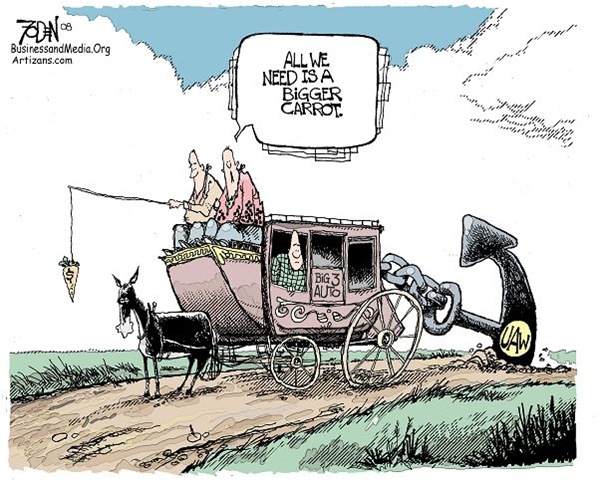
As Detroit burns (figuratively), UAW gets a paid vacation …

December 19, 2008

When Chrysler plants are idled because they are not making vehicles, Chrysler is still required to pay its UAW workers 95 percent of their wages.
http://voices.washingtonpost.com/economy-watch/2008/11/corker_uaw_should_not_be_paid.html?hpid=topnews

image002

* * * * *

Want more from the Homa Files?
Click link =>
  The Homa Files Blog

From Band-Aid to K-Y: The Power of Green Packaging

December 19, 2008

Excerpted from Ad Age “J&J’s Green-Packaging Rebirth Proves Power of Smart Design” by Teressa Iezzi, November 3, 2008 

* * * * *

AIGA, “the professional association for design,” held a conference bringing together an interesting range of voices from design, branding and culture…One of the featured speakers was Chris Hacker…design officer at Johnson & Johnson…

Hacker’s…presentation took a look at the reinvention of the design process at the package-goods giant and how design has resulted in a major win for J&J’s bottom line as well as for the environment.

J&J had acknowledged over the years that while the company did a lot of things very well, product design was not one of them. That bit of reality was thrown into alarming relief one day when during a meeting with Target, Goggins was told that if J&J didn’t “get its design act together,” it would lose position in stores…

The company didn’t have in-house designers in the consumer-products group. All design decisions were made by “the left hand”…typically by the most junior marketing people…who tended to move around every 18 months or so. They worked with outside design consultants, and all projects were handled separately, without a unifying vision.

When Hacker joined, he set up a design office…The new design discipline (which includes working with outside designers) has resulted in a number of successful product rebirths and a new focus on sustainability for the company.

Among the product stories: a sales-inducing facelift for the iconic Baby Shampoo packaging, new Band-Aid packaging and a streamlined first-aid kit, and an all-out redesign of K-Y, with more intimately oriented packaging and the addition of the K-Y Yours & Mine…

Hacker described sustainability at a company J&J’s size as “a journey.” It starts with packaging-weight reduction and the use of recyclable and certified materials; biodegradability and reusability are the next step. He says, for example, when he joined the company, Band-Aid packaging was made mostly in Brazil from “unknown source” material. He moved to Forest Stewardship Council-certified paper; post-consumer recycled paper will follow. The Aveeno brand has also moved in part to post-consumer materials and will continue to do so.

Will the design and sustainability journey be slowed by the current economic conditions? “Recession is exactly the reason we need to be doing what we’re doing,” he said. “It’s cutting through the chaos of everything that’s going on.”

Edit by SAC  

Full article:
http://adage.com/columns/article?article_id=132145

* * * * *

Want more from the Homa Files?
Click link =>
The Homa Files Blog

Low-interest mortgages are the answer … Not !

December 18, 2008

Here’s the newest twist on how to stabilize the housing market: price fix the retail mortgage rate at 4.5%, with the government (i.e. you and me) subsidizing the rates for folks who wouldn’t otherwise be able to afford the mortgage payments.  My suggestion for stabilizing housing prices is below.

* * * * *
Excerpted from WSJ, “Low-Interest Mortgages Are the Answer”, Hubbard & Mayer, December 17, 2008

The Treasury Department is considering a plan to offer a 4.5% mortgage for home buyers for a period of time. Let’s hope it does. It would help arrest the decline in house prices that is at the base of the ongoing financial crisis and recession.

In most markets house values are today lower than what is consistent with the average level of affordability in the past 20 years. Current futures markets suggest that house prices will decline by 12%-18% in the next 18 months.

Nonetheless, without policy action house prices are likely to continue falling. Conversely, we see little risk that increasing the demand for housing will touch off another housing bubble. While the economy is contracting, low interest rates would spur housing activity.

A 4.5% mortgage rate is not too low. The 10-year U.S. Treasury yield closed at 2.3% on Dec. 12, 2008. Hence a 4.5% mortgage rate is 2.2% above the Treasury yield, above the 1.6% spread that would prevail in a normally functioning mortgage market.

Recall that a mortgage can be thought of as a risk-free bond plus two possibilities that increase risk to lenders: default and/or prepayment. Historically, the risk of default adds about 0.25% to the interest rate. The remaining spread of the mortgage rate over the Treasury yield represents the risk of prepayment and underwriting costs. With falling house prices, the risk of default could indeed add 0.75% or more for a newly underwritten and fully documented loan.

Moreover, a 4.5% mortgage rate will raise housing demand significantly. A simple forecast can be obtained by applying the 2003-2004 homeownership rates to 2007 households. We use the 2003-2004 home ownership rates because those were the years of the lowest previous mortgage rates (the average mortgage rate was 5.8%).

An increase in the homeownership rate from 67.9 (third quarter, 2008) to 68.6 (the average rate from 2003-2004) would increase homeownership by about 800,000 new homeowners. A simple statistical analysis examining the impact of lower mortgage rates and higher unemployment rates yields an even higher, and firmer, estimate of 2.4 million additional owner occupied homes in 2009.

4.5% mortgage rate that the Treasury is considering also should be available for present homeowners who want to refinance, because of the benefits for the economy as a whole. We calculate that up to 34 million households would be able to do so, at an average monthly savings of $428 — or a total reduction in mortgage payments of $174 billion.

Research article:
http://www4.gsb.columbia.edu/realestate/research/housingcrisis/mortgagemarket

WSJ article:
http://online.wsj.com/article/SB122948162452913103.html

* * * * *

Ken’s Way:

Eliminate capital gains taxes on all residential property that is acquired during 2009 and 2010, provided that the property is held at least 24 months. (Note: that the tax exclusion would depend on both the purchase date and the holding period)

The goal: get private investors — large and small — to buy residential property (i.e. houses) and rent them to folks who neither really can’t afford to buy a house on their own.  To sweeten the deal, let landlords depreciate the property on a highly accelerated basis for income tax purposes, and allow all current tax losses to offset ordinary income when calculating taxes.

It would be a win-win.  Investors would have a place to park their money; more rental housing would be available for non-owners; tax payers wouldn’t have to subsidize anything.  

* * * * *

Want more from the Homa Files?
Click link =>
  The Homa Files Blog

Majority Oppose Government-run National Health Plan … and only 45% of Dems favor it.

December 18, 2008

Excerpted from Rasmussen Reports, December 12, 2008

* * * * *

51% of U.S. voters oppose the creation of a single-payer national health insurance plan overseen by the federal government, 30%  favor it, and 19% are undecided.

45% of Democrats favor a government-run national single-payer plan;  74% of Republicans are against it.

55% of white voters oppose a government-run plan, while a plurality of African-Americans (44%) support it.

61% of liberals favor a national health plan overseen by the government, compared to 30% of moderates and 14% of conservatives.

Married voters — by double digits –are more opposed to a government plan than unmarrieds.

Full article:
http://www.rasmussenreports.com/public_content/business/healthcare/51_oppose_government_run_national_health_plan

* * * * *

Want more from the Homa Files?
Click link =>
  The Homa Files Blog

Soup Isn’t Sexy, Its Effective

December 18, 2008

Excerpted from Brand Channel “Campbell’s Soup un-canny” by Adam Sauer, November 10, 2008

* * * * *  

Even before Warhol pointed out the obvious, Campbell’s was an iconic brand. From its humble beginnings as Joseph Campbell’s cannery of tomatoes, soups, condiments, vegetables, and mincemeat in 1869, it grew into a brand that identifies Americana as much as it identifies America.

While the popularity of the brand’s profile fluctuates over time—often depending on the economic health of its consumers—Campbell’s enjoys extraordinary brand recognition and an envy-inducing level of respect. For example, despite being the oldest of old-economy brands, a 2008 survey…found that Campbell’s was second on a list of the most socially responsible companies in the US, behind only Google.

Campbell’s owes a great deal of its success to technological innovation. Its turn-of-the-century breakthrough of halving water content to create a condensed soup helped to expand its wide popularity.

But just how does the brand fair online in the new economy?

Campbellsoup.com is the brand’s online gateway representing and linking to the brand’s stable of sites…

Much of Campbell’s online success can be attributed to what the brand hasn’t attempted to do. The brand, for example, understands the reasons to visit a soup website do not include Flash-based video games or social networking based on a love for chicken soup. (It should be noted that many similar consumer brands, or those brands’ agencies, are convinced otherwise.)

Also, Campbell’s realizes its brand’s place on the sex appeal spectrum; it knows it is not a high fashion label and it opts, wisely, to avoid flamboyance both online and on the shelf…

A final paradox of the brand is that while Campbell’s is known for the simplicity of its design and product (soup), the label is actually an umbrella for a conglomerate of products ranging from juice to seeds. The challenge is to differentiate the site enough to represent this family of brands without losing that simple Campbell’s iconography that captured Warhol’s attention.

Campbell’s likewise accomplishes this with links to its Pepperidge Farms, Prego and Swanson brand offerings… So, soup to nuts, Campbell’s online does all it should and none of what it shouldn’t. Simple. Effective. Just like the soup.

Edit by SAC 

* * * * *
Full article:
http://brandchannel.com/features_webwatch.asp?ww_id=406

* * * * *

Want more from the Homa Files?
Click link =>
The Homa Files Blog

But, the dogs have been eating the dog food …

December 17, 2008

The Detroit auto execs have been getting pillaged for not making the kind of vehicles that consumers want to buy.

That accusation doesn’t seem to to ring true when driving down an interstate highway or walking through shopping mall parking lots.  I see plenty of SUVs, min-vans, and pick-ups with American brand names.  Some look pretty new to a casual observer.  Seems like folks are buying them.

In fact, for the past several years, about half of the best selling vehicle models are U.S. brands.  The SUVs have fallen out of the top 10, but pick-ups still top the list and at least one American car (Impala) makes the list.  Detroit may not have the car of the future, but it seems to have had some cars for the recent past.

Where are hybrids are the list?  Nowhere.  

CNBC’s Maria Bartiromo  raised that point with Congressman Barney Frank:

Does Congress realize how few hybrids have been sold, as it pushes, Detroit to make them, and will Congress give consumers greater incentives to buy these cars?

Frank’s reply was odd — even by Barney Frank standards:

“That’s a very fair point. And one of the things I’ve been saying is that some of my colleagues and the commentators who have been blaming the auto companies forget to blame somebody else—the consumers. In the recorded history of America, no one was ever forced at gunpoint to buy a Hummer. But we do believe that the combination of genuine concern about global warming and energy efficiency means people are now ready to buy these cars.”
http://www.businessweek.com/magazine/content/08_51/b4113000737793.htm 

Translation:   “If the dogs don’t eat the dog food, blame the dog.”  Not exactly the “marketing concept” at work.

Ken’s take: It looks like Detroit makes vehicles that many American consumers like, but that Washington  doesn’t like .  The congressional meddlers want Detroit to make cars that are guaranteed to lose money (lots of it).  If only the dogs would eat the right food.

* * * * *

Want more from the Homa Files?
Click link =>
  The Homa Files Blog

If the consumer craves "green", why is Toyota delaying its new Prius plant?

December 17, 2008

Toyota is delaying the opening of a new Prius plant in Mississippi.

The plant, near Tupelo, was originally going to make Highlander SUVs from late 2009. Then, as part of a big shakeup of the company’s U.S. production, Toyota decided it would begin making the new Prius at the site from 2010.

Now, Toyota will wait until the market starts picking up.

Excerpted from Business Week Online, Dec. 15, 2008:
http://www.businessweek.com/autos/autobeat/archives/2008/12/toyota_delays_n.html?chan=top+news_top+news+index+-+temp_news+%2B+analysis

* * * * *

Ken’s Take: It is broadly reported that Toyota — the runaway market leader in hybrids — loses money on each Prius it sells.  So, if Toyota can’t make money on hybrids, how are they (hybrids) going to save Detroit?  As usual, I must be missing something.

* * * * *

Want more from the Homa Files?
Click link =>
  The Homa Files Blog

Sirius XM faces strategic challenges, debt load … and, oh yeah, NASDAQ delisting

December 17, 2008

Excerpted from Business Week, “Sirius XM’s Dual Concerns: Debt, Delisting”, December 12, 2008

* * * * *

Sirius XM  is racing to get its financial house in order … The company’s shares have plunged more than 85%, to 14¢,and risk being delisted from the Nasdaq stock market in the coming months.

The biggest hurdle for cash-strapped Sirius XM will be refinancing $1 billion in debt that’s coming due in 2009.

The company is also under pressure to reduce operating costs. Sirius XM may need to negotiate for a lower price on some of its programming agreements. The company pays $60 million a year to broadcast Major League Baseball through 2012, for instance.

Analysts question plans to expand the company’s constellation of costly satellites … the company is due to pay $31.2 million for the construction and launch of a new satellite in 2009. 

In the long run, the company may have to make changes to its whole method for distributing content.  “There are lots of ways to distribute programming, and satellites may not prove to be the ideal way.” Engel says. The company could expand its network of terrestrial repeaters, towers similar to those traditional radio stations use to relay signals, and rely on costly satellites less.

A more aggressive push online and onto wireless networks and devices like the Apple iPhone may help expand Sirius’ customer base, currently about 19 million. “Sirius may be artificially limiting its scope by relying on satellite technology as a delivery vehicle.” A push online or through a wireless network could help Sirius round out its packages of channels, selling for $6.99 to $16.99 a month, with more personalized content.

A greater variety of personalized options may help calm longtime XM subscribers who have grown frustrated in recent months as Sirius consolidated some of its programming and some beloved shows went away… many are considering canceling the service after losing favorite channels.

Word of disgruntled existing users may keep new subscribers from signing up. “That kind of move has a ripple effect beyond the existing subscriber base.”

By starting to distribute its content differently, for instance via the iPhone, Sirius may be able to offer what some of its rivals already offer, and allow users to pay to listen to specific interviews or a particular concert. It may even allow subscribers to purchase song tracks and audio books from its Web site or through its radio receivers.

“If they are going to remain tied to a pure subscription model, they are probably not going to succeed in the long run.”  After all, rivals like Web radio, HD radio, and music services like Apple’s  iTunes are making inroads.

Automakers like Ford  are building more support for Apple iPod music players into their cars.

According to IDC’s fall survey of nearly 2,000 people, 58% of Americans own portable media players, and while only 16.5% subscribe to satellite radio service, many of them are die-hards.

Full article:
http://www.businessweek.com/technology/content/dec2008/tc20081212_917411.htm?chan=top+news_top+news+index+-+temp_news+%2B+analysis

* * * * *

Want more from the Homa Files?
Click link =>
  The Homa Files Blog

How green is your dry cleaner? … and, oh yeah, how clean are your clothes?

December 17, 2008

Excerpted from WSJ, “Finding an Eco-Friendly Dry Cleaner,” by Gwendolyn Bounds, December 4, 2008

* * * * *

Recently we’ve spotted a growing number of dry cleaners hawking “organic” and “eco-friendly” services and wondered if they were up to par, or just engaging in green-washing of a different sort. 

Roughly 80% of the nation’s 30,000 dry cleaners still employ a cleaning method using the liquid solvent perchloroethylene — or “perc”…because it is known to remove stains and odors effectively without damaging or shrinking delicate garments.

However, perc has been listed as a hazardous air pollutant and a probable human carcinogen…long-term exposure could increase the cancer risk for consumers who wear a lot of dry-cleaned clothes…the EPA is requiring a phase-out of perc at dry cleaners located in residential buildings…

These moves, coupled with consumer appetite for eco-anything, are fueling the growth of professional cleaners who dub themselves as “greener.” They’re ditching perc for myriad alternatives, such as liquefied carbon dioxide, silicone and gentle, biodegradable detergents…

WSJ put a handful of cleaners through their sartorial-sanitizing paces to see how they stacked up…all the stores we tested generally cleaned as well as, if not better than, our regular outlets…however, there’s real debate over just how eco-friendly and safe some of these newer methods are.

We tested the four cleaning techniques frequently touted as greener alternatives to perc: “wet-cleaning”…CO2 cleaning, hydrocarbon cleaning and a silicone-based cleaner.  At least two of these methods don’t get endorsements among some eco-watchers. For instance, the hydrocarbon method uses a petroleum solvent that, while not considered hazardous like perc, contains volatile organic compounds that can contribute to smog…Likewise, there have been questions raised about the silicone method…

“It’s absolutely confusing…We are entering a new world here in terms of regulation of chemicals.” As a rule of thumb, “you are pretty darn safe with wet-cleaning” provided you go to a pro that has the proper equipment needed to reshape garments after they’re washed…For now, the Web is the best bet for consumers hunting for a non-perc cleaner in their neighborhood…

Edit by SAC

* * * * *

With the myriad of businesses are claiming to be “green” today the Eco-cleaner’s claims do appear to have some merit.  In the article’s test the “green” cleaners not only stood up against the traditional method, but offered comparable prices and in some cases additional complementary services.  This indicates that consumers aren’t yet aware of the value in eco-cleaning and thus businesses aren’t able to charge a premium or that the cleaners themselves have yet to impose a pricing premium for their green services.  While the eco-jury is still out Eco Cleaners will continue to grow as the use of “perc” is phased out.

* * * * *

Full Article:
http://online.wsj.com/article/SB122834783552077505.html?mod=wsjcrmain

* * * * *

Want more from the Homa Files?
Click link =>
The Homa Files Blog

The Nike Network

December 17, 2008

Excerpted from BusinessWeek, “How Nike’s Social Network Sells to Runners”, by Jay Greene, November 6, 2008

* * * * *
Nike is winning a new game that other corporations, from Coca-Cola to Verizon to General Motors, have tried unsuccessfully to play: building brand loyalty via online social networking.

In the two years since it launched Nike+, a technology that tracks data of every run and connects runners around the world at a Web site, nikeplus.com, Nike has built a legion of fans. In August, for instance, 800,000 runners logged on and signed up to run a 10K race sponsored by Nike simultaneously in 25 cities, from Chicago to São Paulo. Now the company is testing a social network to promote its basketball shoes.

Some analysts back up Nike’s claims that the site is renewing the popularity of its running shoes. SportsOneSource, a Princeton (N.J.) market research firm, says Nike accounted for 48% of all running-shoe sales in the U.S in 2006. Today, its share is 61%. “A significant amount of the growth comes from Nike+,” says Matt Powell, a SportsOneSource analyst.

* * * * *

Nike’s online strategy differs from those of other companies. Most have tried to create virtual communities through a build-it-and-they-will-come approach centered on a brand or specific product. Originally, the Beaverton (Ore.) company envisioned Nike+ simply as a clever way to combine music and running, not as a prototype for a new kind of marketing.

The key to bringing runners onto the Web was the development in 2006 of a $29 Sport Kit sensor that, when synched with an iPod touch or nano, tracks runners’ speed, mileage, and calories burned. When those runners dock their iPods, nikeplus.com launches, and the run data get uploaded. More important, the site is a virtual gathering place. Runners have collectively logged 93 million miles on nikeplus.com.

* * * * *

Nike now hopes to score with another group of jocks: basketballers. The company is beta-testing Ballers Network, a Facebook application that lets players organize real-world games and manage their teams online.

Edit by DAF

* * * * *

Full article:
http://www.businessweek.com/magazine/content/08_46/b4108074443945.htm?chan=top+news_top+news+index+-+temp_news+%2B+analysis

* * * * *

Want more from the Homa Files?
Click link => 
The Homa Files Blog

* * * * *

Feds in "stand off" over foreclosures … is that bad news or good news ?

December 16, 2008

Excerpted from Business Week, “A Standoff Over How to Rescue the Housing Market”, December 11, 2008

* * * * *

image 
        http://images.businessweek.com/ss/08/12/1211_numbers/2.htm

Without reducing foreclosures and ending the slide in home prices, it will be nearly impossible to stabilize banks and lessen the depth of the recession. And sharply rising unemployment has added new urgency: Last spring, Rod Dubitsky, Credit Suisse’s (CS) head of research for asset-backed securities, projected 6.5 million foreclosures. With unemployment set to top 8% in 2009, he says up to 10 million families may lose their homes.

What’s the best way to stabilize plunging home prices?

Treasury Secretary Hank Paulson and his staff are considering plans to push mortgage rates down to 4.5% in hopes of bringing buyers back into the moribund market.

Democrats—in Congress and on President-elect Barack Obama’s team—seem more set on pressing lenders to renegotiate troubled mortgages. That tack, championed by FDIC head Sheila Bair, is aimed at trimming foreclosures and ending fire sales.

Bair’s plan offers a guarantee to lenders that modify a mortgage so payments are trimmed to 31% of a homeowner’s gross income. If they cut interest rates or stretch out the life of a loan, Washington would cover part of the lender’s losses should a homeowner redefault. Bair says the plan would save 1.5 million homeowners at a cost of $24.4 billion. [Note; lenders would get subsidies only on loans that redefault.]

But conflicting investor interests make it legally tough to modify securitized loans. And new statistics suggest that more than half of loans modified early this year are already at least 30 days past due.

Treasury says it’s studying several options, including the plan to subsidize low rates. Proponents say that by bringing new buyers to the market, the move could help end the pricing slide.   Problem is, low rates would do little for those now facing foreclosure or trapped in homes worth less than their mortgages.

Full article:
http://www.businessweek.com/magazine/content/08_51/b4113030318539.htm?chan=top+news_top+news+index+-+temp_news+%2B+analysis

* * * * *

Ken’s Take:

In rough numbers …

  1. 2/3’s of roughly 125 million households are owner-occupied
  2. 1/3 of owner-occupied households are owned free and clear of any mortgage
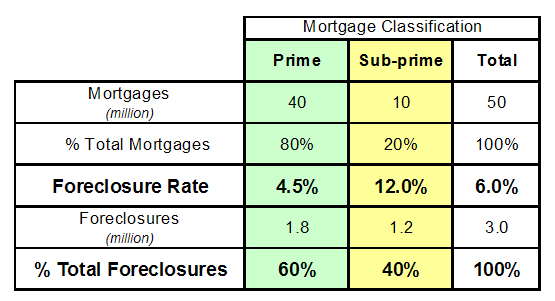
  3. 20% of mortgages are sub-prime; most with no down payment; many “under water”
  4. Vast majority  of sub-primes were “unqualified” at fair market (vs. “teaser”) interest rates
  5. 12% of sub-primes are in foreclosure, accounting for 40% of total foreclosures
  6. 50% of foreclosed sub-primes don’t qualify at modified terms (e.g. writing loan down to house’s FMV)
  7. 50% of modified sub-prime loans re-default within 6 months

image

Bottom line: Many of the people being foreclosed on are “occupants” not “owners”.  Help legitimate owners who are going through some tough times; stop delaying the inevitable for the sub-primes — and certainly don’t reward them with deals better than the people who played by rules have.  That’s not fair !

* * * * *

Want more from the Homa Files?
Click link =>
  The Homa Files Blog

The automaker’s specious bankruptcy argument …

December 16, 2008

Excerpted from WSJ, How Destructive Would Bankruptcy Be for Big Three?, December 12, 2008

* * * * *
One of the Big Three’s main arguments for a bailout is that American consumers won’t buy General Motors and Chrysler cars if they are forced into bankruptcy. They would be tainted by a stigma and by worries that warranties and parts wouldn’t be available years down the road if the firms ran the risk of liquidation.

Consumer surveys support this view. One survey of 6000 consumers by CNW Research this summer found that 80% said they would abandon an auto maker if it were to file for bankruptcy.

Does the argument hold up? One way to test it is to look at consumers’ actual behavior. The risk of bankruptcy has obviously risen in the past few months. If bankruptcy is likely to drive consumers away, one might expect to see the market share of GM and Chrysler fall more precipitously as bankruptcy risks rise.

The U.S. market share of the Big Three has been dropping consistently for years, from 74% in the mid-1990s to less than 50% today. But there’s little evidence in the data so far that this longer term pattern has been dramatically amplified by the rising risk of bankruptcy.  

With the whiff of bankruptcy in the air …

Chrysler’s U.S. sales market share has actually risen from 8.7% in July to 11.5% in November, according to  Moody’s Economy.com.

GM’s market share has bounced around but hasn’t dropped below levels hit earlier this year. 

Ford, which isn’t facing an immediate cash crunch, has picked up market share too, rising from 14.2% in July to 16.5% in November.

Of course, sales have been propped up by  fire-sale deals and aggressive fleet sales.  But, that’s not new news.

http://blogs.wsj.com/economics/2008/12/12/how-destructive-would-bankruptcy-be-for-big-three/

* * * * *

Ken’s Take:

1. Is there anyone who doesn’t recognize that the Detroit automakers are hanging by financial threads?  The companies are bankrupt, they’re just not in legal bankruptcy proceedings. If they were, they’d at least stand some chance of restructuring themselves into healthy positions. The current government thinking stands no chance of doing that. 

2. As I’ve said before, they survey results are misleading.  Would somebody be more likely to buy a car from a financially healthy car maker?  Of course.  Would somebody prefer to by from one that is on the brink of financial collapse or one that is in bankruptcy proceedings?  I bet that would be a statistical tie.

* * * * *

Want more from the Homa Files?
Click link =>
  The Homa Files Blog

Feeling pinched these days? Here’s why …

December 16, 2008

Economists estimate households will have lost more than $5 trillion in net worth since the summer of 2007 because of falling home equity and stock prices.

In recent years, households have used their big multiyear wealth gains as a means to afford more debt and as a surrogate form of savings, instead of socking away more of their pay. But by the end of 2008,  They are now more dependent on income growth to finance their spending and saving and less so on credit and wealth.

Source: Business Week
http://www.businessweek.com/magazine/content/08_51/b4113010266237.htm

* * * * *

Ken’s Take: On average, that works out to be about $40,000 per household — or about 80% of median annual household income — i.e. the rough equivalent of an average person being laid of for about a year.  Ouch.

Want more from the Homa Files
Click link =>  The Homa Files Blog

Bush bends, UAW wins big … automakers still bankrupt.

December 15, 2008

Excerpted from IBD, “Rewarding Failure”, December 12, 2008

The proposed $15 billion bailout of the Big Three failed in the Senate for one major reason: Some lawmakers stood up to the unions. But their stand may be moot, since automakers may get the money anyway, even though the idea is wildly unpopular among voters

In addition to major restructuring by the automakers, GOP senators insisted on givebacks by the United Auto Workers. The UAW responded with a resolute “No.” 

Gold-plated union contracts are a big reason for U.S. automakers’ woes (though managerial incompetence at the Big Three also played a role). The average Big Three worker made $73.26 an hour in 2006; the average worker at a foreign transplant, $44.20.

Last year, Toyota made 9.37 million vehicles. GM, virtually the same number. Yet, Toyota made a profit of $38.7 billion on its global operations, or $1,874 per car, while GM lost $38.7 billion, or $4,055 a car, almost entirely due to its operations in the U.S.

* * * * *
Full article:
http://www.ibdeditorials.com/IBDArticles.aspx?id=313977740860863

* * * * *

Want more from the Homa Files?
Click link =>
  The Homa Files Blog

Bold idea for the Detroit automakers: Leave Detroit (and, maybe, the country)

December 15, 2008

Jagdish Sheth, a professor of marketing at Emory University’s Goizueta Business School says:

“The car companies should legally separate their international divisions from their domestic operations, so they no longer subsidize the U.S. operations. Many of the automakers are actually doing well overseas, especially in emerging economies like China, India, Russia and Brazil, where demand for vehicles is still relatively strong”.

Excerpted from Knowledge @ Emory
http://knowledge.emory.edu/article.cfm?articleid=1201

* * * * *

Ken’s Take

Sheth may be onto something. So, why not take his idea a step further? 

Perhaps the Detroiters (at least Ford & GM) should legally separate the international operations, then enter bankruptcy proceedings in the U.S.  Then, either a real restructuring would happen, or the companies would become profitable entities without a U.S. presence.

Aren’t corporate strategists taught to exit unprofitable markets? 

* * * * *

Want more from the Homa Files?
Click link =>
  The Homa Files Blog

"Car czar" must have sound judgement … which disqualifies anybody who would take the job.

December 15, 2008

Car czar “is an undesirable job. Managing bailout funds in an industry resistant to change won’t be easy. It’s also a government job. Taken together, that means a high risk of waste, fraud, and more bailouts afterward. Nobody wants to sign on to failure.”

Excerpted from IBD, “Romney For Car Czar”, December 11, 2008
http://www.ibdeditorials.com/IBDArticles.aspx?id=313892314464564

* * * * *

Ken’s Take: AMEN !

Mitt and Volcker are smart enough to stay away from this one, right ?

* * * * *

Want more from the Homa Files?
Click link =>
  The Homa Files Blog

To continue in English, please enter your credit card number … a new low in customer service courtesy of Dell

December 15, 2008

Excerpted from Wash. Post,”The Bangalore Backlash: Call Centers Return to U.S.; Some Firms See Value in Familiar Voices”, December 11, 2008

* * * * * 

If you prefer a customer service agent who speaks “American,” then computer maker Dell has a deal for you.

Catering to consumers put off by the accents of Bangalore, Manila and other call-center hubs around the globe, Dell will guarantee — for a price — that the person who picks up the phone on a support call will speak “American”.

The Your Tech Team service, with agents in the United States, costs $12.95 a month.  It also promises that wait times will average two minutes or less. Without the upgrade, a customer is likely to get technical help from someone in India, the Philippines or the other places where Dell has operators.

Occasionally, “we’ve heard from customers that it’s hard to understand a particular accent and that they couldn’t understand the instructions they were getting,” said Dell. “This illustrates Dell’s commitment to customer choice.”

“Most people in the customer service world believe that if you have sold me a product, then support for that product should be free,” the managing director of  a call-center consultancy.

Full article:
http://www.washingtonpost.com/wp-dyn/content/article/2008/12/10/AR2008121003574.html 

* * * * *

Want more from the Homa Files?
Click link =>
  The Homa Files Blog

Playing hard ball … UAW says "$75 per hour sounds about right" … what happened to "no more special interests in Washington"?

December 12, 2008

Below are a few highlights from today’s WSJ report on the apparent collapse of the Detroit 3 bailout loan.  My ‘take’ and predictions follow …

* * * * *

Highlights excerpted from WSJ, Rescue Bid for Detroit Collapses in Senate, Dec. 12, 2008

A frantic, last-ditch attempt to forge a relief package for the auto industry collapsed in the U.S. Senate, dealing a giant blow to the immediate hopes of the Big Three.

The talks, which appeared close to a deal several times, broke off due to a sharp partisan dispute over the wages paid to workers at the manufacturing giants.

Republicans demanded the bill be strengthened to exact concessions from the industry. “We simply cannot ask the American taxpayer to subsidize failure”

The initial White House-backed package saying it doesn’t require auto makers and their unions, suppliers, creditors and dealers to make changes needed to return to a sound financial footing.

[Now, both Democrats and the car companies] hope the White House will now relent and allow the Treasury to provide emergency loans from the $700 billion Wall Street fund.

Harry Reid said the Senate would be in recess, and would stand in pro forma session until January, when the new Congress will be convened with stronger Democratic majorities.

After a marathon day of negotiations, top Democrats appeared close to a deal that would toughen the bailout package in a bid to raise Republican support, which had proved an insurmountable stumbling block. The focus of talks was on seeking commitments to restructure the industry’s debt load and bring labor costs in line with wages paid by Toyota and Nissan  in the U.S.

But those talks fell apart after Republicans insisted that wages reach parity in 2009.  Mr. Reid declared talks at an impasse.

Sen. Christopher Dodd, a Connecticut Democrat, complained that Republicans had attempted to turn the wage issue into a political matter about organized labor, instead of making it an “an economic issue.”

The collapse of the talks represents a major defeat for three companies and an auto union that once wielded immense political clout. Even after two appearances in Washington by the GM, Ford and Chrysler CEOs, and a show of solidarity with the UAW, the auto makers were unable to convince many skeptical lawmakers to change their minds and support a bailout.

GM will also discuss plans for its Saturn division. One option includes putting the division into bankruptcy protection, as it is technically a separate entity.

The collapse of the deal raises the stakes for Chrysler and its majority owner, Cerberus Capital. Lawmakers had called for Cerberus to put more money into the company, but Cerberus maintains it can’t because the bylaw of its investment funds prevents it from putting more than a small percentage of its investors’ funds into any single investment.

Full article:
http://online.wsj.com/article/SB122903816924599853.html?mod=testMod

* * * * *

Ken’s Take

  1. There is zero chance that the Detroit 3 can survive with  line workers getting $150,000 per year in salary and benefits.  Yes, it was weak management (in the 1970s, when business was booming and the UAW was striking) that saddled the companies with the problem.  But, there is no imaginable plan that can neutralize a $1,500 to $2,000 per car cost disadvantage.  Adding a  $5,000 battery to each car doesn’t solve the problem — it only exacerbates it.
  2. The problem isn’t “wages”.  The difference in take-home pay between Detroit and the “transplants” is only a couple of dollars.  The problems are gold-plated benefits (about twice as much for the Detroiters,  restrictive work rules that limit flexibility to move workers around (within the plants), and “featherbedding” — paying non-workers. 
  3. This is the issue that will really test Prez-O.  He campaigned, in part, on “no special interests”.  Well, the UAW threw $11 million into his campaign coffers and probably expect some “considerations”.  We’ll see …
  4. My favorite: Cerebus says it can’t throw in more money because of its by-laws.  That is being said at a time that there’s pressure to legislate the re-writing of mortgages and practically every other contract in America.  B.S.  Cerebus knows it’s good money after bad — and they want it to come from taxpayer’s pockets, not their’s.
  5. The “car czar” idea is frighteningly stupid.  Let’s see: the SEC, etc.,  can’t effectively oversee financial companies,  Boards of Directors can’t seem to oversee companies that they’re responsible for …. but, some uber-dude will be able to parachute in, learn a very complex business at warp speed, and — oh yeah — get the UAW in line.  Call me cynical, but I don’t think so.

* * * * *

Ken’s Predictions

  1. Bush will cave and fund the initial stages of this folly … with few “teeth” in the plan except to make the companies promise to “try hard”.
  2. Any teeth that are put in will be relaxed or reversed  on January 21, 2009.  The money will flow from Washington to Detroit, the UAW will prosper, and the Detroit 3 will still be teetering on bankruptcy. 
  3. A car czar will be appointed — the lobbying and politics will be overwhelming — and the poor sap will fail

* * * * *

Want more from the Homa Files?
Click link =>
  The Homa Files Blog

What’s wrong with this statement: “People won’t buy cars from an automaker in bankruptcy”

December 12, 2008

I’ve heard this refrain at least a dozen times on CNBC today.  It’s been repeated so many times that it’s starting to take on the aura of fact.

Let’s dig a little deeper.  Pundits are saying “people who are surveyed say they won’t buy a car from a bankrupt automaker”.

Well, guess what.  The Detroit 3 (or at least GM and Chrysler are bankrupt!

The “fine hair” of difference is whether they go through a “bankruptcy proceeding” that potentially restructures them (and their burdensome union contracts) into a healthier condition.

I’m sure the survey question is — at least implicitly — “would you be more likely to buy a car from a financially healthy automaker or one that is bankrupt?”  Obvious answer, right?

The question should be “would you be more likely to buy a car from an automaker in bankruptcy proceedings, or one that is hanging by its financial finger nails and likely to go into formal bankruptcy in a couple of monthes?”  Rational answer: “none of the above”

What am I missing?

* * * * *
Want more from the Homa Files?
Click link =>
  The Homa Files Blog

Re: SUVs … the proclamation of their death was a bit premature

December 12, 2008

Excerpted from Business Week, “The SUV Is Rising from the Dead”, November 26, 2008

* * * * * *

Americans are downsizing to the smallest vehicle they can tolerate. But in many cases, that’s just another kind of SUV—one that gets about 22 mpg

* * * * * *

When gasoline blew past $4 a gallon in July, pundits declared the era of the gas-guzzling sport-utility vehicle over.

Since then, of course, prices have dropped 50%, and …  more visitors to the Edmunds.comsite are researching SUVs … and appear to be ‘cycling back to our ‘bad’ car-buying habits.”

It’s more complicated than that. Americans are downsizing to the smallest vehicle they can tolerate.

But in many cases, that’s just another kind of SUV—one that gets about 22 mpg. That’s more eco-friendly than a Hummer, but this is hardly the era of conservation that some had predicted.

Gas-electric hybrids, which typically cost at least 15% more than conventional cars with similar mileage, are a tougher sell than they were just three months ago.

According to Edmunds, the number of people intending to buy a hybrid has been declining along with the fall in fuel prices. When gasoline prices peaked in July, 700,000 visitors to Edmunds.com checked out hybrid cars. But in October, only about 150,000 did so.

Meanwhile, J.D. Power & Associates (MHP) says that 36% of people who traded in large SUVs in November turned right around and bought another one.

“Consumers tell us they don’t want a small car.They want something roomy (to haul kids and cargo) and more fuel-efficient.”

Full article:
http://www.businessweek.com/magazine/content/08_49/b4111063900772.htm 

* * * * *

Want more from the Homa Files?
Click link =>
  The Homa Files Blog

Buzzword: "Cause" Marketing

December 12, 2008

Excerpted from Washingtonpost.com, “Cause Marketing Matters to Consumers”, by Kim T. Gordon, October 14, 2008

* * * * *

In this new era of social responsibility, what you don’t do can cost you. “Cause marketing” is now the norm, and customers who visit your website and see your advertising want to know that you share their desire to make the world a better place by supporting an important cause.

If your business or brand doesn’t stand for a cause, consumers may turn to your competitors. The number of consumers who say they would switch from one brand to another if the other brand were associated with a good cause has climbed to 87 percent, a dramatic increase in recent years, according to a Cone Cause Evolution Survey.

Even niche markets, such as the nation’s college students, now show a striking preference for brands they believe to be socially responsible. According to a newly released College Explorer study from Alloy Media, nearly 95 percent of students say they are less likely to ignore an ad that promotes a brand’s partnership with a cause.

* * * * *

The challenge is to make your socially responsible efforts a winning proposition for the nonprofit group you support, the community and your business. You can master this marketing challenge by following these important steps:

– Choose a related cause: A solid cause-marketing campaign often starts with the right affiliation. So as you go through the nonprofit selection process, look for a cause that relates to your company or its products.

– Contribute more than dollars: For many types of businesses, cause marketing involves donating products or services and not simply writing a check. This can help form even stronger consumer associations between what you offer and the good work you do.

– Formalize your affiliation: To make your affiliation a win-win for everyone, work with the nonprofit you choose to define how it will help your business increase its visibility, brand or company awareness. If the organization has a newsletter or other communications with its constituents, negotiate for opportunities to do joint promotions. Discuss how you will use the organization’s logo and name in your marketing campaigns, and how it, in turn, will use your company logo and name in its press releases, on the organization’s website and in other materials.

– Mount a marketing campaign: Success in cause marketing often means motivating an audience to take action, such as making a donation or participating in an event.. Using a dedicated marketing campaign, you can reach and persuade the target group while also raising awareness for your business and its commitment to social responsibility.

Edit by DAF

* * * * *

Full article:
http://www.washingtonpost.com/wp-dyn/content/article/2008/10/17/AR2008101702913_pf.html

* * * * *

Want more from the Homa Files?
Click link => 
The Homa Files Blog

* * * * *

Just say "no" … 62.7% oppose Detroit 3 bailout loans … Dems split …Congress says "let's roll"

December 11, 2008
    * * * * *

    image

    http://www.ibdeditorials.com/PollsPopUp.aspx?id=313629919786029

    * * * * *

    Excerpted from Rasmussen Reports,”14% Say Federal Government Will Run Big Three Better”, December 09, 2008

    Nonetheless, Congress and the White House are fast reaching a deal on a bailout plan for the Big Three that many suggest is just a step short of nationalizing the U.S. auto industry since it gives the federal government a say in how the automakers spend their money and what kind of cars they build.

    The short-term loan plan being worked out in Washington calls for the creation of a federal “car czar” who will develop benchmarks by which to measure the automakers’ restructuring and who will have the power to push management, unions, shareholders and others to implement changes

    A longer term bailout plan proposed by President-elect Obama goes even further. “It could mean that the government would mandate, or at least heavily influence, what kind of cars companies make, what mileage and environmental standards they must meet and what large investments they are permitted to make,”

    But only 14% of U.S. voters think the Big Three automakers will run better if they are run by the federal government.

    While voters display little confidence in government control of the automakers, 59% say senior managers of a company should be replaced if taxpayer funding is provided to keep the company afloat.

    Full article:
    http://www.rasmussenreports.com/public_content/business/general_business/just_14_say_federal_government_will_run_big_three_better

    Want more from the Homa Files?
    Click link =>
      The Homa Files Blog

Letting the Chicken Loose to Understand the Bottom of the Pyramid

December 11, 2008

Excerpted from WSJ, ” McCann Offers Peak Lives of Latin America’s Poor” By Antonio Regaldo, December 8, 2008

* * * * *

During presentations at McCann Worldgroup’s office in Bogotá, Colombia, staffers have taken to letting a chicken loose to hunt and peck around clients’ feet. Racks of potato chips and other products on display in McCann’s Mexico City conference room, which has been designed to look like a bodega…

The point of these exercises: to give big marketers some insight into the lifestyles of Latin America’s low-income consumer…McCann’s move comes as multinational companies increasingly consider such “emerging consumers” as a big opportunity. But these consumers’ tastes, habits and needs remain largely an enigma to global marketers…

McCann’s research is helping Nestlé market Nido Rindes Diario, a brand of fortified powdered-milk product…one of Nestlé’s challenges was to overcome the perception that milk powder is a specialized formula for babies, and too expensive for the whole family to drink. McCann says its research helped position the product…

The idea of targeting low-income consumers may raise some eyebrows. But greater access to industrialized products like deodorant, and packaged food, can improve their physical and “psychological welfare…We do not pretend to be Mother Teresa”…

Advertisers say practical insights into low-income groups are hard to come by. “A lot of people talk about the emerging consumer, the bottom of the pyramid, but no one really has a structured approach…We have to do a lot for ourselves, and sometimes fall on our face doing it.”

In Mexico, Nestlé decided to sell Nido Rindes Diario exclusively through mom-and-pop stores, not supermarkets…That decision came after McCann found that local shopkeepers exert outsize influence in tightly knit, low-income neighborhoods. “It’s the shopkeeper who can recommend or disavow a product,” he says…

Some experts say marketing directly to low-income groups has yet to become a full-blown trend. “Usually multinationals just put out a Mexican version [of their product] that looks as American as possible”…But examples of products tailored to thin pocketbooks are increasing…

Edit by SAC

* * * * *

According to the theory of the bottom of the pyramid, there is a combination of profit opportunity and social responsibility to be had by marketing to consumers at the bottom of the economic pyramid. Critics of the theory argue that the benefits of marketing to this group are overstated and that marketing to this group can be exploitive.  Whether the profit opportunity is real or a mirage, McCann is taking the right steps to help Nestle benefit from this group by working to understand the group’s purchase desire and developing tailored solutions for the market to ensure that consumers are able to access the product.

* * * * *Full Article:


http://online.wsj.com/article/SB122824726034173129.html

* * * * *

Want more from the Homa Files?
Click link =>
The Homa Files Blog

Consumers Go Cheap as Brand Loyalty Suffers

December 11, 2008

Excerpted from WSJ “At the Supermarket Checkout, Frugality Trumps Brand Loyalty” by Ellen Byron, November 6, 2008 

* * * * *

When Summer Mills visited her local CVS drugstore recently, to save a few dollars she bought the store-brand facial scrub rather than the Olay she normally uses.

“I thought I’d be able to tell the difference, but I couldn’t — I looked at the ingredients and they seemed almost the same,” says Ms. Mills…On her next shopping trip, “I’m going to buy the store-brand moisturizer and cleanser — it’s less money.”

Many Americans are changing their everyday purchases and abandoning brand loyalty, prompted by the persistent financial pressure of rising food, gasoline and electricity prices. Over the past 24 months, consumer prices have risen 7.8%…From coloring hair at home instead of at the salon to trying cheaper laundry detergents, new evidence indicates that Americans are modifying even minor household habits to save money.

Kimberly-Clark’s CEO noted that sales of the company’s potty-training pants, once one of the biggest sales-growth products in the baby aisle, have fallen off in recent months. “You’re seeing consumers leaving children in diapers longer…the diaper is less expensive per piece than a training pant”...Shoppers are even buying toilet paper differently. “When they get to the end of the month, and they’re out of paycheck, they may buy a smaller-count pack”…

To be sure, overall sales of name-brand goods are still higher than those of store brands. Still, about 40% of primary HH shoppers said they started buying store-brand paper products because “they are cheaper than national brands”…Store brands on average cost 46% less than name-brand versions, Mintel found…

Paper napkins suffered the steepest declines over the past year, followed by facial tissue and paper towels. “Not surprisingly, toilet tissue is holding up the best,” Mr. Lockwood says.  Laundry habits are changing, too. Early signs indicate shoppers are switching to cheaper detergents and softeners, a rare shift in one of the most brand-loyal product categories…

Though low-income consumers have been cutting back for the past several months, now upper-income shoppers — those with household incomes of $100,000 or more — also are making significant changes…

“This isn’t belt-tightening, it’s belt-notching…These ritual changes are much deeper and happening much faster than we expected”…

Shoppers’ changing behavior prompted P&G to alter its marketing approach and focus on in-store promotions. “More decisions are made in the store, and we have to be competitive,” CEO A.G. Lafley said…

[Household Spending Habits]
Edit by SAC
Full article:
http://online.wsj.com/article/SB122592835021203025.html

Want more from the Homa Files?
Click link =>
The Homa Files Blog

"Stop those foreclosures, now !" … Nope, that’s a bad idea.

December 10, 2008

Ken’s Take:

“Stop those foreclosures, now !” is one of three recent mortgage-related refrains that make me scratch my head.

The first is a variant of the above one: “we’ve got to keep people in their homes” — with the emphasis on “their”.  Seems to me that folks are conveniently confusing “ownership” with “occupancy”.  Some lug who makes no downpayment and makes at most a couple of mortgage payments at promotional interest rates doesn’t own anything.  He started with no equity, built no equity, and may even be in a negative equity position.  It’s not “his” home simply because he squatted there for awhile.  Geez.

The second came from the mouth of Ben Bernanke himself: “Putting these people through the foreclosure process (instead of cutting rates & principle) will put a permanent, detrimental mark on their credit records.”  No kidding, Ben.  Isn’t it the role of credit records to report to prospective lenders that somebody has a history of stiffing people who lent them money in the past.  Seems fraudulent to me that the government puts together a process that spackles over that serious flaw.

Now, here’s one of hundreds of reasons that we shouldn’t “stop those foreclosures now.” …

* * * * *

Excerpted from IBD, “Bad-Loan Lipstick”, December 09, 2008

Foreclosures: A new federal report shows that most bailed-out borrowers slip back into default within six months.

It seems agreed on all sides that bad home loans got us into our economic crisis. So, goes one argument, wouldn’t it make sense to modify those loans into good ones — that is, loans not in default? That would seem to get at the root cause of the trouble. Besides, help for struggling homeowners is good politics. Sounds like a plan.

The chairwoman of the FDIC and  leading Democrats in Congress want to modify some 2 million high-risk loans by [cutting interest rates, lengthening terms, and even cutting the principle loan balance].  

This week,the Comptroller of the Currency released data showing that … 53% of the mortgages modified by lenders end up back in default –usually within 6 months.   

Were the loans so badly underwritten that borrowers simply could not afford them, even with reduced payments?

After al, they went to borrowers who put little or nothing down, and who lacked the credit history and documented income that lenders would have demanded in saner times.

These loans started to sour in good times. And easing up on their terms now won’t cure their fundamental flaws. 

For these toxic loans, the best thing to do is to let them run their course into foreclosure, and work to contain the damage.

Full article:
http://www.ibdeditorials.com/IBDArticles.aspx?id=313719048815277

* * * * *

Want more from the Homa Files?
Click link =>
  The Homa Files Blog

They’d rather play than eat … huh??

December 10, 2008

Excerpted from Marketing Daily “How We Cut: Restaurants First, Video Games Last” by Sarah Mahoney, November 12, 2008

* * * * *

While there’s no shortage of consumers who are dialing down their spending-.  Guess what consumers axe first when they are worried.

When asked how they planned to trim the fat, dining out is in the hot seat–with 57% of respondents saying they plan to spend less.

Clothes were the next casualty, with 54% cutting back–followed by entertainment, with 50%.

Somewhat safer were beauty products and music, both identified as categories to cut by 44% of the survey, and movies at 43%.

Only 39% say they plan to spend less on toys, and 35% on video games…

How long consumers will continue to tweak their purchasing habits is anyone’s guess, but as far as people are concerned right now, the changes are for the long haul…

Younger consumers are the least hopeful…Those in the 65-plus category come in second in the pessimism parade, with only 7% saying they believe that recovery in less than a year is possible.

Overall, men tend to be less likely to believe we are in a recession, and more likely to believe the economy will bounce back fast.

Edit by SAC 

* * * * *
Full article:
http://www.mediapost.com/publications/?fa=Articles.showArticle&art_aid=94580

Want more from the Homa Files?
Click link =>
The Homa Files Blog

What Downturn? Luxury Brands Keep Consumers Dreaming

December 10, 2008

Excerpted from Knowledge @ Wharton “Luxury Brands: Marketing the Upscale During a Downturn“, November 12, 2008

* * * * *

As 2009 shapes up to be the most challenging year in more than a generation for luxury items such as high-end apparel and fragrances, marketers’ plans for targeting aspirational 16-year-olds and expanding rapidly into the new money hubs of Russia or the United Arab Emirates are suddenly “out.”  What’s now “in” for marketing luxury in this difficult era is pampering the wealthiest and most loyal customers…

In a recession in which even upscale consumers may find themselves strapped for disposable cash, it is a bad strategy to chase customers too far down the economic ladder. “We don’t want to see huge price cuts that will create a lower-priced brand…you don’t want to tarnish your brand…you still have your brand reputation to uphold”…

Many experts believe that the economic pain of the deepening recession could fall disproportionally on these marketers of high-end perfumes, trendy clothing or sleek fashion accessories…Conspicuous consumption seems practically un-American in these troubled times…As a result of the hard times, consumers are likely to see some moves aimed at selling high-end products at a slightly lower cost.

The key is not to make any move that will diminish the value of a brand with a well-established name for luxury…For luxury goods, the business plan places trust in the artistic vision of a designer — and hopes that will lure customers.

Because of the luxurious image they must portray, these marketers said they also need to guard their brands in ways that mass-market companies do not…That does not mean, however, that luxury firms do not want their products to reach a fairly broad audience… But to boost the bottom line, fashion firms are likely to focus now on pampering their best and most loyal consumers, using computer technology to increasingly customize upscale products that will be designed or tailored especially to their needs.

The success of individualized luxury goods — such as designer clothes or eyewear — is a development that could keep a customer repeatedly coming back for more, according to the panelists…Among the designer trends in customization are monogrammed handbags, personalized options for a color or a fabric in accessories, or a wider array of fragrances that are “personalized”…

Ironically, while the panelists were not particularly enthusiastic about the short-term prospects for emerging overseas markets, their companies continue to position themselves for when the time is right…

Still, regardless of where the global economy winds up, luxury marketers say their principle mission will remain the same: Selling a more glamorous way of life to aspiring consumers. “You’re buying into that dream…And you’re buying into that grand theme, which is our job.” 

Edit by SAC

* * * * *
Full article:
http://knowledge.wharton.upenn.edu/article.cfm?articleid=2091

Want more from the Homa Files?
Click link =>
The Homa Files Blog

Let’s get some accountability … Ask your Congressman to put his "you-know-whats" on the table if he votes for the bailout … Better yet, demand it !

December 9, 2008

Ken’s Take: All of these bailouts are flat out nuts.  The worst is the seemingly inevitable tossing of money down the Detroit sink hole.  There is no chance whatsoever that Detroit get on the road to prosperity.  They can’t compete with a $1,500 or more cost disadvantage on every car sold, and the politicos are determined to patronize the UAW. Getting rid of senior management bonuses and corporate planes doesn’t even qualify as rounding error.  A fundamental restructuring of overhead costs (i.e. massive white collar layoffs) and a competitive labor agreement are required.  Neither will happen. If ever there were a case of putting good money after bad, this is it.  No government loans will ever be repaid — either the companies won’t have the wherewithal to repay or the loans will be forgiven by Congress if the companies act like they’re doing something green.

To vent my frustrations, I emailed my Congressman — asking him to make a simple pledge to the dwindling number of taxpayers.  I know it won’t change anything, but I felt better.  You should try it.

* * * * *

Congressional Accountabilty Pledge 

Dear Mr. Congressman:

Stop wasting my tax dollars.

There is no chance that the Detroit 3 will repay bailout loans made to them.

If you vote affirmatively to approve any bailout loans, in any form, to any or all of the Detroit 3 automakers, you should accept personal accountability for your vote and make a binding, irrevocable public commitment to resign your government position on January 1, 2011 if the loans have not been repaid to the government in full by then, regardless of circumstances.

Period.

Your’s truly,

One of a dwindling number of taxpayers

* * * * *

To email your Congressional Representative:
https://writerep.house.gov/writerep/welcome.shtml 

* * * * *

Want more from the Homa Files?
Click link =>
  The Homa Files Blog

From the folks who want to micro-manage Detroit: 3 years late and 134% over budget … geez.

December 9, 2008

Three years behind schedule and almost $360 million above budget, the Capitol Visitor Center  is to open to the public on Dec. 2.

The final cost of the project is put at $621 million, more than double the $265 million estimated cost had the center been completed on schedule in December, 2005.

Security was a key factor in the cost overruns. Congress decided to add two tunnels, one for truck deliveries and one linking the Capitol with the Library of Congress, that could also serve as emergency evacuation routes.

Then there were the usual overruns associated with a project where 9,000 workers set more than 400,000 pieces of stone, some weighing as much as 500 pounds. The excavation phase required the removal of 65,000 truckloads of dirt.Congress also approved the addition of House and Senate office space.

* * * * *

Excerpted from MSNBC, “Capitol Visitor Center opens after delay, cost overrun”, Nov. 10, 2008

Full article:
 http://www.msnbc.msn.com/id/27648214/ 

* * * * *

Want more from the Homa Files?
Click link =>
  The Homa Files Blog

If you want to be Costco, you gotta cut costs …

December 9, 2008

Excerpted from BusinessWeek, “Costco’s Artful Discounts”, by Jena McGregor, October 20, 2008

* * * * *

In Costco Wholesale’s New Jersey distribution center, some 2 million rolls of paper towels recently sat stacked in a mountain of green and orange plastic. Nearby, row upon row of jumbo tissue rolls formed a wall of cushiony toilet paper.

A year ago, the space was virtually empty.

Costco’s customers have not, of course, suddenly stopped buying paper products. The 258 truckloads of Bounty and Charmin are the result of a “buy-in,” just one strategy Costco ( has been using to hold prices down amid rising costs. After Procter & Gamble announced a 6% price increase in August, Costco bought as much as it could stuff into its depots at the old rate.  “We’ll have a six-week supply when everyone else is going up in price.”

* * * * *

At Costco, where more than 29 million households pay $50 to $100 a year to shop, low prices aren’t just a nice-to-have. They’re a way of life.

Not only does Costco’s famously frugal CEO James D. Sinegal cap margins at a sacrosanct 14% on branded goods, he’s constantly pushing his buyers to find creative ways to lower prices and add value while getting his managers to crank up their efficiency efforts. Besides the buy-in strategy, Costco has been redesigning product packaging to squeeze more bulky goods onto trucks and revamping processes for moving goods through its depots. 

 For one, holding prices low is the best way to protect profits: About 75% of Costco’s operating earnings come directly from membership fees, and if prices rose too quickly, some members could flee.  Costco’s reputation for bargain prices and surprise designer goods could inspire a new crop of warehouse chic devotees. 

* * * * *

What Sinegal isn’t doing is wavering from the basic model that helped him  build Costco into a retail phenomenon. The company’s warehouse model relies on selling core items at rock-bottom prices while scooping up excess inventory from high-end brands. The average store does $137 million in annual sales, a volume so high that Costco turns its inventory 11.9 times a year, meaning it often sells goods before it technically has to pay its suppliers. Combine that with high-income customers—the average Costco household makes upwards of $75,000—and “what they’re doing is really high velocity retailing.”

As consumers cut back, Costco is finding more available inventory and fielding more calls from companies hungry to boost slumping sales. Lately, the loot in that treasure chest is getting even more high end. Over the last year, Versace dinnerware, Waterford crystal, and pastel girls’ Lilly Pulitzer dresses have all made their way into Costco’s stores. “Their ability to sell stuff is staggering.”

* * * * *

With about 4000 SKUs, compared to 5300 at Sam’s Club and 40,000 at an average grocery store, Costco’s pared-down approach can make vendors more willing to cut them a deal.

The limited SKU count also helps to drive impulse shopping and remind customers that Costco doesn’t stock everything. “In a tough economy, the ability to change your assortment towards products that are selling more is a huge advantage  …If the item isn’t a value anymore, or isn’t generating the sales hurdles, it’ll be deleted.”  This holiday season, for example, almost all of Costco’s Christmas lights will be light-emitting diode because of the demand for energy-efficient bulbs. Regional food buyers also have significant sway to reflect local tastes.

* * * * *

Costco has even gotten vendors to redesign product packages to fit more items on a pallet, the wooden platforms it uses to ship and display its goods. Putting cashews into square containers instead of round ones will decrease the number of pallets shipped by 24,000 this year, cutting the number of trucks by 600. By reshaping everything from laundry detergent buckets to milk jugs, Costco has needed 200,000 fewer pallets a year overall.

Sinegal acknowledges that he can’t hold back the cost increases forever. “The biggest concern to me is that we lose our way and start thinking it doesn’t matter if you charge another dime or another dollar or another hundred dollars,” he says. “Without those disciplines, we don’t have anything.”

Edit by DAF

* * * * *

Full article:
http://www.businessweek.com/magazine/content/08_42/b4104058856320.htm

* * * * *

Want more from the Homa Files?
Click link => 
The Homa Files Blog

* * * * *

Last comic standing … oops, sorry … I meant "banker"

December 8, 2008

Excerpted from NY Times, “Saluting a Banker in a Year Worth Forgetting”

* * * * *

From the NY Times

It’s like being named the outstanding British soldier of 1776.

The trade publication American Banker unveiled its Banker of the Year award last week: It went to Kenneth D. Lewis, chief of Bank of America.

While Mr. Lewis is a respected executive, 2008 hardly seems like the year for any banker, given how unpopular the industry is these days.

‘One banker observed: ‘He’s a great executive and B. of A.’s a great bank … but it just doesn’t seem like the right time to be dancing in the streets and celebrating banking.”

American Banker said editors  felt they had to laud someone this year.

Its party for the bankers of the year was held Dec. 4 at the Plaza Hotel.

*  * * * *

Added observation

The financial crisis hasn’t been kind to some past honorees.

Kerry Killinger, the 2001 winner, was ousted as CEO of Seattle-based Washington Mutual Inc. in September over disastrous bets on risky mortgages.

The 2005 winner, Ken Thompson, was forced out as CEO of Charlotte-based Wachovia Corp. in June.

In 2006, American Banker gave a Lifetime Achievement award to Countrywide CEO Angelo Mozilo, who gambled on subprime loans and saw his company disintegrating before selling out to Bank of America.

J.P. Morgan Chase & Co. acquired WaMu in September, and Wells Fargo & Co. is buying Wachovia.

Even Bank of America hasn’t come through the crisis unscathed.  Its stock has declined 65% year-to-date.

* * * * *

More from the NY Times:

Corporate executives’ fortunes can fall quickly.

For example, in 2001, Fortune put Enron on its most admired companies list, and Business Week put Tyco International at the top of its best performers list.

Worth magazine placed Jeffrey K. Skilling, the former chief executive of Enron, at No. 2 and L. Dennis Kozlowski, the former chief executive of Tyco, at No. 10 on its list of America’s best chief executives.

Later in 2001, Mr. Skilling resigned as Enron began falling apart. In 2002,Mr. Kozlowski resigned. Both Mr. Skilling and Mr. Kozlowski are now convicted felons.

** * * * *
Full article:
http://query.nytimes.com/gst/fullpage.html?res=9E05E2DA1F38F930A35752C1A96E9C8B63&scp=1&sq=banker+of+the+year&st=nyt

Want more from the Homa Files?
Click link =>
  The Homa Files Blog

Brands Battle as Man Grooming Grows

December 8, 2008

Excerpted from Advertising Age, “The Battle of the Brands: Old Spice Vs. Axe” by Jack Neff, November 17, 2008

* * * * *

One of the crowning achievements of…P&G…has been the rebound of Old Spice in the battle for hearts and minds of men…

“Old Spice was in decline. They’ve now turned that around. It’s growing. Axe has not only stopped growing. Axe is in decline.”

Unilever, of course, begs to differ.

Needless to say, there’s some controversy about that in a battle that’s been a flashpoint in the global struggle between package-goods behemoths. Unilever says Axe continues to grow in body spray and beyond, most recently with the launch of Dark Temptation body spray…

Rather than trying to run away from its grandfatherliness, Old Spice instead embraced a big-brother persona and a purpose…described as “helping guys navigate the seas of manhood” by offering experience…

In practical terms, that’s involved a lot of funny ads from offering campy voices of experience…As a result, Old Spice is no longer declining. Sort of. The publicly available numbers don’t quite make a forceful case for an actual rebound. They do show Axe slowing across most of its business, which had been until the past year or so one of the biggest marketing success stories of package goods, or anything, of the decade…

Edit by SAC

* * * * *

While these two brands battle it out in deodorants and body spray, the market for men’s grooming products continues to grow.  P&G’s Gillette extended its brand this year with a line of body washes, shampoos and conditioners earlier this year.  Unilever’s Vaseline also recently entered men’s grooming with Body & Face and Hand Lotions specifically for men.  As the market grows Old Spice and Axe are sure to face increasing competition from one another and new entrants.

* * * * *

Full Article:
http://adage.com/article?article_id=132559

* * * * *

Want more from the Homa Files?
Click link =>
The Homa Files Blog