Archive for October, 2009

Turn back the clock: coupon clipping brand loyaty.

October 13, 2009

TakeAway: Amid growing competition for consumer purchases, marketers are turning back the clock and resorting to increased couponing.

Now, with coupon values at all time highs, marketers are facing an should-be-expected challenge –  excessive promotion hurts brand image and trains consumers to hop from deal to deal.   

Old practices die hard.

* * * * *

Excerpted from NYTimes, “A Clip-And-Save Renaissance,” By Stephanie Roosenbloom, September 24, 2009 

… It may be the digital age, but when it comes to pinching pennies, most consumers are opting for a method that is well over a 100 years old: the paper coupon. Thanks to the miserable economy, coupons … have made a comeback.

The recession has even made coupon clippers out of some groups that once avoided them, including well-to-do shoppers and young shoppers

As the economy worsened and consumer sentiment plunged, coupon redemption ticked up 10 percent in the fourth quarter of 2008, compared with the period a year ago — the first jump in coupon redemption since the early 1990s. In the first half of this year, coupon redemption climbed 23 percent. Some 1.6 billion coupons were redeemed … it is forecast that more than three billion coupons will be redeemed this year …

Coupon redemption was also spurred on by marketers who dangled more valuable deals … there was a 9 percent increase last year in the face value of coupons …

Another way coupon clippers save is by shedding brand loyalty and buying whatever is on sale …

Edit by TJS

* * * * *

Full Article
http://www.nytimes.com/2009/09/24/business/24coupon.html?em

* * * * *

About unemployment (and accountability) … what did they know and when did they know it?

October 12, 2009

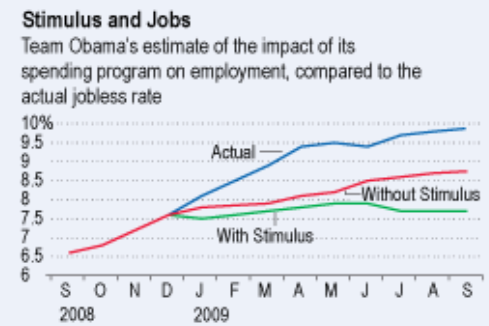
The point of February’s $780 billion stimulus plan was to “do something” to create jobs.

White House economists Christina Romer and Jared Bernstein estimated at the time that the spending blowout would keep the jobless rate below 8%, with the rate peaking in May-June and declining thereafter.

Well, everybody has picked up on the fact that 9.8% is greater than 8%.

New news (to me) is that the actual unemployment rate was 8.5% in Feb-March when the stimulus package was launched.  By my count, 8.5% is greater than 8%, too.  Hmmmm.

image

http://online.wsj.com/article/SB10001424052748703298004574459341050610398.html?mod=WSJ_hps_MIDDLESixthNews

* * * * *

Do you really want people to know “that” about you?

October 12, 2009

TakeAway: Users of social networking sites must be more cognizant of the viral nature of their posts, especially in any context where work and private life are intertwined. “They have to realize there are potential negative consequences that can flow from coworkers knowing more about you than is prudent.”

* * * * *

Excerpted from: Knowledge@Wharton , Available All the Time: Etiquette for the Social Networking Age, September 30, 2009 

Facebook was a highly personal space before it was infiltrated by business and professional users. Initially, many businesspeople attempted to use LinkedIn for business contacts, reserving Facebook for more personal interactions. Gradually, however, professional colleagues, clients and supervisors have now become “friends.”

The explosion in the popularity of Facebook has made the site a key battleground in the struggle to establish consensus on correct social networking behavior.

Managing the scope of social networks is a challenge. Cautious friending is one way to keep a Facebook page from becoming a business liability.  “It’s not that impressive to have 500 friends on Facebook or LinkedIn whom you don’t know, and you don’t know what they might say.”  

Was it wise to accept a colleague or higher-up as a “friend” to begin with?  What if your boss friends you on Facebook? How do you not accept that friend?

* * * * *

For most people who use Facebook and other social networking sites “there is an understanding of the multiple roles we play. There is the self we are for our friends, a self for our family [and] a professional self. What’s interesting is the degree to which we are comfortable playing all of those ‘selves’ at one time.” And that is something that people are not used to doing. Before the advent of such networks, it was unusual for someone to display a persona that would seem familiar to friends, coworkers and family — all at the same time.

“I’ve heard people say that Facebook is for personal friends and LinkedIn is for professional contacts … but many of my Facebook friends are colleagues — people who work just down the hall  … it gives them access to my personal self that’s not normally available to them.”

In mixing up personal and professional roles, people can get themselves into embarrassing situations. “I think some people are good, and some people are not so good, at finding a balance in these roles” and keeping information that would be perceived as too personal out of a professional context.

Some aspects of social networking are generational. Older people may have a Facebook page, but it is not essential to them. Younger people rely heavily on Facebook, Twitter and other social media to communicate. Young people want to be very accessible. 

* * * * *

There is a general “pecking order” in the business community when it comes to responding to different forms of communication. E-mail should be answered within 24 hours and a telephone call returned even sooner.

Social networking sites take the lowest priority.

The order makes sense because a phone call or e-mail seeks specific information from the one individual being contacted. Social networks come last because, they are a wide-open forum where communications is less targeted at one individual.

* * * * *

The root of many of the awkward situations that arise around the use of Facebook and other social networking sites is giving out too much information. 

In face-to-face communications, people are much more careful about the volume and nature of the information they disclose.

On the Internet, however, “there is a lot of lack of awareness — or obliviousness — about who is receiving this information.”

Someone using Twitter, for example, may think that only 20 people will read their message; meanwhile, millions of unknown people may stumble upon the information.

Users of social networking sites must be more cognizant of the viral nature of their posts, especially in any context where work and private life are intertwined. “They have to realize there are potential negative consequences that can flow from coworkers knowing more about you than is prudent.”

* * * * *

Full article:
http://knowledge.wharton.upenn.edu/article.cfm?articleid=2349

* * * * *

Some U.S. chocoholics tell Cadbury to “kiss” off … here’s why.

October 12, 2009

TakeAway:  Gasp! Cadbury chocolate sold in the U.S. is not actually Cadbury chocolate…it’s a variation of Hershey’s chocolate!! 

In a highly competitive industry where brand equity and loyalty is so important, it seems a risky business decision to change the formula of your most prized asset – your chocolate. 

A key pillar of consumer loyalty is based in the consistency of the product experience, no matter the time or the place. 

Given the volume of consumer traffic between the U.K. and the U.S., did Cadbury’s think that consumers would not notice the difference in the taste of its famous chocolate? 

* * * * *

Excerpted from WSJ, “What’s in a Name? Not Much for These Fans of Imported Cadbury,” By Joe Barrett and Timothy Martin, September 14, 2009

When Gayle Green has a craving for chocolate … she drives 45 minutes to … stock up on Cadbury chocolates imported from the U.K. …  Ms. Greene could buy American-made Cadbury bars at a grocery store just a few minutes from her house … she wants nothing to do with the stuff made in the U.S. … she says, “You might as well eat a Hershey bar.” …

Some U.S. fans of Cadbury are determined to snub the Americanized version of the chocolate, which is made under license by Hershey Co. … Like Coca-Cola lovers who swear the Mexican-made version of the soda tastes better, hardcore Cadbury fans spend plenty of time in hot chocolate pursuit. They scour the Internet, pester family and friends visiting Europe, and seek out specialty British and Irish stores to get their fix of imported caramel-filled Curly Wurlys … consumers say though the U.S. candy bar’s label looks virtually identical to the U.K. version, the U.K.-made bars are “silkier, smoother and they don’t leave an aftertaste.” …

A Cadbury spokesman said, “Consumer tastes and preferences differ in each market, and accordingly the products sold in different markets vary.” … Hershey has occasionally sent legal notices to stop U.S. shops from selling British-made Cadbury products. Still, the imports can be readily found in many cities. …

Edit By TJS

* * * * *

Full Article
http://online.wsj.com/article/SB125288517883707275.html

* * * * *


Finally, a Rolls-Royce for the masses … well, kinda.

October 9, 2009

TakeAway:  Owning a Rolls-Royce is an undisputed symbol of wealth…and many would argue that the brand’s exclusivity is consumers’ primary motivation for purchasing and re-purchasing its cars.  Rolls Royce has decided to test the loyalty of its existing consumer base by offering a lower-priced version of its car and thus making the car attainable by a larger portion of society. Will this strategy backfire and alienate its existing loyal consumer base?

* * * * *

Excerpted from WSJ, “Rolls-Royce Unveils its Economy Car” By  Vanessa Fuhrmans, September 17, 2009

… Rolls-Royce Motor Cars’ answer to the worst downturn in decades: Its new Ghost model, to be had for a mere $245,000 … Though the Ghost has the same hand-crafted interiors and famous grill, the sleeker and slightly shorter model costs about one-third less than the $380,000 starting price of the British car maker’s flagship Phantom.  As more people globally can afford a Rolls, though, the company faces a delicate balancing act: boosting sales while not diluting the brand’s exclusive cachet …

The Ghost’s launch comes at a critical time. Rolls-Royce sold a record 1,212 Phantoms last year. But as the economic downturn caught up with even the superrich, sales plunged 34% in the first half of this year, tarnishing what had been a bright spot for its German parent, BMW AG.  Meanwhile, Rolls faces growing competition for the lower rung of the upper crust from Bentley … Bentley sales have risen 10-fold … The success of Bentley’s Continental model (priced between $150,000 and $200,000) underscored the market to be had in the niche above Porsche and Mercedes-Benz but below Rolls-Royce …. 

The Ghost appears to be hitting the mark: Some 1,200 potential buyers have signaled “strong interest” or pledged to order one, about the same number of total Phantoms sold last year, the company said.  As the economy recovers, the car maker says it expects to sell at least 2,000 annually, boosting its total production nearly threefold.  The company has gone to great lengths to preserve the model’s Rolls-Royce quintessence, yet at a downsized price … Rolls-Royce … said 85% of the people who have expressed interest in the Ghost have never owned a Rolls, uncommon among Phantom owners. 

Edit by TJS

* * * * *

Full Article
http://online.wsj.com/article/SB125312564687516787.html#mod=todays_us_nonsub_marketplace

* * * * *

Which is your scarcest asset: time or money?

October 9, 2009

TakeAway:  In today’s economy, motivating consumers to pull the trigger and purchase (now) is job one for most marketers. 

Sometimes, the answer may be as simple as changing the brand message to emphasize time instead of money … or vice versa.

If buyers are “experiential”, focus on time; if they’re “possessive”, focus on money.

* * * * *

Excerpted Knowledge@Wharton, “Time vs. Money:  Analyzing Which One Rules Consumer Choices, ” September 16, 2009

Pick up a magazine or turn on the TV and prepare for a flood of marketing messages about how you spend your time and money … Yet with all this talk of time and money, little is known about how consumers’ attitudes and behaviors are influenced by a product’s association with these concepts …

A new paper … argues that when companies weigh whether to go for an ad campaign with a time or a money theme, they should be aware that each evokes strong reactions from consumers …

Emphasis on time … typically leads to more favorable consumer attitudes and purchasing decisions because … time is less fungible than money … and people feel less accountable for how they spend their time because it can be more difficult to measure than monetary outlays. These two characteristics — fungibility and ambiguity — are important differentiators in how consumers think about time and money …

When money matters … for the prestige possession, subjects reported greater feelings of personal connection when they were primed to recall the money spent on the product …  those who highly valued the mere possession of the product had more favorable attitudes when prompted to consider the money involved in the purchase … 

Ultimately, the researchers conclude: “Brands can cultivate consumer relationships by first considering how consumers most identify with the product (through experience or possession) and then highlighting either their time or money spent accordingly.” … 

Edit by TJS

* * * * *

Full Article
http://knowledge.wharton.upenn.edu/article.cfm?articleid=2341

* * * * *

Ten Fatal Flaws That Derail Leaders

October 8, 2009

HBR, Ten Fatal Flaws That Derail Leaders, by Jack Zenger and Joseph Folkman, June 2009

Poor leadership in good times can be hidden, but poor leadership in bad times is a recipe for disaster.

Based on research, here are the qualities of the worst leaders:

1. Lack energy and enthusiasm.
They see new initiatives as a burden, rarely volunteer, and fear being overwhelmed.
They  “suck all the energy out of any room.”

2. Accept their own mediocre performance.
They overstate the difficulty of reaching targets so that they look good when they achieve them.
They live by the mantra “Underpromise and overdeliver.”

3. Lack clear vision and direction.
They believe their only job is to execute. 
Like a hiker who sticks close to the trail, they’re fine until they come to a fork.

4. Have poor judgment.
They make decisions that colleagues and subordinates consider to be not in the organization’s best interests.

5. Don’t collaborate.
They avoid peers, act independently, and view other leaders as competitors. As a result, they are set adrift by the very people whose insights and support they need.

6. Don’t walk the talk.
They set standards of behavior or expectations of performance and then violate them.
They’re perceived as lacking integrity.

7. Resist new ideas.
They reject suggestions from subordinates and peers. Good ideas aren’t implemented, and the organization gets stuck.

8. Don’t learn from mistakes.
They may make no more mistakes than their peers, but they fail to use setbacks as opportunities for improvement, hiding their errors and brooding about
them instead.

9. Lack interpersonal skills.
They make sins of both commission (they’re abrasive and bullying) and omission (they’re aloof, unavailable, and reluctant to praise).

10. Fail to develop others.
They focus on themselves to the exclusion of developing subordinates, causing individuals and teams to disengage.

* * * * *

Marketing tools: peer pressure and social influence …

October 8, 2009

Ken’s Take: Spawned by books like Freakonomics and Predictably Irrational, behavioral economics is hot … 

* * * * *

BrandChannel, Sacramento Water District Leverages Peer Pressure, Sep. 15, 2009 

People aren’t always rational.

This insight, familiar to brand managers, is the basis of behavioral economics, which uses psychological insights to predict these sometimes illogical choices.

The impact of peer pressure is a popular recent topic among behavioral economists.

Behavioral economists are developing ways to get patients to take their medications (pill containers that trigger e-mail alerts when opened) and testing the effectiveness of marketing promotions (optimal purchase levels for “free” shipping to drive upsell).

Marketers are using social tools like Facebook to allow teens to identify with their brands, hoping to influence their fans’ peers.

As for the most effective methods of social influence, not all forms are equal.

While we put greatest trust in people we know, trust in virtual strangers has reached a surprisingly high level. Marketers who capitalize on this, by offering consumers the chance to rate their products, find that they are more trusted than companies who don’t allow ratings.

Full article:
http://www.brandchannel.com/home/post/2009/09/15/Sacramento-Water-District-Gives-Marketers-Lesson-In-Harnessing-Peer-Pressure.aspx

* * * * *

Trenchcoat marketing … it’s not what you think.

October 8, 2009

BrandChannel, Can BurberrySpace Help Reposition A Luxury Fashion Brand?, September 17, 2009

Burberry, intent on holding onto its recently upgraded cutting-edge image, will launch its own social networking site.

The site, Art Of The Trench, will feature user-submitted pictures of people sporting the brand’s famous trench coat.

Burberry’s goal is to strengthen ties with existing customers while attracting new faces — younger consumers they hope will be inclined to spend disposable income on luxury items.

The premium site is another step in Burberry’s campaign to reclaim its brand as a classic label with a twist of cool, after years of knockoffs and thuggish associations had morphed it into “checks for chavs.”

But do the kids really want Facebook for trenchcoats?

Burberry hopes so.

If the brand’s Facebook page — currently boasting over 666,000 fans — is any indication, their updated, traditional-meets-hip brand may turn out to be a good social networker.

Full article:
http://www.brandchannel.com/home/post/2009/09/17/Can-BurberrySpace-Help-Reposition-A-Luxury-Fashion-Brand.aspx

* * * * *

Count employer paid health insurance premiums as income … Why not?

October 7, 2009

TakeAway: Seems obvious to me that health insurance premiums paid by employers should be counted as W-2 income, with income tax deductiblility (or credits) of, say, $5,000 per person with a max of $15,000 per family.  Helps out the folks who don’t have access to company paid premiums and stops the gold-plated programs from bloating healthcare spending.

* * * * *
From DC Examiner: Democrats Win Lobbyists but Lose Basic Reforms, October 1, 2009

The Democrats are having trouble passing convoluted and plainly imperfect health care bills. Maybe they would be better off going back to basics.

All of the current healthcare proposals build a makeshift addition to the health insurance system that grew out of a tax law decision made during World War II.

That decision was to give a preference to employer-provided health insurance: The cost of insurance would be deductible for employers and would not be counted as income for employees.

The system insulates health care consumers from costs, with the result that insurance costs have recently crowded out wage increases.

The tax preference is steeply regressive. High-earning employees with gold-plated, employer-provided health insurance get deductions that are worth many thousands of dollars.

Those without employer-provided health insurance, or low-earners who are among the 40 percent of earners who do not pay income tax, get exactly zero. If a Republican Congress had designed such a system, it would be attacked as a favor to the rich, and rightly so.

During the 2008 campaign, Barack Obama attacked John McCain’s proposal for equalizing the tax treatment of employer-provided and non-employer-provided health insurance, and so it would be embarrassing for him to advocate such a change.

More determining, labor unions, a strong Democratic constituency, want to maintain the current system because they have obtained very expensive policies for their members. But with only 8 percent of private-sector workers in unions, it seems clear that basic reforms would do more for low-earners and ordinary Americans than the Democrats’ current plans.

* * * * *

Full article:
http://www.realclearpolitics.com/articles/2009/10/01/democrats_win_lobbyists_but_lose_basic_reforms_98526.html

* * * * *

“Synchronous Lateral Excitation” … risky, but not what you’re thinking.

October 7, 2009

TakeAway: In finance, actions can be both individually prudent and collectively disastrous. It’s called “synchronous lateral excitation”, and it explains the credit crunch of 2008 – 2009.

* * * * *

Excerpted from New Yorker: Rational Irrationality – The real reason that capitalism is so crash-prone, John Cassidy, October 5, 2009

On June 10, 2000, Queen Elizabeth II opened the high-tech Millennium Bridge, which traverses the River Thames from the Tate Modern to St. Paul’s Cathedral.

Thousands of people lined up to walk across the new structure, which consisted of a narrow aluminum footbridge surrounded by steel balustrades projecting out at obtuse angles. Within minutes of the official opening, the footway started to tilt and sway alarmingly, forcing some of the pedestrians to cling to the side rails. Some reported feeling seasick.

The authorities shut the bridge, claiming that too many people were using it. The next day, the bridge reopened with strict limits on the number of pedestrians, but it began to shake again. Two days after it had opened, with the source of the wobble still a mystery, the bridge was closed for an indefinite period.

Some commentators suspected the bridge’s foundations, others an unusual air pattern.

The real problem was that the designers of the bridge, who included the architect Sir Norman Foster and the engineering firm Ove Arup, had not taken into account how the footway would react to all the pedestrians walking on it. When a person walks, lifting and dropping each foot in turn, he or she produces a slight sideways force.

If hundreds of people are walking in a confined space, and some happen to walk in step, they can generate enough lateral momentum to move a footbridge—just a little. Once the footway starts swaying, however subtly, more and more pedestrians adjust their gait to get comfortable, stepping to and fro in synch. As a positive-feedback loop develops between the bridge’s swing and the pedestrians’ stride, the sideways forces can increase dramatically and the bridge can lurch violently.

The investigating engineers termed this process “synchronous lateral excitation,” and came up with a mathematical formula to describe it.

What does all this have to do with financial markets? Quite a lot.

Most of the time, financial markets are pretty calm, trading is orderly, and participants can buy and sell in large quantities.

Whenever a crisis hits, however, the biggest players—banks, investment banks, hedge funds—rush to reduce their exposure, buyers disappear, and liquidity dries up.

Where previously there were diverse views, now there is unanimity: everybody’s moving in lockstep.

“The pedestrians on the bridge are like banks adjusting their stance and the movements of the bridge itself are like price changes,” Shin wrote. And the process is self-reinforcing: once liquidity falls below a certain threshold, “all the elements that formed a virtuous circle to promote stability now will conspire to undermine it.” The financial markets can become highly unstable.

This is essentially what happened in the lead-up to the Great Crunch of 2008.

http://www.newyorker.com/reporting/2009/10/05/091005fa_fact_cassidy?printable=true

Factoids: How Medicare Works …

October 7, 2009

Ken’s Take:  It’s still not obvious to me how putting the screws to doctors will “fix” the healthcare situation …

* * * * *

Medicare’s price controls already pay only 83 cents on the private dollar.

* * * * *

Congress decides each year how much it wants to spend on doctors, period.

If one area of medicine receives a larger slice of this pie, another must accept a smaller one.

The portion sizes are determined using a formula known as Relative Value Units, or RVUs. Medicare assigns an RVU to each of 7,500 billable services—in 2008, a colonoscopy earned 5.64 of these units, a hip replacement 37.66.

Then it multiplies a doctor’s total RVUs by some dollar factor, currently about $36, and cuts a check.

* * * * *

Source: WSJ, The War on Specialists Oct. 6, 2009
http://online.wsj.com/article/SB10001424052748704471504574443472658898710.html?mod=djemEditorialPage#printMode

* * * * *

The “Wal-Mart of the web” … Amazon’s KSFs.

October 7, 2009

KSF= Key Success Factors

* * * * *

From BrandChannel, Nimble Amazon Thrives In Recession, September 22, 2009

Having conquered the online book market, reports the New York Times, “Amazon is set to cross a significant threshold” to become the Wal-Mart of the web.

By the end of 2009, Amazon’s worldwide sales of general merchandise will exceed the books, music and movies Amazon is known for.

“Amazon’s expansion strategy has allowed it, almost alone among retailers, to thrive during the recession, even while its own media business has stagnated*”

While Amazon’s marketing has helped transition customers into seeing it as more than a bookstore, back-end innovation is the real engine of the company’s successful expansion.

In Amazon’s huge merchandise warehouses, “every product, shelving unit, forklift, roller cart and employee badge … has a bar code.” The company has an “almost magical business model in terms of inventory management”

Amazon builds engagement with purchase recommendations, wish lists, customer reviews and free shipping.

According to Interbrand — a brand consultancy , the company’s success shows “why you are best off not owning a retail footprint in a recession“: its flexibility lifted it past struggling and fallen competitors like Borders and Circuit City.

Full article:
http://www.brandchannel.com/home/post/2009/09/22/Nimble-Amazon-Thrives-In-Recession.aspx

* * * * *

The housing-foreclosure problem hasn’t gone away …

October 6, 2009

Ken’s Take: Mortgage defaults and housing prices are still a big problem, though they seem to have been pushed to a back burner.

In his WSJ essay, Economist Martin Feldstein has the diagnosis right, but the prescription wrong …

* * * * *

Some Facts

  • More than three million homes are now in serious default (nonpayment for 90 days or more) or foreclosure, nearly double the number a year ago.
  • Sales of properties in foreclosure or serious default made up one third of all home sales in May and June.
  • So far only about 200,000 mortgages have been modified this way, far fewer than the administration’s goal of modifying three million mortgages.
  • Nearly half of all modified mortgages go into default within six months.
  • Today one-third of all homes with mortgages have mortgage debt that exceeds the value of the home. Among these homeowners, half of the loan-to-value ratios exceed 130%.

* * * * *

Feldstein’s Remedy

Borrowers should get relief now, and the banks should get a guarantee down the road.

An epidemic of mortgage defaults and foreclosures is threatening the economic recovery. The problem is serious and getting worse.

There are two separate but mutually reinforcing reasons for the surge in defaults and foreclosures: the reduced affordability of mortgage payments and the high loan-to-value ratios of many houses.

The United States, unlike almost every other country, mortgages are effectively no-recourse loans. If a homeowner defaults, the creditor can take the house but is unable to take other assets or income to make good on the remaining unpaid mortgage balance. No-recourse mortgages increase foreclosures, resulting in more properties being thrown on the market, and lead to an excess decline in house prices.

The risk remains of a continuing downward spiral of house prices.

The administration should work with creditors and homeowners to reduce the principal on mortgages that are at risk of default.

Here’s how such a plan might work in a way that homeowners and creditors could both welcome, that is fair to taxpayers, and that would help the economy:

Any homeowner with a loan-to-value ratio over 120% could apply for a reduction in his mortgage balance. The government and the creditor would then share equally in the cost of writing the loan balance down to 120% of the value of the home. But the homeowner who opts for this write-down would be obliged to convert the remaining mortgage to a loan with full recourse that could not be discharged in bankruptcy. The bank gets a more legally secure loan

Slowing the downward spiral of house prices will protect the solvency of the banks and the net worth of households. The failure to do that could mean a deeper and longer recession that imposes much higher costs to the government.

http://online.wsj.com/article/SB10001424052970204908604574330883957532854.html?mod=djemEditorialPage

* * * * *

Ken’s Rx: Create a more robust rental market of single family homes by providing tax incentives to investor-landlords – e.g. no cap gains taxes, accelerated depreciation, application of cap losses to offset earned income.  That would bolster prices – albeit, artificially – and provide affordable housing  — albeit, sans ownership.  I’ll detail the plan in a subsequent post.

* * * * *

MBA Trends … women and NFPs on the rise.

October 6, 2009

Business Week, B-School: The View at the Gate, Sept. 14, 2009

From the annual applicant survey by QS World MBA Tour, a London-based group that holds MBA fairs globally:

Women now make up 46% of worldwide MBA candidates, more than ever before.

U.S. programs still rank first in popularity,

But “partly because of the U.S. visa situation, more foreign students have shifted to looking at countries in Europe and Asia for schooling.”

Candidates’ stated preference is for a one-year MBA (44%) over a two-year program (43%), a first in the survey’s 11-year history.

There has been a doubling of applicants from the nonprofit sector — to 6% from 3% in 2008.

The percentage of those naming nonprofit work as a career goal: 6.4% vs. 3.8% last year.

Starting a business is the No. 1 post-MBA career goal.

At #2, financial services, almost as popular as it was last year. “The sector is traditionally the big absorber of MBAs,” he says. “And the salary and bonuses are still so high that it’s alluring, despite fact that there are fewer jobs.”

Full article:
http://www.businessweek.com/magazine/content/09_37/c4146btw881806_page_2.htm

* * * * *

The housing glut … peaking, but still high — very high.

October 6, 2009

There are still a record number of houses on the market — 9.4 months’ worth of existing homes for sale, according to NAR data.

The backlog is usually under six months.

And, based on current and projected delinquencies, nearly seven million housing units will eventually enter foreclosure … that could add 1.35 years’ worth of inventory to the market.

[housing supply]

Source: WSJ: Housing Recovery Obstacle: So Many Houses, Sept 24, 2009http://online.wsj.com/article/SB125374552378835617.html#mod=WSJ_hpp_MIDDLENexttoWhatsNewsTop

* * * * *

MillerCoors heading into fantasyland … fantasy football, that is.

October 6, 2009

TakeAway: Beer brands want to be top-of-mind when fantasy football managers are pretending to be savvy general managers

MillerCoors has implemented an online platform that will contain a Coors Light interface while the faux manager is on his team page.

And, MillerCoors wants to be involved with all the touch points of a fantasy sports manager, and is now targeting sports blogs.

Well, at least their product will get your mind off the fact that you passed up on Drew Brees. Or it could help you cope with the fact that you aren’t a real GM.

* * * * *

Excerpted from AdAge, “Coors Light Runs Fantasy Football Advertising Blitz” By Jeremy Mullman, September 14, 2009

Coors Light is betting big on fantasy football.

MillerCoors’ flagship brand, which is the official beer sponsor of the National Football League, is rolling out a raft of new deals in and around fantasy-sports sites for the coming season.

Coors Light had previously had a presence in the sport via NFL.com, but this year it has added a series of new platforms, including deals with WaterCooler, Yardbarker and the Fantasy Sports Ventures network.

The reasons for the marketer’s enthusiasm for the category are twofold: (1) It is convinced that the brand’s core drinkers play the game in droves, and (2) the amount of user data those sites collect gives the brewer a far-greater degree of certainty that it’s ads are being seen by legal-age drinkers, so it won’t have to deal with the sort of backlash that has hounded past online ventures by brewers, such as Anheuser-Busch’s Bud.TV.

How safe? Consider that WaterCooler’s FanSection — a fantasy-football platform that’s integrated into Facebook — is able to use the social network’s user data to determine if players are 21 or older. If they are, they get a version of the game that’s literally coated in Coors, even down to the branded trash-talking modules that accompany game results that are displayed in players’ Facebook news feeds (and, as such, are viewable by all of their friends).

Edit by JMZ

* * * * *

Full Article
http://adage.com/article?article_id=139005

* * * * *

Branding in Action: The Power & Danger of Iconography

October 5, 2009

I thought that the video linked below — using the Obama campaign as an example — did a nice job of illustrating the impact of branding — including the supporting ingredients, e.g. distinctive “brand mark”, strong visual presentations, consistent (and ubiquitous) use.

image

The Video Link

WARNING: The politics lean right.  If you lean left, just pay more attention to the branding points being made than to the political points being raised.

It’s worth watching … really !

http://www.youtube.com/watch?v=GdtqtfXdR-c

* * * * *

Cash for Clunkers: Preliminary post-mortem …

October 5, 2009

Ken’s Take: The core question re: the effectiveness of C4C is whether the program created incremental demand for cars or simply paid people to shift likely demand earlier. Initial results are coming in … synopsis: ouch !

* * * * *

Excerpted from WSJ: One of Washington’s all-time dumb ideas, Oct. 4, 2009

Remember “cash for clunkers,” the program that subsidized Americans to the tune of nearly $3 billion to buy a new car and destroy an old one?

Last week U.S. automakers reported that new car sales for September, the first month since the clunker program expired, sank by 25% from a year earlier. Sales at GM and Chrysler fell by 45% and 42%, respectively. Ford was down about 5%.

Some 700,000 cars were sold in the summer under the program as buyers received up to $4,500 to buy a new car they would probably have purchased anyway, so all the program seems to have done is steal those sales from the future. Exactly as critics predicted.

Burton Abrams and George Parsons of the University of Delaware added up the total benefits from reduced gas consumption, environmental improvements and the benefit to car buyers and companies, minus the overall cost of cash for clunkers, and found a net cost of roughly $2,000 per vehicle. Rather than stimulating the economy, the program made the nation as a whole $1.4 billion poorer.

In the category of all-time dumb ideas, cash for clunkers rivals the New Deal brainstorm to slaughter pigs to raise pork prices. The people who really belong in the junk yard are the wizards in Washington who peddled this economic malarkey.

* * * * *

http://online.wsj.com/article/SB10001424052748703628304574453280766443704.html?mod=djemEditorialPage#printMode

* * * * *

Leading with their chin: NBC shows marketing savvy in late-night comedy timeslot switch

October 5, 2009

TakeAway: Finally Hollywood can provide us with something other than a Paris Hilton debacle or Speidi controversy.

NBC went back to the basics: giving consumers what they want.

By focusing on people, the ever-important (and often forgotten) node of the 6 P’s, NBC has drastically changed the landscape of late-night television without developing a new, innovative product. It simply realized that it’s core viewers were changing, and acted accordingly.

This demonstrates that it doesn’t always take groundbreaking innovation to create a successful product. The same result can be achieved by simply looking at your existing products and attempting to deliver greater value to the consumer.

* * * * *

Excerpted from Forbes, “Lessons from Leno: Marketers Can Learn From NBC’s Timeslot Switch” by Allen Adamson, September 22, 2009

…the producers knew exactly what they were doing when they decided to shift Leno’s show from its 11 p.m. time slot to 10 p.m. They were making a smart marketing move, one that is an interesting case study in brand management. General Electric-owned NBC, recognizing that good brand management means keeping tabs on what’s important to a core target audience, decided that airing the show an hour earlier would be a great way to hang onto this faithful group of viewers who are probably saying, “Hey, I can watch Leno and be able to get up with the kids at the crack of dawn.” There isn’t a powerful company on the planet where executives believe they no longer have to worry about what matters to their most important consumers. Consumer attitudes change, and the best brands respond. The second important branding effort made by those in charge of the Leno brand was taking a look at the competitive programming landscape and determining that there was an opportunity to offer something different, yet relevant. After considering the lineup of mediocre shows on TV, they saw something right in front of their noses. “Why can’t an already successful late-night television show be on earlier?” Here was a simple brand idea which, with a bit of repackaging, could be made ready for prime time–along with an audience delighted to have it in prime time. Taking a look at your category from a unique point of view, identifying something no one else has seen and doing your homework to determine its relevance to a particular target can give you a real competitive advantage.

Edit by JMZ

* * * * *

Full Article
http://www.forbes.com/2009/09/22/nbc-kanye-tv-cmo-network-allenadamson.html?partner=yahootix


* * * * *


Wanna see the doctor? … Come back in a couple of months

October 2, 2009

Ken’s Take: This is my big beef with the healthcare system — the long waits to get appointments, and then the long waits to get seen on appointed days.

* * * * *

Regarding the availability of health care:

74% of those in the U.S. meet for scheduled doctors appointments within four weeks, while only 42% of British and 40% of Canadians do.

Only 10% of Americans wait longer than two months, while 33% of Brits and 42% of Canadians wait that long.

On average, doctors say neurosurgery should be performed within 5.8 weeks, but in Canada it takes about 31 weeks.

Orthopedic surgery should be within 11 weeks, but in Canada it takes 37 weeks.

Hmmm … think about it.

* * * * *

From WSJ: “ObamaCare is hazardous to your health”, Sept 24, 2009
http://online.wsj.com/article/SB10001424052970204488304574433343630176378.html?mod=djemEditorialPage

* * * * *

RIP: Saturn – a new (make that dead) car company …

October 2, 2009

Ken’s Take: I seem to be the solitary mind thinking that GM should keep the Saturn brand and distribution network and use them for sale and distribution of electric and hybrid cars.  Seems like a perfect fit to me.

* * * * *

Excerpted from WSJ: Collapse of Penske Deal Spells End For Saturn, Oct. 1, 2009

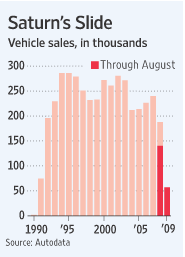
A deal to save GM’s Saturn brand fell through after former race-car driver Roger Penske unexpectedly abandoned a bid to buy its network of dealers, prompting GM to say it would shut the operation down.

It also likely will add Saturn’s 350 dealers to the thousands of U.S. auto retailers that are closing in the car industry’s worst downturn since World War II.

The novel bid to create a car company that didn’t build cars fell apart when Penske Automotive Group failed to secure a related agreement to have France’s Renault SA supply autos for dealers to sell when GM stopped building Saturns in about two years.

For Saturn, it likely means the end of the road for a quirky brand that analysts believe never made money in its 19-year history. GM created Saturn in an attempt to better compete against Japanese auto makers such as Toyota Motor Corp.

Saturn won loyal fans who liked its customer-friendly image and no-haggle sales policy.

But GM produced few new Saturn models in the 1990s and, despite a flurry of critically acclaimed cars added this decade, it never met its sales targets.

The chance of another buyer stepping in to purchase Saturn is remote.

Saturn will wind down by October 2010 under agreements GM already made with the brand’s dealers. Many of the dealerships are expected to close before that deadline. GM remains in talks to sell Saab and Hummer, and is shutting down Pontiac.

GM said earlier this year that Saturn, Hummer and Saab generated an average annual pretax loss of $1.1 billion a year. The moves leave GM with four brands: Chevrolet, Cadillac, Buick and GMC.

image

Full article:
http://online.wsj.com/article/SB125434260817353567.html?mod=WSJ_hps_LEFTWhatsNews#printMode

* * * * *

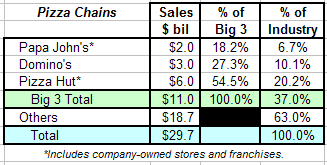
Who sells more pizza: Domino's, Pizza Hut or Papa John's?

October 2, 2009

According to Fortune Magazine …

image

http://money.cnn.com/2009/09/22/news/companies/papa_johns_pizza_schnatter.fortune/index.htm

* * * * *

Ken’s Note: I would have bet Domino’s … not for a minute did I think Pizza Hut sold more than Domino’s and Papa John’s combined.

* * * * *

Who sells more pizza: Domino’s, Pizza Hut or Papa John’s?

October 2, 2009

According to Fortune Magazine …

image

http://money.cnn.com/2009/09/22/news/companies/papa_johns_pizza_schnatter.fortune/index.htm

* * * * *

Ken’s Note: I would have bet Domino’s … not for a minute did I think Pizza Hut sold more than Domino’s and Papa John’s combined.

* * * * *

Majority Rule? … Forget about it !

October 1, 2009

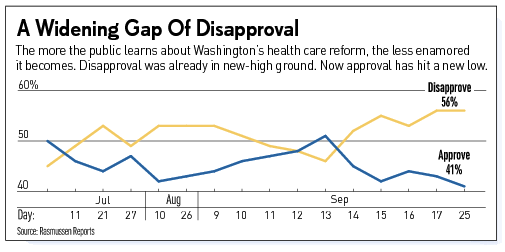
As Congress moves forward, threatening use of the arcane “reconciliation” process to ram a bill in before T-Day … a simple question: aren’t “they” supposed to be representing “us”?

image

http://www.investors.com/NewsAndAnalysis/Article.aspx?id=507336

* * * * *

Facebook ready to prove its not a waste of time.

October 1, 2009

TakeAway:  We have all been told by our agencies that we must have a presence in social networks, yet, to date, there has been little to no evidence that advertising in these spaces will produce results.  Finally, Facebook has finally decided to give us what we have been longing for – data to prove that advertising on its site is worth it.

* * * * *

Excerpted from WSJ, “Facebook Sets Deal to Provide Ad Data to Nielsen” By Jessica Vascellaro, September 23, 2009

Facebook. plans to announce a deal with online measurement company Nielsen in a step to address advertisers’ frustration with measuring how ads perform on the social network. 

Under the partnership, Facebook will begin polling its users about some of the display ads it runs on its site, such as a banner promoting a movie release then will provide that data, including responses from those who didn’t see an ad, to Nielsen, which will package it for advertisers …

The partnership is the latest sign of Facebook’s growing clout in the ad world … Facebook had a 9.1% share of display-ad views in the U.S. in July, up from 6.8% in January … that put it in second place behind Yahoo and ahead of Microsoft Corp. and AOL …

In recent months, Facebook has launched new ad formats that prompt people to take an action — such as a forthcoming ad that allows people to sign up to receive a free sample of what’s being advertised.

It has also overhauled a tool that allows brands to build pages to communicate with their fans and has rolled out a targeted-ad feature that gives advertisers more control and guarantees over who sees their ads …

Sony Pictures … recently tested the new Nielsen polling service for ads promoting its newest movies … in each case, the polls showed a “significant increase” in awareness based on the ads …

Edit by TJS

* * * * *

Full Article
http://online.wsj.com/article/SB125356656635628897.html

* * * * *

Build your own electric car … my friend did !

October 1, 2009

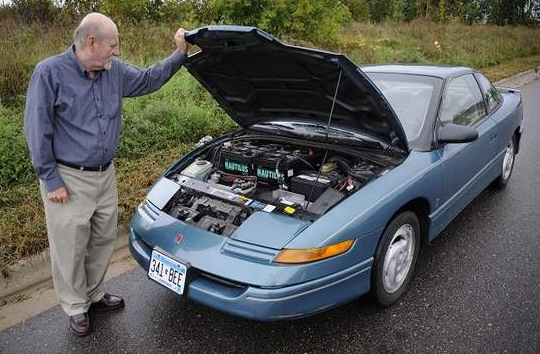
Ken’s Take: A friend of mine recently finished cobbling together — from scratch — an electric car.  Gotta love it when somebody walks the talk … instead of just talking.  Way to go Brian.

* * * * *

From the St. Cloud Minnesota Times:

For Brian Darovic, filling up his car is as simple as plugging in a toaster — and almost as inexpensive.

Darovic of Sartell recently converted his car from a standard, gas-powered vehicle to an electric, battery-powered vehicle.
“Sure, you could buy a GM Volt next year for $40,000,” Darovic said. “But are you going to be spending $40,000 on a car next year? I’m not.”

Though electric car conversion kits are available for between $10,000 and $15,000, Darovic was determined to build it from scratch.

He found a 1994 Saturn and spent more than a year on the project. He sketched designs and then removed the vehicle’s engine, fuel tank, exhaust system and radiator. They were replaced with an electric motor, 12 batteries and a device that controls the motor speed.

The project cost between $9,000 and $10,000, not including labor.

The car covers about 25 miles per charge with a top speed of 60 mph. But Darovic expects to reach 40 miles per charge after he finishes fine-tuning the vehicle.

Darovic estimates his Voltessa will cost about $1 per charge or a little more than 2 cents per mile.

Electric cars are also low maintenance. Tires, brakes, shock absorbers, lights, horn, radio, seats, glass and body work remain the same as those of a gasoline-fueled engine.

But there is no more need for oil changes, antifreeze, belts, exhaust systems or tune-ups. Electric motors are essentially zero maintenance and last the life of the vehicle.

While Darovic had experience working with cars, he said the conversion process is simple enough for those with less experience. “Just about anybody could do it. It’s not rocket science.” 

As demand increases and costs decrease, electric cars are likely to become more affordable. For those that don’t want to wait, converting an existing vehicle to electric power offers a cost-effective solution for today.

http://www.sctimes.com/article/20090926/NEWS01/109260013&referrer=FRONTPAGECAROUSEL

image

* * * * *