Archive for November 20th, 2009

BINGO! I was just a week ahead of the curve …

November 20, 2009

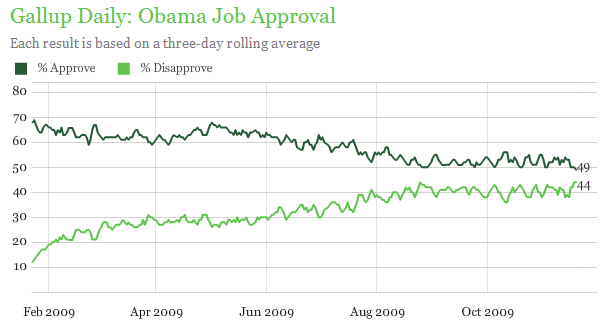
I had predicted that — last Friday — Obama’s job approval would drop below 50% on the slightly left-leaning Gallup survey.

Well, it didn’t happen last Friday, but it did today … I was just off by a week.

As a technical stock trader would say, a resistance level may have been broken …

image
http://www.gallup.com/poll/113980/Gallup-Daily-Obama-Job-Approval.aspx

Turning off the Independents …

November 20, 2009

OK, some will dismiss these numbers because they come from the FoxNews – Opinion Dynamics survey.  But, the results are consistent with many other polls.

The bottom line: a minority of registered voters 46%)  now approve of the job that President Obama is doing  … Dem support remains sky high at 85%, and GOP support is at a rock bottom 15%.  That’s not news.

The news is that only 1 in 3 Independents approve  … that’s down from 2 in 3 back in June.

image
http://www.foxnews.com/projects/pdf/111909_ObamaPoll.pdf

* * * * *

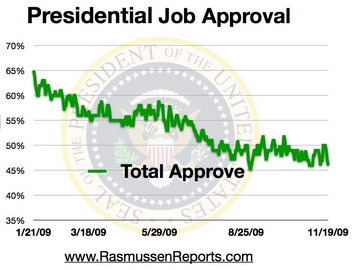
Gallup has Obama at 50% approval; Rasmussen has him at 46%.

image

* * * * *

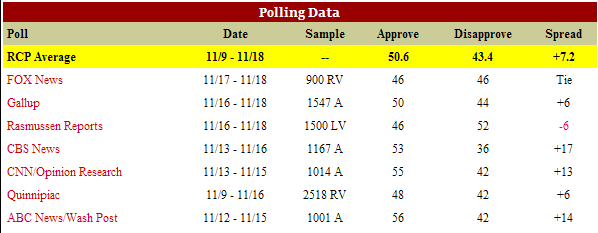
Interestingly, 3 left-leaning TV networks (ABC, CBS, CNN) average Obama’s approval at 55%.

image 
http://www.realclearpolitics.com/epolls/other/president_obama_job_approval-1044.html

* * * * *

I missed last week when I predicted that Obama would fall below 50% in the Gallup Survey.  Keep your eye on today’s Gallup numbers …

Right product, right place, right time … or else

November 20, 2009

TakeAway:  Distribution is half the battle for marketers.  If you can’t get enough of the right product, in the right place, at the right time, you will lose sales regardless of the quality of your product. 

Whirlpool took advantage of the recent slowdown to reexamine its distribution system and, as a result, is now enjoying an array of benefits, including $350M+ in savings a year.

* * * * *

Excerpted from WSJ, “Whirlpool Cleans Up Its Delivery Act,” By Joe Barrett, September 24, 2009 

After raw materials, distribution is one of the biggest single costs at Whirlpool, which needs to get bulky products like dishwashers and clothes dryers from factories to customers quickly …

In 2005, the company’s supply chain system was a hodgepodge of warehouses, transport depots and factory-distribution centers. Retailers often had to wait five to 10 days to get new washing machines or other appliances.

Whirlpool undertook a four-year program to build a state-of-the-art distribution system from scratch … The effort is already producing results, allowing Whirlpool to reduce its annual inventory by about $250 million a year and to deliver products in 48 to 72 hours. Whirlpool is also saving costs — about $100 million a year because of improved efficiency …

Whirlpool’s logistics makeover shows how a recession can leave the biggest, best capitalized companies better positioned than ever to scoop up both market share and profits as the economy rebounds …

The company’s ordering and delivery functions used to be located in separate divisions, complicating coordination and resulting in costly mistakes when Whirlpool made too much of a certain product.  The distribution system often had to soak up excess inventory …

The core of Whirlpool’s program was replacing 41 outdated sites with 10 huge regional distribution centers that used high-tech warehouse management systems and upgraded vehicles that could handle a variety of products.  Now, when trucks deliver appliances from the company’s factories to a distribution center, the merchandise is sorted according to how quickly it is likely to leave. Slower-moving goods, such as certain high-end refrigerators or stoves, are deposited in the center of the building, while fast-moving dryers and washing machines are closer to the loading docks.

The facilities are laid out in quadrants, with most of the products arranged in identical order four times in the same building. That way drivers can access everything they need without going from one end of the building to another …

There are still reduced sales because of the recession, but there are lower than expected inventories thanks to the logistics overhaul …

Edit by TJS

* * * * *

Full Article
http://online.wsj.com/article/SB125366529324132457.html

* * * * *

Who’s more impulsive — men or women ?

November 20, 2009

Excerpted from MarketingProfs.com, It’s All in the Presentation, Oct. 28, 2009

The key factors (category and customer characteristics, and in-store customer activity) that boost, or kill, impulse shopping:

Customers with coupons make fewer unintended purchases. The more focused a customer is on a specific purchase that will save money, the less likely she is to add more to her cart.

Customers who shop more frequently buy fewer items. They may focus more on immediately needed items, and spend less time in-store per visit.

Women tend to impulse-buy more than men. When Mom says, “Pick up some milk,” Dad picks up some milk, and leaves.

Shoppers who shop more aisles make more unplanned purchases. It’s simple: The more they see, the more likely they are to buy.

In-store displays provide the biggest boost to impulse shopping. Cool displays attract attention—and encourage purchases.

* * * * *

Based on these findings:

Consider store layout. “Consumers should be encouraged to shop as many aisles as possible (in general) and be exposed to as many product categories and in-store displays as possible (in particular).”

Mix things up. “Products that are frequently purchased (e.g., milk) should be placed in locations that will lead consumers past as many other categories as possible, or [be] displayed next to less-frequently purchased products.”

Decorate. “Making the shopping experience as pleasant as possible will increase time spent in the store”—and add to the likelihood of an impulse buy. Merchants who make the in-store experience more fun (and more lengthy)  stand the best chance of moving product.

Source: “The Interplay Among Category Characteristics, Customer Characteristics, and Customer Activities on In-Store Decision Making,” by J. Jeffrey Inman, Russell S. Winer and Rosellina Ferraro. Journal of Marketing, 2009.

* * * * *
http://www.marketingprofs.com/news/customer-behavior/index.asp?nlid=1456&cd=dmo121&adref=NciW4A9