Archive for December 8th, 2009

Is there bias in presidential approval polling … you bet !

December 8, 2009

Below is an analysis by Pollster.com that lays out the “House Effect” — more pejoratively known as “polling bias” — of the many survey organizations that report Presidential Approval Ratings.

Pollsters at the top tend to be more favorable to Pres. Obama (some very favorable); those at the bottom tend to be less favorable.

[See Ken’s Take and an important UPDATE at the bottom of this post]

2009-12-01_HouseFX-approve.png
http://www.pollster.com/blogs/why_is_rasmussen_so_different.php

* * * * *

Ken’s Take:

(1) Note that the mainstream media outlets (ABC, WP, CNN, CBS, NYT, AP) hold the top slots.  Hmmm.

(2) Note that FOX is smack dab on the median.   Pollster emphasizes that the line that corresponds with the zero value is NOT a measure of “truth” or an indicator of accuracy. It’s simply a “normalizing” measure — in effect, a median value.  TakeAway: sure seems fair & balanced.

(3) Quant jocks generally attribute the differences to methodology or samples.  For example, Rasmussen is an automated phone survey — and people tend to be less hesitant with negative responses when dealing with an automaton than they are when answering to a humanoid.

Regarding samples, less favorable surveys tend to sample likely voters, not all adults.  Critics argue that minorities and young adults are under-represented when the cut is likely to vote.

(4) A bigger deal, in my opinion, is that sampling tries to get a representative number of Dems and GOPs.  My bet: surveys at the top over-sample Dems and the ones at the bottom over-sample GOPs.

(5) Regardless of the specific poll, the conclusion: country is divided down the middle … plus or minus some random noise.

* * * * *

UPDATE

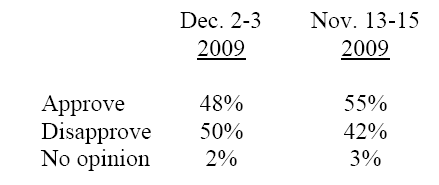
CNN — #2 in favorable leaning to the President — released new poll results on Fri. Dec. 4.

During November, President Obama’s approval dropped from 55% to 48%.

* * * * *

Question: Do you approve or disapprove of the way Barack Obama is handling his job as president?
image

For the full CNN survey results:
http://i2.cdn.turner.com/cnn/2009/images/12/04/rel18a.pdf
The looming Medicaid tsunami …

December 8, 2009

TakeAway: A vast expansion of the Medicaid program — without adequate risk-adjusted reimbursement rates — will impose unsustainable costs on healthcare providers.

* * * * *

Excerpted from WSJ:  Health Reform Could Harm Medicaid Patients, Dec. 4, 2009 

Both the House and Senate health-care reform bills call for a large increase in Medicaid—about 18 million more people will begin enrolling in Medicaid under the House bill starting in 2013.

A flood of new patients will be seeking health services, many of whom have never seen a doctor on more than a sporadic basis. Some will also have multiple and costly chronic conditions. And almost all of them will come from poor or disadvantaged backgrounds.

Johns Hopkins’  Priority Partners handles Medicaid patients under a capitated system — that is, it receives a set payment per individual per month from the state.

Over time, we’ve developed the ability to manage the care of these individuals in a way that is both cost effective and that provides them with quality care. We’ve done it by tapping into our extensive delivery system, which includes four hospitals, a nursing home, the largest community-based primary care group in Maryland, and much more.

We’ve hit above-national benchmarks on all clinical quality measures, reduced monthly costs for patients with substance abuse and highly complex medical needs, and 70% of our patients tell us they’re satisfied with our care.

The key fact is that for years the state did not cover all the costs our Medicaid program incurred. As a result of new patients whose costs were not completely covered by the state, Priority Partners lost $57.2 million from 1997 to 2005.

We stanched the losses by ensuring that the payment from the state was appropriately risk adjusted to match the health conditions of our members, and by investing heavily in primary-care and care-management and disease-management programs.

Yet this past year the losses began again, because the state expanded the program’s eligibility to 116% of the federal poverty level up from 40%.

So we are struggling with a large group of new patients—about 30,000 people. Today, like in the late 1990s, a health-care surge is overwhelming our managed-care system. The capitated rate for the new beneficiaries is not yet risk-adjusted. Priority Partners has lost a devastating $15 million in just nine months.

Congress can help, or at least learn from our experience to use the reform legislation to bend the cost curve if it encourages other states to institute and appropriately fund capitated systems that allow capable providers to adjust payments based on risk. The key is that federal support to states for Medicaid must appropriately adjust rates to match the risk of providing health care to the group of people who are covered by Medicaid.

The Senate bill would increase eligibility for Medicaid to those who make 133% or less of the federal poverty level. The Kaiser Family Foundation reports there are 308,000 people who meet that threshold in Maryland.

Even if only half of those individuals seek Medicaid coverage, such a large expansion would likely have an excruciating impact on the state’s budget.

Without an understanding by policy makers of what a large Medicaid expansion actually means, and without delivery-system reform and adequate risk-adjusted reimbursement the current health-care legislation will have catastrophic effects on those of us who provide society’s health-care safety-net.

In time, those effects will be felt by all of us.

Full article:
http://online.wsj.com/article/SB10001424052748703939404574567981549184844.html?mod=djemEditorialPage

Best jobs … according to Money Mag

December 8, 2009

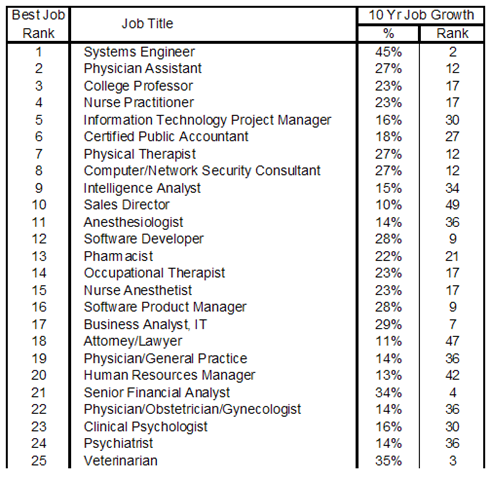
Each year, Money Magazine ranks the best jobs … based on job content and employment growth prospects.

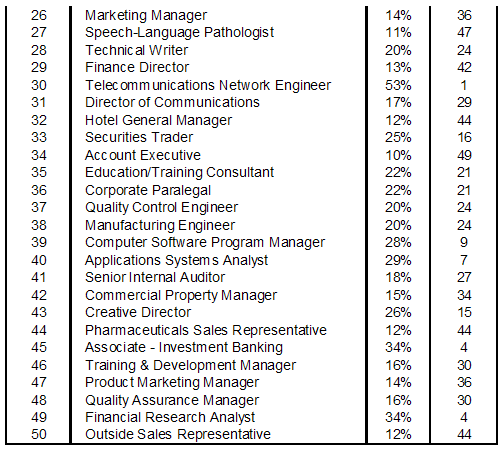
Here’s the 2009 list … Marketing Manager is #26 — ahead of all Finance jobs !

image

image

Full article:
http://money.cnn.com/magazines/moneymag/bestjobs/2009/full_list/index.html

Creating demand … by tapping non-customers.

December 8, 2009

Ken’s Take: “Blue Ocean” Strategists say to stop competing head-on in established markets and refocus on uncontested part of markets — the wide open, blue ocean.  A critical componect of a blue ocean strategy is to “unlock” non-customers …

* * * * *

From the folks at the Blue Ocean Institute …

Traditional strategic thinking looks to capture a greater share of existing demand. But companies can reach beyond existing demand to unlock demand from non-customers, too.

The key is to understand the three tiers of non-customers who buy opportunistically  … or  refuse to buy  …or are unaware of the product offering.

First-tier non-customers are closest to the existing market. They are the buyers who minimally purchase an industry’s offering out of necessity but are mentally
non-customers. They are waiting to jump ship and leave as soon as an alternative is spotted. These are potentially “soon-to-be” non-customers.  But, if they are offered a step-up in value, they can be retained … and may even increase their purchases.

Second-tier non-customers are people who consciously refuse an company’s offerings. These are buyers who have recognized an company’s offerings as an
option to fulfill their needs but have opted against them. These are “refusing” non-customers.

Third-tier non-customers are furthest from the existing market. They are non-customers who have never thought of a company’s offerings as an option. These are “unexplored” non-customers.

* * * * *

The key question to ask: “What are the factors keep non-customers out of the market … and what can be done to pull them into the market?”

Start by by focusing on the key commonalities – not differences – across these non-customers and existing customers to gain insight into how to create demand among these non-customers.

* * * * *