Archive for December 9th, 2009

Why companies aren’t hiring …

December 9, 2009

Thomas Sowell — a conservative economist — has a skill for reducing complex issues down to their essence.

Bottom line: Government mandates (e.g. added healthcare burdens) and uncertainty are and will continue to keep companies from hiring.

* * * * *
Excerpted from RCP: Jobs or Snow Jobs?, December 8, 2009

What does it take to create a job? It takes wealth to pay someone who is hired, not to mention additional wealth to buy the material that person will use.

Government creates no wealth. Government takes wealth from others, whether by taxation, selling bonds or imposing mandates.

However it is done, transferring wealth is not creating wealth.

When government uses transferred wealth to hire people, it is essentially transferring jobs from the private sector, not adding to the net number of jobs in the economy.

Destroying some jobs while creating other jobs does not get you very far, except politically. But politically is what matters to politicians, even if their policies needlessly prolong a recession or depression.

In reality, many things that politicians do reduce the number of jobs.

Politicians who mandate various benefits that employers must provide for workers gain politically by seeming to give people something for nothing. But making workers more expensive means that fewer are likely to be hired.

During an economic recovery, employers can respond to an increased demand for their companies’ products by hiring more workers– creating more jobs– or they can work their existing employees overtime. Since workers have to be paid time-and-a-half for overtime, it might seem as if it would always be cheaper to hire more workers. But that was before politicians began mandating more benefits per worker.

When you get more hours of work from the existing employees, you don’t need to pay for additional mandates, as you would have to when you get more hours of work by hiring new people. For many employers, that makes it cheaper to pay for overtime.

The data show that overtime hours have been increasing in the economy while more people have been laid off.

There is another way of reducing the cost of government-imposed mandates. That is by hiring temporary workers, to whom the mandates do not apply.

The number of temporary workers hired has increased for the fourth consecutive month, even though there are millions of unemployed people who could be hired for regular jobs, if it were not for the mandates that politicians have imposed.

Constant government experiments with new bright ideas is another common feature of Obama’s “change”. The uncertainty that this unpredictable experimentation generates makes employers reluctant to hire.

Full article:
http://www.realclearpolitics.com/articles/2009/12/08/jobs_or_snow_jobs_99443.html
Somebody has to finish last … and it’s CNN.

December 9, 2009

Question: If FOX is so bad, why are so many people watching ?  Here are the nums …

* * * * *
Excerpted from RCP: CNN is Missing Dobbs, December 2nd, 2009

Could things get any worse for CNN? Apparently, the answer is ‘yes.’

The pioneering and once dominant leader in cable news has been hemorrhaging viewers for some time and earlier this year suffered the indignity of slipping to last place among cable news networks, behind even its sister network Headline News.

Now come the November Nielsen ratings showing that the surprise departure of Lou Dobbs has cost the network even more viewers.

After Dobbs announced his resignation on air on Wednesday November 11, CNN suffered a 25% decline among all viewers in Dobbs’ 7pm time slot, and a 26% decline among adults 25-54.

Meanwhile – surprise, surprise – CNN’s competition in the 7pm slot at FOX News, The FOX Report with Shephard Smith, scored its highest rated month of the year in November with more than 2.1 million total viewers.

CNN’s fall after Dobbs’ departure also allowed MSNBC’s Hardball with Chris Matthews to eke its way into second place 7 pm slot in November with 672,000 total viewers.

And, CNN’s golden boy Anderson Cooper is fading in the ratings.  His numbers have slipped significantly through the past year. His 10 p.m. show, “Anderson Cooper 360,” has declined 62% in total viewers from November 2008. Last month, in Cooper’s time slot, Fox News’ “On the Record” attracted an average viewership of 1.9 million while “360” averaged 672,000; repeats of MSNBC’s “Countdown” and HLN’s Nancy Grace show averaged 655,000 and 458,000, respectively.

http://realclearpolitics.blogs.time.com/2009/12/02/cnn-missing-dobbs/

* * * * *

Excerpted from NYT: CNN Drops to Last Place Among Cable News Networks, October 26, 2009

CNN  hit a new competitive low with its prime-time programs in October, finishing fourth – and last – among the cable news networks with the audience that all the networks rely on for their advertising.

CNN’s programs were behind not only Fox News and MSNBC, but even its own sister network HLN (formerly Headline News.) Three of its four shows between 7 and 11 p.m. finished fourth and last among the cable news networks. That was the first time CNN had finished that poorly with its prime-time shows.

Individually, the CNN shows were beaten resoundingly by all the Fox News programs.

CNN averaged 202,000 viewers between the ages of 25 and 54 – the group that television news organizations use as their basis of success because of their advertising sales. That was far behind the dominant leader, Fox News, which averaged 689,000.

The only CNN show from 7 p.m. to 10 p.m. that did not finish last was Larry King, which was third, ahead of the new Joy Behar show on HLN. Mr. King averaged 224,000 and Ms. Behar 181,000. But Sean Hannity’s show on Fox News had a huge lead with 659,000 viewers in that age group. Second was Rachel Maddow on MSNBC with 242,000.

Bill O’Reilly on Fox News continued his long dominance with the biggest numbers of any host, 881,000 viewers. Mr. Olbermann, with his first-run program, was second with 295,000. Close behind was the first edition of Ms. Grace’s show with 269,000. Campbell Brown on CNN trailed with only 162,000.

CNN released a statement Monday saying, “CNN’s ratings are always going to be more dependent on the news environment, much more so than opinion-based programming especially in prime time.”

http://mediadecoder.blogs.nytimes.com/2009/10/26/cnn-drops-to-last-place-among-cable-news-networks/

It’s how you ask the question …

December 9, 2009

Another great analysis from Pollster.com.

Focus is on Presidental Approval Ratings, but the findings are generalizable to other surveys, e.g. customer satisfaction.

* * * * *

From Pollster.com:

Most pollsters offer just two answer categories: “Do you approve or disapprove of the way Barack Obama is handling his job as president?”

Rasmussen’s question prompts for four: “How would you rate the job Barack Obama has been doing as President … do you strongly approve, somewhat approve, somewhat disapprove, or strongly disapprove of the job he’s been doing?”

Rasmussen has long asserted that the additional “somewhat” approve or disapprove options coax some respondents to provide an answer that might otherwise end up in the “don’t know” category.

Rasmussen conducted an experiment to test that argument.

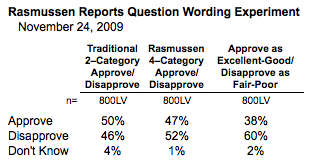
They administered three separate surveys of 800 “likely voters, each involving a different version of the Obama job approval rating: (1) the traditional two category, approve or disapprove choice, (2) the standard Rasmussen four-category version and (3) a variant used by Zogby and Harris, that asks if the president is doing an excellent, good, fair or poor job.

The table below collapses the results into two categories; excellent and good combine to represent “approve,” fair and poor combine to represent “disapprove.”

image

In general, smaller don’t know percentages tend to translate into larger disapproval percentages. The 4-category Rasmussen version shows a smaller “don’t know” (1% vs. 4%) and a much bigger disapprove percentage (52% vs 46%) compared to the standard 2-category question.

The approve percentage is only three points lower on the Rasmussen version (47%) than the traditional question (50%).

The Rasmussen experiment shows an even bigger discrepancy between the approve percentage on the two-category questions (50%) and the much lower percentage obtained by combining excellent and good (38%).

* * * * *

Generalizing the findings: To increase “data discrimination” when doing customer sat polling, use 4 categories and and focus on the “very” categories at the extremes.  That’s where the real info is …