Archive for March, 2010

Novel idea: Listen to your constituents …

March 16, 2010

Punchline: Reps in swing districts can either vote with their constituents or jump off a cliff. Why is that a difficult decision?

* * * * *

Excerpted from WSJ: Swing Districts Oppose Health Reform, Mar 15, 2010 

Democratic leaders cite national polls that show support for individual provisions of the bill as a reason to pass this reform. Yet vulnerable politicians should be warned: Responses to questions about individual benefits, particularly when removed from a cost context, are different from those on the whole bill.

Voters in key congressional districts are clear in their opposition to the proposed health-care reform.

That’s one of the findings of a survey that will be released today by the Polling Company on behalf of Independent Women’s Voice. The survey consisted of 1,200 registered voters in 35 districts represented by members who could determine the outcome of the health-care debate.

The survey shows astonishing intensity and sharp opposition to reform, far more than national polls reflect.

  • For 82% , the heath-care bill is either the top or one of the top three issues for deciding whom to support for Congress next November.
  • 60% want Congress to start from scratch on a bipartisan health-care reform proposal or stop working on it this year.
  • Majorities say the legislation will make them and their loved ones, the economy and the U.S. health-care system worse off.
  • 70% would vote against a House member who votes for the Senate health-care bill with its special interest provisions.
  • 75% disagree that the federal government should mandate that everyone buy a government-approved insurance plan
  • 81% say any reform should focus first on reducing costs.
  • 75% agree that Americans have the right to choose not to participate in any health-care system or plan without a penalty or fine.
  • 60% of the voters surveyed will vote for a candidate who opposes the current legislation and wants to start over.
  • Over 1/3 of respondents say they will actively work against a candidate who votes the wrong way or for the candidate who votes the right way.

That translates into specific concerns with the Senate legislation—and none of these objections would be addressed by the proposed fixes.

Over 70%—indeed in several districts over 80%—of respondents, across party lines, said that the following information made them less supportive:

  • mandates that individuals purchase insurance or face penalties;
  • cuts Medicare Advantage;
  • will force potentially millions to lose existing coverage;
  • will cost an estimated $2.3 trillion over its first 10 years; and it will grant unprecedented new powers to the Health and Human Services secretary.

These are the constituents of the members whose votes will matter most this week. Perhaps, if this republic is still the people’s, those members should heed those they claim to represent.

Full article:
http://online.wsj.com/article/SB10001424052748704416904575121541779736742.html?mod=djemEditorialPage_h

Why is Stupak surprised that his amendment was trashed ?

March 15, 2010

Back in November, pro-life Rep. Bart Stupak scored what he thought was a victory and the House passed an amendment to its ObamaCare bill limiting the use of tax-payer funds for abortions.

Stupak’s language not only prohibits abortion coverage in the public insurance option included in the House bill. It would also prevent private plans from offering coverage for abortion services if they accept people who are receiving government subsidies.

Abortion-rights supporters called it a “de facto” abortion ban and mounted an intense but unsuccessful lobbying campaign against it.

http://thehill.com/blogs/blog-briefing-room/news/66969-senior-dem-confident-stupak-amendment-will-be-stripped

* * * * *

But, immediately after the vote, pro-choice Dems expressed confidence that “controversial language on abortion would be stripped from a final healthcare bill” via legislative maneuvering.

Excerpted from The Hill: Senior Democrat is ‘confident’ that Stupak amendment will be stripped, 11/09/09

A House Democratic leader said Monday she’s “confident” controversial language on abortion will be stripped from a final healthcare bill.

Rep. Debbie Wasserman Schultz (D-Fla.), the Democrats’ chief deputy whip in the House, said that she and other pro-abortion rights lawmakers would work to strip the amendment included in the House health bill that bars federal funding from subsidizing abortions.

“It was extremely painful for me to feel compelled to vote for a bill that contained that kind of restriction on a woman’s ability to make her own reproductive choices,” Wasserman Schultz said.

“We’re all going to be working very hard, particularly the pro-choice members, to make sure that’s the case.”

.

* * * * *
Now, House Dem leadership has told Stupak and his pro-life buddies to take a hike …
Pelosi Calls Stupak’s Bluff on Abortion:

Anti-choice zealot Rep. Bart Stupak (D-Mich) overplayed his hand. House Majority Leader Steny Hoyer announced today that the House Democrats will move forward without a deal on abortion coverage.

Why are they finally telling Stupak to pound sand after endless rounds of negotiations? First off, Pelosi had the strategic advantage of having very little to offer Stupak and his shadowy band of anti-choice Democrats. Second, Stupak’s alleged coalition is looking more like a paper tiger every day.
http://bigthink.com/ideas/19045

* * * * *

And, in the coup de grace, Stupak alledges that Rep. Henry Waxman bluntly told him that liberal Dems want the government to fund abortions.  So there, Bart !
Bart Stupak — the pro-life Democrat leading the charge in the House against passage of the Senate health insurance reform bill — said Friday that Henry Waxman — a key House committee chairman —  told him that Democrats want abortions to be paid by a federally-funded nationalized health insurance system.
http://www.youtube.com/watch?v=-yDtPRSBKyM
.
* * * * *
My questions:
(1) Why is Stupak acting surprised and dismayed by the outcome ?
.
(2) Will Stupak himself cave and vote ‘yes’ ?

My bet: yes …

* * * * *

BTW: Catholic Bishops are OK with the House language, but oppose the Senate language.

“U.S. Conference of Catholic Bishops has said the Senate-passed health care bill fails our moral criteria and must be changed.

The abortion funding problems in the Senate Bill extend well beyond the premium division scheme.

click for details:
http://catholickey.blogspot.com/2010/03/usccb-clarifies-politico-comments-still.html

Will “swing” Congressmen vote their constituents’ will … or the party bosses’ ?

March 15, 2010

The Tarrance Group conducted polling for the districts of eleven Democrats thought to be potential flippers on the final vote on health care reform.

Below are the results for the main question, “do you favor or oppose the health care reform legislation being proposed by President Obama and the Democrats in Congress” , along with the members’ votes on the health care bill the first time around.

In summary, majorities oppose the bill in every district except one (NY-13), most of the opposers strongly oppose the bill.

  • AZ-8 (Giffords, yea): 35% favor, 52% oppose, 46% strongly oppose;
  • CO-4 (Markey, nay): 33% favor, 58% oppose, 51% strongly oppose;
  • IN-9 (Hill, yea): 31% favor, 52% oppose, 44% strongly oppose;
  • NJ-3 (Adler, nay): 34% favor, 57% oppose, 46% strongly oppose;
  • OH-1 (Driehaus, yea): 39% favor, 54% oppose, 48% strongly oppose;
  • OH-16 (Boccieri, nay): 38% favor, 51% oppose, 46% strongly oppose;
  • NV-3 (Titus, yea): 40% favor, 52% oppose, 44% strongly oppose;
  • NY-13 (McMahon, nay): 40% favor, 46% oppose, 37% strongly oppose;
  • NY-24 (Arcuri, yea): 32% favor, 53% oppose, 47% strongly oppose;
  • PA-4 (Altmire, nay): 30% favor, 58% oppose, 47% strongly oppose;
  • PA-10 (Carney, yea): 28% favor, 58% oppose, 47% strongly oppose.

image 

http://www.naw.org/files/TargetCDHealthCareStudyToplines.pdf

Sourced from RCP: How Much Damage Could HC Inflict on Dems?, Mar 10, 2010
http://realclearpolitics.blogs.time.com/2010/03/10/how-much-damage-could-hc-inflict-on-dems/

Why we make mistakes …

March 15, 2010

In this and a couple of subsequent posts, i’ll be excerpting  the 13 reasons from:

Why We Make Mistakes, Joseph T. Hallinanm, Broadway Books 2009

Today, the first 4 reasons on the list

* * * * * *

When it comes to making mistakes, the cause is overwhelmingly attributed to human error.

Whether it’s airplane crashes (70 percent), car crashes (90 percent), or workplace accidents (90 percent), humans are usually to blame.

However, in many cases, our mistakes are not entirely our fault. All of us are afflicted with certain systemic biases in the way we see, remember, and perceive the world around us, and these biases make us prone to commit certain types of errors.

The errors we make can be explained through 13 lessons:

1. We look but don’t always see.

When it comes to human error, this kind of mistake is so common that researchers have given it its own nickname: “a looked but didn’t see” error. When we look at something — or at someone — we think we see all there is to see. But we don’t. Often times, we miss important details, some small and some larger.

2. We all search for meaning.

A recent poll of 3,000 people found that one-fourth of them couldn’t remember their own phone numbers, and two-thirds couldn’t recall the birthdays of more than three friends or family members.

When it comes to hiding places, people also mistakenly believe that the more unusual a hiding place is, the more memorable it will be. However, the opposite is actually true: Unusualness actually makes a hiding place more forgettable. The key to a good hiding place is making a quick connection between the thing being hidden and the place in which it is hidden.

The same holds for passwords.  While associated meanings may make them easier to hack, they’re certainly more memorable if they have personal meaning.

3. We connect the dots (prematurely).

The moment we experience a flicker of recognition, the brain does something similar to connecting the dots that we didn’t know it was connecting. These types of subtle connections are very powerful — and very common. 

Once we “see” a pattern developing we hurry it to its logical conclusion — sometimes erroneously — regardless of contrary indicators that may surface.

4. We wear rose-colored glasses.

Hindsight isn’t 20/20.

In remembering our own actions, we all tend to wear rose-colored glasses. Without intentionally trying to distort the record, we are prone to recalling our own words and deeds ina light that is more favorable than an objective record would show.

In fact, the tendency to see and remember in self-serving ways is so ingrained in us — and so subtle — that we often have no idea that we’re doing it.

* * * * *

Next up: The myth of multi-tasking …

"The special deals will be taken out !" … just kidding.

March 15, 2010

Nobody should be surprised by this move …

President Barack Obama appears ready to reverse his position and allow unpopular deal-sweetening measures in the hopes of finding Democratic support for legislation.

To clinch support, Obama is backing away from his insistence that senators purge the legislation of a number of lawmakers’ special deals.

Taking a new position, the White House will only object to state-specific arrangements, such as an increase in Medicaid funding for Nebraska, ridiculed as the “Cornhusker Kickback.”  That’s being extended to all states.

The new rule: provisions that could — under prescripted circumstances affect more than one state are OK.

That means deals sought by senators from Montana and Connecticut would be fine — even though last week they were singled out as items Obama wanted removed.

There was resistance, however, from two committee chairman, Democratic Sens. Max Baucus of Montana and Chris Dodd of Connecticut, and the White House has apparently backed down.

Excerpted from AP: Obama heads to Ohio looking for health care votes, Mar 15, 2010 
http://news.yahoo.com/s/ap/20100315/ap_on_bi_ge/us_health_care_overhaul

There are not enough taxpayers in the country or creditors in China to …

March 12, 2010

Punchline: At a time the the country is bursting at the economic seams with high debt and unfunded liabilities, the push is on to up spending by another trillion dollars … and up taxes to cover it.  Bad idea.  This excerpt cuts to the chase.

* * * * *

Excerpted from Forbes: Uncommon Sense – Wrong Bill At The Wrong Time, 03.10.10

Even before President Obama rammed through his trillion-dollar-plus stimulus/bailout packages last year, there was a growing sentiment that the country’s top priority ought to be tackling the entitlement programs whose liabilities are like a swelling aneurysm in the brain of the body politic waiting to rupture.

  • The combined unfunded liabilities of Medicare and Social Security–the federal health care and the pension programs for the elderly — are $107 trillion, seven times the current GDP.
  • Medicaid, the joint federal-state health insurance program, is consuming on average 21% of state budgets, their single biggest ticket item even before ObamaCare dumps another 16 million people into the program, expanding the Medicaid population by 25%.
  • State and local government owe their employees a trillion dollars in pension and other benefits than they have funds to deliver.

There are not enough taxpayers in the country or creditors in China capable of financing all these promises.

* * * * *

Expanding this massive, multifarious entitlement state even more strikes most normal people as sheer lunacy — especially now that it is visibly coming apart at the seams.

  • General Motors and Chrysler–the corporate version of the public welfare state in which unions had negotiated the best wage and pension deals in the free world — have already been forced into a taxpayer-financed bankruptcy.
  • California, America’s most European state, is technically bankrupt, thanks to the ubiquitous influence on the state budget of its public unions and its entitlement spending.
  • The deficits and debt of the so-called European PIGS (Portugal, Italy, Greece and Spain) — the social democracies whose cradle-to-grave welfare policies are the inspiration behind Obama’s programs –are on the brink of bankruptcy. Greece, the most vulnerable of the lot, has a deficit of 12.7% of the GDP–not that much higher than America’s 10.6 %.

ObamaCare could well become President Obama’s Iraq.

It will exacerbate the crisis of the entitlement state, requiring someone else to step forward and clean up the fiscal mess he is creating.

Full article:
http://www.forbes.com/2010/03/09/obamacare-health-democrats-congress-opinions-columnists-shikha-dalmia.html?boxes=opinionschannellighttop

The Invincibles: What to do about the twentysomethings ?

March 12, 2010

Interesting factoid from USA Today:

People in their 20s have the highest uninsured rate of any age group in the country

They make up nearly a third of the 46 million uninsured.

Under the health care overhaul bills, about 10 million lower-income young adults would qualify for Medicaid, or for government subsidies to buy private insurance.

About 5 million young adults will have to buy health care insurance or pay a penalty (aka. a ‘fine’, a ‘tax’) of $695, or 2.5% of their annual income, whichever is higher.

Full article:
http://www.usatoday.com/money/industries/health/2010-03-08-youthhealth08_ST_N.htm

Healtcare’s "12 cent problem" …

March 12, 2010

Ken’s Take: I’m a strong proponent of putting all employer paid benefits — health insurance included — on employees taxable W2s and providing a liberal deduction ( say, the lesser of $5,000 per dependent or the taxpayer’s cash outlay.)  Unfortunately, the UAW and SEIU don’t like the idea …

* * * * *
Excerpted from Washington Post: Obama in the Wilsonian Tradition, March 11, 2010

The bold move that the nation needs is a transition from the irrationality of employer-provided health insurance.

Employer-paid insurance is central to what David Gratzer of the Manhattan Institute calls “the 12 cent problem.”

That is how much of every health care dollar is spent by the person receiving the care.

Hence Americans’ buffet mentality — we paid at the door to the health care feast, so let’s consume all we can.

John McCain had the correct prescription for health care during the 2008 campaign.

He proposed serious change — taxing employer-provided health care as what it indisputably is, compensation, and giving tax credits, including refundable ones, for individuals to purchase insurance.

Instead, ObamaCare will subsidize insurance purchases for families of four earning almost $100,000 a year … a redundant reminder of unseriousness about the nation’s fiscal mismanagement.

Full article:
http://www.realclearpolitics.com/articles/2010/03/11/in_the_wilsonian_tradition_104733.html

The curse of Chuck E. Cheese: An epidemic of brawls…

March 12, 2010

Punchline: Law-enforcement officials say “alcohol, loud noise, thick crowds and the high emotions of children’s birthday parties make Chuck E. Cheese restaurants more prone to disputes than other family entertainment venues.”

* * * * *

Excerpted from BrandChannel: Someone Please Save Chuck E. Cheese’s, March 10, 2010

Generally, a strong, popular brand can weather a bad mention in the press. Even a second bit of bad press should be no big deal. However, three, four, or five are cause for alarm. And family dining and entertainment establishment Chuck E. Cheese’s should be alarmed.

The Chuck E. Cheese’s brand name has been turning up in the news with rather disturbing frequency, and each report evokes more of images “jail time” rather than “fun time.” Here is a list of some of the reports from the last few months:

  • “One day, three police incidents at Susquehanna Chuck E. Cheese’s restaurant”
  • “Brawl At Memphis Chuck E. Cheese”
  • “Two Crooks Target Mom At Chuck E. Cheese’s”
  • “Fight breaks out at St. Louis Chuck E. Cheese’s”
  • “Chuck E. Cheese Riot In Tennessee Leaves Several People Facing Charges”
  • “Customers brawl at Toledo Chuck E Cheese”
  • “Brawl breaks out at Chuck E Cheese in Flint Township”
  • “Three Arrested After Greenville Chuck E. Cheese Fight”
  • “Testimony Begins in Chuck E. Cheese Slaying”

“Fights among guests are an issue for all restaurants, but security experts say they pose a particular problem for Chuck E. Cheese’s… Law-enforcement officials say alcohol, loud noise, thick crowds and the high emotions of children’s birthday parties make the restaurants more prone to disputes than other family entertainment venues.” 

Chuck E. seems to be dragging his feet to address the situation.

So far, the only action the brand has taken is to post “rules” in his 530-plus locations:

  • No gang-style apparel.
  • No gang-type conduct or behavior.
  • No weapons, knives, chains, screwdrivers, glass cutters.

* * * * *

Ken’s Take: Gee, woulda thought those rules would have been enough to remedy the situation.  What kind of gang member disrespects a “No” sign ? 

Full article:
http://www.brandchannel.com/home/post/2010/03/10/Someone-Please-Save-Chuck-E-Cheeses.aspx

The perils of reconciliation … or the upside if you don’t like ObamaCare

March 11, 2010

Candidate Obama pledged not to use reconciliation for healthcare legislation when he was stumping.  So much for campaign promises.

There’s a greater risk to the Dems if they use the process to pass ObamaCare: if the GOP retakes a majority of the Senate, it can use the same process to repeal the legislation.  After all, an unequivocal precedent will have been set.  Oops.

* * * * *

Excerpted from WSJ: The Trouble With ‘Reconciliation’, March 11, 2010

Fear not, sayeth Speaker Pelosi, all will be fixed with the magic dust known as “reconciliation” —a  process that allows budget and spending bills to move through the Senate with 51 votes instead of 60.

But, if Democrats use reconciliation to enact health-care reform, this fight isn’t likely to end this year.

Democrats are resorting to reconciliation because that would allow them to avoid a Republican filibuster.

That leaves Republicans free to use the same process to repeal ObamaCare that Democrats are using to enact it.

It means that for the next several election cycles every GOP Senate candidate can campaign on the promise to be that 51st vote for repeal.

House Democrats would be foolish to trust a process that has deeply alienated the American public. There are lots of reasons for Democrats to worry that voters will punish them for passing this reform.

Full article:
http://online.wsj.com/article/SB10001424052748703701004575113831577327418.html

Blame the recession on low and declining business investment — and don’t expect it to get better.

March 11, 2010

Punchline: Headlines typically say that low consumer spending is at the root of the recession.  But, gov’t data indicates another cause: low and declining business investment in plant, equipment, software, and inventories. An aggregate demand problem that is certain to be exacerbated — not mitigated — by higher taxes on business and capital.

* * * * *

Excerpted from: IBD: No Recovery Until America Invests Again, 03/09/2010

The deeper story of the continuing recession can be found buried in the statistical appendix to the 2010 report of the president’s Council of Economic Advisers.

That story: a devastating decline in investment spending.

The government’s data reveal that, contrary to popular belief, consumer spending held up fairly well during the recession, falling less than 2% from the fourth quarter of 2007 to the second quarter of ’09.

A drop in private investment spending — primarily business purchases of structures, equipment, software and additions to inventories — was far more significant to the recession.

Gross private domestic investment peaked in 2006. Between the first quarter of that year and the second quarter of 2009, it fell precipitously, by nearly 34%.

This huge decline in investment spending portends an extended period of slow economic growth, lasting several years and perhaps longer. Worn-out equipment, obsolete software, ill-maintained structures and depleted inventories are not the stuff of which rapid, sustained economic growth is made.

Business firms have also fled from inventory investment, trimming their holdings by an unprecedented $125 billion in 2009 after lopping off $35 billion in 2008.

Federal government spending, meanwhile, has raced ahead. From 2007 to 2009, government purchases of newly produced final goods and services — the federal government’s “contribution” to GDP — increased by over 13% in constant dollars.

Making matters worse, the explosion of the federal government’s size, scope and power since mid-2008 has created enormous uncertainties among investors.

New taxes and higher rates of old taxes; potentially large burdens of compliance with new environmental and energy regulations and mandatory health care expenses; new, intrinsically arbitrary government oversight of systemic risks associated with virtually any type of business — all of these unsettling possibilities must give pause to anyone considering a long-term investment.

Unless Washington acts soon to resolve these uncertainties, from the cap-and-trade folly to the health care monstrosity, most investors will likely remain largely on the sidelines, consuming some of what would have been invested and protecting the remainder of their wealth in cash hoards and low-risk, low-return, short-term investments.

Full article:
http://www.investors.com/NewsAndAnalysis/ArticlePrint.aspx?id=525864

What do electricity, the EZ pass, and the 3-point line have in common ?

March 11, 2010

I often say that they make my list as the top 3 inventions ever …

You know all about the first two.  Here’s the story of the 3-pointer.

* * * * *

Excerpted from RCP Sports: Top 10 Biggest Rule Changes in Sports, 03.9.10

The three-pointer is arguably one of the most exciting parts of basketball.

It can quickly change a game’s momentum and makes the last minutes of every close game that much more exciting.

But years ago most people in power considered the three-pointer a gimmick.

The idea of the three-point field goal was first tested in a college game between Columbia and Fordham back in 1945.

The rule was used in the American Basketball League during its short lifespan starting in 1961, but became popular when it was used by the American Basketball Association (ABA), which was founded in 1967.

The three-point shot was believed to open up the game and spread the court in a league that had become dominated by big men and inside play.

The rule was not instituted in the NBA until the 1979-80 season, when it was used on a trial basis. One year later, the league adopted the rule permanently.

The NCAA didn’t officially establish the three-point field goal until 1986.

Several conferences had applied the rule in their own manner before, differing on the distance for the shot. The first to do so was the Southern Conference in the 1980-81 season.  At the time, Furman coach Eddie Holbrook summed up what most coaches thought with the inception of the rule, “It’s a coach’s nightmare and a spectator’s delight.”

Although the three-point line has changed distances over time in both the NBA and NCAA, no one would argue that it remains a spectator’s delight, and even most of the coaches have come around.

http://www.realclearsports.com/lists/biggest_rule_changes/three_point_field_goal.html?state=stop

For every voter who strongly favors ObamaCare, two are strongly opposed … here’s why.

March 11, 2010

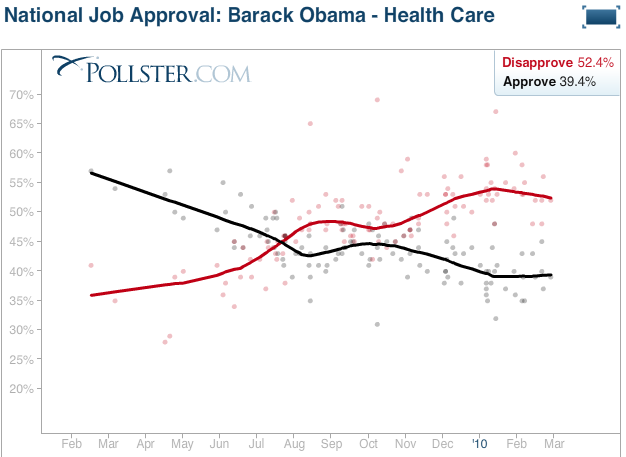
Punchline: Most voters believe the current plan will harm the economy, cost more than projected, raise the cost of care, and lead to higher middle-class taxes.

image 
http://www.pollster.com/polls/us/jobapproval-presobama-health.php?xml=http://www.pollster.com/flashcharts/content/xml/USObamaJobPresHealth.xml&choices=Disapprove,Approve&phone=&ivr=&internet=&mail=&smoothing=&from_date=&to_date=&min_pct=&max_pct=&grid=&points=1&lines=1&colors=Disapprove-BF0014,Approve-000000,Undecided-68228B

* * * * *

Here’s Why

Excerpted from WSJ: Why Obama Can’t Move the Health-Care Numbers, March 9, 2010

One of the more amazing aspects of the health-care debate is how steady public opinion has remained. Despite repeated and intense sales efforts by the president and his allies in Congress, most Americans consistently oppose the plan that has become the centerpiece of this legislative season.

In 15 consecutive Rasmussen Reports polls conducted over the past four months, for every person who strongly favors it, two are strongly opposed.

The reason President Obama can’t move the numbers and build public support is because the fundamentals are stacked against him. Most voters believe the current plan will harm the economy, cost more than projected, raise the cost of care, and lead to higher middle-class taxes.

  • 57% of voters believe that passage of the legislation would hurt the economy, while only 25% believe it would help.
  • Voters think reducing spending is more important than reducing the deficit.
  • People simply don’t trust the official projections: 81% of voters say it’s likely the plan will end up costing more than projected.
  • 66% of voters believe passage of the president’s plan will lead to higher deficits
  • 78% say it’s at least somewhat likely to mean higher middle-class taxes.
  • Fifty-nine percent of voters say that the biggest problem with the health-care system is the cost: They want reform that will bring down the cost of care.
  • Only 17% now believe it will reduce the cost of care.
  • For most voters, the notion that you need to spend an additional trillion dollars doesn’t make sense. If the program is supposed to save money, why does it cost anything at all?
  • The overwhelming majority of voters have insurance coverage, and 76% rate their own coverage as good or excellent.
  • Half of these voters say it’s likely that if the congressional health bill becomes law, they would be forced to switch insurance coverage—a prospect hardly anyone ever relishes.

Full article:
http://online.wsj.com/article/SB10001424052748704784904575111993559174212.html

Where the healthcare reform battle has left us …

March 11, 2010

Note that the article is from the Washington Post, not WSJ or IBD.

* * * * *

Excerpted from Wash Post: Obama is Choosing Liberal Divisiveness, March 10, 2010

Whatever the legislative fate of health reform, the Democratic health reformers have

  • Divided Democrats while uniting Republicans,
  • Returned American politics to well-worn ideological ruts,
  • Employed legislative tactics that smack of corruption,
  • Squandered the president’s public standing,
  • Lowered public regard for Congress,
  • Sucked the oxygen from other agenda items,
  • Re-engaged the abortion battle,
  • Produced freaks and prodigies of nature such as a Republican senator from Massachusetts,
  • Raised questions about the continued governability of America,
  • Caused the White House chief of staff to distance himself from the president’s ambitions.

Quite a list of accomplishments.

* * * * *
Early on Obama rejected the one, genuinely bipartisan health reform proposal — made by Sens. Ron Wyden, D-Ore., and Bob Bennett, R-Utah — that would have ended employer-based insurance and given individuals a deduction to buy their own coverage from a menu of private insurance options.

Wyden has turned out to be the ignored prophet of the health debate:

“If you … just pound it through on a partisan vote, you will have people practically as soon as the ink is dry looking to have it repealed.”

Full article:
http://www.realclearpolitics.com/articles/2010/03/10/obama_is_choosing_liberal_divisiveness.html

Sen Durbin overlooked a few points in his defense of trial lawyers and junk lawsuits …

March 10, 2010

During the ObamaCare “Summit Meeting”, Senator Dick Durbin (IL), himself a former medical malpractice lawyer, gave a spirited rebuttal to folks arguing that any cost-cutting health reform must address junk lawsuits.
http://www.youtube.com/watch?v=OKKPgVkfzw4&feature=youtube_gdata

Durbin’s argument revolved around 3 points:

1. Even without new laws capping damages, medical malpractice lawsuits are dropping off dramatically.

He cited a study by the non-profit Kaiser Foundation saying that the number of paid medical malpractice claims has declined by 50 percent over the last two decades.

And between 2003 and 2008, the total amount paid out for medical malpractice claims – across the entire United States – was cut in half, from $8 billion to $4 billion. 

* * * * *

2. The Journal of the American Medical Association says that 100,000 deaths are caused by medical malpractice annually.

Medical malpractice reform will make doctors feel a little bit more insulated from legal liability for their actions and, therefore, will make them a little bit more careless.

The Congressional Budget Office estimates that the extra careless by doctors will result in additional 4,800 medical malpractice deaths a year

* * * * *

3. According to the Congressional Budget Office, the Republican plan for medical malpractice reform will save $5.4 billion dollars a year … which is inconsequential in the context of a health care budget that is $2.5 trillion.

http://www.bostonpersonalinjurylawyerblog.com/2010/02/sen-durbin-demolishes-republic.html 

* * * * *

What Durbin didn’t say

A Massachusetts Medical Society study showed that “the plague of defensive medicine” leads to about 25 percent of doctor referrals, tests and procedures being done for no medical reason. [Ken’s calc: 25% times $2.5 trillion = $625 billion]
http://www.realclearpolitics.com/articles/2010/03/05/the_health_care_bill_is_a_failure.html

* * *
A study published in the November 2009 issue of the Journal of Law & Economics showed that a rise in the cost of medical liability insurance led to more reductions of hours of medical service supplied by older doctors than among younger doctors.
http://www.realclearpolitics.com/articles/2010/03/06/alice_in_medical_care_part_iv_104664.html

* * *

In other words, experienced doctors are leaving the profession, rather than putting up with the hassles and risks, and letting debt-burdened younger docs take over
* * * * *

Ken’s Take: No health care reform can be taken seriously as a cost-cutting initiative unless junk lawsuits are controlled … probably by setting up medical tribunals that protect patient rights while adding sanity to the payouts.

Dear Secretary Sebelius … Your’s truly, Anthem Blue Cross / Blue Shield of California

March 10, 2010

Anthem BC /BS has provided ObamaCare supporters with a talking point: profit-mongering health insurance companies are arbitrarily jacking up premiums to unprecedented and unconscionable levels.  ObamaCare will put a stop to that pronto.

Further the President said that insurance execs can’t come up with any reasonable explanation for the rate changes.

Well, Anthem has penned a letter to Sec. Sebelius explaining the rate changes (link to letter is below)

While the letter is a bit long-winded, here are the key points … which, incidentally, make sense to me.

  • In 2009, Anthem’s average premium increase was 2%.
  • But the average claims per member — the underlying cost of serving subscribers — increased by 8% in 2009.
  • So, Anthem’s individual health insurance business in California lost money in 2009.
  • An independent actuarial firm concluded that Anthem’s proposed 2010 rates were actuarially sound, reflecting the expected medical costs associated with the membership in these plans.
  • Anthem’s proposed 2010 rates satisfy or exceed the medical loss ratio required by California law i.e. the underlying medical costs are driving the rates
  • The 39% increase reported in the media is an isolated case; some premiums went down by as much as 20%.
  • After these premium changes are enacted, the average individual market premium in California  will still be about 1/2 the average individual market premium in New York.

Full letter:
http://www.wellpoint.com/pdf/SebeliusLetter02112010.pdf

Thanks to DNF  for feeding the lead.

Five forms of risk breed our insecurity …

March 10, 2010

Minds are insecure for many reasons. One reason is perceived risk in doing something as basic as making a purchase.

Behavioral scientists say that there are five forms of perceived risk:

  1. Monetary risk. There’s a chance that I could lose money on this.
  2. Functional risk. Maybe it won’t work, or maybe it won’t do what it’s supposed to do.
  3. Physical risk. It looks a little dangerous. I could get hurt.
  4. Social risk. I wonder what my friends will think if I buy this.
  5. Psychological risk. I might feel guilty or irresponsible if I buy this.

Source:  Repositioning: Marketing in an Era of Competition, Change, and Crisis by Jack Trout with Steve Rivkin, 2010

“But my product is a commodity” … Stop whining, start repositioning

March 10, 2010

How can you reposition your own brand when the entire product category is seen as a commodity? Here are five successful strategies:

  • Identify. Ordinary bananas became better bananas when a small Chiquita label was added to the fruit. Dole did the same for pineapple, and Foxy did the same for lettuce. Of course, you then have to communicate why people should look for these labels.
  • Personify. The Green Giant character became the difference in a family of vegetables in many forms. Frank Perdue became the tough man behind the tender chicken
  • Create a new generic. Tyson wanted to sell miniature chickens, which doesn’t sound very appealing. So it introduced Cornish game hens.
  • Change the name. Sometimes your original name works against you. For example, no one wanted to eat a Chinese gooseberry until the name was changed to kiwi fruit
  • Reposition the category. Sales of pork increased when its producers repositioned it as “the other white meat.”

Source:  Repositioning: Marketing in an Era of Competition, Change, and Crisis by Jack Trout with Steve Rivkin, 2010

The GOP strategy: revenge of the nerds ?

March 10, 2010

Excerpted from RCP: Revenge of the GOP Nerd, March 4, 2010

For Republicans, the nerd might not be the new jock. But the GOP jocks are increasingly letting the nerds in on the party.

Increasingly, nerds appear to be the life of the party. The GOP party, that is.

Paul Ryan, the top Republican on the Budget Committee, used his nerd skills last week to “unpack” the Senate health care bill numbers. Some imagined Ryan as a future vice president.

Indiana Governor Mitch Daniels, a potential presidential candidate, previously served as the director of the Office of Management and Budget. It’s a job only a nerd could love.

Perhaps in this era of the professorial president, Republicans decided to put forward their wonkish rock stars.

It helps to have number crunchers on the main stage when it’s all about the economy.

It’s enough to make the Prof-in-Chief jealous.

Full article:
http://www.realclearpolitics.com/articles/2010/03/04/revenge_of_the_gop_nerd__104647.html

Heads up: The capital gains hurt on the horizon … and the giant sucking sound from the stock market.

March 9, 2010

The unions cut a special behind-closed-doors deal with the President to delay the tax on Cadillac heath insurance plans until 2018.  Though Obama proposes eliminating the Cornhusker kickback, he plans to keep his word to the SEIU on this break.

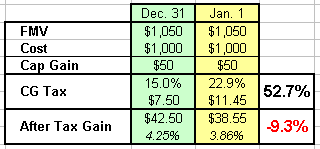
To compensate for the lost tax revenue, Obama proposes extending Medicare “payroll taxes” to unearned income — i.e. interest, dividends and capital gains. 

That’s a 2.9% increase in capital gains taxes.

Keeping in mind that the Bush tax rates expire on Dec 31, the capital gains tax rate will go from 15% to 22.9% — a 52.7% increase !

As the simple example below shows, after-tax gains get crushed — overnight — when the new rates take effect.

Note: Potentially making matters worse, I expect the Medicare tax on unearned income to become effective on the date Obama signs the bill … or worse, I wouldn’t be surprised if Team Obama made the tax hike retroactive to Jan. 1, 2010. The sucking sound you’ll hear is the stock market losing steam …

image

Paul Krugman: "Don’t believe what’s in my textbook" … huh ?

March 9, 2010

OK Krugman didn’t actually say those words, but he did deliver the message.

Great ‘catch’ by WSJ writer James Taranto who hoists economist Paul Krugman  by his own pitards …

* * * * *

Excerpted from WSJ: Mirror, Mirror, By JAMES TARANTO, March 5, 2010

Former Enron adviser Paul Krugman takes note in his New York Times column of what the calls “the incredible gap that has opened up between the parties”:

Today, Democrats and Republicans live in different universes, both intellectually and morally.
“What Democrats believe,” he says “is what textbook economics says”

But that’s not how Republicans see it.

GOPers say unemployment relief “doesn’t create new jobs. In fact, if anything, continuing to pay people unemployment compensation is a disincentive for them to seek new work.”

Krugman scoffs: “To me, that’s a bizarre point of view — but then, I don’t live in their universe.”

What does textbook economics have to say about this question? Here is a passage from a textbook called “Macroeconomics”:

Public policy designed to help workers who lose their jobs can lead to structural unemployment as an unintended side effect. . . . In other countries, particularly in Europe, benefits are more generous and last longer. The drawback to this generosity is that it reduces a worker’s incentive to quickly find a new job. Generous unemployment benefits in some European countries are widely believed to be one of the main causes of “Eurosclerosis,” the persistent high unemployment that affects a number of European countries.

So it turns out that what Krugman calls Republicans “bizarre point of view” is, in fact, textbook economics.

By the way, the authors of that textbook are Paul Krugman and Robin Wells. Miss Wells is also known as Mrs. Paul Krugman.

It seems Krugman himself lives in two different universes — the universe of the academic economist and the universe of the bitter partisan columnist.

OK, so he was off by $1 trillion (twice) … don’t get bogged down in the (flakey) numbers..

March 9, 2010

Liberal pundits tout President Obama’s intellect and grasp of “the details”. 

May be true, but a couple of recent trillion dollar “gaps” gotta make objective observers scratch their heads.

Either he doesn’t know, he’s sloppy, or he’s fibbing.  Pick one.

* * * * *

First, the CBO says that the national debt will rise by at least $1.2 trillion more than Obama’s White House projects.  Oops.

Excerpted from 247WallSt.com: Mr. Obama’s Missing $1 Trillion,  March 8, 2010 at 5:22 am

The Congressional Budget Office said the national debt will be rise by $9.8 trillion by 2020. The figure is $1.2 trillion higher than White House estimates.

The CBO estimates are lower than the President’s on both the receipt and expense sides of the ledger.

The differences between the White House estimates and those of the CBO are profound when the ten years are added up.

US debt held by the public is 67% of GDP under the President’s forecast, but 90% when the CBO estimates are used as the basis of calculations.

The President’s projections are obviously optimistic. If he is wrong, the price will be high enough that America may not be able to meet its debt obligations with any ease by the end of the decade. That could mean default on US sovereign debt, or austerity  greater than the American public has seen in decades.

http://247wallst.com/2010/03/08/mr-obamas-missing-1-trillion/

* * * * *

Then yesterday, the President pitched his health care plan to nodding supporters as “reducing most people’s premiums and bringing down our deficit by up to $1 trillion dollars over the next decade”.  Oops, again.  Off by about $1 trillion … 

Excerpted from White House Blog: Obama Overstates Health Care Savings by $868 Billion, March 8, 2010

In what the White House calls the final push for health care reform, President Obama said: “Our cost-cutting measures mirror most of the proposals in the current Senate bill, which reduces most people’s premiums and brings down our deficit by up to $1 trillion dollars over the next decade because we’re spending our health care dollars more wisely,”

The President was so proud of these cost-saving numbers in the latest version of health care reform, he delved into a bit of Washington-speak to back them up.

“Those aren’t my numbers,” President Obama said to the rising applause of the estimated 1,300 in attendance. “They are the savings determined by the Congressional Budget Office, which is the nonpartisan, independent referee of Congress for what things cost.”

That part is true. The budget office does keep score of what things cost. More precisely, the budget office projects what things cost or save over a given period of time.

But the budget office did not say the Senate health care bill would save $1 trillion over the next decade. Not even close.

It estimated the bill’s tax hikes and MediCare cuts would exceed new spending by $132 billion from 2010 to 2019, leaving President Obama’s “next decade” estimate $868 billion short. [Or, more than $1 trillion if you add back the so-called MediCare “doctor’s fix”.]

That’s some rounding error.

When contacted, a White House official said the President  meant to say the Senate bill would save $1 trillion in its second decade.

But, the CBO has said “Projections for years beyond 2019…would not be meaningful because the uncertainties involved are simply too great.”

http://whitehouse.blogs.foxnews.com/2010/03/08/obama-overstates-health-care-savings-by-868-billion/

Healthcare: Pay for quality, not quantity … now, how exactly is that going to work?

March 9, 2010

On the Sunday talk shows, e of Team Obama’s mantras is that under government-run healthcare, payments to doctors will be made based on quality (outcomes) rather than the quantity of procedures being done.

Nice philosophically, but how to make it happen ?

Couple of observations:

  • Quality over quantity should be easier in education than healthcare since students can be tested for progress.  But, virtually all merit pay programs for teachers (i.e. outcome-based) have been rejected out of hand or fail.  But, they’ll work in healthcare … hmmm.
  • A common method for controlling output quality is to control input quality.  In healthcare, that means rejecting the toughest cases and treating only the sure winners.  For example, when I first investigated corrective eye surgery, the docs rejected me.  My eyes were too bad, and they wanted to tout the percentage of patients that they got to 20/20.
  • It’s argued that a key to controlling quality is to make primary care physicians the coordinators of all medical services. That’s silly because:

    (1) there is a shortage of primary care docs (evidence: how quickly can you get an appointment when you’re sick? how about an appointment outside the 9 to 5 work day window?);

    (2) been there, tried that – in the past, most plans required that a patient see a primary care doc to get a referral to a specialist – the referral was almost always given – net impact: a step was added to the process

  • The Mayo Clinic  — always cited as the model of outcome based systems — has stopped accepting Medicare in its Arizona facilities.  Hmmm. Guess it didn’t drive costs down low enough …

I guess it’s better to bum’s rush through legislation than to give it serious thought.  Disappointing.

Swelling ranks of Federal government employees owe $3 billion in unpaid taxes … ah, give ’em a break.

March 8, 2010

There were 3 related stories last week that have to make you scratch your head … or scream.

First, the monthly BLS jobs report indicated that 36,000 more jobs were lost (“good news” according to Harry Reid) … job losses in the private sector were offset by more jobs added in government. The federal government now spends about $125 billion annually on compensation for about 2 million civilian employees.
http://www.bls.gov/news.release/empsit.nr0.htm

Second, USA Today reported that Federal employees earn higher average salaries than private-sector workers in more than eight out of 10 occupations and that federal workers earned an average salary of $67,691 in 2008 for occupations that exist both in government and the private sector. The average pay for the same mix of jobs in the private sector was $60,046 — a difference of almost 13%. That doesn’t include the value of health, pension and other benefits, which averaged $40,785 per federal employee in 2008 vs. $9,882 per private worker. So, the total of comp plus benefits is $108,476 for a Federal employee, $69,928 for a private sector grunt — a difference of over 55%.
http://www.usatoday.com/news/nation/2010-03-04-federal-pay_N.htm

Now, the coup de grace: According to Internal Revenue Service documents, 276,300 federal employees and retirees owe $3,042,200,000 in back taxes. Rep. Jason Chaffetz (UT) introduced a bill to collect “seriously delinquent” taxes from federal employees and congressional staffers. The amendment was voted down, ostensibly because it would “overburden the Office of Personnel Management, which would be responsible for administering the provision”. And, oh yeah, government employees’ unions lobbied against the changes.

Keep reading for details …

* * * * *

Provision to fire tax-delinquent federal employees pulled

A legislative compromise that would have allowed agencies to fire tax-delinquent federal employees fell apart on Thursday.

An amendment to the 2009 Contracting and Tax Accountability Act would have targeted “seriously delinquent” federal employees and congressional staffers.

Democrats raised concerns about whether the amendment would overburden the Office of Personnel Management, which would be responsible for administering the provision.

Govexec.com, March 4, 2010
http://www.govexec.com/dailyfed/0310/030410rb1.htm

* * * * *

Feds owe Uncle Sam $3B in unpaid taxes

At a time when the White House is projecting the largest deficit in the nation’s history, Uncle Sam is trying to recover billions of dollars in unpaid taxes from its own employees.

Federal workers owe more than $3 billion in income taxes they failed to pay in 2008. According to Internal Revenue Service documents, 276,300 federal employees and retirees owe $3,042,200,000.

The agency with the most tax scofflaws is the U.S. Postal Service, with 28,913 employees who owe $297,933,756.

“We urge our employees to comply with all tax laws and are encouraged that many who have been delinquent have agreed to payment plan with the IRS,” USPS spokesperson Mark Saunders said.

“We remind our employees of this responsibility as part of our mandatory annual ethics training.”

Notable agencies on the list:

Executive Office of the President (includes the White House): 50 employees owe $812,917;

U.S. Senate: 231 employees owe $2,469,026;

U.S. House of Representatives: 447 employees owe $5,809,631;

Wtop.com, December 14, 2009
http://www.wtop.com/?nid=428&sid=1838232

NY Times: “So Much for Jobs, Jobs, Jobs”

March 8, 2010

You read that right.  Even the NY Times has noticed that the administration’s high emphasis on jobs & unemployment had the the lifespan of a tsetse fly.  One calendar week, to be exact — then back to spend, spend, spend — and, oh yeah, health care.

* * * *

Excerpted from NY Times:So Much for Jobs, Jobs, Jobs,  March 5, 2010

The job market may be hitting bottom, but it seems likely to remain mired there.

And despite the insistence that their top three priorities are jobs, jobs, jobs, Congress and the Obama administration aren’t doing enough to create them.

With the latest monthly tally, 8.4 million jobs have been lost since the recession began in December 2007. Another 2.7 million jobs needed to absorb new workers were never created, leaving the economy bereft of 11.1 million jobs. [Ken’s note:  not counting another 10 million or so who are underemployed.]

To keep up with a growing work force, filling the hole would require more than 400,000 new jobs a month for three years — wildly in excess of even the most optimistic projections.

Employers are unlikely to make new hires until they restore current workers to full time. In the private sector, just restoring hours cut during the recession will be like adding 2.8 million jobs, without a single hire.

Over the next several months, the economy will get a temporary job boost from the census, which will hire some one million temporary workers.

The danger is that with stopgap measures boosting the headline job numbers, Congress and the administration will avoid the heavy lifting that is required to clear away the wreckage of the recession.

Layoffs, while waning in the private sector, will shift to the public sector. [Ken’s translation:  bloated government bureaucracies will finally be pared back.]

And as the states tighten, the private sector would be squeezed anew because lower state spending and higher state taxes would mean less consumer spending.

Full article:
http://www.nytimes.com/2010/03/06/opinion/06sat3.html?ref=todayspaper

Uh Oh: Only 1 in 4 Americans think country is on the right track …

March 8, 2010

Punch line: 25% of Americans Say U.S. Heading In Right Direction, Lowest Since Obama Took Office

* * * * *

Excerpted from Rasmussen: Right Direction or Wrong Track, March 03, 2010

Just 25% of U.S. voters now say the country is heading in the right direction, the lowest level of voter confidence since early January 2009.

69% believe the nation is heading down the wrong track, the highest level measured in 14 months.

These findings mirror those in a separate survey  that shows views of the country’s short- and long-term economic future are gloomier than they have been at any time since President Obama took office in January of last year.

Leading up to his inauguration a year ago, the number of voters who felt the country was heading in the right direction remained below 20%.

The week of his inauguration, voter confidence rose to 27% and then steadily increased, peaking at 40% in early May 2009. Confidence has declined since.

Full article:
http://www.rasmussenreports.com/public_content/politics/mood_of_america/right_direction_or_wrong_track

Metrics: Does your EVA have momentum ?

March 8, 2010

My students learn that I’m a big fan of Economic Value Added (EVA) as a profitability. A new measure — called EVA Momentum — takes EVA a step further.  Worth watching.

* * * * *

Excerpted from Fortune: Value Driven – A new financial checkup, January 11, 2010

ROE? Gross margin? Earnings per share? It’s easy to make any of them look better while damaging the business.

Enter EVA.  Economic Value Added is essentially profit after deducting an appropriate charge for all the capital in the business. Because it accounts for all capital costs, EVA is the best measure of value creation.

A new ratio —  EVA momentum — takes EVA to the next level by being difficult to manipulate.

“It always increases when managers do things that make economic sense.”

EVA momentum is a simple concept: It’s the change in a business’s EVA divided by the prior period’s sales.

So if a company increases its EVA by $10 million and the prior period’s sales were $1 billion, then its EVA momentum is 1%.

For most companies, EVA momentum is zero or negative, and the average for many companies is generally around zero.

Stewart’s firm, EVA Dimensions, has crunched the five-year data for firms with revenues of at least $1 billion. The three top performers by EVA momentum: Gilead Sciences (with an average annual EVA momentum of 24.3%), Google (22.7%), and Apple (12.1%).

Achieving high EVA momentum requires a business to do two difficult things at once. It must grow while at the same time maintaining healthy EVA profit margins or improving poor ones.

While Stern-Stewart (fathers of EVA) have measured EVA momentum in hundreds of companies, real businesses have yet to apply it.

So there’s no telling what will happen when this ratio confronts actual managers trying to make actual profits.

But, it’s a  new idea that just might work.

* * * * *

EVA momentum: How to get it right

  1.  Don’t obsess about sales. Managers fixate on how to increase their company’s revenues, but if it doesn’t boost EVA, it does nothing to create value.
  2. Bail out of EVA-negative businesses. Ford’s sale of capital-intensive, EVA-sapping Jaguar and Land Rover shrank the company, but in the end increased its value.
  3. Annihilate wasted capital. Cutting working capital, as Wal-Mart did in 2009, and offloading unproductive assets are great opportunities to build EVA when growth is slow.

Full article:
http://money.cnn.com/2010/01/08/news/economy/eva_momentum.fortune/index.htm

Liar, liar … pants on fire !

March 5, 2010

OK, all politicians lie.  That’s not new news. But …

If you haven’t seen these clips, watch them now. 

Two separate clips … definitely “must see TV”.

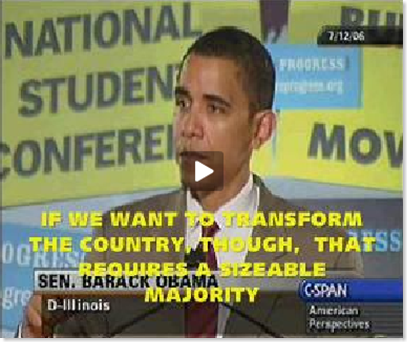
In his words: “Reconciliation is  a majoritarian abuse of power” and “Democrats Should Not Pass Healthcare With a 50-Plus-1 Strategy.”

Makes Tiger Woods seem like a pillar of trustworthiness …

image 
http://www.breitbart.tv/obama-american-agenda-flashback-dems-should-not-pass-healthcare-with-a-50-plus-1-strategy/

image
http://www.powerlineblog.com/archives/2010/02/025673.php

A colossal waste of time — if we’re lucky.

March 5, 2010

Punch line: ObamaCare’s essential mistake is to choose health-care expansion over health-care reform.

Another insightful column from Peggy Noonan.

* * * * *

Excerpted from WSJ: What a Disaster Looks Like , Mar 5, 2010

ObamaCare will have been a colossal waste of time—if we’re lucky.

It is now exactly a year since President Obama unveiled his health care push and his decision to devote his inaugural year to it—his branding year, his first, vivid year.

What a disaster it has been.

At best it was a waste of history’s time, a struggle that will not in the end yield something big and helpful but will in fact make future progress more difficult. At worst it may prove to have fatally undermined a new presidency at a time when America desperately needs a successful one.

In terms of policy, his essential mistake was to choose health-care expansion over health-care reform. This at the exact moment voters were growing more anxious about the cost and reach of government.

The practical mistake was handing the bill’s creation over to a Democratic Congress that was becoming a runaway train. This at the exact moment Americans were coming to be concerned that Washington was broken, incapable of progress, frozen in partisanship.

New presidents should never, ever, court any problem that isn’t already banging at the door. They should never summon trouble.

Mr. Obama did, boldly, perhaps even madly. And this is perhaps the oddest thing about No Drama Obama: In his first year as president he created unneeded political drama, and wound up seen by many Americans not as the hero but the villain.

And now here are two growing problems for Mr. Obama.

The first hasn’t become apparent yet, but I suspect will be presenting itself, and soon. In order to sharpen the air of crisis he seems to think he needed to get his health-care legislation passed, in order to continue the air of crisis that might justify expanding government and sustaining its costs, and in order, always, to remind voters of George W. Bush, Mr. Obama has harped on what a horror the economy is. How great our challenges, how wicked our businessmen, how dim our future.

The president can’t be a hope purveyor while he’s a doom merchant, and he appears to believe he has to be a doom merchant to justify ramming through his legislation. This particular legislation is not worth that particular price.

All this contributes to a second problem, which is a growing credibility gap. In his speech Wednesday, demanding an “up or down” vote, the president seemed convinced and committed — but nothing he said sounded true. His bill will “bring down the cost of health care for millions,” it is “fully paid for,” it will lower the long term deficit by a trillion dollars.

Does anyone believe this?

Does anyone who knows the ways of government, the compulsions of Congress, and how history has played out in the past, believe this? Even a little?

It would be a relief to have a president who could weigh in believably and make clear what his own bill says. But he seems to devote more words to obscuring than clarifying.

The only thing that might make his assertions sound believable now is if a group of congressional Republicans were standing next to him on the podium and putting forward a bill right along with him. 

GOP support won’t happen, for three reasons. First, they enjoy Obama’s discomfort. Second, they believe the bill is not worth saving, that at this point no matter what it contains —a nd at this point most people can no longer retain in their heads what it contains — it has been fatally tainted by the past year of mistakes and inadequacies.

And the third reason is that the past decade has taught them what a disaster looks like, and they’ve lost their taste for standing next to one.

Full article:
http://online.wsj.com/article/SB10001424052748704187204575101742162779612.html?mod=djemEditorialPage_h

The fundamental economic problem of our age … and the impotency of policy makers.

March 5, 2010

Punch line: Commentary from Bill Gross — one of the premier bond traders in the world:  

“The impotency of policymakers … has consequences for credit and asset markets worldwide.”

* * * * *

Excerpted from PIMCO investment outlook, March 2010

Let’s get reacquainted with the fundamental economic problem of our age – lack of global aggregate demand – and how we got to where we are today:

(1) Twenty years of accelerated globalization incrementally undermined the real incomes of most developed countries’ workers/citizens …

forcing governments to promote leverage and asset price appreciation in order to fill in what is known as an “aggregate demand” gap – making sure that consumers keep buying things.

When the private sector assumed too much debt and asset prices bubbled (think subprimes and houses, or dotcoms/NASDAQ 5000), American-style capitalism with its leverage, deregulation, and religious belief in lower and lower taxes reached a dead end.

There was a willingness to keep on consuming, there just wasn’t the wallet. Vigilantes – bond market or otherwise – took away the credit card like parents do with a mall-crazed teenager.

(2) The cancellation of credit cards led to the Great Recession and private sector deleveraging, the beginning of government policy reregulation, and gradual deglobalization – a reversal of over 20 years of trade policies and free market orthodoxy.

In order to get us out of the sinkhole and avoid another Great Depression, the visible fist of government stepped in to replace the invisible hand of Adam Smith.

Short-term interest rates headed to 0% and monetary policies of central banks incorporated new measures labeled “quantitative easing,” which essentially involved the writing of trillions of dollars of checks to replace the trillions of dollars of credit that disappeared after Lehman Brothers.

In addition, government fiscal policies, in combination with declining revenues, led to double-digit deficits as a percentage of GDP in many countries, a condition unheard of since the Great Depression.

(3) Financial crises led to sovereign defaults or at least uncomfortable economic growth environments where real GDP was subpar based on onerous debt levels – sovereign and private market alike.

Dubai, Iceland, Ireland and recently Greece pointed to a potential flaw in the model.

Now, markets are raising interest rates on sovereign debt issuance either in anticipation of higher future inflation, increased levels of credit risk, or both. This places a potential “cap” on the “debt” that supposedly can be created to get out of the “debt crisis.”

* * * * *

An investor’s motto should be, “Don’t trust any government and verify before you invest.”

The potential impotency of policymakers to close the gap are evolving into a life or death outcome for the weakest sovereigns, with consequences for credit and asset markets worldwide.
 
Full article:
http://www.pimco.com/LeftNav/Featured+Market+Commentary/IO/2010/Investment+Outlook+March+2010+Bill+Gross+Dont+Care.htm

The "empathy decay rate" … and cocktail party acceleration.

March 5, 2010

Bill Gross is the one of the world’s premier bon traders.

His view on bonds – I don’t care.

His views on cocktail parties — now, you’re talking.

* * * * *
Excerpted from PIMCO.com: I Don’t Care, March 2010

Cocktail parties wouldn’t be so bad if there was something original to be said, or if “you” had a genuine interest in “me” as opposed to “you,” but let’s face it folks, no one does.

The only reason any of us really cares about cocktail conversations is to quickly redirect someone else’s stories into autobiographies that we assume to be instant bestsellers if only in print.

You can bet that unless there’s a requested personal favor coming, 90 seconds into a typical conversation, no one gives a damn about you and your problems.

image

During that unbearable minute-and-a-half, however, you’re likely to have covered some of the following topics:

  • Where are you from? (If it’s not a place where I’ve been or have a distant second cousin – don’t care.)
  • How’s the family? (If Johnnie is in advanced placement courses and my kids aren’t – don’t care. Don’t care about your kids’ soccer games either or that upcoming wedding.)
  • Medical problems? (Unless you’re dying from cancer – people don’t really care. Your artificial hip and kidney stone stories are important only to let them tell you about their’s.)
  • How’s work? (Forgot where you work, but it’s a good lead in. Don’t really care though unless you can direct some business my way.)
  • Can you believe Tiger? (Now there’s something I care about, but the wife is only five feet away.)

Thank god for the, the “afterparty” — driving home with your partner and dissing all of the guests.

Full article:
http://www.pimco.com/LeftNav/Featured+Market+Commentary/IO/2010/Investment+Outlook+March+2010+Bill+Gross+Dont+Care.htm

Obesity … a disease, or a right ?

March 4, 2010

I can live with higher tanning salon taxes, but closing fast food outlets is going way to far … this guy seems to agree … passionately.

Pro-choice advocates represent the sensical notion that it is not the government’s prerogative to legislate what women do with their physicalities.

It goes without saying that the freedom to abort ones’ fetus should not be the only choice that our country protects. Yet, in recent years, federal, state, and local governments nationwide … have legislated to limit our freedom to chose to smoke cigarettes, gamble our money, bag groceries, borrow cash, drink booze, enjoy tanning beds and anger our girlfriends by getting lap dances.

And just this week, under the leadership of First Lady Michelle Obama, the federal government has launched a new program to limit our freedom to get fat.

While the program is being sold as an attempt to limit childhood obesity, the policies it proposes will affect the lives of all Americans.

As I’ve argued previously, obesity is a physical manifestation of our country’s greatest and most laudable triumph: its defeat of hunger and want.

But, more than that, obesity is a manifestation of personal freedom: if ones enjoy eating hamburgers, then may he chomp away.

Contrary to the infantalizing notion that obesity is a “disease,” an expanding waist line is simply the result of free actors choosing to eat foods that they enjoy.

Indeed, the linguistic decision to label it an obesity “epidemic” reduces dynamic, free individuals into victims and disease carriers, unwittingly transmitting pathogens of obesity. It’s as if they “caught” obesity when they were sneezed on by a fat person.

Realizing that free people will often chose to get fat, anti-obesity crusaders are now actively seeking to limit our choices.

The city of Los Angeles has attempted to impose a moratorium on the construction of new fast food outlets.

Most troublingly, the Obama Administration’s new initiative will seek to change the culinary and commercial makeup of neighborhoods across the country, and potentially mandate the availability of “healthier” options.

All of this is designed to limit our ability to eat what we want, when we want. In other words, it’s about eliminating choice. The thing is: a lot of people like eating jelly donuts, pepperoni pizza, and chocolate cake.

Let them eat cake.

Source blog: Epstein’s Razor
http://trueslant.com/ethanepstein/2010/02/13/im-pro-choice-on-obesity/

Frogs threatened by “gender bending” chemical castration … Kermit frets, Miss Piggy squeals.

March 4, 2010

The good news: Scientists not sure if atrazine affects humans in a similar way.

* * * * *

Excerted from USA TODAY, Tap water contaminant ‘castrates’ frogs, March 3, 2010 

An herbicide that contaminates the tap water consumed by millions of Americans has been found to produce gender-bending effects in male frogs, “chemically castrating” some and turning others into females.

Frogs in an experiment were exposed to amounts of the weedkiller atrazine that are comparable to the levels allowed in drinking water by the EPA.

The atrazine caused male frogs to begin growing eggs in their testes … nearly all of the other males had low testosterone and sperm levels … 10% of the males actually changed sex … some were able to breed and lay eggs. 

The experiment can’t tell scientists whether atrazine affects humans in a similar way. 

Full article:
http://www.usatoday.com/tech/science/2010-03-02-1Aatrazine02_ST_N.htm

Thanks to LKJ for feeding the lead …

Blockbuster: Dead man walking ?

March 4, 2010

Question: when was the last time your were in a Blockbuster?

* * * * *

Excerpted from Business Week: Blockbuster Plots a Remake, Feb. 24, 2010  

With its traditional video-rental business under assault, Blockbuster  has brought in restructuring advisers, looking to buy yet more time to remake itself in the face of new rivals and technologies.

Blockbuster’s plight comes amid major shifts in how people rent and watch movies. Consumers are now getting movies through Redbox, a unit of Coinstar  that operates $1-a-night movie-vending machines in grocery stores and McDonald’s outlets.

Netflix mail-order and online rental service has also stolen Blockbuster customers. Consumers are also watching movies and TV shows through on-demand cable services and electronic gadgets such as Apple Inc.’s iPod.

Blockbuster has adjusted its business, outlining plans to close nearly 1,000 stores out of roughly more than 5,000 world-wide.

As the movie-rental business has evolved, Blockbuster has moved into other video-watching services, such as its own mail-order service, DVD rental kiosks and a digital on-demand service, but it remains far behind its major competitors in those areas.

Blockbuster reaps licensing fees from NCR Corp., which rolled out about 2,500 Blockbuster Express branded vending machines last year and plans to have up to 10,000 DVD kiosks by the end of this year. Blockbuster’s kiosk presence is much smaller than that of Redbox, which has more than 22,000 vending machines.

Blockbuster’s mail-order service has about 1.6 million subscribers, compared with Netflix’s roughly 12 million.

There’s skepticism whether Blockbuster can realize enough value from new business offerings in time to offset declines at its traditional brick-and-mortar outlets.

“If they can’t build a profitable stores operation, then there is no Blockbuster. It’s real simple. If traffic doesn’t pick up by mid-year, we may just kiss this whole story good-bye. We got a dead-man-walking situation here.”

image

Full article:
http://online.wsj.com/article/SB10001424052748703503804575083792463467472.html?mod=WSJ_hps_LEFTWhatsNews

Remember when Obama touted Buffett as the smartest businessman around ?

March 3, 2010

Well, haven’t seen Buffett at the WH as much as the SEIU president.  In fact, don’t recollect seeing there at all in the past year.  Hmmm.

My bet: Warren probably won’t make the President’s invitation list any time soon, now that he advocates scrappoing the ObamaCare bill and starting over with a sharp focus on reducing healthcare costs.

* * * * *

Excerpted from Politico: Warren Buffett would scrap health care bill, 3/1/10 

In a CNBC interview,  CEO Warren Buffett said that President Barack Obama should start over on health care …  scrapping the current health care bills and starting over.

Buffett said the current bill does not focus on controlling costs, which he sees as the central problem that must be addressed to reform the system.

“What we have now is untenable over time …  like a tapeworm eating, you know, at our economic body.”

“We have a health system that, in terms of costs, is really out of control.”

While Buffett applauded Obama for taking up the reform effort, he said that “unfortunately, we came up with a bill that really doesn’t attack the cost situation that much.”

Asked if he would be in favor of scrapping the Senate health care bill, Buffett responded: “I would be.”

If the president were to start over, Buffett would advise him to “just  say that one way or another, we’re going to attack costs, costs, costs.”

Buffett urged Obama to say that “we’re going to cut off all the kinds of things like the 800,000 special people in Florida or the Cornhusker kickback, as they called it, or the Louisiana Purchase, and we’re going to — we’re going to get rid of the nonsense. We’re just going to focus on costs and we’re not going to dream up 2,000 pages of other things.”

Buffett would like to expand access to health insurance, but he said he does not “believe in insuring more people till you attack the cost aspect of this.”

Full article:
http://www.politico.com/news/stories/0310/33693.html

Innovation: USAA says “Grab your iPhone”

March 3, 2010

Using your iPhone to deposit checks in your bank account, to initiate insurance claims from the accident scene, and to go toe-to-toe with car salesmen … now, that’s cool stuff, for sure.

* * * * *

Excerpted from Business Week: Customer Service Champs – USAA’s Battle Plan,  February 18, 2010

The provider of financial services for military families uses remote technology and a keen focus on clients to stay atop our annual customer service rating

When customers want to deposit checks, they don’t need to use an ATM, a teller at a branch, or even a stamped envelope and deposit slip. Rather, they can take a  picture of the check with their iPhone, use an app to send it to their bank, and within minutes the money shows up in their accounts. Giants like Bank of America are just testing a similar service.

In almost everything it does, the financial-services outfit puts itself in the spit-shined shoes of its often highly mobile military customers, many of whom face unique financial challenges.

USAA was the first bank to allow iPhone deposits, it routinely texts balances to soldiers in the field, and it heavily discounts customers’ car insurance while they are deployed overseas.

“They do all this really creative stuff … There is nobody on this earth who understands their customer better than USAA.”

No fewer than 87% of respondents to J.D. Power’s syndicated surveys say they will definitely buy from the company again, far higher than the average, which is just 36%. Its client retention rate? A near-perfect 97.8%.

Reps are armed with software that lets them view a history of the online screens a particular customer has viewed on USAA’s Web site, letting them know what policies or business lines the customer was perusing — and may be ready to buy.

Another high-tech service USAA rolled out in 2008 lets its far-flung customers — a sizable number of whom are young, tech-savvy, and living paycheck to paycheck — get text messages about their account balances before, say, making a big purchase.

Later in 2010, USAA is planning mobile peer-to-peer payments, which let customers e-mail or text-message money to friends or family for immediate deposit, no matter where they are at the time.

USAA was among the first to let customers initiate an insurance claim using their phones from the scene of an accident. And it soon will expand that app so policyholders can attach photos to the claim and complete the entire process via phone. By 2011 customers will even be able to attach voice recordings to their file, immediately retelling exactly what happened.

Also coming this year: a mobile car-buying service that lets customers standing at a dealership snap an iPhone pic of a vehicle’s VIN number and instantly get back insurance quotes, loan terms, and pre-negotiated rates at approved dealerships. “The idea is you can turn that phone around to the salesman and say ‘this is the price I’m going to pay.’ ”

Besides helping policyholders, such technology benefits USAA.  “If you can have the member self-serve on certain parts of the claim, or the entire claim … clearly there’s an efficiency gain.” 

Full article:
http://www.businessweek.com/magazine/content/10_09/b4168040782858.htm

How many ‘pages’ are added to the web each day ?

March 3, 2010

The mind has trouble coping with all the information that is thrown at it today.

Consider …

  • More information has been produced in the past 30 years than in the previous 5,000.
  • The total of all printed knowledge doubles every four or five years.
  • One weekday edition of The New York Times contains more information than the average person in 17th-century  England was likely to come across in a lifetime.
  • More than 4,000 books are published around the world every day.
  • The average white-collar worker uses 154 pounds of copy paper a year.
  • Every day the World Wide Web grows by 1 million electronic pages.

Source:  Repositioning: Marketing in an Era of Competition, Change, and Crisis by Jack Trout with Steve Rivkin, 2010

Blue states bleed red ink … surprised?

March 2, 2010

Punch line: What do you get when you have union dominance, lots of  state employees, and a comfortable environment for moochers?  Well, a Dem majority with mountains of debt, lots of unfunded pension liabilities, and enough social services to choke a horse. 

* * * * *

Excerpted from Forbes: Political Litmus Test: Bluest States Spilling The Most Red Ink, 02.25.10 

Want to know which states are in the worst financial condition? One telling indicator that might not immediately come to mind is whether most of its citizens identify themselves as Democrats.

The five states in the worst financial condition–Illinois, New York, Connecticut, California and New Jersey–are all among the bluest of blue states.

Forbes’ metrics for each state included unfunded pension liabilities, changes in tax revenue, credit ratings, debt as a percentage of Gross State Product, debt per capita, growth expectations for employment and the state economy, net migrations and a “moocher ratio” that compares government employees, pension burdens and Medicaid enrollees to private-sector employment.

Why do Democratic states appear to be struggling more than Republican ones? It comes down to stronger unions and a larger appetite for public programs.

“Unions in general have more influence in Democratic-controlled states … where they’re strong you have bigger demands for social services and coalitions with construction companies, road builders and others that push up debt.”

Of the 10 states in the worst financial condition, eight are among a total of 23 defined by Gallup as “solidly Democratic,” meaning the Democrats enjoy an advantage of 10 percentage points or greater in party affiliation. These states include the ones listed above as making up the bottom five, plus Massachusetts, Ohio and Wisconsin.

Of the three other basement-dwellers, Kentucky is defined as “leaning Democratic” (a five- to 10-percentage-point Democratic advantage) and the remaining two–Louisiana and Mississippi–are termed politically “Competitive” (less than a five-percentage-point advantage for either party). Louisiana tilts slightly Democratic and Mississippi slightly Republican.

The majority Republican states ranked among the financially healthiest are Utah, Nebraska, Texas, North Dakota and Montana.

Utah, the fiscally fittest state, has debt of just $442 and unfunded pension obligations of $7,272 per resident. It is also America’s second reddest state with a 21-percentage-point Republican advantage in party affiliation. The Beehive state boasts a triple-A credit rating from Moody’s.

Illinois is in the worst financial condition, with per-capita debt of $1,877 and unfunded pensions of $17,230. Moody’s rates Illinois’ general obligation debt A1, ahead of only California’s.

Full article:
http://www.forbes.com/2010/02/25/democratic-states-bad-financial-shape-personal-finance-blue.html

“Damn, I got the silver” … “Yea, I got the bronze”

March 2, 2010

Punch line: Research by three U.S. academics, who analyzed heat-of-the-moment reactions, medal-stand temperament and interviews of Olympians, shows that bronze-medal winners, on average, are happier with their finishes than silver medalists.

* * * * *

Excerpted from USA Today: Analysts: Bronze medal leads to more happiness than silver

Take silver, and you tend to fixate on the near miss.

Score bronze, and you are thankful you were not shut out altogether.

Psychologists described it as counterfactual thinking.

“It’s like a student who gets a B, missing an A by one point. The B’s no longer that good.” 

“Same way when you miss your flight by five minutes. You say, ‘Well, I could have made up five minutes somehow.’ If you get close to it, you think, ‘There are things I could have done.’

“I don’t know whether we learn that type of thinking about what we could have done or if it’s something that’s wired into us.”

Full article:
http://www.usatoday.com/sports/olympics/vancouver/2010-02-22-bronze-vs-silver_N.htm

Thanks to RSJ and EAH for feeding the lead

Clearing out the deadwood … who will likely stay unemployed.

March 2, 2010

Well managed companies always use recessions as air cover to “restructure” their their work forces.  This recession has beenno exception.

Bottom line: with little optimism re: a bounce back in demand, expect companies to keep producing at about the same levels, and leveraging their now streamlined work forces.

* * * * *

Good point raise by Business Week:

The output per hour of nonfarm workers has increased by 6.1% since the beginning of the recession.

image

http://images.businessweek.com/mz/10/09/20100301_numbers.pdf?chan=magazine+channel_the+week+in+business

"Paul" scores a direct hit …

March 1, 2010

Ken’s Take: Rep. Paul Ryan (or simply “Paul” in Obama protocol) was the star of the ObamaCare infomercial on Thursday.  His pointed, fact-based questions about the “reduced deficit” accounting” went conspicuously unanswered by the President. 

Obama didn’t score them as “legitimate points” and they weren’t summarily dismissed as mere “talking points” … but Obama did say he didn’t want the discussion to get “bogged down in the numbers”. 

Why waste valuable time on facts when you can be hearing “legitimate points” about wingnuts wearing their sister’s dentures?

* * * * *

Excerpted from IBD: Rebuttals To Ryan? We’re Still Waiting, 02/26/2010 

It was the Wisconsin congressman who made the most pointed remarks about Obama’s reform proposal. For example:

• “This bill does not control costs (or) reduce deficits. Instead, (it) adds a new health care entitlement when we have no idea how to pay for the entitlements we already have.”

• “The bill has 10 years of tax increases, about half a trillion dollars, with 10 years of Medicare cuts, about half a trillion dollars, to pay for six years of spending. The true 10-year cost (is) $2.3 trillion.”

“The $247 billion Medicare “doctor fix” was outboarded from the plan as an unfunded item.”

• “The bill takes $52 billion in higher Social Security tax revenues and counts them as offsets. But that’s really reserved for Social Security. So either we’re double-counting them or we don’t intend on paying those Social Security benefits.”

• “The bill takes $72 billion from the CLASS Act (long-term care insurance) benefit premiums and claims them as offsets.”

• “The bill treats Medicare like a piggy bank, (raiding) half a trillion dollars not to shore up Medicare solvency, but to spend on this new government program.”

• “The chief actuary of Medicare (says) as much as 20% of Medicare providers will either go out of business or have to stop seeing Medicare beneficiaries.”

• “Millions of seniors who have chosen Medicare Advantage (Medicare through a private insurer) will lose the coverage that they now enjoy.”

Full article:
http://www.investors.com/NewsAndAnalysis/Article.aspx?id=522446


Stimulus work ? Elvis alive? … It’s close, but more believe the latter !

March 1, 2010

According to a CBS News poll on the 25th anniversary of Elvis Presley’s death, 7 percent of respondents believed Elvis was still living.

A CBS News/New York Times poll released a few days before the one-year anniversary of the passage of the so-called “stimulus” bill, shows that only 6 percent of respondents believe Keynesian-style spending has “created” jobs.

The Obama Administration’s claims that a depression was averted and promised  that unemployment would remain around 8 percent. Of course, unemployment surpassed 10 percent with stimulus spending.

Taxpayers seem to be looking for more proof.

Source:
http://www.unitedliberty.org/articles/5051-poll-6-of-americans-believe-stimulus-created-jobs-7-believe-elvis-is-alive

Home Depot: Leveraging its “late mover advantage” … huh?

March 1, 2010

Once heralded for its in-store customer service, Home Depot cost-reduced itself into 2nd place in the retailing category it created.

Now, it tries leverage it “late mover advantage”.  Say what ?

* * * * *

Excerpted from WSJ: Home Depot Undergoes Renovation, Feb. 24, 2010

Home Depot is regaining momentum after belatedly tackling its biggest fix-it task to date: remodeling itself.

The world’s largest home improvement chain  is redesigning the way it ships merchandise to stores, answers customers’ questions, and showcases its wares on the Internet.

The goal is to improve productivity and expand profits by revamping a slew of business practices that never changed during the company’s mushrooming growth in the 1980s and 1990s, and that look primitive compared to current trends in retailing.

The most dramatic change is that Home Depot is phasing out the antiquated practice of having suppliers send dozens of half-empty trucks directly to its more than 2,200 stores.

A network of “rapid deployment” warehouse centers being completed this year will combine shipments, trim costs and cut truck trips to stores by up to 50%. That will let more of Home Depot’s orange-apron-wearing workers shift from shipping docks to store aisles, in hopes of tackling a festering reputation for bad service.

Home Depot is claiming a “late-mover” advantage will allow it to avoid the costly mistakes that other retailers made modernizing operations.

Home Depot executives concede that the company’s supply chain still won’t be state of the art after the upgrade, though it will be a big step forward.

To tackle the perception that Home Depot workers are always too busy to help customers, the company is spending $60 million on hand-held devices that will help workers check on the spot if something is in stock.

Communication was also a problem at Home Depot. Mr. Ellison said he was stunned to discover that store managers were drowning in hundreds of emails from headquarters.

So Mr. Ellison says he cut it to one email a week, on Monday, and set up a hotline for managers to complain if the edict is violated.

In addition to its supply chain fixes, Home Depot is waking up to the Internet after being embarrassed that Amazon.com — which sells more drills online than Home Depot. Now the company is building a site that not only sells what stores do, but features do-it-yourself videos to help customers with projects. “We’re now building a site that fixes people’s problems.”

Full article:
http://online.wsj.com/article/SB10001424052748704188104575083081020924838.html?mod=WSJ-hps-LEFTWhatsNews