Interesting recap by Gallup …
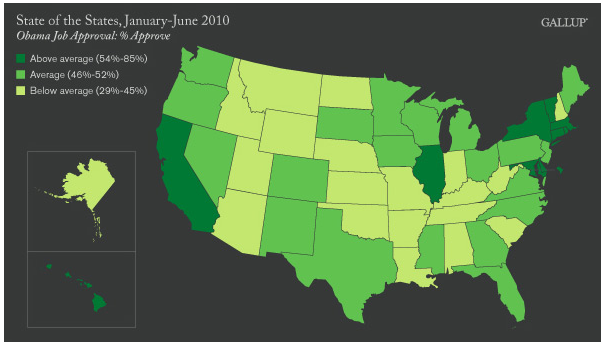
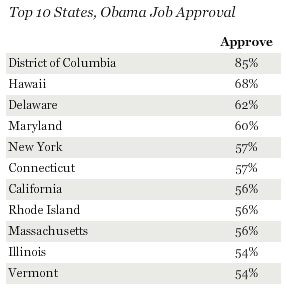
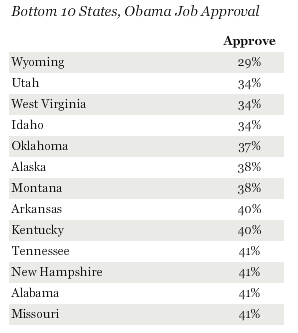
DC leads with a sky high 85% approval … Wyoming’s 29% is the lowest.
http://www.gallup.com/poll/141428/Obama-Highest-Half-Year-Approval-Ratings-Hawaii.aspx
Interesting recap by Gallup …
DC leads with a sky high 85% approval … Wyoming’s 29% is the lowest.
http://www.gallup.com/poll/141428/Obama-Highest-Half-Year-Approval-Ratings-Hawaii.aspx
That’s what the President keeps saying.
Michael Boskin – a senior professor of economics at Stanford University – disagrees … as do dozens of his colleagues.
* * * * *
Excerpted from WSJ: Obama’s Economic Fish Stories, July 21, 2010
President Obama says “every economist who’s looked at it says that the Recovery Act has done its job” — i.e., the stimulus bill has turned the economy around.
That’s nonsense.
Opinions differ widely and many leading economists believe that its impact has been small.
Why?
The expectation of future spending and future tax hikes to pay for the stimulus and Mr. Obama’s vast expansion of government are more than offsetting any direct short-run expansionary effect. That is standard in all macroeconomic theories.
So, as I and others warned, the permanent government expansion and higher tax rate agenda is a classic example of what not to do during bad economic times.
The president does not say that economists agree that the high future taxes to finance the stimulus will hurt the economy.
Mr. Obama’s economic statements are increasingly divorced not only from competing viewpoints but from those of his own economic advisers, e.g. he claims that the stimulus bill was several times more potent than his chief economic adviser estimates.
The stimulus bill has assumed certain mystic powers in administration discourse, but revoking the laws of arithmetic shouldn’t be one of them.
At the very least, his staff needs to avoid putting these exaggerations on the teleprompter.
It undermines confidence and raises concerns about competence. It’s doing nobody any good—not the economy and certainly not Mr. Obama.
Full article:
http://online.wsj.com/article/SB10001424052748703724104575378751776758256.html
Punch line: If you want to control your spending, leave your credit cards at home and only carry around big bills …
* * * * *
Excerpted from NYT: A Reluctance to Break the Large Bills, March 29, 2009
A paper published in The Journal of Consumer Research investigates the so-called denomination effect — the additional tight-fistedness people exhibit when their money is tied up in a few large-denomination bills, as opposed to many small ones.
“People overvalue these large bills … It’s partly a self-control mechanism — I want to hold onto it, because if I do break that big denomination, I lose track of my spending.”
The findings are especially relevant to “places like China or India that are predominantly a cash-based economy.”
Full article:
http://www.nytimes.com/2009/03/30/business/30drill.html
* * * * *
Ken’s Note: Never thought of a “single dollar bill” as a particularly big denomination …


 The Homa Files