The Administration (and mainstream media) have been touting a recent paper by Alan Blinder and Mark Zandi that apparently vindicates the Obama stimulus plan, claiming that if not for the response of the federal government, the unemployment rate would be 15.7 percent, far higher than the current 9.5 percent … and understandably way higher than the promised 8%.
Yeah, right.
First, not noted by the press, most of the positive effects cited in the paper came not from the stimulus but from stabilizing actions of the Federal Reserve, the FDIC, and TARP.
Second, the paper argues that the 8% promise was impaired because Romer & Bernstein didn’t adequately dope out how bad the economy really was.
The below analysis shreds the “starting point” argument and concludes that the stimulus program achieved – in effect – nothing … except for boosting the national debt by a trillion dollars.
* * * * *
Excerpted from Weekly Standard: Did the Stimulus Stimulate?, Lawrence B. Lindsey, August 16, 2010
In January 2009, Christina Romer, who resigned last Friday as chairman of the president’s Council of Economic Advisers, and Jared Bern-stein, chief economic adviser to Vice President Biden, published a paper projecting what would happen if President Obama’s proposed stimulus package passed, compared with what would happen if it did not.
The Romer-Bernstein paper has often been cited as saying that if the package passed, the unemployment rate would peak below 8 percent in the middle of 2009 and would decline to below 7.5 percent by now.
Obviously this has not happened.
The administration argues that it is not fair to conclude that this proves the package was a failure since Romer and Bernstein underestimated the severity of the recession and that unemployment was already 8.2 percent in the first quarter of 2009, higher than the assumed peak.
The chart below corrects for their complaint by raising their estimate of where unemployment started in their experiment.
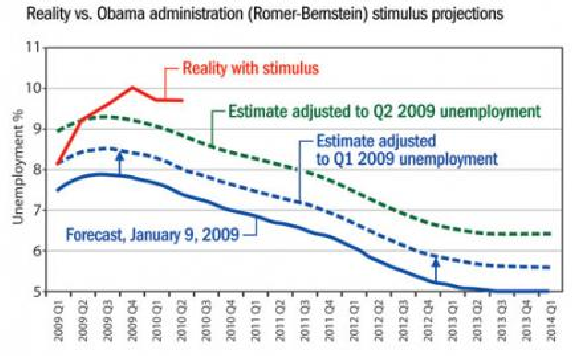
The lowest line provides the original estimate of the path of unemployment provided by Romer and Bernstein on January 9, 2009.
The second line replicates the Romer and Bernstein path, but raises the initial unemployment rate from their assumed 7.5 percent to 8.2 percent. This was the actual average of the unemployment rate in the first quarter of 2009, the period in which the stimulus was passed.
The third line provides a more extreme alternative by raising the initial unemployment rate to the 9.3 percent average of the second quarter 2009.
The first modification fully compensates for their objection while the second modification more than compensates for their concern.
But as the chart shows, the problem with the stimulus wasn’t just the starting point — it was that the stimulus itself has been ineffective at lowering it.
The actual unemployment rate, given by the red solid line, is not only above the original Romer-Bernstein projections, but also above projections that take account of the “starting point” problem.
Actual unemployment has been consistently above all of the projections, regardless of starting point, because the stimulus bill has basically brought no relief in terms of lower unemployment.
Full article:
http://www.weeklystandard.com/articles/did-stimulus-stimulate


 The Homa Files