Archive for March 22nd, 2011

So, it the unemployment rate up or down?

March 22, 2011

Answer: Depends who you ask.

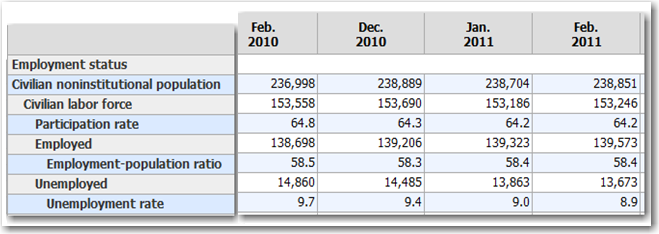
The gov’t Bureau of Labor Statistics reported that unemployment has fallen the past couple of months and is now a bit under 9%.

That would be good news … if true.

image

http://www.bls.gov/news.release/empsit.a.htm

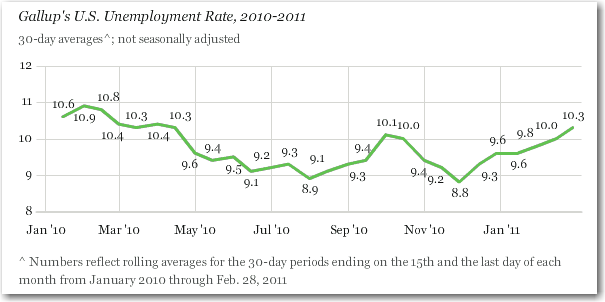
But, it seems that Gallup begs to differ.

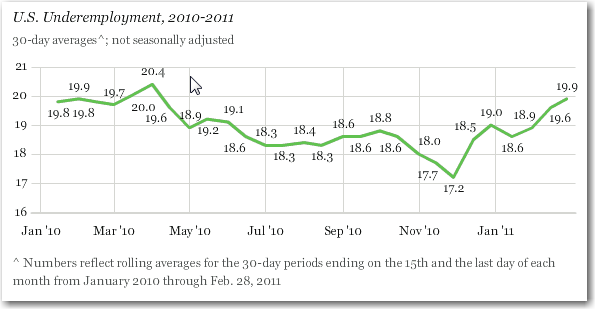
According to Gallup, the unemployment rate has been increasing the past couple of months and is now over 10%.  The underemployment rate has also been increasing and is now almost 20%

So, who to believe – the fox guarding the henhouse or a left-leaning, reasonably objective 3rd party.

Hmmm.

image

 image

Brands and Buddies, the new way to Bing

March 22, 2011

TakeAway: Visual “tiles” that come up with Bing’s search results are part of the Bing’s innovations  to make the search platform more interactive and relevant to its users.

It is also showing the searcher’s Facebook friends’ Likes as another way to for users to validate the results. 

* * * * *

Excerpted from BrandChannel, “Bing Enhances Search with Brands and Buddies”  by Sheila Shayon, February 25, 2011

… search with Microsoft’s Bing lately, noticed the tiles now included with dynamically rendered visual info from brands in the entertainment, local, travel and auto categories. … enhancing Bing to be more relevant to users.

User queries trigger them to appear on the right side of the screen from one of 45 launch partners including IMDb, Yahoo Movies, Rotten Tomatoes, OpenTable, Yelp, CitySearch, Urban Spoon, Cheap Flights, YouTube, MTV, Last.fm, Rhapsody, Pandora, MSN and dozens more.

The tiles are interactive and click-through on a Pandora or Rhapsody tile brings up a song or checks the number of plays via Last.fm.

… the tiles are “going to be pulling in metadata from those sites. …figure out the results they’re looking for if you append some kind of visual cue onto the page.” … And enable users to “ingest third party content more successfully,” …

… “an innovative move to add images to the organic results. But … innovations must come from the ranking results vs. making adjustments to the aesthetics of searches…

… not so much intrusive as a value add to the search and/or social online experience: …feel Bing as a search engine is more user-friendly, smart and reputable. Consumers are intrinsically drawn to visual references and respect and trust this type of added feature when looking for a product…

… Bing tiles are the latest ingredient in a richer mix evocative of Microsoft’s Windows Phone 7 interface with alerts on homescreen tiles updated real-time.

Add to the mix that Bing also now displays your friends’ Facebook likes in your search results, …

Edit by HH

That menu — it’s playing with your mind … is it a profit scheme?

March 22, 2011

You bet it is …

In his book, Priceless: The Myth of Fair Value (and How to Take Advantage of It), author William Poundstone dissects the marketing tricks built into menus—for example, how something as simple as typography can drive you toward or away from that $39 steak.

1. The Upper Right-Hand Corner
That’s the prime spot where diners’ eyes automatically go first.

Restaurants often use it to highlight a tasteful, expensive pile of food.

2. Pictures

Generally, pictures of food are powerful motivators but also menu taboos — mostly because they’re used in downscale chains like Chili’s and Applebee’s.

Red Lobster ditched pics when it started trying to inch upscale

3. The “Anchor”
The highest priced item on the menu may not ever get ordered.  That’s ok.  It’s purpose is to make everything else near it look like a relative bargain.

4. In The Vicinity
The restaurant’s high-profit dishes tend to cluster near the anchor.  They’re items at prices that seem comparatively modest (when compared to the anchor).. They’re the items the restaurant really wants you to buy.

5. Columns Are Killers
It’s a big mistake for restaurants to list prices in a straight column. “Customers will go down and choose from the cheapest items.”

Consultants say to omit “leader dots” that connect the dish to the price; and to drop dollar signs, decimal points, and cents

6. The Benefit Of Boxes
“A box draws attention and, usually, orders.

When you see an item in a box, think “high margin”

7. Menu Siberia
That’s where low-margin dishes that the regulars like end up. They’re there, but relatively easy-to-miss  … or so the restaurant hopes..

8. Bracketing
A regular trick …  it’s when the same dish comes in different sizes.

Because youre never sure of the portion size, you’re tempted to to trade up … especially from small to “regular” size.

* * * * *

Excerpted from Priceless: The Myth of Fair Value (and How to Take Advantage of It), to be published in January by Hill & Wang, an imprint of Farrar, Straus & Giroux. © 2010 by William Poundstone.
http://nymag.com/restaurants/features/62498/

Is social media losing its edge?

March 22, 2011

TakeAway: With all the recent social media flops some say the end of using social media is near. 

While the way people get and consume information is different, the idea behind making a product that people need and selling it them stays the same, and CMOs need to do things that matter like actually selling the product.  

* * * * *

Excerpted from AdAge, “Do Campaign Failures, High-Profile Firings Signal the End of Social Media?” by Jonathan Salem Baskin, March 22, 2011

The latest news involving social-media pioneers isn’t good. Pepsi has fallen to third place behind Diet Coke in spite of its widely heralded switch from Super Bowl ads to a huge social charity program called Refresh Project. Burger King has …fired agency Crispin Porter & Bogusky after producing Facebook campaigns and viral videos that got lots of attention while the business witnessed six consecutive quarters of declining sales. …

Every CMO should use this occasion to pause and reflect …on rolling out a social-media campaign or start giving away content for free. Unfortunately, there are many reasons why you shouldn’t, and may not.

what good are invented metrics for social campaigns if they don’t evidence any influence on sales? There’s no such thing as a successful brand that doesn’t deliver successful marketing, is there? In fact, the latter builds the former. They can’t be disconnected, and if social marketing can’t be made responsible for tangible behaviors that matter to the business, not just to ideas about branding, then no made-up measures of its importance matter much at all.

… Identifying what the social efforts did, if anything, requires the upfront presumption that they were necessary and therefore accomplished anything at all that mattered (like starting out to claim that cereal is “part of a balanced breakfast”). …

…beginning of the end of social media’s infancy. Maybe it’s time to stop talking unseriously and get serious for real. Technology has utterly changed the ways consumers get and use information, and it has completely disrupted how companies create, share and collect it. …People still need and do the same things they always did, and companies still need to sell to them. Pretending that conversation has any value apart from the meaningful, relevant and useful information within it — fad ideas, like “content” is anything more than a silly buzzword, or that anybody wakes up in the morning hoping to have a conversation with a brand of toothpaste or insurance — is no longer credible in light of the latest news.

Instead, CMOs need to discover new ways to do the old things that still matter: Offer products and services that someone truly needs, admitting that you want to sell stuff to them, and then properly serving them after they’ve given you their business. Sounds so easy as I type it but doing so has gotten so incomprehensibly complicated. Maybe the news coming out of Pepsi and Burger King is a wakeup call that we need to make all of this simpler, not harder. …


Edit by HH