Archive for November, 2017

How the super-rich shelter their income & wealth from taxes …

November 30, 2017

While keeping (or increasing) their financial and political might.

=========

For years, I’ve ranted whenever Warren Buffett whined that my taxes should be increased because he pays a lower income tax rate than his secretary.

And, I even offered up a suggestion (think: “Buffett Rule”) that might assuage Mr. Buffett’s guilt.

clip_image001

For background …

Buffett benefits from the preferential tax rate on capital gains … but his mega tax dodge is bequeathing a big chunk his estate to his buddy Bill Gates’ tax exempt foundation … part, I guess, to “give back to society” … but in large part to dodge estate taxes.

You see, that part of Buffett’s estate escapes death taxes  (since it’s a “charitable donation”) … and, while alive, Buffett can still wield unfettered financial and political clout.

So, I proposed a simple tax reform to nullify the loophole and provide Warren with the opportunity to pay some serious taxes (and spread his wealth around).

Ken’s “Buffett Rule”: For purposes of estate taxation, estates shall be limited to a maximum deduction of $1 million for charitable donations.

It turns out that my focus on estate taxes was way too narrow and may have missed the forest for the trees.

(more…)

To bring back jobs, don’t cut the the corporate tax rate … here’s another idea.

November 28, 2017

Last week, we asked: if increasing the number of well-paying manufacturing jobs is important —  then rather than the usual proposed bromide of just cutting corporate taxes across-the-board, why not offer employers a double tax deduction for workers’ wages earned in the U.S.?

Here’s a complementary idea (to doubling the wages deduction) that might be worth worth considering …

(more…)

Answer to: Are you smarter than a 3rd grader?

November 28, 2017

Yesterday, we posted a question posed to me by my soon-to-be 9 year old granddaughter … and challenged you to give it a try:

Determine the numerical values for a roasted turkey, a slice of pie and a cob of corn.

image

Here’s the answer … if you haven’t already done the problem, do it before peeking:

(more…)

Are you smarter than a 3rd grader?

November 27, 2017

A Thanksgiving Day puzzle from my granddaughter.

==========

What does your family do for fun at Thanksgiving?

Nowadays, mine tries to stump me with math problems.

This year, my soon-to-be 9 year old granddaughter brought over a set of puzzles that she’d been working on at school (3rd grade).

Give one a try:

Determine the numerical values for a roasted turkey, a slice of pie and a cob of corn.

image

We all like to whine that American students are slipping behind other countries in math and science … which begs a basic question:

Are you at least as smart as a third grader?

I’ll post the answer tomorrow …

=========
Thanks to AMH for feeding the lead.
=========

#HomaFiles

Follow on Twitter @KenHoma            >> Latest Posts

Happy Thanksgiving !

November 22, 2017

image

* * * * *
Follow on Twitter @KenHoma

To bring back jobs, don’t cut the the corporate tax rate …

November 21, 2017

Rather, double the corporate tax deduction for workers’ wages earned the U.S. workers.

=======

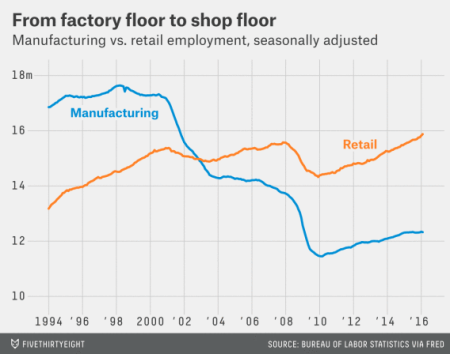
Let’s start with an interesting analysis from Nate Silver’s  535.com titled Manufacturing Jobs Are Never Coming Back

“It’s understandable that voters in 2016  were angry about trade. The U.S. has lost more than 4.5 million manufacturing jobs since NAFTA took effect in 1994. And, there’s mounting evidence that U.S. trade policy, particularly with China, has caused lasting harm to many American workers.”

“Manufacturing in particular embodies something that seems to be disappearing in today’s economy: jobs with decent pay and benefits available to workers without a college degree are vanishing. The average factory worker earns more than $25 an hour before overtime; the typical retail worker makes less than $18 an hour.”

“In 1994 there were 3.5 million more Americans working in manufacturing than in retail. Today, those numbers have almost exactly reversed, and the gap is widening. More than 80 percent of all private jobs are now in the service sector.”

image

=======

How can that be?  Aren’t we hearing a lot about “re-shoring” and foreign capital investing in U.S. based manufacturing plants?

(more…)

My biggest beef with the GOP tax plan …

November 20, 2017

… and nobody seems to be talking about it.

===========

Remember Mitt Romneys ill-timed observation about “47% of Americans”.

No, they weren’t deplorables, they were simply the folks who pay no Federal income taxes.

Well if the GOP tax plan goes through, the 47% will be be alive .. and well … and growing.

image
Source

Let’s start with some data…

(more…)

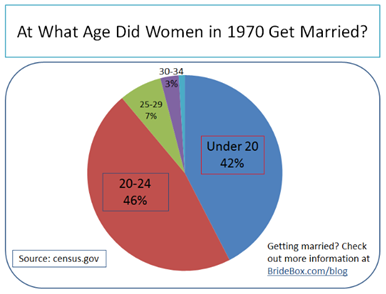
At what age did women get married in the 1970s?

November 17, 2017

An odd question motivated by recent events.

========

First the disclaimer, Judge Roy Moore creeps me out … and I’m certainly no apologist for older men who hit on teenage girls. Period.

That said, two comments got me wondering.

First, a Clinton apologist was on TV saying that Bill deserved a pass for his sexual transgressions and abuses because “things were different in those days.”

Say, what?  Different how?

Separately, a friend bad-quipped about the sterotype of Southern girls marrying young – often in their early teens.

So, I started to wonder: what were things like in “those days” – specifically,in Alabama, when Judge Moore is alleged to have been hitting on teenage girls.

image

What I discovered certainly doesn’t make Moore any less creepy or exonerate him, but it is interesting.

(more…)

More Disney: How does Mickey fingerprint me?

November 16, 2017

The tech behind biometric fingerprints
========
Note: We’ve been doing an amusement park case in my current course.  So, we’re reprising a post from the archives.
=========

In prior posts, I gushed over the technology applications at Disney World … and recounted the plausible explanations for why Mickey digitally records guests’ fingerprints when then enter the park.

Ostensibly, the purpose is fraud protection – keeping folks from passing along their partially used tickets for reuse.

Of course, there are other sorts of uses for digital fingerprints (e.g. catching bad guys) … and ways that the information can be misused.

clip_image002

========

With my curiosity aroused, I did some digging re: digital fingerprints.

(more…)

More Disney: Why is Mickey fingerprinting me?

November 15, 2017

A plausible “why” and a very interesting “how”.
========
Note: We’ve been doing an amusement park case in my current course.  So, we’re reprising a post from the archives.
=========

In a prior post Seriously, why not outsource TSA ops to Disney? , I gushed over the technology applications at Disney World … the Magic Bands than let me into my hotel room & the park, Fast-Passed me to the front of lines, and “personalized” my family’s experience with real-time greetings and photos.

I noted that I was digitally fingerprinted when I entered the park and asked if anybody could tell me why.

clip_image002

A couple of loyal readers clued me and provoked some digging.

Here’s what I learned …

(more…)

Seriously, why not outsource TSA ops to Disney?

November 14, 2017

Disney’s technology applications are impressive.
===========
Note: We’ve been doing an amusement park case in my current course.  So, we’re reprising a post from the archives.
============

Last Spring, I took a fact-finding trip (aka. family vacation) to Disney World.

I was amazed at the way that Disney uses technology.

My first “wow” was at the entrance gate.

No surprise, there was a huge rush of “guests” entering the Magic Kingdom when the gates opened at 8 a.m.

The crowd measured into the thousands … all needing to be security-screened.

All bags and strollers had to be hand-checked … all kids – big & little – had to be ushered through metal detectors.

Nightmare, right?

Maybe at the airport, but not at Disney.

Our wait & processing time: less than 10 minutes.

clip_image002

Then came the good part…

(more…)

Facebook’s addictive dopamine hits “exploit a vulnerability in human psychology."

November 13, 2017

Co-founder admits: ‘God only knows what it’s doing to our children’s brains’

=========

Loyal readers know that I’m not a big fan of Facebook.

Besides the obvious privacy issues, I’ve been swayed by the mounting evidence that mental health deteriorates with heavy Facebook “engagement” … and that heavy Facebook engagement is becoming the norm … especially among teens.

So, I wasn’t surprised — but, I was shocked — when Sean Parker – one of Facebook’s co-founders – “unloaded on Facebook” … confirming many suspicions and bluntly admitting that it was all part of a master plan that may have “created a monster”.

clip_image002

Here are some highlights of Parker’s catharsis (and a link to the chilling video) …

(more…)

How physically fit are folks in your city?

November 10, 2017

Washington, D.C. rated as “most fit city” for 3rd year in a row.

======

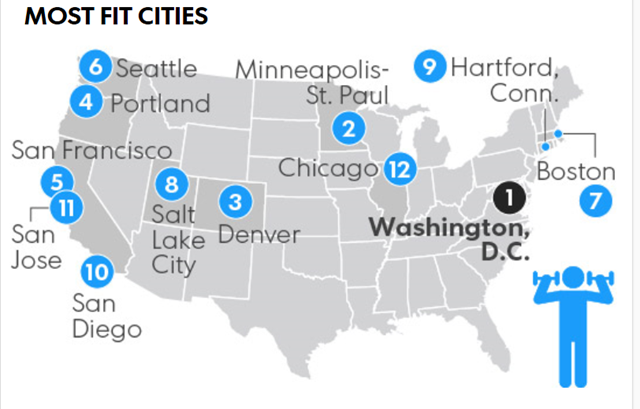
Every year, the American College of Sports Medicine and the Anthem Foundation rates the “fitness” of major metro areas based on a number of health behaviors and environmental factors such as access to parks, recreational facilities and walking trails.

According to this year’s  report, Washington, D.C. topped the list again.


image

=======

What makes D.C. so fit?

• Lower (than target) percent currently smoking
• Lower death rate for cardiovascular disease
• Higher percent of city land area as parkland
• Higher percent bicycling or walking to work
• More dog parks per capita
• More park units per capita
• More recreation centers per capita

And, my favorite:  More farmers’ markets per capita

Say, what?

D.C.’s score got a couple of dings including  a biggie: Fewer golf courses per capita

========

Which of the 50 biggest metro areas scored the worst?

(more…)

Studies: More time on Facebook … and it’s not good for you.

November 9, 2017

“Negatively associated with overall well-being … particularly mental health”.

=========

Let’s connect a couple of recently reported studies …

First, the BLS periodically reports how Americans spend their leisure time.

According to the NYT, channeling the most recent BLS report:

The average time that users spend on Facebook is nearing an hour.

clip_image002

Putting that hour of Facebook in perspective:

That’s more than any other leisure activity surveyed … with the exception of watching television programs and movies (an average per day of 2.8 hours).

It’s more time than people spend reading (19 minutes); participating in sports or exercise (17 minutes); or social events (four minutes).

It’s almost as much time as people spend eating and drinking (1.07 hours). NYT

========

And, a recent study published by the Harvard Business Review indicates that all that Facebook time is unhealthy.

(more…)

Happy? Sad? Excited? … Facebook can tell.

November 8, 2017

And, has been caught doing just that.

=======

It always amazes me what people post on Facebook. Their daily activities, their deepest emotions – you name it.

By now, every Facebook user should know that FB sifts through their content – posts, pictures, links, emojis – to determine, for example, what topics are hot; what people are doing; which brands people are buying, recommending, trashing or considering; whether users are feeling happy, sad, scared, excited.

The latter is called “sentiment analysis” using computer algorithms to take users’ “emotional pulse”.

Of course, FB promises that they’ll protect users’ privacy and would never even consider divulging that information to outsiders, say, advertisers or political campaigns.

image

Bad news for believers: FB was caught “sharing” sentiment analysis data.

=========

According to USA Today

Documents leaked to a newspaper, The Australian, indicate that Facebook executives prepared a report for one of the country’s top banks.

The report described how Facebook gleans psychological insights into the mood shifts of millions of young people in Australia and New Zealand by monitoring their status updates and photos.

The 23-page report showed Facebook’s ability to detect when users as young as 14 are feeling emotions such as defeat, stress, anxiety or being overwhelmed … and. other information on young people’s emotional well-being such as when they exhibit “nervous-excitement” are “conquering fears“.

FB claimed that it can track how emotions fluctuate during the week.

Anticipatory emotions are more likely to be expressed early in the week.

Reflective emotions increase on the weekend.

Monday-Thursday is about building confidence.

The weekend is for broadcasting achievements.

At a relatively benign level, advertisers can use that information to target ads to certain age groups … and they can time them to run on a certain day.

That’s apparently what FB got caught doing – revealing anonymous and aggregated data – to a potential advertising client.

========

Let’s go a step further…

According to the article: “Facebook has also come under heavy scrutiny in the past for secretly conducting research that manipulated the emotions of users by altering what they see in their News Feed without their consent.”

So, it doesn’t take much creativity to imagine the collection and dissemination of individuals’ sentiment data that could be used to target advertising to specific individuals at specific times – say, when they’re feeling down and are vulnerable to buying certain products geared to giving them a pick-me-up, say, some new clothes, a fancy car or miracle drug.

Pretty unnerving, right?

Of course, FB assures users that it would never consider divulging that sort of data.

Yeah, right.

========

Connecting dots

In a prior post, we reported on a study that concluded time on Facebook can be hazardous to your mental health.

For details see Studies: More time on Facebook … and it’s not good for you.

So, being on Facebook can make you emotionally vulnerable.

Facebook can determine when you’re vulnerable.

Facebook can sell that info to advertisers.

But, FB assures us that it won’t sell that data.

Whew … that’s a relief.

========

#HomaFiles

Follow on Twitter @KenHoma            >> Latest Posts

========

A prof says: “You earn exam points … and, the burden of proof is on you”

November 7, 2017

Students often take issue with grades … sometimes understandably, sometimes not so much.

For perspective, here’s an interesting op-ed by an econ prof …

(more…)

Should my trash pick-up be tax deductible?

November 6, 2017

… and what about HOA fees?

=========

For openers, let me declare: I think that I end up worse off under the proposed GOP tax plan.

That said, I’m all for eliminating the deduction for state & local taxes.

image

Here’s why I’m not swayed by the whiners in the high tax & spend states ..

(more…)

Are you a nice person?

November 3, 2017

You probably over-rate your “niceness” … but that’s OK.

=======

According to the UK Independent

You may consider yourself to be a nice person, but  a new study concludes that you’re probably not as nice as you think.

Psychologists at the University of London have discovered that 98 per cent of British people think they’re part of the nicest 50 per cent of the population.

Participants in the study were given a list of “nice” behaviors and asked which ones they do.

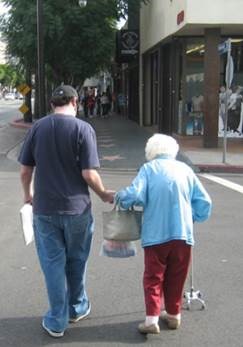
They claimed to do easy stuff like giving directions to lost souls, holding doors open or giving Granny their seat on the bus.

clip_image002

But, their niceness had limits …

The respondents stopped short of giving money to needy strangers (less than 1 in 5) or helping Granny cross the street (about 1 in 4).

Still, there’s some very good news …


(more…)

All of the info I’ve collected says I’m right … so there!

November 2, 2017

Dan Lovallo, a professor and decision-making researcher says, “Confirmation bias is probably the single biggest problem in business, because even the most sophisticated people get it wrong. People go out and they’re collecting the data, and they don’t realize they’re cooking the books.”

What’s this “confirmation bias” that Lovello is talking about?

No surprise, people tend to seek out information that supports their existing beliefs.

You know, liberals watch MSNBC, read the NY Times listen to BBC podcasts; conservatives watch FOX, read the WSJ and listen to Rush.

Behavioral psychologists call the he dynamic “confirmation bias”.


clip_image002

=====

In socio-politics, the confirmation bias tends to harden polarized positions. People just gather debate fodder rather than probing both sides of issues.

In the realm of decision making, confirmation bias has a dysfunctional effect: it leads to bad decisions.

(more…)

Should you put your extracurricular activities and interests on your resume?

November 1, 2017

More than you think, they may impact your chances of getting an interview.

=======

Interesting study reported in HBR

The study investigated whether applicants got invited to interview at highly prestigious law firms (though the findings are probably generalizable to other top-notch professional firms).

Here’s the drill:

Imagine four applicants, all of whom attend the same, selective second-tier law school.

They all have phenomenal grade point averages, are on law review, and have identical, highly relevant work experiences.

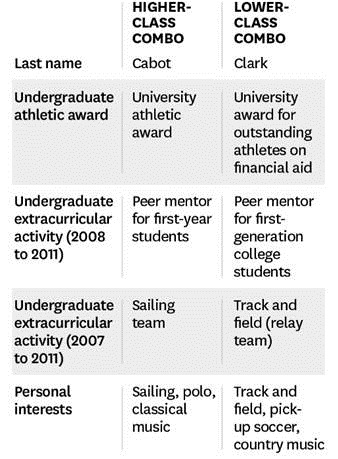
The only differences are whether they are male or female and if their extracurricular activities suggest they come from a higher-class or lower-class background.

Who gets invited to interview?

More specifically, the researchers used a technique — known as the resume audit method — randomly assigning different items to the resumes and sending applications to real employers to see how they affect the probability of being called back for a job interview.

All applicants were from 2nd tier schools (where top firms don’t typically do on campus interviewing).

All educational, academic, and work-related achievements were identical between the fictitious candidates.

To test gender effects, the applicants were first-named James or Julia.

To “signal” social status, last names were either prestigious sounding “Cabot” or more common “Clark” … and commonly used and and often required portions of resumes were varied: awards and extracurricular activities:

clip_image002

The experiment confirmed some expectations, but there were also surprises …

(more…)