=============

=============
Joe gets blowback re: moving teachers to the front of the line.
=============
Immediately after Biden announced that there would be vaccine available for all adults by the end of May … and that all teachers, school staffs and child care workers would get at least 1 vax shot by the end of May, we observed:
1. Achieving the “available supply” is not exactly a moon-shot. It simply requires continuing to deliver vaccines (to & from the government) at current run rates, adding in the new incremental J&J supply.
If the goal had been set at getting all 250 million adults 18 and over fully vaccinated by the end of May — that would have been a moon shot
For details, see VAX: What exactly did Biden promise?
2. Getting at least 1-shot into all teachers arms by the end of this month isn’t possible without compromising some “science” and medical ethics.
You see, stores in the Federal Retail Pharmacy Program already scheduled out their anticipated vaccine supply for March.
So, letting teachers cut the line would require cancelling appointments already on the books for “vulnerables” and other “essentials”.
For details, see VAX: Did Biden’s brain trust set him up to fail?
============
While we were first, it didn’t take long for the piling-on to start … from science & data advocates, ethicists, “equitarians”, “zeroists” and politicos.
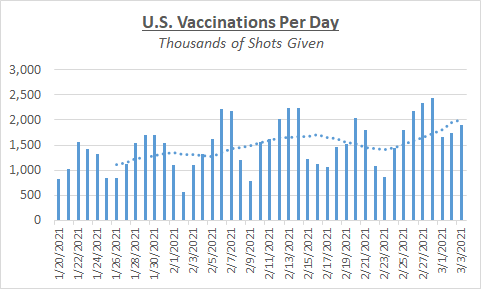
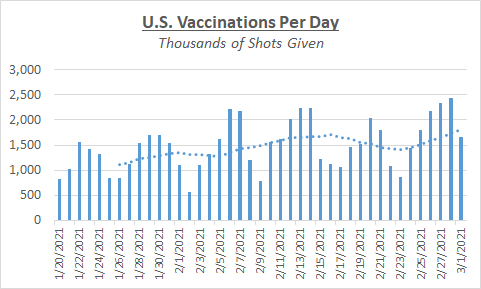
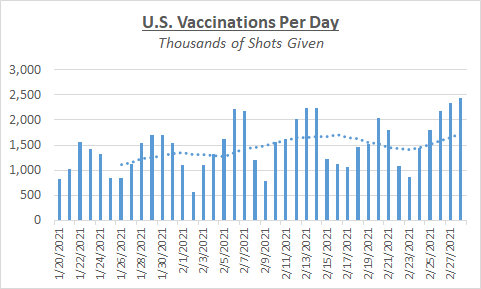
Averaging over 2 million shots per day !
=============

=======

=======
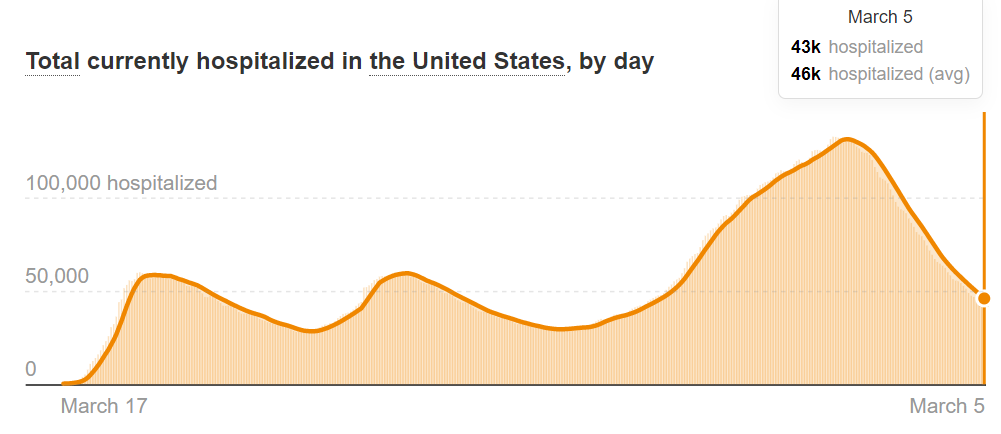
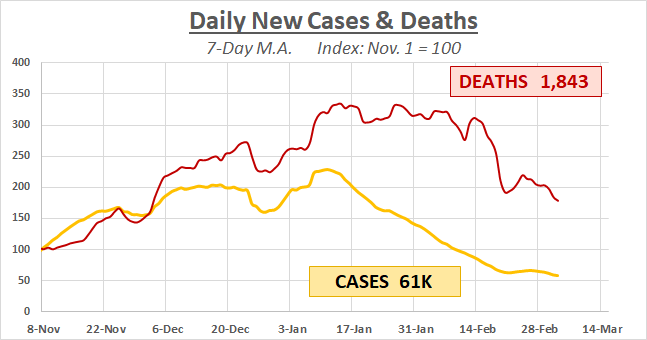
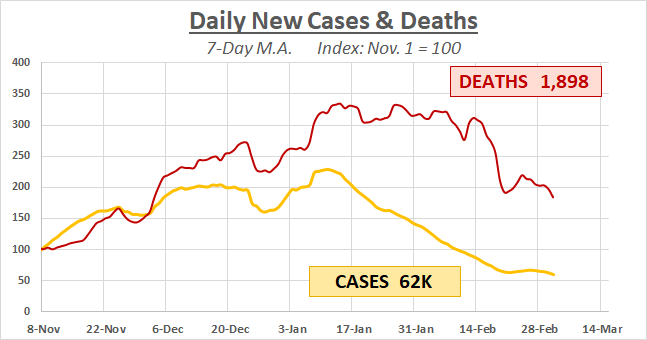
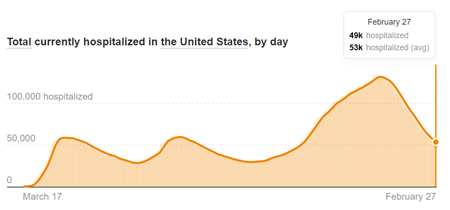
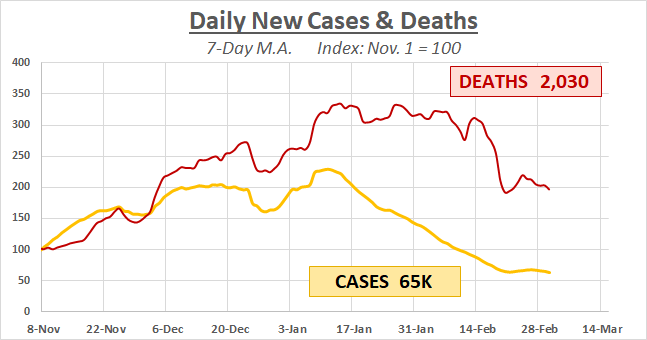
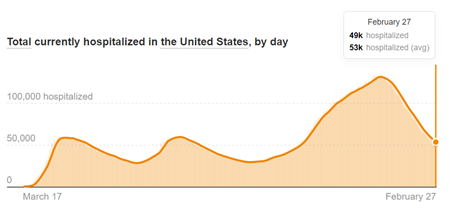
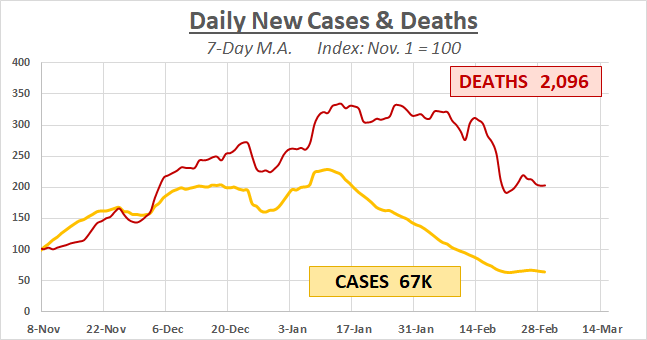
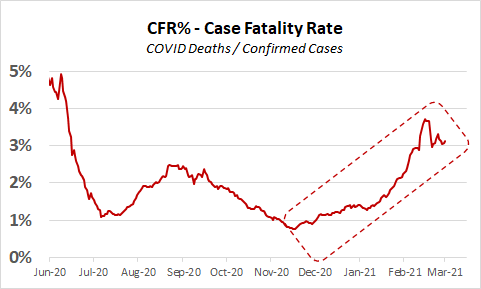
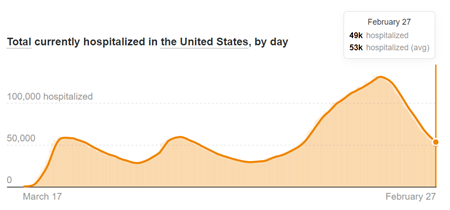
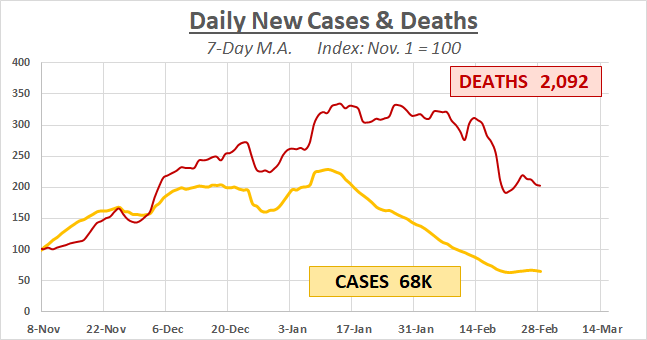
Cases, hospitalizations & deaths down from peaks but leveling
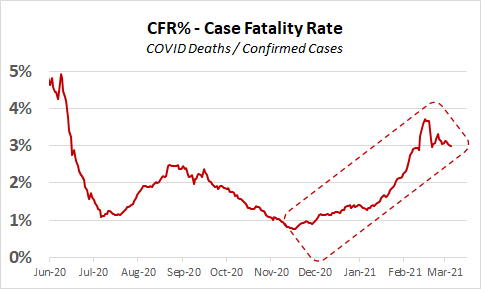
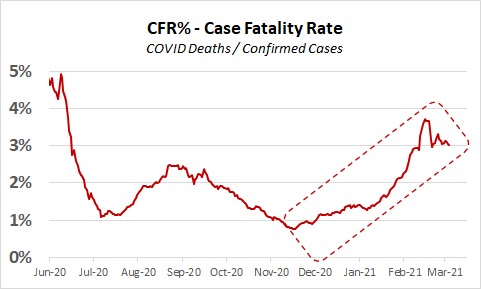
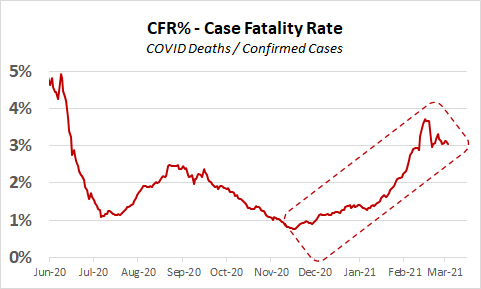
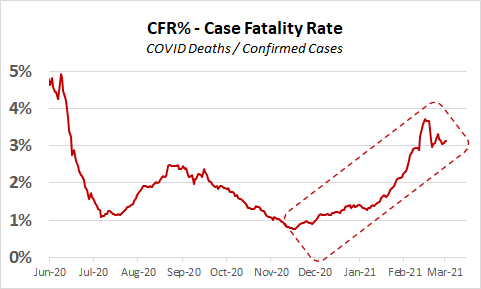
… case fatality ratio (CFR%) stubbornly high @ 3%.
==============
click graph to enlarge
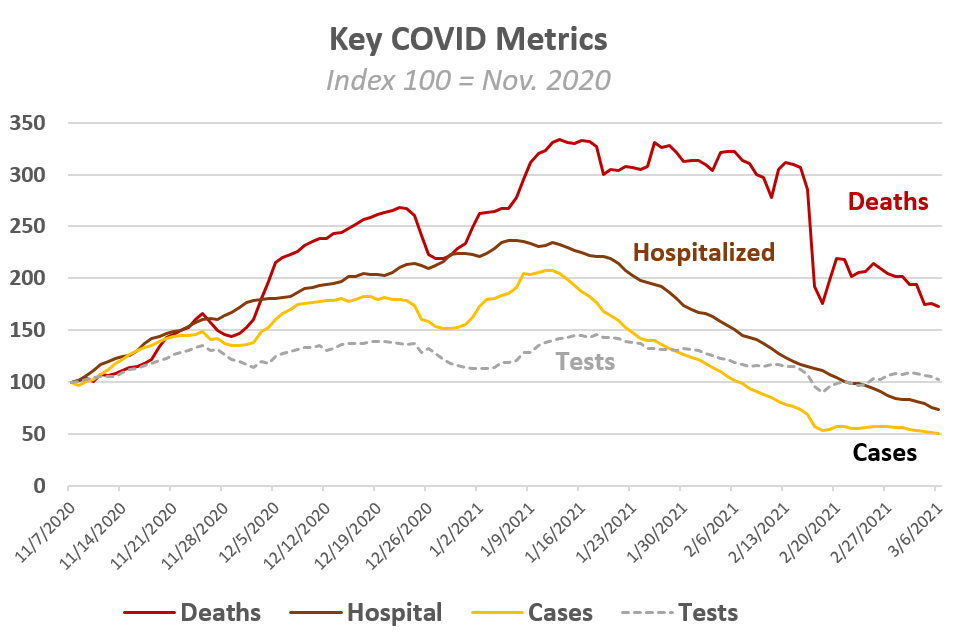
Note: At the index starting date: deaths were ~1,000 per day. hospitalizations were ~55K, cases were ~ 100K and tests were ~1.4 MM per day

=======

=======


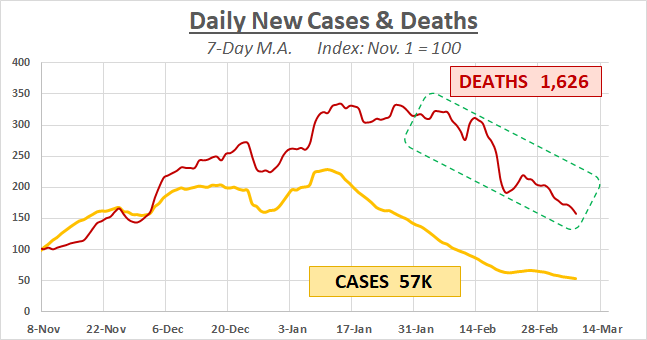
Note: At the index starting date, cases were
~ 100K and deaths were ~ 1,000 per day.
=============

=============

Source: RonaViz.com

Note: At the index starting date, cases were
~ 100K and deaths were ~ 1,000 per day.
=============
=============
Source: RonaViz.com

=======

=======
Spring 2021 plan: Federal gov’t tells states to do standardized testing to measure students’ learning levels in math & reading.
==============
In a prior post, we reported results from a survey done in Fall 2020 that indicated, for example:
Of course, we opined: It be useful to give students standardized tests this spring, as more of them return to school?
Well, maybe, just maybe, that will materialize.
According to USA Today…
Under federal law, states must administer annual exams in key subjects including reading and math to students in third through eighth grade and once in high school.
The requirement to administer state exams was waived by in spring 2020, when most U.S. schools shut down as a result of COVID-19.
But, a recent letter from Biden’s Education Dept. advised states that they will need to administer the annual standardized achievement exams to students this year.
There is some “wiggle room” to shorten the annual exams, administer them remotely or delay giving them until summer or fall … but, “the Biden administration will not consider blanket waivers of assessments this year.”
Of course, not all sides agree with the announcement.
Fall 2020 Estimate: The COVID schools’ shutdown compounded the inevitable “summer slide”.
=============
In a prior post (originally published July 30, 2020 and re-posted last week), we provided background on students’ “summer slide” in learning … and presented some research projecting how much “dislearning” will have occurred since schools closed in Spring, 2020 until Fall, 2020.
At the time, the WSJ did a study that painted a dire picture: The Results Are In for Remote Learning: It Didn’t Work.
Preliminary research projects students nationwide will return to school in the fall with roughly 30% dis-learning in reading relative to a typical school year, and more than 50% in math.
Those were forecasts, so we asked the rhetorical question: Wouldn’t it be nice if we knew how much students’ actually regressed while schools have been closed?
And, we advised: To find out, give students a round of standardized tests at the start of the school year.
We predicted: Results would likely shock educators, parents and politicos alike.
============
Well, a national testing service did just what we asked.
According to the WSJ …
Data from Renaissance Learning — a national testing program which is used widely by U.S. public schools to assess students’ progress — shows widespread performance declines at the start of 2020-2021 academic year, particularly in math.
Spring 2020 Forecast: The COVID schools’ shutdown compounded by the inevitable “summer slide”.
=============
Originally posted on July 20, 2020 … and relevant today!
In his 2008 bestseller Outliers: The Story of Success, Malcolm Gladwell popularized the notion of an educational “summer slide”.
Referencing a tracking study of Baltimore City Public School students, Gladwell highlighted evidence that students’ standardized test scores in the fall were generally lower than their scores in the prior spring.
His observation: “Between school years, students’ accumulated learning is diminished”.
In other words, there is a statistically significant “forget factor” if learning isn’t reinforced and edged forward with summer enrichment activities (think: summer school, educational camps, field trips, parental tutoring).
The summer slide is most pronounced for poor students who lack summer enrichment opportunities … and for all students in math.
The black line below illustrates the math score drop-off for typical 3rd, 4th and 5th graders. On average, the typical summer slide in math skills is about 2%. That is, students are 2% less proficient in math after their summer vacations.

Source: WSJ
To make matters worse, note the red line on the chart … it illustrates the projected drop-off due to this year’s virus-induced school closings.
It’s estimated that students will be about 5% less proficient in math than they were when the schools closed … the combined effect of lesser learning during the schools’ shut-down period and an extended summer slide (with many schools declaring no mas in early June) .
More specifically…

=======

=======

Note: At the index starting date, cases were
~ 100K and deaths were ~ 1,000 per day.
=============
=============

Source: RonaViz.com
“At least one shot for all teachers, school staff and child-care workers by the end of March”
=============
Biden said that he was directing states to prioritize teachers and that he’d use the Federal Retail Pharmacy Program to get teachers at least one shot by the end of March.
That latter point got my attention since wife Kathy & I are scheduled for our second shots in mid-March at a Fed program pharmacy.
The program kicked off at our road trip CVS in mid-February.
From then until now, the store has been jabbing 1st shots and scheduling 2nd shots at the prescribed 4 weeks interval.
Said differently, the store’s 2nd shots start in mid-March.
My sense is that the store is operating at near capacity given its space constraints.
So, by my count, they’re fully booked for the rest of March (and into April), giving promised 2nd doses to their 1st dose recipients.
Hmmm.
=============
If our store is representative of all in the Fed retail pharmacy program, how is Team Biden going to squeeze teachers into the stores’ schedule?

=======
=======
Note: At the index starting date, cases were
~ 100K and deaths were ~ 1,000 per day.
=============
=============
Source: RonaViz.com
Is “enough vaccine supply for every adult by the end of May”
a lay-up or a long-shot?
=============
I commend Biden for putting a quantitative stake in the ground.
That said, let’s parse his announcement to decode what it really means…
============
First, how many people are we talking about?
There are 250 million adults 18 & over in the U.S.
============
So, how much vaccine is required?
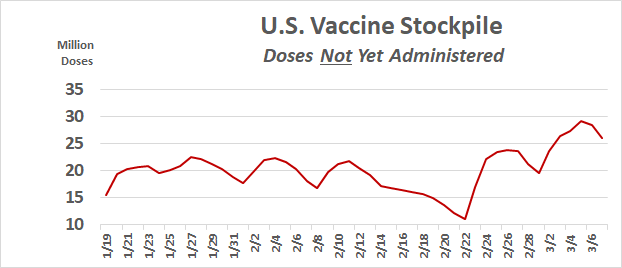
As of today, 26 million have been fully vaccinated (i.e. received 2 shots) … 52 million have received only the 1st of 2 shots.

An obvious question: Is Biden talking about fully vaccinated or just “in the system” …. having received at least received one shot? More on that later.
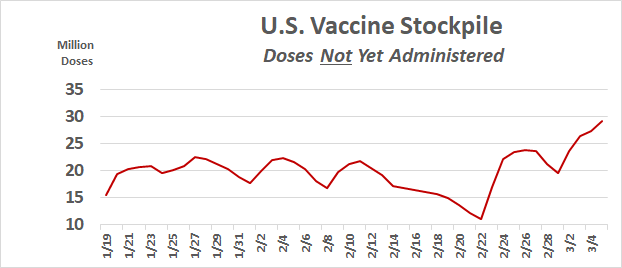
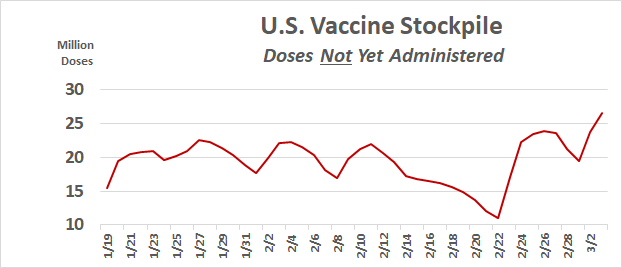
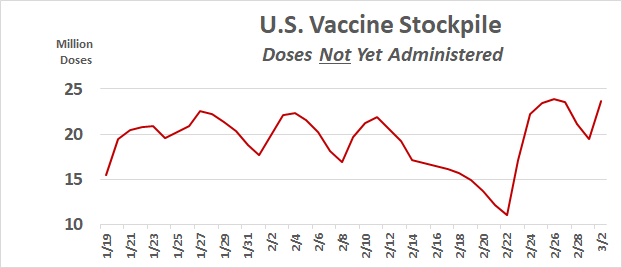
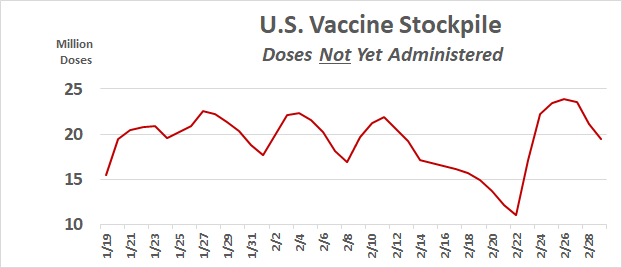
As of today, there is over 24 million doses in the government stockpile.

Presumably, that inventory is intended for the 2nd shots to be given to folks (like me) who have already received their first shots.
So, we can assume that we just need to consider new vaccination candidates.
That means that we need enough new supply to vaccinate just over 200 million people (250 million adults 18 & over less the 52 million already vaccinated and presumed scheduled for their 2nd shots).
The good news: J&J says that it will deliver 20 million 1-shot doses by the end of March and 100 million by summer.
That works out to about 75 million J&J doses by the end of May. (20 million in March plus 2/3s of the 80 million ‘by summer’ balance).
Since J&J is a 1-dose vaccine, that leaves 125 million adults to be vaccinated by the end of May.
So, we need about 250 million doses from Pfizer & Moderna to hit the goal (125 million adults times 2 doses).
=============
Are 250 million mRNA doses a long-shot or a lay-up?
There were 52.5 million doses delivered to (and from) the Feds in February.
Quant note: Cumulatively, there were 49.9 million doses delivered as of Feb.1 and 102.4 million delivered as of March 1 … the difference (52.5 million) was delivered in February, Source
So, at the February rate, we can expect at least another 150 million doses in the 3-month period March-April-May.
That leaves us about 100 million mRNA doses short of having enough to have all adults 18 & over fully vaccinated by the end of May.
Said differently, it leaves 50 million adults partially vaccinated (i.e. having on 1 of their 2 shots).
Finishing them off will require another month’s supply (at the current delivery rate.
That pushes us out to June unless there’s a boost in vaccine manufacturing output.
Since the J&J-Merck manufacturing partnership requires a couple of months until it comes on line, it’s not clear where & how the additional supply will materialize.
So, if the goal is “fully vaccinated” , then May is aggressive … June is realistic … and, the difference is, in my opinion, rounding error.
Of course, the goal can be fudged to “at least one dose” … which may be doable by the end of May.
So, there should be enough supply to hit the available supply goal, plus or minus a couple of weeks.
============
The big “but…”
Biden’s commitment is “available supply” … which is less daunting than getting all adults 18 & over “vaccinated”.
And, achieving an available supply goal simply requires continuing to deliver vaccines (to & from the government) at current run rates (plus the new incremental J&J supply).
But, converting the supply into “shots in arms” is likely to run into at least 2 challenges: (1) the last mile under-served populations (i.e. rural, inner city), and (2) demand creation among the vaccine hesitants.
These challenges may be more of an impediment than vaccine supply.
We’ll cover them in future posts…
In today’s editorial, the WSJ says that Trump’s vaccine bet was government’s best pandemic decision.
=============
A bold move:
American governments, federal and state, have made many mistakes in the Covid-19 pandemic.
But the great success — the saving grace — was making a financial bet in collaboration with private American industry on the development of vaccines.
=============
A fast track to normalcy
That effort is now letting the country see the possibility of a return to relatively normal life as early as the spring.
President Biden announced that the U.S. should have enough vaccine supply for every American adult by the end of May.
[That’s months, or years, before Dr. Fauci and other experts said to expect the first doses of a Covid vaccine to be delivered.]
=============
False claims try to diminish the achievement:
Critics scoffed when President Trump set a target of having a vaccine approved by the end of 2020.
Kamala Harris suggested she would not take a shot recommended by the Trump Administration.
The Biden-Harris Administration has now changed to full-throated encouragement — though not before continuing to trash the Trump efforts.
President Biden and White House aides have repeatedly stated that they inherited little vaccine supply and no plan for distribution.
Both claims are false.
The claim that the administration inherited no vaccine program at all, initially propagated through the ministrations of a kindly reporter, is so at odds with the evidence that even the most friendly newspapers were obliged to call it out.
The supply was ramping up fast, and while there were distribution glitches at first, the real problem has been the last mile of distribution controlled by states [at their demand].
=============
Politically-inflicted complexity:
Governors like New York’s Andrew Cuomo tried to satisfy political constituencies that wanted early access to vaccines, adding complexity and bureaucracy that confused the public.
Mr. Biden is making the same mistake, asking states to give priority to educators (read: teachers unions), school staffers and child-care workers.
That is arbitrary and unfair.
A 30-year-old teacher who may still work remotely until September is at far less risk than a 50-year-old FedEx driver who interacts with customers all day.
The fairest, least political distribution standard is age.
=============
The big bet:
The Trump Administration’s Operation Warp Speed also contracted most of the vaccine supply for production before approval by the FDA: 200 million doses each of Pfizer and Moderna, and 100 million of J&J.
No one knew which technology would be approved first, if at all, so the Trump administration wisely bet on several [with firm advance orders and contract options to order more once the vaccines were approved and in distribution].
This was a grand strategy and the best money the feds spent in the pandemic.
Mr. Biden ought to give the vaccine credit where it is due — to U.S. drug companies and Operation Warp Speed.
==============
I couldn’t have said it better myself…

=======

=======
Note: At the index starting date, cases were
~ 100K and deaths were ~ 1,000 per day.
=============
=============
Source: RonaViz.com
Fall 2020 Estimate: The COVID schools’ shutdown compounded the inevitable “summer slide”.
=============
In a prior post (originally published July 30, 2020 and re-posted last week), we provided background on students’ “summer slide” in learning … and presented some research projecting how much “dislearning” will have occurred since schools closed in Spring, 2020 until Fall, 2020.
At the time, the WSJ did a study that painted a dire picture: The Results Are In for Remote Learning: It Didn’t Work.
Preliminary research projects students nationwide will return to school in the fall with roughly 30% dis-learning in reading relative to a typical school year, and more than 50% in math.
Those were forecasts, so we asked the rhetorical question: Wouldn’t it be nice if we knew how much students’ actually regressed while schools have been closed?
And, we advised: To find out, give students a round of standardized tests at the start of the school year.
We predicted: Results would likely shock educators, parents and politicos alike.
============
Well, a national testing service did just what we asked.
According to the WSJ …
Data from Renaissance Learning — a national testing program which is used widely by U.S. public schools to assess students’ progress — shows widespread performance declines at the start of 2020-2021 academic year, particularly in math.

=======
=======
Note: At the index starting date, cases were
~ 100K and deaths were ~ 1,000 per day.
=============
=============
Source: RonaViz.com

=======
=======

Note: At the index starting date, cases were
~ 100K and deaths were ~ 1,000 per day.
=============

=============

Source: RonaViz.com


 The Homa Files