Archive for the ‘Careers & Interviewing’ Category

Alum props: Jen Folsom of Momentum Resources featured in Newsweek

June 29, 2010

Jen Folsom, MSB MBA ‘02, got some nice press in Newsweek … she’s become one of our rockstar alums ! 

Way to go, Jen.

* * * * *

Newsweek, The Vanishing 9-to-5 Job, June 25,2010

On a typical weekday, Jennifer Folsom works from 5 a.m. to 7 a.m., from 10 a.m. to 3:30 p.m. and from 7 p.m. to about 8 p.m. Her hours may sound like they belong to a college student cobbling together a hodgepodge of part-time jobs, but Folsom is the director of a successful D.C. headhunting firm where she oversees a handful of employees with equally irregular schedules.

“We get the job done and I work 50 or 60 hours a week,” says Folsom, who adapts her work schedule to give herself time with her three sons. “I just don’t necessarily do it from 9 to 5.”

As the traditional U.S. workday continues to fade, Folsom’s experience may soon become the rule rather than the exception. Two generations ago, America’s workforce — from Ford’s assembly-line workers to IBM’s “company men” — would show up to work at 9 a.m. on the dot and leave the second the whistle blew at 5 o’clock. Now, one in five Americans works mostly nonstandard hours — nights, weekends, or rotating shifts.

Experts believe that statistic will balloon in coming years as the Great Recession accelerates a cultural shift in the corporate world, allowing more employees to tailor their work schedules to preference, position, and personal life.

Folsom has seen this firsthand. Her company, Momentum Resources, is designed to place professionals in senior-level positions with flexible hours.

When she helped start the firm in 2007, her biggest challenge was convincing CEOs that their stringent loyalty to the 9-to-5 workday was impeding them from acquiring top talent, specifically working mothers with impressive résumés.

“They just weren’t set up to do it,” she says. But the model has proven remarkably successful at companies like Best Buy and employers seem more willing to adapt these days: since 2007, Momentum has placed flex employees with more than 250 clients in the D.C. metro area, and Folsom says demand is growing.

Full article:
http://www.newsweek.com/2010/06/25/the-vanishing-9-to-5-job.html
"What are your weaknesses ?"

June 7, 2010

Predictably, the NY Times praised President Obama’s press conference last week.

After all, he fessed up to a mistake and admitted that he was wrong — something Bush would never do. 

What did he do wrong?

“I was too trusting of the information that we were getting from BP.”

That reminds me of a typical job interview question “What are your weaknesses ?”

Classic answer: “Sometimes I get impatient with people who don’t share my high quality standards”.

Isn’t it a breath of fresh air when people can step-up and be self-critical.

* * * * *

P.S. Don’t give the above answer in a job interview or your candidacy will be squashed before your very eyes.

High paying finance jobs getting harder to find …

January 12, 2010


Even when the U.S. labor market finally starts adding more workers than it loses, many of the unemployed will find that the types of jobs they once had simply don’t exist anymore.

The downturn that started in December 2007 delivered a body blow to U.S. workers. In two years, the economy shed 7.2 million jobs, pushing the jobless rate from 5% to 10%, according to the Labor Department. The severity of the recession is reshaping the labor market. Some lost jobs will come back. But some are gone forever, going the way of typewriter repairmen and streetcar operators.

Many of the jobs created by the booms in the housing and credit markets, for example, have likely been permanently erased by the subsequent bust.

For more highly educated workers, finance may no longer offer as many high-paying jobs as it has in the past. Since the start of the recession, the financial sector has lost 548,000 jobs, or 6.6% of its work force. Experts predict that there will be further pressure on financial jobs.

Excerpted from WSJ: Even in a Recovery, Some Jobs Won’t Return, Jan. 12, 2010 
http://online.wsj.com/article/SB126325594634725459.html?mod=WSJ_hps_MIDDLEThirdNews

Don’t interview for jobs on rainy days !

January 11, 2010

Dr. Don Redelmeier examined University of Toronto medical school admission interview reports from 2004-2009.

After correlating the interview scores with each day’s weather archives, he determined that candidates who interviewed on rainy or snowy days received interviewer ratings that were significantly lower than those of candidates who were lucky enough to visit on a sunny day, a difference that could not be explained by demographic factors or by grades and test scores.

In fact, the impact of the bad weather on applicants was the equivalent of a 10% lower score on the MCAT, easily enough to influence acceptance and rejection in many cases.

Some other Redelmeier findings …

* * * * *

The belief that arthritis pain is related to the weather is just another example of perception trumping reality.

After following 18 arthritis patients for a year, Dr. Don found no relationship between weather and pain.

It’s just that people tend to notice the weather more when their joints are aching, and that humans like to find patterns and explanations (particularly for unpleasant phenomena), even when none exist.

* * * * *

Mortality among patients admitted to hospitals on weekends is higher than weekdays.

Dr. Redelmeier found that seriously ill patients admitted to hospitals on weekends were significantly more likely to die.

This study catalyzed important discussions about weekend staffing patterns in hospitals around the world.

* * * * *

Academy award winners live longer than runner-ups.

Dr. Redelmeier, noting that most research examining the correlation between social status and health focused on society’s lower rungs, decided to use the Academy Awards to examine the relationship among the glitterati.

This study found that Academy Award winners live an average of 4 years longer than runner-ups, an astounding survival advantage.

The full mechanism of the apparent survival benefit among successful actors and actresses is not known. Untangling the explanations is complicated because some stars also engage in superstitious and deleterious behaviors.

* * * * *

Medical school class presidents die early

Comparing medical school class presidents to a control group comprised of those who appeared alphabetically before or after the president in the medical school class photo , the class presidents died about 2.5 years earlier.

“The type of medical professional who sacrifices themselves for this type of professional prestige may also be the type who fails to look after their health or is otherwise prone to early mortality.”

* * * * *

Full article:
http://community.the-hospitalist.org/blogs/wachters_world/archive/2009/12/21/rainy-day-interviews-oscar-winners-mortality-and-a-randomized-trial-of-niceness-in-the-er-the-extraordinary-mind-of-don-redelmeier.aspx

Best jobs survey: Better to be a teacher or a sewer plant operator?

January 6, 2010

Oh, come on … obviously teacher.  I was just having some fun with you.

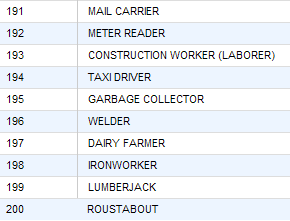
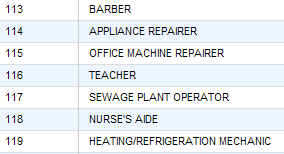
According to a newly released study from job site CareerCast.com —  teacher ranked #116 out of 200 of the best and worst jobs in the U.S. —  based on five criteria — environment, income, employment outlook, physical demands and stress.

Sewer plant operator came in a distant #117. 

image

The best and worst are displayed below … with the link to the full survey.

* * * * *

Top Jobs

Ken’s favorite: Philosopher … know any ?

image

* * * * *

Worst Jobs

Where’s toll collector?

image 

Full list:
http://online.wsj.com/public/resources/documents/st_BESTJOBS2010_20100105.html

Thanks to Coop for stringing the lead.

Why can't Americans make things? Two words: business school

December 22, 2009

Excerpted from The New Republic, Upper Mismanagement: Why can’t Americans make things? Two words: business school, December 18, 2009

The business schools had their own incentives to channel students into high-paying fields like finance, thanks to the rising importance of school rankings, which heavily weighted starting salaries. The career offices at places like Harvard, Stanford, and Chicago institutionalized the process—for example, by making it easier for Wall Street outfits and consulting firms to recruit on campus.

A recent Harvard Business School case study about General Electric shows that the company had so much trouble competing for MBAs that it decided to woo top graduates from non-elite schools rather than settle for elite-school graduates in the bottom half or bottom quarter of their classes.

No surprise then that, over time, the faculty and curriculum at the Harvards and Stanfords of the world began to evolve. “If you look at the distribution of faculty at leading business schools, they’re mostly in finance. …  Business schools are responsive to changes in the external environment.”

Which meant that, even if a student aspired to become a top operations man (or woman) at a big industrial company, the infrastructure to teach him didn’t really exist.

In fairness, all that financial expertise we’ve been churning out hasn’t been a complete waste (much as it may seem that way today).

Many of the financial restructurings of the ‘80s and ‘90s made the economy more efficient and competitive.

Likewise, it would be ludicrous to suggest that simply changing the culture of business schools would single-handedly revive U.S. manufacturing. 

But, it’s hard to believe that American manufacturing has a chance of recovering unless business schools start producing people who can run industrial companies, not just buy and sell their assets. And we’re pretty far away from that point today.

Full post:
http://www.tnr.com/article/economy/wagoner-henderson?page=0,1

* * * * *

Thanks to Laj for the lead

Best jobs … according to Money Mag

December 8, 2009

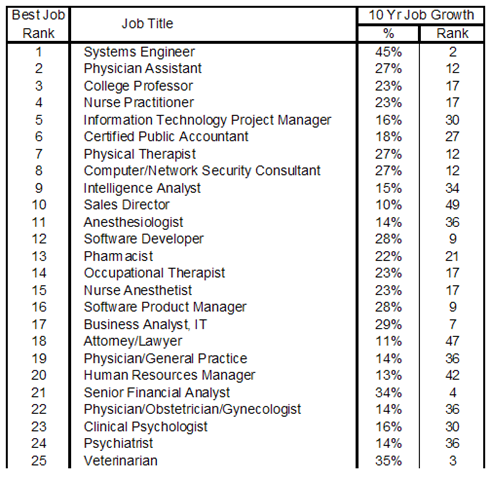
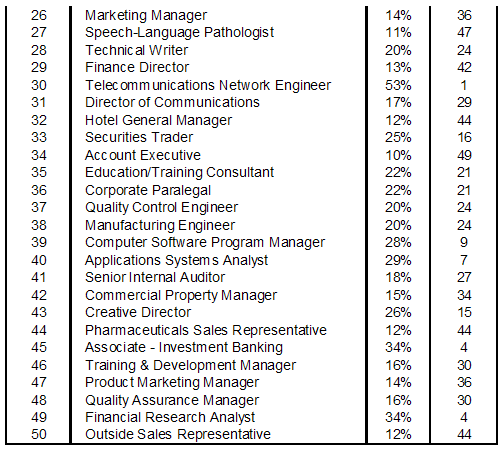
Each year, Money Magazine ranks the best jobs … based on job content and employment growth prospects.

Here’s the 2009 list … Marketing Manager is #26 — ahead of all Finance jobs !

image

image

Full article:
http://money.cnn.com/magazines/moneymag/bestjobs/2009/full_list/index.html

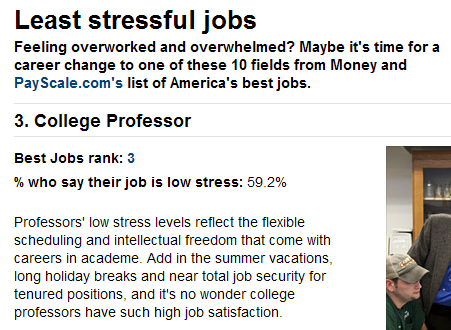
Here’s why I’m so laid back …

December 7, 2009

OK, I’ve never been accused of being too laid back — or, come to think of it,  laid back at all.

Imagine what I’d be like if I were still in a pressure-cooker job …

* * * * *

From Money Mag and PayScale.com:

image

image

http://money.cnn.com/galleries/2009/moneymag/0910/gallery.bestjobs_leaststress.moneymag/3.html

Full article:
http://money.cnn.com/magazines/moneymag/bestjobs/2009/full_list/index.html

Add some pop to your resume …

November 5, 2009

Excerpted from: EditorialEmergency.com, Resume as Personal Branding

TakeAway: Your resume needs to do more than rehash old job descriptions; it needs to get the attention of overburdened employers. 

“If they don’t ‘get’ you after reading your resume — skimming it, if you want the truth — you haven’t effectively differentiated, or branded, yourself.”

* * * * *

Do you really think the folks doing the hiring will find you memorable because you’re a “self-starter?”

Will you separate yourself from the pack by claiming to be a “results-oriented professional?”

Here are “Ten Boilerplate Phrases That Kill Resumes“:

  • Cross-functional teams
  • More than [x] years of progressively responsible experience
  • Superior (or excellent) communication skills
  • Strong work ethic
  • Met or exceeded expectations
  • Proven track record of success
  • Works well with all levels of staff
  • Team player
  • Bottom-line orientation

While we’re at it, let’s add the strangely ubiquitous jargon “thought leader” .

* * * * *

So how do you stand out from the crowd?

Forget about listing every job you’ve ever had in strict reverse-chronological order. Do indicate the years you were with each employer, but make sure the “experience” entries most aligned with your current career goals come first. This is sometimes called a “functional” resume. It’s arranged by order of importance. Sacrificing strategy to chronology is so 20th century.

Don’t make them Google it. Unless your prior employers, clients and partners are so well known that clarifying what they do would be ridiculous, provide a pithy description: Fortress of Solitude, a boutique entertainment-marketing firm. Lithwick, Stahl and Osterman, a financial consultancy. Green’s Greens, the Upper Midwest’s leading distributor of frozen vegetables. If the HR manager has to search for info because you didn’t provide it, consider yourself deleted.

Use vocabulary cherry-picked from the listing for the job you want. Large firms frequently depend on computers to sift resume submissions; the software sorts for keywords that match the listing. Include those keywords in your resume to penetrate the machines’ defenses so you can work your magic on some HUMAN eyeballs.

Rely on compelling stories, not old clichés about your “strong work ethic.  Use (brief) anecdotes to illustrate your productivity, your efficiency, your indispensability. Give life to the tale of your 11th-hour campaign pitch (illustrated by nothing more than stick-figure sketches), which won your outfit a $12 million contract with ActiVision.

Remember that personal branding extends to file names. When submitting your resume electronically, don’t name the file ‘resume,’ or even ‘resume 2009,’– you might as well title it ‘I don’t really want this job.’  File name equals full name (yours).”

* * * * *

Source articles:
http://www.editorialemergency.com/content/view/325/76
http://www.marketingprofs.com/news/marketing-inspiration/index.asp?nlid=1339&cd=dmo121&adref=NmiF1A9The

* * * * *

MBA Trends … women and NFPs on the rise.

October 6, 2009

Business Week, B-School: The View at the Gate, Sept. 14, 2009

From the annual applicant survey by QS World MBA Tour, a London-based group that holds MBA fairs globally:

Women now make up 46% of worldwide MBA candidates, more than ever before.

U.S. programs still rank first in popularity,

But “partly because of the U.S. visa situation, more foreign students have shifted to looking at countries in Europe and Asia for schooling.”

Candidates’ stated preference is for a one-year MBA (44%) over a two-year program (43%), a first in the survey’s 11-year history.

There has been a doubling of applicants from the nonprofit sector — to 6% from 3% in 2008.

The percentage of those naming nonprofit work as a career goal: 6.4% vs. 3.8% last year.

Starting a business is the No. 1 post-MBA career goal.

At #2, financial services, almost as popular as it was last year. “The sector is traditionally the big absorber of MBAs,” he says. “And the salary and bonuses are still so high that it’s alluring, despite fact that there are fewer jobs.”

Full article:
http://www.businessweek.com/magazine/content/09_37/c4146btw881806_page_2.htm

* * * * *

What’s the #1 skill that MBA recruiters are looking for ?

September 29, 2009

TakeAway:  MBA schools and students frequently forget that no matter how book smart one is, if one cannot effectively communicate that knowledge with others and drive action … that knowledge does little good. 

So, the answer: communications skills.

* * * * *

Excerpted from Insead Knowledge, “Communicating Your Way To The Top,” September 18, 2009

Good communication skills outrank other core business competencies as the number one skill for corporate recruiters looking to hire MBA graduates.

That conclusion comes not from communications specialists, but from an organization that has all the relevant data at its fingertips, The Graduate Management Admission Council (GMAC) …

This is no one-off effect. Communication skills have been consistently ranked in the top three in the last few years and this is not the first year they have been the number one requirement …

Communication is held in such high regard by recruiters … because people today expect to be communicated with on a regular basis and … communication cuts across all levels …

One of the tools of communicating is the ever-popular presentation. However, as commonplace as they may be, …  few have perfected the art of delivering a memorable and effective presentation … a few pointers to offer: first, assess the audience, preferably weeks ahead of the event. Find out who your audience is and what they will be expecting from you. Then you can fine-tune your presentation to make sure you hit the right notes …

Second, good stage presence is another clincher to an effective presentation. This encompasses knowing exactly how to command attention from the audience through body language, eye contact, and moving around the stage instead of standing behind the lectern.

Third, avoid … ‘death by PowerPoint’, basically using a standardized deck of slides, irrespective of context and audience … your story has got to come first, then you produce your slides to support your story … the slides need to be clear and concise … short and simple … visually interesting and entertaining.

Edit by TJS

* * * * *

Full Article
http://knowledge.insead.edu/contents/Communication-skills-steveknight-090918.cfm?vid=305

* * * * *

Outlook is Optimistic for Marketers’ Job Security

April 7, 2009

Excerpted from Brandweek, “Marketers Expect to Keep Jobs, Budgets” By Kenneth Hein, March 14, 2009

* * * * *

While many reports suggest the sky is falling for marketers, a large number of top-level executives feel that their jobs and much of their staff’s jobs are safe. What’s more, the majority do not anticipate cutting their marketing budgets.

The CMO Council interviewed 659 global senior marketers online between mid-January and March 2. Overall, it found that marketers are not planning major restructuring, head-count reductions or wholesale agency terminations this year.

More than half do not feel their jobs are at risk and 20.6% simply are not sure. More than a third plan to keep their teams intact and 26% expect to add staff.

“There was not as much panic about job security that we thought there would be,” said Liz Miller, vp, programs and operations at the CMO Council. “The big story for the marketing community is it is not about budget slashing; it’s about budget reallocation. Marketers are looking to better support the sales team, drive business growth and engage the individual customer” …

“It’s not about window dressing this year … Marketers need to stop looking at how to refresh our brand, change our logo or what we mean to consumers. This year they don’t have the millions to do that. It’s how do you do it faster, better and more efficiently with less cash to waste on things that don’t work. You need to better support your sales team because they need leads, that’s the bottom line” …

Marketers top marching orders from their bosses are: Growing and retaining market share (48%), lowering costs and improving efficiencies (44%) and improving customer insight and retention (33%).

The top factors affecting marketers are customer anxiety and cutbacks (49%) and slower, more complex selling cycles (38%). The top frustrations were: Insufficient budget (43%), the organizational culture (37%) and senior management mindset (33%).

Overall, “We’re coming out of a long phase where the wind was in our favor … When they are in your favor you don’t need to be particularly smart to be somewhat successful. In these conditions, you need to be a lot smarter than before.”

Edit by SAC

* * * * *

Full Article:
http://www.brandweek.com/bw/content_display/news-and-features/direct/e3idd9d6803dbe30862f19d9fb07e5dfbca

* * * * *

Want more from the Homa Files?
Click link =>
The Homa Files Blog

Getting Your Network To Work for You

November 26, 2008

Excerpted from WSJ “Networking? Here’s How to Stand Out” by Joann Lublin , November 4, 2008

* * * * *

Fans of Bruce Mount sang his praises to BzzAgent before he applied to become vice president of engineering of the Boston word-of-mouth marketer.

In late June, the software-development manager asked nearly two dozen present and past colleagues to tout his abilities. “Even one sentence will help!” he assured them. Their testimonials ranged from a brief haiku to a multipage missive dubbing him “a freakin’ goldmine of knowledge, ingenuity and kindness.”

Mr. Mount’s creative approach “made him stand out,” recalls BzzAgent’s director of recruiting. He was the frontrunner among 166 outside prospects…

Unusual times demand unusual networking tactics. Most candidates find work through networking, surveys show. But in today’s dismal job market, many feel frustrated with standard strategies such as tapping friends for referrals…

“The bar has been raised on what it takes to make networking work,” concurs Scott Allen, a consultant about online networking. “Virtual interaction allows us to create the illusion of networking by making electronic links with people,” but online ties represent “just a starting point,” he says. “You still need some kind of relationship.”

For job hunters who use networking Web sites like Linkedin.com, Mr. Allen favors a more-sophisticated approach. When you invite someone to join you on LinkedIn, he proposes including a personalized offer of help, such as an introduction to a customer or a useful link to a relevant article.

In the real world, you can improve your networking by finding out whether key executives of potential employers will attend a trade group meeting and then scheduling encounters during the event… “Don’t expect to just show up and bump into these people,” he cautions…

There are additional ways to network more effectively at events. “Be the only person like yourself in the room”…An offbeat but memorable “elevator pitch” will also make you stand out in a crowd, says Lorraine Howell, a public-speaking trainer in Seattle…

Still frustrated? Your network may know why. Ask friends, relatives and associates to anonymously assess your strengths and weaknesses through SurveyMonkey.com…

Possible questions to pose in an anonymous poll of your network:

  • What three words come to mind when you think of my strengths? Areas where I could improve?
  • Is there one aspect of my hunt where I am making a big mistake but appear unaware? If yes, what is my mistake?
  • What jobs do you think I might be good at that I haven’t considered?
  • What type of jobs have I looked down on that might pay well?  

Edit by SAC

Full article:
http://online.wsj.com/article/SB122575114437694677.html

Want more from the Homa Files?
Click link =>
The Homa Files Blog

Sometimes the answer is "yes, sir" or "no, sir" …

August 21, 2008

Excerpted from WSJ, “Saddleback: The Inner Game of Politics”, August 21, 2008

* * * * *

The questions Pastor Rick Warren asked:  

Who are the three wisest people you know in your life?

What would be the greatest moral failure in your life?

What does it mean to you to trust in Christ?

What’s the toughest decision you ever had to make?

At what point does a baby get human rights?

Does evil exist?

What about stem cells?

What is your definition of marriage?

* * * * *
Barack Obama clearly has spent more time than is healthy around places like the law schools of Harvard and Chicago, where one learns that a short answer cannot exist.

At Annapolis, John McCain’s school, one learns the answer is often “Yes, sir” or No, sir.”

* * * * *

Ken’s POV: Worth considering when in a job interview … the benefits of clear, direct answers that reveal the “real you” … even if the interviewer doesn’t like the answer.

* * * * *

Full op-ed:
http://online.wsj.com/article/SB121927592113858497.html?mod=todays_columnists

* * * * *

Want more from the Homa Files?
Click link =>
  The Homa Files Blog

* * * * *