Archive for the ‘Economics’ Category

The pretense-of-knowledge syndrome …

June 17, 2011

Recent bad economic news has been reported as “surprising” and “unexpected” by the mainstream media.

That causes two problems:

  • Since the news is bad, it understandably breeds low consumer confidence.
  • More nuanced, since the news is “unexpected”, it breeds low confidence in the folks who are in charge: “do they know what they’re doing?”

While politicos need to maintain an optimistic façade, how much damage has been done by  “we’ll hold unemployment under 8%” and “this is recovery summer”?

* * * * *

Excerpted from RDP: Hunkered-Down America by Robert Samuelson

Economists suffer from what one of them (Ricardo Caballero of the Massachusetts Institute of Technology) calls “the pretense-of-knowledge syndrome.”

They act as if they understand more than they do and presume that their policies, whether of the left or right, have benefits more predictable than they actually are.

For example, economic models, based on past relationships and assumptions, don’t capture shifts, which embody new assumptions and beliefs.

So modern economics has been oversold, and the public is now disbelieving.

The disillusion feeds stubbornly low confidence.

Because psychology is so important, the good news is that if the economy surprises on the upside, the boost to confidence could accelerate the recovery.

[The bad news is that if the economy surprises on the downside, the hit to confidence could slow the recovery.] 

* * * * *

Marginal Revolution: America’s hottest economist

June 16, 2011

According to Business Week:

Tyler Cowen is  America’s Hottest Economist.

The George Mason University professor has written a bestseller, The Great Stagnation, keeps an influential blog, and reads way too many books. 

Cowen’s first rule of reading: You need not finish.

He takes up books with great hope and no mercy, and when he is done—sometimes after five minutes—he abandons them in public, an act he calls a “liberation.”

* * * * *

His best seller, The Great Stagnation, runs through three centuries’ worth of what Cowen calls the “low-hanging fruit” of economic growth: free land, technological breakthroughs, and smart kids waiting to be educated. For developed economies.

He argues, none of these remains to be plucked.

Yet America has built political and social institutions on the assumption of endless growth.

Cowen thinks that now that America has used up the frontier, educated all of the farm kids, and built a couple of cars for every family, we might be done growing for awhile.

* * * * *

Cowen is still best known for his blog: Marginal Revolution.

It’s the second-most popular blog on economics.

Greg Mankiw’s eponymous blog at Harvard just edged it out; both picked up far more votes than Paul Krugman’s New York Times blog Conscience of a Liberal, which ranked third, or Freakonomics, at fifth.

* * * * *

Another Obama economist bites the dust …

May 19, 2011

Well, to be technically correct, Jared Bernstein was Biden’s chief economist and one of the crafters of the administration’s  Trillion Dollar-Stimulus plan.  He fronted for the 3 million jobs saved or created.

Adios, Jared.

Just announced: “Jared Bernstein, the former top economic adviser to Vice President Biden, joined the Center on Budget and Policy Priorities on Monday, May 16, as a Senior Fellow”.

Sommers, gone.

Romer, gone

Bernstein, gone.

Obama says: His economic program saved us from catastrophe. and is working just fine, thank you.

Yeah, right.

Jobs affected by federal minimum wage hikes account for 41.8% of the total reduction in jobs seen since 2006.

March 21, 2011

Economists warned that raising the minimum wage would result in lost jobs. It always does.

Why?

As labor gets more expensive, companies pare back the employment rolls.

Sure, the folks who hang onto their jobs make more … but folks who lose their jobs make less – zero to be precise.

Here’s a great analysis from the site Political Calculations

* * * * *

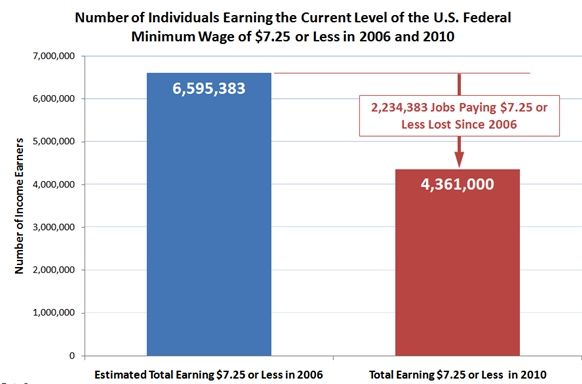
In 2006, the last full year in which the U.S. federal minimum wage was a constant value throughout the whole year, at least before 2010, approximately 6,595,383 individuals in the United States earned $7.25 per hour1 or less.

For 2010, the first full year in which the U.S. federal minimum wage was a constant value through the year since 2006, the U.S. Bureau of Labor Statistics estimates that an average of just 4,361,000 individuals in the United States earned the same equivalent of the current prevailing federal minimum wage of $7.25 or less throughout the year.

 image

In terms of jobs lost, that means that 2,234,383 of the jobs lost in the U.S. economy since 2006 have been jobs that were directly impacted by the series of minimum wage increases that were mandated by the federal government in 2007, 2008 and 2009.

Interestingly, the average number of employed members of the civilian labor force in 2006 was 144,427,000. In 2010, the average number of employed members of the civilian labor force in the U.S. was 5,363,000 less, standing at 139,064,000.

So, in percentage terms of the change in total employment level from 2006 to 2010, jobs affected by the federal minimum wage hikes of 2007, 2008 and 2009 account for 41.8% of the total reduction in jobs seen since 2006.

Thanks to Tags for feeding the lead

Are you doing better now ?

February 22, 2011

Key stats from date Obama was inaugurated until today.

Yeah, I know … it’s Bush’s fault.

image

Published on DickMorris.com on February 15, 2011

What’s the difference between politics and economics?

January 20, 2011

According to conservative economist Thomas Sowell is short-term thinking that ignores second-order consequences:

  • A fundamental difference between political decisions and economic decisions: political decisions tend to be categorical, while economic decisions tend to be incremental.
  • That is, when the public votes in a candidate, that decision lingers and is broadly applicable. Whereas, economic decisions are more transactional.
  • As a result, the public can end up paying as taxpayers for increments of spending that they would not have chosen to make as individual consumers.

 * * * * *

  • Politicians have a clear bias towards policies that will produce good results before the next election — even if they can be expected to produce bad results afterwards. That is, second stage — or second order — consequences are routinely ignored.
  • For example, price controls may provide apparent short-term benefits, but have repeatedly shown that they ultimately constrained supply and create shortages.
  • Another example: a second order effect of the Americans with Disabilities Act — which mandated reasonable accommodations to those with disabilities — was a decline in the employment of people with disabilities.
  • Infrastructure spending — repairing bridges, roadways, dams, or government buildings — doesn’t provide an immediate, visible payoff. So, politicians defer spending on infrastructure unless there is some obvious defect that is both immediately visible and important to a large segment of the voting public.
  • Political thinking tends to conceive of policies, institutions, or programs in terms of their hoped for results, not the realistically likely results.

Source: Chapter 1, Applied Economics, Thomas Sowell, Basic Books, 2010

The perils of moral hazard …

January 19, 2011

According to conservative economist Thomas Sowell …

“Moral hazard” is an insurance term.

People behave differently when they are insured from the way they behave when they are not insured.

For example, people whose cars are insured may not be as cautious as other people are about what kinds of neighborhoods they park their car in.

Similarly, when taxpayer-subsidized government insurance policies protect people against flood damage, more people are willing to live in places where there are greater dangers of flooding.

Often these are luxury beach front homes with great views of the ocean.

So what if they suffer flood damage once every decade or so, if Uncle Sam is picking up the tab for restoring everything?

More than 25,000 properties have received government flood insurance payments more than four times.

Over a period of 28 years, more than 4,000 properties received government insurance payments exceeding the total value of the property.

If a property is located in a dangerous place, repeated damage can easily add up to more than the property is worth, especially if the property is damaged and then later wiped out completely.

Excerpted from RCP: “Moral Hazard” in Politics, August 27, 2010
http://www.realclearpolitics.com/articles/2010/08/27/moral_hazard_in_politics_106909.html

Crime … it’s simple economics.

January 18, 2011

According to conservative economist Thomas Sowell, for some, a life of crime may be a series of rational economic choices:

  • Given the Low Educational and IQ levels of many who become career criminals, crime may well be their best paying option.
  • Crime is one of those occupations, like sports and entertainment, in which a relatively few at the top achieve very high incomes, while most of those who enter the occupation received very low incomes.
  • For example, many ordinary young sellers of drugs on the street live at home with their mothers, often in public housing projects — clearly not an indication of affluence — but the lavish lifestyles of drug kingpins attract many young people into the occupation, in hopes of rising to the lofty level.
  • Changes in crime rates reflect rational reactions to the cost of criminals expect to pay both in punishment inflicted by law enforcement system and the risk of being harmed by their intended victims.
  • Burglary rates tend to be affected by the proportion of homeowners who have guns in their homes. For example the burglary rate in Britain is much higher than it is in the United States. And, when the Atlanta suburb of Kennesaw passed an ordinance requiring households to keep a firearm in their homes, residential burglaries dropped by 89%
  • Another example of the Rationality of Criminals Is the Response to the unusual American Institution of the private bail bondsman a system used by only one other country, the Philippines. Criminals who use bail bondsman, usually show up for their court dates because they know the consequences can be severe.
  • When the criminals in a given area belong to a crime syndicate, their activities are restrained by the organized crime leaders who have to take a wider repercussions into account. A syndicate may restrict the amount of crime to keep law enforcement from ratcheting up their efforts.
  • Ironically both law enforcement and organized crime tend to reduce the total amount of crime in a specific area


Applied Economics, Thomas Sowall, Basic Books, 2010  Chapter 2

When is insurance not insurance ?

January 17, 2011

According to conservative economist Thomas Sowell:

Insurance is, at it’s core, a pooling of risk.

“But, political Incentives make it rational to mandate insurance coverage on things they would not be covered by insurance on purely economic grounds, since those things are not a matter of risk.

For example, the cost of an annual medical checkup is not a risk, since is known in advance that these checkups occur once a year.

To have health insurance covers annual checkups is like having automobile insurance cover annual state inspection checks or routine oil changes.

But, because of the stronger emotions involved in medical issues, annual health checkups are more readily depicted as a good thing — and therefore justified as part of a government mandate.”

Source:Applied Economics, Basic Books, 2009

Fuzzy math: About that remarkable drop in the unemployment rate …

January 10, 2011

Let’s see, the BLS reports 100k jobs added in Dec. –– pushing the unemployment rate down from 9.8% to 9.4% – giving Obama & Goolsbee fodder to crow that their economic programs are “clearly working”.

Hmmm.

According to the BLS data set, in Nov. there were 238.715 million non-institutionalized civilians age 16 and over … 153.950 of them were participating in the labor force by either being employed or actively looking for work … that’s a 64.5% participation rate, down from 64.9% in May.

Of the 153.950 million … 138.909 (90.2%) were employed, 15.041 (9.8% – rounded up from 9.77%) were unemployed.

Then the BLS reported that about 100k jobs were added in Dec.

OK, let’s do the math.

138.909 million employed in Nov. plus 100k jobs added in Dec. equals 139.009 employed in Dec. …  which divided by 153.950 participants equals 90.3% employed … or, flipping the numbers, 9.7% unemployed … down from the rounded 9.8% in Nov.

But, the Feds say unemployment went from 9.8% to 9.4% … how can that be?

Simple.

First, the unemployment number comes from a different source: household surveys vs. employer surveys.

The household survey says that 297k jobs were added … 3 times what the employers say they added.

OK,  let’s recalculate.

138.909 million employed in Nov. plus 297k jobs added in Dec. equals 139.206 employed in Dec. …  which divided by 153.950 participants equals 90.4% employed … or, flipping the numbers, 9.6% unemployed … down from the rounded 9.8% in Nov. and the 9.7 based on the employer data.

But, the Feds say unemployment went down to 9.4% … where’s the other .2% ?

Simple.

260k unemployed people who were previously participating in the labor force by at least looking for work got sufficiently discouraged (or distracted by Xmas) that they stopped looking for jobs … so the labor pool denominator dropped to 153,690.

Let’s re-do the math one more time.

138.909 million employed in Nov. plus 297k jobs added in Dec. (according to the household survey) equals 139.206 employed in Dec. …  which divided by 153.690 participants equals 90.6% employed … or, flipping the numbers, 9.4% unemployed … down from the rounded 9.8% in Nov.

Presto.

Bottom line: if government policies can simply discourage another 7 million people enough that they stop looking for work, we’ll have the unemployemnt problem fixed.

Good News: Corps accumulating cash and increasing dividends

December 14, 2010

OK, the headline has the gist of the story. Here’s the meat.

  1. The WSJ reported that companies are sitting on almost $2 trillion in cash reserves … the largest cash share of corp assets since 1959.
    http://online.wsj.com/article/SB10001424052748703766704576009501161973480.html?mod=WSJ_hp_LEFTWhatsNewsCollection
  2. GE – a corporate bell cow, raised its dividend for the second time this year … reported a healthy balance sheet, cited an optimistic near tern sentiment, and declared an intention to distribute 45% of profits as dividends.  Analysts expect many companies to follow suit.

    ”A senior analyst at S&P, said the big factor for investors this year is that companies largely have stopped cutting their dividends. Next year, he expects over half the S&P 500 to raise their payouts.”
    http://online.wsj.com/article/SB10001424052748704457604576011561050926064.html?ru=yahoo&mod=yahoo_hs

    Disclaimer: I hold a bunch of GE stock and I am totally biased re: the company.

  3. As part of the extension of the Bush tax cuts, the tax rate on dividends stays at 15% for high-earners and zero for low earners.  So, dividends will continue to be welcome on an after-tax basis.

    Technical note: The double-taxation of dividends – at the corp level and at the individual level — is stupid.  The tax rate should be zero.

  4. As dividends go up, so do stock prices … which increases individuals’ net worth … in their Schwab accounts, in IRAs, in 401Ks, in pension accounts, etc. … some pundits are predicting the S&P will go to 1,450.

    ”The Fed’s data, known as the “flow of funds” report, show that the net worth of U.S. households increased to $54.9 trillion in the third quarter, up from $53.7 trillion in the second quarter, as rising stock-market wealth more than offset declining home values.”
    http://online.wsj.com/article/SB10001424052748703766704576009501161973480.html?mod=WSJ_hp_LEFTWhatsNewsCollection

  5. As net worth goes up, consumer confidence goes up … consumers can use the “new found money” to finish cleaning up their balance sheets … and eventually, will start spending again.  That’s good.

There’s reason to be optimistic …

Where the high earners live … on average, that is.

December 8, 2010

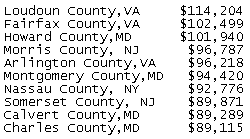
Based on 2009 Census Dept data, 7 of the 10 U.S. counties with the highest median incomes are located in the DC metro area.

image

The old Fed government ‘halo’ is shining …

SF Fed says “Obama Stimulus created (or saved) 2 million jobs … but they were costly and transient.

December 6, 2010

According to wonk site e21 …

The economists at San Francisco Federal Reserve bank just completed a major study of the Obama Stimulus.

The results suggest that the program did result in 2 million jobs “created or saved” by March 2010.  That’s less than the 3.5 million that Obama-Biden promised and touted.

More alarming,  they found that by August of this year, net job creation was statistically indistinguishable from zero.

Translation: They were all temporary jobs that have gone away already.

Taken at face value, this would suggest that the stimulus program (with an overall cost of $814 billion) worked only to generate temporary jobs at a cost of over $400,000 per worker.

Further, they concluded that even if the stimulus had in fact generated this level of employment as a durable outcome, it would still have been an extremely expensive way to generate employment.

Source article:
http://www.economics21.org/blog/outcome-stimulus-and-burden-proof

SF Fed Report:
http://www.frbsf.org/publications/economics/papers/2010/wp10-17bk.pdf

Ken’s UEI (Ultimate Economic Indicator) … the real gauge of the economy.

December 2, 2010

There are a lot of indicators bandied about to ‘prove’ how well or poorly the economy is doing.

There’s GDP, unemployment, CPI, and many, many other metrics.

Sometimes they provide a consistent view of the economy … sometimes they contradict.

Well, I’ve stumbled on the Ultimate Economic Indicator. An indisputable measure of economic activity.

Ken’s UEI: the number of days that it takes a “ships free” order from Amazon to arrive at my door.

Here’s the logic: When placing an order, Amazon projects that  a “ship free” item will be delivered in 7 to 10 days.

Hmmm.

Since I’m a cheapskate, I’ll always take the free shipping option and trade-off fast delivery for free shipping.

Then I started to notice that when the economy  is doing well, the shipments do take a week or so.

But, when business is slow, the shipments arrive 2 days after the order is placed.

Makes sense, since the ship free packages are – in essence – flying standby.

When the economy is steaming, planes and trucks are full and standby packages may hang on the shipping dock for a couple of days.

When business is slow, there’s plenty of space on the planes and trucks, so the standbys catch the first flight.

These days, the press is reporting gangbuster retail sales

But, I’m getting my ships free stuff the day after tomorrow.

Tells me that business is still slow.

Try it out …

What you earn is a function of what you learn …

October 22, 2010

I don’t often quote Bill Clinton (except for “depends on what the meaning of the ‘is’ is”) … but he’s on the mark with this one …

* * * * *

Slate, The Great Divergence: The United States of Inequality, Sept. 8, 2010

Bill Clinton said more than once when he was president, “What you earn is a function of what you learn.”

That had always been true, but Clinton’s point was that at the close of the 20th century it was becoming more true, because computers were transforming the marketplace. A manufacturing-based economy was giving way to a knowledge-based economy that had an upper class and a lower class but not much of a middle class.

The top is occupied by a group  labeled “symbolic analysts.”

These are people who “simplify reality into abstract images that can be rearranged, juggled, or experiment with” using “mathematical algorithms, legal arguments, financial gimmicks, scientific principles, psychological insights,” and other tools seldom acquired without a college or graduate degree.

At the bottom were providers of “in-person services” like waitressing, home health care, and security.

The middle, once occupied by factory workers, stenographers, and other moderately skilled laborers, is disappearing fast.

Did computerization create the Great Divergence?

* * * * *

In the 1950s, at the dawn of the computer age, people first began to worry that automation would bring about mass unemployment.

Computers represented an entirely different sort of new machine.

Previously, technology had performed physical tasks.

Computers were designed to perform cognitive tasks.

Theoretically, there was no limit to the kinds of work computers might eventually perform … “a system of almost unlimited productive capacity which requires progressively less human labor.”

The kinds of jobs computers tend to eliminate are those that require some thinking but not a lot — precisely the niche previously occupied by moderately skilled middle-class laborers.

Consider the sad tale of the bank teller. Over the last 30 years, people pretty much stopped ever stepping into the lobby of their bank; instead, they started using the automatic teller machine outside and eventually learned to manage their accounts from their personal computers or mobile phones.

Contemporary culture is so fixated on the computer revolution that the very word “technology” has become an informal synonym for “computers.”

But before computers we witnessed technological revolutions brought on by the advent of the automobile, the airplane, radio, television, the washing machine, the Xerox machine, and too many other devices to name.

Most of these earlier inventions had much the same effect as the computer—that is, they increased demand for progressively higher-skilled workers.

Full article:
http://www.slate.com/id/2266025/entry/2266508/

Must Read: Home Depot founder says "Stop Bashing Business, Mr. President"

October 15, 2010

This will the the buzz on the talk shows today.

Ken Langone was one of the 3 founders of Home Depot.

His Punch Line: “If we tried to start The Home Depot today, it’s a stone cold certainty that it would never have gotten off the ground.”

Highlights are below.  Worth reading the whole piece.

* * * * *

Excerpted from WSJ: Stop Bashing Business, Mr. President, Ken Langone, Oct.15, 2010 

Your insistence that your policies are necessary and beneficial to business is utterly at odds with what you and your administration are saying elsewhere. You pick a fight with the U.S. Chamber of Commerce, accusing it of using foreign money to influence congressional elections, something the chamber adamantly denies.

Your U.S. attorney in New York, Preet Bahrara, compares investment firms to Mexican drug cartels and says he wants the power to wiretap Wall Street when he sees fit.

And you drew guffaws of approving laughter with your car-wreck metaphor, recently telling a crowd that those who differ with your approach are “standing up on the road, sipping a Slurpee” while you are “shoving” and “sweating” to fix the broken-down jalopy of state.

Your short-sighted wavering—between condescending encouragement one day and hostile disparagement the next — creates uncertainty that, as any investor could tell you, causes economic paralysis. That’s because no one can tell what to expect next.

          * * * * *

If we tried to start Home Depot today, under the kind of onerous regulatory controls that you have advocated, it’s a stone cold certainty that our business would never get off the ground, much less thrive.

Rules against providing stock options would have prevented us from incentivizing worthy employees in the start-up phase—never mind the incredibly high cost of regulatory compliance overall and mandatory health insurance.

Still worse are the ever-rapacious trial lawyers.

          * * * * * 

Meantime, you seem obsessed with repealing tax cuts for “millionaires and billionaires.”

I stand behind no one in my enthusiasm and dedication to improving our society and especially our health care.

[I’m willing to pay higher taxes.] Just make sure that money actually reduces federal spending and isn’t simply shifted elsewhere.

I guarantee you that many millionaires and billionaires will gladly forego government benefits — as my wife and I already do when we forward those checks each month to charity.

Full article:
http://online.wsj.com/article/SB10001424052748704361504575552080488297188.html

“Hey dude, why are you snapping your fingers ?”

October 12, 2010

3 variants of a very old joke:

Original
A dazed guy is standing on a street corner snapping his fingers.  Curious guy approaches and asks “Hey dude, why are you snapping your fingers ?”  Dazed guy answers: “To keep away elephants”.  Curious guy says: “There aren’t any elephants around here.” Finger snapper says: “See.  It works.”

Current
A President is standing on a street corner spending like a drunken sailor.  Curious guy approaches and asks “Hey dude, why are you spending like a drunken sailor ?”  Free-spender answers: “To avert an economic depression”.  Curious guy says: “There’s no depression around here.”  President says: “See.  It works.”

Recent Past Version
A President is standing on a street corner ordering troops to Iraq.  Curious guy approaches and asks “Hey dude, why are you ordering troops to Iraq ?”  Troop-sender answers: “To avert another terrorist attack”.  Curious guy says: “There haven’t been any terrorist attacks since 9-11.”  President says: “See.  It works.”

Hmmm.

Why are only 2 of these counter-factuals considered far fetched by the media?

What per cent of Americans “always or usually” live from pay check to pay check ?

September 13, 2010

Answer:

Recent polls show that 61%of Americans “always or usually” live from pay check to pay check … up from 49% in 2008.

Source:
http://www.ft.com/cms/s/0/44d4b1c4-b52f-11df-9af8-00144feabdc0.html

Is Germany Ruining the Recovery?

September 2, 2010

Yesterday’s post – which suggested that Germany’s fiscal austerity is outperforming Obama’s ‘spend ‘til you drop’ program – seems to have piqued some interest.

As a follow-on, here are some highlights a New Republic article on the topic:

For months, top U.S. officials have begged the Germans to stay the course on their modest stimulus measures, fearing that a too-quick withdrawal would hamstring the European recovery and pose risks to the global economy.

But the Germans have stood firm, rejecting the administration’s Keynesian logic with rhetoric that can sound gratingly reminiscent of Republican talking points.

The Germans even dragged their feet over a stress test of European banks, complicating efforts to restore confidence in the continent’s balky financial system.

* * * * *

Welcome to economic stewardship in the age of German parochialism.

For years, the Germans could be relied upon to play a stabilizing role in Europe, subsuming their national self-interest to lofty visions of continental solidarity.

But, over the last decade, as German leadership has passed to a younger generation less compelled by the war’s memory and unbothered by the Soviet menace, the Germans have ceased to view Europe’s safekeeping as their historical responsibility.

* * * * *

The Americans and Germans spent a stretch of the spring debating the right time to close the stimulus spigot and start narrowing their deficits.

The Americans, haunted by the Great Depression, worried that countries would cut back too quickly and relapse into recession.

The Germans, haunted by their own interwar experience, worried that deficits would lead to a debilitating inflation.

* * * * *

Goodbye to Berlin: How Germany became a thorn in America’s side, August 30. 2010
http://www.tnr.com/article/politics/magazine76973/america-germany-global-finance-conflict?passthru=N2FjMThhMmJmYjU3YzQ2YTQ2YWU3YTZkMTljYTFhNjU

Fiddling while Rome burns …

August 27, 2010

How many pundit columns or TV clips have you seen in the past week that have opened with “Nobody begrudges the President with some hard earned R&R”?

OK, I just have to get this off my chest … I begrudge Obama his vacation.

Geez, he’s the POTUS … not Clark Griswald.

Ask any C-level exec if they’ve ever had a vacation cancelled, shortened, or interrupted by urgent company business

I’ll bet 100% say they did. I sure did.  Just ask my family.

There’s no more important job than POTUS … and — except for war or a plague — few matters more urgent than an economic meltdown.

According to the AP …

The government is about to confirm what many people have felt for some time: The economy barely has a pulse.

Today, the Commerce Department will revise its estimate for economic growth in the April-to-June period and Wall Street economists forecast it will be cut almost in half, to a 1.4 percent annual rate from 2.4 percent.

That’s a sharp slowdown from the first quarter, and economists say it’s a taste of the weakness to come.

Such slow growth won’t feel much like an economic recovery and won’t lead to much hiring.

The unemployment rate, now at 9.5 percent, could even rise by the end of the year.

Consumers can’t be sure their jobs are safe, with unemployment so high. Business executives don’t know if sales and profits will grow enough to justify adding jobs.

And potential changes to tax laws at the end of this year and other policy reforms also make it hard to plan ahead, economists say.

People have been overwhelmed by uncertainty.”

High unemployment is making it harder for people to make their mortgage payments and stay in their homes.

About 10% of homeowners have missed at least one mortgage payment this year.

AP, Snapshot of economy about to get a lot bleaker, Aug 27, 2010
http://news.yahoo.com/s/ap/20100827/ap_on_bi_go_ec_fi/us_economy

Rather than strolling around swanky Martha’s Vineyard showing folks what a cool dude he is, I’d like our POTUS at least acting like he’s engaged on the economic problem.

Whatever happened to “”I will not rest until (fill in the blank)”

Oh, I know that he took time for a conference call with his economic advisers.

Big deal.

The outcome: stimulus was a grand success, staying the course with people and programs, not to worry – the home winterizing credits and solar panel tax incentives are still in play.

Give me a break …

Flash: Michael Moore may be onto something… well, kinda.

August 16, 2010

An article in The Daily Beast — by super-sized, unconscionably rich, uber-lib Michael Moore – caught my eye.  In it, Moore says:

To understand what’s happening (in the economy), we have to focus on the bottom line, just like CEOs do.

And what the bottom line says is that the entire business world has figured out how to make huge buckets of money without hiring people to work for them.

I’m not sure how in the long run this benefits these companies. Maybe the same robots who make most things now are also programmed to buy them?

But the upshot is this: We have to face the fact that most of America’s CEOs don’t want the economy to get “better.”

Because for them, it couldn’t get better—they’ve got profit coming out their ears, while with 9.5 percent unemployment their entire workforce is too scared to ask for a 25 cent-an-hour raise.

They’d be happy to have things stay just like they are now. Forever.

Profits Up at GM! And You’re Still Unemployed by Michael Moore, Aug 13, 2001
http://www.thedailybeast.com/blogs-and-stories/2010-08-13/gm-profits-michael-moore-on-unemployment-gm-hiring-new-ceo/?cid=hp:mainpromo1

I think Moore’s conclusion that CEOs don’t want the economy to get better is just plain nuts.

But, he’s onto something: the entire business world has figured out how to make huge buckets of money without hiring people.

Well, maybe not the entire business world, but a big chunk of it.

Fact is that businesses always use economic slowdowns to purge themselves of organizational fat that has accumulated in good years.  This slowdown is no exception.

The differences:

(1) more fat had accumulated this time so the cuts appear deeper

(2) companies are rebuilding their cash balances so that – if there is a double dip – they won’t have to grovel for gov’t aid again

(3) few companies  are expecting a quick return to growth —  so hiring freezes are in place

(4) surviving employees are stepping up and delivering productivity increases

(5) ObamaCare, etc., have substantially increased the cost per employee – so there’s less economic advantage to hiring.

How many millionaires are there in the U.S. ? … and some other interesting economic factoids

August 16, 2010

For an update see our later post How many millionaires & billionaires are there in the US ?

* * * * *
From the BusinessInsider.com :

  • In 2009, the number of millionaires in the United States rose 16 percent to 7.8 million.
  • The top 10% of Americans now earn around 50% of our national income.
  • 83 percent of all U.S. stocks are in the hands of 1 percent of the people.
  • The bottom 80 percent of American households held about 7% of the liquid financial assets.
  • The bottom 50 percent of income earners in the United States now collectively own less than 1 percent of the nation’s wealth.
  • 61 percent of Americans “always or usually” live paycheck to paycheck, which isup from 49 percent in 2008 and 43 percent in 2007.
  • More than 40 million Americans are on food stamps.
  • 21 percent of all children in the United States are living below the poverty line
  • 36 percent of Americans say that they don’t contribute anything to retirement savings.
  • 43 percent of Americans have less than $10,000 saved up for retirement.
  • 24% of American workers say that they have postponed their planned retirement age in the past year.
  • The average federal worker now earns 60% MORE than the average worker in the private sector.
  • More than 40% of Americans who are employed are now working in service jobs.
  • In China a garment worker makes approximately 86 cents an hour and in Cambodia a garment worker makes approximately 22 cents an hour.

* * * * *

Source: 22 Statistics That Prove The Middle Class Is Being Systematically Wiped Out Of Existence In America 

>> Current Posts

How much does a ‘for sale’ home’s list price matter?

August 13, 2010

Answer: a lot … it’s the psychological effect called anchoring.

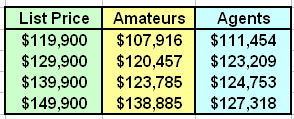
For example, researchers asked both professional real estate agents and man-off-the-street amateurs to predict the final selling price of a house.

They were all told that the current tax appraisal value of the house was $135,000.

Then, each respondent was told that the house was listed in one of four prices — ranging from $119,900 to $149,900.

The researchers found a clear positive correlation between list prices and predicted sale prices.

The amateur is responded more to the differences in list prices and the professionals — but even the pros and a $15,000 spread that can only be attributed to the differences in the list prices.

Bottom line: if you’re selling a home beach for the sky with your list price; if you’re buying a home try to ignore the list price and focus on more fundamental values like tax assessments and comparable sales

image

Source: Priceless, William Poundstone, Hill and Wang Books, 2010

How much does a ‘for sale’ home’s list price matter?

August 13, 2010

Answer: a lot … it’s the psychological effect called anchoring.

For example, researchers asked both professional real estate agents and man-off-the-street amateurs to predict the final selling price of a house.

They were all told that the current tax appraisal value of the house was $135,000.

Then, each respondent was told that the house was listed in one of four prices — ranging from $119,900 to $149,900.

The researchers found a clear positive correlation between list prices and predicted sale prices.

The amateur is responded more to the differences in list prices and the professionals — but even the pros and a $15,000 spread that can only be attributed to the differences in the list prices.

Bottom line: if you’re selling a home beach for the sky with your list price; if you’re buying a home try to ignore the list price and focus on more fundamental values like tax assessments and comparable sales

image

Source: Priceless, William Poundstone, Hill and Wang Books, 2010

Just in case you still think the Stimulus stimulated … a great analysis!

August 10, 2010

The Administration (and mainstream media) have been touting a recent paper by Alan Blinder and Mark Zandi that apparently vindicates the Obama stimulus plan, claiming  that if not for the response of the federal government, the unemployment rate would be 15.7 percent, far higher than the current 9.5 percent …  and understandably way higher than the promised 8%.

Yeah, right.

First, not noted by the press,  most of the positive effects cited in the paper came not from the stimulus but from stabilizing actions of the Federal Reserve, the FDIC, and TARP.

Second, the paper argues that the 8% promise was impaired because Romer & Bernstein didn’t adequately dope out how bad the economy really was.

The below analysis shreds the “starting point” argument and concludes that the stimulus program achieved – in effect – nothing  … except for boosting the national debt by a trillion dollars.

* * * * *

Excerpted from Weekly Standard: Did the Stimulus Stimulate?, Lawrence B. Lindsey, August 16, 2010

In January 2009, Christina Romer, who resigned last Friday as chairman of the president’s Council of Economic Advisers, and Jared Bern-stein, chief economic adviser to Vice President Biden, published a paper projecting what would happen if President Obama’s proposed stimulus package passed, compared with what would happen if it did not.

The Romer-Bernstein paper has often been cited as saying that if the package passed, the unemployment rate would peak below 8 percent in the middle of 2009 and would decline to below 7.5 percent by now.

Obviously this has not happened.

The administration argues that it is not fair to conclude that this proves the package was a failure since Romer and Bernstein underestimated the severity of the recession and that unemployment was already 8.2 percent in the first quarter of 2009, higher than the assumed peak.

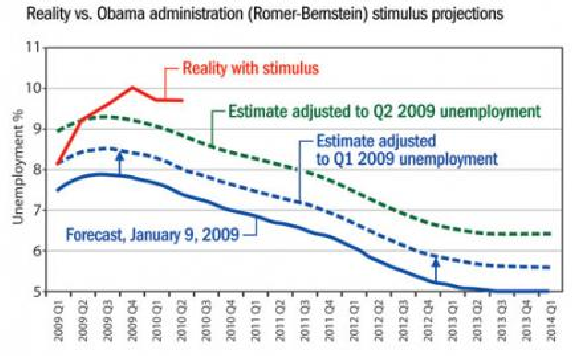
The chart below corrects for their complaint by raising their estimate of where unemployment started in their experiment.

image

The lowest line provides the original estimate of the path of unemployment provided by Romer and Bernstein on January 9, 2009.

The second line replicates the Romer and Bernstein path, but raises the initial unemployment rate from their assumed 7.5 percent to 8.2 percent. This was the actual average of the unemployment rate in the first quarter of 2009, the period in which the stimulus was passed.

The third line provides a more extreme alternative by raising the initial unemployment rate to the 9.3 percent average of the second quarter 2009.

The first modification fully compensates for their objection while the second modification more than compensates for their concern.

But as the chart shows, the problem with the stimulus wasn’t just the starting point — it was that the stimulus itself has been ineffective at lowering it.

The actual unemployment rate, given by the red solid line, is not only above the original Romer-Bernstein projections, but also above projections that take account of the “starting point” problem.

Actual unemployment has been consistently above all of the projections, regardless of starting point, because the stimulus bill has basically brought no relief in terms of lower unemployment.

Full article:
http://www.weeklystandard.com/articles/did-stimulus-stimulate

Why is economics called the dismal science?

August 9, 2010

According to conservative economist Thomas Sowell:

Economics was christened the dismal science because it deals the allocation of scarce resources with inescapable constraints and painful trade-offs, instead of more pleasant, unbounded visions and their accompanying inspiring rhetoric, which many find so attractive in politics and in the media.

Moreover, economics follows the unfolding consequences of decisions over time, not just what happens in the very short run. That is, economics deals as well with second and third-order effects and unintended consequences.

And, economics focuses analytical comparisons against next best alternatives, not idealistic scenarios of perfection.

Source:Applied Economics, Basic Books, 2009

Romer’s Legacy: “Spend a trillion and unemployment will stay under 8%”

August 6, 2010

Which metaphor applies ?

Was she thrown under the bus or did she jump off the ship?

Romer’s history of academic research concluded that Keynesian fiscal stimulus doesn’t work.

Then, she drank the kool-aid and shilled for Obama’s trillion dollar faux-stimulus spending spree.

She seemed smart enough and sincere enough, that one had to think that she was dying of hypocrisy on the inside.

Now, after a short 18 months as Obama’s chief economic spokesperson, Romer woke up and realized that her youngest child was going to start high school, so she needed to move back to California,

Yeah, right.

If she didn’t see that one coming 18 months ago, how could she possibly forecast the economy?

I feel for the lady. 

She’ll end up being remembered for her 8% promise — which will go down in the history books next to “Mission Accomplished”.

If only she had maintained her academic integrity …

* * * * *

Excerpted from WAJ: Romer to Resign as Obama Adviser,  August 6, 2010

Christina Romer said she would resign as chairman of President Barack Obama’s Council of Economic Advisers to return to her teaching post at the University of California at Berkeley, effective Sept. 3.

Ms. Romer is the second member of Mr. Obama’s economic team to leave.

White House budget director Peter Orszag left earlier this summer.

She said she is returning to California so the youngest of her three children can begin high school there.

Among her challenges was explaining why her prediction that the Obama-backed fiscal stimulus would keep the unemployment rate below 8% proved overly optimistic. The unemployment rate is now at 9.5%.

Ms. Romer’s academic work focused, among other things, on the causes of and recovery from the Great Depression and the impact of monetary, spending and tax policy on the economy.

Her 19 months in Washington has confirmed some of her prior beliefs …

Full article:
http://online.wsj.com/article/SB10001424052748704657504575411973910324964.html?mod=WSJ_hps_SECONDTopStories

Geithner declares Mission Accomplished: “Welcome to the Recovery”

August 6, 2010

Well, Treasury Secretary Tim Geithner did it. He declared Mission Accomplished.

In a New York Times op-ed, titled Welcome to the Recovery, he argues that the Administration’s economic plan is working — even better than expected.

“Recent data on the American economy shows that we are on a path back to growth.”

Among his points:

“From the start, President Obama made clear that recovery from a crisis of this magnitude would not come quickly”

Ken’s Note: Well actually, the president said that the almost $1 trillion in stimulus money would be quickly deployed to shovel ready projects that would keep the unemployment rate under 8%. As everybody knows, it has been hovering just shy of double digits.

“The new data show that this recession was even deeper than previously estimated.”

English translation: Our initial analysis was deeply flawed, but you can trust that we’ve got this sucker figured out now. Don’t judge us based on our track record.

“We  expect the unemployment rate to go up before it goes down.”

Ken’s Note: How much recovery can we stand?

“The economic collapse drove tax revenue down, pushing the annual deficit up to $1.3 trillion by last January.”

Ken’s Note: Who could ever have imagined that lower aggregate income would generate less tax revenue

“It would be irresponsible to continue the Bush tax cuts for the wealthy.”

English translation: Let’s defy all empirical evidence and see what happens when you raise taxes during a recession.

Kens Note: I love it when a guy who was caught cheating on his taxes lectures on taxpaying responsibility.

* * * * *

I don’t know about you, but I slept well last night…

NY Times, Welcome to the Recovery, August 2, 2010
http://www.nytimes.com/2010/08/03/opinion/03geithner.html?_r=1&ref=opinion

Is that a Mercedes in the Dollar General parking lot?

August 3, 2010

Punch line: Americans are broke and depressed — and also swilling $3 lattes and waiting in line for iPhones.

Go figure.

* * * * *
Highlights from Bloomberg Business Week:The New Abnormal, July 29, 2010

The new abnormal has given rise to a nation of schizophrenic consumers — dollar stores and luxury. They splurge on high-end discretionary items and cut back on brand-name toothpaste and shampoo.

Companies like Apple and Starbucks  are thriving. Mercedes-Benz is having a record sales year.

The irony is that it is often the same people juggling iPhones and venti lattes who are open to switching to off-brand laundry detergents — abandoning Ivory soap and Crest toothpaste for generic brands.

They may also be sneaking into discount retailers for these deals.

The dollar store is the new Target … You go in there to buy shampoo for a buck so you can go to Starbucks and justify spending $3 for a coffee … you buy cheap towels there before hitting a pricey spa.”

What’s going on?

“Some consumers are probably liquidity-constrained … and aren’t buying iPads.

But 90 percent of Americans do have a job, and maybe 70 percent are confident about them. And maybe half of those have liquidity.”

“Consumers’ brains lack a line that separates spending from saving. Instead they practice a certain amount of thrift to justify blowing a large sum frivolously.”

People are saying, ‘There is still risk. I gotta cut back … but life has to have some normalcy. I have to have some luxuries.”

Full article:
http://www.businessweek.com/magazine/content/10_32/b4190050473272_page_4.htm

The economy: Light at the end of the tunnel ?

August 2, 2010

Nope.  Not according to the AP’s survey of leading economists.

That’s confusing (to me) since the President said on the view that he’s got this one under control.

Who to believe ?

* * * * *

Excerpted from: AP survey: A bleaker outlook for economy into 2011, July 29,2010

The U.S. economic recovery will remain slow deep into next year, held back by shoppers reluctant to spend and employers hesitant to hire, according to an Associated Press survey of leading economists.

Economists have turned gloomier in the past three months as “we hit an air pocket in consumer spending,”  They foresee weaker growth – less than 3% — and higher unemployment than they did before.

Growth would have to equal 5 percent for a full year to drive the unemployment rate down by 1 percentage point. Neither the economists in the AP survey nor the Obama administration expects that to happen.

More specifically, economists  forecast:

  • Economic growth the rest of this year and early next year will weaken, to less than 3 percent. From January through May, the economy grew at roughly a 3.5 percent pace.
  • The unemployment rate will be no lower at the end of the year than it is now — 9.5 percent. It will be 2015 or later before the rate falls to a historically normal 5 percent.
  • State budget shortfalls pose a “significant” or “severe” risk to the national economy. The loss of tax revenue has forced state and local governments to cut services and lay off workers. State and local governments cut their spending in the first three months of this year by 3.8%. The drop in state and local government spending shaved about half a percentage point off the U.S. gross domestic product in the first three months of this year.

Full article:
http://www.google.com/hostednews/ap/article/ALeqM5ioRXliVfpQrwlEITOiWDGlofCQfAD9H8FSJ80

“Make no mistake, we’re headed in the right direction” … oh, yeah ?

August 2, 2010

Ken’s Take: Q2 GDP growth was 2.4% … 3% is required to hold the unemployment rate constant … that means that next week’s unemployment rate will tick up … unless more unemployeds get discouraged, stop looking for work and don’t get counted in the denominator.

Doesn’t sound like the right direction to me …

* * * * *

Highlights from WSJ: The 2.4% Recovery, July 31, 2010

Savings by households also increased again, to above 6%, which is back to the range of the early 1990s and is a healthy sign.

The great deleveraging that began with business last year is now continuing with consumers.

While some economists fret that this is bad for consumer “demand,” savings don’t vanish from the economy. They are recycled into lending and investment that can drive future growth if businesses see the right opportunities and have enough confidence.

Ken’s Note: the savings do “vanish” if repaid lenders are also shoring up their balance sheets, i.e. holding the capital in reserve – by law or by desire.

* * * * *

The Obama Administration, in its Keynesian confusion, is simultaneously saying the economy is so weak it needs more spending “stimulus” but also strong enough to absorb a huge tax increase.

The message of 2.4% second quarter growth is closer to the opposite: The epic government stimulus has failed to produce the robust expansion the White House promised, and the prospect of higher taxes and more regulation is inhibiting the private animal spirits needed for growth to accelerate.

Ken’s Note: the fight over the Bush tax cuts will be fun to watch … my bet: it’ll be another GITMO … lots of rhetoric, but Bush had it right.

* * * * *

Full article:
http://online.wsj.com/article/SB10001424052748703999304575399490468359832.html?mod=WSJ_Opinion_LEADTop

Smackdown: Obama versus business …

July 30, 2010

At a recent cocktail party, in a lightning strike occurrence, I brushed up to a real, live CEO. 

He’s a member of the Business Roundtable, so I said “glad to see you guys speaking out on Obama’s policies”.

He said “yeah, we figured he’s going to screw us any way, so we might as well speak out”.

He also said Obama sent some communications flunky to address the group – she said “you gotta understand, it’s good politics for us to beat up on you guys.”

She should have added “now, go out there and save or create some jobs for us.”

Might work …

* * * * *

Excerpted from FT: Obama needs to stop baiting business, Mort Zuckerman, July 26 2010

The growing tension between the Obama administration and business is a cause for national concern.

The president has lost the confidence of employers, whose worries over taxes and the increased costs of new regulation are holding back investment and growth. The government must appreciate that confidence is an imperative if business is to invest, take risks and put the millions of unemployed back to productive work.

One unfortunate pattern that has emerged in the past 18 months is to lay all the blame for our difficulties on the business community and the financial world. This quite ignores the role of Congress in many areas, most glaringly in forcing Fannie Mae, Freddie Mac and the Federal Housing Administration to make loans to people who could not afford them. Then there is the Securities and Exchange Commission, which raised acceptable levels of leverage for financial institutions.

The predilection to blame business was manifest in one of President Barack Obama’s recent speeches.

He was supposed to be seeking the support of the business community for a doubling of exports over the next five years. Instead he lashed out at “unscrupulous and underhanded businesses, who are unencumbered by any restriction on activities that might harm the environment, take advantage of middle-class families, or, as we’ve seen, threaten to bring down the entire financial system.”

This kind of gratuitous and overstated demonization – widely seen in the business community as a resort to economic populism on the part of Mr Obama to shore up the growing weakness in his political standing – is exactly the wrong approach.

It ignores his disappointing stimulus program, which was ill-designed to produce the jobs the president promised. It also undermines the confidence that business needs to find if it is to invest in the face of a new generation of regulations, increased bureaucracy and higher taxes.

Disillusion has spread to the Business Roundtable, the US Chamber of Commerce and the National Federation of Independent Business, which represents small businesses.

The chief economist of the NFIB recently wrote: “Business owners do not trust the economic policies in place or proposed … the US economy faces hurricane-force headwinds and the government is at the center of the storm, making an economic recovery very difficult.”

Full article:
http://www.ft.com/cms/s/0/a18bd9a2-98e6-11df-9418-00144feab49a.html

The “Paradox of Thrift”… explains a lot.

July 27, 2010

Here’s why much of Stimulus has been ineffective in actually stimulating the economy …

The meltdown occurred largely because consumers (and businesses) were over-leveraged. That is, they were carrying too much debt – way too much debt.

When asset values plummeted (think home prices) panic understandably set in.

So, any “free cash” that flows in (think gov’t rebate checks) goes to retiring debt (i.e. deleveraging) instead of consumption.  That’s good for balance sheets, but doesn’t stimulate the economy.

Economists call it the “paradox of thrift.”

^ ^ ^ ^ ^

Excerpted from Minyanville.com: Why There’s No Case for Healthy Economic Growth, Jul 23, 2010

The consumer is simply carrying too much debt.

In the US, consumption represents 70% of GDP, but the consumers’ debt/GDP ratio, which spurted from 100% in 2001 to more than 135% in 2008, still stands at 126%, nearly three years after the recession began.

Much of the nine-percentage-point decline is due to financial institution write-offs as opposed to debt repayment, so it appears that the consumer has a long way to go to even get back to the 100% ratio. The next healthy economic upswing must await the healing of household balance sheets.

Unfortunately, to get a healthy consumer balance sheet, savings must increase to repay the debt, which leaves less for consumption.

Lower consumption means slower economic growth with all the attendant implications for employment.

This is known in the economics profession as “the paradox of thrift.”

Unfortunately, the politicians are promoting ill-conceived schemes that wind up only prolonging the agony — like “Cash for Clunkers” and the “homebuyer tax credit.” These programs promote more debt which will have to be reduced in the future

The need to work off debt together with the loss of retirement income by the baby boomers will cause them to put off retirement for several years.

This will trickle down to the younger generation who will find it increasingly difficult to find satisfactory employment.

We’ll see the U6 unemployment measure (which counts the underemployed) continue to stay high – very high.

Full article:
http://www.minyanville.com/businessmarkets/articles/overconsumption-economy-consumers-finance-investors-economcy/7/23/2010/id/29290

Economy’s weak, so let’s spend and tax … huh ?

July 26, 2010

I continue to be dismayed by the Administration’s lack of business savvy, economic unorthodoxy (despite lack of success), and steaming contradictions …

* * * * *

Excerpted from WSJ: Liberal Tax Revolt, July 23, 2010

Only in the age of Obama have Democrats convinced themselves that the best “stimulus” is higher spending and higher taxes.

There’s nothing like the prospect of an electoral rout to concentrate the incumbent mind, and so all of a sudden rank-and-file Democrats in Congress are saying maybe they shouldn’t let the 2003 tax rates expire after all.

The revelation that “as a general rule, you don’t want to be  raising taxes in the midst of a downturn.” tax increases has recently been heard from Senators Evan Bayh of Indiana, Ben Nelson of Nebraska, and, most surprising, even from Kent Conrad of North Dakota. On a scale of unlikely events, this is like the Pope coming out against celibacy.

These are hardly supply-side conversions, but they’re a start.

As for  Pelosi,  Geithner and Obama, they remain prisoners of their spend-and-tax dogma.

Geithner declared that the tax increases will arrive as scheduled.

So the same Mr. Geithner who says the economy is weak enough that we must have new spending “stimulus” says it is strong enough to endure a huge tax increase.

Go figure.

* * * * *

New data from, of all places, the Democratic-run Joint Committee on Taxation show that in 2011 roughly 750,000 taxpayers with net business income will pay the highest marginal rate of 39.6% or the next highest bracket of 36% (up from 33%) – that’s a higher rate than Goldman Sachs will be paying.

About half of the roughly $1 trillion of total net business income will also be reported on those returns.

In a stroke, that will make tens of billions of dollars unavailable to invest or to hire new workers.

* * * * *

Full article:
http://online.wsj.com/article/SB10001424052748703467304575383233009284878.html?mod=WSJ_newsreel_opinion

“Every economist agrees that the Stimulus worked” … oh, really ?

July 21, 2010

That’s what the President keeps saying.

Michael Boskin – a senior professor of economics at Stanford University – disagrees … as do dozens of his colleagues.

* * * * *

Excerpted from WSJ: Obama’s Economic Fish Stories, July 21, 2010

President Obama says “every economist who’s looked at it says that the Recovery Act has done its job” — i.e., the stimulus bill has turned the economy around.

That’s nonsense.

Opinions differ widely and many leading economists believe that its impact has been small.

Why?

The expectation of future spending and future tax hikes to pay for the stimulus and Mr. Obama’s vast expansion of government are more than offsetting any direct short-run expansionary effect. That is standard in all macroeconomic theories.

So, as I and others warned, the permanent government expansion and higher tax rate agenda is a classic example of what not to do during bad economic times.

The president does not say that economists agree that the high future taxes to finance the stimulus will hurt the economy.

Mr. Obama’s economic statements are increasingly divorced not only from competing viewpoints but from those of his own economic advisers, e.g. he claims that the stimulus bill was several times more potent than his chief economic adviser estimates.

The stimulus bill has assumed certain mystic powers in administration discourse, but revoking the laws of arithmetic shouldn’t be one of them.

At the very least, his staff needs to avoid putting these exaggerations on the teleprompter.

It undermines confidence and raises concerns about competence. It’s doing nobody any good—not the economy and certainly not Mr. Obama.

Full article:
http://online.wsj.com/article/SB10001424052748703724104575378751776758256.html

Yesterday the Homa Files, today the Wall Street Journal …

June 25, 2010

Yesterday, the Homa Files posted ”Business Roundtable CEOs come out of the closet … “
https://kenhoma.wordpress.com/2010/06/24/business-roundtable-ceos-come-out-of-the-closet/

Punch line:  CEOs are finally speaking out about Obama’s anti-business policies.

Today, the WSJ is on the case

WSJ, Business’s Buyer’s Remorse, June 25, 2010
http://online.wsj.com/article/SB10001424052748704911704575327241599453032.html?mod=WSJ_Opinion_BelowLEFTSecond

Punch line:  For cooperating with the White House, member companies of the Business Roundtable gets socked with higher taxes and more regulations.

Think the WSJ editors read the Homa Files ?

Business Roundtable CEOs come out of the closet …

June 24, 2010

This is a big deal.

The Business Roundtable – the CEO “club” – has stopped playing nice-nice with the President and gone public with a 54 page listing of specifics on how the Obama administration is stifling business growth and employment prospects.

This is important for 2 reasons:

1) The policy concerns are what’s keeping CEOs from hiring.  It’s why unemployent levels will stay around 10% for the foreseeable future.

2) The letter and speech represent a new boldness on the part of the CEOs

I’ve heard directly from a Roundtable member that that the group had been silent on their concerns because, initially, they expected Obama to “move to the middle” and wanted to give him some time. Then, when they saw how vindictive and punishing the administration was towards certain industries and specific companies, they were afraid to speak out.  Now, they figure “what the hell”.

It’s too bad that the McChrystal situation hogged the air the past couple of days … that pushed these public grievances off the front pages.

* * * * *

Excerpted from WSJ : Business Leader Slams ‘Hostile’ Policies on Jobs, June 23, 2010

Where the U.S. Chamber of Commerce, the other big business group in the capital, has been openly confrontational with the administration, the Business Roundtable — whose member companies pay 60% of U.S. corporate taxes and employ 12 million people — has until now been reluctant to criticize its policies in public. That has changed.

Verizon CEO Ivan Seidenberg, current head of one of the nation’s most influential business groups, slammed the Obama administration for decisions he said “create an increasingly hostile environment for investment and job creation.” He urged the administration to “focus on the big goal,” meaning job growth, “and stop trying to micromanage industries.  By reaching into virtually every sector of economic life, government is injecting uncertainty into the marketplace and making it harder to raise capital and create new businesses … the government needs to be removing itself from the private sector.”

The comments mark one of the sharpest breaks between top executives and the Obama White House. Mr. Seidenberg used  his speech at Washington’s Economic Club to unleash a list of policy grievances over taxes, trade and financial regulation.

  • Increased taxes on foreign earnings
  • Stalled free-trade agreements
  • Shareholder rights to nominate directors
  • End to secret ballots in union elections
  • Expanded damages for pay discriminationEPA regulation of greenhouse gases 

White House spokeswoman Jennifer Psaki said businesses would be helped by the administration’s policies, including its overhaul of the health-care system and promotion of clean energy. “The president has consistently pursued policies designed to create a better climate for American businesses in order to foster job creation, innovation and economic growth,” she said.

http://online.wsj.com/article/SB10001424052748704853404575322931249166908.html?KEYWORDS=business+roundtable

Business Roundtable CEOs come out of the closet …

June 24, 2010

This is a big deal.

The Business Roundtable – the CEO “club” – has stopped playing nice-nice with the President and gone public with a 54 page listing of specifics on how the Obama administration is stifling business growth and employment prospects.

This is important for 2 reasons:

1) The policy concerns are what’s keeping CEOs from hiring.  It’s why unemployent levels will stay around 10% for the foreseeable future.

2) The letter and speech represent a new boldness on the part of the CEOs

I’ve heard directly from a Roundtable member that that the group had been silent on their concerns because, initially, they expected Obama to “move to the middle” and wanted to give him some time. Then, when they saw how vindictive and punishing the administration was towards certain industries and specific companies, they were afraid to speak out.  Now, they figure “what the hell”.

It’s too bad that the McChrystal situation hogged the air the past couple of days … that pushed these public grievances off the front pages.

* * * * *

Excerpted from WSJ : Business Leader Slams ‘Hostile’ Policies on Jobs, June 23, 2010

Where the U.S. Chamber of Commerce, the other big business group in the capital, has been openly confrontational with the administration, the Business Roundtable — whose member companies pay 60% of U.S. corporate taxes and employ 12 million people — has until now been reluctant to criticize its policies in public. That has changed.

Verizon CEO Ivan Seidenberg, current head of one of the nation’s most influential business groups, slammed the Obama administration for decisions he said “create an increasingly hostile environment for investment and job creation.” He urged the administration to “focus on the big goal,” meaning job growth, “and stop trying to micromanage industries.  By reaching into virtually every sector of economic life, government is injecting uncertainty into the marketplace and making it harder to raise capital and create new businesses … the government needs to be removing itself from the private sector.”

The comments mark one of the sharpest breaks between top executives and the Obama White House. Mr. Seidenberg used  his speech at Washington’s Economic Club to unleash a list of policy grievances over taxes, trade and financial regulation.

  • Increased taxes on foreign earnings
  • Stalled free-trade agreements
  • Shareholder rights to nominate directors
  • End to secret ballots in union elections
  • Expanded damages for pay discriminationEPA regulation of greenhouse gases 

White House spokeswoman Jennifer Psaki said businesses would be helped by the administration’s policies, including its overhaul of the health-care system and promotion of clean energy. “The president has consistently pursued policies designed to create a better climate for American businesses in order to foster job creation, innovation and economic growth,” she said.

http://online.wsj.com/article/SB10001424052748704853404575322931249166908.html?KEYWORDS=business+roundtable

Surprise, surprise: It’s the wealthy that drive retail sales … so, tax ‘em to improve the economy … huh ?

June 16, 2010

A new poll from Gallup (chart below) confirms that consumers who make more than $90,000 account for practically all of the periodic variation in consumer spending.

Upper-income Americans’ self-reported spending averages about $120 per day – about twice the spending level of those making less than $90,000.

Note that lower income spending is practically flatlined at $60 per day. Makes sense since most of the spending is on necessities (or at least I hope so).

But, upper income spending ranges plus or minus 20% – from about $100 per day when times are perceived to be tougher, to $145 per day when optimism reigns.

Couple of implications …

These days, gov’t programs (e,g, via Obama’s dollar-a-day “make work pay” tax rebate) don’t move the needle on lower income spending … not even the dollar-a-day seems to flow through.

Higher taxes on the wealthy drive them to the lower limit of their spending ($100 per day) … from their higher limit ($145 per day). 

Impact on the recovery?  Draw your own conclusion …

image

Source article: WSJ, Wealthy Are the Only Ones Spending, June 11, 2010
http://blogs.wsj.com/economics/2010/06/10/wealthy-are-the-only-ones-spending/

What does $1 trillion (plus or minus) get you these days ?

June 1, 2010

Answer: If perception is reality, then not much.

Stimulus spending has far exceeded $1 trillion (don’t forget Fed actions and bailouts).

Since the 3 to 4 million jobs saved or created was discarded as a metric, we’ve got look elsewhere for performance measurements.

How about how people assess the effect of Obama’s economic programs on them personally ?

Left-leaning CBS conducted a poll and found that:

  • More people think Obama’s economic programs have hurt (18%), rather than helping them (13%)
  • Less than 1 in 4 Dems think Obama’s economic programs have helped them
  • The vast majority — 68% – think Obama’s economic programs have had no effect on them

So, taking the most favorable view, people think that a trillion dollars in added debt has bought us, well, nothing.

Oops.

image
http://www.cbsnews.com/htdocs/pdf/poll_052510.pdf?tag=contentMain;contentBody

Decades of economic pain … until lucrative union & government pension plans go to the graveyard.

May 7, 2010

I’m a believer that commitments should be kept.  Even when they turn out to be disadvantageous.

So, I’m conflicted.

For decades, companies and governments have made major concessions to their employees — often reflected in lucrative retirement and pension plans (think UAW and Federal gov’t), regarded as too distant in the future to worry about, and inconsequential if growth rates stayed very high.

Well, now they (and we) are paying to the piper.

The pension obligations in most states and for many companies is choking the economic horse.

And, there’s no means of avoiding the burdensome costs — save for reneging on past deals made.

Since I rule out that option, I see our economy saddled by these obligations until retirees have the political courtesy to go meet their maker. 

That’ll take awhile … though the rate may accelerate under ObamaCare’s seniors’ rationing rule.  Hmmm …

* * * * *

Excerpted from WSJ: How to Tackle Government Labor Costs, April 29, 2010

State and local governments’ … pension obligations are underfunded to the tune of $1 trillion … propelled over the last decade by rising municipal employment.

The inescapable conclusion: Labor costs, which at $1.1 trillion in 2008 account for half of state and local spending, simply must come down.

Years ago, there was an informal “social contract” — public employees generally received lower wages than private-sector workers, and in return they got earlier retirement and generous pensions, allowing them to catch up.

For years, state and local government employees have received pay increases in excess of inflation, and they now have wages that are 34% higher on average than in the private sector.

Partly responsible for these trends is unionized …  pay levels higher than needed to attract qualified employees. The average quit rate among state and local employees is a third of that in the private sector.

Public employees also have a 70% advantage in benefits. Health insurance, retirement benefits, life insurance and paid sick leave are not only much more available to them, but much richer. In 2009, the costs of health insurance were 2.18 times as much for state and local employees as for private-sector workers.

Public-sector retirement costs also are high because many can retire at age 55 after 30 years of employment with pensions equal to 60% or more of final salary, which is often jacked up by lots of overtime in final working years. In some states, employees can “double dip” by retiring early and then resuming their previous jobs or taking other government positions. So they get salaries and pensions at the same time.

With slow economic growth, limited income expansion and high unemployment likely in future years, a taxpayer revolt may be brewing.

Americans still want basic municipal services like police and fire protection, good schools for their kids, clean streets and garbage collection, but at lower costs and budgets that don’t kick the deficit can down the road.

State and local government labor costs can be reduced in an orderly way.

  • Following in the footsteps of bankrupt GM, two-tier wage structures would allow existing employees to continue at current salaries, but pay new hires much lower wages that are nevertheless adequate to attract and retain qualified people.
  • And the new people can be enrolled in defined-contribution pension plans that require employee contributions instead of defined-benefit plans. Retirement ages can be increased.
  • While waiting for existing employees to retire, their pay can be frozen.
  • Pension formulas can be reformed to avoid the system being gamed by heavy overtime in final years on the job, and double-dipping can be eliminated.
  • Retirees in the public sector can be required, as they are in the private sector, to pay meaningful shares of their health-care costs.

These changes would be profound and shake up the high-paid, secure image of state and local government jobs. But essential services would still be delivered, only much more cost effectively. Push has come to shove.

Full article:
http://online.wsj.com/article/SB10001424052748704131404575117943161614762.html?mod=djemEditorialPage_h

McKinsey: A marketer’s guide to applying behavioral economics

March 18, 2010

TakeAway: Marketers have been applying behavioral economics—often unknowingly—for years. A more systematic approach can unlock significant value.

* * * * *

Excerpted from McKinsey Online: A marketer’s guide to behavioral economics, Feb. 2010

Long before behavioral economics had a name, marketers were using it.

“Three for the price of two” offers and extended-payment layaway plans became widespread because they worked — not because marketers had run scientific studies showing that people prefer a supposedly free incentive to an equivalent price discount or that people often behave irrationally when thinking about future consequences.

Here are four practical techniques that should be part of every marketer’s tool kit.

1. Make a product’s cost less painful 
In marketing practice, many factors influence the way consumers value a dollar and how much pain they feel upon spending it.

Retailers know that allowing consumers to delay payment can dramatically increase their willingness to buy.

One reason delayed payments work is perfectly logical: the time value of money makes future payments less costly than immediate ones. But there is a second, less rational basis for this phenomenon. Payments, like all losses, are viscerally unpleasant. Even small delays in payment can soften the immediate sting of parting with your money and remove an important barrier to purchase.

Consumers use different mental accounts for money they obtain from different sources.

Commonly observed mental accounts include windfall gains, pocket money, income, and savings. Windfall gains and pocket money are usually the easiest for consumers to spend. Income is less easy to relinquish, and savings the most difficult of all.

2. Harness the power of a default option
The evidence is overwhelming that presenting one option as a default increases the chance it will be chosen.

Defaults — what you get if you don’t actively make a choice — work partly by instilling a perception of ownership before any purchase takes place, because the pleasure we derive from gains is less intense than the pain from equivalent losses. When we’re “given” something by default, it becomes more valued than it would have been otherwise — and we are more loath to part with it.

An Italian telecom company, for example, increased the acceptance rate of an offer made to customers when they called to cancel their service. Originally, a script informed them that they would receive 100 free calls if they kept their plan. The script was reworded to say, “We have already credited your account with 100 calls—how could you use those?” Many customers did not want to give up free talk time they felt they already owned.

Defaults work best when decision makers are too indifferent, confused, or conflicted to consider their options.

That principle is particularly relevant in a world that’s increasingly awash with choices — a default eliminates the need to make a decision.

3. Don’t overwhelm consumers with choice
When a default option isn’t possible, marketers must be wary of generating “choice overload,” which makes consumers less likely to purchase.

Large in-store assortments work against marketers in at least two ways.

First, these choices make consumers work harder to find their preferred option, a potential barrier to purchase.

Second, large assortments increase the likelihood that each choice will become imbued with a “negative halo” — a heightened awareness that every option requires you to forgo desirable features available in some other product.

Reducing the number of options makes people likelier not only to reach a decision but also to feel more satisfied with their choice.

4. Position your preferred option carefully
Economists assume that everything has a price: your willingness to pay may be higher than mine, but each of us has a maximum price we’d be willing to pay.

How marketers position a product, though, can change the equation.

Marketers sometimes benefit from offering a few clearly inferior options. Even if they don’t sell, they may increase sales of slightly better products the store really wants to move.

Similarly, many restaurants find that the second-most-expensive bottle of wine is very popular — and so is the second-cheapest.

Customers who buy the former feel they are getting something special but not going over the top.

Those who buy the latter feel they are getting a bargain but not being cheap.

Sony found the same thing with headphones: consumers buy them at a given price if there is a more expensive option — but not if they are the most expensive option on offer.

Marketers have long been aware that irrationality helps shape consumer behavior. Behavioral economics can make that irrationality more predictable.

Understanding exactly how small changes to the details of an offer can influence the way people react to it is crucial to unlocking significant value—often at very low cost.

Full article:
https://www.mckinseyquarterly.com/Marketing/Strategy/A_marketers_guide_to_behavioral_economics_2536

Blame the recession on low and declining business investment — and don’t expect it to get better.

March 11, 2010

Punchline: Headlines typically say that low consumer spending is at the root of the recession.  But, gov’t data indicates another cause: low and declining business investment in plant, equipment, software, and inventories. An aggregate demand problem that is certain to be exacerbated — not mitigated — by higher taxes on business and capital.

* * * * *

Excerpted from: IBD: No Recovery Until America Invests Again, 03/09/2010

The deeper story of the continuing recession can be found buried in the statistical appendix to the 2010 report of the president’s Council of Economic Advisers.

That story: a devastating decline in investment spending.

The government’s data reveal that, contrary to popular belief, consumer spending held up fairly well during the recession, falling less than 2% from the fourth quarter of 2007 to the second quarter of ’09.

A drop in private investment spending — primarily business purchases of structures, equipment, software and additions to inventories — was far more significant to the recession.

Gross private domestic investment peaked in 2006. Between the first quarter of that year and the second quarter of 2009, it fell precipitously, by nearly 34%.

This huge decline in investment spending portends an extended period of slow economic growth, lasting several years and perhaps longer. Worn-out equipment, obsolete software, ill-maintained structures and depleted inventories are not the stuff of which rapid, sustained economic growth is made.

Business firms have also fled from inventory investment, trimming their holdings by an unprecedented $125 billion in 2009 after lopping off $35 billion in 2008.

Federal government spending, meanwhile, has raced ahead. From 2007 to 2009, government purchases of newly produced final goods and services — the federal government’s “contribution” to GDP — increased by over 13% in constant dollars.

Making matters worse, the explosion of the federal government’s size, scope and power since mid-2008 has created enormous uncertainties among investors.

New taxes and higher rates of old taxes; potentially large burdens of compliance with new environmental and energy regulations and mandatory health care expenses; new, intrinsically arbitrary government oversight of systemic risks associated with virtually any type of business — all of these unsettling possibilities must give pause to anyone considering a long-term investment.

Unless Washington acts soon to resolve these uncertainties, from the cap-and-trade folly to the health care monstrosity, most investors will likely remain largely on the sidelines, consuming some of what would have been invested and protecting the remainder of their wealth in cash hoards and low-risk, low-return, short-term investments.

Full article:
http://www.investors.com/NewsAndAnalysis/ArticlePrint.aspx?id=525864

My take on the Stimulus …

February 22, 2010

The Washington Post says:

PRESIDENT OBAMA’S argument with Republicans over the effectiveness of the $862 billion American Recovery and Reinvestment Act — a.k.a., the stimulus bill — is not an easy one for him to win.

With unemployment at 9.7 percent, he has to make the counterfactual case that things would be even worse if he and congressional Democrats had not administered this dose of deficit-financed tax cuts and spending.

It does not help him that joblessness is well above what it was when the act went into effect a year ago — and higher than the administration predicted it would be after a year of stimulus.

Nevertheless, at its core, the president’s argument is correct.

You cannot inject $300 billion — an amount equal to about 2 percent of U.S. gross domestic product — into the economy without stimulating some short-run economic activity that would not have occurred otherwise.

But, the precise number of jobs that this additional demand “saved or created” —  is not provable.

Nor is it simple to disentangle the Recovery Act’s impact from the trillions of dollars worth of support from other sources, mostly the Federal Reserve.

But it’s churlish to assert flatlythat “not one net job” has been created. The country is better off because of the bill.

http://www.washingtonpost.com/wp-dyn/content/article/2010/02/18/AR2010021804662.html

* * * * *

Ken’s Take

No surprise, I wasn’t a big fan of the bailouts or the fiscal stimulus program.  And, suffice it to say, empirical evidence hasn’t given me any reason to jump on the wagon now.

Here’s are the key points that framesmy thinking:

  • Christine Romer – chair of the President’s Council of Economic Advisers — made her academic reputation on research that convincingly proved that fiscal stimulus doesn’t work.  Her recent conversion makes me a tad suspicious, to say the least.
  • Adding almost $1 trillion to the national debt — the price tag of the stimulus when all the dust settles — is simply a transfer of resouces out of the private sector (eventually) to the public sector (now).  In other words, there will be a subsequent depressing effect on the economy.
  • A big chunk of the stimulus money (around $120 billion) went to extending unemployment benefits, food stamps, etc.  On one hand, I’m ok with helping  folks in tough times.  On the other hand, is it any surprise that the BLS reports record numbers of unemployed people who have stopped looking for work.  It’s called moral hazard, and economists have written about it for decades.
  • About 1/3 of the stimulus was “tax relief for 95% of workers”.  That’s true (I guess), but what was it?  Obama’s $400 rebate checks.  First, evidence seems to suggest that many folks used the money to pay off bills —  that’s certainly not stimulative.  And, I don’t understand why taxpayers (like me) should be paying off somebody else’s overextended credit card balance.  Even if you look at the tax rebate as a stimulant, how much stimulating can a person do with an extra buck-a-day in their wallet?
  • Another chunk of the stimulus actually went towards jobs.  As near as I can tell, about 3/4  of that (around $150 billion) went to preserving the jobs of government workers in states and locales that were spending way beyond their means.  Again, why should folks from fiscally responsibile places bail out some irresponsible local governments, fund marginal teachers hanging on (maybe they should be fired), and preserve bloated government bureaucracies?  I don’t get it.
  • Now, we’re down to the spending on things like roads and bridges and turtle crossings and fast trains between Disneyland and the Mirage (about $50 billion in total).  Even if those are all good things , the administrtion’s numbers say that the bill is over $100,000 for each associated job.  Give me a break.
  • Finally, they said: “Give us $787 billion and we’ll keep unemployemnt uner 8%”.  They didn’t do it.  Period.  Don’t give me “jobs saved or created” — they set the metric and failed to achieve it.

That’s my POV …

Remember the $787 billion Stimulus … oops, make that $862 billion.

January 27, 2010

Yesterday the CBO released a new budget outlook for 2010 and beyond.  The highlights (or,  lowlights):

  • ” … if current laws and policies remained unchanged, the federal budget would show a deficit of about $1.3 trillion for fiscal year 2010.”
  • The unemployment rate is projected to fall to 9.5% by 2011, 8% by 2012 and about 6% by election day 2012 (hmmm)

    image


  • Somewhat buried in the details is a re-estimation of the cost of the 2009 stimulus bill (officially known as ARRA – American Recovery and Reinvestment Act).

    CBO originally estimated that ARRA would cost $787 billion from 2009 through 2019. Its new estimate is $862 billion, about $75 billion (9.5%) higher than previously forecast.

    Roughly 75% of the overage is attributable to “safety net” programs — food stamps and unemployment benefits.  Logical since the Stimulus program was going to be the silver bullet that kept unemployment below 8%.  Oops.Below is a chart summarizing all of the costs.

    Note that $258 billion hasn’t been spent yet (bank it ?) and that, so far,  a whopping 3% of the budget ($28 billion) has been spent to rebuild our roads and bridges.  Wasn’t that supposed to be the main event?

    Side note: if CBO estimate is off by 10%  in the current year of a budgeted program, how much confidence should we have in a trillion dollar healthcare estimate ?  Yipes.

    Click the chart to enlarge it

image
See Appendix A of the CBO Report:
http://www.cbo.gov/ftpdocs/108xx/doc10871/01-26-Outlook.pdf

Why high unemployment is sticky this time …

January 12, 2010

Excerpted from CNBC: How government is routing the recovery, January 11, 2010

Despite all the money spent on stimulus, the economy continues to lose jobs and unemployment remains at a staggering 10 percent.

The number-crunchers have been celebrating what appears to be the end of the Great Recession as told through rising GDP, higher business profits and a buoyant stock market.

But owners of small businesses — the usual engines of economic growth — are still refusing to hire back workers as they normally do when the economy turns up from a sharp decline.

How are companies surviving the recession?

By cutting costs and hoarding cash, not expanding their business and hiring more people, even as the economy now is starting to recover.

During other recoveries, firms would be hiring workers in droves as demand picks up for goods and services. This time around, they’re not — because “they don’t know what their costs are going to be.” And those costs are, of course, higher taxes.<p>

Talk to them, and they’ll gladly tell you why: Having weathered the recession, they now fear the administration will choke off the nascent recovery and increase their costs through higher taxes to pay for the myriad of programs , including the hyperexpensive health-care overhaul.

JP Morgan CEO Jamie Dimon explains that many businesses simply don’t want to borrow to expand their operations and hire more workers. The demand for loans is way down because businesses, particularly those that are making money and can qualify for loans, simply don’t want to borrow … because they don’t know just how high their tax bills will be.”

“Why logically would any businessman use this money to expand if he doesn’t know what all his costs will be because of the expansion of these government programs?”

Why risk expanding operations and hiring workers amid a wild boom in government that will lead to massive tax hikes when you can make money simply by doing nothing or laying people off?        

All of which translates into a jobless recovery — the economy appearing to grow while unemployment remains unnaturally high — unless of course, you work in government

http://www.nypost.com/p/news/opinion/opedcolumnists/how_obama_routing_the_recovery_zneMnksB1VnHzSS7QmuhnL

Why companies aren’t hiring …

December 9, 2009

Thomas Sowell — a conservative economist — has a skill for reducing complex issues down to their essence.

Bottom line: Government mandates (e.g. added healthcare burdens) and uncertainty are and will continue to keep companies from hiring.

* * * * *
Excerpted from RCP: Jobs or Snow Jobs?, December 8, 2009

What does it take to create a job? It takes wealth to pay someone who is hired, not to mention additional wealth to buy the material that person will use.

Government creates no wealth. Government takes wealth from others, whether by taxation, selling bonds or imposing mandates.

However it is done, transferring wealth is not creating wealth.

When government uses transferred wealth to hire people, it is essentially transferring jobs from the private sector, not adding to the net number of jobs in the economy.

Destroying some jobs while creating other jobs does not get you very far, except politically. But politically is what matters to politicians, even if their policies needlessly prolong a recession or depression.

In reality, many things that politicians do reduce the number of jobs.

Politicians who mandate various benefits that employers must provide for workers gain politically by seeming to give people something for nothing. But making workers more expensive means that fewer are likely to be hired.

During an economic recovery, employers can respond to an increased demand for their companies’ products by hiring more workers– creating more jobs– or they can work their existing employees overtime. Since workers have to be paid time-and-a-half for overtime, it might seem as if it would always be cheaper to hire more workers. But that was before politicians began mandating more benefits per worker.

When you get more hours of work from the existing employees, you don’t need to pay for additional mandates, as you would have to when you get more hours of work by hiring new people. For many employers, that makes it cheaper to pay for overtime.

The data show that overtime hours have been increasing in the economy while more people have been laid off.

There is another way of reducing the cost of government-imposed mandates. That is by hiring temporary workers, to whom the mandates do not apply.

The number of temporary workers hired has increased for the fourth consecutive month, even though there are millions of unemployed people who could be hired for regular jobs, if it were not for the mandates that politicians have imposed.

Constant government experiments with new bright ideas is another common feature of Obama’s “change”. The uncertainty that this unpredictable experimentation generates makes employers reluctant to hire.

Full article:
http://www.realclearpolitics.com/articles/2009/12/08/jobs_or_snow_jobs_99443.html

Freakin’omics: What Spitzer can teach Tiger …

December 4, 2009

Eliott Spitzer (a.k.a. “Client–9”) raised eyebrows when it was leaked that he paid a pro $4,500 for a night of transgression(s). 

At the time, $4,500 a pop sounded like a lot of money to most folks.

Well, Tiger Woods, has taken the game to a new level.

The Daily Beast reports that the beleaguered golfer is negotiating an immediate $5 million “sorry” payment to his wife — and revising her prenup to give her a “retention bonus” of $55 million more to stay with him two more years.

Let’s see.  The tramp that went public says she and Tiger “got together” about 20 times.  There’s speculation that there were at least 2 other Tiger-pleasers  in play. Let’s assume that Tiger teed off 20 times with each of them, too.

OK, $60 million  divided by 60 “dates” …

Holy smoke … $1 million a shot !!!!

Now, that’s  freakin’omics.

* * * * *
P.S.  Since we’re talking incentive pay and retention bonuses, shouldn’t the Fed pay czar have a crack at the deal?
* * * * *
Source article:
http://www.thedailybeast.com/blogs-and-stories/2009-12-03/new-details-on-tigers-prenup/?cid=hp:mainpromo1
* * * * *
PROMISE: This is my last Tiger post …

The “Costs” of Medical Care …

November 11, 2009

Ken’s Take: Economists are trained to focus on “real” costs. 

One of my major complaints about the current healthcare “reforms” is that — except for electronic medical records — there are, for all practical purposes, no structural changes proposed.  No gov’t clinics, no additional medical schools, no tort reform. 

Just more money being thrown at the problem and more obfuscation of real costs.

* * * * *

Excerpted from RCP: The “Costs” of Medical Care, Thomas Sowell, November 3, 2009

We are incessantly being told that the cost of medical care is “too high”– either absolutely or as a growing percentage of our incomes.

But nothing that is being proposed by the government is likely to lower those costs, and much that is being proposed is almost certain to increase the costs.

There is a fundamental difference between reducing costs and simply shifting costs around, like a pea in a shell game at a carnival.

Costs are not reduced simply because you pay less at a doctor’s office and more in taxes– or more in insurance premiums, or more in higher prices for other goods and services that you buy, because the government has put the costs on businesses that pass those costs on to you.

Costs are not reduced simply because you don’t pay them. Letting old people die would undoubtedly be cheaper than keeping them alive– but that does not mean that the costs have gone down. It just means that we refuse to pay the costs. Instead, we pay the consequences. There is no free lunch.

Despite all the demonizing of insurance companies, pharmaceutical companies or doctors for what they charge, the fundamental costs of goods and services are the costs of producing them.

If highly paid chief executives of insurance companies or pharmaceutical companies agreed to work free of charge, it would make very little difference in the cost of insurance or medications.

If doctors’ incomes were cut in half, that would not lower the cost of producing doctors through years of expensive training in medical schools and hospitals, nor the overhead costs of running doctors’ offices.

What it would do is reduce the number of very able people who are willing to take on the high costs of a medical education when the return on that investment is greatly reduced and the aggravations of dealing with government bureaucrats are added to the burdens of the work.

In short, reducing doctors’ income is not reducing the cost of medical care, it is refusing to pay those costs. Like other ways of refusing to pay costs, it has consequences.

http://www.realclearpolitics.com/articles/2009/11/03/the_costs_of_medical_care_98986.html

The "Costs" of Medical Care …

November 11, 2009

Ken’s Take: Economists are trained to focus on “real” costs. 

One of my major complaints about the current healthcare “reforms” is that — except for electronic medical records — there are, for all practical purposes, no structural changes proposed.  No gov’t clinics, no additional medical schools, no tort reform. 

Just more money being thrown at the problem and more obfuscation of real costs.

* * * * *

Excerpted from RCP: The “Costs” of Medical Care, Thomas Sowell, November 3, 2009

We are incessantly being told that the cost of medical care is “too high”– either absolutely or as a growing percentage of our incomes.

But nothing that is being proposed by the government is likely to lower those costs, and much that is being proposed is almost certain to increase the costs.

There is a fundamental difference between reducing costs and simply shifting costs around, like a pea in a shell game at a carnival.

Costs are not reduced simply because you pay less at a doctor’s office and more in taxes– or more in insurance premiums, or more in higher prices for other goods and services that you buy, because the government has put the costs on businesses that pass those costs on to you.

Costs are not reduced simply because you don’t pay them. Letting old people die would undoubtedly be cheaper than keeping them alive– but that does not mean that the costs have gone down. It just means that we refuse to pay the costs. Instead, we pay the consequences. There is no free lunch.

Despite all the demonizing of insurance companies, pharmaceutical companies or doctors for what they charge, the fundamental costs of goods and services are the costs of producing them.

If highly paid chief executives of insurance companies or pharmaceutical companies agreed to work free of charge, it would make very little difference in the cost of insurance or medications.

If doctors’ incomes were cut in half, that would not lower the cost of producing doctors through years of expensive training in medical schools and hospitals, nor the overhead costs of running doctors’ offices.

What it would do is reduce the number of very able people who are willing to take on the high costs of a medical education when the return on that investment is greatly reduced and the aggravations of dealing with government bureaucrats are added to the burdens of the work.

In short, reducing doctors’ income is not reducing the cost of medical care, it is refusing to pay those costs. Like other ways of refusing to pay costs, it has consequences.

http://www.realclearpolitics.com/articles/2009/11/03/the_costs_of_medical_care_98986.html